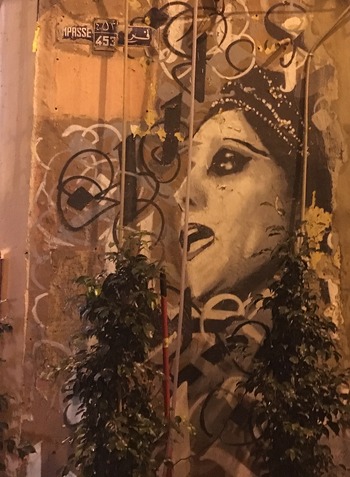
As a Lebanese person, I cannot escape Fairuz. When I return to Beirut after months away from home, her voice greets me before my own mother’s does, resonating through the long hallway to customs at Rafik Hariri International Airport. Classics like “Le Beirut,” “Nassam Alayna,” and “Zourouni” filter through the speakers as I drag my battered carry-on past poster after poster of beautiful Lebanon, strategically curated by the Ministry of Tourism to display the country’s rich cultural heritage.Footnote 1 Fairuz accompanies me through customs, baggage claim, and arrivals, and she will greet me anew tomorrow when I try to buy a coffee somewhere frequented by foreign visitors. The message is clear: Fairuz’s voice is the only acceptable companion to the grandeur of Lebanon’s cedars, the aural equivalent of baklawa, the brightest colour in the symbolic fabric of the Lebanese state (Figure 1).
A mural of Fairuz’s face, mouth open in song, on a street in Beirut’s Gemmayze neighbourhood. The mural is by Lebanese artist Yazan Halwani (photo by author, 30 December 2018).

Lebanon has not always been so eager to represent itself through Fairuz’s music. When, in 1957, a group of local composers and musicians including Fairuz and the Rahbani Brothers were asked to compose and perform music at the Baalbak International Festival’s inaugural “Lebanese Nights,” the Festival’s organisational committee was less than pleased. “At that time,” Mansour Rahbani recalls,
the Festival was limited to foreign acts presented by international theater, opera and ballet groups…[Committee members] were not enthusiastic about the idea of the Lebanese Nights, feeling that it would be less prestigious than the foreign nights’ international groups (in Zoghaib Reference Zoghaib1993:72).
The inclusion of the Lebanese Nights’ folkloric programme in the 1957 season of the Baalbak International Festival was a decision made largely by then-president Camille Chamoun and his wife, Zalfa. The programme was conceived to codify and institutionalise folk traditions that could foster a sense of Lebanese unity, which in the late 1950s was beginning to deteriorate due to shifts in the country’s sectarian balance of power and an attendant decline of public satisfaction with the government. In the face of this presidential mandate, the Festival Committee “could barely hide their anger, concern and fear about including a programme of local art” in an international music festival (Nabil Abu Murad, in Abi Samra Reference Abi Samra1998:9). Their vision for Lebanon as represented at Baalbak left no room for the “traditional” Arabic song as it had existed since the advent of recording technology in the 1920s and 30s.Footnote 2 They cautioned against the length of such songs and the aesthetics of tarab,Footnote 3 to which they claimed their audience had become averse after experiencing more “cultivated” foreign works at the festival’s previous iterations. More bluntly, the Committee saw the inclusion of music that seemed “too Arab” as liable to tarnish Baalbak’s reputation, in keeping with its members’ position within a tension that had dominated Lebanese politics since the late nineteenth century. Arabic music—a normative term used to describe music and practices from Egypt and the Levant in the early-to-mid-twentieth century—was associated at the time with the growing tide of Nasser’s Arab Nationalism and, therefore, with a predominantly Muslim view of Lebanon as fundamentally rooted within the larger Arab world. At odds were two spatiotemporal orientations towards Lebanon and its history, divided roughly along religious lines. Christian nationalists, including Baalbak’s Festival Committee, sought to orient Lebanon in relation to Europe and the West through its pre-Islamic past, asserting its Roman and Phoenician heritage.
Despite the Festival Committee’s concerns about contaminating the westward-facing image of Lebanon it sought to cultivate, inaugural Lebanese Nights performances took place on Sunday 31 August and Monday 1 September 1957. Headlining the performances was Fairuz, performing songs written by the Rahbani brothers. The trio’s work met such success that they became mainstays of the Lebanese Nights stage until the Festival’s suspension at the beginning of the civil wars in 1975.Footnote 4 As I will demonstrate, the very politics that almost excluded Fairuz and the Rahbani Brothers from Baalbak ultimately played a major role in their success, which in turn came to shape the festival’s outsized role in authenticating Lebanese music. In this article, I will consider how the musical project developed by the trio did not just articulate Lebanon’s national character but actively aspired towards a utopian future in which the country’s liminal position between the Arab world and the West would bring prosperity and long-lasting peace. Furthermore, I will argue that this element of stylistic futurity, while rhetorical and discursive, was also profoundly sonic, manifesting in the arrangement, instrumentation, and style of the trio’s work.
After establishing the sociopolitical context in which Lebanese Nights developed, I will consider how the music produced by Fairuz and the Rahbani Brothers for the programme carefully negotiated, through musical cosmopolitanism, the fraught question of Arabness and its place in the official heritage discourses that emerged in the twentieth century. I will then look further at the aesthetics of the trio’s musical plays, which affirmed the centrality of the mountain village to the national imaginary in ways that exposed the sectarian biases of their “inclusive” ethos. Finally, I will explore the legacy of this music following the civil wars’ devastation of its utopian project, considering the role of nostalgia in its continued popularity.
Lebanon Before the Lebanese Nights: 1860–1943
The idea of an autonomous Lebanese state began to crystallise in the second half of the nineteenth century. In 1861, a year-long civil war between Maronite Christian and Druze populations in Mount Lebanon ended in the establishment of the semi-autonomous Mutasarrifiyya of Mount Lebanon. The war of 1860, commonly cited as the first in Lebanon to be fought over sectarian interests, created an ideal opening for French forces to realise long-standing colonial interests in the region under the guise of defending the Ottoman Empire’s Christian minority. Due largely to French rhetoric of humanitarian intervention, the Mutasarrifiya became a self-governing entity within the framework of the Ottoman Empire that was conceived as a haven for Maronite Christians and Druze. Lebanese historian Ussama Makdissi argues that the Mutasarrifiyya, and the 1860 civil war, did not arise from an existing culture of sectarian affiliation but instead caused an intensification and discursive centering of such identity categories, thus enabling and entrenching the sectarianism which continues to shape Lebanon’s political landscape (Reference Makdisi2000). For the Ottomans, Europeans, and local elites, Makdissi asserts, sectarianism became a convenient mode of justifying and advancing political moves towards reform, intervention, and the reconsolidation of power. The Mutasarrifiya was short-lived, lasting only until administrative rights were returned to the military governing body of Ottoman Greater Syria in response to the outbreak of the First World War in 1914; however, it spawned the powerful and pervasive trope of “the mountain” as a locus of authentic Lebanese-ness.
With the Ottoman defeat in 1919 came the division of the Levant into French and British mandates. Realising the Mutasarrifiya’s vision of an independent Lebanese state, the French mandate of Greater Lebanon was created in 1920, expanding the Mutasarrifiya’s borders to include the Bekaa valley and the coastal cities of Beirut, Tripoli, Sidon, and Tyre. In so doing, the French realised longstanding Maronite desires to extend their “small Lebanese territory to what they argued were its natural and historical boundaries,” but also inaugurated seismic shifts in the demography and rhetoric of “Lebanon” as it had existed under the Mutasarrifiya (Salibi Reference Salibi1988:26). The expansion transformed the formerly Maronite Christian and Druze entity into a state with a Sunni Muslim majority, and challenged the mountain’s master-narrative of Lebanese heritage. Where the mountain saw Lebanon as the genetic and cultural heir to the glorious Phoenician civilisation, residents of the newly incorporated coastal and valley regions largely understood themselves as belonging to a shared Arab culture and past.
The establishment of the State of Greater Lebanon under the French Mandate marked the birth of modern Lebanon as a bounded geopolitical entity, and the Mandate’s dissolution in 1943 established the independent Republic of Lebanon as it exists today. Where the French colonial administration neglected to actively implement any institutional frameworks to resolve the sectarian tensions created by the expansion of Mount Lebanon’s borders, the Republic’s first act included the negotiation of a National Pact. An informal oral agreement between Sunni and Maronite political elites, the National Pact laid the foundations for Lebanon as a multiconfessional state and institutionalised a compromise between Lebanon’s competing spatiotemporalities. The agreement established Lebanon as an independent, sovereign entity “thu wajh ’arabi,”––with an Arab face––and it formalised an agreement by Christian and Muslim leadership to seek neither pan-Arabist unity with Syria nor special ties with France or the West.Footnote 5 Thus, the National Pact signalled a new politics preoccupied with balancing the competing interests and orientations of various nationalist mythologies as well as negotiating the boundaries for imagining Lebanon’s future.
Lebanese Nights and the Creation of a Lebanese National Music
The National Pact points to the multitude of cultural influences and transnational relationships that had been integrated into Lebanon’s sense of self by the time of its independence. In its urgency to establish and maintain a balance between those elements, the pact reflects the very real sociopolitical tensions that animated the nascent state. At the same time, it gestures to the politicisation of cosmopolitanism in the Lebanese context. Cosmopolitanism is conventionally understood to denote an “ethical embrace of difference” that is not tied to a national vocabulary and which is not territorialised (Guilbault Reference Guilbault, Giannattasio and Giuriati2017:102).Footnote 6 In Lebanon, however, the notion is inextricable from a Westward-facing cultural orientation with heavy sectarian and class-related connotations, easily marshalled in the service of Christian Nationalism. As art historian Sarah Rogers points out in her study of Lebanese painter Daoud Corm (1852–1930), nationalism during the French Mandate became a tool for naturalising an existing, implicitly cosmopolitan ontology of Lebanon. Grounded in the liberal mercantile history of the Phoenicians and in its geographical position as a crossing point between Europe and Asia, this ontology “disregards regional relationships, resulting in an internally exclusive cosmopolitan nationalism” (Rogers Reference Rogers2010:48). The cosmopolitanism that I contend with here was selective rather than open, exclusive where cosmopolitanism has been understood as being inclusive. As sanctioned by the ruling class, Lebanon’s cosmopolitanism was carefully curated to maintain the fragile peace of the National Pact while distancing the country from what it saw as the regressive, dated, and distasteful elements of broader Arab culture.
It must be noted that, whatever its political utility, Lebanese cosmopolitanism has never been wholly contrived. Its port cities have long been centres of cross-cultural exchange, its religious diversity engendering ties to Christian Europe and the Islamic world alike. For Lebanon’s political elites, to borrow from ethnomusicologist Thomas Turino, there could be no nationalism that was not cosmopolitan, as the individuals responsible for conceiving the state were always already “operat[ing] from this basis as a matter of common sense” (Reference Turino2000:13). The national culture that they sought to develop in the wake of independence was not always calculating or self-conscious in its cosmopolitanism. Nevertheless, in the realm of music, early efforts towards the invention of a Lebanese national culture were conceived to distance the country from Arabic influences. Established in 1910, the first Lebanese school of music provided instruction only in European art music until 2000, when it founded its Arabic music orchestra. Initially called Dar al-Musiqa (The House of Music), the school was renamed the Madrasat al-Conservatoire (The National Conservatory of Music) in 1929 (Abbani Reference Abbani, Boyar and Fleet2018:60). From its curriculum to the Gallicisation of its name, the implications were clear: to be a modern Lebanese musician meant being well versed in the canons of European art music.
Arabic music was not so easily wiped from the map, however. Its association with Egyptian culture and with the growing tides of Arab nationalism caused friction with Lebanon’s nascent political imaginaries, but it was also built into the fabric of the country. Lebanon was always a significant node in the network of cultural practices that were appropriated by, and congealed into, Arabic music as a “central domain” (Racy Reference Racy1981). Moreover, Lebanon was a hub within the constellation of music institutions, such as radio stations, universities, and performance spaces, that authenticated and disseminated these practices. Rather than merely emulate Western styles and genres, members of Beirut’s growing middle class argued for the need to revitalise local and regional artforms through the lens of European art musical practice (Abbani Reference Abbani, Boyar and Fleet2018:56).
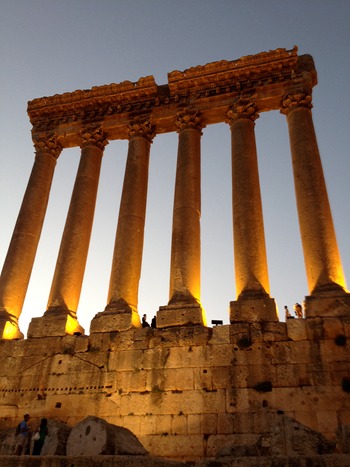
The concept of a distinctly “Lebanese music” truly crystallised with the establishment of the Baalbak International Festival’s Lebanese Nights in 1957. While there existed a significant body of local musics in circulation, affiliated predominantly with Lebanon’s national and Near East radio stations, the music composed for and performed at the Baalbak International Festival’s Lebanese Nights acquired an unprecedented level of representational authority and continues to index notions of Lebanese-ness in music. This was possible largely by virtue of its affiliation with Baalbak as a focal point of an emergent, Eurocentric Lebanese nationalist mythology, and the Festival’s close social and political ties to both the Lebanese presidency and the former French authorities (Figure 2).
The six pillars of Baalbak’s iconic temple of Jupiter (photo by author, 15 July 2012).

The brainchild of Lebanon’s second president, Camille Chamoun, the Baalbak Festival staged its first performances in the summer of 1955. The concept grew out of a tradition of performing at the ruins that dates back to 1922, when a group of high-ranking French military officers and their friends and families on a tour of the new French mandate area were inspired to recite poetry on the steps of the Temple of Bacchus. The group later continued to stage plays in the same location, featuring members of the French and Lebanese Christian elite (Aboussouan Reference Aboussouan and Tueni1994). That the official history of the Baalbak Festival aligns so closely with the French mandate of Lebanon and its annexation of the Bekaa valley to create Greater Lebanon brings to light the inherent inequity of the influence and action within the construction and institutionalisation of the Lebanese state and its heritage regime.Footnote 7 After the Festival’s success in in the summer of 1955 came the decision to turn it into an annual organised event, and a festival committee—composed mainly of wealthy Maronite women—was formed. Central to the Festival’s rhetoric were attempts to reconnect Lebanon and its Phoenician past. For the occasion of the first Baalbak Festival, Chamoun wrote:
The historical role of Lebanon has been since time immemorial, is now, and will continue to be primarily the development of culture and civilization. In organizing this International Festival in the magnificent temples of Baalbeck at which great classic works of music and drama of rare beauty and power have been presented, Lebanon has been conscious of and faithful to its heritage. ([1955]Reference Chamoun and Tueni1994)
The work that Fairuz and the Rahbani brothers performed at Baalbak’s Lebanese Nights (re)mediated musical and visual signs that indexed Chamoun’s “magnificent” pasts. Through their music, as I will demonstrate, the temporal and identitarian compromises that defined national character according to the 1943 National Pact were brought to bear on musical style and aesthetics.
This resonance is particularly significant because the pact’s delicate balance of ethno-nationalist interests had recently proven fragile. Weeks before the premiere of Lebanese Nights, Egyptian socialist Gamal Abdel Nasser had nationalised the Suez Canal, further galvanising Lebanon’s neighbours––and its leftist Muslim citizens––around the Pan-Arabist promise of self-determination. Chamoun, meanwhile, had months earlier endorsed the recently announced Eisenhower Doctrine offering aid from the United States to Middle Eastern countries “threatened by international communism,” sending the clear message that his Lebanon had no interest in being Arab. At the time of his endorsement, high-profile officials flooded the Lebanese press with editorials rebuking Chamoun. Former foreign minister Henri Pharaon cautioned that foreign policy could not be separated from domestic affairs, “especially when it comes to a country like Lebanon, whose existence is based on a fair balance between the different communities that compose it.” Lebanon, Pharaon argued, is a model of “effective political harmony” whose role as “mediator between East and West” was threatened by a hasty alliance with the United States. Chamoun’s rash decision, made “without taking any measures to appease dissenting parties domestically, without first consulting Lebanese individuals whose expertise entitled them to a say in Lebanon’s fate,” had cast the resulting alliance in an unduly aggressive light (Pharaon, 8/4/Reference Pharaon1957). In a Reference Gemayel1957 editorial, Khalil Gemayel, editor of local French-language newspaper Le Jour, succinctly summarised the situation:
According to the government, “Lebanon’s international position has never been so solid, and our country has never benefited more from the respect and confidence of the international community than it does today.” Many Lebanese people believe, on the contrary, that Lebanon has never been so powerless, regionally and internationally, as it has been since it allowed itself to be internally divided.
Indeed, internal tensions between pro- and anti-Chamoun factions continued to rise through 1957 and into 1958, with a multi-confessional coalition staging public protests and agitating through print media in opposition to Chamoun’s presidency. This conflict came to a head with the 1958 assassination of an anti-Chamoun, pro-Nasser journalist, which ignited protests across the country and prompted mobs in Beirut to burn down US diplomatic buildings. Soon after, Chamoun invoked the very doctrine that had caused the controversy, asking Eisenhower for American military aid in keeping the “threat” of pan-Arab socialism at bay (Traboulsi Reference Traboulsi2012[2007]:129–138). Considered in this context, the president’s establishment of the Lebanese Nights appears timely. The programme brought utopian depictions of a harmonious, unified Lebanon to a festival that was hotly anticipated by every faction of the upper class, simultaneously urging the reconciliation of aggrieved parties and effacing the fissures between them.
In an interview with ethnomusicologist Kenneth Habib, Mansour Rahbani speaks to their myriad influences:
We were influenced unconsciously by Arab music, and Byzantine, Syriac, Muslim, Turkish, Armenian, Assyrian. Also…by European music…[and] when we produced, our production was neither eastern nor western, but it was Rahbani…which is unique in the world. And we consider ourselves international. (Reference Habib2005:144/5)
Echoing the internationalist sentiment of Mansour Rahbani’s statement, the music that debuted at Baalbak in 1957 clearly positioned itself sonically in relation to the three major points of reference that were dominant within nationalist discourse at the time: Arab nationalism, the West (specifically conceived as European high culture), and Lebanese culture, conceived as local folklore. In his work on Arabic music in Egypt, ethnomusicologist AJ Racy uses the term “lawn” (colour, pl. alwan) to denote musical character or style (Reference Racy1981, Reference Racy1982). Alwan, Racy argues, has utility both as a descriptive tool, and as a way of parsing out distinct stylistic influences within what is otherwise perceived to be a dominant and coherent musical style. Although, following Racy, the concept of lawn has been taken up as an analytic within Arabic music research, I find that it is also a useful framework for critically listening to the Rahbanis’ early work. In line with the trope of linguistic cosmopolitanism at play in larger nationalist discourses, the Rahbani brothers and their contemporaries at Baalbak used three distinct alwan—lawn fulkluri (the folkloric), lawn ‘arabi (the Arabic), and lawn gharbi (the Western)—in order to sonically and aesthetically position Lebanon. In order to highlight the trio’s use of these three alwan to sonically articulate the elements of an aspirational, cosmopolitan national character, I will closely examine a song from an early-1960s musical written at the height of the Rahbanis’ involvement with the Baalbak Festival. Combining close listening with musical analysis, I tease out each of these alwan to highlight the ways that through sound, they outlined foundational ideas about Lebanon and its future.
The body of work written by the Rahbani Brothers and performed at the Lebanese Nights and around Beirut in the 1950 is united by several key compositional and stylistic characteristics. Crucially, considering the Festival Committee’s concern about the length of tarab songs, most of the music written for Baalbak was significantly shorter than most songs in circulation at the time. Moreover, most of the pieces were entirely pre-composed, and therefore left no room for improvisation or extemporaneous expression, thus distinguishing the Baalbak/Rahbani style from dominant tarab convention. The Rahbanis’ choice of instrumentation was also integral to the conditions of possibility for a distinctly Lebanese style of music. The majority of circulating musics at the time, known by the blanket term Al Musiqa al Arabiyya (Arabic music) featured instruments that originated in the takht ensemble—‘oud, violin, nay, qanun, and Arabic percussion.Footnote 8 While these instruments were present in Rahbani compositions, their orchestration emphasised less conventional instruments such as the accordion, wood recorder, buzuq, and piano, as well as European orchestral instruments.
“Lebnan el Akhdar”
“Lebnan el Akhdar (Lebanon the Verdant),” is the closing song of the Rahbani brothers’ ’Awdat al ‘Askar (Return of the Soldiers), performed in 1962 at Beirut’s Le Capitole Theater, and released on vinyl in 1963 (Audio 1). Written at the height of Fairuz and the Rahbanis’ involvement with Baalbak and premiered in the same year as their hit Baalbak play, Jisr al Qamar (Bridge of the Moon), “Lebnan el Akhdar” is exemplary of the stylistic and aesthetic conventions that came to signify Lebanon and its new nationalist mythology.
Lawn Fulkluri describes both a constructed origin in folklore, as well as the generic designation, “fulklur,” that came to define Fairuz and the Rahbanis’ music at Baalbak. This folkloric character emerges most clearly in relation to “Lebnan el Akhdar’s” language and lyrics, its instrumentation, and iqa’ (rhythmic mode). Lyrical references to the mountains and the sea, local foods, and folk songs worked further to place the music of the Rahbanis within an actively codifying constellation of Lebanese folklore and folk practices. Significant also was the particular Arabic accent featured in their songs; the Rahbanis drew from the dialects spoken in Lebanon’s mountain regions—the territories that had belonged to the Mutasarrifiyya—and adapted them by combining their characteristic sounds with the precise and clear enunciation of fusha Arabic.Footnote 9 The resulting patterns and cadences of speech became a hallmark of Rahbani songs, and have, as a result, become a standard for Lebanese dialect in music and official governmental settings.Footnote 10
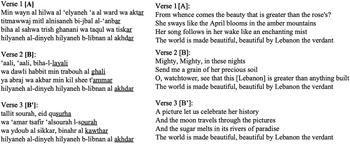
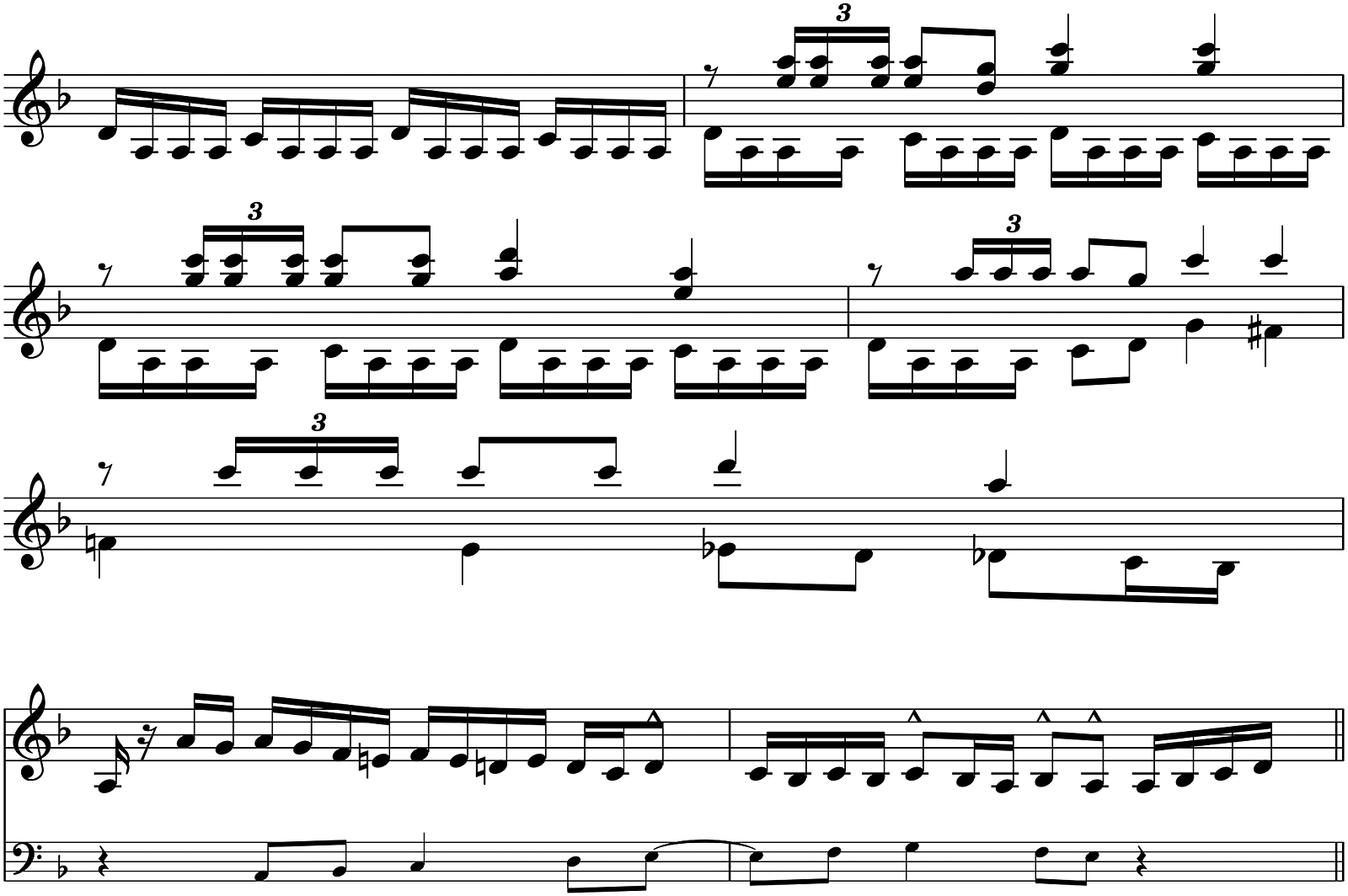
Formally, the song’s ABB’A melodic organisation and coupled rhyme scheme (Figure 3) further signal the notion of simplicity that has been associated with the folkloric.Footnote 11 Lawn fulkluri was indexed sonically by the use of the wood recorder and buzuq,Footnote 12 which are native to the Levant, and had been excluded from the popular and art music produced in Egypt.Footnote 13 The song’s arrangement further evokes the folkloric in featuring a multiplicity of voices during the chorus, which literally mobilises “the folk.” Here, these voices sing: “Lebanon the verdant, Lebanon/the world is made beautiful/beautiful by Lebanon the verdant” (Audio 2).Footnote 14 Another significant aspect of the song’s folkloric character is its use of iqa’. The song is set in iqa’ wahda wa nuss, also known as wahda kabira, or sumbati (Figure 4) (Audio 3).Footnote 15 While the rhythm is common within Arabic classical music, one of its names, sumbati, signals origins in Egyptian northern rural regions. In addition to its evocation of rurality, the iqa’s syncopation suggests its use within a popular dance context. Particularly in the song’s second and third verses (B/B’ sections) whose lyrics mythologise and equate Lebanon with natural wonder, and are more evocative of the lawn fulkluri than the opening and closing “A” sections, the rhythm and its syncopation are brought to the forefront. In these B verses, the song’s marching bass line is silenced, and the vocal line mirrors and reinforces the iqa’s syncopation in a way that suggests rural dances in general, and the Levantine dabke more specifically (Audio 4).Footnote 16
Lyrics highlighting the rhyme scheme of each verse (transliterations and translations by author).

Iqa’ Wahda wa Nuss (transcription by author).

Lawn ‘arabi, which drew from the conventions of Arabic music,Footnote 17 is most audible in terms of form in the Rahbani repertoire. Rhythmic organisation, song form, and tonality, as well as the use of takht instruments, furnished the brothers’ music with an “Arab face.” Much like the National Pact’s nod to Lebanon’s Arabness, these stylistic elements amounted to what was a largely symbolic gesture. “Lebnan el Akhdar’s” use of iqa’ (rhythmic mode) and maqam (melodic mode) and its arrangement work together to establish a relationship to Arabic music. As mentioned above, the iqa’ wahda wa nuss featured throughout the song is understood in Arabic musical practice to signify a rural character while still operating within the established conventions of Arabic music. Texturally, the song evokes lawn ‘arabi in its emphasis on horizontal, rather than vertical development. The track is largely monophonic, with the vocal line mirrored by its instrumental accompaniment; timbral variation, here, is created largely by short instrumental response motifs.
The notion of maqam (pl. maqamat) is also central to authorised discourses surrounding Arabic music and its creation. The term maqam describes an established set of melodic modes that make up the raw pitch material of Arabic music. It also signals the conventional uses or expositions of a given maqam, ornamentation techniques, and certain moods or characters with which a certain mode might be associated (Marcus Reference Marcus1989). A maqam is typically made up seven notes which in most cases repeat at the octave. These notes are organised into two ajnas (genus, in the singular, jins),Footnote 18 which give the maqam its name, character, and structure.Footnote 19 The first jins always begins at the tonic, and the second often begins on the last note of the first jins, also known as its ghammaz, the most melodically emphasised note of the jins after its tonic. Maqamat that share the same first jins are typically classified into larger maqam families named after the jins in question.Footnote 20
A maqam analysis of “Lebnan el Akhdar” places the song firmly within a transposed maqam called Kurd la, which is sometimes referred to as a western diatonic maqam due to its lack of microtones. Kurd is made up of two primary ajnas—it begins with jins Kurd (here ABbCD) that is followed by jins Nahawand (here DEFGA) (see Figure 5), here with special weight on the notes A, D, and E. Jins Kurd is especially audible within the cadential movement that bounds each section of the song (Audio 5). This cadential movement is comprised of a sequentially downward motion towards the starting pitch, with rhythmic accents emphasising the notes A, Bb, C, and D (see Figure 6). Even the track’s chromaticism (seen, for example, in the aforementioned cadential movement) follows convention, and is used primarily in anticipation of this cadential movement, in order to re-establish a sense of Kurd. The more “folkloric” verses B/B’, conversely, feature largely the maqam’s jins Nahawand, thus creating tonal contrast between the folkloric and more classical Arabic verses. It bears noting, however, that maqam Kurd is analogous to the Phrygian mode, and might be just as easily analysed as such.
Maqam Kurd la with its two ajnas highlighted (transcription by author).

Sequential downwards motif emphasising jins Kurd (transcription by author).

Kurd’s lack of microtones enables the use of Western orchestral instruments like the piano and trumpet, which both feature heavily in the track, and work to evoke a lawn gharbi (Western colour). Many of the elements that placed the Rahbanis’ music within repertoires of Arabic music were undermined by characteristics that exemplify lawn gharbi. In the song in question, this Western character is further evoked through the presence of a full orchestra, the foregrounding of an accordion, and the use of cymbals and triangle instead of a riqq (tambourine). European orchestral instruments such as the piano, xylophone, and various woodwinds and brass were unable to produce the microtones that characterised Arabic music’s tonality.Footnote 21 As a result, most of the Rahbanis’ works were composed either explicitly in Western major or minor keys, or in musical modes corresponding to existing maqamat that did not feature microtonesFootnote 22.
Texturally, this music distinguished itself from the monophony of Arabic music by utilising vocal and instrumental homophony as well as polyphony which created instances of harmony that were uncharacteristic of Arabic music. The music, furthermore, utilised sonic tropes drawn from the canon of European art music—a marching bass to denote the military, open fourths between trumpets to evoke royal grandeur—which were easily incorporated into this Lebanese popular musical project due to the central place of art music in the musical lives of Beirut’s elite (Figure 7) (Audio 6). In the song’s introduction and first verse, the texture, combined with the timbre and open fourths in the trumpet line, and the marching bass draw on European art musical convention to create an air of grandness and courtliness that suggests the greatness of Lebanon as a country, and evokes Baalbak’s mythical past, placing Lebanese music firmly within those genealogies.
Opening measures featuring polyphonic lines. Sonic tropes like the open fourths signifying grandeur were common to the music in question (transcription by author).

These alwan—lawn fulkluri, lawn ‘arabi and lawn gharbi—draw from vastly different genealogies and musical practices to orient Lebanon sonically and reinscribe the nation’s newly conceived authorised heritage discourse,Footnote 23 but it is Fairuz’s voice which ties all of these characters together coherently. Although, by all accounts, Fairuz had no hand in composing the music or writing the lyrics that she performed, the elements of her own style as a performer have come to define how the music—and its intentions—are heard and understood. Though invisible in much discourse surrounding the genius of the Rahbani brothers, Fairuz’s voice has become the sonic iteration of the very project that excluded her.
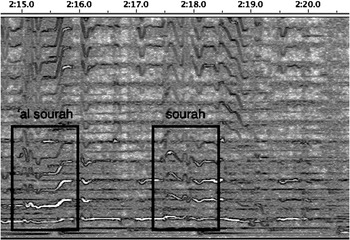
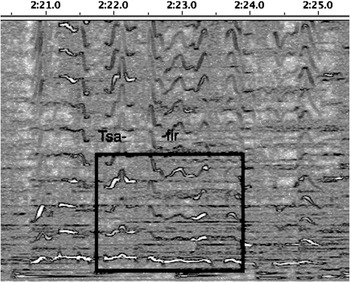
Fairuz’s voice functions conventionally within each lawn, while also challenging and reorienting these same conventions. The in-between-ness of her voice can be heard most clearly in her use of a mixed voice rather than solely her chest or nasal resonances. Her voice also has a distinct lack of grain, a characteristic often described as “mukhmali” or velvety, full, and clear (Habib Reference Habib2005). Both these characteristics defy the conventions of Arabic music, which place value on full chest vocal production, and vocal rasp or skillfully deployed breaks (Khula’i Reference Khula’I1904). Fairuz demonstrates her proficiency as an Arabic music vocalist, and showcases her classical training through her skillful and strategic ornamentation. At several moments during “Lubnan el Akhdar,” Fairuz ornaments words with vocal turns, executing these turns on vowels and strong consonants (like “r”), in line with established Arabic music convention (see Figure 8 and Figure 9) (Audio 7). Fairuz’s voice, more than any other aspect of the Rahbanis’ aesthetics or style, has become representative of Lebanon’s music, and symbolic of Lebanon itself.
Spectrogram of Fairuz’s vocal ornamentation featuring expressive variation on a repeated lyric (captured by author).

Spectrogram of Fairuz’s voice featuring deployment of vocal turns on long vowel sounds, in line with Arabic music convention (captured by author).

(Re)Inventing Folklore: The Mountain Village
It is interesting, given the fact that Fairuz and the Rahbanis are credited with reinvigorating Lebanese folklore, that their work contains very little actual folkloric material. The folklore they did include was either re-authored and standardised, bearing little resemblance to existing material or created and composed entirely by the Rahbanis themselves, with no grounding in existing regional folklore. Instead, the Rahbanis’ works offered a contained and easily digested conception of Lebanese-ness which satisfied the new state’s need for definitive representation. Although the Rahbanis’ romanticised utopian state and society did not reflect the reality of Lebanon, it provided a standard to which to aspire, a central point of reference within a developing national imagination. Through the popularity they enjoyed, the Rahbani musicals were a prime locus for the development of a mythologised authenticity located in the imagery and themes of Lebanon’s mountain villages and village life. In a climate of mass migration from the mountains to the new coastal centers, the trio capitalised on what Assi Rahbani called “a nostalgia of the mountain for itself” (Abi Samra Reference Abi Samra1999:6), by authoring and authorising a heritage discourse based on the idea of Lebanon as emanating from the mountains.
With few exceptions, all of the Rahbanis’ musicals are set in some ambiguously constructed northern Lebanese mountain village.Footnote 24 The pastoral imagery featured in their lyrics, as well as the sets against which their shows were performed, established rural village life as a primary site from which to derive social legitimacy and a locus of individual and collective identification. Although today much of Lebanon’s population has settled in urban coastal centers, individuals and families retain strong ties with their villages of origin, which allow for identification based on economic and confessional lines. It was in the work of the Rahbanis and their contemporaries that these village associations became standard. Despite the ubiquity of identification with one’s ancestral village, such a model for authenticity and belonging is deeply loaded. The mountain villages—now incorporated into the historical imagination of the Lebanese state and its heritage regime—are historically Maronite Christian and Druze, and are home to only a part of Lebanon’s population. There exist sizeable communities in coastal cities like Beirut, Tripoli, and Sidon who have no ancestral ties to the mountain villages. Despite this, the Rahbani musicals’ settings and staging, together with the Northern mountain pronunciation and traditional mountain costumes featured in their music and musical plays, worked both to depict and produce a specific image of Lebanese heritage. Through elision, “Lebanese” came to mean “rural, Christian mountain village.” More than this, these representations had no grounding in any sort of physical or lived reality. The mountain village around which the Rahbanis’ musicals built a trope of authentic Lebanese-ness did not exist.
The grounding of public imagination in the Lebanese mountain was not unique to the Rahbanis’ endeavor. Writing in the early 1950s, American University of Beirut professor Anis Frayha began to collect and publish books of folkloric stories. Based in the same preservationism which inspired President Chamoun to host the Lebanese Nights at Baalbak, Frayha’s books represent a discursive and ideological turn in public conceptions of national heritage. Unlike the Rahbanis’ project, Frayha’s work was specific to the folklore of the Christians in the Lebanese mountains, rather than Lebanon’s Druze and Muslims or other coastal natives. Echoing the dominant current of Christian nationalism, Frahya wrote that the sectarian and geographic exclusions in his work were deliberate, as Lebanon’s coastal cities were “never part of old Lebanon, Lebanon the mountain and the village,” and its Muslim communities were not the “inhabitants of old Lebanon” (Frayha Reference Frayha1957:10). Fairuz and the Rahbanis, along with their colleagues at Lebanon’s Near East Radio Station, had worked since the early 1950s to transform, develop, and codify Lebanese folklore. At Baalbak in 1957, these folkloric themes became dominant through music and dance performances, as well as costuming and set design, all of which reflected the painstaking efforts of the Festival’s organisers to invent a local folk culture that derived authenticity from its proximity to existing practices but was legible within (and palatable to) the cosmopolitan orientations of its imagined audiences.Footnote 25 Moreover, their idyllic setting, the village, emerged as a peaceful and utopian community coded heavily as non-Muslim, a constructed mythical counterbalance to the lived reality of a stratified Lebanon.
The case of Fairuz, Baalbak, and their Lebanese Nights programme reveal the multiple and concatenated heritage regimes and discourses at play in the creation and preservation of a national culture. The festival, which still exists today, is an outgrowth of larger authorised heritage discourses at the level of the nation-state, and is also itself a heritage regime, with its own host of institutional networks, actors, and interests. The Lebanese Nights in particular have comprised (and continue to comprise) an authorised heritage discourse, to the exclusion of any music which does not resemble or carry on the specific notions of Lebanese national heritage constructed and popularised by Fairuz and the Rahbanis.
Fairuz, the Rahbani Brothers, and Lebanon’s “Golden Age”
The decades between independence in the 1940s and the outbreak of the civil wars in 1975 are nostalgically referred to as Lebanon’s “Golden Age.” Defined largely by remarkable economic growth due to a policy of laissez-faire capitalism and the relatively peaceful coexistence of various religious group, journalism and popular writing from this period often characterised Beirut and Lebanon as the “Paris” and “Switzerland of the Middle East.” Though the Lebanese writ large have enshrined this era in nostalgia and longing, this particular version of Lebanon was largely reserved for tourists and the educated elite. It is particularly the utopian representations of cultural cosmopolitanism and religious pluralism which are most problematic. While sectarian mixing and cultural exchange among the elites did occur, there wasn’t any sort of public consensus concerning fundamental principles of governance, nor did there exist any administrative body which ensured confessional equality (Mackey Reference Mackey2008:82).
As their work grew less folkloric and their work became more and more difficult to present under the folkloric auspices of the Lebanese Nights, Fairuz and the Rahbani brothers’ close ties with the Festival began to slowly loosen. While Fairuz and the Rahbani brothers needed the Baalbak Festival in order to establish their representational authority, their ideological project continued to thrive even after their time exclusively with the Festival had ended.Footnote 26 Even as their music changed, it remained the authoritative sounding of Lebanon’s various social, cultural, and political presents. Through the 1960s and 1970s—the height of Lebanon’s “golden age”—Fairuz and the Rahbani brothers continued to write and record albums, stage live performances, and tour nationally, regionally, and internationally. It was in this period that they devoted serious creative attention to television and movies, many of which drew from themes established at Baalbak, and which fell in line with understandings of Lebanon as originating in “the mountain” even as the trio’s sound became less audibly aligned with aesthetics and folkloric themes that they pioneered at Baalbak. The Rahbanis continued to draw from and play on the idea of “the mountain”Footnote 27 as a representative trope, after the fact of the decentering of Mount Lebanon in nationalist discourse.
Fairuz left the Rahbani brothers in in late 1970s, shortly after the outbreak of the civil wars, but continued to produce music in collaboration with her son Ziad Rahbani. Quite notably, she did not perform in Lebanon for the duration of the civil wars,Footnote 28 and sang her first concert in Lebanon since the wars’ outbreak in 1994, returning to Baalbak’s stage in 1998 for the occasion of the Festival’s postwar return. Fairuz’s silence during the war was publicly received as an act of resistance against the violence which was occurring on Lebanese soil, and a show of solidarity with the Lebanese people, further reinforcing the association of her voice and her persona with Lebanon as a country.
Conclusion
In the thirty years since the end of the 1975–1990 civil wars, the veritable black hole of public discourse has worked to further entrench the fiction of a lost utopian pre-conflict golden age. In the absence of governmentally sanctioned recuperation efforts, work like the music that Fairuz made with the Rahbanis has defined popular understandings of Lebanon’s sociocultural past. Their happy mountain villages and verdant rural imagery has become a focal point for understandings of both what Lebanon was, and what it could have been had the wars never happened. Although Fairuz rose to prominence as the voice of an overtly Christian nationalist project, she has become central to a new shared heritage discourse that has developed around a collective sense of cultural loss after the civil wars. Today, the singer indexes the utopian cosmopolitanism of a lost, golden age “Paris of the Middle East” instead of bucolic village life. Her silence during the wars—which was perceived as a silence in solidarity with all of Lebanon’s peoples, regardless of sectarian affiliation—has elevated her as a champion of Lebanese social unity. This new discourse of nostalgia elides the sectarian tensions that shaped her music with the Rahbanis and because of which Lebanon’s early nationalist aspirations for a bright, pluralistic future lead instead to civil war.
In this article, I have argued that the music that Fairuz and the Rahbani brothers made continues to shape understandings of who and what Lebanon is. By bringing critical listening and musical analysis into conversation with the development of a national politics in the 1950s, I have highlighted the ways that sound was an active participant in the project of nation-building rather than simply an epiphenomenon of it. Even as political discourse has shifted since the 1950s, nostalgia for the pre-civil-wars era, driven and expressed largely by Fairuz’s music, continues to evoke and presence the utopian imaginaries that were central to early Lebanese Christian nationalism. Moreover, the sonic elements of this nationalist imaginary continue to define what it means to sound “Lebanese” today. Fairuz’s voice and the aesthetics of the Rahbanis’ music are the de facto gatekeepers of authenticity against which young musicians are judged to sound “Lebanese” enough.
Glossary