INTRODUCTION
Post-mastectomy radiotherapy has shown to reduce the risk of local recurrence by about two-thirds and reduces the risk of dying from breast caner presumably by preventing secondary dissemination from recurrent disease.Reference Dewar1 However, the first meta-analysis report did not find any advantage in overall survival at 10 and 20 years.2 One explanation is the increase of non-breast cancer-related deaths, particularly cardiac disease in relationship to old radiotherapy techniques.Reference Cuzick, Stewart and Rutqvist3 Post-mastectomy radiotherapy to the chest wall is given by; (1) two opposed tangential photon beams followed by scar boost with electronsReference Perez and Brady4 and (2) Electron therapy of the chest wall.Reference Gaffney, Prows and Leavitt5 Both techniques have shown similar locoregional control, disease-free survival, and overall survival rates.Reference Gez, Ashaf and Bar-Deroma6 However, several publications have now called into question, the accuracy of using conventional techniques (determination of tumor depth on available computed tomography {CT} and magnetic resonance imaging {MRI}, clinical judgment for energy selection and PTV determination and laborious process of cut out fabrication).Reference Perkins, McNeese and Antolak7 Further such planning can potentially lead to inaccuracy in delineation of the tumor bed and high dose to underlying organs at risk (OARs).Reference Bauduceau, Pons and Campana8
Electron Conformal therapy (ECT), uses one or more electron energies to contain the planning target volume (PTV) in the 90% of prescribed dose and to spare the underlying organs at risk (OARs),Reference Kudchadker, Antolak and Morrison9 and in modulated electron therapy (MET), the electron therapy is delivered by using energy modulation (using multiple electron energies) or intensity modulation (different doses per pixel).Reference Kudchadker, Hogstrom and Garden10 Energy modulation improves the conformity of dose to both the proximal and distal PTV ends in the direction of the electron’s central beam axis and intensity modulation improves the conformity of dose to the lateral sides of PTV in the direction perpendicular to the electron’s central beam axis.
There are two basic methods of delivering ECT and MET; Bolus ECT and segmented field ECT (SFECT). In Bolus ECT, a customised bolus or wax is used to match the patient’s anatomy on one side and to conform the 90% of prescribed dose to the distal PTV surface on the other sideReference Zeidan, Chauhan and Estabrook11 and SFECT is the utilisation of multiple abutted electron field segments, each having a common virtual source position, but each having its own energy and beam weight to conform the therapeutic dose (90%–100% of prescribed dose) to the PTV. SFECT allows each segment having its own energy (energy modulation) and allows each segment having its own monitor units (MU) (intensity modulation).Reference Richert, Hogstrom and Fields12
Bolus ECT has been used to treat sarcomas of the paraspinal muscles, post-mastectomy chest walls and diseases of the head and neck. However, SFECT has not been well-studied in clinical settings, and only few centres are using ECT and MET. Herein we present our experience of SFECT and MET for post-mastectomy chest wall irradiation.
MATERIALS AND METHODS
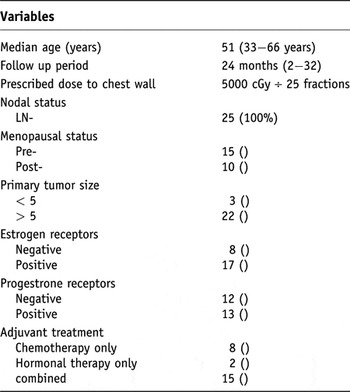
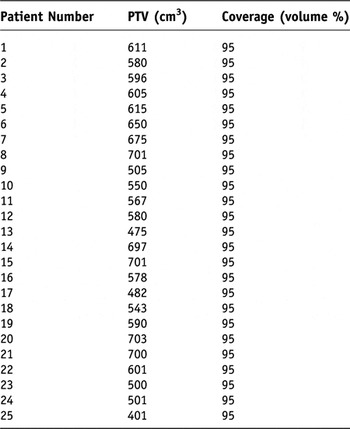
During November 2008–October 2009, 25 consecutive post-mastectomy lymph node negative breast cancer patients (Table 1.) after written consent, were treated in the following sequence:
Patient characteristics.

Virtual simulation
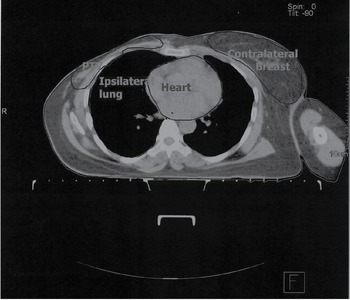
All patients underwent virtual simulation using CT scanner SOMATOM Siemens® by keeping the patient in the supine position on a carbon breast board with the ipsilateral arm up and head turned to the contra-lateral side. Radio-opaque wires were used to mark the mastectomy scar and non contrast CT images were acquired of 5 mm slice thickness. The CT scanning reference point was defined using the CT simulation software Coherence Dosimetrist Siemens® and the target volumes {GTV, CTV, PTV and (OARs, lungs and heart)} were defined. The planning target volume(PTV) was defined according to the breast cancer atlas for radiation therapy planning consensus definitions of the Radiation Therapy Oncology Group (RTOG) and PTV included the chest wall (tumor bed: pectoralis muscle, chest wall muscles, scar with 1–2 cm margins and ribs)Reference Allozi, Li, White and Apte13 (Figure 1).
Delineation of PTV (tumor bed: pectoralis muscle, chest wall muscles, scar with 1–2 cm margins and ribs) and organs at Risk (heart, ipsilateral lung and contra-lateral breast).

Chest wall irradiation via segmented field electron conformal therapy (SFECT) and modulated electron therapy (MET) and cut out fabrication
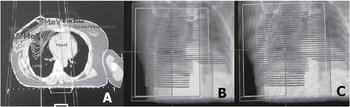
More than one field segments with appropriate gantry angles and bolus of appropriate thickness were applied to cover distal side of PTV from electron beam’s perspective. The SSD was set to approximately 105 cm to allow for the electron bolus to be placed on the patient without collision with the applicator. Based on the maximum depth of the segment of PTV, the electron beam of least energy, such that R90 (its central-axis depth of 90% dose) was greater than the maximum depth of the PTV in that segment, was chosen. The field segmentation was then determined in beam’s eye view (BEV) to make individual field segments having their own energy and intensity with and without bolus (Figure 2).
(A) PTV segmentation and isodose curves, (B) Field segmentation on beam’s eye view (BEV) to make individual field segments having their own energy and intensity with different thickness bolus in each field segment.

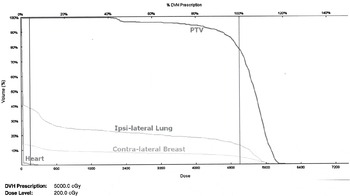
Total dose was prescribed 5000 cGy in 25 fractions (200cGy/fraction). The dose was planned to cover PTV by 95% isodose line, as recommended by International Commission on Radiation Units and Measurement (ICRU) Reports 50 and 62. Gantry angles ranged from 42° to 55° for the medial fields and from 224° to 232° for the lateral fields for patients treated on the right side, and from 305° to 322° for the medial fields and from 133° to 147° for the lateral fields for patients treated on the left side. Lateral (external) part of scar was planned to give additional boost dose of 1000 cGy (200cGy per fraction, over two weeks), because, mostly this area is thick and may be subject to under dosage. Dose volume histograms (DVH) for PTV and OAR of the ECT and MET plans were generated (Figure 3).
Dose volume histogram of electron conformal therapy and modulated electron energy (better PTV coverage and maximal sparing of organs at risk).

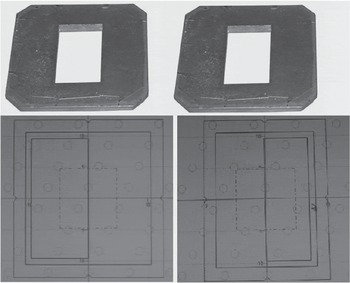
The Homogeneity index (HI) was defined as the fraction of the PTV with a dose between 95% and 105% of the prescribed dose (V95%–V105%). The Conformity Index (CI) was defined as the fraction of the PTV surrounded by the reference dose (V95%) multiplied by the fraction of the total body volume covered by the reference PTV dose {(PTV95% / PTV) × (PTV95% /V95%)}.Reference Al-Yahya, Schwartz and Shenouda14,Reference Chavaudra15 Using the approved treatment plan, the cut outs were fabricated with computer assisted cutting device (Autimo 2D) and patients were treated with appropriate applicators on linear accelerator (Figure 4). Quality assurance was done by using in vivo dosimeters.
Fabrication of cut outs with computer assisted cutting device (Autimo 2D).

All dosimetric and clinical data was recorded and was analysed by using SPSS version 17.0.
RESULTS
Dosimetric data
With ECT and MET, the prescribed dose was 5000 cGy (5250–5500cGy) with standard deviation (SD) 5290 ± 2.5 and dose which covered PTV 95% isodose line was 4800 cGy (4700–5300cGy), SD 4360 ± 4. The hot spots of the ECT and MET plans were situated at the overlap of field segments. Mean depth of 20-Gy isodose in midline was 0.7–1.6 cm (range 0.2–2.3, SD 0.7) and mean depth of 40 Gy isodose that was in lung and heart was 1.5–2.1 cm (range 0.9–2.5, SD 1.7). The mean time for treatment planning and fabrication of cutouts was 1.5 hours (0.75–2.5 hours). The mean dose to heart and pericardium was 23 cGy (0–446) and mean dose to lung was 1118 cGy (0–5127). Contra-lateral breast received negligible mean dose of 5 cGy (0–15). Table 2.
Summary of changes in PTV (planning target volume) and dose coverage.

Clinical data
Out of 25 patients, 8 patients (32%) developed grade 2 skin reactions (dry and wet desquamation), three patients had grade 3 skin reactions (12%) and remaining patients tolerated the treatment well with grade 0 and 1 skin reactions. The median time to develop erythema was 5 days (3–7) and median time to desquamation appearing was 10 days (8–19).
Four weeks after the completion of ECT and MET, 2 patients (8%) were found to have hyper- pigmentation with desquamation. At 3 and 6 months post radiotherapy time, 11 patients had (44%) hyperpigmented skin. No case of subcutaneuos fibrosis of chest wall was noticed. All patients were found without any locoregional recurrences.
The average homogeneity index was 1.2±0.1 (range 1.1–1.5) for SFECT plans and average conformity index was 1.3±0.2 (range 1.2–1.8).
DISCUSSION
Post-mastectomy data has shown that more than 50% of local recurrences are seen in chest wall especially in post-mastectomy scar; therefore, post-mastectomy irradiation to the chest wall is recommended in patients with tumor size > 5 cm and with four or more positive axillary lymph nodes.Reference Recht, Edge and Solin16 For treating post-mastectomy chest wall, twin opposed tangential photon beams is a common technique. However, these techniques may increase the non-breast cancer-related deaths, particularly cardiac disease; therefore, many centres are using electron therapy for its advantage of rapid dose fall off beyond PTV. Our results of ECT and MET were encouraging in terms of better PTV coverage, maximal sparing of organs at risk (lung, heart and contra-lateral breast) and less time consuming. Numerous studies have shown that the optimal dose offers the greatest chance of locoregional control of breast cancer.Reference Gebski, Lagleva and Keech17
Our treatment planning software, i.e., Prowess Panther used an electron algorithm similar to the photon beams, which accounted for SSD effects throughout field and penumbra changes in depth but did not account for any inhomogeneities, so the dose distributions were shown without any inhomogeneity correction. Second, our study can be criticised for using small bore CT scanner, but anatomic data was taken on virtual simulator, so we did not see any significant difference similar to other studies.Reference Bauduceau, Pons and Campana8
In conclusion, ECT and MET resulted in improved tumor homogeneity, conformity and maximal sparing of underlying and adjacent organs at risk (heart, lung and contra-lateral breast) and this treatment modality was associated with a low rate of early toxicity events.