Introduction
The understanding of trophic webs in marine environments depends on the identification of the trophic levels occupied by organisms (Young et al., Reference Young, Hunt, Cook, Llopiz, Hazen, Pethybridge, CeccarellI, Lorrain, Olson, Allain, Menkes, Patterson, Nicol, Lehodeym, Kloser, Arrizabalaga and Choy2015), which in turn is based on analysis of the contents of the digestive tract (Baker et al., Reference Baker, Buckland and Sheaves2014). The identification of prey, number and size of prey ingested are limiting factors in trophic ecology studies (Bowen & Iverson, Reference Bowen and Iverson2013). The identification of prey is possible using sophisticated methods such as DNA analysis (Bowles et al., Reference Bowles, Schulte, Tollit, Deagle and Trites2011) and isotopic analysis (Silva-Costa & Bugoni, Reference Silva-Costa and Bugoni2013; Nielsen et al., Reference Nielsen, Christiansen, Grønkjær, Bushnell, Steffensen, Kiilerich, Præbel and Hedeholm2019), and more traditional methods such as analysis of rigid structures (for example, otoliths and bones) (Sekiguchi & Best, Reference Sekiguchi and Best1997; Tarkan et al., Reference Tarkan, Gaygusuz, Gaygusuz and Acipinar2007; Rupil et al., Reference Rupil, Barbosa, Marcondes, Carvalho and Farro2019).
Otoliths are complex structures of calcium polycarbonate, precipitated mainly as aragonite (Popper & Fay, Reference Popper and Fay2011). Phylogenetic proximity influences the similarity of otolith morphology between species (Avigliano et al., Reference Avigliano, Comte, Rosso, Mabragaña, Paola, Sanchez, Volpedo, Rosso and Schenone2015; Tuset et al., Reference Tuset, Otero-Ferrer, Omez-Zurita, Venerus, Stransky, Imondi, Orlov, Ye, Santschi, Afanasie, Zhuang, Farré, Love and Lombarte2016). Although otoliths have intraspecific patterns, some morphological changes may occur under the influence of physiological or external factors (Volpedo & Echeverría, Reference Volpedo and Echeverría1999). The onset of the reproductive process is one of the physiological factors that influence otolith shape (Gonzalez-Naya et al., Reference Gonzalez–Naya, Tombari, Volpedo and Gomez2012; Carvalho & Correia, Reference Carvalho and Corrêa2014; Carvalho et al., Reference Carvalho, Vaz-dos-Santos, Spach and Volpedo2015), as is sexual dimorphism (Maciel et al., Reference Maciel, Vaz-dos-Santos, Barradas and Vianna2019). In addition, food availability can cause morphological changes (Gagliano & McCormick, Reference Gagliano and McCormick2004). Environmental factors, including depth (Torres et al., Reference Torres, Lombarte and Morales-Nin2000), temperature (Lombarte & Lleonart, Reference Lombarte and Lleonart1993), pH (Schulz-Mirbach et al., Reference Schulz-Mirbach, Riesch, León and Plath2011) and salinity (Capoccioni et al., Reference Capoccioni, Costa, Aguzzi, Menesatti, Lombarte and Ciccotti2011; Avigliano et al., Reference Avigliano, Tombari and Volpedo2012) may also influence the shape of otoliths.
Several studies have used morphometric relationships between otoliths and fish size to estimate the length and weight of prey ingested by ichthyophagous organisms (Di Beneditto & Lima, Reference Di Beneditto and Lima2003; Cremer et al., Reference Cremer, Pinheiro and Simões-Lopes2012; Silva-Costa & Bugoni, Reference Silva-Costa and Bugoni2013; Miotto et al., Reference Miotto, Carvalho and Spach2017a). However, the digestion process causes erosion and breaks in the otoliths, modifying their measurements and proportions (Sekiguchi & Best, Reference Sekiguchi and Best1997; Tollit et al., Reference Tollit, Heaslip, Zeppelin, Joy, Call and Trites2004; Christiansen et al., Reference Christiansen, Moen, Hansen and Nilssen2005; Bowen & Iverson, Reference Bowen and Iverson2013). In vitro digestion demonstrated that estimates of prey length using otoliths overestimate prey size by 35% (Tollit et al., Reference Tollit, Steward, Thompson, Pierce, Santos and Hughes1997, Reference Tollit, Heaslip, Zeppelin, Joy, Call and Trites2004; Bowen & Iverson, Reference Bowen and Iverson2013).
Otoliths of species belonging to the family Sciaenidae are considered robust and have been described in several studies (Sasaki, Reference Sasaki1989; Volpedo & Echeverría, Reference Volpedo and Echeverría2000; Oliveira et al., Reference Oliveira, Di Beneditto and Monteiro2009; Siliprandi et al., Reference Siliprandi, Rossi-Wongtschowski, Brenha, Gonsales, Santificetur and Vaz-Dos-Santos2014; Volpedo et al., Reference Volpedo, Biolé, Callicó Fortunato, Tombari, Thompson, Volpedo, Thompson and Avigliano2017). Species of the family Sciaenidae have been identified as prey of ichthyophagous organisms (Giberto et al., Reference Giberto, Bremec, Acha and Mianzan2007; Bornatowski et al., Reference Bornatowski, Braga, Abilhôa and Corrêa2014; Rupil et al., Reference Rupil, Barbosa, Marcondes, Carvalho and Farro2019) and, in some studies, the length of prey were estimated (Santos et al., Reference Santos, Rosso, Santos, Lucato and Bassoi2002; Cremer et al., Reference Cremer, Pinheiro and Simões-Lopes2012; Miotto et al., Reference Miotto, Carvalho, Spach and Barbieri2017b).
Traditionally, the morphological characteristics of otoliths have been used to identify prey, but shape indices could also be an efficient tool in identifying prey in stomach contents of ichthyophagous organisms. Shape indices of otoliths are widely used for differentiation of fish stocks (Avigliano et al., Reference Avigliano, Comte, Rosso, Mabragaña, Paola, Sanchez, Volpedo, Rosso and Schenone2015; Zischke et al., Reference Zischke, Litherland, Tilyard, Strarford, Jones and Wang2016; Vaz-dos-Santos et al., Reference Vaz-dos-Santos, Santos-Cruz, Souza, Giombelli-da-Silva, Gris and Rossi-Wongtschiwski2017) and identification of ontogenetic variations (Cañas et al., Reference Cañas, Stransky, Schlickeisen, Sampedro and Fariña2012; Carvalho et al., Reference Carvalho, Vaz-dos-Santos, Spach and Volpedo2015). However, otolith shape indices have not yet been used as a tool to aid in the identification of species in stomach contents of ichthyophagous organisms, although these indices are easy to apply and provide excellent results for description and differentiation of species (Tuset et al., Reference Tuset, Lozano, Gonzalez, Pertusa and Garcia-Diaz2003; Volpedo & Echeverría, Reference Volpedo and Echeverría2003; Rondon et al., Reference Rondon, Vaz-dos-Santos and Rossi-Wongtschowski2014). Therefore, the present study was conducted to test the efficiency of separation of otolith shape indices of three species of the family Sciaenidae before and after in vitro digestion.
Materials and methods
Sampling was performed monthly between August 2000 and July 2001 on the continental shelf of the State of Paraná (25°30′–25°45′S 48°07′–48°30′W), Brazil. In the laboratory, the specimens Paralonchurus brasiliensis, Stellifer rastrifer and Stellifer brasiliensis were identified using specific literature (Menezes & Figueiredo, Reference Menezes and Figueiredo1980), measured for total length (TL, in mm) and sagittal otoliths were extracted from the palate region (Rossi-Wongtschowski, Reference Rossi-Wongtschowski, Volpedo and Vaz-dos-Santos2015). After extraction, otoliths were photographed with the aid of ImageJ, and measured for otolith length (OL, greater longitudinal distance), otolith height (OH, greater perpendicular distance), otolith area and perimeter (AO and PER, respectively), and the area and perimeter of the sulcus acusticus (AS and PERS, respectively). The otolith shape, type, position and opening of sulcus acusticus, and presence or absence of rostrum and antirostrum were classified according to Tuset et al. (Reference Tuset, Lombarte and Assis2008).
To calculate the shape indices, it was initially necessary to remove the effect of the individual size of each specimen. For this, an allometric model of estimation with the normalization of Lombarte & Lleonart (Reference Lombarte and Lleonart1993) was applied using the equation y’ = y (x 0/x)b, where: y’ is the normalized variable, y is the raw value of the data, x 0 is the reference value, in the case of the lowest length of each species analysed (P. brasiliensis < TL = 68 mm, S. brasiliensis < TL = 56 mm and S. rastrifer < TL = 54 mm), and b is the allometric coefficient between TL and OL as the dependent variable.
After normalization, six indices of shape were applied to verify the ontogenetic variation in three species: OL/TL and OH/OL × 100 (aspect ratio), which indicated to what extent the otolith is circular or elongated (Volpedo & Echeverria, Reference Volpedo and Echeverría2003); rectangularity [Rc = AO/(OL × OH)], ellipticity [E = (OL – OH/OL + OH)] (Tuset et al., Reference Tuset, Lozano, Gonzalez, Pertusa and Garcia-Diaz2003); relative surface of the sulcus acusticus [SRS = AS/AO] (Lombarte, Reference Lombarte1992); and circularity (PER2/AO) (Tuset et al., Reference Tuset, Lozano, Gonzalez, Pertusa and Garcia-Diaz2003; Volpedo & Vaz-dos-Santos, Reference Volpedo and Vaz-dos-Santos2015).
The data were analysed in R with non-parametric tests. To check for morphometric differences between the three species analysed, the Kruskal–Wallis test and the Nemenyi post-hoc test (Pohlert, Reference Pohlert2016) were used. To evaluate which of the shape indices is most correlated with a particular species, a Canonical Analysis of Principal Coordinates (CAP) was applied using Pearson's correlation (r = 0.8) (Anderson et al., Reference Anderson, Gorley and Clarke2008). Significant values were considered at P < 0.05.
To simulate the digestion of an aquatic mammal, the otoliths were randomized and maintained in 2% hydrochloric acid at a constant temperature of 37 °C for different durations (T1 = 6, T2 = 12, T3 = 18 and T4 = 24 h). After the completion of each experimental batch (T1, T2, T3 and T4), the otoliths were washed with distilled water, photographed and re-measured, and shape indices and statistical analyses were used as described above. A t-test was also performed between the length and height of the otolith before and after digestion for each duration to measure changes in otolith dimensions after verification of the normality and homogeneity of variances assumptions.
After digestion, we calculated percentage mean size reduction (MSR): MSR = 100 × (1 – (mean size after digestion/mean size before digestion)) to measure the reduction of otoliths in length and height at different periods of the experiment (Tollit et al., Reference Tollit, Steward, Thompson, Pierce, Santos and Hughes1997).
Results
A total of 328 otoliths of P. brasiliensis (TL range = 68 to 220 mm; N = 121), S. rastrifer (TL range = 54 to 201 mm; N = 114) and S. brasiliensis (TL range = 56 to 177 mm, N = 93) were measured and classified morphologically.
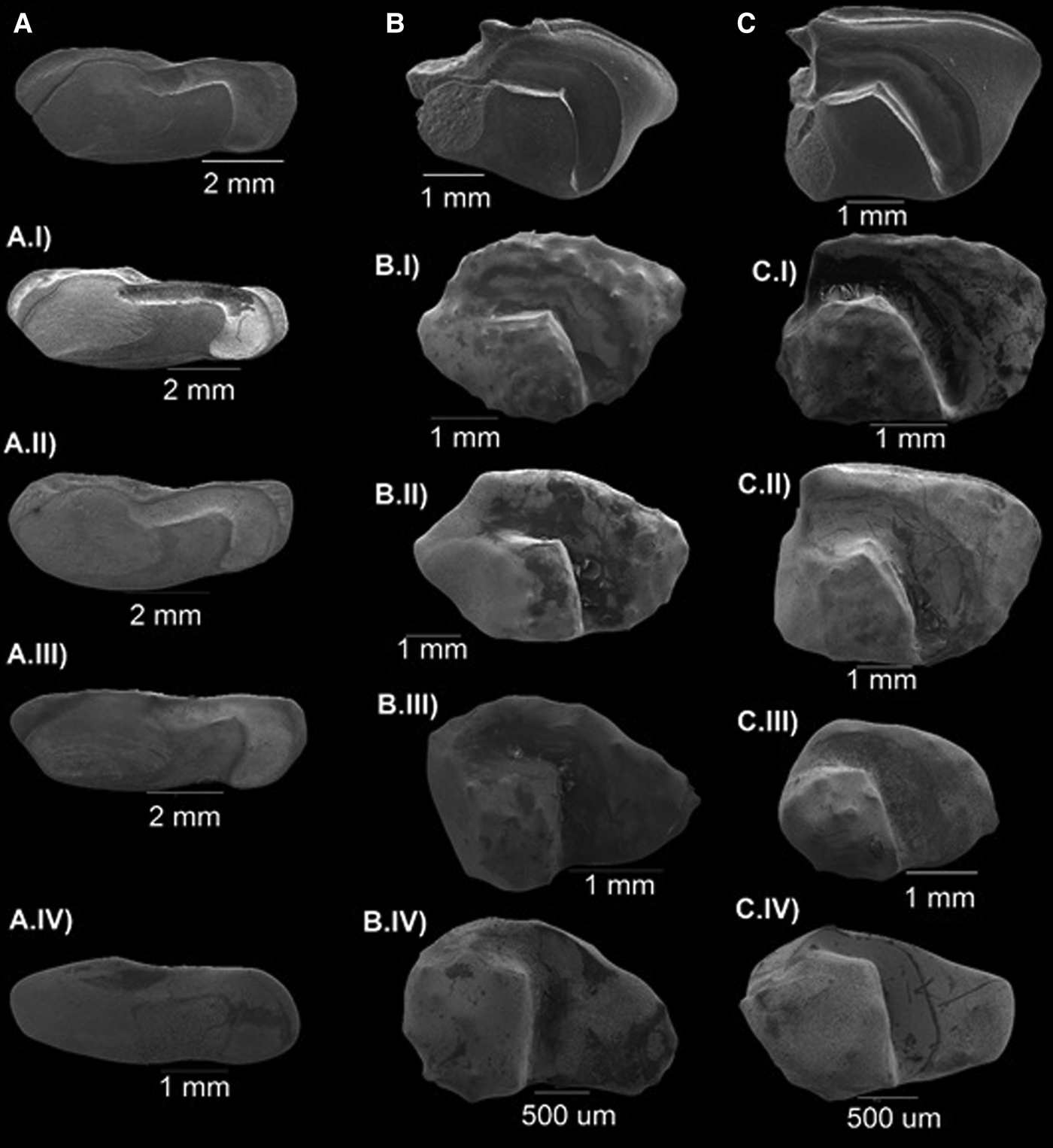
According to the morphological classification, the three species presented otoliths of distinct shapes: P. brasiliensis bullet-shaped, S. rastrifer hexagonal and S. brasiliensis rhomboidal. The sulcus acusticus was heterosulcoid for the three species. The type of opening of the sulcus acusticus was pseudo-ostial for S. brasiliensis and S. rastrifer. In the three species, the sulcus acusticus is located in the median region of the otoliths, with absence of rostrum and anti-rostrum in the three species (Figure 1A–C). However, in P. brasiliensis, there were two types of openings of the sulcus acusticus – predominant para-ostial (86.77%) and pseudo-ostial (12.39%).
Micrographs of the three Sciaenidae species: (A) Paralonchurus brasiliensis, (B) Stellifer brasiliensis and (C) Stellifer rastrifer. Micrographs A.I, B.I and C.I correspond to the respective species after 6 h; A.II, B.II and C.II, after 12 h; A.III, B.III and C.III, after 18 h; and A.IV, B.IV and C.IV, after 24 h of in vitro digestion.

Before the experiment
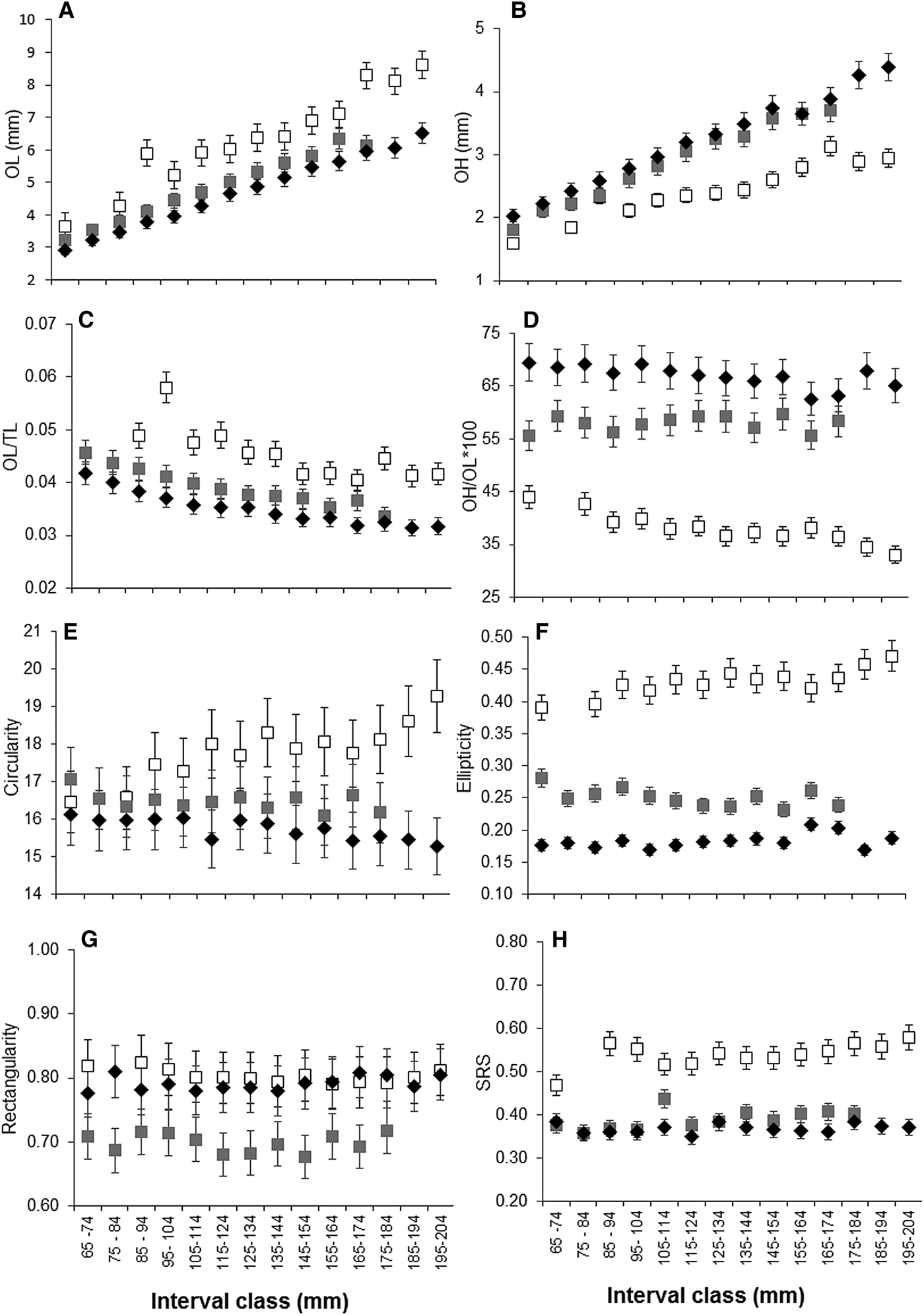
Both the OL and OH tend to increase with fish growth (Figure 2A, B). For the three species studied, the OL/TL and aspect ratio showed a tendency of reduction along with growth; probably owing to a reduction in the growth rate of the antero-posterior axis of the otolith, a reduction that should not occur in the body growth of the fish (Figure 2C). In Figure 2D, it is possible to observe higher values of the aspect ratio for S. rastrifer and S. brasiliensis in relation to that of P. brasiliensis, indicating the first two have more rounded otoliths throughout their ontogeny in comparison to P. brasiliensis.
Mean and standard error of the shape indices of the otoliths of Paralonchurus brasiliensis (square), Stellifer rastrifer (diamond) and Stellifer brasiliensis (grey square): (A) length and (B) height of otoliths, (C) OL/TL shape aspect ratio, (D) OH/OL × 100 (shape aspect ratio), (E) Circularity, (F) Ellipticity, (G) Rectangularity, and (H) SRS (relative surface of the sulcus acusticus).

The circularity index resulted in similar values between S. rastrifer and S. brasiliensis; P. brasiliensis with the range 165–174 mm TL presented an upward trend in values of this index increasing the complexity of its contour (Figure 2E). In contrast, the ellipticity index for P. brasiliensis presented a growth tendency as the fish grew, thus having greater growth in the antero-posterior axis of the otolith. Minor variation in the values of this index was found for S. brasiliensis and S. rastrifer (Figure 2F).
The rectangularity showed almost constant values along the ontogeny of the three species, indicating it is not an adequate index to distinguish these species (Figure 2G). The SRS was higher for P. brasiliensis than that for the two species of the genus Stellifer (Figure 2H).
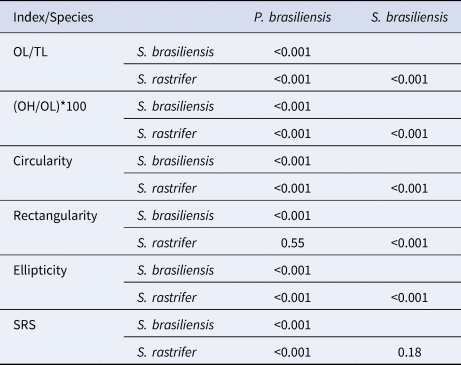
The Kruskal–Wallis test evidenced significant differences for OL (k = 130; df = 2; P < 0.001) and OH (k = 285; df = 2; P < 0.001) between the three species. The Nemenyi post-hoc test indicated significance in the interaction of OL and of OH for the three species. For shape indices, significant probability values were also found between species in the Kruskal–Wallis test (P < 0.001). The results of the Nemenyi post-hoc test are presented in Table 1 and only the interaction in SRS between P. brasiliensis and S. rastrifer was not significant.
Probability values (P) obtained from the Nemenyi post-hoc test of the shape index related to Paralonchurus brasiliensis, Stellifer rastrifer and Stellifer brasiliensis in the State of Paraná, Brazil (significant differences, P < 0.05)

OL, otolith length; OH, otolith height; TL, total fish length.
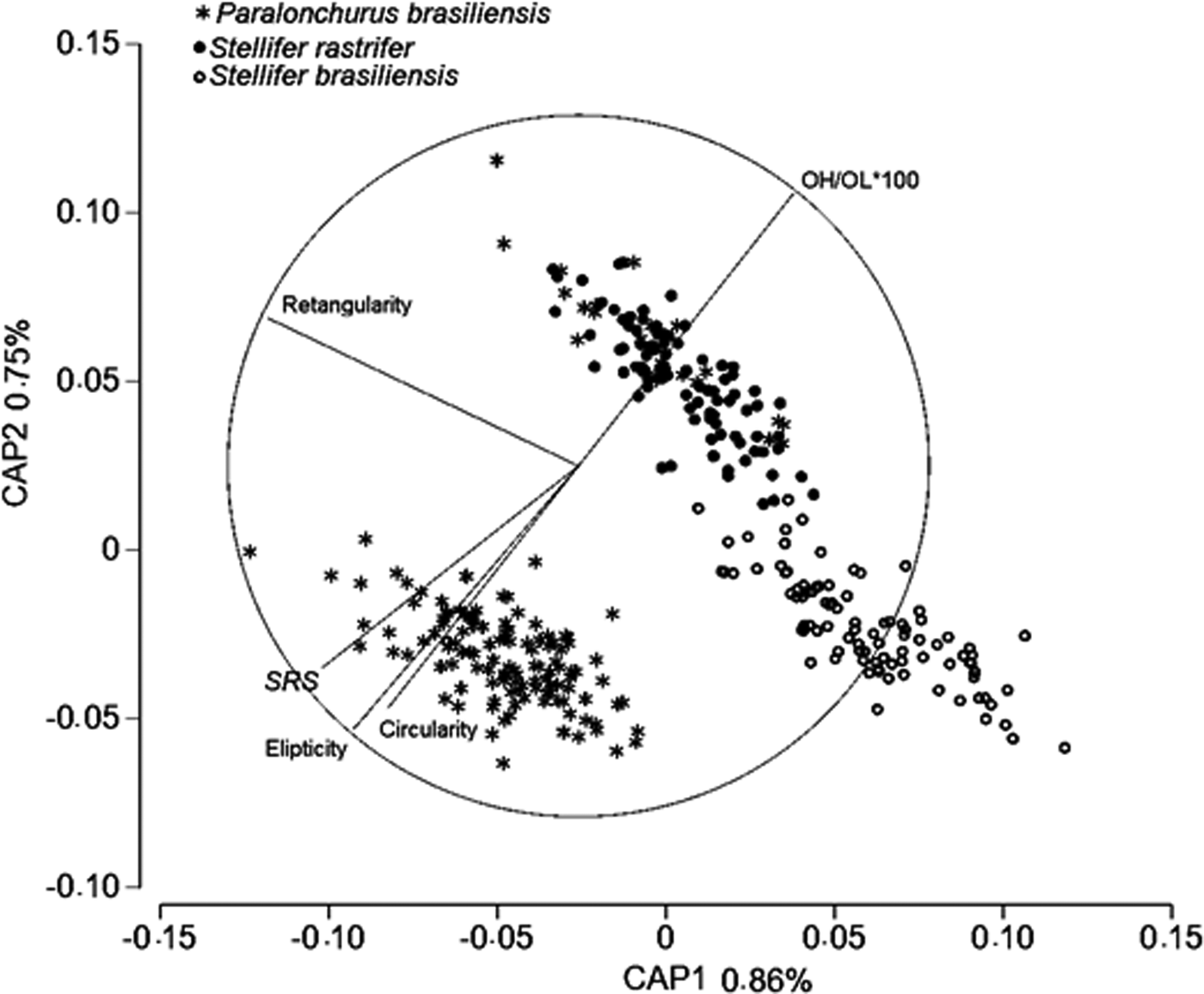
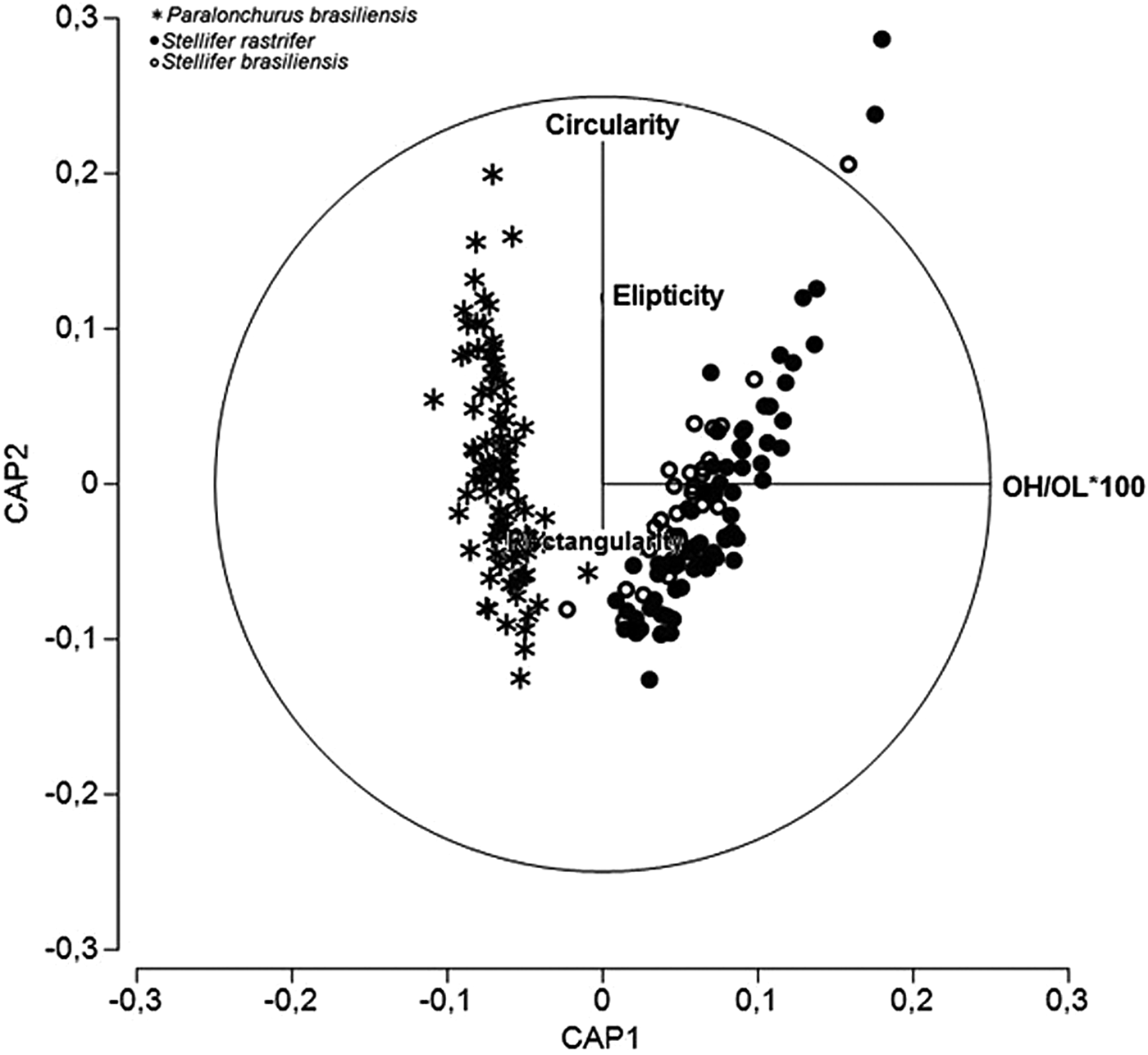
In Figure 3, the graphed result of CAP illustrates the indices most correlated with the three different species. The vector of the aspect ratio and the rectangularity influenced the separation of the two species of the genus Stellifer; S. rastrifer otoliths were smaller in length and more rounded and S. brasiliensis otoliths were longer and more elongated. The ellipticity, circularity and relative surface indices of the sulcus acusticus separate P. brasiliensis from the other two species.
Results of the Canonical Analysis of Principal Coordinates (CAP) with shape index for different species. Vectors of the index based on Spearman correlation of 0.8. OL, otolith length; OH, otolith height; SRS, relative surface of the sulcus acusticus.

After the experiment
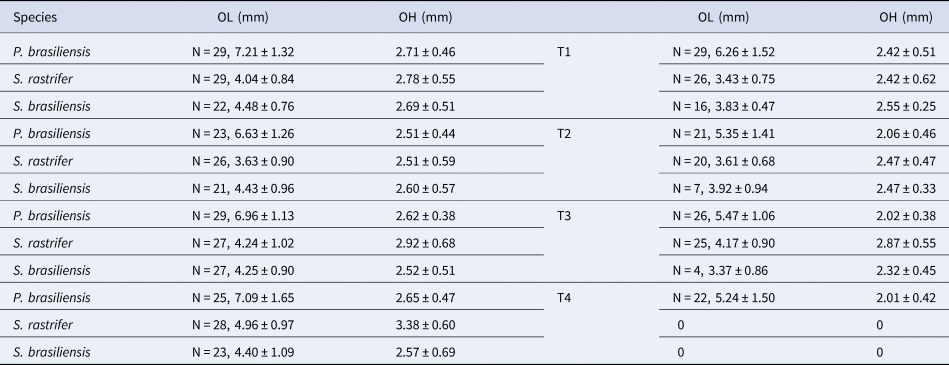
At 12 h of the experiment, the otoliths of S. brasiliensis did not resist digestion and only a few specimens were retrieved (Table 2). For S. rastrifer, few otoliths resisted digestion after 18 h. The otoliths subjected to in vitro digestion were measured before the experiment and after the different treatments (Table 2). The three species presented a reduction in the OL and OH when comparing before and after treatment measurements. However, no significant differences were detected (P > 0.05).
Mean and standard deviation of the length and height of the otoliths of Paralonchurus brasiliensis, Stellifer rastrifer and Stellifer brasiliensis used in the experiment

N, number of otoliths measured; OL, otolith length; OH, otolith height; T1, otoliths exposed for 6 h; T2, otoliths exposed for 12 h; T3, otoliths exposed for 18 h; T4, for 24 h of in vitro digestion.
Owing to the high erosion of the otoliths of S. rastrifer and S. brasiliensis after 24 h of in vitro digestion, these otoliths were not measured again. It was not possible to apply the index of SRS, since the ostium of the species of the Stellifer genus was very worn out, making it impossible to define the area of sulcus acusticus in any of the treatments (Figure 1).
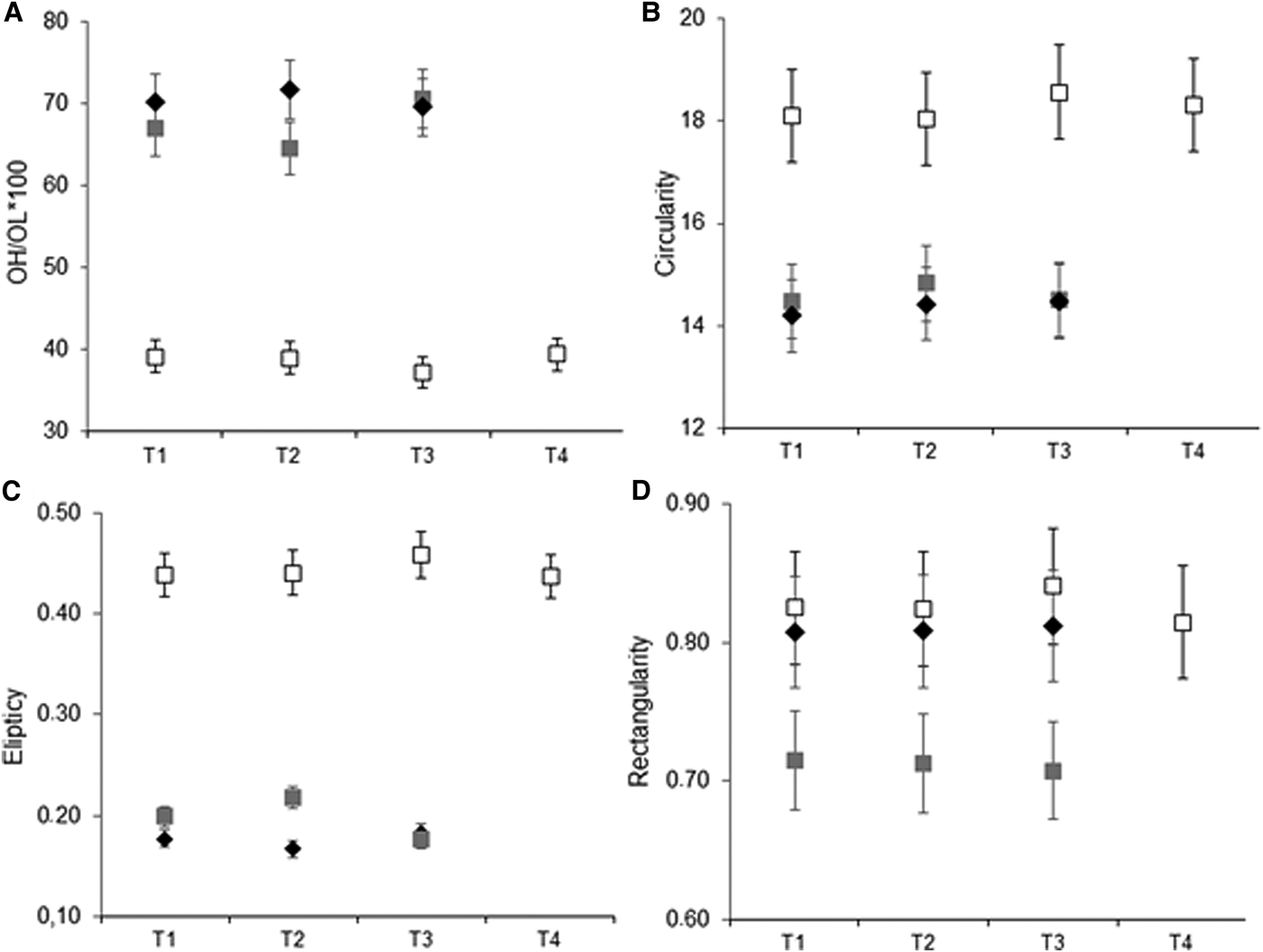
After in vitro digestion, the otoliths belonging to the genus Stellifer continued to be more rounded irrespective of the duration they were digested for compared with those of P. brasiliensis (Figure 4A). The pattern observed in Figure 2 for the circularity and the ellipticity indices with higher values for P. brasiliensis was maintained even after in vitro digestion (Figure 4B, C). The rectangularity index also presented a pattern similar to that observed before the experiment with higher values for P. brasiliensis (Figure 4D); however, a separation of Stellifer species was observed with higher values for S. rastrifer in relation to that for S. brasiliensis.
Mean and standard error of the shape indices of otoliths of Paralonchurus brasiliensis (square), Stellifer rastrifer (diamond), Stellifer brasiliensis (grey square): (A) Shape aspect ratio (OH/OL × 100), (B) Circularity, (C) Ellipticity, (D) Rectangularity in the different treatments (T1: 6 h, T2: 12 h, T3: 18 h and T4: 24 h of in vitro digestion).

The graphed result of CAP shows after in vitro digestion, the indices of circularity and aspect ratio are suitable for the separation of the genera Paralonchurus and Stellifer. However, the indices were not efficient in the separation of species of the genus Stellifer (Figure 5).
Results of the Canonical Analysis of Principal Coordinates (CAP) with shape index for differences species. Vectors of the index based on Spearman correlation of 0.8. OL, otolith length; OH, otolith height.

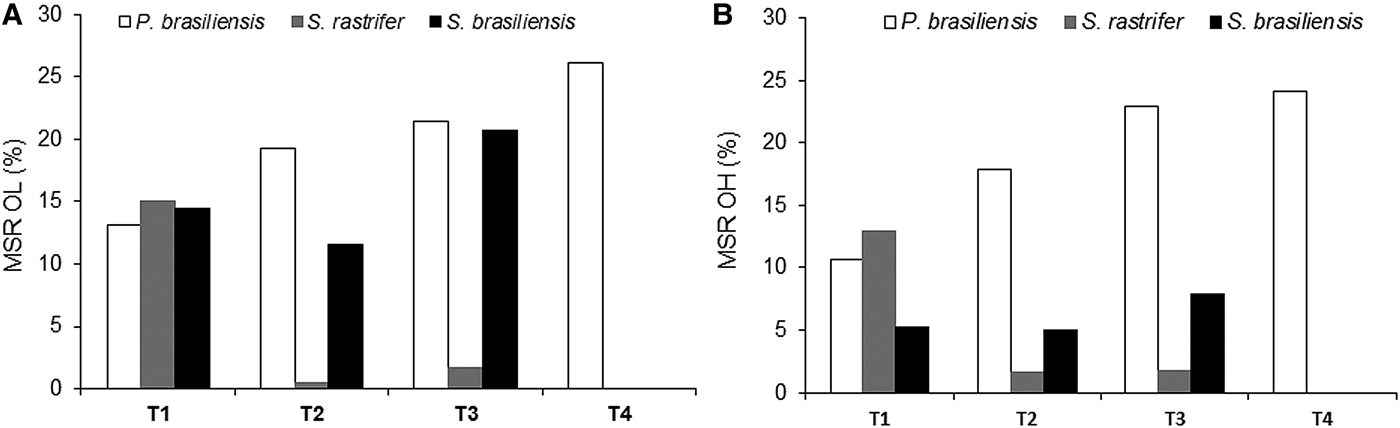
In Figure 6, MSR of the OL demonstrated the otolith of P. brasiliensis reduced by 13% at T1 and 26% at T4, S. rastrifer presented a greater reduction in otolith length at T1 and S. brasiliensis a greater reduction at T3. The MSR of the OH demonstrated patterns similar to the length, greater reductions for P. brasiliensis at T4, for S. rastrifer at T1 and for S. brasiliensis at T3 (Figure 6B).
Frequency histogram of the percentage reduction: (A) in length (OL) and (B) the height (OH) of the otolith before and after the different treatments (T1: 6, T2: 12 h, T3: 18 h, and T4: 24 h of in vitro digestion) of three species of the Sciaenidae.

Discussion
Some morphological characteristics were constant for the species analysed in this study; rostrum and excisura were absent, and heterosulcoid sulcus acusticus was located in the medial portion of the otolith, representing the diagnostic features of otoliths of species belonging to the family Sciaenidae from the South-west Atlantic coast (Sasaki, Reference Sasaki1989; Volpedo & Echeverría, Reference Volpedo and Echeverría2000; Siliprandi et al., Reference Siliprandi, Rossi-Wongtschowski, Brenha, Gonsales, Santificetur and Vaz-Dos-Santos2014).
Otoliths of the three species tend to increase in length and height according to the somatic growth of fish. Consequently, shape indices showed a variation along the ontogenetic development of the otoliths of S. rastrifer, S. brasiliensis and P. brasiliensis. These changes in patterns between the otolith growth and the growth of the body in the fish are often associated with reproduction or sexual dimorphism (Carvalho & Correia, Reference Carvalho and Corrêa2014; Maciel et al., Reference Maciel, Vaz-dos-Santos, Barradas and Vianna2019) with a reduction in somatic growth owing to energy expenditure with gonadal development (Quince et al., Reference Quince, Shuter, Abrams and Lester2008). The existence of these shape variations of the otoliths along ontogeny is a pattern also described for other species (Curin-Osorio et al., Reference Curin-Osorio, Cubillos and Chong2012; Rondon et al., Reference Rondon, Vaz-dos-Santos and Rossi-Wongtschowski2014; Carvalho et al., Reference Carvalho, Vaz-dos-Santos, Spach and Volpedo2015).
To distinguish the species of the genera Paralonchurus and Stellifer, the aspect ratio, circularity, ellipticity and SRS were efficient. The separation is because of distinct morphometric and morphological variations among the otoliths of these two genera; for example, the otoliths of Paralonchurus are larger and more elongated resulting in larger area and length. They also have a well-developed sulcus acusticus, mainly due to the direct influence of the ostium on the SRS. In the genus Stellifer, the otoliths are wider and shorter in length, being more rounded. Diagnostic characteristics of these genera allow their identification in stomach contents when they are not highly digested, while the indices were efficient up to 18 h of digestion (T3).
In the present study, it was possible to verify morphological and morphometric differences between the species of the genus Stellifer as reported in other studies (Corrêa & Viana, Reference Corrêa and Viana1992; Siliprandi et al., Reference Siliprandi, Rossi-Wongtschowski, Brenha, Gonsales, Santificetur and Vaz-Dos-Santos2014). The shape aspect ratio and rectangularity were efficient in separating the congeneric species S. brasiliensis and S. rastrifer.
Otoliths exposed to in vitro digestion reduced both in length and height in the different treatments of the present study. The reduction in the dimensions of otoliths exposed to in vitro digestion was also observed in other studies and in some cases the otoliths broke after 12 h of experimentation (Sekiguchi & Best, Reference Sekiguchi and Best1997; Wijnsma et al., Reference Wijnsma, Pierce and Santos1999; Christiansen et al., Reference Christiansen, Moen, Hansen and Nilssen2005). The exposure of S. brasiliensis and S. rastrifer otoliths for long periods (12 and 18 h) to gastric acid may lead to an underestimate of how much these species are preyed upon by aquatic mammals, and the few otoliths that resist no longer have morphological characteristics that allow their identification. Therefore, previous knowledge of the otolith morphology is necessary for the separation of the otoliths of these species.
Even after digestion, the otoliths maintained their standards of shape independent of the duration of exposure in the experiment: otoliths of the Stellifer species with higher values in the shape aspect ratio and otoliths of P. brasiliensis retained greater circularity, rectangularity and ellipticity (Figure 4). This demonstrates digestion does not alter the shape of the otolith, but rather only its linear dimensions. Linear reductions can cause errors in prey length estimates when based only on morphometric ratios between otolith length and fish length.
The percentage mean size reduction of both the length and the height of the otoliths of the three species analysed in this study presented a reduction of less than 30% as also reported by Tollit et al. (Reference Tollit, Steward, Thompson, Pierce, Santos and Hughes1997). This indicates the experiment efficiently simulated the stomach of an aquatic mammal.
In conclusion, the shape indices circularity and aspect ratio were efficient in separating the worn otoliths from the genera Stellifer and Paralonchurus but no index distinguished the two species of the genus Stellifer before the experiment. After digestion, the shape indices circularity and the aspect ratio remained efficient in separating the genera Stellifer and Paralonchurus. However, the application of these indices should be further investigated with artificial digestion of otoliths of other species of the family Sciaenidae and in other fish taxa.
Acknowledgements
The authors are grateful for funding from the project CAFP-BA/SPU and 292/14 UFPR/Fundação Araucária. They also thank CONICET and UBACYT, CNPQ for the PhD scholarship to the first author (141267/2015-1), LAFMA (CEM-UFPR) for the use of the stereomicroscope and the Olympus DP71 camera, and the Centro de Microscopia Eletrônica (CME-UFPR) for the micrographs. This study was financed in part by the Coordenação de Aperfeiçoamento de Pessoal de Nível Superior – Brazil (CAPES) – Finance Code 001.