Introduction
Neonatal cardiopulmonary resuscitation (N-CPR) is a low-frequency but high-acuity critical procedure, which makes it challenging for paramedics to learn. Paramedics, who could be responsible to help with giving birth in emergencies, albeit in rare situations, should have both the technical skills and the non-technical skills related to the N-CPR requirement caused by asphyxia. According to the American Heart Association (AHA; Dallas, Texas USA) Guidelines, updated in 2020, at least one person who can start the initial steps of N-CPR should be present at every birth.Reference Aziz, Lee and Escobedo1 The inadequacies in both technical and non-technical skills (eg, communication, situation awareness, decision making, and teamwork) could lead to fatal errors and poor patient outcomes.Reference Singhal and Bhutta2,Reference Lee, Cousens and Wall3 For this reason, paramedics need to be well-trained and possess enhanced non-technical skills through clinical education such as blended learning and simulation-based education (SBE).
Clinical education is complex and requires a versatile approach to meet the needs of students. Deliberate practices such as classroom lecturing, problem-based education, discussion, and SBE could be combined with the online learning tools to create or develop effective comprehensive strategies that contain a variety of learning styles. Deliberate practice in SBE is shown to improve educational outcomes of performance and resuscitation skills compared to traditional clinical education.Reference McGaghie, Issenberg and Cohen4
The blended learning was shown to facilitate the learning of the procedural, communicational, decision-making skills, and adherence to the algorithm at the cognitive level. It enables the flexible participation of the learner, meanwhile saving time and labor costs.Reference Kho, Chew and Azhar5–Reference Halverson and Graham7 Blended learning, which combines the advantages of traditional face-to-face learning with asynchronous or synchronous e-learning, is widely used in today’s education.Reference Liu, Peng and Zhang8 Blended learning provides benefits over using a single learning method.Reference Singh9 Additionally, the integration of online education into the curriculum has been shown to overcome time and space constraints, support teaching outcomes that are difficult to achieve by using textbooks solely, and reach more students without increasing their need for resources.Reference Gray and Tobin10 However, the content of educational materials used in blended learning varies based on the original structure of the education. When the information provided is complex (ie, when a person must learn several steps), the “intrinsic load” becomes high. In these cases, a teaching design that has an impact on the “extraneous load and germane load” is important for the learning process to be effective and efficient. Therefore, when planning a blended learning program, it is important to design the training material by considering the cognitive load in order to ensure effectiveness and efficiency.Reference Anglin, Vaez, Cunningham and Jonassen11–Reference Paas, Tuovinen and Tabbers13
Based on the real-world scenarios, SBE creates a setting where cognitive, psychomotor, and effective learning is synthesized. This way, new knowledge and skills are applied into clinical practice and have an overall impact on minimizing errors. One example of this on reducing neonatal mortality is discussed in the works of Mduma, et al.Reference Mduma, Ersdal and Svensen14 In addition, the education of the paramedic students with simulation-based training to achieve proficiency in both technical and non-technical skills carries high importance to minimize these errors and to ensure patient safety.Reference Singhal and Bhutta2,Reference Lee, Cousens and Wall3,Reference Duby, Hansen and Meckler15–Reference Collopy17
The main aim of this study was to evaluate the effect of blended learning on the theoretical knowledge and familiarity with psychomotor skills, adherence to the algorithm, and teamwork in SBE of N-CPR. The secondary aim was to compare the blended learning materials: the slide presentation that appeals to the visual perception and the video clip which appeals to both auditory and visual perception.
Methods
Selection and Description of Participants
This randomized, prospective study was conducted in the Acibadem Mehmet Ali Aydinlar University Vocational School of Health Services First and Emergency Aid Program (Istanbul, Turkey), which is a paramedic school. The ethical approval for the study was obtained from the same university’s Medical Research Assessment Committee (ATADEK) with the decision number: 2019-14/64.
All fourth-semester paramedic students were informed about and invited to the study (n = 67). No exclusion criteria were present. Consent was obtained from those who agreed to participate (n = 60). The participating students had already received Basic Life Support training with the SBE technique for all age groups (neonate, infant, child, and adult) at the end of their second semester as a requirement of the curriculum. The participants were informed that the results would not be graded. Twenty-six (43%) of the participants were female and 34 (57%) were male. The number of participants between the age group 18-20 years was 37 (62%), 21-23 years was 21 (35%), and older than 24 years was two (3%).
Technical Information
Two hypotheses were investigated throughout the study. These hypotheses were as follows:
-
1. The combined use of traditional learning and e-learning is more effective than traditional learning alone in N-CPR education. Regarding this hypothesis, the study investigated the relationship between the levels of theoretical knowledge (the classroom lecturing versus the blended learning) measured by the multiple-choice questions (MCQs) and the levels of psychomotor skills, adherence to the algorithm, and communication skills through observational performance evaluation (OPE) between Group 1 and Group 2.
-
2. Video clip modality that appeals to the visual and auditory perception in blended learning is superior to the slide presentation modality which appeals only to the visual perception. Regarding this hypothesis, the study explored the relationship between the levels of theoretical knowledge of both learning methods through MCQs and the levels of psychomotor skills, adherence to the algorithm, and communication skills through OPE between Group 1 and Group 2.
Study Design
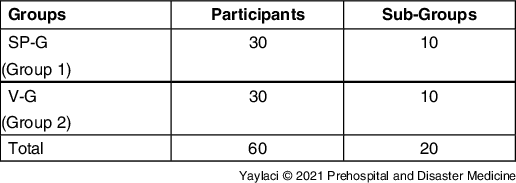
A 45-minute classroom lecture about the N-CPR algorithm, prepared according to the updated 2018 AHA Guideline, was given to the participants by an instructor. The participants were randomly separated using a uniform pseudorandom number generator available in MATLAB software (MathWorks; Natick, Massachusetts USA) into two groups 10 days after the classroom lecture (Group 1 and Group 2). A test comprising of MCQs was assigned to the participants after the classroom lecture. Ten sub-groups, consisting of three people each, were randomly divided with the previous randomization method into two groups (Table 1). Each sub-group participated in an eight-minute neonatal asphyxia megacode scenario on the same day. High fidelity and high emotion Preterm Simulator Paul (SIMCharacters GmbH; Vienna, Austria), which indicates the compression and ventilation efficiency, was used in the scenarios. The simulated neonatal megacode scenario performance of each sub-group was recorded. Feedback was given to students after this. A performance checklist was created by the neonatal resuscitation program instructor. Thirty-four items of the 35-step N-CPR performance evaluation checklist were developed based on the updated AHA 2018 Guideline for Cardiopulmonary Resuscitation and Emergency Cardiovascular Care Steps. The evaluation of the communication skills with a closed-loop system was added to the checklist as the 35th step. The sub-group performances were monitored by two independent instructors and evaluated based on the performance checklist. The correlation coefficient among the instructors was 0.85. The evaluation of the ventilation and compressions was done on a three-point scale based on the feedback of the simulator during the application (Successful [100 points] – 76%-100% errorless and effective application; Partially successful [50 points] – 51%-75% errorless application; Unsuccessful [0 points] – 0%-50% erroneous application and step-missing]. The e-learning materials of the groups (Group 1: slide presentation group [SP-G] and Group 2: video clip group [V-G]) were determined randomly using the previous method (Table 1).
Study Groups and Sub-Groups of the Participants

Abbreviations: SP-G, Slide Presentation Group; V-G, Video Clip Group.
One week following the determination of the e-learning materials of the sub-groups, e-learning access comprising of a presentation consisting of 25 slides with pictures about the conceptual/procedural information, and team dynamics based on the updated AHA Neonatal Advanced Life Support (ALS) Guidelines 2018, was made available to Group 1 (SP-G) for three days. A six-minute video clip containing practical demonstrations about the conceptual/procedural information, and team dynamics based on the updated AHA Neonatal ALS Guidelines 2018, was made available via e-learning to Group 2 (V-G) simultaneously at the same timeframe. The contents of the training materials were identical.
Following three days of access, on the fourth day, students were invited to the simulation laboratory. The number of the students who studied the material was retrieved from the e-learning system. A test containing MCQs was applied to all students after blended learning. The scenario sub-groups formed in the beginning were preserved. Each sub-group participated again in the simulated neonatal asphyxia megacode scenario and the performances were recorded. The simulator was used again in the scenarios. The students were then given feedback on their errors to enhance the complete learning process. The video recordings of the sub-groups were viewed by two independent instructors, and the students’ procedural skills, performance levels, adherence to the algorithm, task distribution, communication, and decision-making skills were scored using the same 35-step checklist. The correlation coefficient among the instructors was 0.83. The scorings outside of the correlation coefficient were singularized by calculating the mean score. Individual scores were based on the answers to the MCQs and the sub-group performance OPE score was based on the scenarios.
Statistics
Descriptive statistics were presented using the mean and the standard deviation scale variables. T-test was used for the comparison of two normally distributed independent groups. Non-parametric statistical methods were used for the values with skewed distribution. Mann-Whitney U test was used to compare two non-normally distributed independent groups.
Non-parametric statistical methods were used for values with skewed distribution. Wilcoxon signed-rank test was used to compare two non-normally distributed dependent groups. Statistical significance was determined when the two-sided P value was lower than .05.
The statistical analysis was performed using the MedCalc Statistical Software version 12.7.7 (MedCalc Software bvba; Ostend, Belgium). The post-hoc power analysis was performed with the ClinCalc online post-hoc power calculator (ClinCalc LLC; North Chicago, Illinois USA).
Results
The post-hoc power analysis for the collected data was performed with 5% Type 1 error. The calculated power for the after blended learning MCQs and OPE was found as 100.0% and 82.7% between the SP-G and V-G, respectively. This analysis showed that the sample size was reliable for this study and there was a significant difference between the after classroom lecture and after blended learning for both groups in terms of MCQ results (Table 2). The average of the results on the MCQs after blended learning was higher than the results on the MCQs after classroom lecture for both groups (Wilcoxon signed-rank test; P <.05). There was a significant difference between the results of the groups after blended learning (P <.001). The average of the V-G was higher (Mann-Whitney U test; P <.05). The effect size (ES) was calculated as very large (Cohen’s d >1).
The Multiple-Choice Question Results of the Groups and their Comparison According to the Measurements

Abbreviations: SP-G, Slide Presentation Group; V-G, Video Clip Group; ES, Effect Size.
a Mann-Whitney U test.
b Student’s t-test.
c Wilcoxon signed-rank test.
There was a significant difference between the after classroom lecture and the after blended learning OPE performances for both groups (Table 3). The average of the after blended learning OPE performances was higher than the after classroom lecture OPE performances (Wilcoxon signed-rank test; P <.05). There was a significant difference between the groups in terms of after blended learning OPE performance (P = .002). The average of the V-G was higher (Mann-Whitney U test; P <.05). The ES was calculated as large (Cohen’s d >0.50).
The Observational Performance Evaluation Results of the Groups and Comparisons According to the Measurements

Abbreviations: SP-G, Slide Presentation Group; V-G, Video Clip Group; ES, Effect Size.
a Mann-Whitney U test.
b Wilcoxon signed-rank test.
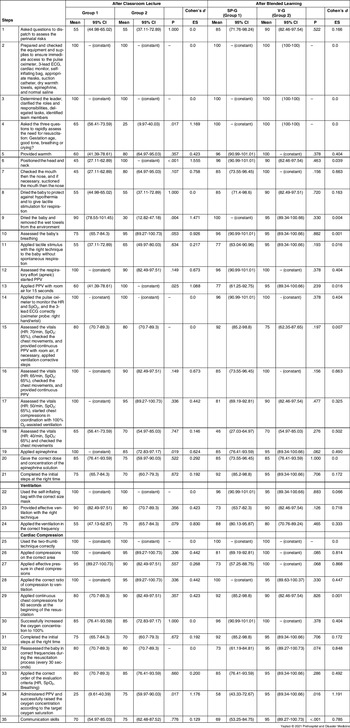
In general, the average scores increased in both groups after blended learning (Table 4). There was a significant improvement in steps 34 and 35 in favor of the V-G group (Group 2) when the checklist steps were analyzed (Student’s t-test; P <.05). The improvement in steps 5, 7, 12, 14, 16, 17, 18, 19, 23, 26, 27, 30, 32, 33, 34, and 35 in the V-G group (Group 2) was more significant compared to the SP-G (Group 1) when the checklist steps were analyzed in terms of ES. The ESs calculated were between 0.30-1.191 (Cohen’s d).
Distributions of the Performance Checklist Steps and their Comparison Between the Groups (Student’s t-test)

Abbreviations: ES, Effect Size; SP-G, Slide Presentation Group; V-G, Video Clip Group; ECG, Electrocardiogram; PPV, Positive Pressure Ventilation; HR, Heart Rate; SpO2, Peripheral Capillary Oxygen Saturation.
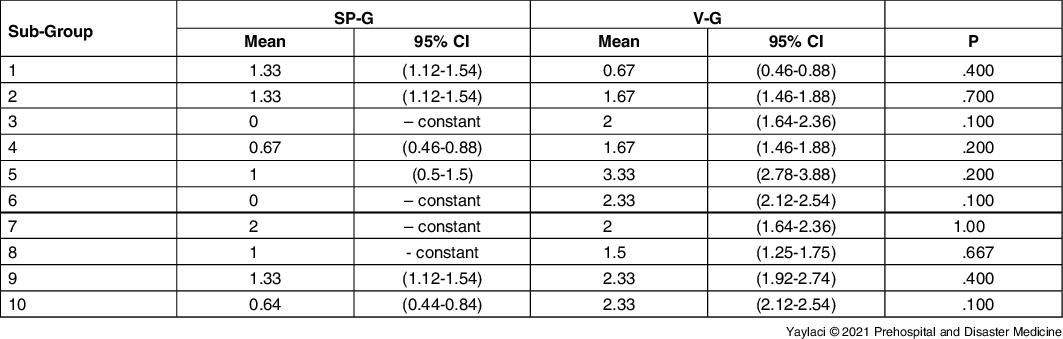
There was no significant difference between these groups in terms of the number of times the learning materials were studied (Table 5; Mann-Whitney U test; P >.05).
The Number of Times the Video Clip and the Slide Presentation were Studied According to the Sub-Groups (Mann-Whitney U test)

Abbreviations: SP-G, Slide Presentation Group; V-G, Video Clip Group.
Discussion
A statistically significant improvement was detected in the theoretical knowledge and performance levels of both groups when the average scores based on MCQs and OPEs, that were performed after the classroom lecture and e-learning, were compared (P <.05). The results support that blended learning was more effective. It was suggested that the use of the blended approach helps students to overcome the gap between theoretical knowledge and practice in clinical scenarios.Reference Davies, Ramsay and Lindfield18,Reference Tan, Ladyshewsky and Gardner19 It was found in a study on medical students that blended learning (both electronic and face-to-face) provided statistically significant and better results on different types of examinations (written, OPE, and case scenarios) than traditional learning.Reference Makhdoom, Khoshhal and Algaidi20 Rowe, et al concluded that blended learning has the potential to increase the development of a series of clinical competencies among health care students.Reference Rowe, Frantz and Bozalek21
The comparison between the two learning modalities after classroom lecture learning, SP-G and V-G, showed that the success of the V-G was higher in the OPE, whereas SP-G results were higher in MCQs. These results were not statistically significant (P = .104 and P = .056 in OPE and MCQ, respectively). The comparison between the two learning modalities after blended learning, V-G and SP-G, showed that the success of the V-G was statistically higher in the MCQs and OPEs (P <.05; CI 77.8-82.2; Cohen’s d >1; and P < .05; CI 90.1-94.5; Cohen’s d = 0.749, respectively). In other words, the V-G was more skillful and had obtained more information. This result was in line with the literature on the acquisition of clinical skills by video clip training materials. Cardoso, et al observed that the cognitive and technical competence required to achieve quality nursing care was developed more after the video clip was watched.Reference Cardoso, Moreli and Braga22 Forbes, et al found that the video clip was equal to or more effective than the traditional clinical face-to-face learning for advanced clinical skills when used as teaching material.Reference Forbes, Oprescu and Downer23 They also stated that the use of video clips is effective in terms of skill acquisition and student satisfaction.
High school students were presented with visual/visual and audio/visual content, and it was shown that the audio/visual content was more effective than the visual/visual content.Reference Mousavi, Low and Sweller24 The visual and verbal components of video-based learning facilitate the learning process and lead to better comprehension according to the dual-channel theory.Reference Clark and Paivio25
In the OPEs which were done after the blended learning, the scores of both groups increased, and this increase was higher in the V-G. The increase could be observed in Table 4; although the evaluation time (Step 32) and evaluation criteria (Step 33) were not statistically significant in the critical decision-making skills, they were significant in terms of ESs (Steps 12, 16, 17, and 19). There was a statistically significant difference between the two groups in the application of the correct concentration of oxygen support (Step 34: P <.05) and communication skills (Step 35: P <.001) in favor of the V-G. The reason for the lack of statistical difference between the groups in the preparation for resuscitation steps (Steps 1, 2, and 3: P >.05) might be that the paramedic students obtain theoretical and practical knowledge, teamwork skills, case preparation, case-related skills training, and practice these skills in six-hour-long simulation case scenarios each week. It could be stated that the increase in the number of practices increases the probability of developing an attitude about the topic at hand.
The fact that students who participated in the study had already completed the neonatal psychomotor skills training, as required by the curriculum, might explain the absence of a statistically significant difference in the ventilation and effective compression skills. However, when considered in terms of ES, there was a significant difference in favor of the V-G in the location of cardiac compression, depth, and ventilation technique (Cohen’s d >0.70). These results could be explained by the fact that the dynamic video training materials create a better internal representation than the static images in the acquisition of procedural skills and cause the development of certain parts of the working memory during the learning process by imitation of the video clips.Reference Forbes, Oprescu and Downer23,Reference Arguel and Jamet26
Both groups were provided access to educational materials equally in the study. There was no statistically significant difference between the groups in terms of how many times the learning material was studied. Therefore, it could be stated that this variable does not affect scores.
Limitations
Both MCQs and OPEs were not performed before the classroom lecture, which if performed, the extent of pre-existing knowledge and skills would be affected. The academic success levels of both groups at the end of the lecture and the accuracy level of the pre-existing knowledge gained could have been determined. The number of sub-groups was low. The ES of each parameter was calculated to prevent the number of sub-groups from compromising the strength of the research. The number of times the learning materials were studied was low in the study. In order to determine the threshold of the number of times the materials were studied, to achieve the optimal level of competency, more studies are needed. Lastly, the feedback was not received from the students and the learning strategy could not be evaluated from the students’ perspective.
Conclusions
The use of the blended learning method with video clips appears to be an expedient, widely used, and promising educational strategy that could increase the quality of clinical skills under the circumstances of this era. The results demonstrated that blended learning, especially video clips, was effective in acquiring and developing both technical and non-technical skills at a cognitive level among paramedic students in the N-CPR training. The results of the study could be used as a foundation for the SBE-using academic community to determine the blended learning strategy for the preliminary material in the simulation-based N-CPR training programs.
Conflicts of interest/funding
This research did not receive any specific grant from funding agencies in the public, commercial, or not-for-profit sectors. The authors declare no conflict of interest to disclose. The views expressed in the submitted article are authors’ and not an official position of the institutions or funders.
Author Contributions
Serpil Yaylaci: Conceptualization, Data curation, Project administration, Investigation, Resources, Visualization, Writing – original draft preparation, Writing – review and editing. Feray Guven: Conceptualization, Methodology, Data curation, Project administration, Investigation, Supervision, Writing – original draft preparation, Writing – review and editing.
Acknowledgments
The authors would like to thank Erol Barbur, MD and Gulsen Oztosun (final-year medical student at the Acibadem Mehmet Ali Aydinlar University, School of Medicine) for their comments on the manuscript and helpful contributions.