Introduction
Even though speech is the primary means of human linguistic communication, millions of people are daily exposed to and use written language. While it may not come as a surprise that spoken language phonology is automatically activated and affects the processing of written language (e.g., Rastle & Brysbaert, Reference Rastle and Brysbaert2006; see Frost, Reference Frost1998, for a review) – after all, most people learn their first language through speech – it may seem more surprising that orthography might be activated during online speech recognition and might affect linguistic representations in fundamental ways. Yet this is the hypothesis put forward by many current models of word recognition (e.g., Grainger, Diependaele, Spinelli, Ferrand, & Farioli, Reference Grainger, Diependaele, Spinelli, Ferrand and Farioli2003; Grainger & Ferrand, Reference Grainger and Ferrand1994; Grainger & Ziegler, Reference Grainger and Ziegler2011; Taft, Reference Taft2006, Reference Taft2011; Taft & Hambly, Reference Taft and Hambly1985). What makes this observation especially important, however, is that many people who are daily faced with the task of learning a foreign or a second language, do this in formal instructional settings often based mostly on written language. We could therefore assume that orthography has a much more significant role for the shaping of the linguistic representations in these learning contexts. Consequently, orthography might also have a different role in the processing of spoken language depending on how proficient the language learner is.
It has been shown in different tasks in L1 that orthography is activated during speech processing. This is the case in metaphonological tasks, like rhyme judgements (Seidenberg & Tanenhaus, Reference Seidenberg and Tanenhaus1979; but see Damian & Bowers, Reference Damian and Bowers2009; Pattamadilok, Kolinsky, Ventura, Radeau & Morais, Reference Pattamadilok, Kolinsky, Ventura, Radeau and Morais2007; and Pattamadilok, Perre & Ziegler, Reference Pattamadilok, Perre and Ziegler2011, for discussion on the automaticity of orthographic activation), or phoneme detection (Hallé, Chéreau & Segui, Reference Hallé, Chéreau and Segui2000), but also in tasks that do not demand phonological awareness. For example, Chéreau, Gaskell and Dumay (Reference Chéreau, Gaskell and Dumay2007) showed that phonological priming effects in auditory lexical decision were modulated by the degree of orthographic overlap between primes and targets.
Grainger et al. (Reference Grainger, Diependaele, Spinelli, Ferrand and Farioli2003) reported orthographic effects in French using the masked priming method within and across modalities in visual and auditory lexical decision tasks (for masked priming, e.g., Forster & Davis, Reference Forster and Davis1984; see Kinoshita & Lupker, Reference Kinoshita and Lupker2003, for an overview). Grainger et al. (Reference Grainger, Diependaele, Spinelli, Ferrand and Farioli2003, p. 1256) stated that if any repetition effects can be obtained under masked priming, “they are assumed to reflect rapid automatic activation of representations shared by prime and target”. The authors contrasted visual and auditory lexical decision tasks using visual masked priming with both modalities and obtained a repetition priming effect (<franc> – [fʀ ]) with a 53 ms prime duration and a pseudohomophone (<frant> – [fʀ]) priming effect with a slightly longer 67 ms prime duration in both visual and auditory modalities. They also reported significant facilitation from orthographically related primes (<frinc> – [fʀ
 ]) with both modalities with the longer prime duration. As the pseudohomophone facilitation did not differ significantly from the facilitation of the orthographic condition, they argued that both orthographic and phonological overlap between primes and targets is needed to obtain significant effects. Because the priming effects increased when sublexical orthographic or phonological overlap increased, and because the effects did not depend on target modality, the authors argued that the locus of these effects was sublexical.
The most convincing evidence for the activation of orthography during speech processing comes from the so called consistency effect. Ziegler and Ferrand (Reference Ziegler and Ferrand1998) were the first to discover that words with a phonological rime associated with only one possible spelling (<bague> – [bag], compare <vague> – [vag]) were recognized faster than words with a phonological rime with multiple spellings (<plomb> – [pl ], compare <nom> – [n], <ton> – [t], <prompt> – [pr], <tronc> – [tr], <long> – [l]). The same effect was observed also with Portuguese (Ventura, Morais, Pattamadilok & Kolinsky, Reference Ventura, Morais, Pattamadilok and Kolinsky2004) although its magnitude was smaller with this more transparent orthography (Pattamadilok, Morais, Ventura & Kolinsky, Reference Pattamadilok, Morais, Ventura and Kolinsky2007).
There are currently two main explanations for the activation of orthography during spoken word processing. Many studies (e.g., Luo, Johnson & Gallo, Reference Luo, Johnson and Gallo1998) support the idea that reading triggers an automatic online activation of the phonological forms of words. To account for the co-activation of orthography and phonology, interactive-activation models assume that there are two separate codes, the orthographic and the phonological, with automatic links between them. Thus, according to this online co-activation account, when people learn to read new words, orthographic representations that are separate from the pre-existing phonological representations are formed, and strong links are created between the two representations at both lexical and sublexical levels. These links lead to an automatic co-activation of the orthographic representations during listening and to an automatic co-activation of the phonological representations during reading. (Grainger & Ferrand, Reference Grainger and Ferrand1996; Grainger et al., Reference Grainger, Diependaele, Spinelli, Ferrand and Farioli2003; Ziegler & Ferrand, Reference Ziegler and Ferrand1998; Ziegler, Muneaux & Grainger, Reference Ziegler, Muneaux and Grainger2003). In contrast, the restructuration account claims that there are no separate representations for orthographic and phonological codes. Instead, the account argues that learning to read and acquiring the new orthographic information fundamentally changes the pre-existing phonological representations into abstract representations that amalgamate both orthographic and phonological information. As a consequence, orthographic effects during spoken word processing are taken as arising within the phonological system and resulting from these abstract phonological representations influenced by orthography (Muneaux & Ziegler, Reference Muneaux and Ziegler2004; Taft, Reference Taft2006, Reference Taft2011; Taft, Castles, Davis, Lazendic & Nguyen-Hoan, Reference Taft, Castles, Davis, Lazendic and Nguyen-Hoan2008; Taft & Hambly, Reference Taft and Hambly1985; Ziegler & Goswami, Reference Ziegler and Goswami2005). Even though there is yet no consensus as to this question, recent brain imaging studies exploring the locus of the orthographic activation seem to be in support of the restructuration account, as the activation during orthographic effects takes place mostly in the brain areas specialized in phonological processing (Pattamadilok, Knierim, Kawabata Duncan & Devlin, Reference Pattamadilok, Knierim, Kawabata Duncan and Devlin2010; Perre, Pattamadilok, Montant & Ziegler, Reference Perre, Pattamadilok, Montant and Ziegler2009).
Orthography and L2 speech processing
Learning a foreign or second language (henceforth L2) is in many ways different from learning the first language, and this has some implications for the processing of the spoken language as well. First of all, learners of L2 are already familiar with one phonological system, that of their native language (L1), and this may influence the learning of a new phonological system. Weber and Cutler (Reference Weber and Cutler2004) investigated this using the visual world eye-tracking paradigm. They showed with L1 Dutch learners of L2 English that when there are differences between the L2 and L1 phoneme categories, L2 speakers try to interpret the unfamiliar L2 phonemes as belonging to the familiar L1 categories even in L2 spoken word recognition. This can lead to increased lexical competition and slow down the recognition of spoken words in L2.
Another crucial difference compared to learning the native language – when the learning of the foreign language takes place in an instructional setting – is that the learners are already literate. This is important, because it means that L1 phoneme to grapheme correspondences are already established. As the spelling-to-sound correspondences vary from one language to another, new correspondences often have to be learned when learning a foreign language. Hayes-Harb, Nicol and Barker (Reference Hayes-Harb, Nicol and Barker2010) used an artificial language to study how L1 orthography influences the learning of new words in auditory modality. The participants remembered the new words equally well in a later testing phase independent of whether they had in the training phase been presented with only congruent orthographic information, both congruent and incongruent orthographic information or no written forms at all. However, when the orthographic form was available in the learning phase, it affected the phonological representation: the group that had been presented with incongruent spellings was less accurate with the words that were spelled differently than in their L1. Similarly, Escudero, Hayes-Harb and Mitterer (Reference Escudero, Hayes-Harb and Mitterer2008) showed that a novel vowel contrast was easier to learn when the contrast was present also orthographically and when the orthographic form was learned together with the phonological form. Moreover, Bassetti (Reference Bassetti2006) showed that it was more difficult for learners using the Roman alphabet in their L1 to learn to pronounce Chinese vowels when Pinyin, phonetic alphabet using Roman letters, was used together with Chinese characters in the initial stages of learning. The use of the Roman alphabet activated L1 vowel categories and thus the new categories in Chinese were more difficult to learn (for the influence of L1 orthography on L2 phonology, see also Escudero & Wanrooij, Reference Escudero and Wanrooij2010). These results suggest that L1 orthography can influence the learning of second language orthography and phonology.
There is also evidence that the depth of L1 orthographic system can influence L2 processing (for orthographic depth hypothesis, see e.g., Katz & Feldman, Reference Katz and Feldman1983; Katz & Frost, Reference Katz, Frost, Frost and Katz1992). Wang, Koda and Perfetti (Reference Wang, Koda and Perfetti2003) showed that native speakers of a language with shallow orthography (Korean) made more categorization errors on English homophones (stare vs. stair) than on orthographic controls (e.g., stars), but speakers of a language with a deep orthography (Chinese) did not show this effect. Lemhöfer, Dijkstra, Schriefers, Baayen, Grainger and Zwitserlood (Reference Lemhöfer, Dijkstra, Schriefers, Baayen, Grainger and Zwitserlood2008) suggested that in L2 visual word recognition, native speakers of orthographically deep languages might be using the full word representation (lexical level) whereas speakers of a language with a shallow orthography might rely more on sublexical orthographic representations.
To our knowledge, there are no studies focusing on the role of orthography in L2 spoken word processing although there is some evidence from orthographic effects in L2 visual word recognition showing that masked orthographic primes can simultaneously activate lexical representations in both L1 and L2 even in a monolingual task (Bijeljac-Babic, Biardeau & Grainger, Reference Bijeljac-Babic, Biardeau and Grainger1997), and that also non-target language orthographic neighbours can cause inhibition (van Heuven, Dijkstra & Grainger, Reference van Heuven, Dijkstra and Grainger1998). These results are in line with the assumption that bilingual visual word recognition is language non-selective, meaning that at the presentation of a word, candidates from both languages are activated at an early stage of the recognition process (e.g., Dijkstra & van Heuven, Reference Dijkstra and van Heuven2002; Dijkstra, Hilberink-Schulpen & van Heuven, Reference Dijkstra, Hilberink-Schulpen and van Heuven2010).
One consequence of many L2 learners being literate is that the teaching and the learning of L2 are often based on written language to a significant degree. The orthographic forms of new words are in this learning context often acquired together with the phonological forms, if not before them. As a result, we could assume that orthography has a more important role in L2 representation and processing. As mentioned above, recent studies seem to support the restructuration account as an explanation for the orthographic effects in L1 speech processing. However, diachronically the restructuration process as such does not seem suitable for explaining L2 processing in learners who are already literate in their L1 and have been exposed to written language during the learning of L2, if it assumes chronologically prior establishment of phonological representations. Rather, in this learning context, we might argue that a co-structuration account where orthographic and phonological information contribute in parallel to the formation of lexical representations would be more plausible, in some cases maybe even with orthography dominating over phonology. If orthographic forms of words are learned first or simultaneously with the corresponding phonological forms, we could hypothesize that the lexical representations so formed would contain both orthographic and phonological information from the early stages of L2 learning. Another possible explanation in line with the on-line activation account would be that learning written and spoken word forms leads to the formation of two sets of separate representations, orthographic and phonological at both the sublexical and lexical levels. In the early stages of L2 learning there could be only a few links and little interaction between the two, but along the learning process new links would be created enabling more interaction between orthography and phonology.
However, since L2 learning process is often influenced by the pre-existing L1 sublexical categories – phonological and orthographic, as described above – and because L2 learning in instructional settings is often based on both quantitatively and qualitatively poor input compared to L1, it means that at least in the initial stages of L2 learning, lexical representations might be relatively unstable (see De Bot & Lowie, Reference De Bot, Lowie, Pütz and Sicola2010; Jiang, Reference Jiang2000), and also contain erroneous information resulting from the interference of L1 or of the previously learned foreign languages. When the grapheme-to-phoneme conversion rules together with the written and spoken forms of the words in L2 become more familiar with the increasing amount of input, lexical representations will contain more accurate information and the orthographic and phonological correspondences will become more native-like.
For spoken word recognition, the co-structuration account described above would predict orthographic effects from the initial stages of L2 learning whereas the interactive-activation account would predict stronger orthographic effects as the learners get more proficient and have more stable lexical representations and stronger links between orthography and phonology. Knowing the importance of orthography and written language in formal instructional settings, it is likely that lower proficiency learners have strong orthographic representations for the L2 words, and in consequence might show stronger orthographic effects than the higher proficiency learners, who could be expected to rely more on the phonological form of L2 words. However, due to both quantitatively and qualitatively poor spoken language input, we expect the lower proficiency learners to have quite weak phonological representations and such deficits in their phoneme-to-grapheme mappings (not strong enough links from phonology to orthography) that spoken input would not induce strong orthographic effects. It is also possible that the nature of the lexical representations and the mechanisms of orthographic activation are not the same at different proficiency levels. Lower proficiency learners might have separate orthographic and often inadequate phonological representations, whereas higher proficiency learners might have integrated representations with both orthographic and more accurate phonological information. In this case the online co-activation account would be more plausible for explaining possible orthographic effects with lower proficiency learners and the co-structuration account with higher proficiency learners. All in all, more proficient learners should become more accurate and faster in spoken word recognition with the increased experience of orthographic and phonological characteristics of L2 words.
As there are no previous findings concerning orthographic effects with L2 learners, we began by investigating the role of orthography in auditory L2 word recognition using masked cross-modal priming.
Current study
In order to examine the influence of orthography during L2 spoken word recognition, we investigated the relationship between orthographically and phonologically related primes and target words in lexical decision using masked visual-auditory cross-modal priming (as in Grainger et al., Reference Grainger, Diependaele, Spinelli, Ferrand and Farioli2003). First, we wanted to explore the relationship between orthographic and phonological information in L2 word recognition, and thus contrasted orthographic priming with a phonological condition. Second, we wanted to further assess the language independent lexical access account and therefore used both within-language priming in L2 and cross-linguistic priming from L1 to L2. Finally, we investigated the extent to which orthographic and phonological effects would be modulated by L2 proficiency level and subjective familiarity of the target words.
The first experiment investigated L2 to L2 visual priming in spoken word recognition in a partial replication of Grainger et al. (Reference Grainger, Diependaele, Spinelli, Ferrand and Farioli2003, Experiments 4 and 5). We contrasted three conditions in priming spoken French target words such as [staʒ] (<stage> “course”): (i) repetitions, that is orthographic equivalents of the auditory targets (e.g., <stage> – [staʒ]; (ii) non-word pseudohomophones which according to French grapheme–phoneme conversion rules could be pronounced like the target words (e.g., <staje> – [staʒ]); and (iii) non-word controls that had no form overlap with the targets (e.g., <bleur> – [blœʀ]). If the activation of the orthographic form of the word induces facilitation in the processing of its phonological form we should obtain facilitation in the repetition condition. If the effects are comparable to L1 speakers of French (Grainger et al., Reference Grainger, Diependaele, Spinelli, Ferrand and Farioli2003), we should also observe facilitation in the pseudohomophone condition. If orthography does play a role in L2 spoken word recognition, we would expect the repetition effect (100% orthographic and phonological overlap between written primes and spoken targets) to be stronger than the pseudohomophone effect (partial orthographic overlap between written primes and spoken targets). We would also expect more proficient learners to show stronger, more native-like effects.
The second experiment investigated whether L1–L2 orthographic overlap would affect L2 spoken word processing in the absence of phonological or semantic similarity. French auditory words were preceded by one of three L1-based (Finnish) visual primes: (i) words with orthographic onset overlap, i.e., semantically unrelated existing Finnish words with a three letter onset overlap with the target, L1 <huivi> ([huivi] “scarf”) priming L2 [ɥil] (<huile> “oil”); (ii) Finnish pseudohomophones, phonologically and orthographically legal non-words which are pronounced closely like the targets, L1 <yil> ([yil] “non-word”) priming L2 [ɥil]; and (iii) unrelated Finnish words with no semantic, phonological, or orthographic overlap with the target: L1 <saate> ([saːte] “covering note”) priming L2 [ɥil]. It must be emphasized that all the primes in condition (i) had only orthographic, but no phonological overlap with the targets (e.g., [huivi] vs. [ɥil]. If the orthographic overlap of the primes and targets in condition (i) facilitates word recognition, it suggests that the locus of the orthographic effects is sublexical. If these real word L1 orthographic primes increase lexical competition and produce inhibition, the locus of the effects is more likely lexical. The L1 pseudohomophones, in turn, could facilitate the processing for learners who have not yet developed stable L2 orthographic representations, but might not influence to the same extent the processing of advanced learners who are more familiar with the L2 grapheme-to-phoneme correspondences.
It is well known that L2 processing is influenced by proficiency level, age of acquisition and exposure to the foreign language (e.g., Indefrey, Reference Indefrey2006). We wanted to study learners who were literate in their L1 when starting to learn the L2, in other words relatively late learners, and control for their proficiency level and exposure in L2 as well as possible. This allowed us to examine whether proficiency influences the role that orthography has in spoken language processing.
Frequency is perhaps the most robust factor affecting language processing, and influences lexical decision tasks in both in visual (for a review, see Seidenberg, Reference Seidenberg, Miller and Eimas1995; for L2, see e.g., Duyck, Vanderelst, Desmet & Hartsuiker, Reference Duyck, Vanderelst, Desmet and Hartsuiker2008) and auditory domains (e.g., Taft & Hambly, Reference Taft and Hambly1986). However, learners of a foreign or second language can have very different vocabularies depending on their proficiency level and their personal learning experiences. Therefore we assessed the influence of frequency by having the participants rate the target words for subjective familiarity (see Balota, Pilotti & Cortese, Reference Balota, Pilotti and Cortese2001; Connine, Mullinex, Shernoff & Yelen, Reference Connine, Mullennix, Shernoff and Yelen1990; De Groot, Borgwaldt, Bos & Van den Eijnden, Reference De Groot, Borgwaldt, Bos and Van den Eijnden2002; Gernsbacher, Reference Gernsbacher1984) and including the by-participant ratings in the data analysis. On the basis of L1 and L2 visual word recognition, we predict familiarity effects also in L2 auditory word recognition.
Experiment 1: Repetition and pseudohomophone priming from L2 to L2
In order to investigate orthographic influences on L2 spoken word processing we used forward and backward masked cross-modal priming (67 ms SOA) tapping into the early stage of form processing. Experiment 1 was a partial replication of Experiments 4 and 5 by Grainger et al. (Reference Grainger, Diependaele, Spinelli, Ferrand and Farioli2003) combining repetition and pseudohomophone visual priming with auditory lexical decision. They obtained a repetition priming effect with a 53 ms prime duration and a pseudohomophone priming effect with a slightly longer 67 ms prime duration in both visual and auditory modalities in French. As the pseudohomophone facilitation did not differ significantly from the facilitation of the orthographic condition, they argued that both orthographic and phonological overlap between primes and targets is needed to obtain significant effects. Because the priming effects increased when sublexical orthographic or phonological overlap increased, and because the effects did not depend on target modality, the authors argued that the locus of these effects was sublexical. If we found similar effects with L2 as with L1 speakers, it would suggest that the activation of the orthographic form can influence phonological processing also with L2 learners. Similarly, obtaining pseudohomophone effects could suggest phonological but also to some degree orthographic facilitation, because many of the pseudohomophones also share several letters with the written form of the spoken targets. If orthography influences L2 spoken word recognition, we would however expect the effect of 100% orthographic overlap (repetition priming) to be larger than the effect of partial orthographic overlap (pseudohomophone priming). In contrast, obtaining a priming effect of the same magnitude in the two conditions would be problematic for a strong influence of orthography.
On the basis of earlier literature, we expect high proficiency learners to show overall faster reaction times and less errors than the lower proficiency groups. As we hypothesized above, if the lower proficiency group is relatively more dependent on orthography than the more advanced learners, they might show relatively stronger effects of repetition compared to the pseudohomophones than the high proficient learners. This would be in line with co-structuration initially relying more on spelling than sound. If, however, the online co-activation account is correct, we might expect weaker orthographic and stronger phonological facilitation for the less advanced group, because the necessary orthography–phonology linkages would not be as stable as with the more advanced learners.
Method
Participants
Seventy-five undergraduates majoring in French Studies from the University of Turku participated for a course credit or volunteered. All participants were native speakers of Finnish. They reported no hearing impairment or language deficits and had normal or corrected-to-normal vision. They were all unbalanced late bilinguals having Finnish as their L1 and French as their L2–L5 in order of acquisition (L4 for 77% of the participants). None of the participants was an early bilingual in any other language and Finnish. Their L1, Finnish, has a transparent orthographic system with only minimal inconsistency in grapheme to phoneme relations, e.g., <n> = /n/, but <nk> = /ŋk/ and <ng> = /ŋː/. The L2 French writing system is less transparent: it has rather consistent grapheme-to-phoneme relations (e.g., <ou> = /u/ but <ai> = /ɛ/, <aill> = /aj/ and <ain> = //, but quite inconsistent phoneme-to-grapheme relations (/ɔ/ = <o>, <ô>, <ot>, <os>, <au>, <aux>, <eau>, <eaux>; // = <in>, <ein>, <eint>, <ain>, <ym>). Thus, our participants are accustomed to near one-to-one correspondence between letters and sounds in their L1 Finnish and have to learn that L2 French sounds can have multiple spellings.
Proficiency levels
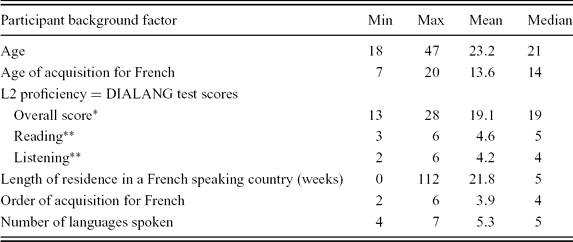
The proficiency level of the participants in French was assessed with the DIALANG test (Huhta, Luoma, Oscarson, Sajavaara, Takala & Teasdale, Reference Huhta, Luoma, Oscarson, Sajavaara, Takala, Teasdale and Alderson2002) in five sub-skills (reading, listening, vocabulary, grammar and writing) on the six-point Common European Framework of Reference (CEFR) scale (Council of Europe, 2001). The overall scores for the DIALANG test ranged from lower intermediate (B1) to highly proficient (C2). The participants’ background factors, age of acquisition, length of residence in a French-speaking country, the order of acquisition for French and the number of other languages spoken, were assessed with a questionnaire. These factors are summarized in Table 1.
Summary of the background information of the participants in Experiment 1 and 2 (n = 75).

* Scores on CEFR scale: 1–5 = A1, 6–10 = A2, 11–15 = B1, 16–20 = B2, 20–25 = C1, 25–30 = C2
** Scores on CEFR scale: 1 = A1, 2 = A2, 3 = B1, 4 = B2, 5 = C1, 6 = C2
Three background factors – L2 proficiency score, age of acquisition and length of residence in an L2 speaking country – were used to divide the participants into three proficiency level subgroups. The range of overall proficiency scores from the DIALANG test on the CEFR scale was from B1 (Threshold level) to C2 (Mastery level). The three proficiency subgroups therefore represented lower intermediate (n = 24), higher intermediate (n = 27) and high proficiency levels (n = 24).
Materials
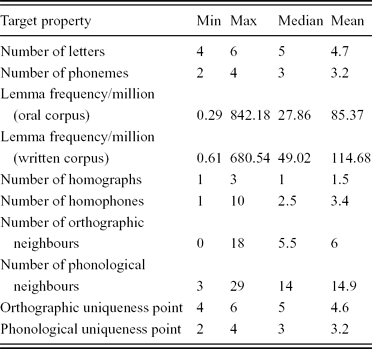
We used the same set of target stimuli as Grainger et al. (Reference Grainger, Diependaele, Spinelli, Ferrand and Farioli2003) in their Experiment 5. Two targets (linge and noix) were excluded from the original set, because they were used in Experiment 2. We thus obtained a set of 58 words and 58 non-words which served as targets in Experiment 1 (see Appendix A). They were monosyllabic words with a mean lemma frequency (LEXIQUE database; New, Pallier, Ferrand & Matos, Reference New, Pallier, Ferrand and Matos2001) of 85.4 (films = spoken frq) / 114.7 (books = written frq) per million words. Other characteristics of the targets are summarized in Table 2.
Summary of the distributional properties of the target words used in Experiment 1.
The auditory stimuli were spoken by a female French native speaker and recorded onto a computer hard disk. The average length for word targets was 4.7 letters and 3.2 phonemes. These auditory targets were associated with three different visual prime stimuli: (i) repetitions, (ii) non-word pseudohomophones, and (iii) non-word controls. In the repetition priming condition, primes were real words and orthographic equivalents of the auditory targets (e.g., <stage> – [staʒ] priming [staʒ]). In the pseudohomophone condition, primes were non-words, which according to French grapheme–phoneme conversion rules could be pronounced like the target words (e.g., <staje> – [staʒ] priming [staʒ]). In the control condition, primes were non-words showing no form overlap with the targets (e.g., <bleur> – [blœʀ] priming [staʒ]). All primes and non-word controls were matched with targets for length.
Design and procedure
The targets were counterbalanced between three experimental lists so that each list included only one of the above priming conditions ((i)–(iii)) per target. All lists included an equal number of trials from each condition. The participants were assigned to the experimental lists in the order of appearance.
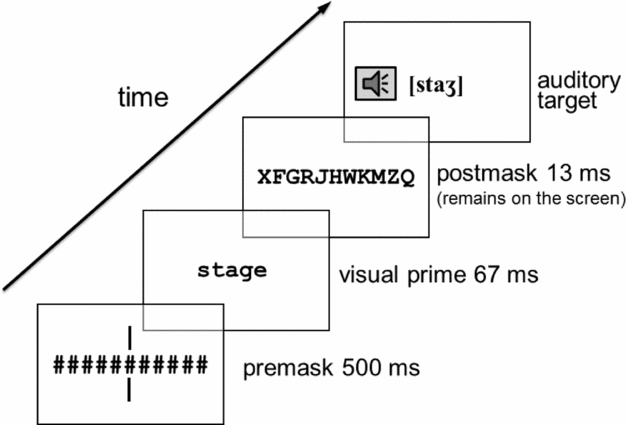
The participants were tested individually in a quiet room. The experimental session consisted of a practice block, an experimental block and a target familiarity rating task, in that order. The practice block consisted of 20 targets (10 words and 10 non-words, none of which appeared in the experimental lists). Only unrelated primes were used in the practice block. The experimental block consisted of two separate experiments, Experiment 1 and Experiment 2 (below), presented one after another in a counterbalanced order between participants. Experiment 1 consisted of 116 prime-target pairs (i.e., 58 words and 58 non-words) and Experiment 2 of 90 prime-target pairs (45 words and 45 non-words, described in detail below), which were presented in a randomized order for each participant. Figure 1 presents the timeline of the experiment. Each trial began with the presentation of a forward mask consisting of 11 hash marks (###########) together with two vertical lines (i.e., one above and one beneath the centre of the forward mask. This forward mask was presented for 500 ms in the centre of the computer screen. Following the mask, the prime appeared in the same location in lowercase 12 pt. Courier New letters and stayed on the screen for 67 ms (equals five scans of a 75 Hz video monitor), being immediately replaced by a backward mask composed of a pseudorandom string of 11 uppercase consonants (e.g., XFGRJHWKMZQ) for 13 ms. The backward mask shared no consonants with either the target or any of the primes and preceded the same target in all three prime conditions. The auditory target was presented 13 ms after the onset of the backward mask, and the mask remained on the screen until the end of the trial. The prime duration was set to 67 ms as Grainger et al. (Reference Grainger, Diependaele, Spinelli, Ferrand and Farioli2003) reported that obtaining pseudohomophone effects with the masked cross-modal priming paradigm was unlikely even with native speakers when shorter prime exposures were used. We also used the same type of backward mask as Grainger et al. (Reference Grainger, Diependaele, Spinelli, Ferrand and Farioli2003) to prevent revealing these longer primes to the participants.
The timeline of the experimental trials in Experiments 1 and 2.
The stimuli were presented to participants via a Beyerdynamic DT 550 headset connected to a standard PC. Visual primes were presented on a monitor with a 75 Hz refresh rate (frame duration of 13.3 ms). The experiment was controlled and run using DMDX (Forster & Forster, Reference Forster and Forster2003). Participants were instructed to decide as quickly and as accurately as possible whether the spoken stimulus was a French word or not. They did so by pressing the “yes” button on the right or the “no” button on the left of a Logitech Attack 3 joystick. For left-handed participants, this response procedure was reversed. Following a response, the backward mask disappeared from the screen. The cut-offs for the responses and the inter-trial interval were 4,000 ms and 532 ms, respectively (see Grainger et al., Reference Grainger, Diependaele, Spinelli, Ferrand and Farioli2003). Response latencies and error rates were recorded for data analyses.
Familiarity rating
The main experiment was followed by an offline target familiarity rating task. All target words from experiment 1 and 2 were presented visually to the participants.Footnote 1 Because we wanted to know the degree to which knowledge about the targets’ meaning would influence the recognition, we asked the participants to give a L1 Finnish translation for each word and rate on a five-point scale how certain they were of the given meaning (100%, 75%, 50%, 25% and 0% = a guess). If they did not know the meaning of the word, they had to choose between “I have seen this word before but I don't know its meaning” or “I have never seen this word before”. There was no time limitation for this task. These ratings were transformed into familiarity scores ranging from 0 to 6, and these scores were used in the analysis as a measure of each participant's subjective familiarity for each target.
Results
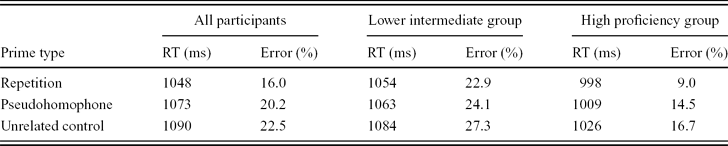
Prior to the data analyses, the targets that resulted in a high number of errors (≥50%) were excluded. This resulted in nine targets to be removed (cime, clan, grange, nerf, paix, ruse, plot, proie and score). In addition, all incorrect responses (22.0%) as well as responses below 100 ms and above 2000 ms (3.7%) were excluded from further analyses. Additional by-subject outliers (responses that were further than 1.58 × interquartile range (IQR) from the by-subject logarithmic reaction time median, 2.0%) were excluded using by-subject boxplots (Tukey, Reference Tukey1977). Table 3 summarizes the results from Experiment 1.
Arithmetic mean reaction times (RT) and error percentages in Experiment 1.
Reaction times
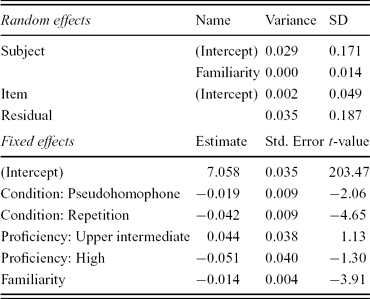
The data analysis was carried out by fitting a linear mixed model to the log-transformed latency data using participants and items as a crossed-random factor (e.g., Baayen, Reference Baayen2008), and condition (repetition, pseudohomophone, control), subjective familiarity and proficiency level group (lower intermediate, higher intermediate, high) as the fixed-effect predictors. We used backward elimination and log likelihood tests to evaluate the models (function anova in R). The best model without random correlation parameters showed significant effects for the repetition (Estimate = –0.041, SD = 0.009, t = –4.59, p < .001), and pseudohomophone conditions (Estimate = –0.018, SD = 0.009, t = –2.01, p = .047) as well as familiarity (Estimate = –0.011, SD = 0.002, t = –4.09, p < .001). We then inspected the effects of by-subject and by-item random slopes for the fixed predictors. Likelihood-ratio test showed that adding by-subject slopes for familiarity increased the model fit significantly (p < .001). The resulting model is depicted in Table 4. The analyses revealed that the repetition condition and the pseudohomophone condition resulted in clear facilitation compared to the unrelated condition. As we expected the repetition condition to show stronger priming than the pseudohomophone condition, we inspected the relative strength of the priming effects in the two conditions. We calculated the respective priming effects for the subjects (averaged over items) and items (averaged over subjects) separately by calculating the by-subject and by-item means for all three conditions and subtracting the baseline values from the pseudohomophone and repetition condition means. A paired t-test for the subject and item means showed that priming in the repetition condition was marginally stronger than in the pseudohomophone condition (t 1(74) = 1.575, p = .059; t 2(86) = 1.651, p = .051; one-tailed). In addition, we observed a significant effect of subjective familiarity, showing faster recognition for more familiar than less familiar words.
The model with the best fit for Experiment 1. The reference levels for factors were as follows: Condition – unrelated; Proficiency level – lower intermediate.
Adding an interaction term to the model did not increase the model fit significantly, which suggests that there were no qualitative differences between the proficiency groups, or, that there was not enough statistical power to detect such an interaction. However, as it is of interest to see whether all groups showed the effect to a similar degree, planned comparisons were carried out for the high proficiency and lower intermediate proficiency groups separately. The lower intermediate proficiency group showed a marginal effect of repetition priming (t = −1.87, p = .062) whereas for the high proficiency group this effect was significant (t = −2.55, p = .014). There were no significant pseudohomophone effects for any of the groups when analysed separately, suggesting that this effect was equally present in all groups, but did not appear significant in the separate analyses due to lack of statistical power.
Error rates
We inspected response accuracy by fitting a generalized linear mixed model (function lmer with binomial family in R) to the error data (correct, incorrect) with subjects and items as a crossed-random factor (e.g., Baayen, Reference Baayen2008), using the above fixed-effect predictors. The repetition condition significantly reduced the number of errors overall (Estimate = 0.527, SD = 0.126, z = 4.16, p < .001), whereas the pseudohomophone primes had no effect (z = 1.34, p = .180). Planned comparisons showed that the repetition condition produced significantly less errors in the high proficiency group (Estimate = 0.857, SD = 0.261, z = 3.28, p = .001,) whereas there was only a trend in the lower intermediate proficiency group (Estimate = 0.336, SD = 0.208, z = 1.62, p = .106). The pseudohomophone condition was not significant in either of the proficiency groups.
Discussion
The results of Experiment 1 showed that the masked cross-modal priming technique can be used to investigate spoken language processing with L2 learners. It further showed that orthographic activation can lead to facilitation also in L2 speech processing. We obtained a significant repetition priming effect showing that the visual primes had an early effect on the processing of the auditory targets. Repetition priming also significantly reduced the number of errors. However, the observed repetition effect as such does not confirm whether orthography is activated during all speech processing or across tasks (e.g., Cutler, Treiman & Van Ooijen, Reference Cutler, Treiman and Van Ooijen2010; Pattamadilok et al., Reference Pattamadilok, Perre and Ziegler2011; Peereman, Dufour & Burt, Reference Peereman, Dufour and Burt2009; Taft et al, Reference Taft, Castles, Davis, Lazendic and Nguyen-Hoan2008). We also obtained a slightly less pronounced but a significant effect of pseudohomophone priming which is in line with the results obtained with L1 speakers (Grainger et al., Reference Grainger, Diependaele, Spinelli, Ferrand and Farioli2003). This pseudohomophone effect could also be interpreted as orthographic to some extent, because the pseudohomophone primes often shared several letters with the target words. As expected, the repetition effect was stronger, albeit statistically only marginally so, than the pseudohomophone effect, suggesting that the difference was due to the larger orthographic overlap in the repetition than the pseudohomophone condition.Footnote 2 As expected, the subjective familiarity of the targets was a powerful predictor of both the reaction time latencies and error data (see De Groot et al., Reference De Groot, Borgwaldt, Bos and Van den Eijnden2002). When the proficiency groups at the two ends of the proficiency scale were compared and analysed separately, the high proficiency group showed stronger effects for repetition priming and thus more native-like performance than the lower intermediate proficiency group (see Grainger et al., Reference Grainger, Diependaele, Spinelli, Ferrand and Farioli2003).
As we were able to establish cross-modal influence from orthography to phonology within the target language, in Experiment 2 we proceeded to investigate between-language orthographic and phonological influence from L1 (Finnish) to L2 (French) with the same paradigm.
Experiment 2: Orthographic and pseudohomophone priming from L1 to L2
In order to investigate between-language orthographic influence in L2 spoken word processing, we used the masked cross-modal priming paradigm as in Experiment 1. Instead of using L2-based primes, we now used primes based on the participants’ L1, Finnish. First, our primary goal was to investigate how the activation of orthographically similar but semantically and phonologically unrelated real written L1 words would influence the processing of auditory words. As the grapheme–phoneme correspondences in Finnish and French differ to a great extent, we were able to avoid both semantic and phonological overlap between the primes and the targets and create a solely orthographic condition. Second, we wanted to contrast this condition with a phonological condition where the primes would be pronounced as similarly as possible compared to the targets but written according to the L1 sound to spelling rules. However, since it turned out to be difficult to find a sufficient number of familiar existing Finnish words that could serve as pseudohomophone primes while accommodating our primary goal of inspecting orthographic overlap, we used phonotactically legal pronounceable Finnish nonwords. As it is not possible to match Finnish and French pronunciation exactly, these primes were not a 100% phonological match with the L2 targets, but L1 Finnish accented variants of the L2 French target words. The choice of graphemes to represent L2 phonemes not existing in L1 was based on a task where L1 Finnish learners of different proficiency levels in L2 French had to write pronunciation instructions for French words to Finnish speakers not speaking any French.
Obtaining effects from L1 real word orthographic primes would speak for language non-selective access to an integrated lexicon. On one hand, if the learner's lexical system for L2 is indeed integrated with and organizsed as their L1, we might expect inhibition to arise (see e.g., Dijkstra et al., Reference Dijkstra, Hilberink-Schulpen and van Heuven2010). However, this effect could be strongly dependent on their L2 proficiency and could depend on how familiar, and thus how stable the meaning representations of the L2 words are for the learners. We might also expect inhibitory effects in the orthographic overlap condition resulting from the phonological mismatch between the L1 primes and the L2 targets. In that case the inhibition would rise at the sublexical level.Footnote 3 On the other hand, obtaining a facilitative effect would speak for a sublexical locus and support online activation of orthographic/phonological codes. Again, however, this effect might interact with proficiency and familiarity of the words. As to the L1 pseudohomophone primes, we expect facilitation if the sublexical route via L1 grapheme-to-phoneme correspondences offers a pathway to L2 phonology. As the lower proficiency learners have less stable L2 phoneme-to-grapheme mappings, they should benefit more from the phonological activation via L1 phoneme-to-grapheme correspondences than from orthographic overlap with L1 words, even though this might be more clearly visible for relatively less familiar words. The high proficiency learners, with more integration between phonological and orthographic information, should therefore show both phonological and orthographic effects. As our participants L1 orthography is shallow and highly transparent, they might rely more on the sublexical orthographic representations and show therefore facilitative orthographic effects even for L1 real word primes. These effects should get smaller for more familiar words because of the more stable lexical representations (further, possibly causing inhibition with L1 primes). In sum, we expect the proficiency groups to show a different pattern of results for these conditions: the high proficiency group should show stronger orthographic effects and the lower proficiency group stronger phonological effects, possibly with diminishing effects as the subjective word familiarity increases.
Method
Participants
Participants were the same as in Experiment 1.
Materials
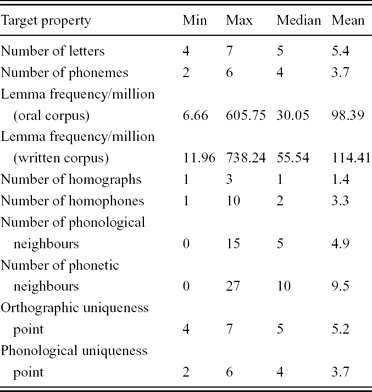
A set of 45 words and 45 non-words served as targets in Experiment 2 (see Appendix B). The target stimuli were mono- or bi-syllabic French nouns and were 4–7 letters long consisting of 2–6 phonemes with a mean lemma frequency (LEXIQUE database; New et al., Reference New, Pallier, Ferrand and Matos2001) of 98.4 (films = spoken frq) / 114.4 (books = written frq) per million words. The properties of the targets are summarized in Table 5.
Summary of the distributional properties of the target words used in Experiment 2.
The auditory targets were associated with three Finnish-based (L1) visual prime conditions: (i) orthographic onset overlap, (ii) Finnish-based pseudohomophones, and (iii) unrelated controls. In the orthographic onset overlap condition (i) the primes were semantically unrelated Finnish words with a three-letter orthographic onset overlap with the target's written form: L1 <huivi> ([huivi] “scarf”) priming L2 [ɥil] (<huile> “oil”). It must be emphasized that in all cases the primes had only orthographic but no phonological overlap with the targets (e.g., [hui] vs. [ɥi]). In the L1 pseudohomophone condition (ii) the primes were phonologically and orthographically legal non-word pseudohomophones which according to the Finnish grapheme–phoneme conversion rules would be pronounced closely like the targets: L1 <yil> ([yil] “non-word”) priming L2 [ɥil]. The primes in the control condition (iii) were real Finnish words with no semantic, phonological or orthographic overlap with the target: L1 <saate> ([saːte] “covering note”) priming L2 [ɥil]. The primes in conditions (i) and (iii) were matched with the targets for frequency and number of syllables.
Design and procedure
The design and procedure were as in Experiment 1.
Results
One of the targets (lance) produced more than 50% of errors and was excluded from the analysis. All incorrect responses (12.9%) as well as responses below 100 ms and above 2000 ms (2.6%) were excluded. Per subject outliers (responses that were further than 1.58 × interquartile range (IQR) from the by-subject logarithmic reaction time median) were also excluded (2.5%). The results are summarized in Table 6.
Arithmetic mean reaction times (RT) and error percentages in Experiment 2.
Reaction times
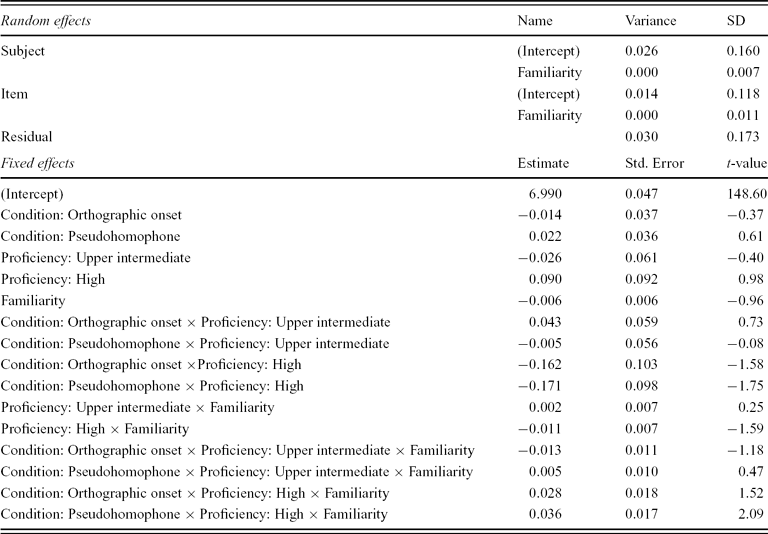
The remaining reaction times were log-transformed and analysed using linear mixed modelling (as in Experiment 1) with participants and items as a crossed-random factor (e.g., Baayen, Reference Baayen2008), and condition, familiarity of the targets, proficiency level group as fixed-effect predictors. The best model without random correlation parameters showed a three-way interaction suggesting that the high proficiency group differed significantly from the low intermediate group (intercept) with respect to familiarity and the L1 pseudohomophone condition (t = 2.23, p = .026) and marginally significantly with respect to familiarity and the orthographic onset condition (t = 1.76, p = .079). We then proceeded to inspect the effects of by-subject and by-item random slopes for the fixed predictors. Likelihood-ratio test (anova function in R) justified adding by-subject slopes and by-item-slopes for familiarity (p = .006). Table 7 presents the resulting model with the best fit to the data. As the summary indicates, only the former interaction remained significant. There was also an additional two-way interaction between high proficiency group and pseudohomophone condition indicating that the high proficiency group behaved significantly differently from the lower intermediate group with respect to this factor.
Results from the data analyses for Experiment 2. The reference levels for factors were as follows: Condition – unrelated; Proficiency level – lower intermediate.
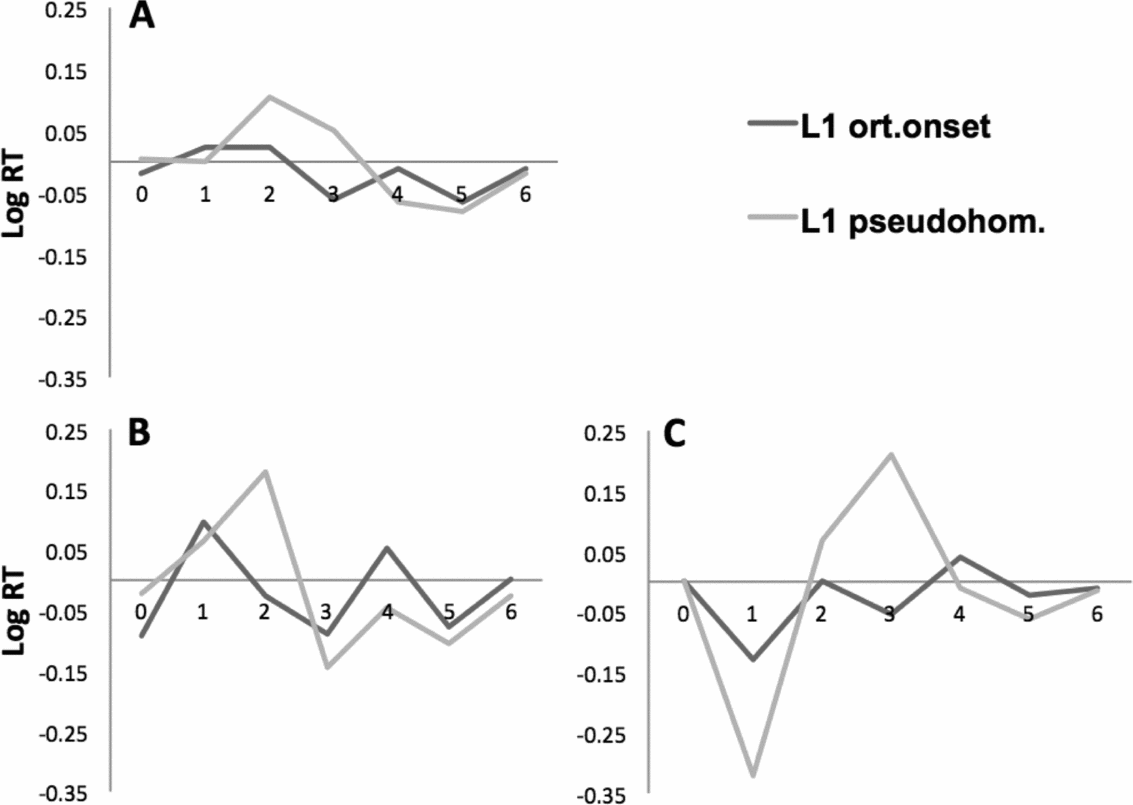
Separate analysis for the low intermediate and high proficiency levels revealed differing patterns of results for the two groups. The lower intermediate proficiency group benefitted from the pseudohomophone primes that showed significant facilitation (Estimate = −0.030, SD = 0.015, t = −1.99, p = .051) but not from the orthographic condition (t = −0.42). Including by-subject random slopes for familiarity significantly improved the model fit and also improved the results for the fixed-effect predictors (Orthographic onset, t = −0.54; Pseudohomophone, t = −2.24). In the high proficiency group the pseudohomophone primes showed marginal facilitation (Estimate = −0.166, SD = 0.091, t = −1.82, p = .071), whereas the effect of orthographic onset overlap condition was significant (Estimate = −0.192, SD = 0.096, t = −2.01, p = .046). Moreover, in the high proficiency group the facilitation induced by orthography was further modulated by a marginally significant interaction with the familiarity of the targets (Estimate = 0.032, SD = 0.017, t = 1.95, p = .057) indicating that the benefit from orthography in the high proficiency group grew less when the target words became more familiar. The interaction between the familiarity of the targets and L1-based pseudohomophones was marginal (Estimate = 0.027, SD = 0.016, t = 1.72, p = .086). The distribution of log-transformed priming effects between different subjective familiarity scores are depicted in Figure 2. Including by-subject and by-item random slopes did not increase the model fit according to likelihood-ratio test.
Log transformed priming effects by subjective familiarity of the targets in Experiment 2. Panel A: All participants. Panel B: Lower intermediate group. Panel C: High proficiency group.
0 = I have not seen this word before 1 = I have seen this word, but I don't know its meaning 2 = I am not at all certain of the meaning that I gave for this word 3 = I am 25% certain of the meaning that I gave for this word 4 = 50% certain 5 = 75% certain 6 = 100% certain
Error rates
We fitted a logistic mixed effects regression model (lmer with binomial family in R) to the error data with subjects and items as a crossed-random factor (e.g., Baayen, Reference Baayen2008), and condition, proficiency level group, familiarity of the targets as fixed-effect predictors (see Table 6 for the error percentages). The model with the best fit to the data revealed a significant two-way interaction between the high proficiency group and the orthographic overlap condition (Estimate = 2.741, SD = 1.335, z = 2.05, p = .040) indicating that in the orthographic condition, the high proficiency group was significantly more accurate than the lower intermediate group. A further three-way interaction between proficiency, orthographic overlap and familiarity (Estimate = −0.658, SD = 0.255, z = −2.58, p = .010) showed that familiarity modulated the effect of orthographic overlap in the high but not in the lower intermediate group. The high proficiency learners were more accurate with less familiar targets, and had a clear tendency to be less accurate with more familiar targets, whereas no such difference was observed for the lower intermediate group.
Overall, target word familiarity marginally reduced the number of errors (Estimate = 0.137, SD = 0.079, z = 1.74, p = .081), and the high proficiency group was marginally more accurate than the lower intermediate proficiency level group (Estimate = −1.674, SD = 0.887, z = −1.89, p = .059). When the groups were analysed separately, in the lower intermediate group there was a facilitative trend in the L1 pseudohomophone condition (Estimate = 0.447, SD = 0.272, z = 1.64, p = .101), but not in the orthographic condition (z = 1.36). The familiarity of the targets reduced errors significantly both in the lower intermediate (Estimate = 0.175, SD = 0.059, z = 2.98, p = .003) and the high proficiency group (Estimate = 0.467, SD = 0. 102, z = 4.60, p < .001). As to the high proficiency group, the effects of the orthographic (z = −0.61) and pseudohomophone (z = −0.66) priming were not significant. None of the by-subject and by-item adjustments increased the model fit significantly for any of the error analyses.
Discussion
The results of Experiment 2 suggest that orthography can play a role in spoken word recognition even with L2 learners, but that orthographic effects depend on the proficiency level of the learners and on the familiarity of the targets. When we analysed the data of all the different proficiency level participants together, we observed a significant interaction between the Finnish-based pseudohomophone condition, proficiency level group and familiarity of the targets in response latencies, and a trend for a similar interaction in error rates. These interactions indicated that for more familiar words, activating the phonology via L1 grapheme-to-phoneme mappings induced stronger facilitative effects in the lower intermediate proficiency group than in the high proficiency group which had a tendency to be less accurate compared to the unrelated baseline in this condition. We also observed a marginal interaction between the L1 Finnish orthographic primes sharing first three letters with the L2 French targets, proficiency level and the familiarity of the targets indicating that in the high proficiency group the facilitative orthographic effect was smaller for more familiar than less familiar words. We also observed a significant interaction between the same factors for error rates showing that high proficiency learners were less accurate when the primes were real L1 words. As in Experiment 1, the familiarity of the targets was the most powerful single predictor both for the RTs as well as the error data. When we analysed the data from different proficiency levels separately, the groups showed a distinctly different pattern: we obtained facilitative orthographic effects in the high proficiency group for latencies, whereas the lower intermediate proficiency group did not show any orthographic effects. In contrast, pseudohomophone facilitation was observed only in the lower intermediate proficiency group both for the reaction times and error rates. In addition, the orthographic effects on the reaction times of the high proficiency group were modulated by the familiarity of the targets showing that the facilitative effect of orthography decreased with more familiar words. The same inhibitory profile was found in the error data as well showing that, unlike the lower intermediate group, the high proficiency learners’ benefit from orthographic information decreased and their error rates increased as the target words got more familiar.
Obtaining L1-based pseudohomophone effects for the lower intermediate proficiency group suggests that these learners have not yet acquired stable L2 word representations with sufficient amounts of orthographic and phonological information or sufficiently strong links between the two. The significant interaction between orthographic primes and the familiarity of the targets showing facilitation for the mid-range but not the high familiarity words, the words the subjects were only 25%–50% certain, suggests that L1 orthography can offer sublexical facilitation for L2 processing when the L2 lexical representation is semantically unstable/weak but the form is familiar. The lack of effects for highly familiar targets is in line with this, suggesting that when the L2 semantic representations become more stable, cross-language lexical competition between L1 and L2 might result in inhibiting the benefit from sublexical orthographic facilitation. This finding is also compatible with the non-selective bilingual lexical account and the co-structuration account described above. These different patterns of results obtained for the low intermediate and highly proficient learners indicate that the processing mechanisms responsible for these effects for L2 spoken words might be different depending on the learners’ proficiency level.
General discussion
Summary of the main findings
The present study investigated the role of orthography in spoken word recognition with L1 Finnish learners of L2 French using masked cross-modal priming. The results indicate that orthography can influence spoken word processing even with L2 speakers, but that its influence depends on learners’ overall level of L2 proficiency.
For the L2 intralingual priming experiment (Experiment 1), we predicted stronger effects in the repetition condition than in the pseudohomophone condition, and stronger, more native-like effects for the more proficient learners. The visually presented repetition primes (<stage> – [staʒ]) facilitated the recognition of the auditory target words significantly. This was also the case with French pseudohomophones (<staje> – [staʒ]), but to a lesser extent. The pseudohomophone condition, though originally designed to be phonological, was without doubt also partly an orthographic one as the orthographic overlap with the targets was non-negligible. The results confirmed that activating the orthographic form of the target word can facilitate the recognition of its spoken form with L2 speakers, as it does with L1 speakers. Furthermore, the result shows that masked cross-modal priming is a viable tool for the investigation of L2 spoken word processing.
For the L1–L2 interlingual priming experiment (Experiment 2), we observed different patterns of effects depending on the participants’ overall proficiency level and the prime type. As expected, in the high proficiency group, we observed facilitation in the latencies in the purely orthographic condition consisting of L1 Finnish real word primes. In line with the predicted inhibition, the orthographic benefit (in RTs and errors) disappeared in this group with highly familiar targets. In contrast, the lower intermediate group showed no facilitation in the orthographic condition, but did benefit from the phonological condition consisting of L1 Finnish-based pseudohomophone nonwords that could be pronounced like the targets. The results indicate that orthography plays a role in L2 spoken word recognition as it does in native speech perception (see Grainger et al., Reference Grainger, Diependaele, Spinelli, Ferrand and Farioli2003), but only for relatively advanced learners with relatively established mental representation of the L2 lexicon.
Orthographic and phonological information in L2 word recognition
Models of language processing based on interactive activation assume that orthographic information is co-activated during phonological processing and phonological information is co-activated during orthographic processing (e.g., Grainger et al. Reference Grainger, Diependaele, Spinelli, Ferrand and Farioli2003; Grainger & Ziegler, Reference Grainger and Ziegler2011). The BIA+ model, a bilingual interactive activation model of visual word recognition (Dijkstra & van Heuven, Reference Dijkstra and van Heuven2002; van Heuven & Dijkstra, Reference van Heuven and Dijkstra2010) also assumes that orthographic, phonological and semantic representations are stored in an integrated language non-selective lexicon where the word candidates of any language are activated if the input matches the stored sublexical and lexical representations. Its architecture is based on the assumption of online co-activation of both modalities: visual input activates first sublexical orthographic representations which in turn activate both orthographic whole-word representations and sublexical phonological representations. The whole-word form representation can send bottom–up activation to the semantic representations as well as to the so called language nodes that account for the language membership.
The framework of BIA+ model fits well for explaining the findings of our intralingual Experiment 1. The robust cross-modal repetition effect that we obtained in the intralingual L2 priming experiment (Experiment 1) suggests that like with native speakers, with late bilinguals not dominant in the target language, the activation of the target's orthography facilitates the processing of its spoken form. The locus of this facilitation might have been either sublexical or lexical. If the locus is sublexical, this effect could be explained by the online co-activation account and it would have arisen because the learners had enough connections between the strong orthographic representations and probably weaker phonological representations. The larger observed effects with more proficient learners could in this framework be explained by the increased number of connections between orthography and phonology. If the locus were lexical, the effect might have been induced by lexical representations containing both orthographic and phonological information, which would be in line with the co-structuration account. Our results for Experiment 1 did not tease apart these two possible explanations.
The weaker but significant intralingual L2 pseudohomophone effect could be interpreted in the same framework as being strictly phonological. However, it is likely that it had a large orthographic component because there was both phonological and orthographic overlap between the primes and the targets. As we argued above, L2 speakers that learn L2 in instructional settings might often acquire the orthographic forms of the lexemes earlier or at the same time than their spoken variants. Thus, the pseudohomophone effect could arguably have an even stronger orthographic component for these learners than for L1 speakers. However, in our study this effect was not modulated by familiarity nor was it affected by L2 proficiency level in any straightforward way. Because the primes were non-words, this suggests that the benefit arose sublexically. This means that for getting from the visual form to the sublexical phonological representations and for the pseudohomophone effect to arise, the L2 learners have to have acquired sufficient knowledge about how orthography maps into phonology in L2.
Our between-language priming results in Experiment 2 could partly be interpreted in the BIA+ framework as having a sublexical locus. A brief presentation of visual L1 words sharing their first three letters with the targets (like <huivi>) activated orthographic units associated with this form (e.g., <h>, <u>, <i> or <ui>) and these units activated both the orthographic whole-word representation <huivi> and the corresponding phonological units (e.g., /h/, /u/, /i/ or /ui/). In the high proficiency group the Finnish L1 orthographic primes (e.g., huivi [huivi] “scarf”) facilitated the recognition of the French L2 words (e.g., huile [ɥil] “oil”). Because the orthography–phonology link in Finnish is not based on the same grapheme-to-phoneme correspondences as French L1 words, this would suggest that the locus of this facilitation was sublexical: the activated orthographic units (<h>, <u>, <i>) also mapped onto the sublexical phonological units of L2 (/ɥ/ /i/) in parallel to those of L1 (/h/, /u/, /i/). However, this effect diminished for more familiar words.
In contrast, the lower intermediate group did not benefit from orthographic information, but did show significant facilitation with the L1-based pseudohomophones. Because Finnish has a shallow transparent orthography, this effect was due to direct phonological activation: The L1 pseudohomophone non-word prime <yil>, mimicking a Finnish-like accented pronunciation of the French word, offers fast mapping of native spelling-to-sound and further to L2 phonology via the sublexical phonological units (/y/, /i/, /l/.). This is in line with the findings suggesting that L1 sublexical links between orthography and phonology can influence L2 processing (Hayes-Harb et al., Reference Hayes-Harb, Nicol and Barker2010). It also suggests that the phonological representation for L2 words might be influenced by the L1 accent (see e.g., Hanulikova & Weber, Reference Hanulikova and Weber2012; Reinisch, Weber & Mitterer, in press, for the effects of the L1 accent on L2 speech perception). Furthermore, since the primes in the L1 pseudohomophone condition did not have orthographic overlap with the L2 targets’ written form, this effect, along with the lack of one in the orthographic condition, suggests that the lower proficiency learners have not yet developed stable L2 orthography–phonology representations in French. Important, the lack of this effect with high proficiency learners coupled with the observed orthographic facilitation that diminished for high familiar words in this group suggests that the processing mechanisms may be different for different L2 proficiency levels.
In the interlingual priming Experiment 2, the benefit from orthography depended on how well the participants knew the word's meaning. Non-target language orthographic neighbours are known to cause inhibition due to lexical competition (Bijeljac-Babic et al., Reference Bijeljac-Babic, Biardeau and Grainger1997; van Heuven et al., Reference van Heuven, Dijkstra and Grainger1998). If increased certainty about the meaning of the word is an indicator of a (more) stable lexical representation, then the result suggests that our learners benefitted from sublexical orthographic facilitation only when the word did not yet have a stable representation in place, because the facilitation from L1 orthography grew less when L2 target word familiarity increased. The possibility that the inhibition would have resulted from the mismatch between the orthographic and phonological information on the sublexical level cannot be totally overruled, but it seems likely, that the benefit from bottom–up sublexical activation was countered and rendered moot by competition at the lexical level, even though it was not general and stable enough to counter all the bottom–up facilitation thus showing itself as a lack of facilitation in RTs and as an inhibitory trend in error rates (see Dijkstra et al., Reference Dijkstra, Hilberink-Schulpen and van Heuven2010, whose within-modality inhibition was nonsignificant as well). The results fit well with the idea that native and non-native words compete for recognition in a language non-specific integrated bilingual lexicon. They further suggest that increasing experience with L2 spoken input co-structures lexical representation for non-native words and diminishes the likelihood of false alarms originating from L1 bottom–up orthography. In sum, our finding that L1 orthographic effects were modulated by the familiarity of the targets and the level of overall proficiency indicates that orthographic overlap between L1 primes and L2 targets offers a shortcut to access L2 word representations assuming that the learners have enough knowledge about the correspondences of L2 orthography and phonology at the sublexical level and assuming that they do not yet have stable L2 lexical representations that would cause inhibition by the interlingual lexical competition.
The restructuration account as such does not seem suitable for explaining the results of our participants who were all relatively late learners of L2, literate when starting to learn L2 French, and exposed to plenty of written input. It is unlikely that these learners would have strong phonological representations in L2 that were later restructured by the orthography. An alternative explanation for L2 learners excluding the sublexical resonance between phonology and orthography like the restructuration account (Taft et al., Reference Taft, Castles, Davis, Lazendic and Nguyen-Hoan2008) would be the co-structuration account suggested above. When orthographic and phonological information are learned in parallel, it could lead to the development of abstract orthographic-phonological representations which amalgamate information from both modalities. In terms of this account our results could be explained by a proficiency related quantitative difference about how much orthographic and phonological information is stored in the L2 lexical representations and a qualitative difference in how accurate this information is and how well it is integrated. If the co-structuration of orthographic and phonological information had led to balanced integration of this information from the early developmental stages, we should have observed similar effects at all proficiency levels. This was not the case, however. The observed differing between-language effects for lower and high proficiency learners could be interpreted as showing that as the learners become more proficient, their lexical representations contain increasingly accurate orthographic and phonological information with sufficient amounts of integration resulting from the learning of L2 grapheme–phoneme correspondences.
Conclusions
The results of the current study suggest that L2 learners of different proficiency levels can benefit from different information sources for processing spoken words. Interactive activation models (e.g., Dijkstra & van Heuven, Reference Dijkstra and van Heuven2002; Grainger & Ferrand, Reference Grainger and Ferrand1994; Grainger et al., Reference Grainger, Diependaele, Spinelli, Ferrand and Farioli2003; van Heuven & Dijkstra, Reference van Heuven and Dijkstra2010) fit well for explaining these results. The links between sublexical orthographic and phonological representations lead to facilitation if orthography is activated by the prime – regardless of the source language. More proficient learners have developed more and stronger links between the modalities and show therefore more pronounced orthographic effects. An alternative explanation would be the co-structuration account described above. Learners who have been exposed largely to written language from the early stages of L2 learning are unlikely to not have acquired enough orthographic information for words that they are able to recognize in the spoken form. Therefore differences due to proficiency may be qualitative: More proficient learners would have acquired more accurate orthographic and phonological information in L2, integrated it better in common abstract representations and show therefore more and stronger effects. There is also the possibility that the processing mechanisms are not the same at different proficiency levels. Lower proficiency L2 learners might have separate orthographic and phonological representations which are co-activated if there is enough matching information between the two, whereas higher proficiency learners might have integrated these two in one common set of qualitatively co-structured lexical representations.
The current study is the first to use the masked cross-modal paradigm to investigate the relationship between orthography and phonology with L2 speakers. It has established the use of this method in L2 context by showing that orthographic effects can be obtained both in L2 intralingual and between-language priming from L1 to L2. More important, it has shown that high proficiency L2 learners activate orthography automatically and early in spoken word recognition whereas lower proficiency L2 learners rely more on phonological processing. Whether orthography is automatically activated in other types of tasks and with L2 learners of other types of L1 orthographies is to be solved in further studies.
Appendix A. Stimuli used in Experiment 1
Appendix B. Stimuli used in Experiment 2