1. Introduction
The increase in stringent environmental regulation costs in terms of ‘regulatory protectionism’ Baldwin (Reference Baldwin, Collins and Rodrik2000) that firms must pay to access foreign markets has the potential to impact trade flows both at the intensive and extensive margins. The United Nations Conference on Trade and Development, in its Trade and Development Report 2005, quotes a 2002 study by the International Trade Commission which finds that 40 per cent of exports from less-developed countries are subject to non-tariff barriers, including standards (UNCTAD, 2005). This issue has assumed great importance, as the past decade saw a global proliferation of environmental and health-related standards (Chaturvedi and Nagpal, Reference Chaturvedi and Nagpal2002; Chakraborty, Reference Chakraborty2009). Both leather and textile sectors emerged as a battlefield for dramatic regulatory shifts during the early 1990s with the processing technologies being under greater scrutiny by the governments and consumer advocacy groups in the industrial economies (Tewari and Pillai, Reference Tewari and Pillai2005). The Indian leather and textile industries in the 1990s witnessed sudden regulatory shocks from one of its key trade partners, Germany. This paper explores one such unique natural experiment – Germany's banning of one of the most widely used chemicals (‘azo-dyes’) in the production of leather and textile goods in 1994 – in terms of trade-related environmental regulation, in order to investigate the effect on the trade, adaptation and exit effects of leather and textile firms. The paper argues that the azo-dyes legislation significantly helped the Indian leather and textile firms to earn higher revenue from exports through investment in high-quality imported raw materials and technology. In short, the presumed tradeoff between compliance and export competitiveness did not materialize (Tewari and Pillai, Reference Tewari and Pillai2005).
The banning of one of the most widely used chemicals in the production of leather and textile goods, ‘azo-dyes’, by the German regulatory authorities in July 1994 was an exogenous regulatory shock on Indian leather and textile firms. The sudden regulatory shock imposed by the global authorities unleashed a debate on how the leather and textile firms could possibly comply with the stringent environmental/technical standard without compromising their competitiveness.Footnote 1 Triggered by the 1994 azo-dyes regulation and to prevent the cascading effect of the ban on the economy, two events happened simultaneously in order to facilitate Indian leather and textile firms in their process of adjustment: (1) the Government of India immediately slashed the import duties on the improved high-quality substitutable chemicals from 150–200 per cent to its base rate, 20 per cent; and (2) German regulatory authorities, with help from the state-sponsored industrial bodies (e.g., Central Leather Research Institute, Bombay Textile Research Association), engaged in providing direct technical support to leather and textile firms in the process of adaptation.Footnote 2 The reason for this immediate and efficient action was primarily due to the importance of these sectors both in terms of their contribution to the domestic economy and to international trade earnings.Footnote 3 In addition, Germany represented a large share of the export market for Indian leather and textile goods. For example, textiles alone made up around 76 per cent of all consumer-goods exports from India to Germany (IKB Deutsche Industriebank, 1994),Footnote 4 which highlights the importance of the supply chain between Germany and India during the early 1990s.
Given the significance of these sectors for the Indian economy, it is worth examining important issues of the effects – trade, adaptation and exit – on leather and textile firms due to the ban of azo-dyes as a critical input in the production processes of leather and textile products. While there is some literature available on how these firms have coped with such customary quality and environmental norms, much of the existing research remains either at the qualitative or policy level (Tewari and Pillai, Reference Tewari and Pillai2005). This paper tries to fill this gap by explicitly considering the imposition of the German regulation which arguably provides a good source of a natural experiment in terms of an exogenous shock as it was mainly demand driven. To the best of our knowledge, this is the first paper to address the effects of the azo-dyes ban at the micro level using firm performance measures. This paper also contributes to the growing firm-level literature about the effects of environmental regulation on firm dynamics. It uses a firm-level panel data set containing direct measures on exports, imports of raw materials, expenditure on usage of domestic raw materials, R&D expenditure, royalty payments for technical knowhow, capital, labour, intermediate goods, expenses on plant and machinery, etc., to test for the trade, adaptation and discontinuity effects of this regulation for the years 1990–2002.
The results are clear and robust. First, the impact of the azo-dyes regulation is estimated on three important firm-level characteristics: export earnings, import of raw materials and technology transfer (royalty payment for technical knowhow). Indirect evidence of the signalling effect is found: the regulation forced the leather and textile firms, the upper-half of the size distribution, to use high-quality substitutable inputs and improved technology to earn significantly higher revenue from exports. Next, we examine the factors which may pose a credible threat to the continuity of a firm's activity because of the azo-dyes regulation. Nonlinear estimates demonstrate that higher use of imported raw materials significantly lowers the exit probabilities. Lastly, strong evidence is found in support of the sorting effect by the 1994 regulation – the German regulation negatively affects the operation of only the small leather and textile firms.
The rest of the paper is organized as follows. Section 2 provides contextual background to the paper. Section 3 describes the data with preliminary analysis. The direct effect of the regulation on firm-level export flows and adaptation cost has been estimated in section 4. Section 5 estimates the survival probabilities of the firms. Section 6 confirms the amount of heterogeneity involved in the effect of the ban, and section 7 concludes.
2. Background
2.1. Regulatory changes
Consumers and governments in the OECD countries take environmental threats seriously and use their purchasing power effectively to influence legislatures to introduce new regulation(s) which produce eco-friendly products. Based on a laboratory test report and petition filed by consumer advocacy groups, the use of azo-dyes and pigments was banned through legislation in the Federal Parliament of Germany on 15 July 1994. The German Parliament by an amendment to Germany's Consumer Goods OrdinanceFootnote 5 passed legislation completely banning the use of certain azo-dyes in consumer products that had the potential to come into close and prolonged contact with the skin.Footnote 6 Azo-dyes, a group of synthetic dyes made from benzidine, toluidine and similar organic chemicals, used to account for approximately 70 per cent of all organic dyes produced in the world. Through chemical breakdown, some azo-dyes form chemical substances called aromatic amines (arylamines) which have been proven to be or are suspected of being carcinogenic. According to this regulation, nothing dyed with azo-colourant is allowed to reach the market in Germany. This law applies to both domestic and foreign products.Footnote 7 The ban on azo-dyes has been considered an acceptable measure within the General Agreement on Tariffs and Trade as well, since according to Article XX it is implemented to protect human health. Furthermore, the ban also did not discriminate against the origin of products.Footnote 8 A report by the OECD (2006a) notes that the effects of the European legislation on azo-dyes is perhaps felt most acutely in India because its considerably large textile and leather industry depends on these dyes. For example, around 25–70 per cent of the items treated with azo-dyes were exported to the EU, with Germany being one of its main markets.
2.2 Literature review
This paper fits mainly into the literature regarding the impact of regulation(s), especially environmental regulation(s), on firm performance. The existing theoretical literature is concentrated mainly on two different kinds of effects: (a) signalling or the demand-side effect which operates through either the use of high-quality input substitution or the technology upgradation/spillover effect; and (b) the cost or supply-side effect. The former argues that successful adoption of a technical standard may act as a label or quality indicator, giving a signal to the consumers that the product is of higher quality. This may effectively increase demand by relieving consumers' concerns about the quality of the product (Porter and Van der Linde, Reference Porter and Van der Linde1995; Greaker, Reference Greaker2006; Andre et al., Reference Andre, Gonzalez and Porteiro2009). On the other hand, the cost-side literature claims that, by raising adaptation costs, higher technical standards raise overall production costs of the polluting firms, rendering them uncompetitive and eventually driving them out (Conrad and Wang, Reference Conrad and Wang1993; Sengupta, Reference Sengupta2010). The results in this paper draw significant support from the theoretical findings of Greaker (Reference Greaker2006) and Andre et al. (Reference Andre, Gonzalez and Porteiro2009), which show that exports or sales of a firm could increase in the post-regulation period, even when there is an increase in adaptation cost, as the regulation acts as a signal. This is the primary contribution of this paper.
Empirically, the effect of environmental regulation(s) has been explored in several dimensions: (1) productivity (Berman and Bui, Reference Berman and Bui2001); (2) plant exit (Biorn et al., Reference Biorn, Golombek and Rakneurd1998); (3) trade volumes (Chen et al., Reference Chen, Otsuki and Wilson2008); (4) product choice (Lipscomb, Reference Lipscomb2008); (5) plant or establishment birth and size (Dean et al., Reference Dean, Brown and Stango2000); and (6) innovation activity (Jaffe and Palmer, Reference Jaffe and Palmer1997). The evidence is mixed; some studies find positive effect on exports, while some see the opposite. Although there is some literature available on the effects of environmental regulation on the dynamics of industries or firms, the lion's share focuses on the effect of state- or national-level regulation, which could be endogenous to the performance of the industries or firms concerned. By focusing on the azo-dyes regulation from Germany, it was possible to identify an important natural experiment in terms of trade-related environmental regulation which is completely exogenous and estimates its effect on crucial firm-level choice variables of the targeted industries, i.e., the Indian leather and textile firms. This constitutes the second contribution of this paper.
3. Data
3.1. Firm-level data: PROWESS
The current study uses firm-level data from the PROWESS database published by the Centre for Monitoring Indian Economy (CMIE). It contains information primarily from the income statements and balance sheets of the companies. The database covers large companies, companies listed on the major stock exchanges (this includes all the publicly traded firms) and many small enterprises. Data for large companies is worked out from the balance sheets while CMIE periodically surveys the smaller companies. However, the database does not cover the unorganized sector. The firms in the sample comprise 60–70 per cent of the economic activity in the organized industrial sector in India and encompass 75 per cent of corporate taxes and 95 per cent of excise duty collected by the Government of India (Khandelwal and Topalova, Reference Khandelwal and Topalova2011).
PROWESS has some significant advantages over other data sets documenting India's manufacturing sector: (1) it is a panel of firms which enables us to see firm performance over time; (2) the database records detailed product-level information at the firm level; (3) it perfectly suits the time period of concern, i.e., 1990–2002; and (4) a unique feature of the data set, on which this study is based, is that it gives direct information on export revenues, import of raw materials and innovation expenditure (R&D expenditure and royalty payment for technical knowhow) for each firm. PROWESS, therefore, is particularly well suited for understanding how these leather and textile firms adjusted their production function over time in response to the foreign regulation from Germany in 1994. All firms are matched with the 2004 National Industrial Classification (NIC) at the 2-digit level. All the variables are measured in Indian Rupees (INR) millions. An unbalanced panel over the period 1990–2002 is used for estimation purposes.
3.2. Preliminary analysis
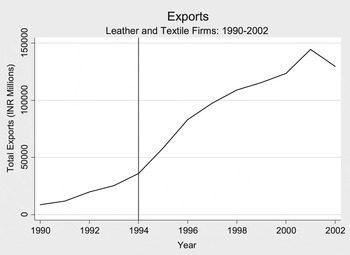
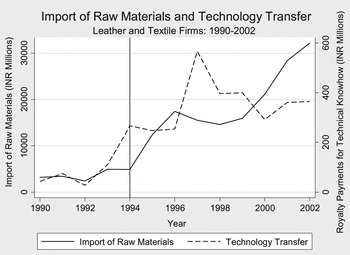
This section previews the rigorous empirical analysis. Figure 1 plots export revenues of all leather and textile firms for 1990–2002. It shows a clear and significant increase in the export revenues of the leather and textile firms in the post-1994 or post-regulation period. Next, figure 2 plots import of raw materials and royalty payments for technical knowhow (proxy for technology transfer); both show significant upward spikes immediately after 1994. To investigate whether this is a common trend across all the manufacturing sectors or just specific to the leather and textile firms (because of the 1994 German regulation), we check the import of raw materials and technology transfer of all other manufacturing industries less leather, textile and chemical (not reported).Footnote 9 No evidence is found to indicate that this trend is not specific to the leather and textile sector.
Total exports of leather and textile firms, 1990–2002

Import of raw materials and technology transfer of leather and textile firms, 1990–2002

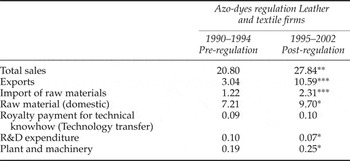
Next, we look at the average values of the outcomes of interest along with a few other important firm-level indicators in the pre- and post-1994 regulation period in table 1, using 1990–1994 and 1995–2002 as the pre- and post-regulation periods, respectively. The average values – expenditures/earnings – across all leather and textile firms for total sales, export earnings, import of raw materials, expenditure on domestic raw materials, royalty payments for technical knowhow (proxy for technology transfer), investments on R&D, and expenditure on plant and machinery are calculated. The values in table 1 are corrected for inflation using the sector-specific Wholesale Price Index number. An average leather and textile firm earns more (from both total sales and exports) in the post-regulation period.Footnote 10 A firm spends around double on import of raw materials in the post-regulation as compared to the pre-regulation period; expenditure on use of domestic raw materials also increased, but not very significantly.Footnote 11 A leather and textile firm does not spend significantly more for royalty payments towards transfer of technology in the post-regulation period; however, expenditure for plant and machinery increased significantly. Use of new raw materials may have required some changes in the production process which led to increase in investment in plant and machinery. However, these results are merely suggestive and do not provide any conclusive evidence, unless other simultaneous policy changes and firm-level characteristics (observed and unobserved) are controlled for.
Firm-level characteristics: before and after the azo-dyes regulation

Notes: Figures are simple averages (deflated by the wholesale price index number) over all the leather and textile firms. Values are expressed in INR millions. *, **, *** denote significance at 10%, 5% and 1% level, respectively.
4. Effect of the azo-dyes regulation on exports, import of raw materials and technology transfer
We now evaluate the direct effect of the 1994 azo-dyes ban on three of the most important firm-level characteristics by using difference-in-differences type of specification:
 $$\ln\lpar x_{ijt}\rpar =\beta\!\lpar {Post}_{t}\ast {lt}_{ij}\rpar +{Post}_{t}+{firmcontrols}_{it}+\mu_{j}+\epsilon_{ijt}\comma \; $$
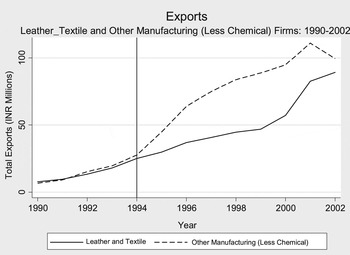
where x ijt is either export earnings or import of raw materials or technology transfer of firm i belonging to sector j at time t. Post t is a year dummy variable measuring the azo-dyes regulation. It takes a value 1 for the years following the regulation. In particular, Post t would take value 1 for the years 1995–2002. Since the main variable of interest is a year dummy, it will be difficult to distinguish between the ‘treatment’ and the ‘time’ effects unless a control group is used in the estimation. To untangle the true effect of the regulation, a group must be used which is unaffected by the shock (or treatment), but on the other hand its behavioural pattern follows more or less the same path as that of the treated one in the pre-regulation period. For this purpose, we use other manufacturing sectors (less chemical) as the control group in the estimation.Footnote 12 We acknowledge that this may not be the perfect control group that could have been used; the best would have been using any subsector within the leather and textile industries which is exogenous to the regulation. But this would still not solve the problem of the control group being completely exogenous, as there is free mobility of workers across different subsectors of leather and textile.Footnote 13 Given the circumstances, this is the best that could be found since all the other manufacturing sectors are impacted by some of the macro reforms (e.g., by the simultaneous tariff and FDI liberalization that happened in the 1990s) in the same way as in the leather and textile sectors. Using any other sector, say services, would have been more exogenous to the shock relative to the other manufacturing sector (less chemical), but the behavioural pattern of any services sector is completely different from that of manufacturing (as this is not a tradeable sector) and may bias the results in a different way. Figure 3 plots average exports of a firm belonging to the ‘control’ group (all other manufacturing sectors less chemical) and ‘treated’ (leather and textile) sector for 1990–2002, normalized by the base year (1990). The figure clearly supports the conjecture about using the rest of the manufacturing sector (less chemical) as the control group. In other words, trends of export flows for the ‘treated’ (leather and textile) group is almost the same as that of the ‘control’ (other manufacturing less chemical) group before the regulation, with the deviation starting after the year 1994.
Comparison of exports between leather & textile and other manufacturing sectors (less chemical)

lt ij is a dummy variable, which takes a value 1 for a firm if a firm belongs to the leather and textile sector. The main coefficient of interest is β, which measures the effect of the azo-dyes regulation (Post t × lt ij ) on firm-level outcomes given that a firm belongs to the leather and textile sector in comparison to those sectors which potentially have the same characteristics as the treated sectors, but are unaffected by the regulation. In other words, it measures the relative earnings of leather and textile firms as compared to other manufacturing sectors (less chemical). In particular, β, the coefficient of interest in equation (1), is the effect of the treatment on the treated, or the impact of the azo-dyes regulation on leather and textile firms relative to the manufacturing firms unaffected by the policy change. Or, β estimates the change in x ijt due to the azo-dyes ban, net of general change post-1994, and net of possible permanent difference across other manufacturing sector (less chemical) firms. firmcontrols it includes size of the firm, age, age squared, and indicator for domestic or foreign ownership. Total assets of a firm is used as its size indicator. μ j and η t are industry and year fixed effects, respectively. The standard errors are clustered at the industry level (NIC, 2-digit).
While estimating the above equation, we carefully control for other simultaneous industrial and trade policies, undertaken by the Government of India because of the trade liberalization exercise in the early 1990s, which could potentially affect the outcomes. Those, if not controlled for, may confound the estimates. Three crucial events took place during the same period which may affect the results: (a) India became a member of the World Trade Organization (WTO) from 1 January 1995; (b) in March 1998 the European Commission (EC) requested that India procure export licenses to export raw hides and skins; the presence of the year fixed effects (η t ) in the regression equation will categorically control for the effect of such events;Footnote 14 and (c) finally, the trade reform exercise (tariffs were reduced and industries were de-licensed). To specifically control for these events and disentangle the true effect of the 1994 azo-dyes regulation, we do the following: (i) use input tariffs at the NIC 2004 3-digit level, following Khandelwal and Topalova, (Reference Khandelwal and Topalova2011); and (ii) interact industry fixed effects with time trends.
The presence of industry fixed effects (μ j ) will also control for the anti-dumping duties that may have been imposed during the same time period on different kinds of textile products from India,Footnote 15 information received from different state-sponsored industrial bodies about the bans, network effects (of industries with different state-level stakeholder agencies, which are the primary receivers of information about the regulation), and the assistance the firms got from institutions like the Central Leather Research Institute (CLRI) or the Bombay Textile Research Association (BTRA), etc., which may have helped them in the process of upgrading the production process or in the use of new raw materials. Controlling for all these other policy effects will help produce true and exact estimates of the effects of the azo-dyes regulation.
4.1. Benchmark results
Before moving on to detailed estimation with firm-level data, we check for the required effect using trade data at the aggregate level. The data used to estimate the effect of the azo-dyes regulation on aggregate leather and textile exports relative to other manufacturing sectors (less chemical) of India is obtained from WITS (World Integrated Trading Solution). Unlike the data from PROWESS, this data set includes exports from both organized and unorganized sectors and therefore gives evidence of what has happened at the aggregate (rather than only for the registered industrial sector as when using PROWESS data) because of the azo-dyes regulation. Post t × lt j is used as the variable of interest. In table A.1 in online Appendix A, available at https://doi.org/10.1017/S1355770X17000079, the coefficients clearly show that the azo-dyes regulation induces higher relative earnings for the leather and textile sectors.
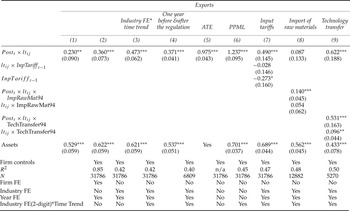
To check whether the same is true at the micro level, firm-level data is used to investigate the effect of the 1994 azo-dyes regulation on firm-level export earnings. Table 2 reports the result. In a nutshell, the results from the disaggregated or firm-level analysis match completely with preliminary evidence from the macro level. In other words, the coefficient of interest clearly demonstrates that the 1994 azo-dyes regulation significantly increased the export revenues of the leather and textile firms relative to other manufacturing sectors (less chemical). Column (1) regresses the natural logarithm of total exports of a leather and textile firm plus one on the interaction of Post t and lt ij controlling for its size, age and firm-year fixed effects; column (2) repeats the same by substituting firm fixed effects with industry and including ownership dummy (domestic or foreign). The effect continues to be the same. In column (3), we interact industry fixed effects (2-digit level) and time trends to control for industry-level unobservable heterogeneity which varies over time. The estimates show that it does little to harm the benchmark result – the primary result continues to hold at 1 per cent level of significance. The estimates show that the 1994 azo-dyes regulation helped an average leather and textile firm to earn 26–60.5 per cent more than an average manufacturing firm belonging to any other sector (less chemical). In column (4), the time period is narrowed – one year before and after the regulation (time period runs from 1993 to 1995) – to check whether the same effect holds. This is done to reduce the effect of other policies, say industrial de-licensing, affecting the outcome of interest. By doing so, the result will entail a much cleaner effect of the regulation on the export earnings. As the coefficient of interest demonstrates, reducing the sample period does not alter the benchmark finding.Footnote 16
Effect of the azo-dyes regulation on export earnings of leather and textile firms

Notes: The dependent variable is the natural logarithm of exports plus 1. Post t is a regulation dummy, which takes a value of 1 when the year ( = t) is greater than 1994. lt ij is a dummy variable, which takes a value of 1 if a firm i belongs to the industrial sector j ( = Leather and Textiles). Other manufacturing sectors (less chemical) are used as the control group in the estimations. ‘InpTariff t-1’ is input tariffs at the 3-digit NIC 2004. ‘ImpRawMat94’ is the average amount of raw material imported by a firm between 1990 and 1993 (before the regulation). ‘TechTransfer94’ is the average amount of royalty payment made by a firm for technical knowhow between 1990 and 1993 (before the regulation). ‘Assets’ is the total amount of assets of a firm. ‘Assets’ of a firm is used as its size indicator. All the regressions include the individual and double interaction terms of the double and triple interactions, respectively. Firm controls include age of a firm, age squared and ownership (domestic or foreign) indicator of a firm. Numbers in parentheses are clustered standard errors at the industry level. Intercepts are not reported. *, **, *** denote 10%, 5% and 1% level of significance, respectively.
An important problem of causal inference is how the estimate of a causal effect obtained by comparing a treatment group with a non-experimental comparison group could be biased because of problems such as self-selection or some systematic judgement by the researcher in selecting units to be assigned to the treatment. Column (4) uses the propensity score-matching method to correct for potential sample selection bias due to observable differences between the treatment and control groups. The average treatment effect (ATE) is estimated to understand the effect of the azo-dyes ban on the relative earnings from international trade flows of an average leather and textile firm. A simple exposition of the ATE can be written as:
 $$ATE=E\!\lpar Y_{1i}\vert T_{i}=1\comma \; 0\rpar -E\lpar Y_{0i}\vert T_{i}=1\comma \; 0\rpar \comma \;$$
where E(.) represents the expectation in the population. T i denotes the treatment (in this case, it is the azo-dyes ban) with a value of 1 for the treated group and 0 for the control group. In other words, the ATE can be defined as the average effect that would be observed if everyone in the treated and the control groups received treatment, compared with if no-one in both groups received treatment (Li, Reference Li2012). The ATE measures the difference in mean (average) outcomes between the units assigned to the treatment and control groups, respectively. For this estimation, the leather and the textile exporters are used as the ‘treated’ and the exporters of the other manufacturing sectors less chemical as the ‘control’ group. The observables across the ‘treated’ and ‘control’ groups are balanced based on age, ownership and size. The point estimate doubles and continues to show significant effect of the azo-dyes regulation on relative export earning of leather and textile exporters.
In column (5), we deal with the problem of zeroes. For all the previous estimations (from columns (1)–(4)), the natural logarithm of the dependent variable plus one is used to estimate the model in percentage changes. Dealing with zeroes is a huge issue and the plus one method is somewhat arbitrary. A typical way to deal with this situation is to estimate using a Poisson Pseudo-Maximum Likelihood (PPML) following Santos Silva and Tenreyro (Reference Santos Silva and Silvana2006). Like logging the dependent variable, PPML estimates the coefficients in terms of percentage changes. On the other hand, PPML, unlike log, is able to handle zeroes. PPML gives consistent point estimates for a broad class of models: the dependent variable does not have to follow a Poisson distribution or be integer-valued (it can be continuous).Footnote 17 As the coefficient demonstrates, the regulation induces significant gains from exports. In column (6), the trade reform exerciseFootnote 18 of India is controlled for. Previous research on India's trade reform process argues that it significantly increased the efficiency of the Indian manufacturers (Khandelwal and Topalova, Reference Khandelwal and Topalova2011), and this may well increase the earnings from exports. So, if not controlled for, the results can possibly run into omitted variable bias. Column (6) uses input tariffs at the 3-digit NIC 2004 as one of the possible factors that may explain the observed finding so far. As the coefficients show, even though input tariffs significantly affect the export earnings of the leather and textile firms, the primary result – the effect of the azo-dyes regulation positively affecting the export revenues of the leather and textile firms – continues to hold at the 1 per cent level of significance.
Next, columns (7)–(8) use import of raw materials and technology transfer as potential explanatory variables. The reason for using these variables is the following: the azo-dyes regulation immediately triggered two significant events that may also affect the export earnings: (a) slashing of the import duties of substitutable chemicals by one-tenth, and (b) firms engaging in technical transfer. We interact these two variables with Post t × lt ij to investigate whether we observe the same effect when we interact these pro-industry policies with the azo-dyes ban. Since both import of raw materials and technology transfer are endogenous in the post-regulation period, we take the average expenditure on import of raw materials and technology transfer for the years 1990–1993 and interact with the variable of interest. The results show that the firms that used higher amounts of imported raw materials and technical knowhow, because of the 1994 azo-dyes regulation, earned more from exports as opposed to other firms. These results confirm the qualitative findings of Tewari and Pillai (Reference Tewari and Pillai2005) and suggest that involvement of the state, triggered by a binding environmental regulation, made a major difference to the process of compliance.Footnote 19 Overall, the estimates show that the azo-dyes regulation led to a 26–245 per cent increase in export earnings for an average leather and textile firm relative to firms belonging to other manufacturing sectors (less chemical). In addition, the results also indicate that large firms earn more from exports – firm assets being significantly and positively correlated with the outcome of interest.
Figure 3 clearly supports the benchmark finding explicitly; it shows significant difference in the earnings between an average leather and textile firm and firms of other manufacturing sectors (less chemical) in the post-1994 phase. The gap widens between 1994 and 2000 and narrows around 2002. To corroborate these findings, we check the aggregate leather and textile exports from India during the same period; value of leather exports between 1991–1992 and 1998–1999 went up from INR30,360 m to 64,360 m, whereas for textile, it increased from INR154,836 m to 401,715 m. The results are interestingly similar to those of Swann et al. (Reference Swann, Temple and Shurmer1996), even though they use a different time period and data set. They use counts of standards to find that British exports are positively correlated with national standards. There could be other effects as well, which may influence the results – for example, simultaneous increase in the demand for leather and textile goods. To check for this, world income is included as one of the explanatory variables to see if the effect of azo-dyes ban vanishes. No such evidence is found (results not reported).
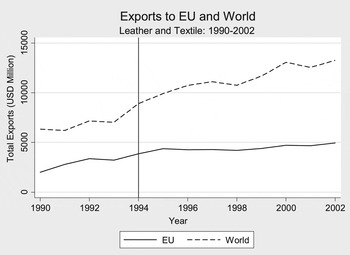
The benchmark finding could also be a result of a trade diversion effect; Indian leather and textile exports increase (in the post-regulation period) for other destinations and not the EU, resulting in an increase in total exports.Footnote 20 Figure 4 plots total exports of Indian leather and textile goods to the World and the EU for 1990–2002 using the UN COMTRADE database; the figure fails to show any evidence in support of this alternative hypothesis. Export flows continue to increase towards the EU even in the post-regulation period. We go one step further to decompose the exports of leather and textiles particularly towards Germany and other EU countries (Austria, Belgium, France and Netherlands) that simultaneously adopted the regulation (and that also happen to be important trading partners of India). Figure A.1 in online Appendix A plots the same, and shows that there is no drop in leather exports either towards other major EU trading partners (that simultaneously adopted the regulation), or towards Germany. However, in the case of textile exports it is not the same: there is a slowdown after a year of the regulation and then a decrease for a couple of years (before starting to increase again), only to be compensated by the increase in exports to other major EU importers. Therefore, there could possibly be an occurrence of trade diversion only in case of Germany for textiles. Secondly, a simultaneous decrease in exports from the other major leather and textile exporters (competitors of India), such as Bangladesh, Pakistan and Vietnam, to the EU (because of the azo-dyes regulation) could force the EU member countries to buy more Indian products. The trend of export flows of leather and textile products from these countries to the EU in the post-regulation period is therefore checked. The trend does not seem to support this conjecture.
Total exports of Indian leather and textile products to the EU and world, 1990–2002

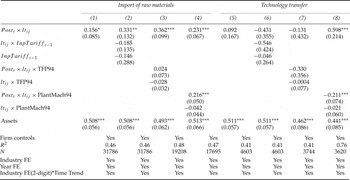
The principal objective of the azo-dyes regulation was to ban a widely used chemical (which is supposedly harmful) in the production process of leather and textile products and substitute it with some improved input. This process of substitution entails a firm adjusting its production process, using either a different set of inputs (replacing the banned chemical) and/or technical upgradation. Using substitute imported inputs (of high quality) or upgraded technology may have encouraged this growth in exports in the post-regulation period (as highlighted earlier), but can also add to a firm's production costs. For this reason, we test the effect of the 1994 azo-dyes regulation on the following two variables related to the process of compliance: import of raw materials and royalty payments for technical knowhow (proxy for technological transfer) in table 3.Footnote 21 These are used as the measures for ‘adjustment support’. The Government of India reduced the import duties substantially on the substitutable chemicals to enable the leather and textile firms easily to procure the new inputs (chemicals). This policy should affect the import bill of the firms. Since the information on the exact tariff lines (on which the tariff duties have been reduced) is not available, information is used on the import of raw materials by the firms as a proxy for the government aid effect in columns (1)–(4).Footnote 22 The results show that the 1994 regulation has significant and positive impact on the import of raw materials by a leather and textile firm, even when controlling for the trade liberalization exercise (using input tariffs).
Effect of the azo-dyes regulation on import of raw materials and technology transfer of leather and textile firms

Notes: Columns (1)–(4) use natural logarithm of imports of raw materials, whereas columns (5)–(8) use royalty payments for technical knowhow (technology transfer) as the dependent variable, respectively. Post t is a regulation dummy, which takes a value of 1 when the year ( = t) is greater than 1994. lt ij is a dummy variable, which takes a value of 1 if a firm i belongs to the industrial sector j ( = Leather and Textiles). Other manufacturing sectors (less chemical) is used as the control group in the estimations. ‘InpTariff t-1’ is input tariffs at the 3-digit NIC 2004. ‘TFP94’ is the average level of firm productivity measure, estimated by Levinshon and Petrin's (Reference Levinshon and Petrin2003) methodology, between 1990 and 1993 (before the regulation). ‘PlantMach94’ is the average amount of expenses for plant and machinery and its repairs by a firm between 1990 and 1993 (before the regulation). ‘Assets’ is the total amount of assets of a firm. ‘Assets’ of a firm is used as its size indicator. All the regressions include the individual and double interaction terms of the double and triple interactions, respectively. Firm controls include age of a firm, age squared and ownership (domestic or foreign) indicator of a firm. Numbers in parentheses are clustered standard errors at the industry level. Intercepts are not reported. *, **, *** denote 10%, 5% and 1% level of significance, respectively.
Based on a field-level survey in Chennai and Kanpur for leather firms and Mumbai and Surat for textile firms, a 2005 report from the Energy and Resources Institute (TERI, 2005) also points out that the firms experienced an increase in their adaptation cost (through use of imported high-quality materials) in the process of substitution of the banned chemical. Moreover, the report also points out that the process of substitution did not hinder export flows significantly.Footnote 23 Surveying a handful of leather firms in Chennai, Tewari (Reference Tewari2001) also documents similar evidence of significant increase in their cost of substituting the newly improved chemical. OECD (2006a, 2006b) case studies on the effect of the azo-dyes ban also report a similar increase in the adaptation cost for the leather and textile firms. According to one OECD study (2006a), one consequence of this change is the improvement in the general environmental performance of India's leather and textile industries. Two years following the ban, only one out of 129 samples failed the azo-dyes test compared to nearly all in 1994 (Tewari, Reference Tewari2001).
The OECD (2006a, 2006b) azo-dyes case studies point out evidence of technology transfer from Germany in collaboration with industry associations (CLRI and BTRA) and the Government of India. Royalty payments made by the firms on technical knowhow is used as a proxy for technology transfer. A leather and textile firm may use upgraded technology to produce final products to comply with the regulation. Columns (5)–(8) regress the natural logarithm of royalty payments by firms on Post t × lt ij ; no effect is found.Footnote 24 However, there could be many reasons for this. For example, the transfer of technology might be concentrated on only one section of the firms and not on the entire size distribution. This issue is explored later by dividing the firms by size categories.
So, what could be the economic rationale behind such a phenomenon, i.e., the increase in the relative export earnings of the leather and textile firms because of the regulation? The fundamental reason that could be responsible for the increase in export earnings of a textile and leather firm lies in the nature of the regulation. It is purely demand driven and binding. The introduction of the 1994 azo-dyes regulation allowed for the production of a new and more environmentally friendly variant using high-quality input. Since environmentally friendly products are more costly to produce, in an unregulated market many firms would like to avoid such a foray into ‘green’ production. However, in the case of a binding regulated market (such as this one), the firms are bound to adopt high-quality input (our results give evidence of such practice) as suggested, to maintain their operation in the international market. And, since the regulation comes from the demand side, the firms benefit from the consumers' willingness-to-pay higher prices for a high-quality good and none would run the risk of being exploited by their competitors. This is called the ‘signalling effect’. The adoption of a high-quality input gives a clear signal to the consumers about its quality, which lead to higher earnings from trade. Further, this quick adoption of the newly improved chemical/input due to the support of various local/regional and international agencies, public and private, helped the firms to lower their cost of adjustment, generate ongoing learning and diffuse widely across the value chain. This also suggests that greater demands for safer high-quality goods outweigh the increase in cost as part of the compliance process. This result draws significant support from the theoretical underpinnings of Greaker (Reference Greaker2006) and Andre et al. (Reference Andre, Gonzalez and Porteiro2009). It also draws support from the central premise of the Porter and Van der Linde (Reference Porter and Van der Linde1995) hypothesis that environmental regulation can entail a positive effect on the competitiveness of the firms.
The standards may also have reduced the transaction costs by increasing the transparency of products and components, through flow of information between producers and consumers regarding the inherent characteristics and quality of products that can help in obtaining good prices for the exporting establishments (Jones and Hudson, Reference Jones and Hudson1996). Another reason that could have helped the exporters to gain from exports is the reduction in uncertainty in quality because of the compliance with the environmental/technical standard. As Tewari and Pillai (Reference Tewari and Pillai2005) report, an official from the Council of Leather Exports points out that it became fashionable to show that a leather and textile product is ‘azo-dye’ free, since it signals better quality and yields higher price.
5. Survival probabilities
As trade cost goes down, chances of survival of a firm increase, thereby enabling new firms to enter the market (Melitz, Reference Melitz2003); we test the opposite. The azo-dyes regulation could impose an additional cost on the firms (in terms of complying with the regulation), therefore lowering their survival chances and finally forcing them to exit the export market. Biorn et al. (Reference Biorn, Golombek and Rakneurd1998) studies such a correlation between environmental regulation and plant exit for three manufacturing sectors in Norway and finds that firm characteristics play an important role in exit probabilities. In the following, we test the factors which could potentially be responsible for lowering the chances of survival of a leather and textile firm because of the 1994 azo-dyes regulation. Since the decision to exit is a discrete variable, which equals 0 or 1, a conditional probit model with a discrete binary endogenous dependent variable is appropriate. Hence, the discontinuing probability of a firm i operating in industry j at time t is:
 $$\eqalign{P\lpar {X_{ijt}=0}\, \vert\, {X_{ijt-1}>0}\rpar & = 1\quad if \lpar {Post}_{t} \times {lt}_{ij} \times Z_{it} \rpar +\mu_{j}+\eta_{t}+\epsilon_{ijt} = 0 \cr & = 0\, otherwise\comma \; }$$
where, Z ijt is a vector of control variables which includes import of raw materials, expenditure on raw materials used from domestic sources, technology adoption, TFP of a firm, expenditure on plant and machinery and capital employed. All the variables are used in their logarithmic form. The dependent variable is the discontinuing decision of a firm, which is denoted as 1 if the export earnings of a firm equal zero either for 1995 or 1996, conditional on the fact that the exports are positive on or before the year of the ban. Since the exit decision is taken at the firm level, a full set of industry (μ j ) dummies is used along with a battery of year fixed effects (η t ). The standard errors are clustered at the industry level. The coefficients are estimated by the maximum likelihood (MLE) procedure and the marginal effects are reported. Other manufacturing sectors less chemical continues to be used as the control group in the estimation. To check if the dependent variable is capturing the right effect and not any just general trend, an additional estimation is performed (results not reported). Any random year is taken as the potential year of exit and the same set of regressions is run to see if the factors which significantly affect the operation decision of a leather and textile firm as result of the regulation stay the same. No such evidence is found. While estimating the binary equation above, one issue which can potentially influence the results is the problem of attrition bias.Footnote 25 This is not much of a problem in the case of the export market, as: (i) the exit rates are very low, i.e., around 5–7 per cent; and (ii) we clearly observe the firms who stop exporting in the years following the azo-dyes regulation.
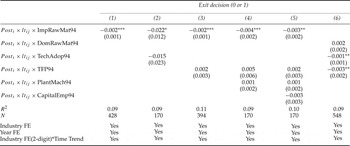
Table 4 produces the results from the conditional probit estimation. Columns (1)–(6) estimate the survival probabilities of a leather and textile firm because of the azo-dyes regulation in 1994. Column (1) regresses the exit decision of a firm on the interaction of the natural logarithm of import of raw materials and Post t × lt ij . The coefficient shows that use of imported raw materials significantly affects the exit decision of a firm; higher expenditure for import of raw materials entails low exit probability. The estimate is significant at the 1 per cent level. Column (2) additionally introduces the amount of technology adopted. Technology adoption is defined as the sum of expenditure on R&D and royalty payments for technical knowhow. No significant effect of the technology adoption by a leather and textile firm on its exit decision is found; the primary result therefore continues to hold.Footnote 26
Effect of the azo-dyes regulation on survival probabilities of leather and textile firms

Notes: Since the decision is either to stay or to discontinue, our dependent variable is either 0 or 1. The analysis is done using conditional probit regressions. Marginal effects are reported. Post t is a regulation dummy, which takes a value of 1 when the year ( = t) is greater than 1994. lt ij is a dummy variable, which takes a value of 1 if a firm i belongs to the industrial sector j ( = Leather and Textiles). Other manufacturing sectors (less chemical) is used as the control group in the estimations. ‘ImpRawMat94’ is the average amount of raw material imported by a firm between 1990 and 1993 (before the regulation). ‘DomRawMat94’ is the average expenditure on raw materials from domestic sources by a firm between 1990 and 1993 (before the regulation). ‘TechAdop94’ is the average amount of expenditure by a firm for technology adoption between 1990 and 1993 (before the regulation). Technology adoption is the sum of R&D expenditure of a firm and royalty payment for technical knowhow (technology transfer). ‘TFP94’ is the average level of firm productivity measure, estimated by Levinshon and Petrin's (Reference Levinshon and Petrin2003) methodology, between 1990 and 1993 (before the regulation). ‘PlantMach94’ is the average amount of expenses for plant and machinery and its repairs by a firm between 1990 and 1993 (before the regulation). ‘CapitalEmp94’ is the average amount of capital employed by a firm between 1990 and 1993 (before the regulation). All the firm-level variables are used in their natural logarithm form. All the regressions include the individual and double interaction terms of the triple interactions. Numbers in parentheses are clustered standard errors at the industry level. Intercepts are not reported. *, **, *** denote 10%, 5% and 1% level of significance, respectively.
Column (3) examines whether TFPFootnote 27 of a firm has any effect on the exit decision. Complying with the regulation may result in a drop in TFP, which can drive a firm out of the market; no such evidence is found. As the coefficients demonstrate, the initial result continues to hold at the 1 per cent level of significance. Change in the input mix may also induce changes in the production process; this could force firms to make alterations in the capital employed and expenditure for machinery used for production. To account for these changes, columns (4) and (5) introduce expenditure on plant and machinery and capital employed, respectively. Again no significant evidence is found of any other factor except for the import of raw materials on the exit decision of the firms. In column (6), we substitute import of raw materials with expenditure on use of domestic raw materials, controlling for the technology adoption and the level of productivity. No effect is found of the use of domestic raw materials on the exit decision of a leather and textile firm. However, the results show that higher adoption of technology entails low exit probabilities, which points to an interesting and crucial result. A leather and textile firm, when not using any imported raw materials, is dependent on the use of high-technology processes to comply with the 1994 regulation. The estimates indicate that, at the mean, a surviving leather and textile firm spent 0.2–2.2 per cent more on imported raw materials compared to a non-survivor; it did so to comply with the 1994 regulation and to continue its operation in the international market.
6. Heterogeneity: quartile regressions
This section tests whether there is heterogeneity involved in the effect of the azo-dyes regulation. In particular, the effect of the azo-dyes regulation on size distribution of leather and textile firms is tested. To do so, the sample of firms is divided into four different quartiles, according to the total assets of a firm (total assets is considered to be the size indicator). The different size categories of firms are indicated by a dummy variable. For example, if the total assets of a firm fall below the 25th percentile of total assets of the industry (that the firm belongs to), then that firm belongs to the first quartile and the variable would indicate 1 for that particular firm, and zero otherwise. Likewise, if a firm's total assets fall between the 25th to 50th percentile, 50th to 75th percentile or above 75th percentile, the firm belongs to the categories of second, third or fourth quartile, respectively. We interact different quartile dummies with Post t × lt ij to measure the effect of the azo-dyes regulation on that particular quartile of firms. The effects on different quartiles of firms are estimated in two separate ways:
-
(i) the impact of the regulation for four different quartiles on three important firm-level outcomes – exports, import of raw materials and royalty payments on technical knowhow (technology transfer) using the following equation:
(3)where r indexes each of the four different quartiles of the size distribution and Q it r are dummy variables taking the value of 1 when firm i belongs to quartile r. $$\eqalign{\ln\!\lpar x_{ijt}\rpar & = \beta^{r}\sum\limits_{r=1}^4 {\lpar {Post}_{t} \times {lt}_{ij} \times Q_{it}^{r}} \rpar +\varphi^{r}\sum\limits_{r=1}^4 Q_{it}^{r} +\gamma\!\lpar {Post}_{t} \times {lt}_{ij}\rpar \cr & \quad +{firmcontrols}_{it}+\mu_{j}+\eta_{t}+\epsilon_{ijt}}$$
-
(ii) the direct impact of the regulation on the discontinuing decisions of the firms across different quartiles:
(4)
$$\eqalign{P\!\lpar {X_{ijt}=0}\, \vert\, {X_{ijt-1}>0}\rpar & =1 \quad if \beta^{r}\sum\limits_{r=1}^4 {\lpar {Post}_{t} \times {lt}_{ij} \times Q_{it}^{r}} \rpar \cr & \quad +\varphi^{r} \sum\limits_{r=1}^4 Q_{it}^{r} + \gamma\!\lpar {Post}_{t} \times {lt}_{ij} \rpar \cr & \quad +{firmcontrols}_{it}+\mu_{j}+\eta_{t}+\epsilon_{ijt}=0\cr & = 0\, otherwise.}$$


The dependent variable used in equation (4) is the same as that in equation (2). It takes the value of 1 if the exports of a leather and textile firm are zero in either of the years following the regulation, 1995 or 1996, conditional on the fact that it is positive in the year of (1994), or the year before (1993), the ban. Other manufacturing sectors (less chemical) is used as the control group. Firms could change their positions (quartiles) over the period of operation and this may endogenize our estimates. To control for this, we use the rank of firms in the base period of the analysis, i.e., 1990. For both the above regressions, the standard errors continue to be clustered at the industry level.
Effect of the regulation on exports, import of raw materials and technology transfer
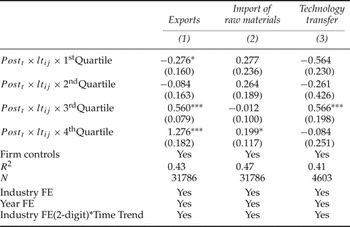
The differential effect, by varying firms according to their size distribution, of the German azo-dyes regulation on export earnings, import of raw materials and technology transfer is presented in table 5. Column (1) regresses the natural logarithm of exports on the interaction of the four different quartile dummies with Post t × lt ij . The coefficients demonstrate that the effect of the azo-dyes regulation is indeed heterogeneous.Footnote 28 The increase in export earnings because of the regulation is concentrated only on the upper half of the firm size distribution, i.e., for the 3rd and 4th quartiles of firms, which are typically the marginally big and big firms, respectively. Big exporters enjoy considerable advantages in their economies of scale which may have helped them to comply with the regulation using new high-quality inputs and/or upgraded production processes, thereby earning more revenue from exports. Additionally, the result shows that the azo-dyes regulation reduces earnings from exports in the case of small firms, or the firms belonging to the 1st quartile. In column (2), the import of raw materials is used as the dependent variable; the regulation significantly increases the import of high-quality raw materials, but only for the big (4th quartile) leather and textile firms. The estimates are significant at the 1 per cent level. Lastly, royalty payments for technical knowhow or technology transfer are used as the dependent variable in column (3). As the result demonstrates, the effect of the regulation on the technology transfer is positive and significant, but only for firms belonging to the upper-middle size cohort of the firm size distribution, i.e., firms of the 3rd quartile. The result regarding the transfer of technology concentrating on the upper-middle size cohort of firms because of some exogenous trade-related shock is outstandingly similar to the benchmark result of Bustos (Reference Bustos2011), even though she uses a completely different context and data set. Bustos (Reference Bustos2011) points out that a reduction in trade cost increases the use of the most advanced technology by the marginally big (3rd quartile) firms that export. The findings in this paper are similar in this sense but quite the opposite in other dimensions – in this case, a supposed increase in trade cost forces the firms to use new technology.
Effect of the azo-dyes regulation on exports, import of raw materials and technology transfer of leather and textile firms: quartile regressions

Notes: Columns (1), (2) and (3) use natural logarithm of exports, imports of raw materials and royalty payment for technical knowhow plus 1 as the dependent variable, respectively. Post t is a regulation dummy, which takes a value of 1 when the year ( = t) is greater than 1994. lt ij is a dummy variable, which takes a value of 1 if a firm i belongs to the industrial sector j ( = Leather and Textiles). Other manufacturing sectors (less chemical) is used as the control group in the estimations. Quartiles are defined according to the total assets of a firm. Total assets is used as the size indicator. A firm belongs to the 1st quartile if the assets of that firm are below the 25th percentile of the total assets of that industry to which the firm belongs. A firm belongs to the 2nd, 3rd or 4th quartile if the total assets of the firm are between the 25th to 50th percentile, 50th to 75th percentile or above the 75th percentile, respectively. Firm controls include age of a firm, age squared and ownership (domestic or foreign) indicator of a firm. All the regressions include the individual and double interaction terms of the triple interactions. Numbers in parentheses are clustered standard errors at the industry level. *, *** denote 10% and 1% level of significance, respectively.
Returning to the result in column (1), we argue that technology transfer and use of high-quality imported substitutable raw materials may have possibly helped firms in the 3rd and 4th quartiles to achieve higher growth in exports in the post-regulation period through quality signal in their products.Footnote 29 This result also corroborates the earlier finding on survival probabilities – a firm when not using imported raw materials utilizes upgraded technical processes to survive in the market. Tewari and Pillai (Reference Tewari and Pillai2005) notes that, in the firms' adjustment process to the regulation, there is significant evidence of technical transfer from the standard-imposing country, Germany, to India. The Indo-German Export Promotion Project (IGEP) played a significant role in providing adequate help to the firms when adapting to changes in the technical and environmental standard put forward by the azo-dyes regulation. Additionally, The Netherlands provided technical assistance. Between October 1996 and January 1997, the Centre for the Promotion of Imports from Developing Countries in The Netherlands, together with a Dutch independent consultancy, CREM, jointly organized a series of workshops aimed at preventing the azo-dyes legislation from becoming a trade barrier to developing country exporters. The United Nations Industrial Organisation (UNIDO) has also been one of the most proactive intergovernmental organizations in providing technical assistance to the leather industries (OECD, 2006b). In order to continue significant technical assistance at the firm level, a new, internationally certified testing centre – Asia's first ISO-17025 certified testing and certification laboratory – was established in 2001. This resulted in important spillover gains for both the industries. These findings suggest that the involvement of the state – in both Germany and India – made a crucial difference to the degree and speed of compliance.
Effect of the regulation on the exit decision
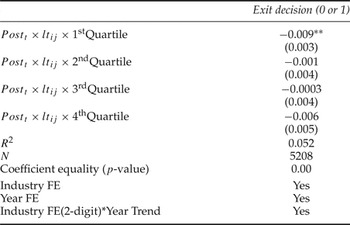
Table 6 presents the direct effect of the azo-dyes regulation on survival probabilities of leather and textile firms of different sizes – in other words, how the firm exit effects vary by size. The required effect is investigated using a conditional probit regression with a full set of industry and year fixed effects. The variables of interest are the interaction terms of four different quartile dummies with Post t × lt ij . The coefficients of these interaction terms measure the variance in the effect of the regulation on different sizes of leather and textile firms. The result suggests that the 1994 regulation led to a sorting effect. In other words, the regulation renders significant exit probabilities only for the small firms, i.e., the firms belonging to the 1st quartile. These are typically the small firms which have been hit the hardest by the foreign regulation, forcing them to stop exporting and to exit the market.Footnote 30
Effect of the azo-dyes regulation on survival probabilities of leather and textile firms: quartile regressions

Notes: Since the decision is either to stay or to discontinue, the dependent variable is either 0 or 1. The analysis is conducted using conditional probit regressions. Marginal effects are reported. Post t is a regulation dummy, which takes a value of 1 when the year (=t) is greater than 1994. lt ij is a dummy variable, which takes a value of 1 if a firm i belongs to the industrial sector j (= Leather and Textiles). Other manufacturing sectors (less chemical) is used as the control group in the estimations. Quartiles are defined according to the total assets of a firm. Total assets is used as the size indicator. A firm belongs to the 1st quartile if the assets of that firm are below the 25th percentile of the total assets of that industry to which the firm belongs. A firm belongs to the 2nd, 3rd or 4th quartile, if the total assets of the firm are between the 25th to 50th percentile, 50th to 75th percentile or above the 75th percentile, respectively. All the regressions include the individual and double interaction terms of the triple interactions. Numbers in parentheses are clustered standard errors at the industry level. Intercepts are not reported. ** denotes 5% level of significance.
Field-level reports by TERI (2005) also suggest the severe impact of the 1994 azo-dyes ban on small enterprises. In particular, 24 firms, small and medium-sized, belonging to the leather sector were surveyed in the city of Chennai, Tamil Nadu. Around 88 per cent of the respondents felt that there had been an adverse impact of the environmental standards, particularly the 1994 regulation, on the export earnings in the long run. The regulation acted as an insurmountable trade barrier, resulting in great losses, in terms of selling in the export markets. Problems may have cropped up because of any of the binding regulations, such as poor understanding of environmental issues, asymmetric information on international regulations, not enough access to import of high quality raw materials or new domestically produced input, limited technical knowhow, and so forth. These factors may have played a role in the exit decisions of small leather and textile firms. This left no choice for German importers but to buy from the large firms instead, which led to significant gains from trade for the large firms. This particular result about the sorting effect draws support from the findings of Pavcnik (Reference Pavcnik2002); she argues that the drop in tariffs reallocates resources from the small firms to the big firms. Our finding is the same, but for a rise in implicit trade cost.
7. Conclusion
This paper investigates the trade, adaptation and firm exit effects of the imposition of a purely exogenous technical standard or trade-related environmental regulation, specifically designed for Indian leather and textile firms. It exploits firm-level data from the leather and textile manufacturing sector to present evidence, which is at odds with the prevalent view of environmental compliance and trade competitiveness of firms from developing countries. In particular, we find that the 1994 azo-dyes regulation led to significant gains from international trade for both leather and textile firms. The gain from trade is possibly based on the signalling effect, i.e., through the use of high-quality raw materials and technology-intensive production processes, particularly for the upper half of the firm-size distribution. Regulation, on average, acts as a barrier and when originated from a buyer in the international market can be termed as an implicit trade cost which can impact firm survival. Investigation of the impact of the regulation on the exit probabilities of an average leather and textile firm finds that higher use of imported raw materials entails low exit probabilities. It is also found that the 1994 regulation led to sorting effect – discontinuation of the small firms from the export market.
There is a considerable amount of debate about whether regulation(s) or standard(s) help or hurt the competitiveness of firms. This paper is an empirical contribution to this continuously growing debate. Although the paper does not test the Porter's hypothesis (1995) directly, it explores similar issues. The results go beyond the assumed tradeoff between the compliance and the competitiveness of the firms and prove that firms from developing countries can also comply with stringent global standards that are increasingly becoming associated with trade, without necessarily undermining their competitiveness. One problem that could have hindered the performance of the firms is the political weakness of the state and its limited administrative and technical capacity, which could have posed a threat to the effective diffusion of new norms and standards (Dasgupta, Reference Dasgupta2000). But such was not the case for India. The Government of India's quick response in terms of substantial reduction of the import duties on the substitutable chemicals and technical consultations in response to the embargo by Germany is also an important component in the process of the transformation of the firms. Nonetheless, in the context of this reform, India not only promoted the quality of production but also obtained the necessary foreign revenue for development and investments. In the process, the leather and textile industry played an important role. According to an interview conducted by Tewari and Pillai (Reference Tewari and Pillai2005) in the IGEP Project in New Delhi (April 2003), there is a general agreement that India had taken care of its azo-dyes problem and emerged as a model in international circles, especially among its neighbouring competitor countries, such as China and Pakistan.
Supplementary material and methods
To view supplementary material for this article, please visit https://doi.org/10.1017/S1355770X17000079.