Introduction
Algeria is home to a diverse range of important tree and shrub species whose fruits play a crucial role in human nutrition because of their high nutritional value. However, some fruits are rarely consumed due to their scarcity or the lack of knowledge about their nutritional value. Among these species, the Rhamnaceae family's wild jujube (Ziziphus lotus L. Desf.) was selected to examine its fruits.
Jujube is an excellent source of many nutrients and phytochemical components (Tardío et al., Reference Tardío, Sánchez-Mata, Morales, Molina, García-Herrera, Morales, DíezMarqués, Fernández-Ruiz, Cámara, Pardo-de-Santayana, Matallana-González, Ruiz-Rodríguez, Sánchez-Mata, Torija-Isasa, Guil-Guerrero and Boussalah2016; Wojdyło et al., Reference Wojdyło, Carbonell-Barrachina, Legua and Hernández2016). It contains minerals (calcium, magnesium, sodium, potassium, phosphorus), carbohydrates, proteins and fatty acids (Hammi et al., Reference Hammi, Jdey, Abdelly, Majdoub and Ksouri2015). Wild jujube is rich in antioxidants, including phenolic flavonoid compounds, tocopherols, tocotrienols, ascorbic acid and carotenoids (Siriamornpun et al., Reference Siriamornpun, Weerapreeyakul and Barusrux2015). These metabolites are known for their anticarcinogenic, anti-mutagenic and cardioprotective properties (Bakchiche et al., Reference Bakchiche, Gherib, Smail, Custódia and Graça2013). This species' chemical analysis led to the isolation of many cyclopeptide alkaloids and natural substances with immunosuppressive activities (Benammar et al., Reference Benammar, Hichami, Yessoufou, Simonin, Belarbi, Allali and Khan2010; Yessoufou et al., Reference Yessoufou, Gbenou, Grissa, Hichami, Simonin, Tabka, Moudachirou, Moutairou and Khan2013), antibacterial, antifungal, nematicide (Renault et al., Reference Renault, Ghedira, Thepenier, Lavaud, Zeches-Hanrot and Le Men-Olivier1997), antiviral and fortifying properties (Rsaissi et al., Reference Rsaissi, Kamili-Bencharki B, Hillali and Bouhache2013). The various parts of wild jujube have been utilized in traditional medicine for their anti-inflammatory, analgesic (Borgi et al., Reference Borgi, Ghedira and Chouchane2007a; Borgi et al., Reference Borgi, Recio, Ríos and Chouchane2008), anti-ulcerogenic (Borgi et al., Reference Borgi, Bouraoui and Chouchane2007b), anti-spasmodic (Borgi and Chouchane, Reference Borgi and Chouchane2009), antidiabetic, sedative and digestive disorder and fever treatment properties (Benammar et al., Reference Benammar, Hichami, Yessoufou, Simonin, Belarbi, Allali and Khan2010).
The wild jujube is known for its ability to adapt to a wide range of environments and only requires a small amount of water for development and growth (Sudhersan and Ashkanani, Reference Sudhersan and Ashkanani2009). The wide geographical and climatic distribution indicates much diversity to be identified (Singh et al., Reference Singh, Devanshi, Sharma, Singh, Singh, Koundal and Singh2007). Alternatively, environmental factors may have a stronger correlation with phenotypic variation within populations. Climate, for example, is an essential selection factor for plants that cover wide areas. Natural selection, influenced by temperature and precipitation fluctuations, may enhance the variability of traits throughout the life cycle. Character variation can, however, be triggered by environmental variability due to phenotypic plasticity, which has a genetic basis (Villellas et al., Reference Villellas, Berjano, Terrab and Garcia2014).
Various researches have been conducted to investigate the biochemical content of different components of wild jujube and their therapeutic effects. However, there is limited information on the variation of this phytochemical composition across diverse habitats. For that purpose, comparing multiple wild jujube populations could offer insight into the current variation of phytochemicals in the fruits of this species.
Material and methods
Plant material and sites description
The fruits of Z. lotus (Fig. 1) were used in these experiments. They were harvested at full maturity in August, September and October of 2016.
Photographs of fruits of the nine wild jujube (Z. lotus) natural populations.

Fruits were collected from nine different locations around Algeria, including the steppe and Saharan zones. Each station depicts a population represented by thirty trees. The sampling stations are located between the longitudes of 2°12′W and 4°18′E and the latitudes of 32°1′ and 36°6′. This vast area, which covers Algeria's major bio-climatic zone, is characterized by climatic and soil variations. They can be found in various climate zones, from semiarid to dry arid (online Supplementary Fig. S1). These sampling locations were, from north to south respectively, Ouled Ziad (Chlef); Djemâa Ouled Chikh (Ain Defla); Boghar (Medea); Tidda (Tiaret); Maarif (M'Sila); Bougtob (El Bayadh); Oued Nougued (Laghouat); Metlili (Ghardaia); and Mougheul (Bechar).
Djemâa Ouled Chikh and Boghar locations have a moderate climate. These locations experience abundant and consistent precipitation, with annual rainfall measuring 773.62 and 807.23 mm respectively. Additionally, the winters in these areas are warm (online Supplementary Table S1). The semi-arid stage, influenced by a continental climate, is characterized by moderate rainfall (404.85 mm in Ouled Ziad and 334.4 mm in Tidda), a cold winter and a hot summer.
The local dry steppe climate, characterized by minimal rainfall (172.21 to 218.65 mm) throughout the year, influences the populations of Maarif, Oued Nougued and Bougtob in the desert zone (online Supplementary Table S1). The Saharan stage sites of Metlili and Mougheul receive minimal rainfall (17.5 to 107.95 mm) and have a warm winter, a relatively hot summer and an arid climate.
Similarly, the soils of the different locations vary greatly, with sandy soils being predominant in arid and Saharan regions. Clay-loamy and sandy-loamy soils are found in semi-arid areas (online Supplementary Table S1). The soil pH ranges from neutral to slightly alkaline, with a range of 6.5 to 8.61. Organic matter levels range from 0.48 to 2.01 per cent, whereas CaCO3 levels range from 0 to 24.97 per cent.
Determination of primary metabolites
The fruits of Z. lotus were peeled (Fig. 2) and their different components (pulp and seeds) were separated for the measurements.
Different parts of Z. lotus fruit.
O.Ziad, Ouled Ziad; Dj.O.C, Djemaa Ouled Chikh; O.Nogd, Oued Nougued; DM, Dry matter.

The fresh material was dried at 80°C in an isothermal oven vented at atmospheric pressure until its weight became practically constant (Chen et al., Reference Chen, Dou, Zhang and Shen2019). The difference in sample weight before and after drying represented the water content.
The total sugar content was determined with the help of anthrone reagent and Fales's (Reference Fales1951) procedure. 100 mg of dry matter was heated at 95°C with 10 ml of HCl (2N) for 2 h. The centrifuged carbohydrate extract was diluted 20 times. 0.5 ml of the dilution was added to 4.5 ml of anthrone reagent (200 ml of H2SO4 was mixed with 0.4 g of anthrone, 15 ml of ethanol and 60 ml of distilled water). The total sugar content was determined by UV spectrophotometry after heating for 20 min at a temperature of 95°C, at a wavelength of 620 nm. Optical densities were converted to glucose concentration (%) using the equation given in the calibration curve (y = 2.0275x – 0.0894; R 2 = 0.9789).
The protein test uses the Lowry method described by Rodger and Sanders (Reference Rodger, Sanders, Rodger and Sanders2017) and is based on the Folin Ciocalteu reagent. 10 g of fresh plant material was ground with 10 ml of NaCl (1N). The supernatant was recovered after centrifugation at 0°C. 3.3 ml of 20% TCA was mixed vigorously with 10 ml of the supernatant. After incubation for 10 min on ice, centrifugation at 5000 rpm for 10 min at 0°C was performed. The supernatant was discarded, and the pellet was mixed with 10 ml of 5% TCA. Then, the mixture was vortexed and centrifuged at 5000 rpm for 10 min at 0°C. 5 ml of 0.1N NaOH was added to the recovered pellet, followed by shaking. The resulting solution was assayed. 0.8 ml of the solution to be analysed was taken, to which was added 0.2 ml of 0.5N NaOH and 5 ml of solution A (50 ml of 2% NaCO3 + 0.5 ml of 1% CuSO4 + 0.5 ml of 2% Na and K tartrate). After incubation in the dark for 10 min, 0.2 ml of folin was added. The solutions were read on a spectrometer at 730 nm after 30 min of incubation in the dark. The optical densities were converted into protein concentrations using the equation for a calibration curve based on increasing concentrations of bovine serum albumin (y = 0.0053786 x + 0.0372857).
Determination of the lipid content was conducted according to Hewavitharana et al. (Reference Hewavitharana, Perera, Navaratne and Wickramasinghe2020). A Soxhlet extractor was used to extract lipids, with hexane as solvent. A 150 ml flask was dried in an oven at 105°C for one hour, cooled in a desiccator for 30 min, and weighed to the nearest 0.01 g. 15 g of the fruit or seed powder was introduced into a cartridge. This was placed in the extractor of the SOXHLET apparatus. 100 ml of hexane was poured into the flask and 50 ml into the extractor. The flask was heated at 50°C for 4 h (20 siphonings per hour) until the fat was used. The solvent was distilled from the flask using a rotary evaporator (80 revolutions per minute at a temperature of 70°C). The residue from the flask was then removed by evaporation in a ventilated oven at 70–80°C. The flask was then cooled again in a desiccator for 30 min. Finally, the flask with the oil was weighed using a precision balance. The yield of the oils was calculated using the following formula:

With: OY: Oil yield (%); W 0: Weight of the test portion; W 1: Weight of empty flask (g); W 2:
Weight of the flask with the oil (g).
Determination of mineral contents
Mineralization combines mineral components (such as K, Ca, P and Na) to form a solution. Mineralization is used to recover ash that has previously been accumulated in liquid. Mineralization of the dry crushed pulp or seeds of Z lotus was carried out at a temperature of 650°C for 3 h. The ash obtained was moistened with 2 ml of absolute nitric acid (HNO3). The mixture was heated to evaporate the nitric acid and then 1 ml of concentrated hydrochloric acid HCL (6N) was added to the ash. The resulting mixture was filtered into 50 ml volumetric flasks and made up to the mark with boiling bi-distilled demineralized water. This solution is designed directly to measure calcium, sodium and potassium using a flame spectrophotometer (Pattar et al., Reference Pattar, Kerur and Nirmala2018). The production and reduction of phosphoric acid and molybdic acid combinations was used to determine phosphorus (Linden, Reference Linden1991). It was carried out at 650 nm with UV spectrophotometry. 1.5 ml of mineral assay solution was mixed with 6.5 ml of ascorbic acid (0.1%), 1.5 ml of HCl (1.5%) and 2 ml of a sulpho-molybdic solution (38 g of ammonium molybdate dissolved in 1 l of 5 M HS2O4). The mixture was heated in a water bath for 10 to 12 min until a blue colour developed. The calibration range was prepared with increasing concentrations of phosphorus. Optical densities were converted to phosphorus concentrations using the equation given in the graph of the calibration curve (y = 0.2524x + 0.0093; R 2 = 0.9985).
Determination of secondary metabolites
Determination of phenolic compounds
Z. lotus (L.) fruit pulp and seeds were macerated in water for 72 h. The combination was then filtered and concentrated at 40°C under reduced pressure, according to Hosseinzadeh and Younesi (Reference Hosseinzadeh and Younesi2002). After that, total polyphenols, flavonoids and condensed tannins were measured. He et al. (Reference He, Lan, Lu, Zhao and Yuan2013) described the folin ciocalteu reagent for determining total polyphenol concentration. 0.5 ml of each aqueous extract (pulp or seed) was added to 2.5 ml of Folin-Ciocalteu (diluted tenfold). After incubation for 3 min, 2 ml of 20% Na2CO3 was added. The resulting mixture was incubated again for 15 min at room temperature in the dark. Absorbance was read at 760 nm. The calibration range was prepared from increasing concentrations of gallic acid. Optical densities were converted to concentrations of gallic acid using the equation given in the calibration curve (y = 0.0101x – 0.2321; R 2 = 0.9964).
The concentration of flavonoids was determined using Alyafi's (Reference Alyafi2007) method, which relies on developing complexes between phenolic compounds and aluminium trichloride. 1 ml of each extract solution was added to 1 ml of 2% AlCl3. The mixture was shaken vigorously and then incubated at room temperature in the dark for 10 min. Absorbance was read at 430 nm. The calibration range was prepared from increasing concentrations of Quercitrin. Optical densities were converted to Quercitrin concentrations using the equation given in the calibration curve (y = 72.749x – 0.0714; R 2 = 0.9968).
The binding of the vanillin aldehyde group on carbon 6 of the gallic acid cycle (A) to generate a red chromophore complex was used to determine condensed tannins (Schofield et al., Reference Schofield, Mbugua and Pell2001). To 250 μl of each extract was added 2.5 ml of ferrous sulphate solution (77 mg of ferric ammonium sulphate Fe2(SO4)3 dissolved in 500 ml of (3v :2v n_butanol : HCl). After incubation at 95°C in a water bath for 50 min, absorbance was measured at 530 nm. The calibration range was prepared from increasing concentrations (mg/ml) of gallic acid. Optical densities were converted to concentrations of gallic acid using the equation given in the calibration curve graph (y = 0.001x + 1.0519; R 2 = 0.9916).
Determination of liposoluble pigment
The method described by Barros et al. (Reference Barros, Cabrita, Boos, Carvalho and Ferreira2011), 150 mg of pulp or seed crush was shaken vigorously with 10 ml of a 4v: 6v acetone: hexane mixture for 1 min. This mixture was then filtered. At different wavelengths, the filtered mixture was measured: 453, 505, 645 and 663 nm. The amount of liposoluble pigments in dry vegetable matter is calculated using the formulae below and presented at μg g−1 :
β-carotene = 0.216 × A663 – 1.220 × A645 – 0.304 × A505 + 90.425 × A453
Lycopene = −0.0458 × A663 + 2.204 × A645 – 0.304 × A505 + 90.425 × A453
Chlorophyll a = 0.999 × A663 – 0.0989 × A645
Chlorophyll b = −0.328 × A663 + 1.77 × A645
Statistical analysis
The variance partition among the nine wild jujube populations is determined for each variable using Type III (SPSS V. 21) for statistical analysis of the variance (ANOVA). The Student's Tukey test was used to determine statistical significance. Multivariate statistical discriminant canonical analysis was employed to select similarity indicators among Z. lotus populations. To validate the similarity among the populations examined in this study, the data were organized in a matrix using the Sneath and Sokal (Reference Sneath and Sokal1973) approach, and then analysed using Ward's method of cluster analysis.
Results
Primary metabolites content
The results of the primary metabolite content showed a large variation between populations as well as between seeds and pulp (Fig. 3). The moisture content in pulp ranged from 8.768 ± 0.449 to 13.468 ± 1.303 per cent, and in seeds it ranged from 6.7 ± 0.652 to 12.12 ± 0.335 per cent. The carbohydrate content in pulp ranged from 35.25 ± 1.06% to 48.87 ± 2.65%, and in seeds it ranged from 18.71 ± 0.82% to 24.71 ± 1.99%. The protein content in pulp ranged from 8.37 ± 1.23 to 27.75 ± 1.1%, and in seeds it ranged from 11.39 ± 1.1 to 23.69 ± 0.37%. The lipid content in pulp ranged from 14.73 ± 1.06 to 19.87 ± 0.39 per cent, and in seeds it ranged from 35.39 ± 0.06 to 48.01 ± 4.04 per cent.
Primary metabolites and mineral contents in fruits from the nine natural populations of Z. lotus. (Letters represent homogeneous groups according to a Tukey test when there are significant differences (P < 0.05, P < 0.01, P < 0.001), Lowercase letters for seed averages and uppercase letters for pulp averages).
O.Ziad, Ouled Ziad; Dj.O.C, Djemaa Ouled Chikh; O.Nogd, Oued Nougued; DM, Dry matter.

The pulps of Z. lotus fruits contained more moisture and were richer in carbohydrates, while their seeds were higher in lipids and proteins (Fig. 3). The pulps and seeds of the Mougheul population had the highest carbohydrate and lipid content, respectively. The pulps from the Ouled Ziad population contained the highest amount of carbohydrates. The seeds from the Oued Nougued population had the highest lipid content, and its pulp had the highest moisture content. The seeds of the Metlili population had the highest moisture content. The Bougtob population had protein-rich pulp. Seeds from the Tidda population were the richest in protein.
Mineral content
Analysis of the mineral composition of Z. lotus fruits revealed significant diversity among populations (Fig. 3). The average values ranged from 63.114 ± 5.745 to 155.269 ± 17.907 mg 100 g−1 DM in pulp, and from 6.89 ± 2.369 to 31.575 ± 6.434 mg 100 g−1 DM in seeds for phosphorus. For sodium, the values ranged from 3.48 ± 0.08 to 5.691 ± 0.7 mg 100 g−1 DM in pulp, and from 0.763 ± 0.158 to 1.604 ± 0.994 mg 100 g−1 DM in seeds. The potassium content varied from 79.72 ± 15.7612 to 220.047 ± 12.482 mg 100 g−1 DM in pulp, and from 125.874 ± 57.61 to 325.408 ± 18.213 mg 100 g−1 DM in seeds. Calcium content ranged from 9.178 ± 2.626 to 38.269 ± 9.101 mg 100 g−1 DM in pulp, and from 2.727 ± 1.016 to 7.273 ± 1.017 mg 100 g−1 DM in seeds.
Significant diversity was also observed between the pulp and seeds of Z. lotus fruits. The pulps contained more phosphorus, sodium and calcium, while the seeds were richer in potassium (Fig. 3). Seeds and pulp from the Oued Nougued population had the highest levels of phosphorus and potassium, respectively. The pulps from the Boghar population contained the highest phosphorus content, while the seeds from the Djemâa Ouled Chikh population had the highest potassium content. The pulp of the Mougheul population was the richest in sodium, and their seeds contained the highest levels of calcium. The seeds of the Maarif population were richer in sodium, while the pulps of the Metlili population had more calcium.
Secondary metabolites content
Phenolic compounds content
Z. lotus fruits are very rich in phenolic compounds, which vary significantly among different populations (Fig. 4). Polyphenol contents ranged from 436.25 ± 97.033 to 1349.46 ± 351.78 mg GAE.100 g−1 DM for the pulp, and from 790.178 ± 35.994 to 964.028 ± 50.295 mg GAE.100 g−1 DM for the seeds. Flavonoid contents varied from 83.908 ± 9.586 to 98.259 ± 1.44 mg QE.100 g−1 DM for the pulp and from 89.031 ± 1.374 to 72.838 ± 1.031 mg QE.100 g−1 DM for the seeds. The condensed tannin content ranged from 55.2682 ± 15.57 to 277.946 ± 60.8 mg GAE.100 g−1 DM for the pulp, and from 54.752 ± 1.333 to 85.962 ± 7.388 mg GAE.100 g−1 DM for the seeds.
Phenolic compounds and liposoluble pigment contents in fruits from the nine natural populations of Z. lotus. (Letters represent homogeneous groups according to a Tukey test when there are significant differences (P < 0.05, P < 0.01, P < 0.001), Lowercase letters for seed averages and uppercase letters for pulp averages).

The Mougheul population had the highest total polyphenol and condensed tannin content in the pulp, as well as the highest flavonoid content in the seeds. The Bougtob and Maarif populations had the highest levels of total polyphenols and condensed tannins in their seeds, respectively. On the other hand, the Metlili population had the highest levels of flavonoids in their pulps (Fig. 4).
Liposoluble pigments content
Z. lotus fruits appear to be rich in β-carotene and lycopene. The β-carotene contents of the pulp ranged from 18.4 ± 5.413 to 36.4 ± 4.369 μg g−1 DM for, while the contents of the seeds ranged from 61.6 ± 2.966 to 84.4 ± 7.303 μg g−1 DM (Fig. 4). For the pulp, the lycopene contents ranged from 40 ± 3.39 to 46 ± 3.240 μg g−1 DM, and for the seeds, the contents ranged from 59.2 ± 4.658 to 100.4 ± 13.59 μg g−1 DM. These fruits also contain chlorophyll (a) and (b). The chlorophyll (a) content of the pulp varied from 2.4 ± 0.548 to 7.4 ± 1.517 μg g−1 DM, while the content of the seeds ranged from 3.6 ± 0.873 to 7.2 ± 2.604 μg g−1 DM. Additionally, the chlorophyll (b) content of the pulp ranged from 11.2 ± 1.095 to 30.45 ± 0.741 μg g−1 DM, and the content of the seeds ranged from 5 ± 1.871 to 29 ± 1.597 μg g−1 DM.
A variation was recorded between the pulp, which was rich in lycopene and chlorophyll (b), and the seeds, which were rich in β-carotene (Fig. 4). The pulps from the Oued Nougued population and the seeds from the Ouled Ziad population contained the highest levels of β-carotene. The pulps from the Mougheul population and the seeds from the Tidda population were the richest in lycopene and chlorophyll (a) and (b).
Canonical discriminant analysis
The measured phytochemical traits and populations were subjected to a canonical discriminant analysis (Fig. 5). The first canonical axis (Axis 1) has a higher discriminative power (76.1%) than the second (Axis 2), which has a discriminative power of 21.2%.
Scatter diagram of the first and second canonical axes obtained by the canonical discriminant analysis of phytochemical variables for the nine natural populations of Z. lotus according to phytochemical traits.
PM, pulp moisture; SM, seed moisture; PSuc, pulp sugars; SSuc, seed sugars; PPro, pulp proteins; SPro, seed proteins; PLip, pulp lipids; SLip, seed lipids; PPhos, pulp phosphorous; SPhos, seed phosphorous; PNa, pulp sodium; SNa, seed sodium; PK, pulp potassium; SK, seed potassium; PCa, pulp calcium; SCa, seed calcium; PPoly, pulp polyphenol; SPoly, seed polyphenols; PFla, pulp flavonoids; SFla, seed flavonoids; PTan, pulp tannins; STan, seed tannins; PCar, pulp carotene; SCar, seed carotene; PChla, pulp chlorophyll (a); SChla, seed chlorophyll (a); PChlb, pulp chlorophyll (b); SChlb, seed chlorophyll (b).

A distinction between populations may be observed on the first axis. The populations of dry steppe and Saharan regions (Maarif, Bougtob, Oued Nougued, Metlili and Mougheul) which are characterized by seeds with close moisture levels, are located to the right of the axis. While the populations from semiarid regions (Ouled Ziad, Djemâa Ouled Chikh, Boghar and Tidda) are classified oppositely due to close mineral content in their pulp, particularly sodium and potassium, as well as close chlorophyll (a) and (b) values.
In contrast to the populations of Ouled Ziad, Djemâa Ouled Chikh (form semiarid regions), Maarif, Oued Nougued (from dry steppe regions) and Mougheul (from Saharan region), which were separated on the first axis, they had close averages for β-carotene and lipids in their pulp and sodium, calcium, β-carotene and total sugar in their seeds. The populations of Tidda, Boghar (from semiarid regions), Bougtob (from dry steppe) and Metlili (from Saharan region) were grouped on the second axis. These populations had close levels of chlorophyll (a) levels of and similar moisture content.
The Maarif, Oued Nougued, Metlili, Mougheul and Bougtob populations are primarily located at high altitudes. These areas are characterized by low rainfall, high aridity and sandy textured soils with low clay content levels. Djemâa Ouled Chikh, Tidda, Ouled Ziad and Boghar populations, on the other hand, are found at high latitudes in the north and have silty and clay soils.
Ascending hierarchical classification (Ward's method)
Ward's method is based on the complete linkage paradigm. It begins with all of the data as singleton clusters and gradually joins two clusters to create a clustering that has one less cluster. The pair of clusters is chosen to (locally) reduce the clustering step's k-means cost (Großwendt et al., Reference Großwendt, Röglin and Schmidt2019).
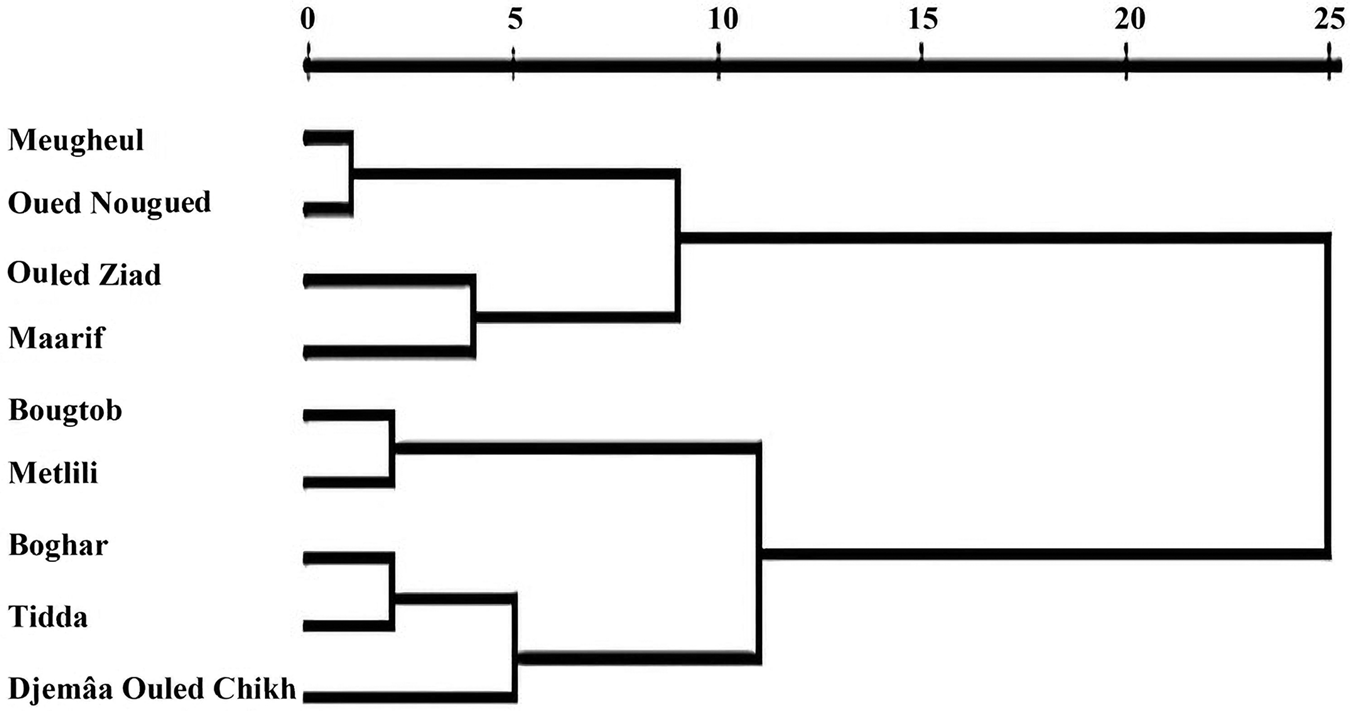
Ward's method divided the nine Z. lotus L. populations into two closed groups by assessing the distance between their phytochemical traits (Fig. 6). The first group comprises four populations, while the second group comprises five.
Dendrogram for hierarchical upward classification of phytochemical variables of different populations of Z. lotus, based on Mahalanobis distances using the Ward clustering method.

In the first group, two subgroups are strongly linked: the Oued Nougued and Mougheul populations, and the Ouled Ziad and Maarif populations. The Oued Nougued and Mougheul populations hail from arid, climatically deserted regions with accurate latitudinal data, thermal amplitudes and soil organic matter content. Fruits from these populations contain comparable amounts of moisture and calcium. Arid climates with close temperatures and calcareous soils characterize the Ouled Ziad and Maarif populations. Calcium levels in pulp and seeds were similar in both populations' fruits, as were carbohydrate and moisture levels.
The second group is further divided into two subgroups, with three populations representing the first, and two populations representing the second. In the first subgroup, there were clear similarities between the fruits of the Tidda and Boghar populations, to which the fruits of the Djemâa Ouled Chikh population were added (Fig. 6). These populations are found in silty soils at low elevations. These populations' fruits exhibited similar amounts of calcium (pulp and seeds), lipids (seeds), flavonoids (seeds) and lycopene (seeds). Metlili and Bougtob populations with similar moisture (seeds) and sodium (seeds), phosphorus (seeds), potassium (pulp), lipid (pulp), protein (pulp), β-carotene (seeds) and lycopene (seeds) content are categorized in the second grouping.
Discussion
We evaluated the phytochemical diversity of Z. lotus fruits from various locations across Algeria, encompassing all bioclimatic stages. The results revealed a significant divergence among the different populations for the set of characters analysed. Seeds and pulps were found to have different biochemical compositions. The Bougtob, Boghar and Mougheul populations had the highest biochemical values for primary metabolites and minerals, while the Metlili and Ouled Ziad populations had the lowest values. The fruits from the Oued Nougued, Maarif and Mougheul populations had the most abundant phenolic compounds whereas the lowest concentrations were found among the Boghar, Djemâa Ouled Chikh and Tidda populations. Oued Nougued, Maarif and Mougheul populations have a higher concentration of liposoluble pigments in their fruits whereas the populations of Boghar, Djemâa Ouled Chikh and Tidda had the lowest levels. The primary metabolites were unaffected by environmental variations, which have significant effects on the other parameters studied.
The results from this investigation demonstrated that wild jujube fruits are rich in mineral and organic nutrients and primary and secondary metabolites despite their small size. The fruits of the Djemâa Ouled Chikh, Mougheul, Ouled Ziad, Bougtob and Tidda populations were the richest in primary metabolites, including total sugar, lipids and proteins. Minerals abound in the fruits of the Bougtob, Mougheul and Oued Nougued populations, while liposoluble pigments are abound in the Mougheul, Maarif, Oued Nougued and Tidda populations. The results showed that Z. lotus fruits are dry products with the edible section accounting for approximately half of the fruit's weight.
The correlation coefficient between protein and fat content in pulp and seed were r = −0.756* and r = −0.931***, respectively. The seed's moisture content was found to have a significant negative correlation (r = −0.725*) with the total sugar content. According to Awada and Ikeda (Reference Awada and Ikeda1957), the concentration of sugars in Carica papaya fruits is inversely related to the plant's water content. The percentage of total sugar in poorly irrigated plots ranged from 9.64 per cent to 11.54 per cent, whereas heavily irrigated plots ranged from 8.41 per cent to 9.72 per cent.
Our findings demonstrated that Z. lotus fruits are rich in polyphenols, flavonoids and tannins, as well as other secondary metabolites. Populations from arid and Saharan areas, where the environmental conditions were extremely challenging (high temperature, low rainfall, salinity and drought) had the highest phenolic compound levels whereas the population from the semiarid areas had the lowest. Phenolic compounds function as antioxidants directly in the human body by affecting the production or activity of other antioxidant molecules (Connor et al., Reference Connor, Finn and Alspach2005). These substances can potentially improve health (Connor et al., Reference Connor, Finn and Alspach2005). They can act as free radical scavengers, peroxide decomposers, extinguishers of singlet and triplet oxygen, inhibitors of enzymes and synergists (Alfaro et al., Reference Alfaro, Mutis, Palma, Quiroz, Seguel and Scheuermann2013).
Total polyphenol and sugar levels in wild jujube fruit were inversely associated (r = −0.73*). Polyphenols and total sugars in plants have an antagonistic relationship because these secondary metabolites are produced from primary plant metabolic pathways, notably carbohydrate metabolism (Cheynier et al., Reference Cheynier, Comte, Davies, Lattanzio and Martens2013). The amount of polyphenol in the sample was also correlated with the amount of chlorophyll (r = 0.747*).
Liposoluble pigments (such as β-carotene, lycopene and chlorophyll) were found in the pulp and seeds of Z. lotus fruits (Table). Carotenoids, such as βcarotene and lycopene, are crucial antioxidant defence components in living cells that protect against lipid peroxidation. Carotenoids are essential sources of vitamin A in the diet (Arthanari and Dhanapalan, Reference Arthanari and Dhanapalan2019). Chlorophyll is essential not only as a colour pigment and for its physiological role in plants, but also for its health benefits (Pareek et al., Reference Pareek, Sagar, Sharma, Kumar, Agarwal, González-Aguilar, Yahia and Yahia2017).
We demonstrated an inverse relationship between the β-carotene level and the lycopene content in the pulp and seeds of wild jujube fruits (r = −0.727* and r = −0.626*). Fruit pulps from the Tidda population had the highest lycopene content but had the lowest β-carotene amount. Similarly, the Mougheul population's seeds, which were high in lycopene, had the lowest β-carotene level. Desai et al. (Reference Desai, Holihosur, Marathe, Kulkarni, Vishal, Geetanjali, Rajeev and Hiremath2018) confirmed this result by revealing that lycopene is a red pigment produced by a synthetic carotenoid plant found in fruits and vegetables.
Our results provide critical data that will be utilized in the future. However, further research is necessary to assess the variety of Z. lotus as phylogenetic sources. However, the populations in our study only occupy a small area. Further comparative investigations across a broader geographical range of this species are needed to examine the impact of environmental conditions. This is necessary because of Algeria's Mediterranean climate is characterized by variations and fluctuations.
Supplementary material
The supplementary material for this article can be found at https://doi.org/10.1017/S1479262123000898
Acknowledgements
We would like to express our gratitude to everyone who helped us finish this project, which was carried out in the Plant Physiology Applied to Soilless Crops laboratory of the Faculty of Natural and Life Sciences at Ibn Khaldoun University in Algeria. We would also like to thank Aicha Mezahem, Hanane Kedjaout, Ouarda Benaissa, Hamida Hebel, Asma Hamed and Abdelhedi Kassab for their help. We would like to extend our gratitude to Khadidja Fellah (University of Bechar), Mohamed Krimat (University of Ghardaia) and Nouara Bakiri (University of M'Sila) for their assistance in harvesting Z. lotus fruits.
Author contributions
Fatima Dahlia: Conceptualization, methodology, formal analysis, supervision, writing -review & editing. Soria Barouagui: Data curation, writing- original draft preparation, visualization, Sarah Mahieddine: Resources, data curation. Khaled Drici: Resources, data curation. Omar Salah: Resources, data curation. Mokhtar Attil: Resources, data curation. Mohamed Amine Heroual: Resources, data curation, Ilyes Harrouche: Review & editing, Koulla Doukani: Review & editing.
Funding statement
This research received no specific grant from public, commercial or not-for-profit funding agencies.
Competing interests
None.