Introduction
While the sheer importance of architecture cannot be satisfactorily understood without actual visiting experiences, their photographic representations can determine many aspects of their public profiles. In the words of the early twentieth-century cultural critic Walter Benjamin (1892‒1940), “for the first time in the process of pictorial reproduction, photography freed the hand of the most important artistic functions which henceforth devolved only upon the eye looking into a lens.”Footnote 1 Indeed, the introduction of photography exerted a decisive impact on the image-making of architecture in the early twentieth century: instead of the hand, the eye began to draw buildings through the camera lens. Moreover, the photographs of architecture themselves acquired an alternative visual command and began to represent something new to the eye.Footnote 2
This paper looks at the photographic image of Islamic Iranian architecture by analyzing the objectives of cultural politics during the Pahlavi era. As part of a much larger study of Persian art historiography with the focus on the role of the American pioneer of Persian art studies Arthur Upham Pope (1881‒1969),Footnote 3 it reassesses early twentieth-century discourses on architectural photographs among Pope and his contemporary scholars, as well as their disputes concerning the ownership of visual reproductions. While reconsidering the mediation of photographs in the formation of what came to be aesthetically and disciplinarily categorized as “Persian architecture,”Footnote 4 this paper extends discussion into the merits of historic architectural photographs for tracking down the impact of restoration on cultural heritage in Iran and Central Asia—Ilkhanid and Timurid monuments, respectively—throughout the twentieth century. Finally, it intends to promote awareness of the documentary value of architectural photographs for constructing an alternative art history and heritage study of the Persian world.
Architectural Photographs and the Question of Ownership
While Pope tends to be portrayed as a showman rather than a scholar, one of his contributions to the field of Persian art studies undoubtedly lies in his photographic documentation of Persian architecture. He began to embark on his career as a photographer soon after his first visit to Iran in 1925. Under the patronage of Reza Shah Pahlavi (r. 1925‒44), which granted him permission to access religious buildings in Iran as one of the first westerners, Pope undertook a series of photographic campaigns across the country from 1929 until the outbreak of World War II.Footnote 5 A large number of negatives and prints that Pope amassed over some ten years were primary intended as illustrative tools for A Survey of Persian Art (1938‒39; hereafter, Survey or SPA), co-edited by Pope and his partner Phyllis Ackerman (1893‒1977), as well as teaching resources at the American Institute for Persian Art and Archaeology in New York (established in 1928).
Besides their quantitative value, Pope’s attention was also given to the aesthetic and propagandistic quality of photographs. For instance, he took great care of each photograph on its own artistic merits, in accordance with his own personal taste, as well as Pahlavi cultural ideology. According to Donald N. Wilber (1907‒97), one of Pope’s associates who became involved in Pahlavi cultural affairs as an architectural historian, the shah made sure that any photographs that could potentially damage the image of Iran must not be shown outside the country, and all film had to be processed and inspected before it was allowed to leave Iran.Footnote 6 Wilber’s observation corresponds with the following remark made by Robert Byron (1905‒41), who was also in Iran in the 1930s:
The Persians have a talent for cutting off their nose to spite their face … they want a tourist traffic, but forbid photographing because somebody once published a picture of an Iranian beggar, while conformity with their police regulations is a profession in itself, as I have discovered in the last day or two.Footnote 7
The camera of foreign travelers was then considered to pose a serious threat to Iran’s emerging image as a progressive nation, since it might catch the still existing signs of “backwardness.”Footnote 8 In fact, the police officers were instructed to prevent foreigners from taking pictures that could potentially damage the country’s pride, and special photography licenses (javaz) were issued accordingly; it was prohibited to take pictures that could reveal “bad taste,” while those that could offer a progressive image were permitted.Footnote 9 Therefore, random snapshots of abandoned monuments must have been unwelcome, and it is difficult to believe that such photographs were considered advantageous for enhancing Iran’s aspiring image as a modern nation at that time. Yet the artistry of Pope’s photographs of select historic buildings, as discussed in detail below, seems to have met the country’s self-promotional needs.
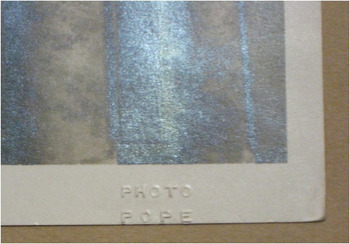
Pope may have had been interested in transferring knowledge to the general public and next generation as an altruist act. But at the same time, he made an ambitious attempt to increase his fame among his peers by means of architectural photographs. His photographic work was therefore publicized explicitly as his own intellectual property by stamping many of his photographic prints with the custom-made seal “PHOTO POPE”; this seal is often embossed on the bottom right of the prints, including those given to Pope’s colleagues, such as Byron, who equally left an important photographic collection of Islamic architecture (Figure 1).Footnote 10 Furthermore, some of the prints, for instance those now in the Arthur Upham Pope Papers in the collection of the New York Public Library, were firmly copyrighted by a square stamp on the back, assuring that “Publication rights reserved. Available on written application. A.U.P.” This copyright statement is followed by the name and address of the printing company in London (W. Watson and Sons London, 313 High Holborn). The other variation of the stamp states: “PROPERTY OF THE AMERICAN INSTITUTE FOR PERSIAN ART AND ARCHAEOLOGY 724 FIFTH AVE., NEW YORK, U.S.A.” If not stamped, another slightly different version of Pope’s trade mark—“Photo. Pope”—was added to the image captions of buildings and details of architectural decoration in the Survey, so as to distinguish his work from other examples, as well as to denote his ownership. While Pope was rightly credited for his collection of Persian architectural photographs, his egoistical approach to the publication of A Survey of Persian Art solely as his brainchild—thus His Survey—unfortunately overshadowed Ackerman’s pivotal role as a co-editor.Footnote 11
Details of PHOTO POPE, found in the photographic collection of Robert Byron at the Conway Library of the Courtauld Institute of Art.
Source: Photographed by the author, 2013. Permission courtesy of the Courtauld Institute of Art, London.

Such an obsessive attachment to photographic reproductions of Persian architecture reminds us of the famous episode regarding the dispute between Pope and Ernst Herzfeld (1879‒1948) over the photographs of Persepolis: in the early summer of 1931, Pope visited Persepolis and began to take photographs of the ruins for the Survey. This made Herzfeld suspicious of Pope’s behavior—he might be spying on Herzfeld’s excavations—and Pope’s efforts to make a comprehensive photographic documentation of Persepolis were hampered.Footnote 12 Herzfeld’s stubbornness was witnessed by Byron, who was equally having trouble obtaining permission to take photographs at Persepolis in early 1934. When Byron visited the sites, Herzfeld showed him round but did not allow him to photograph. In addition to official excuses, such as lack of copyright law in Iran and pressure from the Pahlavi authorities to protect “national” monuments from the misuse of their photographic reproductions by foreigners, Herzfeld made a personal plea for copyright protection, for instance referring to his traumatic experience with a certain Mr. X:
When I first came here, I sent my pictures to be developed in Shiraz. The photographer made copies of the plates and sold the prints as his own. Then that terrible fellow X—came when I was away and took 100 pictures of my discoveries. The first I knew of it was when they appeared in the newspapers as his discoveries.Footnote 13
“I quite see that if other people sell pictures of your discoveries,” the junior English architectural historian tries to persuade the senior German archaeologist to understand the different use of photographs between archaeology and architecture: “All I’m interested in here is the architectural forms, not because they are old, but because they are a part of architectural history.”Footnote 14 Herzfeld remained fiercely protective of his authority as a site director: “When I was a young man, making excavations, we were never allowed to photograph anything.”Footnote 15
Although the relationship between Pope and Herzfeld had been tense from the beginning, the “Persepolis Affair” developed into an enduring animosity between them.Footnote 16 This may have also encouraged Pope to focus on the standing buildings of medieval and early modern times rather than the pre-Islamic archaeological sites. On the other hand, photographs of medieval and early modern monuments could have been viewed as versatile reproductions not only for illustrating publications and lectures but also as works of art in their own right, more than those of archaeological ruins that were essentially intended for topographical documentation among archaeologists and cartographers, as well as military and oil surveyors. This does not mean that archaeological photographs are completely devoid of artistic quality: aerial photographs of archaeological sites were, for example, explored in Iran by the German-born American archaeologist Erich F. Schmidt (1897–1964) from the autumn of 1935 to the spring of 1936 and again in the spring of 1937.Footnote 17 Schmidt’s photographs were essentially meant to record an archaeological landscape, yet some of them convey the intangible quality of picturesqueness.
Another difference between Pope and his peers is that Pope took photographs of monuments through the eyes of aestheticians and showcased them as visual tools for the worldwide dissemination of the ideal image of Persian beauty. Myron Bement Smith (1897‒1970)—another associate of Pope who was also in Iran in the 1930s—by contrast, focused on the photographic documentation of architectural technology and became increasingly possessive about his intellectual property, keeping it exclusively for his own scholarly use.Footnote 18 Writing to Mehmet Ağa-Oğlu (1896‒1946), who became the first chair of Islamic art at the University of Michigan and the editor of Ars Islamica, Smith expresses his desire to protect his copyrights with regard to his study of the Friday Mosque of Damavand:
While I hardly need to mention it, I reserve all rights, in particular, I expressly prohibit the reproduction of my text, plans or illustrations in my article or book edited by, or written by, Mr. Arthur Upham Pope, in particular in his “Survey of Persian Art.” I suggest the words “All rights reserved” be placed at the foot of the first page of the text. I am having the plan copyrighted in my name, as a “scientific drawing.” I would not be so particular, but that some people stop at nothing to get photographs. I think you know what I mean.Footnote 19
Smith’s copyright statement is, however, not included in his article, entitled “Material for a corpus of early Iranian Islamic architecture. I. Masdjid-i Djum‘a, Demāwend,” that appeared in Ars Islamica 2, no. 2 (1935); instead, each photograph is labeled as “Photo. M. B. Smith,” accompanied by his meticulously classified negative number. Furthermore, Smith gives a warning to opportunistic photographers, perhaps intending to address it to Pope:
The number of unpublished buildings is so great and the opportunity for their examination is now so favorable that a temptation exists to rush up and down the country “discovering” monuments, snapping photographs in quantity, and attempting to “spot” dates.Footnote 20
Whether or not Smith’s photographs are more scientific than Pope’s, the displayable quality of architectural photographs was exploited by Pope in the form of public exhibitions, an endeavor that made his photographs breakthroughs.
Photographs as Exhibits and Study Resources
The idea of utilizing photographs as a public presentation of Persian architecture seems to have occurred to Pope as early as at the time of his famous Burlington House exhibition of Persian art in 1931. While the replica of the portal of the Masjid-i Shah or Masjid-i Imam (Royal or Imam Mosque) caught the attention of many visitors at the London show,Footnote 21 Pope made sure of the incorporation of architectural photographs into the exhibition installation as a visual supplement to the beautification of Persian art. This can also be seen as a test for the public reaction to view photographs as two-dimensional exhibits on the wall, like Old Master paintings.
Shortly after the London exhibition, Pope shifted his attention, among others, to the exhibition management of Persian architectural photographs. Having negotiated with a number of institutions and individuals, Pope managed to secure a variety of venues across the United States, Europe and the Middle East, at museums and universities, and his exhibition was touring worldwide in the period between 1932 and 1969.Footnote 22
Among the exhibition venues, the involvement of professional architectural organizations, such as the Architectural League in New York and the Royal Institute of British Architects (RIBA) in London, in Pope’s Persian art enterprise is particularly noteworthy.Footnote 23 The Architectural League, for instance, hosted not only the first exhibition of Pope’s Persian architectural photographs in 1932 (8 March–20 March) but also another show two years later (19 April–9 May 1934). On the occasion of the second exhibition in 1934, for instance, The New York Times reports:
The present showing … stresses architectural and decorative detail, although enough vistas and more general views are provided to assist the spectator in his [Pope’s] effort to keep in mind the relationship of part and whole.Footnote 24
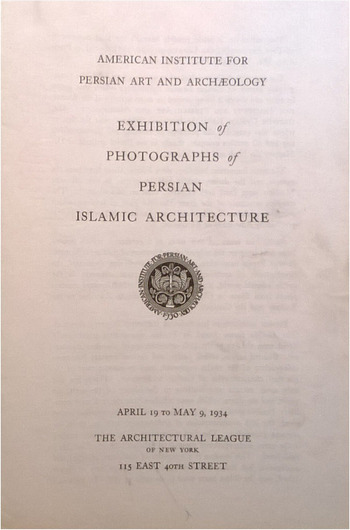
Like much other media coverage that helped to shape public opinion on the exhibitions, a flyer from the 1934 show stresses the glory of Persian architecture narrated in a distinctive “Popian” style (Figure 2):Footnote 25
Exhibition of Photographs of Persian Islamic Architecture, 1934.
Source: Photographed by the author, 2015. Permission courtesy of the New York Public Library, New York.

It was Persia more than any other country that dominated the development of architecture and architectural ornament in the entire Islamic world, a school of building which created masterpieces from Spain to China and from India to Zanzibar to the Balkans and the Caspian.Footnote 26
Equally noteworthy is the impact of Pope’s exhibition of architectural photographs on the future generations of scholars. The exhibition went on tour across major educational establishments in the US,Footnote 27 and Pope capitalized on this opportunity to disseminate his image as the authority on Persian architecture. The young Wilber was, for instance, impressed with the exhibition while studying at Princeton, and this experience set his career path as a historian of Persian architecture:
During the course of the year at Princeton, I was greatly impressed by an exhibition of photographic enlargements at the school. The subjects were Islamic mosques and other structures in Iran, and the photographer was Arthur Upham Pope. I learned that he was head of the fledgling American Institute for Persian Art and Archeology in New York. He was out of the country or I would have gone to see him. Instead, I wrote to him.Footnote 28
In The Architecture of Islamic Iran: The Il Khānid Period (1955), Wilber remarks on the first sight of Pope’s photographs that initially encouraged him to see monuments in Iran with his own eyes.Footnote 29
Finally, in contrast to his fussiness about photo credits, Pope was generous in sharing his photographs with emerging scholars, as well as with experts who had expertise in the field beyond his capacity, such as epigraphy. The Architecture of Islamic Iran is, for instance, illustrated with more than eighty photographs taken by Pope, along with some hundred photographs taken by Wilber himself.Footnote 30 In the case of the Swiss paleographer Samuel Flury (1874‒1935), who was unable to visit Iran in person, new photographs supplied by Pope greatly enhanced his epigraphical reading on the Mosque of Na’in, which had been previously published in 1921 in the journal called Syria with the French archaeologist Henry Viollet (1880‒1914).Footnote 31
Conveying Monumentality and Texture
While exploring a variety of subjects, Pope clearly favored medieval and early modern architecture, particularly that of the Saljuq and Safavid periods, rather than the modern and contemporary architecture of his time, namely Qajar and Pahlavi buildings.Footnote 32 Among the pre-modern monuments, two of the most iconic Saljuq and Safavid examples, namely the Masjid-i Jami‘ (Friday Mosque) and the Royal or Imam Mosque, both in Isfahan, were extensively photographed: the former was used for his discourse on Persian contributions to the development of European architecture, with a focus on the vaulting system, while the latter was glorified as the zenith of Persian architectural mastery, particularly its tilework.Footnote 33
Similarly, the architecture of the Ilkhanid period caught the fancy of Pope, particularly its monumental scale and lavish decoration.Footnote 34 Having written a long chapter on the fourteenth century in the Survey, Pope situates the Mongol period as the turning point of Persian architectural history and regards it as “a building era of immense creative energy.”Footnote 35 Following the same academic stance, the Mongol conquerors are considered as “more than butchers and devastators” in the chapter on “The Mongols: Destruction and Grandeur” in his Persian Architecture (1965), and their architectural remains are acclaimed as masterpieces owing to their grand scale and sumptuous ornament.Footnote 36 Collectively known as Mongol monuments rather than those of the Ilkhanids at that time,Footnote 37 the distinctive character of Persian architecture of the early-to-mid fourteenth century tickled Pope’s creative fancy not only to spotlight its proportional beauty but also to challenge the visualization of large-scale, highly ornate buildings by means of photographs: to what extent could photographs be life-sized reproductions of gigantic mosques, palaces, towers and fortresses? How artistically could photographs present details of stucco, tile or painted decoration?
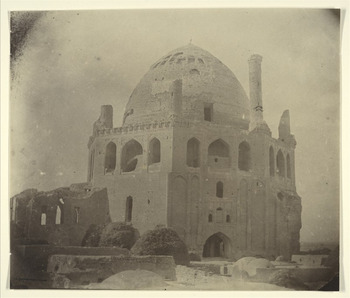
In this respect, the Gunbad-i Sultan Uljaitu (r. 1304‒17) in Sultaniyya (completed in 1313)—over fifty meters in height—provides an intriguing case study. This imposing funerary architecture was initially drawn rather than photographed during the nineteenth century, as illustrated in Jane Dieulafoy’s (1851–1916) La Perse (Paris, 1887, 89)Footnote 38 and Pascal Xavier Coste’s (1787–1879) Monuments modernes de la Perse (Paris, 1867, pl. LXVII).Footnote 39 Such drawings remain useful for grasping the overall view of the monument, yet they are fundamentally different from what the camera can realistically project. Even though nineteenth-century photographs of this monument—for example a photograph from the Wilkinson Album (Figure 3),Footnote 40 reveal a fundamental lack of understanding in lightening and distance, the photographs serve to convey the scale of the monument more accurately than the drawings of the same time.
The Mausoleum of Sultan Uljaitu, Sultaniyya.
Source: Photographed by Luigi Pesce, 1840s‒60s. 17.78 × 20.82 cm. The Metropolitan Museum of Art, Gift of Charles Wilkinson, 1977 (1977.683.46 recto). Image © The Metropolitan Museum of Art.

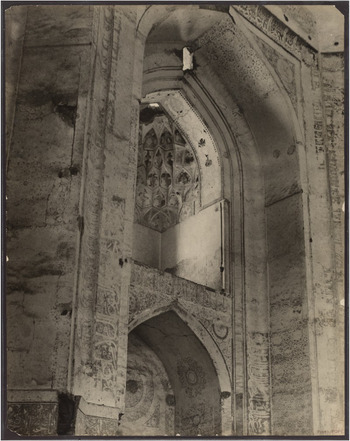
Pope exceled at architectural photography in that his photographs were able not only to provide the visually attractive portrayal of the exterior of the Mausoleum in a book format, such as that used in the Survey,Footnote 41 but also to capture its monumental scale at public exhibitions by means of enlargement techniques.Footnote 42 In addition, Pope was able to explore the photographic documentation of interior decoration, thanks to his privileged access to historic buildings in Iran under the shah’s patronage, so as to provide different perspectives on this architectural masterpiece to the Survey readers or exhibition visitors, many of whom never made an actual visit to Sultaniyya (Figure 4).
Interior of the Mausoleum of Sultan Uljaitu, Sultaniyya.
Source: Photographed by Arthur Upham Pope, 1929‒39. 63 × 43 cm. Image courtesy of Harvard Fine Arts Library, Special Collections (Pope:083, AKP069).

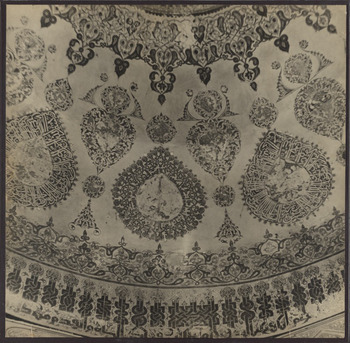
Pope was aware of the limitation of his photographs in terms of coloration, a technique which was not yet widespread at the time of Pope’s photographic survey in Iran.Footnote 43 On the contrary, he foresaw the merits of black-and-white photographs that could capture the texture of architectural decoration artistically, and in many cases served to project contrasts and layers more sharply and accurately than color photographic prints could offer.Footnote 44 Instead of admitting the absence or limited use of colored plates in his publications, Pope is consistent in his high opinion of monochromaticity in Persian architecture: “Persian designers also knew the value of pure white.”Footnote 45 Besides stucco, brick and tilework, which are monochrome or polychrome, Pope photographed several important examples of painted fresco decoration in Mongol monuments in black and white, including that of the Mausoleum of Sultan Uljaitu (Figure 4), as well as those used in other Mongol monuments in Central Iran, such as the Buq‘a-yi Sayyid Rukn al-Din in Yazd (completed in 1325), locally known as the Rukniyya.Footnote 46
One of Pope’s surviving original black-and-white photographic prints (Figure 5)Footnote 47 highlights textural details of the interior decoration of the Rukniyya, including a series of radial floral patterns, combined with alternating Kufic and Nashki inscriptions, in a way that evokes the two-dimensional surface of Persian block-printed cotton textiles, called kalam-kari.Footnote 48 According to Pope, who makes a convincing interpretation of the texture of fresco decoration of the Rukniyya without any chromatic visual aids:
The delicacy of most of the ornament gives the surfaces a quality comparable to rich brocades, and is indeed a witness to the influence of the ideals of the textile art, an influence that could hardly not have prevailed in this city of fine fabrics.Footnote 49
Following Pope’s aesthetic approach as well as counting heavily on his photographic collection, Wilber, who conducted a major architectural survey in Yazd, acclaims the interior decoration of the Rukniyya as a “profusion of ornament” in a catalogue entry of the monument in The Architecture of Islamic Iran: The Il Khānid Period. Footnote 50 Yet as an architectural historian, Wilber interprets its distinctive interior decoration from a slightly different angle:
Interior of the Rukniyya, Yazd.
Source: Photographed by Arthur Upham Pope, 1929‒39. 53 × 52 cm. Image courtesy of Harvard Fine Arts Library, Special Collections (Pope 091, AKP069).

Some patterns have an architectonic relationship with the surfaces on which they appear while others are less well adapted and seem to have been taken over from book covers and manuscript illumination. For example, the painted patterns on the inner surface of the dome are extremely rich and fine but they have little relationship to the scale or the profile of the area to which they were applied.Footnote 51
Although black-and-white reproductions alone could satisfactorily facilitate the reading of buildings, as exercised by Pope and Wilber, color photographs serve to offer a different dimension of architectural texture and should be used as a primary tool for documenting monuments, ideally in combination with previously made black-and-white photographs, as well as color films in the future.Footnote 52 In reality, coloration remains visible in the fresco decoration of the Rukniyya, while the exterior of the monument was originally decorated with not only painted plaster, as used on the interior, but also tile mosaic and glazed brickwork.Footnote 53
Documenting Persia’s Architectural Past
Pope’s photographs of Persian architecture equally deserve an archival reappraisal as a valuable documentation of Persian architecture in the 1930s. Since the early twentieth century, a number of monuments in Iran and elsewhere in Central Asia have undergone several restoration stages. Some lost much of their original fabric, while the others were completely remodeled in an idealized architectural form of quasi-historical significance.
One of the scandals in the recent decades is the over-restoration or remodeling of Timurid monuments in Uzbekistan shortly after the country’s independence in the early 1990s.Footnote 54 Although they had already undergone heavy restoration during the Soviet era, the buildings of the Timurid dynasty were thoroughly re-historicized so as to restore a cultural link to great medieval dynasties, such as the Timurids for Uzbekistan, versus the Samanids for Tajikistan.Footnote 55 The most infamous case is the rebirth of the Bibi Khanum Mosque in Samarqand: built during the reign of Timur, it was already in danger of collapse in the fifteenth century, due to its enormous size. It was long neglected during post-Timurid times, particularly under Soviet rule. But soon after the 1990s, the building began to recapture its former glory, thanks to a newly created dome, portal, tile revetments, as well as a newly interpreted epigraphic program that was designed to fit Uzbekistan’s state rhetoric of the unity (one nation) in diversity (multi-ethnic communities).Footnote 56
Although this restoration program intended to erase a dark age in the history of Islamic architecture in former Soviet Central Asia, the re-fashioning of Timurid buildings has ironically served to increase the archival value of the photographs taken in pre-independence times. Thus early twentieth-century photographs of Timurid architecture, such as those taken by Ernst Cohn-Wiener (1882‒1941) during his research expeditions in West Turkestan (modern-day Uzbekistan, Turkmenistan, Kazakhstan and Kyrgyzstan) in 1924‒25,Footnote 57 help to improve our understanding of multi-layered chronicles of ancient monuments, while the unnecessary degree of restoration elides our knowledge of cultural heritage in the region.
In Iran, the policy of restoration evolved in a different way from that of post-Soviet states in Central Asia. An initial step to institutionalize the conservation of cultural heritage took place in the 1920s and 1930s, such as the establishment of the National Monument Council (Anjoman-i Athar-i Melli) in 1922, and local archaeologists, in collaboration with non-Iranian institutions and personnel, continued to look after historic buildings, adopting advanced conservation techniques throughout the twentieth century.Footnote 58
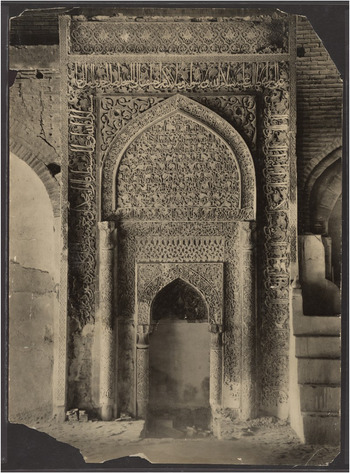
While the revivalism of Safavid tilework during the early years of the Pahlavi dynasty is well-known,Footnote 59 I would like to add a note to the negative impact of restoration on the originality of architectural decoration, for instance the stucco mihrab added to the Friday Mosque of Isfahan under Sultan Uljaitu, dated 1310. The mihrab was photographed by Pope during his series of architectural surveys in Iran between 1929 and 1939, with the emphasis on the tranquil image of the sanctuary (Figure 6). A photograph of the mihrab was not only published in the Survey as copyrighted with “Photo.Pope,”Footnote 60 but also similar, if not exactly identical, versions of Pope’s mihrab photographs were granted permission to be reproduced in his colleagues’ publications, including Wilber’s study of Ilkhanid architecture and Creswell’s (Keppel Archibald Cameron Creswell, 1879–1974) short essay of Persian architecture.Footnote 61 Among the decorative components of the mihrab, however, a band of lotus ornament in its top frieze did, unfortunately, vanish at some stage of the restoration.Footnote 62 Also drawn beautifully and published in the Survey, described as “a new symbol of opulence,”Footnote 63 it remains unclear when exactly the disappearance of the lotus frieze occurred. A photograph of the sanctuary of Sultan Uljaitu at the Friday Mosque of Isfahan, including the mihrab, taken by Baroness Marie-Thérèse Ullens de Schooten (1905‒89) in the period between 1951 and 1972, when the improvement in the country’s economy encouraged the sponsoring of restoration projects on a large scale,Footnote 64 shows that the mihrab had already been restored by then and replaced by characterless vegetal motifs.Footnote 65 This episode, as well as several photographic records mentioned above, indicates one of the complex, multi-layered questions as to the ethics of restoration and poses a concern for the preservation of cultural heritage not only in modern-day Iran but also across Asia and Africa.Footnote 66
Mihrab at the Sanctuary of Sultan Uljaitu, Friday Mosque of Isfahan.
Source: Photographed by Arthur Upham Pope, 1929‒39. 45 × 60 cm. Image courtesy of Harvard Fine Arts Library, Special Collections (Pope 018, AKP069).

Concluding Remarks
In sum, early twentieth-century photographs of Persian architecture are of both art-historical and art-historiographical significance for the following reasons: first, such photographs served to introduce the architectural wonders of Persia to academia. They profoundly stimulated the scholarly debate of Persian architecture and triggered fierce rivalry among architectural historians and archaeologists working in Iran, particularly between Arthur Upham Pope and his peers, such as Ernst Herzfeld, Robert Byron and Myron Bement Smith. Yet what make Pope’s photographs more intriguing than those of the others is that they were targeted not only at his small academic circle but also at much wider audiences, including the general public. The outreach value of Pope’s photographs was manifested in a series of public exhibitions that traveled worldwide. Moreover, each of his photographs was laboriously executed not only to legitimize his own aesthetics but also to fit Iran’s political agenda under the Pahlavis. Second, the significance of early twentieth-century photographs of Persian architecture lies in their archival value: since the early 1930s, many of the architectural features that Pope and his colleagues captured through the lens have been refashioned or, in the worst case, completely lost. While the cultural heritage of Iran appears to be in a comparatively good state of preservation, historic architectural photographs reveal the chronological sequence of building and decorative alterations more vividly than can be seen on site.
As a final note, it is hoped that early twentieth-century photographs of Persian architecture, which are currently scattered across different locations, will be compiled as an invaluable documentary source on the cultural and political landscape of Pahlavi Iran, especially prior to World War II. They will undoubtedly serve as a key parameter regarding the state of historic buildings in the 1930s, as well as an ethical guidance for restoration in the future.