Introduction
Popular music studies have produced an impressive number of analyses of the boundaries and different types of musical categories. One of the technologies considered to be important in drawing boundaries is award ceremonies. In fact, awards and galas tend to be recognised as important signs of quality for cultural commodities (Gemser et al. Reference Gemser, Leenders and Wijnberg2008), thus contributing to the canon formation of specific kinds of expression (Watson and Anand Reference Watson and Anand2006), whether cinema, literature, television or music. They function as a ‘certifier’ for the relative quality of a song, an artist, a movie or a spectacle (Caves Reference Caves2000). By the same token, they also help to organise fields or sets in distributing value and negotiating inclusions or exclusions (Anand and Watson Reference Anand and Watson2004). However, even if they often represent the most spectacular events of the cultural agenda, awards and galas have received surprisingly scant attention from scholars. I contend that we should look at the politics of inclusion and exclusion that unfold in awards and galas, in the way the field or category that this event is celebrating is created or performed through the gala itself, be they ‘popular music’ or ‘independent cinema’, for example.
In recent years, the rise of ‘musiques émergentes’ (‘emerging musics’) in the cultural and mediatic landscape in the mainly French-speaking province of Québec in Canada, and in its metropolis of Montréal in particular, has been increasingly felt. What is striking about musiques émergentes is their diversity, their fluidity, their diffuseness and their evanescence. Many cultural, media and political actors have stressed the difficulty of identifying their contours. The non-obviousness of musiques émergentes is presented as something taken for granted by many. Taking this non-obviousness seriously, this paper looks at the constitution of musiques émergentes as a reality through its celebration in an award ceremony. How is it constituted as a population that can be surveyed? And what are the best examples that can be presented by means of an award ceremony? This paper looks first at the way an award ceremony should be understood as an example of something, and the way it determines what it is exemplary of. I then turn to considering the manner in which this exemplarity is actualised in the different categories or awards given during these ceremonies and to the strategies at play that ensure the totality exemplified is as accurate as possible and the population celebrated is circumscribed as precisely as possible. The paper examines the case of the Montréal International Music Initiative (MIMIs) awards, a ceremony that celebrates musiques émergentes in Montréal, in particular the press coverage of its organisation and planning.
The MIMIs as example
Since 1995, the MIMIs, a gala dedicated to musiques émergentes, has established itself on the cultural scene in the province of Québec. The events and ceremonies set the pace for the cultural year. The Association québécoise de l'industrie du disque, du spectacle et de la vidéo (‘Québec association for the record industry, spectacle and video’ – ADISQ), Québec's music trade association, has hosted an annual award ceremony to celebrate local music, artists and cultural workers since 1979. If one of the pivotal dates of the calendar of the Québec music industries is the gala organised by ADISQ, the MIMIs are imposing themselves as a point of passage for musiques émergentes in Montréal: ‘The MIMIs is THE gala of the emerging scene’ (Robillard Laveaux Reference Robillard Laveaux2006a, p. 16; original emphasis).Footnote 2 Over the years the MIMIs have been cast as an ‘anti-gala’ (Parazelli Reference Parazelli2000; Baillargeon Reference Baillargeon2001), a response to that of the ADISQ: even the shape of the event seems to be a response to the ADISQ gala. Indeed, the evening is more like a (freak) show than a prize-giving ceremony: it ‘[…] celebrates with lightness the burgeoning, bubbling and culturally explosive scene of Montréal’ (Greenland and SOPREF 2000).
Started by Dan Webster, a concert promoter (Greenland Production), the MIMIs have become an important event for musiques émergentes. Since the inaugural event in April 1995, the gala has grown: each year, it has more spectators, more votes by the public and more media coverage. In fact, a look at the Montréal newspapers provides a clue to its growing importance. If in 1995 only a few local newspaper articles testified to the existence of the MIMIs, over the years the press coverage of the event has become increasingly important. A nomination is prestigious: ‘Now the winners proudly display their prizes or their nominations to the MIMIs gala when it's time to prepare their CVs’ (Titley Reference Titley2002, p. 18). Between the second (1996) and the third (2000) events, Webster and Greenland Production joined with a local organisation called the Société de promotion de la relève musicale de l'espace francophone (Society for the promotion of emerging music of the francophone space – SOPREF) dedicated to the professionalisation of musiques émergentes actors. For SOPREF (2002), the growing importance of the MIMIs can also be measured by the increase in advertising sales in the evening's printed programme and the increasing number of table bookings for the gala. A real tradition for musiques émergentes (Renault Reference Renault2006), the MIMIs have become one of their most vibrant manifestations.
From the beginning, the MIMIs have been presented as an opportunity to recognise Montréal musicians by giving them prizes and placing them in the spotlight. The MIMIs are not all that different from the ADISQ gala, which has become a powerful promotional tool for members of the association (ADISQ 1988), nor other equivalent ceremonies in other markets, such as the Grammies in the United States (Watson and Anand Reference Watson and Anand2006), among others. It affords an opportunity to ‘reward people who work hard’ (Webster, in Titley Reference Titley1995, p. 4) and to give visibility to the object of the celebration. The MIMIs offer a means of presenting a set of forgotten music actors to the dominant music industries, the press and the potential audience: the event is both unifying – of a set of industries, people and sounds often labelled ‘musiques émergentes’ in Montreal – and spectacular – it draws attention to itself. The MIMIs are the opportunity to showcase some artists, artisans and products, among others, and to present them as good examples of musiques émergentes.
Award ceremonies like the MIMIs contribute to canon formation in popular culture by presenting some parts of their population as representative of the best practices: it is an example. This paper starts from the idea that the MIMIs and the different events that are a part of it – such as the gala, the process of nomination, the promotion of the event, and so on – act as an example of musiques émergentes in the way that Agamben uses this concept: ‘In any context where it exerts its force, the example is characterised by the fact that it holds for all cases of the same type and, at the same time, is included in these. It is one singularity among others, which, however, stands for each of them and serves for all’ (Agamben Reference Agamben1993, pp. 9–10). The example is a member of what is exemplary – it is one case among others – and extends its exemplarity to anything with which it may be articulated: it is at the same time one term and the whole, or rather the interface that connects both. The example can take the place of all terms for which it is an exemplar, not as a rule but as another singularity. It is a singular object that holds for all cases, and produces the ensemble of which it is the exemplar. For Agamben, the example is not more general than that which it is an exemplar for; it is not the norm, but rather a member of the ensemble. It is a singularity among others that is not situated over but next to them. Therefore, it cannot be considered as more universal than what it is exemplary, but it can be more understandable (Agamben Reference Agamben2009): it is opening the way to circumscribe an undefined ensemble into a singularity, a multiplicity into a totality. The example suggests mediating the relationship between terms of a set and their signification as members of this set. It exposes their belonging – all belongings – and transforms at the same time the singularities into part of the ensemble. Thus, the example condenses all the singularities into one, and exposes them as belonging to the same ensemble: ‘[…] one for all, and all in itself’ (Massumi Reference Massumi2002, p. 18). As Agamben (Reference Agamben2009) proposes, the set that is exemplified is not first, but is immanent to the example itself. In this sense, it is one of the ways for the different terms that belong to musiques émergentes to become-together, that is, to become one together and to become something else together.
Totalising
Like other awards ceremonies, the MIMIs are a celebration. They celebrate musiques émergentes by proposing a condensed version of all their variations, ‘from all languages and all styles’ (Papineau Reference Papineau2006, p. B5). Indeed, many aspects of the ceremony put forward their variations of heterogeneity and fluidity. Among others, the categories used for the prizes at the ceremony change every year. This aspect is perceived as one of the most notable characteristics of the MIMIs: it ‘[…] presents trophies […] in categories whose names change from year to year’ (Renaud Reference Renaud2004, p. 11). The annual changes in the labelling of the categories are not unique to the MIMIs, quite the opposite: the Grammies saw an increase in the number of categories from 28 in 1958 to 105 in 2003, and many changes in the names followed (Watson and Anand Reference Watson and Anand2006). Similarly, the ADISQ gala saw many variations in the categories too (Grenier et al. Reference Grenier, Martin and Deglise1996). Like these other galas, organisers of the MIMIs present this characteristic as the result of their attempt to grasp all the variations in musiques émergentes and transpose them to the awards categories:
With regard to the categories [according to one of the organisers], I think it will still change. It is a snapshot of the year. In the year, there are sectors or musical styles where there are more movements than others. For instance, the ska blowout of last year [in 2000] has ended: only six ska albums were recorded this year [2001]. They have been placed, according to the trends in punk or pop. (Lévesque, in Lamarche Reference Lamarche2002a, p. C1)
In 1996 this conception of the MIMIs as the celebration of all musiques émergentes led to the organisers adding the category ‘Fill in the Blank’. The public was invited to propose, through a reply coupon available in a Montréal cultural weekly, the name of a new category and the nominees for it. With this open category, the MIMIs were sure to be up to date with the different genres of musiques émergentes. It prevents the organisers from forgetting to mention artists, genres or performances that the public consider deserving of recognition.
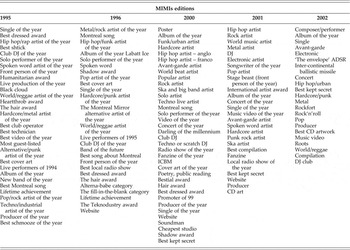
Table 1 presents a list of the categories used during the first five years of the MIMIs. In 1995, seven out of 29 prizes were explicitly genre specificFootnote 3: Hip-hop/rap artist of the year, Spoken word, World/reggae artist of the year, Hardcore/Metal artist of the year, Alternative/punk artist of the year, Pop/rock artist of the year and Techno/industrial artist of the year. In 1996 their number rose to eight out of 27, almost 30 per cent. The revival of the ceremony has seen the continued increase of such prizes: in 2000, 12 categories out of 36 (33 per cent) were reserved for particular genres, while in 2001 this proportion rose to 12 out of 26 (46 per cent) and in 2002, 12 out of 22 (54 per cent). Therefore, to celebrate all that has happened during the musical year and to keep abreast with all the trends in musiques émergentes, it is necessary to adjust categories that explicitly refer to musical genres by eliminating, adding or transforming them. Among other things, changes in the categories dedicated to the different genres related to techno have been numerous and repeated, following comments from journalists and actors as well as perceptions from the organisers of the MIMIs:
Also, last year the techno category was criticised for not distinguishing between club DJs and scratch DJs. As a consequence, this year [2002] the techno category is divided into two, one oriented towards the dance floor and named Club DJ, the other to sound research, identified as ADSR envelope (‘Attack, Decay, Sustain, Release’, a processing function on their machines). The scratch DJs have been removed from the game, and the MIMIs, in trying to adapt themselves, are taking a greater account of the place taken this year by the minimalist techno in Montréal. (Lamarche Reference Lamarche2002a, p. C1)
Categories used in the first five editions of the MIMIs.Footnote 4

For the MIMIs, changing some of the categories and adding others allows them to be up to date and to adapt to the movements in musical genres. Table 1 also shows the birth, the evolution and the death of many other genre-specific categories: for example, the appearance and rapid disappearance of ska in 2000 and 2001, industrial techno/‘technodustry’ during the first two editions of the MIMIs, and the linguistic schism involving hip hop in 2000.
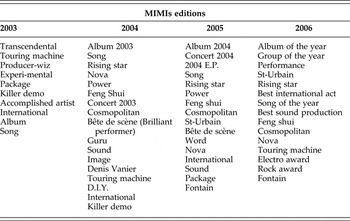
Adding genre-specific categories was supposed to enable the MIMIs to ‘adapt’ and grasp more adequately all musiques émergentes variations. However, as is shown in Table 2, in 2003 these categories were abandoned in favour of others which are more inclusive and ‘trans-genres’. Some of those categories included: the Transcendental award – ‘for the one who pushes the boundaries of the possible’; Experi-mental award – ‘The artist who breaks away the most from pregiven and defined niches (in linguistic, musical or artistic terms)’; Touring Machine – ‘The most rigorous and enthusiastic artistic collective performing shows and recording together’; or Accomplished artist – ‘The most visible and most constant artist’, among others (for descriptions of the categories, see Adler 2003; Renaud Reference Renaud2003). In 2004 the categories continued to change and awards such as Nova – ‘artist who will inspire generations to come’, Denis Vanier – ‘depth and delivery of a lyrical work’, Feng shui – ‘Dynamics, arrangements, moods’, and Guru – ‘artistic growth, experience and recognition’ were added to those of 2003 or replaced others (Renaud Reference Renaud2004). The 2006 event kept some of the previous two awards categories, but it withdrew some old genre-specific prizes, such as Electro and Rock awards, which were delivered through showcases.
Categories used at the MIMIs from 2003 to 2006.

The new categories that were not genre specific opened the possibility for the MIMIs to ‘totalise’ musical variations by giving the opportunity for any artist, sound or product to be nominated in every category. Rather than identify musical genres by exposing them one by one through a dedicated category, the MIMIs presented them all by the trans-genre awards:
Exit the categories of best rock band, trad, metal, punk, hip hop or world music. Down with the musical styles fragmentation. From a point of view that is opposed to the worldwide tendency in music consumption, the organisation of the MIMIs Awards […] wants to reflect both diversity of talents and their common effort on the road to success. (Renaud Reference Renaud2003, p. E8)
With these changes, two sides of the MIMIs were revealed, first, as an event that claims to grasp all variations in opening the categories to everyone, and second, one that seeks to ‘reflect’ participation in a ‘common effort’. Thus, the trans-genre categories emphasise the differences perceived by the MIMIs between the genres and the collective nature of their participation in the ‘totality’ of musiques émergentes. The new categories highlight both the diversity of musical variations and their union with the exemplarity of the MIMIs. In this sense, the MIMIs are acting as mediation (Hennion Reference Hennion1993) of their singularity and their totality, inscribing them as a ‘becoming-together’.
The multiplying of genre-specific categories in the first five versions of the MIMIs tracked the movements diagnosed in all musiques émergentes by the organisers of the event. The emergence of trans-genre categories in 2003 reflected the fact that the movement and the number of genres were growing to such an extent that they were becoming unmanageable:
For us, it [trans-genre categories] was the best way to be fair with the local talent […]. Not only because a number of the favourite bands would have been nominated in several categories, but also because the independent production is so vast this year that it would have been difficult to give a prize for each category. (Webster, in Renaud Reference Renaud2003, p. E8)
Because too many categories were needed, the solution was to highlight the heterogeneity of the ‘totality’ of musical variations. The MIMIs serve to capture this multiplying of categories; instead of celebrating the separate entities that are signified by genres, they celebrate multiplicity and heterogeneity. In this sense, the object of the MIMIs is not just a set of separated musical families, but also the disjunctions themselves, that is to say, their multiplicity and ‘eclecticism’ (Robillard Laveaux Reference Robillard Laveaux2004, p. 16). These new trans-genre categories also reflect another argument: more artists and sound productions than ever before are situated at the frontiers of two genres. From the MIMIs' perspective, the unmanageability of the multiplication of genre-specific categories is linked to the fact that many artists and sound productions are perceived as hybrids. By 2001, there were calls in the media for the organisers to include categories that reflected the hybridisation of musical genres. For instance, when submitting the various shapes of the trophies that are awarded to the MIMIs' winners, a journalist noted: ‘M is for mutant: Hybridisation is breaking out all over. Let the award reflect that’ (Bottenberg Reference Bottenberg2001, p. 16). He suggested the shape of a mutant for the trophy to reflect more effectively the movement in musical genres.
The trans-genre categories allowed the MIMIs to celebrate simultaneously the hybridisation, the actual movement of musical genres and their multiplicity. But their labelling, far from the tradition of musical genres, appears opaque to many people:
Did you understand anything about the categories? ‘Tour machine’ [Maudite machine (Damn machine) in French], ‘Experi-mental’, ‘Container’, ‘Wiz-Producer’ […] It was complicated enough to vote (because we journalists have that privilege!). I don't know how the public and the artists will react. (Baillargeon Reference Baillargeon2003, p. 16)
Often, information is needed to be sure that during the evening of the ceremony the public in the venue understand the categories: ‘As in the past years, a programme was necessary to decipher some elliptic categories’ (Zivitz Reference Zivitz2004, p. D5). With the trans-genre categories, this (new) need to provide descriptions for prizes underlines the evidence that the genre is a guiding principle in the categorisation of actors, sound or artisans, among others. The fact that this ‘need’ appears highlights the superfluous or unnecessary explanations for the categories dedicated to specific genres. With these new categories, the MIMIs are questioning the taken-for-granted nature of genre as a guiding principle in determining categories and awards; they are addressing it as flawed and ensuring the celebration of all their multiplicity and their hybridisation. This totalisation by the MIMIs goes beyond the circle of the known. Indeed, it allowed all categories to be open for inclusion, going beyond the musical horizons known to the organisers. As the organiser stated in an interview: ‘It's like a party – you invite some people you know, some people you do not know’ (Webster, in Dunlevy Reference Dunlevy2006, p. D3). With these categories, the MIMIs are not just placing in full view individual actors who deserve their award – artists, workers, sounds, performances, and so on – and who are grouped under distinct banners, but also all musiques émergentes and the movements within them: known or unknown, and remaining unknown or not.
The totalisation process: from the delegate to the census
The MIMIs pose themselves a particular challenge: how do you identify your audience, that whole which is to be exemplified and celebrated? The act of identifying your audience determines the conditions of membership. The exemplarity of the MIMIs means that they are part of an ensemble, while they are concurrently inferring the modes of participation to the totality. As Steven DeCarolis emphasises, this is one of the main features of the example: ‘[…] the example is at one and the same time a member of a set and the defining criteria of that set’ (DeCaroli Reference DeCaroli2001, p. 10). The exemplarity of the gala is dependent on determining the limits of its population. But, as a journalist asked when describing the questions that arose behind the scenes at the awards ceremony, ‘[…] where does [it] start? […] The margin implies a centre, and borders. These limits are increasingly fluid and permeable, but they still exist. As they say in journalism, here is the snapshot of a border that is hard to delineate’ (Lamarche Reference Lamarche2002a, p. C1). The awards ceremony involves the limits of its exemplarity, limits that are not drawn around the set like a border, but rather are proposed as conditions for membership. The MIMIs are bringing the limits of their totality with themselves.
One way to determine the reference population for the MIMIs is to delegate this task to others who will take that decision. For the first edition of the MIMIs in 1995, these delegates were appointed by the organisers of the event on the basis of their recognition as belonging to musiques émergentes. It is a circular logic that asks delegates selected as members of the set to determine the conditions of belonging to that set. At their first meeting, discussions were held between the delegates about their exemplarity: were they standing for all singularities of the reference population? Their appointment, made primarily by the organiser himself, possibly jeopardised the exemplarity of the MIMIs: the group increased from 40 delegates to 80 (Cummins Reference Cummins1995; Yurkiw Reference Yurkiw1995). Their micro-exemplarity was also dependent on the most ‘balanced’ sample of delegates possible:
After our first delegate meeting, some people thought that certain areas weren't being represented […] so we had more names submitted and we considered a lot more people as delegates. We wanted to balance it out a little more and get a broader consensus in terms of the nominees. (Webster, in Yurkiw Reference Yurkiw1995, p. 16)
These delegates were responsible for drawing the line between what could and could not be nominated at the MIMIs – that is, who belongs to the population exemplified by the ceremony – and in what category. They were deciding if the artists, producers and products were ‘sufficiently independent’ to be celebrated in a gala dedicated to Montréal's independent music industry:
And the delegates themselves made the decision whether or not something was independent enough. If 30 delegates – who are all independent music aficionados, so to speak – said that you were independent, then you were independent enough. We weren't going to draw the line in terms of a record company or a management company. (Webster, in Yurkiw Reference Yurkiw1995, p. 16)
The delegates themselves represent the condition of belonging to the ensemble. Their exemplarity gives them the strength to use their judgments to mediate the meaning of some artists, products and artisans, among others, as members of the group celebrated by the MIMIs. Besides the delegates, no criteria for membership are clearly stated.
As already noted, the use of delegates as a condition of belonging to the ensemble exemplified by the MIMIs implies that they are themselves micro-examples. The selection of these delegates who represent the membership to the totality is based on a criterion which, at the same time, constitutes their exemplarity: independence (Yurkiw Reference Yurkiw1995). What binds the delegates together, and allows them to ‘micro-exemplify’, is their participation in industrial activities. The choice of delegates not only ensured the totalisation of the reference population, but also asserted the existence of a supporting industry. Indeed, the first editions of the MIMIs were trying to promote the very existence of a music industry other than ADISQ:
The challenge of the first gala was to gather all these peoples for the first time in the same room […]. In 1995, not everybody knew that an alternative music industry in Montreal existed. We were then able to show them that this scene was alive and well. (Webster, in Poitras Reference Poitras2006, p. 16)
The delegates and the juries are micro-examples of an industry, which qualifies as independent. In fact, for the first two editions, the words composing the acronym MIMI were Montreal Independent Music Industry. As early as 1995, the relevance of the term ‘independent’ was questioned:
By the way, concerning the MIMIs, it seems that […] there is an amazing ignorance of Québec's music industry. With an acronym like MIMI (that means Montreal Independent Music Industry Awards), we may think that multinationals own the biggest part of the local market. But it is entirely wrong. (Saulnier Reference Saulnier1995, p. 24)
In response to these critics, the acronym changed in 2000. No longer the Montreal Independent Music Industry Awards, MIMI now stands for the Montreal International Music Initiative. In the new wording, the industrial and ‘independent’ components were removed to make way for some international references. As later highlighted by the organiser of the event, the MIMIs now seek to celebrate artists and artisans whose works are ‘exportable’ (Leclair Reference Leclair2006; Poitras Reference Poitras2006). This was not the only change that occurred in the organisation of the event.
Between 1996 and 2000, the totalisation process was transformed. In 2000 the organisers of the MIMIs got together with SOPREF to organise the event. This new joint venture took the form of a census, which has been SOPREF's responsibility. The new process for determining what the MIMIs exemplify is supported by the organisation to ensure that the totality is covered:
In order to take advantage of the large annual census made by SOPREF and ensure a representation of all the specialised musics of Québec at the MIMIs gala, SOPREF offered to coordinate the voting process. Like any gala, the MIMIs is simplistic and cannot reflect all subtleties involved in current creative practices; but it tries and it is in this spirit that SOPREF is involved in the exercise. (SOPREF 2004, p. 10)
The census is part of a project to determinate the reference population as precisely as possible in order to help the MIMIs ‘testify to all subtleties involved in current creative practices’. Like any census, this process connects a body to a population under certain conditions: for instance, spatial circumstances (i.e. a body must be located within the territorial limits of a state), or citizenship status – among other things, in the census of 1860 in the United States, the body of a slave was worth only 0.6 of the free white body (Curtis Reference Curtis2002). As proposed by Bruce Curtis (Reference Curtis2002), the population is both the object of the census and its outcome as a configuration of an ensemble. The census organises the observations of units into a broad statistical portrait or a count of all people who are important to the census designer. The population covered by the census conducted by SOPREF is also produced by it: it is constituting the reference population as its own object of investigation and is associating with the MIMIs.
To complete the census, SOPREF looks over the information to ensure that nothing is forgotten from the totality. The anchor enabling SOPREF to compile its census is incarnated by record production (Lamarche Reference Lamarche2002a). What matters to the census compiler, and what may be captured by the census as a record, is not subject to strict criteria. Indeed, almost all discs may be included in the census: ‘We accept almost everything, but in general we do not accept the boot legged CD-R. Even people who produce less than 150 copies of their album […] are accepted. They might not be nominated, but they are considered’ (Lévesque, in Lamarche Reference Lamarche2002b, p. C2). The large and loosely defined reference population drawn by SOPREF is not made of bodies – as the traditional census – but of records. Despite this, it is not only records that are nominated, but also artists and the artisans around them. The record is both a mode of objectification of the set and the condition of belonging to the totality exemplified by the MIMIs. What is included in the census is not the reference population in terms of bodies that are given and are being numbered, but their participation in the totality evaluated by their ‘activities on disc’ (SOPREF 2006, p. 10). Their belonging to the totality exemplified by the MIMIs is not dependent on their genre, their origin or their industrial affiliation, but rather whether or not their record is in the census.
The census conducted by SOPREF is produced through a method that is partly explained by the organisation. This method provides systematicity to the totalisation process of the MIMIs, introduced by a standard census practice that has two steps:
For several months, many people from the music world joined together […] to elaborate the process for the MIMIs' census. In any case, the methodology is the same, first [a person responsible for that] takes a census of the records released in 2001 by asking the labels, independent artists and community and student radio stations. When the long list is drawn up, the committee formed by the producers of the event listens to the records to determine their place in the categories. Then, an advisory committee – constituted of 70 people from journalism, the industry, and artists – chooses five artists in their categories of expertise. The votes are then counted and the artists that obtained the most votes are nominated. That's it for the methodology! (SOPREF 2002, p. 22)
The census implies that the process of listing makes it possible to cover the totality. Such lists are generated (see Bellemare Reference Bellemare2004), and are used to handle this totality: they are sent to a committee and are shared with other organisations. For the organisers of the MIMIs, this method of census, which is the same ‘in all cases’, ensures that it is done in a rigorous manner. As expressed by one of the people in charge of the 2002 census: ‘[…] event organisers want to reach a higher degree of professionalism. To be recognised, you have to be rigorous’ (Lévesque, in Lamarche Reference Lamarche2002a, p. C1). SOPREF puts in place a rigorous census that ensures that the MIMIs ‘tend’ to be the exemplarity of ‘all subtleties involved in current creative practices’ by both the systematisation of the method and by the specialisation of tasks. The rigor of the systematic census echoes the incarnation of the conditions that constitute the delegates.
The delegates and the census are two totalising processes used to ensure that the MIMIs' exemplarity is as accurate as possible. The example sets the limits to its own exemplarity: the census and the delegates are used to draw this limit as a condition of belonging to the totality. The conditions of belonging to the totality exemplified by the MIMIs constitute a central issue for the organisers: ‘The central debate for the MIMIs, […] from when an artist is no longer part of independent and emergent music milieus. […] Where to draw the line? […] We are questioning ourselves a lot about this, this will probably be clearer in a few years’ (Lévesques, in Lamarche Reference Lamarche2002a, p. C1). The delegates and the census allow the example to be balanced out. They give form to the totality. The example of the MIMIs is dependent on what there is to celebrate – the totality.
Voting for a good example
Awards ceremonies are exemplars because they participate in the canon formation that presents ‘[…] a body of work that stands up to a standard of judgement’ (Watson and Anand Reference Watson and Anand2006, p. 56; also Sanjek Reference Sanjek, Horner and Swiss1999). A canon works as a reference for judgements, taking together the most important artists, songs, records or performances of a totality. Following this, the award ceremonies are exemplar and pedagogical: they show the best individuals, whom one might be inspired by. Steven DeCaroli (Reference DeCaroli2001) presents Agamben's example as a pedagogical notion. It is used in order to educate, ‘[…] that is, a mode of coming to knowledge, which more often than not, is employed for the sake of gathering a community: be it in religious traditions or aesthetic education’ (DeCaroli Reference DeCaroli2001, p. 11). For example, the MIMIs are giving visibility to what should be valued. The awards ceremony is presenting masterpieces, models to follow. But these models are chosen thanks to a voting process that legitimates and records this ‘excellence’. It is a canon, but a canon decided upon by the compilation of votes.
In February 2004 I had the opportunity to assist at the meeting of the nomination jury. There were 14 persons present, of whom 12 had to vote for the artists that would be nominated at the award ceremony. The others were present as moderators for the debates. The jury has three voting members qualified as ‘generalists’ and the nine others recognised as experts in specific music genres: francophone ‘chanson’, singer-songwriter, hip hop, electro, world, roots, rock, punk and metal (Bellemare and Bernard Reference Bellemare and Bernard2004). Before the meeting, voting members were asked to send their choices for the nominations in each category. The purpose of the meeting was for the juries to draw up a list of five artists to nominate for each MIMI award by unanimous agreement. During discussions regarding nominations for the Album of the year category, the voting members were confronted by a question about the meaning of their vote. One of them asked the others if she should vote for the artist that she personally likes the most, the one that she thinks that the public prefer (i.e. that is the most popular), or the one that deserves to be better known. Her hesitation came with two arguments about the MIMIs. The first argument was that the awards ceremony is a means by which to attract public attention by nominating artists, music or records that are popular. The second argument was that the MIMIs are a tool to educate the population in presenting what the juries consider to be the most gifted artists, developing the public's taste. The answer to this question was that each voting member of the jury should decide personally whether the MIMIs are a tool to draw attention or to educate the public.
Since the first version of the MIMIs, the fans have had the chance to voice their opinion through a ballot in the different free cultural newspapers that are distributed locally on a weekly basis. Looking at the ballot reveals the categories for which the fans are invited to vote. In 1995, the ballot contained 15 categories, while the MIMIs gave out 28 awards. The next versions used the same process and only some of the awards were open to the public vote. In 1996, 18 of 27 categories were open to the fans; in 2001, 24 of 26; and in 2006, nine awards out of 15 were open to the public vote. Among these categories where the fans have the chance to voice their opinion, the relative importance of their vote varies. Regularly, the vote in some of the categories is distributed equally between the ‘members of the industry’ that are consulted by the organisers, and the fans. The rest of the categories that are not open to the public vote are reserved exclusively to the industry. The public have a limited capacity to vote, and some of the categories need the opinion of certain experts.
The limited ability of the public to vote for the ‘good choice’ is not only underlined by the existence of categories reserved exclusively to the members of the industry; it is also regularly questioned by the local cultural commentators. Echoing comments by some of the voting members of the nomination jury, this concern produced a conflict between talent and popularity. For them, there is collateral damage as a result of using the nomination to attract public attention: it brings more votes from the audience, but these votes are not for the best or most talented artist. From the point of view of the members of the nomination jury, the categories that are open for the public vote bring with them the threat of canonising artists that have the largest fan base, making popularity the condition for exemplarity. During the jury's debate in February 2004, comments concerning this problem arose for the Concert category. The members of the jury hesitated to nominate one band that had performed one of the biggest concerts in 2003, playing to more than 20,000 people in a local arena. The members of the jury considered that the popularity of this band would attract a large audience to the MIMIs. But they were also seeing this as an important counter-effect: the large audience would lower the chances of another more talented band receiving the award. One member of the jury stated that ‘We know that if we put them in there, they will win’ (S., 5 February 2004). In response to this comment, one of the moderators remarked : ‘We never know, BUT …’ (C., 5 February 2004). From the jury's standpoint, the public vote was committed to one artist. The other artists in this category were nominated in order to give them visibility: ‘So, the other, we gonna give them exposure in putting them in this category’ (C., 5 February 2004). The dice are loaded: the popular band is given victory in advance by the members.
One of the strategies to counter this perceived limited ability of the audience to vote for the ‘good choice’ is to keep the vote in some of the categories out of the public domain. In 1995, 13 categories were reserved to the ‘industry’. This continues every year with changing proportions; in 2006, six out of 15 categories were reserved to the industry members. This practice conjures up two images: one of watchman of the exemplarity of the MIMIs, and one of actors that have privileged access to some dimensions of the musiques émergentes totality. For instance, during the meeting of the nomination jury in 2004, concerns about the ‘nomination-to-attract’ strategy convinced the jury members to remove the audience from the voting process for the category Bête de scène (Brilliant performer). One of the members of the jury stressed that ‘People, even if they never saw the bands or artists live, they know their names, so they vote for the names’ (S., 5 February 2004). The answer to this problem was to remove the audience's right to vote for this category and to give exclusivity to the industry. Hence, the vote for the ‘good choice’ will be less influenced by popularity. During the meeting, one moderator proposed this solution to the jury: ‘I just talked about this with [the other moderator]. It is possible that this category will become “industry” if we think that it's going to be a vote of popularity’ (C., 5 February 2004). For the MIMIs, the industry is a way of countering the nominees' popularity. Other categories have a hybrid vote – half public and half industry – where the industry helps to balance the importance of popularity in designating a winner. Industry is the watchman that guarantees MIMIs' exemplarity.
The distinction between industrial and public votes brings forward two corresponding perspectives on the totality: one from an insider point of view, and the other from the public's standpoint. In 2004 the debates about the category Bête de scène ended with the decision to open it up to the public vote. As argued by one of the members of the nomination jury, the reason is that the audience has easy access to live performances. Even though many members of the jury stressed that people in the industries see more live concerts than the majority of the audience, and are thus better equipped to make the ‘good choice’, they considered the category Bête de scène too public to be reserved to the industry. But other categories are too ‘industrial’ to be open for the public vote. In these cases, the ‘industry’ was taken as a more objective and privileged spectator of a few dimensions that are harder to isolate. For the award ceremony, this objectivity is dependent on the quantity of live performances and records to which the industry members are exposed. In the discussions of the nomination jury about the exclusion of the audience from the vote for the category Bête de scène, phrases like ‘we see everything’, ‘we are more able to judge, for sure’ or ‘they [the public] go maybe to two concerts a year’ underlined the expertise attributed to the industry. Because of this experience, the vote from the industry members could be used to balance the distortion caused by popularity in the constitution of the canon. The industrial vote is a legitimating technology that certifies the MIMIs' exemplarity.
MIMIs vs. GAMIQ
In 2006 an event similar to the MIMIs was announced: the Gala de l'Alternative Musicale Indépendante du Québec (‘Quebec Independent Music Awards’ – GAMIQ). The new event has not resulted in unanimity and many people fear a separation between the two linguistic solitudes of Montréal (Leclair Reference Leclair2006): the MIMIs for the Anglophones, and the GAMIQ for the Francophones. But this announcement has also had the effect of highlighting the confusion surrounding the MIMIs. The aim of the GAMIQ is to produce a more organised gala that is closer to the model proposed by the industry: ‘We want to distinguish ourselves from the MIMIs in organising a more tight ceremony […]. Our event will tend towards a less confusing formula […]’ (Caron, in Robillard Laveaux Reference Robillard Laveaux2006b, p. 16). After the first edition of the GAMIQ, an agreement between the two events was signed. The MIMIs and the GAMIQ merged and founded the Association de la musique indépendante du Québec (‘Québec Independent Music Association’ – AMIQ), which is responsible for the organisation of the two ceremonies. The merger also signalled that the GAMIQ was the official musiques émergentes gala, while the MIMIs became an organisation dedicated to presenting showcases and grants for record production or export (AMIQ 2007). With the creation of the GAMIQ, the MIMIs' position has moved: its place is not beside the other singularities, but among them.
Award ceremonies could be conceived as events that show an exemplary model that hold for all cases, producing the assemblage for whom it is the exemplar. They are singularities among populations that could conceivably help to make the dispersion of musical or cultural phenomena ‘more understandable’ as parts of the same group. As Agamben (Reference Agamben2009) puts it, the example is the question that organises the ensemble. It opens a space of intelligibility in a dispersion of elements that gives them their significance. For a period of time, the MIMIs were this question asked about musiques émergentes. The diverse parts of the population exemplified by the awards ceremony had little in common except the fact that they belonged to the example, that they were assembled by the MIMIs itself. As argued earlier in this paper, the census process that determines what is part of the totality of musiques émergentes is driven by the very existence of the award ceremony itself. The totality is not presupposed by the example, but contingent upon it. Musiques émergentes are immanent to their example. MIMIs' effectivity is not only felt on the totality it celebrates; nor is it only a part of that totality. It constitutes its population and acts as the only foundation for a regrouping of musiques émergentes.
For the MIMIs, the loss in visibility caused by the creation of the GAMIQ and its relegation as an organisation dedicated to presenting showcases and grants underlined the fact that exemplarity comes with public prominence. The position of the MIMIs and other awards ceremonies besides other singularities are dependent upon the exhibition of their very exemplarity. Visibility is needed in order for the example to actualise its normalisation capacity, to serve as a canon or a model. Since there is no foundation for musiques émergentes regrouping, there are no principles, no aesthetic rules or other well-defined forms of conventions that might be explained or theorised by musicians, industry workers or the general audience. Without pre-given rules, the only pedagogical strategy that might be used is to show the best records, performers or businesses. In doing so, one is invited to experiment empirically with the canon: ‘Through the example one learns something, one comes to knowledge in the manner of the witness, not through the abstractions of reason but through an empirical encounter’ (DeCaroli Reference DeCaroli2001, p. 14). Award ceremonies' visibility is a way to make musiques émergentes musicians, artisans and audience acquainted with its preferred forms or practices through empirical encounter. In this context, it does not provide a model, but it gives the direct experience of the most valued parts of a set and hence participates in the ‘surfacing’ (Probyn Reference Probyn1996) of its implicit and moving rules of belonging and of greatness – that is the way it becomes visible on the social surface. For the MIMIs, this empirical evidence is a unique occasion that affirms the heterogeneity of the totality, while giving visibility only to a few terms of the set. It is as much a homogenising as it is a heterogenising technology.