Implications
High environmental temperature is a main problem in worldwide rabbit production. Productive and reproductive performances of rabbits exposed to high ambient temperature are low and result in substantial economic loss. Although several studies addressed the effect of different agents on improving rabbit tolerance to high environmental temperature, to the best of our knowledge, few studies explored that of glucose supplementation. The aim of the present work is to evaluate the effect of different concentrations of oral glucose via drinking water on productive and reproductive performance of New Zealand White rabbits raised under tropic condition such as summer condition, either mated or artificially inseminated. The outcomes of this work indicated that 5 g of glucose/l during summer months increased availability of energy for rabbits and thus improved productive and reproductive performance and resulted in improving economic profits for rabbit’s producers in the tropics. This work emphasizes the role of energy availability in improving animal performance exposed to heat stress.
Introduction
The use of biotechnological agents such as growth promoters (e.g. prebiotics such as fructo-oligosaccharides and galacto-oligosaccharides) improves gut ecosystem due to lactic acid production, which, as an end product, decreases pH level in the intestines (Maertens, Reference Maertens1992). Low intestinal pH inhibits Escherichia coli and Clostridium perfringens growth and increases Lactobacillus populations (Morisse et al., Reference Morisse, Gall, Maurice, Cotte and Boilletot1990). Moreover, polysaccharides protect rabbits against enteritis, increase caecal volatile fatty acids concentration, while decreasing caecal ammonia level.
Glucose is the main metabolic fuel used by the growing embryo, foetus and neonate (Koski and Hill, Reference Koski and Hill1990), and is also the main precursor for milk lactose and milk fat de novo syntheses (Williamson, Reference Williamson1980; Koski et al., Reference Koski, Hill and Lönnerdal1990). Thus, it is conceivable that a competition for glucose among thermoregulation, productive (growth) and reproductive (pregnancy, lactation) functions comes into play when daily energy requirements of animals increase due to high ambient temperature (Treadway and Young, Reference Treadway and Young1989). Also, restricted maternal dietary energy compromises glucose delivery to foetus development as evidenced by reduced concentrations of glycogen in the liver, heart and muscle, and in plasma glucose too (Lanoue et al., Reference Lanoue, Liu and Koski1999; Matsuno et al., Reference Matsuno, Esrey, Perrault and Koski1999).
Productive and reproductive performances of rabbits exposed to high ambient temperature are low, and result in substantial economic loss. Although several studies addressed the effect of different agents on improving rabbit tolerance to high environmental temperature, to the best of our knowledge, few studies explored that of glucose supplementation. Thus, the present work aimed to evaluate the effect of different concentrations of oral glucose via drinking water on productive and reproductive performance of NZW rabbits raised under tropic condition such as summer condition in Egypt, and either mated or artificially inseminated.
Material and methods
The present study was carried out on a private sector rabbit farm. All the laboratory work was done at the Faculty of Agriculture-Damanhour, Alexandria University, Egypt, during the period from April to September 2004.
At the beginning of the trial, a total of 120 nulliparous NZW does, 5- to 6-month-old, with an average (±s.e.) live body weight (BW) of 3207 ± 28 g, and 36 bucks, 6- to 7-month-old, with an average (±s.e.) live BW of 3432 ± 10 g, were assigned to four experimental groups (30 does and 9 bucks per group). The actual number of females per group is reported in the tables that summarize the results. The animals were raised in flat deck batteries (Italian type) with universal specifications, accommodated with feeders for pelleted rations and automatic fresh-water drinkers, and kept under hygienic control. Batteries for does were provided with external nests. All batteries were located in a naturally ventilated windowed house. Does and bucks were fed on pelleted rations containing 18% and 17% CP, 2700 and 2600 kcal digestible energy/kg feed dry matter, and 12.5% and 14% crude fibre, respectively. Feed and fresh water were offered ad libitum.
The treatments consisted in supplementing the drinking water with glucose at a concentration of 0 (control), 2.5, 5, and 10 g/l, respectively. To study the effect of the reproduction method (natural v. artificial), each experimental group was divided into two sub-groups (15 does/sub-group), e.g. naturally mated and artificial inseminated, by using the bucks of the same treatment group. The reproductive rhythm was semi-intensive and does were re-submitted to natural mating or artificial insemination (AI) 10 days after delivery (42-days inter-pupping interval).
Mating was carried out in the morning; both does and bucks were selected randomly within the same sub-group. Each doe was transferred to the buck’s cage for mating and returned to its cage after copulation. Each doe was subjected to two services within 30 min by the same buck. For AI, the rhythm of semen collection from bucks was extensive (two successive ejaculates once a week). The rabbit does that failed to become pregnant after three successive AIs or natural mating were discarded from the experiment. Pregnancy was diagnosed by abdominal palpation at day 10 after service.
Semen, collected from bucks from each experimental group, was pooled at each collection and diluted with saline (0.9% NaCl) at a rate of 1 ml semen diluted with 9ml Nacl to contain approximately 30 × 106 sperms. Each doe was artificially inseminated in the morning by insemination pipette with 0.5 ml of diluted semen. No GnRH (gonadotropin-releasing hormone) treatment was performed, and doe’s ovulation was induced by a mating with a castrated buck just before AI. All kindled rabbits remained in the nests with their dams for suckling from birth up to weaning at day 28 of age, when they were moved to the growing batteries.
Number of insemination or mating per conception, conception rate, gestation length, litter size, litter weight, kit weight, litter weight gain, pre-weaning mortality percentage, feed intake and milk yield were measured from birth to weaning age. Milk yield was calculated by weighing the does before and after milking. Feed and water consumptions were calculated by weighing twice a day, feed and water. Milk conversion ratio per week was calculated by dividing week-milk yield by litter weight gain in the same week. The experiment was performed according to the Guide to the Care and Use of Experimental Animals. Performance index (%) was calculated using the following equation: Performance index (%) = (BWW/MC) × 100, where BWW = kit weight at weaning (kg) and MC = milk conversion from birth to weaning.
Economic efficiency was calculated by dividing the net return by total cost multiplying by 100.
Total cost is equal to the total cost of feeding + cost of glucose supplementation.
Net return = total return − total cost.
Relative economic efficiency = Economic efficiency of any treatment group divided by the economic efficiency of the control group and multiplying by 100.
Statistical analysis
Data were analysed by Least Squares Maximum Likelihood method of analysis (Snedecor and Cochran, Reference Snedecor and Cochran1982) by using the Statistical Package for the Social Sciences (1998) computer programs. Duncan’s New Multiple Range Test (Duncan, Reference Duncan1955) was used for the multiple comparisons.
Results
Environmental conditions
During the trial, the mean air temperature inside the raising house was 18.0°C, 31.8°C, 26.2°C, 28.0°C, 27.5°C and 26°C from April to September, respectively. The highest temperature was reached in May (41.3°C) and the lowest in April (24.2°C). During the other months of the trial, the maximum temperature averaged 32.4°C ± 0.58. The mean relative humidity was 53.78% ± 10.75.
Doe traits
After the third AI/mating treatment, the does removed from the experiment were 5/4 for control group, 3/3 for 2.5, 2/1 for 5.0, and 2/2 for 10.0 glucose groups, respectively. As a consequence, the number of does for each group was 21, 24, 27 and 26 for control, 2.5, 5.0 and 10.0 glucose groups, respectively.
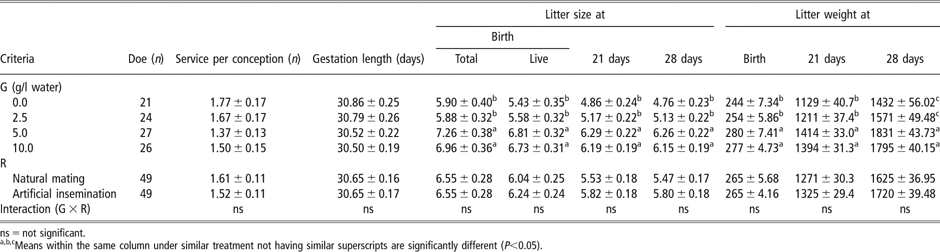
Table 1 shows the effects of different levels of oral glucose supplementations on number of services per conception, gestation length, litter size and litter weight. There was no significant effect of glucose level on number of services per conception and gestation length.
Effects of different levels of oral glucose supplementation (G) and reproduction method (R) on rabbit doe reproductive performance (least squares means ± s.e.)

ns = not significant.
a,b,cMeans within the same column under similar treatment not having similar superscripts are significantly different (P<0.05).
The reproduction method, natural mating v. AI, had no effect on number of services per conception, gestation length, litter size and litter weight at birth, 21 and 28 days of age. Also, the interaction between the level of glucose supplementation and reproduction method was not significant on number of services per conception and gestation length, litter size at birth (total and live), 21and 28 days of age.
The differences in litter size at birth (total and live), 21 days and at weaning (28 days) among experimental groups supplemented with different levels of glucose (Table 1) were significant (P < 0.01). Does supplemented with 5 g of glucose had greater litter size (P < 0.01) from birth until 28 days of age than those of control or those receiving 2.5 g glucose. However, increasing glucose level to 10 g/l did not yield further increase in litter size. Glucose supplementation of 2.5 g/l had no beneficial effect on litter size.
Offspring performance
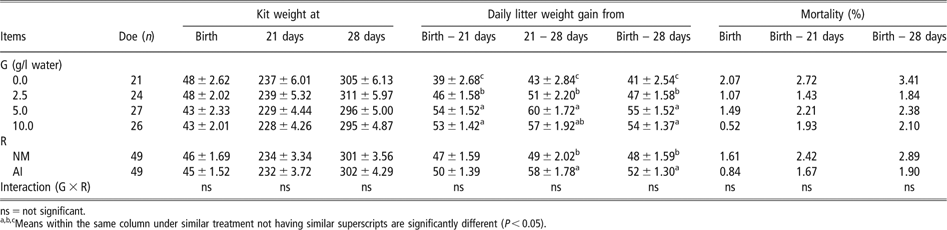
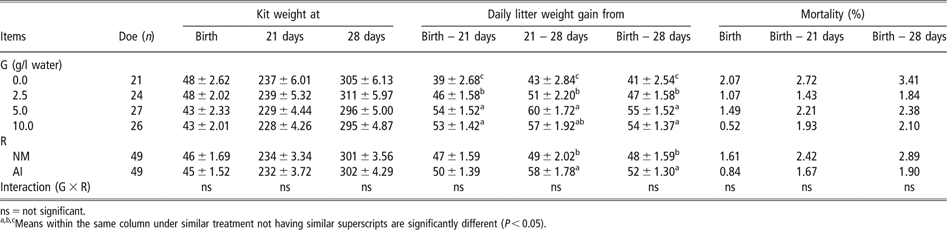
Table 2 shows the effect of different levels of oral glucose supplementations on offspring performance. There were no significant differences in kit weight at birth, 21 and 28 (weaning) days of age. The increase in kit weight found in both control and 2.5 g glucose groups might be attributed to the lowest litter size recorded in these groups at birth. Whatever the period, does supplemented with 2.5, 5 or 10 g of glucose produced kits having significantly heavier daily weight gain than those of the control group. On the other hand, differences in daily weight gain between does supplemented with either 5 or 10 g of glucose were not significant. The difference in litter weight at birth, 21 days and at weaning (28 days), of rabbits receiving different levels of glucose were also significant (P < 0.01). Does supplemented with 5 or 10 g of glucose produced significantly heavier litter weight from birth until 28 days of age than those produced by groups given 0 and 2.5 g glucose. On the other hand, there was no significant difference between groups receiving 5 or 10 g glucose, and 2.5 g glucose had no beneficial effect on litter weight.
Effects of different levels of oral glucose supplementation (G) and reproduction method (R) on offspring performance issued from natural mating (NM) or artificial insemination (AI) (least squares means ± s.e.)
ns = not significant.
a,b,cMeans within the same column under similar treatment not having similar superscripts are significantly different (P < 0.05).
Milk yield and milk conversion
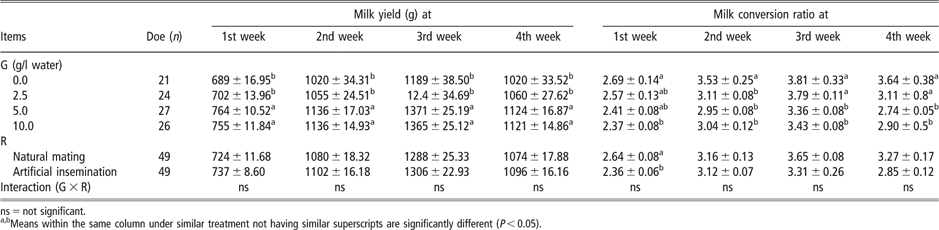
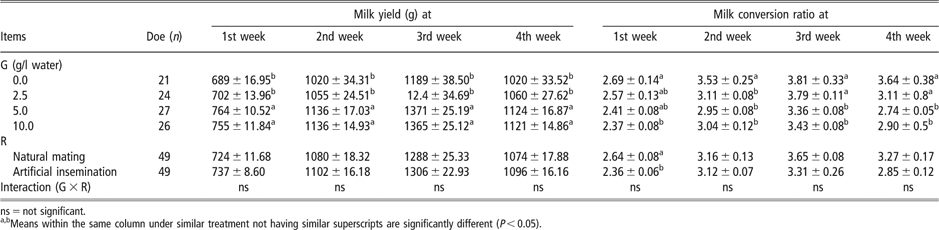
Milk yield, during all experimental intervals, was significantly higher for does supplemented with 5 and 10 g glucose than for rabbits of groups supplemented with 0 (control) and 2.5 g glucose (Table 3). Conversely, the differences among the former groups or the latter groups were not significant. The increase in milk yield observed in does provided with 5 g glucose may be due to greater energy availability for milk formation and secretion and/or higher litter size (Maertens and Groote, Reference Maertens and de Groote1990). There was no further response to glucose level above 5 g/l water.
Effects of different levels or oral glucose supplementation (G) and reproduction method (R) on milk yield and milk conversion ratio (least squares means ± s.e.)
ns = not significant.
a,bMeans within the same column under similar treatment not having similar superscripts are significantly different (P < 0.05).
Feed consumption of does
There were no significant differences due to different levels of glucose administration on feed consumption per doe during the gestation period, lactation period and from birth up to weaning (Table 4). However, feed consumption from 7 to 14 days decreased (P < 0.01) in does receiving 2.5 and 5.0 g glucose compared with controls and those drinking 10 g/l of glucose. In general, glucose supplementations did not affect feed consumption of rabbits. The reproduction method does not significantly influence feed consumption and the values were similar between artificially inseminated and naturally mated does during all tested periods. No interaction was evidenced between glucose level and reproduction method on milk yield and milk conversion ratio.
Effects of different levels of oral glucose supplementation (G) and reproduction method (R) on feed consumption of does during the pregnancy period and from birth up to weaning (least squares means ± s.e.)

ns = not significant.
a,b,cMeans within the same column under similar treatment not having similar superscripts are significantly different (P < 0.05).
Economic efficiency, performance index and relative economic efficiency
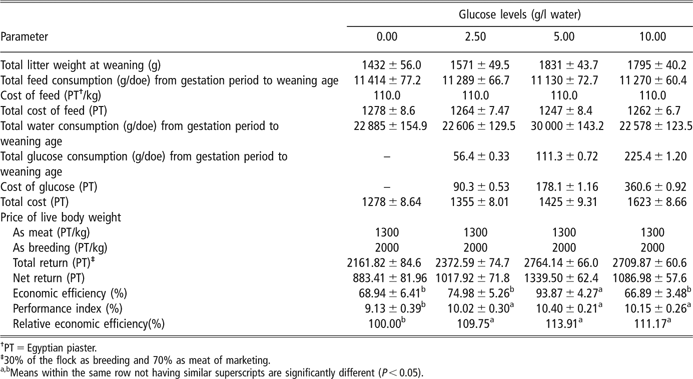
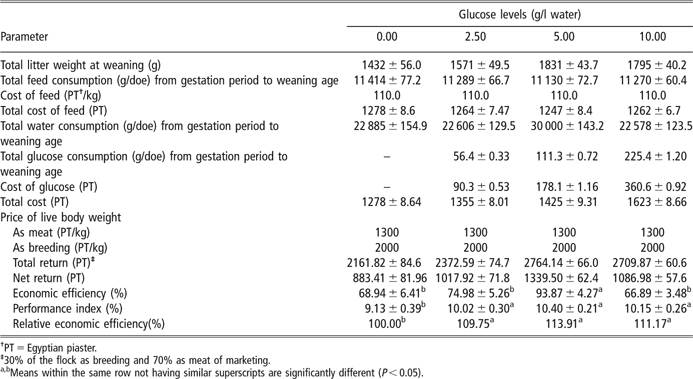
Table 5 summarizes the effect of different levels of oral glucose supplementation on the performance index, economic efficiency and relative economic efficiency of NZW does.
Economic efficiency of New Zealand White rabbits receiving different levels of oral glucose supplementation in drinking water (least squares means ± s.e.)
†PT = Egyptian piaster.
‡30% of the flock as breeding and 70% as meat of marketing.
a,bMeans within the same row not having similar superscripts are significantly different (P < 0.05).
The performance index is significantly higher when glucose is added in drinking water, but a significant economic efficiency is obtained only with the supplementation of 5 g glucose. Does supplemented with 2.5 or 10.0 g glucose/l did not improve the economic efficiency; performance index and relative economic efficiency were similar in 2.5, 10 g glucose/l and control groups.
Discussion
In the tropic, heat stress impairs performance of animals and causes a substantial loss to animal production elsewhere; thus, agents that improve the outstanding of animals to heat stress are of great interest (Marai et al., Reference Marai, Habeeb and Gad2003). The mechanism by which glucose increased litter size is not clear. However, it may be due to decreased mortality and/or increased survival of embryos as a result of improving carbohydrate status and energy availability during pregnancy. Niewoehner and Neil (Reference Niewoehner and Neil1992) reported that d-glucose improved energy availability and liver glycogen for adult rats. On the other hand, Matsuno et al. (Reference Matsuno, Esrey, Perrault and Koski1999) reported that different levels of glucose (20%, 40% and 60%) in maternal diets did not significantly affect number of born pups. However, Lanoue et al. (Reference Lanoue, Liu and Koski1999) observed that dietary glucose during pregnancy is required for neonatal survival and its restriction not only reduces glycogen reserves, but can also disrupt the normal gene expression of liver phosphoenolpyruvate carboxykinase, showing that development of neonatal glucoregulatory mechanisms is modified by the availability of maternal glucose. However, Castellini et al. (Reference Castellini, Brecchia, Canali and Boiti2000) did not found any effect on the reproductive performance of does drinking water supplemented with sucrose.
Litter weight at weaning, as a composite trait, reflects the contribution of fertility, maternal behaviour, milk production, growth rate and survivability (Lukefahr et al., Reference Lukefahr, Cheeke and Patton1990), indicating that litter weight at weaning is a function of all pre-weaning effects. The mechanism by which glucose increased litter weight is not evident in literature, but it may be due to the increase in energy availability, glycogen reserves of liver and muscle. However, Matsuno et al. (Reference Matsuno, Esrey, Perrault and Koski1999) observed that different dietary level of glucose (20%, 40% and 60%) in maternal diets for rats did not significantly affect average weight of pups at birth. Similarly, Rubio et al. (Reference Rubio, Hallford and Haweekins1997) found that average birth weight, actual and adjusted weaning weight was not significantly affected by glucose administration. Also, Lanoue et al. (Reference Lanoue, Liu and Koski1999) found that glucose restriction did not affect rat pups’ birth weight, but feeding a diet without glucose significantly decreased it.
The differences in pre-weaning mortality rate of kits due to different levels of glucose supplementations were not significant during all the experimental periods. Mortality rate was higher in control group (P < 0.05) and lower in 2.5 glucose group, and intermediate in the others. Similarly, Moran (Reference Moran1989) found that mortality of chicks was lower in d-glucose-treated than in control groups at post-hatch period. Furthermore, Iwasaki et al. (Reference Iwasaki, Ikawa, Washio, Oyama, Horikaawa, Zhou-Wei, Yamamoto and Zhou1998) observed that survival time of broiler chicks was enhanced by supplementation of d-glucose in drinking water, which would be beneficial under high ambient temperature during April to September.
Doe rabbits artificially inseminated significantly produced (P < 0.01) litter with higher daily weight gain from birth to 28 days of age than naturally mated does. However, daily litter weight gains from birth to 21 days of age were not significantly affected by reproduction method. The reproduction method did not significantly affect kit weight and pre-weaning mortality percentage during the experimental period. On the other hand, Tawfeek and El-Gaafary (Reference Tawfeek and El-Gaafary1991) found that kits’ weight at birth was not affected by reproduction method; however, kits delivered by does inseminated artificially had significantly higher weight at 21 and 35 days of age than those produced by does naturally mated.
Results showed that the effect of the interaction between glucose supplementation and reproduction method was not significant on kits’ weight, daily litter weight gain and pre-weaning mortality percentage at different intervals.
Glucose is the most important precursor for milk lactose and de novo synthesis of milk fat (Koski et al., Reference Koski, Hill and Lönnerdal1990; Matsuno et al., Reference Matsuno, Esrey, Perrault and Koski1999), and a decrease in plasma glucose level during summer months was reported (Marai et al., Reference Marai, Habeeb and Gad2003 and Reference Marai, Habeeb and Gad2005). In agreement with the present results, Matsuno et al. (Reference Matsuno, Esrey, Perrault and Koski1999) found an increase in milk fat with increasing dietary glucose levels from 20% to 60% in maternal diets of rats, while milk protein, lactose and energy were not affected by dietary glucose level. Thus, higher availability of energy substrate such as glucose might have improved energy reserves and tolerance to heat stress in rabbit during the summer months and thus increased milk yield. However, Matsuno et al. (Reference Matsuno, Esrey, Perrault and Koski1999) reported that different maternal dietary levels of glucose (20%, 40% and 60%) did not affect cumulative feed intake of rats during pregnancy and lactation, but might have increased glucose uptake.
Obviously, there was a significant effect of glucose supplementation on milk conversion ratio in all tested periods. The best milk conversion ratio throughout the 4 weeks examined was found in the group supplemented with 5 g glucose, followed by those receiving 10 and 2.5 g, respectively. These improvements in the milk conversion ratio could be attributed to the improvement in litter weight gain and milk yield.
Generally, milk yield was maximal at the 3rd week after delivery, and declined afterwards. For AI group, there was no significant increase in milk yield. However, artificially inseminated does had unexplained better (P < 0.01) milk conversion ratio than those of naturally mated does at 1st and 4th week of lactation. There was no significant interaction among different levels of glucose and reproduction method on milk yield and milk conversion ratio at different stages of lactation (Table 3).
Conclusion
Glucose administration to rabbits kept under tropical condition of Egypt during summer months significantly improve litter size at birth and weaning, daily weight gain of pups and milk production of does, while no differences were observed in terms of fertility and feed intake. However, better results were obtained when glucose was used at 5 g/l, while further increase in glucose concentration did not induce further improvements. Thus, rabbit breeders may benefit from supplementing drinking water with 5 g glucose/l during summer months when feed intake is naturally reduced, and glucose can represent an important source of energy.