INTRODUCTION
In a now well-known quotation, Romaine (Reference Romaine1982:212) observes that “the infiltration of wh- into the relative system can be seen as completed in the modern written language … but it has not really affected the spoken language.” Vernacular usage has largely resisted implementing the wh- forms (who, whom, whose, which), relying on the more traditional relative pronouns, that and the null form. When research does report higher rates of wh- relatives in conversational data, it is typically based on standard varieties (e.g. Guy & Bayley Reference Guy and Bayley1995, Kikai et al. 1987, Quirk Reference Quirk1957, Tottie Reference Tottie, Rissanen, Nevalainen and Kahlas-Tarkka1997). Materials representing older, peripheral, and conservative varieties exhibit much lower rates of wh- (Tagliamonte Reference Tagliamonte, Smith and Lawrence2005:94). Indeed, the use of who is often restricted in these contexts to a highly circumscribed group of speakers: educated individuals with middle-class aspirations (Romaine Reference Romaine1982:206, Tagliamonte et al. Reference Tagliamonte, Smith and Lawrence2005:92, n. 18 for Tyneside English; cf. Beal & Corrigan Reference Beal and Corrigan2002). This wide gulf between written and spoken, and standard and nonstandard, suggests that prescriptive norms and ideologies of standard speech are determinants of variation among relative pronoun choice. As such, imprints of these factors should be visible in the variable grammar that constrains pronoun choice in contemporary spoken usage.
Previous research on the English relative pronouns has largely focused on language-internal explanations for variant choice. This paper explores the sociolinguistic conditions that operate in an urban speech community. The data indicate that speakers not only use the relative pronouns in ways that adhere to strict linguistic conditions, but also in ways that evince their social position within the community and indicate accommodation to their interlocutors. The convergence exhibited by speakers provides a further example of the ways in which salient social category memberships are negotiated in interaction, further highlighting the social indexicality of this variable. The patterns of socially meaningful variation uncovered in the analysis can be traced to historical factors on the one hand and to ideological factors on the other, suggesting that notions of prestige that prevailed at the time of a change are tenacious and continue to have modern repercussions. The past provides a window to explain the present (cf. Romaine Reference Romaine1980).
THE RELATIVE PRONOUNS AND SOCIAL MEANING
The relativization system has been characterized by layering of relative pronouns since at least the Old English period. Some contemporary examples are given in (1). The system has also been the subject of extensive research, both diachronic and synchronic (e.g. Adamson Reference Adamson1992, Ball Reference Ball1994, Reference Ball1996, Beal & Corrigan Reference Beal and Corrigan2002, Biesenbach-Lucas Reference Biesenbach-Lucas, Denning, Inkelas, McNair-Knox and Rickford1987, Dasinger & Toupin Reference Dasinger, Toupin, Berman and Slobin1994, Dekeyser Reference Dekeyser and Fisiak1984, Reference Dekeyser1986, Guy & Bayley Reference Guy and Bayley1995, Jaeger & Wasow Reference Jaeger, Wasow, Cover and Kim2006, Johansson Reference Johansson, Kytö, Rydén and Smitterberg2006, Kikai et al. 1987, Montgomery Reference Montgomery and Trahern1989, Mustanoja Reference Mustanoja1960, Nevalainen & Raumolin-Brunberg 2002, Poussa Reference Poussa and Jacobson1985, Rissanen Reference Rissanen and Fisiak1984, Romaine Reference Romaine1982, Tagliamonte Reference Tagliamonte and Poussa2002, Tagliamonte et al. Reference Tagliamonte, Smith and Lawrence2005, Temperley Reference Temperley2003, Tottie Reference Tottie, Melchers and Warren1995, Reference Tottie, Rissanen, Nevalainen and Kahlas-Tarkka1997, Traugott Reference Traugott1972). However, despite relativization being “one of the most researched topics in the history of the English language” (Nevalainen & Raumolin-Brunberg 2002:109), the role of linguistic factors has been emphasized while that of social ones has received notably less attention.
(1) a. There's one lady that lives in my building who had been in a concentration camp in Hungary, not, not in Germany. (I/£/f/83)Footnote 1
b. … a woman who runs a exercise place to a guy that works in a nursery. (4/j/m/47)
c. It went up to the loop here and then there's another trolley Ø went to Port Credit. Um, there was a huge trestle Ø went across the Etobicoke Creek to carry the trolley on. (N/P/m/82)
d. There was a junior-high that Sharon was at and a public-school Ø Michael was at. (I/8/f/75)
e. The biggest change that my grandmother's always teasing me about is we're not as fluid with our speaking. She says a lot of talking Ø she notices is putting into like sweeping generalizations. (N/k/f/25)
f. It was weird because the guy Ø I was dating happened to be like a childhood friend basically of my manager who I am really good friends with now. (N/r/f/22)
It is not that studies have not considered social factors. Gender, education, and socioeconomic status have all received nodding attention (e.g. Macaulay Reference Macaulay1991, Romaine Reference Romaine1982, Tottie Reference Tottie, Rissanen, Nevalainen and Kahlas-Tarkka1997). Indeed, Romaine (Reference Romaine1982) argues quite convincingly that the social profiles of the wh- relatives (who, whom, whose, which) and a zero relativizer, particularly when this latter form is in subject position (1c), align with the standard/nonstandard dimension of language use. We are aware of no analysis, however, that has conducted a methodical and systematic test of a multiplicity of social factors or their intersecting effects on relative choice.Footnote 2
From a historical perspective there are compelling reasons to suspect that social factors are equally as important (if not more so) as linguistic ones in constraining variation and that the relative pronouns are indexical of social meaning. First, the wh- forms are believed to have entered the English relative pronoun system as a change from above (Romaine Reference Romaine1982:213; see also Nevalainen & Raumolin-Brunberg 2002). Second, they are thought to have been adopted to this function through analogy with historically prestigious French and Latin (Mustanoja Reference Mustanoja1960:199–200). Third, when first used as relative pronouns, the wh- forms were confined to formal styles of writing (Jones Reference Jones1972:140, Romaine Reference Romaine1982:212–13; see also Dekeyser Reference Dekeyser and Fisiak1984:76, Peters Reference Peters1996:125–26, Tottie & Rey Reference Tottie and Rey1997:465). This latter observation reflects the typical pattern for changes from above which tend to manifest in careful speech, “reflecting a superposed dialect learned after the vernacular is acquired” (Labov Reference Labov1994:78).
Thus, further reason to suspect that social factors underlie relativizer choice is suggested by the inherent stylistic profile of the wh- forms, a derivative of their history as a change from above. Specifically, the operation of stylistic variation implies variation along socioeconomic parameters (cf. the style axiom, Bell Reference Bell1984:151). Indeed, Tottie (Reference Tottie, Rissanen, Nevalainen and Kahlas-Tarkka1997:474f) demonstrated a positive correlation between educational level and wh- use, while Macaulay (Reference Macaulay1991:65) reported stratification between middle- and working-class speakers in the rates of wh- forms. Such findings are consistent with Romaine's hypothesis that the addition of the wh- forms to the English relative paradigm “resulted in a ‘squish’ of two strategies which are opposed in stylistic meaning rather than in actual qualitative change in the relative system” (1980:221; see also 1980:239, 1982:208).
Finally, synchronic studies have either not made allowances for age and/or time distributions (e.g. Beal & Corrigan Reference Beal and Corrigan2002, Fox & Thompson Reference Fox and Thompson1990, Tottie Reference Tottie, Rissanen, Nevalainen and Kahlas-Tarkka1997; though see Beal & Corrigan Reference Beal and Corrigan2000a, Reference Beal and Corriganb) or they have targeted a specific age group, ruling out the possibility of investigating potential age differences (e.g. preadolescents—Levey Reference Levey2006; older speakers (generally over sixty years of age)—Guy & Bayley Reference Guy and Bayley1995, Ihalainen Reference Ihalainen1980, Peitsara Reference Peitsara2002, Tagliamonte et al. Reference Tagliamonte, Smith and Lawrence2005, Van den Eynden Morpeth Reference Van den Eynden Morpeth2002). Grammatical descriptions of the relative system neatly circumscribe the use of particular forms to specific linguistic contexts. For example, the null form is stipulated for nonsubject relatives only (Quirk et al. Reference Quirk, Greenbaum, Leech and Svartvik1985:420), who(m) for persons, which for things (see e.g. Curme Reference Curme1947:166, Denison Reference Denison and Romaine1998:278, Jespersen Reference Jespersen1961:80, Swan Reference Swan1995:473), and that (which carries no case or person inflection) for either persons or things (Swan Reference Swan1995:473). According to Montgomery (Reference Montgomery and Trahern1989:136), these prescriptions were in place by the eighteenth century. We take the sum of these facts to imply stable variation among the relative pronouns in present-day English.
Crucially, stable variables are characterized by a distinct sociolinguistic profile: They divide into standard and nonstandard forms, of which the standard variants are associated with women (Labov's Principle Ia) and with higher socioeconomic indicators (e.g. increased levels of education and white-collar professions). Stable variables also tend to be subject to age-grading (see Labov Reference Labov1990, Reference Labov2001:76f, 119).Footnote 3 Previous research has suggested that relativization, as a “covert variable,” is not readily available for social evaluation (Tottie & Rey Reference Tottie and Rey1997:245). However, if the choice of relative pronoun in English either continues to be affected by the history of the system and/or is stable, then we can expect there to be a rich sociolinguistic component to the variation.
THE WH- FORMS: AN ABRIDGED HISTORICAL BACKGROUND
The relative pronoun system of English has been rich in variation since Old English when there were at least three strategies for relativization: the inflected demonstratives se and seo, the invariant þe, and zero (i.e. deletion). In Middle English the interrogative pronouns (hwa, hwilc, etc.) also began to be used as relative pronouns (Romaine Reference Romaine1980:234). The last to develop this new function was modern who (Romaine Reference Romaine1980:223), which appears to have been restricted to human antecedents from the outset (Romaine Reference Romaine1982:61, Rydén Reference Rydén1983:128, Traugott Reference Traugott1972:155–56). The earliest attestation occurs in a Paston letter of 1426, shown in (2).
(2) I submitte me and alle þis matier to yowr good discrecion, and euere gremercy God and ye, who euere haue yow and me in his gracious gouernaunce.
‘and always thanks to God and you, and may He always keep you and me in his gracious governance’ (Rydén Reference Rydén1983:127)
The consensus in the historical literature is that the restrictive function of the wh- pronouns gained prestige by their association with French and Latin relative constructions (Mustanoja Reference Mustanoja1960:199–200, Romaine Reference Romaine1982:213; see also Nevalainen et al. 2001). Romaine (Reference Romaine1982:213) writes, “even though wh- is internal to the system, its use as a relativizer can be thought of as a borrowing from a Romance acrolectal adstratum in Middle English.” When first used as relatives, the wh- forms appear to have been confined to formal use (Jones Reference Jones1972:140) as evident in (2) above. This conclusion is supported by Ball (Reference Ball1996:248), whose data indicate “a clear lag” in the use of wh- relative pronouns between literary texts and spoken usage. This suggests that sociolinguistic correlates may have been present from the outset (see Nevalainen et al. 2001).
The development of the relative markers in subject position has been studied extensively by Ball (Reference Ball1996). In this context, which was already well established by the sixteenth century and could be used for reference to both nonhuman and human antecedents. As Ball (Reference Ball1996) documents, however, the situation changed markedly during the seventeenth century when the frequency of who gradually increased to mark human antecedents; that was relegated to nonpersonal antecedents. According to Ball (Reference Ball1996:247), this shift “laid the foundation for the modern dominance of who for personal subject restrictive relatives.”
As we demonstrate below, the longitudinal linguistic variability among relative pronoun forms, the systemic functional split between who and that, and the marked social overlay in the system perdures in contemporary speech communities.
METHODOLOGY
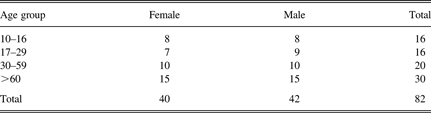
The data used in our analysis were drawn from the Toronto English Archive (Tagliamonte Reference Tagliamonte2003–2005). This collection of synchronic spoken corpora was recorded in Toronto, Canada between 2002 and 2004 using traditional Labovian sociolinguistic interview methods. Much of the interview materials consist of narratives of personal experience and the recordings are highly informal. As an urban variety, Toronto English is a standard dialect, representative of General (standard) Canadian English (Chambers to appear). Nonetheless, linguistic variability abounds in the community and can be correlated with social characteristics of native Torontonians (see e.g. Hoffman & Walker Reference Hoffman and Walker2010; Tagliamonte et al. Reference Tagliamonte, D'Arcy and Jankowski2010). The details of the current sample, consisting of eighty-two speakers ranging in age from ten to ninety-two years, are provided in Table 1.
Sample constitution.

The diversity captured in a sample of this size enables us to test for the effects of a number of language-external factors. First, the age range presents an ideal opportunity to examine the apparent-time profile of the relative pronouns. Are they in fact stable? If so, are they age-graded? Second, the equal stratification by speaker sex enables us to probe the possibility of a gender effect. Are certain forms associated with women and others with men? Third, these speakers represent a variety of socioeconomic backgrounds, allowing us to explore the possible effects of two key socioeconomic determinants: education and occupation. Labov (Reference Labov2001:60) has suggested that education provides perhaps the best binary measure of the social evaluation of features in a community, with higher levels of education correlating with linguistic features held to have prestige. We distinguish here between speakers with some degree of post-secondary schooling (+) versus those with none (–). Occupation is also highly correlated with conceptions of social status, in that higher status groups lean toward positively valued linguistic features (Labov Reference Labov2001:60, Wolfram Reference Wolfram and Coulmas1996:120–22). Chambers (Reference Chambers2003:7) has suggested that the essential occupational distinction in industrialized societies separates manual, blue-collar and nonmanual, white-collar laborers; we categorize these groups as nonprofessional and professional respectively.Footnote 4 We thus explore the question of whether or not a correlation holds between either education or occupation and the wh- forms, as might be expected from their genesis as relative pronouns as changes from above.
As already discussed, past research on English relativization has largely been concerned with the linguistic conditions that underlie variant choice. Thus it is known, for example, that nonrestrictive relative clauses are virtually always introduced by a wh- form, resulting in that and zero being largely confined to restrictive relatives (e.g. Dekeyser Reference Dekeyser1986, Lass Reference Lass1987, Poutsma Reference Poutsma1904/1926, Visser Reference Visser1963–1973). Restrictive and nonrestrictive structures also differ semantically. Nonrestrictive relatives contain supplementary information while restrictive relatives contain propositional content (e.g. Huddleston & Pullum Reference Huddleston and Pullum2002, Quirk et al. Reference Quirk, Greenbaum, Leech and Svartvik1985). Given the lack of variability in nonrestrictive clauses (almost categorical wh-) and their distinct functional characteristics (parenthetical), we focus here on restrictive relative clauses, the category that has received the bulk of attention in variationist sociolinguistic research (e.g. Ball Reference Ball1996, Guy & Bayley Reference Guy and Bayley1995, Levey Reference Levey2006, Nevalainen & Raumolin-Brungerg Reference Nevalainen and Raumolin-Brungerg2002, Tagliamonte Reference Tagliamonte and Poussa2002, Tagliamonte et al. Reference Tagliamonte, Smith and Lawrence2005, Tottie Reference Tottie, Rissanen, Nevalainen and Kahlas-Tarkka1997).
To isolate the restrictive relative clauses (as opposed to any other types) as well as make our results comparable to earlier research, we followed the methods outlined in Tagliamonte (Reference Tagliamonte and Poussa2002:151–52) and in Tagliamonte et al. (Reference Tagliamonte, Smith and Lawrence2005:84–86), which are based in main on those of Tottie and Harvie Reference Tottie, Harvie and Poplack2000. This procedure provided 3,220 relative clauses for analysis.
LINGUISTIC RESULTS
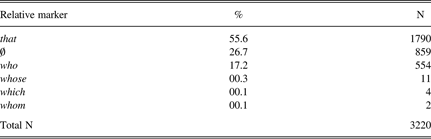
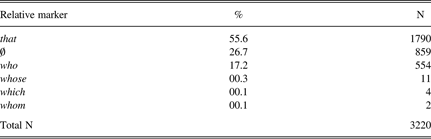
Table 2 displays the overall distribution of restrictive relative markers in these data. These results reveal that the restrictive paradigm is circumscribed to the tripartite division of codified strategies: wh-, that, and zero. The vernacular forms associated with regional and nonstandard varieties (what, at, as; see Ihalainen Reference Ihalainen1980, Tagliamonte et al. Reference Tagliamonte, Smith and Lawrence2005, Levey Reference Levey2006) never occur. Moreover, the wh- paradigm is almost categorically represented by who, which accounts for a full 97% of wh- forms (N = 571); occurrences of whose, which, and whom are negligible. Indeed, these latter forms account for just 0.5% of the data overall (N = 17). Thus, even though Toronto English is a relatively standard variety, wh- relative markers rarely occur in the casual conversations of its speakers.
Overall distribution of relative markers.
This raises the question of why who should be productive when other wh- forms are not. Undoubtedly, the fact that informal speech does not generally elicit genitive or pied-piping constructions limits the opportunity for whose and whom to occur (see Levey Reference Levey2006:57 and references therein). At the same time, if who is circumscribed to particular individuals with high social standing then it does not constitute a community norm (cf. Tagliamonte et al. Reference Tagliamonte, Smith and Lawrence2005:92; see also Beal & Corrigan Reference Beal and Corrigan2002, as cited in Tagliamonte et al. Reference Tagliamonte, Smith and Lawrence2005, n. 18). Given the lack of other wh- relatives in the Toronto data, we must wonder whether use of who is similarly restricted here.
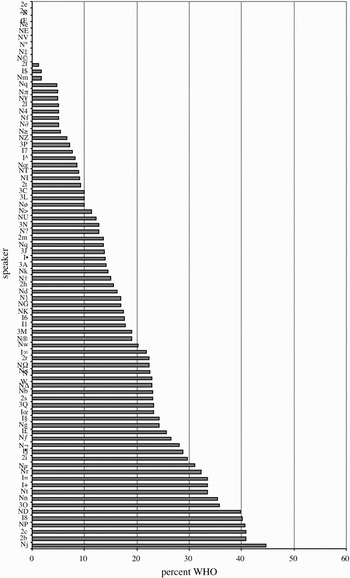
Figure 1 displays the use of who, as a proportion of total restrictive relative markers, by individual speaker.Footnote 5 Two observations are immediately apparent. First, the vast majority of speakers use it, if only sparingly; only nine of the eighty-two fail to produce a single token. Second, the slope from one end of the scale to the other is gradient; the average difference in the frequency of who from one cell to the next is just 0.548%. At the same time, however, there is a wide range in the rates of use overall, 0% to 44.4%. The median frequency is 14.55%, but the standard deviation is large, 12.01%. What then are the factors that contribute to the position of individual speakers along the continuum (e.g. within the group of speakers who use who at rates below the median vs. those who use it at rates in the 25–35% range)? We have more to say about individuals shortly.
Overall frequency of relative who by individual speaker.

From this point forward, we confine our analysis to the principal variants in the Toronto materials, that, zero, and who. The first step is to disentangle the well-known factors of syntactic function and animacy of the antecedent.
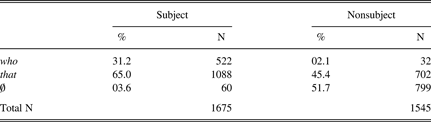
When considered as a simple overall distribution of forms, as in Table 2, that and zero reign among relative pronouns, accounting for over four-fifths of the data (82.3%, N = 2649). When considered according to different syntactic functions, however, a different picture emerges. Table 3 displays the distribution of relative markers according to syntactic function, subject or nonsubject (i.e. direct object, indirect object, object of preposition).
Distribution of relative markers according to syntactic function.
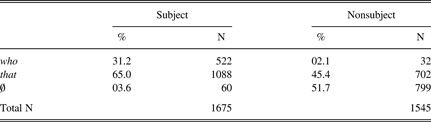
Not shown: whose, which, and whom (N = 17).
The results in Table 3 indicate that in subject position, pronoun choice is largely restricted to that and who; zero is rare. In nonsubject position, that and zero alternate robustly; who is rare. In other words, there is a sharp division across contexts: that ~ who for subject relatives and that ~ zero for nonsubject relatives. Of the three principal variants, only that is used productively across the restrictive domain, competing robustly in subject and nonsubject positions. These results thus provide compelling linguistic motivation for considering the syntactic functions separately. There is another contextual factor that must also be considered.
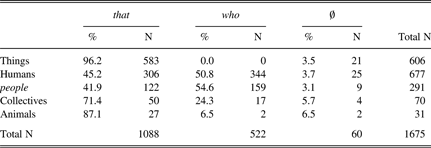
Table 4 displays the distribution of relative markers according to the animacy of the antecedent. These results reveal a further partitioning of the variable context. When the antecedent is inanimate there is in fact no variation: that is nearly categorical (96.2%, N = 606). Animals appear to pattern alongside things, with that occurring at the rate of 87.1% (N = 31). That also preponderates for collective nouns (71.4%, N = 70).
Distribution of relative markers by animacy of the antecedent, subject function only.
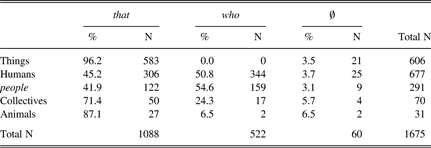
Not shown: whose and which (N = 5).
In sum, variation within the restrictive relative-pronoun system of Toronto English is highly circumscribed. This finding is consistent with other research that has disentangled subject function and animacy among restrictive relatives (e.g. Ball Reference Ball1996, Nevalainen & Raumolin-Brunberg 2002, Tagliamonte Reference Tagliamonte and Poussa2002, Tagliamonte et al. Reference Tagliamonte, Smith and Lawrence2005). As a consequence, from this point we limit our analysis to the two following contexts: (i) where variability between that and who operates robustly—subject relatives with human antecedents and people (combined N = 968),Footnote 6 which we refer to simply as “human,” and (ii) nonsubject relatives with inanimate antecedents (human antecedents excluded for reasons of frequency, N = 66).
From the distributional results in Tables 3 and 4, it can now be reasonably assumed that some of the interspeaker variability of Figure 1 results from the ratios of subject vs. nonsubject relatives and, among subject relatives, animate vs. inanimate antecedents in the data of individual speakers. These grammatical constraints answer, in part, the question of why who is used: it marks human subject relatives. However, to assess the degree of penetration of who into spoken Canadian English the next step is to determine whether who has social meaning. Who uses who, and why?
SOCIOLINGUISTIC RESULTS
Romaine (Reference Romaine1982) suggests that in speech, both the wh- relatives and the null form (especially in subject position) are socially and stylistically diagnostic. In particular, she suggests that their stylistic profiles are coincident with the social dimension of standard/nonstandard. As a marker of more formal styles, wh- aligns with the standard. In contrast, the null form is stereotyped through its association with informal registers and nonstandard speech. The third primary variant, that, is stylistic, increasing in use in speech and, in written language, in speech-like genres. As noted earlier, however, no study has carried out a systematic investigation of the full social profiles exhibited by these forms. We begin the process with an examination of speaker age. The norms for relative pronoun choice in written data are thought to have stabilized early in the development of the wh- forms (Romaine Reference Romaine1982:212). The issue facing us is how assumptions about the state of the written language may be corroborated by spoken data. In other words, is variation among the relative pronouns stable across the community?
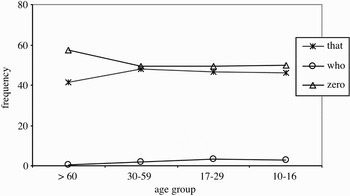
Figure 2 displays the apparent-time distribution of the restrictive relative pronouns in nonsubject position. The trajectories depart little from a straight line. There is robust competition between that and zero in every age group, closely matching Labov's (Reference Labov1994:83) definition of stability.
Distribution of nonsubject-restrictive relative pronouns across apparent time.

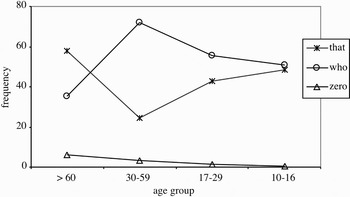
Figure 3 displays the distribution of the restrictive relative pronouns in subject position (when the antecedent is human). There is no monotonic relationship between frequency and age as would be expected of a change in progress (Labov Reference Labov2001:171), suggesting that the community as a whole is stable. In contrast to Figure 2, however, Figure 3 raises the possibility that individuals are not stable across their lifetimes. The curvilinear pattern along the age axis is precisely that which is linked with stable, age-graded variables: “less prestigious variants [are] used more frequently by younger speakers, and also by older speakers, with the prestige variants used relatively more frequently by middle-aged speakers” (Cheshire Reference Cheshire, Ammon, Dittmar, Mattheier and Trudgill2005:1555; see also Downes Reference Downes1998:24).
Distribution of subject-restrictive relative pronouns across apparent time, human antecedents only.

To what extent can we confirm that the pattern for who in human-subject relatives is the result of stable age-grading? The clearest example of long-term stability available in the sociolinguistic literature is Trudgill's (Reference Trudgill1974) analysis of variable -ing in Norwich, England. Variable -ing refers to variation in the realization of the unstressed final syllable in words like running and singing as either an alveolar or a velar nasal. To date, no study has uncovered evidence for change in progress in this variable (Labov Reference Labov2001:86).
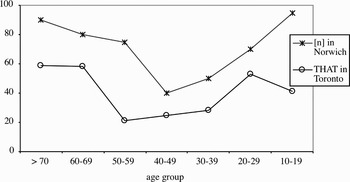
Figure 4 compares the results for variable -ing, the classic example of age-grading, with the results from the present analysis of human subject relatives in Toronto. The Toronto sample has been regrouped so as to align with Trudgill's age divisions.
Comparison of apparent time distributions of human-subject restrictive relatives in Toronto and (ing) in Norwich (based on free speech results in Chambers & Trudgill Reference Chambers and Trudgill1980:91, fig.6.4).

Differences in quantificational methods aside (the Toronto results report frequency; the Norwich results report index scores (consistent use of [n] = 100, consistent use of [ŋ] = 0)), the age patterns are remarkably parallel. In Norwich, the nonstandard alveolar realization occurs most frequently among older and younger speakers, with a trough occurring among middle-aged speakers. In Toronto, that in human-subject relatives shows a parallel dip in the same age cohorts. The high degree of correspondence between these two sets of results provides compelling evidence to suggest that for subject relative pronouns (when the antecedent is human), the choice of who—which patterns in complementary distribution with that—is also a stable but age-graded phenomenon.
Stable, age-graded variables have well-known social correlates (see Labov Reference Labov1990, Reference Labov2001:76f, 119). If the variable is binary, which subject restrictive relatives appear to be (Table 3), then it is generally the case that one variant will be correlated with higher socioeconomic indicators and with women. Conversely, the alternating variant will be correlated with lower socioeconomic indicators and with men. The history of who suggests that it was originally a prestige form. Synchronic retention of this sociolinguistic value is suggested by its age distribution in Figure 3, which rises in frequency among middle-aged speakers and diminishes at the outside edges of the age spectrum (and among the oldest speakers in particular). In contrast, the apparent-time trajectory of human-subject relative that reveals a contrasting pattern, peaking in use among the oldest and youngest speakers in the sample.
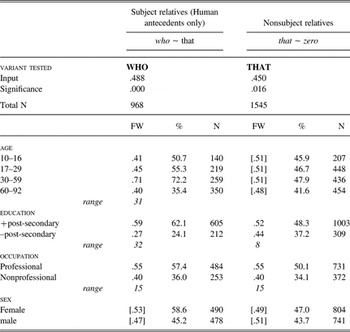
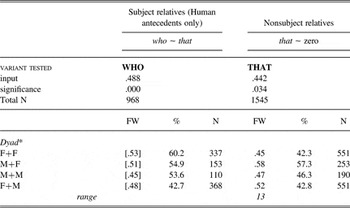
The next step, therefore, is to determine the extent to which the restrictive relative pronouns behave like age-graded features on sociolinguistic grounds. To investigate this issue we conduct a multivariate analysis using Goldvarb X (Sankoff et al. Reference Sankoff, Tagliamonte and Smith2005). This method allows us to model the combined and simultaneous effects of known sociolinguistic correlates of linguistic variation: age, sex, education, occupation.Footnote 7 In this statistical test, the input reports the overall rate at which a variant occurs in the data when all factors are controlled for. Factor weights, which range between 0 and 1, indicate the probability of occurrence in each context included in the model. Figures closer to 1 indicate stronger favoring effects while those closer to 0 indicate stronger disfavoring effects. Finally, the range, which we report only for factor groups selected as significant (p < 0.05), provides a nonstatistical measure of the strength of the group relative to other groups in the model in conditioning variability.
Table 5 shows the results of two independent multivariate analyses. The left column reports the results for who in subject position (human antecedents). The right column reports those for that in nonsubject position.
Two independent variable rule analyses of factors contributing to the probability of who and that as restrictive relative pronouns in Toronto English.

Factor groups in square brackets not significant.
As a restrictive relative pronoun, who alternates in subject function with that, one of the two traditional English relativization strategies. We have elected to model who in the multivariate analysis of subject relatives because it enables us to gauge the sociolinguistic reflexes of its history of prestige in contemporary usage.
The results in Table 5 reveal that age, education, and occupation are statistically significant factors operating on the use of who as a human-subject restrictive relative pronoun. With respect to age, who is only favored—and heavily so—among the 30–59 year olds. Elsewhere, it is disfavored. Moreover, this age effect, setting the middle-aged speakers apart from the other cohorts, is very strong (range = 31). This effect is rivaled by that of education, which exerts a similarly robust effect (range = 32). The probabilities indicate that who is favored among speakers with post-secondary schooling while strongly disfavored among speakers with no training beyond high school. Indeed, the effect of education operates in such a way that regardless of age, speakers with post-secondary schooling consistently favor who, though it is noteworthy that this effect is most robust among speakers between the ages of thirty and fifty-nine (78% vs. 21%, N = 214), the precise cohort in which who is favored.Footnote 8 Finally, occupation constrains variability so that who is favored among professionals and disfavored among nonprofessionals. By extension, that patterns in opposition, favored for less educated, nonprofessional individuals and those at the outer edges of the age spectrum.
These results are precisely as expected based on the known sociolinguistic correlates of both changes from above (the historical profile of the wh- forms in English) and stable age-graded features (the contemporary apparent-time profile of the subject relative pronouns). These findings reveal that variation among relative pronouns in contemporary spoken English is a highly marked sociolinguistic feature, as argued for by Romaine (Reference Romaine1982). And yet, there is no sex effect in these aggregate results. This is unusual, since with both changes from above and stable sociolinguistic variables it is expected that the prestige or standard form should be associated with women (Labov Reference Labov1990, Reference Labov1994, Reference Labov2001). Thus, we would have predicted that who would be correlated with women, but in Table 5 it is not. This anomalous result requires further investigation; as we demonstrate, cross-tabulations of the social factors prove informative.
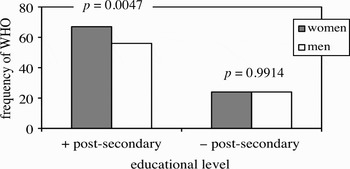
Indeed, as shown in Figure 5, there is a key interaction in these data between speaker sex and education. Among less educated speakers, sex does not influence the choice of relative pronoun. In contrast, within the more educated cohort, women use who significantly more frequently (and that significantly less so) than men do (Pearson's χ2: df = 1, p = 0.0047; N = 605). Thus, while sex is not a principal sociolinguistic determinant of subject relative pronoun choice in the community overall, it is an important correlate within the population of speakers with post-secondary education, the very group that favors who overall.
Cross-tabulation by speaker sex and education: subject-restrictive relatives (human antecedents).

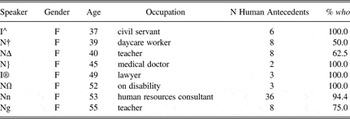
To summarize, the analysis of human-subject relatives has revealed two main findings. First, variation between who and that is constrained by age, education, and occupation. Who is favored among middle-aged speakers (thirty to fifty-nine years of age), professionals, and those with education beyond the secondary level. Second, and arising from this latter point, education and occupation do not operate in parallel across the speech community. Who, as a subject-restrictive relative pronoun, is associated not only with middle-aged, more educated, professional speakers in general, but more specifically with middle-aged, more educated women. Table 6 provides a breakdown of the seven women in our sample who meet this profile; they include two teachers, a lawyer, a medical doctor, and a civil servant. What is striking in this table is the consistently high frequency of who in subject position when the antecedent is human. The average is 85.1% (N = 74), significantly higher than in any other social group.
Details for middle-aged, tertiary-educated women, subject-restrictive relatives.

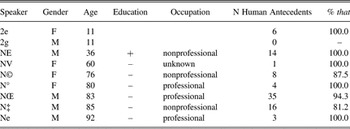
Now that we have established who uses who (middle-aged and more educated women and professionals), let us return to the nine individuals in Figure 1 who never used who. The details for these speakers are listed in Table 7 and they contrast starkly with those in Table 6.
Details of speakers who did not use who, subject-restrictive relatives (cf. Figure 1).

From a linguistic perspective, the variable context for who (subject relatives with human antecedents) occurs at very low rates for the majority of the speakers in this table, the notable exceptions being speakers NE (N = 14), N‡ (N = 16), and NŒ (N = 35). We return to speaker NE shortly. Speaker N‡ was eighty-five at the time of recording and male, was only educated to the middle-school level (grades six to eight, or ages eleven to thirteen years), and was employed as an auto mechanic throughout his working life. Moreover, while a full 81% of his subject pronouns with human antecedents were lexicalized as that, the remaining 19% (a nonnegligible proportion) were marked with the decidedly nonstandard null form. Speaker NŒ has a similar social profile. He was eighty-three when interviewed, male, and did not complete high school. Thus, the failure of these men to produce a single token of who is fully in line not only with the local social profile of a non-who user, but it is also consonant with findings reported elsewhere (e.g. Lehmann Reference Lehmann and Peters2002, Tagliamonte et al. Reference Tagliamonte, Smith and Lawrence2005, Romaine Reference Romaine1982).
For the remaining speakers in Table 7, the temptation is to posit too few tokens to explain the lack of who. There is no prima facie correlation, however, between low token numbers and a zero occurrence rate. Among the seventy-three speakers who did employ who, sixteen produced five or fewer tokens of subject relatives with human antecedents. The more explanatory condition is thus not token numbers but social factors constraining pronoun choice. If we consider the characteristics of the speakers in Table 7, only one fits the more general local profile of a who user: speaker NE. He is middle-aged (thirty-six years), but while he has culinary training (which qualifies him as having post-secondary education), he dropped out of high school and only completed his qualifications as an adult. Further, he is male and works in the restaurant industry “behind the line” as a cook. Thus, while meeting some characteristics that favor use of who (age, education), he meets others that favor use of that (sex, occupation). The remaining speakers in Table 7 fall squarely into who-disfavored social categories (aged either eleven or seventy-six and older, and having no post-secondary education). In contrast, although the sixteen who users with low token numbers (≤5) include just five women, they are uniformly educated beyond the secondary level and/or hold white-collar professions, including journalists, lawyers, and teachers. Such unanimously consistent trends strongly corroborate the multivariate findings and explain the results from Figure 1 with respect to the anomalous nine individuals with no tokens of who.
Let us now return to Table 5 and consider the sociolinguistic conditions on nonsubject-restrictive relative pronouns. Where in subject position we find an age-graded trajectory in which that competes with who, and it is who that carries the hallmarks of the standard variant, the nonsubject function presents a context in which variation appears stable but not age-graded (cf. Figure 2). Since that is unique in occurring in both subject and nonsubject functions and therefore presents a direct point of comparison between the two, we have elected to model it in the multivariate analysis of nonsubject relatives.
The analysis reveals that that is stable (no age effect) and gender neutral (no sex effect), but it has significant educational and, in particular, occupational correlates. By extension, the zero form operates in opposition, associated with less educated and nonprofessional speakers. Such social conditions suggest that zero patterns as a nonstandard form, a conclusion that is consonant with a host of previous findings reported in the literature. For example, a null relative pronoun has been associated with lower social classes (Adamson Reference Adamson1992, Prideaux & Baker Reference Prideaux and Baker1986, Romaine Reference Romaine1982), less formal styles (Guy & Bayley Reference Guy and Bayley1995, Romaine Reference Romaine1982), and regional, nonstandard varieties (Beal & Corrigan Reference Beal and Corrigan2002, Henry Reference Henry1995, Ihalainen Reference Ihalainen1980, Peet Reference Peet, Shuy and Bailey1974, Van den Eynden Morpeth Reference Van den Eynden Morpeth2002). This leaves that as the more explicit option that patterns with the standard social indicators, education and professional occupations. The interesting finding therefore is that as a restrictive relative pronoun, that is bivalent: With human subject relatives it is relegated to the vernacular spectrum, while in nonsubject relatives it patterns as a standard form.
In sum, as initially hypothesized, the choice of restrictive relative pronoun—whether for human-subject reference or for nonsubject function—is highly sensitive to social factors, particularly those related to education and occupation.
INTERACTIONAL CONSEQUENCES
The apparent sensitivity of the Torontonians in our sample to the standard language led us to suspect that there might be interactional consequences. Sociolinguistic research has long established the significant role of situational or audience-based variability (Bell Reference Bell1984, Bourhis & Giles Reference Bourhis, Giles and Giles1977, Coupland Reference Coupland1980, Reference Coupland1984, Giles Reference Giles1973, Giles & Coupland Reference Giles and Coupland1991, Giles & Powesland Reference Giles and Powesland1975). In the context of the sociolinguistic interview, the interviewer can impact variation in the speech of participants (Cukor-Avila Reference Cukor-Avila2000, Cukor-Avila & Bailey Reference Cukor-Avila and Bailey2001, Rickford & McNair-Knox Reference Rickford, McNair-Knox, Biber and Finegan1994), prompting “the need to account for interviewer characteristics … in reaching conclusions based on sociolinguistic fieldwork” (Cukor-Avila & Bailey Reference Cukor-Avila and Bailey2001:268). In the case of the restrictive relative pronouns, the wh- forms are stratified stylistically, and we have established that the three primary variants in the system—who, that, and zero—hold significant social currency (cf. Romaine Reference Romaine1982). This suggests that there may be distinct accommodation patterns visible between social groups in response to characteristics of the interlocutor. Speakers may make subtle alternations in variant use in response to the social makeup of the discourse situation (cf. Bell Reference Bell1984, Giles Reference Giles1973, Giles & Coupland Reference Giles and Coupland1991).
With this particular data set, the gender composition of the interview dyads is the most viable way to test for accommodation effects. Indeed, gender is held to be “a salient group membership” that exerts a major influence on interpersonal communication (Giles & Ogay Reference Giles, Ogay, Whaley and Samter2006:336). Linguistically, neither men nor women behave the same way in same-sex and mixed-sex situations, accommodating their communicative style to the gender of their interactant (ibid.). In line with this observation, Coates (Reference Coates, Coates and Cameron1988) has suggested that findings from same-sex and mixed-sex research should be distinguished.
A post-hoc factor group was thus configured to examine the effects in these data, if any, of the interview being held with same-sex interlocutors (female/female, male/male) and those of the opposite sex (female/male, male/female). However, dyad could not be run in the same multivariate model as speaker sex because the two factor groups are not orthogonal. The dyad group bisects the sex one, splitting participants according to their own sex as well as that of the interviewer. Consequently, to examine the possible consequences of gender from an interactional perspective, the models from Table 5 were rerun with dyad in lieu of speaker sex. The results are shown in Table 8.Footnote 9
Two independent variable-rule analyses of factors contributing to probability of that and who as restrictive relative pronouns in Toronto English (same model as Table 5; dyad in lieu of speaker sex).

Factor groups in square brackets not significant.
*left = interviewer sex; right = speaker sex.
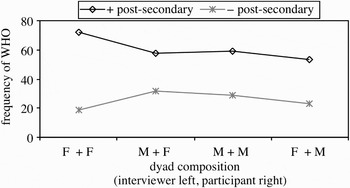
Table 8 permits a number of observations. First, dyad does not appear to have an effect on the choice of pronoun in human-subject relatives. Note, however, that there is a mismatch between frequencies and factor weights for the dyad combinations. This suggests an interaction in the data. Recall that in Table 5, speaker sex was found to interact with education. Speakers with no post-secondary education were not differentiated along gender lines, but more educated women used who significantly more frequently than did their male peers (cf. Figure 5). Since the dyad group is a derivative of speaker sex, it is likely that an interaction occurs again with education. Figure 6 shows the intersection between dyad and education.
Frequency of who according to dyad and education: subject-restrictive relatives.

The association of who and education is clearly visible in Figure 6: The two educational groups are distinct from each other in every dyad. Moreover, the groups operate in parallel: The frequency of who is relatively constant, and none of the minor fluctuations is significant. However, the women, when interviewed by another woman, diverge from the norms evident in the other interview contexts.Footnote 10 When interviewed by a man, the women behave no differently from their male peers in their use of who in human subject relatives, but when speaking to another woman, the rate of who among educated women becomes significantly greater (Pearson's χ2: df = 1, p = 0.0094).Footnote 11
This pattern is remarkably similar to that reported by Takano (Reference Takano1998), in which the frequency of particle ellipsis in Japanese significantly increases in female/female dyads. However, an important point of contrast between Takano's findings and those in Figure 6 concerns the more localized effect of the participant framework on variability between that and who: For subject restrictive relative pronouns, the sex of the interlocutor has a restricted effect. It is not simply that women in general (i.e. as some kind of coherent social category) alter the relative frequency of who (and by extension, of that) in response to the gender of their addressee. Rather, it is educated women who step outside the otherwise generalized pattern of mutual convergence that is visible across the Toronto sample. The interviewers who collected the data for the Toronto English Archive were all university students. This means that the female interviewers were members of the group associated with high rates of who in this community. In the terminology of Bell Reference Bell1984, the educated female participants thus appear to make an upward “responsive shift” based on the social-category membership of their audience.
This same pattern of accommodation is not evident in the effect of dyad for nonsubject position. In this context, that is favored in mixed-sex dyads and disfavored in same-sex ones. This pattern suggests that speakers adopt a more standard form (that) when talking to the opposite sex, but select a more vernacular form (zero) with an interlocutor of the same sex.
This configuration does not conform with that which is typically observed in studies of gender-based variability, where differences often become less salient in mixed-sex interactions, that is, mutual convergence (e.g. Brown Reference Brown, McConnell-Ginet, Borker and Furman1980, Erman Reference Erman1992, Hogg Reference Hogg1985, Takano Reference Takano1998; cf. Giles & Coupland Reference Giles and Coupland1991). Presumably, however, a static male/female difference must be operative at some level before a dynamic one can manifest in the context of same- and different-sex participant frameworks. Arguably, gender-based linguistic differentiation of the kind that appears to inform the saliency of gender in single-sex interactions functions to maintain in-group norms (cf. Giles & Coupland Reference Giles and Coupland1991, Takano Reference Takano1998). In the absence of a socially meaningful gender difference in the use of a linguistic variable, there is no reason for one to come to the fore in a same-sex communicative context.
Ultimately, the test of dyad adds a further nuance to understanding the variability among relative pronouns in the Toronto speech community. Not only do static social correlates influence the choice of relative pronoun, but in the case of human-subject relatives, dynamic interactive forces also hold significant explanatory power. This finding highlights the importance of taking the interview context into account when examining language variation and change: The ways in which speakers “perform” or create different aspects of their social identities is malleable, depending in part on contextual factors and cues (Cameron & Coates Reference Cameron, Coates, Coates and Cameron1988, Eckert & McConnell-Ginet Reference Eckert and McConnell-Ginet1992, Giles & Coupland Reference Giles and Coupland1991).
GRAMMATICAL IDEOLOGY
The fundamental observation to be gleaned from the totality of the results presented here is the complex interaction between syntactic variation and social meaning. The added insight is just how indexical of social meaning the relative pronouns actually are. A core part of the variability involves the simultaneous influences of education and occupation, which pattern so as to divide the variants into standard (+education, professional) and nonstandard (−education, nonprofessional). However, speakers are also sensitive to their interlocutors. Salient social-category membership is negotiated during face-to-face interaction through significant degrees of accommodation.
At this point it is instructive to return to the notion of prestige. According to Kroch and Small (Reference Kroch, Small and Sankoff1978:45), “prestige norms can have a powerful influence on speech, and the whole question of their role in language is worth another look.” In this article we have done just that, and we have found that such an influence is clearly present with respect to who. In Toronto English, human-subject restrictive relatives are the only context in which the wh- pronouns have made an imprint on the spoken language. This is the linguistic domain of who, the only wh- form with any presence in the system overall, and yet even within its mandated context it manages to account for just half of the data (51.96%, N = 968). In other words, since its earliest attestation in 1426 to the early 2000s, nearly 600 years later, relative who continues to function like an importation, localized to the specific linguistic context and social groups where the pressures of the standard model are most influential on the spoken vernacular. This is most evident in the results for educated women. It is not only that they use who more frequently than any other social group. When interacting with another woman rather than with a man, these women use who nearly 25% more often (compare woman/woman at 72% vs. man/woman at 58%; cf. Figure 6).
The social patterns evident in the use of who demonstrate that prescriptive norms can be a significant factor influencing speakers' choice among linguistic variants (cf. Kroch & Small Reference Kroch, Small and Sankoff1978). Who retains its legacy of prestige hundreds of years after its introduction to the relative domain and continues to exhibit the characteristics of “a superposed dialect learned after the vernacular is acquired” (Labov Reference Labov1994:78), typical of changes from above. The hypercorrect uses in (3) comprise the only occurrences of whom in the Toronto data set. In both instances pied-piping, prescriptively mandated with this wh- form, proves problematic: In (3a) the preposition is reduplicated (to whom … to), while in (3b) the preposition is dangled (whom … with). These examples demonstrate how speakers, sensitive to the prestige norms, attempt to conform to them in speech regardless of whether they know how to use them “correctly” (i.e. according to the full set of prescriptive rules).
(3) a. Like getting married. I guess that comes after you find that person to whom you would like to get married to. (3/J/m/18)
b. And we met a- another girl who had nursed with Helen, and her husband, whom I used to sit with while we were waiting for the girls to come out uh, from the nurse's residence. (N/d/m/83)
The relationship between standard language and the apparent status of that in nonsubject restrictive relatives is less transparent than is that for who. Historically both that and zero alternated as relative pronouns, with zero only becoming specialized for nonsubject functions during the Middle English period (Bever & Langendoen Reference Bever and Langendoen1971:442, Visser Reference Visser1963–1973:538). What then might be responsible for the bisection of these forms along socioeconomic parameters that is evident in contemporary, urban use?
Kroch and Small (Reference Kroch, Small and Sankoff1978:46) argue that variants that represent the standard are assumed to be “logically superior” to those of nonstandard dialects. In syntax this ideology finds expression in alternants whose surface forms more closely align with the logical form of the proposition they express. Thus, in the case of complementizer that deletion (e.g. I know that/Ø you heard me), for example, an overt complementizer corresponds more closely to propositional form than does a null form because that explicitly indicates the relationship between the matrix verb and the complement clause (Kroch & Small Reference Kroch, Small and Sankoff1978:49). A similar ideology may well be responsible for the standard/nonstandard pattern of that and zero for nonsubject restrictive relatives. That overtly coindexes its antecedent, explicitly linking main and subordinate clause in a relation of relativization; zero, as a null element, does not. In other words, explicit relatives, in this case that, create greater clarity in spoken language.Footnote 12
CONCLUSION
Cheshire (Reference Cheshire1999:65) suggested that sociolinguistic investigations tend to be limited by what they set out to look for. But the opposite also holds: Sociolinguistic research can be enlightened by continually reexamining what it assumes to be true. At the outset of this analysis we outlined a number of reasons why social factors were likely to be implicated in variation among restrictive relative pronouns. The system itself has been variable for centuries but underwent a divisional reorganization during the seventeenth century. The wh- forms are prestige borrowings to the system and have been subject to stylistic stratification from the outset. While prescriptive tradition has resulted in their adoption in written language, sociolinguistic research has argued for a resistant vernacular (Romaine Reference Romaine1982:212, Tagliamonte et al. Reference Tagliamonte, Smith and Lawrence2005). As we have demonstrated here, the only productive wh- pronoun in contemporary, urban, standard (Canadian/Toronto) speech is who, and its use is restricted to human-subject relatives. But we have also uncovered a rich social life, one that constrains each of the three primary relative pronouns in significant ways. Variation between forms is stable, and in subject position it is age-graded. Indeed, the extra-linguistic patterns of variation in this context support Romaine's assertion that the introduction of wh- to the relative paradigm resulted in the juxtaposition of two strategies for a single syntactic operation that are primarily distinguished along the stylistic continuum (Romaine Reference Romaine1980:221; see also 1980:239, 1982:208). Speakers employ different relative pronoun choices in different areas of their grammar not only in ways that exhibit strict linguistic patterns, but also in ways that show accommodation to their interlocutors and that articulate their social position and social standing. Romaine (Reference Romaine1980) suggested that for sociolinguistics to be a viable theory of language, it must be able to account for more than synchronic states of language. It must also “show how particular uses, functions, and kinds of language develop historically” (1980:221). The analysis presented here demonstrates how the past can explain the present: Who, by longitudinal maintenance of its sociolinguistic pedigree, provides a mechanism through which prestige norms are articulated in vernacular speech. In this sense, speakers inherit not only the internal history of language but also its external history, reproducing historically preserved variable patterns of sociolinguistic conditioning (cf. Labov Reference Labov1989).