INTRODUCTION
One of the challenges facing healthcare professionals is how to safeguard the psychosocial, spiritual, and existential integrity of people in their final stages of life. Although there is extensive experience in effectively addressing distress such as pain, depression, and anxiety, less is known about how to maintain the overall dignity of people whose lives are drawing to a close. The little work that has been done in this area tends to focus on palliative care and individuals who are imminently dying. On the other hand, far less attention has been paid to the spectrum of dignity-related concerns of elderly people as they move through their final stages of life.
Dignity therapy, a brief individualized psychotherapy, was designed primarily for the terminally ill. The intervention is based on an empirically grounded model of dignity (Chochinov et al., Reference Chochinov, Hack and McClement2002) and has proven (Chochinov et al., Reference Chochinov, Hack and Hassard2005) effective in reducing end-of-life psychosocial and existential distress. It has also been shown to mitigate bereavement-related distress (McClement et al., Reference McClement, Chochinov and Hack2007). Dignity therapy, however, has yet to be studied outside the context of palliative care. Although elderly individuals are not typically described as terminally ill, they are, nevertheless, in their final phase of life. Hence, the existential issues facing them likely approximate those facing people who are approaching end of life because of illness.
The introduction of dignity therapy to the geriatric population is fraught with challenges. Elderly individuals may not typically perceive themselves to be dying, making it uncertain whether this particular intervention will resonate as meaningful or fitting. Many of the frail elderly also experience some cognitive deterioration. Dignity therapy, however, requires a degree of cognitive clarity, which allows patients to respond accurately and reflectively on a broad range of important and meaningful issues. The purpose of this study was to determine the feasibility of undertaking larger scale studies to test dignity therapy with the frail elderly population.
BACKGROUND AND LITERATURE REVIEW
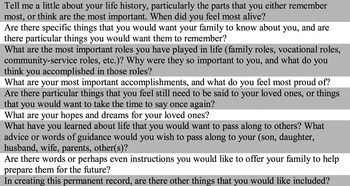
Dignity therapy was originally designed to reduce psychosocial and spiritual or existential distress in terminally ill patients (Chochinov et al., Reference Chochinov, Hack and Hassard2005). Its purpose is to decrease suffering; enhance quality of life; and bolster a sense of meaning, purpose, and dignity among patients approaching death. Trained dignity therapists guide patients through a discussion, touching on matters of most importance to them or that they would most want others to remember following their death. The therapist follows the respondent's cues, facilitating the disclosure of thoughts, feelings, and memories, guided by the Dignity Therapy Question Protocol (Fig. 1) Although these questions provide for some structure, the protocol is highly flexible in order to accommodate individual needs and choices. These conversations were audio-recorded, transcribed, and edited. The final document was returned to the patient, and in most instances bequeathed to a friend or loved one. Most dignity therapy participants reminisce or review their lives, and reflect on significant events, people, and places. In this way, the therapy resembles reminiscence and life review therapies that have been applied in elderly populations. Many patients also use dignity therapy as an opportunity to offer words of advice or wisdom, which might help prepare their loved ones for a future without them. A thematic analysis of the dignity transcripts of terminally ill patients revealed that patients' core values permeate the transcripts, suggesting that adherence to, and fulfillment of, core values serves to make life meaningful. This also suggests that dignity therapy is an important clinical tool for values clarification and distillation of life meaning as death approaches (Hack et al., Reference Hack, McClement and Chochinov2010). Because it was designed for the terminally ill, dignity therapy can accommodate patients who are very ill or whose energy is low. By logical extension, then, the therapy may prove useful among the frail elderly.
Dignity Therapy Question Protocol (Chochinov et al., Reference Chochinov, Hack and Hassard2005).

Several recent meta-analyses have evaluated psychosocial interventions, including reminiscence and life review in the elderly. Plinquart and Sörenson (Reference Plinquart and Sorensen2001) performed a meta-analysis of 122 psychosocial and psychotherapeutic intervention studies of older adults. The effect size across all studies of interventions on clinician-rated depression was very large, with the greatest effect demonstrated in those studies of psychodynamic therapy and cognitive-behavioral therapy. There was a medium effect size of interventions on psychological well-being across all studies. The largest effect on psychological well-being was by means of control-enhancing interventions; cognitive-behavioral therapy produced the next largest effect. Interventions with community-dwelling older adults were associated with smaller changes in subjective well-being than were interventions with residents of nursing homes.
Robert Butler, a pioneer in gerontology, postulated “… the universal occurrence in older people of an inner experience or mental process of reviewing one's life” (Butler, Reference Butler1963, p. 65). Butler argued that life review, which he conceived to include, but not be synonymous with, reminiscence, was a way of recalling past experiences and unresolved conflicts that could be examined and reintegrated. During simple reminiscence, people are cued to recall and verbalize pleasant memories, whereas life review is a more intensive and structured approach during which the focus is on recalling and synthesizing both positive and negative experiences (Buchanan et al., Reference Buchanan, Moorhouse and Cabico2002; Bohlmeijer et al., Reference Bohlmeijer, Roemer and Cuijpers2007). Butler's early work set the stage for the emergence and development of reminiscence and life review therapies. Similar to dignity therapy, both reminiscence and life review therapies are potentially powerful tools for maintaining or enhancing a sense of self.
Bohlmeijer et al. (Reference Bohlmeijer, Roemer and Cuijpers2007) conducted a meta-analysis of 15 studies in which they assessed the effects of reminiscence or life review on the psychological well-being of older people. The meta-analysis detected an overall moderate influence on life satisfaction and emotional well-being. A similar meta-analysis (Bohlmeijer et al., Reference Bohlmeijer, Smit and Cuijpers2003) assessed the effects of reminiscence and life review on depressive symptoms in the elderly. In 20 studies, reminiscence and life review were found to have a statistically and clinically significant effect on symptoms of depression, comparable to other treatments such as antidepressant medication and cognitive-behavioral therapy. Lai et al. (Reference Lai, Chi and Kayser–Jones2004) conducted a single-blinded, parallel-groups randomized controlled trial of reminiscence therapy to promote the well-being of nursing home residents with dementia. The intervention group received reminiscence therapy using a life-story approach; the comparison group received friendly visits, and one group received no intervention. Outcomes (measured using the Social Engagement and the Well-being/Ill-being Scales) were examined at baseline then, immediately, and at 6 weeks post-intervention. Although no significant differences were found the among the groups, significant differences were observed on the Wellness/Illness Scale for only the reminiscence intervention group when comparing baseline to immediately post-intervention ratings.
The literature supports the notion that dignity therapy may have applications to elderly residents in personal care homes. This is based on the partial overlap between dignity therapy and life review and reminiscence, the latter two of which have shown to be effective in improving psychological well-being in the elderly (Plinquart & Sorenson, Reference Plinquart and Sorensen2001). Like life review, dignity therapy is a structured, individual psychosocial intervention, targeting depression and psychological and existential distress, while enhancing sense of self, meaning, and purpose. Unlike life review or reminiscence, however, dignity therapy does not always result in extensive life review. Dignity therapy is also distinct, in that it is partly shaped by the concept of generativity. Generativity is an element of the dignity model, referring to the notion that something meaningful, related to oneself, will survive or transcend death. In deference to the notion of generativity, dignity therapy produces a tangible and permanent record of the patient's thoughts and words. As in palliative care, the dignity therapy document—or generativity document—may be an attractive feature of this approach for elders and their families.
METHODS
Dignity therapy has not as yet been applied to the frail elderly outside of the palliative care context; this study set out to determine the feasibility of doing so. The study was designed to identify how dignity therapy affects participants, and if there are issues unique to the elderly that might sway its effectiveness. To glean the effect of dignity therapy on psychosocial and existential domains of patient experience, the study included an examination of the prominent themes emerging from transcribed dignity therapy narratives.
Participants were recruited from six personal care units of a 388-bed rehabilitation and long-term care facility in Winnipeg, Manitoba. Potential subjects were identified by personal care unit staff members. For cognitively intact residents, the following participant eligibility criteria applied: being ≥65 years of age; residing in a long-term care facility; reading and speaking English; expressing interest in a psychotherapeutic intervention; having a screening score of >21 on the Mini Mental Status Examination (MMSE); and being able to provide valid written consent. To explore possible applications of dignity therapy for cognitively impaired residents, a cohort of proxy family participants (broadly defined as those who care and are involved) were identified. The proxy participant met the following eligibility criteria: a family member of a cognitively impaired individual who resides in a long-term care facility; being ≥18 years of age; able to read and speak English; interested in a psychotherapeutic intervention, and able to provide valid written consent, both on their own and on their cognitively impaired family member's behalf.
After obtaining permission from the cognitively intact residents or, in the case of cognitively impaired residents, proxy family participants, staff members released names and contact information to the research team. The Faculty of Medicine Ethics Committees at the University of Manitoba approved the study and the Riverview Health Centre Research Review Board granted formal access to residents of the long-term care facility. All residents interested in participating, or their proxies, provided written informed consent. In addition, written informed consent was obtained from family members and participant care providers who agreed to give feedback on dignity therapy.
Cognitively Intact Residents
These participants had three primary contacts with the research staff. During the first contact, consent was obtained from individuals who scored ≥21 on the MMSE. As a way of preparing for the next meeting, participants were shown the Dignity Therapy Question Protocol and asked what they might want to discuss in their upcoming session. The second contact was generally made within 24 to 48 hours. At this time, participants were guided through their audio-recorded dignity therapy session. They were reminded that they would receive an edited, written record of their session and that they would be able to correct the document before receiving the final copy. This allowed them to speak freely, knowing they could later address any changes, perceived imperfections, or errors of omission or commission. At the conclusion of the session, a time for a third contact was arranged.
The third contact consisted of delivering the edited manuscript to the resident within 2–3 days of the dignity therapy session. The manuscript was read to participants, inviting them to make any editorial changes they saw fit. After editorial changes were completed, the final document was left with the residents for them to share with whomever they chose. At the same time a post-intervention feedback questionnaire was administered to elicit participant satisfaction and perceived influence of the dignity therapy.
Cognitively Impaired Residents
Because cognitive decline is so prominent among the frail elderly, this study set out to determine if dignity therapy could be modified to accommodate those individuals. Family proxies were asked to participate on behalf of their cognitively impaired family member. The dignity therapy questions were reformatted to elicit family members' responses about their loved ones (e.g., “Tell me about your relative, particularly the parts that you think were the most important or that you think they would most want remembered”). Cognitively impaired residents may or may not have been present during the dignity therapy with family proxies; those who were present participated in these sessions to the degree that their dementia allowed. For this component of the study, family proxies responded to a modified post-intervention feedback questionnaire.
Family and HCP (HCP) Feedback
This study examined whether dignity therapy could influence families' or HCPs' perceptions of the resident. Permission was sought from participants or proxy family participants to make the dignity therapy manuscript available to care providers (irrespective of professional affiliation) or family members to read. To safeguard privacy, only those specifically named had access to the manuscript. Family members and identified HCPs were asked to respond to a modified feedback questionnaire 2 months post-intervention. Family members were asked questions such as: where is the manuscript kept; who has read it; how often it has been read; what influence family members feel it has had on their relative; what influence family members feel it may have had on care providers; and what influence it has had on them, personally. HCPs were asked questions such as when the care provider read it and how often; what influence they thought the document had on their perception of the resident; and how has this changed or influenced the way they provided care to the resident.
Data Analysis
Quantitative Data
Resident, family, and HCP responses on the post-intervention feedback questionnaires were analyzed using the Statistical Package for the Social Sciences (SPSS) Version 15.0 for Windows. Because the sample was small, only frequencies and descriptive statistics were reported.
Qualitative Analysis
Two research nurses (BC and KC), including the one who conducted dignity therapy (KC), analyzed the content of the dignity therapy transcripts. Each research nurse independently reviewed two transcripts of competent residents to identify possible emerging themes. After completing four transcripts, commonalities and differences were examined, thus establishing a template for analyzing the remaining transcripts. This same process was used to analyze the transcripts of proxy respondents. At the conclusion of the data reduction and the theme categorization process, the principal investigator (HMC) and research associate (SM) reviewed the themes, checking them all against associated exemplars, in order to corroborate and validate previous thematic decisions, definitions, and labels.
RESULTS
Demographics
Forty-six residents or their family proxies were approached for this study. Twenty-two declined to participate, 13 citing a lack of interest. Other reasons for declining included: family not interested or unavailable (4); resident's personal reason (shy, study is not of benefit to me, I'm not an interesting enough person) (3); resident not feeling well (1); resident's condition changed (1). Twelve cognitively intact residents took part in the study; 13 originally consented to the study but 1 eventually withdrew. One aphasic cognitively intact resident was assisted by two family members. Eleven cognitively impaired residents were represented in the study through family member proxies, in some cases by more than one family member.
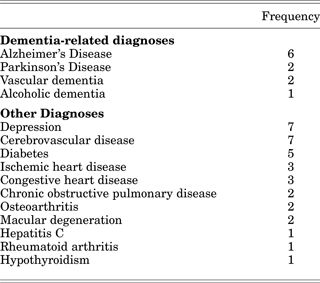
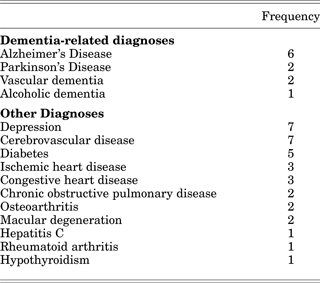
The 23 cognitively intact and cognitively impaired residents included 18 women and 5 men ranging in age from 56 to 94 years of age, the mean age being 80 years. Nine individuals were married, nine widowed, three divorced, and two had never married. All participants were Caucasian and identified English as the language spoken most at home. The sample was nearly evenly split between those who identified their religious affiliation as Roman Catholic (10) or as Protestant (13). Nine respondents had completed some post-secondary education whereas nine had completed some or graduated from high school; three people had completed some primary schooling. In two cases, the education level was unknown. The length of stay for residence in the personal care home ranged from 13 days to >6 (6.35) years, the median being >1 (1.26) year. The mean number of recorded comorbidities per participant was 2.0 (SD 1.04) (Table 1).
Frequency of medical diagnoses
Narrative Themes
Differences, both in terms of structure and content, were noted between dignity therapy completed by cognitively intact participants, and dignity therapy completed by family proxy participants. There were 12 cognitively intact participants of whom 11 told their stories in the first person. Although one aphasic resident was unable to tell her own story, she was able to contribute to the interview through active listening and by concurring with statements that her daughters made, or by offering one word cues regarding what she wanted to contribute. Of the 11 participants who gave first person accounts, responses to probes were cogent and often quite lengthy.
By contrast, to the extent that cognitively impaired residents were able to take part with their family members, responses tended to be short, usually one sentence or thereabouts. These responses did not always logically match the preceding probe or conversation, and there was little momentum to carry thoughts forward. In one instance, the participant's daughter filled in detail when her mother had difficulty elaborating or when her mother struggled to answer at all. Despite these difficulties, it was clear that she found dignity therapy to be meaningful. She stated, “It could be pretty important, I tell you. When I see my background and my days in school, then I think gee whiz.”
Anecdotes about childhood or youth were frequently quite detailed among cognitively intact participants. By contrast, proxies provided fewer details about their family members' childhood or youth, perhaps reasonably so, given that spouses or children did not witness that history.
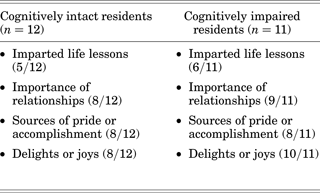
Several themes emerged from the dignity therapy transcripts that were common to both cognitively intact residents and family member proxies of cognitively impaired residents (Table 2). The theme, Delights and Joys, emerged in nearly every narrative conveyed by proxies and in >50% of those conveyed by residents themselves. The category Delights and Joys refers to those matters in life that people relish or in which they take special pleasure. As one daughter said of her mother, “She lights up like a Christmas tree when [her grandson] comes in.” Another resident, a 92-year-old woman, fondly recalled, “I loved Munich. The plays and the music, it was just beautiful.”
Themes common to narratives of cognitively impaired and cognitively intact individuals
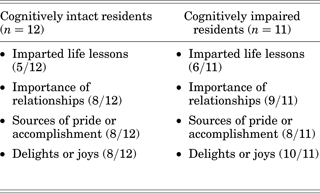
The theme, Sources of Pride or Accomplishment, was often mentioned by residents and proxies alike. A 90-year-old mother said, “I raised two darn great kids. I'm proud of them today and just how well they turned out.” Although a question from the protocol directly solicited this information, similarly to all other inquires within the question framework, it need not have been responded to, suggesting that this question resonated across both groups of participants.
Another common theme was Importance of Relationships. This theme emerged in >50% of all transcripts and was identified when a specific person had great significance for the respondent (e.g., Daughter: “[M] is a nephew and he has been a very important person in Mom's life.” Mother [a 94-year-old with dementia]: “That's right; [M] was special.”) or when maintaining strong human bonds was a salient feature of a person's life. In looking back on her life, a 68-year-old former music teacher stated, “I have a lot of very good friends. Some of them are friends for life. I have always been very rich in the people that I knew.”
Imparted Life Lessons was a theme in ~50% of the transcripts of both cognitively intact and proxy participants. Imparted Life Lessons refers to the wisdom that people gain from life experience and choose to share with others. One 90-year-old woman had this to say: “Passing over trivial things is one of the things that helped our marriage be a good one” whereas a daughter recalled the wisdom previously imparted by her now cognitively impaired father whom she described as a kind and gentle man who loved horses, “It was important to study hard in school and to work hard. He instilled a really strong work ethic in us. To achieve was important.”
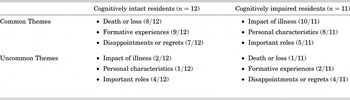
Several themes were cited at different frequencies across the two participant groups, including Death or Loss, Formative Experiences and Disappointments or Regrets (Table 3). Although these themes arose frequently in cognitively intact individuals, they were far less common among proxy participants. On the other hand, themes that were more common among proxies included Impact of illness, Personal Characteristics and Important Roles.
Thematic differences between cognitively intact and cognitively impaired individuals

Death or Loss is a theme that refers to one's lifetime of accumulated losses or deaths of loved ones and may be particularly apparent to a person in the last phase of their life. The following two examples speak to the acute loneliness one might feel while recalling these losses: An 86-year-old former nurse said, “I am the only one left” and a 75-year-old single woman, who had lost her best friend and many family members, lamented “As far as I'm concerned I have no one left. I didn't think I'd be the last one to go. I wish I wasn't.” Except in one instance, this theme did not emerge in the narratives of family proxies.
Formative Experiences were frequently described by cognitively intact residents. This thematic label was applied when someone described early life events that had had a significant impact on them or helped shape the person they became. In only two instances did family members describe Formative Experiences for their cognitively impaired loved ones.
The theme Disappointments and Regrets refers to situations in which a person expressed feelings of longing, unhappiness, or sorrow for past actions or events. This theme appeared in over half of the accounts of cognitively intact individuals. Sometimes the disappointment or regret was quite profound: A 90-year old former merchant mariner recalled, “Unfortunately, that meeting with him was when my rotten life started, because he persuaded me to go to [country].” Other times the disappointment or regret was in the remote past but, nonetheless, seemed still to beleaguer the individual: A 67-year-old former trucker who was estranged from his siblings asked “What did I do wrong to you guys? … What did I do wrong? … I figured out it must have been what happened when my dad died.” Disappointments and Regrets, as a theme, did not frequently emerge in the transcripts of cognitively impaired individuals. When it did, it sometimes was in reference to family members describing their own disappointment or regret. A 58-year-old former teacher's husband exclaimed: “I just feel that we were cheated. We talked about retirement and some of the things that we would do …” A sister, who described her sibling as a neighborly person who was always willing to help others, said: “It makes me so sad that the others don't come to see her …”
Themes that were common in the narratives of family proxies, but were much less common in those of cognitively intact individuals included: Impact of Illness, Personal Characteristics, and Important Roles. Impact of Illness, referring to the physical, psychosocial, and spiritual toll the illness has taken on the individual, was cited less often by cognitively intact individuals than by proxy respondents. Family proxies frequently referred to their loved one's illness, usually the illness that precluded the resident from being able to share a personal narrative. In these instances, the impact of the illness on the resident and family member emerged as a common and plaintive theme. The husband of a vivacious woman who had built a life around family and friends observed, “The day she was paneled was a horrible day … Dr. [C] … told her that she would lose her license. She had had her own car for 35 years … I've never seen her so mad. But it had to happen, there was no question.” Another woman who described her husband as “nurturing” and “soft-spoken” mourned the loss of these essential characteristics: “When his personality started changing he was quite rude and that was not my husband. He started getting angry.”
Descriptions of Personal Characteristics were also relatively frequent in the accounts of family members of cognitively impaired residents. For instance, one daughter described her 94-year-old mother as “… a kind, loveable and caring person to her family and friends.” In another instance, the wife and daughter of a loving but strict family man noted that “… dad ruled our family … He was in charge. We grew up knowing that if Dad says ‘no,’ that's it.” On the other hand, first person narratives from cognitively intact residents were less likely to describe their own personal characteristics.
The theme Important Roles appeared somewhat more frequently in the accounts provided by family members. This theme refers to the important roles people reported playing throughout their lives or the important roles that family members observed. A 71-year-old divorced woman and mother of three identified nursing as an important life role: “I enjoyed caring for people and being a nurse.” A daughter, noting her mother's lifelong love of children, said, “She is a great mom, grandmother and great-grandmother.”
Post-intervention Feedback Questionnaire
In addition to the qualitative analysis of dignity therapy transcripts, the study design included a post-intervention feedback questionnaire that elicited feedback on the actual experience of taking part in this novel therapeutic approach from cognitively intact participants and proxy family members of cognitively impaired residents. Feedback was also obtained from family members of cognitively intact residents and HCPs who were not directly involved in the dignity therapy sessions but were identified to receive or read the dignity therapy document.
Cognitively Intact Residents
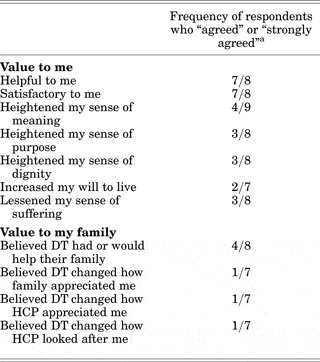
Three of the 12 cognitively intact participants chose not to complete the feedback survey (see Table 4). Of the remaining nine respondents, the majority reported that dignity therapy was both helpful and satisfactory. Of interest, most respondents did not articulate the benefits of dignity therapy in terms of meaning, purpose, dignity, will to live or suffering. One 74- year-old woman summarized the benefits of dignity therapy as follows: “It helped me in a sense to bring back the good and bad and forced me to think. I was pleased.” A 77-year-old man, separated from his wife, said the dignity therapy, “gives you a little bit of hope that someone wants to know something about you. You are helping and so less likely to want to give up.” Half the respondents indicated that dignity therapy might help their families.
Cognitively intact residents' feedback on the value to themselves of participating in dignity therapy (DT)

aOf the 12 cognitively intact residents who participated in the study, between 7 and 9 individuals provided responses, depending upon the feedback question. Therefore, the denominator is reported for each variable. HCP, Healthcare provider
Cognitively Intact Residents' Family Members
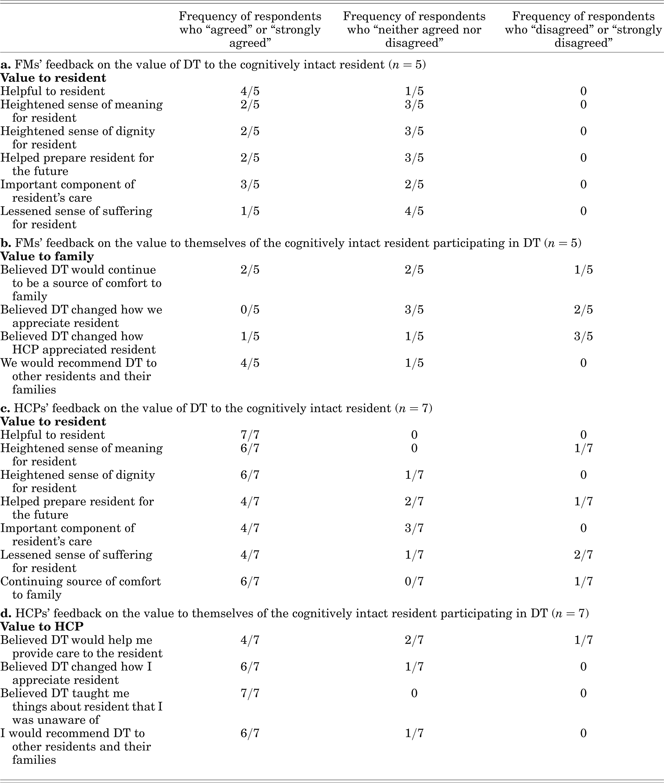
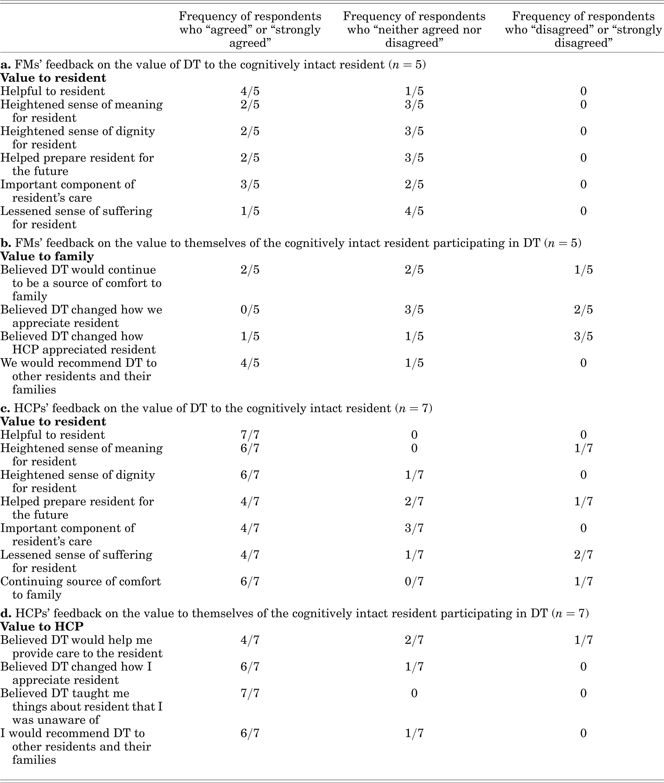
Of the 12 cognitively intact residents who took part in this study, 5 had one family member each who provided feedback. All five family members were female; four were adult children and one was a friend. Most family members felt that dignity therapy was helpful to their loved one, with >50% acknowledging it as an important component of their family members' care (Table 5a). The majority, however, did not articulate these benefits in terms of dignity, suffering or preparation for the future. Rather, benefits were expressed in various other, usually quite specific, ways. The daughter of a 77-year-old man indicated, “He seems much more open to discuss his feelings.” Of these five family members, all but one said they would recommend it to other residents and their families (Table 5b). As the son of a 94-year-old widow put it, “[The] patient has an opportunity to share their life experiences. [The] family has an opportunity to learn how their family member reflects on their life.”
Family members' (FM) and healthcare providers' (HCP) feedback on the value of dignity therapy (DT) to the cognitively intact resident and to themselves
Cognitively Intact Residents' HCPs
Of the 12 cognitively intact residents who took part in this study, 5 had one or more corresponding HCPs who participated in the study. In total, seven HCPs took part; five were female and two were male. Four were nurses and three were healthcare aides. Their work experience in healthcare ranged from 6 to 32 years (average of 16.3 years). The HCPs had known the residents an average of 14 months (range 9 to 24 months).
All HCPs felt that dignity therapy helped the resident, and the majority described those benefits in terms of meaning, suffering, and dignity (Table 5c). As one healthcare provider remarked, “I think she would believe that if we took the time and energy to do this with her, she would feel important.”
The majority of HCPs felt that dignity therapy would help prepare their patient for the future and was an important element of patient care. One nurse said of the 92-year-old resident: “She knows that as time goes, her ability and mobility changes. Whatever changes—she is ready to face it.” All but one HCP expected dignity therapy would be a continuing source of comfort to families of the cognitively intact participants.
Dignity therapy influenced HCPs in a variety of other ways (Table 5d). For example, the majority felt that dignity therapy would have a positive effect on how they provided care. As stated by one nurse, dignity therapy “Helped me understand what [the resident's] goals are.” The vast majority felt that dignity therapy changed the way they appreciated patients, and that they learned things they previously had not known. According to one health care aide, “[dignity therapy] gave me a new way to look at the way I approach things,” whereas another stated, “[dignity therapy] made [me] understand what she is now, based on her past.”
Cognitively Impaired Residents' Family Proxies
As previously noted, for the most part, cognitively impaired residents were unable to participate directly in dignity therapy. Instead, family members were invited to do so by proxy. Nineteen family members participated as proxies for 11 cognitively impaired residents. Family members responded to dignity therapy questions on behalf of their loved ones as a means of capturing thoughts and memories these residents could no longer share. Of the 11 cognitively impaired residents, 7 had one or more family members who provided post-intervention feedback. In total, nine proxy family members provided feedback; six were female and three were male. Four were spouses, four were adult children, and one was a sibling.
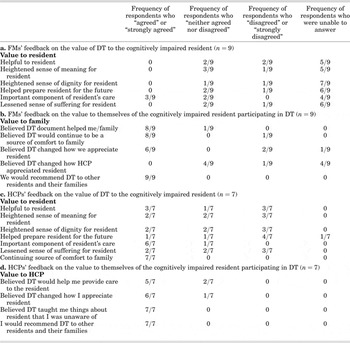
Proxy family members had difficulty verbalizing how dignity therapy provided direct benefit to their cognitively impaired loved one. They did not describe these benefits in terms of meaning, purpose, relief of suffering, or dignity (Table 6a). However, all of them indicated that they would recommend it for other cognitively impaired residents and their family members. The majority felt that dignity therapy would be helpful to them and their family, providing ongoing comfort and possibly changing their appreciation of their loved ones (Table 6b). As the son of a 90-year-old resident put it, “Yes! I think you want to capture that life and time frame and not leave it to memory.” Another daughter summarized her response as follows: “[Dignity Therapy] might help families understand one another better.”
Family members' (FM) and healthcare providers' (HCP) feedback on the value of dignity therapy (DT) to the cognitively impaired resident and to themselves

Cognitively Impaired Residents' HCPs
Of the 11 cognitively impaired residents whose proxies took part in this study, 5 had one or more corresponding HCP who provided post-intervention feedback. In total, seven HCPs took part; all were female. Six were nurses and one was an activity worker. Their work experience in healthcare ranged from 8 to 33 years (average of 22 years). The length of time that the seven HCPs had known the resident ranged from 4 to 152 months.
The majority indicated that dignity therapy was an important element of the resident's care (Table 6c). In reference to a resident who had been known for her baking, family celebrations, and infectious laugh, one nurse said: “It preserves personhood of the individual and makes the disease not so important.” All HCP respondents indicated that dignity therapy would continue to provide a source of comfort to families of cognitively imparted residents—“It's a life history and a comfort for family once the resident passes.”
Every HCP affirmed that dignity therapy taught them things about the resident they were unaware of (Table 6d). They all indicated that they would recommend dignity therapy for other cognitively impaired residents and their families. The majority thought that dignity therapy might change the way they appreciated the resident and, in turn, the way in which they were able to provide care. One HCP had this to say: “[dignity therapy] helped me to understand her needs and behaviours and better understand family dynamics.” Another indicated that in spite of knowing the family well, [dignity therapy] provided “a new appreciation for their life together … [it] enhanced my respect for them because I saw them in a different light.” Yet another stated, “[dignity therapy] makes you see them as people, not purely clients.” Finally, one HPC stated: “I hope Dignity Psychotherapy will be well established in day-to-day practice when I reach the end of life.”
DISCUSSION
Although there is mounting evidence to support the application of dignity therapy for patients who are imminently dying; to date, no studies have examined the utility of dignity therapy for the frail elderly. Similarly to the terminally ill, the frail elderly often face existential issues related to loss, disability, and death. Dignity therapy can assuage these elements of end-of-life distress in the terminally ill; therefore, it seems timely to examine its role among the frail elderly. This study compared two groups of frail elderly—those maintaining cognitive acuity and those not. Although dignity therapy in the former group largely replicates the protocol in palliative circumstances, the latter group required some significant accommodations. Dignity therapy requires an ability to speak to issues regarding one's past, one's thoughts, and personal reflections. Without cognitive clarity, this is simply not possible. As such, family members of the cognitively impaired elderly were invited to respond, by way of proxy, on their loved ones' behalf.
As expected, there were similarities and differences between the two groups, in terms of both the structure and content of dignity therapy. Whereas cognitively intact residents responded with full and logical responses, cognitively impaired individuals, as expected, were not able to do so. Although some sat in on the interviews, these cognitively impaired residents were largely unable to directly participate. In those instances, family proxies served as key informants and sole respondents. Similarly to cognitively intact residents, proxies responded to questions in a fashion suggesting full and sincere engagement. Both groups of participants recalled many of life's highlights, including delights and joys, important relationships, and lessons learned. Of note, residents who were cognitively intact were far more likely than proxies to reflect on formative experiences, disappointments or regrets, and issues related to death or loss. This suggests that these issues tend to dominate the psychological landscape of people who actually live those experiences, as opposed to proxies, who were either not present for, or did not bear witness to, those experiences. On the other hand, proxies were more likely to reflect on their loved ones' personal characteristics and the impact of the illness itself, than were other participants. Personal characteristics may be easier to observe by others. For someone with dementia, a family member may be the only witness who can articulate the accumulation of losses incurred as a result of insidious cognitive deterioration.
The post-intervention feedback survey provided some important insights about how dignity therapy is perceived, and how its benefits are articulated, by both groups of participants, as well as their family members and HCPs. Nearly every cognitively intact participant found dignity therapy helpful, although neither they nor their family members described its benefits in terms of meaning, dignity, preparation for the future, or diminished suffering. Despite this, nearly every family member indicated that they would recommend dignity therapy to other residents and their families. On the other hand, HCPs of these participants tended to describe the perceived benefits of dignity therapy for their patients in terms of a heightened sense of meaning and dignity; most felt it lessened the resident's suffering and prepared them for the future. They also felt it had helped the resident's family, with the vast majority indicating they would recommend it to other patients and families. Perhaps most noteworthy was the fact that HCPs felt that dignity therapy changed the way they appreciated the patient; some even felt that dignity therapy might help them in terms of providing ongoing care to the resident.
Residents and family members tended to describe the benefits of dignity therapy in more concrete terms—such as “making one think” or “giving [a] better insight” into someone's past. In contrast, HCPs were more inclined to use the language of dignity, suffering, and meaning. As previous research has shown, the concept of “dignity” is multidimensional, and subsumes various issues and concerns (Chochinov et al., Reference Chochinov, Hack and McClement2002). Although HCPs appear to use the term “dignity” in this broader fashion, residents and families are more likely to choose descriptors with much more specificity. This has implications for researchers trying to identify outcome measures to evaluate dignity therapy among the elderly as well as other patient cohorts.
The application of dignity therapy for cognitively impaired residents was particularly revealing. Once again, participants—in this case family member proxies—had difficulty articulating the benefits of dignity therapy for their cognitively impaired loved ones. In spite of this, nearly all of them indicated that they would recommend dignity therapy for other residents—cognitively impaired or not—and their families. The majority also acknowledged the personal benefits gained, in terms of their appreciation of the cognitively impaired residents and the ongoing comfort that dignity therapy would offer family members over time. As with cognitively intact residents, HCPs indicated that dignity therapy—in this instance as executed by family proxies—provided them information about the resident they had previously not known, changed their appreciation for the resident, and would help them provide care. Without exception, these HCPs indicated they would recommend dignity therapy for other residents and their families.
Despite being uncertain about how it directly influenced the cognitively impaired resident, both families and HCPs recommended that dignity therapy be offered to other residents and families, noting it to be an important element of healthcare. The fact that dignity therapy changed the perception of the HCPs and family members is quite profound. If dignity-conserving care depends upon how recipients of healthcare are perceived, Dignity therapy may have the potency to change those all-important perceptions (Chochinov, Reference Chochinov2004). Consequently, HCPs indicated that as a result of dignity therapy, they were able to alter their approach to looking after the patient. They articulated these changes in terms of “empathy,” “having a better understanding;” as one nurse stated, “I see my resident not just how she is now but how she was in her earlier life, who she was, and how she came to be the person she is now.”
More than one modest feasibility study is required to establish the role of dignity therapy in the frail elderly. The number of residents enrolled in this study was small and the sample was further split between very distinct cohorts; those who were competent and those who were not. Across both these samples, the evaluation of dignity therapy was limited to a qualitative analysis of emergent themes and a post-intervention feedback survey. Certainly, the fact that study participants articulated the benefits of dignity therapy in very different ways raises challenges for being able to identify outcome measures that will capture those particular gains. On the other hand, in spite of how they described the benefits and even when they were not able to do so in terms of dignity, suffering, or meaning, the majority indicated that they would recommend dignity therapy to others in similar circumstances, and that it was an important element of healthcare.
CONCLUSIONS
This study opens the door for other investigators to explore the role of dignity therapy for the frail elderly. Given that benefits were accrued by cognitively intact participants and family proxy participants, it would appear that dignity therapy may have broad applications among the frail elderly. The effect of dignity therapy on families was marked, and may provide a means for addressing bereavement-related issues or morbidity. Perhaps most notable was the ability of dignity therapy to change the perceptions of HCPs toward residents, irrespective of their cognitive status. These perceptual changes were accompanied by a shift in how care was provided—a shift based on considerations of personhood rather than “patienthood.” Whether residents are able to articulate this shift or not, the ability to adapt dignity-conserving practices may be an overarching benefit of this novel psychotherapeutic intervention. Although the role of dignity therapy in the care of the frail elderly population warrants further examination, these preliminary findings suggest that the therapy may promote understanding and empathy in this clinical setting, and bodes well for its adaptation and application beyond the traditional confines of palliative care.