


Introduction
Turgeon et al.’s (Reference Turgeon, Bilodeau, White and Henderson2019) “A Tale of Two Liberalisms” is an important piece in the Canadian political science canon, winning the 2020 John McMenemy Prize for the best article published in the Canadian Journal of Political Science the preceding year. Our present work builds on this important contribution, by clarifying what is driving the perceived association between liberal values and attitudes toward minority symbols in Canada and Quebec. Turgeon et al.’s (Reference Turgeon, Bilodeau, White and Henderson2019) original piece hints at the mechanism: the authors explain that one of their central claims is that “contemporary changes in elite discourses in Canada and Quebec are reflected in the different relationships between liberalism and citizen attitudes toward minority religious symbols” (Turgeon et al., Reference Turgeon, Bilodeau, White and Henderson2019, p. 251). In this research note, we show that this is likely true, but perhaps not because Quebeckers directly updated their attitudes toward religious minority symbols due to their liberal values. Rather, when particular political actors—notably, leaders in Quebec’s nationalist movements, including the Bloc Québécois (BQ) at the federal level, or the Parti Québécois (PQ) and Coalition Avenir Québec (CAQ) at the provincial level—discursively link liberal values and opposition to minority religious symbols, then voters who identify with nationalist parties are also more likely to exhibit a positive association between liberal values and support for restricting minority symbols.
Empirically, we show that Turgeon et al.’s (Reference Turgeon, Bilodeau, White and Henderson2019) original findings replicate using data collected nearly a decade later and analyzed with similar procedures. We then build on these findings to show that, controlling for partisan attachments, Turgeon et al.’s (Reference Turgeon, Bilodeau, White and Henderson2019) main finding—that the relationship between liberal values and support for restricting minority religious symbols is conditional on living in Quebec (where the association is positive in Quebec, and negative outside Quebec)—disappears. We show that partisan identities—specifically, attachments to nationalist parties (either the federal or provincial nationalist parties)—moderate the relationship between liberal values and support for restricting minority religious symbols, and that the main effect of liberal values on support for restricting religious symbols is negative.
Our analysis offers evidence of mediated moderation: the apparent conditional relationship between liberal values and living in Quebec is an artifact of the fact that effectively all Quebec nationalist partisans reside in Quebec (the mediation). Ultimately, identification with a Quebec nationalist party shapes how liberal values translate into policy preferences (the moderation). Specifically, the relationship between liberal values and support for restricting minority religious symbols is conditional on identifying with a Quebec nationalist party (at either the federal or provincial level). Our work speaks to the growing scholarly interest in how social identities impact politics (Iyengar and Westwood, Reference Iyengar and Westwood2015; Iyengar, Sood and Lelkes, Reference Iyengar, Sood and Lelkes2012; Huddy, Mason and Aarøe, Reference Huddy, Mason and Aarøe2015; Greene, Reference Greene2004), including Canadian politics (Caruana, McGregor and Stephenson, Reference Caruana, Michael McGregor and Stephenson2015; Johnston, Reference Johnston2023; Borwein, Reference Borwein2024; Lachance and Beauvais, Reference Lachance and Beauvais2024).Footnote 1 Our results build upon and strengthen one of Turgeon et al.’s (Reference Turgeon, Bilodeau, White and Henderson2019) main endeavours: to show that elite discourses in Quebec and Canada outside of Quebec are reflected in the different relationships between liberal values and attitudes toward minority religious symbols. By showing that the relationship between liberal values and support for restricting minority religious symbols is conditional on attachments to a Quebec nationalist party, we more directly show how political elites—namely, leaders in Quebec’s nationalist movements—have managed to rhetorically link liberal values with restrictions on minority religious symbols in the minds of party supporters.
Theory
In order to understand the differences between Quebeckers’ and Canadians outside of Quebec’s attitudes toward wearing minority religious symbols, a number of scholars have pointed to differences in the way liberal attitudes are articulated in the two regions. For instance, Taylor (Reference Taylor and Gutmann1994) distinguishes between the “procedural liberalism” of English Canada, which refers to state neutrality on the question of the good life, and “substantive liberalism” in Quebec, which refers to the state taking an active role in achieving a particular vision of the good life.
Turgeon et al. (Reference Turgeon, Bilodeau, White and Henderson2019) note that although these distinct forms of liberalism may have existed, these distinct forms of liberalism did not cause systematic variation in attitudes toward wearing minority religious symbols until recently, as “polling in the 1990s showed no significant attitudinal difference between Quebec and the rest of Canada on support for wearing religious symbols” (Turgeon et al., Reference Turgeon, Bilodeau, White and Henderson2019, p. 250). To explain the contrasting trajectories of the relationship between liberal values and attitudes toward minority religious symbols in Quebec and the rest of Canada, Turgeon et al. (Reference Turgeon, Bilodeau, White and Henderson2019) point to changing elite discourses related to secularism and the headscarf.
In the 1990s in France, elites began discussing banning headscarfs and other minority religious symbols as a means of religious emancipation (Koussens and Amiraux, Reference Koussens, Amiraux and Lévesque2014, p. 67), or even feminist emancipation. Quebec elites and academics began to link the state interventionist, French model of secularism, or laïcité, to liberal values. As Turgeon et al., (Reference Turgeon, Bilodeau, White and Henderson2019) explain, “In Quebec, many intellectuals, politicians and social activists defended this model of laïcité explicitly on liberal grounds, arguing that it would preserve the neutrality of the state or that it would preserve respect for gender equality and the rights of LGBTQ+ communities” (see also Weinstock, Reference Weinstock2007).
Belief systems differ across regions and can change over time, and social identity theory offers a framework for understanding why sets of attitudes (i.e., liberalism and support for restricting minority religious symbols) may appear to hang together differently in Quebec and the rest of Canada (ROC). According to social identity theory, people categorize themselves into groups, and group affiliations elicit strong cognitive and behavioural outcomes (Tajfel and Turner, Reference Tajfel and Turner2004). Canadian scholars have long been interested in how intergroup relations impact political behaviour (e.g., Johnston, Reference Johnston1985, Reference Johnston and Wearing1991), and recent scholarship shows that voters’ feelings toward groups cluster together in meaningful ways and impact vote choice (Cochrane, Reference Cochrane2015; Lachance and Beauvais, Reference Lachance and Beauvais2024).
Increasingly, political scientists are directly applying the lens of social identity theory to understand partisan political behaviour, seeking to understand how people come to identify as members of political groups or parties and how this impacts vote choice and political attitudes (Caruana, McGregor and Stephenson, Reference Caruana, Michael McGregor and Stephenson2015; Johnston, Reference Johnston2023; Borwein, Reference Borwein2024; Iyengar and Westwood, Reference Iyengar and Westwood2015; Iyengar, Sood and Lelkes, Reference Iyengar, Sood and Lelkes2012; Huddy, Mason and Aarøe, Reference Huddy, Mason and Aarøe2015; Greene, Reference Greene2004). Research shows that voters can quickly update what were previously believed to be fairly durable attitudes in response to the dynamics of partisan competitions, and follow elite cues when faced with partisan primes (Merkley, Reference Merkley2021, Reference Merkley2022, Reference Merkley2026). With respect to support for restricting minority religious symbols, it is possible that in Canada outside of Quebec, leaders from the various right-of-centre partisan groups—including the former Progressive Conservatives and Reform/Alliance, and the contemporary Conservative Party of Canada and People’s Party—have articulated rhetoric that is both conservative (opposed to liberal values) and rhetoric that is, to varying degrees, supportive of restricting religious minority symbols. By contrast, in Quebec, leaders of the federal nationalist party, the BQ, and leaders of both the provincial nationalist parties, the PQ and CAQ, have connected restricting religious minority symbols to liberal values.
This is most obviously true of the PQ, which is a centre-left, social democratic party. And while the other provincial nationalist party, the CAQ, is a conservative party, CAQ politicians actively link the party’s legislative restrictions on minority symbols to emancipatory, liberal values. For instance, the CAQ leader, Quebec Premier François Legault, has repeated defended the necessity of restricting religious symbols to protect Quebec’s values against radical Islam, which Legault says oppresses women. Legault has promised Quebec voters that “We are not going to let anyone attack the hard-won freedom of Quebec women. Never!” (Tamtam, Reference Tamtam2025). The CAQ Minister Responsible for the Status of Women, Isabelle Charest, has said wearing a hijab is oppressive and “keeps women from flourishing” (Canadian Press, Reference Canadian2019), while another CAQ Minister, Jean-François Roberge, has similarly suggested that interventionist policies of laïcité are necessary to liberate women forced to wear a veil (hijab) (Lajoie, Reference Lajoie2026).
Voters who identify with the BQ or a provincial nationalist party in Quebec may adopt a preference for restricting religious minority symbols, even if they otherwise espouse liberal values, to align with other members of their ingroup. Alternatively, voters who prefer to restrict religious minority symbols may find themselves drawn to these parties. Together, these mechanisms could produce the relationship that we appear to find between liberalism and support for restricting religious minority symbols in Quebec (but which may actually be explained in large part by partisan attachments). Existing research using panel data lends some support for intuition. Bodet et al. (Reference Bodet, Dufresne, Bouchard and Gélineau2019) show that, with respect to the debate over religious minority symbols, both partisan cues and issue priming were important for shifting attitudes on religious minority symbols in Quebec. Bodet et al. (Reference Bodet, Dufresne, Bouchard and Gélineau2019) find that having a positive evaluation of the PQ in 2012 was associated with a drop in support for religious accommodation between 2012 and 2014, after the issue became salient. However, they also find that Quebec voters who were less inclined to support religious accommodation increased their evaluation of the PQ after the issue of religious accommodation became salient. The authors do not specifically look at liberalism—and their findings are more nuanced than we can do justice in this short research noteFootnote 2 —but their findings are congruent with the theoretical intuition that we are advancing.
Methods
We hired Leger Opinion to collect data from their online panels of Canadian respondents. The survey was fielded in November 2023, and was available in both English and French. Leger uses quota-based sampling and the final sample (n = 2, 000) is broadly representative of the Canadian adult population in terms of gender, age, educational attainment and language.
We begin our analysis by first replicating Turgeon et al.’s (Reference Turgeon, Bilodeau, White and Henderson2019) analysis, regressing attitudes toward displaying minority religious symbols on region, liberal values, religiosity, prejudice and cultural threat, which were controlled for in the original study. In the present work, attitudes toward displaying minority religious symbols is measured by asking respondents whether they thought it was (un)acceptable for a police officer to wear a turban or a headscarf, and for a teacher to wear a turban or a headscarf. Responses were measured using a four-point scale ranging from always acceptable, often acceptable, often unacceptable or always unacceptable (rescaled from 0 to 1).Footnote 3 The results for each civil servant category (police officer and teacher) are pooled in a long-data structure for simplicity, and because the results are hypothesized to be similar across these groups. The resulting unit of analysis is the respondent-item, with up to two observations per respondent: one teacher item and one police-officer item. Standard errors are therefore clustered at the respondent level and a control for the civil servant type (police officer = 1) is included in the models.
The main independent variables are liberal values, religiosity and region (Quebec). We use the exact question wording and coding as was used in the original study. Following the original study, a scale of liberal values was constructed using respondents’ level of agreement (on a five-point scale ranging from strongly disagree to strongly agree) with the same five Likert-type statements used in the original study: (1) Society would be better off if more women stayed home with their children (reverse coded); (2) It is too easy to get an abortion nowadays (reverse coded); (3) Gays and lesbians should NOT be allowed to marry in Canada (reverse coded); (4) Euthanasia (or assisted suicide) is never ethically justified (reverse coded); and, (5) Canada should decriminalize prostitution. The scale was created by taking respondents’ mean score across the five items. As in the original study, the liberalism scale is internally consistent (alpha = 0.73).Footnote 4 Religiosity was measured by asking respondents’ level of agreement with the statement: “Religion is very important in our life” on a scale ranging from (1) Strongly disagree; (2) Somewhat disagree; (3) Neither agree nor disagree; (4) Somewhat agree; (5) Strongly agree. Region is measured with an indicator variable (Quebec = 1). Because we have a smaller sample than in the original study (after deleting missing values, our sample size is less than half that of the original study), we thus cannot replicate the original analysis for each individual province.
As per the original study, we also control for feelings toward minority groups and cultural insecurity. Following the original study, to measure feelings toward minorities, we construct a scale that averages feelings (measured on 101-point feeling thermometers) toward a range of minority groups, namely: Black, Indigenous, immigrant, Muslim and Jewish peoples. Following the original research design, we also create a normalized scale measuring distinct feelings toward Muslims (by taking the difference between feelings toward all minorities from feelings toward Muslims) and feelings toward Jewish people (by taking the difference between feelings toward all minorities from feelings toward Jewish people). A positive score on these normalized scales suggests that a respondent feels more warmly toward the target group (either Muslim or Jewish people) than to the average of all the minority groups (i.e., they like the target group more, on average, than minorities in general); by contrast, a negative score indicates a respondent feels cooler toward the target group than to the average of all minority groups (i.e., they dislike the target group more, on average, than minorities in general).
As per the original study, we measure “cultural insecurity” with a measure of feelings of immigrant threat to one’s province. Specifically, we ask respondents their agreement with the statement: “Immigration is a threat to [province]’s culture” where the respondent’s province (i.e., British Columbia, for respondents living in British Columba) was referenced. Level of agreement was measured using on a five-point scale ranging from Strongly disagree to Strongly agree. The original study did not include standard sociodemographic controls. Because background attributes are associated with both the outcome and main independent variable of interest (i.e., liberal values), we control for age, gender (man = 1), and education (college = 1). However, we also run the analysis without these controls in the SM.
Finally, we extend upon Turgeon et al.’s (Reference Turgeon, Bilodeau, White and Henderson2019) original study by accounting for party attachments, to clarify whether identifying with a Quebec nationalist party actually filters how liberalism impacts policy preferences, such as supporting restrictions on religious minorities. National party identification is operationalized using dummy variable indicating whether a respondent identifies with either a federal Quebec nationalist party (the BQ) or whether they voted for a provincial nationalist party (the PQ or CAQ). Note that the survey included the standard measure of party identity at the federal level. BQ identity is measured by from a variable asking respondents “In federal politics, do you usually think of yourself as …” (with list of federal parties). Unfortunately, the survey only included a measure of provincial vote choice (“If an election were called today, which party would you vote for? (list of provincial parties)”), and no measure of provincial party identification. As such, intended voting for a provincial nationalist party (either the Parti Québécois (PQ) or the Coalition Avenir Québec (CAQ)) is used as a proxy variable for nationalist party identity at the provincial level. We refer to our proxy measure of nationalist identifiers as “nationalist supporters” throughout the article. The results with federal and provincial nationalist party support as separate indicators are presented in the Supplementary Materials (SM).
In summary, the original study considers opposition to police officers and teachers wearing minority symbols as separate outcomes; we consider attitudes toward minority religious symbols as a single pooled outcome. The original study includes a liberalism scale and controls for religiosity, feelings toward minorities, and cultural insecurity; we include these identical variables (with identical question wording) in our study. The original study did not include controls for basic sociodemographics; we do include sociodemographic controls for age and gender in the body of our article (but we also show the analysis without controls in the SM for comparability with the original study). The primary difference between the original study and the one presented here is that, in our extension of the original analysis, we additionally control for identification with a Quebec nationalist party.
Results
Revisiting the original study
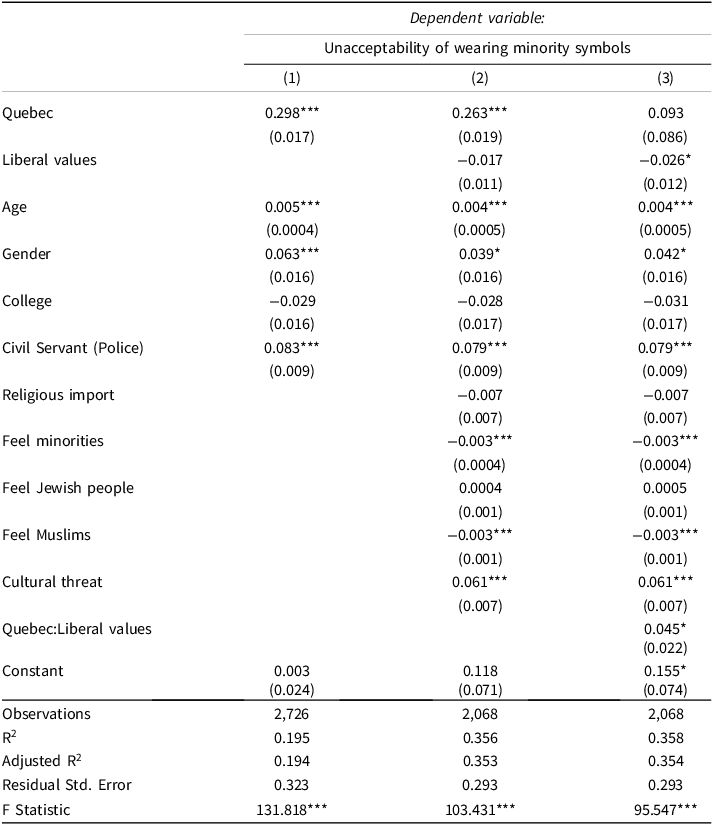
Turgeon et al.’s (Reference Turgeon, Bilodeau, White and Henderson2019) original study replicates faithfully. Quebeckers appear distinct from the rest of Canadians in terms of their willingness to assert that it is unacceptable for minorities in the civil service to wear religious symbols (Table 1, Model 1), and this holds even when controlling for a range of outgroup attitudes (feelings toward minorities, normalized feelings toward Muslims and Jewish people, and feelings of cultural threat) that were accounted for in the original study (Table 1, Model 2).
Replication of Turgeon et al.’s (Reference Turgeon, Bilodeau, White and Henderson2019) Model Explaining Quebeckers’ Greater Support for Restrictions on Minority Religious Symbols

Table 1. Long description
A table with three columns and multiple rows, showing the results of a model explaining Quebeckers’ support for restrictions on minority religious symbols. The table includes variables such as Quebec, Liberal values, Age, Gender, College, Civil Servant (Police), Religious import, Feel minorities, Feel Jewish people, Feel Muslims, Cultural threat, and Quebec:Liberal values. Each row presents coefficients and standard errors for these variables across three models. The table also includes statistical measures like Observations, R-squared, Adjusted R-squared, Residual Std. Error, and F Statistic.
Note: *p < 0.05; **p < 0.01; ***p < 0.001
Respondent-clustered standard errors in parentheses.
When we control for outgroup attitudes, liberal values are not significantly associated with the opinion that it is unacceptable for minorities to wear religious symbols. However, as was the central point of Turgeon et al.’s (Reference Turgeon, Bilodeau, White and Henderson2019) original study, this relationship appears to be clarified by looking at the conditional relationship between liberal values and being a Quebecker. Including the interaction between Quebec and liberals values shows that among Quebeckers, greater liberalism appears to be associated with greater support for restrictions on minority religious symbols (Table 1, Model 3). A post-estimation test of the liberal values slope among Quebeckers from Table 1, Model 3 (testing whether liberal_values + Quebec X liberal values = 0) is not statistically significant (see Table S5). The significant interaction term in Table 1, Model 3 and the flat liberal-values slope among Quebeckers (Table S5) would suggest that the difference is more between Quebec and the rest of Canada, rather than an effect of liberal values within Quebec—although we return to this question in the next section.
Extension
Building on Turgeon et al.’s (Reference Turgeon, Bilodeau, White and Henderson2019) original analysis, we test the hypothesis that social identity explains these results. To do so, we consider whether these findings are robust to the inclusion of partisan identity, namely identifying with a Quebec nationalist party at either the federal or the provincial level. First, we run the main effects model (i.e., the results presented in Table 1 Model 2) but add a control variable indicating whether a respondent is a Quebec nationalist party supporter (Table 2, Model 1).
Explaining Quebeckers’ Greater Support for Restrictions on Minority Religious Symbols Accounting for Party Identity
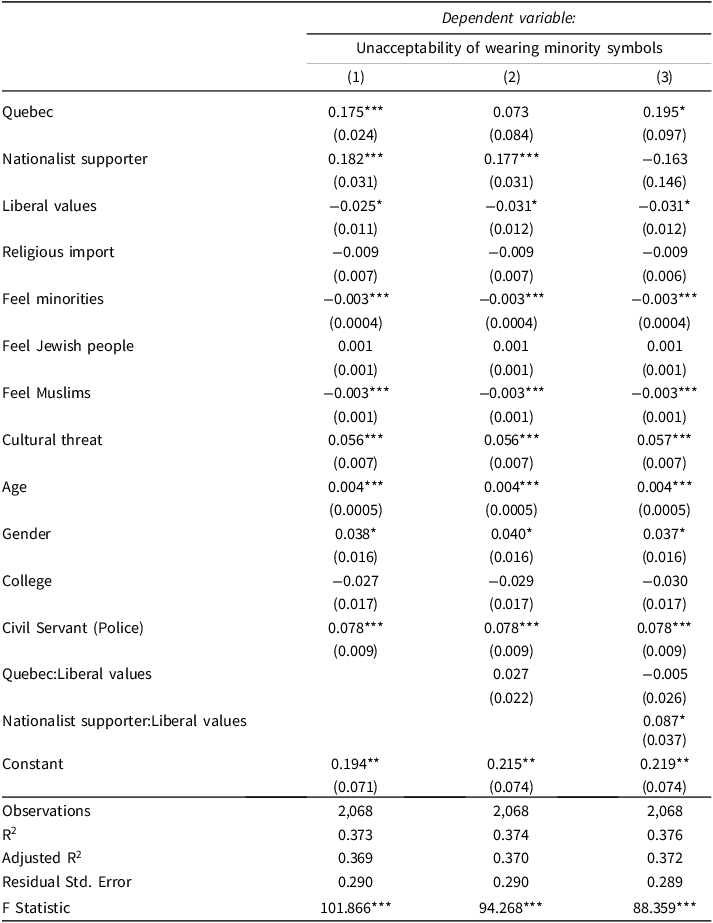
Table 2. Long description
A table with three models analyzing the unacceptability of wearing minority symbols. The table has 18 rows and 4 columns. Column headers are Quebec, Nationalist supporter, Liberal values, Religious import, Feel minorities, Feel Jewish people, Feel Muslims, Cultural threat, Age, Gender, College, Civil Servant (Police), Quebec: Liberal values, Nationalist supporter: Liberal values, Constant, Observations, R 2, Adjusted R 2, Residual Std. Error, F Statistic. Row 1: Quebec, 0.175, 0.073, 0.195. Row 2: Nationalist supporter, 0.182, 0.177, -0.163. Row 3: Liberal values, -0.025, -0.031, -0.031. Row 4: Religious import, -0.009, -0.009, -0.009. Row 5: Feel minorities, -0.003, -0.003, -0.003. Row 6: Feel Jewish people, 0.001, 0.001, 0.001. Row 7: Feel Muslims, -0.003, -0.003, -0.003. Row 8: Cultural threat, 0.056, 0.056, 0.057. Row 9: Age, 0.004, 0.004, 0.004. Row 10: Gender, 0.038, 0.040, 0.037. Row 11: College, -0.027, -0.029, -0.030. Row 12: Civil Servant (Police), 0.078, 0.076, 0.078. Row 13: Quebec: Liberal values, 0.027, -0.005. Row 14: Nationalist supporter: Liberal values, 0.087. Row 15: Constant, 0.194, 0.215, 0.219. Row 16: Observations, 2068. Row 17: R 2, 0.373, 0.374, 0.376. Row 18: Adjusted R 2, 0.369, 0.370, 0.372. Row 19: Residual Std. Error, 0.290, 0.290, 0.289. Row 20: F Statistic, 101.866, 94.268, 88.359.
Note: *p < 0.05; **p < 0.01; ***p < 0.001
Respondent-clustered standard errors in parentheses.
The coefficient for Nationalist supporters is positive, significant, and substantive, suggesting that Nationalist supporters are meaningfully more likely to support restrictions on minority symbols (Table 2, Model 1). The Nationalist supporter coefficient is positive and significant in both the model with demographic controls and the corresponding specification without demographic controls (Table S4, Model 1).Footnote 5
We then consider whether the interaction that seemed to suggest that Quebeckers with more Liberal values express greater support for restrictions on minority religious symbols is significant after controlling Quebec nationalist partisan attachments, and we find that it is not (Table 2, Model 2). Controlling for nationalist party attachments, the interaction between Quebec and liberal values is no longer associated with support for restricting minority religious symbols. Adding party identity to Turgeon et al.’s (Reference Turgeon, Bilodeau, White and Henderson2019) original interaction model significantly improves the model.
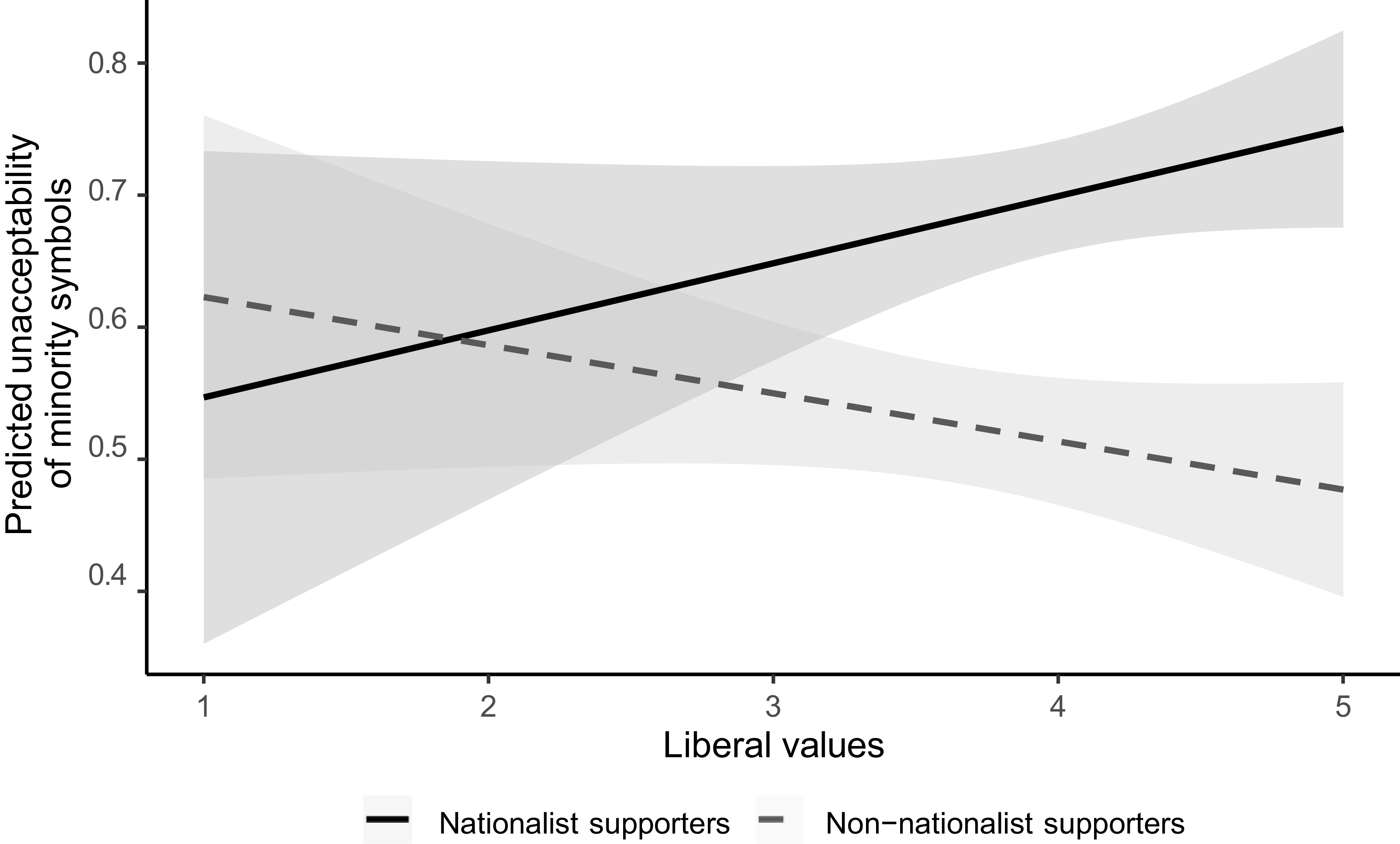
Finally, we test the alternative explanation, that the relationship between liberal values and support for restrictions on minority religious symbols is conditional on being a nationalist party identifier (Table 2, Model 3). We find support for the alternative hypothesis: including the interaction between liberal values and nationalist supporter status significantly improves the model. The post-estimation test of Quebec × liberal values = 0 is clearly non-significant, while the nationalist supporter × liberal values interaction is significant (Table S5). This suggests that the relevant heterogeneity is better captured by nationalist political alignment than by Quebec residence alone. Figure 1 illustrates this pattern among Quebec respondents: the association between liberal values and predicted unacceptability is negative among non-nationalist supporters, but positive among nationalist supporters.
Predicted unacceptability of minority religious symbols among Quebec respondents, by liberal values and nationalist party supporter status.

The relationship is perhaps best illustrated by graphing the conditional marginal effects. Figure 1 plots the predicted unacceptability of minority religious symbols among Quebec respondents by nationalist supporter status.
Figure 1 shows that, among Quebec non-Nationalist supporters, the slope is negative, indicating that higher liberal values are associated with lower predicted unacceptability, but this slope is not significantly different from zero (p = 0.149; Table S5). Among Quebec Nationalist supporters, the slope is positive, indicating that higher liberal values are associated with greater predicted unacceptability, but again this relationship is not statistically different from zero at conventional levels of significance (p = 0.101; Table S5). The key result is therefore not that either simple slope is necessarily individually significant, but that the two slopes differ significantly from one another, as indicated by the significant Nationalist supporter × liberal values interaction (p = 0.020; Table S5). The conditional marginal effects of liberal values from Table 2, Model 3 are also presented in Table S6.
Discussion and Conclusion
This study builds upon Turgeon et al.’s (Reference Turgeon, Bilodeau, White and Henderson2019) “A Tale of Two Liberalisms,” one of the most important contributions to CJPS, and thus the Canadian canon, in the past decade. Turgeon et al.’s (Reference Turgeon, Bilodeau, White and Henderson2019) original piece reveals a tantalizing difference between voters in Quebec and voters in the rest of Canada (and most regions around the world). Specifically, in Quebec there appears to be a positive association between traditionally more liberal values—attitudes toward gender roles, abortion and sexuality—and support for restricting minority religious symbols. In contrast, in Canada and in most of the world outside of Quebec, there is a negative association between liberal values and support for restricting minority religious symbols.
Turgeon et al. (Reference Turgeon, Bilodeau, White and Henderson2019) attribute these apparent differences to the distinctiveness of Quebec’s liberalism. In this research note, we showed that Turgeon et al.’s (Reference Turgeon, Bilodeau, White and Henderson2019) original findings replicate using data collected nearly a decade later. However, we further developed the original analysis and show that the original finding—that the relationship between liberal values and support for restricting minority religious symbols appears to be conditional on living in Quebec—disappears when controlling for partisan identities. Instead, our analysis reveals that the relationship between liberal values and support for restricting minority religious symbols is, in fact, conditional on identifying with a Quebec nationalist party, at either the federal or provincial level.
We agree with the suggestion in Turgeon et al.’s (Reference Turgeon, Bilodeau, White and Henderson2019) original piece, that the causal mechanism driving this relationship likely has to do with “contemporary changes in elite discourses in Canada and Quebec,” which have become “reflected in the different relation-ships between liberalism and citizen attitudes toward minority religious symbols” (Turgeon et al., Reference Turgeon, Bilodeau, White and Henderson2019, p. 251). Our analysis refines this idea, and we suggest that when specific political actors—in this case, Quebec nationalist leaders and candidates—discursively link liberal values and opposition to minority religious symbols, then voters who identify with those parties are more likely to adopt those views and thus espouse both liberal values and support for restricting minority symbols.
Although the results from our final model differs, our results build upon and strengthen one of Turgeon et al.’s (Reference Turgeon, Bilodeau, White and Henderson2019) main endeavours: to show that elite discourses in Quebec and Canada outside of Quebec are reflected in the different relationships between liberal values and attitudes toward minority religious symbols. By showing that the relationship between liberal values and support for restricting minority religious symbols is conditional on identifying with a Quebec nationalist party, we more directly show how political elites—namely, leaders in Quebec’s nationalist movements—have managed to connect liberal values with restrictions on minority religious symbols in the minds of certain voters—namely, voters who support these parties.
This leads us to a slightly different conclusion and theoretical contribution. Rather than concluding that differences between Quebeckers and other Canadians on the question of restrictions on religious symbols stem from “the contemporary predominance of distinctive interpretations of liberalism” per se, we conclude that the differences are not between Quebeckers and Canadians at all. Rather, the difference is between voters who identify with Quebec nationalist parties, which only run candidates in Quebec. These findings are congruent with research showing that partisanship matters in Canada (Merkley, Reference Merkley2022, Reference Merkley2026), and that voters respond to partisan cues (Merkley, Reference Merkley2021). These findings also speak to the growing literature on the role that social identities, and in particular, partisan identities play in shaping political attitudes and behaviour in Canada (Caruana, McGregor and Stephenson, Reference Caruana, Michael McGregor and Stephenson2015; Johnston, Reference Johnston2023; Borwein, Reference Borwein2024; Lachance and Beauvais, Reference Lachance and Beauvais2024) and around the world (Iyengar and Westwood, Reference Iyengar and Westwood2015; Iyengar, Sood and Lelkes, Reference Iyengar, Sood and Lelkes2012; Huddy, Mason and Aarøe, Reference Huddy, Mason and Aarøe2015; Greene, Reference Greene2004).
Our work has certain limitations. Recall that our measure of nationalist party attachments is a proxy variable that indicates whether a voter either identifies as BQ or indicated they would vote for a Quebec nationalist provincial party (the PQ or CAQ). Of course, vote intention is not the same as identity—vote choice is a behaviour, while partisan identification is socio-psychological. That said, there tends to be tremendous overlap between vote choice and partisan identification and the former is not a bad proxy for the latter. Furthermore, using vote choice as a proxy for identity should add noise to the analysis. Using vote choice as a proxy for identity thus threatens to underestimate the relationships we are seeking to uncover—not overestimate them. However, future scholars working on this topic should include measures of partisan identification to reduce noise.
Another shortcoming of the present analysis is that, because of data limitations, it is impossible to test whether a similar mechanism is at work in New Brunswick, Canada’s only officially bilingual province. Our hypothesis is that—because New Brunswick francophones are consuming much of the same media as Quebec francophones and may feel more warmly toward, or even identify with Quebec nationalist movements—the differences we see between Quebec and the rest of Canada will play out in a similar way within New Brunswick. One way for future scholars to test this would be to include a measure of identification with, or feelings toward the Quebec nationalist parties in a survey of New Brunswick voters, to identify whether a positive association between liberal values and support for restricting minority symbols is conditional on identification with, or feelings toward Quebec nationalist aspirations or nationalist parties in New Brunswick.Footnote 6
Like with Turgeon et al.’s (Reference Turgeon, Bilodeau, White and Henderson2019) original work, our present analysis theorizes that elite discourses in Quebec and Canada outside of Quebec are reflected in the different relationships between liberal values and attitudes toward minority religious symbols. This study is not an exact reproduction of the original study (using the original data), but instead involves analyzing new data collected nearly a decade later using very similar procedures. We find that the original study replicates remarkably well, despite the passage of time and regardless of the inclusion of additional covariates (age, gender and education). However, once we control for partisan attachments, the relationship between living in Quebec and liberalism on attitudes toward minority symbols disappears. The passage of time may matter as Bodet et al. (Reference Bodet, Dufresne, Bouchard and Gélineau2019) show.
Issue salience impacts the relationship between partisan feelings and issue attitudes. The question of exactly when, how, and why values (including liberal values), social identities, and policy positions become intertwined is an important topic of future scholarship.
Taken together, these results do not undermine the original finding that Quebec differs from the rest of Canada. Instead, they clarify its source. The evidence indicates that the liberal values association with attitudes toward minority religious symbols is conditional on political identity: liberal values are associated with lower support for restrictions among non-Quebec nationalists, but this association is attenuated among Quebec nationalist party supporters. Thus, the present analysis supports a more precise interpretation of the original Quebec effect, one in which regional differences in the effect of liberalism on attitudes toward minority religious symbols are linked to Quebec nationalist political alignment, rather than to Quebec residence per se.
Supplementary material
To view supplementary material for this article, please visit https://doi.org/10.1017/S0008423926101401


 Open access

