INTRODUCTION
Acute residential psychiatric care implies that patients arrive around the clock. The organization of referrals and intake in hospitals may differ. Some hospitals have a common emergency unit for all patients, and patients with mainly psychiatric needs are then transferred to the acute psychiatric care unit. Other hospitals handle acute psychiatric referrals within the premises of the department of psychiatry. The time at which patients arrive during the day has been studied in medical and surgical departments, and staff presence is organized to accommodate patients all around the clock (Vehviläinen et al., Reference Vehviläinen, Kumpusalo and Takala1988; Luyt et al., Reference Luyt, Combes, Aegerter, Guidet, Trouillet, Gibert and Chastre2007; Sheu et al., Reference Sheu, Tsai, Hung, Yang, Hung and Chong2007; Arabi et al., Reference Arabi, Alshimemeri and Taher2006); the level of qualified staff is deemed high enough for adequate care. We have previously studied referrals during the day in a one-year cohort of patients, finding that in the department of psychiatry half the patients arrived after most of the qualified staff had left the facility (Berg, Reference Berg2007). That study did not, however, focus on the outcome diagnoses of the patients according to time of day at admission. Thus we have now taken the opportunity to do such a study of distribution of diagnoses round the clock for a one-year cohort of patients referred to the acute care wards.
MATERIALS AND METHOD
All patients admitted to the 27-bed acute care wards in 2005 were studied. The patient population is described in more detail in our former study (Berg, Reference Berg2007). In all, 998 patients were admitted, some of them several times. Mean age was 39.0 (SD = 13.2) for women and 38.2 (SD = 12.7) for men. All days of the week were equally counted.
The patient diagnosis in the medical report after termination of the stay was used. If the patient was given more than one diagnosis, the main diagnosis was used. These diagnoses were based on the ICD-10 system of diagnoses. For the purpose of the present study, we followed the main chapters of the ICD-10 catalogue, giving 10 major diagnostic groups. Some diagnostic groups had very few entries, as the hospital did not receive many mentally retarded persons or persons under the age of 18. Furthermore, some diagnostic entities are taken care of in an ambulatory setting not connected to the hospital wards.
Statistics
Comparisons were made using the SPSS statistical package with chi-square tests, t-tests and simple regression.
RESULTS
In 2005 there were 998 referrals to the acute wards, of which 480 (47.9%) were female and 518 (52.0%) were male. The pattern of referrals during the day was as follows: 470 (47.1%) arrived between 8.00 and 16.59; between 17.00 and 00.59 407 (40.8%) patients arrived; during the night proper (i.e. between 01.00 and 7.59) 121 (12.1%) arrived.
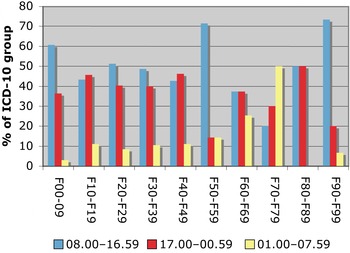
The distribution of referrals according to time of day and diagnostic groups is shown in Fig. 1. The figure indicates that the differences are rather small around the clock. There is, however by simple regression, a tendency towards fewer referrals with higher diagnostic numbers during the evening and night compared to office hour referrals (t = 3.1, p = 0.002). Also length of stay in the wards is shorter with higher diagnostic numbers during the evening and night compared to office hour referrals (t = −2.8, p = 0.006).
Distribution of referrals during the day according to ICD-10 diagnosis

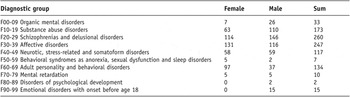
Table 1 gives the frequency of admissions, according to diagnostic group and gender. In order of frequency, patients with psychotic disorders comprise 26.1%, narrowly followed by the affective disorders 24.7%. Substance abuse disorders 17.3%, then personality disorders 13.4% and crises and anxiety disorders 11.7%. There is a tendency towards later arrival during the day of patients with the three last mentioned diagnostic groups. Women with personality disorders were almost thrice as frequent as males (χ2 = 35.5) whereas males with substance abuse were almost twice as frequent as females (χ2 = 10.9). The older patients, above 60 years of age, with non-abuse related organic disorders were mainly males (26 versus 7) χ2 = 13.0, all with a p-value <0.05.
Number of referrals according to diagnostic group and sex (N = 998)

Patients >60 years of age (N = 57) had the following frequencies of admission during the three time periods: 54.4%, 36.8% and 8.8%, whereas patients below 60 years of age (N = 941) had 46.7%, 41.0% and 12.3%, respectively.
Among the patients with depression, the number of men was higher than women late at night, 17 (14.7%) and 9 (6.9%), respectively, the difference did, however, not attain statistical significance at the 0.05 level.
Age at entry differed slightly according to time of day. During office hours mean age was 39.1, in the afternoon and early night 38.5 and during night hours 37.3. The age-ranges in the same time periods were respectively: 18.1–91.4, 18.3–88.8 and 18.0–74.0. The mean age during the 3 time periods was 39.3, 39.6 and 36.2 in women, and 38.9, 37.4 and 38.3 in men. This trend did not attain statistical significance.
DISCUSSION
The majority of patients arrive at the acute psychiatric care clinic outside office hours. Psychotic disorders, affective disorders, substance abuse disorders and personality disorders comprises more than 80% of referrals as viewed from the main diagnosis used in the medical records at dismissal from residential treatment. Women outnumbered men with personality disorders, whereas the opposite was the case with substance abuse disorders.
The present study has used a rather course diagnostic subdivision of patients referred to an acute clinic. This may have obliterated the differences in our patient group. On the other hand, diagnostic accuracy may be less fine-tuned than in facilities observing and investigating patients for a longer period of time. Mean residential stay of the patients is less than 9 days. The grouping of several diagnoses in patients in order of significance could have been influenced by the fact of being referred to a psychiatric facility and not for instance to a drug treatment facility. There seems to be a tendency towards giving a symptom diagnosis as primary diagnosis to patients suffering from substance abuse and a comorbid symptom illness. We had no way of corroborating this through the computerized medical records used for the present study. The percentage of patients with a primary substance abuse diagnosis may thus be too low. A high incidence of comorbidity between substance abuse, alcohol abuse and bipolar affective disorder is well documented (Regier et al., Reference Regier, Farmer, Rae, Locke, Keith, Judd and Goodwin1990). The co-occurrence of abuse and personality disorders of the cluster B type may also contribute to the low level of primary abuse diagnoses (Mariani et al., Reference Mariani, Horey, Bisaga, Aharonovich, Raby and Cheng2008; Monras et al., Reference Monras, Mondon and Jou2008; Hesse & Thylstrup, Reference Hesse and Thylstrup2008).
The present study did not handle referrals during weekends and holidays separately. This may have influenced the results, given that referrals are substantially different during weekends. A further study of psychiatric referrals could be accomplished to look into this question.
The oldest patients seem to be referred and arrive more frequently during office hours than during night hours. These patients were admitted to our acute psychiatric unit because no psycho-geriatric acute facility is available, and because the medical departments did not manage to accommodate their agitation.
The fact that the patients with organic disorders not related to substance abuse were mainly males, may hinge on the observation that in the higher age groups males living at home tend to have a spouse to take care of them. Thus when she cannot handle the male spouse a referral occurs. On the other hand, females with agitation and organic disorders have usually lost their spouse and already live in a nursing home. When the nursing home, staffed better than a home, is not able to cope with the unrest, the patient may be referred. However, our material is limited, thus the reasons behind our observations need more research.
Even a one year cohort of patients from a 27-bed facility may have been too small to explore differences in diagnosis around the clock. Whether other organizational factors, such as admission policy, opening hours of family doctor offices or psychiatric polyclinics, would influence the patterns observed, has not been studied here.