INTRODUCTION
It is well documented that infants' relatively open language learning systems become increasingly specified over the first two years of life (see Curtin & Zamuner, Reference Curtin and Zamuner2014, for a review). By 12 months of age, infants hold expectations about what constitutes an appropriate word form for an object label in their native language (Graf Estes, Edwards & Saffran, Reference Graf Estes, Edwards and Saffran2011; Hochmann, Endress & Mehler, Reference Hochmann, Endress and Mehler2010; MacKenzie, Curtin & Graham, Reference MacKenzie, Curtin and Graham2012a, Reference MacKenzie, Curtin and Graham2012b). For example, English-learning 12- and 18-month-olds are sensitive to the allowable sound sequences of English, and will learn words that conform to these legal sound patterns (Graf Estes et al., Reference Graf Estes, Edwards and Saffran2011; MacKenzie et al., Reference MacKenzie, Curtin and Graham2012b). They will not, however, map forms that violate the phonotactics of English. This resistance to map illegal forms can be overridden if the task is changed in subtle ways. That is, if 12-month-olds are pre-familiarized to familiar objects paired with their labels, they will then accept phonotactically illegal forms as potential object labels (MacKenzie, Graham, Curtin & Archer, Reference MacKenzie, Graham, Curtin and Archer2014). Here, we explore whether this flexibility continues throughout the second year of life or whether infants' developing lexicon further constrains the sounds forms that are acceptable as object labels.
There is growing evidence that infants' sensitivity to linguistic properties of their native language impacts early word learning (e.g. Hay, Graf Estes, Wang & Saffran, Reference Hay, Graf Estes, Wang and Saffran2015, Singh, Hui, Chan & Golinkoff, Reference Singh, Hui, Chan and Golinkoff2014). For example, by 12 months of age, English-learning infants will map novel words that parallel the sound and syllable structure of English content words (i.e. CVCV or CVC words; e.g. fep). In contrast, same-aged infants will not map function-like words (e.g. determiners), communicative sounds (e.g. ooh), or single consonantal sounds (e.g. /l/) to objects (MacKenzie et al., Reference MacKenzie, Curtin and Graham2012a; MacKenzie, Graham & Curtin, Reference MacKenzie, Graham and Curtin2011; MacKenzie et al., Reference MacKenzie, Graham, Curtin and Archer2014).
At the same time, other research has shown that infants' willingness to map certain word forms can shift depending on the demands of the task. In interactive studies, where an experimenter clearly highlights the intent to use a particular form as an object label, infants establish mappings between a variety of unconventional forms and objects (e.g. Woodward & Hoyne, Reference Woodward and Hoyne1999). For example, 13- to 18-month-olds will accept a range of symbols (e.g. words, gestures, pictograms, and non-verbal sounds) as object names when they are provided with cues that highlight the referential status of these symbols (Namy, Reference Namy2001; Namy, Campbell & Tomasello, Reference Namy, Campbell and Tomasello2004; Namy & Waxman, Reference Namy and Waxman1998, Reference Namy and Waxman2000; Suanda & Namy, Reference Suanda and Namy2013; Suanda, Walton, Broesch, Kolkin & Namy, Reference Suanda, Walton, Broesch, Kolkin and Namy2013). Recent investigations have demonstrated similar flexibility in infants' word-mapping performance in associative word-learning tasks. For example, 14-month-olds will map words with non-native speech sounds (i.e. clicks) to objects, when tested with a modified Switch task that included a training phase where familiar objects were paired with their labels (May & Werker, Reference May and Werker2014). Using a similar task, MacKenzie et al. (Reference MacKenzie, Graham, Curtin and Archer2014) demonstrated that English-learning 12-month-olds link phonotactically illegal word forms (e.g. ptak) with objects. This flexibility, however, was limited – infants restricted their mappings to well-formed words and avoided mapping ‘poor’ word forms (e.g. consonantal sounds; function-like words), even when presented with the training phase.
Infants' willingness to accept various forms as object labels, in the presence of referential cues, narrows as they approach their second birthday (Graham & Kilbreath, Reference Graham and Kilbreath2007; Namy & Waxman, Reference Namy and Waxman1998; Suanda & Namy, Reference Suanda and Namy2013; Woodward & Hoyne, Reference Woodward and Hoyne1999). The developmental point at which this flexibility shifts, however, varies considerably with the type of form tested. For example, 17- to 20-month-olds with higher vocabularies no longer accept words containing non-native speech sounds (May & Werker, Reference May and Werker2014) or words with phonotactically illegal onsets (Graf Estes et al., Reference Graf Estes, Edwards and Saffran2011). Infants around this age, however, still accept gestures as object labels (Namy, Reference Namy2001; Suanda & Namy, Reference Suanda and Namy2013). Indeed, it is not until around 22 to 26 months of age that infants cease to map gestures to objects (Graham & Kilbreath, Reference Graham and Kilbreath2007; Namy & Waxman, Reference Namy and Waxman1998). Furthermore, there continue to be conditions under which infants older than 24 months will accept non-linguistic sounds (Henderson, Graham & Schell, Reference Henderson, Graham and Schell2015) and gestures as labels for objects (Namy et al., Reference Namy, Campbell and Tomasello2004). Taken together, these studies highlight the interplay between referential status and type of symbolic form in word learning tasks. That is, in the presence of referential cues, there are developmental differences in infants' willingness to map word forms and other symbolic forms as object labels. More specifically, infants appear to restrict their acceptance of word forms earlier in development when compared to other symbolic forms (e.g. gestures, non-linguistic sounds).
In this experiment, we investigated infants' flexibility in accepting phonotactically illegal word forms as object labels. As noted above, while English-learning 12-month-olds will map words containing non-native phonotactics when provided with referential cues (MacKenzie et al., Reference MacKenzie, Graham, Curtin and Archer2014), 17- to 20-month-olds will not, even when these word forms are embedded in a labeling phrase (Graf Estes et al., Reference Graf Estes, Edwards and Saffran2011). Here, we tested 16- and 20-month-old English-learning infants to address this developmental gap. That is, by including two different age groups (with limited age range within each group), we aimed to more clearly identify when the developmental shift in infants' flexibility in accepting phonotactically illegal word forms occurs. To address this question, we presented infants with word forms that contained sound combinations that are considered illegal in their native language in a task where the referential status of these words either was or was not clarified. Critically, the word forms contained native individual speech sounds, but these speech sounds were presented in combinations and positions that are illegal in English. Thus, the focus of the present study was to clarify whether 16- and 20-month-olds will map word forms that violate the permissible sound combinations of their native language, despite having exposure to the individual phonemes.
In our study, we used a modified Switch task (Werker, Cohen, Lloyd, Casasola & Stager, Reference Werker, Cohen, Lloyd, Casasola and Stager1998) with an added referential training component used in prior studies (e.g. Fennell & Waxman, Reference Fennell and Waxman2010; MacKenzie et al., Reference MacKenzie, Graham, Curtin and Archer2014; May & Werker, Reference May and Werker2014). That is, infants were assigned to one of two conditions – one that aimed to highlight the fact that the label was meant as the object name (i.e. Name Training condition in which infants were presented with familiar objects paired with their corresponding English names) and one that maintained the ambiguity of the task (i.e. Exclaim Training condition in which infants were presented with familiar objects paired with common exclamations). Following training, infants were habituated to two objects, each paired with a CCVC Czech word. To determine whether infants had formed an object–word mapping, we evaluated their looking times to Same and Switch trials. During Same trials, infants were presented with one of the familiar pairings, while Switch trials entailed the presentation of a familiar object and a familiar word, but in a mismatched pairing. If infants formed specific word–object mappings, their looking time to Switch trials was expected to be significantly longer than their looking time to Same trials.
Our predictions differed across age group and condition. We hypothesized that 16-month-olds, but not 20-month-olds, in the Name Training condition would draw upon the referential cues in forming associations between objects and phonotactically illegal word forms. Further, we did not expect infants in either age group to make a word–object mapping in the Exclaim Training condition, as the training did not clarify the goal of the task. Our predictions parallel prior work suggesting referential training impacts younger, but not older infants' mapping of unfamiliar non-native words and other symbolic forms (e.g. May & Werker, Reference May and Werker2014).
METHOD
Participants
Forty-three 16-month-olds and thirty-seven 20-month-olds were included in the final sample. Infants in each age group were randomly assigned to one of two conditions: Name Training or Exclaim Training (see Table 1 for demographic information). Infants were born full-term, and came from homes where English was the predominant language spoken (i.e. infants were exposed to English for at least 80% of the time). Only six of the eighty infants included in the final analysis were exposed to another language. An additional sixty-one infants were tested, but were excluded from final analysis due to the following reasons: did not finish habituation phase and did not proceed to test trials (n = 36); experimenter error (n = 8); did not habituate (n = 2); parental interference (n = 4); failure to recover to the post-test (n = 7); and did not look for longer than 1 second during test trials (n = 4). Attrition rates did not differ by age group (n = 31 for 16-month-olds, and n = 30 for 20-month-olds). The primary reason for the high attrition rate is the large number of infants who did complete the habituation trials, and thus no data was available for their performance during test trials. Our attrition rate is consistent with other research using the Switch task with older infants (e.g. May & Werker, Reference May and Werker2014; 43–48% attrition).
Infant demographic information

note: * As measured by the MacArthur-Bates CDI – Short Form (Fenson et al., Reference Fenson, Pethick, Renda, Cox, Dale and Reznick2000).
Stimuli
Our stimuli and procedure are similar to that of MacKenzie et al. (Reference MacKenzie, Graham, Curtin and Archer2014). During pre- and post-test trials, infants were presented with a waterwheel accompanied by a novel word (i.e. wug). Four stationary pictures of familiar objects were used as the visual stimuli during the training phase: cat, car, baby, shoe. However, the accompanying auditory stimuli differed depending on the condition. Infants assigned to the Name Training condition heard the English names corresponding to the objects (i.e. kitty, car, baby, and shoe), while infants in the Exclaim Training condition heard common exclamations (i.e. wow, whee, oooh, and yay).
The visual and auditory stimuli presented during the habituation and test trials were the same for all infants. The visual stimuli consisted of two novel objects (see Figure 1) accompanied by one of two phonotactically illegal CCVC Czech words (i.e. ptak [ptAk] ‘bird’, and svet [svεt] ‘world’). A Czech–English female bilingual speaker recorded all sound stimuli using infant-directed speech. Eight different tokens of each word were presented during a habituation trial.
Experimental design.

Apparatus
Infants were tested in soundproof, dimly lit room, sitting on their parent's lap or on a high chair. The visual stimuli were displayed on a 122 cm × 91·5 cm monitor, while the auditory stimuli were played from a speaker above the monitor. Parents listened to music and were instructed to have minimal interaction with their children during the experiment. The Habit X 1·0 program (Cohen, Atkinson & Chaput, Reference Cohen, Atkinson and Chaput2004) was used to run the experiment.
Procedure
Figure 1 provides an overview of the design. All infants were tested using a modification of the Switch task that included a training phase (Fennell & Waxman, Reference Fennell and Waxman2010). The purpose of the training phase was either to highlight the referential status of the label (i.e. familiar objects paired with their corresponding name) or to maintain the ambiguity of the task (i.e. familiar objects accompanied by exclamations).
The testing began and ended with the presentation of a novel object–sound pairing (i.e. waterwheel – wug). All trials were 20 seconds in duration. Infants were then presented with a training phase that differed across conditions. On four sequential trials, infants in the Name Training condition saw four pictures of familiar objects accompanied by their corresponding English names (e.g. cat – kitty). Infants in the Exclaim Training condition were presented with four familiar objects accompanied by exclamations (e.g. cat – wow).
Following training, all infants were habituated to two word–object pairings on sequential trials (e.g. Object A – svet, and Object B – ptak). The habituation phase ended when infants' looking to the last block of trials decreased by 35% of their looking to the first block of habituation trials, or when a maximum of twenty-four trials had been administered. The trials were divided into six blocks, such that each word–object pairing appeared twice within each block. If infants reached the habituation criterion prior to the last block of trials, the testing phase began. The order in which the objects appeared during the habituation phase and the specific word–object pairings were also counterbalanced across participants.
Following habituation, infants were presented with two types of test trials. Same trials consisted of the presentation of a familiar word–object pairing (e.g. Object A – svet). Switch trials entailed a mismatched word–object pairing (e.g. Object A – ptak). That is, although both the object and the word were familiar, their pairing was violated. The order of the test trials was counterbalanced across participants.
Following task completion, parents completed the Toddler Version of the MacArthur-Bates Communicative Development Inventories – Short Form (Fenson et al., Reference Fenson, Pethick, Renda, Cox, Dale and Reznick2000; see Table 1 for mean number of words produced by children in each age group and condition).
Coding
Online coding was used to determine whether infants met the habituation criterion. Looking times for the pre- and post-test trials, last block of habituation, and test trials were coded on a frame-by-frame basis. To measure inter-rater reliability, a second rater coded 20% of the data (n = 16). The intra-class correlation (ICC) was high (ICC = ·99, p < ·001). The coders could not identify the type of test trial during coding, and were unaware of the hypotheses.
RESULTS
First, we used the Shapiro–Wilk test of normality (e.g. Elliott & Woodward, Reference Elliott and Woodward2007; Thode, Reference Thode2002) to determine whether our data were normally distributed across the following trials: pre-test, last block of habituation, post-test, same, and switch. Results revealed non-normal distributions across all variables of interest (ps < ·05).We performed log base 10 transformations to normalize the data. The analyses reported below use the transformed data. However, for ease of interpretation, we report untransformed mean looking times for the trials of interest.
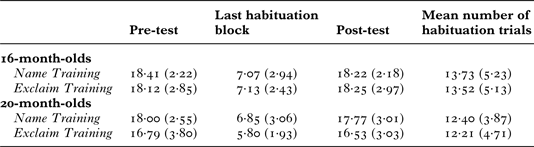
To determine whether fatigue over the course of the experiment influenced infants' looking times, we examined looking times to pre-test and post-test trials, and to the last block of habituation trials (see Table 2 for mean looking times). A 2 (Age group – 16- and 20-month-olds) × 2 (Condition – Name and Exclaim Training) × 3 (Trial Type – pre-test, post-test, and last block of habituation) mixed-model ANOVA revealed significant main effects of trial type and age group (F(2,152) = 401·12, p < ·001, η p 2 = ·84, and F(1,76) = 4·62, p = ·035, η p 2 = ·057, respectively). With respect to the main effect of trial type, planned pairwise comparisons indicated that infants in all groups looked longer to the pre-test and to the post-test as compared to the last block of habituation (ps < ·001). Infants' looking time to the pre-test and post-test did not differ (p = ·857). Thus, infants in all groups recovered their attention following habituation. With respect to the main effect of age group, results revealed that 16-month-olds infants (M = 14·53, SD = 1·66) looked significantly longer across the pre-test, post-test, and last block of habituation than 20-month-old infants (M = 13·64, SD = 1·87). However, a 2 (Condition) × 2 (Age) mixed-model ANOVA on the average number of habituation trials yielded no significant main effects or interactions (ps > ·05), suggesting that infants in both groups attended similarly to the word–object pairings during habituation.
Mean looking time for pre-test, post-test, and last familiarization block

Our primary analysis focused on infants' looking time during the test trials. We expected infants to look longer to Switch than to Same trials if they had formed the word–object mappings. Given our specific hypotheses about developmental differences in infants' ability to map phonotactically illegal word forms, we examined infants' performance within each age group. First, we evaluated 16-month-olds' looking times during test trials using a 2 (Trial Type – Same and Switch) × 2 (Condition – Name and Exclaim Training) mixed-model ANOVA. This analysis revealed a significant trial type by condition interaction (F(1,35) = 6·22, p = ·017, η p 2 = ·132). Paired comparisons demonstrated that infants in the Name Training condition looked significantly longer to Switch (M switch = 8·39, SD = 4·84) than to Same trials (M same = 6·44, SD = 4·16; p = ·036). The majority of infants in this group (18/22) exhibited this pattern of responding. In contrast, 16-month-olds' looking time to Same (M same = 7·35, SD = 4·65) and Switch (M switch = 6·54, SD = 5·25) trials did not differ in the Exclaim Training condition (p = ·178), with only 8 of 21 infants looking longer to Switch than to Same trials.
Next, we examined 20-month-olds' looking times during the test trials using a 2 (Trial Type) × 2 (Condition) mixed-model ANOVA. We found only a main effect of condition, such that 20-month-olds in the Name Training condition (M = 9·53, SD = 3·49) looked significantly longer across both Same and Switch trials than infants in the Exclaim Training condition (M = 7·02, SD = 4·38). The trial type by condition, however, was not significant (F(1,35) = 0·074, p = ·787), suggesting that 20-month-olds' looking time did not differ between Same and Switch trials in both the Name Training (M same = 9·21, SD = 4·07; M switch = 9·84, SD = 4·41) and Exclaim Training (M same = 6·78, SD = 4·82; M switch = 7·25, SD = 4·77) conditions. Here, only 8 of 19 infants in the Name Training condition and 9 of 18 infants in the Exclaim Training condition looked longer to Switch than to Same trials.
To determine whether infants' productive English vocabulary impacted their ability to map phonotactically illegal word forms to objects, we examined the correlation between infants' total productive vocabulary size and their performance on the Switch task (i.e. we correlated total vocabulary size with a difference score between Same and Switch trials). Infants' total vocabulary size did not correlate with their performance in the Switch task in any of the conditions or age groups (r(22) = 0·339, p = ·122 for the 16-month-old Name Training condition; r(21) = –0·045, p = ·847 for the 16-month-old Exclaim Training condition; r(19) = 0·244, p = ·314 for the 20-month-old Name Training condition; r(18) = 0·363, p = ·139 for the 20-month-old Exclaim Training condition). Thus, infants' productive vocabulary was not a predictor of their performance in the Switch task; rather age and type of training predicted their willingness to map illegal word forms to objects.
DISCUSSION
Our findings revealed developmental differences in infants' sensitivity to referential cues when establishing associations between objects and phonotactically illegal word forms. Consistent with our hypotheses, 16-month-olds successfully mapped phonotactically illegal word forms when the referential status of these labels had been highlighted through a training phase; however, 16-month-olds failed to map those same words when the training phase did not clarify the referential status of the novel words. By 20 months of age, infants did not form word–object mappings with the phonotactically illegal word forms regardless of whether or not they were presented with referential cues. Together, our results demonstrate that, while 16-month-olds are flexible in their mappings of word forms when provided with referential cues, 20-month-olds are restricted by the phonotactics of their native language when forming word–object associations.
Our findings are consistent with previous research demonstrating that clarifying the referential status of word forms increases infants' willingness to form word–object mappings (e.g. Fennell & Waxman, Reference Fennell and Waxman2010; MacKenzie et al., Reference MacKenzie, Graham, Curtin and Archer2014; May & Werker, Reference May and Werker2014; Namy, Reference Namy2001). That is, 12- to 16-month-olds have been shown to map a variety of non-native forms (e.g. phonotactically illegal words, words containing non-native speech sounds, non-verbal sounds) when provided with referential cues (Hollich, Hirsh-Pasek & Golinkoff, Reference Hollich, Hirsh-Pasek and Golinkoff2000; MacKenzie et al., Reference MacKenzie, Graham, Curtin and Archer2014; May & Werker, Reference May and Werker2014); however, infants appropriately restrict their mappings in the absence of referential cues. Our findings add to this literature by demonstrating that, at 16 months of age, infants approach the mapping of phonotactically illegal word forms in a similar manner to that of other symbolic forms. That is, 16-month-olds who received the name training mapped the words containing illegal sound combinations, as they were provided with evidence that the novel word form referred to the object. Importantly, the exclaim training did not promote the formation of word–object associations, suggesting that the familiar exclamations did not provide sufficient contextual information regarding the role of the novel word form as an object label. Thus, although 16-month-olds have a preference for word forms that follow the phonotactics of their native language, these preferences can be overridden in contexts where referential cues are provided.
Furthermore, our findings add to research demonstrating a developmental narrowing in the forms infants consider to be appropriate object labels (e.g. Graham & Kilbreath, Reference Graham and Kilbreath2007; May & Werker, Reference May and Werker2014; Namy & Waxman, Reference Namy and Waxman1998; Woodward & Hoyne, Reference Woodward and Hoyne1999). We demonstrated that, unlike 16-month-olds, 20-month-olds do not map word forms that contain illegal sound combinations, and thus are more constrained by the phonotactics of their native language. This finding parallels the results of Graf Estes and colleagues (Reference Graf Estes, Edwards and Saffran2011), who demonstrated that 17- to 20-month-olds did not map phonotactically illegal word forms, even when they were embedded in a labeling phrase. We extend this research by more clearly outlining the developmental shift in infants' flexibility in accepting phonotactically illegal word forms between 16 and 20 months of age. At this time, however, it remains an empirical question whether providing additional referential cues (e.g. using interactive tasks) will also shift older infants' flexibility in mapping phonotactically illegal word forms.
More broadly, our results speak to the fact that this developmental narrowing varies considerably depending on the type of symbolic form being tested, although the acquisition of various types of forms is likely underpinned by the same associative mechanism. That is, we propose that infants may be less flexible in their acceptance of non-native word forms than in their acceptance of forms that do not directly interact with their developing lexicon (e.g. gestures, non-linguistic sounds). When hearing infants encounter a label, it is spoken. As infants acquire more language, they have a developing lexicon to rely upon when experiencing new words. This lexicon can help to direct information uptake, and can guide infants' expectations about appropriate word–object mappings in their native language. In contrast, other symbolic forms, such as gestures, are not typically used to represent objects in a hearing infant's environment; thus, infants do not have a set of symbols to direct their information uptake and must rely on contextual or task-specific information to guide their mappings (Ferguson & Waxman, Reference Ferguson and Waxman2015; Suanda & Namy, Reference Suanda and Namy2013; Suanda, Walton, Broesch, Kolkin & Namy, Reference Suanda and Namy2013). Thus, although infants are willing to map both word forms and other symbolic forms as object labels, there are differences in the contexts and developmental stages in which infants begin to restrict their mappings. For example, 18-month-olds do not treat words and gestures as lexically equivalent, even though infants at this age are open to accepting both words and gestures as labels for objects (Suanda & Namy, Reference Suanda and Namy2013; Suanda et al., Reference Suanda, Walton, Broesch, Kolkin and Namy2013).
In summary, the present study revealed a developmental trend in infants' willingness to establish word–object mappings with non-native word forms. Specifically, 16-month-olds, but not 20-month-olds, formed an association between an object and a phonotactically illegal word form when the referential status of the novel word was highlighted. In contrast, infants of both ages did not map the phonotactically illegal words in the absence of referential cues. Thus, our studies provide insight into early word learning processes, by highlighting the relation between developmental status and referential cues in mapping word that contain illegal speech sounds. We have demonstrated that infants recruit their acquired knowledge of their native language when making word–object mappings, but demonstrate some flexibility at younger ages when referential information is available.