INTRODUCTION
Accountability is an essentially contested, and hence thoroughly political notion: an umbrella concept touching upon almost all facets and aspects of the drive for ‘democracy’ and ‘good governance’, in developed industrial countries as well as in emerging economy countries like Tanzania. It has become a buzz-word in the Washington Consensus ideas about economic development through improving competiveness, and in concomitant funding programmes by the WB, IMF, OECD and even NGO or charitable donation-based donors. This widespread uptake of the concept has, no doubt, added to the multiple meanings of the concept.
Recently, associated academic research on accountability has started to distinguish between formal and informal accountability mechanisms. This distinction not only encourages new thinking on how accountability practices work in Africa but also defies the widely held notion that formal accountability practices are a silver bullet to Africa's quest for development. As a consequence, the dominant discourse on formal accountability as a solution is increasingly challenged to consider informal accountability mechanisms more seriously (Kelsall Reference Kelsall2008; de Wit & Akinyoade Reference de Wit and Akinyoade2008; Lindberg Reference Lindberg2010; Tilley Reference Tilley2014). The parliament-executive accountability relationship is one area where formal and informal accountability behaviour of Members of Parliament is increasingly coming to light and often analysed in terms of ‘political clientelism’ (Lindberg Reference Lindberg2010).
The major question this article poses is whether or not different meanings of accountability can be discerned in the beliefs of Tanzanian Members of Parliament (MPs), and if yes, which ones. The overall motivation for this research is to contribute to efforts for ‘good governance’ by ‘providing sensible interpretations of African realities that offer guidance – rather than precise answers – as to what can be done to foster improvement of governance from within. Therefore, the study of political accountability must be embedded in understandings of African realities – what some would call ‘culture’' (Hyden Reference Hyden2010: 14).
The executive-oriented nature of the Tanzanian parliament provides a particular motivation to uncovering views of MPs on accountability. Parliament, after all, is the forum at the centre of a democratic political system. Accountability discourses and behaviour in the parliamentary arena will have an emblematic, illustrative and imitative function for all other accountability chains in a nation. The existing national–local government arrangements in Tanzania empower the national government to oversee national policies and priorities and provide guidance on how other levels of government, including local governments should implement them. In this context, national government institutions, including the parliament have a bearing on local government accountability practices. However, such arrangements makes the executive branch powerful over other institutions. Thus, the executive-oriented character of Tanzanian governance throws doubts on the degree to which parliamentarians can and do hold the executive to account (De Mesquita & Smith Reference De Mesquita and Smith2012: 66–8; Reference De Mesquita, Smith, Wolf, Schöttli, Frommherz, Fürstenberg, Gallenkamp, König and Pauli2015).
The present parliamentary institutions in Tanzania were established as the Legislative Council of Tanzania (LEGCO), by the British parliament in the Tanganyika Legislative Council Order (LEGCO) in 1926. The LEGCO was an appendage of the office of the colonial Governor (Tambila Reference Tambila, Mukandala, Mushi and Rubagumya2004). The composition of the LEGCO assured an executive-nominated majority and thus heavily favoured the executive (Matenge Reference Matenge2012). After attaining independence in 1961, Tanzania adopted a unicameral Westminster first-past-the-post district model in which the doctrine of parliamentary supremacy was formally emphasized (Van Donge & Liviga, Reference Van Donge and Liviga1985, Reference Van Donge and Liviga1986; Mwakyembe Reference Mwakyembe and Shivji1986; Tordoff Reference Tordoff1993; Liviga Reference Liviga and Mukandala2004; Mhina Reference Mhina and Mukandala2004; Shivji & Majamba Reference Shivji and Majamba2004). In the Nyerere period of ujamaa (1960s–70s) Tanzania became a single party state in 1964 (Thoden van Velzen & Sterkenburg Reference Thoden van Velzen and Sterkenburg1969; Van Donge & Liviga Reference Van Donge and Liviga1985). The following year (1965) multiparty elections were held. The Tanganyika African National Union (TANU) won the election. TANU assumed supreme political power over other institutions, including the parliament, which was reduced to a rubber stamping institution. This phenomenon was called party supremacy (Thoden van Velzen & Sterkenburg Reference Thoden van Velzen and Sterkenburg1969). The current ruling party, CCM, is a union of the TANU from the Mainland and the Zanzibar-based Afro-Shirazi Party (ASP) (Morck Reference Morck2005, cited in Hoffman Reference Hoffman2006: 16).
CCM became the dominant party extending its grip on power to all government institutions. Such dominance resulted into a fusion of the Presidency and the bureaucratic machinery, producing a monolithic authority, systematically articulating the executive as the de facto power centre, with parliament the de jure, but only titular, sovereign (Matenge Reference Matenge2012). This situation is captured by Van de Walle (Reference Van de Walle2009) in an African context:
Though many African states inherited parliamentary rule at independence, power was soon concentrated in a relatively powerful presidency, whose considerable formal powers as defined by the constitution were in fact often dwarfed by their even greater informal and de facto ones. Powers of appointment, control of the national budget, and discretion over policy implementation with little oversight was not only concentrated in the office of the presidency, it was often actually controlled by the president himself and a tiny cadre of top politicians, who were often above the law for all intents and purposes. Similarly, the executive branch dominated the other branches of government, with a subservient and pliant legislature and a weak, unprofessional and politicised judiciary. (Van de Walle Reference Van de Walle2009: 6)
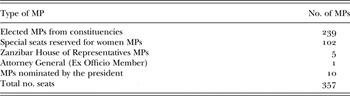
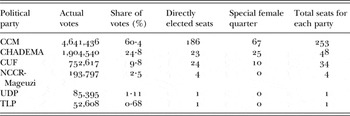
In 1992 the political system changed from a single party to a multiparty one, with five opposition parties obtaining a considerable number of seats (88 out of 357) in the 2010 elections.Footnote 1 However, the composition of the Tanzanian Parliament is not just determined by MPs elected by the Districts' electorate; these only make up 239 out of 357 seats (Table I). The constitution of the United Republic of Tanzania of 1977 (article 66) lists five categories of MPs: elected members representing individual constituencies; women members (at present 30% of all seats, allocated to parties on the basis of number of elected MPs); five MPs elected by the Zanzibar House of Representatives from among its members; the Attorney General; and 10 members appointed by the President to the parliament (Table I). This composition means that, compared to percentages of votes cast, the parliamentarian majority of the ruling party CCM is enlarged even more than is already inherent in a first-past-the-post system.
Composition of Members in the Parliament of the United Republic of Tanzania

Source: The national parliament of Tanzania, www.parliament.go.tz.
This means that the President (as member of the ruling party) controls parliament if he is able to get a majority, or 179 votes. This is a doable task. At the time of writing, CCM hold 253 seats while combined five opposition political parties hold 88 seats (Table II). Even if factional struggles within CCM do not guarantee the President all 253 CCM votes, his electoral ‘slack’ in parliament is (253 + 11) – 179 = 85 seats (Table I). This is almost equal to the 88 seats of five opposition parties (CHADEMA, CUF, NCCR-Mageuzi, UDP and TLP) together (Table II).Footnote 2 Yet, this amount of ‘slack’ may be necessary in view of CCM's increasing internal factional struggles (Presidential Power, consulted 15 September 2015).
Parliamentary votes and seats by party-2010 union elections

Source: Compiled from the Tanzania National Electoral Commission (NEC), 2010 election data.
Meanwhile, the frequency and amount of governance and corruption scandals has increased in recent times, deteriorating Tanzania's rankings on good governance and accountability in Africa (Mo Ibrahim Foundation 2014). Tanzania's score on the composite accountability index lost 8·5 points between 2006–2013, regressing towards the African mean. Although Tanzania ranks 15th in the composite good governance index out of 52 African countries, it ranks only 24th on accountability. In this context, an enquiry about the meaning(s) of ‘holding the executive accountable’ amongst Tanzanian MPs is highly appropriate since this may be one of the reasons for the worsening performance. Also, it contributes to the research proposed by Hyden (Reference Hyden2010) to compare the effect of different governance systems on accountability, e.g. proportional vs. first-past-the-post systems. We discuss previous research on accountability in Africa next.
MEANINGS OF ACCOUNTABILITY
Any research using the term ‘accountability’ needs to un-pack its specific meaning or meanings in the relevant context. Our first step is to more precisely delineate its meaning as part of the drive for more democracy. In their recent work, Esaiasson and Narud (Reference Esaiasson and Narud2013) conceptualise ‘democracy’ as a two-way process of interaction between the represented and their representatives. This dualist nature of democracy gives it a Janus-face as both egalitarian (of and by the people) and elitist (for the people). Political scientists take an institutionalist, egalitarian view of democracy in election mode: the key mechanism is electoral turnover. For a relatively short time, many public issues are simultaneously debated among the represented, and the would-be representatives seduce them with complex packages of proposals in holistic (party) platforms. Through elections, the people or electorate selects its representatives for the next mandate period. Policy scientists and public administration scholars stress the longer period of the elitist between-election mode of democracy. Once elected, the representatives or selectorate exercise the power delegated to them over the represented. Assuring the integrity of elections is difficult enough (Norris et al. Reference Norris, Frank and Martinez i Coma2014); holding the elected accountable in between-election periods even more so. Accountability mechanisms in the longer between-election mode are the rule-of-law, guarded by an independent court system; the rules, habits and resources of responsiveness, answerability and controllability of a parliament to the electorate (Hyden Reference Hyden2010); and the rules, and habits and resources of the executive to parliament and the courts.
To arrive at an operational definition of accountability, we follow Bovens (Reference Bovens2007), who analyses formalised accountability as a social relationship between an actor (minister, civil servant, etc.) and a forum (e.g. a parliament, a court), in which the actor is obliged to explain and justify his/her conduct, after which the forum may pose questions, pass judgement, of which, finally, the actor faces consequences. This formal accountability is usually elaborated in extensive rule systems. Judging rule application and rule following in accountability issues, therefore, inevitably becomes a complex judgemental game. As demonstrated by numerous legal and social science scholars (Innerarity Reference Innerarity2013), no rules can exist which exhaustively and unambiguously prescribe their own application. There is always room for interpretation and creativity – and subversion, which means that normally, informal institutions with their own set of informal rules exist alongside formal accountability rules (Helmke & Levitsky Reference Helmke and Levitsky2004).
For Boven's (Reference Bovens2007) definition of accountability means that not only the consequences have formal and informal aspects, but also that the forum, the information, the debating and the judgment are ‘doubled’ too. Think of communist states, where all official organs and units and roles had ‘party-doubles', a situation that also existed in ujamaa Tanzania. In Africa the implications for accountability of the informal ‘economy of affection’ (Hyden Reference Hyden2013) or ‘the politics of the belly’ (Bayart Reference Bayart2009) are particularly pertinent, as are the cases where outright (sometimes state-protected) criminal networks do the ‘doubling’ (Bayart et al. Reference Bayart, Ellis and Hibou1999; De Mesquita & Smith Reference De Mesquita and Smith2012; Chayes Reference Chayes2015). The result amounts to a ‘dual’ or ‘shadow’ institutional governance and accountability system. According to Helmke & Levitsky (Reference Helmke and Levitsky2004) such a shadow system may either positively affect the formal accountability system by accommodating or complementary impacts, or it may undermine it in substituting for or competing with the formal rule system.
In between-election mode accountability rules, and habits and resources can be formal and informal, both significantly shaping the behaviour of political actors. Advocates of good governance and democracy tend to assume that when the behaviour of political actors is subject to formal accountability rules of conduct intended policy goals will be achieved. However, recent research suggests that informal accountability mechanisms may structure the actors' incentives alongside formal accountability, in complementary, accommodative, competitive or substitutive modes (Helmke & Levitsky Reference Helmke and Levitsky2004). In weak institutional set-ups, informal accountability mechanisms may become competitive and substitutive with respect to formal accountability mechanisms (Chalmers & Setiyono Reference Chalmers and Setiyono2012). This understanding is captured in the concept of clientelism (Van de Walle Reference Van de Walle2009; Hyden Reference Hyden2010; Lindberg Reference Lindberg2010). Clientelistic relationships have three main characteristics: (i) they are between actors of unequal power and status; (ii) they are based on the principle of reciprocity i.e. a self-regulating form of interpersonal exchange, the maintenance of which depends on the return that each actor expects to obtain by rendering goods and services to each other; and (iii) they are particularistic and private, anchored only loosely in public law or community norms (Kaufman 1974; Brinkerhoff et al. 2002; Van de Walle Reference Van de Walle2009; Lindberg Reference Lindberg2010).
Parliament-executive accountability relations is one important area where both formal and informal accountability mechanisms may structure the behaviour of members of parliament and executive. For instance, clientelistic relationships between an MP and constituents stem from the tendency to regard the office of MP as infused with traditional notions of ‘head of family’ (Lindberg Reference Lindberg2010). In this informal accountability role MPs are expected to take care of constituency members by providing medical help, schools fees, funeral costs etc. This moral obligation of an MP is often felt very strongly (Lindberg Reference Lindberg2010). As a result, the traditional institution of a ‘family head’ has been grafted onto the formal institution of the MP to produce a hybrid institution which may compel MPs to respond to demands for personalised accountability, which comes in the form of political clientelism (Lindberg Reference Lindberg2010). Thus, in this case, clientelism is a modern, instrumental phenomenon which aids in the understanding of how the role of informal institutions favour MPs clientelistic behaviour (Lindberg Reference Lindberg2010).
We ought to acknowledge this mixed egalitarian and elitist character of representative democracy; and hence locate formal and informal accountability firmly in both election and between-election modes of democracy. Concurrent with the wave of attention for ‘good governance’, much has been written in the last decade, both in peer reviewed articles and in the so-called ‘grey’ literature of governmental and NGO reports, about political accountability in Africa in general (Melber Reference Melber2007; Kelsall Reference Kelsall2008; Bayart Reference Bayart2009; Grindle Reference Grindle2010; Hyden Reference Hyden2010; Booth Reference Booth2011; De Mesquita & Smith Reference De Mesquita and Smith2012; Hyden Reference Hyden2013; Andrew Reference Andrew2013; Bratton & Logan Reference Bratton and Logan2013; Transparency International 2014) and Tanzania in particular (Thoden van Velzen & Sterkenburg Reference Thoden van Velzen and Sterkenburg1969; Van Donge & Liviga Reference Van Donge and Liviga1985, Reference Van Donge and Liviga1986; Mwakyembe Reference Mwakyembe and Shivji1986; Therkildsen Reference Therkildsen2000; Heilman & Ndumbaro Reference Heilman and Ndumbaro2002; Rottenburg Reference Rottenburg2002; Kelsall Reference Kelsall2003, Reference Kelsall2008; Shivji & Majamba Reference Shivji and Majamba2004; Liviga Reference Liviga and Mukandala2004; Mhina Reference Mhina and Mukandala2004; Tambila Reference Tambila, Mukandala, Mushi and Rubagumya2004; Lawson & Rakner Reference Lawson and Rakner2005; Khan & Gray Reference Khan and Gray2006; Bratton Reference Bratton2010; Hyden Reference Hyden2010; Mallya Reference Mallya2011; Matenge Reference Matenge2012; Carlitz Reference Carlitz2013; Schatz Reference Schatz2013; Lindner & Banoba Reference Lindner and Banoba2014; Killian Reference Killian2014). This work provides a treasure of interesting and useful insights that will help us to put our findings in context. However, no detailed and systematic assessment has been undertaken of the opinions of Tanzanian MPs about exacting accountability from the executive, which we believe is key to understanding the flaws in accountability mechanisms often pointed out in this literature. Although some qualitative studies of Tanzanian MPs exist (Lawson & Rakner Reference Lawson and Rakner2005), these findings are rather dated and highly speculative. In this article, we thereby focus on the accountability relationship between parliament and executive, although we will also pay attention to how MPs see other accountability relationships: with special auditing bodies and the judiciary and with foreign actors.
With this work we particularly build on and respond to two recent studies. First, Hyden (Reference Hyden2010) used semi-structured interviews with Ghanaian MPs to propose a typology of political party cultures as a comparative framework for the study of MPs' conceptions of accountability. We will explore whether this typology is useful for our data, this time using the mixed method Q-method to add strength to our findings. Second, in his discussion of the political implications of the divergences between formal and informal rules and institutions in Africa, Kelsall (Reference Kelsall2008: 21) argues that accountability should not be thought of as being made ‘of one piece of cloth’. Rather ‘there is not a unidirectional grain to African society. [P]eople are constructed in the interplay of different and often conflicting social currents, giving rise to complex and sometimes self-contradictory subjectivities, all of which make concerted action in any particular direction difficult to achieve.’ Q-method being the study of subjectivities, this method is eminently suitable to discover and systematise discourses on accountability amongst Tanzanian MPs, and review to what extent Kelsall's proposition is confirmed. The questions we ask are then: How do Tanzanian MPs in the 2009–2015 parliament talk about holding the executive to account? May the findings be interpreted through Hyden's typology of African political party cultures, and Kelsall's proposition of the occurrence of divergent, self-contradictory accountability discourses?
RESEARCH DESIGN – Q-METHOD
We identified Q-method (Stephenson Reference Stephenson1954; Brown Reference Brown1996) as the appropriate research tool to study the discourses about accountability among Tanzanian MPs. Q-method elicits the variety of opinions, perceptions and attitudes that reflect the discourse(s) of an individual or group of individuals in a valid and reliable way. It is widely used in many subject areas, disciplines and countries (Hoppe Reference Hoppe2008; Watts & Stenner Reference Watts and Stenner2012). In a nutshell, Q-method asks each participant in the sample (the P-sample) to sort a series of statements (a Q-sample) representative of the breadth of debate on an issue (the concourse) into a distribution of preference (a Q-sort) from which statistically significant groupings (factors) are derived and interpreted (Jeffares & Skelcher Reference Jeffares and Skelcher2011).
Research procedure
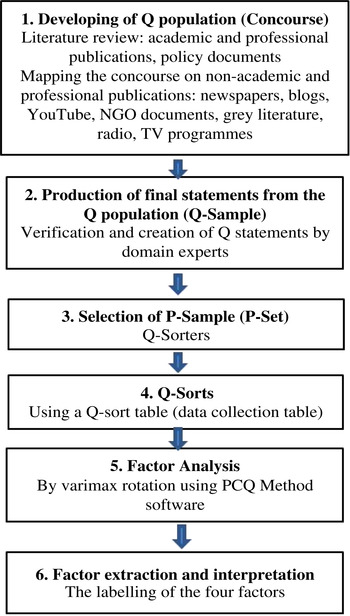
There are six main widely recognised steps to conducting a Q-method study (Figure 1). The first two steps are the development of a set of statements, the Q-population, running into the hundreds, that somehow captures the full scope and breadth of debate on a topic, in our case MPs holding the executive accountable and being accountable to an electorate; and, second, to narrow these statements down to a manageable number of between 30 and 60, the Q-sample, while ensuring that this Q-sample of statements remains representative of the diversity of opinion within the concourse.
Practical steps in doing Q-method research.

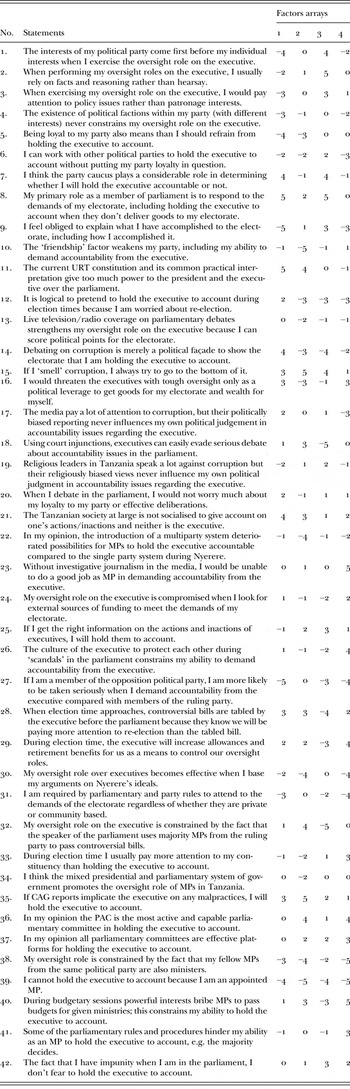
In our study, we began by extracting over 150 statements on accountability from data collected in our fieldwork in Tanzania, including fieldwork reports, government and non-government reports and academic literature. We also included statements on accountability in Tanzanian newspapers, blogs, YouTube, radio and television programs about parliament sessions. The main themes found in these sources include: party organisation, responsiveness, answerability, controllability, party caucus, corruption, the role of media, friendship/networks/alliances, party interests, patronage/clientelistic politics, culture, single party vs. multiparty, etc. We then eliminated overlapping and ambiguous statements, resulting in 100 statements. These statements were sent to prominent scholars (Goran Hyden and Benson Bana) for review;Footnote 3 this consultation reduced the list to 50 statements. A pilot testing of the Q-sorting (step 4) was then conducted with three scholars (Benson Bana, Kelvin Munisi and George Jerico) working at the Department of Political Science and Public Administration, University of Dar es Salaam.Footnote 4 Statements were reworded where necessary, and some more were eliminated as superfluous (Ha Reference Ha2015). The adequate number of statements is usually between 20–100 (Watts & Stenner Reference Watts and Stenner2012), depending on the researcher's estimate of how much time he may reasonably claim from respondents. Finally, 42 Q-statements (the Q-sample) were retained to represent the concourse surrounding the discourse on accountability in Tanzania (Table III).
Standardised factor Q-sort values for each statement

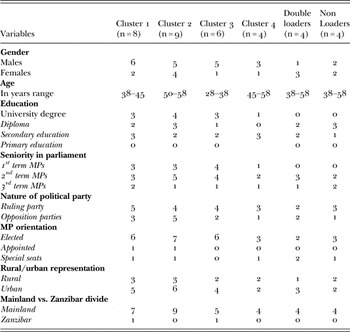
The third step was to sample from the population of 357 MPs (the P-sample). Q-method requires a smaller response N than other forms of quantitative analysis, because the purpose of the P-sample is not representativeness for generalizability, but to map the diversity of opinions (Watts & Stenner Reference Watts and Stenner2012: 72). Given the nature of Q-method, the only sampling rule is to have a number of participants that is smaller than the number of statements in the Q-sample (Table IV). This number being 42, we decided that 10% or 35 MPs of the 357-seat parliament would be sufficient. To avoid bias as much as possible, we tried to get a good spread amongst our participants on the following criteria: seniority in the parliament, i.e. first-time, second or third term MP; gender; age; rural-urban divide; Zanzibar-mainland divide; type of MP i.e. elected or appointed; as well as opposition party vs ruling party.
Q-sort participants' characteristics (N = 35)

Source: Fieldwork data.
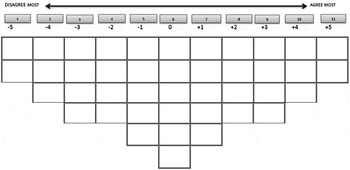
The fourth step is to ask respondents to sort the statements into order of preference, giving them a specific instruction, such as ‘agree/disagree’ or ‘most like/most unlike’. Approaches to sampling depend on the topic under investigation, and may utilise purposive, naturalistic or demographically representative samples. Participants then undertake a more refined sorting by placing each statement into a forced distribution prescribed by the researcher, often a semi-Normal distribution ranging from −4 to + 4 or −5 to + 5, depending on the number of statements (Figure 2). This forces participants to rank statements relative to each other, rather than only agreeing or disagreeing. The basic assumption of this survey technique is that statements gain credibility if weighed off against each other, and that stronger statements (e.g. +5, −5) are fewer than more moderate or neutral statements.
Forced semi-Normal distribution of the Q-set.

In each encounter, the researcher approached MPs in the parliamentary grounds during breaks. During these breaks, MPs would go for tea and lunch in a restaurant located a few metres from the main building. A generous parliamentary administrative official introduced the researcher to several MPs. This approach was useful but challenging. It was useful because this was a convenient opportunity to interact with MPs right away, or ask for an appointment. The challenge was that the research coincided with the 2015 national elections period. MPs were focused on how to be re-elected; they were busy on phones talking to supporters in their electorate, or with visitors representing constituencies. This pressure prevented some MPs from accepting interview appointments. Unexpected cancellation of interviews and unanswered follow-up phone calls were some of the other hurdles. In addition, one day after the researcher arrived at the parliament 43 opposition members were expelled by the speaker following their objection on a bill tabled by the government under a certificate of urgency. This meant more time was needed to track down opposition members for interviews.
In each meeting, participants were informed of ethical considerations (see below). The participants were instructed to randomly pick Q-sort cards and sort the statements into three piles: agree, disagree and neutral. Subsequently, they ranked the statements into an 11-way matrix (Figure 2). After this Q-sort, respondents were interviewed to explain the sorting. These recorded interviews helped to interpret the findings in later stages of analysis.
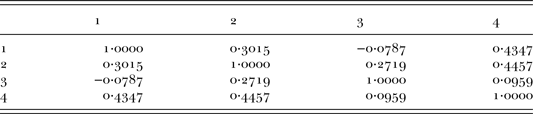
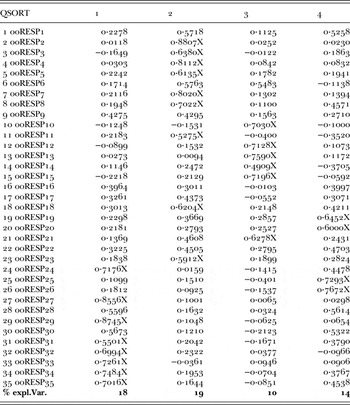
In the fifth step Principal Component Analysis (PCA) was performed on the ensemble of Q-sorts to reveal patterns in the data, using PQ-method software (Schmolck Reference Schmolck2014). This yields clusters (or groups) of participants with the most similar statement rankings (‘factors’ in Q-method jargon). Based on the eigenvalues (> 1·000) the statistical procedure initially derived eight factors. Using Scree and Humphrey's tests (Watts & Stenner Reference Watts and Stenner2012: 107–8) and researchers' judgment, four clusters were chosen for a VARIMAX rotation using statistical criteria. While other numbers of clusters were also significant, we opted to distinguish four clusters because they appeared eminently interpretable. The inter-correlation matrix (Table V) shows the four factors to be well distinct (max. correlation is 0·4457); there are no strict consensus statements; the spread of individual respondents statistically loading on the four factors (minimum loader is a high 0·6380) is well balanced (N = 8, 9, 6, 4 respectively) with just four confounding loaders and four non-loaders; the accumulated explained variance is a satisfactory 61%. Subsequently, each participant's ranking was transformed into a factor loading, signalling the degree to which an individual's ranking corresponds to the averaged rankings of the four principal factors, the so-called factor array (Table VI). As Brown (Reference Brown1996) advises, weighted averaging of the scores was used to calculate each factor's (cluster's) standardised average rating for each statement (Table VI).
Inter-correlation matrix between factor scores

Factor matrix with X indicating a defining sort (N = 35)

The sixth and final step is for the researcher to interpret the results. This task was assisted by asking respondents to discuss the reasoning behind their preferences once they had completed the Q-sort (Jeffares & Skelcher Reference Jeffares and Skelcher2011). The discussions were largely conducted in Swahili and quotes below are translated to English by the first author.
Ethical considerations
The study followed all required research formalities, including obtaining research clearance from the University of Dar es Salaam. The research permit was presented to the Secretary Office of the Parliament. This Office issued a letter confirming the researchers' permission to conduct interviews with members of parliament. During the course of the research, all respondents received information about the purpose and method of the study. They were also informed that their participation was voluntary, that they could refuse to participate and could withdraw during the study without any consequences. The information gathered was treated with confidentiality and anonymity.
FINDINGS
The four clusters distinguished in the Q-sort are captured by the following labels: My Electorate's Advocates (MEA), Partycrats (PC), Frustrated Account Holders (FAH), Pragmatic Account Holders (PAH). The following elaborates their Q-sort and interprets the clusters in the context of Tanzanian governance.
My Electorate's Advocates (MEA): ‘My electorate is my family’
This cluster is the second largest one and consists of eight MPs; it is dominated by males (6M-2F) and the ruling party (5) is better represented than the opposition parties (3). Although they are relatively young (38–45) years), they are highly experienced: only three are first-term MPs (who, meanwhile, also have 5 years of experience since elections were imminent); all others are in their second or third term.
MPs in this cluster put primacy on the electorate of their own districts. They feel that the main role of an MP is to respond to the demands of their own electorate (statement #8 scores +5; abbreviated to #8 +5). Accordingly, they mainly try to hold the executive to account when it fails to deliver goods and services to their electorates. As a logical consequence this group of MPs reject the statement that the interests of their political party come first, before individual interests (#1–4). However, the allegiance to their electorate is not matched with a perceived need to explain to the electorate how they deliver goods and services (#9 −5). This is in line with their belief that Tanzanian society at large is not socialised to give account on actions/inactions and neither is the executive (#21 +4). Note that the other three clusters also support this belief, but more weakly (PC #21 +1; PAH #21 +2; FAH #21 +3):
Tanzanians in my constituency want to see schools, functional water wells, good roads, good prices for agriculture produce etc. They are not interested to know how I managed to deliver these services. A member of parliament is like a father in a family. He is supposed to bring food on the table. Children are not supposed to question how much did the father pay for the food, it is none of their business.
This may mean that these MPs justify engaging in corrupt endeavours to obtain the resources to deliver goods and services. Indeed, this cluster rejects the statement that when exercising oversight roles on the executive, it is justified to let patronage interests prevail over policy issues (#3 −3). Furthermore, debates about corruption by this group of MPs are considered a political façade to show the electorate that the executive is being held accountable (#14 +4). All three other clusters strongly reject this statement (PAH −2; FAH −3; PC −4). Having no confidence in the URT constitution, which gives too much powers to the president and the executive over the parliament (#11 +5), may explain why these MPs think only through the electorate that the executive may be held accountable.
The MPs also reject the statement that when performing oversight roles, they would rely on facts and reasoning rather than hearsay (#2 −2). Only this cluster rejects this statement. This implies that in this cluster the Nyerere ideals of ujamaa socialism in general are no longer influential on MPs oversight roles over the executive (#30 −2):
Nyerere does not bring development to my constituency, he is long dead, but he is still very respected … What matters now is who is currently in power, that's the one we should be dealing with, including his government. A person that can give you hope is the one that you can see and talk to physically, not an imagined one.
MPs in this cluster do not see any constraints preventing appointed MPs from holding the executive to account, strongly rejecting statements that they cannot hold the executive to account because of being an appointed MP (#39 −4) and related statements (#27 −5; #38 −3). In a nutshell the MEA MPs' take on accountability may be summarised as follows: my allegiance is solely to my district's electorate and this is where I hold the executive to account.
Partycrats (PC): ‘Party first, individuals later’
This cluster consists of 6 MPs. It is a very young (ages 28–38) male-dominated (5M −1F) and rather inexperienced group of MPs, with most of them in their first term. The cluster consists of both ruling party (4) and opposition party MPs (2).
In their choice of statements, this cluster has few overlaps with other clusters. The MPs in this cluster believe that only the party can hold the executive to account. Both opposition and ruling party MPs in this cluster strongly confirm the statement that the interests of their respective political party come first, before their individual interests, when exercising oversight roles (#1 +4): ‘In our party we have a party creed that goes like this: ‘party first, individuals later’. No one is bigger than the party, including the president who also serves as the chairman of the party. If the party decides on an issue no member can decide otherwise’ (MP ruling party). ‘Party caucus plays a great role in determining (the) oversight role of MPs … for instance the anti-corruption agenda is our party agenda since 2005 … all members of the opposition adopted this stance when we joined the parliament' (opposition MP). Such strong belief in the party is exemplified as well by the rejection of the statement that ‘using court injunctions, executives can easily evade serious debate about accountability issues in the parliament’ (#18 −5). This implies that for this cluster executives cannot easily escape from being held accountable.
Furthermore, while other clusters believe this to be true, MPs in this group reject the statement that their oversight role is constrained by the fact that the speaker of the parliament uses MPs from the ruling party to pass controversial bills (#32 −5). The MPs also rejected the statement that when election time approaches, controversial bills are tabled by the executive before the parliament because at such time MPs would be paying more attention to re-election (#28 −4). However, this needs to be interpreted in the light of what was happening during the interview period: three bills were tabled in the parliament under a certificate of urgency and were forcedly passed despite strong resistance from the opposition MPs, who were banned from appearing in parliament due to alleged ‘misconduct’.
Unlike MPs in the MEA cluster who scored (#9 −5), the PC cluster feel obliged to explain how they accomplished their achievements (#9 +3): ‘These days people talk about transparency everywhere … to me I think it makes sense to deliver your promises to the voters, but also explain to them how you managed to deliver or failed to deliver … this will make you an MP of the people and prepare good grounds for re-election’ (MP ruling party). This belief may be informed by the need to build a good party image, which is at the source of re-election possibilities (MPs cannot stand independently). The party caucus thus plays a crucial role in determining whether MPs will hold the executive to account (#7 +4): ‘The party caucus is a way of keeping MPs on track, to make them work together as a team to avoid divisions and factions within the party. It determines to a great extent which position MPs should adopt in the parliament’ (MP ruling party).
Although PC members like MEAs show a strong allegiance to the electorate for re-election purposes (both score #8 +5), the big difference is that they strongly believe in facts and reasoning as opposed to hearsay when they deliberate in parliament (#2 +5), and more oriented to policy issues than patronage interests (#3 +3). This view may result from the fact that most of the MPs in this cluster are young and well educated, and able to read complex policy proposals and make informed deliberations in the parliament. MPs in this group strongly believe that if they smell corruption, they would always try to go to the bottom of it (#15 +4), which is a logical consequence of rejecting the statement that debating on corruption is merely a political façade (#14 −4). Thus the PC discourse on accountability may be summarised as: only the party can effectively hold the executive to account.
Frustrated Account Holders (FAH): ‘Yes we can, but the party/political system fails us’
This cluster is the largest one, with nine MPs. The group is balanced in gender (5M and 4F) and highly experienced: their age is between 50–58, and most MPs are in their second or third term. The group consists in equal proportions of both ruling and opposition party members.
MPs in this cluster share the allegiance to the electorate with the MEA cluster (#8 +5) and with the PC cluster (#8 +5), although more weakly (#8 +2). Contrary to MEA and PC clusters, who believe in the power of re-election and/or the (ruling) political party as mechanism of holding the executive to account, MPs in this group believe that they should do so as parliamentarians with their own parliamentary resources, i.e. going through the Controller and Auditor General (CAG) and Public Accounts Committee (PAC). This is exemplified by strongly agreeing to hold the executive to account when implicated by CAG reports (#35 +5) and seeing the PAC as the most active and capable parliamentary committee in holding the executive to account (#36 +4).
They also believe that there are too many party-political and political-social constraints on holding the executive to account in practice, hence their frustration. The ruling party MPs in FAH are frustrated by both the party constraints and the political system (e.g. the constitution) (#3 −2), while the opposition MPs in FAH are frustrated by parliamentary practices that favours the ruling party and the political system: ‘Party factions have weakened and paralyze my party. There are a dozen of camps with different interests in the party. This is not healthy for effective oversight role of an MP’ (MP ruling party). ‘Party factions are a result of poor leadership and power mongering. The factions are formed during the internal nomination processes and last afterwards … neither the chairman nor senior party leaders have moral authority to stop this … in the end it cost the party dearly in the parliament and in the constituencies' (MP ruling party).
Showing deep commitment to accountability as such, and despite the frustration with party factions and corruption, the FAH MPs strongly believe that if they smell corruption they will always try to go to the bottom of it (#15 +5). Conversely, they reject the statement that debating on corruption is merely a political façade (#14 −3). But at the same time they believe that powerful interests bribe MPs to pass budgets for given ministries (#40 +3): ‘Everyone understands the magnitude of corruption in this country, including we MPs, but let us be honest why does corruption not end? It is because everyone benefits. I may look very genuine in fighting corruption in the parliament but who knows if I have been paid to shout about it … I think it is difficult to judge’ (Opposition MP).
The ruling party and opposition MPs in this group believe that the constitution and its interpretation give too much power to the president and the executive over the parliament (#11 +4): ‘The appointment powers over members of parliament that the president has, weaken parliament oversight over the executive … the President is also the chairman of the party in power – this gives him a lot of powers to control MPs through the party’ (MP ruling party). MPs in this group also believe that Tanzanian society at large is not socialised to give account of on one's actions/inactions and neither is the executive (#21 +3). Scheduling tricks used by the Speaker (#28 +3; #32 +4) add to their frustration: ‘The Speaker of the parliament should be more neutral. She is favouring too much the CCM MPs and executive. The era of a single party parliament is gone. We are in a multiparty parliament’ (Opposition MP).
However, MPs in this group do not believe that their oversight role is constrained by the fact that fellow MPs from the same political party are also ministers (#38 −4); and, somewhat surprisingly given their stress on the appointment powers of the president, strongly disagree that appointed MPs cannot hold the executive to account (#39 −5). Demonstrating a commitment to accountability per se, they do not think that being loyal to the party also means than they should refrain from holding the executive to account (#5 −3); nor that they cannot work with other political parties to hold the executive to account because it might put their party loyalty in question (#6 −2). Likewise, they strongly disagree that their informal relationships weaken the party (#10 −5). Summarizing this cluster's stance on accountability: As parliamentarians we are committed to hold the executive to account with our own parliamentarian resources, but as yet there are too many (party) political constraints to achieving this in practice.
Pragmatic Account Holders (PAH): ‘As parliamentarians we can only hold the executive to account in collaboration with civil society’
This cluster has four MPs. It is dominated by older males (age 45–58) (3M and 1F) of the ruling party (3) in their second or third term (3).
As pragmatic politicians, this group of MPs believe that holding the executive to account is very important but contextual; they can sometimes hold the executive to account with the help of journalists (and ‘society’) and sometimes they cannot because of inherent impediments. Contrary to MPs in the FAH cluster, who rely on parliamentary resources alone, this group therefore believes in the power of external actors to hold the executive to account (#23 +5). One MP narrated how Twaweza and Haki Elimu (renowned critical NGOs working in the education, water and health sectors) helped MPs with data to question the government: ‘There are very few mainstream investigative papers which are doing a wonderful job … these newspapers help me a lot because they bring up serious policy issues which assist me in deliberating in the parliament’ (MP ruling party). However, media support is not sufficiently effective yet. On this account PAH MPs believe that powerful interest bribe MPs to pass budgets for given ministries (#40 +5): ‘The budget season is a great opportunity for some money loving MPs … I cannot deny that influential companies and business people usually come to parliamentary grounds to lobby MPs … there are also officials within ministries who lobby MPs through brown envelopes' (MP ruling party). These MPs also rejected the statement that although the media pay a lot of attention to corruption, their politically biased reporting never influences MPs own political judgement in accountability issues (#17 −3): ‘There are very few MPs who pay attention to media bias in reporting corruption … usually MPs would consider the media as a very important source of information … it has always been like that’ (MP ruling party).
Furthermore, MPs in this group strongly believe that the culture of the executive to protect each other during ‘scandals’ in the parliament constrains their own ability to demand accountability from the executive (#26 +4). They agree that some of the parliamentary rules and procedures hinder their ability as an MP to hold the executive to account, e.g. the majority decides (#41 +3). Interestingly, all the four clusters reject the statement that MPs oversight role is constrained by the fact that fellow MPs from the same political party are also ministers (MEA #38 −3; PC #38 −2; FAH #38 −4; PAH #38 −5). However, the strongest rejection comes from PAH opposition MPs; MPs from the opposition have never been appointed to a ministerial post.
The PAH MPs also feel accountable to the electorate. They would threaten the executives with tough oversight only as a political leverage to get goods for the electorate and wealth for themselves (#16 +3). Implicitly, this may also mean that they favour patronage over policy issues although the relevant statement is weakly supported (#3 +1). Yet, they reject the statement that it is logical to pretend to hold the executive to account during election times because of being worried about re-election (#12 −3): ‘If this is true then there will be very few MP who do that and they are hypocritical; if an MP is worried about re-election, it doesn't make sense to be active when election times approaches … voters are not stupid, they know who fake it and who is deeply concerned with their problems' (Opposition MP). The PAH MPs also somewhat disagree with the idea of holding the executive to account via the party (#1 −2). Summarizing this cluster's views on accountability: as pragmatic politicians, MPs can sometimes hold the executive to account for achieving the electorate's preferences with the help of journalists (and ‘society’).
DISCUSSION AND CONCLUSIONS
The main finding of this Q-method research is that there are four clearly identifiable discourses on accountability issues among Tanzanian MPs. The chief division is found between, on the one hand, MPs who believe that the political party's parliamentary representatives are the only ones who can effectively hold the executive in check, meanwhile serving the electorate (labelled PC for ‘particrats’), and, on the other hand, those who were never convinced of this or have given up this belief, and instead rely on their own constituency as their only political power base and issue compass in exacting accountability from the executive, labelled ‘my electorate's advocates' (MEA). This tension is inherent in the Westminster model of first-past-the-post District representatives, who always have to balance party interests (imposed though the ‘party caucus’) and their electorate's demands.
Interestingly, both PC and MEA believe that theirs is the best way to responsiveness, i.e. to serve the electorate in a broader sense of the word. Although electoral districts in Tanzania may have some tribal or ethnic overrepresentation, even the MEAs speak about their electorates' needs and demands not in terms of private or club goods, but in terms of generic public goods and services that a state, through good governance, should supply its citizens with. Priorities may differ per constituency – some districts need more clean water and better health services, and others improved roads and better prices for their products – but constituencies' needs are not claimed by MEAs in terms of tribal or ethnic demands. In that sense, their accountability discourse is ‘modern’. However, the PC discourse also stresses other elements of ‘modern’ politics such as facts, evidence and debate, whereas the MEA-discourse actually disparages the importance of these elements. MEA-discourse MPs, in spite of the apparent modernity of their substantive claim, actually stand in the traditions of ‘the economy of affection’ (Hyden Reference Hyden2013) and the ‘politics of the belly’ (Bayart Reference Bayart2009). This becomes particularly clear in their beliefs about answerability. Whereas PC MPs feel they should tell the electorate where and how they acquired the resources for service delivery, the MEA MPs absolve themselves of this obligation, invoking traditional family rules and habits.
The other two discourses, MPs as frustrated (FAH) or pragmatic account holders (PAH), appear to be derived from PC- and MEA-discourses. Both FAH- and PAH-discourses stress the role of parliamentarians as overseers of the executive, and they wish to see this oversight role strengthened. FAH-discourse stress systemic constraints on controllability, i.e. efforts by parliament proper to hold the executive accountable by means of its own resources and skills. The constitution, the party caucus, the speaker of the house, the legal system, educational level of some MPs, etc. – they all impede good-willing parliamentarians to live up to their own and others' expectations in practice. Those who use a PAH-discourse appear to have learnt from these frustrations and acknowledge that parliamentarians need to collaborate with civil society – journalists and NGOs particularly – if they want any serious impact on executive political and administrative conduct. They acknowledge that this is impossible across the board, and seem resigned to the idea that only careful selection of issues may bring occasional successes.
Somewhat surprisingly, few of the MPs' characteristics (appointed-special/elected seats, urban-rural constituency, mainland-Zanzibar, opposition-ruling party, level of education, age, gender) has an effect on membership of any of these four groups of MPs. Only age and seniority as MP were found to make a difference. Only younger and less experienced MPs are PC: if you are young but more senior, you are more likely to be MAE; and the relatively older and more experienced MPs tend to become either FAH or PAH. It looks as if MPs are recruited along party lines and are expected to follow the party line, only to learn from experience that other political actors and factors are at play in holding the executive to account and best serving one's constituency. For inexperienced MPs to be a PC may simply mean a good start to their future political career. Unlike in Ghana (Hyden Reference Hyden2010: 6), in Tanzania there are no MPs who have a diaspora background. Young MPs are either groomed within their respective parties or come from a strong business and educational background. There are also cases of young MPs who come from political dynasties, but they are mostly appointed in special seats and do not need much party support.
Although Q-method strictly speaking does not allow for generalization beyond the Q-sample, these findings invite the hypothesis that the era of strong single party rule by CCM (or, in future, an alternative opposition party) is drawing to a close.Footnote 5 Three of the four identifiable discourses are clearly ‘anti-party’, although for different reasons: one's own electorate as overriding reference group and power base for accountability (MEA); and more frustrated (FAH) or pragmatic account holders (PAH) looking to a strictly parliamentarian resource base for exacting accountability (FAH), or seeking strategic collaboration with civil society actors (PAH).
Hyden's reflection on MPs' accountability practices illuminates our findings (Hyden Reference Hyden2010: 12). It would seem that MEA-discourse MPs keep choosing the populist, overtly clientelistic route of patronage for their own constituency. PC MPs take one step more toward political modernity in allowing for policy considerations, fact-based rational debate, and some networking, albeit within the confines of one political party and its strategies. On the basis of his research, Hyden postulated that party cultures would be important determinants for enhanced political accountability. His typology of party cultures uses two parameters, deliberation and loyalty (Hyden Reference Hyden2010: 17–19). ‘Deliberation’ is the extent to which a party culture encourages open-minded and business-like deliberation to process political issues. ‘Loyalty’ expresses the extent to which a political party demands loyalty from its MPs, i.e. the degree to which they are obliged to follow party instructions in parliamentary voting and other important party activities. Using our data (with the standardised factor scores on Q-statements as rough ‘proxies’ for aspects of ‘deliberation’ and ‘loyalty'),Footnote 6 we can intuitively and qualitatively position the four Tanzanian MPs' accountability discourses in the Hyden typology (Figure 3).
Typology of accountability discourses (after Hyden Reference Hyden2010).

As is obvious from the previous discussion, MEA and PC-discourses have opposite scores for the deliberation and loyalty dimensions and therefore end up in opposite quadrants of the Hyden typology. Frustrated and pragmatic account holders score more or less in the middle of the loyalty and deliberation dimensions, and thus have a considerable overlap, but are both closer to MEA than to PC; this is supported by the score in the inter-correlation matrix, Table IV).Footnote 7 In practice this would mean that we would see MPs of FAH- and PAH-discourses side more frequently with MEA-discourse MPs.
It would appear, then, that there is more ‘system in the madness’ than suggested by Kelsall (Reference Kelsall2008), who maintains that there is an inscrutable ‘interplay of different and often conflicting social currents, giving rise to complex and sometimes self-contradictory subjectivities, all of which make concerted action in any particular direction difficult to achieve’. In Tanzania the key to government control is, after all, the fact that PC-minded MPs and the politically nominated members of the executive belong to the same party. This makes the following political control strategy a likely possibility (De Mesquita & Smith Reference De Mesquita and Smith2012) and one that has in fact been reported (Venugopal & Yilmaz Reference Venugopal and Yilmaz2010; Reith Reference Reith2011; Matenge Reference Matenge2012). The executive controls administrative and bureaucratic service delivery to citizens through vertical accountability lines between ministries and other levels of government. So does the ruling political party, CCM. By withholding some services, or by just-in-time service delivery in election time, the executive may influence the probability of re-election of MPs in their districts. After all, MPs are held to account by their own constituencies on the basis of their skills and ability to make the executive deliver the right type of services in the appropriate amounts. This elicits collaboration between PC-minded MPs and the executive, but MEA-minded MPs are vulnerable to such a political strategy. What Guillan-Montero (Reference Guillan-Montero2014) has demonstrated quite convincingly for Argentina is manifest in Tanzanian parliamentarian politics as well: if necessary, MEA- and PAH MPs will ‘threaten the executives with tough oversight only as political leverage to get goods for my electorate and wealth for myself’ (statement #16). Another method of collusion would be bloc-voting, where District Commissioners and other senior administrators or local politicians pledge to ensure the voting support of their constituents to an MP, on condition he or she delivers what they want.
In other words, the different discourses on accountability among Tanzanian MPs enable the executive to rule in semi-autocratic ways. Due to the weak mobilisation capacity of other political players – NGOs, faith-based organisations, community-based associations, and the like – and the possibilities of choosing private solutions for public problems through bribes and other modes of corruption, political parties, for the time being, will hold the key in exacting more accountability of the executive to the preferences and demands of Tanzanian citizens. However, even if opposition parties would obtain a parliamentary majority, the accountability culture that emerges from this Q-method investigation of discourses held by Tanzanian MPs stands in the way of achieving greater democratic responsiveness. We need to understand MPs discourses within the broader context of ‘political clientelism’ and probe how good governance reforms under the rubric of democratization are likely to transform clientelistic practices embedded in some of the MPs discourses on accountability. As Van de Walle (Reference Van de Walle2009) puts it: ‘The expectation that democracy in Africa or elsewhere might make political actors more altruistic is both unreasonable and naïve, but it is no more wrongheaded than the expectation that it would make people less so.’