Although many studies in childhood document the association between attention-deficit/hyperactivity disorder (ADHD) symptoms, mainly inattention symptoms, and reading abilities, studies of what happens of this association during adolescence are scarce. Such studies however may be crucial, as Willcutt and Pennington (Reference Willcutt and Pennington2000) have shown that approximately 15% to 40% of 8- to 18-year-olds with ADHD or reading disability (RD) present both at the same time. However, as their study did not distinguish co-occurrence in children from those in adolescents, it is unclear if rates across these developmental periods are similar. In addition, as ADHD symptoms appear to decline during adolescence (American Psychiatric Association, 2013; Biederman, Mick, & Faraone, Reference Biederman, Mick and Faraone2000), so could the nature of their association with reading abilities. Furthermore, as the chronicity of this co-occurrence could lead to greater challenges later in life (Brook & Boaz, Reference Brook and Boaz2005), studies are required to determine if the ADHD–reading association persists into adolescence.
In population-based studies, inattention is the ADHD dimension associated with reading during childhood. This association is modest but robust across different reading measures: reading abilities rated by parents/teachers and objective measures in word reading, reading speed, and reading comprehension skills (Ebejer et al., Reference Ebejer, Coventry, Byrne, Willcutt, Olson, Corley and Samuelsson2010; Greven, Harlaar, Dale, & Plomin, Reference Greven, Harlarr, Dale and Plomin2011; Greven, Rijsdijk, Asherson, & Plomin, Reference Greven, Rijsdijk, Asherson and Plomin2012; Paloyelis, Rijsdijk, Wood, Asherson, & Kuntsi, Reference Paloyelis, Rijsdijk, Wood, Asherson and Kuntsi2010; Plourde et al., Reference Plourde, Boivin, Forget-Dubois, Brendgen, Vitaro, Marino and Dionne2015; Rodriguez et al., Reference Rodriguez, Jarvelin, Obel, Taanila, Miettunen, Moilanen and Olsen2007). Inattention remains a significant predictor of reading abilities, even after controlling for confounding variables such as gender (Pham, Reference Pham2013), verbal and nonverbal abilities (Pham, Reference Pham2013; Plourde et al., Reference Plourde, Boivin, Forget-Dubois, Brendgen, Vitaro, Marino and Dionne2015; Rabiner & Coie, Reference Rabiner and Coie2000), externalizing symptoms (Giannopulu, Escolano, Cusin, Citeau, & Dellatolas, Reference Giannopulu, Escolano, Cusin, Citeau and Dellatolas2008; Plourde et al., Reference Plourde, Boivin, Forget-Dubois, Brendgen, Vitaro, Marino and Dionne2015; Rabiner & Coie, Reference Rabiner and Coie2000), or prior reading abilities (Rabiner & Coie, Reference Rabiner and Coie2000). Unfortunately, these results have yet to be replicated in population-based studies of adolescents.
Nevertheless, clinical studies of adolescents have shown that ADHD is associated with academic achievement, particularly reading achievement. Frazier, Youngstrom, Glutting, and Watkins (Reference Frazier, Youngstrom, Glutting and Watkins2007) conducted a meta-analysis on ADHD and achievement among child, adolescent, and adult samples, including seven clinical studies with adolescents published since 1990. They demonstrated that throughout development, ADHD had a more negative impact on reading achievement than on spelling or mathematics for both boys and girls using rating scales or standardized reading measures. They also showed that reading impairment among participants with ADHD decreased both from childhood to adolescence, and from adolescence to adulthood. These results suggest that the association between ADHD symptoms and reading achievement possibly persists into adolescence but may become more modest.
Among clinical studies with adolescents, only one (Ghelani, Siduhu, Jain, & Tannock, Reference Ghelani, Sidhu, Jain and Tannock2004) has looked at multiple reading measures. It included 32 participants with ADHD only, 20 with RD only, 19 with both diagnoses, and 25 controls (N = 96, 14–17 years old). Results showed that, when controlling for general intellectual abilities, adolescents with ADHD only were slower to read a text aloud than controls. Adolescents with RD only or with ADHD and RD were also slower to read a text aloud, and they also had lower scores in text reading accuracy and silent reading comprehension compared to controls. Thus, ADHD symptoms may be more related to reading abilities that depends on processing speed in adolescence. These different patterns of associations highlight the need to consider multiple reading abilities when investigating their associations with ADHD symptoms.
This study and others of adolescents included in the above-mentioned meta-analysis (Frazier et al., Reference Frazier, Youngstrom, Glutting and Watkins2007) used clinical samples and a dichotomous approach to classify participants as having ADHD or RD. This categorical approach is informative for adolescents with severe symptom levels but less informative for adolescents with subclinical levels of ADHD and RD, or typically developing adolescents. Furthermore, the choice of criteria to determine at-risk groups of children can vary between studies.
Population-based samples using a dimensional approach consider the whole range of abilities and disabilities in ADHD dimensions and reading abilities. As such, they overcome these limits, they allow the study of individual differences, and they are deemed appropriate to test the association between reading abilities and ADHD dimensions given that both have been shown to be normally distributed (Levy, Hay, McStephen, Wood, & Waldman, Reference Levy, Hay, McStephen, Wood and Waldman1997; Polderman et al., Reference Polderman, Derks, Hudziak, Verhulst, Posthuma and Boomsma2007; Shaywitz, Escobar, Shaywitz, Fletcher, & Makuch, Reference Shaywitz, Escobar, Shaywitz, Fletcher and Makuch1992).
Once a phenotypic association between two constructs is established, a potential next step is to investigate its underlying mechanisms. One way to do this is to study twins to quantify how genetic and environmental factors account for the association (Boivin et al., Reference Boivin, Brendgen, Dionne, Dubois, Pérusse, Robaey and Vitaro2013). Previous twin studies have shown that in the early school years, inattention (55%–79%), hyperactivity/impulsivity (72%–88%), and reading (67%–84%) are among the most highly heritable phenotypes (Byrne et al., Reference Byrne, Samuelsson, Wadsworth, Hulslander, Corley, DeFries and Olson2006, Reference Byrne, Coventry, Olson, Samuelsson, Corley, Willcutt and DeFries2009; Larsson, Lichtenstein, & Larsson, Reference Larsson, Lichtenstein and Larsson2006; McLoughlin, Ronald, Kuntsi, Asherson, & Plomin, Reference McLoughlin, Ronald, Kuntsi, Asherson and Plomin2007; Paloyelis et al., Reference Paloyelis, Rijsdijk, Wood, Asherson and Kuntsi2010; Plourde et al., Reference Plourde, Boivin, Forget-Dubois, Brendgen, Vitaro, Marino and Dionne2015). These studies have also shown that correlations between reading and ADHD dimensions, especially inattention, are mostly due to shared genetic factors (Ebejer et al., Reference Ebejer, Coventry, Byrne, Willcutt, Olson, Corley and Samuelsson2010; Greven et al., Reference Greven, Harlarr, Dale and Plomin2011; Paloyelis et al., Reference Paloyelis, Rijsdijk, Wood, Asherson and Kuntsi2010; Plourde et al., Reference Plourde, Boivin, Forget-Dubois, Brendgen, Vitaro, Marino and Dionne2015). Moreover, Paloyelis et al. (Reference Paloyelis, Rijsdijk, Wood, Asherson and Kuntsi2010) have demonstrated that the genetic inattention–reading associations were almost completely independent from general verbal and nonverbal abilities.
There are only two known quantitative genetic studies of the associations between ADHD and reading during early adolescence (Greven et al., Reference Greven, Harlarr, Dale and Plomin2011, Reference Greven, Rijsdijk, Asherson and Plomin2012). Greven et al. (Reference Greven, Rijsdijk, Asherson and Plomin2012) used a longitudinal twin design to study the associations between continuous measures of ADHD dimensions rated by parents and reading rated by teachers in 7- to 8-year-olds and 11- to 12-year-olds. They showed that inattention and reading in 11- to 12-year-olds were as highly heritable (72% and 54%, respectively) as during early childhood. They also showed that the modest association between reading and inattention was partially attributable to shared genes (r g = –.31), whereas reading was less associated with hyperactivity/impulsivity (r g = –.13). Greven et al. (Reference Greven, Harlarr, Dale and Plomin2011) had obtained similar results with objective measures of decoding skills and reading comprehension. Together with results on younger children, these results suggest that the genetic etiology of the inattention–reading association may be stable over the course of early development into early adolescence and span over multiple reading measures. However, age 12 may not be representative of what occurs later in adolescence. Although other quantitative genetic studies have shown that inattention (78%–82%; Chang, Lichtenstein, Asherson, & Larsson, Reference Chang, Lichtenstein, Asherson and Larsson2013) and reading (60%–68%; Betjemann et al., 2008) remain highly heritable in later adolescence, the etiology of their associations was not investigated. Moreover, given the higher heritability of general verbal and nonverbal abilities (Haworth et al., Reference Haworth, Wright, Luciano, Martin, de Geus, van Beijsterveldt and Plomin2010) as well as the increasing relationship between verbal abilities (e.g., vocabulary) and reading abilities as children get older and become better readers (Ouellette & Beers, Reference Ouellette and Beers2010), these abilities need to be considered when addressing the ADHD–reading associations during adolescence.
Therefore, the goal of the present study is to investigate associations between ADHD dimensions and three objective reading measures in a population-based sample of 14- to 15-year-old twins. The specific objectives are the following:
-
1. To measure the associations between ADHD dimensions (inattention and hyperactivity/impulsivity) and text reading accuracy, text reading speed, and word reading, while taking nonverbal abilities, verbal abilities, and the shared variance between inattention and hyperactivity/impulsivity into account.
-
2. To estimate the genetic and environmental contributions to significant associations between ADHD dimensions and reading abilities during midadolescence, while controlling for nonverbal and verbal abilities.
Method
Participants
Participants come from the Quebec Newborn Twin Study (Boivin et al., Reference Boivin, Brendgen, Dionne, Dubois, Pérusse, Robaey and Vitaro2013). More than 660 families in the Greater Montreal area were initially enrolled (1995–1998) and followed annually from birth on a range of individual, social, family, and school characteristics. Parents’ consent was obtained before each data collection. Inclusion criteria at onset were the fluent use of French or English by the mother and no major medical complications at birth. Zygosity was initially assessed via questionnaire (Goldsmith, Reference Goldsmith1991) and confirmed with DNA tests on a subsample (n = 123) of same-sex pairs showing a 96% correspondence (Forget-Dubois et al., Reference Forget-Dubois, Pérusse, Turecki, Girard, Billette, Rouleau and Tremblay2003). Data for this study were collected when participants were on average 15.08 years old (SD = 0.26; range = 14.50–15.92). Attrition for the sample was estimated at approximately 5% per year between 5 months and 7 years old (Plourde et al., Reference Plourde, Boivin, Forget-Dubois, Brendgen, Vitaro, Marino and Dionne2015). Approximately 78% of the sample followed after kindergarten was tested at age 15 years (see Boivin et al., Reference Boivin, Brendgen, Dionne, Dubois, Pérusse, Robaey and Vitaro2013, for more information on participation rates). In addition, 34 families recruited after kindergarten with twins also born during the same period (1995–1998) were tested at 15 years old and included in the present sample. Participants were assessed in the language in which they are schooled (French or English) for verbal and nonverbal abilities. Only French-speaking twins (89%) were assessed on reading. As the analyses use a full information maximum likelihood approach, the number of participants thus varies across measures (text reading speed and accuracy, Alouette-R, n = 671; word reading, n = 674; inattention and hyperactivity symptoms, n = 792; nonverbal abilities, n = 752; verbal abilities, n = 757).
Measures and procedure
Text reading speed and accuracy
To assess text reading speed and accuracy, the Alouette-R (Lefavrais, Reference Lefavrais2005), a widely used clinical reading task was administered to French-speaking participants only. The participant had to read aloud a nonsensical text composed of 265 common and difficult/uncommon words. The task was interrupted after 180 s. Time to read the text and the total number of errors was used to derive an accuracy and a speed score. The accuracy score is the number of correct words (C) divided by the total of read words (R), multiplied by 100 ([C/R] × 100), which yields a percentage value. The speed score is the number of correctly read words multiplied by 180 (maximum allowed reading time in seconds), divided by the actual reading time in seconds (T) ([C × 180]/T). There are no available norms for Canadian children/adolescents on the Alouette-R; therefore, raw scores corrected for age and sex were used for the analyses.
Word reading
The French version of the word reading subtest of the Wechsler Individual Achievement Test (Wechsler, Reference Wechsler2005) was used to assess word reading and was administered to French-speaking participants only. The participant had to correctly read aloud a series of words as fast as possible. The test includes 131 items rated as pass (1) or fail (0, i.e. reading error not spontaneously corrected by the reader), and was interrupted after seven consecutive errors. Start and end criteria were based on age. All scores were standardized (M = 100, SD = 15) based on the participant's age. Internal consistency varies from 0.92 to 0.93 in 14- to 15-year-olds (Wechsler, Reference Wechsler2005).
ADHD dimensions
Both parents rated the level of ADHD dimensions within the past 6 months on a 3-point Likert scale: (0) never or not true, (1) sometimes or a little true, (2) often or very true with three items for inattention and five items for hyperactivity/impulsivity from the Social Behavior Questionnaire validated for its use with children and adolescents (Tremblay, Desmarais-Gervais, Gagnon, & Charlebois, Reference Tremblay, Desmarais-Gervais, Gagnon and Charlebois1987; Tremblay et al., Reference Tremblay, Loeber, Gagnon, Charlebois, Larivée and LeBlanc1991). The Cronbach α values were 0.85 for inattention reported by mothers, 0.83 for inattention reported by fathers, 0.76 for hyperactivity reported by mothers, and 0.78 for hyperactivity/impulsivity reported by fathers in this sample. Correlations between parents were .50 for inattention and .45 for hyperactivity, indicating good interrater agreement.
Nonverbal abilities
Nonverbal abilities were assessed with the block design subtest of the Wechsler Intelligence Scale for Children—Third Edition (WISC-III; Wechsler, Reference Wechsler1991). Raw scores were converted to standard scores (M = 10, SD = 3). This subtest has good internal consistency (r = .90–.92), and test–retest reliability (r = .83), as well as high correlations with the performance scale of the WISC (r = .64–.72) at ages 14–15 years (Wechsler, Reference Wechsler1991).
Verbal abilities
Verbal abilities were assessed with the French version (French-speaking participants) or the English version (English-speaking participants) of the vocabulary subtest of the WISC-III (Wechsler, Reference Wechsler1991). Raw scores were converted to standard scores (M = 10, SD = 3). This subtest has good internal consistency (r = .91), and test–retest reliability (r = .93), as well as high correlations with the verbal scale of the WISC (r = .80–.82) at ages 14–15 years (Wechsler, Reference Wechsler1991).
Statistical analyses
Descriptive statistics and correlations were computed separately for girls and boys with the total sample, using Mplus 7.3 (Muthén & Muthén, Reference Muthén and Muthén2013). Remaining analyses were computed using age/sex regressed scores. Standard multiple regressions and correlated-factors multivariate genetic models were tested with Mplus 7.3 using the maximum likelihood estimator robust to the nonindependence of observations. The genetic models looked at the ADHD dimension associated with reading skills, and ADHD symptom scores were aggregated into a latent factor combining mother and father reports to reflect what is common between these two measures and exclude rater-specific variations. Full information maximum likelihood was the default estimator to allow the use of all available data with the inclusion of subjects with missing data.
The basis of the twin method is to compare similarities between monozygotic (MZ) twins, who share 100% of their genes, and dizygotic (DZ) twins, who share on average 50% of their genes. Variances and covariances are decomposed into their additive genetic, shared environment, and nonshared environment components. Additive genetic influences reflect the extent to which MZ twin pairs are more similar than DZ twin pairs. Shared environment increases similarities between twins of the same family regardless of their genetic similarity whereas nonshared environment decreases them. The genetic and environmental correlations (Rg, Rc, Re) reflect the overlap between factors responsible for the phenotypic correlations (Plomin, DeFries, McClearn, & McGuffin, Reference Plomin, DeFries, McClearn and McGuffin2008, p. 183).
Results
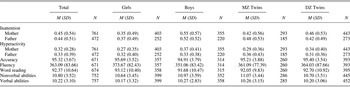
Table 1 presents the means and standard deviations for the total sample, by sex and by zygosity for all variables. The means and standard deviations for word reading, nonverbal abilities, and verbal abilities are comparable to population norms. Mothers assessed girls as less inattentive than boys, and boys have better nonverbal abilities than girls (ps < .05). There were no other sex or zygosity mean differences.
Descriptive statistics for the total sample, girls, boys, and MZ and DZ twins on word reading, accuracy, reading speed, inattention, hyperactivity/impulsivity, nonverbal abilities, and verbal abilities

Note: MZ, Monozygotic; DZ, dizygotic.
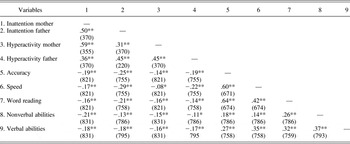
Correlations (see Table 2) among ADHD dimensions are moderate to high for both mothers and fathers, as are correlations across reading measures. Correlations between ADHD dimensions and reading measures are modest, with higher levels of inattention and hyperactivity/impulsivity associated with lower reading scores.
Significant two-tailed Pearson correlations (N) between reading abilities and attention-deficit/hyperactivity disorder dimensions (n = 220–831)

*p < .05. **p < .01.
Correlations were computed separately for girls and boys and compared with a formula developed to compare correlations across independent groups (Cohen, Cohen, West, & Aiken, Reference Cohen, Cohen, West and Aiken2003). Some correlations are higher in girls than in boys (inattention and hyperactivity reported by father, p = .003; hyperactivity reported by father and reading accuracy, p = .012; hyperactivity reported by father and word reading, p = .001), while the correlation between nonverbal abilities and reading accuracy (p = .001) is higher in boys than in girls. Remaining correlations do not differ for girls and boys.
Do ADHD symptoms remain predictors of reading in adolescents after controlling for confounds?
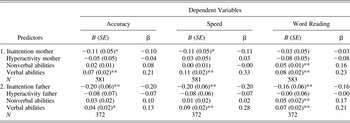
Standard multiple regressions were computed to test the contribution of age/sex regressed ADHD dimensions scores to age/sex regressed reading abilities once nonverbal and verbal abilities, and the shared variance between inattention and hyperactivity/impulsivity, were controlled. Regressions were separately computed for ADHD symptoms reported by mothers and fathers (Table 3). Results show that verbal abilities are the best unique predictors of all reading measures. Nonverbal abilities are a significant unique predictor of word reading only. Of the ADHD symptoms, inattention rated by both parents, but not hyperactivity/impulsivity, remains a significant unique predictor of accuracy and speed, and inattention rated by fathers remains a significant unique predictor of word reading. Even though only inattention reported by fathers predicted word reading, all other results were very similar for inattention reported by either parent. Moreover, parent scores were correlated at .50 and similarly associated with all reading measures (see Table 2). Therefore, these results support the aggregation of mother and father reports of inattention symptoms into a latent factor to conduct multivariate genetic analyses, reducing potential rater-specific error and increasing statistical power.
Standard multiple regression models predicting reading abilities from attention-deficit/hyperactivity disorder dimensions and nonverbal and verbal abilities (n = 372–583)

*p < .05. **p < .01.
What are the genetic and environmental contributions to the association between inattention symptoms and reading abilities in adolescents?
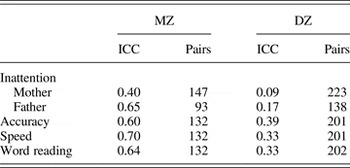
The genetic analyses were performed on age/sex regressed inattention, reading accuracy, reading speed, and word reading. The intraclass correlations (Table 4) show that MZ correlations are moderate to high whereas DZ correlations are small for inattention and modest for reading measures, suggesting high heritability for all measures.
MZ and DZ ICCs and number of participants

Note: MZ, Monozygotic; DZ, dizygotic; ICC, intraclass correlation.
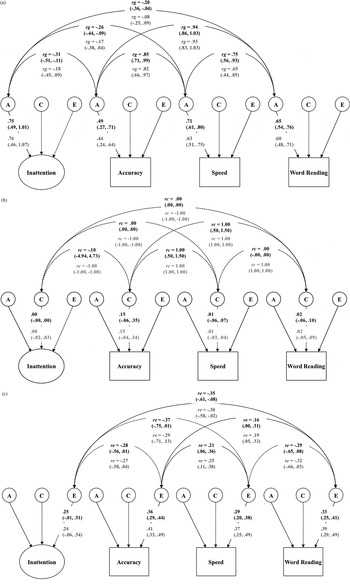
Figure 1 illustrates the correlated-factors multivariate genetic model and additive genetic (A), shared environment (C), and nonshared environment (E) components (ACE) variance estimates. Fit indices showed the model offered a good fit to the data, χ2 (86) = 101.14, p = .13; Akaike information criterion (AIC) = 7,965.93, Bayesian information criterion (BIC) = 8,141.88, comparative fit index (CFI) = 0.99, root mean square error of approximation (RMSEA) = 0.03. ACE parameters confirm a moderate to high heritability for all measures (inattention: 75%; accuracy: 49%; speed: 71%; word reading: 65%) and modest nonshared environmental contributions for reading measures (accuracy: 36%; speed: 29%; word reading: 33%), whereas they did not reach significance for inattention (25%). The inattention–accuracy, and inattention–speed associations are partly explained by genetic factors (r gs = –.31 and –.26, respectively), whereas the inattention–word reading association is partly explained by both genetic (r g = –.20) and nonshared environmental factors (r e = –.35). The genetic correlations between reading measures are high (r g = .75–.94), showing that similar genetic influences underlie accuracy, speed, and word reading. Accuracy also shares unique environmental factors with speed (r e = .21) and word reading (r e = .16).
Correlated-factors multivariate models for the association between inattention and reading accuracy, inattention and reading speed, inattention and word reading, reading accuracy and reading speed, reading accuracy and word reading, and between reading speed and word reading. All variables are age and sex regressed. A, Proportion of variance explained by additive genetic factors; C, proportion of variance explained by shared environmental factors; E, proportion of variance explained by unique environmental factors and error. Standardized estimates with 95% confidence intervals. Curved double-headed arrows refer to (a) A, (b) C, and (c) E correlations. Dotted double-headed arrows are nonsignificant correlations (p > .05). Estimates in black correspond to the model without control variables, and estimates in gray correspond to the model with variables regressed on verbal abilities.

Correlated-factors multivariate genetic models were also tested with measures additionally regressed for nonverbal abilities, χ2 (84) = 104.04, p = .07; AIC = 7,524.99, BIC = 7,704.52, CFI = 0.98, RMSEA = 0.04, and for verbal abilities, χ2 (83) = 92.29, p = .23; AIC = 7,827.75, BIC = 8,012.06, CFI = 0.99, RMSEA = 0.02. Parameter estimates for each measure remain similar across models. However, the genetic correlation between inattention and word reading (r g = –.11) is no longer significant once nonverbal abilities are taken into account. Moreover, none of the genetic correlations are significant once verbal abilities are taken into account (inattention–accuracy r g = –.18; inattention–speed r g = –.17; inattention–word reading r g = –.08; Figure 1). This indicates that verbal abilities measured by vocabulary could also share genetic factors common to inattention and reading abilities at this age. Finally, although some of the shared environment correlations are significant in these models, they do not translate into meaningful contributions to their covariation as the contribution of shared environment to individual inattention and reading measures is not significant.
Discussion
It is known and empirically supported that ADHD symptoms and reading difficulties emerge during childhood, and persist through adolescence and adulthood. Scientific evidence has also shown that ADHD, mostly inattention, and reading abilities are associated in childhood and early adolescence across multiple measures and samples. These associations are also mainly due to shared genetic factors. However, less is known about these associations later in adolescence. Given that ADHD symptoms have been shown to decrease during adolescence, this study set out to document the phenotypic and genetic associations between ADHD and reading in midadolescence in a large sample of 14- to 15-year-old twins.
The results of the present study revealed that inattention is the ADHD dimension associated with reading abilities at 14–15 years of age. These phenotypic correlations are very similar to those obtained with children, although ADHD symptoms change during development. Studies have shown that ADHD symptoms decrease over time, albeit more so for hyperactivity/impulsivity symptoms than inattention symptoms (Biederman et al., Reference Biederman, Mick and Faraone2000; Sibley et al., Reference Sibley, Pelham, Molina, Gnagy, Waschbusch, Garefino and Karch2012). This decrease could be due to developmental changes in ADHD symptomatology not captured by the adolescence diagnostic criteria (Faraone, Biederman, & Mick, Reference Faraone, Biederman and Mick2006) or by the development and use of effective compensatory strategies related to the symptoms during adolescence (Frazier et al., Reference Frazier, Youngstrom, Glutting and Watkins2007). However, most children do not show a complete remission of their inattention symptoms, underlying the persistence of these symptoms during adolescence.
Dyslexia and reading difficulties remain more stable across ages and persist during adolescence (Shaywitz et al., Reference Shaywitz, Shaywitz, Fulbright, Skudlarski, Mencl, Constable and Gore2003), with difficulties in word reading, reading fluency, but mostly in reading comprehension (Brasseur-Hock, Hock, Kieffer, Biancarosa, & Deshler, Reference Brasseur-Hock, Hock, Kieffer, Biancarosa and Deshler2011; Cirino et al., Reference Cirino, Romain, Barth, Tolar, Fletcher and Vaughn2013). Studies have also shown that reading abilities remain intercorrelated during adolescence (Cirino et al., Reference Cirino, Romain, Barth, Tolar, Fletcher and Vaughn2013), suggesting that reading difficulties could span across multiple skills. In the present study, reading accuracy, reading speed, and word reading were highly correlated and essentially influenced by the same genetic factors. This leads us to propose that difficulties across these reading skills probably often co-occur among struggling adolescent readers.
Despite developmental changes in ADHD and reading, the present results showed that inattention remains associated with reading abilities in midadolescence. These associations converge with results of previous studies in early adolescence (Greven et al., Reference Greven, Harlarr, Dale and Plomin2011, Reference Greven, Rijsdijk, Asherson and Plomin2012; Rogers, Hwang, Toplak, Weiss, & Tannock, Reference Rogers, Hwang, Toplak, Weiss and Tannock2011). In addition, they add to this literature in showing that inattention is still associated with reading once sex, age, nonverbal abilities, verbal abilities, and hyperactivity/impulsivity are taken into account. This shows that the association is robust.
The results from genetic models indicate that the inattention–reading association is attributable to shared genes at this age. Both inattention and reading abilities are moderately to highly heritable at this age, and it is the correlation among their genetic factors that partially accounts for the modest but robust phenotypic association. Population-based twin studies have shown very similar genetic correlations between reading and inattention in childhood (Greven et al., Reference Greven, Harlarr, Dale and Plomin2011, Reference Greven, Rijsdijk, Asherson and Plomin2012; Paloyelis et al., Reference Paloyelis, Rijsdijk, Wood, Asherson and Kuntsi2010; Plourde et al., Reference Plourde, Boivin, Forget-Dubois, Brendgen, Vitaro, Marino and Dionne2015). One twin study of 11- to 12-year-old adolescents found genetic correlations of the same magnitude (r g = –.26 to –.31; Greven et al., Reference Greven, Harlarr, Dale and Plomin2011, Reference Greven, Rijsdijk, Asherson and Plomin2012) as those estimated in the present study. These genetic correlations are modest, indicating that most of the genetic influences on inattention and reading are not shared. However, some of these genetic factors are shared and, as observed in childhood, they account for a portion of the inattention–reading association during adolescence.
The potential mechanisms involved need some further investigation. The genetic association could mean that a higher level of inattention leads to a higher error rate and a slower reading speed. This could alternately mean that lower word reading and reading fluency lead to higher inattention symptoms. Alternatively, the genetic association could also stem from neurological and cognitive functioning that shares a genetic etiology with both inattention and reading abilities. This hypothesis has been proposed (Pennington, Reference Pennington2006) and empirically supported in childhood, with results showing that processing and naming speed (Willcutt et al., Reference Willcutt, Betjemann, McGrath, Chhabildas, Olson, DeFries and Pennington2010) account for the genetic association between inattention and reading abilities.
The results in adolescents point to an additional cognitive ability that shares genetic factors with reading and inattention: general verbal skills measured by vocabulary. This result differs from Paloyelis et al. (Reference Paloyelis, Rijsdijk, Wood, Asherson and Kuntsi2010) in childhood, showing that the genetic association between inattention and reading was largely independent from general verbal and nonverbal abilities. In the present study, while the phenotypic associations remained after controlling for verbal abilities, the genetic correlations between inattention and all three reading measures were no longer significant once verbal abilities were taken into account in a subsequent model. A potential explanation of these divergent results could be the use of different reading measures in both studies. Paloyelis et al. (Reference Paloyelis, Rijsdijk, Wood, Asherson and Kuntsi2010) used a parent rating scale assessment of reading problems while we used objective assessments of specific reading abilities. The objective reading measures may be more dependent on general verbal ability compared to Paloyelis et al.’s measure, explaining why they could play a more important role in the genetic association between inattention and reading abilities in the present study. Thus, notwithstanding the foregoing debate about using or not general abilities as a covariate in cognitive studies (Dennis et al., Reference Dennis, Francis, Cirino, Schachar, Barnes and Fletcher2009), we believe that verbal abilities like vocabulary skills should be considered in future studies to improve our understanding of its role in the inattention–reading association in childhood and midadolescence.
Different hypotheses can be proposed to explain why vocabulary, inattention, and reading share genetic factors in the present study. Inattention could interfere with vocabulary acquisition, which could in turn affect reading accuracy and speed. Moreover, higher levels of reading abilities and reading experience could in turn contribute to better vocabulary skills (Cain & Oakhill, Reference Cain and Oakhill2011). Another hypothesis is that vocabulary could share genetic factors with inattention and reading abilities. This could be the case as some studies have shown common genetic influences between vocabulary and reading (Harlaar et al., Reference Harlaar, Cutting, Deater-Deckard, DeThorne, Justice, Schatschneider and Petrill2010), and between vocabulary and inattention (Ouellet, Reference Ouellet2010) during childhood. Moreover, common genetic factors between inattention, reading, and vocabulary could increase during adolescence compared to childhood given that the heritability of vocabulary (67% in the present study) has been shown to also increase with development (Haworth et al., Reference Haworth, Wright, Luciano, Martin, de Geus, van Beijsterveldt and Plomin2010). Finally, vocabulary skills could also be associated with inattention and reading abilities because of genetic factors shared with other more basic intermediary cognitive mechanisms. For instance, mechanisms involved in processing and naming speed, but also in working memory, shown to be involved in the association between inattention and reading abilities during midadolescence (Rogers et al., Reference Rogers, Hwang, Toplak, Weiss and Tannock2011), could be investigated in future studies of the inattention–reading association during adolescence.
The present results also suggest that nonshared environment influences play a more minor role in the inattention–reading association in adolescence compared to genetic factors. However, they were not involved in the inattention–reading association when the same sample was tested in childhood (Plourde et al., Reference Plourde, Boivin, Forget-Dubois, Brendgen, Vitaro, Marino and Dionne2015). These etiological influences were only significant in the correlation between inattention and word reading. This result could be due to environmental influences that are not shared by twins from the same family. They may have increasingly distinct academic paths, interests, extracurricular activities, and friends in adolescence compared to childhood. These could in turn have a unique impact on how the inattention–reading association evolves. In addition, twins from the same family could be increasingly exposed to different reading instructions and teacher strategies to manage inattention as most of them were not in the same class in the late primary grades. Differential instruction could therefore play a long-term role in making twins from the same family more different on the association between inattention and word reading during adolescence.
One last notable result from this study is the high heritability of all reading measures at this age and the strong genetic correlations among them. These results suggest that more basic reading abilities share almost all their genetic factors during adolescence. This converges with previous studies in childhood showing high genetic correlations among low-level reading abilities but also with higher level skills such as reading comprehension (Byrne et al., 2007; Reference Byrne, Coventry, Olson, Samuelsson, Corley, Willcutt and DeFries2009). As reading comprehension becomes more sophisticated during adolescence and adulthood, it is unclear if this would remain the case (Betjemann et al., 2008).
Suggestions for clinicians, educators, and parents can be formulated in accordance with the present results. First, the study demonstrates that inattention symptoms in adolescence remain robustly associated with reading abilities. This reinforces the need for continuous assessment and monitoring of inattention symptoms as they relate to persistent reading difficulties across development. These can be neglected in assessments and interventions that target poor adolescent readers. Second, the similar etiological basis of the inattention–reading association from childhood to adolescence underscores the need to intervene early. Third, in adolescents with more inattention problems, interventions targeting reading skills may need to be adapted to their shorter attention spans to maximize gains. For example, intervention could be divided into shorter blocks structured around specific abilities much the same way interventions are adapted to attention spans in the early school years. As reading levels and attention spans do increase with age, it may be tempting to overlook the need for continuous monitoring and tailored strategies.
Despite the novel contributions of this study, some limitations should be mentioned. First, although the ADHD measure was based on eight items, the inattention dimension was based on three items. This is not the standard DSM-based measure used in clinical practice. However, this measure has been validated in numerous studies (Galéra et al., Reference Galéra, Cote, Bouvard, Pingault, Melchior, Michel and Tremblay2011; Leblanc et al., Reference Leblanc, Boivin, Dionne, Brendgen, Vitaro, Tremblay and Prusse2008; Tremblay et al., Reference Tremblay, Desmarais-Gervais, Gagnon and Charlebois1987, Reference Tremblay, Loeber, Gagnon, Charlebois, Larivée and LeBlanc1991), and as we used both mother and father reports and focused on the agreement portion of their assessments, we feel this measure is a fair proxy of inattention symptoms at this age. Second, single measures of each reading ability were used, increasing the risk of task-specific results. Future studies replicating these results are therefore warranted. Moreover, text reading speed and accuracy were measured with a complex nonsensical text. The execution of this task could require higher attentional demands compared to other text reading measures, therefore potentially inflating its association with inattention symptoms. Third, the present study did not examine reading comprehension and its associations with ADHD. It would be interesting to use different reading comprehension tasks and see if inattention is more strongly related to reading comprehension than other reading abilities during midadolescence, given that comprehension relies on higher order cognitive skills, such as making inferences, and integrating vocabulary and grammar skills to understand the meaning of the text (Dalpé, Giroux, Lefebvre, & St.-Pierre, Reference Dalpé, Giroux, Lefebvre, St.-Pierre, St.-Pierre, Dalpé, Lefevbre and Giroux2010; Woolley, 2010). Fourth, standard limitations of the twin studies (Plomin et al., Reference Plomin, DeFries, McClearn and McGuffin2008) and the sample size are also to be considered. Future studies should incorporate multiple tasks of reading abilities and use longitudinal data to test this co-occurrence. Moreover, these studies should include general verbal and nonverbal abilities as control variables. This could let us see if the genetic and environmental correlations between ADHD and reading are the same across age and what may be the role of general cognitive abilities in this regard. Another promising research venue is to pursue the investigation of the mechanisms (genetic, environmental, and neuropsychological) responsible for these associations.