The immediate consequences of aggressive behavior in early childhood include peer rejection and academic underachievement, both of which can establish a self-perpetuating cascade of risk factors that constrain opportunities for prosocial development (Murry-Close et al., Reference Murry-Close, Hoza, Hinshaw, Arnold, Swanson and Jensen2010). Research on aggressive behavior is essential in order to support the development of highly effective intervention strategies. However, this pursuit is hampered by aggression not being a diagnostic entity in and of itself, resulting in a lack of clearly delineated criteria that can be standardized across studies. Aggression is frequently presumed to be synonymous with other externalizing diagnoses such as oppositional defiant disorder in early development and conduct disorder and antisocial personality disorder in later development. Although the presence of aggressive tendencies in children diagnosed formally with externalizing behavior disorders is high, aggression is not necessary for these diagnoses. For instance, all eight individual criteria for oppositional defiant disorder and half of the criteria for conduct disorder do not include physical aggression, making it possible to reach a diagnostic threshold for externalizing disorders without displaying aggressive behavior. Aggression may be mediated by distinct neural processes related to emotional reactivity to threat that arguably differ from the processes that contribute to insensitivity to punishment that is thought to underlie serious delinquent behaviors such as theft. Clinical research has long conflated the distinction between individual symptoms by focusing on the level of the syndrome. This approach impedes progress in elucidating mechanisms that underlie the expression of chronic aggressive tendencies.
In addition, research on clinical syndromes is often undertaken from a group-differences perspective, examining the relative frequency of a range of personal and contextual risk factors between diagnostic and comparison groups. This line of research has effectively identified a range of factors known to increase risk for aggressive behavior (Dodge, Malone, Greenberg, & The Conduct Problems Research Group, Reference Dodge, Malone and Greenberg2008). These include characteristics of the child such as poor inhibitory control (Utendale & Hastings, Reference Utendale and Hastings2011), low cognitive function (Hinshaw, Reference Hinshaw1992), and dysregulated arousal (Lipschitz, Morgan, & Southwick, Reference Lipschitz, Morgan and Southwick2002; Meyer-Lindenberg et al., Reference Meyer-Lindenberg, Buckholtz, Kolachana, Hariri, Pezawas and Blasi2006); as well as characteristics of the child's environment such as harsh, coercive, or inconsistent parenting practices (Buschgens et al., Reference Buschgens, Van Aken, Swinkels, Ormel, Verhulst and Buitelaar2010; Campbell, Shaw, & Gilliom, Reference Campbell, Shaw and Gilliom2000; Olson, Lopez-Duran, Lunkenheimer, Chang, & Sameroff, Reference Olson, Lopez-Duran, Lunkenheimer, Chang and Sameroff2011), parental psychopathology (Halperin, Schulz, McKay, Sharma, & Newcorn, Reference Halperin, Schulz, McKay, Sharma and Newcorn2003), and contextual risks including low socioeconomic status and neighborhood violence (Campbell et al., Reference Campbell, Shaw and Gilliom2000). Although each of these risk factors has been thoughtfully examined and well established, the validity of the group differences approach typically used in clinical research is predicated on the assumption that the diagnostic phenotype represents a homogeneous construct. This approach makes the discovery of etiological heterogeneity more difficult. However, the examination of heterogeneity within the phenotype of aggressive behavior could provide valuable information that is needed to refine and target effective intervention strategies. In this study we seek to examine the differential contributions of specific risk factors to the manifestation of aggressive behavior in order to identify candidate etiological pathways toward the development of pathological aggressive tendencies.
Greenberg, Speltz, DeKlyen, and Jones (Reference Greenberg, Speltz, DeKlyen and Jones2001) previously examined externalizing behavior problems from a person-oriented perspective to identify differential patterns of risk factors that coalesce to result in pathological behaviors. Inherent in this approach is the recognition that, although children with aggressive behavior differ “on average” from their nonaggressive peers on many factors, not everyone who contributes to the mean is necessarily well represented by it. For instance, although children with early onset aggression generally average lower verbal IQ scores than those without aggression (Speltz, DeKlyen, Calderon, Greenberg, & Fisher, Reference Speltz, DeKlyen, Calderon, Greenberg and Fisher1999), the distributions between the groups overlap considerably. However, little is known about highly aggressive children with high IQs or nonaggressive children with low IQs. This discrepancy can be noted for any given risk variable, indicating that no currently identified risk has been demonstrated to be either necessary or sufficient for the manifestation of aggressive behavior.
Aggression, like any psychopathology, represents a probabilistic outcome, the chances of which increase as risk accumulates (Greenberg et al., Reference Greenberg, Speltz, DeKlyen and Jones2001). Furthermore, research indicates that risk for psychopathology is especially exacerbated when individual vulnerability is met with environmental risk (see Beauchaine, Neuhaus, Brenner, & Gatzke-Kopp, Reference Beauchaine, Neuhaus, Brenner and Gatzke-Kopp2008). Vulnerability within an individual represents greater susceptibility to environmental influences, and environmental risk factors interact with this vulnerability to shape the manifestation of the underlying trait. Because both individual vulnerability and environmental risk combine and interact to increase psychopathological risk, a single behavioral phenotype, such as aggression, likely represents an equifinal manifestation of a myriad of etiological processes. The elucidation of these processes represents the future of research in psychopathology, and it undoubtedly requires the examination of risks that transact across levels of analysis (Beauchaine et al., Reference Beauchaine, Neuhaus, Brenner and Gatzke-Kopp2008).
Greenberg and colleagues (2001) approached this question by identifying four domains of risk that are known to be associated with clinical behavior disorders, including risks associated with the child him-/herself as well as risks associated with the family environment (e.g., parenting practices, the nature of the parent–child relationship, and parental stressors). The child-focused risk factors in that study were selected based on variables associated with impaired neurodevelopment such as medical complications at birth, early developmental history, and IQ. As expected, that study supported the notion that impaired neurodevelopment increases risk for conduct problems when embedded within high-risk familial contexts. However, this broad construct of “neurodevelopment” does little to identify the mechanisms by which neural processing may interact with high-risk environments to alter developmental trajectories. Here, we aim to continue the person-centered model of analysis, but we further expound upon individual vulnerability by identifying discrete and theoretically derived affective and neurocognitive risk factors to characterize heterogeneity at the individual level. Furthermore, heterogeneous vulnerability factors may interact differently with environmental risk factors, thus establishing more specific etiological pathways to psychopathology.
Etiology of Aggressive Behavior
Aggressive behavior is a manifest outcome resulting from the relative input from neural processes that relay affective information and initiate physiological arousal and those that underlie regulatory control and problem solving. Aggression is essentially the product of one equation with two unknowns. Because frustration is a normative affective response, it is possible that aggression develops when a child fails to acquire the regulatory skills needed to redirect emotional arousal in productive and socially sanctioned ways. However, it is also possible that aggression will manifest when a child, despite age-appropriate regulatory skills, experiences affective arousal of an intensity too substantial to inhibit.
Physiologically mediated affective arousal
Aggressive behavior is precipitated by enhanced activation of the sympathetic nervous system (SNS), which is designed to provide the metabolic resources for behavioral activation. When activated sufficiently, the SNS initiates increases in heart rate (HR), blood pressure, and skin conductance in order to facilitate the physical demands of action. Although the physiological effects are extremely rapid, SNS activation is also designed to sustain arousal on the order of 10s of minutes through the systemic release of epinephrine and cortisol (see Haller, Makara, & Kruk, Reference Haller, Makara and Kruk1998). Because the ability to react to threat without delay can be essential to survival, highly threatening stimuli are processed neurally through rapid channels that allow immediate physiological responding without awaiting higher order cognitive processing (Haller et al., Reference Haller, Makara and Kruk1998; Ohman & Mineka, Reference Ohman and Mineka2001). Once activated, the arousal associated with SNS activation is more difficult to modulate than arousal achieved through parasympathetic withdrawal (see Porges, Reference Porges2001), and thus the individual may have a difficult time interrupting an affectively aroused response despite being cognitively aware of the need to do so.
Individuals who exhibit heightened SNS activity at baseline may be especially susceptible to being highly physiologically reactive to emotional situations because their system is “primed” to some extent. This translates functionally to a state of hypervigilance whereby sensitivity to environmental stimuli is enhanced in order to be prepared for rapid responding. Evidence of enhanced SNS activity in a baseline context has been shown to mediate the association between contextual risk and externalizing behaviors in previous research (Bubier, Drabick, & Breiner, Reference Bubier, Drabick and Breiner2009; Rudolph, Troop-Gordon, & Granger, Reference Rudolph, Troop-Gordon and Granger2010). Skin conductance activity is a robust indicator of arousal; and, unlike cardiac measures such as HR and HR variability, it is entirely controlled by the SNS (e.g., Fowles et al., Reference Fowles, Christie, Edelberg, Grings, Lykken and Venables1981; Tranel & Damasio, Reference Tranel and Damasio1994). Furthermore, electrodermal activity has been shown to be modulated by amygdala activation even in the absence of external stimuli (Laine, Spitler, Mosher, & Gothard, Reference Laine, Spitler, Mosher and Gothard2009), indicating that this psychophysiological marker reflects neuroaffective state. However, research regarding the skin conductance characteristics of children with externalizing disorders has been contradictory with support for both hyper- and hypoarousal models (Bubier et al., Reference Bubier, Drabick and Breiner2009; Gatzke-Kopp, Raine, Loeber, Stouthamer-Loeber, & Steinhauer, Reference Gatzke-Kopp, Raine, Loeber, Stouthamer-Loeber and Steinhauer2002).
Verbally mediated regulatory control: “Use your words”
Aggression as a behavioral tool in response to frustration is a normal component of development emerging in the early part of the second year of life, when the physical ability to exert one's will develops ahead of the cognitive ability to do so strategically. Epidemiological surveys indicate that as many as 35% of boys and 18% of girls were reported by their parents to regularly engage in aggressive behavior during the second year of life (Baillargeon et al., Reference Baillargeon, Zoccolillo, Keenan, Cote, Perusse and Wu2007). The ability to supplant aggressive responses improves as children develop verbal skills. Over the toddler and preschool period children are increasingly encouraged to communicate their emotional states verbally as an alternative to hitting, and they are guided by adult caretakers in solving interpersonal conflicts through conversation and compromise. Thus, verbal skills appear to be essential in learning to regulate aggressive impulses (Vygotsky, Reference Vygotsky1972). It was not surprising that studies consistently identify reduced verbal IQ and poor receptive vocabulary skills in participants characterized by externalizing behavior problems (Seguin, Parent, Tremblay, & Zelazo, Reference Seguin, Parent, Tremblay and Zelazo2009; Speltz et al., Reference Speltz, DeKlyen, Calderon, Greenberg and Fisher1999).
The role of verbal ability in aggressive behavior is likely multifaceted. Receptive verbal skills are essential in a child's ability to extract socializing influences that guide children toward nonaggressive solutions to emotionally evocative situations. Studies show that parents who guide their children through frustrating tasks by providing verbal guidance that is metacognitive in nature significantly increase their children's ability to later utilize effective behavior management techniques such as self-talk and help seeking (Neitzel & Stright, Reference Neitzel and Stright2003). This association illustrates the importance of verbal ability in being able not only to extract meaningful content in parental verbalizations but also to use verbal expression to the self and to others to manage prosocial behavior. Furthermore, verbal ability is associated with additional cognitive abilities that may further strengthen a child's ability to engage in behavioral control. Early verbal ability predicts the development of executive function skills, including inhibitory control and attention shifting, over the preschool period (Fuhs & Day, Reference Fuhs and Day2011). Thus, weakened verbal skills may create a cascade of challenges that impair the normal developmental progression from aggressive reactions to frustration into more socially appropriate and behaviorally regulated strategies (Greenberg, Kusche, & Speltz, Reference Greenberg, Kusche, Speltz, Cicchetti and Toth1991).
Relationship between systems
The functional relationship between heightened arousal and verbal ability is not entirely clear. Verbalization has been shown to subserve emotion processing within an individual even when serving no communicative function. A neuroimaging study found that the simple act of providing a verbal label to a strong facial emotion significantly reduces amygdala activation in response to the emotion expression, and it increases activation in the prefrontal cortex (Liberman et al., Reference Liberman, Eisenberger, Crockett, Tom, Pfeifer and Way2007). In that study the ability to verbally identify an emotion appeared to mitigate the intensity of the affective response to that emotion. Therefore, verbal labeling and identification of emotions is hypothesized to be an important first step in helping children regulate arousal. Structural equation models have shown that verbal ability is a significant predictor of preschool children's emotion knowledge and emotion regulation skills, both of which in turn contribute to social and academic competence in elementary school (Trentacosta & Izard, Reference Trentacosta and Izard2007).
Whether these two systems (e.g., verbal ability and SNS arousal) represent separate pathways to aggression or whether they are primarily co-occurring facets within aggression is unclear. It is possible that deficient verbal skills contribute to the misunderstanding of emotional situations that facilitates inappropriate threat detection as well as compromises regulatory ability to reduce physiological arousal in response to emotion. In this way, these two systems may engage in reciprocity where impairments in both are evident in chronic aggressive behavior. Alternatively, each may contribute independently to aggression, where having either factor is sufficient to make an individual vulnerable to adverse environmental circumstances. Thus, these two systems might underlie distinct mechanisms by which vulnerability precipitates psychopathology by establishing sensitivity to different aspects of environmental risk. Differential vulnerability implies the need for better targeted treatment strategies that take into account the nature of interactions that occur between the child and his/her environment.
This study aims to examine the extent to which verbal deficits and affective overarousal represent unique contributions to vulnerability toward aggression. If subgroups with distinct etiologies exist, more must be understood about the implications these etiological mechanisms have for the expression of aggressive behavior and the consequences it engenders. It is possible that differences in comorbid symptoms, social skills, or peer interactions may arise from these distinct pathological processes. This would have important implications for refining screening procedures for clinical identification, as well as for researching the mechanistic processes by which current intervention programs address specific skills deficits and reduce aggressive behavior.
Methods
Data were drawn from a longitudinal clinical trial of a multicomponent intervention for children with early onset aggression conducted in partnership with the Harrisburg School District in central Pennsylvania. Harrisburg is an economically depressed small metropolitan area in which 86% of children qualify for free or reduced-price lunches and less than 25% are designated as “proficient” in reading and math achievement. Only data from the preintervention assessment will be presented here, and thus intervention status will not be considered.
Participants
All kindergarten teachers in all 10 elementary schools completed a brief aggressive behavior rating scale for each child in their class during the fall of 2008 (Cohort I) and 2009 (Cohort II). Following from similar preventive interventions, 10 items were drawn from the Teacher Observation of Child Adaptation—Revised (Werthamer-Larsson, Kellam, & Wheeler, Reference Werthamer-Larsson, Kellam and Wheeler1991), such as “Gets in many fights” and “Cruelty, bullying, or meanness to others,” and rated on a 6-point Likert scale.
Children were rank ordered on aggressive behavior within each classroom. Families of children in the upper quartile of aggressive behavior within each classroom were contacted for recruitment. Of the children targeted for recruitment, 30% were unable to be located or refused participation because of the larger demands of the study. A total of 207 children rated high in aggression were enrolled in the study, two-thirds of whom were males. An additional 132 children selected from the lowest quartile of aggression and matched for sex and classroom with children in the high aggression group were recruited. Consistent with the racial demographics of the region, 73% of the participants were African American, 19% were Latino, 8% were Caucasian, and less than 1% were Asian. Chi-square analyses revealed no significant differences between the high aggression and comparison samples with regard to race or sex (ps > .15). However, children in the high aggression group were significantly younger than comparison children by an average of approximately 4 months, F (1, 273) = 35.30, p < .01.
Only children enrolled in the high aggressive group were further assessed during a home visit, at which time parents were also interviewed. For all participants, teachers were asked to complete comprehensive ratings of children enrolled in the study. Children were additionally assessed on cognitive, academic, and psychophysiological functioning. Parents of children in the high aggression group were compensated with a $75 gift card for the home data collection portion of the study. Parents of the children in the comparison group did not receive compensation because no further data collection occurred with the parent, and children were assessed during the school day and required no commitment of time from the parent.
Teacher ratings of behavior
Approximately 3 months after initial screening, teachers were provided with rating forms from the Strengths and Difficulties Questionnaire (SDQ; Goodman, Reference Goodman1997), the Child Behavior Questionnaire (CBQ; Conduct Problems Prevention Research Group [CPPRG], 1990; Werhamer-Larsson et al., 1991), and the attention-deficit/hyperactivity disorder rating scales (DuPaul, Reference DuPaul1991) for each child enrolled in the study. The CBQ consisted of 26 items that assess child functioning in four domains: aggressive/oppositional behavior, internalizing/withdrawn behavior, emotion regulation, and prosocial behavior (details of this measure can be found at http://headstartredi.ssri.psu.edu; CPPRG, 1990; http://fasttrackproject.org). The internal consistency for each of the CBQ subscales ranged from .83 (internalizing) to .95 (prosocial). In order to minimize the burden on teachers, a shortened version of the SDQ, consisting of 20 items and containing four subscales (conduct problems, emotional symptoms, hyperactivity/inattention, and peer problems), was administered. Items were rated on a 3-point Likert scale from 0 = not true to 2 = certainly true. This brief measure of children's behaviors has demonstrated satisfactory reliability and validity (Goodman, Reference Goodman1997). The internal consistency in the current sample ranged from .65 (peer problems) to .89 (hyperactivity/inattention). Teachers were provided with a $15 gift card for each child as compensation for their time. However, data were not provided for 12% of the participants because some teachers did not wish to participate.
Child assessments
Academic achievement/executive function
Children in the high aggression group were administered a series of cognitive assessments during the initial home visit. Children in the comparison group were assessed on a subset of these measures in a 30-min session during the school day. Two children in the comparison group refused participation in the cognitive assessment.
Verbal ability
Children's expressive language ability was assessed via the Expressive One-Word Picture Vocabulary Test (EOWPVT; Brownwell, Reference Brownell2000). Children were shown single pictures and asked to name the object. Standard scores were based on national norms.
Achievement
Verbal and mathematical ability were assessed with the letter–word identification and applied problems subtests of the Woodcock–Johnson III Tests of Achievement (Woodcock, McGrew, & Mather, Reference Woodcock, McGrew and Mather2001). Scores were standardized according to national norms. Extensive research shows adequate reliability and construct validity for this assessment in individuals from 2 years old to adulthood (Woodcock et al., Reference Woodcock, McGrew and Mather2001). In the letter–word identification subtest, children were asked to name upper- and lowercase letters and read increasingly difficult words. In the applied problems subtest, children were required to count and perform increasingly challenging math calculations.
Inhibitory control
Inhibitory control was assessed with the pencil tapping task (Diamond & Taylor, Reference Diamond and Taylor1996). Children were instructed to tap their pencil twice when the research assistant (RA) taps theirs once and vice versa. Scores ranged from 0 to 16 indicating the number of trials performed correctly. Because the data were highly skewed with 58% of the high aggression sample scoring 15 or 16 trials correct, inhibitory control was dichotomized into appropriate performance (≥15) and impaired performance (<15).
Set shifting
Mental flexibility was assessed with the Dimensional Change Card Sort (Frye, Zelazo, & Palfai, Reference Frye, Zelazo and Palfai1995). Children were asked to sort a deck of cards by a specific criterion (such as color). After mastering the sorting criterion, children were instructed to switch to a new sorting rule. Total scores represent the number of cards sorted correctly under the new sorting rule, ranging from 1 to 6. Similar to the inhibitory control measure, 64% of the high aggression sample completed all six trials successfully. Therefore, a dichotomous score was created to indicate successful and unsuccessful (less than six correct trials) switching.
Working memory
Working memory was assessed with the Backward Word Span (Davis & Pratt, Reference Davis and Pratt1996) in which children were asked to repeat a sequence of words in reverse order. Total scores represent the longest successful sequence, which ranged between one and three in this sample.
Emotion understanding
To assess emotion understanding, children were administered the Emotion Recognition Questionnaire (Ribordy, Camras, Stafani, & Spacarelli, Reference Ribordy, Camras, Stafani and Spacarelli1988). This measure assesses the accuracy of emotion recognition by using pictorial faces and contextualized stories. Children's accuracy of receptive and expressive emotion identification was assessed first. Children were shown cartoon drawings of facial emotion expressions for scared, sad, happy, and angry. During the receptive language assessment, children were asked to point to the face depicting the emotion stated by the RA (“show me the happy face”). During the expressive assessment children were shown a face and asked to identify the feeling (“how do you think this person is feeling?”). Total scores were computed based on number of trials correct. Children were given a score of 2 for correct responses, a score of 1 for responses with correct valence but incorrect emotion (i.e., “sad” instead of “mad”), and a score of 0 for incorrectly valenced responses (e.g., “happy” instead of “scared”).
Children then were presented with a series of short vignettes in which a child experiences an emotionally provocative situation “Susie's little brother broke her favorite toy on purpose.” Participants were asked to identify how the story protagonist feels. A total of 12 vignettes, containing three examples of four emotions (happy, angry, scared, sad) were read to the child. Scores were assigned in the same manner as the emotion understanding assessment.
Further scores were created to explore potentially systematic errors in emotion identification during the vignettes. First, the scores were calculated to identify children's “tendency” to misidentify a particular emotion, for instance, to not identify sadness when it was depicted. Scores ranged from 0 (random error) to 1 (consistently identify a given emotion incorrectly) for each emotion. Thus, the higher the value the more likely the child was to misidentify that emotion when it was depicted. Second, a “bias” score was calculated to determine if the child was more likely to respond with a specific emotion even when that emotion was not the one being depicted, for instance, to consistently respond with “mad” to other negatively valenced emotions. For vignettes in which the emotion was misidentified, scores were calculated ranging from 0 (random error) to 1 (all erroneous answers consisted of the same emotion response).
Social problem solving
Children were administered the Challenging Situations Task (Denham, Bouril, & Belouad, Reference Denham, Bouril and Belouad1994), in which children were read short descriptions of a provocative social situation and shown a corresponding illustration (“John was building a very tall tower of blocks, and Bobby knocked it down.”). The children were asked what they would do if provoked in a similar way, and they were prompted to provide at least two different solutions. Children's open-ended responses to the four vignettes were classified as competent, aggressive, passive, and inept/ineffective and tallied within category.
Neurobiological assessments
Psychophysiological equipment was installed into an RV and driven to each school to conduct assessments. This maximized consistency of the testing environment across the school sites while minimizing the burden on parents. Several measures were taken to reduce apprehension regarding the physiological assessments. The RV was decorated inside and outside with a space theme, depicting a familiar cartoon character in an astronaut suit. At the beginning of the school year, the RV was brought to each school location and kindergarten classes were invited one at a time to tour the RV with their teacher. Thus, when children were enrolled in the study, they were familiar with the vehicle and had been inside previously with classmates and familiar adults.
On the day of the assessment, RAs met children at their classroom and escorted them to the RV. The tasks were explained to the children verbally, who were then asked to provide verbal assent. Children who asked to return were escorted back promptly, but they were approached on a separate day and offered the possibility to participate again. Most children who were initially apprehensive eagerly participated on the second day. Of the 339 children enrolled in the study, only 3 refused participation in the physiological assessment.
During the setup process, children were provided with a coloring page and crayons and asked to draw a picture. This was used as an assessment of the child's dominant hand, which the RAs made note of, ensuring that electrodes were placed on the nondominant hand. Children were seated while the RAs applied the physiological electrodes for the EEG, cardiac, and electrodermal measures described below.
Protocol
Assessments took place with the child seated at a table with a computer monitor. One RA was positioned behind the child where s/he monitored data recording from two laptops. The second RA sat next to child but did not interact with the child unless necessary. The RA explained that the child was now going to “travel through space” to a planet where they would play a game. The child was instructed to sit very still during the travel, which consisted of a 2-min baseline recording during which a moving star-field video was played on the computer monitor. The children were then asked to play a go/no-go game for approximately 12 min; however, data from this assessment will not be examined in this paper. After the go/no-go game the participants were offered a break and a small snack or some juice. They were then informed they would again be “traveling through space,” and a second baseline was assessed in order to correct for any drift associated with time or the effects of the previous task. Children were then asked to sit passively while viewing a series of video clips depicting emotional situations (described below). Once this ended, a final 2-min baseline was assessed as the “spaceship travels back home.”
Emotion induction
During the emotion induction paradigm, children were shown a series of film clips depicting four emotions. Presentation of the film clips was controlled by Eprime II software (Psychological Software Tools, Inc., 2004) so that the sequence of clips ran uninterrupted and the onset and offset of each clip was time stamped in synchrony with the physiological recordings. For consistency, all clips were extracted from the same movie, The Lion King. This movie was selected for several reasons: (a) the movie was considered to be age appropriate for the children in the study; (b) the movie provides multiple channels of mood congruent sensory information including color, musical score, vocalizations, and storyline; and (c) the protagonist is a cartoon character (a lion), thus avoiding concerns about racial matching with the target character that could enhance saliency for some participants and not others.
The four emotion clips were as follows: the hyenas chasing Simba (fear), Simba's father dying (sad), characters singing a joyous song (happy), and Simba fighting Scar (anger). Clips were always presented in chronological order to avoid confusion, given that Simba ages across the clips. To facilitate the return to baseline once each emotion clip ended, each clip was followed by a 30-s neutral clip that contained no specific emotional content but portrayed the resolution of any conflict presented in the prior clip. To control for potential order effects, a 30-s baseline fixation period was recorded after each neutral clip in order to establish the pre-emotion baseline specific to the next clip in the sequence. Each emotion clip ranged from 2 to 3 min in length as needed to ensure that the nature of the scene was evident in isolation from the rest of the film but confined to the presentation of a single emotion. The entire session lasted approximately 12 min.
Physiological data processing
EEG
The EEG was assessed with a 32 channel elastic stretch BioSemi headcap with the Active Two BioSemi system (BioSemi, Amsterdam). Head circumference was measured to identify cap size. Placement of the Cz electrode was centered at the point of intersection between the line from the nasion to the occipital protuberance in the back of the head and from one temporal mandibular joint to the other. Once the cap was placed, gel was inserted into each electrode receptacle. Two additional electrodes were placed on the left and right mastoids to serve as reference channels during the recording, and four additional facial electrodes were placed on the supraorbital ridge centered under the pupils and approximately 1 cm outside the participants’ right and left outer canthi in order to detect eye blinks for later correction and removal of artifactual data. Data were recorded at 512 Hz with Actiview Software, version 8.0.
Data were analyzed using Brain Vision Analyzer II, version 2.0. Data were rereferenced to the average and filtered with a high pass frequency of 0.1 Hz and a low pass frequency of 30 Hz. A semiautomated procedure was used to identify and correct physiological artifacts according to the following criteria: a voltage step of more than 100 µV/ms between sampling points, a voltage difference of more than 300 µV within an interval, and a maximum voltage difference of less than 0.50 µV within 100-ms intervals. EEG data were segmented in 1-s increments with 0.5-s overlap for each emotion clip in 30-s epochs across each emotion clip in the Lion King task. The alpha power was extracted using fast Fourier transformation (FFT) in the 7- to 12-Hz range. Previous research indicates that the association between asymmetry and behavioral activation is specific to anterior brain regions and strongest at the F3/4 site (Sutton & Davidson, Reference Sutton and Davidson1997). Therefore, asymmetry was calculated by subtracting the power at the left (F3) electrode from the power at the right (F4) electrode. Because alpha is the inverse of activation, positive scores indicate left asymmetry and negative scores indicate right asymmetry.
Autonomic psychophysiology
Cardiac and skin conductance measures were collected continuously with a sampling frequency of 500 Hz using Biolab 2.4 acquisition software (Mindware, Westerville, OH). Skin conductance activity was measured as the conductance between two disposable prejelled electrodes placed on the palm of the child's nondominant hand. An ECG was recorded from three disposable, prejelled electrodes placed over the distal right collar bone, lower left rib, and lower right rib; and impedance cardiography was measured with four spot electrodes. Cardiac data were quantified in terms of the average HR within each 30-s epoch, as well as the respiratory sinus arrhythmia (RSA) value, presumed to reflect the independent contribution of the parasympathetic nervous system to cardiac control (e.g., Berntson, Quigley, & Lozano, Reference Berntson, Quigley, Lozano, Cacioppo, Tassinary and Berntson2007). RSA is thought to reflect an individuals’ capacity to engage in regulatory control over physiological arousal (see Porges, Reference Porges2007).
Skin conductance activity
Data were analyzed using software from Mindware Technologies (v. EDA 3.0–3.0.15) with gain set at 10 µS/V and bandpass filtered between 0.05 and 10 Hz. Data were visually inspected by trained RAs to identify and reject artifactual segments. Data were quantified in 30-s epochs across the task. An average was created for the pretask baseline and each emotion clip. Data were quantified in two ways: (a) the number of skin conductance responses (SCRs), defined as a.05 µS change, and (b) the amount of time across the 30-s epoch not spent in a response state (tonic time). Although the interrelated nature between these measures results in a high correlation, it is possible for individuals to differ in SCRs despite identical estimates of tonic time, depending on the duration of the response.
HR
Data were scored using Mindware's HRV (v. 3.0–3.0.15) software. This software identifies the peak of each R wave and estimates HR as the average number of beats/minute within each epoch. Cardiac waves were inspected by trained RAs to identify and correct erroneously identified R peaks.
RSA
The respiratory rate was estimated from the impedance wave to verify the individual rate of respiratory frequency. For any epoch in which peak respiratory frequency was outside of the designated frequency band for RSA (0.12–1.04 Hz), the data were not written. Data were decomposed using an FFT to extract power in the frequency band associated with RSA.
Family context
Parents of children in the high aggression group completed a series of questionnaires during the initial research home visit. Only 15% of the participants in the sample were married. Information was assessed only from the primary caretaker.
Parental distress
Distress was measured across multiple domains. Mothers’ symptoms of depression were assessed with the 20-item Center for Epidemiological Studies Depression Scale (Radloff, Reference Radloff1977). Mothers responded to each item (i.e., “During the past week, how often did you feel that everything you did was an effort?”) on a 4-point Likert scale ranging from 0 (rarely) to 3 (almost always; α = 0.76).
Stress exposure was assessed by asking mothers to indicate whether any of 14 stressful events (such as death of a relative) had occurred within the past year (CPPRG, 1990). Mothers were also asked to report on the frequency with which they must deal with 12 common daily hassles of parenting such as “continually cleaning up messes of toys and food” and “children resisting bedtime” (CPPRG, 1990; α = 0.72). Mothers were also asked to rate their satisfaction with the social support they receive from friends and family across 9 items (Crnic, Reference Crnic1983; α = 0.79).
Discipline practices
Parental disciplinary practices were assessed using the Discipline Questionnaire, which comprises questions from the Developmental History Interview of Fast Track (CPPRG, 1999). Parents were asked to estimate how often they use specific strategies when responding to their child's misbehavior. Responses were averaged to create estimates of the following parental strategies: reasoning, appropriate discipline (positive reinforcement and negative punishment), verbal aggression, and physical aggression.
Analyses
As indicated above, some data were highly skewed because of ceiling effects on performance. In such cases performance was categorized as normative or impaired, and group differences were explored using chi-square analysis. Data loss was most prominent in the psychophysiological measures, owing to a combination of movement artifact, researcher error, and equipment failure. In addition, a few teachers declined to provide behavioral ratings, and missing data occurred in a few cases on specific child cognitive tests or parent reports. Given the large number of variables incorporated into the analyses, listwise deletion resulted in highly variable sample sizes across analyses. To address this, multiple imputation procedures were utilized to maximize inclusion of all possible participants. However, it is important to note that because the low aggression group did not participate in all data collection (i.e., no home visit), the low aggression group could not be included in the imputation procedures: only the analyses in which subgroups within the high aggression group are compared are based on imputed data (see below). Therefore, a small number of analyses are reported comparing high and low aggression groups that do not utilize imputed data.
Data were multiply imputed using the PROC MI command in SAS version 9.2. In accordance with the multiple imputation approach (Rubin, Reference Rubin1987; Schafer, Reference Schafer1997; Schafer & Graham, Reference Schafer and Graham2002), 45 imputed data sets were estimated with the assumption that data was primarily missing at random. In addition to the variables utilized in the analyses, all demographic variables as well as auxiliary variables of child behavior and physiology were included in the imputation procedure. Detailed information on missing data and the imputation process for this analysis are available from the first author.
To identify significant differences among subgroups, separate mixed model analyses (PROC MIXED; Singer, Reference Singer1998) were performed using each imputed data set. Aggression subgroups were entered into each of the models as categorical independent variables. Race (dichotomized as African American or other), sex, and age were included as covariates. The F ratio mean and range across the 45 imputed data sets are reported. In addition, the proportions of imputed data sets eliciting significant subgroup differences are given (percentage of ps < .05). LSmeans, LSmeans difference estimates, and standard errors were derived from the mixed models for each of the imputed data sets by subgroup. PROC MIANALYZE was then performed to determine whether significant differences in the outcome of interest existed between each of the subgroups when all of the imputed data sets were combined.
Results
Differences between the high aggression and low aggression samples
Differences between the high and low aggression groups were observed in both verbal ability and physiological arousal. Scores on the EOWPVT were significantly lower in the high aggression group (M = 81.38, SD = 11.70) than in the low aggression group (M = 86.13, SD = 11.95), F (1, 271) = 8.49, p < .01, although the means for both groups were well below the normative average. Skin conductance also differed between the groups with more SCRs and less tonic time evident in the high aggression group during the initial baseline recording, Fs (1, 263) > 8.25, ps < .01.
Relationship between verbal ability and physiological arousal
The correlation between SCR and verbal standard score was not significant for the sample as a whole (r = .01, p = .87) or for either group independently (ps > .2). Children were classified on both traits to compare the frequencies with which individuals in each group met criteria for both vulnerability factors. Children were classified as being deficient in verbal ability if they had a score of <85 on the EOWPVT. The distribution of SCRs was skewed, with a disproportionate number of children showing no electrodermal activity during the 2-min baseline. Therefore, children were classified as being high in physiological arousal if they evidenced ≥2 SCRs during the baseline period. Classification in these two domains was nonmutually exclusive. Sixty-one children were not classified because of missing SCR data.
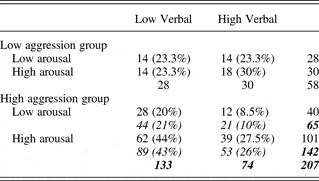
A chi-square analysis indicated that classification as low in verbal ability was not associated systematically with classification as high in physiological arousal for the sample as a whole, χ2 (1) = 0.37, p = .53, or within the high or low aggression groups individually (ps > .22). The proportion of children in each risk category by group is illustrated in Table 1. The presence of low verbal ability, high arousal, or both characterized 90% of the aggression group. Although there is no relationship between the two vulnerability factors, children in the aggression group were more likely to be classified into both risk domains and children in the comparison group were more likely to be classified into neither domain, χ2 (3) = 12.22, p < .01.
Association between low verbal ability and high arousal across high and low aggressive groups

Note: The italic and bold italic numbers represent the estimated frequency and percentage of participants in each subgroup as an average of the 45 imputed data sets. The bold italic values also represent the row and column totals for the imputed data, reflecting the full sample of 207 participants.
Comparison of aggression etiology subgroups
Comparisons were made between high aggression children characterized by different etiological risk factors with regard to cognitive processing (executive function, academic skill), socioemotional competence (emotion understanding, psychophysiological reactivity to emotions), and family risk context. Because the number of children with neither factor (i.e., high verbal and low arousal) was low (≈10%), this group was not included in analyses. The three groups examined were those low in verbal ability only (LowV; n = 44; SD = 3.28), high in arousal only (HighA; n = 53; SD = 2.25), or both factors (comorbid; n = 89; SD = 3.40; see Table 1). These groups did not differ in age, average F (2, 176–186) = 0.69, 0% at p < .05, or sex, average F (2, 178–186) = 0.50, 0% at p < .05. However, age, sex, and racial status are included as covariates in all analyses.
Teacher ratings of behavior
Groups were compared with regard to teacher ratings of behavior on the CBQ and SDQ. None of the individual scales was significantly different between the groups.
Cognitive function
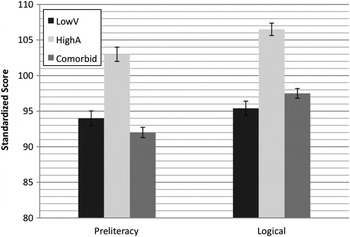
Groups differed with regard to academic competence on both the letter–word identification, average F (2, 178–186) = 15.33, 100% at p < .05, and applied problems, average F (2, 178–186) = 20.17, 100% at p < .05, tests. Post hoc examination of LSmeans and LSmeans differences across imputations revealed that both the LowV and the comorbid group differed significantly from the HighA group on both tests (ps < .001). Means and standard deviations are illustrated in Figure 1. Groups were then compared on measures of executive function including inhibitory control, working memory, and set shifting. The three aggression etiology groups indicated no differences in inhibitory control, average F (2, 178–186) = 1.51, 4.44% at p < .05, or set shifting performance (Dimensional Change Card Sort; average F (2, 178–186) = 2.63, 4.44% at p < .05. Groups did differ, however, on working memory performance, average F (2, 178–186) = 5.17, 84.44% at p < .05. Post hoc analyses revealed that the HighA group had a significantly higher score (ps < .001) on working memory (backward digits; M = 2.19, SE = 0.15) than the LowV (M = 1.72, SE = 0.19) and comorbid groups (M = 1.80, SE = 0.13).
Group differences in performance on standardized academic function tests. Group means and standard errors of standardized scores for letter–word identification and applied problems subscales are from the Woodcock–Johnson III Tests of Achievement. LowV, low verbal ability; HighA, high arousal.

Socioemotional processing
Emotion understanding
Groups did not differ with regard to receptive knowledge of emotion terms, average F (2, 178–186) = 1.93, 2.22% at p < .05. A marginal group difference was noted in expressive emotion knowledge, average F (2, 178–186) = 3.81, 64.44% at p < .05, but post hoc tests did not reveal significant group comparisons.
During the emotion recognition stories, the groups differed with regard to overall accuracy in identification of depicted emotions, average F (2, 178–186) = 7.25, 100% at p < .05. Post hoc analysis indicated that both the LowV group (M = 1.64, SE = 0.04) and the comorbid group (M = 1.66, SE = 0.03) performed worse than the HighA group (M = 1.79, SE = 0.03; ps < .001).
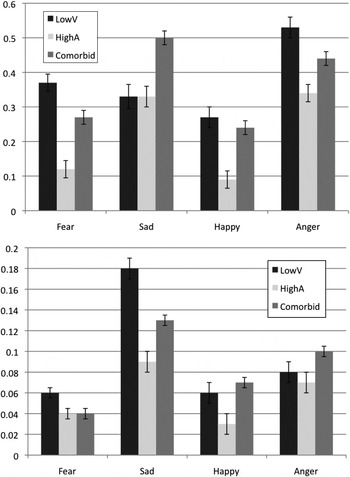
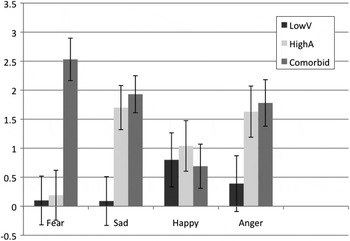
Erroneous answers were examined between groups for potential systematic bias in emotion recognition for each of the four emotion categories. An analysis of tendency scores (the likelihood of misidentifying a particular emotion) revealed a significant group difference for sadness, average F (2, 178–186) = 3.71, 75.56% at p < .05; fear, average F (2, 178–186) = 5.03, 100% at p < .05; and anger, average F (2, 178–186) = 4.48, 88.89% at p < .05. As illustrated in Figure 2 (top), children in the comorbid group were more likely to fail to identify sadness than the single risk factor groups. Children with low verbal ability were more likely to fail to identify fear and anger than the children with high arousal, with the comorbid group performing intermediate to the two. Differences for happy, average F (2, 178–186) = 2.62, 20% at p < .05, were not significant.
Group differences in the systematic nature of errors in emotion identification from story context. (Top) The mean “tendency” scores defined as a failure to identify each emotion when presented, and (bottom) the mean “bias” scores defined as identification of a particular emotion when it is not presented. For both metrics, zero represents random error and higher values represent more systematic errors. LowV, low verbal ability; HighA, high arousal.

The analysis of bias scores (the likelihood of identifying a particular emotion when it was not presented) indicated that groups did not differ for the happy or fear emotions. However, they did differ significantly with regard to sadness, average F (2, 178–186) = 6.37, 100% at p < .05, with the LowV group most likely to identify sadness when it was not presented and the HighA group least likely to do so (ps < .001). The comorbid group performed intermediate to the two. The groups also differed significantly in terms of identifying angry emotions, average F (2, 178–186) = 3.90, 86.67% at p < .05. Specifically, the comorbid group was more likely to identify an angry emotion when it was not present compared to the HighA group (p < .05). Group means for bias scores are illustrated in Figure 2 (bottom). In summary, children in the comorbid group were more likely to misinterpret sadness as anger, and children with low verbal ability were more likely to misinterpret fear and anger as sadness.
Social problem solving
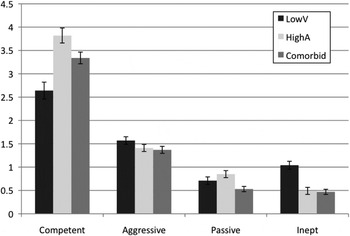
Groups were compared on their social problem solving strategies to hypothetical social situations. Overall, competent responses were the most commonly reported for all groups, average F (2, 178–186) = 2.50, 28.9% at p < .05. Groups did not differ with respect to frequency of aggressive or passive responses, average F (2, 178–186) = 1.22, 0% at p < .05. Groups did differ, however, in frequency of producing a socially inept response, average F (2, 178–186) = 7.83, 100% at p < .05, with children in the LowV group twice as likely to produce an inept response as either of the other two groups. The relationship between the group means is illustrated in Figure 3.
The quality of strategies generated in response to social problem solving vignettes involving hypothetical conflict. Values represent the mean number of responses generated in each category. Children were prompted to generate multiple responses to each vignette. LowV, low verbal ability; HighA, high arousal.

Physiological response to emotion
Groups were examined for differences in physiological reactivity to emotion induction in cardiac (HR, RSA) and EEG (alpha asymmetry) measures. Reactivity in the autonomic measures reflects change between the immediately preceding baseline and the average value across the emotion block. Because skin conductance is a defining feature of the group creation, group differences in skin conductance reactivity are not evaluated here. However, there was a significant main effect for emotion in skin conductance reactivity, average F (3, 179–188) = 13.24, 100% at p < .0001, with greater activity in the fear and anger clips than the sad and happy clips, indicating that children did differentiate between the clips based on affective content. Mixed model repeated measures analysis was used to test for differences between subgroups in patterns of cardiac reactivity across the emotions (fear, sad, happy, and anger), controlling for race, sex, and age.
HR
Groups did not differ with respect to HR in the pre-emotion baseline, average F (2, 178–186) = .47, 0% at p < .05. There was a main effect for emotion category, average F (3, 179–188) = 13.48, 100% at p < .0001. Across the sample, there was an average tendency to slow HR in response to film clips (compared with immediately preceding baseline), consistent with cardiac slowing as a marker for attention. On average, slowing was greater over the negative mood clips compared with the happy clip, indicating that cardiac measures of arousal index a different pattern of differentiation of emotion than skin conductance measures, which appear to more directly index arousal intensity. There was no main effect for group, average F (2, 174–186) = 1.47, 0% at p < .05. Evidence suggests a marginal Group × Emotion interaction, average F (6, 237–248) = 2.86, 64.44% at p < .05. Although this effect is not robust, the pattern of cardiac reactivity is consistent with the LowV group's tendency to conflate all negative affect in the emotion recognition assessments. Cardiac slowing in this group was greater in all three negative affect clips compared with the happy clip. In contrast, the HighA group showed the most slowing in the fear and sad conditions, consistent with withdrawal, compared with the happy and angry conditions. The comorbid group also demonstrated less slowing on average in the happy and angry conditions, but they also showed less slowing in the sad condition compared to the other two groups (ps < .16) similar to the results that this group is more likely to conflate sadness and anger in emotion recognition.
RSA
Groups did not differ with respect to RSA during the pre-emotion baseline, average F (2, 178–186) = 1.02, 0% at p < .05. No main effect for emotion, average F (3, 179–188) = 0.69, 0% at p < .05, or group, average F (2, 178–186) = 1.22, 6.67% at p < .05, were noted. Furthermore, no significant Emotion × Group interaction was identified, average F (6, 237–248) = 0.47, 20% at p < .05.
EEG
Groups did not differ on asymmetry during the pre-emotion baseline (all ps > .6). Unlike autonomic physiological arousal, which is slower and hypothesized to accumulate across the emotion induction, EEG asymmetry is thought to reflect more rapid changes to current mood state; furthermore, the variable length of the clips can bias estimates of the FFT used to extract power in the alpha frequency. Therefore, values were extracted from the final 30-s epoch where affective content of the clip reaches a climax and autonomic reactivity is maximal in order to standardize the length of the time series for each emotion. Mixed model repeated measures analysis was used to examine group differences across the four emotion categories.
In contrast to the autonomic measures, no main effect of emotion, average F (3, 179–188) = 0.62, 0% at p < .05, was evident in EEG asymmetry patterns. Likewise, no main effect of group, average F (2, 174–186) = 1.23, 6.67% at p < .05, was detected. However, there was a significant Group × Emotion interaction, average F (6, 237–248) = 2.01, 71.11% at p < .05. Group asymmetry patterns by emotion are illustrated in Figure 4. Groups did not differ during the happy condition in which all showed moderate left asymmetry consistent with mild positive affect. Groups did differ in the fear condition, with the comorbid group showing significantly greater left asymmetry compared to the LowV and HighA groups, which were near zero. Groups also differed in the sad condition; both the HighA and comorbid groups showed significant left asymmetry whereas the LowV group was near zero. Group differences did not reach significance in the anger condition, although the pattern was similar with both the HighA and comorbid groups, showing more left asymmetry than the LowV group.
The differences in aggression subgroups on patterns of EEG asymmetry across the four emotion inductions. The asymmetry score was calculated as the difference in power in the alpha band between the right (F4) and left (F3) electrode sites. Positive scores reflect higher activation in the left hemisphere. As indicated by the error bars, although the average for the LowV group was positive asymmetry, a large proportion of individuals within the group displayed negative asymmetry to the negative affect clips. LowV, low verbal ability; HighA, high arousal.

Family risk context
Parental distress
Groups differed with respect to maternal self-report of depression, average F (2, 178–186) = 6.00, 97.78% at p < .05. Parents of children in the comorbid group (M = 17.80, SE = 1.34) and HighA group (M = 16.64, SE = 1.76) reported higher levels of depression than those whose children were in the LowV group (M = 10.72, SE = 1.98; p < .01).
Groups did not differ with respect to the number of reported major stressful life events, average F (2, 178–186) = 0.55, 0% at p < .05. However, groups did differ with regard to the report of daily hassles, average F (2, 178–186) = 3.72, 97.78% at p < .05. Parents of children in the LowV group (M = 1.78, SE = 0.08) reported significantly fewer daily hassles than parents of children in the HighA group (M = 2.01, SE = 0.07) and the comorbid group (M = 2.00, SE = 0.06; ps < .01), who did not differ from each other. Finally, groups differed with regard to parent-reported sense of social support, average F (2, 178–186) = 4.56, 75.56% at p < .05. Parents of children in the LowV group (M = 3.33, SE = 0.11) reported higher social support compared to parents of children in the HighA (M = 3.04, SE = 0.10) or comorbid (M = 3.00, SE = 0.08; ps < .05) groups, who did not differ from each other.
Discipline practices
Groups were compared across the frequency at which parents report using different discipline styles in response to their child's behavior over the last year. Groups did not differ with regard to parental reports of verbal reasoning, average F (2, 178–186) = 1.25, 4.44% at p < .05, or appropriate discipline, average F (2, 178–186) = 2.10, 17.78% at p < .05, but they did differ with respect to reported frequency of verbal aggression, average F (2, 178–186) = 4.14, 73.11% at p < .05, and physical punishment, average F (2, 178–186) = 3.70, 73.33% at p < .05. For both scales, parents of children in the HighA group were more likely to report verbal (M = 4.03, SE = 0.24) and physical (M = 1.73, SE = 0.22) aggression as punishment strategies than the parents of children in the LowV group (M = 3.13, SE = 0.27 and M = 0.95, SE = 0.24, respectively; ps < .01). The comorbid group did not differ significantly from either group (M = 3.69, SE = 0.19 and M = 1.41, SE = 0.17, respectively).
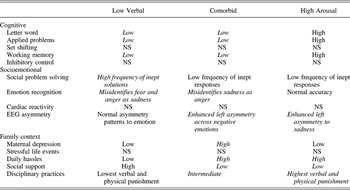
A summary of the risk profiles associated with differential vulnerability appears in Table 2. The italic type in Table 2 indicates the findings that were common between the comorbid group and each of the single-factor groups. Overall, the comorbid group appears to be characterized by risk factors of both groups.
Summary of differences in risk profiles across aggression subgroups in cognitive, socioemotional, and family context domains

Note: Italic type identifies the presence of a risk factor and indicates patterns of overlap between aggression subgroups.
Discussion
This study was designed to examine potential heterogeneity within a group of 207 children identified as highly aggressive at kindergarten entry. Even though all children in this high aggression sample were equivalent in teacher ratings of aggression, internalizing symptoms, and social competence, the evidence supports the supposition that different profiles of risk in cognitive, social–emotional, and family domains are associated with specific patterns of individual vulnerability. Heterogeneity within a diagnostic profile has significant implications for the need to refine and individualize intervention approaches. However, heterogeneity is illuminated by transcending the behavioral surface and considering individual variability within cognitive, social–emotional, psychophysiological, and contextual domains.
Verbal ability and sympathetic arousal as independent markers of vulnerability
Consistent with previous research, children identified as high in aggression evidenced lower verbal ability and higher resting skin conductance than their low aggression peers. However, each of these group-level differences applied to only approximately two-thirds of the sample. Although not all children in the aggression group were characterized by the same vulnerability factors, verbal impairment and/or heightened SNS arousal characterized 90% of the aggressive sample, indicating that these factors are common and powerful contributors to individual risk. Furthermore, the overlap between these factors occurred only at chance levels, supporting the notion that they represent independent correlates of aggressive behavior. However, it is important to note that a proportion of children in the low aggression group could also be characterized by the presence of one or both of these factors, reinforcing the assertion that psychopathological behavior is the product of accumulated and interacting risk factors across multiple domains (Greenberg et al., Reference Greenberg, Speltz, DeKlyen and Jones2001). Although neither verbal deficiency nor heightened physiological arousal is itself sufficient for the manifestation of aggressive behavior, both confer an increase in vulnerability that can be considered unique from one another.
Implications for differential vulnerability: Cognitive function
Poor verbal ability likely contributes to risk for aggression through multiple routes. The developmental transition from aggressive responses to socialized problem solving is supported by verbal feedback of inappropriate behavior and verbally mediated guidance toward alternative responses. Children who are less able to utilize verbal feedback are likely to display developmentally immature behavioral strategies. Furthermore, children with poor verbal skills are likely to experience less success when attempting verbally mediated problem solving, thus reducing exposure to reinforcement for prosocial behaviors.
In addition, these findings indicate that aggressive children characterized by low verbal ability evidenced a range of cognitive deficits. Both the low verbal and comorbid groups were more impaired in preliteracy skills and mathematical reasoning. Likewise, both groups scored more poorly than the HighA group on working memory performance. However, no group differences were apparent in the other two executive function domains (set shifting and inhibitory control). Given the apparent ceiling effect for these two measures, it is important to view these findings with caution given the substantial measurement issues with executive function at this age level (Blair, Zelazo, & Greenberg, Reference Blair, Zelazo and Greenberg2005). Because research suggests that executive function can be directly targeted through intervention (Diamond & Lee, Reference Diamond and Lee2011), further research is warranted to determine if executive function (when measured more precisely) is actually a correlated risk with low verbal status, an independent contributor to the development of aggression, or a moderator of the association between individual vulnerability and aggressive outcomes.
Implications for differential vulnerability: Socioemotional competence
Both the low verbal and comorbid groups had difficulties in extracting emotional content from contextual cues whereas aggressive children marked only by high arousal did not, suggesting that this deficit may be a function of impaired verbal ability and not general aggression status. However, differences were apparent between the LowV and comorbid groups in the nature of their erroneous responses. The LowV group's errors appeared to be driven by an inability to differentiate among negative emotions generally (fear, anger, sad), resulting in an overidentification of all negative emotions as sadness. In contrast, comorbid children were more likely to misinterpret sadness as anger, suggesting that although both groups have deficits in social-information processing, they differ considerably in the nature of these misattributions (Schultz, Izard, & Ackerman, Reference Schultz, Izard and Ackerman2000).
The performance on social problem solving also differentiated the low verbal and comorbid children, which required the child to generate possible solutions to a challenge with a peer. Groups did not differ in frequency of generating appropriate or aggressive responses, but children in the LowV group were significantly more likely to produce an inept response than both of the other groups. The lack of group differences and the overall low rate of aggressive responses is somewhat surprising given the potential for heightened arousal to predispose toward misattribution of emotions in others (as seen in the comorbid group) and more aggressive responses to social challenges. However, this may be a function of the hypothetical nature of the assessment. Children who display high levels of aggression are often able to identify a socially sanctioned and appropriate response to challenges presented hypothetically, despite not utilizing these responses in the immediate context of emotional arousal (Dearing et al., Reference Dearing, Hubbard, Ramsden, Parker, Relyea and Smithmyer2002). The children characterized by high baseline arousal demonstrate higher accuracy and social competence in this assessment, consistent with the notion that their cognitive skills remain intact under “cold” or affectively neutral conditions. Given the discrepancy between their task performance and their behavioral tendencies within the classroom, it is important to understand more about the affective reactivity children in this group experience when emotions are elicited. Direct physiological assessments provide the opportunity to characterize individual reactivity across different emotion contexts, as well as avoid social desirability influences in self-report.
This study assessed both the autonomic and central nervous systems with regard to indices of psychophysiological response to emotion. These two levels of physiological response likely reflect different aspects of emotional response. The autonomic system reflects the physiological response in preparation for behavioral activation. Increases in HR provide the physiological resources for the “fight or flight” response engaged under conditions of intense emotional arousal. However, arousal at this level does not discriminate between so-called “flight” or “fight” because arousal is independent of the direction of behavioral activation. In contrast, EEG asymmetry is often examined to identify predispositions toward behavioral action, particularly in affective contexts, that cannot be readily gleaned from autonomic arousal (Sutton & Davidson, Reference Sutton and Davidson1997).
Autonomic profiles of affective arousal
Because groups were defined by differences in skin conductance arousal, examination of group differences in reactivity to emotion were restricted to the cardiac system by measuring HR, which reflects both sympathetic and parasympathetic influences (see Berntson et al., Reference Berntson, Quigley, Lozano, Cacioppo, Tassinary and Berntson2007), and by RSA, which is thought to capture only the parasympathetic influence on the heart and reflect appropriate engagement and coping with the stimulus in a regulated manner.
The cardiac and electrodermal measures of physiological reactivity both evidenced differential activation by emotion condition. Therefore, activation was not a nonspecific marker of general engagement or affective arousal but sensitive to the differential nature of the clips. A Group × Emotion effect was detected for HR in more than half of the imputed data sets, but the inconsistency in the significance of this effect warrants caution in interpretation. However, the results were consistent with the findings for emotion recognition, where the LowV group showed similar HR reactivity to all three negative emotion clips as though they failed to differentiate among them as the other subgroups did. Likewise, the comorbid group showed a similar pattern of HR reactivity to sad and angry clips, again consistent with the findings of emotion recognition assessment.
The failure to detect subgroup differences in RSA is not likely a function of a general failure by all subgroups to appropriately activate the parasympathetic system because the aggressive group as a whole did not differ from the low aggression comparison group in RSA. Although research across domains of psychopathology indicates that cardiac measures, particularly RSA, are frequently associated with disorders of affect dysregulation (see Beauchaine, Reference Beauchaine2001), research in children ages 4–6 years suggests that these characteristic deficits in RSA may not yet be apparent in children in this age range (Crowell et al., Reference Crowell, Beauchaine, Gatzke-Kopp, Sylvers, Mead and Chipman-Chacon2006). Thus, it is important to place these findings in a developmental framework in which some characteristic aspects of aggression-associated dynamics may not yet be consolidated in this age group.
EEG profiles of affective arousal
Research on the association between EEG asymmetry and externalizing behavior is less well established than that for depression and internalizing symptoms. However, some researchers have postulated that right prefrontal asymmetry, typically considered to be characteristic of depression, is also characteristic of externalizing behavior problems, suggesting that right asymmetry reflects negative affect and a general dysregulation of emotion. Resting right prefrontal asymmetry in normally developing 10-year-old children has been associated with higher rates of aggression and delinquency (Santesso, Reker, Schmidt, & Segalowitz, Reference Santesso, Reker, Schmidt and Segalowitz2006). Similarly, a sample of children recruited for high risk for the development of psychopathology demonstrated an association between right prefrontal asymmetry and externalizing behaviors, although only in females (Baving, Laucht, & Schmidt, Reference Baving, Laucht and Schmidt2003). In contrast, left prefrontal asymmetry has been implicated in both state and trait aggression and thought to reflect the approach orientation of behavioral reactivity that characterizes aggression (Peterson, Shackman, & Harmon-Jones, Reference Peterson, Shackman and Harmon-Jones2008). Thus, both right and left asymmetry could conceivably contribute to aggressive behavior and apply differentially to individuals within a sample of aggressive children.
No differences in resting asymmetry were identified between the three subgroups. However, significant interactions between group status and EEG asymmetry during emotion conditions were evident, suggesting that subgroup differences were evident in the state (reactivity) rather than the trait (resting) domain. As seen in Figure 4, the LowV group evidence mild left asymmetry in the fear and sad conditions and greater left asymmetry in the happy and anger conditions. This is consistent with the interpretation of both the happy and angry emotion contexts as sharing an approach orientation consistent with greater left frontal asymmetry and suggests that the LowV group is characterized by normative patterns of emotion-context asymmetry. In contrast, the comorbid group showed more exaggerated left asymmetry in all negative affect conditions than in the happy condition, although this only reached significance in comparison to the LowV group for the fear and sad clips. This pattern is indicative of an overall tendency to engage in behavioral activation in response to negative affect, which could underlie a tendency toward aggressive behavior when upset. The tendency to engage in atypical left activation during the sad clip is also consistent with the tendency of this group to misidentify sadness as anger. The HighA group displayed asymmetry patterns similar to the comorbid group in all conditions except fear. Thus, both the HighA and comorbid groups appear to be characterized by abnormal reactivity to emotion induction, although this seems to be exaggerated in the comorbid group.
Implications for differential vulnerability: Family context as risk
Family context is known to exacerbate risk for children with externalizing disorders, and several specific characteristics of parents themselves as well as parenting strategies were evaluated. Like the other domains studied, risk was not equally represented in all subgroups and it was interesting that this was one domain in which children in the LowV group appeared to fare best. Mothers of children in this group reported less depression, fewer daily hassles, and more social support. Mothers in this group also reported less use of verbal and physical punishment strategies compared with mothers of children in the HighA group. Mothers of children in the comorbid group reported verbal and physical punishment tendencies intermediate to the other two groups, but they did report the highest levels of depression. Thus, overall, both groups defined by high arousal appeared to be characterized by highly stressful family contexts, maternal distress, and less effective parental discipline.
Because of the cross-sectional nature of the study, it is not possible to tease apart how parenting and child factors relate. Children with heightened arousal may be more difficult to interact with and thus generate more stressful conditions within the home, although teacher reports do not suggest this to be the case. Alternatively, heightened baseline arousal in these two groups may reflect an adaptive hypervigilance in response to the increased exposure to environmental stress. Research indicates that heightened cardiac activation is linearly associated with accumulation of contextual risk factors in children, and it may reflect an adaptive response under adverse conditions (Evans, Reference Evans2003). Viewed from this perspective, family context may be an etiological factor in the development of aggressive tendencies for some children, and heightened sympathetic arousal may reflect the physiological consequences of this developmental influence.
However, other models have proposed that heightened arousal moderates the association between family context and the development of aggressive behavior such that the heightened arousal these children evidence enhances their susceptibility to the adverse effects of these contextual and disciplinary experiences. Accumulating research suggests that enhanced arousal facilitates the extraction of information from the environment, the benefit of which is dependent on environmental quality (Boyce & Ellis, Reference Boyce and Ellis2005; Del Giudice, Ellis, & Shirtcliff, Reference Del Giudice, Ellis and Shirtcliff2011). Research indicates children with higher RSA are better able to “tune out” the negative effects of maternal depression, possibly through the ability of RSA to decrease physiological arousal (Blandon, Calkins, Keane, & O'Brien, Reference Blandon, Calkins, Keane and O'Brien2008). Although no differences were found in the present study regarding RSA, heightened skin conductance arousal could indicate that these children are especially “tuned in” to the negative aspects of their environment. Thus, the interaction between vulnerability conferred by heightened arousal and the presence of risk factors in the family environment may represent one etiological pathway by which these children arrive at aggressive tendencies that differs from their low verbal aggressive peers.
The biological sensitivity to context theory (e.g., Boyce & Ellis, Reference Boyce and Ellis2005) also provides a basis for speculation on how heightened arousal enhances vulnerability without serving as a sufficient risk factor for aggression. It is possible that children characterized by high arousal who do not develop aggressive behavior (52% of the comparison sample) may be protected by the lack of exacerbating risk factors in their environment. Alternatively, nonaggressive children with heightened arousal may be better able to extract protective factors from their environment. All children in the present study can be considered to be at relatively increased risk for aggressive behavior by virtue of the neighborhood demographics, which include high rates of poverty, single parenthood, violent neighborhoods, and low school resources. Even within high-risk contexts, microcoded parenting behaviors have been demonstrated to serve as proximal buffers to contextual risk; and these effects are enhanced for children high in arousal (Cipriano, Skowron, Gatzke-Kopp, & Van Epps, Reference Cipriano, Skowron, Gatzke-Kopp and Van Epps2011). Unfortunately, data on parenting practices were not available for the comparison sample, making it impossible to test the hypothesis that exposure to harsh parenting practices moderates the association between heightened arousal and aggressive behavior in this sample.
Implications for identifying subgroups
This study supports the notion that etiological heterogeneity exists within the construct of aggression. Despite different profiles of individual risk factors, all children in this sample evidenced consistent inappropriate aggressive behavior. However, teacher reports of internalizing, externalizing, or prosocial behavior did not discriminate between the subgroups. It is possible that, although teachers can readily identify the presence of problematic aggression in the classroom, they do not make fine-grained distinctions about emotional processing with children they already assess as high in aggression. It is also possible that behavior rating scales, which were developed in the absence of biologically informed theories about the mechanisms that lead to aggression, do not discriminate pertinent characteristics that differentiate among the heterogeneous pathways to aggressive behavior. However, research on reactive and proactive aggression, domains that are informed by biological models, illustrates the challenges in discriminating underlying motivations behind behavioral manifestations of aggression at the observational level (e.g., Raine et al., Reference Raine, Dodge, Loeber, Gatzke-Kopp, Lynam and Reynolds2006). The results from the present study suggest that pursuit of heterogeneity within behaviorally identified phenotypes (e.g., aggression) benefits from assessments across levels of analysis.
In particular, two distinct mechanisms are proposed based on the findings from this study. The first mechanism is proposed to derive from low cognitive function, particularly with regard to verbal ability. The deficiency in verbal processing likely impedes the developmental transition from aggressive to prosocial problem solving that is expected to occur in this age range. Thus, children with lower verbal and cognitive processing will persist in developmentally immature behavioral strategies and may simply be delayed compared to peers in meeting increasing social demands. Alternatively, heightened sympathetic arousal at baseline appears to be associated with a unique pathway to the development of aggressive behavior that is not marked by cognitive deficits in academic or social information processing domains (at least when assessed in a decontextualized manner). Children marked by this vulnerability may be either reactive to or especially sensitive to the adverse effects of stress and ineffective parenting. These children also appear to experience greater emotional reactivity and are more predisposed to behavioral action in the context of negative affect, as evidenced by EEG asymmetry.
Distinguishing between these two potentially unique routes to aggression has significant implications for intervention. Based on the pattern of findings, children with heightened arousal may be more dependent on intervention effects in parenting domains than children with low verbal processing. It is important to note that these different vulnerability factors are not mutually exclusive, nor are they etiologically related. Co-occurrence of both factors occurred at chance levels, although co-occurrence did increase the probability of being in the high aggressive compared to the low aggressive groups, consistent with models of accumulation of risk. In most cases, children comorbid for both vulnerability factors shared the profile deficits of the individual factor groups, rendering them with more associated risk overall (see Table 2). However, it is important to emphasize that both vulnerability factors were present in children who were not identified as highly aggressive, and future research is needed to identify factors that interact with these traits to differentially exacerbate or mitigate the development of aggressive behavior.
Limitations and future directions
Worth noting is the lack of a group characterized by low autonomic arousal. In this sample low autonomic arousal at baseline was modal and associated with normal developmental behavior. This is in contrast to a large literature on antisocial behavior that frequently identifies hypoarousal characteristics in both skin conductance and HR (Crowell et al., Reference Crowell, Beauchaine, Gatzke-Kopp, Sylvers, Mead and Chipman-Chacon2006; Gatzke-Kopp et al., Reference Gatzke-Kopp, Raine, Loeber, Stouthamer-Loeber and Steinhauer2002). Several possible explanations exist for this discrepancy and should be considered in future studies. First, arousal was examined in this study through baseline measures, whereas other studies have examined arousal with respect to low or high levels of reactivity. The relationship between these approaches is complex, because low levels of reactivity may reflect higher baseline arousal and consequently less room within which to react. Thus, it is not necessarily the case that these results are in direct opposition to other research studies, and they are actually consistent with studies of children that specifically examined baseline levels of arousal (Bubier et al., Reference Bubier, Drabick and Breiner2009).
Second, it is possible that low arousal is a stronger correlate of antisocial behavior broadly, and not necessarily aggression. Research identifying low arousal in children in this age range found an association with oppositionality that did not necessarily include aggressive behavior (Crowell et al., Reference Crowell, Beauchaine, Gatzke-Kopp, Sylvers, Mead and Chipman-Chacon2006). In a study of 9- to 10-year-olds, low levels of skin conductance activity were associated with higher psychopathic traits (although only in boys) such as manipulation and deceitfulness (Isen et al., Reference Isen, Raine, Baker, Dawson, Besdijian and Lozano2010), suggesting that this marker may reflect personality traits that may increase the use of aggressive tactics, but through separate mechanisms than those explored in this paper. Although aggression and antisocial behavior are correlated and often reviewed as loosely synonymous, it is possible that limiting the screening to aggression did not systematically select for children who may be prone to manipulative or callous tendencies. Such children may be more likely to engage in instrumental aggression that may emerge over time and/or may be more sophisticated in identifying subversive means to aggress that are not easily observed by the teacher. Consequently, although the results from this sample do not provide support for a pathway to aggression marked by fearlessness or a callous lack of empathy, this physiological pathway of risk is likely a valid phenomenon that is not characterized by aggression at this developmental time point. Thus, future research should continue to consider this as a neurophenotypic marker of risk. In addition, because we will follow this sample longitudinally, we will examine the possible emergence of this subgroup across the elementary years.
It is also worth noting that the disproportionate missingness in the physiological data compared with any of the other variables. Missingness was dispersed across the physiological domains and experimental epochs with all participants providing some data, but nearly half were missing at least one variable. This problem was greater for the EEG data that were not extracted from an average of multiple epochs as the autonomic data were. Multiple imputation was used to capitalize on the existing data for each participant in order to estimate the missing values, but interpretation warrants caution given the extent of data imputed for some analyses. Future replication of differences in physiological reactivity to emotion is needed in all physiological domains.
Summary
Reliance solely on behavioral measures may impede progress in research on the developmental etiology of aggression, because behavior can represent an equifinal manifestation of distinct mechanisms of dysfunctional information processing. The majority of studies on aggressive behavior have examined between group differences to identify purported individual and contextual factors that differentiate aggressive children from nonaggressive peers. The inherent problem with the logic of this model is that the validity of the identified risk factor is tethered to the validity of the phenotypic indicator. To the extent that a given phenotype contains a heterogeneous composite of underlying causes, consistency and replicability will continue to elude the field. The evidence provided in this paper supports the hypothesis that children who meet criteria for clinical intervention for aggressive behavior represent heterogeneous profiles of risk across distinct domains. Children identified as having impaired verbal ability appear to experience extreme difficulty in normal peer interactions, and they likely resort to aggression because they have experienced more success with this approach than attempts at verbally mediated conflict resolution. Alternatively, children identified by heightened arousal appear to have abnormal responses to emotional stimuli despite normally developing cognitive skills and social competencies. This may evolve from exposure to different risk factors within the family, including higher prevalence of maternal depression, maternal distress, and greater use of harsh disciplinary practices. These distinct profiles suggest the potential need for clinical interventions to consider the mechanisms underlying individual pathways to problematic aggressive behavior both with regard to child-focused and parent-focused intervention strategies. The results from this study suggest that physiological arousal and verbal ability represent distinct but important factors for future research on the early heterogeneity of aggressive behavior.