





Childhood obesity in the USA is characterised by pronounced racial and ethnic disparities that manifest long before children enter school. Hispanic and non-Hispanic (NH) Black children experience significantly higher rates of obesity compared with their NH White peers, with these profound disparities emerging as early as the preschool years(Reference Taveras, Gillman and Kleinman1,Reference Vazquez and Cubbin2) . Similar early-onset disparities and shifting obesity trends are also increasingly observed among Asian American, Native Hawaiian and Pacific Islander subgroups(Reference Jain, Mitchell and Chirumamilla3–Reference Nam5).
Infancy represents a highly sensitive window for metabolic programming, during which early feeding practices and rapid weight gain serve as robust predictors of subsequent childhood and adult obesity(Reference Baird, Fisher and Lucas6–Reference Woo, Dolan and Morrow8). In this context, breastfeeding is widely recognised as a fundamental element for optimal infant growth and early childhood development(Reference Belfort, Rifas-Shiman and Kleinman9,Reference Meek and Noble10) . However, empirical evidence regarding the benefit of breastfeeding on childhood adiposity remained inconclusive. A protective, dose-response relationship between prolonged breastfeeding and reduced childhood adiposity was documented across systematic reviews, prospective cohorts and quasi-experimental analyses(Reference Dharod, Frazier and Labban11–Reference Yan, Liu and Zhu16). In contrast, the cluster-randomised Promotion of Breastfeeding Intervention Trial and several observational studies reported null associations after adjusting for confounders such as maternal BMI and socioeconomic status(Reference Vazquez and Cubbin2,Reference Kramer, Matush and Vanilovich17–Reference Kjaer, Faurholt-Jepsen and Medrano20) , with some researchers proposing that apparent protective associations may reflect residual confounding or publication bias(Reference Beyerlein and von Kries21).
Investigations into specific subpopulations revealed divergent sex- and race-specific pathways. Longer breastfeeding increased the likelihood of exiting elevated body mass in a dose-response fashion among girls but offered no such benefit for boys(Reference Park and Reither22), whereas other studies reported stronger protective effects for boys(Reference Jwa, Fujiwara and Kondo23,Reference Liu, Lv and Wang24) . Furthermore, research indicated that race and ethnicity functioned as additive baseline penalties(Reference Taveras, Gillman and Kleinman1,Reference Taveras, Gillman and Kleinman25) , and that infant nutrition mediated underlying sociodemographic differences in adiposity(Reference Woo, Dolan and Morrow8). Within specific racial minority groups, protective associations were observed but were occasionally attenuated by acculturation(Reference Luecken, Jewell and MacKinnon26,Reference Verstraete, Heyman and Wojcicki27) . This conflicting and limited evidence highlights a critical need for further research.
To address these critical gaps in the literature, this study utilises a nationally representative longitudinal birth cohort in the USA to evaluate whether, and to what extent, the protective effect of prolonged breastfeeding on BMI trajectories exists, and whether this effect is heterogeneous by sex and race/ethnicity. Specifically, we evaluated two primary hypotheses: (H1) to what extent breastfeeding duration is associated with sex-specific BMI trajectories, and (H2) to what extent these associations vary by race and ethnicity.
Methods
Data
Data were drawn from the Early Childhood Longitudinal Study, Birth Cohort (ECLS-B), a nationally representative prospective cohort of children born in the USA(Reference Nord, Edwards and Hilpert28). This dataset offers detailed longitudinal information on children at birth, 9 months, 2 years, preschool and kindergarten entry stages (approximately 60 months of age). The target population of the ECLS-B comprised all children born in the USA in 2001, except for children born to mothers under 15 years of age, children who died or were adopted prior to the 9-month assessment and children who died or moved permanently out of the USA before the first wave of data collection. The ECLS-B also included linked data from birth certificates for all infants. The response rates and sample sizes across the five waves were 74·1 % (n 10 700), 69·0 % (n 9800), 63·1 % (n 8950), 58·0 % (n 7000) and 53·7 % (n 1900), respectively, after adjusting for the previous wave’s response rates and the substitution of primary sampling units(Reference Wheeless, Kimberly and Copello29). The final analytic sample consisted of 8500 mother-child dyads, following the exclusion of infants whose mother was not a biological mother (n 100) and those identifying as races or ethnicities other than NH White, NH Black or Hispanic (n 2500). All subsequent analyses were performed on this study population (n 8500).
Measures
The outcome measure for this study was the child’s BMI percentile, calculated from directly measured weight and height data collected at 9, 24, 36, 48 and 60 months using the standard 2000 Centers for Disease Control and Prevention sex- and age-specific growth charts(Reference Kuczmarski, Ogden and Guo30). To mitigate the influence of outliers and potential measurement errors, observations falling below the 3rd percentile or above the 97th percentile of the BMI percentile distribution were truncated prior to analysis(Reference Kuczmarski, Ogden and Guo30–Reference Olsen, Groveman and Lawson32).
Our measure of breastfeeding was constructed from a series of questions at waves 1 and 2, including ‘Did you ever breastfeed (the child)?’; ‘Are you still breast-feeding (the child) now?’; ‘For how many months did you breastfeed (the child)?’ and ‘How old was (child) in months when you completely stopped breast feeding him/her?’ From these questions, breastfeeding was categorised as never breastfed, less than 6 months and 6 months or longer, which were chosen based on the recommendation from American Academy of Pediatrics(Reference Meek and Noble10). Exclusive breastfeeding, which is defined as taking breast milk only, excluding any other food or drink (even water) for the first 6 months of life(33), was not assessed because the ECLS-B does not include a question about water intake.
A priori selected confounders were adjusted for in the analyses. Child age centred at 9 months and its quadratic term were included as fixed and random effects to account for the non-linear nature of body mass change during infancy and early childhood(Reference Kuczmarski, Ogden and Guo30,Reference Geserick, Vogel and Gausche34) . Infant, maternal and obstetric characteristics included race/ethnicity (i.e., NH white, NH black and Hispanic), plurality (i.e., singletons v. twins or multiples), delivery methods (i.e., vaginal v. C-section), maternal age at birth (i.e., 15–19 y/o, 20–24 y/o, 25–29 y/o, 30–34 y/o and 35 y/o or more), education level of mothers (i.e., less than high school, high school, and more than high school), marital status at birth (i.e., married v. not married) and household income (i.e., 0–15 K, 15–30 K, 30–40 K, 40–75 K and ≥75 K). Maternal BMI before pregnancy was estimated using self-reported weight and height, and then classified as underweight (BMI < 18·5), normal (BMI between 18·5 and 24·9), overweight (BMI between 25 and 29·9) or obese (BMI ≥ 30). Maternal weight gain during pregnancy was obtained from the birth certificate and categorised as 0–15 lbs, 16–30 lbs, 31–45 lbs or 46 lbs or more, per the empirical distribution of the measure.
Statistical analysis
To estimate BMI percentile trajectories during early childhood, stepwise hierarchical linear modelling was utilised to specify a series of non-linear individual growth curves. The nested structure of repeated BMI measurements within individual children was accounted for to address the non-independence of longitudinal anthropometric data. A random intercept and a random slope for the linear effect of age (child age in months) were specified using an unstructured covariance matrix. The inclusion of a random slope for the linear effect of age allows for the estimation of unique developmental velocities of BMI accumulation for each child. Furthermore, the time variable was parameterised with both linear and quadratic terms to capture the curvilinear deceleration of BMI percentiles observed after infancy.
The formal specification for the hierarchical linear model is detailed below:
 $$\! BM{I_{ij}} = {\beta _{00}} + {\beta _{10}}\left( {Ag{e_{ij}}} \right) + {\beta _{20}}\left( {Age_{ij}^2} \right) + {\beta _{01}}\left( {B{F_j}} \right) + {\beta _{02}}\left( {Rac{e_j}} \right) + {\beta _{03}}\left( {B{F_j} \times Rac{e_j}} \right) + \mathop \sum \limits_{m = 1}^M {\gamma _m}{C_{mj}} + {u_{0j}} + {u_{1j}}\left( {Ag{e_{ij}}} \right) + {\epsilon _{ij}}$$
where
 $BM{I_{ij}}$
represents the BMI percentile of child
 $j$
at time
 $i$
;
 ${\beta _{00}}$
is the fixed overall intercept;
 ${\beta _{10}}$
and
 ${\beta _{20}}$
represent the fixed linear and quadratic growth rates over time, respectively;
 ${\beta _{01}}$
,
 ${\beta _{02}}$
and
 ${\beta _{03}}$
capture the main effects of Breastfeeding (
 $BF$
), Race/Ethnicity (
 $Race$
) and their interaction. The term
 $\mathop \sum \nolimits_{m = 1}^M {\gamma _m}{C_{mj}}$
represents the combined fixed-effect contribution of
 $M$
time-invariant infant, maternal and obstetric covariates (as detailed in the Measures section), where
 ${C_{mj}}$
is the
 $m$
-th covariate for child
 $j$
and
 ${\gamma _m}$
is its corresponding coefficient. Finally,
 ${u_{0j}}$
is the individual-specific random intercept (baseline variance);
 ${u_{1j}}$
is the individual-specific random slope for the linear effect of age (growth velocity variance) and
 ${\epsilon _{ij}}$
is the time-specific residual error.
Analyses were stratified by sex given the potential differences in growth pattern, which was also supported by a formal interaction test (Appendix Table 1)(Reference Kuczmarski, Ogden and Guo30,Reference Lovejoy and Sainsbury35) . The analytical strategy proceeded in three sequential stages. Model 1 included the linear and quadratic time variables only to establish the baseline BMI percentile trajectories for both boys and girls. Model 2 expanded upon the baseline model by incorporating the main effects of breastfeeding duration and child race/ethnicity and adjusting for a set of confounders. Finally, Model 3 incorporated the interaction terms between breastfeeding duration and child race/ethnicity to evaluate the heterogeneous impacts of breastfeeding across different racial and ethnic subgroups. Least-squares means (marginal predicted means) and their standard errors were extracted from the models to visualise the trajectories.
To address non-response and loss to follow-up during the survey, longitudinal sampling weights provided by the ECLS-B were applied during analyses. Missing data were handled using multiple imputation under a missing at random assumption. To preserve the longitudinal data structure, the dataset was configured in a wide format prior to generating 50 imputed datasets via the fully conditional specification method. These datasets were subsequently restructured into a long format to estimate the hierarchical linear models, with final estimates aggregated according to Rubin’s rules(Reference Austin, White and Lee36,Reference Austin and van Buuren37) . Robust standard errors were estimated to correct for cluster-correlated errors and heteroscedasticity. All analyses were carried out using SAS 9.4 (SAS Inc., Cary, NC). A detailed description of the statistical analyses is available in Appendix 1 to facilitate replicability and reproducibility.
The restricted data for this research were obtained with permission and approval from the Institute of Education Sciences – National Center for Education Statistics (Contract number: 21020012). The Utah State University Institutional Review Board exempted this study from review under federal guidelines 45 CFR §46.104(d), category 4 (protocol number: 12933). The number of cases was rounded to the nearest 50 per National Center for Education Statistics (NCES) guidelines(Reference Nord, Edwards and Hilpert28).
Results
Table 1 summarises the sex-specific baseline characteristics by breastfeeding duration. Breastfeeding distributions were similar across sex: approximately 34 % were never breastfed, 39–40 % were breastfed for less than 6 months and 26–27 % were breastfed for 6 months or longer. All maternal, clinical and household characteristics differed significantly across these categories. NH Black mothers were most represented in the never-breastfed group and least represented in the breastfed group for 6 months or longer, whereas NH White mothers were most prevalent in the longest duration category. Pre-pregnancy obesity and caesarean deliveries were most frequent among mothers who never breastfed and least frequent among those who breastfed for 6 months or longer. Furthermore, socioeconomic indicators were positively associated with breastfeeding duration; mothers who breastfed for 6 months or longer reported higher annual household incomes and post-secondary education.
Baseline characteristics of the study population by duration of breastfeeding and infants’ sex, ECLS-B

Table 1. Long description
The weighted estimates show that mothers who breastfed for six months or longer comprised higher proportions of women who were older, married, Non-Hispanic White, and had greater educational attainment and household income compared to those who never breastfed or breastfed for less than six months. This category of mothers also recorded lower percentages of pre-pregnancy obesity and higher percentages of vaginal deliveries. For girls, mean BMI percentiles were lowest in the six months or longer breastfeeding category, whereas mean BMI percentiles for boys did not differ across breastfeeding durations.
Data: ECLS-B, Early Childhood Longitudinal Study, Birth Cohort; y/o, years old; NH, non-Hispanic; NCES, National Center for Education Statistics.
* Table presents unweighted sample sizes alongside weighted column percentages and weighted means (for age and BMI). Per NCES confidentiality guidelines, all unweighted counts were rounded to the nearest 50. Due to this rounding, counts and percentages may not sum to the totals or 100 %.
† Differences between duration of breastfeeding categories were assessed using F-tests and chi-square tests.
‡ Information was missing for BMI percentiles (n 700), duration of breastfeeding (n < 50), plurality (n 100), delivery methods (n 150), maternal age at birth (n 100), education level of mothers (n 250), maternal marital status (n 100), maternal BMI before pregnancy (n 250), and maternal weight gain during pregnancy (n 2250).
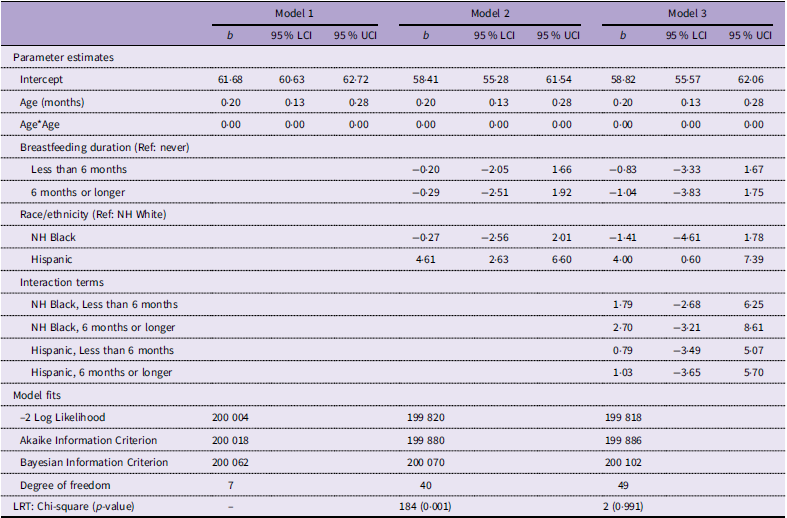
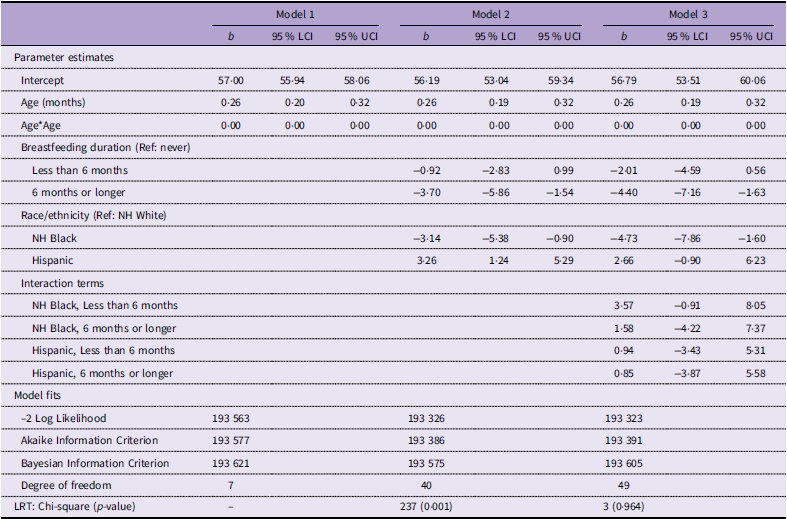
Tables 2 and 3 summarise the BMI percentile trajectories across all analytic models by infant sex, respectively. In the unadjusted model (Model 1), boys initiated at a significantly higher baseline BMI percentile (61·68, 95 % CI: 60·63, 62·72) than girls (57·00, 95 % CI: 55·94, 58·06), though both exhibited significant curvilinear growth. After adjusting for relevant confounders in Model 2, breastfeeding duration demonstrated no significant association with BMI trajectories among boys, either for durations less than 6 months (b [adjusted mean difference in BMI percentiles] = −0·20, 95 % CI: −2·05, 1·66) or for durations 6 months or longer (b = −0·29, 95 % CI: −2·51, 1·92), compared with those never breastfed (Table 2). Additionally, Hispanic boys exhibited a significantly higher trajectory (b = 4·61, 95 % CI: 2·63, 6·60) relative to NH White boys, while NH Black boys showed no significant difference (b = −0·27, 95 % CI: −2·56, 2·01). Conversely, among girls (Table 3), breastfeeding for 6 months or longer was associated with a significant downward shift in BMI percentile trajectory (b = −3·70, 95 % CI: −5·86, −1·54), whereas shorter durations remained non-significant. Relative to NH White girls, BMI trajectories were significantly higher for Hispanic girls (b = 3·26, 95 % CI: 1·24, 5·29) and lower for NH Black girls (b = −3·14, 95 % CI: −5·38, −0·90). Finally, Model 3 revealed no significant interactions between breastfeeding duration and race/ethnicity for either sex.
Estimated BMI percentiles by breastfeeding duration and race/ethnicity, boys

Table 2. Long description
Model 1 establishes baseline BMI percentile trajectories using linear and quadratic age variables. Model 2 incorporates main effects, showing that Hispanic boys record higher estimated BMI percentiles compared to Non-Hispanic White boys, whereas the estimated BMI percentiles for boys breastfed for less than six months or six months or longer do not differ from those who were never breastfed. Model 3 introduces interaction terms between breastfeeding duration and race/ethnicity, showing no variations in estimated BMI percentiles across the specific racial and ethnic subgroups by breastfeeding duration categories.
Data: ECLS-B, Early Childhood Longitudinal Study, Birth Cohort; (NCES), National Center for Education Statistics; NH, non-Hispanic; LCI, 95 % lower confidence interval; UCI, 95 % upper confidence interval; b, adjusted mean difference in BMI percentiles; LRT, Likelihood Ratio Test.
Notes: Model 1 included only the linear and quadratic time variables to establish the baseline BMI percentile trajectories. Model 2 expanded upon the baseline model by incorporating the main effects of breastfeeding duration and child race/ethnicity, and adjusting for a set of confounders. Model 3 further added the interaction terms between breastfeeding duration and child race/ethnicity. Child age was centred at 9 months. LRT compares the fit of the current model to the immediately preceding nested model (e.g., Model 2 v. Model 1). Longitudinal sampling weights provided by the ECLS-B were applied during analyses.
Estimated BMI percentiles by breastfeeding duration and race/ethnicity, girls

Table 3. Long description
Model 1 establishes baseline BMI percentile trajectories using linear and quadratic age variables. Model 2 incorporates main effects, showing that girls breastfed for six months or longer record lower estimated BMI percentiles compared to those who were never breastfed. Hispanic girls record higher estimated BMI percentiles, and Non-Hispanic Black girls record lower estimated BMI percentiles, compared to Non-Hispanic White girls. Model 3 introduces interaction terms between breastfeeding duration and race/ethnicity, showing no variations in estimated BMI percentiles across the specific racial and ethnic subgroups by breastfeeding duration categories.
Data: ECLS-B, Early Childhood Longitudinal Study, Birth Cohort; NCES, National Center for Education Statistics; NH, non-Hispanic; LCI, 95 % lower confidence interval; UCI, 95 % upper confidence interval; b, adjusted mean difference in BMI percentiles; LRT, Likelihood Ratio Test.
Notes: Model 1 included only the linear and quadratic time variables to establish the baseline BMI percentile trajectories. Model 2 expanded upon the baseline model by incorporating the main effects of breastfeeding duration and child race/ethnicity, and adjusting for a set of confounders. Model 3 further added the interaction terms between breastfeeding duration and child race/ethnicity. Child age was centred at 9 months. LRT compares the fit of the current model to the immediately preceding nested model (e.g., Model 2 v. Model 1). Longitudinal sampling weights provided by the ECLS-B were applied during analyses.
Figure 1 visualises predicted BMI trajectories from Tables 2 and 3. Boys initiated at a higher baseline BMI percentile at 9 months and exhibited a curvilinear trajectory that plateaued between 48 and 60 months before declining slightly by 84 months, whereas girls initiated at a lower baseline percentile but demonstrated a steeper BMI trajectory velocity throughout early childhood. When BMI trajectories were stratified by breastfeeding duration, the predicted trajectories among boys nearly overlapped, indicating no significant association. However, among girls, a clear gradient of lowered BMI trajectories associated with longer breastfeeding durations was observed. This lack of trajectory differentiation among boys remained uniform regardless of racial and ethnic groups, although the intercept was notably elevated for Hispanic boys. For girls, the protective effects of longer breastfeeding duration were preserved within each racial and ethnic group; while the BMI percentile intercepts shifted according to racial main effects (i.e., highest among Hispanic girls and lowest among NH Black girls), the relative distances between the breastfeeding duration remained parallel.
Comparisons of sex-specific BMI percentile trajectories by breastfeeding duration and race/ethnicity. Data: Early Childhood Longitudinal Study, Birth Cohort, National Center for Education Statistics. NH, non-Hispanic.

To address potential violations of linear mixed-effects model assumptions arising from the bounded nature of BMI percentiles (0–100), a sensitivity analysis was conducted using unbounded BMI z-scores as the outcome variable. The similarity of the results suggested that the primary conclusions were not highly sensitive to the choice of BMI outcome scale or to potential floor or ceiling effects (Appendix Tables 2 and 3).
Discussion
This study identified a distinct sex-specific effect of breastfeeding, whereby a duration of six months or longer significantly lowered BMI percentile trajectories in girls but yielded no significant association in boys. BMI trajectories by race also varied between sexes: among boys, only Hispanic infants exhibited higher percentiles than NH Whites, whereas among girls, both Hispanic and NH Black infants showed significant differences relative to NH Whites. There was no significant interaction between breastfeeding and race. These findings suggest that the physiological or behavioural pathways linking early nutrition to growth are likely sex-specific, and that the influence of infant feeding remains independent of underlying racial disparities.
These observed sex-specific effects of breastfeeding likely stem from the dynamic calibration of human milk to offspring sex, mediated by maternal hormones and foetal metabolic demands(Reference Stan, Grathwohl and O’Neill38). Mothers of males produce more energetically dense milk, providing sons with approximately 25 % more energy and distinct lipid profiles (e.g., specific polyunsaturated fatty acids) compared with daughters(Reference Powe, Knott and Conklin-Brittain39–Reference Khelouf, Haoud and Meziani41). This lipid-rich composition accelerates growth, potentially driving steeper BMI trajectories in males(Reference Thakkar, Giuffrida and Cristina40). Consistent with these observations, twin studies show same-sex twins grow significantly heavier and taller than opposite-sex twins, as maternal milk cannot be simultaneously tailored to both sexes(Reference Kanazawa and Segal42). Alongside males’ higher basal metabolic rates and fat-free mass(Reference Ua-areechit, Suteerojntrakool and Pongcharoen43), this sex-specific macronutrition likely contributes to the attenuation of breastfeeding’s typical BMI-protective effect in boys.
These physiological differences likely intersect with gendered feeding practices specific to racial and ethnic contexts. While females are often breastfed longer, males typically consume greater daily milk volumes(Reference da Costa, Haisma and Wells44,Reference Shafer and Hawkins45) . For example, Hispanic mothers often perceive boys as needing to be ‘larger’ or ‘stronger’, leading to more aggressive complementary feeding and earlier cessation of exclusive breastfeeding(Reference Dharod, Frazier and Labban11). Such race- and ethnicity-driven behaviours may override human milk’s metabolic protections, explaining the null effect on male BMI trajectories and suggesting breastfeeding’s benefits are mediated by both sex and racial/ethnic factors(Reference Hyczko, Ruggiero and Hohman46).
Relative to NH White infants, the persistent differences in BMI percentiles observed in Hispanic boys and both Hispanic and NH Black girls are likely due to upstream structural factors and racialized behavioural mechanisms(Reference Hildebrand, Ferguson and Sciscione12). Structural barriers, such as residential segregation and restricted healthy food access, likely contribute to obesity risk and may foster early disparities through obesogenic practices like early solid food introduction(Reference Davis, Li and Adams-Huet47–Reference Williams, McKinney and Cheskin50). These disparities are likely further compounded by ‘toxic stress’ from discrimination and food insecurity, which are associated with disrupted infant weight gain and cellular ageing (e.g., shorter early-childhood telomere lengths)(Reference Baskind, Hawkins and Heyman51–Reference Wojcicki, Heyman and Elwan53). Such systemic stressors may encourage non-responsive feeding styles, such as using food or formula to soothe, which can undermine infants’ emerging self-regulation and potentially attenuate the metabolic protections of human milk(Reference Duh-Leong, Au and Chang54–Reference Wasser, Thompson and Suchindran56).
These findings suggest potential limitations to universal obesity prevention paradigms. The observation that breastfeeding is inversely associated with BMI percentiles in girls, but not boys, aligns with recent studies and suggests that future interventions may benefit from accounting for these biological and behavioural nuances(Reference Horta, Rollins and Dias13,Reference Dua, Tomlinson and Tablante57) . These observed sex differences highlight that stratifying analyses by sex may be beneficial in pediatric obesity research, as aggregating data from both sexes can obscure distinct growth patterns and partially explain previous inconsistent findings. The persistence of racial and ethnic disparities across feeding categories also indicates that individual behaviours alone may not fully mitigate obesity risk. Public health strategies may therefore be more effective if they address upstream structural determinants, such as unequal food access and psychosocial stress, alongside culturally tailored nutritional guidance(Reference Cloutier, Wiley and Wang58,Reference Segura-Pérez, Hromi-Fiedler and Adnew59) .
This study is not without limitations. First, as an observational cohort study, residual confounding from unobserved variables, such as precise caloric intake from complementary foods and total breast milk volume, cannot be completely ruled out. Second, the available data did not permit a continuous, granular assessment of exclusive v. mixed feeding intensities across all developmental stages. Finally, the findings documented in this study may not be fully generalisable to contemporary birth cohorts given the secular shifts in paediatric nutritional patterns and obesity trends observed over the preceding two decades. Despite these limitations, this study possesses several notable strengths. The utilisation of a large, nationally representative longitudinal dataset allows for the robust tracking of BMI percentile trajectories from infancy through early childhood across a diverse US population. Furthermore, the application of hierarchical linear models with both linear and quadratic age terms appropriately captures the non-linear, dynamic nature of growth, while sex-stratified analyses unmask physiological nuances frequently obscured in aggregated models.
Conclusions
In conclusion, this study showed that longer breastfeeding was inversely associated with early childhood obesity in girls, but not in boys. Racial and ethnic disparities were independently associated with elevated obesity risks from infancy, although no significant interactions were observed between race/ethnicity and breastfeeding duration. These observations suggest that universal breastfeeding promotion, though essential for overall infant health, may not fully mitigate early obesity disparities if broader demographic and structural contexts are not accounted for. Future public health strategies may benefit from integrating tailored nutritional guidance with efforts to address systemic disparities by sex and race/ethnicity.
Supplementary material
For supplementary material/s referred to in this article, please visit https://doi.org/10.1017/S0007114526108757
Data availability statement
This manuscript utilises restricted-use data from the ECLS-B sponsored by the Institute of Educational Statistics at the US Department of Education’s NCES. The PI (HP) established a data use agreement with NCES prior to receiving access to the restricted-use data. Per the requirements of the NCES, data cannot be freely shared with other investigators; researchers interested in using these data must complete a data use agreement with the NCES prior to accessing restricted-use data from the Institute of Educational Statistics. Information about obtaining a restricted-data license for the ECLS-B can be found at https://nces.ed.gov/pubsearch/licenses.asp.
Acknowledgements
None.
Author contributors
Hyojun Park: Conceptualization; Methodology; Software; Formal analysis; Investigation; Data Curation; Visualization; Writing – original draft; Writing – review & editing.
Funding statements
The author declares that no funds, grants or other support were received during the preparation of this manuscript.
Competing interests
The author has no relevant financial or non-financial interests to disclose.



 Open access

