1 Introduction
Let
 $(X, \omega )$
be a translation surface, where X is a connected, compact Riemann surface of genus g, and
 $\omega $
is a non-zero holomorphic 1-form on X. Consider the quadratic differential
 $q_{\theta }=e^{2i\theta }\omega ^2$
associated with
 $\theta $
. The vertical foliation
 $\mathcal {F}_{\theta }$
of
 $q_\theta $
consists of leaves satisfying
 $\textrm {Re~} (\sqrt {q_{\theta }})=0$
. To endow the vertical foliation
 $\mathcal {F}_{\theta }$
with a measure, we define the transverse measure
 $\mu _\theta $
as follows: for any transverse curve
 $\gamma $
, the transverse measure is given by
 $$ \begin{align*} \mu_\theta(\gamma)=\int_{\gamma}|\textrm{Im~}(\sqrt{q_\theta})|=\int_{\gamma}|\textrm{Im~}(e^{i\theta}\omega)|. \end{align*} $$
This makes
 $\mathcal {F}_\theta $
a measured foliation. An important topological property of foliations is minimality. A foliation is called minimal if every closed union of leaves is either empty or the entire surface. The measure-theoretic counterpart of minimality is ergodicity. A measured foliation is said to be ergodic if every measurable union of leaves has either zero measure or full measure. A stronger property than ergodicity is unique ergodicity. A measured foliation is called uniquely ergodic if it admits a unique (up to scaling) transverse invariant measure.
The set of angles
 $\theta $
for which the measured foliation
 $\mathcal {F}_\theta $
is non-ergodic exhibits an intricate structure. We denote it as
 $\operatorname {\mathrm {NE}}(X,\omega )$
. A fundamental result regarding the ergodic properties of these flows was established by Kerckhoff, Masur, and Smillie [Reference Kerckhoff, Masur and SmillieKS86], which states that for any translation surface, the flow in almost every direction (with respect to the Lebesgue measure) is uniquely ergodic. While the set
 $\operatorname {\mathrm {NE}}(X,\omega )$
is metrically rare (constituting a null set), its geometric organization displays potentially rich fractal behavior. In 1992, Masur [Reference MasurMas92] established an upper bound of
 $\frac {1}{2}$
for the Hausdorff dimension of
 $\operatorname {\mathrm {NE}}(X,\omega )$
.
Consider a special class of translation surfaces
 $(X_{\unicode{x3bb} ,\mu },\omega )$
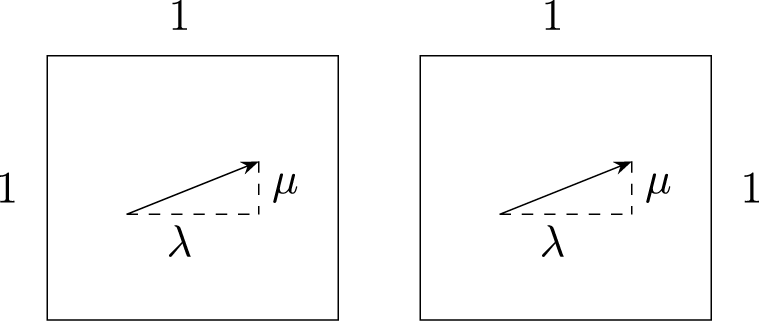
defined as the double cover of a standard flat torus of area one gluing along a slit with holonomy
 $(\unicode{x3bb} ,\mu ) \in \mathbb {R}^2$
. A significant advancement occurred in 2003, when Cheung [Reference CheungChe03] proved that the upper bound Hausdorff dimension
 $\frac 12$
can be achieved in this case. Later, in 2011, Cheung, Hubert, and Masur [Reference Cheung, Hubert and MasurCHM11] demonstrated that
 $\operatorname {\mathrm {HDim}} \operatorname {\mathrm {NE}}(X_{\unicode{x3bb} ,0})$
can only take the values
 $0$
or
 $\frac {1}{2}$
.
When the slit is not parallel to any absolute homology class, a result of Veech [Reference VeechVee89] establishes that every minimal direction is uniquely ergodic if
 $(\unicode{x3bb} , \mu )$
is rational. Boshernitzan (see [Reference CheungChe03], Appendix) showed that the existence of irrational vectors
 $(\unicode{x3bb} , \mu )$
, for which
 $\operatorname {\mathrm {NE}}(X_{\unicode{x3bb} ,\mu },\omega )$
, constitutes an uncountable but Hausdorff dimension
 $0$
set (see Figure 1). In 2025, Huang [Reference HuangHua25] provided a proof that the Hausdorff dimension of
 $\operatorname {\mathrm {NE}}(X_{\unicode{x3bb} ,\mu })$
is zero when the non-Pèrez–Marco condition holds, formulated in terms of best approximation denominators.
 $(X_{\unicode{x3bb} ,\mu },\omega )$
.

1.1 Statement of main results
In [Reference Cheung, Hubert and MasurCHM11], the dichotomy in Hausdorff dimension of non-ergodic directions corresponds to whether the denominators of the continued fraction expansion satisfy the Pérez–Marco condition or not. Our framework extends this result to the setting of best approximation vectors and establishes the following dichotomy.
Theorem 1.1. Let
 $\{q_k\}$
be the sequence of denominators of the best approximation vectors of an irrational vector
 $(\unicode{x3bb} , \mu )$
with respect to any norm
 $\|\cdot \|$
on
 $\mathbb {R}^2$
. Then,
 $\operatorname {\mathrm {HDim}} \operatorname {\mathrm {NE}}(X_{\unicode{x3bb} ,\mu },\omega ) = 0$
or
 $\frac {1}{2}$
, with the latter case occurring if and only if
 $$ \begin{align} \sum_k \frac{\log\log q_{k+1}}{q_k} < \infty. \end{align} $$
In Theorem 1.1, the dichotomy is completely characterized by the Pérez–Marco condition (see [Reference Pérez MarcoPM93]) expressed in terms of best approximation vectors. For a given norm
 $\|\cdot \|$
on
 $\mathbb {R}^n$
, we recall the following definition.
Definition 1.2.
 $({\mathbf {p}}/{q})\in \mathbb {Q}^n$
is a best approximation vector of
 $\mathbf {x}$
if:
-
(i)
 $\|q\mathbf {x}-\mathbf {p}\|<\|q^\prime \mathbf {x}-\mathbf {p^\prime }\|$
for any
$(\mathbf {p}^\prime ,q^\prime )$
with
$q^\prime <q$
;
-
(ii)
$\|q\mathbf {x}-\mathbf {p}\|\leq \|q\mathbf {x}-\mathbf {p^\prime }\|$
for any
$\mathbf {p^\prime }\in \mathbb {Z}^n$
.


Best approximation vectors have been introduced for a long time inside proofs in an non-explicit form. In 1951, C. A. Rogers [Reference RogersRog51] first defined best Diophantine approximations with respect to the supreme norm. Lagarias [Reference LagariasLag82, Reference LagariasLag85] undertook a systematic study of the best Diophantine approximations. For more details, we recommend the survey given by Moshchevitin (see [Reference MoshchevitinMos07]).
A long-recognized property, in multidimensional simultaneous Diophantine approximation, is that the definition (of best approximations) depends intrinsically on the choice of norm. In the study of the Lévy–Khintchine constant arising from the sequence of denominators of best approximation vectors, Cheung and Chevallier [Reference Cheung and ChevallierCC24] posed an intriguing question: do these constants coincide under different norms? As a corollary of Theorem 1.1, we show that the sequence of denominators of best approximation vectors satisfies the Pèrez–Marco condition with norm-independence.
Corollary 1.3. All sequences of denominators of best approximation vectors of any irrational vector
 $(\unicode{x3bb} ,\mu )$
satisfy the same Pérez–Marco condition.
Proof. In the proof of Theorem 1.1, we showed that the Hausdorff dimension of
 $\operatorname {\mathrm {NE}}(X_{\unicode{x3bb} ,\mu },\omega )$
is entirely determined by the Pèrez–Marco condition satisfied by the sequence of denominators of best approximation vectors of
 $(\unicode{x3bb} ,\mu )$
, constructed with respect to any chosen norm
 $\|\cdot \|$
on
 $\mathbb {R}^2$
.
1.2 Sketch of main ideas
A key contribution of this work is the establishment of the Hausdorff dimension
 $\frac 12$
, which had previously remained open. To show the result, we define a recursive process to construct a tree of slits and associate this tree with a Hausdorff dimension of
 $\frac 12$
Cantor set. The construction of the tree of slits is divided into two parts based on the heights of the slits: the Liouville construction and the Diophantine construction. The Liouville construction is based directly on the best approximation vectors of
 $(\unicode{x3bb} , \mu )$
. The primary challenge arises from the Diophantine construction. To ensure a sufficiently large dimension while maintaining the self-sustaining nature of the construction, it is necessary to work with normal slits at this stage. This paper establishes a sufficient condition for the normality of a slit
 $w = (\unicode{x3bb} + m, \mu + n)$
. The proof can be summarized as a strategy for identifying the best approximation vectors of
 $(\unicode{x3bb} , \mu )$
under the assumption
 $$ \begin{align} \bigg| \frac{\unicode{x3bb} + m}{\mu + n} - \frac{p}{q} \bigg| < \frac{1}{q q'}, \end{align} $$
where q and
 $q'$
are successive convergents of the inverse slope of w, with
 $|w| < q < |w|^{r} < |w|^{1+(r-1)N'} < q'$
. Our approach to the construction is based on the following idea: the best approximation vector we construct arises from the intersection of two non-parallel rational affine lines, each of which lies at a very small distance from
 $(\unicode{x3bb} , \mu )$
.
The condition (1.2) yields the inequality
 $$ \begin{align*} |q\unicode{x3bb} - p\mu + mq - np| < \frac{\mu + n}{q'} < \frac{1}{|w|^{(r-1)N'}}, \end{align*} $$
which geometrically corresponds to the line
 $\ell $
defined by
 $$ \begin{align} qx - py + mq - np = 0 \end{align} $$
with a small distance from
 $(\unicode{x3bb} ,\mu )$
.
The key novelty in our method lies in introducing the concept of nearest affine ration lines to
 $(\unicode{x3bb} ,\mu )$
, through which we construct an additional rational line. (This concept can also be referred to as the best linear forms of
 $(\unicode{x3bb} , \mu )$
.) For the norm
 $\|\cdot \|$
we choose on
 $\mathbb {R}^n$
, we can define the height of
 by
 . (We use
 $\mathbb {Z}_{\operatorname {\mathrm {pr}}}^{n+1}$
to denote the set of primitive vectors in
 $\mathbb {Z}^{n+1}$
.)
Definition 1.4. For  , we say
 is a nearest rational affine hyperplane of
 if:
-
(i)
for any with height
${\eta ^{\prime }}^-<\eta ^-$
; -
(ii)
for any with height
${\eta ^{\prime }}^-=\eta ^-$
.
 for any
 with height

 for any
 with height

We fix once and for all a sequence
 $\{\eta _j\}_{j\in \mathbb {N}}\subseteq \mathbb {Z}_{\operatorname {\mathrm {pr}}}^{n+1}$
of rational affine hyperplanes nearest to
 $(\unicode{x3bb} ,\mu )$
with increasing heights
 $\eta _1^- < \eta _2^-< \cdots $
. For irrational vectors in
 $\mathbb {R}^2$
, we have the following dichotomy: if
 $(\unicode{x3bb} , \mu )$
lies on a uniquely rational line, we call it uniquely rational; otherwise, it is totally irrational.
Accordingly, we handle each case individually in the proof.
Case 1. If
 $(\unicode{x3bb} , \mu )$
is uniquely rational, then it lies on a uniquely rational line
 $\eta $
, which can be expressed as
 $$ \begin{align} ax + by + c = 0, \end{align} $$
where
 $a, b, c \in \mathbb {Z}$
with
 $a \neq 0$
or
 $b \neq 0$
. (In [Reference Cheung, Hubert and MasurCHM11], (1.4) reduces to
 $y = 0$
.) The best approximation vector we are looking for arises as the intersection of
 $\ell $
and
 $\eta $
.
Case 2. When
 $(\unicode{x3bb} , \mu )$
is totally irrational, the pair of nearest rational affine lines
 $\eta _j$
and
 $\eta _{j+1}$
, whose heights satisfy
 $\eta _j^- \leq \ell ^- < \eta _{j+1}^-$
, contribute to the construction of the best approximation vector.
1.3 Outline of proof
We provide a brief outline of the proof of Theorem 1.1, which naturally divides into two parts. The first part establishes an upper bound, demonstrating that the Hausdorff dimension is
 $0$
.
1.3.1 Dimension 0 case
A similar argument was given in [Reference HuangHua25], where the best approximation vectors of
 $(\unicode{x3bb} , \mu )$
were chosen with respect to the
 $\|\cdot \|_{\infty }$
norm. Here, we prefer to rewrite the proof to demonstrate that the Hausdorff dimension zero result holds for any norm
 $\|\cdot \|$
.
Under the assumption
 $$ \begin{align} \sum_k\frac{\log\log q_{k+1}}{q_k}=\infty, \end{align} $$
we start the proof by recalling the notions of Z-expansions and Liouville direction (relative to Z). Then, we associate every non-ergodic direction
 $\theta \in \operatorname {\mathrm {NE}}(X_{\unicode{x3bb} ,\mu })$
with its Z-expansion, which is a sequence of slits
 $\{w_j\}$
and loops
 $\{v_j\}$
whose slopes converge to
 $\theta $
and satisfy the summability condition (2.1). (See Theorem 3.5.) Finally, we show every Z-expansion is Liouville relative to Z and then by Corollary 3.7, the set of Liouville directions has Hausdorff dimension zero, and we finish the proof. This is stated as Lemma 3.11.
The proof strategy for Lemma 3.11 is as follows: assuming
 $\theta $
is Diophantine relative to Z, the number of slits in a long interval
 $[q_k, q_{k+1})$
that satisfy the conditions of Lemma 3.8 is approximately
 $\log \log q_{k+1}$
. By Lemma 3.10, the sum of the vector cross products
 ${|w_j \times v_j|}$
over these slits is bounded below by
 ${(\log \log q_{k+1})}/{q_k}$
. Summing over all such long intervals indexed by k and using the divergence condition (1.5), we obtain
 $$ \begin{align*} \sum \frac{\log \log q_{k+1}}{q_k} = \infty. \end{align*} $$
This result contradicts the summability condition (2.1).
1.3.2 Dimension
$\tfrac{1}{2}$
case

The starting point for the argument establishing a dimension of
 $\frac {1}{2}$
is Theorem 2.2, which states that if a sequence of slits
 $\{w_j\}$
satisfies the summability condition (2.1), then the sequence of their inverse slopes converges to a non-ergodic direction.
Our strategy involves constructing a tree structure composed of slits, where each slit
 $w_{j+1}$
in the
 $(j+1)$
th level is derived from a slit
 $w_j$
in the jth level. These slits satisfy the conditions
 $|w_{j+1}| \approx |w_j|^r$
and
 $|w_j \times w_{j+1}| < \delta _j$
, where
 $\delta _j$
is chosen such that
 ${\sum \delta _j < \infty }$
. The slits
 $w_{j+1}$
generated from
 $w_j$
under these constraints are referred to as the children slits of
 $w_j$
, while
 $w_j$
is referred to as the parent slit.
The first construction in this paper is designed to address the case of a slit w whose height falls within a short interval
 $[q_k, q_{k+1}]$
, where
 $q_{k+1}<q_k^N$
for some fixed N. Our objective is to demonstrate that for an
 $\alpha $
-normal slit w, the child slits
 $w'$
that are
 $\alpha r$
-normal constitute a substantial portion (see Proposition 4.16). First, we rule out the possibility of
 $w'$
being a ‘miracle slit’ by showing that w can have at most one miracle child slit (see Lemma 4.8). The proof then proceeds in two parts. In the first part, if the spectrum of w lies within the interval
 $(\alpha \rho ^{N^\prime +1}|w|, |w|^r)$
, we establish that
 $w'$
is
 $\alpha r$
-normal using Lemmas 4.3, 4.6, and 4.9. In the second part, we derive an upper bound for the number of child slits that are not
 $\alpha r$
-normal. This is achieved through Lemmas 4.14 and 4.15. This approach to constructing ‘normal child slits’ is termed the Diophantine construction.
In §4.2, we introduce the construction using Liouville convergents of w when
 $|w|$
falls in a long interval of
 $[q_k,q_{k+1}]$
. We call it Liouville construction. Lemma 3.8 tells that the Liouville convergent u is a ‘very good approximation’ of w in this case, which implies a very small cross-product
 $|w\times u|$
. Based on it, we have a set of v constructed by u such that
 $w'=w+2v$
is a child of w.
Then, we associate this tree with a Cantor set
 $F(r)$
and demonstrate that the lower bound of
 $\operatorname {\mathrm {HDim}} F(r)$
can be arbitrarily close to
 $\frac {1}{2}$
by choosing the parameter r sufficiently close to one. The detailed construction of the tree of slits and the precise definitions of the terms
 $\delta _j$
are provided in §6.1. Finally, in §6, we verify the convergence of the series
 $\sum \delta _j$
.
2 Preliminary
2.1 Slits and loops
Suppose that
 $z_0$
and
 $z_1$
are two marked points on a standard area-one flat torus T, with horizontal distance
 $\unicode{x3bb} $
and vertical distance
 $\mu $
. Then, a saddle connection on T is a straight line that starts and ends at
 $\{z_0,z_1\}$
without meeting either point in its interior. The set of saddle connections can be divided into two types: a slit, which is a saddle connection joining
 $z_0$
and
 $z_1$
, and a loop, which is a saddle connection that joins one of these points to itself.
The holonomies of saddle connections are represented as pairs of real numbers. The set of holonomies of loops is given by
 $$ \begin{align*} V_0 = \{(p, q) \in \mathbb{Z}^2 : \gcd(p, q) = 1\}, \end{align*} $$
and the set of holonomies of slits is expressed as
 $$ \begin{align*} V_1 = V_1^+ \cup (-V_1^+), \end{align*} $$
where
 $$ \begin{align*} V_1^+ = \{(\unicode{x3bb} + m, \mu + n) : m, n \in \mathbb{Z}, n> 0\} \cup \{(\unicode{x3bb}, \mu)\}. \end{align*} $$
Let
 $(X_{\unicode{x3bb} ,\mu },\omega )$
denote the double cover of T branched over
 $z_0$
and
 $z_1$
, then we say that a slit
 $\gamma $
is separating if
 $\gamma $
separates
 $X_{\unicode{x3bb} ,\mu }$
into a pair of tori interchanged by the involution of the double cover. A lemma from [Reference CheungChe03] associates a separating slit with a pair of even integers m and n, and then the collection of separating slits is said to have holonomies given by
 $$ \begin{align*} V_2 = V_2^+ \cup ( -V_2^+ ), \end{align*} $$
where
 $$ \begin{align*} V_2^+ = \{ (\unicode{x3bb} + 2m, \mu + 2n) : m, n \in \mathbb{Z}, n> 0 \} \cup \{ (\unicode{x3bb}, \mu) \}. \end{align*} $$
We then use the following definition to establish a connection between slits and loops.
Definition 2.1. We say two slits w and
 $w'$
are related by a Dehn twist about v if
 ${w'-w\in \mathbb {Z} v}$
for v is a loop in
 $V_0$
.
The next theorem provides a method to construct non-ergodic directions on
 $(X_{\unicode{x3bb} ,\mu }, \omega )$
. It is a key theorem in the proof of the case for dimension
 $\frac {1}{2}$
.
Theorem 2.2. [Reference Masur and SmillieMS91]
(A more general condition developed in [Reference Masur and SmillieMS91] that applies to arbitrary translation surfaces and quadratic differentials.) Let
 $\{w_j\}$
be a sequence of separating slits with increasing heights
 $|w_j|$
, and suppose that every consecutive pair of slits
 $w_j$
and
 $w_{j+1}$
are related by a Dehn twist about some
 $v_j$
such that
 $$ \begin{align} \sum_j |w_j\times v_j| < \infty. \end{align} $$
(The cross-product formula expresses the area of the parallelogram spanned by u and v as
 $$ \begin{align*}|u\times v|=\|u\| \|v\|\sin\theta,\end{align*} $$
where
 $\times $
denotes the standard skew-symmetric bilinear form on
 $\mathbb {R}^2$
,
 $\|\cdot \|$
the Euclidean norm, and
 $\theta $
the angle between u and v.) Then, the inverse slopes of
 $w_j$
converge to some
 $\theta $
and this limiting direction belongs to
 $\operatorname {\mathrm {NE}}(X_{\unicode{x3bb} ,\mu },\omega )$
.
2.2 Best approximation vectors
Continued fractions have a long history and were traditionally used to generate optimal rational approximations of irrational numbers. A continued fraction is an expression of the form
 $$ \begin{align*} x = a_0 + \cfrac{1}{a_1 + \cfrac{1}{a_2 + \ddots}}, \end{align*} $$
where
 $a_0$
is an integer and
 $a_1, a_2, \ldots $
are positive integers called partial quotients. The rational number
 $$ \begin{align*} \frac{p_k}{q_k} = [a_0; a_1, a_2, \ldots, a_k] = a_0 + \cfrac{1}{{\ddots + \cfrac{1}{a_k}}} \end{align*} $$
is called the kth convergent. We recall the following two classical facts from the theory of continued fractions, which yield effective estimates for how well irrational numbers can be approximated by rationals.
Theorem 2.3. [Reference KhinchinKhi64, Theorems 9 and 13]
If
 $\{{p_k}/{q_k}\}$
is a sequence of convergents of
 $\theta $
, then we have
 $$ \begin{align} \frac{1}{q_k(q_k+q_{k+1})}<|\theta-\frac{p_k}{q_k}|\leq\frac{1}{q_kq_{k+1}}. \end{align} $$
Theorem 2.4. [Reference KhinchinKhi64, Theorem 19]
If a reduced fraction satisfies
 $$ \begin{align} |\theta-\frac{p}{q}|<\frac{1}{2q^2}, \end{align} $$
then
 ${p}/{q}$
is a convergent of
 $\theta $
.
In Definition 1.2, we introduce the notion of best approximation vector. We now describe two theorems of best approximation vectors, which respectively generalize Theorems 2.3 and 2.4.
Definition 2.5. Let v be a vector in
 $$ \begin{align*} Q := \{ (\mathbf{p}, q) \in \mathbb{Z}^3 : \gcd(\mathbf{p}, q) = 1,\ q> 0 \}. \end{align*} $$
We then define
 $\tilde {Q}$
as the set
 $$ \begin{align*} \tilde{Q} := \bigg\{ \dot{v} = \frac{\mathbf{p}}{q} : v \in Q \bigg\}. \end{align*} $$
The statements of these two theorems are independent of any particular choice of norm; they hold uniformly for all norms. This generality enables us to derive Corollary 1.3 from Theorem 1.1. Further details can be found in [Reference CheungChe11].
Henceforth, we fix a norm on
 $\mathbb {R}^2$
, which we denote by
 $\| \cdot \|$
.
Theorem 2.6. [Reference CheungChe11, Theorem 2.13]
Let
 $\dot {v_j}=({\mathbf {p_j}}/{q_j})\in \mathbb {Q}^2$
be a sequence of best approximation vectors to
 $\mathbf {x}$
. Then,
 $$ \begin{align} \frac{1}{2q_{j+1}}\leq \|q_j\mathbf{x}-\mathbf{p_j}\| \leq \frac{C_1}{q_{j+1}^{1/2}}. \end{align} $$
Here,
 $C_1$
denotes a constant that depends only on the choice of norm.
Theorem 2.7. [Reference CheungChe11, Theorem 2.10]
If
 $\dot {v}=({\textbf {p}}/{q})\in \tilde {Q}$
satisfies
 $$ \begin{align} \|x-\dot{v}\|<\frac{1}{2q^2}, \end{align} $$
then
 $\dot {v}$
is a best approximation vector of
 $x\in \mathbb {R}^2$
.
3 Hausdorff dimension 0
In this section, the central idea of our proof is to demonstrate that, for any norm, the sequence of best approximation vectors satisfying condition (1.5) yields
 $\operatorname {\mathrm {HDim}} \operatorname {\mathrm {NE}}(X_{\unicode{x3bb} ,\mu },\omega ) = 0$
.
3.1 Z-expansion
We recall the notions of Z-expansions and Liouville direction relative to a closed discrete subset
 $Z\subset \mathbb {R}^2$
. These notions were first introduced in [Reference Cheung, Hubert and MasurCHM11].
Definition 3.1. Given an inverse slope
 $\theta $
and
 $v=(p,q)\in \mathbb {R}^2$
, we define
 $$ \begin{align*}\operatorname{\mathrm{hor}}_\theta(v)=|q\theta-p|\quad \text{and}\quad |v|=q.\end{align*} $$
Here, q is called the height of v. Let Z be a closed discrete subset of
 $\mathbb {R}^2$
. A Z-convergent of
 $\theta $
is any vector
 $v\in Z$
that minimizes the expression
 $\operatorname {\mathrm {hor}}_\theta (u)$
among all vectors
 $u\in Z$
with
 $|u|\le |v|$
. The Z-expansion of
 $\theta $
is defined to be the sequence of Z-convergents ordered by increasing height.
Notation 3.2. Recall that
 $|v|$
is the absolute value of the y-coordinate. We call it the height of v. If two or more Z-convergents have the same height, we choose one and ignore the others.
In this paper, we set
 $Z = V_0 \cup V_2$
. For the general definition of Z, certain assumptions must be considered. Further details on this can be found in [Reference Cheung, Hubert and MasurCHM11, §3].
Definition 3.3. A direction is called minimal (relative to Z) if it is not the direction of vectors in Z.
The next lemma provides a sufficient condition on its Z-expansion to guarantee a minimal direction.
Lemma 3.4. [Reference Cheung, Hubert and MasurCHM11, Lemma 3.3]
The Z-expansion of a direction with inverse slope
 $\theta $
is infinite if and only if
 $\theta $
is minimal.
The following characterization of non-ergodic directions in terms of Z-expansions is one of the key ideas used to prove
 $\operatorname {\mathrm {HDim}}\operatorname {\mathrm {NE}}(X_{\unicode{x3bb} ,\mu },\omega )=0$
.
Theorem 3.5. [Reference Cheung and EskinCE07]
Let
 $\theta $
be a minimal direction in
 $P_{\unicode{x3bb} ,\mu }$
. (This implies it will also be a minimal direction relative to Z.) Then,
 $\theta $
is non-ergodic if and only if its Z-expansion is eventually alternating between loops and separating slits
 $$ \begin{align*} \ldots, v_{j-1}, w_j, v_j, w_{j+1}, \ldots \end{align*} $$
and satisfies the summable cross-products condition (2.1).
3.2 Liouville directions
Definition 3.6. A minimal direction is Diophantine relative to Z if its Z-expansion satisfies
 $$ \begin{align} |w_{k+1}|=O(|w_k|^N) \end{align} $$
for some N. Additionally, if no such N satisfy (3.1), it is Liouville relative to Z.
The next lemma states that the collection of Liouville directions is a zero Hausdorff dimension set. Then, the remaining task is to show that every direction
 $\theta \in \operatorname {\mathrm {NE}}(X_{\unicode{x3bb} ,\mu },\omega )$
is Liouville relative to Z.
Lemma 3.7. [Reference Cheung, Hubert and MasurCHM11, Corollary 3.9]
The set of Liouville directions relative to the set of holonomies of saddle connections on a translation surface has Hausdorff dimension zero.
By Lemma 3.7, it is enough to show that every non-ergodic direction is Liouville relative to Z. We argue by contradiction and suppose
 $\theta \in \operatorname {\mathrm {NE}}(X_{\unicode{x3bb} ,\mu },\omega )$
is Diophantine relative to Z. We shall exploit (1.5) together with the Diophantine property to get a contradiction to (2.1).
3.3 Liouville convergents
From now on, we set
 $\tilde {C}=16C_1$
. The following lemma shows that the best approximation vectors of
 $(\unicode{x3bb} ,\mu )$
with
 $q_{k+1}\gg q_k$
give rise to the convergents of
 ${(\unicode{x3bb} +m)}/{(\mu +n)}$
.
Lemma 3.8. Assume that
 $w=(\unicode{x3bb} +m,\mu +n)$
is a slit and
 $(({p_{k,1}}/{q_k}),({p_{k,2}}/{q_k}))$
is a best approximation vector of
 $(\unicode{x3bb} ,\mu )$
. Let
 ${p}/{q}$
denote the fraction
 ${(p_{k,1}+mq_k)}/{(p_{k,2}+nq_k)}$
in lowest terms. If the height of w is such that
 $$ \begin{align} |w|<\frac{q_{k+1}^{1/2}}{\tilde{C}q_k}, \end{align} $$
then
 ${p}/{q}$
is a convergent of
 ${(\unicode{x3bb} +m)}/{(\mu +n)}$
and the height of the next convergent is larger than
 ${(q_{k+1}^{1/2})}/{2C_1}$
.
Proof. Let
 $v=(p,q)$
and
 $\mathbf {x}=(\unicode{x3bb} ,\mu )$
. Since
 $$ \begin{align*} \frac{|w\times v|}{|w||v|} &=\bigg|\frac{\unicode{x3bb}+m}{\mu+n}-\frac{p_{k,1}+mq_k}{p_{k,2}+nq_k}\bigg|\\ &=\frac{|(\unicode{x3bb}+m)(p_{k,2}-q_k\mu)-(\mu+n)(p_{k,1}-q_k\unicode{x3bb})|}{|w|(p_{k,2}+nq_k)}, \end{align*} $$
we have
 $$ \begin{align} \frac{|w\times v|}{|w|}\leq 4\|q_k\mathbf{x}-\mathbf{p_k}\|\leq \frac{4C_1}{q_{k+1}^{1/2}} \end{align} $$
for
 $(\mathbf {p_k},q_k)=(p_{k,1},p_{k,2},q_k)$
. While
 $|v|\leq nq_k+p_{k,2} \leq 2q_k|w|$
, then
 $$ \begin{align*} 2|v|\frac{|w\times v|}{|w|}\leq \frac{\tilde{C}q_k|w|}{q_{k+1}^{1/2}}. \end{align*} $$
So if
 $|w|< {(q_{k+1}^{1/2})}/{(\tilde {C} q_k)}$
, we will get
 $$ \begin{align*} \frac{|w\times v|}{|w||v|}<\frac{1}{2|v|^2}, \end{align*} $$
which implies that
 $({p}/{q})$
is a convergent of
 ${(\unicode{x3bb} +m)}/{(\mu +n)}$
by Theorem 2.4.
Let
 $q^\prime $
be the height of the next convergent of
 ${(\unicode{x3bb} +m)}/{(\mu +n)}$
. By (2.2), we have
 $$ \begin{align*} q^\prime>\frac{2|w|}{|w\times v|}, \end{align*} $$
which implies
 $$ \begin{align*} q^\prime>\frac{q_{k+1}^{1/2}}{2C_1}. \\[-41pt] \end{align*} $$
Definition 3.9. When the conclusion of Lemma 3.8 holds, we refer to
 ${p}/{q}$
(or the vector
 $v=(p,q)$
) as the Liouville convergent of w indexed by k.
We denote
 $$ \begin{align*}n_k=\tfrac{1}{2}\log_{q_k}{q_{k+1}}-2\end{align*} $$
for each k. Then,
 $\{n_k\}$
is a divergent sequence. If not, for some N, we have
 $$ \begin{align*}\sum \frac{\log\log q_{k+1}}{q_k} \le \sum \frac{\log 2N+\log\log q_k}{q_k}< \infty.\end{align*} $$
Let
 $$ \begin{align} S_k= \{w, q_k<|w|<q_k^{n_k}\}. \end{align} $$
The next lemma gives a sufficient condition on the non-zero upper bound for the cross-product
 $|w \times v|$
, where
 $w \in V_2$
and
 $v\in V_0$
.
Lemma 3.10. Let
 $\theta $
be a minimal non-ergodic direction and
 $w_j$
,
 $w_{j+1}$
,
 $w_{j+2}$
be three consecutive separating slits in its Z-expansion. Suppose further that
 $w_j,w_{j+1},w_{j+2}\in S_k$
for some k, then we can deduce that
 $$ \begin{align} |w_j\times v_j|>\frac{1}{4q_k}. \end{align} $$
Proof. By applying Theorem 3.5, we can write
 $w_{j+1}=w_j+bv_j$
for some non-zero, even integer b. Then,
 $$ \begin{align*} |v_j|=\frac{|w_{j+1}-w_j|}{|b|}\leq\frac{|w_{j+1}|+|w_j|}{2}<|w_{j+1}|. \end{align*} $$
Let
 $\alpha ^\prime $
be the inverse slope of
 $w_{j+1}$
and
 $v_j=(p,q)$
. We have
 $$ \begin{align*} |\alpha^\prime-\frac{p}{q}|=\frac{|w_{j+1} \times v_j|}{|w_{j+1}||v_j|}<\frac{|w_j\times v_j|}{|v_j|^2}<\frac{1}{2q^2}. \end{align*} $$
Then, Theorem 2.4 shows that
 ${p}/{q}$
is a convergent of
 $\alpha ^\prime $
. Let
 $q^\prime $
be the height of the next convergent of
 $\alpha ^\prime $
. Then, (2.2) implies
 $$ \begin{align*} \frac{1}{2qq^\prime}<|\alpha^\prime-\frac{p}{q}|<\frac{1}{qq^\prime}, \end{align*} $$
equivalently,
 $$ \begin{align*} \frac{|w_{j+1}|}{2|w_j\times v_j|}<q^\prime<\frac{|w_{j+1}|}{|w_j\times v_j|}, \end{align*} $$
and let u be the Liouville convergent of
 $w_{j+1}$
indexed by k. Here, u cannot have its height
 $|u|<q$
because Lemma 3.8 implies the height of the next convergent of
 $\alpha ^{\prime }$
is greater than
 ${(q_{k+1}^{1/2})}/{(2C_1)}>|w_{j+1}|>|v_j|=q$
, which contradicts the fact that q is also the height of a convergent of
 $\alpha ^\prime $
. Thus,
 $|u|\geq |v_j|$
.
If we have
 $|u|>|v_j|$
so that
 $|u|\geq q^\prime>{|w_{j+1}|}/{2|w_j\times v_j|}$
, since
 $|u|\leq p_{k,2}+|w_{j+1}|q_k \leq 2|w_{j+1}|q_k$
, the inequality (3.5) is fulfilled.
If not, we have
 $|u|=|v_j|$
. Then, by Lemma 3.8, we have
 $q^\prime>{(q_{k+1}^{1/2})}/{(C_1)}$
. By the definition of
 $v_{j+1}$
, we have
 $$ \begin{align*} 1\leq |u\times v_{j+1}|&\leq|u||v_{j+1}|\bigg(\sin(\angle{w_{j+1} u})+\frac{|w_{j+1}\times v_{j+1}|}{|w_{j+1}||v_{j+1}|}\bigg)\\ &\leq \frac{|v_{j+1}|}{q^\prime}+\frac{|v_j|}{2|w_{j+1}|}<\frac{|v_{j+1}|}{q^\prime}+\frac{1}{2} \end{align*} $$
from which it follows that
 $|v_{j+1}|>{(q^\prime )}/{2}>{(q_{k+1}^{1/2})}/{(\tilde {C})}$
. Then, we can deduce that
 $$ \begin{align*} |w_{j+2}|>|v_{j+1}|>\frac{(q_{k+1}^{1/2})}{(\tilde{C})}, \end{align*} $$
which contradicts with the height condition
 $|w_{j+2}|<q_k^{n_k}$
.
After preparing all ingredients, we begin to prove the main theorem of this section.
Theorem 3.11. Assume
 $$ \begin{align*} \sum_{k}^{\infty}\frac{\log\log q_{k+1}}{q_k}=\infty \end{align*} $$
holds. Then, any minimal
 $\theta \in \operatorname {\mathrm {NE}}(X_{\unicode{x3bb} ,\mu },\omega )$
is Liouville relative to Z, which deduces that
 $\operatorname {\mathrm {HDim}}\operatorname {\mathrm {NE}}(P_{\unicode{x3bb} ,\mu }$
) = 0.
Proof. We prove by contradiction and suppose
 $\theta $
is Diophantine relative to Z. Then, there exists
 $N'>1$
for which the growth estimate
 $|w_{k+1}|<|w_k|^{N'}$
holds for all k. Then, we have
 $$ \begin{align*} \# \{w_j, q_k<|w_j|<q_k^{n_k}\} \geq \bigg\lfloor\frac{\log (n_k)}{\log{N'}}\bigg\rfloor>\frac{\log n_k}{2\log N'} \end{align*} $$
provided
 $n_k> N_0$
for some
 $N_0$
depending only on
 $N'$
. Applying Lemma 3.10, we thus obtain a contradiction since
 $$ \begin{align*} \sum_j|w_j\times v_j|\geq\sum_{n_k> N_0}\sum_{w_j\in S_k} |w_j\times v_j| \gtrsim \sum_{n_k>N_0} \frac{\log \log q_{k+1}}{q_k}=\infty. \\[-47pt] \end{align*} $$
The last equation is given by (1.5) and
 $n_k$
is unbounded.
4 Two approaches to the construction
We begin the proof of the Hausdorff dimension
 $\frac {1}{2}$
result. Theorem 2.2 establishes that the limiting set of
 $\{w_j\}$
, satisfying condition (2.1), converges to a non-ergodic direction on
 $(X_{\unicode{x3bb} ,\mu }, \omega )$
. Based on this result, our strategy is to construct a tree of slits satisfying (2.1), associate this tree to a Cantor set, and then prove that the Cantor set has Hausdorff dimension
 $\frac {1}{2}$
.
This section presents two approaches to the construction of a tree of slits. Specifically, we propose the following algorithm. We fix a large number N from now on. Let
 $$ \begin{align} \ell_N=\{k: q_{k+1}>q_k^N\}. \end{align} $$
An interval
 $(q_k,q_{k+1})$
is called long if
 $k\in \ell _N$
. Otherwise, we call it short. When a slit w of height
 $|w|$
lies within the long interval
 $[q_k, q_{k+1}]$
, we will use the Liouville construction to identify the children of w. We will introduce this method in detail in §4.2. Let
 $k,k'$
be the consecutive elements of
 $\ell _N$
. The primary construction in this paper is designed to address the case of a slit w whose height falls within the union of short intervals
 $(q_{k+1}^{{1}/{N}}, q_{k'}^{{1}/{3r}})$
. We refer to it as a Diophantine construction, which is established by Proposition 4.16.
In the following three sections, we assume that
 $\ell _N$
is an infinite set. Under this assumption, both the Liouville construction and the Diophantine construction will be required. The case where
 $\ell _N$
is a finite set will be considered in §7. The choice of the parameter N will depend on considerations in §5.1 and will be specified there, by (5.2). The indices in
 $\ell _N$
will guide our choice of constructions.
4.1 Diophantine construction
Let us first recall the definition of a good slit. Assume parameters
 $1<\alpha <\beta $
are given.
Definition 4.1. A slit w is
 $(\alpha ,\beta )$
-good if its inverse slope has a convergent of height q satisfying
 $\alpha |w|\le q\le \beta |w|$
.
Let
 $\Delta (w,\alpha ,\beta )$
be the collection of slits of the form
 $w+2v$
, where
 $v\in \mathbb {Z}\times \mathbb {Z}_{>0}$
satisfies
 $\gcd (v)=1$
, and
 $$ \begin{align} \beta|w| \le |v| \le 2\beta|w| \quad\text{and}\quad \frac{1}{\beta} < |w\times v| < \frac{1}{\alpha}. \end{align} $$
The next lemma gives a lower bound for the number of such
 $w+2v$
constructed from good slits w.
Lemma 4.2. [Reference Cheung, Hubert and MasurCHM11, Lemma 7.2]
There is a universal constant
 $0<c_0<1$
such that
 $$ \begin{align} \#\Delta(w,\alpha,\beta)\ge\frac{c_0\beta}{\alpha} \end{align} $$
for any
 $(\alpha ,\beta )$
-good slit w and
 $\alpha <c_0\beta $
. (To apply [Reference CheungChe03, Theorem 3], one needs to assume
 $\beta \gg \alpha $
, but this hypothesis was shown to be redundant in [Reference CheungChe04]. Indeed, by [Reference CheungChe04, Theorem 4], we can take
 $c^{\prime }_0={4}/{27\pi }.$
)
The next lemma shows that the good property will hold in a weaker vision for the child slit.
Lemma 4.3. If w is an
 $(\alpha ,\beta )$
-good slit, then every slit
 $w'\in \Delta (w,\alpha ,\beta )$
is
 $(\alpha -\frac 12,\beta )$
-good, but not
 $(1,\alpha -\frac 12)$
-good.
Proof. Let
 $w'=w+2v\in \Delta (w,\alpha ,\beta )$
, where
 $w'=(\unicode{x3bb} +m',\mu +n')$
and
 $v=(p,q)$
. Then, we have
 $$ \begin{align*} \bigg|\frac{\unicode{x3bb}+m'}{\mu+n'}-\frac{p}{q}\bigg| = \frac{|w'\times v|}{|w'||v|}<\frac{|w\times v|}{2|v|^2}<\frac{1}{2\alpha q^2}<\frac{1}{2q^2} \end{align*} $$
for
 $\alpha>1$
. Then, by (2.3), v is a convergent of
 $w'$
. Let
 $q'$
be the height of the next convergent of
 $w'$
. Then, by (2.2), we have
 $$ \begin{align} \frac{1}{q'+q} < \frac{|w\times v|}{|w'|} < \frac{1}{q'}. \end{align} $$
From the left-hand side above, we have
 $$ \begin{align*} q'> \frac{|w'|}{|w\times v|} - q > \bigg(\alpha-\frac{1}{2}\bigg)|w'| \end{align*} $$
for
 $|w'|>2|v|=2q$
, and from the right-hand side of (4.4),
 $$ \begin{align*} q' < \frac{|w'|}{|w\times v|} < \beta|w'|. \end{align*} $$
This shows that
 $w'$
is
 $(\alpha -\frac 12,\beta )$
-good.
Since q and
 $q'$
are the heights of consecutive convergents of
 $w'$
(and since
 $|v|<|w'|$
), it follows that
 $w'$
is not
 $(1,\alpha -\frac 12)$
-good.
We introduce a key definition characterizing a well-behaved Diophantine property. Let
 $r \in \mathbb {R}$
be a fixed constant satisfying the chain of inequalities:
 $$ \begin{align*} 1 < r < r^3 < \tfrac{3}{2}. \end{align*} $$
Based on this constant, we define two derived quantities:
 $$ \begin{align} N^{\prime} = \frac{4(N+1)r}{r-1},\quad \rho = r + \frac{1}{2}, \end{align} $$
where N is a positive integer parameter.
Definition 4.4. A slit w is
 $\alpha $
-normal if it is
 $(\alpha \rho ^t,|w|^{(r-1)t})$
-good for all
 $t\in [1,T]$
, where
 $T>1$
is determined by
 $\alpha \rho ^T=|w|^{r-1}$
. Equivalently, w is
 $\alpha $
-normal if and only if for all
 $t\in [1,T]$
, we have
 $$ \begin{align} \Psi(w)\cap[\alpha \rho^t|w|,|w|^{1+(r-1)t}]\neq\emptyset, \end{align} $$
where
 $\Psi (w)$
denotes the collection of heights of the convergents of the inverse slope of w.
We shall now present sufficient conditions for w to be
 $\alpha $
-normal. The detailed proof will be divided into two cases.
Notation 4.5. We note that there exists a global constant
 $C^\prime $
such that
 $\|\cdot \|\asymp _{C^\prime }\|\cdot \|_\infty $
, where
 $||\cdot \|_\infty $
is the supremum norm.
4.1.1 Uniquely rational case
We first consider the case when
 $(\unicode{x3bb} , \mu )$
is uniquely rational, meaning that it lies on a uniquely rational line
 $\eta $
, which can be expressed as
 $$ \begin{align} ax + by + c = 0, \end{align} $$
where
 $(a, b, c) \in \mathbb {Z}_{\operatorname {\mathrm {pr}}}^3$
and at least one of a or b is non-zero. Let
 . Hereafter, we always assume the parameter k is chosen sufficiently large to satisfy
 $q_k> \eta ^-$
. (The selection of such a k is permissible since
 $\ell _N$
constitutes an infinite set.) This leads to the following sufficient condition for
 $\alpha $
-normality of a slit w.
Lemma 4.6. Let w be a slit such that
 $$ \begin{align} q_{k+1}^{{1}/{N}}\leq |w|<q_{k^\prime}^{{1}/{3r}}, \end{align} $$
where
 $k,k'$
are consecutive elements of
 $\ell _N$
. If w is
 $(\alpha \rho ^{N^\prime },|w|^{r-1})$
-good, then it is
 $\alpha $
-normal.
Proof. If w is
 $(\alpha \rho ^{N^\prime },|w|^{r-1})$
-good but not
 $\alpha $
-normal, let
 $v=(p,q)$
be the convergent of w with the maximal height
 $q<|w|^r$
. Since w is
 $(\alpha \rho ^{N^\prime },|w|^{r-1})$
-good, we have
 $\alpha \rho ^{N^\prime }|w|\leq q<|w|^r$
. Let
 $v^\prime =(p^\prime ,q^\prime )$
be the next convergent. If
 $q^\prime \leq |w|^{1+(r-1)N^\prime }$
, then w is
 $\alpha $
-normal by definition. We proceed by contradiction. Suppose that
 $$ \begin{align*} q'> |w|^{1 + (r - 1)N'}. \end{align*} $$
Then,
 $$ \begin{align*} \frac{q^\prime}{|w|}>|w|^{(r-1)N^\prime}\geq q^{(1-{1}{r})N^\prime}=q^{4(N+1)}. \end{align*} $$
So it can be deduced that
 $$ \begin{align*} |w\times v|<\frac{|w|}{|v^\prime|}<\frac{1}{q^{4(N+1)}}. \end{align*} $$
Writing
 $w=(\unicode{x3bb} +m,\mu +n)$
, we have
 $$ \begin{align*} |q\unicode{x3bb}-p\mu+(qm-pn)|<\frac{1}{q^{4(N+1)}}. \end{align*} $$
Let
 $\ell $
denote the line defined by
 $$ \begin{align*}qx - py + (qm - pn) = 0.\end{align*} $$
We now consider the intersection of
 $\ell $
with
 $\eta $
, as defined in (4.7). This intersection yields
 $$ \begin{align*} \bigg(\frac{cp+(qm-pn)b}{ap+bq},\frac{cq+(pn-qm)a}{ap+bq}\bigg) =: \bigg(\frac{p_{h,1}}{q_h},\frac{p_{h,2}}{q_h}\bigg) =: \dot{v}_h \end{align*} $$
in lowest terms. We also have
 $$ \begin{align*} q_h\leq |ap+bq| \leq 2\eta^-q\leq 2q^2, \end{align*} $$
where the last inequality follows from
 $q> q_{k+1}^{1/N} > q_k > \eta ^-$
. Then, it follows that
 $$ \begin{align*} \|(\unicode{x3bb},\mu)-\dot{v}_h\|_{\infty}<\frac{2\max(|a+q|,|b+p|)}{q^{4(N+1)}|ap+bq|}<\frac{4}{q^{4N+3}}. \end{align*} $$
By Theorem 2.7 and the definition of
 $C^\prime $
(here, we use the definition of
 $q_{k_0}$
from (5.3) to eliminate the constant
 $C'$
. We use this fact throughout the entire proof),
 $$ \begin{align*} \|(\unicode{x3bb},\mu)-\dot{v}_h\| < C^\prime\|(\unicode{x3bb},\mu)-\dot{v}_h\|_{\infty}<\frac{1}{2(2q^2)^2}<\frac{1}{2q_h^2}, \end{align*} $$
which implies that
 $\dot {v}_h$
is a best approximation vector. By (2.4), we have
 $$ \begin{align} \frac{1}{2q_hq_{h+1}}<\frac{4C'}{q^{4N+3}}. \end{align} $$
Since
 $q>|w|>48C'$
, we have
 $$ \begin{align*} q_{h+1}>\frac{q^{4N+3}}{8C'q_h}>\frac{q^{4N+1}}{16C'}>q^{3N}>(4q^2)^N\geq(q_h)^N \end{align*} $$
from which it follows that
 $h\in l_N$
. Since
 $q_h\leq 2q^2\leq 2|w|^{2r}<|w|^{3r}<q_{k^\prime }$
, we must have
 $q_h\leq q_k$
. Hence,
 $q_{h+1}<q_{k+1}$
so that
 $$ \begin{align*} \frac{1}{2q_kq_{k+1}}\leq\frac{1}{2q_hq_{h+1}}<\frac{4C'}{q^{4N+3}}. \end{align*} $$
Since
 $\alpha>1$
, we have
 $q>|w|\geq q_{k+1}^{{1}/{N}}>q_k$
. Then,
 $$ \begin{align*} q_{k+1}>\frac{q^{4N+3}}{12C'q_k}>q^{N}>|w|^{N}, \end{align*} $$
which contradicts with the hypothesis on
 $|w|$
.
4.1.2 Totally irrational case
The case when
 $(\unicode{x3bb} , \mu )$
is totally irrational presents the main difficulty in solving this problem. To address it, we use the notion of the nearest rational affine line to
 $(\unicode{x3bb} , \mu )$
. We also need the definition of miracle slits to exclude certain exceptional cases.
Definition 4.7. Given a slit
 $w=(\unicode{x3bb} +m,\mu +n)$
, we associate to it the triple
 $\ell =(q,-p,qm-pn)\in \mathbb {Z}^3_{pr}$
, where
 $p/q$
is the convergent of the inverse slope
 ${(\unicode{x3bb} +m)}/{(\mu +n)}$
determined by
 $|w| < q\le |w|^r < q'$
and
 $q'$
is the height of the next convergent. Then, we let
 $\eta _j$
be the nearest rational affine line to
 $(\unicode{x3bb} ,\mu )$
determined by
 $\eta _j^- \le \ell ^- < \eta _{j+1}^-$
. We refer to
 $(\ell ,\eta _j)$
as the ‘pair of lines’ associated to w. We say w is a miracle slit if
 $\ell =\pm \eta _j$
and
 $\eta _{j+1}^-> (\eta _j^-)^{r^3}$
.
We will show in the next lemma that the miracle slits appear with a very low frequency in
 $\Delta (w,\alpha ,\beta )$
.
Lemma 4.8. There exists some constant c (depending only on norm) such that at most one miracle slit appears in
 $\Delta (w,\alpha ,\beta )$
if
 $$ \begin{align} |w|^{(r-1)^2}>c. \end{align} $$
Proof. Let
 $w^\prime \in \Delta (w,\alpha ,\beta )$
be a miracle slit with smallest norm and
 $(\ell ,\eta _j)$
the pair of lines of
 $w^\prime $
such that
 $$ \begin{align*}\eta_{j+1}^->(\eta_j^-)^{r^3}=(\ell^-)^{r^3}.\end{align*} $$
Writing
 $\ell $
by
 $\ell =(q,-p,qm-pn)$
, we have
 $$ \begin{align*}{q}^{1/r}\leq |w^\prime|<q\end{align*} $$
implies
 $$ \begin{align*} {\bigg(\frac{\eta_j^-}{C^\prime}\bigg)}^{1/r}\leq |w^\prime|< C^\prime \eta_j^-. \end{align*} $$
Then, the next miracle slit
 $w^{\prime \prime }$
associating with
 ordered by ascending norm satisfies
 $$ \begin{align} |w^{\prime\prime}|>{\bigg(\frac{\eta_{j'}^-}{C^\prime}\bigg)}^{1/r}>\frac{(\eta_j^-)^{r^2}}{C^\prime}>\frac{|w^\prime|^{r^2}}{{C^\prime}^{5}}. \end{align} $$
Because
 $\beta |w|\leq |v| \leq 2\beta |w|$
, each slit
 $\tilde {w} \in \Delta (w,\alpha ,\beta )$
satisfies
 $$ \begin{align*}(2\beta-1)|w|\leq |\tilde{w}| \leq (4\beta+1)|w|.\end{align*} $$
We choose
 $c=5{C^\prime }^5$
and
 $|w|^{r^2-1}>|w|^{(r-1)^2}>c$
, then
 $4\beta +1<5(2\beta -1)$
will deduce that
 $w^{\prime \prime }$
is not in
 $\Delta (w,\alpha ,\beta )$
.
Lemma 4.9. Let w be a slit which is not miracle such that
 $$ \begin{align} q_{k+1}^{{1}/{N}}\leq |w|<q_{k^\prime}^{{1}/{3r}}, \end{align} $$
where
 $k,k'$
are consecutive elements of
 $\ell _N$
. (To prove this lemma, we require
 $|w|$
to be sufficiently large so as to dominate certain constants (e.g.
 $|w|> 48C'$
). This assumption is implicitly built into the choice of
 $q_0$
in (5.3).) If w is
 $(\alpha \rho ^{N^\prime },|w|^{r-1})$
-good, then it is
 $\alpha $
-normal.
Proof. We prove by contradiction. Assume w is
 $(\alpha \rho ^{N^\prime },|w|^{r-1})$
-good but not
 $\alpha $
-normal. Let
 $v=(p,q)$
be the convergent of w with the maximal height
 $q<|w|^r$
. Since w is
 $(\alpha \rho ^{N^\prime },|w|^{r-1})$
-good, we have
 $\alpha \rho ^{N^\prime }|w|\leq q<|w|^r$
. Let
 $v^\prime =(p^\prime ,q^\prime )$
be the next convergent. If
 $q^\prime \leq |w|^{1+(r-1)N^\prime }$
, then w is
 $\alpha $
-normal by definition. So, we must have
 $$ \begin{align*} q^\prime>|w|^{1+(r-1)N^\prime}. \end{align*} $$
Then,
 $$ \begin{align*} \frac{q^\prime}{|w|}>|w|^{(r-1)N^\prime}\geq q^{(1-({1}/{r}))N^\prime}=q^{4(N+1)}. \end{align*} $$
So, it can be deduced that
 $$ \begin{align*} |w\times v|<\frac{|w|}{|v^\prime|}<\frac{1}{q^{4(N+1)}}. \end{align*} $$
Writing
 $w=(\unicode{x3bb} +m,\mu +n)$
, we have
 $$ \begin{align*} |q(\unicode{x3bb}+m)-p(\mu+n)|<\frac{1}{q^{4(N+1)}}. \end{align*} $$
Equivalently,
 $$ \begin{align} |q\unicode{x3bb}-p\mu+(qm-pn)|<\frac{1}{q^{4(N+1)}}. \end{align} $$
Let
 $(\ell ,\eta _j)$
be the pair of lines associated to w for
 $l=(q,-p,qm-pn)$
by definition. Since w is not miracle, by hypothesis, we have only two cases to consider. We will show that each will lead to a contradiction.
Case 1:
 $\ell \neq \pm \eta _j$
. By the definition of nearest rational affine line, we have
 $$ \begin{align} |a_j\unicode{x3bb}+b_j\mu+c_j|<\frac{1}{q^{4(N+1)}}. \end{align} $$
Note that
 $\ell $
and
 $\eta _j$
are not parallel. If not, we notice the distance between
 $\ell $
and
 $\eta $
is larger than
 ${1}/{2q}$
, while the distances from
 $(\unicode{x3bb} ,\mu )$
to
 $\ell $
and
 $\eta _j$
are both less than
 ${1}/{(q^{4(N+1)})}$
, which is a contradiction.
The intersection point of
 $\ell $
and
 $\eta _j$
is
 $$ \begin{align*} \bigg(\frac{c_jp+(qm-pn)b_j}{a_jp+b_jq},\frac{c_jq+(pn-qm)a_j}{a_jp+b_jq}\bigg) =: \bigg(\frac{p_{h,1}}{q_h},\frac{p_{h,2}}{q_h}\bigg) =: \dot{v}_h \end{align*} $$
in lowest terms. Recalling that
 $\eta _j^-\le \ell ^-$
, we have
 $$ \begin{align*}q_h\leq |a_jp+b_jq| \leq 2\eta_j^-q\leq 4q^2.\end{align*} $$
From (4.13) and (4.14), it follows that
 $$ \begin{align*} \|(\unicode{x3bb},\mu)-\dot{v}_h\|_{\infty}<\frac{2\max(|a_j+q|,|b_j+p|)}{q^{4(N+1)}|a_jp+b_jq|}<\frac{6}{q^{4N+3}}. \end{align*} $$
By Theorem 2.7 and the definition of
 $C^\prime $
,
 $$ \begin{align*} \|(\unicode{x3bb},\mu)-\dot{v}_h\| < C^\prime\|(\unicode{x3bb},\mu)-\dot{v}_h\|_{\infty}<\frac{1}{2(4q^2)^2}<\frac{1}{2q_h^2}, \end{align*} $$
which implies that
 $\dot {v}_h$
is a best approximation vector. By (2.4), we have
 $$ \begin{align} \frac{1}{2q_hq_{h+1}}<\frac{6C'}{q^{4N+3}}. \end{align} $$
Since
 $q>|w|>48C'$
, we have
 $$ \begin{align*} q_{h+1}>\frac{q^{4N+3}}{12C'q_h}>\frac{q^{4N+1}}{48C'}>q^{3N}>(4q^2)^N\geq(q_h)^N \end{align*} $$
from which it follows that
 $h\in l_N$
. Since
 $q_h\leq 4q^2\leq 4|w|^{2r}<|w|^{3r}<q_{k^\prime }$
, we must have
 $q_h\leq q_k$
. Hence,
 $q_{h+1}<q_{k+1}$
so that
 $$ \begin{align*} \frac{1}{2q_kq_{k+1}}\leq\frac{1}{2q_hq_{h+1}}<\frac{6C'}{q^{4N+3}}. \end{align*} $$
Since
 $\alpha>1$
, we have
 $q>|w|\geq q_{k+1}^{{1}/{N}}>q_k$
. Then,
 $$ \begin{align*} q_{k+1}>\frac{q^{4N+3}}{12C'q_k}>q^{N}>|w|^{N}, \end{align*} $$
which contradicts with the hypothesis on
 $|w|$
.
Case 2:
 $\ell =\pm \eta _j$
and
 $$ \begin{align} \eta_{j+1}^-<(\eta_j^-)^{r^3}<(2q)^{r^3}. \end{align} $$
By the definition of nearest oriented affine hyperplane, we have
 $$ \begin{align} |a_{j+1}\unicode{x3bb}+b_{j+1}\mu+c_{j+1}|<\frac{1}{q^{4(N+1)}}. \end{align} $$
The intersection of
 $\eta _j$
and
 $\eta _{j+1}$
is
 $$ \begin{align*} \bigg(\frac{c_{j+1}p+(qm-pn)b_{j+1}}{a_{j+1}p+b_{j+1}q},\frac{c_{j+1}q+(pn-qm)a_{j+1}}{a_{j+1}p+b_{j+1}q}\bigg)=: \bigg(\frac{p_{h,1}}{q_h},\frac{p_{h,2}}{q_h}\bigg) =: \dot{v}_h \end{align*} $$
in lowest terms. So, it follows by (4.16) and
 $r^3<3/2$
that
 $q_h\leq a_{j+1}p+b_{j+1}q\leq 2|\eta _{j+1}|q\leq 2^{r^3+1}q^{r^3+1} <q^3<|w|^{3r}<q_{k^\prime }$
. Then, from (4.13) and (4.17), it follows that
 $$ \begin{align*} \|(\unicode{x3bb},\mu)-\dot{v}_h\|_{\infty}<\frac{2\max(|a_{j+1}+q|,|b_{j+1}+p|)}{q^{4(N+1)}|a_{j+1}p+b_{j+1}q|}<\frac{1}{q^{4N+1}}. \end{align*} $$
With the same argument in Case 1, we have
 $$ \begin{align*} \|(\unicode{x3bb},\mu)-\dot{v}_h\| < C^\prime\|(\unicode{x3bb},\mu)-\dot{v}_h\|_{\infty}<\frac{1}{2(4q^2)^2}<\frac{1}{2q_h^2}, \end{align*} $$
which implies that
 $\dot {v}_h$
is a best approximation vector by Theorem 2.7. Since
 $$ \begin{align} \frac{1}{2q_hq_{h+1}}<\frac{C'}{q^{4N+1}}, \end{align} $$
we have
 $$ \begin{align*} q_{h+1}>\frac{q^{4N+1}}{2C'q_h}>(q^3)^N>(q_h)^N, \end{align*} $$
which implies
 $h\in l_N$
. We follow the previous proof and will get
 $$ \begin{align*} \frac{1}{2q_kq_{k+1}}\leq\frac{1}{2q_hq_{h+1}}<\frac{C'}{q^{4N+1}}. \end{align*} $$
Since
 $\alpha>1$
, we have
 $q>|w|>q_{k+1}^{{1}/{N}}>q_k$
. Then,
 $$ \begin{align*} q_{k+1}>\frac{q^{4N+1}}{2C'q_k}>q^{N}>|w|^{N}, \end{align*} $$
which is also impossible.
4.1.3 Normal children slits
Given a slit w, let
 $$ \begin{align*}\beta=|w|^{r-1}.\end{align*} $$
We aim to show that the definition of a normal slit exhibits a form of recurrence such that many slits
 $w' = w + 2v \in \Delta (w, \alpha , \beta )$
are
 $\alpha r$
-normal if w is an
 $\alpha $
-normal slit.
Let us begin by assuming an
 $\alpha $
-normal slit w. Consider a loop v satisfying
 $$ \begin{align} |w|^r\le|v|\le2|w|^r \quad\text{ and }\quad |w\times v|<\frac{1}{\alpha}. \end{align} $$
Then,
 $w'=w+2v$
defines a new slit. If
 $w'$
is
 $\alpha r$
-normal and satisfies (4.19), then it will be called a child of w. If w is
 $(\alpha \rho ^{N'+1},\beta )$
-good, Lemma 4.9 together with Lemma 4.3 will prove that
 $w'$
is either
 $\alpha r$
-normal or miracle. Thus, the main task is to bound the number of
 $w'$
that satisfy (4.19) but are not
 $\alpha r $
-normal when w is not
 $(\alpha \rho ^{N'+1}, \beta )$
-good. The idea has been addressed in a series of lemmas in [Reference Cheung, Hubert and MasurCHM11] (see [Reference Cheung, Hubert and MasurCHM11, Lemmas 7.6–7.10]). We show that these lemmas remain valid in our setting.
Suppose w is
 $\alpha $
-normal. Let u be the convergent of the inverse slope of w with maximum height
 $|u|< |w|^r$
and q the height of the next convergent. Then, we can define
 $t_1$
by
 $$ \begin{align} |u|=\alpha\rho^{t_1}|w| \end{align} $$
and
 $t_2$
by
 $$ \begin{align} q=|w|^{1+(r-1)t_2}. \end{align} $$
Because w is
 $\alpha $
-normal, we first note that (4.6) with
 $t=1$
implies
 $1\leq t_1\leq T$
. By the definition of q, we have
 $t_2\geq 1$
. Then, we claim that
 $t_2\leq t_1$
, otherwise (4.6) will fail when
 $t\in (t_1,t_2)$
.
Also, for every
 $w'\in \Delta (w,\alpha ,\beta )$
, we can denote
 $u(w')$
to be the convergent of the inverse slope of
 $w'$
with maximum height
 $|u'|< |w'|^r$
and
 $q(w')$
the height of the next convergent. Then,
 $t_1(\cdot ),t_2(\cdot ):\Delta (w,\alpha ,\beta )\rightarrow \mathbb {R}$
can be viewed as a function given by
 $$ \begin{align} |u(w')|=\alpha r\rho^{t_1(w')}|w'|,\quad q'=|w'|^{1+(r-1)t_2(w')}. \end{align} $$
Lemma 4.10. Suppose
 $q_{k+1}^{1/N}<|w'|<q_{k'}^{1/3r}$
. If
 $w'$
is neither
 $\alpha r$
-normal nor miracle, then
 $t_1(w')\leq \min (N',t_2(w'))$
.
Proof. By the definition of
 $q'$
,
 $t_2(w')\geq 1$
. Now, we prove by contradiction. If
 ${t_1(w')>t_2(w')\geq 1}$
, then (4.6) is satisfied by
 $|u(w')|$
for all
 $t\in [1,t_1(w')]$
and by
 $q'$
for all
 $t\in [t_1(w'),T]$
, in contrast to the assumption that
 $w'$
is not
 $\alpha r$
-normal. If
 $t_1(w')> N'$
, then Lemma 4.9 applied to the slit
 $w'$
, with
 $(\alpha r)$
in place of
 $\alpha $
, also implies that
 $w'$
is
 $\alpha r$
-normal.
Lemma 4.11. Let
 $\bar {t}_1' := \max (t_1(w'),1)$
. Then,
 $u(w')$
determines a (non-zero) integer
 ${a\in \mathbb {Z}}$
such that
 $$ \begin{align*} |(w\times u(w'))+2a|<\frac{1}{|w|^{r(r-1)\bar{t}_1'}}. \end{align*} $$
Moreover,
 $|a|<2\rho ^{N'+1}$
.
Proof. Write
 $w'=w+2v$
and v satisfies
 ${|w'\times v|}/{|w'||v|}<{1}/{(\alpha |v|^2)}<{1}/{(2|v|^2)}$
, which deduces that v is a convergent of
 $w'$
. Let
 $v'$
be the next convergent of
 $w'$
after v. Since
 $|u(w')|>|w'|>|v|$
, we either have
 $u(w')=v'$
or
 $u(w')$
comes after
 $v'$
in the continued fraction expansion of
 $w'$
. From the property of continued fractions, we know that v and
 $v'$
form a basis where
 $u(w')=av'+bv$
for some non-negative integers
 $a\ge b\ge 0$
with
 $\gcd (a,b)=1$
. Since
 $v\times v'=\pm 1$
, we have
 $$ \begin{align*}|w'\times u(w')| = |(w\times u(w')) + 2(v\times u(w'))| = |(w\times u(w')) \pm 2a|.\end{align*} $$
However,
 $$ \begin{align*} |w'\times u(w')| < \frac{|w'|}{q'}=\frac{1}{|w'|^{(r-1)t_2'}} < \frac{1}{|w|^{r(r-1)\bar{t}_1'}}.\end{align*} $$
This proves the first part.
By the first inequality in (4.4),
 $|v'|>{|w'|}/{2|w\times v|}$
. Then, by
 $|w\times v|<({1}/{\alpha })$
, we have
 $|v'|>{(\alpha |w'|)}/{2}$
, which implies
 $$ \begin{align*} a<\frac{|u(w')|}{|v'|} < 2r\rho^{t_1(w')}<2\rho^{N'+1}, \end{align*} $$
by Lemma 4.10 and since
 $r<\rho $
. This proves the second part.
Let
 $w"\in \Delta (w,\alpha ,\beta )$
satisfy (4.19) and is not
 $(\alpha r)$
-normal and miracle. We also suppose that
 $|w"|<q_{k'}^{1/3r}$
.
Definition 4.12. If
 $u(w")$
determines the same integer a determined by
 $u(w')$
as in Lemma 4.11, then we denote that
 $u(w')$
and
 $u(w")$
belong to the same strip.
Then, by Lemma 4.11, the number of strips is bounded by
 $$ \begin{align} 4\rho^{N'+1}. \end{align} $$
Definition 4.13. Suppose
 $u(w'),u(w")$
belong to the same strip. We denote that
 $u(w')$
and
 $u(w")$
lie in the same cluster if they differ by a multiple of u.
Lemma 4.14. Suppose that
 $$ \begin{align*}|w|^{(r-1)^2}\geq 5.\end{align*} $$
(It will be guaranteed by the choice of
 $q_0$
in §5, so we just admit it in this section.) Then, if
 $|u(w")-u(w')|<|w|^r$
, they belong to the same cluster.
Proof. Since
 $u(w'),u(w")$
determine the same a, Lemma 4.11 and the fact that
 $\bar {t}_1'\geq 1$
imply
 $$ \begin{align} |w\times(u(w")-u(w'))|<\frac{2}{|w|^{r(r-1)}} \end{align} $$
so that writing
 $u(w")-u(w')=d\bar {u}$
, where
 $d=\gcd (u(w")-u(w'))$
, we have
 $$ \begin{align*} \frac{|w\times(u(w")-u(w'))|}{|u"-u'||w|} < \frac{2}{|u(w")-u(w')||w|^{r+(r-1)^2}} \le \frac{1}{2|u(w")-u(w')|^2}, \end{align*} $$
which implies
 $\bar {u}$
is a convergent of w. Since
 $|\bar {u}|\le |u(w")-u(w')|\le |w|^r$
, we have
 ${|\bar {u}|\le |u|}$
, through the definition of u. We prove by contradiction and assume that
 $|\bar {u}|<|u|$
. Since u is a convergent of w coming after
 $\bar {u}$
,
 $$ \begin{align*}|w\times\bar{u}|>\frac{|w|}{2|\bar{u}|}>\frac{|w|}{2|u|},\end{align*} $$
which, together with (4.24), implies
 $$ \begin{align*}\frac{d|w|}{2|u|} < \frac{2}{|w|^{r(r-1)}}\end{align*} $$
so that
 $$ \begin{align*}|u|>\frac{d|w|^{r+(r-1)^2}}{4} \ge |w|^r,\end{align*} $$
which contradicts the definition of u. We conclude that
 $\bar {u}=u$
, so that
 $u(w'),u(w")$
differ by a multiple of u. That is, they belong to the same cluster.
Pick a representative from each cluster. To bound the number of clusters, we bound the number of representatives. Since
 $|u(w')|=\alpha r\rho ^{t_1(w')}|w'| < 5\alpha \rho ^{N'+1}|w|^r$
and the difference in height of any two representatives is greater than
 $|w|^r$
, the number of clusters is bounded by (since
 $\alpha>1$
)
 $$ \begin{align} 5\alpha\rho^{N'+1}+1 \le 6\alpha\rho^{N'+1}. \end{align} $$
We randomly pick
 $u'$
in each cluster. The number of elements in the cluster can be bounded by the following lemma.
Lemma 4.15. Suppose
 $t_1(w')\ge t_1-1$
(we assume that
 $w'$
defines the smallest
 $t_1$
in this cluster). Then, the number of elements in the cluster is bounded by
 $$ \begin{align*}5|w|^{(r-1)-(r-1)^2}.\end{align*} $$
Proof. Lemma 4.11 implies for any
 $u(w'),u(w")$
in the cluster,
 $$ \begin{align*} |w\times(u(w")-u(w'))|\le\frac{2}{|w|^{r(r-1)\bar{t}_1'}}, \end{align*} $$
where
 $\bar {t}_1'$
is the smallest possible within the cluster. However,
 $$ \begin{align*}|w\times u|> \frac{|w|}{2q} = \frac{1}{2|w|^{(r-1)t_2}}\ge\frac{1}{2|w|^{(r-1)t_1}}\end{align*} $$
so that
 $$ \begin{align*} \frac{|w\times(u(w")-u(w'))|}{|w\times u|}<4|w|^{(r-1)(t_1-r\bar{t}_1')}. \end{align*} $$
By the definition,
 $u(w")-u(w')$
is a multiple of u. To get the desired bound, using the assumptions
 $1<r<2$
and
 $|w|^{r-1}\geq 1$
, it remains to show that
 $$ \begin{align*} t_1-r\bar{t}^{\prime}_1 \le 2-r. \end{align*} $$
If
 $t_1(w')>1$
and since
 $t_1(w')\ge t_1-1$
,
 $$ \begin{align*} t_1-rt_1(w') = (t_1-t_1(w'))+(1-r)t_1(w')<2-r, \end{align*} $$
whereas if
 $t_1'\le 1$
, then
 $$ \begin{align*}t_1-r \le t_1(w')+1-r \le 2-r. \\[-35pt] \end{align*} $$
We will now combine the above lemmas to demonstrate that, under appropriate assumptions, an
 $\alpha $
-normal slit w will have many children, that is,
 $\alpha r$
-normal slits
 $w'$
satisfying the condition in (4.19).
Proposition 4.16. Suppose w is an
 $\alpha $
-normal slit satisfying
 $$ \begin{align*}q_{k+1}^{1/N}\le|w|<5|w|^r<q_{k'}^{1/3r},\end{align*} $$
where
 $k,k'$
are consecutive elements of
 $\ell _N$
. Suppose further that
 $$ \begin{align} |w|^{(r-1)^2}\geq \max(480\alpha^2\rho^{N'+3}/c_0,c). \end{align} $$
Then, the number of
 $w'$
satisfying (4.19) that are
 $\alpha r$
-normal is at least
 $$ \begin{align*}\frac{c_0|w|^{r-1}}{4\alpha\rho^{N'+1}}. \end{align*} $$
Proof. Let
 $t_1$
be the parameter associated with the convergent u of w as in (4.20). There are two cases. If
 $t_1\ge N'+1$
, then w is
 $(\alpha \rho ^{N'+1},|w|^{r-1})$
-good, so that Lemma 4.2 implies w has at least
 $$ \begin{align} \frac{c_0|w|^{r-1}}{\alpha\rho^{N'+1}} \end{align} $$
 $w'=w+2v$
satisfying (4.19). However, among all the slits, at most one is miracle by Lemma 4.8 under the assumption
 $|w|^{r^2-1}>|w|^{(r-1)^2}\geq c$
. Then, the number of non-miracle slits is at least
 $$ \begin{align*} \frac{c_0|w|^{r-1}}{\alpha\rho^{N'+1}}-1 \geq \frac{c_0|w|^{r-1}}{2\alpha\rho^{N'+1}}. \end{align*} $$
Moreover, by Lemma 4.3, each
 $w'$
constructed is
 $(\alpha \rho ^{N'+1}-\frac 12,|w'|^{r-1})$
-good. Since
 $$ \begin{align*}\alpha\rho^{N'+1}-\tfrac12>\alpha r\rho^{N'},\end{align*} $$
by the choice of
 $\rho $
, every non-miracle
 $w'$
is a
 $(\alpha r\rho ^{N'},|w'|^{r-1})$
-good slit. Then, we use Lemma 4.6 or Lemma 4.9 to imply that such a
 $w'$
constructed is
 $\alpha r$
-normal except the miracle slit.
Now, consider the case
 $t_1<N'+1$
. In this case, w is
 $(\alpha \rho ^{t_1},|w|^{r-1})$
-good, so that Lemma 4.2 implies w has at least
 $$ \begin{align*}\frac{c_0|w|^{r-1}}{\alpha\rho^{t_1}}-1>\frac{c_0|w|^{r-1}}{2\alpha\rho^{N'+1}}\end{align*} $$
 $w'$
satisfying (4.19) and not miracle. Moreover, Lemma 4.3 implies that each child
 $w'$
constructed is
 $(\alpha \rho ^{t_1}-\frac 12,|w'|^{r-1})$
-good, and since
 $$ \begin{align*}\alpha\rho^{t_1}-\tfrac12>\alpha r\rho^{t_1-1},\end{align*} $$
again, by the choice of
 $\rho $
, this means
 $w'$
is
 $(\alpha r\rho ^{t_1-1},|w'|^{r-1})$
-good.
Moreover, the parameter
 $t_1(w')$
associated with the convergent
 $u'$
of each such
 $w'$
satisfies
 $t_1(w')\ge t_1-1$
. Applying Lemmas 4.11, 4.14, and 4.15, we conclude the number of
 $w'$
constructed that are not
 $\alpha r$
-normal is at most the product of the bounds given in (4.23), (4.25), and Lemma 4.15, that is,
 $$ \begin{align*}120\alpha\rho^{2N'+2}|w|^{(r-1)-(r-1)^2},\end{align*} $$
which is at most one fourth of the amount in (4.27) since (4.26) holds.
4.2 Liouville construction
We turn our focus to the Liouville construction. The key proof presented here relies on the concept of Liouville convergents introduced in Definition 3.9 and their properties established in Lemma 3.8.
Let u be the Liouville convergent of a slit
 $w=(\unicode{x3bb} +m,\mu +n)$
indexed by k. Then, we have
 $$ \begin{align} (p_{k,1}+mq_k,p_{k,2}+nq_k) = du, \quad \gcd(u)=1, \end{align} $$
where
 $$ \begin{align*}d=d(w,k)=\gcd(p_{k,1}+mq_k,p_{k,2}+nq_k).\end{align*} $$
A simple calculation on (4.28) implies the height of u satisfies
 $$ \begin{align} \frac{|w|q_k}{2}<d|u|<2|w|q_k. \end{align} $$
Choose
 $\tilde {u}\in \mathbb {Z}\times \mathbb {Z}_{>0}$
so that
 $$ \begin{align*}|u\times\tilde{u}|=1 \quad\text{ and }\quad |\tilde{u}|\le|u|.\end{align*} $$
Observe that there are exactly two possibilities for
 $\tilde {u}$
.
Let
 $$ \begin{align*}\Lambda_1(w,k)=\{w+2v : v = \tilde{u}+au, a\in\mathbb{Z}_{>0}\}\end{align*} $$
consist of children
 $w+2v$
such that v forms a basis for
 $\mathbb {Z}^2$
together with u, that is,
 ${\mathbb {Z}^2=\mathbb {Z} u+\mathbb {Z} v}$
.
The next lemma gives a bound on the cross-product of a parent with a child, which, recall, is a necessary estimate in Liouville construction.
Lemma 4.17. Let u be the Liouville convergent of w indexed by k. Then,
 $w+2v\in \Lambda _1(w,k)$
for some
 $|v|<{(q_{k+1}^{1/2})}/{(\tilde {C})}$
will imply
 $$ \begin{align} |w\times v| < \frac{2|w|}{|u|} < \frac{4d(w,k)}{q_k}. \end{align} $$
Proof. By (3.3), we have
 $$ \begin{align*}\sin(\angle uw)<\frac{\tilde{C}}{|u|q_{k+1}^{1/2}}.\end{align*} $$
Since
 $|v|<{(q_{k+1}^{1/2})}/{C}$
and
 $|u\times v|=1$
, we have
 $$ \begin{align*}\sin(\angle uv) = \frac{|u\times v|}{|u||v|}> \frac{\tilde{C}}{|u|q_{k+1}^{1/2}}\end{align*} $$
so that
 $\sin (\angle vw)\le \sin (\angle uv)+\sin (\angle uw)<2\sin (\angle uv)$
. Therefore,
 $$ \begin{align*}|w\times v| = |w||v|\sin(\angle vw)< 2|w||v|\sin(\angle uv) = \frac{2|w|}{|u|}. \\[-41pt] \end{align*} $$
The following lemma encapsulates the key property of the slits constructed using the Liouville construction.
Let
 $d(w, k)$
measure how far
 ${(p_1 + mq)}/{(p_2 + nq)}$
is from being a reduced fraction; specifically, it quantifies the amount of cancellation between the numerator and denominator. It is remarkable that, whenever a new slit
 $w'$
is constructed by using the Liouville construction, the inequality
 $d(w', k) \leq 2$
always holds.
Lemma 4.18. For any
 $w'\in \Lambda _1(w,k)$
, we have
 $d(w',k)\le 2$
. Hence, if
 $|w'|<{(q_{k+1}^{1/2})}/{(\tilde {C} q_k)}$
, then the inverse slope of
 $w'$
has a convergent whose height is between
 ${(q_k|w'|)}/{4}$
and
 $2q_k|w'|$
.
Proof. Let
 $w'=(\unicode{x3bb} +m',\mu +n')$
, where
 $$ \begin{align*}(m',n')-(m,n)=w'-w=2v. \end{align*} $$
Now,
 $d'=d(w',k)$
is determined by
 $d'u'=(p_k+m'q_k,n'q_k)$
for some primitive
 $u'\in \mathbb {Z}^2$
. In terms of the basis given by u and
 $\tilde {u}$
, we have
 $$ \begin{align*}d'u'=(p_{k,1}+mq_k,p_{k,2}+nq_k)+2q_k(\tilde{u}+au)=(2q_k)\tilde{u}+(2aq_k+d)u.\end{align*} $$
Note that
 $d=\gcd (p_{k,1}+mq_k,p_{k,2}+nq_k)$
. Since
 $\gcd (p_{k,1},p_{k,2},q_k)=1$
, we have
 $$ \begin{align*}d' = \gcd(2aq_k+d,2q_k) = \gcd(d,2q_k) = \gcd(p_{k,1}+mq_k,p_{k,2}+nq_k,2q_k) \le2.\end{align*} $$
Given
 $r>1$
, we let
 $$ \begin{align*}\Lambda(w,k)=\{w+2v\in\Lambda_1(w,k) : |w|^r \le |v| \le 2|w|^r \}.\end{align*} $$
The next lemma gives a lower bound for the number of children constructed in the Liouville construction.
Lemma 4.19. If
 $|w|^{r-1}\ge 2q_k$
, then
 $$ \begin{align} \#\Lambda(w,k) \ge \frac{|w|^{r-1}}{2q_k}. \end{align} $$
Proof. Since there are two options for
 $\tilde {u}$
, the number of slits in
 $\Lambda (w,k)$
is at least
 $$ \begin{align*} \#\Lambda(w,k) \ge 2\bigg[\frac{|w|^r}{|u|}\bigg] \ge \frac{|w|^r}{|u|} \ge \frac{|w|^{r-1}}{2q_k}, \end{align*} $$
where
 $|u|\le 2|w|q_k\le |w|^r$
was used in the last two inequalities.
5 Choice of initial and transition slits
In §6, we will build a tree of slits using Diophantine construction and Liouville construction, and then associate the tree of slits with a Cantor set
 $F(r)$
and express its Hausdorff dimension in terms of the parameters r,
 $|w_0|$
,
 $\delta _j$
, and
 $\rho _j$
. In this section, we will specify these parameters first. Moreover, we will establish a connection between the two constructions introduced in §§4.1 and 4.2 by determining the type of construction to be used at each level for finding the slits of the next level. The levels where Diophantine constructions are applied are referred to as the Diophantine region, while those using Liouville constructions are called the Liouville region. Typically, the Diophantine region follows the Liouville region, and it is necessary to decide when the slits transition from the Liouville region to the Diophantine region.
The initial Diophantine region requires normal slits to apply Proposition 4.16, and Lemma 4.9 plays a crucial role in ensuring the existence of normal slits. The conditions in Lemma 4.9 require us to avoid a special case known as miracle slits. To achieve this, we define
 $j^D_k$
as the transition point between the Liouville and Diophantine regions, ensuring that no slit at level
 $j^D_k$
is a miracle slit.
Given
 $\varepsilon>0$
, we adopt the notation from §4 and choose
 $1< r <r^3 <\frac 32$
satisfying
 $$ \begin{align*}\frac{1}{1+r}>\frac{1}{2}-\varepsilon.\end{align*} $$
Then, we choose
 $\delta $
such that
 $$ \begin{align*} \frac{1-\delta}{1+r+2\delta}>\frac{1}{2}-\varepsilon. \end{align*} $$
It will be convenient to set
 $$ \begin{align*} M:=\frac{1}{r-1}>1, \end{align*} $$
 $$ \begin{align} M'=\max(3M^2,Mr/\delta), \end{align} $$
 $$ \begin{align} N=4M'r^5, \end{align} $$
and let
 $N'$
be given by (4.5).
5.1 Initial slit
Now, because
 $\ell _N$
is an infinite set, we can choose
 $k_0\in \ell _N$
large enough so that
 $$ \begin{align} q_{k_0}> \max(c^M,60c_0^{-1}\rho^{N'+3},4\rho^{N'}(\log_r(3M')+4),2^7\rho^{N'},48C'), \end{align} $$
where
 $c=5C^{\prime 5}>5$
is given in Lemma 4.8. (When
 $(\unicode{x3bb} ,\mu )$
is uniquely rational, we additionally choose
 $q_{k_0}> \max (|a|, |b|)$
, as required in Lemma 4.6.)
We choose
 $w_0$
satisfying the conditions of the following lemma and let it be fixed for the rest of this paper. This lemma benefits us to always construct the tree of slits beginning with a Liouville construction. It is the unique slit of level
 $0$
.
Lemma 5.1. There is a slit
 $w_0\in V_2^+$
such that
 $d(w_0,k_0)\le 2$
and
 $$ \begin{align} q_{k_0}^{M'} \le |w_0| < q_{k_0}^{M'r}. \end{align} $$
Proof. We first note that the height of interval
 $[q_{k_0}^{M'}, q_{k_0}^{M'r})$
is
 $$ \begin{align*}q_{k_0}^{M'r}-q_{k_0}^{M'}=q_{k_0}^{M'}(q_{k_0}^{M'/M}-1)\geq q_{k_0}^{M'}(q_{k_0}^{3M}-1)>q_{k_0}^{M'}.\end{align*} $$
Let
 $w\in V_2^+$
be any slit of height
 $|w|<q_{k_0}/4$
and u be the Liouville convergent of w indexed by
 $k_0$
. Then, its height is
 $|u|\le 2q_{k_0}|w|\le q_{k_0}^2/2$
. Since two adjacent elements in
 $\Lambda _1(w,k_0)$
differ by
 $2u$
and
 $q_{k_0}^{M'}>q_{k_0}^{2}$
, one can choose a slit
 $w_0\in \Lambda _1(w,k_0)$
satisfying (5.4). By Lemma 4.18, we have
 $d(w_0,k_0)\le 2$
.
Then, the choice of
 $k_0$
in the first term of (5.3) gives us a lower bound on the height of
 $w_0$
,
 $$ \begin{align} |w_0|^{(r-1)^2} \ge q_{k_0}^{M'/M^2 }> q_{k_0}^{1/M} > c >5. \end{align} $$
5.2 Transition slits
Next, we specify the type of construction to be applied at each level
 $j \geq 0$
for generating the slits of the subsequent level (the same type of construction is applied uniformly to all slits within a given level).
We define indices
 $j^A_k$
for each
 $k \in \ell _N$
with
 $k \geq k_0$
and
 $A \in \{B, C, D\}$
such that, whenever
 $k < k'$
are consecutive elements of
 $\ell _N$
, the following inequality holds (see Lemma 5.6(i) below):
 $$ \begin{align*} j^B_k < j^C_k < j^D_k < j^B_{k'}. \end{align*} $$
For
 $j^C_k \leq j < j^D_k$
, we apply the construction described in §4.2, while for all other j, we use the techniques described in §4.1. The choice of
 $j^C_k$
and
 $j^D_k$
must ensure that the slits at level j for
 $j^C_k \leq j \leq j^D_k$
satisfy the conditions in Lemmas 4.18 and 4.19. Meanwhile, the choice of
 $j^D_k$
and
 $j^B_{k'}$
must guarantee that the slits at levels
 $j^D_k \leq j \leq j^B_{k'}$
satisfy the conditions in Proposition 4.16. The precise implementation of these constructions is described in the next section.
First, we introduce our strategy for choosing the indices
 $j^A_k$
. Using the two types of constructions, we know that
 $$ \begin{align} |w_j|^r<|w_{j+1}|<5|w_j|^r, \end{align} $$
which implies that the logarithm of the height sequence of
 $w_j$
, taken to the base
 $|w_0|$
, approximately increases in a geometric progression with ratio r.
Define
 $H_0 = \{|w_0|\}$
and for levels
 $j> 0$
, the heights of all slits at level j are contained within the interval
 $$ \begin{align*} H_j = [|w_0|^{r^j}, 5^{({r^j-1})/({r-1})}|w_0|^{r^j}]. \end{align*} $$
The next lemma demonstrates that the sequence of intervals
 $H_j$
forms a collection of closed, disjoint intervals in
 $\mathbb {R}$
.
Lemma 5.2. For all
 $j\ge 0$
,
 $$ \begin{align} \sup H_j < \inf H_{j+1} = (\inf H_j)^r. \end{align} $$
Proof. The condition
 $\sup H_j<\inf H_{j+1}$
is equivalent to
 $$ \begin{align*} 5^{({r^j-1})/({r-1})}<|w_0|^{r^j(r-1)}, \end{align*} $$
which is implied by
 $$ \begin{align*}5^{r^j}<|w_0|^{(r-1)^2r^j}, \end{align*} $$
which in turn is implied by (5.5).
The choice of the indices
 $j^A_k$
will depend on the position of
 $H_j$
relative to that of the following intervals:
 $$ \begin{align*} I^C_k=[q_k^{M'},q_{k+1}^{1/3r})\quad\text{and}\quad I^D_k=[q_{k+1}^{1/3r^5},q_{k'}^{1/3r}). \end{align*} $$
Here,
 $k,k'$
are successive elements in
 $\ell _N$
. These intervals overlap non-trivially and the overlap cannot be too small in the sense that there are at least three consecutive
 $H_j$
terms contained in it.
Lemma 5.3. For any
 $k\in \ell _N$
with
 $k\ge k_0$
,
 $$ \begin{align} \#\{j: H_j \subset I^C_k\cap I^D_k\}\ge3. \end{align} $$
Proof. We first note that
 $\inf H_{j+1}=(\inf H_j)^r$
implies the logarithm of
 $\inf H_j$
to base
 $|w_0|$
is a geometric series of r. We claim that the fact in Lemma 5.2 implies
 $$ \begin{align*}\#\{j\ge0: H_j\subset[q_{k+1}^{1/3r^5},q_{k+1}^{1/3r})\} \ge \lfloor\log_r(r^4)\rfloor -1=3.\end{align*} $$
To show this, it suffices to check that
 $$ \begin{align*} q_{k+1}^{1/(3r^4)}> q_k^{N/(3r^4)} > q_k^{M'r} > |w_0|, \end{align*} $$
which is ensured by the assumptions
 $N = 4M'r^5$
and
 $q_{k+1}> q_k^N$
.
By virtue of the fact that the quantity in (5.8) is at least one, we can now give two equivalent definitions of the index
 $j^A_k$
. When defining
 $j^D_k$
, we want to ensure that there are no miracle slits at the last level of the Liouville region so that Lemma 4.9 can be applied to all of them.
Definition 5.4. For
 $k<k'$
consecutive elements of
 $\ell _N$
with
 $k\ge k_0$
, let
 $$ \begin{align*} j^C_k &= \min\{j:H_j\subset I^C_k\} = \min\{j:\inf H_j\ge q_k^{M'}\},\\ j^B_{k'} &= \max\{j:H_j\subset I^D_k\} = \max\{j:\sup H_j<q_{k'}^{1/3r}\}. \end{align*} $$
Note that
 $j^C_{k_0}=0$
and that
 $j^B_{k_0}$
is not defined.
Let
 $$ \begin{align*}j_k = \max\{j:H_{j+1}\subset I^C_k\} = \max\{j:\sup H_{j+1}<q_{k+1}^{1/3r}\}.\end{align*} $$
We define the slits in levels
 $j_k^C, j_k^C+1,\ldots , j_k-1$
using the Liouville construction. We apply the Liouville construction once more to all the slits of level
 $j_k-1$
, that is, we use the construction described in §4.2 with
 $\delta =({4}/{q_k})$
to find slits. If no miracle slits appear in this manner, we let
 $j_k^D=j_k$
determine the beginning of the Diophantine region; otherwise, we let
 $j_k^D=j_k-1$
. The next lemma ensures that none of the slits of level
 $j_k^D$
are miracle.
Lemma 5.5. If the Liouville construction applied to any slit of level
 $j_k-1$
results in a miracle slit, then none of the slits of level
 $j_k-1$
can be miracle.
Proof. Suppose in contrast that level
 $j_k-1$
and
 $j_k$
contain miracle slits w and
 $w^\prime $
, respectively. Then, the definition of miracle slit implies
 $$ \begin{align*}\eta_j^->\frac{|w|}{C^\prime}>\frac{|w_0|^{r^{j_k-1}}}{C^\prime}\end{align*} $$
and
 $$ \begin{align*}\eta_{j^\prime}^-\geq\eta_{j+1}^->(\eta_j^-)^{r^3}>\frac{|w_0|^{r^{j_k+2}}}{{C^\prime}^{r^3}}.\end{align*} $$
Then,
 $$ \begin{align*} |w^\prime|>{(\frac{{\eta_{j^\prime}}^-}{C^\prime}})^{1/r}> \frac{|w_0|^{r^{j_k+1}}}{{C^\prime}^{r^2+1}}>5^{{(r^{j_k}-1)}/{(r-1)}}|w_0|^{r^{j_k}}, \end{align*} $$
where the last inequality is given by
 $|w_0|^{(r-1)^2}>c=5{C^\prime }^5.$
Then,
 $w^\prime $
is not in level
 $j_k$
by Lemma 5.2.
The main facts about these indices are expressed in the next two lemmas.
Lemma 5.6. For any
 $k\in \ell _N$
,
 $k\ge k_0$
:
-
(i)
$j^B_k < j^C_k < j^D_k \leq j^B_{k'};$
-
(ii)
$j^C_k\le j^B_k + \log _r(3M')+ 4.$


Proof. For part (i), we note that
 $$ \begin{align*}\inf H_{j_k^B} \le \sup H_{j_k^B} \le q_k^{1/3r} < q_k^{M'}\end{align*} $$
so the first inequality follows by the (second) definition of
 $j_k^C$
. From the first definitions of
 $j^C_k$
and
 $j^D_k$
, we see that the second inequality is a consequence of Lemma 5.3 and definition of
 $j^D_k$
. The third inequality follows by comparing the second definitions of
 ${j_k}$
and
 $j^B_{k'}$
, and noting that
 $q_{k'}\ge q_{k+1}$
.
For part (ii), first note that
 $$ \begin{align*}\inf H_{j^B_k} = (\inf H_{j^B_k+1})^{1/r} \ge(\sup H_{j^B_k+1})^{1/r^2} \ge q_k^{1/3r^3}\end{align*} $$
by Lemma 5.2 and the second definition of
 $j^B_k$
. Thus, we have
 $$ \begin{align*}\inf H_{j^B_k+n} = (\inf H_{j^B_k})^{r^n} \ge q_k^{r^{n-3}/3} \ge q_k^{M'},\end{align*} $$
where
 $n=\lceil \log _r(3M')+4\rceil $
. The second definition of
 $j^C_k$
now implies
 $j^C_k\le j^B_k+n\le j^B_k+\log _r(3M')+4$
.
Lemma 5.7. Let
 $\tilde {C}$
be given by Lemma 3.8. For any slit w of level j, we have:
-
(i)
$ \quad j^C_k \le j \le j^D_k \quad \Longrightarrow \quad |w|\in I^C_k \quad \Longrightarrow \quad (2q_k)^M\le |w|<{(q_{k+1}^{1/2})}/{(\tilde {C} q_k)};$
-
(ii)
$ \quad j^D_k \le j \le j^B_{k'} \quad \Longrightarrow \quad |w|\in I^D_k \quad \Longrightarrow \quad q_{k+1}^{1/N'}\le |w|<q_{k'}^{1/3r}.$


Proof. By definition,
 $\inf H_{j^C_k}\ge q_k^{M'}$
and
 $\sup H_{j^D_k} <q_{k+1}^{1/3r}$
, giving the first implication in part (i). Since
 $N>4M'\geq 12M^2$
, we have
 $$ \begin{align*} q_{k+1}^{1/2-1/3r}>q_k^{N/6}\ge q_k^{2M^2}>\tilde{C}q_k \end{align*} $$
so that
 $q_{k+1}^{1/3r}<{(q_{k+1}^{1/2})}/{(\tilde {C} q_k)}$
. This, together with
 $q_k^{M'}\ge q_k^{2M}\ge (2q_k)^M$
, implies the second implication in part (i).
For part (ii), note that (5.8) implies
 $H_{j^D_k}\subset I^C_k\cap I^D_k$
, giving the first implication, while the second implication follows from
 $N'>3r^5$
.
6 Hausdorff dimension
$\tfrac{1}{2}$

In this section, we first building the slit tree in §6.1, then we will associate the tree of slits with a Cantor set and prove that it has Hausdorff dimension
 $\frac {1}{2}$
.
6.1 Tree of slits
We describe precisely the procedure for constructing the slits of level
 $j+1$
from those of level j. As discussed in §5, this process is classified into three types based on the indices
 $j^A_k$
, where
 $A \in \{B, C, D\}$
. The conditions on the heights of slits required for the Diophantine and Liouville constructions, as detailed in §§4.1 and 4.2, are resolved by Lemma 5.7.
Additionally, another set of conditions concerns the continued fraction expansions of the inverse slopes of slit directions. The necessity of these conditions is made clear by the Lemma 4.2, which serves as a fundamental tool to determine whether a slit will produce a significant number of children.
For the levels between consecutive indices of the form
 $j^A_k$
, we have guaranteed these conditions when we introduce the constructions in §4. Special attention is needed to check the relevant hypotheses of the second kind for the levels
 $j^A_k,k\in {B,C,D}$
when the type of construction used to find the slits of the next level changes.
The parameters
 $\delta _j$
and
 $\rho _j$
are also specified in this section. At each step, we verify that the choice of
 $\delta _j$
and
 $\rho _j$
ensures that all cross-products of the slits at the level j with their children are less than
 $\delta _j$
, while the number of children is at least
 $\rho _j|w|^{r-1}\delta _j$
.
We use
 $k < k'$
to denote consecutive elements of
 $\ell _N$
, with
 $k \geq k_0$
. If
 $k> k_0$
, then
 $\tilde {k}$
denotes the element of
 $\ell _N$
immediately preceding k.
6.1.1 Liouville region
For the levels j satisfying
 $j^C_k\le j<j^D_k$
, the slits of level
 $j+1$
will be constructed by applying Lemma 4.19 to all slits of level j.
For the initial slit
 $w_0$
given by Lemma 5.1, and every
 $w'\in \Lambda (w_0,k)$
, we can apply Lemma 4.17 to show that the cross-product of
 $w_0$
with
 $w'$
is less than
 $4/q_{k_0}$
. Lemma 4.19 implies the number children is at least
 $|w|^{r-1}/2q_{k_0}$
. Therefore, we set
 $$ \begin{align*} \delta_0 = \frac{4}{q_{k_0}} \quad\text{ and }\quad \rho_0=\frac18. \end{align*} $$
For the levels
 $j^C_k<j<j^D_k$
, we set
 $$ \begin{align*} \delta_j = \frac{4}{q_k} \quad\text{ and }\quad \rho_j=\frac18.\end{align*} $$
Lemma 6.1. For
 $j^C_k<j\le j^D_k$
, every slit w of level j satisfies
 $d(w,k)\le 2$
. Moreover, if
 $j<j^D_k$
, then the cross-products of each slit of level j with its children are less than
 $\delta _j$
and the number of children is at least
 $\rho _j|w|^{r-1}\delta _j$
.
Proof. Since all slits of level j were obtained via the Liouville construction, the first part follows from the first assertion of Lemma 4.18. Suppose w is a slit of level j with
 ${j^C_k<j<j^D_k}$
. Lemma 4.17 now implies the cross-products of w with its children are less than
 $4/q_k$
, and the number of children is at least
 $|w|^{r-1}/2q_k$
, by Lemma 4.19.
The next lemma shows that the slits w lying in the level
 $j^D_k$
will share a property of normal slit. Let
 $$ \begin{align*} \alpha_k=\frac{q_k}{4\rho^{N'}}. \end{align*} $$
Lemma 6.2. Every slit of level
 $j^D_k$
is
 $\alpha _k$
-normal.
Proof. Let w be a slit of level
 $j^D_k$
. Since
 $H_{j^D_k}\subset I^C_k$
, we have
 $$ \begin{align*} |w|^{r-1}=|w|^{{1}/{M}}>|w|^{{3}/{M'}}\geq 2q_k. \end{align*} $$
By Lemma 6.1, we have
 $d(w,k)\le 2$
and since w was obtained via the Liouville construction, Lemma 4.18 implies the inverse slope of w has a convergent with height between
 $q_k|w|/4$
and
 $2q_k|w|$
, or, by the above, between
 $\alpha _k\rho ^{N'}|w|$
and
 $|w|^r$
. This means w is
 $(\alpha _k\rho ^{N'},|w|^{r-1})$
-good. Because all slits at level
 $j^D_k$
are not miracles (the definition of
 $j^D_k$
), then w is
 $\alpha _k$
-normal according to Lemma 4.9.
6.1.2 Diophantine region
For the levels j satisfying
 $j^D_k\le j<j^B_{k'}$
, we apply Proposition 4.16 with the parameter
 $\alpha =\alpha _kr^{j-j^D_k}$
to all slits w of level j, then the slits of level
 $j+1$
consist of all the
 $\alpha r$
-normal children.
For the levels
 $j^D_k\le j<j^B_{k'}$
, we set
 $$ \begin{align*} \delta_j = \frac{4\rho^{N'}}{q_kr^{j-j^D_k}} \quad\text{ and }\quad \rho_j = \frac{c_0}{4\rho^{N'+1}}. \end{align*} $$
Lemma 6.3. For
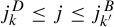 $j^D_k\le j\le j^B_{k'}$
, every slit w of level j is
 $\alpha _kr^{j-j^D_k}$
-normal. Moreover, if
 $j<j^B_{k'}$
, then the cross-products of each slit of level j with its children are less than
 $\delta _j$
and the number of children is at least
 $\rho _j|w|^{r-1}\delta _j$
.
Proof. The case
 $j=j^D_k$
of the first assertion follows from Lemma 6.2, while the remaining cases follow from Proposition 4.16.
When we apply Proposition 4.16, we should first verify if the inequality (4.26) holds, that is, if
 $$ \begin{align} 60q_k^2r^{2(j-j^D_k)}\rho^{N'+3}\le c_0|w|^{(r-1)^2} \end{align} $$
and
 $$ \begin{align} |w|^{(r-1)^2}>c. \end{align} $$
The second condition is given by (5.5). We also note that it is enough to check (6.1) in the case where
 $j=j^D_k$
since the left-hand side increases by a factor
 $r^2$
as j increases by one, while the right-hand side increases by a factor
 $|w|^{(r-1)^3}>q_{k_0}^{3(r-1)}>5>r^2$
. Moreover, since
 $|w|^{(r-1)^2}>q_k^3$
, (6.1) in the case where
 $j=j^D_k$
follows from
 $60\rho ^{N'+3}<c_0q_{k_0}$
, which is guaranteed by the third term in (5.3).
Then, we apply Proposition 4.16 to an
 $\alpha $
-normal slit, and the cross-products with its children are less than
 $1/\alpha $
, which is
 $\delta _j$
if
 $\alpha =\alpha _kr^{j-j^D_k}$
. The number of children is at least
 $$ \begin{align*}\frac{c_0|w|^{r-1}}{4\alpha\rho^{N'+1}} = \rho_j|w|^{r-1}\delta_j. \\[-43pt] \end{align*} $$
Lemma 6.4. Every slit w of level
 $j^B_{k'}$
is
 $(\alpha _k,|w|^{r-1})$
-good.
Proof. Let w be a slit of level
 $j^B_{k'}$
. Lemma 6.3 implies that w is
 $\alpha $
-normal for some
 $\alpha>\alpha _k$
. By the case
 $t=1$
in the definition of normality, this means w is
 $(\alpha ,|w|^{r-1})$
-good, that is, its inverse slope has a convergent whose height is between
 $\alpha |w|$
and
 $|w|^r$
. Since
 $\alpha>\alpha _k$
, the height of this convergent is between
 $\alpha _k|w|$
and
 $|w|^r$
. Hence, w is
 $(\alpha _k,|w|^{r-1})$
-good.
6.1.3 Bounded region
For the levels j satisfying
 $j^B_k\le j< j^C_k, k>k_0$
, we will require the property of
 $(\alpha ,\beta )$
-good instead of normal slits because the length of this region (see part (ii) in Lemma 5.6) is small relative to the decrease of
 $\alpha $
in Lemma 4.2.
The slits of level
 $j+1$
will be constructed by applying Lemma 4.2 to all slits w of level j with the parameters
 $$ \begin{align} \alpha=\alpha_{\tilde{k}}-\frac{j-j^B_k}{2} \quad\text{ and }\quad \beta=|w|^{r-1}. \end{align} $$
For the levels
 $j^B_k\le j< j^C_k, k>k_0$
, we set
 $$ \begin{align*}\delta_j = \frac{4\rho^{N'}}{q_{\tilde{k}}} \quad\text{ and } \quad \rho_j = \frac{c_0}{2}.\end{align*} $$
Lemma 6.5. For
 $j^B_k\le j\le j^C_k$
, every slit w of level j is
 $(\alpha _{\tilde {k}}/2,|w|^{r-1})$
-good. Moreover, if
 $j<j^C_k$
, then the cross-products of each slit of level j with its children are less than
 $\delta _j$
and the number of children is at least
 $\rho _j|w|^{r-1}\delta _j$
.
Proof. First, we note that every slit w of level j is
 $(\alpha ,\beta )$
-good, where
 $\alpha $
and
 $\beta $
are the parameters given in (6.3). Indeed, for
 $j=j^B_k$
, this follows from Lemma 6.4, while for
 $j^B_k<j\le j^C_k$
, it follows from Lemma 4.3. Lemma 5.6(ii) and the third relation in (5.3) imply
 $$ \begin{align*}j-j^B_k\le j^C_k-j^B_k\le\log_r(3M')+4\le \alpha_{\tilde{k}},\end{align*} $$
from which we see that the first assertion holds.
For children constructed using the Lemma 4.2 applied to an
 $(\alpha ,\beta )$
-good slit, the cross-products are less than
 $1/\alpha $
, which is
 $<\delta _j$
, since
 $\alpha \geq \alpha _{\tilde {k}}/2$
. Additionally, since
 $\alpha \le \alpha _{\tilde {k}}$
, the number of children is at least
 $$ \begin{align*}\frac{c_0|w|^{r-1}}{\alpha_{\tilde{k}}} = \rho_j|w|^{r-1}\delta_j\end{align*} $$
giving the second assertion.
Finally, for the levels
 $j=j^C_k$
with
 $k>k_0$
, we set
 $$ \begin{align*}\delta_j = \frac{8\rho^{N'}}{q_{\tilde{k}}} \quad\text{ and } \quad \rho_j = \frac{q_{\tilde{k}}}{16\rho^{N'}q_k}.\end{align*} $$
Lemma 6.6. For any slit w of level
 $j=j^C_k$
with
 $k>k_0$
, the cross-products of w with its children are less than
 $\delta _j$
and the number of children is at least
 $\rho _j|w|^{r-1}\delta _j$
.
Proof. Suppose w is a slit of level
 $j^C_k$
with
 $k>k_0$
. The case
 $j=j^C_k$
of Lemma 6.5 implies w is
 $(\alpha _{\tilde {k}}/2,|w|^{r-1})$
-good. Let u be the Liouville convergent of w indexed by k. By Lemma 3.8, the height
 $q'$
of the next convergent is
 $$ \begin{align*} q'>\frac{q_{k+1}^{1/2}}{\tilde{C}} > q_{k+1}^{1/3r} > (\sup H_{j^C_k})^r \ge |w|^r. \end{align*} $$
Since w is
 $(\alpha _{\tilde {k}}/2,|w|^{r-1})$
-good, we must have
 $|u|\ge \alpha _{\tilde {k}}|w|/2$
so that, by Lemma 4.17, the cross-products of w with its children are
 $$ \begin{align*}< \frac{2|w|}{|u|} \le \frac{4}{\alpha_{\tilde{k}}} = \frac{8\rho^{N'}}{q_{\tilde{k}}}.\end{align*} $$
By Lemma 4.19, the number of children is at least
 $|w|^{r-1}/2q_k = \rho _j|w|^{r-1}\delta _j$
.
The construction of the tree of slits is now complete. In the following, we demonstrate how a Cantor set can be defined using this tree of slits.
6.2 The Cantor set arising from the tree of slits
For a slit w, let
 $I(w)$
denote the interval of length
 $$ \begin{align*} \operatorname{\mathrm{diam}} I(w) = \frac{4}{|w|^{r+1}} \end{align*} $$
centered at the inverse slope of the direction of w. The following lemma provides estimates for the sizes of these intervals and the gaps between them.
Lemma 6.7. [Reference Cheung, Hubert and MasurCHM11, Lemma 5.1]
Assume
 $|w_0|^{r(r-1)}\ge 64$
and
 $\delta _j<({1}/{16})$
. Let
 $w_{j+1}$
be a child of a slit
 $w_j$
of level j. Then:
-
•
$I(w_{j+1})\subset I(w_j)$
; and -
• if
$w^{\prime }_{j+1}$
is another child of
$w_j$
, then
$\operatorname {\mathrm {dist}}(I(w_{j+1}),I(w^{\prime }_{j+1})) \ge {1}/{(16|w_j|^{2r})}.$


Let
 $$ \begin{align*}F_j=\bigcup_w I(w),\end{align*} $$
where the union is taken over all slits of level j. Then, the Cantor set associated with the tree of slits will be defined as
 $$ \begin{align*} F=\bigcap_{j \geq 0} F_j. \end{align*} $$
From (5.6), we have
 $$ \begin{align} |w_0|^{r^j} \le |w_j| \le 5^{{(r^j-1)}/{(r-1)}}|w_0|^{r^j}, \end{align} $$
so that the number of children is at least
 $$ \begin{align} m_j := \rho_j\delta_j|w_0|^{r^j(r-1)}, \end{align} $$
while the smallest gap between the associated intervals is at least
 $$ \begin{align*} \epsilon_j := \frac{1}{16\cdot5^{2r({r^j-1}/{r-1})}|w_0|^{2r^{j+1}}}, \end{align*} $$
by Lemma 6.7. Then, Falconer’s lower bound estimate is
 $$ \begin{align*} \operatorname{\mathrm{HDim}} F \ge \liminf_j \frac{\log (m_0\cdots m_j)}{-\log m_{j+1}\epsilon_{j+1}}. \end{align*} $$
If
 $\lim _{j\to \infty }m_j\epsilon _j=0$
, as is necessarily the case if the length of the longest interval in
 $F_j$
tends to zero as
 $j\to \infty $
, then
 $$ \begin{align} \operatorname{\mathrm{HDim}} F \ge \liminf_j d_j, \end{align} $$
where
 $$ \begin{align} d_j \notag&= \frac{\log m_j}{-\big({m_{j+1}\epsilon_{j+1}}/{m_j\epsilon_j}\big)}\\\notag &= \frac{r^j(r-1)\log|w_0| + \log(\rho_j\delta_j)} {r^j(r^2-1)\log |w_0| + 2r^{j+1}\log5 -\log(\rho_{j+1}\delta_{j+1}/\rho_j\delta_j)}\\&= \frac{1 - {(-\log(\rho_j\delta_j))}/{(r^j(r-1)\log|w_0|)}} {1+r + {(2r\log5)}/{((r-1)\log|w_0|)} + {(\log(\rho_j\delta_j/\rho_{j+1}\delta_{j+1}))}/{(r^j(r-1)\log|w_0|)}}. \end{align} $$
Now, making
 $d_j$
close to
 $\frac 12$
will mean making r close to
 $1$
, and making the terms
 $$ \begin{align} \frac{-\log(\rho_j\delta_j)}{r^j(r-1)\log|w_0|} \end{align} $$
and
 $$ \begin{align} \frac{2r\log5}{(r-1)\log|w_0|} + \frac{\log(\rho_j\delta_j/\rho_{j+1}\delta_{j+1})}{r^j(r-1)\log|w_0|} \end{align} $$
small. In §6.1, we have selected
 $\delta _j$
and
 $\rho _j$
which satisfied each step of construction. Conditions
 $\delta _j < ({1}/{16})$
, as required by Lemma 6.7, and
 $m_j \geq 2$
, as required by Falconer’s estimate, were verified in §6.1, along with the fact that
 $|w_0|$
can be chosen sufficiently large to ensure that
 $d_j$
is close to
 $\frac {1}{2}$
.
First, we verify the hypotheses needed for Falconer’s estimate. Recall the definition
 $m_j=\rho _j|w_0|^{r^j(r-1)}\delta _j$
in (6.5).
Lemma 6.8. We have
 $\delta _j< ({1}/{16})$
and
 $m_j\ge 2$
for
 $j\ge 0$
.
Proof. By the fourth relation in (5.3), we see that
 $\delta _j\le {(8\rho ^{N'})}/{(q_{k_0})} < ({1}/{2^4})$
. Then, we consider two regions divided by the methods of construction. When
 $j^C_k\le j<j^D_k$
, we have
 $\rho _j\delta _j=1/2q_k$
and since
 $|w_0|^{r^{j^C_k}}\ge q_k^{M'}$
, by the definition of
 $j^C_k$
, we have
 $|w_0|^{r^j(r-1)}\ge q_k^{M'/M}\ge q_k^{3M}$
. Then, we have
 $$ \begin{align*}m_j=\frac{q_k^{3M-1}}{2}\ge\frac{2\rho}{c_0}>2\end{align*} $$
by the second relation in (5.3). For
 $j^D_k\le j < j^C_{k'}$
, the expression
 $|w_0|^{r^j(r-1)}$
increases faster than
 $\rho _j\delta _j$
decreases, so it is enough to check the case where
 $j=j^D_k$
, for which, by the above, we have
 $m_j\ge ({c_0}/{\rho })m_{j-1}\ge 2$
.
Next, we calculate the lower bound on the Hausdorff dimension of F. The next lemma shows that it is close to
 $\frac 12$
by the choices made in §5.
Lemma 6.9. We have
 $\liminf _{j\to \infty } d_j>\frac 12-\varepsilon .$
Proof. By (6.7), it is enough to show that the term (6.8) and both terms in (6.9) are bounded by
 $\delta $
. Using the choice of
 $M'$
in (5.1), it would be enough to show that each term is bounded by
 ${Mr}/{M'}$
for all large enough j.
We first consider the expression (6.9). Using (5.5), we see that the first term in (6.9) satisfies
 $$ \begin{align*}\frac{2r\log5}{(r-1)\log|w_0|}\le\frac{2r}{M}.\end{align*} $$
Then, by the choice of
 $\rho _j$
and
 $\delta _j$
in §6.1, we see that for
 $j\neq j^C_{k-1}$
, we have
 $$ \begin{align*}\frac{\rho_j\delta_j}{\rho_{j+1}\delta_{j+1}} \in \bigg\{1,\frac{\rho}{c_0},r, \frac{1}{2\rho^{N'+1} r^{j^B_{k'}-j^D_k-1}}, \bigg \},\end{align*} $$
while for
 $j=j^C_{k-1}$
, we have
 $$ \begin{align*}\frac{\rho_j\delta_j}{\rho_{j+1}\delta_{j+1}} = \frac{2c_0\rho^{N'}q_k}{q_{\tilde{k}}}.\end{align*} $$
Then, in the second case, we have (here,
 $A_j\lesssim B_j$
is an abbreviation for
 $\liminf A_j\le \liminf B_j$
)
 $$ \begin{align*}\frac{\log(\rho_j\delta_j/\rho_{j+1}\delta_{j+1})}{r^j(r-1)\log|w_0|} \le M\bigg(\frac{\log q_k+\log 2c_0\rho^{N'}}{r^{j^C_k-1}\log|w_0|}\bigg) \lesssim \frac{Mr}{M'}\end{align*} $$
since
 $\inf H_{j^C_k}\in I^C_k$
; in the first case, the left-hand side above is
 $\lesssim 0$
.
We now turn to the expression (6.8). For
 $j^C_k\le j<j^D_k$
, we have
 $$ \begin{align*}\frac{-\log(\rho_j\delta_j)}{r^j(r-1)\log|w_0|} \le M\bigg(\frac{\log q_k}{r^{j^C_k}\log|w_0|}\bigg) \le \frac{M}{M'}.\end{align*} $$
Next, consider
 $j^D_k\le j<j^B_{k'}$
. Using
 $jr^{-j}\log r\le 1$
, we have
 $$ \begin{align*} \frac{-\log(\rho_j\delta_j)}{r^j(r-1)\log|w_0|} &\le M\bigg(\frac{\log q_k+(j-j^D_i)\log r+\log(\rho/c_0)}{r^j\log|w_0|}\bigg) \\ &\lesssim \frac{M(\log(q_k)+1)}{r^{j^D_k}\log|w_0|} \lesssim \frac{Mr^5\log q_k}{\log q_{k+1}} < \frac{Mr^5}{N} = \frac{M}{4M'}. \end{align*} $$
Finally, we turn to the possibility that
 $j_i^B\leq j< j_i^C$
(
 $i\ge 1$
). Since
 $j^C_k-j^B_k\le \log _r(3M')+4$
, we have
 $$ \begin{align*} \frac{-\log(\rho_j\delta_j)}{r^j(r-1)\log|w_0|} &\le M\bigg(\frac{\log q_{\tilde{k}}-\log(2c_0\rho^{N'})}{r^{j^B_i}\log|w_0|}\bigg) \lesssim \frac{MM'r^4\log q_{\tilde{k}}}{r^{j^C_k}\log|w_0|} \\ &\le \frac{Mr^4\log q_{\tilde{k}}}{\log q_k} < \frac{Mr^4}{N} < \frac{M}{4M'} \end{align*} $$
and the lemma follows.
The proof of Theorem 1.1 in the case where
 $l_N$
is infinite will be complete with the proof of the following lemma.
Lemma 6.10. If
 $(\unicode{x3bb} ,\mu )$
satisfies (1.1), then
 $F\subset \operatorname {\mathrm {NE}}(X_{\unicode{x3bb} ,\mu },\omega )$
.
Proof. It suffices to check that
 $\sum \delta _j<\infty $
for in that case, every sequence
 $\ldots , w_j, v_j, w_{j+1},\ldots $
constructed above satisfies (2.1) and
 $F\subset \operatorname {\mathrm {NE}}(X_{\unicode{x3bb} ,\mu })$
, by Theorem 2.2. We break the sum into three intervals:
 $j^B_k\le j\le j^C_k$
,
 $j^C_k<j<j_k^D$
, and
 $j_k^D\leq j<j^B_{k'}$
.
Let
 $2n_k=\log _{q_k}q_{k+1}$
be such that
 $q_{k+1}^{1/2}=q_k^{n_k}$
. It follows easily from the definitions that
 $$ \begin{align*}j^D_k-j^C_k < \log_r n_k < \frac{\log\log q_{k+1}}{\log r}\end{align*} $$
so that (1.1) implies
 $$ \begin{align*}\sum_{k\in\ell_N}\sum_{j^C_k<j<j^D_k}|w_j\times v_j| \le \frac{4}{\log r}\sum_{k\in\ell_N}\frac{\log\log q_{k+1}}{q_k}<\infty.\end{align*} $$
Since
 $j_k^C-j_k^B\le \log _r(3M')+4$
, we have
 $$ \begin{align*}\sum_{k\in\ell_N}\sum_{j^B_k\le j\le j^C_k}|w_j\times v_j| \le \sum_{k\in\ell_N} \frac{8\rho^{N'}(\log_r(3M')+4)}{q_{\tilde{k}}}<\infty.\end{align*} $$
Finally,
 $$ \begin{align*}\sum_{k\in\ell_N}\sum_{j^D_k\le j< j^B_{k'}}|w_j\times v_j| \le \sum_{k\in \ell_N}\frac{2R\rho^{N'}}{q_k}<\infty,\end{align*} $$
where
 $R=\sum _{j\ge 0}r^{-j}$
.
7 A special case where
$\ell _N$
is finite

We recall the definition of
 $\ell _N$
given in (4.1). If
 $\ell _N$
is finite, then we can choose a large number
 $k_0$
such that
 $$ \begin{align} q_{k_0}>\max(480\rho^{N'+3}/c_0,c^M,48C') \end{align} $$
and
 $q_k\notin \ell _N$
for all
 $k\geq k_0$
.
We begin by choosing a slit
 $w_0$
with
 $|w_0|>q_{k_0}^{M'}$
such that
 $w_0$
is not miracle and
 $w_0$
has a convergent q with
 $|w_0|<q<|w_0|^r$
.
Lemma 7.1. There exists some slit
 $w_0$
with
 $|w_0|>q_{k_0}^{M'}$
such that
 $w_0$
has a convergent q with
 $|w_0|<q<|w_0|^r$
.
Proof. Let w with
 $|w|>q_{k_0}^{M'}$
and q be the first convergent of w such that
 $q>3|w|$
. We denote
 $\beta ={(q+1)}/{|w|}$
and if
 $\beta <|w|^{r-1}$
, we finish the proof. Otherwise,
 $\beta \geq |w|^{r-1}$
. By definition, w is
 $(3,\beta )$
-good. Then, by applying Lemma 4.3,
 $$ \begin{align*}\#\Delta(w,3,\beta)\geq \frac{c_0\beta}{3}\geq\frac{c_0|w|^{r-1}}{3}>180.\end{align*} $$
Let
 $2v=2(p,q)\in \Delta (w,3,\beta )-w$
and
 $w'=w+kv=(\unicode{x3bb} +m',\mu +n')$
be such that
 $|w'|^{r-1}>\beta $
for some integer
 $k\geq 2$
. Then, we have
 $$ \begin{align*} \bigg|\frac{\unicode{x3bb}+m'}{\mu+n'}-\frac{p}{q}\bigg| = \frac{|w'\times v|}{|w'||v|}<\frac{|w\times v|}{k|v|^2}<\frac{1}{2q^2}. \end{align*} $$
Then, by (2.3), v is a convergent of
 $w'$
. Let
 $q'$
be the height of the next convergent of
 $w'$
. Then, by (2.2), we have
 $$ \begin{align} \frac{1}{q'+q} < \frac{|w\times v|}{|w'|} < \frac{1}{q'}. \end{align} $$
From the left-hand side above, we have
 $$ \begin{align*}q'> \frac{|w'|}{|w\times v|} - q > \bigg(3-\frac{1}{k}\bigg)|w'|>2|w'|\end{align*} $$
for
 $|w'|>k|v|=kq$
, and from the right-hand side of (7.2),
 $$ \begin{align*}q' < \frac{|w'|}{|w\times v|} < \beta|w'|<|w'|^r\end{align*} $$
for
 $|w'|^{r-1}>\beta $
.
By Lemma 4.8, we can always choose a slit w that satisfies Lemma 7.1 that is not a miracle slit. The next lemma shows that this slit is
 $\alpha $
-normal where
 $\alpha =({2}/{\rho ^{N'}})$
. (To simplify the exposition, we choose to omit the case when
 $(\unicode{x3bb} , \mu )$
is uniquely rational, as the proof is quite similar to that of Lemmas 4.6 and 7.2.)
Lemma 7.2. Let w with
 $|w|>q_{k_0}^{M'}$
is not a miracle slit. If w is
 $(2,|w|^{r-1})$
-good, then it is
 $\alpha $
-normal.
Proof. We use the similar argument with the proof in Lemma 4.9 and prove by contradiction. Assume w is not
 $\alpha $
-normal. Let
 $v^\prime =(p^\prime ,q^\prime )$
be the next convergent. If
 $q^\prime \leq |w|^{1+(r-1)N^\prime }$
, then w is
 $\alpha $
-normal by definition. So, we must have
 $$ \begin{align*} q^\prime>|w|^{1+(r-1)N^\prime}. \end{align*} $$
Then,
 $$ \begin{align*} \frac{q^\prime}{|w|}>|w|^{(r-1)N^\prime}\geq q^{(1-{1}/{r})N^\prime}=q^{4(N+1)}. \end{align*} $$
So, it can be deduced that
 $$ \begin{align*} |w\times v|<\frac{|w|}{|v^\prime|}<\frac{1}{q^{4(N+1)}}. \end{align*} $$
Writing
 $w=(\unicode{x3bb} +m,\mu +n)$
, we have
 $$ \begin{align*} |q(\unicode{x3bb}+m)-p(\mu+n)|<\frac{1}{q^{4(N+1)}}. \end{align*} $$
Equivalently,
 $$ \begin{align} |q\unicode{x3bb}-p\mu+(qm-pn)|<\frac{1}{q^{4(N+1)}}. \end{align} $$
Let
 $(\ell ,\eta _j)$
be the pair of lines associated to w for
 $l=(q,-p,qm-pn)$
by definition. Since w is not a miracle slit, by hypothesis, we have only two cases to consider.
Case 1:
 $\ell \neq \pm \eta _j$
. By the definition of nearest rational affine line, we have
 $$ \begin{align} |a_j\unicode{x3bb}+b_j\mu+c_j|<\frac{1}{q^{4(N+1)}}. \end{align} $$
Note that
 $\ell $
and
 $\eta _j$
are not parallel. If not, we notice the distance between
 $\ell $
and
 $\eta $
is larger than
 ${1}/{2q}$
, while the distances from
 $(\unicode{x3bb} ,\mu )$
to
 $\ell $
and
 $\eta _j$
are both less than
 ${1}/{(q^{4(N+1)})}$
, which is a contradiction.
The intersection point of
 $\ell $
and
 $\eta _j$
is
 $$ \begin{align*} \bigg(\frac{c_jp+(qm-pn)b_j}{a_jp+b_jq},\frac{c_jq+(pn-qm)a_j}{a_jp+b_jq}\bigg) =: \bigg(\frac{p_{h,1}}{q_h},\frac{p_{h,2}}{q_h}\bigg) =: \dot{v}_h \end{align*} $$
in lowest terms. Recalling that
 $\eta _j^-\le \ell ^-$
, we have
 $$ \begin{align*}q_h\leq |a_jp+b_jq| \leq 2\eta_j^-q\leq 4q^2.\end{align*} $$
From (7.3) and (7.4), it follows that
 $$ \begin{align*} \|(\unicode{x3bb},\mu)-\dot{v}_h\|_{\infty}<\frac{2\max(|a_j+q|,|b_j+p|)}{q^{4(N+1)}|a_jp+b_jq|}<\frac{6}{q^{4N+3}}. \end{align*} $$
By the definition of
 $C^\prime $
,
 $$ \begin{align*} \|(\unicode{x3bb},\mu)-\dot{v}_h\| < C^\prime\|(\unicode{x3bb},\mu)-\dot{v}_h\|_{\infty}<\frac{1}{2(4q^2)^2}<\frac{1}{2q_h^2}, \end{align*} $$
which implies that
 $\dot {v}_h$
is a best approximation vector. By (2.4), we have
 $$ \begin{align} \frac{1}{2q_hq_{h+1}}<\frac{6C'}{q^{4N+3}}. \end{align} $$
Since
 $q>|w|>48C'$
, we have
 $$ \begin{align*} q_{h+1}>\frac{q^{4N+3}}{12C'q_h}>\frac{q^{4N+1}}{48C'}>q^{3N}>(4q^2)^N\geq(q_h)^N \end{align*} $$
from which it follows that
 $h\in l_N$
. So, by definition of
 $q_{k_0}$
, we have
 $q_{h+1}\leq q_{k_0}$
, while
 $q_{h+1}>q^{3N}>q_{k_0}^{3N}$
, which is a contradiction.
Case 2:
 $\ell =\pm \eta _j$
and
 $$ \begin{align} \eta_{j+1}^-<(\eta_j^-)^{r^3}<(2q)^{r^3}. \end{align} $$
By the definition of nearest oriented affine hyperplane, we have
 $$ \begin{align} |a_{j+1}\unicode{x3bb}+b_{j+1}\mu+c_{j+1}|<\frac{1}{q^{4(N+1)}}. \end{align} $$
The intersection of
 $\eta _j$
and
 $\eta _{j+1}$
is
 $$ \begin{align*} \bigg(\frac{c_{j+1}p+(qm-pn)b_{j+1}}{a_{j+1}p+b_{j+1}q}, \frac{c_{j+1}q+(pn-qm)a_{j+1}}{a_{j+1}p+b_{j+1}q}\bigg)=: \bigg(\frac{p_{h,1}}{q_h},\frac{p_{h,2}}{q_h}\bigg) =: \dot{v}_h \end{align*} $$
in lowest terms. So, it follows by (7.6) and
 $r^3<3/2$
that
 $q_h\leq a_{j+1}p+b_{j+1}q\leq 2|\eta _{j+1}|q\leq 2^{r^3+1}q^{r^3+1} <q^3$
. Then, from (7.3) and (7.7), it follows that
 $$ \begin{align*} \|(\unicode{x3bb},\mu)-\dot{v}_h\|_{\infty}<\frac{2\max(|a_{j+1}+q|,|b_{j+1}+p|)}{q^{4(N+1)}|a_{j+1}p+b_{j+1}q|}<\frac{1}{q^{4N+1}}. \end{align*} $$
With the same argument in Case 1, we have
 $$ \begin{align*} \|(\unicode{x3bb},\mu)-\dot{v}_h\| < C^\prime\|(\unicode{x3bb},\mu)-\dot{v}_h\|_{\infty}<\frac{1}{2(4q^2)^2}<\frac{1}{2q_h^2}, \end{align*} $$
which implies that
 $\dot {v}_h$
is a best approximation vector. Since
 $$ \begin{align} \frac{1}{2q_hq_{h+1}}<\frac{C'}{q^{4N+1}}, \end{align} $$
we have
 $$ \begin{align*} q_{h+1}>\frac{q^{4N+1}}{2C'q_h}>(q^3)^N>(q_h)^N, \end{align*} $$
which implies
 $h\in l_N$
. We follow the previous proof in Case 1 and get
 $q_{h+1}\leq q_{k_0}$
, which is also impossible.
Then, one can check that the conclusion in Proposition 4.16 will hold for slits w when replacing the first norm condition by
 $|w|>q_{k_0}^{M'}$
.
We set
 $ \alpha _j=\alpha r^j, \delta _j = {1}/{(\alpha r^j)}=({\rho ^{N'}}/{2r^j})$
and
 $\rho _j=({c_0}/{4\rho ^{N'+1}})$
.
Lemma 7.3. For
 $j\geq 1$
, every slit w of level j is
 $\alpha _kr^{j}$
-normal. Moreover, the cross-products of each slit of level j with its children are less than
 $\delta _j$
and the number of children is at least
 $\rho _j|w|^{r-1}\delta _j$
.
Proof. The case
 $j=0$
of the first assertion follows from Lemma 7.2, while the remaining cases follow from Lemma 7.2 and Proposition 4.16.
When we apply Proposition 4.16, we should first verify that the inequality (4.26) holds, that is, if
 $$ \begin{align} 60q_{k_0}^2 r^{2j}\rho^{N'+3}\le c_0|w|^{(r-1)^2} \end{align} $$
and
 $$ \begin{align} |w|^{(r-1)^2}>c. \end{align} $$
The second condition is given by (5.5). We also note that it is enough to check (7.9) in the case where
 $j=0$
since the left-hand side increases by a factor
 $r^2$
as j increases by one, while the right-hand side increases by a factor
 $|w|^{(r-1)^3}>q_{k_0}^{3(r-1)}>5>r^2$
. Moreover, since
 $|w|^{(r-1)^2}>q_k^3$
, (7.9) in the case where
 $j=0$
follows from
 $480\rho ^{N'+3}<c_0q_{k_0}$
, which is guaranteed by the third term in (5.3).
Then, we apply Proposition 4.16 to an
 $\alpha $
-normal slit, the cross-products with its children are less than
 $1/\alpha $
, which is
 $\delta _j$
if
 $\alpha =\alpha _kr^{j}$
. The number of children is at least
 $$ \begin{align*} \frac{c_0|w|^{r-1}}{4\alpha\rho^{N'+1}} = \rho_j|w|^{r-1}\delta_j. \\[-43pt] \end{align*} $$
Next, we need to first demonstrate that the tree structure constructed under this special case satisfies the conditions required in Lemma 6.7. By verifying condition (2.1), we can then prove that a subset of non-ergodic directions can be constructed. Finally, using the Falconer’s lower bound estimate (6.6) in §6, we conclude that its Hausdorff dimension is
 $1/2$
.
Lemma 7.4. There exists
 $J \geq 0$
such that for all
 $j \geq J$
,
 $\delta _j < ({1}/{16})$
and
 $m_j \geq 2$
.
Proof. By definition,
 $\delta _j = ({\rho ^{N'}}/{2r^j})$
. There exists J such that
 $\delta _J \leq ({1}/{16})$
. Moreover, since
 $m_j = \rho _j|w_0|^{r^j(r-1)}\delta _j$
and the growth rate of
 $|w_0|^{r^j(r-1)}$
exceeds the decay rate of
 $\rho _j\delta _j$
, it suffices to verify the case where
 $j = 1$
. For
 $j = 1$
, using the fact that
 $|w|^{r-1}> q_{k_0} > ({16\rho }/{c_0})$
, we have
 $$ \begin{align*} m_1 \geq \frac{c_0|w|^{r-1}}{8\rho} \geq 2. \\[-43pt] \end{align*} $$
We now prove that the constructed set
 $F \subset \operatorname {\mathrm {NE}}(X_{\unicode{x3bb} ,\mu },\omega )$
.
Lemma 7.5. For the J constructed in Lemma 7.4, when
 $j \geq J$
,
 $\sum \delta _j < \infty $
.
Proof.
 $$ \begin{align*} \sum_{j\geq J}|w_j\times v_j| \leq \sum_{j\geq J}\frac{\rho^{N'}}{2r^j}<\infty. \\[-45pt] \end{align*} $$
Finally, we apply the Falconer-type lower bound on the dimension from §6.2 to the estimate (6.6) and deduce that the Hausdorff dimension is equal to
 $\frac {1}{2}$
.
Lemma 7.6. We have
 $$ \begin{align*} \liminf_{j \to \infty} d_j> \tfrac{1}{2} - \varepsilon. \end{align*} $$
Proof. By (6.7), it suffices to show that both terms in (6.8) and (6.9) are controlled by
 $\delta $
. Using the choice of M and
 $M'$
in (5.1), for sufficiently large j, it is enough to ensure that each term is small.
We first consider the expression in (6.9). By (7.1), the first term satisfies
 $$ \begin{align} \frac{2r\log 5}{(r-1)\log|w_0|} \leq \frac{2r}{M}. \end{align} $$
Moreover, by the definition of
 $\rho _j$
and
 $\delta _j$
, we have
 $$ \begin{align} \frac{\log(\rho_j\delta_j/\rho_{j+1}\delta_{j+1})}{r^j(r-1)\log|w_0|} \leq \frac{\log r}{(r-1)\log|w_0|} \lesssim 0. \end{align} $$
Now, we consider the expression in (6.8). For sufficiently large j, since
 $jr^{-j} \log r \leq 1$
, we obtain
 $$ \begin{align} \frac{-\log(\rho_j\delta_j)}{r^j(r-1)\log|w_0|} \leq M \bigg( \frac{\log 8 + j \log r + \log(\rho/c_0)}{r^j \log|w_0|} \bigg) \lesssim \frac{M}{M'}. \end{align} $$
This completes the proof.