The goal of the Veterans Health Administration (VA) Clostridioides difficile infection (CDI) prevention initiative, launched in July 2012, was to reduce hospital-onset healthcare-facility–associated CDI cases by 30% nationwide within 2 years of implementing the program. The program is comprised of a 4-part bundle emphasizing (1) environmental management, (2) hand hygiene, (3) contact precautions for suspected or confirmed CDI cases, and (4) an institutional culture change in which infection control becomes everyone’s business. This intervention was similar to the bundle implemented in 2007 to prevent methicillin-resistant Staphylococcus aureus healthcare-associated infections (HAIs) in VA medical centers.Reference Evans, Kralovic, Simbartl, Jain and Roselle1
To evaluate the performance of the CDI prevention initiative, a multivariable regression model was developed for the calculation of standardized infection ratios (SIRs). This dividend of observed over predicted healthcare-associated infections takes differences among facilities into account and allows better interfacility comparisons. A 15% decline (P = .01 for the trend) in CDI rates among VA acute-care facilities nationwide from July 2012 through March 2015 was documented using SIRs.Reference Evans, Kralovic, Simbartl, Jain and Roselle2 These data suggested progress, but the outcome was clearly short of the goal.
Efforts were then undertaken to find facilities within the VA system where prevention would have the greatest overall impact on the national rate. Although SIRs showed performance relative to a preintervention baseline, they did not provide insight into where resources for additional improvement should be invested for the greatest impact on future overall CDI rates. For instance, a smaller VA facility with 4 observed CDI cases had an SIR of 3.32, whereas a larger facility with 82 observed cases had an SIR of 1.00. We postulated that focusing resources on the larger facility and preventing CDI cases to bring its SIR down 30% (per the goal) might provide greater systemwide benefits than targeting the smaller facility, even though its SIR was higher.
Calculation of cumulative attributable difference (CAD) as recommended by the National Health and Safety Network (NHSN) might overcome the shortcoming of focusing solely on SIRs because it estimates the actual number of cases that must be prevented to reach a goal.Reference Soe, Gould, Pollock and Edwards3 Facilities can be ranked by their CADs, and those with the highest numbers can be targeted for prevention efforts.
Methods
We used previously described CDI case definitions and methods of data collection, evaluation, and reporting.Reference Evans, Simbartl, Kralovic, Jain and Roselle4 The CDI cases were identified by a positive diagnostic laboratory test (LabID event). From October 2010 through September 2017, a hospital-onset healthcare-facility–associated (HO-HCFA) CDI case was defined as any nonduplicate or nonrecurrent positive CDI laboratory diagnostic test collected >48 hours after admission. In October 2017, the definition was revised to better align with NHSN definitions. A case was identified as a positive LabID event 4 or more days after admission, and observation days were included in the calculation of patient days.
CAD values were calculated using this equation:
 $${\rm{CAD}} = {\rm{observed}} - \left( {{\rm{predicted}} \times {\rm{SI}}{{\rm{R}}_{{\rm{goal}}}}} \right)$$
where predicted values were derived from the VA multivariable model,Reference Evans, Kralovic, Simbartl, Jain and Roselle2 observed values were those recorded for the facility from April 2014 to March 2015 and were used in the SIR numerator, and the SIRgoal was 0.7.Reference Soe, Gould, Pollock and Edwards3
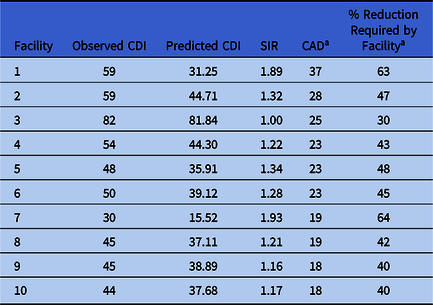
Of the 127 VA facilities, 35 (28%) had a pooled annual SIR > 1.0 in the last 12 months of the analysis period (April 2014–March 2015). During this time, 2,436 observed and 2,858 predicted HO-HCFA CDI cases were recorded for all 127 facilities. Using this equation, we calculated that 435 total CDIs would need to be prevented to reach the 30% nationwide reduction goal within 1 year. This goal could be achieved by targeting 27 facilities with the highest CAD values when sites were ranked in decreasing order according to their individual CADs. Given the investment in time needed to work with all 27 facilities, we chose to focus on the 10 hospitals with the highest CAD values, which were located geographically throughout the United States (Table 1). We predicted that reducing the 233 CDI cases in these 10 hospitals would achieve an SIRgoal of 0.77.
Hospital-Onset Healthcare-Facility–Associated Clostridioides difficile Infection (CDI) Cumulative Attributable Differences (CADs) for VA Acute-Care Facilities Ranked by CAD

Note. SIR, standardized infection ratio.
a To meet SIRgoal = 0.7.
Personnel at these 10 facilities were contacted by phone beginning in August 2015 to convey the results of the CAD analysis and to discuss ways to bring down local HO-HCFA CDI rates. The calls followed a specific agenda, and generally, consisted of personnel from the VA National Infectious Diseases Service in Cincinnati, Ohio, personnel from local facility hospital infection prevention and control, infectious diseases, laboratory, environmental management, and top management, and representatives from VA regional oversight offices. All 10 facilities had received their first phone call by January 2016. The facilities were subsequently contacted at ~4–6-month intervals through September 2019 to discuss progress.
The trend in nationwide HO-HCFA CDI rates from July 2012 through July 2015 (before facility conference calls were implemented) was compared to the trend during full implementation of this intervention (January 2016 through September 2019) using linear regression.
The dissemination of findings that resulted from review of national VHA operational data sets beyond programmatic needs has been reviewed and approved by the institutional review board at the University of Cincinnati, which is the institutional review board of record for the Cincinnati VA Medical Center.
Results
Nationwide, there were 4,575,316 admissions, 25,005,923 patient days, and 20,048 hospital-onset healthcare-facility–associated CDI cases during the analysis period from October 2010 through September 2019.
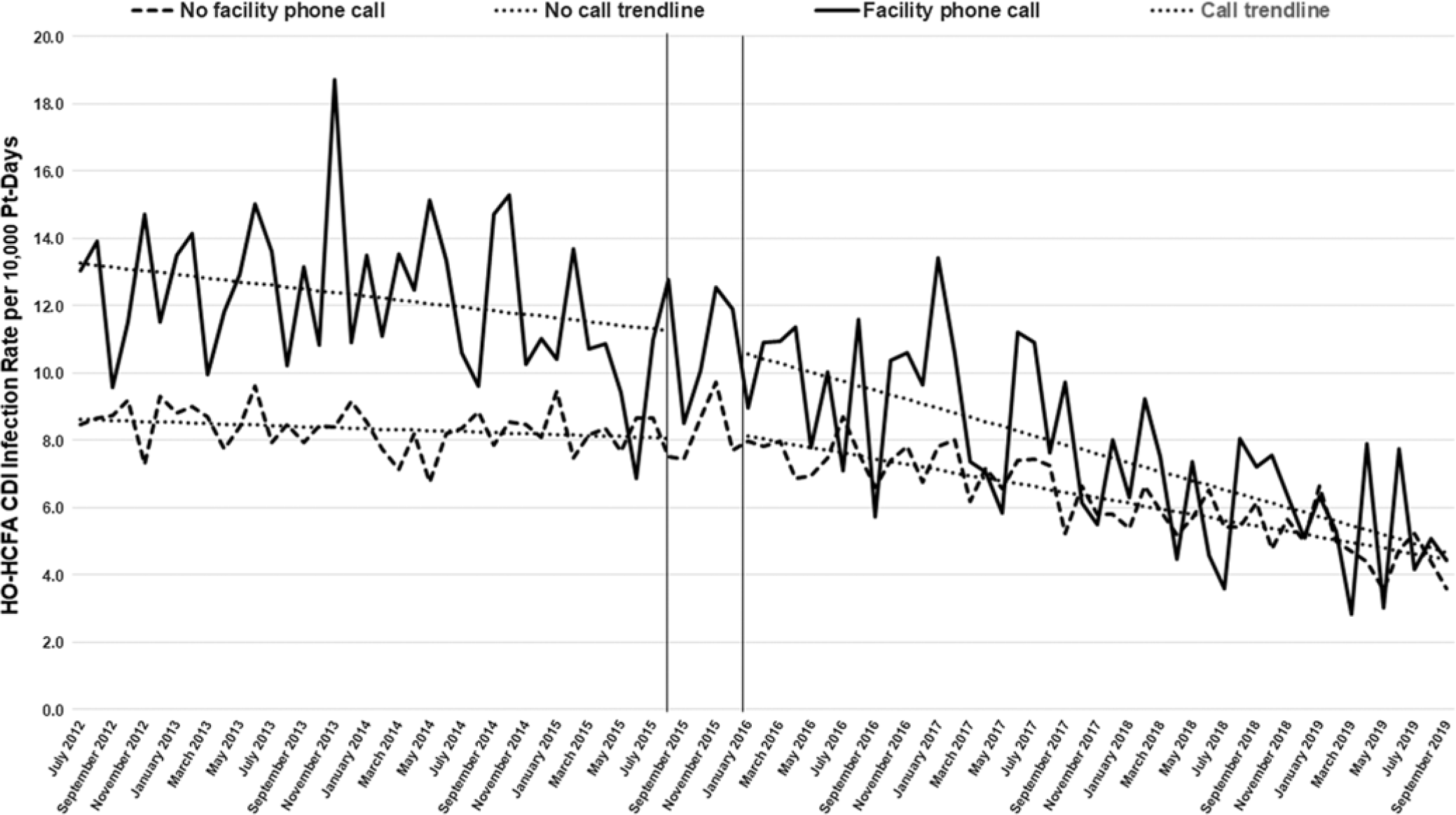
HO-HCFA CDI rates in all 127 facilities trended downward significantly during the baseline period (Fig. 1), which has been reported previously.Reference Evans, Kralovic, Simbartl, Jain and Roselle2 There was a significant decline (P < .0001) in nationwide HO-HCFA CDI rates after the implementation of the process improvement program in January 2016 for both intervention and nonintervention facilities compared to the preimplementation period (October 2012–August 2015) (Fig. 1). The change in the HO-HCFA CDI definition in October 2017 did not change the slope of the decline in rates during the implementation phase (P = .71). The HO-HCFA CDI rate in the 10 facilities with the highest CADs declined 56% during the process improvement period compared to a 44% decline in the 117 nonintervention facilities (P = .03) (Fig. 1). The overall decline in VA nationwide HO-HCFA CDI SIR values since the inception of the program in 2012 was 37%.
VHA Clostridioides difficile hospital-onset healthcare facility-associated (HO-HCFA) infection rate per 10,000 patient days in 10 intervention facilities (solid line) and 117 nonintervention facilities (dashed line) from July 2012 through September 2019. Vertical lines demarcate the run-in period for implementation of the targeted intervention. A significant decline occurred in nationwide HO-HCFA CDI rates after implementation of the process improvement program in January 2016 for both intervention and nonintervention facilities compared to the preimplementation period (October 2012 through August 2015) (P < .0001). The HO-HCFA CDI rate in the 10 facilities with the highest cumulative attributable differences (CADs) declined 56% during the process improvement period compared to a 44% decline in the 117 nonintervention facilities (P = .03).

Discussion
Standardized infection ratios adjust HAI rates by accounting for differences in facility size, disease admission prevalence, type of laboratory testing, involvement in healthcare provider training, and other measures of complexity in an effort to “level the playing field” when comparing facilities. This ratio of observed to predicted infections is useful in determining whether a facility meets a predetermined standard, but it is an abstract metric that does not readily translate into an absolute number of HAIs that must be prevented to reach a reduction goal.
The CAD metric was introduced by NHSN in the context of catheter-associated urinary tract infections (CAUTIs) as a way to translate SIRs into an absolute number of HAIs that must be prevented to achieve a prespecified reduction goal.Reference Soe, Gould, Pollock and Edwards3 It was suggested that for this HAI, and when generalized to others, it would be useful for conceptualizing the magnitude of a problem when appropriating resources and might serve as a metric for tracking and reporting progress. CADs could be used within a facility or in large healthcare systems, such as NHSN, to identify locations where a disproportionate number of HAIs occur and to help prioritize prevention efforts.
We achieved a statistically significant decline in CDI rates nationwide coincident with application of the CAD approach to our process improvement program. The decline in CDI rates in the intervention facilities was significantly greater than that in concurrent nonintervention facilities. Targeting 10 facilities seemed sufficient, although we may have had more of an impact by targeting additional facilities with high CAD values. In our case, the effort required had to be balanced with the resources available. Notably, facilities were ranked again using the CAD approach using data from October 2017 through February 2019. Only 1 of the facilities contacted for the process improvement efforts presented here was still in the top 10, suggesting that this tool is useful for continuous quality improvement.
In the analysis of CAUTIs in the NHSN, the HAI reduction goal could be reached by targeting a smaller number of facilities (8%) when they were ranked according to their CAD values compared to when they were ranked according to their SIRs (19%).Reference Soe, Gould, Pollock and Edwards3 In our analysis of CDIs in the smaller VA healthcare system, the difference was not as large (21% for CADs and 29% for SIRs), although the SIR ranking resulted in the identification of more facilities with ≤1 case per month. In these facilities, the average frequency of HAIs might not be different than what might occur by chance alone, thereby raising the question of whether an expenditure of time and effort in improving infection prevention and control practices is justified or even necessary.
In the present research, we did not test for an association between the number of facilities targeted for intervention and the size of the overall effect on CDI rates, nor did we test for the minimum number of facilities that could be targeted and still provide maximal benefit. Thus, we cannot comment on the number of facilities needed for an optimal effect.
The decline in CDI rates in all facilities nationwide since 2012 (Fig. 1) may have been the result of implementation of the VA CDI prevention initiative with dissemination of the “VHA Guideline for Prevention of Clostridium difficile Infections in Acute Care Facilities.” To our knowledge, no novel interventions or changes in definitions or testing methods were introduced systemwide to explain the dramatic downturn in CDI rates in both intervention and nonintervention groups beginning in January 2016 coincident with the implementation of our targeted quality improvement initiative.
Common areas for improvement were identified among the 10 targeted facilities: lack of quantitative assurance that environmental cleaning was undertaken properly, staffing issues with infection prevention and control, delay in initiation of contact precautions prior to fecal testing results, and inappropriate testing for patients recently given laxatives. Because the calls generally had representation from the VA oversight region for the facility, it is likely that attention was drawn to CDI for other facilities in the regional networks. Thus, the decline in the overall rate may have been the effect of targeting facilities with the highest CAD values consistent with the theory of this approach.
Focusing on facilities with a larger burden of HAIs, as identified by the CAD analysis, might make better use of process improvement resources in a large healthcare system; this is a low-cost intervention that is not labor intensive. Consistent with the effort, the VA has achieved a hospital-onset healthcare-associated CDI SIR decline of 37% overall, exceeding the initial goal of 30%.
Acknowledgments
We thank the VA Under Secretary for Health, the Deputy Under Secretary for Health for Policy and Services, the VA MRSA/MDRO Taskforce, the MRSA/MDRO prevention coordinators, infection prevention and control professionals, infectious diseases specialists, and clinical laboratory personnel at each facility for support of the MDRO prevention initiatives and their hard work and dedication toward improving the healthcare of America’s Veterans. Thanks also to the CDI Data Workgroup and MDRO Prevention Office staff for their educational activities and help with data validation and cleaning.
Financial support
No financial support was provided relevant to this article.
Conflicts of interest
All authors report no conflicts of interest relevant to this article.