Introduction
Huntington's disease (HD) is an autosomal dominant neurological disease, characterized by motor, cognitive and psychiatric features (Craufurd & Snowden, Reference Craufurd and Snowden2002; Kremer, Reference Kremer2002; White, Vasterling, Koroshetz, & Myers, Reference White, Vasterling, Koroshetz and Myers1992). Chorea in HD significantly impairs patients’ activities of daily living (ADL). However, poor quality of life in HD is directly associated with functional decline and not the severity of motor symptoms alone (Ho, Gilbert, Mason, Goodman, & Barker, Reference Ho, Gilbert, Mason, Goodman and Barker2009). Importantly, alike patients with HD, also individuals with Parkinson's disease (PD) and cervical dystonia (CD) develop involuntary movements that have been linked to the dysfunction of basal ganglia circuits (see: Draganski, Thun-Hohenstein, Bogdahn, Winkler, & May, Reference Draganski, Thun-Hohenstein, Bogdahn, Winkler and May2003; Jankovic, Reference Jankovic2005). Moreover, choreic movements, typical and quite stable during the day in HD, appear also in advanced PD as a disease-specific drug-induced dyskinesias (Schrag, Jahanshahi, & Quinn, Reference Schrag, Jahanshahi and Quinn2000), associated with the “on” state and with better motor function (Jankovic, Reference Jankovic2005). Thus, since patients with HD, PD, and CD present with motor symptoms discernible to a neurologically naive observer, they may all suffer because of social stigmatization.
Of interest, it has been recently shown that, despite marked and progressive disability, patients with HD frequently exhibit limited self-awareness of motor, cognitive, and psychiatric symptoms (Deckel & Morrison, Reference Deckel and Morrison1996; Ho, Robbins, & Barker, Reference Ho, Robbins and Barker2006; Hoth et al., Reference Hoth, Paulsen, Moser, Tranel, Clark and Bechara2007; Snowden, Craufurd, Griffiths, & Neary, Reference Snowden, Craufurd, Griffiths and Neary1998; Vitale et al., Reference Vitale, Pellecchia, Grossi, Fragassi, Cuomo, Di Maio and Barone2001), a phenomenon known as anosognosia or, in less severe cases, as anosodiaphoria (see: Heilman & Harciarek, Reference Heilman and Harciarek2010). Moreover, there is evidence to suggest that poor insight may even precede clinical diagnosis of HD (Duff et al., Reference Duff, Paulsen, Beglinger, Langbehn, Wang and Stout2010). By comparison, in PD, patient–proxy agreement is typically satisfactory in non-demented patients with regard to motor disability, executive function, and quality of life (QoL) (Fleming, Cook, Nelson, & Lai, Reference Fleming, Cook, Nelson and Lai2005; Leritz, Loftis, Crucian, Friedman, & Bowers, Reference Leritz, Loftis, Crucian, Friedman and Bowers2004; Martínez-Martín et al., Reference Martínez-Martín, Benito-León, Alonso, Catalan, Pondal, Tobias and Zamarbide2003; Mathias, Reference Mathias2003; McRae, Diem, Vo, O'Brien, & Seeberger, Reference McRae, Diem, Vo, O'Brien and Seeberger2002). Of note, self-awareness of motor symptoms in CD has never been investigated.
Nonetheless, to date, there is only one comparative study addressing the question of unawareness of dyskinesias in HD and PD (Vitale et al., Reference Vitale, Pellecchia, Grossi, Fragassi, Cuomo, Di Maio and Barone2001). The results of this study indicate that in PD the unawareness seems to be inversely related with severity of dyskinesias, while in HD it is directly related to disease duration and its severity. The interpretation of these findings is, however, limited by small sample sizes of both subject with HD and PD. Thus, it remains unclear whether cognitively comparable patients with HD and PD are similarly (un)aware of choreic movements, as underestimation of such movements was reported in HD (Snowden et al., Reference Snowden, Craufurd, Griffiths and Neary1998; Vitale et al., Reference Vitale, Pellecchia, Grossi, Fragassi, Cuomo, Di Maio and Barone2001), PD (Vitale et al., Reference Vitale, Pellecchia, Grossi, Fragassi, Cuomo, Di Maio and Barone2001), drug-induced dyskinesias in schizophrenia (Caracci, Mukherjee, Roth, & Decina, Reference Caracci, Mukherjee, Roth and Decina1990), and in choreas other than HD (Shenker, Wylie, Fuchs, Manning, & Heilman, Reference Shenker, Wylie, Fuchs, Manning and Heilman2004).
Several factors are believed to contribute to poor self-awareness of symptoms in HD: (1) cognitive: lower cognitive status, memory impairment, cognitive control deficits; (2) emotional: avoidance coping strategies, mood; (3) disease related: disease severity and sensory deficit (the latter in case of awareness of motor symptoms) (see: Hoth et al., Reference Hoth, Paulsen, Moser, Tranel, Clark and Bechara2007; Snowden et al., Reference Snowden, Craufurd, Griffiths and Neary1998).
This study aimed at assessing self-awareness of motor symptoms and ADL impairment in HD in comparison to PD (both with dyskinesias, PDdys; and without them, PDndys) and CD. A direct comparison of patients with HD and PDdys (with equal cognitive status) enabled assessing perception of choreic movements as an early, persistent, and core symptom (in HD), and as a late and variable symptom (PDdys). Also, by comparing individuals with PD who did with those who did not develop dyskinesias, we investigated the perception of parkinsonism at different disease stages. PDndys and CD served as reference groups. Our study used a larger N than previous studies for HD/PD comparisons, a video basis for judgment of motor symptoms instead of questionnaires/interview that were previously applied (Snowden et al., Reference Snowden, Craufurd, Griffiths and Neary1998; Vitale et al., Reference Vitale, Pellecchia, Grossi, Fragassi, Cuomo, Di Maio and Barone2001) and control populations to verify the following hypotheses.
Based on the clinico-pathological features of each of these conditions, we expected that, if anosognosia is a product of prefrontal pathology deficits in self-awareness of the disease-specific symptoms should be primarily identified in HD and PDdys groups. If so, anosognosia/anosodiaphoria of motor symptoms would be expected to correlate with the performance on cognitive measures of dorsolateral prefrontal function. Alternatively, self-awareness of symptoms may be more deficient in HD than in PD, as it seems to be one of the early symptoms of HD (Duff et al., Reference Duff, Paulsen, Beglinger, Langbehn, Wang and Stout2010), probably resulting from a more widespread neurodegeneration process encompassing frontostriatal and orbitofrontal–limbic pathways (Douaud et al., Reference Douaud, Behrens, Poupon, Cointepas, Jbabdi, Gaura and Remy2009). Such lesions may, in turn, lead to a failure to attach significant negative value to particular impairments in behavior.
Summing up the study aimed at assessing self-awareness of symptoms in HD with reference to PD and CD with the emphasis on the self-awareness of choreic movements in HD and elucidating the underlying causes of poor self-awareness of symptoms in HD.
Methods
Procedure
The patients were recruited from a specialty outpatient Movement Disorders Clinic and Dystonia Center in St. Adalbert Hospital in Gdansk, Poland. All consecutive patients with the diagnosis of HD, PD, or CD were asked to participate in the study by the examiner trained in movement disorders (by J.S., W.S., or M.S.). The duration of patients’ recruitment was 8 months, and patients were enrolled if they agreed to participate and fulfilled the inclusion criteria during the neurological visit. All HD patients recruited for the study participated in the REGISTRY study by European Huntington's Disease Centre in Gdansk. All the participants volunteered for the study.
Clinical diagnosis, supported by neuroimaging (Computed Tomography or Magnetic Resonance Imaging) and laboratory tests, was established by a movement disorders specialist according to the broadly accepted clinical criteria for PD (Litvan et al., Reference Litvan, Bhatia, Burn, Goetz, Lang, McKeith and Wenning2003), HD (Kremer, Reference Kremer2002), and CD (Albanese et al., Reference Albanese, Barnes, Bhatia, Fernandez-Alvarez, Filippini, Gasser and Valls-Solè2006). In HD, the diagnosis was in all cases confirmed by genetic testing. Individuals were included if their Mini-Mental State Examination score was ≥20 points. Patients with concurrent neurological dysfunction or alcohol abuse were excluded from the study. Further exclusion criteria were the following: inability to complete the study protocol due to severe oculomotor/motor impairment (inability to remain in a sitting position during few hours and inability to read) and lack of proxy to provide ratings. Proxies were required to have spent most of their time with the patients and knew them well premorbidly. From the total of 97 patients who initially agreed to participate, 14 subjects were excluded from the study: 3 with HD (1 with severe thyroid dysfunction, 1 after rupture of intracranial aneurysm, 1 with history of alcohol abuse), 3 with PDdys (1 with severe dementia with MMSE score below 20, 1 without proxy, 1 after pallidotomy), 1 with PDndys (lack of proxy), and 7 with CD (1 after mild head trauma, 6 without proxy). The study was approved by Bioethic committee of the Medical University of Gdansk and conducted in accordance with the Helsinki Declaration.
The testing was performed during the day, in case of PD patients always in the “on” phase. Eighty-three patients were tested at the clinic (73 on the outpatient basis, 10 on the inpatient basis), while 6 individuals were tested at home. In all cases, the examination was performed in a quiet room with good lightning. The questionnaires were administered to the patients and their proxies independently. The patients filled in the questionnaires assessing motor, memory, and executive function before neuropsychological assessment to assess the general self-awareness of symptoms, and to avoid the confounding effect of the testing procedure on the patient's ratings.
Patients
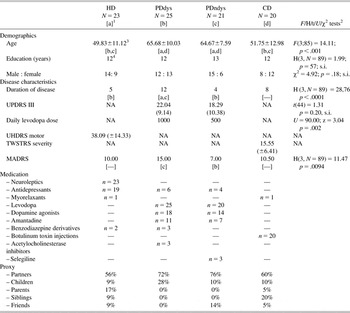
Eighty-nine patients participated in the study (23 with HD, 25 with PDdys, 21 with PDndys patients, and 20 with CD). Group demographics and disease characteristics are presented in Table 1. The groups were matched in terms of sex and years of education. Due to the heterogeneity of treatment regimens only levodopa dosage in PD patients was calculated and is presented in Table 1.
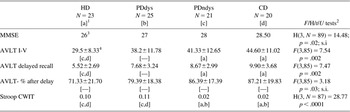
Due to a difference in the average age of symptom onset between HD, PD, and CD, and owing to the fact that choreic movements are early symptoms in HD, whereas in PD, they occur after several years of levodopa treatment, our groups could not have been matched in terms of age and disease duration. PDdys and PDndys groups differed in the presence of dyskinesia and severity of other PD symptoms. Montgomery Asberg Depression Rating Scale (MADRS) assessment identified more depressive symptoms in PDdys than in other groups. HD and PDdys groups were matched for cognitive status (see Tables 1 and 2).
Demographics and disease characteristics of HD, PD, and CD patients

Note. NA=not assessed; s.i. = statistically insignificant; MADRS = Montgomery-Asberg Depression Rating Scale; UHDRS = Unified Huntington's Disease Rating Scale; UPDRS = Unified Parkinson's Disease Rating Scale; TWSTRS = Toronto Western Spasmodic Torticollis Rating Scale; HD = Huntington's disease; PD = Parkinson's disease; CD = cervical dystonia; PDdys = PD with dyskinesias; PDndys = PD without dyskinesias.
1Letters a–d denote significant intergroup differences as indicated in the first row of the table.
2The differences between the two groups were analyzed either with t-unpaired test, U-Mann-Whitney test, or chi-square test. The differences among the four groups were tested either with one-way analysis of variance test with Scheffe post hoc comparisons or with H Kruskal-Wallis test with post hoc comparisons. Significant inter-group differences are indicated by a–d as indicated in the first row.
3Mean ± standard deviation is reported in case of normal data distribution.
4Median is reported in case of non-normal data distribution.
Neuropsychological assessment data of HD, PD, and CD patients

Note. AVLT = Auditory Verbal Learning Test; CWIT = Colour-Word Interference Test; MMSE = Mini-Mental State Examination; s.i. = statistically insignificant; HD = Huntington's disease; PD = Parkinson's disease; CD = cervical dystonia; PDdys = PD with dyskinesias; PDndys = PD without dyskinesias.
1Letters a–d denote significant intergroup differences as indicated in the first row of the table.
2The differences between two groups were analyzed either with t-unpaired test or Mann Whitney U test. The differences among the 4 groups were tested either with one-way analysis of variance test with Scheffe post hoc comparisons or with H Kruskal-Wallis test with post hoc comparisons. Significant inter-group differences are indicated by a–d as indicated in the first row.
3Median is reported in case of non-normal data distribution.
4Mean ± standard deviation is reported in case of normal data distribution.
Measures
Neurological assessment
Neurological examination comprised of the motor section from Unified Huntington's Disease Rating Scale (UHDRS) (Huntington Study Group, 1996) for HD, the Unified Parkinson's Disease Rating Scale (UPDRS) Part II-IV (Paulson & Stern, Reference Paulson and Stern1997) for PD and the Toronto Western Spasmodic Torticollis Rating Scale (TWSTRS) (Consky, Basinski, Bele, Ranawaya, & Lang, Reference Consky, Basinski, Bele, Ranawaya and Lang1990) for CD. For PD groups, scores only scores from UPDRS III and for CD group only scores from TWSTRS-severity are reported in Table 1.
Assessment of the self-awareness of symptoms
Questionnaires filled in by both the patient and his/her proxy included: Motor Impairment Scale (MIS) based on a series of 15 films demonstrating different motor symptoms [5 from UHDRS (Reilmann et al., Reference Reilmann, Roos, Rosser, Grimbergen, Kraus, Craufurd and Landwehrmeyer2009), 5 from UPDRS (Goetz et al., Reference Goetz, Stebbins, Chmura, Fahn, Klawans and Marsden1995), and 5 from TWSTRS (Comella et al., Reference Comella, Stebbins, Goetz, Chmura, Bressman and Lang1997)] and Self-Assessment Parkinson's Disease Disability Scale (SPDDS) (Brown, MacCarthy, Jahanashi, and Marsden, Reference Brown, MacCarthy, Jahanashi and Marsden1989). In both the MIS and the SPDDS, higher scores correspond to greater impairment.
The MIS, assessing the severity of motor symptoms (chorea, core parkinsonian symptoms, torticollis) from a patient/caregiver perspective, was created specifically for the purposes of the current study. This scale was based on training films for neurologists (UHDRS items: chorea in trunk, lower limbs, upper limbs, face, and buccolingual area; UPDRS items: hand tremor, posture, bradykinesia, leg tremor, and gait; TWSTRS items: laterocollis, anterocollis, retrocollis, rotation, and shoulder elevation; see Appendix for item choice, testing procedure, reliability and validity data). The global score on the MIS ranges from 0 to 15, subscores for each of the assessed domains (choreic movements/dyskinesias, parkinsonism, torticollis) range from 0 to 5.
The SPDDS, assessing the impairment in the activities of daily living caused by motor symptoms, has a minimum score of 24 and maximum score of 120 and it comprises 24 items. The patient and the observer can fill the SPDDS in; as such procedure was used in a validation study (Brown et al., Reference Brown, MacCarthy, Jahanashi and Marsden1989).
For patient–proxy discrepancies, average discrepancy score (based on item differences between patient and caregiver) was computed as described by Hoth et al. (Reference Hoth, Paulsen, Moser, Tranel, Clark and Bechara2007) for each scale separately. Using average scores instead of sum of discrepancies made the results independent of differences in scale length used for different domains.
Mood assessment
The patients’ mood was assessed by means of Montgomery-Asberg Depression Rating Scale (MADRS) (Montgomery & Asberg, Reference Montgomery and Asberg1979). Rating scale filled in by the examiner (not by the patient) was chosen because of the possibly impaired insight in HD.
Neuropsychological assessment
Neuropsychological assessment addressed global cognitive function (MMSE) (Folstein, Folstein, & McHugh, Reference Folstein, Folstein and McHugh1975), verbal learning (Auditory Verbal Learning Test AVLT) (Choynowski & Kostro, Reference Choynowski and Kostro1980), and cognitive control (Stroop Control Word Interference Test, CWIT) (Stroop, Reference Stroop1935).
Stroop CWIT was administered in a format used by the European Huntington's Disease Network (www.euro-hd.net) (European Huntington's Disease Network Cognitive Working Group, 2009) with a modified procedure. In each trial (color naming, color reading, interference) 50 stimuli were presented. The proportion of uncorrected errors to reactions (to account for omission errors) in the interference trial was computed and constituted a cognitive control measure (as uncorrected errors represent the failure to successfully monitor one's performance).
To sum up, MIS and SPDDS were administered to patients and caregivers. Neurologist performed UHDRS, UPDRS or TWSTRS. Neuropsychologist administered MMSE, AVLT, MADRS, and Stroop task.
Data Analysis
The reliability of the MIS was tested by means of internal-consistency Cronbach's alpha coefficient. Normality of distribution was tested with Shapiro-Wilk W test and homogeneity of variance was assessed with Levene's test. The between-group differences for the four groups were tested using one-way analysis of variance with post hoc Scheffe test or H Kruskal-Wallis test with post hoc comparisons (Siegel & Castellan, Reference Siegel and Castellan1988). Differences between two groups were tested either with Mann-Whitney U test, t unpaired test or χ2 tests as appropriate. Correlation analyses were performed using Spearman rank correlation coefficients. A conventional alpha of .01 was used in all the analyses.
Results
Assessment of Memory, Cognitive Control, and Mood
Patients with HD exhibited the worst performance in AVLT, while their performance on the Stroop CWIT was comparable to PDdys group (see Table 2).
Assessment of Patient–Caregiver Discrepancies
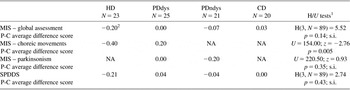
Overall, patients with HD underestimated their deficits in the motor domain (see Table 3). Differences for ADL assessment were not statistically significant.
Patient–caregiver (P-C) discrepancies in Motor Impairment Scale (MIS) (based on films) and Self-Assessment Parkinson's Disease Disability Scale (SPDDS)

Note: NA = not assessed; s.i. = statistically insignificant; HD = Huntington's disease; PD = Parkinson's disease; CD = cervical dystonia; PDdys = PD with dyskinesias; PDndys = PD without dyskinesias.
1The differences between the two groups were analyzed with Mann Whitney U test. The differences among the 4 groups were tested either with H Kruskal-Wallis test with post hoc comparisons.
2Median value.
Patient–proxy reports of choreic movements differed significantly when average difference scores were analyzed. As the median of average difference score in the HD group has a negative value and median in the PDdys has a positive value, patients with HD as a group had a tendency to underestimate choreic movements, while patients with PDdys tended to overestimate those movements (see Table 3). Patient–proxy agreement on parkinsonism severity was lower in the PDdys than in the PDndys group.
Self-awareness of Symptoms and Other Clinical Variables
The relationship between self-awareness of symptoms and other clinical variables was assessed only for the HD group. For MIS (motor) and SPDDS (ADL) average difference scores were mildly correlated with Stroop score, AVLT scores, MMSE score, MADRS score, and UHDRS motor score. None of these correlations were statistically significant, however.
Discussion
The present study was designed to comparatively assess the self-awareness of motor symptoms and ADL dysfunction in HD in comparison to PD and CD, with special emphasis on the chorea perception. The results of the analyses show that, in comparison to patients with advanced PD, individuals with HD underestimate the intensity of choreic movements. Thus, our findings are consistent with previous reports suggesting deficient self-awareness of chorea in HD (Hoth et al., Reference Hoth, Paulsen, Moser, Tranel, Clark and Bechara2007; Snowden et al., Reference Snowden, Craufurd, Griffiths and Neary1998; Vitale et al., Reference Vitale, Pellecchia, Grossi, Fragassi, Cuomo, Di Maio and Barone2001). In particular, our data are in concordance with the results from the questionnaire-based study obtained by Snowden et al. (Reference Snowden, Craufurd, Griffiths and Neary1998), who showed that in HD self-awareness of ADL dysfunction (consequences of motor symptoms) is better preserved than the self-awareness of chorea. Our data, based on the movie presentation of involuntary movements, provided a similar pattern of results: better preserved self-awareness of ADL impairment than self-awareness of choreic movements. This discrepancy suggests that the patients’ subjective experience of chorea is impaired, while observing its impact on ADL may be possible at the same time. This explanation suggests neurophysiological rather than neuropsychological background of impaired self-awareness of chorea. Alternatively, greater chorea may be associated by the patients with more severe disease stage and as such may be denied on the basis of psychological defense mechanisms.
Moreover, the fact that poor self-awareness of symptoms was seen in HD but not in PD supports the hypothesis that anosognosia/anosodiaphoria in HD may be predominantly associated with orbitofrontal–limbic pathology, resulting in failure to attach significant negative value to particular impairments in behavior. What is more, the results of this research are additionally strengthened by the fact that self-awareness of motor symptoms has been evaluated using a movie material, which is likely to have improved comprehension of test items.
Nonetheless, although our study indicates that anosognosia/anosodiaphoria of chorea might be characteristic for HD, the relationship between the severity of motor symptoms and the diminished self-awareness of these symptoms remains unclear. For example, in the study by Vitale et al. (Reference Vitale, Pellecchia, Grossi, Fragassi, Cuomo, Di Maio and Barone2001), but in contrast to the study by Hoth et al. (Reference Hoth, Paulsen, Moser, Tranel, Clark and Bechara2007) greater severity of motor symptoms in HD was associated with poorer self-awareness of these symptoms. This discrepancy is, however, difficult to interpret in the light of our data, since the mean UHDRS motor score in our study was similar to that reported by Hoth et al., whereas the UHDRS mean score was not presented in the study by Vitale et al. Importantly, in our study the magnitude of patient–proxy discrepancy was unrelated to symptom severity. Moreover, the results of our analyses have also suggested that self-awareness of motor symptoms in HD is not related to patients’ memory. Thus, this study contrasts some previous reports indicating that in patients with HD poor self-awareness of symptoms is typically associated with memory disturbance (Deckel & Morrison, Reference Deckel and Morrison1996; Hoth et al., Reference Hoth, Paulsen, Moser, Tranel, Clark and Bechara2007). Along the same line, our findings do not support the somewhat paradoxical observation by Snowden et al. (Reference Snowden, Craufurd, Griffiths and Neary1998) that better memory (verbal learning either object recall) may be associated with more deficient self-awareness. In our study, no association was noted between mood and the degree of self-awareness. It could be argued that possibly many variables contribute to poor self-awareness and none of them influences it to an extent that could be ascertained in a study with a limited number of subjects.
Previous research have suggested that deficient self-awareness of symptoms in HD is not a result of poor judgment, as it was shown that patients’ ability to assess the behavior of other people was preserved (Ho et al., Reference Ho, Robbins and Barker2006; Hoth et al., Reference Hoth, Paulsen, Moser, Tranel, Clark and Bechara2007). As already mentioned, such a selective deficit might stem from a failure to perceive consequences of one's behavior and to attach negative value to one's actions, reflecting orbitofrontal–limbic pathology. In our study, all participants were asked only to rate their own functioning and not proxies’, as rating the intensity of motor dysfunction and its impact on daily function in proxies would be pointless. Comparable Stroop CWIT results in both our HD and PDdys group might also suggest that the cognitive ability to monitor one's performance (detect errors) may not be a crucial factor responsible for deficient self-awareness of symptoms. Thus, further studies are needed to elucidate the underlying causes of deficient self-awareness in HD.
Although deficient self-awareness in HD has been frequently associated with prefrontal pathology (Hoth et al., Reference Hoth, Paulsen, Moser, Tranel, Clark and Bechara2007; Sitek, Slawek, & Wieczorek, Reference Sitek, Slawek and Wieczorek2008), recent studies have shown that orbitofrontal dysfunction, albeit characteristic for HD, may be also seen even in mild PD without dementia (Lyoo, Ryu, & Lee, Reference Lyoo, Ryu and Lee2010; Tinaz, Courtney, & Stern, Reference Tinaz, Courtney and Stern2011). Moreover, orbitofrontal atrophy, is not selective in HD, and the neurodegeneration in this disorder encompasses also extra-fronto-striatal dysfunction (e.g., corpus callosum as well as posterior cortical areas) (Douaud, 2009; Halliday et al., Reference Halliday, McRitchie, Macdonald, Double, Trent and McCusker1998; Rosas et al., Reference Rosas, Lee, Bender, Zaleta, Vangel, Yu and Hersch2010). Thus, since we did not compare the severity of anosognosia/anosodiaphoria of motor symptoms in HD with the extent of brain abnormalities on neuroimaging, the attribution of deficient self-awareness of motor symptoms exclusively to the orbitofrontal–limbic atrophy in HD may be a simplification of this complex phenomenon and requires further empirical evidence.
The present study has several limitations. First, two different scales were used to assess self-awareness, which was controlled for by using average discrepancy scores (Hoth et al., Reference Hoth, Paulsen, Moser, Tranel, Clark and Bechara2007). Second, neuropsychiatric factors, other than depression (such as apathy or anxiety) and neuropsychological factors (others than cognitive control and memory) were not included in the analysis. Third, the effect of pharmacotherapy (e.g., neuroleptic drugs) on our results was not analyzed due to the heterogeneity of treatment regimens. Moreover, the fact that the magnitude of patient–proxy discrepancy was unrelated to symptoms severity might have resulted from the overall underrepresentation of patients with severe symptomatology due to the chosen MMSE cut-off as one of the inclusion criteria.
Conclusions and practical implications
The present study highlights the need of interviewing the HD caregivers in clinical practice, as patients with HD tend to underestimate their motor abnormalities. Hence, underreporting of symptoms may have serious consequences in the patient's management, such as inadequate pharmacological treatment failing to address main, albeit unreported problems. Another important implication of the present study is that reducing chorea in HD should not be automatically regarded as a priority in HD pharmacotherapy, mostly because of the limited data on drug effectiveness as well as their possible adverse effects (Mestre, Ferreira, Coelho, Rosa, & Sampaio, Reference Mestre, Ferreira, Coelho, Rosa and Sampaio2009), especially in cases of mild chorea. Additionally, psychoeducational intervention should be aimed at HD caregivers’, so they may attempt to accept deficient self-awareness as another symptom of HD and, thus, may learn how to better cope with the devastating impact of HD on the functioning of both the patient's and his/her surroundings.
Acknowledgments
We thank the Movement Disorder Society for the permission to use sequences from UPDRS and TWSTRS training tapes in our study. We also thank Motor Phenotype Working Group of European Huntington's Disease Network for sharing films prepared for the updated UHDRS version. We are also indebted to Prof. Janusz Limon—clinical geneticist, from Medical University of Gdansk (Genetics Department), for his help in genetic counseling and patients’ recruitment. While preparing the manuscript the corresponding author was supported by the scholarship “START” from the Foundation for Polish Science (FNP). There were no other sources of financial support. There are no conflicts of interest.
APPENDIX
Motor Impairment Scale
I. Item choice
For each symptom, films with patients presenting moderate intensity of a given symptom where chosen.
II. Item order
1 Hand tremor (UPDRS)
2 Shoulder elevation (TWSTRS)
3 Chorea- lower limb (UHDRS)
4 Bradykinesia (UPDRS)
5 Gait (UPDRS)
6 Rotation (TWSTRS)
7 Chorea-buccolingual (UHDRS)
8 Retrocollis (TWSTRS)
9 Leg tremor (UPDRS)
10 Chorea-upper limb (UHDRS)
11 Anterocollis (TWSTRS)
12 Laterocollis (TWSTRS)
13 Chorea-face (UHDRS)
14 Posture (UPDRS)
15 Chorea-trunk (UHDRS)
III. Procedure
Each film was presented till the participant provided the answer (replayed if necessary), but not for a period shorter than 7 seconds (the duration of the shortest film). Each time, all films were shown on the same notebook monitor (HP Pavilion dv5 Notebook PC; dimensions 33×21 cm). When a viewer mentioned that some symptoms were not persistent, but temporary (as in case of dyskinesia in PD), he/she was asked to rate its intensity referring to moments when it was present.
IV. Scoring
Each symptom from each movie was rated by the patient as either absent (0), less pronounced than in the movie (1), of more or less similar intensity as shown (2), or as more pronounced (3). The month preceding the actual testing was suggested as a reference period, with the exception of CD patients and proxies who were asked to rate the symptoms intensity before former botulinum toxin injection (all were treated, but examined after the wash-out period before the next injection).
V. Reliability
Reliability analysis performed for MIS yielded satisfactory results for all subscales (all Cronbach's alpha coefficients were between 0.71 and 0.78). Item–subscale correlation coefficients were moderate (0.40–0.69).
VI. Validity
Validity of the scale was evidenced by inter-group differences for subscores, consistent with diagnosis (HD, PD or CD) and disease severity (in case of PD). Severity of choreic movements/dyskinesias was higher in HD and PDdys than in PDndys and CD, both according to patients’ (H(3, N = 89) = 44.78; p < .0001) and caregivers’ ratings (H(3, N = 89) = 49.01; p < .0001). Parkinsonism severity was higher in PDdys than in HD, PDndys, and CD according to patients (H(3, N = 89) = 41.87; p < .001) and higher than in HD and CD according to proxies (H(3, N = 89) = 43.82; p < .0001). Torticollis symptoms severity was rated by the patients as higher in CD than in HD, PDdys, and PDndys (H(3, N = 89) = 43.97) and higher in CD than in PDdys and PDndys by the caregivers (H(3, N = 89) =26.93; p < .001).