1. Introduction
Traditional pastoralist land management institutions in sub-Saharan Africa have been stressed by a number of interrelated factors, including an increasing human population; private enclosure of grazing land for grazing or agricultural purposes (Fratkin and McCabe, Reference Fratkin and McCabe1999; Hammel, Reference Hammel2001; Bruce and Mearns, Reference Bruce and Mearns2002; Toulmin, Reference Toulmin, Bigg and Satterthwaite2005); government-sponsored privatization, sometimes through titling programs (Swallow, Reference Swallow1994; Fratkin and McCabe, Reference Fratkin and McCabe1999; Cotula et al., Reference Cotula, Toulmin and Hesse2004); localized rangeland degradation (McPeak, Reference McPeak2003); and the increasing prevalence of violent conflicts and livestock theft (Oba, Reference Oba1992; Swallow, Reference Swallow1994; Fratkin and McCabe, Reference Fratkin and McCabe1999; Oba, Reference Oba2001; Hundie, Reference Hundie2006). The deterioration of traditional institutions has created a need either for these institutions to be strengthened or for sustainable new institutions to be created. In order to improve pastoralists' welfare through policies designed to promote specific institutions, governments must understand the strengths and weaknesses of the traditional property rights system (Oba, Reference Oba2001). While early government interventions in pastoralist systems tended to favor privatization, the outcomes of these interventions demonstrated that privatization can have serious shortcomings in the context of sub-Saharan Africa (Graham, Reference Graham1988; Sserunkuuma and Olson, Reference Sserunkuuma and Olson2001; Bruce and Mearns, Reference Bruce and Mearns2002; Mwangi and Dohrn, Reference Mwangi and Dohrn2006; Mwangi, Reference Mwangi2007). More recent efforts have sought to internalize some, but not all, features of the traditional system (Haro et al., Reference Haro, Doyo and McPeak2005). Mwangi (Reference Mwangi2007) and Burnsilver and Mwangi (Reference Burnsilver and Mwangi2007) discuss how, in some instances, after the privatization of Maasai group ranches in Kenya, individuals have informally reimplemented some aspects of the traditional system.
Pastoralist systems in sub-Saharan Africa have three important features: mobility, common use of land, and the often complex nature of the rules determining grazing access and the underlying property rights. As is widely recognized in the literature on pastoralist systems in sub-Saharan Africa and elsewhere, these features enable pastoralists to deal with the highly variable rainfall and resulting uneven forage distribution characteristic of the regions. Economists have analyzed the effects of mobility and common use on the efficiency of traditional sub-Saharan pastoralist systems. Mobility and the resulting ability to respond to shocks ex post may dominate private property rights for an individual pastoralist or pastoralist group (van den Brink et al., Reference van den Brink, Bromley and Chavas1995), while the externalities resulting from common use may partially or completely mitigate these gains (Goodhue and McCarthy, Reference Goodhue and McCarthy1998).
With one exception, previous theoretical economic frameworks have not addressed the third feature, the contingent, incomplete nature of grazing rights under the complex set of rules governing resource use. While Goodhue and McCarthy (Reference Goodhue, McCarthy, McCarthy, Swallow, Kirk and Hazell2000) examine contingent, incomplete rights, they do not model two important aspects of property rights under the traditional system: the role of absolute, as well as relative, shocks in the determination of access, and the tendency for grazing areas to be managed by a primary user group, but to be accessible to others. Our analysis incorporates these features, which enables us to construct a model of the traditional grazing rights system that can be compared to a model that reflects its breakdown. Within neoclassical economics, a simple conventional model of common property can be used to represent this breakdown: non-cooperative use of a resource by a well-defined group of users who have complete, symmetric access, and the complete exclusion of non-members. Modeling pastures as common property between two pastoralists who are members of the same tribe, and excluding all other potential users, represents the breakdown of the traditional rules governing resource use.Footnote 1
We relax the standard assumptions regarding complete, non-contingent grazing rights, and model the incomplete, contingent nature of traditional sub-Saharan African grazing rights using fuzzy sets. We then compare private and social returns for two pastoralists sharing two pastures under the traditional land access system modeled with fuzzy sets to conventional economic models of private property and of non-cooperative common property where all members have equal access (and non-members are excluded). Ex ante, there is no reason to expect any of the three systems to always dominate. Mobility is allowed under the traditional and common property systems, which could lead to higher returns than a sedentary private property system. Under private property the ability to exclude all others means that the owner will obtain the full benefit of his management activities. Under the traditional system, pastoralists may be able to improve their welfare relative to the common property system by mutually agreeing to adjust access to specific grazing areas in response to relative weather shocks (Goodhue and McCarthy, Reference Goodhue, McCarthy, McCarthy, Swallow, Kirk and Hazell2000). Under some conditions, the traditional system results in the highest level of social welfare.
Our analysis fits into a larger literature regarding the interactions between ecological systems, and property right systems and other social institutions. Indigenous land tenure arrangements vary with land use patterns, which in turn are a function of ecological characteristics (Netting, Reference Netting, McAdams, Smelser and Treiman1982). Netting (Reference Netting1972, Reference Netting1976, Reference Netting1981) demonstrated that within the southern Swiss village he studied property rights adapted to the patchy nature of different ecological zones. Summer grazing areas high in the mountains were held communally, while lower elevation agricultural production areas were held privately. Individual families held multiple, geographically separated parcels within agricultural zones. Casimir (Reference Casimir, Rao and Casimir2003) documented similar patterns governed by different altitudinal zones in parts of the western Himalayas. Chakravorty-Kaul (Reference Chakravorty-Kaul1996, Reference Chakravorty-Kaul1997, Reference Chakravorty-Kaul1998) examined traditional land use systems of the Gaddi in the Himalayas that responded to the patchiness of land productivity with communal grazing rights and private rights or private/communal rights (defined by season) for agricultural land. For additional examples of property rights systems that incorporate different types of rights depending on land use and ecology, see Netting (Reference Netting, McAdams, Smelser and Treiman1982), who reviewed a number of studies, and Fuys et al. (Reference Fuys, Mwangi and Dohrn2006), who synthesized a number of case studies of common property regimes for various natural resources. Within our context of sub-Saharan Africa, van den Brink et al. (Reference van den Brink, Bromley and Chavas1995) made a similar point regarding the extent of grazing and agricultural cultivation. Agrawal (Reference Agrawal1999) linked pastoralist mobility to relationships between pastoralist groups and their more settled agricultural neighbors for the case of the Raika agro-pastoralists in western India.
The rest of the paper is organized as follows. In section 2 we document the incomplete and contingent nature of grazing rights in sub-Saharan Africa. In section 3 we develop our formal model. In section 4 we briefly sketch the private and common property regimes we will compare to our fuzzy property regime. Section 5 reports the results of our welfare comparisons across property rights regimes. Section 6 concludes with a discussion of our findings and their implications for policy.
2. Describing traditional grazing rights
In most neoclassical economic analyses of private and common property regimes, property rights are assumed to be complete and non-contingent. In our context this means that if a pastoralist has the complete right to graze a particular area, he may freely access it regardless of whether or not others have this same right, and if his right to graze the pasture is non-contingent, it is unaffected by states of nature, such as weather shocks to other grazing areas.
In contrast to these institutional settings, grazing rights and resource access in sub-Saharan Africa are frequently described as incomplete and contingent, except at the broadest, tribal level. Within an area held by members of a given tribe, different members have different rights to specific regions. These rights are incomplete ex ante and ex post. Ex ante, when pastoralists make their stocking decisions, they recognize that their access to certain resources is incomplete; that is, they are not entitled to fully exploit the available forage. Incompleteness may be reflected in a number of ways ex post; for example, once animals are grazing the area, pastoralists may leave the area before the forage is fully exploited.Footnote 2 Their stocking decision, in terms of livestock days on pasture, is below the level they would choose if they had a complete right to the available forage.
Rights are also contingent. Traditional institutions recognize the importance of relative weather shocks. Pastoralists who sustain relatively large negative shocks to their primary grazing areas may obtain greater access to certain resources as a consequence. Rights are contingent in other ways (although we will focus on relative weather shocks). For instance, herds composed of milking cows and young animals generally receive higher priority than the main herds, which are more mobile (Coppock, Reference Coppock1994).
Grazing area boundaries and membership in the access group, the parameters over which incomplete, contingent grazing rights are defined, are themselves imprecise (Scoones, Reference Scoones1994; McPeak and Barrett, Reference McPeak and Barrett2001; Haro et al., Reference Haro, Doyo and McPeak2005). While boundaries are not fixed and groups may cross them, particularly in times of stress, users recognize that different groups have different levels of access (Cossins and Upton, Reference Cossins and Upton1987; Coppock, Reference Coppock1994). Often, a ‘primary’ user or user group is responsible for managing a grazing area, and often ‘secondary’ users must ask permission to graze from the primary user and abide by rules regarding water and pasture use promulgated by the primary user, or both (Cossins and Upton, Reference Cossins and Upton1987; Hogg, Reference Hogg1990; Hundie, Reference Hundie2006). Particularly for secondary users, access to a specific area may depend on the availability of forage in other areas to which they have access (Hogg, Reference Hogg1990; Solomon et al., Reference Solomon, Snyman and Smit2007). Often these use patterns are based on reciprocal arrangements during times of localized drought (Bartels et al., Reference Bartels, Norton and Perrier1990; Freudenberger and Freudenberger, Reference Freudenberger and Freudenberger1993). Hence, the effective pasture available to a given group is imprecisely defined.
Pastoralist norms allow primary users to encourage other users to move on and otherwise manage grazing resources through direct communication and other tools, such as the allocation of scarce water resources. Under the traditional deep well management system used on the Borana Plateau in southern Ethiopia, well managers, who are the primary users of surrounding rangeland, consider both water and forage availability when allocating watering rights (Cossins and Upton, Reference Cossins and Upton1987). The acceptance of these behaviors coexists with strong social disapproval (and the threat of sanctions) of groups who attempt to close their primary grazing areas to other users entirely (Coppock, Reference Coppock1994). Desta and Coppock (Reference Desta and Coppock2004) and Lybbert et al. (Reference Lybbert, Barrett, Desta and Coppock2004) credit the system with eliciting a significant degree of cooperation regarding resource use.
There is a small literature analyzing the effects of commonly recognized determinants of cooperation on stocking densities and other system variables that provides additional motivation for developing a model of property rights that are neither private nor common. McCarthy et al. (Reference McCarthy, Kamara and Kirk2003), McCarthy and Vanderlinden (Reference McCarthy and Vanderlinden2004), and Benin and Pender (Reference Benin and Pender2006) find evidence of imperfect cooperation in the absence of formal rules.
3. Modeling traditional grazing rights
Sub-Saharan African grazing rights are defined in an extremely complex traditional system that is difficult to characterize fully. While reciprocity of access plays a role, there are a number of other considerations. Factors such as kinship, other relationships such as age groups, relative shocks to primary grazing areas, and overall access rights to other areas all affect access to specific areas, sometimes in overlapping ways (Haro et al., Reference Haro, Doyo and McPeak2005). Rather than seek to precisely define all these relationships, which are site- and user-specific, we use fuzzy set theory to model the system and its consequences for users.
Fuzzy set theory and fuzzy game theory
Fuzzy set theory was invented by Zadeh (Reference Zadeh1965) in order to model complex systems.Footnote 3 When a system is very complex, precise set definitions are either absent or extremely costly to model. Fuzzy sets reduce the cost of modeling such a system by incorporating imprecision into the set definitions used to describe specific system parameters, which eliminates the need for huge numbers of specific definitions.
Fuzzy set theory describes the extent to which items possess a specific property using the degree of membership. Rather than a simple 0–1 definition of set membership, each object in a fuzzy set possesses a degree of membership in the [0, 1] interval. Essentially, fuzzy sets define the property by assigning linguistic variables to partitions of continuous values. Standard sets are a special ‘crisp’ case of fuzzy sets, where every element of the set has a degree of membership of 1, and every element of its complement has a degree of membership of 0.
For example, in our context seasonal rainfall may be usefully characterized as high, low, or somewhere in between. ‘In between’ rainfall realizations possess some non-zero degree of membership in both the high and low fuzzy set. In a ‘crisp’ system, each rainfall realization would have to be defined as either high or low. Obviously, within the context of this example, a third ‘crisp’ set could be defined, such as ‘average’ rainfall. This change would simply increase the number of arbitrary boundaries where a very small change in a continuous variable would lead to a large change in how it entered the decisionmaking system. This possibility illustrates another advantage of fuzzy set theory: it is relatively parsimonious in its specification.
Fuzzy analysis has been used to model economic problems, including ones in game theoretic contexts. Such analyses can be grouped into three categories based on their use of fuzzy analysis. The first category uses fuzzy analysis as a methodological tool, and applies it to conventional economic data (Fedrizzi et al., Reference Fedrizzi, Fedrizzi and Ostasiewicz1993; Benaroch, Reference Benaroch1996). The second category uses fuzzy logic to model specific features of an economic problem or economic system, such as preferences (Dompere, Reference Dompere1995), the degree of product similarity across firms and other market characteristics in an oligopoly (Mansur, Reference Mansur1995; Greenhut et al., Reference Greenhut, Greenhut and Mansur1995), and firms' information on demand shocks in a trigger strategy game (Goodhue, Reference Goodhue1998). The third category uses fuzzy rules to define players' strategies, such as firms' strategies in a collusion game (Aristidou and Sarangi, Reference Aristidou and Sarangi2006) and firms' strategies in a spatial location–supply chain game (Bogataj and Usenik, Reference Bogataj and Usenik2005).
Our analysis is a member of the second category. We utilize fuzzy sets to represent the role of relative and absolute rainfall in defining a pastoralist's ex ante right to use a given pasture, while we use a crisp decision rule for the pastoralist's pasture choice as a function of his fuzzy right. As such, our analysis uses restricted fuzzy preferences. Butnariu (Reference Butnariu, Gupta, Ragade and Yager1979) derives conditions under which equilibria exist for restricted fuzzy games (as part of a larger class of fuzzy games). In order to be an equilibrium in the two-player case, a set of strategies must be a fixed point for the 2-dimensional restricted fuzzy preferences of the two players; that is, given his opponent's strategy, each player must prefer his equilibrium strategy to all other possible strategies.
Model
We model a non-cooperative Nash game between two pastoralists (or pastoralist groups), A and B, who allocate grazing time for their animals between two pastures, 1 and 2, over the course of a single season in order to maximize profits. Pastoralists are indexed by i, i ∈ {A, B}, and pastures are indexed by j, j ∈ {1, 2}. Pastoralist A chooses the share of the season his animals graze pasture 2, S A2 ∈ [0, 1), and pastoralist B chooses the share of the season his animals graze pasture 1, S B1 ∈ [0, 1). Due to direct forage consumption and stocking externalities, the players' allocation decisions are interdependent.
Each pastoralist has a herd of fixed size, denoted a and b, respectively. The output price is exogenous, and normalized to 1. Production costs, such as pastoralists' opportunity cost of time, are normalized to 0. These assumptions imply that each pastoralist maximizes profits by maximizing total weight gain. We specify total weight gain as a linear-quadratic function of the animal-days on pasture (McCarthy, Reference McCarthy1996). Each pastoralist allocates his fixed number of animal-days across the two pastures in order to maximize profits as a function of rainfall realizations for the two pastures. Except for realized rainfall shocks, the pastures are physically identical, and are characterized by the forage productivity parameter α and the stocking externality parameter β. Pasture size is normalized to 1. Total forage on pasture j is equal to αrj, where rj is the rainfall shock realized on pasture j. However, placing livestock on the pasture reduces the forage available for consumption. This stocking externality is a non-linear function of the number of animal-days, and is defined as  for pasture 2. Intuitively, the externality per animal
 increases as A spends more animal-days on 2. If A does not elect to move to 2, the externality per animal becomes simply β. Accordingly, the payoffs for A and B can be represented as

where the pastoralists' choices of SA 2 and SB 1, and hence their profits, depend on their opponent's choice, pasture productivity parameters, rainfall realizations, and the property rights regime.
Our static model ignores any effects of the stocking decision in one period on the forage available in future periods. Whether or not current stocking densities have an effect on future forage productivity has been much debated in the range ecology literature, especially for the arid and semi-arid environments of sub-Saharan Africa. Some authorities argue that dynamic externalities are in fact likely to be 0 or very small (see, for example, the discussions in Scoones, Reference Scoones1994). McPeak (Reference McPeak2003) argues that only localized degradation occurs around towns and water sources in Kenya's Marsabit District.
In our analysis, each pastoralist has a ‘home’ pasture. A's home pasture is 1, and B's home pasture is 2. Pastoralist i's access to pasture j, denoted Pij, is the degree of membership of j in the fuzzy set ‘areas accessed by pastoralist i’. In fuzzy set notation, this may be written more formally as Zi = {Pij/j for j = 1, . . ., J}. Each pastoralist has a degree of access of 1 to his home pasture under all property rights regimes. If a pasture is the private property of another pastoralist, i's degree of access is 0. Thus, if we wished to represent two private property pastoralists in our two-pasture setting, we would write ZA = {1/1, 0/2} and ZB = {0/1, 1/2}. Under a common property regime, where pastoralists A and B are the only users of pastures 1 and 2, i's degree of access to both pastures is 1.
Under the traditional property rights system, each pastoralist has incomplete access to the other pastoralist's home pasture. Empirically, this two-pastoralist model represents cases where range areas are predominantly used by one pastoralist group but others also have some access. The group with the high level of access rights functions as the primary manager of the area, and the group with the low access may access the area either through lineage ties or other links between the two. This is a relatively common arrangement of property rights in our study area (Cossins and Upton, Reference Cossins and Upton1987; Niamir, Reference Niamir1991; Oba, Reference Oba1992).
In the model, the maximum number of animal-days a pastoralist can use the other pastoralist's home pasture is determined by his property right, which is a function of absolute and relative rainfall on the two pastures. Rainfall realizations are independently and identically distributed across pastures. Herders observe rainfall, 0 < rj ≤ 1, for both pastures. Each pasture's rainfall is used to define its membership in the fuzzy set corresponding to the following statement: ‘Pasture j is in a drought year’.

where γ > 1.Footnote 4 Equation (1) defines pasture j's membership in a fuzzy set, so that drought ∈ [0, 1].
To reflect the role of relative rainfall, the two rainfall realizations are used to define each pasture's membership in the fuzzy set corresponding to the following statement: ‘Pasture j is in more of a drought year than pasture ≠j is.’

Equation (2) defines pasture j's membership in a fuzzy set, so that worse ∈ [0, 1].
The two rules in equations (1) and (2) are integrated into rules defining pastoralist i's access to the other pastoralist's home area. For A, the rule is

where mA 2 recognizes that under the traditional system A would never choose to use pasture 2 more than he would if his degree of access was 1, which corresponds to the standard common property regime. Because it is the solution to the common property game, mA 2 is defined by the following ‘crisp’ rule

Defining Pij using the minimum of these three terms reflects that in practice access to another's home territory is dependent on the latter having forage to share.
Under the traditional system, A chooses whether to move to pasture 2 or remain entirely on pasture 1. B chooses whether to move to pasture 1 or remain entirely on pasture 2. A will move to pasture 2 if

where SA 2 is no greater than PA 2, which defines A's maximum access to 2. Similarly, B will move to pasture 1 if

Based on the pastoralists' decision rules, we offer the following two comments.
Comment 1: It will never be the case that A will choose to move to 2 and B will choose to move to 1. At most, one pastoralist will move.
To see this, begin by recalling the definition of Pij. It will never be the case that both PA 2 and PB 1 are greater than 0. For PA 2 > 0, it must be the case that r 2 – r 1 > 0, while for PB 1 > 0, it must be the case that r 1 – r 2 > 0. Now, rearrange the decision rules. If r 2 – r 1 < 0, then A will never move

Similarly, B will never move if r 1 – r 2< 0.

Comment 2: Provided that A's payoff is increased by moving to pasture 2 for some share of the season, A will never choose to spend a smaller share of his animal-days on 2 than he is entitled to under the traditional system.
This comment follows from the combination of the definition of the fuzzy set governing A's access to the pastures and A's decision rule for moving. Because PA 2 can be no larger than 1, A's stocking choice will be no greater than the stocking day choice A would make under a conventional common property regime. Hence, there is never an incentive for A to reduce the share of animal-days he spends on 2. Accordingly, SA 2 = PA 2 and SB 1 = PB 1 under the traditional system.
Based on these comments we offer the following proposition regarding the Nash equilibrium for the non-cooperative game between the two pastoralists:
Proposition 1: The Nash equilibrium is the outcome of the game where, taking the rules governing fuzzy property rights as given, each pastoralist chooses whether or not to spend part of the season on the other pastoralist's home pasture based on the following decision rules: A will move to pasture 2 if and only if  . Similarly, B will move to pasture 1 if and only if
 .
The equilibrium exists because neither A nor B wishes to alter his strategy, given the other pastoralist's strategy (Butnariu, Reference Butnariu, Gupta, Ragade and Yager1979). The following expressions are profits for the pastoralists under the traditional system

4. Alternative property rights regimes
In this section, we derive the outcomes of common and private property rights regimes as conventionally modeled in neoclassical economics in order to compare them to the outcomes of the traditional system. Under the common property regime, both pastoralists have complete access to both pastures: AccessA = {1/1, 1/2} and AccessB = {1/1, 1/2}. Under the private property regime, each pastoralist has complete rights to his own home pasture and no rights to the other pastoralist's home pasture: AccessA = {1/1, 0/2} and AccessB = {0/1, 1/2}. We exclude the possibility of rental from our private property regime. Allowing for rental does not alter our results in any qualitative way.Footnote 5
Common property
Each pastoralist begins the season on his home pasture, and optimizes his total returns by choosing the share of the season he will spend on the other pastoralist's home pasture: mA 2 and mB 1.
Proposition 2: Under the common property regime, the Nash equilibrium depends on the rainfall realizations. When r 2 – r 1 > 0,  and mB 1 = 0. When r 2 – r 1 < 0, mA 2 = 0 and
 . When r 2 = r1, mA 2 = 0 and mB 1 = 0.
Proof: The proof is in the appendix.
Returns under the common property regime are

Private property
Under the private property regime, A remains on pasture 1 and B remains on pasture 2 regardless of rainfall. Returns are

5. Results
We compare individual and total expected returns under the three property rights regimes in order to examine whether or not the traditional system is preferable to either or both of our benchmark systems in terms of expected value. We begin by noting the established comparison between common property and private property.
Comment 3. Assuming rainfall realizations are independently and uniformly distributed on the [0, 1] interval:
(A) expected returns to each pastoralist may be higher or lower under the common property regime than under the private property regime, depending on parameter values;
(B) expected total returns may be higher or lower under the common property regime than under the private property regime, depending on parameter values.
Intuitively, this finding is due to a tradeoff between the two regimes. Private property provides a benefit of exclusion. Each pastoralist benefits fully from the effective forage on his home pasture, and the externality due to stocking days is determined only by his own herd size. However, there is no mobility which provides insurance against poor rainfall realizations on his home pasture. In contrast, common property provides a benefit of insurance. The pastoralist can move and use the other pasture when his home pasture has relatively and absolutely low rainfall, and increase the forage consumed by his animals. The offsetting cost is that each pastoralist does not benefit fully from the effective forage on his home pasture. Whenever his home pasture has more rainfall than the other pastoralist's home pasture, the other pastoralist moves to join him at some point during the season. This increases the stocking externality and reduces the effective forage consumed by the first pastoralist's animals.
The same sort of tradeoff between the value of insurance and the value of exclusion exists when comparing the traditional regime and the private property regime.
Proposition 3: Assuming rainfall realizations are independently and uniformly distributed on the [0, 1] interval, for given values of parameters a, b, β, and γ, then, provided α is sufficiently large:
(A) expected returns to each pastoralist are higher under the traditional regime than under the private property regime;
(B) expected total returns are higher under the traditional regime than under the private property regime.
Proof: The proof is in the appendix.
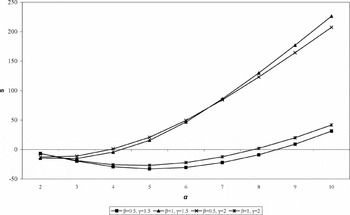
The traditional regime dominates the private property regime provided the resource base parameter α is sufficiently large, relative to other parameters. Essentially, the insurance provided by traditional grazing rights does not have any value if it does not empower one to actually use many resources. In that instance, it is preferable to protect what few resources one has using a private property regime when one has a relatively good rainfall realization rather than share the other pastoralist's resources under a traditional property regime when one has a relatively and absolutely bad rainfall realization. Figure 1 illustrates this for selected parameter values. Notice that the difference in profits is not necessarily everywhere increasing in α. All that is required is that above some α the difference in returns is always positive.
Fuzzy property regime profits less private property regime profits as a function of α

The tradeoff between insurance against poor home pasture realizations and using all of the effective forage on one's home pasture oneself determines the relative returns from private property and the two non-exclusive property rights regimes. The comparison of the traditional regime and the common property regime depends on the nature of the insurance: in order for A to access 2, the rainfall realization on 1 must be absolutely (‘Pasture j is in a drought year’) as well as relatively (‘Pasture j is in more of a drought year than pasture ≠j is’) low under the traditional regime, while for the common property regime only the relative rainfalls matter.
Prior to comparing returns under the two regimes, we compare expected mobility by examining the pairs of rainfall realizations for which each pastoralist will move.
Proposition 4: Assuming rainfall realizations are independently and uniformly distributed on the [0, 1] interval, expected mobility is lower under the traditional regime than under the common property regime. Each pastoralist moves less often in expectation.
Proof: The proof is in the appendix.
The difference in mobility occurs because traditional rights are a function of absolute and relative rainfall, while common property rights are complete, and both pastoralists make the decision to move purely as a function of absolute rainfall on the two pastures. We now compare expected returns under the two regimes.
Proposition 5: Assuming rainfall realizations are independently and uniformly distributed on the [0, 1] interval:
(A) expected returns to each pastoralist may be higher or lower under the traditional system than under the common property regime;
(B) expected total returns may be higher or lower under the traditional system than under the common property regime.
Proof: The proof is in the appendix.
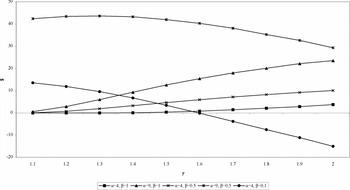
The outcome is determined by a tradeoff between two forces: the value of exclusion, and the value of insurance. Depending on which force dominates, whether or not the traditional system results in higher returns than the common property system will depend on how important absolute rainfall realizations are in the definition of traditional rights, compared to the importance of relative rainfall. When α is large relative to β, given herd sizes a and b, the value of exclusion is low because adding additional livestock has a relatively small effect on available forage. In this case, the value of insurance dominates. Consequently, the benefit of the traditional system relative to the common property system declines as γ increases, fewer rainfall realizations are in the drought fuzzy set, and absolute rainfall becomes less important in the definition of traditional grazing rights, because fewer rainfall realization pairs result in outcomes where one pastoralist moves. When α is small relative to β, the value of exclusion is high and the value of insurance is low because adding additional livestock has a relatively large effect on available forage. In this case, the benefit of the traditional system relative to the common property system increases as γ increases, fewer rainfall realizations are in the drought fuzzy set, and absolute rainfall becomes less important in the definition of traditional grazing rights, because more rainfall realization pairs result in outcomes where neither pastoralist moves under the traditional system. Figure 2 illustrates different possible cases.
Fuzzy property regime profits less common property regime profits as a function of γ

6. Conclusions and policy implications
We have developed an economic model of pastoralist behavior that incorporates the three critical features of traditional pastoralist land management systems in sub-Saharan Africa: mobility, common land use, and incomplete, contingent access. In contrast to previous economic analyses, our approach includes the roles of both absolute and relative rainfall in determining rights to a given area. Our findings indicate that the relative performance of traditional systems compared to private and common property regimes depends on a number of factors.
The first factor affecting the relative performance of traditional and private property systems is the amount of forage available. Traditional grazing rights will be preferred to well-defined private property rights when the resource base is large enough for the insurance feature of traditional rights to provide real value, given the existence of the stocking externality. This result runs counter to that of van den Brink et al. (Reference van den Brink, Bromley and Chavas1995), who found that mobility declined in attractiveness as annual rainfall increased. However, there are at least two possible explanations for this difference. First, they compared the profitability of a mobile pastoralist production system to a sedentary agricultural production system, not a sedentary pastoralist system. This difference in the benchmark system may drive the difference in our findings regarding the relationship between the value of the resource and the value of mobility. Second, their analysis was performed using specific parameter values. Referring again to figure 1, our analysis does not demonstrate that the mobile traditional system is always more profitable than the sedentary private property regime; their analysis may be within a parameter region where the sedentary private property regime is more profitable in our framework.
Other factors affecting the relative performance of traditional and common include the importance of the stocking externality parameter β relative to the forage productivity parameter α; and the importance of the drought fuzzy set and absolute rainfall realizations in the definition of fuzzy rights, relative to the worse fuzzy set and the role of differences in rainfall realizations across the two pastures. These considerations interact. If the stocking externality parameter is small compared to the forage productivity parameter, then the difference in profits between the traditional system and the common property regime declines as fewer rainfall realizations are members of the drought fuzzy set, and absolute rainfall becomes less important in the definition of traditional grazing rights. In this case, the value of excluding the other pastoralist is dominated by the value of insuring against relatively bad rainfall realizations so that symmetric complete rights dominate traditional rights. If the stocking externality is relatively large, then the difference in profits between the traditional system and the common property regime increases as fewer rainfall realizations are members of the drought fuzzy set and absolute rainfall becomes relatively less important in the definition of traditional grazing rights. Here, the value of excluding the other pastoralist dominates the value of insurance against relatively bad rainfall shocks due to the large negative externality due to adding his animals to a single pasture, so that traditional rights dominate symmetric complete rights.
This finding has implications for policymakers considering whether to strengthen traditional land management institutions or replace them with an alternative property rights regime. First, it suggests that policymakers should be sensitive to small differences in traditional land management institutions because property rights may reflect differences in the value of exclusion and insurance. Our result is consistent, for example, with the tendency in some pastoralist systems for rights to pasture in outlying areas used in the rainy season to be undifferentiated among group members, while rights to pasture in home areas during the dry season are much more nuanced. These differences in rights suggest that any approach intended to strengthen the traditional system must differentiate among different arrangements of traditional rights, and that any approach intended to replace the traditional system with well-defined property rights should not assume it will be desirable to replace it with a single regime.
Second, our results suggest that mobility is less likely to be observed when traditional land management institutions are strong than when they have deteriorated, holding other things equal. In practice, of course, the predicted effect may be hard to separate from an effect of the tendency toward enclosure often associated with the decline of traditional institutions: enclosure of a particular resource eliminates it from the portfolios of other pastoralists, who may need to move more in order to manage their response to risky, patchy rainfall and forage patterns. There are two implications for policy. First, continued pastoralist mobility in the face of stressors on traditional institutions is not sufficient evidence that the system continues to be economically viable. Second, the desirability of reinforcing a weakened traditional system that has sustained the enclosure of a substantial part of its range will depend on whether enough of the original range remains to support the traditional rules governing mobility.
Our findings are subject to a number of caveats. First, we have assumed that property rights are costless, and that the rules underlying these rights are exogenously specified. One reason for the deterioration of traditional institutions may be that there has been an increase in the cost of maintaining traditional rights or that the cost of negotiating the rules determining these rights has increased, perhaps due to a competing state-sponsored system of property rights (Fuys et al., Reference Fuys, Mwangi and Dohrn2006). Our current analysis cannot address these possibilities. Second, we do not incorporate herd population dynamics into our analysis. Third, we do not incorporate distance into our analysis, nor do we address asymmetries in forage productivity and stocking externality parameters across grazing areas. Finally, we considered only one distribution of rainfall realizations. These factors may affect the relative performance of the different property rights regimes. All of these concerns provide directions for future research.
Appendix
Proof of proposition 2
A optimizes with respect to mA 2, the share of the season he spends on pasture 2, holding B's choice of mB 1 constant. A maximizes
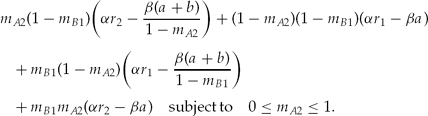
It will never be the case mA 2 > 0 and mB 1 > 0. If the returns to B from moving to 1 and sharing it with A are greater than the returns to remaining on 2, then there is no incentive for A to move to 2, even if B moves to 1. Hence, A's decision problem reduces to

There are two possible solutions: mA 2 = 0 and  . It is never the case that mA 2 = 0 and r 2 – r 1 > 0. A will always wish to exhaust the effective forage on 1 before moving to 2, and restricting rainfall realizations to be positive ensures that there will always be some forage on 1. If r 2 – r 1 < 0, there is less total forage available on 2 than on 1, holding stocking days constant. If B were to remain on 2, then the effective forage is reduced below the total forage. If B increases his profits by moving to 1 and sharing it with A, relative to remaining on 2, then A has no incentive to move to 2. Therefore, if r 2 – r 1 < 0, then m A2 = 0. By symmetry, if r 2 – r 1 < 0,
 . If r 2 = r 1, total forage is the same on pastures 1 and 2. Neither pastoralist has an incentive to move, because if both are on the same pasture, stocking days increase and effective forage is reduced.
Proof of proposition 3
Part (A) We separate the proof of Part (A) into two cases: PA 2 > 0 and PA 2 = 0. When PA 2 > 0, A's returns under the traditional regime are higher than under the private property regime. To see this, begin with the expression for A's returns under the traditional regime.

When PA 2 > 0, appealing to Comment 1 we simplify the expression to

In order for πFA > πPA, it must be the case that  . This is precisely the condition under which A moves to pasture 2 because it is more profitable to share 2 with B than to remain alone on 1, as A does under the private property regime.
When PA 2 = 0, A's returns under the traditional regime are lower or the same as under the private property regime. If PB 1 = 0, A's returns are identical. If PB 1>0, A's returns are lower, because B shares pasture 1 with A for part of the season, while A would be able to capture all of the benefits of its relatively high rainfall realization under the private property regime. The net effect of higher returns under the traditional system when PA 2> 0 and lower returns when PA 2 = 0 depends on parameter values. For any set of parameter values {a = b, β, γ}, for a given pair of rainfall shocks y > x, there is a sufficiently large  such that for all α ≥ tilde A's returns under the traditional system are larger than A's returns under the private property regime, as defined by the following condition:
 , where P y,x represents the traditional right of the pastoralist with the lower rainfall realization, x, to the home pasture of the other pastoralist, which received the higher rainfall realization, y. Integrating the expression over all y, x pairs, there is a sufficiently large α so that for all α ≥ α the total expected returns from the traditional system are greater than the total expected returns from the private property system. A symmetric argument holds for B's returns.
Part (B) Part (B) follows from Part (A) and the assumptions of identical pastures and pastoralists.
Proof of proposition 4
We need only to demonstrate that there exist pairs of rainfall realizations for which neither pastoralist moves under the traditional system but one does move under the common property regime. We will do so for a case where r 2 – r 1 > 0, PA 2 > 0 and PB 1 = 0. Given the definition of the fuzzy set denoting A's access rights and the fuzzy set denoting drought (drought = {j/max(0, 1 – γrj), j = {1, 2}}), A will not move if  . Because γ > 1, this will be true for some interval [r*, 1], where 0 < r*. In contrast, under the common property regime A will always move when r 2 – r 1 > 0 (proposition 2).
Proof of proposition 5
Part (A) Because proposition 4 established that there are rainfall realizations for which a pastoralist will move under the common property regime but not under the traditional system, returns are calculated for five possible cases: instances in which either A or B moves under both systems, instances in which either A or B moves under the common property regime but not under the traditional system, and instances in which neither group moves under either system. We will evaluate A's profits for each case. By symmetry, results will be the same for (B). We then aggregate profits over all cases using our specified rainfall distribution in order to determine which property rights regime is preferred by an individual pastoralist and by society.
Case 1. A moves under the common property regime, but not under the fuzzy property rights regime. Because A's profits would increase if he moved to the pasture with more forage, A's profits are lower under the fuzzy property regime.
Case 2. B moves under the common property regime, but not under the fuzzy property rights regime. Because A is able to exclude B from pasture 1, A's profits are higher under the fuzzy property regime.
Notice that cases 1 and 2 are mirror images of each other, given our assumption of identical pastoralists and pastures. For any pair r 1 = x, r 2 = y in case 1, the corresponding pair r 1 = y, r 2 = x will fall under case 2. To evaluate the net effects of these two cases on expected returns, it is sufficient to sign A's profits from the sum of one set of corresponding pairs of rainfall realizations (y, x) and (x, y):  . The first term inside the parentheses is always negative, because x < y. The second and third terms are always negative, because stocking rates a and b and the externality parameter β are always greater than 0, and m, the share of the season the pastoralist with the lower rainfall realization spends on the other pastoralist's home pasture, is always less than 1. Consequently, the expected profits from rainfall realization pairs in cases 1 and 2 are always negative. Because the common property regime allows A to benefit when his home pasture receives less rain, the net effect is that A's profits are lower under the traditional system.
Case 3. A moves under both regimes. For rainfall pairs in this region, the relative level of expected profits is determined by the share of the season A spends on pasture 2 under each regime. For πFA > πCA, the following condition must hold

Simplifying, this condition becomes

Substituting in the definition of mA 2 when mA 2 > 0 and rearranging results in

Recall the condition under which A moves to pasture 2 under the traditional system  . Because 0 ≤ P A2 ≤ 1, 1 − P A2 > (1 − P A2)2. Thus, there are a set of cases where
 , which occur if m A2 > P A2. This condition always holds, based on the definition of the fuzzy set describing A's access. Thus, whenever A moves under both regimes, A's profits are lower under the fuzzy property regime.
Case 4. B moves under both regimes. For rainfall pairs in this region, the relative level of expected profits is determined by the share of the season B spends on pasture 1 under each regime. The shorter the time B shares pasture 1 with A, the higher A's returns. Thus, for πFA > πCA the following condition must hold: m B1 > P B1. By the same logic as case 3, this condition always holds. Whenever B moves under both regimes, A's profits are higher under the fuzzy property regime.
Notice that cases 3 and 4 are mirror images of each other. For any pair r 1 = x, r 2 = y in case 3, the corresponding pair r 1 = y, r 2 = x will fall under case 4. To evaluate the net effects of these two cases, it is sufficient to sign A's profits as the sum of one set of corresponding pairs of rainfall realizations (x, y) and (y, x). The expression for the sum is  . Because y > x the first term is always positive. Because P y,x ≤ m y,x, the second and third terms are always nonnegative.
Case 5. Neither pastoralist moves under either regime. Profits are identical across the two regimes.
The net effect of cases 1–4 depends on parameter values, because these values determine which pairs of rainfall shocks fall into each case.
Part (B) Part (B) follows from Part (A) and the assumptions of identical pastoralists and pastures.