Introduction
Palliative care is aimed at relieving the pain, anxiety, and stress associated with terminal illnesses (Brugnoli et al., Reference Brugnoli, Pesce and Pasin2018). However, it does not treat the illness or ailment. Therefore, the goal of palliative care is to make patients feel as comfortable as possible as they approach the end of life. The utilization of music therapy is increasing in palliative care as music therapists are gaining employment opportunities in hospices and as members of the multidisciplinary palliative care team in hospitals. There is a growing body of evidence that shows how music interventions have a positive contribution to health outcomes of palliative and dementia care patients (Bradt and Dileo, Reference Bradt and Dileo2010). As patients and families gain access to a variety of therapies in hospice and palliative care, it is important to note that the most popularly chosen forms of complementary therapies currently are massage and music (Hilliard, Reference Hilliard2004; Oneschuk et al., Reference Oneschuk, Balneaves and Verhoef2007).
Music therapy involves the systematic use of music within a therapeutic relationship. Its aims are restoring, maintaining, and furthering emotional, physical, and mental health (Wang and Agius, Reference Wang and Agius2018). Music has the power to reach out to emotions, by-passing verbal expression (Balasubramanian et al., Reference Balasubramanian, Kanagasabai and Mohan2018). Lehman (Reference Lehman2018) asserts that music helps to create a mood, offering music in cinematography as an illustration. The music in suspense movies is carefully planned to create an atmosphere of tension or foreboding. In the same vein, music can be used to create positive moods in palliative care patients. The therapeutic goals most frequently aimed at are comfort care, pain and symptom management, self-esteem, choice and control, stimulation, normalization, coping strategies, social connection, family support, and emotional expression (Daveson and Kennelly, Reference Daveson and Kennelly2000). It also supports symptom management, improvement in regulation of emotions, enhancement of communication, and spiritual experiences (Warth et al., Reference Warth, Keßler and Hillecke2015).
The use of music within palliative care across the UK is still an emerging therapy (Daykin et al., Reference Daykin, Bunt and McClean2006) compared to more established interventions like art therapy. It is, however, important to note that music therapy has been used in many health care settings across different patient groups, including dementia, neuro-rehabilitation, recovery from stroke and depression (Grau-Sanchez et al., Reference Grau-Sanchez, Ramos-Escobar and Sierpowska2018). The majority of music therapy provision has been funded externally by the NHS and in very few cases internally by hospice organizations themselves (McConnell and Porter, Reference McConnell and Porter2017). Most of the research incorporating music therapy has concentrated on pain management and well-being of the patients and their families. However, there is a lack of published literature reporting on the effectiveness of music as a coping strategy for palliative care patients. Therefore, this study sets out to explore the efficacy of music therapy in palliative care through a scoping review.
Methods
We used Arksey and O'Malley five stages framework to guide our scoping review (Arksey and O'Malley, Reference Arksey and O'Malley2005). The five stages followed are as follows:
1. Identification of the research question;
2. Identification of relevant studies;
3. Selection of studies;
4. Data abstraction (charting of the data); and
5. Data analysis and reporting of results.
The scoping review was conducted in June 2019 using the following specific subject databases: Cumulative Index of Nursing and Allied Health Literature (CINAHL), British Nursing Index (BNI), and PubMed, which includes MEDLINE. Attention was paid to keywords during navigation to ensure consistency of searches in each database. Two limiters were applied in all three databases. These included the use of the English language and articles published in the last 10 years (2009–2019).
Truncation and Boolean logic used in all the databases were as follows: utilization of music OR palliative OR care OR hospice OR quality AND life OR opinion OR attitude OR feeling OR pain AND management OR perspective OR spiritual OR patients OR intervention OR music therapy AND palliative care.
Inclusion criteria
Articles were considered if they met at least one of the outlined inclusion criteria:
• Articles exploring the use of music to enhance the quality of life among palliative care patients.
• Articles exploring palliative care and pain management interventions that utilize music.
• Articles exploring attitudes and perceptions toward the use of general interventions in palliative care, including music.
• Articles exploring knowledge around palliative care issues held by nurses and doctors which include the subject of music effect.
Exclusion criteria
Articles were excluded from the scoping review based on the following criteria:
• Articles exploring palliative care and pain management that does not include interventions that utilize music.
• Articles exploring attitudes and perceptions toward the use of general interventions in palliative care excluding music.
• Articles exploring general training of frontline workers in palliative care without focusing on music and its impact.
• Articles exploring knowledge around palliative care issues held by nurses and doctors which does not include the subject of music effect.
Study selection and data abstraction
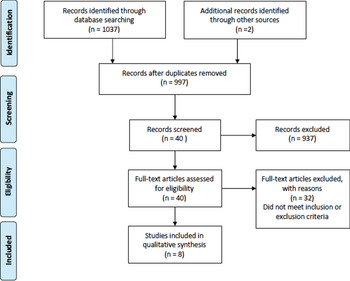
We identified a total of 1,037 literature from the database search. Two records were further identified through manual citation search. Following the removal of duplicates, we were left with 997 articles, which we considered for our scoping review. All the abstracts of the considered articles were screened, which resulted in the exclusion of 937 articles. We then identified 40 articles as relevant for use in the scoping review and were matched against the inclusion and exclusion criteria. A total of eight articles were judged to meet the prescribed criteria after screening the full articles. The PRISMA diagram in Figure 1 outlines the searches undertaken and the subsequent results obtained.
A PRISMA flowchart outlining the literature search.

Data abstraction
Data abstraction was undertaken by the first author and verified by the second author. Discrepancies in the results were resolved by the third author.
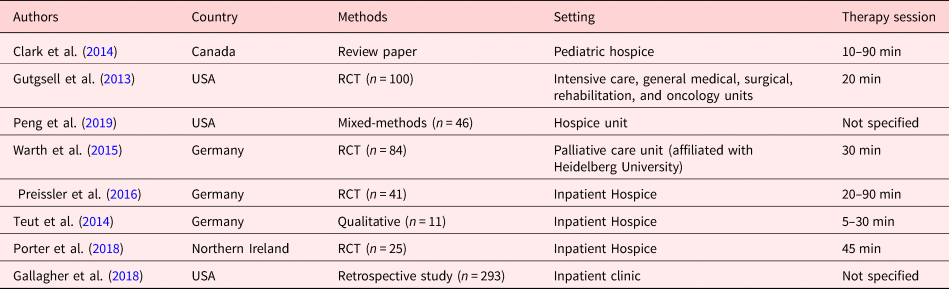
The majority of the articles were from Germany and the United States (n = 3), 1 was from Canada and Northern Ireland. The majority of the articles were quantitative (n = 5); 2 were qualitative, while the remaining 1 was mixed-methods. Despite the methodological differences and geographical locations of the studies analyzed, a common thread was noted and confirmed throughout the themes identified, as shown in Table 1.
Characteristics of studies in the scoping review (n = 8)

Qualitative analysis
Following data extraction, the findings were exported into Microsoft Excel for analysis. Due to the sensitive nature of the topic under consideration (Palliative care) and in keeping with the principles of scoping review, the critical appraisal was not considered to eliminate articles from the review. Instead, all the eight articles contributed to the final analysis of the results presented in this article. Thematic analysis was utilized to reflect the new combined findings of the eight articles considered (Braun and Clarke, Reference Braun and Clarke2006). Articles were color coded on Microsoft Excel according to the related themes they contributed (Aveyard and Sharp, Reference Aveyard and Sharp2013). The color coding used helped to visualize the contribution of each article, including its contribution to the themes. The data coding was reviewed over 1 month, leading to various changes and refinement of themes, which subsequently made the final themes of the article.
Results
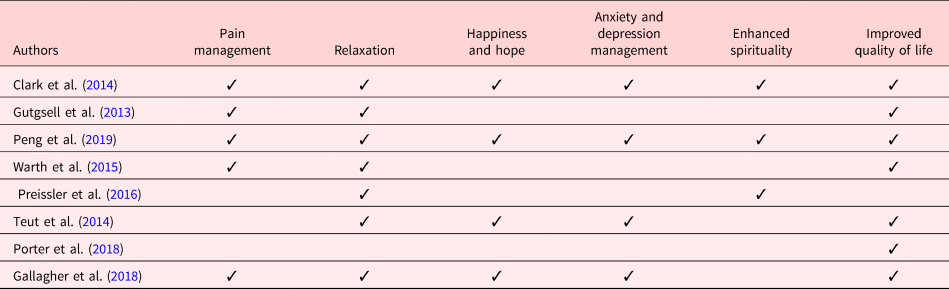
Most of the studies reported similar benefits of music in palliative care patients. The six recurring themes emanating from the studies included Pain management; Relaxation; Happiness and hope; Anxiety and depression management; Enhanced spirituality; and Improved quality of life. Table 2 provides a summary analysis of the themes covered, including the contribution of each paper. The themes of relaxation and improved quality of life were more prominent and found in seven out of the eight articles.
Summary of themes from the data analysis

Theme 1: Pain management
A common theme running through most of the research articles used in this review (n = 5) was that music is effective in managing pain in both children and adults. In all the five articles, music therapy was linked to the ability of patients to manage pain (Gutgsell et al., Reference Gutgsell, Schluchter and Margevicius2013; Clark et al., Reference Clark, Siden and Straatman2014; Warth et al., Reference Warth, Keßler and Hillecke2015; Gallagher et al., Reference Gallagher, Lagman and Rybicki2018; Peng et al., Reference Peng, Baxter and Lally2019). One of the articles indicated that the private and relaxing ambience and instructions provided by the music therapist was sufficient in some cases to reduce pain in patients (Gutgsell et al., Reference Gutgsell, Schluchter and Margevicius2013). Patients in four articles reported significant improvement in coping with pain following episodes of listening to music compared to groups, which had no access to music (Gutgsell et al., Reference Gutgsell, Schluchter and Margevicius2013; Clark et al., Reference Clark, Siden and Straatman2014; Gallagher et al., Reference Gallagher, Lagman and Rybicki2018; Peng et al., Reference Peng, Baxter and Lally2019). Only one article reported that there was no significant difference in pain management between the therapy and control groups (Warth et al., Reference Warth, Keßler and Hillecke2015).
Theme 2: Relaxation
Following the utilization of music therapy patients with terminal illness felt comfort and were able to relax (Gutgsell et al., Reference Gutgsell, Schluchter and Margevicius2013; Clark et al., Reference Clark, Siden and Straatman2014; Teut et al., Reference Teut, Dietrich and Deutz2014; Warth et al., Reference Warth, Keßler and Hillecke2015; Preissler et al., Reference Preissler, Kordovan and Ullrich2016; Gallagher et al., Reference Gallagher, Lagman and Rybicki2018; Peng et al., Reference Peng, Baxter and Lally2019). The use of music to enhance relaxation was a recurring theme in seven articles, and it was shown to have far-reaching effects on patients. For instance, one article showed that patients were able to increase levels of interaction while exercising choice and control due to relaxation (Clark et al., Reference Clark, Siden and Straatman2014). Another article reported that the creation of a relaxing ambience through the use of music which consequently resulted in a significant reduction in pain (Gutgsell et al., Reference Gutgsell, Schluchter and Margevicius2013).
Theme 3: Happiness and hope
Palliative care interventions that included music resulted in a general feeling of happiness, hope, and love among the research participants in four of the studies (Clark et al., Reference Clark, Siden and Straatman2014; Teut et al., Reference Teut, Dietrich and Deutz2014; Gallagher et al., Reference Gallagher, Lagman and Rybicki2018; Peng et al., Reference Peng, Baxter and Lally2019). Peng et al. (Reference Peng, Baxter and Lally2019) reported increased happiness among patients following the completion of a pre- and post-music intervention evaluation. Two articles reported feelings of hope and happiness for both patients and their families as a result of the music therapy (Teut et al., Reference Teut, Dietrich and Deutz2014; Peng et al., Reference Peng, Baxter and Lally2019).
Theme 4: Anxiety and depression management
Music was also found to reduce the level of anxiety and depression in four out of the eight studies (Clark et al., Reference Clark, Siden and Straatman2014; Teut et al., Reference Teut, Dietrich and Deutz2014; Gallagher et al., Reference Gallagher, Lagman and Rybicki2018; Peng et al., Reference Peng, Baxter and Lally2019). Children managed to conceptualize a sense of self, following the use of a musical intervention, which subsequently led to a reduction of anxiety and depression (Clark et al., Reference Clark, Siden and Straatman2014). This made it possible for children living with terminal conditions to engage with activities, including dancing and manipulating instruments. The mixed-methods study also found that live music had a profound effect on the health and well-being of patients in palliative care as it embeds social interactions among musicians and patients (Peng et al., Reference Peng, Baxter and Lally2019). This interaction made patients calm and filled them with a sense of happiness. Furthermore, one article showed that music could reduce anxiety and depression levels by making patients and families feel more connected (Teut et al., Reference Teut, Dietrich and Deutz2014).
Theme 5: Enhanced spirituality
Some of the articles (n = 3) exhibited the connection of music to spirituality (Clark et al., Reference Clark, Siden and Straatman2014; Preissler et al., Reference Preissler, Kordovan and Ullrich2016; Peng et al., Reference Peng, Baxter and Lally2019). The articles reported that patients thought that music therapy enhanced their spiritual awareness (Clark et al., Reference Clark, Siden and Straatman2014) or brought them closer to God (Peng et al., Reference Peng, Baxter and Lally2019).
Theme 6: Improved quality of life
In general, there was a consensus that music improved the quality of life among palliative patients. Nearly, all the articles (n = 7) considered in this literature review confirmed the efficacy of music in reducing pain and subsequently improving the quality of life (Gutgsell et al., Reference Gutgsell, Schluchter and Margevicius2013; Clark et al., Reference Clark, Siden and Straatman2014; Teut et al., Reference Teut, Dietrich and Deutz2014; Warth et al., Reference Warth, Keßler and Hillecke2015; Gallagher et al., Reference Gallagher, Lagman and Rybicki2018; Porter et al., Reference Porter, McConnell and Graham-Wisener2018; Peng et al., Reference Peng, Baxter and Lally2019). However, one of the articles did not think that the improvement was significant (Warth et al., Reference Warth, Keßler and Hillecke2015). Another article did not show a significant improvement in quality of life following a music intervention (Porter et al., Reference Porter, McConnell and Graham-Wisener2018). However, it concluded that it is feasible to assess the efficacy of music therapy for improving quality of life among a larger sample of palliative care patients (Porter et al., Reference Porter, McConnell and Graham-Wisener2018).
Discussion
This scoping review has demonstrated that music is not only effective for pain management in palliative care but it can also improve the comfort and well-being of palliative care patients. Music in palliative care can improve the experiences of patients and families facing problems associated with terminal illness as it offers a useful adjunct to the overall objective of palliative care which is the prevention and relief of suffering and treatment of pain (Puntillo et al., Reference Puntillo, Nelson and Weissman2014). More importantly, music is central to improved positive outcomes of any patient undergoing a managed terminal condition. This study also demonstrated that the use of music in palliative care settings has positive outcomes with regards to happiness, relaxation, and general well-being of palliative care patients. The role of music as a creative complementary approach in palliative care is, therefore, to improve the quality of life of patients and their families by providing a natural form of relief and solace. Although there are cultural differences in the nature of music and how it is understood and enjoyed, we find that, within any given culture, music reaches virtually every person, in one way or another (Lehman, Reference Lehman2018).
Over the years, there has been a constant development of pain management medication, which has come with both relief and negative side effects on the patient in palliative care. The availability of alternative noninvasive interventions with minimal side effects like music has come with greater relief for both patients and service providers (Zucchella et al., Reference Zucchella, Sinforiani and Tamburin2018). For patients, the side effects of music are minimal, and for service providers, music is a cost-effective and relatively easy intervention to utilize (Gutgsell et al., Reference Gutgsell, Schluchter and Margevicius2013; Warth et al., Reference Warth, Keßler and Hillecke2015). Pain is subjective, highly complicated to understand and may manifest differently from patient to patient depending upon the physical state as well as the individual patient's psychological state (Bushnell et al., Reference Bushnell, Čeko and Low2013). Furthermore, research suggests that pain can become resistant to conventional treatment measures if psychological and social issues are not adequately addressed (Turk and Gatchel, Reference Turk and Gatchel2018).
A previous study which highlights the issue of nonphysical pain through analysis of pain narratives using a hermeneutical-phenomenological approach indicated that the loss of relationships was associated with psychological pain in patients (Kugelmann, Reference Kugelmann2000). When one considers palliative care patients, there is already a sense of grieving for losses manifesting throughout the illness journey and imminent death. There is separation from loved ones, loss of shared enjoyment of life, and lost opportunities as a result of terminal illnesses. Our review has shown that music therapy can help both patients and families restore some of these losses by enhancing interactions and providing a space for shared emotions (Teut et al., Reference Teut, Dietrich and Deutz2014; Peng et al., Reference Peng, Baxter and Lally2019). The use of music in palliative also helps patients and families find closure to difficult episodes in their lives (Cadrin, Reference Cadrin2006). Consequently, this can reduce psychological distress and pain perception leading to some form of happiness, hope, and well-being.
The purpose of music therapy is not limited to the existential benefit to patients but also contributes to the wider social relationships with their friends and families. There is a notion that when music therapy is delivered to a group which include patients’ families and staff, it can lower bereavement levels for families, patients, and caregivers (O'Callaghan et al., Reference O'Callaghan, McDermott and Hudson2013). Music can also soften and humanize the palliative care setting by adding life and atmosphere of happiness through dancing listening or singing along together. This may lift the mood of patients, families, and staff leading to improved patient care including well-being (Teut et al., Reference Teut, Dietrich and Deutz2014; Peng et al., Reference Peng, Baxter and Lally2019) as patients in palliative care experience a sense of isolation from holding onto feelings and issues perceived as hard to share with others. Staying in a restricted area because of a degenerative condition can also cause pain and fatigue in the affected individual (Tanaka et al., Reference Tanaka, Detamore and Mercuri2008). However, this study demonstrated that the use of music in palliative care settings has positive outcomes with regards to happiness, reducing anxiety levels, and increasing relaxation for palliative care patients (Clark et al., Reference Clark, Siden and Straatman2014; Gallagher et al., Reference Gallagher, Lagman and Rybicki2018; Peng et al., Reference Peng, Baxter and Lally2019).
Another finding from this scoping review was the association of spirituality with music intervention. The term “spirituality” has constantly appeared in healing, including scripts on health and well-being since the early 1980s. However, sometimes it appears to be a confusing term (Chiu et al., Reference Chiu, Emblen and Van Hofwegen2004). In the context of public health and healthcare literature, the term incorporates a wide range of meanings departing from the idea of religion as normally assumed by many people (Fryback and Reinert, Reference Fryback and Reinert1999). Post-White contends that spirituality is more about “ … the search for meaning and existential purpose in life” (Post-White, Reference Post-White1996, p. 1572). Indeed, a common thread running through the literature on spirituality, health and palliative care is the search for meaning (Tanyi, Reference Tanyi2002). Music therapy has been identified as one of the most important interventions used for the spiritual care of patients with advanced or critical life-threatening illnesses. This scoping review also highlighted music therapy's unique contribution in addressing the spiritual needs of patients in palliative care settings (Clark et al., Reference Clark, Siden and Straatman2014; Preissler et al., Reference Preissler, Kordovan and Ullrich2016; Peng et al., Reference Peng, Baxter and Lally2019). The level of enduring, managed during palliative care, is believed to be influenced by finding meaning in one's lived experiences, which may be facilitated by music therapy (Potvin et al., Reference Potvin, Bradt and Ghetti2018).
Spiritual care training for staff working in palliative care can result in a more holistic approach to patient care, and this can, in turn, result in improved patient outcomes (Clark et al., Reference Clark, Siden and Straatman2014; Yang et al., Reference Yang, Tan and Cheung2017; Peng et al., Reference Peng, Baxter and Lally2019). Spiritual care can also help patients in palliative care to talk through various aspects of their concerns, and that in itself is helpful for the patients’ well-being (Yang et al., Reference Yang, Tan and Cheung2017). However, the effectiveness of this spiritual support depends also on patients’ beliefs and experiences in life, including other supporting systems within their environment.
Study strengths and limitations
A key strength of this scoping review is the quality of articles included in the review. Half of the articles included in the review were RCT studies. Although only one researcher conducted the search for the literature used in this article, the study interpretations were strengthened by having two researchers abstract and discuss the themes and findings. Another strength is the diversity of the studies presented. The research articles used in this article were drawn from different countries, enhancing diversity, but this poses a limitation in terms of difficulty to generalize. In this article, a scoping review was conducted. However, it excluded grey literature, specialist opinion, and policymakers’ perspectives. Additional information from the excluded types of documents and expert sources would have enriched this article with a wealth of information.
Recommendations
Many music therapy researches carried out in palliative care have been aimed at reducing and managing pain in patients. However, there are many problems that can affect patients in palliative care. For example, little has been done in facilitating the discussion of sensitive or difficult conversations around managing everyday activities of the patients and post humus funeral arrangements (Paal, Reference Paal2018). These issues, in many circumstances, have been deemed sensitive conversations and marginalized in the palliative discourse. It is, therefore, important to explore the use of music in opening these difficult conversations among patients, families, and staff in a palliative care setting.
This scoping review has identified how some issues within palliative care settings, such as pain and anxiety, may be addressed or alleviated by the use of music as an intervention. Still, there are some other pertinent issues central to palliative care that need to be tested and addressed, potentially using music as an intervention. For example, the utilization of music directly by frontline staff to discuss sensitive issues affecting patients, families, and care staff in palliative care settings. This may open a new chapter in palliative care where interventions go beyond managing pain to include the facilitation of difficult dialog among the above-mentioned social groups.
We also recommend that future studies focus on the effectiveness of music for specific health conditions in order to draw inferences or commonalities on how music affects palliative care across a range of illnesses.
Conclusion
The use of music as an intervention in palliative care is increasingly being recognized worldwide and has the potential to address a wide range of needs among patients, care staff, and families. This scoping review has identified some existing needs within palliative care that may potentially be addressed by music specifically through: Pain management; Relaxation; Happiness and hope; Anxiety and depression management; Enhanced spirituality; and Improved quality of life. Our review suggests that music therapy can be an effective psychosocial approach when managing palliative symptoms through its therapeutic effects on the physical, psychological, emotional, and spiritual well-being of patients and their families.
Funding
The authors received no specific grant from any funding agency in the public, commercial, or not-for-profit sectors for this research.
Conflict of Interest
The authors declare no potential conflict of interest with respect to the research, authorship and publication of this article.