

In the study of fifteenth-century music manuscripts, the accepted wisdom is that most changes were made by the copyist, who acted not only as scribe but also as collector, corrector, interpreter, and at times even as composer. This attitude is encapsulated in the New Grove article on Sources, in which Stanley Boorman says: ‘Finally, in many kinds of music … the scribe was apparently accorded a more important role than that of a mere copyist: the freedom with which he was expected to make substantive changes in the musical text being copied was a reflection of the extent to which that text was not seen as being sacrosanct in all its aspects.’Footnote 1 Margaret Bent's work on the manuscript Bologna Q15 and other sources confirms the freedom that scribes often enjoyed when copying music.Footnote 2 That this was often or even usually the case may be true, but just as it would be foolish to underestimate the initiative that scribes could exercise in their work, so too would it be equally foolish to assume that only scribes ever wielded such interpretative creativity. Who collected, arranged, corrected, altered and recomposed – in short, who acted as an editor – depended on a variety of circumstances, including the type and purpose of the manuscript, its owner or commissioner and the level of expertise of the scribe. Occasionally, a separate editor exerted the kind of control over the production of a manuscript that we normally attribute to the scribe. Such instances may be rare, but they can shed considerable light on transmission, the difference between copying and (re)composition and the early history of editorship.
Editing in the late fifteenth century was not yet an acknowledged profession in the same way that copying was. The birth of the modern music editor is tied to the rise of music publishing in the sixteenth century and a printer's need for someone to collect, correct, select, proofread, package and market the books.Footnote 3 The use of an editor in the publishing of material other than music, however, goes back even further. Editors were regularly employed in the publication of vernacular texts in Italy beginning in the second half of the fifteenth century and many intellectuals now known primarily as authors also acted as editors, the most prominent example perhaps being Pietro Bembo.Footnote 4
Manuscript production had a different set of requirements than printing. Packaging and marketing were not an issue for manuscripts and scribes usually were responsible for collecting, correcting and proofreading the works that they copied. ‘Correctors’ – experts in Latin or modern literary standards – were often employed by manuscript authors and later by publishing houses, but no comparable person existed in the production of music manuscripts.Footnote 5 In printed books, the editor was often named somewhere, either in a dedicatory letter, preface or in a colophon; in manuscripts, such details are lacking. A close reading of ModD shows that although the modern music editor may have been born in the sixteenth century, he was conceived during the fifteenth century and although his first widespread use was in publishing houses, he has an earlier, inchoate history in manuscript production.
In this essay I will examine one manuscript: Modena, Biblioteca Estense, MS α.M.1.13 (hereafter ModD), a collection of masses copied onto parchment in Ferrara around 1479–81 for the court of Ercole I d'Este. Lewis Lockwood noted that the versions in ModD differ substantially from their concordances and proposed that Johannes Martini might have acted as the editor, but admitted that an extended study of the source and its concordances was necessary.Footnote 6 This hypothesis has recently been challenged: Elaine Moohan, in her study of sources from Ercole's court, suggested that significant variants originated with the composers rather than a compiler or scribe;Footnote 7 and Francesco Rocco Rossi attributes the different readings in ModD to problems in transmission and/or scribal intervention and suggests that there was absolutely no editorial intervention by Martini.Footnote 8 The situation is far more complex than either of these authors suggests. I will argue that ModD indeed had a separate and independent editor (Martini) apart from the scribe who copied it (Fra Filippo) and that both tampered with the music to different extents. The reasons behind the changes may in part have been politically and religiously motivated. Finally, I will suggest that several of the masses in ModD contain sections written by someone other than the original composer and that this practice was more common than we currently believe.
ModD contains eighteen masses, but due to subsequent damage, the last mass – Martini's Missa Cucu – is fragmentary (all that remains is the verso of a folio containing the superius and tenor of Kyrie I and the Christe). The inventory at the beginning of the manuscript, which is in the same hand as the rest of the manuscript, lists Missa Cucu as the last mass, indicating that a complete copy was once part of the manuscript. Using payment records from the court, Lockwood suggested that ModD was copied around 1481. The description of the manuscript in the payment records does not match ModD exactly; it says that there were twenty-seven quinterns or 270 leaves, but ModD has only 224 leaves. Even allowing for some missing leaves at the end of the manuscript, this tally is off by several quinterns. Lockwood implies that the payment record simply had the number of quinterns incorrect, but that it does indeed refer to ModD.Footnote 9 Moohan, using palaeographic evidence, suggests that ModD was copied a few years earlier, c. 1479. She contends the double-choir Office manuscripts (ModC1 and C2) are both in the same practised hand but that ModD, although copied by the same scribe, is in a less-practised hand, which suggests an earlier date. Furthermore, it was common for musical centres to have a mass book copied before an Office book, citing the examples of Milan, Bologna, Casale Monferrato and Treviso.Footnote 10
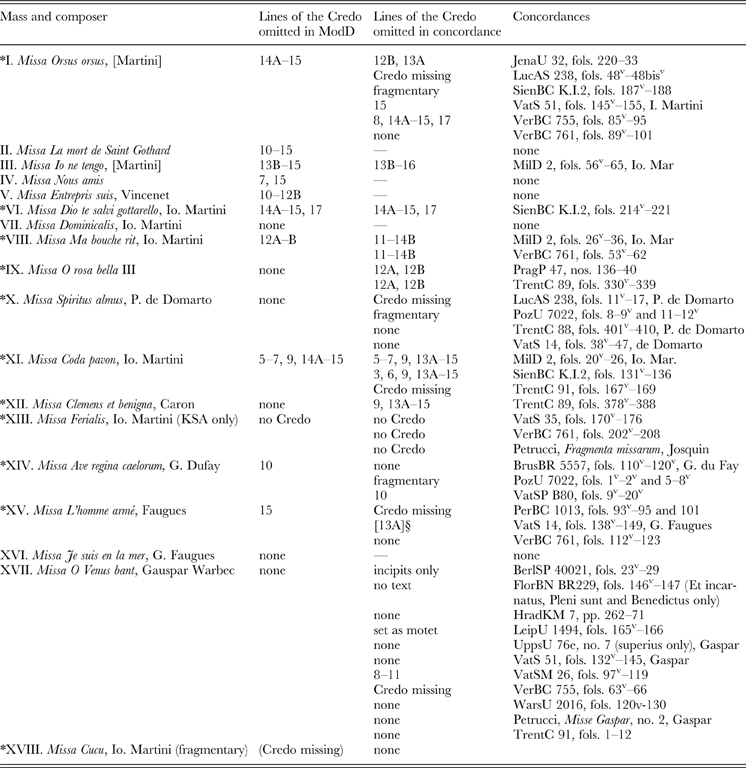
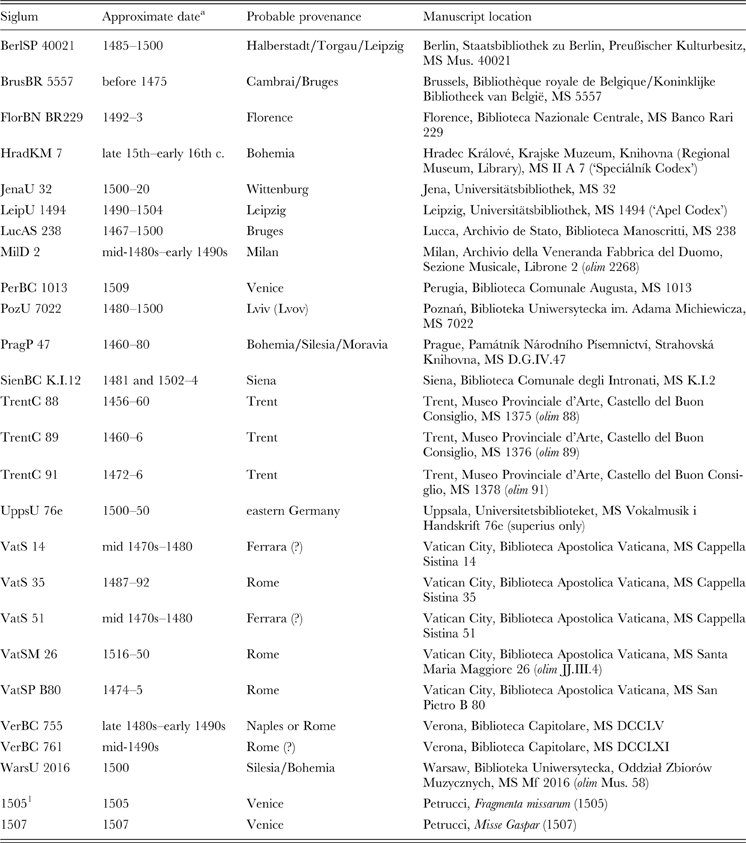
The scribe of ModD was Fra Filippo di San Giorgio, who copied several other music manuscripts for the Este court.Footnote 11 The composers represented are those who were active primarily during the 1460s and 1470s, and include Firminus Caron, Petrus de Domarto, Guillaume Faugues, Johannes Martini and Johannes Vincenet. Also included is Guillaume Du Fay's Missa Ave regina caelorum, a work possibly written as late as 1472, as well as three anonymous masses, which a few modern scholars have tentatively attributed to Martini, although I have argued elsewhere that all of these attributions are very doubtful.Footnote 12 The contents of ModD are given in Appendix II, along with their concordances. Five of the masses are unique to ModD, while the others have anywhere from one to ten concordances scattered among twenty-four geographically diverse manuscripts and two printed sources, and ranging in date from the late 1450s through to the middle of the sixteenth century.
Whoever selected the music for ModD chose eight masses by Martini and ten by his contemporaries. ModD is the earliest extant source for a few of the masses by Martini, and these were probably composed specifically for Ercole's chapel.Footnote 13 The masses were not chosen randomly, but rather were selected to suit the duke's needs. Ercole heard Mass daily, and although the daily Mass may not have been polyphonic, the ducal chapel was nevertheless very active in singing at Mass and had ample need for polyphonic masses. ModD contains a variety of different types of masses that could supply the music for any occasion requiring a polyphonic mass. There is a Missa Dominicalis for Sundays; a Missa Ferialis for daily use; at least three masses for Mary (Missa Spiritus almus, Missa Clemens et benigna and Missa Ave regina caelorum); two masses for St Gothard; and finally, a Missa L'homme armé that would have been suitable for any gathering of knights, which included most princes, dukes and other nobility. The masses intended for a specific purpose account for nearly half of the manuscript (eight of the eighteen masses); the other ten, most of which are based on secular chansons, were more suitable for special occasions. Weddings seem particularly appropriate because of the courtly-love texts of many of the models, but just as easily these may have been used at Marian celebrations. In the fifteenth century, it was a small step from the earthly love embodied in the ideals of fin amours that infused the chanson repertory to the divine love of the Virgin Mary.Footnote 14
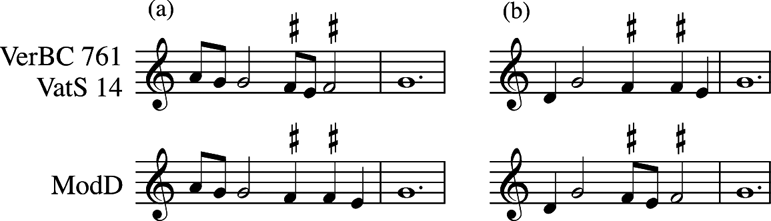
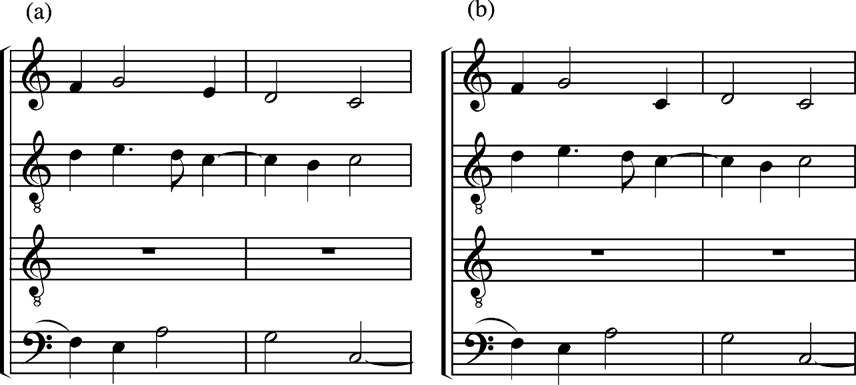
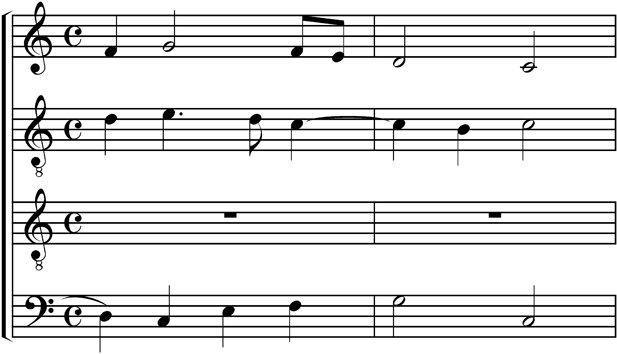
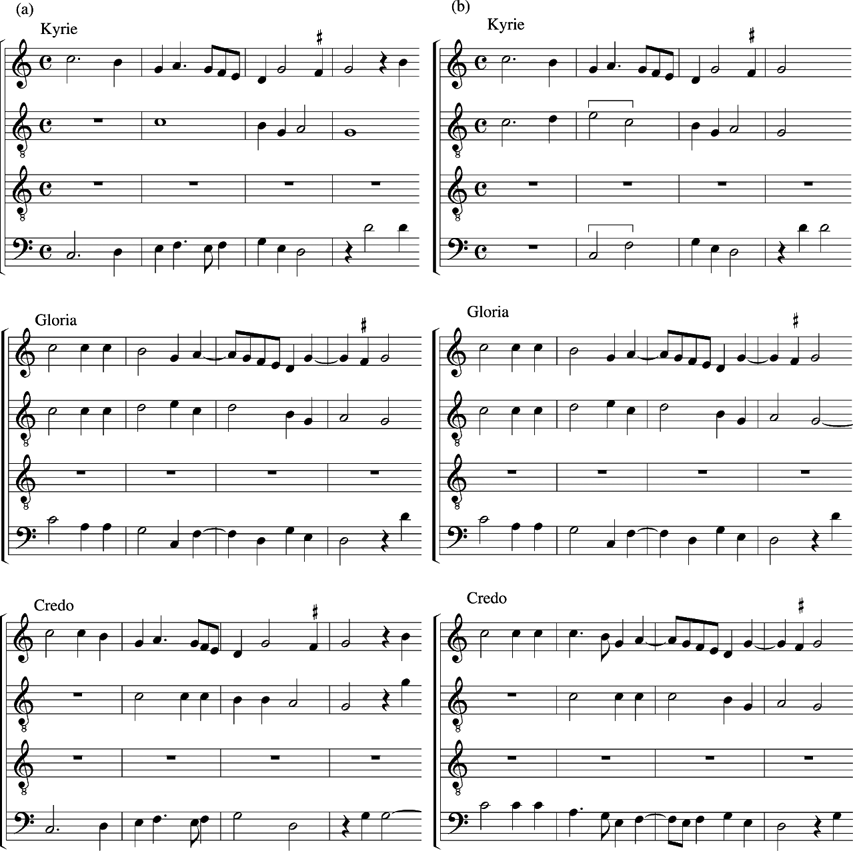
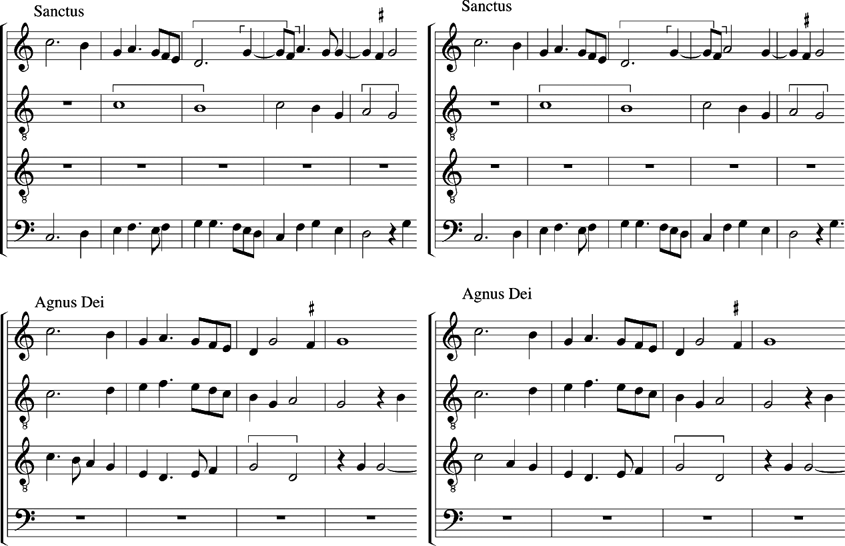
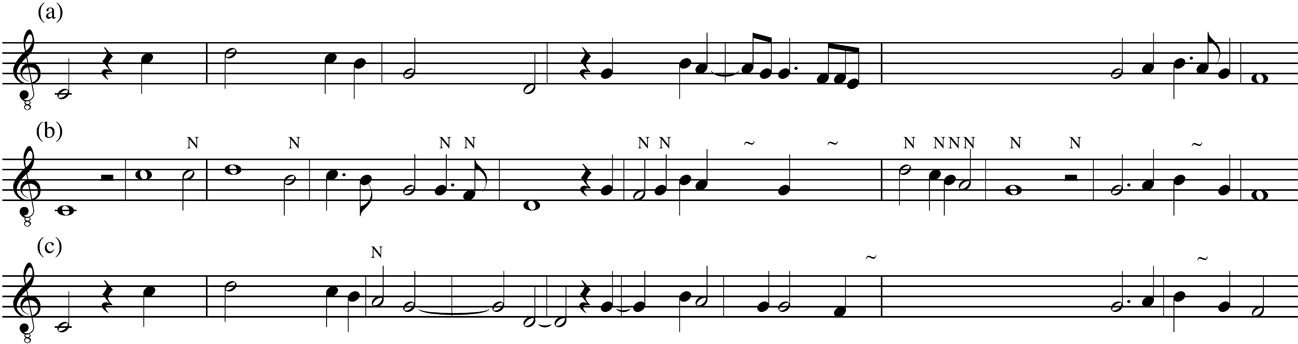
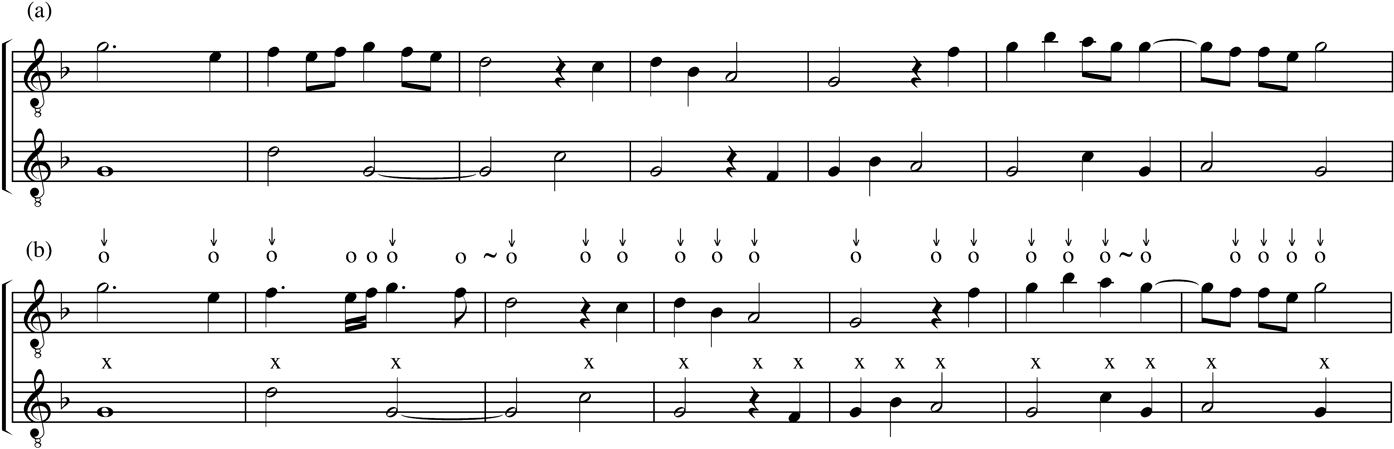
An important aspect of all manuscript studies is an examination of the variants in the text as well as the music. It is important to distinguish between changes that any scribe might make and those that required greater expertise. To be sure, lack of expertise did not stop some scribes from making changes, but it is a useful distinction to make nonetheless. A variety of small, seemingly random changes exist among the masses of ModD and their concordances; for example, some cadences in ModD are decorated differently than in their concordances. Cadences are the very places where one might expect a scribe to introduce minor decorative variants, and these changes are most convincingly explained as random actions of the scribe, who evidently felt that the musical conventions of his time allowed him the freedom to add or change small embellishments wherever he liked.Footnote 15Example 1, from Faugues's Missa L'homme armé, illustrates this point quite clearly. In the excerpt from the Kyrie, the scribes of the Verona and Vatican manuscripts decorate the cadence one way, while the scribe of ModD decorates it another. Both versions are textbook examples of how to vary a standard cadential passage. In the excerpts from the end of the Cum Sancto Spiritu, the Verona and Vatican sources once again agree with each other but not with ModD. In all of the excerpts, the same cadence is used but the scribes decorated it differently. Notational variants such as changes in ligatures and the use of coloration, especially minor color, are also best explained as the actions of the scribe. More substantial changes, however, required much greater forethought and may signal the presence of an editor. I will divide these changes into two broad categories: changes to the text, particularly that of the Credo, and changes to the music.
Guillaume Faugues, Missa L'homme armé, cadential decorations: (a) Kyrie I, bb. 7–8; (b) Cum Sancto Spiritu, bb. 38–9

Textual changes in the modena manuscript
Medieval and Renaissance scribes frequently omitted portions of the Credo text, ranging from a few words to half a dozen lines or more. A number of theories have been proposed over the years to account for textual omissions in the Credo. Ruth Hannas suggested that parts of the Credo, especially those dealing with the Holy Spirit, and in particular the word ‘filioque’, were omitted in an attempt to appease the Greeks and others who had difficulty accepting that the Holy Spirit proceeded from the Son as well as the Father. Hannas further speculated that these omissions began at the time of the Council of Florence/Ferrara in 1438.Footnote 16 Her hypothesis was quickly challenged, partially on the grounds that it is difficult to see what impact such a conciliatory attitude would have had on masses written thirty, forty, or even fifty years later.Footnote 17 Margaret and Ian Bent suggested that certain deletions were the result of Continental scribes copying English telescoped Credos but omitting the text in the lower voices, thereby giving the erroneous impression that text was omitted intentionally when in fact it was not.Footnote 18 While this theory explains the omissions in some masses from the mid-fifteenth century, it is again difficult to see its explanatory value for textual deletions in Continental masses from the end of the century. Finally, Geoffrey Chew suggested that Credo omissions in Continental masses could best be seen as ‘gestures of solidarity with the aims of the Pope’.Footnote 19 This very speculative theory goes some way towards explaining omissions in the late fifteenth century, but was not supported by substantial evidence. It is therefore important to look at individual masses and manuscripts and explore motivating factors behind any omissions. From a liturgical point of view, it may not have mattered what the singers sang as long as the celebrant recited the text; but from a musicological point of view, the missing text poses some serious questions.Footnote 20 Was the text omitted by the composer or the scribe? Was it left out deliberately or accidentally? Should modern editors restore the missing text, thereby tacitly blaming the omission on either scribal error or expediency, or leave it out, assuming that the composer or scribe had a good reason for its omission? Although these are not easy questions to answer, it is important to address them because they have a significant impact on how we view fifteenth-century style. The evidence from ModD and its concordances suggests that practices varied.
The music in ModD is arranged in choirbook format, with the superius and tenor on the left-hand opening, and the alto and bass on the right. The text generally is underlaid throughout the superius, but the amount provided for the other voices varies from mass to mass and from section to section, as in most contemporary sources. The alto only occasionally contains a complete text; most of the time only an incipit and cues are provided, and sometimes only an incipit. The tenor and bass rarely have a complete text, but always have an incipit and frequently cues for the beginnings of at least a few other phrases. When the top voice was resting and text was omitted, the scribe often was careful to underlay at least one of the other voices with the specific portions of the text that were required, usually the alto. Nevertheless, two masses contain examples in which brief phrases of the text were left out completely; in every case, the top voice is resting where the omitted text would appear, and the other voices contain only incipits. In these instances the scribe did not intend to omit text, but accidentally gave that impression by not providing the complete text in the lower voices.Footnote 21
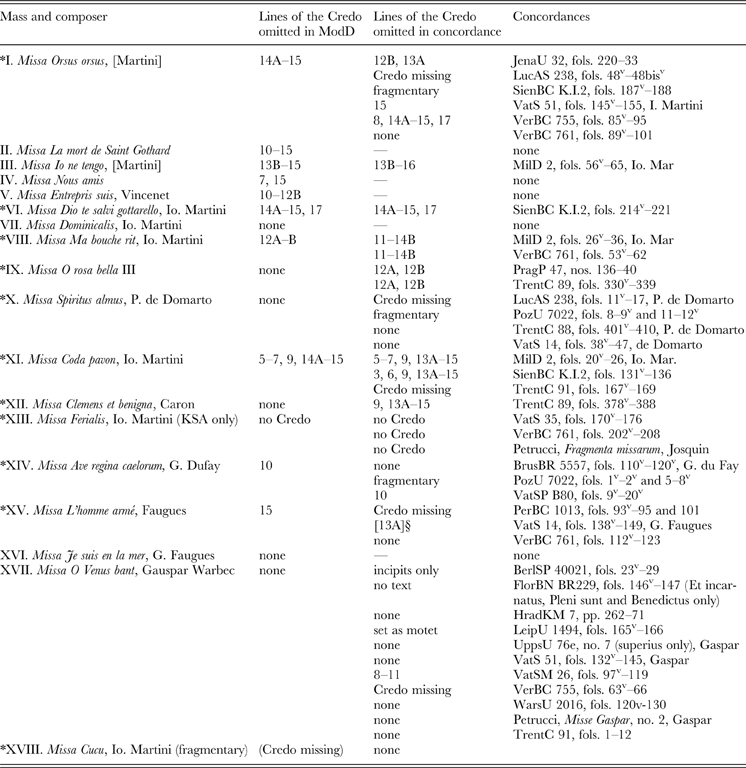
Of the sixteen masses in ModD that contain a Credo, ten have some textual omissions, ranging from one to nine lines of text:Footnote 22
1. Credo in unum Deum,
2. Patrem omnipotentem, factorem caeli et terrae, visibilium omnium et invisibilium.
3. Et in unum Dominum Jesum Christum, Filium Dei unigenitum,
4. Et ex Patre natum ante omnia saecula.
5. Deum de Deo, lumen de lumine, Deum verum de Deo vero,
6. Genitum, non factum, consubstantialem Patri: per quem omnia facta sunt.
7. Qui propter nos homines, et propter nostram salutem, descendit de caelis.
8. Et incarnatus est de Spiritu Sancto ex Maria virgine, et homo factus est.
9. Crucifixus etiam pro nobis sub Pontio Pilato; passus et sepultus est,
10. Et resurrexit tertia die, secundum Scripturas,
11. Et ascendit in caelum, sedet ad dexteram Patris.
12A. Et iterum venturus est cum gloria judicare vivos et mortuos,
12B. cujus regni non erit finis.
13A. Et in Spiritum Sanctum, Dominum et vivificantem;
13B. qui ex Patre Filioque procedit.
14A. Qui cum Patre et Filio simul adoratur et conglorificatur;
14B. qui locutus est per prophetas.
15. Et unam sanctam, catholicam et apostolicam Ecclesiam.
16. Confiteor unum baptisma in remissionem peccatorum.
17. Et exspecto resurrectionem mortuorum,
18. Et vitam venturi saeculi. Amen.
Most of the omitted text occurs between lines 10 and 15, although a few masses also omit earlier lines. Those most frequently omitted are 14A–15, which are omitted at least five times each, sometimes in isolation, as in Martini's Missa Orsus, orsus, and sometimes in conjunction with other lines, as in his Missa Coda pavon; line 15 is omitted by itself on two other occasions. Together, lines 14A–15 account for about half of the omissions in ModD, and all but one of these are in masses by Martini (the only one not by Martini is the anonymous Missa La mort de St Gothard). These seem to be the lines that Martini normally omitted. Occasionally he omitted others as well, but only once did he omit text that did not include lines 14A–15: his Missa Ma bouche rit omits lines 12A–B. There is no discernible pattern to the omissions in the masses by Faugues, the only other composer represented by more than one mass in ModD.
A comparison of the omissions in ModD with those in its concordant sources shows that in most cases, ModD contains fewer textual omissions (compare columns 2 and 3 in Appendix II).Footnote 23 Sometimes, the number of lines omitted in a concordant source is only slightly greater than in ModD: Martini's Missa Io ne tengo, for example, has five lines of text omitted in the version found in its Milanese source, but only four lines omitted in ModD. Elsewhere, the difference is more dramatic: Caron's Missa Clemens et benigna has six lines omitted in its Trent source, but none in ModD. In most cases, any text omitted in ModD is also omitted in its concordant sources. Occasionally, however, concordant sources will omit completely different lines of text; for example, ModD omits lines 14A–15 in Martini's Missa Orsus, orsus, but the Jena source omits lines 12B and 13A; the Roman source omits line 15; and the first Verona source omits lines 8, 14A–15 and 17. Missa Orsus, orsus highlights the need to examine the background of individual sources to see what local traditions or other factors may have been at work.
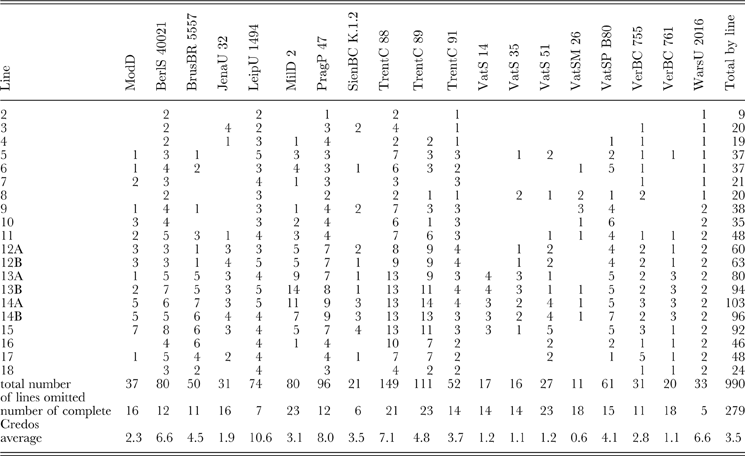
Looking at missing Credo text from manuscripts as a whole and not simply from individual masses, ModD is generally more complete compared with its concordant sources. An examination of the Credo omissions in the concordances reveals a variety of practices (see Table 1); two factors, however, appear to influence the amount of text given in the Credos. First, the earlier the manuscript was copied, the more omissions it is likely to have. Four of the earliest sources (TrentC 88, TrentC 89, BrusBR 5557 and VatSP B80) have the greatest number of lines omitted. Before the 1480s, scribes were generally unconcerned with the thoroughness of their text underlay; later, they began to include more of the Credo text. Second, certain musical centers were usually much more careful about the Credo text than others, most notably the Cappella Sistina.Footnote 24 For example, VatS 35 – a Cappella Sistina source prepared near the end of the fifteenth century – has relatively few omissions: nine of its eighteen masses have no omissions whatsoever, and only two of them have substantial omissions, each lacking five complete lines of text. On the other hand, MilD 2 – compiled in Milan at roughly the same time as VatS 35 – has considerably more omissions: although eight of its twenty-three masses have no omissions, nine have five to nine lines omitted, a significant amount indeed. ModD is remarkable for its time: its Credos were generally among the most fully texted, second in completeness only to later manuscripts or those compiled for the Vatican.Footnote 25 Indeed, ModD has fewer overall omissions and a greater percentage of masses with no omissions than the majority of its concordances.
Credo omissions by line and by source
The numbers in each cell represent the number of masses that omit a particular line. I took into consideration the telescoping of text; furthermore, when text was given fully in only one voice and that voice rested for a considerable time, I assumed that any missing text at that point would be sung by the other voices and did not count it as an omission (for example, see § in Appendix II). By dividing the total number of lines omitted in a source by the number of Credos within that source, we arrive at an average number of omissions per source; thus averages are low in manuscripts with few omissions and high in manuscripts with many omissions.
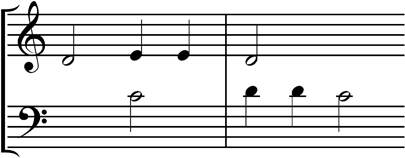
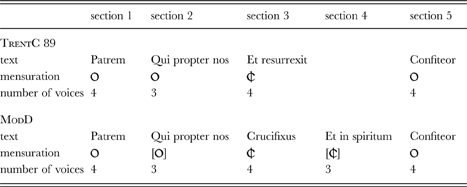
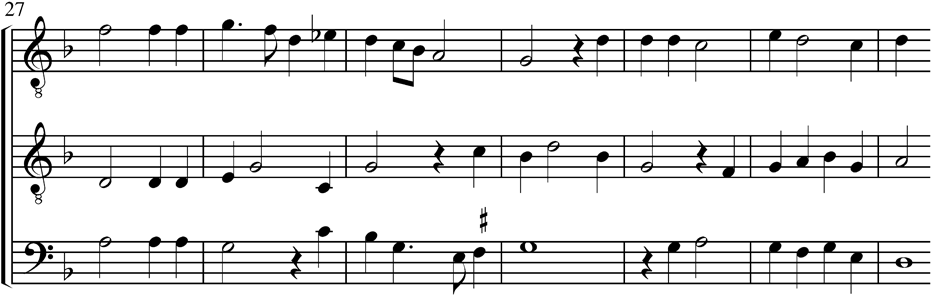
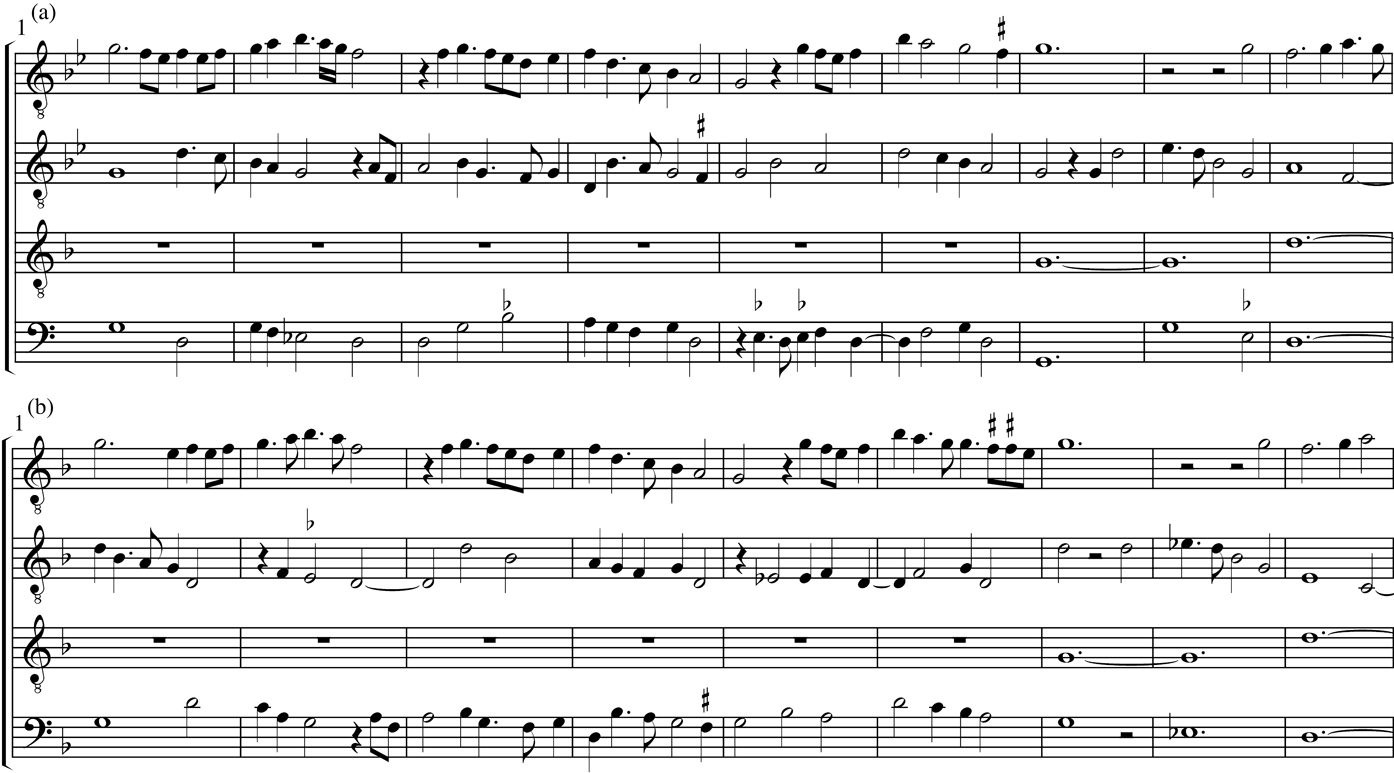
Any line of the Credo could be omitted on occasion, as Table 1 shows, but certain lines are more apt to be omitted than others. Lines 13A through 15 are clearly the most commonly omitted lines in the manuscripts sampled here. In some masses, there is sufficient music to accommodate the complete Credo text, or at least more than was given by the scribe, and it is not a matter of simply fitting in the text as best as possible, but that the masses appear to have been composed with the missing text in mind. A good example of this occurs in Caron's Missa Clemens et benigna. The textual omissions in this mass occur in two places; I will examine the second, longer omission later, but the first is line 9 (‘Crucifixus etiam pro nobis’, etc.): the Trent version is missing this line altogether whereas in ModD it opens the third section. A comparison of the two versions of the third section (Et resurrexit in Trent and Crucifixus in ModD) strongly suggests that that section was originally composed with the extra line of text in mind, but that the scribe of Trent 89 left it out (for what reason we may never know). Examples 2 and 3 show two places where the underlay in ModD fits perfectly but the underlay in Trent leaves something to be desired. In Example 2, from the opening of the section, the superius line fits the text (‘Crucifixus etiam’) so well that it seems to have been written with that text in mind; in the Trent version, the text fits with a short melisma, but the correspondence seems non-specific, even generic. In Example 3, taken from the middle of the movement, there are simply not enough notes to accommodate the text as underlaid in Trent, but again the text from ModD fits perfectly.
Firminus Caron, Missa Clemens et benigna, text underlay in Trent and ModD compared
Firminus Caron, Missa Clemens et benigna, text underlay in Trent and ModD compared
In other masses, there is insufficient music to accommodate the complete text of the Credo comfortably. A good example of this is Martini's Missa Orsus, orsus, which lacks three full lines of text: lines 14A–15 – the lines Martini most often omits. It would not be possible to accommodate all of the missing text in the music as it has come down to us, but there is no indication that any music is missing: the cantus firmus is rationally laid out, the music moves to triple metre at the end of the movement (characteristic of Martini), and it coheres in a way that suggests it is complete as it stands. The inference is clear: Martini wrote this Credo with the intention of omitting those three lines of text.
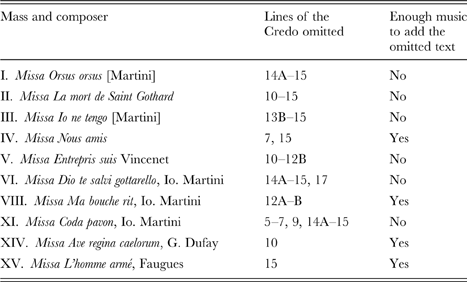
Table 2 lists those masses in ModD that lack text in the Credo and indicates which have enough music to accommodate the missing text and which do not (masses in ModD that either do not have a Credo or do not lack any text are not listed here; cf. Appendix II). In two cases (Du Fay's Missa Ave regina caelorum and Faugues's Missa L'homme armé), there is only one line missing and it could easily be accommodated; furthermore, in both masses at least one of the concordant sources supplies the complete text. In two other masses (the anonymous Missa Nous amis and Martini's Missa Ma bouche rit), both of which are missing two lines of text, it would be possible to include the text, but it would noticeably alter the style and the result would be a cramped setting in which sections are completely syllabic rather than the prevailing neumatic/slightly melismatic setting, many ligatures would need to accommodate multiple syllables, and there would be absolutely no alignment between textual and musical accents on important words. In the remaining six masses, there is so much text missing – anywhere from three to nine lines – that it would not be possible to add the missing texts.
Masses in ModD and the possibility of supplying missing text in the Credo
In addition to the Credo omissions, other textual changes occur in ModD. The anonymous Missa O rosa bella III exists in three sources: ModD, Trent 89 and Prague 47. In Trent 89, each section of the Kyrie has its own textual trope: ‘Rex virginum’ in the first Kyrie, ‘Deus de Patre’ in the Christe, and ‘O paraclite’ in the second Kyrie.Footnote 26 These tropes appear in the top voice – the only fully-texted voice in the mass in this manuscript – but were probably intended to be sung by all four voices. Very little text is given in the Kyrie of Prague 47, but the tenor does contain the cue ‘Rex virginum’. Given that scribe's cavalier attitude towards the text and the cramped layout of the Kyrie, it is quite likely that in this manuscript the tropes were meant to be sung at least by the tenor if not by all the voices, as in Trent 89. Troped Kyries were unusual in the late fifteenth century, at least on the Continent, and so it is remarkable that two of the sources of this mass contain the trope. The tropes do not appear in any voice in ModD; considering the care that was taken with the text of the Credo, these omissions undoubtedly were not oversights but intentional changes, an attempt to purge the manuscript of any unorthodox texts.
Petrus de Domarto's Missa Spiritus almus exists in five sources: ModD, plus sources from Trent, the Vatican, Lucca and Poznań (the latter two are fragmentary). In Trent 88, the only text that occurs in the tenor is ‘spiritus almus’, the text of the cantus firmus; and in LucAS 238, although the text of the Ordinary occurs sporadically, the scribe took some pains to underlay the ‘spiritus almus’ text rather than simply give it as an incipit.Footnote 27 In ModD, however, incipits for the Ordinary appear in the tenor, suggesting that once again someone involved in the production of the manuscript made the effort to standardise the text and make it conform to the somewhat conservative, preconceived notion that the only texts admissible in the Mass Ordinary were the normal Mass Ordinary texts. Such a decision would have been the prerogative of a knowledgeable editor who was not only aware of the liturgical and musical expectations at court, but was also competent enough to make the necessary adjustments to that would meet such expectations.
Musical changes in martini's masses
In addition to textual changes, eleven masses in ModD – nearly two-thirds – have musical readings that differ significantly from earlier concordances: six by Martini, one each by Caron, Domarto, Du Fay and Faugues, and one anonymous (these are marked with an asterisk in Appendix II). Five of the remaining seven masses are unique to ModD, leaving only two masses that do not show significant reworking. The musical changes themselves are instructive, but they also shed light on the redactive process that the music in ModD underwent.
Martini's Missa Ma bouche rit survives in three sources: ModD; MilD 2, which was copied in Milan sometime around 1490;Footnote 28 and VerBC 761, which probably was copied in Rome towards the end of the fifteenth century.Footnote 29 Although both concordances are later than ModD, they appear to represent an earlier version of Missa Ma bouche rit that Martini subsequently revised for ModD. The readings in MilD 2 and VerBC 761 in general are very close to one another, and the greatest differences are to be found in ModD; nevertheless, VerBC 761 has several passages that differ from both other sources. For example, the last eleven bars of the Gloria, especially the altus and bassus, have several different readings that neither correct errors nor modernise old-fashioned cadences, but simply provide alternative readings, suggesting that the scribe of VerBC 761, Hieronimus Beltrandi,Footnote 30 either had trouble with his exemplar or that he wilfully changed it.
The most important variant among the sources occurs in the Credo, in which the cantus firmus is divided into three sections: the first two are generally the same in all three sources, but while the third section is the same in MilD 2 and VerBC 761, in ModD it is completely different.Footnote 31 Nevertheless, a close comparison shows that there are a few, brief similarities between them, suggesting that the composer had the original third section in mind when he composed the new version in ModD.Footnote 32 The third section begins with different text in each version:

This change may have been effected to include a greater amount of text: ModD omits only two lines of text (lines 12A–B) whereas MilD 2 and VerBC 761 omit seven (11–14B). One consequence of rewriting the last section is that the layout of the cantus firmus is different; the version in ModD is more logical, more in keeping with the rest of the mass, and more comparable to what Martini does in his other masses (nowhere else in either this or any of his other masses does he present a phrase of a cantus firmus three times in a row). Furthermore, the third section of the Credo in ModD is substantially longer: eighty-eight bars in contrast to only thirty-nine in MilD 2 and VerBC 761; the expansion was probably made to accommodate the greater amount of text (six lines in ModD as opposed to only three in MilD 4 and VerBC 761). One of the recurrent patterns that we see in ModD is an attempt to accommodate as much of the Credo text as possible, and a willingness to do nearly anything – including rewriting sections, as here, or adding wholly new sections, as we shall see later – in order to accomplish this.
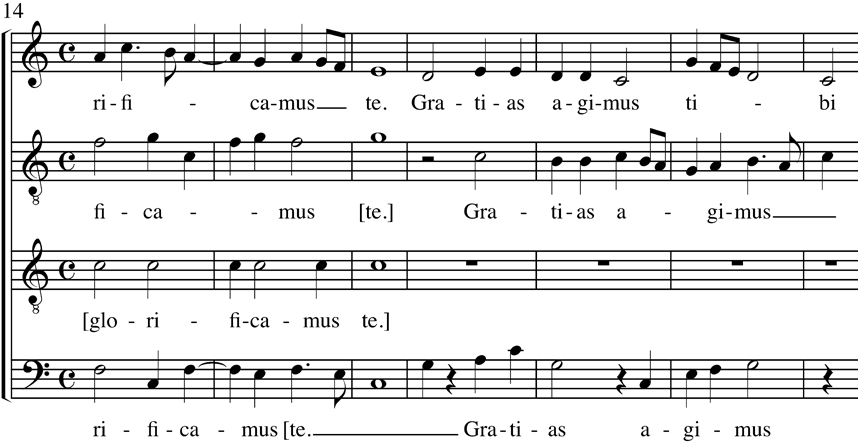
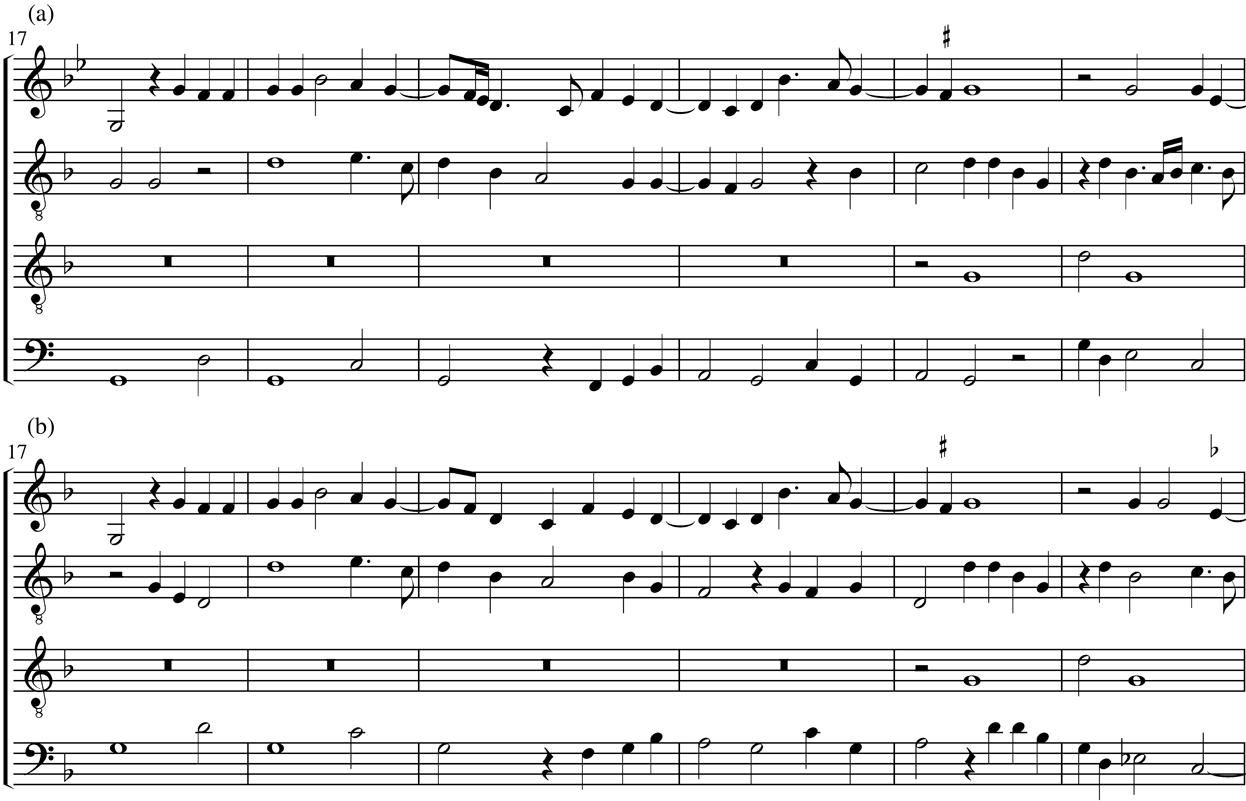
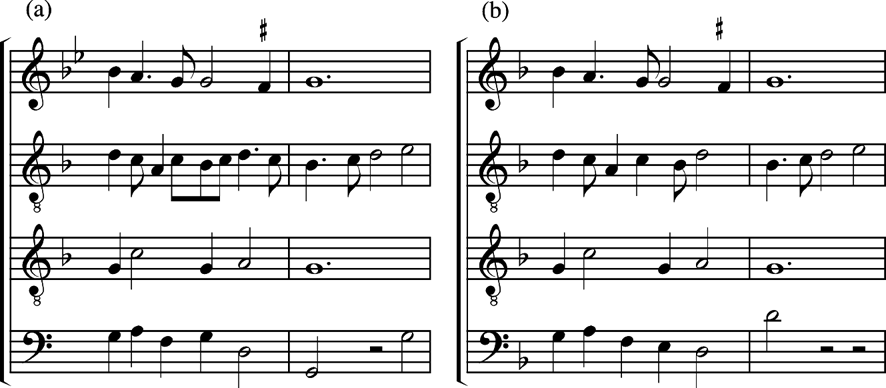
Another significant variant among the sources occurs in bars 19–20 of the Gloria: the ModD version has parallel fifths in the outer voices, but MilD2 and VerBC 761 avoid the parallelism altogether (see Example 4). At first glance, this could be construed as proof that the ModD version is indeed an earlier version of this mass, but there are several other alternative explanations. It may be that the bulk of Missa Ma bouche rit was composed long before its earliest source, and that Martini only carefully reworked the last section of the Credo. Alternatively, the parallel fifths in ModD could easily be the result of the scribe of ModD randomly introducing an error by copying one note a third higher than it should have been, or Martini may have preferred the parallel fifths in Example 4a to the unison and parallel fourths in Example 4b. On the other hand, the scribe may have made the astute observation that the passage in question in the Gloria is very similar to a passage in the Credo; here, however the superius does not leap down a fifth, but rather there is a note changed in the bassus (see Example 5). Perhaps the questionable passage in the Gloria was a result of the scribe's attempt to make this passage more like the equivalent passage in the Credo. Finally, although parallel fifths were frowned upon by contemporary theorists, they were not banned outright;Footnote 33 moreover, they were still found in the works of many composers, including Josquin, as well as in other masses by Martini, and this may simply be the sound that Martini wanted.Footnote 34
Johannes Martini, Missa Ma bouche rit, Gloria, bb. 19–20: (a) ModD; (b) MilD and VerBC 761
Johannes Martini, Missa Ma bouche rit, ModD, MilD 2 and VerBC 761, Credo, bb. 26–7
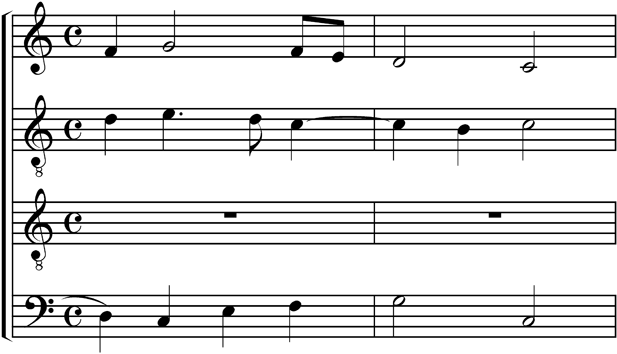
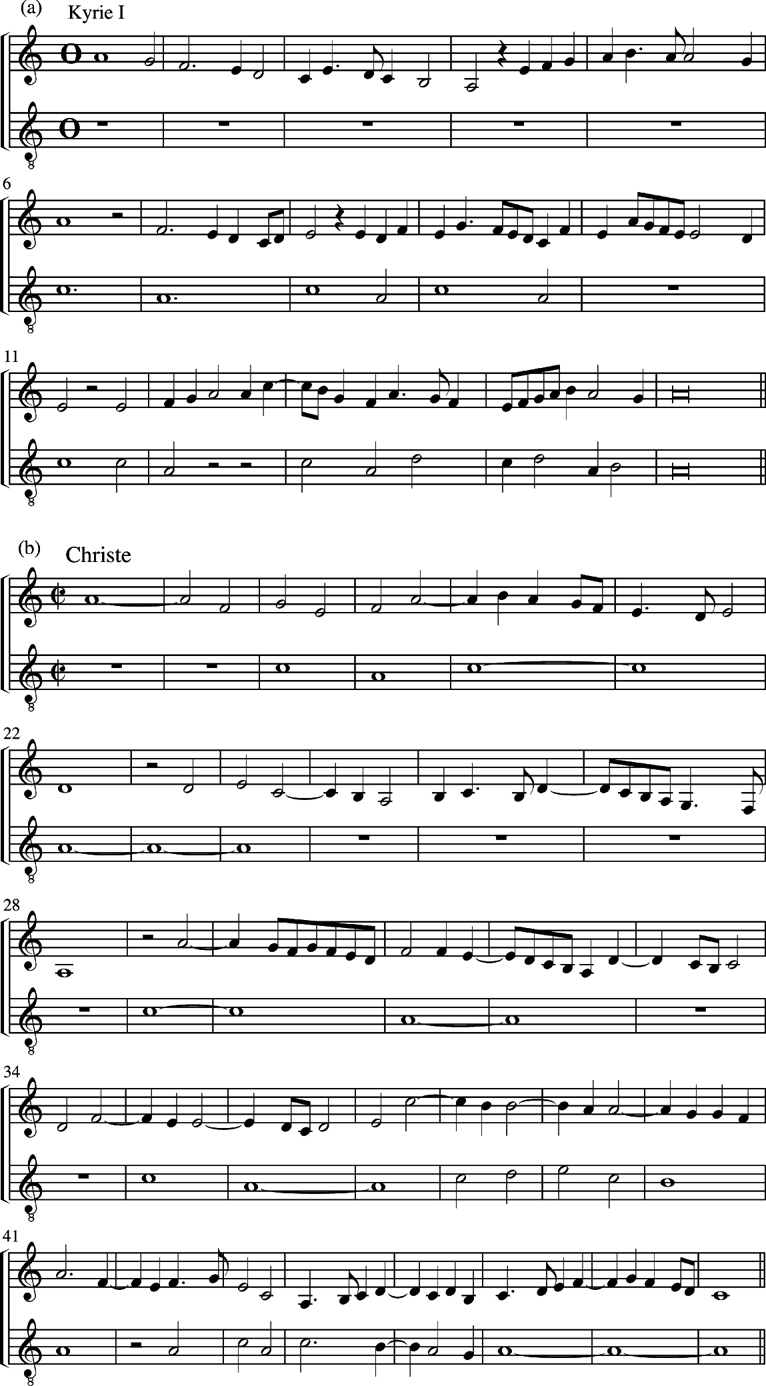
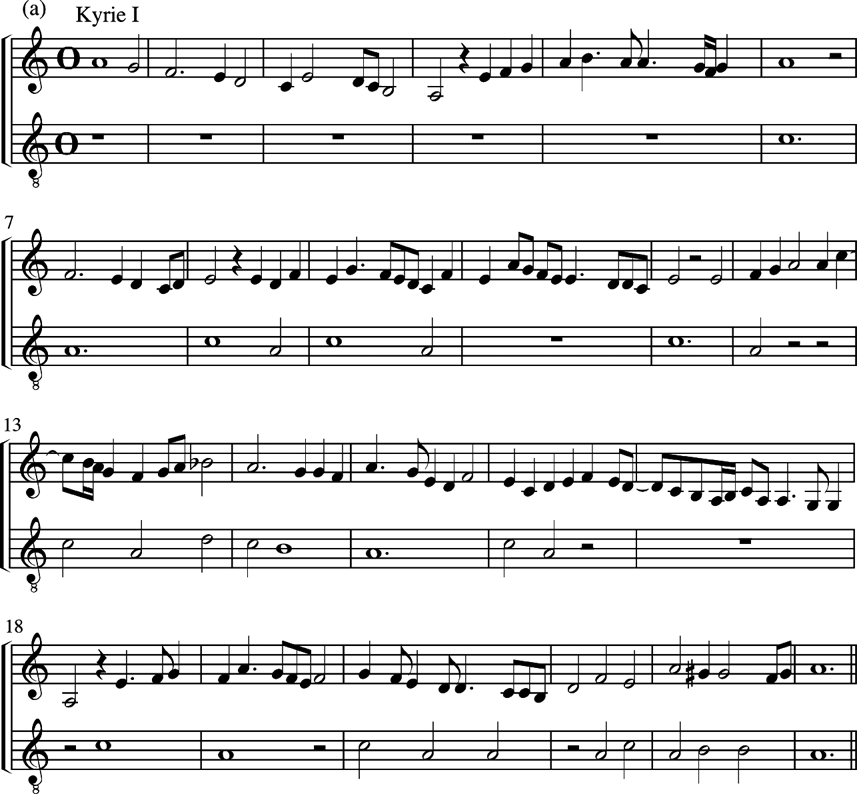
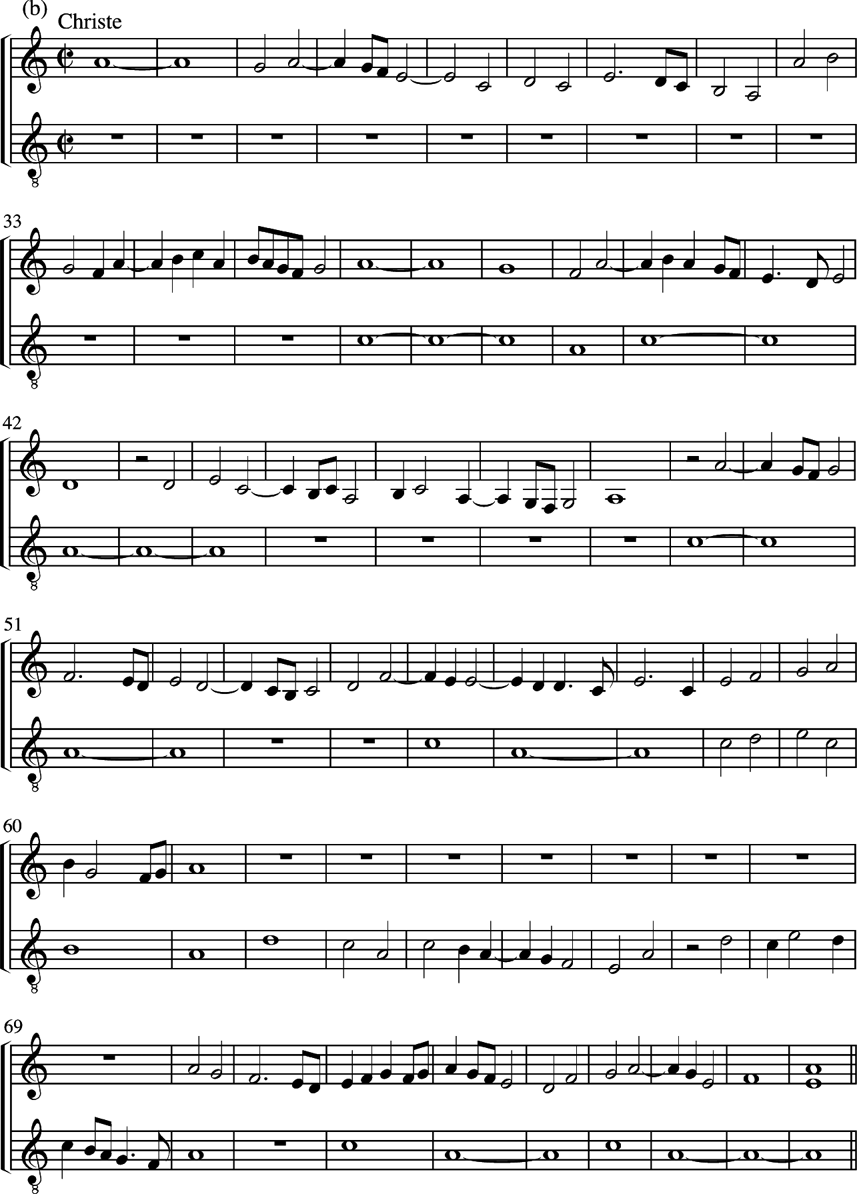
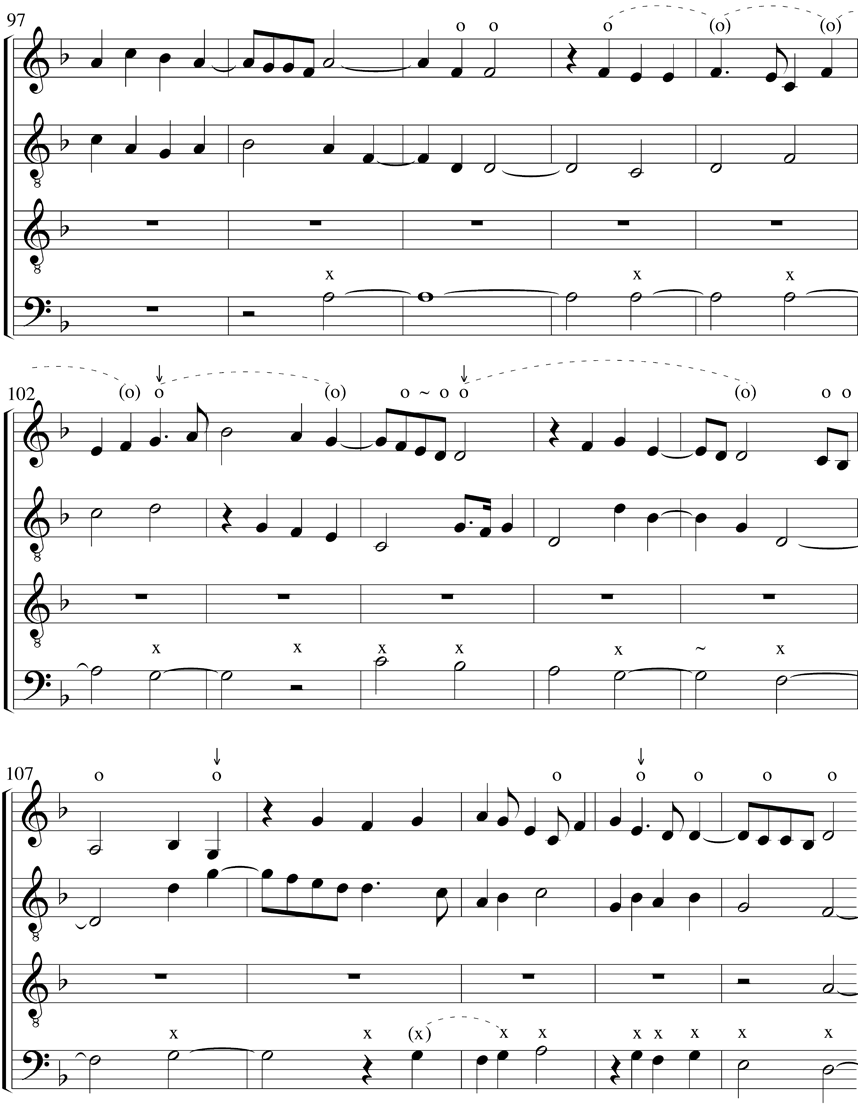
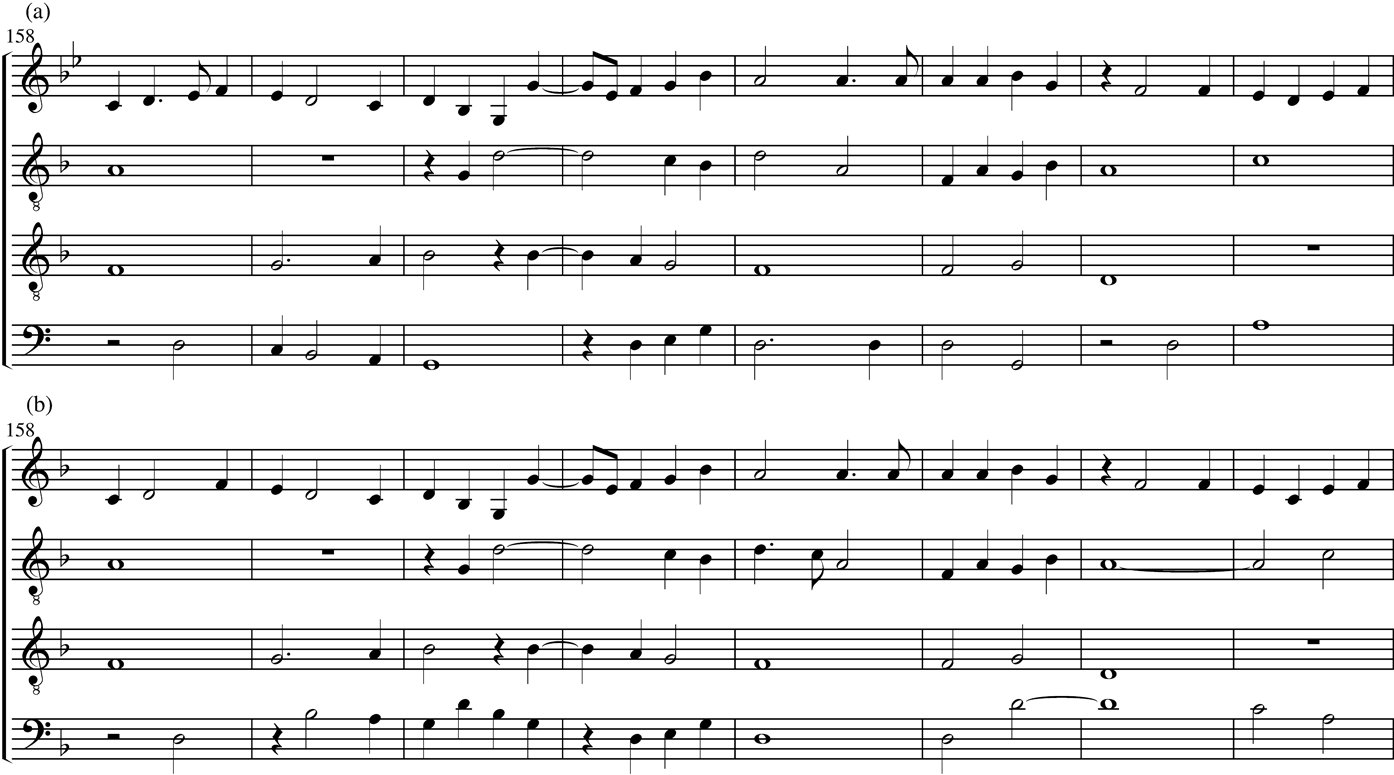
The only concordance for Martini's Missa Cucu is TrentC 91, copied c. 1472–4, less than a decade before ModD.Footnote 35 In ModD, the mass is fragmentary: all that survives is the left-hand side of the first opening, containing the superius and tenor voices for the first Kyrie and Christe. A comparison with the Trent version shows significant changes between the two sources; Example 6 contains all that exists from ModD and Example 7 contains the corresponding sections and voices of TrentC 91. The first Kyrie has twenty-three bars in Trent but only fifteen in ModD. The first twelve bars are very similar in both sources, with the main differences occurring in cadential decorations; the last eleven bars of the Trent version, however, have been reduced to a mere three bars in ModD. The Christe has been completely rewritten: it is shorter (thirty-three bars in ModD as opposed to fifty-five in TrentC 91); although the tenor voice is similar in both versions, with the same C–A oscillation, the rhythms are different and the melodic outbursts that occasionally separate statements of the C–A motif in Trent 91 have been eliminated in ModD; and the superius is radically altered (despite a few momentary similarities – compare bars 19–36 in Example 6 with bars 39–57 in Example 7). In the process of rewriting this movement, the range of the tenor in ModD is narrower than in TrentC 91, descending only to g rather than to e. Narrowing the range of a voice is a common change in ModD.
Johannes Martini, Missa Cucu, (a) Kyrie I and (b) Christe, ModD (superius and tenor; other voices lacking)
Johannes Martini, Missa Cucu, (a) Kyrie I and (b) Christe, TrentC 89 (superius and tenor)
Continued
Martini's Missa Coda pavon also has two principal concordances with ModD: MilD 2 again and SienBC K.I.12, a composite source currently made up of several manuscripts that were copied in Siena between about 1481 and 1506. Timothy Dickey dates the copying of Missa Coda pavon into its Sienese source to c. 1502–4.Footnote 36 A fourth source, TrentC 91, only contains contrafacta of the Et in terra and Agnus Dei 2 (Flos virginum and Jhesu Christe piissime respectively);Footnote 37 individual mass sections were often turned into instrumental works or retexted as motets in the late fifteenth century.Footnote 38 TrentC 91 clearly represents the earliest version of the mass, but it contains only two brief sections, each retexted. SienBC K.I.12 and MilD 2 are closely related,Footnote 39 whereas ModD is further removed from the other sources.
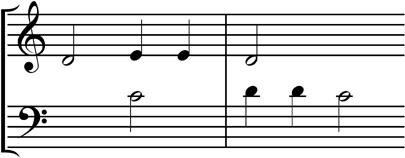
Notwithstanding that MilD 2 and SienBC K.I.12 were copied later than ModD, three contrapuntal details found only in ModD suggest that they represent an earlier version of the mass that Martini later revised for inclusion in ModD.Footnote 40 First, a brief motif occurs at least once in every movement, sometimes as two voices (see Example 8) and even more frequently as just the upper of those two voices. This motif occurs more often in ModD; it is frequently altered beyond recognition in SienBC K.I.12, and on one occasion the lower voice is changed in MilD 2.Footnote 41 Second, although Martini used a great deal of imitation throughout this mass, bars 90–1 of the Credo in ModD have a brief moment of imitation between the alto and bass that does not occur in any of the other sources: MilD 2 and SienBC K.I.12 have conjunctive variants at this moment, but neither has imitation.Footnote 42 Finally, bar 90 is also the moment when the cantus firmus enters for the first time in the Et resurrexit, and Martini brings it in one breve earlier in ModD than in either of the other sources, creating less of a gap between phrases. The more frequent and stable use of the motif, the extra bit of imitation, and the attempt to connect phrases more closely all suggest a conscious, later revision rather than an earlier version of the mass.
Johannes Martini, Missa Coda pavon, recurring motif
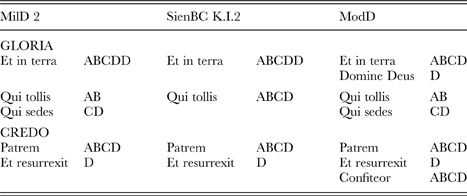
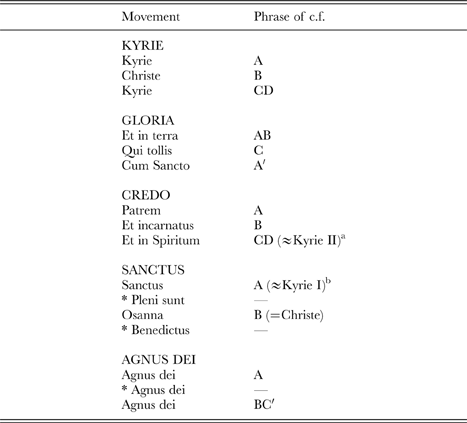
Perhaps the most significant variant among the sources occurs once again in the Credo. In ModD, this mass has an extra section at the end of its Credo that is not found in either of its concordances (see Table 3). To be precise, the Confiteor section in ModD is not an independent section but rather a continuation of the Et resurrexit. The Et resurrexit does not end with a fermata or double bar the way most sections do in ModD, but rather with a custos and the rubric ‘verte’ (turn [the folio]); at which point there is a change in mensuration from  to
 . But there is nothing in either MilD 2 or SienBC K.I.13 to suggest that anything is missing: the section ends with a longa and a double bar; both sources have the last three lines of the Credo text; the final cadence is to C, the modal centre of the mass. The layout of the cantus firmus in the Credo in the ModD version is more in keeping with the layout of the cantus firmus in the Gloria: in both, there is a complete statement of all four phrases of the model tenor, a repetition of the last phrase, and a second complete statement of the cantus firmus. Although the situation is comparable to Missa Ma bouche rit, it is not identical. In Missa Ma bouche rit, the change in ModD is clearly a reworking and expansion of a previously composed movement; in Missa Coda pavon, the change appears to be the addition of a new section rather than the rewriting of an existing one. In both cases, however, the effect is similar: there is a more contextually logical layout of the cantus firmus and more of the Credo text is accommodated. As we have already seen in Missa Ma bouche rit and Missa Cucu, Martini seems to be purposefully revising his earlier masses, and, as in Missa Ma bouche rit, he seems to be deliberately expanding the Credo in order to accommodate more of the text (in Missa Coda pavon, ModD omits only seven lines of text whereas MilD 2 omits nine and SienBC K.I.2 omits eight).
Layout of the cantus firmus in the Gloria and Credo of the Missa Coda pavon
Missa Orsus, orsus survives in seven sources, one of which was copied shortly before ModD and the rest later. Francesco Rocco Rossi maintains that Martini played absolutely no editorial role whatsoever in ModD, and the evidence he uses in support of that position lies primarily in this mass.Footnote 43 He cites variants among the many sources in four of the movements as proof that ModD is not the best reading and therefore could not possibly have been edited by Martini. As interesting as Rossi's observations are, most of them are ambiguous at best on the possibility of Martini's editorship of this manuscript.
Although the ModD version of this mass has many changes compared to its earlier version in VatS 51, it should be noted at the outset that none of the changes affects the layout of the cantus firmus: neither the new section in the Credo, the rearrangement of sections in the Sanctus, nor the omission of one section of the Agnus Dei (all of which are discussed in detail below) alters the layout of the cantus firmus. Similarly, the recomposition of the head motif in several movements avoids impinging on the cantus firmus. Martini normally did not tamper with a cantus firmus unless he had a strategic reason for doing so, such as lengthening a movement in order to accommodate more text, as in Missa Ma bouche rit.
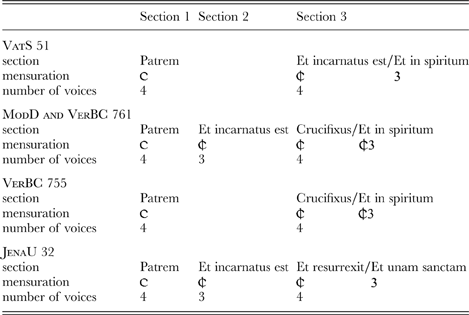
The most significant difference among the sources appears in the Credo. Two sources, VatS 51 (most likely the earliest source for this mass) and VerBC 755, have only two sections, while ModD, VerBC 761 and JenaU 32 have an added section in the middle.Footnote 44 The last section in all the sources (Crucifixus in most cases) is spread out over two openings, with a change in mensuration from to  (or simply in some sources) at the page turn. The new section is in reduced scoring (three voices rather than four) and does not use the cantus firmus (see Table 4).Footnote 45 Although the arrangement in ModD – with two outer sections for all four voices surrounding a contrasting section for reduced texture – is quite common, it is not so standard that we can claim that the earlier sources of this Credo were necessarily lacking a section that had already been written; several of Martini's Credos in ModD have only two sections, with no middle section in reduced texture.Footnote 46 In ModD and VerBC 761, the new section has only line 8 as its text (‘Et incarnatus est’); in JenaU 32 it has lines 8–9.Footnote 47 None of the text that appears in the new section was left out of VatS 51.Footnote 48 The new section either was unavailable to the scribes of VatS 51 and VerBC 755 for some reason, or it was composed after the compilation of VatS 51 but before ModD, perhaps specifically for inclusion in ModD. The tacit assumption in modern scholarship has been that the former is more probable. Richard Sherr has suggested that VatS 51 may have originated in Ferrara, which supports the argument that the earlier, two-section Credo was indeed complete as it stood, and that the new section was composed later.Footnote 49
Layout of the Credo in Missa Orsus, orsus
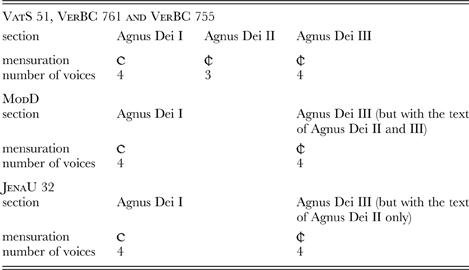
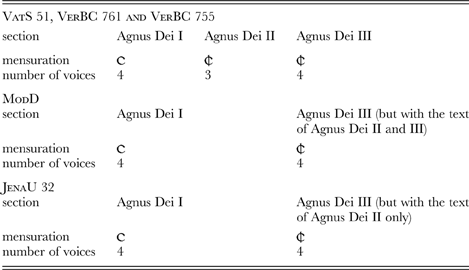
The transmission of the Agnus Dei of Missa Orsus, orsus presents a different problem than the Credo. In three of the sources (VatS 51, VerBC 755 and VerBC 761), each of the three sections of text has its own music; in ModD and JenaU 32, the second section is missing (see Table 5). In ModD, the texts for both Agnus Dei II and III are underlaid in the last section, but in JenaU 32, only the text of Agnus Dei II is underlaid. In ModD, the text of the two sections is underlaid consecutively rather than one above the other, which suggests that to some extent the scribe did this deliberately rather than accidentally. Of course it is still possible that the omission of Agnus Dei II was accidental, but that the scribe caught the mistake before he added the text, at which point he did what he could to rectify the error. Benfield suggested that the lack of Agnus Dei II in ModD was perhaps because ‘local practice dictated that this section be played on the organ or chanted rather than sung’.Footnote 50 Two important details contradict Benfield's hypothesis. First, the text of Agnus Dei II does appear in ModD, underlaid in Agnus Dei III; if Agnus Dei II was not meant to be sung, that text should not be there at all. Second, this is the only one of the seventeen Masses that lacks an Agnus Dei II; if it were common practice at Ercole's court to perform the second Agnus Dei as chant or on the organ, more of them would be arranged in this manner.Footnote 51 The omission of Agnus Dei II in ModD may have been a copying error by the scribe that later found its way into JenaU 32, rather than a modification to the mass by the composer. That the mistake was not corrected by adding the missing section suggests that Martini was not proofreading the manuscript as Fra Filippo finished copying each mass.Footnote 52
Layout of the Agnus Dei in the Missa Orsus, orsus
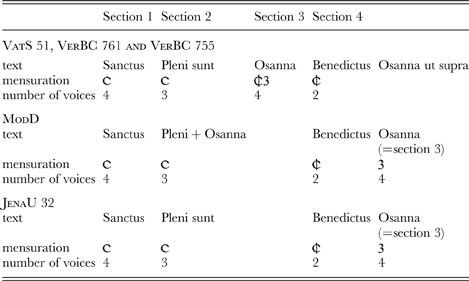
The transmission of the Sanctus in Missa Orsus, orsus again presents a wholly different problem than either the Credo or Agnus Dei, and relates more to the texting of the movement than to the music. There are four sections of music in all of the sources, but they are given different texts and arranged in a slightly different order among the sources (see Table 6). As in the Agnus Dei, VatS 51 and the two Verona manuscripts transmit the Sanctus in the most standard format, with the common breaks in the text and the common alternation of full and reduced texture. In ModD, on the other hand, the text for the first Osanna has been added to the Pleni sunt section without altering the music; this is immediately followed by the two-voiced Benedictus section, and finally by the four-voiced Osanna. JenaU 32 is again laid out similarly to ModD, except that the text of the Osanna has not been added at the end of the Pleni sunt section.Footnote 53 The layout in ModD thus presents an unusual sequence of textures: four voices, three voices, two voices, four voices. This sequence, however, more likely represents an error by the scribe than a conscious change by the composer. The second mass in ModD, Missa La mort de Saint Gothard, has its Sanctus laid out in precisely the same way as Missa Orsus, orsus, which prompted Moohan to propose that ‘This may suggest that the scribe had not yet settled into a copying method when work on the volume began’.Footnote 54 It is unfortunate that Missa La mort de Saint Gothard has no concordances, for this could signal a major but as yet unexplored area of scribal intervention.
Layout of the Sanctus in the sources of Missa Orsus, orsus
One final difference between the two versions of this mass merits close attention. Rossi points to a difference in the opening of the Kyrie between ModD and VatS 51 as further evidence that Martini was not involved in the production of ModD. Each movement of Missa Orsus, orsus opens with a quotation of the first few bars of the chanson's superius and tenor, but those voices are elaborated differently in every movement; thus the head motif is not identical in each movement but is always clearly derived from the opening of the chanson (see Example 9). A comparison of the head motif in all of the sources reveals two distinct traditions: VatS 51 and both of the Verona manuscripts have a different head motif in the Kyrie and Credo compared with ModD and JenaU 32. The head motif in VatS 51 and the Verona sources is closer to the chanson than the one in ModD and JenaU 32. Rossi believes that the closer resemblance between the head motif and model in VatS 51 gives that source greater authority, whereas the only slightly less close resemblance in ModD debars Martini from having had any connection with that version.Footnote 55 But motivic closeness cannot be the only index of authority. In VatS 51, the opening two bars of the Kyrie, Credo and Sanctus are virtually identical;Footnote 56 the Gloria and Agnus Dei are different, both from each other and from the other movements, although the superius in both is still the same as in the other movements. In ModD, by slightly altering the opening of the Kyrie and Credo, the head motif is now distinctive in every movement. Perhaps the intent was simply greater varietas, which would suggest that the changes in ModD represent a purposeful revision by the composer.Footnote 57 Apart from aesthetics, the changes to the head motif in ModD are not merely whimsical but have a substantive musical rationale. Neither version of the Kyrie or Credo is contrapuntally better than the other, neither corrects any mistakes. The change in the Credo, however, does have a long-term effect that has been overlooked. The opening phrase in the Credo of ModD is extended by a semibreve, putting the opening cadence in the middle of a tactus. At first blush this appears to weaken the phrase slightly, but the overall effect for the entire section is just the opposite: by extending the opening phrase by a semibreve, nine of the thirteen cadences in the ModD version – including the final cadence in the section – now fall on the beginning of the tactus; the numbers are necessarily reversed in the VatS 51 version. In the Gloria and Sanctus – the other movements in which the head motif ends in the middle of the bar in both versions – the majority of the internal cadences are also on the downbeat, which appears to have been an important issue for Martini in this mass. Whether it was a desire for greater varietas or a perceived need to strengthen the metrical organisation of the cadences in the Credo, the changes in ModD seem unequivocally to have been initiated by the composer himself.Footnote 58
Johannes Martini, Missa Orsus, orsus, head motifs: (a) VatS 15; (b) ModD
Continued
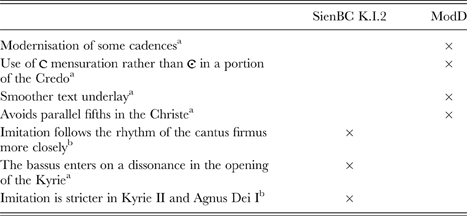
The only concordance for Martini's Missa Dio te salvi is SienBC K.I.2. Controversy endures over the dating of the section that contains the mass: Rifkin dates the copying of this mass from ‘no earlier than 1487 or 1488’, whereas Dickey dates it to 1481.Footnote 59 The Sienese version uses imitation more systematically than that of ModD, prompting Rifkin to see it as an authorial revision; Dickey argues that at least seven variants between the two sources suggest that Siena preserves the earlier reading.Footnote 60 The arguments for Siena preserving the earlier reading are subjective and some actually point to the opposite conclusion. Table 7 summarises Dickey's evidence, which I discuss at length below.
Summary of Dickey's evidence for believing that SienBC K.I.2 preserves an earlier version of Missa Dio te salvi than ModD
a I believe this evidence is ambiguous and does not indicate that either source is earlier than the other.
b I believe this evidence actually points to ModD being the earlier source.
First, Dickey cites two octave-leap cadences in the Credo which were modernised in ModD and three other octave-leap cadences that were left unaltered in ModD. Although it is true that octave-leap cadences were old-fashioned by the 1480s, there are examples among the masses of ModD in which modern cadences were changed back into octave-leap cadences.Footnote 61 Furthermore, there is fundamentally only a single different note between the old-fashioned octave-leap cadence and the more modern one, where the bassus leaps up a fourth. A single instance of this kind of modernisation, or even two, may signal anything from authorial intervention to scribal whimsy.
Second, there is a brief passage in the Credo that uses the mensuration  in SienBC K.I.2, but simply
 in ModD. As Dickey points out, is not a common mensuration in Martini. Its use in the Siena version of Missa Dio te salvi does not support the claim that the Sienese version pre-dates the ModD version, and may even contradict it, as the only other source of in a Martini mass is also later than ModD.Footnote 62 Furthermore, we must remember that the repertory of ModD was a practical one, used at the court of Ercole I d'Este. Martini, as a member of the chapel choir, would have rehearsed and performed these pieces regularly. Whether or not he frequently used himself is less important than whether or not he was familiar with the mensuration, and given its use in several masses in ModD, including his own, it is clear that he was.Footnote 63
Dickey suggests that ModD ‘achieves a smoother underlay’, especially in those movements with little text, like the Sanctus.Footnote 64 The text underlay is better in ModD than in SienBC K.I.2, but this has little bearing on which version is the earlier: the scribe of SienBC K.I.2 could easily have changed the underlay himself.
In the Christe, parallel fifths exist between the tenor and bassus in the Sienese version but not in ModD, which Dickey interprets as evidence that the Sienese version came first and was then corrected in ModD.Footnote 65 This interpretation looks at the result – avoiding parallel fifths – but not at how the result was achieved. The note that has been changed in ModD is in the cantus firmus and is strictly imitated in the bassus and superius in SienBC K.I.2. This change could be the Sienese scribe's attempt to make the imitation exact and to state the cantus firmus as it appears in other movements. The resulting parallel fifths may have been preferable to altering the cantus firmus; or, in the process of restoring the cantus firmus, the fifths may have been overlooked.
Dickey also argues that imitation in the Sienese version follows the rhythm of the cantus firmus more closely than in the ModD version, suggesting an earlier date for Siena. This seems counter-intuitive, at least for Martini. A comparison of his Missa Orsus, orsus with Missa La Martinella (these represent an early and a late mass according to their survival in fifteenth-century sources),Footnote 66 reveals that imitation of the cantus firmus is stricter and lasts longer in his later mass.
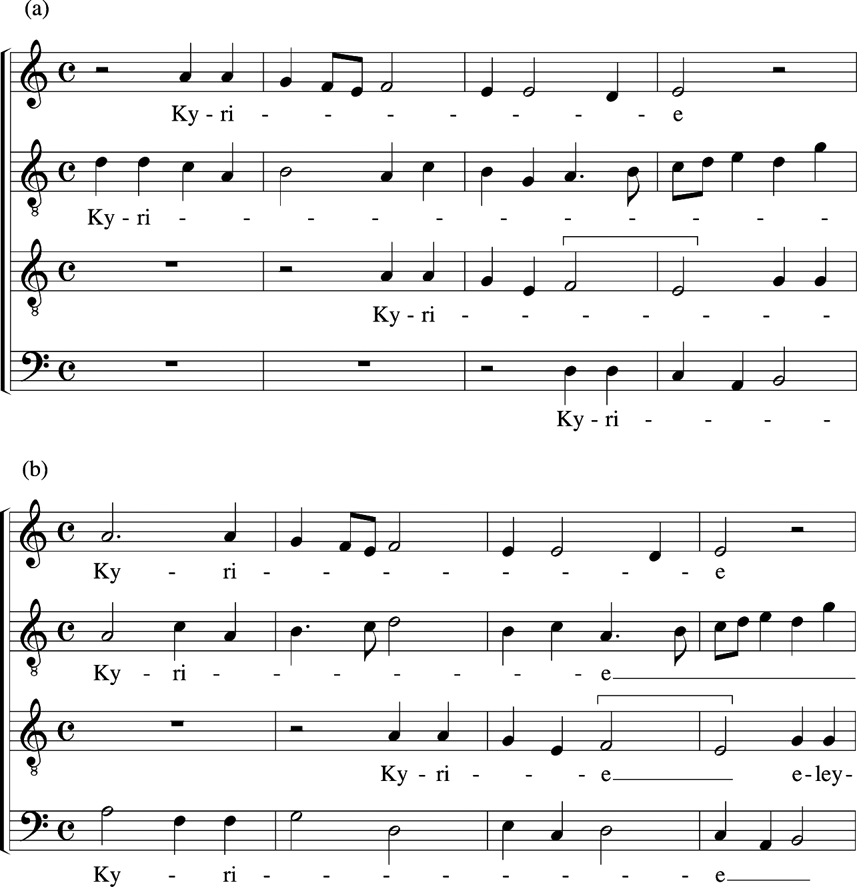
The opening of the Kyrie in the Sienese version is composed in such a way that when the bassus enters in bar 3, it comes in on a dissonance (see Example 10); the ModD version has the same dissonance but as a properly prepared suspension. Dickey interprets this as proof that the Sienese manuscript transmits an earlier version of the mass, and the ModD version corrects that contrapuntal infelicity. As Dickey points out, however, three similar passages occur in both versions of this mass, as well as in Martini's Missae Dominicalis and Ma bouche rit.Footnote 67 Furthermore, Martini uses dissonances in his masses more freely than his contemporaries.Footnote 68 He also uses dissonances rather freely in the si placet parts that he wrote for other composers' chansons.Footnote 69 The variant reading in ModD may not represent the correction of a contrapuntal error at all. The Sienese version has strict imitation among all the voices; the ModD version had loose imitation between two voices. This difference between the two sources suggests that the ModD version is the earlier one, and that the Sienese version represents a later reworking of the mass in which imitation is frequently added to, expanded upon, or simply made more exact. For the purposes of dating, the presence of a dissonance in bar 3 of the bassus in SienBC K.I.2 is irrelevant, given Martini's fondness for dissonance. Example 11 is characteristic of Martini's penchant for dissonance. In addition to regular passing notes (bb. 14 and 19), there are two instances of more unusual dissonance. The first, in the outer voices at the end of bar 15, initially appears to be a mistake for parallel tenths that could be easily corrected; however, it occurs often enough in his masses that it must be regarded as what he wanted. The second, between the alto and bass in bar 18, has the bass come in on a dissonance after a short rest, and is very similar to Example 10.Footnote 70
Johannes Martini, Missa Dio te salvi, Kyrie, bb. 1–4: (a) SienBC K.I.2; (b) ModD
Johannes Martini, Missa Coda pavon, Gloria, bb. 14–20
Finally, Dickey points out that in the ModD version of Kyrie II and Agnus Dei I, the imitation of the cantus firmus is less exact. As in the previous two points, Martini moved from loose to strict imitation during his career, and ModD in fact represents the earlier version which was later reworked and then copied into SienBC K.I.2.
The musical differences between the two sources of Missa Dio te salvi, in particular the move from looser to stricter imitation, strongly suggest that the ModD version was earlier than the SienBC K.I.2 version, and that some time after the compilation of ModD, the mass was reworked, most likely by the composer. As we have already seen, Martini was in the habit of reworking his masses. The fact that this mass appears in an updated version shortly after its appearance in ModD suggests that it was initially composed very close in time to the compilation of ModD, perhaps even for inclusion in ModD, and that Martini did not feel that an update was warranted for several more years, for inclusion in SienBC K.I.2.
Missa Ferialis exists in four sources, the earliest of which is ModD. Rossi argues that the mistakes in the ModD version of this mass are further proof that Martini was not associated with ModD in any way.Footnote 71 To be sure, there are a few mistakes in this mass not found in the later versions; but they are all minor errors easily attributable to the scribe.Footnote 72 No one who has argued that Martini acted as editor of ModD has suggested that he also acted as a proofreader once individual masses had been copied, and indeed, this is an extremely unlikely scenario. Although printers in the sixteenth century frequently would print a single copy of a title, proofread and correct it as necessary, and only then print a full run, no such system existed in manuscript production. Errors that were erased and corrected were undoubtedly done by the scribe as he worked, not by a separate editor-cum-proofreader.Footnote 73
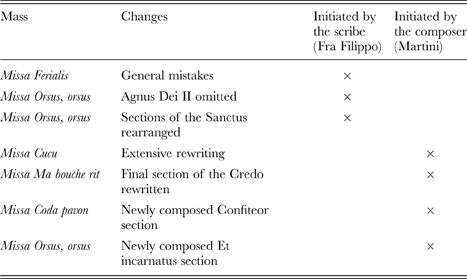
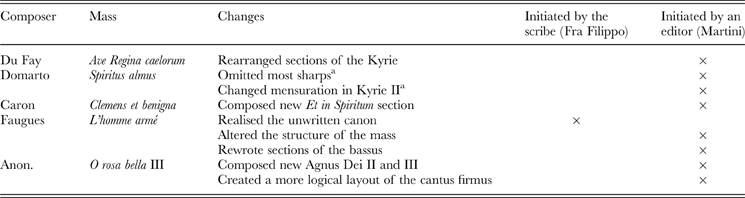
From the foregoing discussion of Martini's masses in ModD, we can comfortably distinguish between two different categories of changes (see Table 8). A few are most securely attributable to the scribe: the mistakes in Missa Ferialis are unquestionably simple copying errors; the omitted second Agnus Dei of Missa Orsus, orsus is also very likely a copying error; and the rearrangement of the Sanctus sections in Missa Orsus, orsus may simply have been the scribe's own copying convention (the next mass in the manuscript is copied in the same fashion). Other changes in his masses could very easily have been accomplished by the composer himself: what little remains of Missa Cucu shows that it was extensively rewritten; Missa Coda pavon, Missa Orsus, orsus and Missa Ma bouche rit all have either a new or extensively rewritten section in the Credo, resulting in a more logically laid out cantus firmus and more text underlaid in the Credo; and short segments of several masses were rewritten not to correct counterpoint but possibly for aesthetic reasons. In Missa Dio te salvi, the one mass in which ModD is the earliest source, its later source shows Martini once again updating his original, this time by using stricter imitation. One of Martini's general, long-term characteristics is that he constantly tinkers with his music.Footnote 74 Our ability to determine whether or not he tinkered with other composers' music (and if he did, the extent to which he imposed his own stamp) will depend on our ability to distinguish between authorial, editorial and scribal changes.
Summary of significant changes to Martini's masses in ModD and the person who most likely initiated those changes
In addition to the six masses by Martini that have major changes in ModD, another five masses by other composers also exhibit changes in their ModD reading. An in-depth look at these changes – including a comparison with the changes in Martini's masses and a comparison of newly composed sections with the original composer's style – will shed significant light on the provenance of the changes.
Musical changes in du fay's missa ave regina caelorum
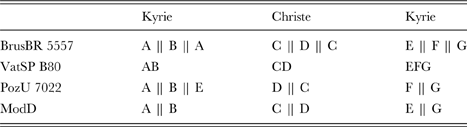
All four sources of Du Fay's Missa Ave regina caelorum were copied within a decade or so of each other. The most significant musical difference among them is in the transmission of the Kyrie. BrusBR 5557 has seven different sections of music (labelled A–G in Besseler's edition); section A (Kyrie I) is repeated after section B (Kyrie II) and section C (Christe I) is repeated after section D (Christe II), creating a ninefold arrangement (see Table 9). However common a nine-section Kyrie may have been, its derivation from seven sections caused some confusion for fifteenth-century scribes, and all of the other sources attempt to reshape the Kyrie into a form that better suited their own liturgical requirements or fit their own experience of what a Kyrie should be. VatSP B80 joins sections to create three sections altogether that omit repetitions; PozU 7022 rearranges their order, and in the process misrepresents the cantus firmus; and ModD omits one section and also forgoes repetition. Rather than being a mistake on the part of the scribe or editor, the rearrangement of the Kyrie in ModD represents a conscious attempt to create a more familiar layout, by allowing chant to alternate between polyphony in each of the three large sections (A chant B || C chant D || E chant G).Footnote 75
Layout of the sections in the Kyrie of Du Fay's Missa Ave regina caelorum a
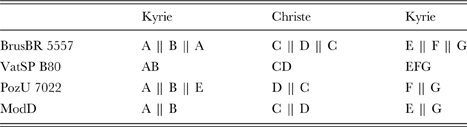
a || indicates an internal section break.
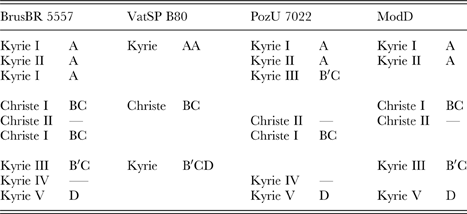
The cantus firmus for this mass is derived from the eponymous Marian antiphon, which is stated once in each movement, each time in a different rhythmic form with new embellishments.Footnote 76 The chant is divided into four phrases: the first has a repeat within itself and the second and third are closely related, giving it an overall form of AA BC B′C D. Table 10 demonstrates that BrusBR 5557 distorts the cantus firmus by having unnecessary repetitions of phrases. This may or may not have been Du Fay's intention, but it comes back to the question of how to obtain a nine-section Kyrie from seven phrases of music – in other words, which sections to repeat – that seems to have caused the greatest confusion in the other sources. The ModD version presents the cantus firmus close to the original form of the chant, and it is this general striving for orthodoxy that may have been the motivating force behind the changes in the Kyrie. As we have seen in other masses in ModD, rationalisation of the cantus firmus was a significant component of the redaction of the manuscript, and most likely indicates the intervention of a separate editor rather than the scribe.
Layout of the cantus firmus in the Kyrie of Du Fay's Missa Ave regina caelorum
Musical changes in domarto's missa spiritus almus
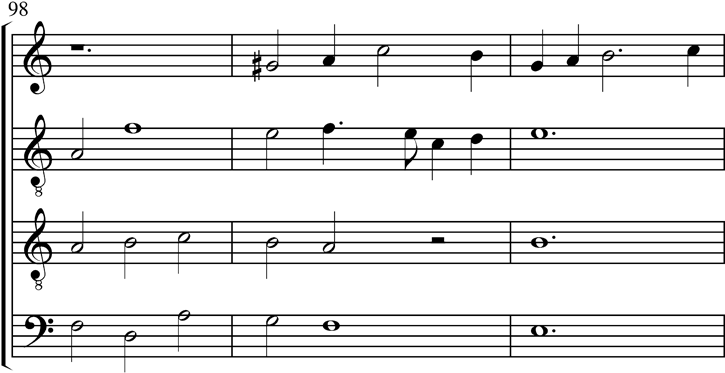
Domarto's Missa Spiritus almus has some significant changes from its other, mostly earlier sources. In addition to the texting of the tenor (discussed above), there are important changes in the use of accidentals. This mass has a small number of flats but a considerable number of sharps (forty-three in all), which is rare in the late fifteenth century. The sharps are spread out somewhat unevenly among the manuscripts: VatS 14 has thirty-seven, TrentC 88 has twenty-one, LucAS 238 has fifteen and PozU 7022 has about three.Footnote 77 Many of the sharps in these sources would have been added by any competent singer at the time, and include raised leading notes and raised thirds at important cadences. A few of the sharps, however, do not fall into this category, but rather represent substantive changes to the music. Many of these, however, create new problems of their own. Example 12, from the Kyrie of this mass, illustrates this point. The G♯ in the top voice in bar 99 appears in both the Vatican and Trent sources. It would be a simple matter to sharpen the G in the bassus as well – that could easily be accomplished in a single rehearsal – but the augmented second that that would create in the bassus, as well as the harmonic motion from E major to F major, is quite foreign to fifteenth-century musical style.Footnote 78 It is possible that both scribes simply misplaced the sharp and intended it to apply to bar 100. Nevertheless, none of the sharps appears in ModD, although the flats do.
Petrus de Domarto, Missa Spiritus almus, Kyrie, bb. 98–100
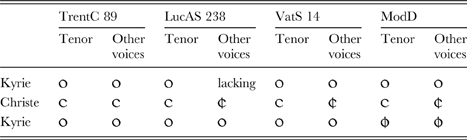
The mensurations in the Kyrie of Missa Spiritus almus also vary among the sources (see Table 11). ModD is the only source to use  in Kyrie II, creating a sequence of mensurations from
 to to . This sequence occurs in only four masses in ModD, and in three of those four the concordances preserve a different set of mensurations, usually .Footnote 79 It is not immediately apparent why those mensurations were changed in ModD. It cannot be argued that it was done simply out of habit, for three other masses in ModD have the sequence of mensurations in the Kyrie, while another one has .Footnote 80 One possibility is that those mensurations that were changed from to were done in order to indicate a speeding up of the tactus in the final Kyrie. If this is the case, then the person most likely responsible was someone involved with the performance, which certainly would have been Martini rather than the scribe Fra Filippo.
Mensurations in the Kyrie of Domarto, Missa Spiritus almus
Musical changes in caron's missa clemens et benigna
The only concordance with Caron's Missa Clemens et benigna is TrentC 89, compiled c. 1460–6, approximately fifteen to twenty years earlier than ModD.Footnote 81 The two most important differences between the sources are the key signatures and the transmission of the Credo. Both sources have one flat in the signature in the altus and tenor but the superius and bassus have none. Although conflicting key signatures are common, this particular arrangement – one flat in the inner voices but none in the outer voices – is less usual. Even more curious is that both sources omit the key signature in the inner voices in different movements: TrentC 89 has no signature in the Gloria and ModD has none in the Sanctus and Agnus Dei. Neither source has a significant change in range in any of the movements and sectional cadences in all the movements are to G or occasionally to D. In all probability, both scribes erred in these movements, and the inner voices should have a flat in the signature throughout the mass.
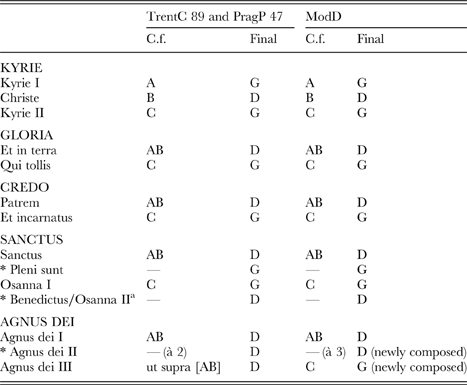
The other important difference between the sources affects the Credo: TrentC 89 has four sections whereas ModD has five (see Table 12). Rossi argues that ModD does not represent a second version but rather that TrentC 89 is incomplete.Footnote 82 Indeed, apart from Martini's Missa Orsus, orsus, this is the only other mass in ModD that he discusses at length, and he cites this mass as further proof that Martini was in no way connected with ModD. A thorough examination of the music, however, demonstrates that the Trent version was indeed complete, that the added section was written later, and that it was written by someone other than Caron.
Layout of the Credo of both versions of Caron, Missa Clemens et benigna
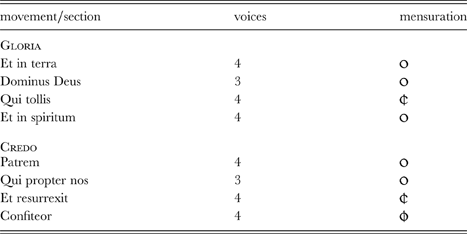
Although the Trent version is missing six lines of text (lines 9 and 13A–15), this by no means implies that any music is missing; as we have already seen, text is missing in the Credo of many masses. On the other hand, a comparison of the Credo in Trent with its Gloria suggests that the two movements were intentionally designed in a similar fashion: the number of sections is the same, the sequence of full and reduced textures is the same, and the succession of mensurations is virtually the same (see Table 13). Indeed, the majority of masses in TrentC 89 have the same number of sections in the Gloria as in the Credo, and the majority of those have exactly the same sequence of mensurations in both movements and use reduced texture in the corresponding sections.Footnote 83 The added section in the Credo of ModD (Et in Spiritum) in Missa Clemens et benigna disrupts this symmetry.
Comparison of the Gloria and Credo in the TrentC 89 version of Caron, Missa Clemens et benigna
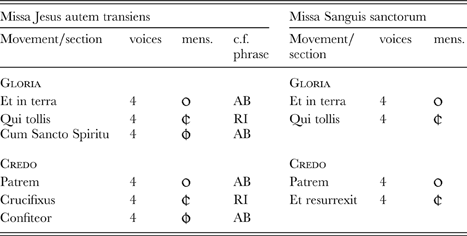
In order to determine how important this kind of symmetry was for Caron, we must consider a few of his musical habits. Three of his five masses are based on chant: Missa Clemens et benigna, Missa Jesus autem transiens, and Missa Sanguis sanctorum.Footnote 84 In the latter two, as well as the Trent version of Missa Clemens et benigna, the Gloria and Credo have the same number of sections, the same sequence of full and reduced textures, and the same sequence of mensurations (see Table 14). The relationship between the Gloria and Credo is particularly close in Missa Jesus autem transiens: not only do they have the similarities already mentioned, but also the same number of breves before the entrance of the cantus firmus; they use the same paraphrased version of the cantus firmus even though all other movements paraphrase it differently; and the middle section of each movement uses an identical new phrase within the cantus firmus, a retrograde inversion of the cantus firmus (Caron does not use this technique anywhere else in this mass; this phrase is indicated as ‘RI’ in the table).Footnote 85 It seems fair to say that symmetry was an important consideration for Caron, and the absence of symmetry in the ModD version of Missa Clemens et benigna forces us to consider the possibility that the extra section was added at a later date.
Gloria–Credo symmetry in Caron's other cantus-firmus masses
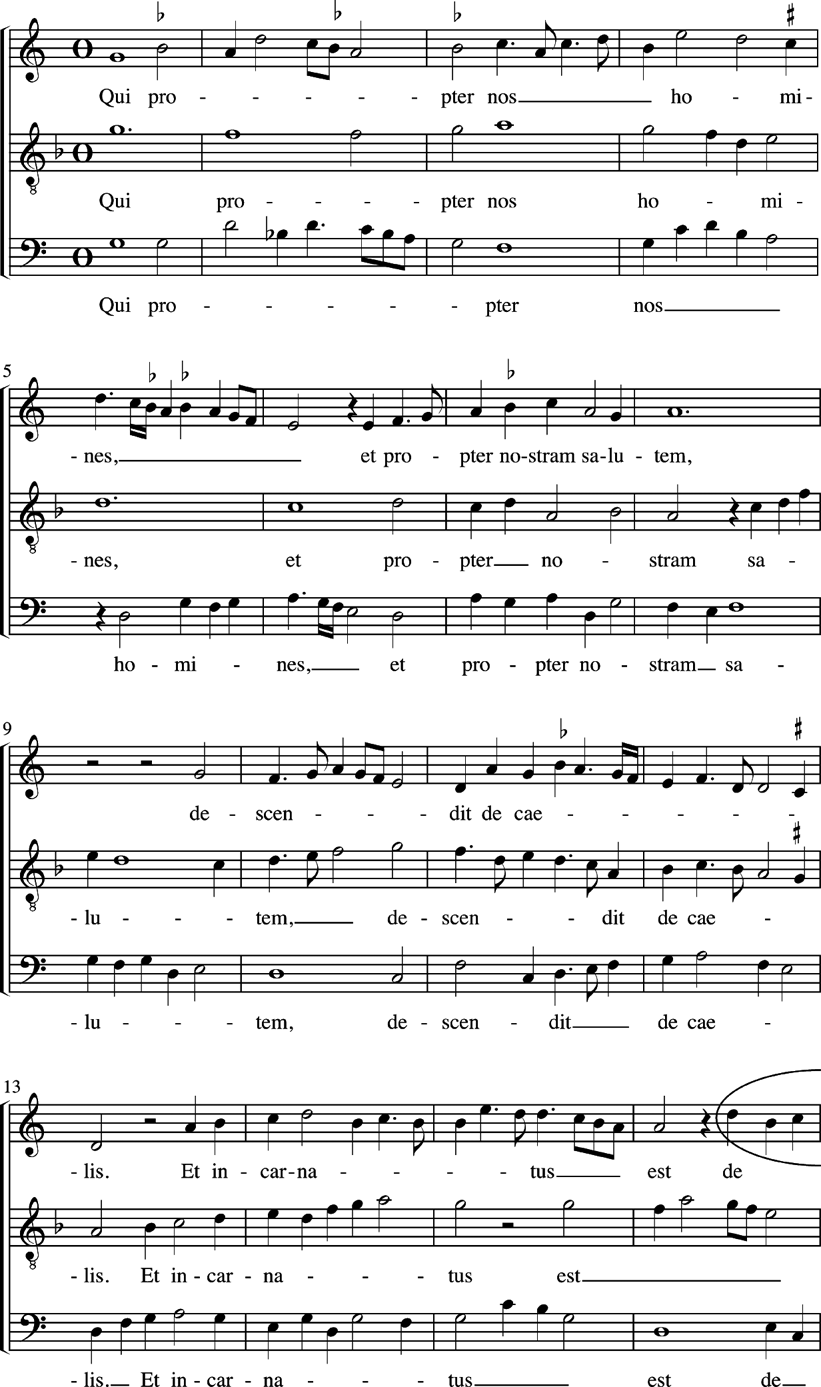
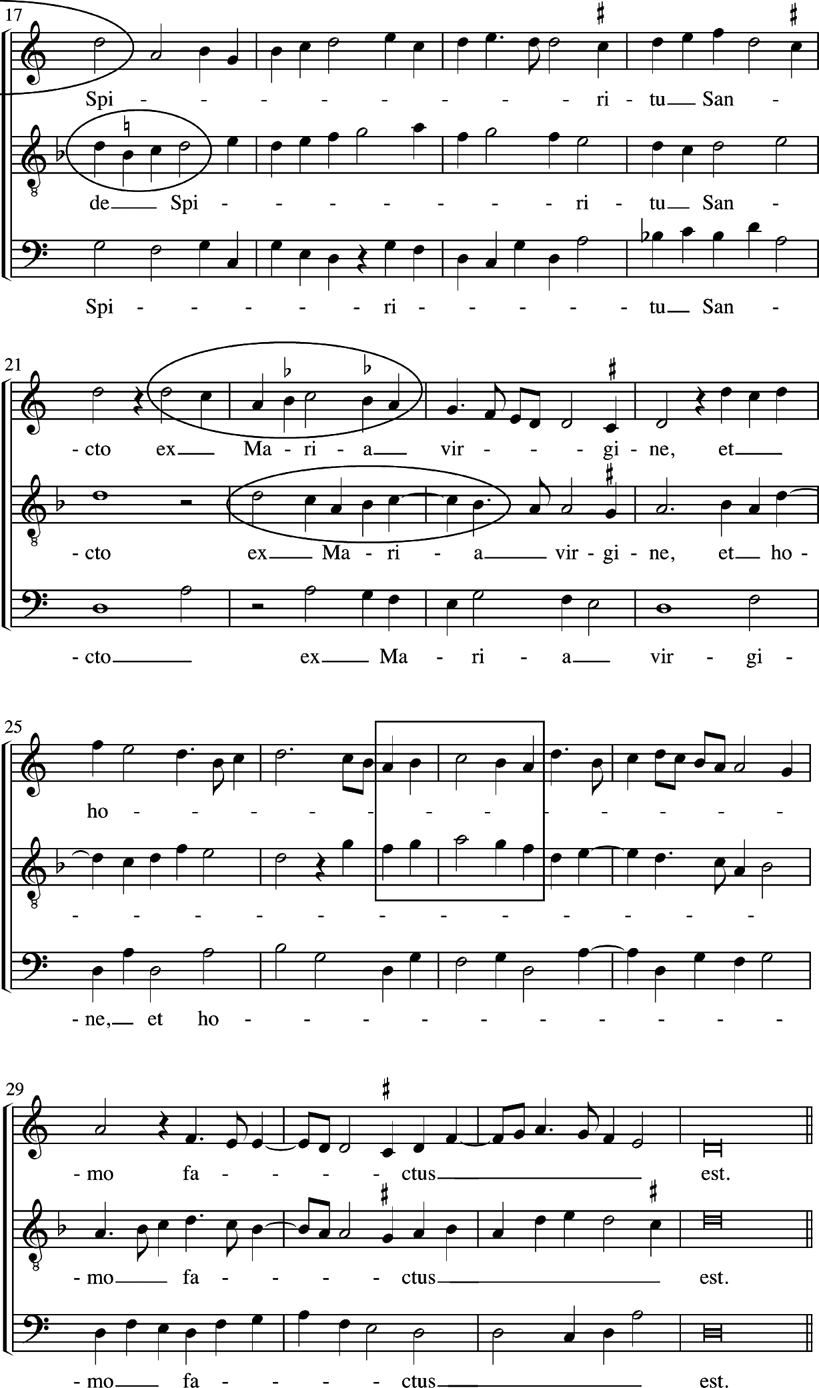
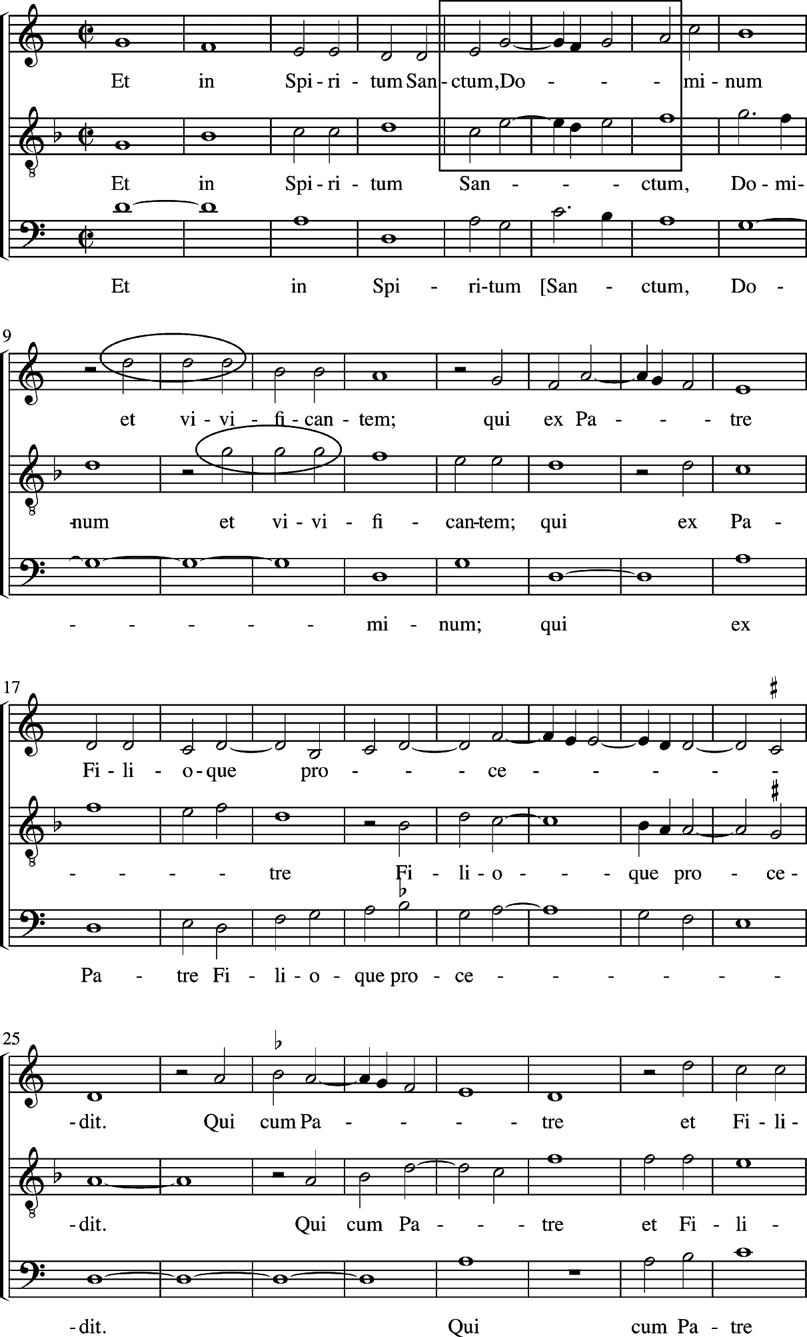
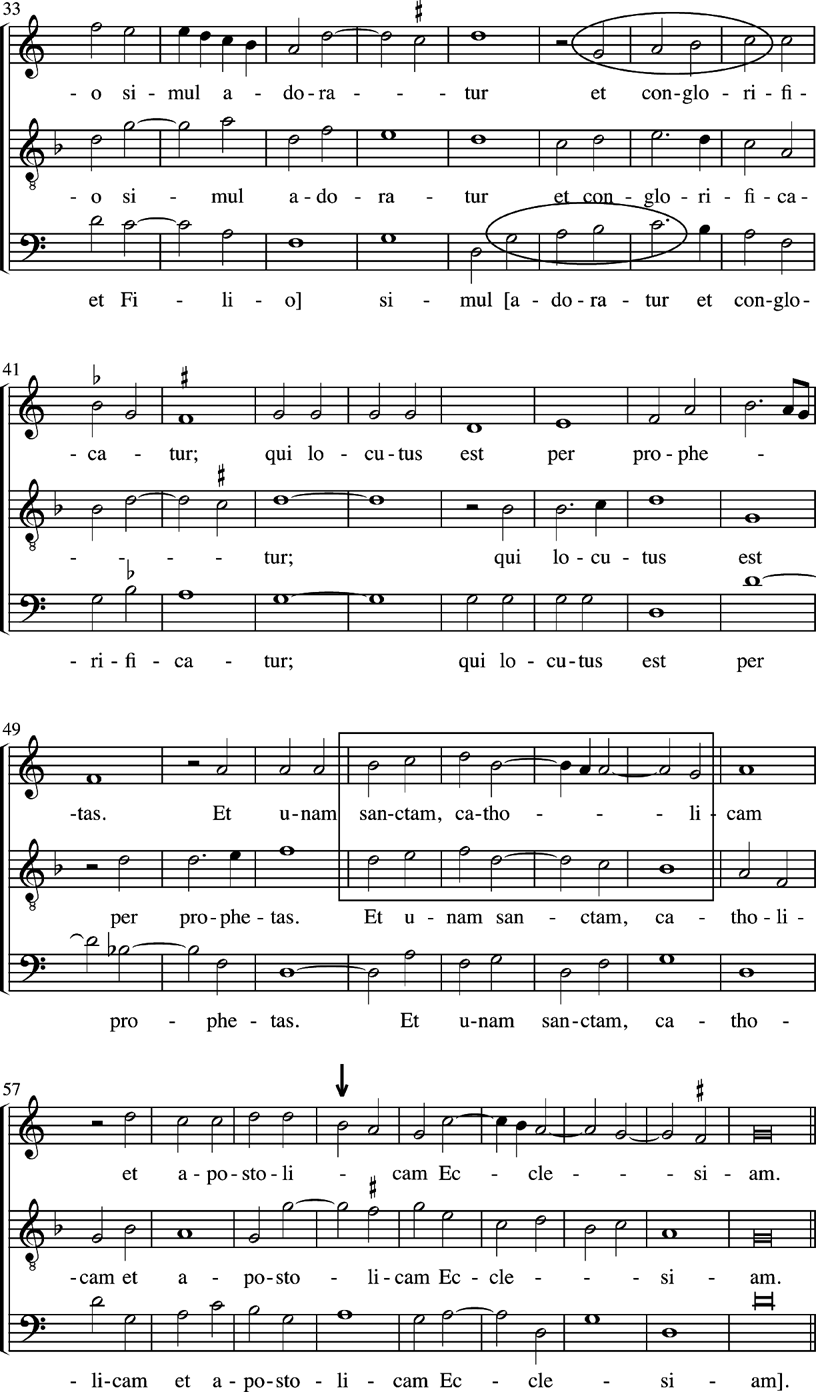
Furthermore, a close look at the Et in Spiritum section in ModD, particularly in comparison with the other three-voiced sections of the mass, suggests that it was not composed at the same time as the rest of the mass, and possibly not even by Caron. Five of its features are inconsistent with the rest of the mass. First, although the specific cantus firmus that Caron used has yet to be found, because of the text it was most likely a Sanctus trope.Footnote 86 The chant is paraphrased in a different way in the tenor in each movement, and part of the chant also appears in the altus in all the three-voiced sections. All of the three-voiced sections open with a paraphrase of the same section of the chant except the Et in spiritum, which paraphrases a different segment of the chant (see Examples 13 and 14). The three-voiced sections do not use a cantus firmus per se but rather simply paraphrase a short segment of the chant. Nevertheless, the portion of the chant that appears in the Et in Spiritum is out of place, and although it does not disrupt the overall structure of the cantus firmus, it suggests that it was composed after the rest of the movement, if not the whole mass, by someone who was either unconscious of or simply unconcerned with the correspondences with the other three-voiced movements. Second, the new section has far more repeated notes than the rest of the mass: there are thirty-two, only three of which are cadential anticipations; in the comparably long Qui propter nos section of the Credo, there are only twelve repeated notes, seven of which are cadential anticipations. Third, the rhythmic motion is noticeably slower in the Et in Spiritum than in any other section: more than 90 per cent of the notes are semibreves or longer note values; in contrast, in the Qui propter nos section, more than two-thirds of the notes are shorter than a semibreve. Fourth, there are numerous passages in the Et in Spiritum in which the upper voices move in parallel thirds or tenths (e.g. bb. 5–7, 11–4) or parallel sixths (bb. 51–4), and a few passages in which the outer voices move in parallel thirds (bb. 20–1) (I have boxed the longer passages in parallel thirds or tenths in Example 14). In contrast, there is only a single passage in the Qui propter nos that makes use of parallel thirds (bb. 26–7). Indeed, motion in parallel thirds, sixths, or tenths is relatively uncommon in Caron's music, as it is in most music from the 1450s and 1460s (excepting fauxbourdon settings), and did not become popular until the later 1470s and 1480s. Finally, the Et in spiritum is the only three-voiced section in duple metre (tempus imperfectum diminutum); all of the other four are in triple metre (tempus perfectum).
Firminus Caron, Missa Clemens et benigna, Qui propter nos
Continued
Firminus Caron?, Missa Clemens et benigna, Et in spiritum
Continued
No other section in any of Caron's masses is as problematic as this Et in Spiritum; indeed, no other section in any of Caron's masses is so disconnected from the rest of his compositional habits. The evidence clearly indicates that this section was composed by someone other than Caron, which raises the question of who might have written it and why.
Whoever composed this Et in Spiritum clearly knew the rest of the mass and wrote in a very similar style. This new section ends on G, which is the modal centre of the mass and the ending of the majority of sections, and the principal cadences are to G and D, which is also in keeping with the rest of the mass. Both of these features are common for the time, however, and have little to say about the question of authorship. On the other hand, the section closes with an octave-leap cadence very similar to the one ending the Christe. By this time (c. 1480) the octave-leap cadence was somewhat old-fashioned, although Caron had used it extensively (so had Martini). There are several brief examples of imitation in the Et in Spiritum, as there are in the Qui propter nos section and throughout the mass (I have circled some of these in Examples 13 and 14). Brief passages in imitation, either at the unison or fifth, are common in Caron (as well as in Martini).
Martini appears to be the most likely person to have written the Et in Spiritum of this mass. Many factors argue against Caron as the composer: the disruption in the symmetry of the Gloria–Credo as found in TrentC 89, the incongruous quotation of chant, the greater use of repeated notes, and the slower rhythmic motion. Similarly, a number of factors argue in favour of Martini as the composer: the use of imitation; the use of parallel thirds, sixths and tenths; and the use of the old-fashioned octave-leap cadence. That this section was copied in Ferrara and exists nowhere else, while not a compelling argument on its own, strongly reinforces the hypothesis that Martini was the composer; had the only version of the Et in Spiritum appeared in a source from another musical centre, the Martini hypothesis would be considerably weaker. Furthermore, the additional section ensures that the entire text of the Credo is sung (it is lacking six full lines in TrentC 89), and this is in keeping with what we saw in three of Martini's masses.
Musical changes in faugues's missa l'homme armé
Like several other masses in ModD, Faugues's Missa L'homme armé exists in two very distinct versions. The earlier version is found in three sources: VatS 14, VerBC 761 and PerBC 1013;Footnote 87 the later is found exclusively in ModD. Some of the changes among the sources are typical of the kinds of changes that most scribes make. For example, all ten of the four-voiced sections of the mass in the Vatican and Verona sources end with an octave-leap cadence, a somewhat old-fashioned type of cadence by 1480, and all but two of these have been modernised in ModD.
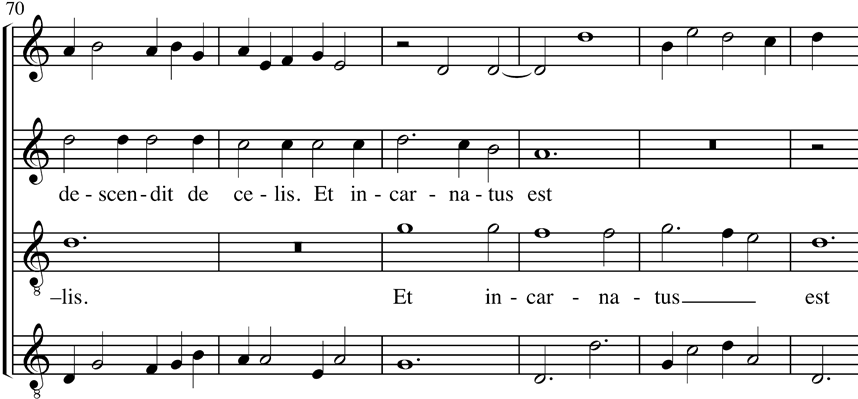
In the Vatican and Verona version, the alto is canonically derived from the tenor in every movement. No verbal instructions are given, and although signa congruentiae are used to mark where the derived voice should begin, there is nothing to indicate that it begins a fifth higher, although it probably would not take a good choir long to figure that out. In ModD, the unwritten canon is resolved, and both parts are written out in their entirety. Bonnie Blackburn suggested that resolving canons was one of the main functions of Petrucci's editor Petrus Castellanus, and this may have been an important function for manuscript editors as well, whether or not they were also the scribe.Footnote 88 Jesse Rodin suggested that Vatican scribes resolved canons ‘for cases of unusual notational complexity’, while scribes elsewhere resolved them on a more haphazard basis.Footnote 89 In ModD, the act of resolving the canon was not wholly a mechanical one, for there are small differences between the altus and tenor, so they are not always strictly canonic. But these changes are minor; usually two or more repeated notes are combined into a single note of longer value, as in Example 15. The difference in text underlay that these changes imply was carefully handled, which fits the profile we have already seen in other pieces in ModD. Furthermore, both voices have their complete text underlaid throughout, which is very unusual indeed.
Guillaume Faugues, Missa L'homme armé, Credo, bb. 70–6
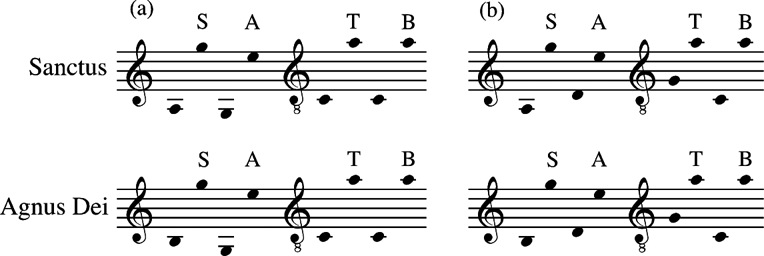
The voice derived from the tenor is not really an altus part but a second Soprano. In ModD, this part is designated ‘triplum’, the only voice so labelled in the manuscript (altus parts are normally labelled simply ‘Contra’).Footnote 90 The triplum lies about a fifth higher than altus parts in general, and even though choirs did not rely on absolute pitch, it most likely would have been sung by sopranos. But this creates a problem in the earlier version, in which the upper two voices have a combined range of two full octaves, which is very wide for this time, no matter where the pitch is set. Indeed, this large range may have been the impetus for the changes in ModD. In the earlier version, the range of individual voices is not the same in every movement: the altus and tenor both descend an extra fifth only in the last two movements (see Example 16), and it is here that the extended range seems to have been particularly problematic, for it is in these two movements that we see the greatest changes in ModD.
Guillaume Faugues, Missa L'homme armé, Sanctus and Agnus Dei ranges compared: (a) VatS 14; (b) ModD
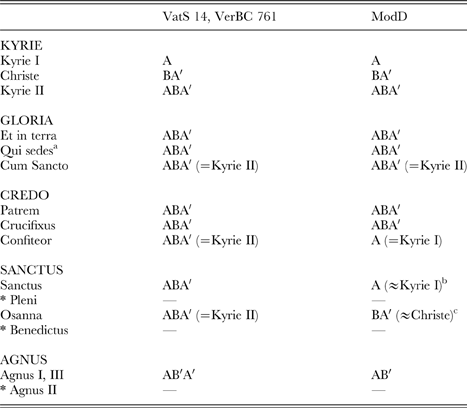
The most significant change in the ModD version is found in the structure of the mass (see Table 15). In the Vatican and Verona version, the music of Kyrie II comes back at the ends of the Gloria, Credo and Sanctus. It functions as a unifying device, much like a head motif, only it is quite long (forty bars) and comes at the end of movements rather than at the beginning – what David Fallows calls a tail motif.Footnote 91 This structural repetition, relatively rare in the fifteenth century, is found in all of Faugues's securely attributed masses.Footnote 92 The ModD version has been substantially altered. Here, the music of Kyrie II does return at the end of the Gloria, but the end of the Credo has the music of Kyrie I rather than Kyrie II. Furthermore, the Sanctus is cobbled together from different parts of the mass with a small amount of new material. The first three bars plus one semibreve of bar 4 of the Sanctus in ModD are newly written and include a quotation from the opening of Busnoys's Missa L'Homme armé; from the second semibreve of bar 4 through to the cadence in bar 9, ModD is the same as bars 5–10 of the Sanctus of VatS 14 and VerBC 761; finally, the rest of the Sanctus in ModD is the same as the last eighteen bars of Kyrie II.Footnote 93 The Osanna section, which in the Vatican and Verona version was Kyrie II, is a truncated statement of the Christe in ModD.Footnote 94 Both the Pleni and Benedictus sections are the same in all three sources. The Agnus Dei is essentially the same in all the sources as well, except that the first Agnus Dei ends nine bars earlier in ModD, making its statement of the cantus firmus incomplete.
Layout of the cantus firmus in Faugues's Missa L'homme armé
a Qui tollis in ModD.
b Bars 8–27 of the Sanctus are equivalent to bb. 10–28 of Kyrie I.
c Bars 1–5 and 6–49 of the Osanna are equivalent to bb. 1–5 and 20–63 of the Christe (in bb. 1–5, the bassus of the Christe appears in the tenor of the Osanna, and the bassus of the Osanna is newly composed).
* Indicates that a section is written for fewer voices than the mass as a whole.
The structural changes in ModD have several important ramifications. First, the lowest sections of the triplum in the Sanctus and Agnus Dei have been eliminated: most of the Sanctus was replaced by music from Kyrie I, and Agnus Dei I has been truncated. Both of these changes had the effect of eliminating the brief sections where the triplum dips down the extra fifth to g. Thus the ranges of the altus and tenor are more consistent in ModD. Second, the layout of the cantus firmus is different; in particular, the Credo in ModD ends with only a partial statement of the cantus firmus and the Agnus Dei lacks the last phrase altogether. It is unusual for a later version of a mass to have a more haphazard rendering of the cantus firmus than an earlier one. Finally, a comparison between Missa L'homme armé and the next mass in the manuscript, Faugues's Missa Je suis en la mer, reveals that both masses have similar structural repetition (see Table 16). The last section of the Credo is based on a section of the Kyrie: in Missa L'homme armé it is based on Kyrie I and in Missa Je suis en la mer it is based on Kyrie II. The structural similarities are closer in the Sanctus: in both masses, the Sanctus is based on Kyrie I and the Osanna on the Christe. As can be seen in Table 15, the structural repetition in Missa L'homme armé in its Vatican/Verona version is quite different. Perhaps the ModD version represents an attempt to impose some degree of regularity in the repetitions. Since ModD is the only source of Missa Je suis en la mer, it is possible that this version is the result of a similar editing process of Faugues's original.
Layout of the cantus firmus in Faugues's Missa Je suis en la mer in ModD
a Bars 15–23 of Kyrie II are equivalent to bb. 37–45 of the Et in Spiritum.
b Bars 6–18 of Kyrie I are equivalent to bb. 10–7 of the Sanctus.
* Indicates that a section is written for fewer voices than the mass as a whole.
The unusual nature of the changes to Missa L'homme armé forces us to ask who made them and why.Footnote 95 Rossi argued that Faugues himself reworked the mass between the time it was copied into VatS 14 and ModD.Footnote 96 This explanation parallels what we have already seen with Martini updating his earlier masses before their inclusion in ModD, but with one major difference: when Martini updated his masses, he composed new music; in the update of Missa L'homme armé, on the other hand, portions of movements were rearranged or cobbled together from previous sections, but very little new music was written. Ranges were changed, perhaps to make it more easily singable by Ercole's chapel, but this was accomplished not by composing new music but simply by cutting out passages and either replacing them with sections from other movements (as in the Sanctus) or not replacing them at all (as in the Agnus Dei). Indeed, the changes strongly suggest that the mass was edited not by the original composer but rather by another composer who understood Faugues's modus operandi and whose style was comparable. The most logical candidate, not only because of his proximity to the compilation of ModD but also because of his general similarity to Faugues, is Martini. Wegman observed that Martini and Faugues had several compositional habits in common: the use of what he calls ‘flexible literalism’ (the ability to augment or insert notes and rests into a cantus firmus but nevertheless maintain its melodic and rhythmic characteristics fairly exactly); modelling a mass on a two-voice structure rather than a single-line cantus firmus; and the use of structural repetition.Footnote 97 Indeed, it is this shared use of structural repetition that makes Martini the most logical candidate to have reworked Faugues's mass. Martini's Missa Io ne tengo has a tail motif in all the movements (truncated in the Sanctus) that is similar in concept to the one in Faugues's mass.
Musical changes in missa o rosa bella iii
In 1985, Reinhard Strohm suggested that the anonymous Missa O rosa bella III was composed by Johannes Martini.Footnote 98 In a 1996 article, I argued that the mass as a whole differs from Martini's masses in a number of important ways: the cantus firmus makes little use of the original rhythmic structure of the model, which is thoroughly atypical of Martini; the polyphonic quotations are paraphrased, whereas Martini's are literal; and the number of polyphonic quotations is considerably smaller than is generally found in Martini.Footnote 99 After having spent more time looking not only at Martini but also at the source tradition and the role of editors in late medieval manuscripts, I would like to offer a more nuanced theory about the authorship of part of this mass.
Missa O rosa bella III exists in three sources: TrentC 89, PragP 47 and ModD. There is a very clear progression in the readings of the sources viewed chronologically: TrentC 89 is the earliest; PragP 47, compiled somewhat later, has some substantial changes but still closely resembles TrentC 89 in many of its important details; and ModD, the latest of the sources, incorporates many of the changes from PragP 47, and adds several new and even more substantial changes. One change we have already seen is that the Kyrie in TrentC 89 and PragP 47 uses a trope which does not appear in ModD.
The mass uses the tenor of John Bedyngham's O rosa bella as its cantus firmus, and quotes substantial portions of the superius of the chanson and rather less of the contratenor.Footnote 100 The anonymous composer of this mass divided Bedyngham's tenor into three unequal phrases, labelled A, B and C in Table 17. In most movements, the cantus firmus is stated once in its entirety in the tenor, but in the Agnus Dei, only the first two phrases are used (see the left-hand side of Table 17). The first and third phrases of the cantus firmus end on G, while the middle phrase ends on A, which in the mass is usually taken as the fifth of a triad on D. In the Trent and Prague sources, the first three movements end on G, while the last two end on D. In the Agnus Dei, this is the result of using only the first two phrases of the cantus firmus; in the Sanctus, however, the situation is more complicated. The last phrase of the cantus firmus is used in Osanna I (which ends on G), but the Benedictus and Osanna II are combined into a single movement (not in itself rare); but that section does not use a cantus firmus and ends on D, creating a mass in which not all of the movements cadence on the same pitch (in this case, they cadence to either G and D). This is relatively rare; it is the only mass in either TrentC 89 or PragP 47 to do so, and no mass in ModD does.Footnote 101
Layout of the cantus firmus in Missa O rosa bella III
a In ModD, only the text of the Benedictus is underlaid.
* Indicates that a section is written for fewer voices than the mass as a whole.
The cantus firmus is usually stated in an altered form. The changes include the use of some ornamental notes as well as the addition, omission and repetition of notes. Furthermore, the rhythm of the original is thoroughly altered: sometimes it is changed to undifferentiated long notes, as in the opening of the Kyrie, and other times it resembles the other voices in its rhythmic activity but is unrelated to the original. Example 17 compares phrase C of the chanson with its use towards the end of the Kyrie (the Agnus Dei is discussed below). ‘N’ indicates a note that was not in Bedyngham's original, and a tilde signifies a note missing in the mass but present in the original. The manipulation of the cantus firmus in Missa O rosa bella III is unlike that of Martini, who occasionally uses a little ornamentation but retains the original rhythmic structure of the model.
John Bedyngham, O rosa bella, tenor and its use as a cantus firmus: (a) tenor, bb. 36–42; (b) Missa O rosa bella III (TrentC 91 and PragP 47), Kyrie, bb. 77–86; (c) Missa O rosa bella III (ModD), Agnus Dei, bb. 87–95
The polyphonic quotations in this mass are paraphrased. Examples 18 and 19, from Bedyngham's chanson and the Et incarnatus of the Credo, are typical of the polyphonic quotations in the first four movements of the mass. In this example, an ‘x’ signifies a quotation from the tenor of the model and an ‘o’ indicates a quotation from the superius. Here the quotation precedes the entry of the cantus firmus in the tenor in bar 111. Most of the polyphonic quotations in this mass occur at or near the beginning of a section, before the entry of the cantus firmus. In this passage, bars 27–33 of the tenor of the chanson are quoted in the bassus of the mass, and the superius of the chanson is quoted in the superius. When a composer paraphrases a polyphonic quotation, he can clarify the passage in a number of ways. First, he can arrange the quotation of the superius to coincide with the quotation of the tenor (I have marked such these places with an arrow pointing towards the quoted note in the other voice (↓)). Second, although there are often a great many added pitches between the actual notes of the quotation, the composer can repeat a note from the model immediately after a melodic digression and before moving on to the next note from the model (these repeated notes are marked with an ‘o’ or an ‘x’ in parentheses, (o), (x), and are tied to the original note with a dotted slur). In Missa O rosa bella III, the composer frequently repeats a note after a melodic digression, especially in the first half of the example (notice all the ‘o's in parentheses and the dotted slurs), but has purposefully paraphrased the tenor–superius duet in such a way that the vertical alignment between those voices is usually changed (note that only four of the sixteen notes in the superius with a plain ‘o’ over them have descending arrows). Paraphrased polyphonic quotations are very rare in Martini, and this kind of paraphrased quotation is thoroughly atypical of his style.Footnote 102
John Bedyngham, O rosa bella, bb. 27–33
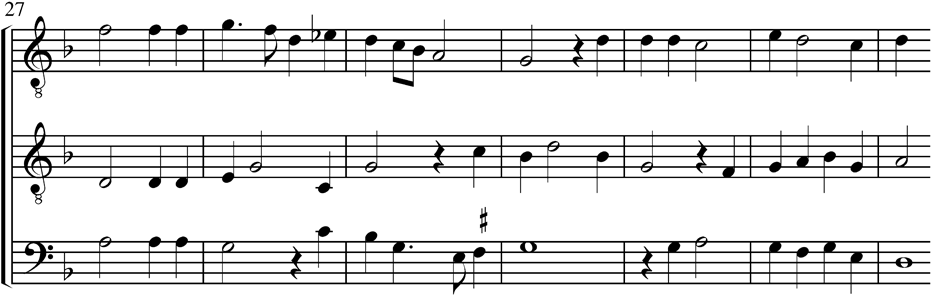
Missa O rosa bella III, Credo, bb. 97–111
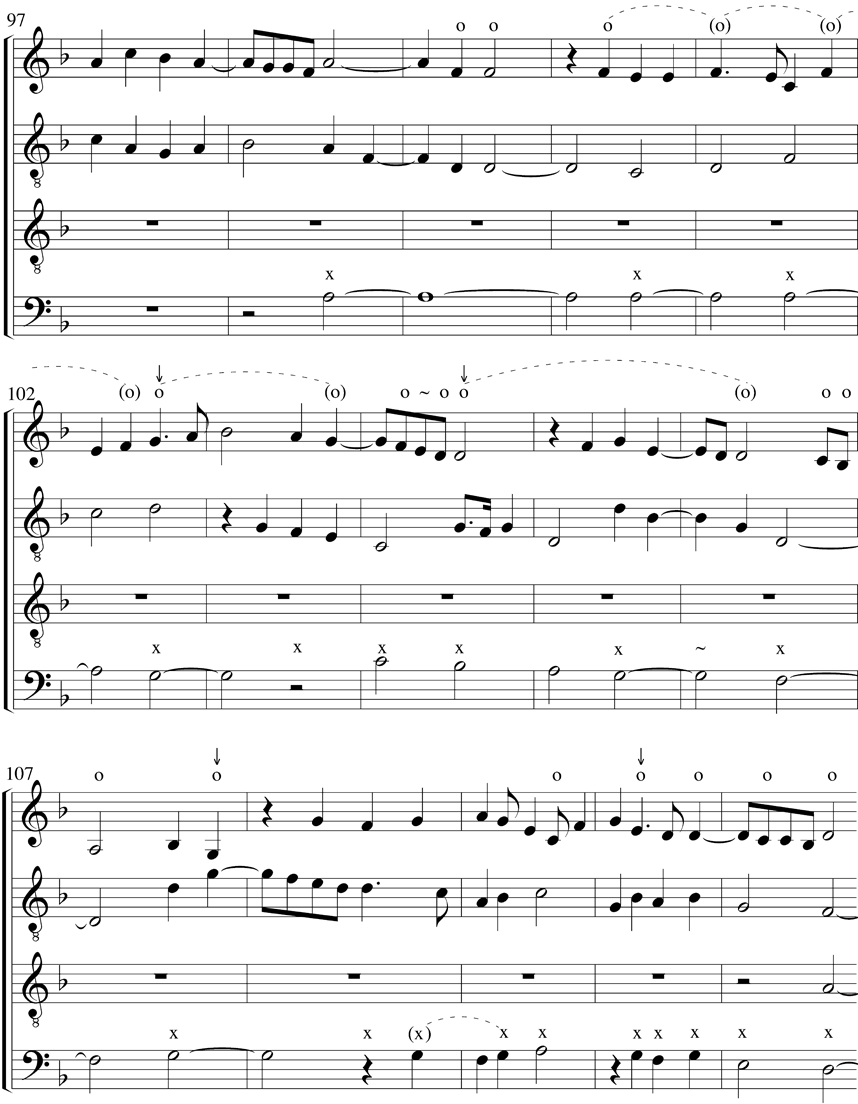
The ModD version of Missa O rosa bella III has some significant differences. In the fourth section of the Sanctus (that is, the combined Benedictus qui venit and Osanna II section), only the text of the Benedictus is given (see Table 17 above). There is no rubric such as ‘Osanna ut supra’ to indicate that Osanna I should be repeated, but it is evident that someone (scribe or editor) thought that what was a combined Benedictus and Osanna in Trent and Prague was really only the Benedictus and that the first Osanna should be repeated. In all the other masses in ModD, the last section of the Sanctus is either a repeat of the first Osanna or a new setting of it. Missa O rosa bella III is the ninth mass in ModD. Only two of these first nine masses have a separate Osanna II; the other seven repeat the first Osanna after the Benedictus. This, however, is taken for granted in the manuscript: nowhere before this mass was the standard rubric ‘Osanna ut supra’ considered necessary. All of the masses after O rosa bella either use this rubric or have a separate Osanna II. This Sanctus may have caused some confusion – was that fourth section simply the Benedictus, or did it also include the Osanna II – and thereafter the scribe decided to add the rubric to ensure the proper performance. I will come back to this point below.
In addition to changing, one might say normalising, the text, the editor of ModD also made some substantial changes to the music of this mass. The first change that occurs is in the key signatures, which vary among all the sources (this is one time in which TrentC 89 and PragP 47 do not remotely agree): PragP 47 has no signature whatsoever; TrentC 89 has two flats in the superius, one in the altus and tenor, and none in the bassus; and ModD has one flat in each voice. The Prague version is clearly the most problematic, changing the mode of the mass from transposed Dorian to Mixolydian. By contrast, the versions in TrentC 89 and ModD are much closer, and the conflicting signatures of TrentC 89 could be explained as representing different recta realms for individual voices.
The version of Missa O rosa bella III in PragP 47 represents an intermediate stage between the version in TrentC 89 and ModD. All of the significant changes in PragP 47 appear in ModD, which has several more of its own. In PragP 47 (and subsequently in ModD), the range of the bass voice has been radically altered: the bassus in TrentC 89 has a range of a twelfth, from f to c′; but in PragP 47 and ModD, it has been altered to only a ninth, from c to d′. This change required portions of the bassus part to be rewritten: some passages originally quite low in Trent were simply taken up an octave in PragP 47 and ModD (Example 20); the only portion of this example in which the ModD bassus diverges from the earlier bassus is in bar 21, where someone took the trouble to add a bit of imitation between the bassus and altus. Indeed, there are numerous other passages in which the bassus voice has been altered to include imitation. Other bassus passages, especially those that stay in the upper part of the register, have only a note or two changed (Example 21); these passages most often occur at cadences. Occasionally, the type of cadence is altered, usually modernised, but here, a standard later fifteenth-century cadence is changed into the somewhat old-fashioned octave-leap cadence. Finally, a few bassus passages were recomposed to some degree. In Example 22, part of the bassus line in PragP 47 and ModD is the Trent bassus line taken up an octave, and part of it is new. In bar 160, someone has once again added a bit of imitation, this time in the outer voices. In Example 23, the bassus line from Trent is not in PragP 47 or ModD, the altus line from Trent was moved into the bass in PragP 47 and ModD, and the altus in PragP 47 and ModD is a new line altogether.
Missa O rosa bella III, Gloria, bb. 17–22: (a) TrentC 89; (b) PragP 47 and ModD
Missa O rosa bella III, Credo, bb. 34–5: (a) Trent C89; (b) PragP 47 and ModD
Missa O rosa bella III, Credo, bb. 158–65: (a) Trent C89; (b) PragP 47 and ModD
Missa O rosa bella III, Kyrie, bb. 1–9: (a) Trent C 89); (b) PragP 47 and ModD
The most dramatic change to this mass in ModD occurs in the Agnus Dei (see Table 17 above). In the Trent and Prague sources, the second Agnus Dei is a duet for superius and tenor, and the third Agnus Dei repeats the music of the first. In ModD, the second Agnus Dei is a newly composed trio for superius, altus and bassus, and has no connection whatsoever to the second Agnus Dei in Trent and Prague. The third Agnus Dei in ModD is also newly composed, this time for all four voices, and it uses the last phrase of the cantus firmus. From the point of view of the cantus firmus, the Agnus Dei in ModD makes more sense: the Trent and Prague sources use only the first two of the three phrases of the cantus firmus, but ModD states the cantus firmus in its entirety. This new structural cohesiveness is generally typical of the kinds of changes in ModD. Furthermore, if my earlier hypothesis about the performance of the Sanctus in ModD is correct, and that it ended with a repeat of the Osanna I, then all of the movements end on G, which was by far the most common arrangement during most of the fifteenth century.
Returning to the newly composed sections of the Agnus Dei (Agnus Dei II and III), I believe there is a strong probability that they were newly composed for inclusion in ModD, and that Johannes Martini is the author. A close examination of these two new movements suggests that they were written by a composer different from whoever wrote the rest of the mass, perhaps to create a more logical layout of the cantus firmus. First of all, the cantus firmus in Agnus III is closer to Bedyngham's original than the cantus firmus in other movements, as can be seen from Example 17 above. In the earlier movements, exemplified in Example 17(b), the cantus firmus has numerous added or deleted notes and only rarely follows the original rhythmic structure of Bedyngham's tenor; notice how many more ‘N's there are in Example 17(b) compared with Example 17(c), and how infrequently the rhythms in Example 17(b) are the same as in Example 17(a). In the last Agnus, on the other hand, the cantus firmus frequently follows the original rhythmic structure and has far fewer added or deleted notes (there is only a single N and the deletions (∼) mainly omit ornamental notes such as anticipations or cadential decorations, suggesting that whoever worked with this cantus firmus in Agnus Dei III knew a slightly different version).
Another difference between the new and the original sections of the mass is the use of dissonance. In addition to the more common dissonant passing note and suspension, most fifteenth-century composers also use the cambiata from time to time. The earlier portions of this mass use cambiatas only infrequently (there are only two in the entire Kyrie); conversely, cambiatas abound in Agnus Dei II and III. Martini was very fond of dissonance in general and cambiatas in particular.
The polyphonic quotations in the original portion of this mass are paraphrased. We already saw a typical example in Example 19. The only polyphonic quotation in the new portion of Missa O rosa bella III is not paraphrased but literal. As Example 24 demonstrates, there are no notes added to the quotation, and only two notes omitted: a passing note in bar 35 and an anticipation in bar 39 (these are marked with a tilde). Furthermore, the rhythmic structure and vertical alignment of the original have been maintained. Even a brief comparison with Example 19 will highlight the complete stylistic contrast between the two approaches. Martini preferred this kind of literal polyphonic quotation.
(a) Bedynham, O rosa bella, bb. 1–7; (b) Missa O rosa bella III, Agnus II, bb. 34–41
All of these differences – the handling of the cantus firmus, the use of cambiatas and the polyphonic quotations – suggest that the last two sections of Missa O rosa bella III in ModD were written by a different composer from the rest of the mass. From a stylistic as well as geographic perspective, the most likely composer was Martini. Martini normally uses a cantus firmus literally or with only a few ornamental notes; he took great delight in using cambiatas as well as other dissonances; and he incorporated polyphonic quotations literally. Furthermore, as with the new section of Missa Clemens et benigna, the fact that the new sections of Missa O rosa bella III exist only in Ferrara strongly reinforces the hypothesis that Martini composed them.
Conclusions
Now we can address the question of who initiated the changes in ModD. Choosing the repertory might have been accomplished by someone very close to Ercole, someone who knew his tastes and had the musical expertise to be able to select the best masses available.Footnote 103 As I have argued from the beginning, the small changes – decorated cadences, changes in ligatures, the use of coloration – all easily could have been accomplished by a scribe without the intercession of a separate editor. But what about the more substantial changes? Keeping in mind that this manuscript was written for a specific patron (Ercole d'Este) and with a particular purpose (to supply music for the ducal chapel, which the duke in fact attended on a daily basis), the scribe probably did not have as much freedom as someone compiling a manuscript for his own use, as is the case with Bologna Q15, for example.Footnote 104 Furthermore, Ercole sang mass excerpts with members of his chapel on a regular basis and even taught Ascanio Sforza how to read music.Footnote 105 A letter that mentions one such incident is dated 1481, and it is quite possible that they were singing directly from ModD.Footnote 106 Prior to the compilation of ModD, there must have been some discussion concerning the texts: how much of the Credo texts should be used? Should the tropes in the Kyrie of Missa O rosa bella III be included or not? Should the tenor of Domarto's Missa Spiritus almus be texted with the Mass Ordinary text or the cantus firmus text? A good scribe certainly could have made these changes on his own, but again I doubt that he would have made them without guidance from someone close to Ercole; furthermore, given the musical skill with which most of these changes were accomplished, the scribe was either a very good musician himself or consulted with one, most likely Martini.
The musical changes in ModD present a clearer scenario. Martini appears to have worked on his masses over long periods of time, and individual copies may represent only his current thoughts on the music, not necessarily his final ones. All of his masses in ModD have substantial changes compared with earlier sources: the last section of the Credo of Missa Ma bouche rit was completely rewritten, as was the Kyrie (and presumably the rest) of Missa Cucu. Missa Orsus, orsus has an added section in the Credo in ModD not found in its earlier sources. Similarly, Missa Coda pavon has a new section in the Credo not found in its other sources which, though copied later, probably represents an earlier version. ModD seems to be the earliest extant copy of Missa Dio te salvi, which Martini updated in its later source by making some of the imitation more strict. All of the changes are in Martini's style and were very likely undertaken by him. But updating his own works is still not the same as acting as editor; it is in the changes to the other masses where we can assess most objectively Martini's involvement in ModD.
All but one mass in ModD that is not by Martini and that has a concordance shows signs of being edited by someone other than its original composer; these are summarised in Table 18 (a comparison of Table 18 with Table 8 shows that many of the changes to the masses not by Martini are very similar in nature to the kinds of changes that Martini made in his own masses). In Caron's Missa Clemens et benigna and the anonymous Missa O rosa bella, new movements were inserted that appear to have been written by someone other than the original composer and that closely resemble Martini's style. Another two masses – Du Fay's Missa Ave regina caelorum and Faugues's Missa L'homme armé – also were revised by someone other than the original composer; in these masses, no new music was added, but sections were rearranged, discarded, or repeated. The changes to Du Fay's mass may have been made for performance reasons (in order to create an alternatim performance, for example); the same performance-initiated changes are behind the editing of Domarto's Missa Spiritus almus, which had its numerous sharps removed and the mensuration in the final Kyrie changed. Martini must have sung all of these masses with the court cappella and determined that the changes outlined in this article were necessary for one or another of a small number of reasons: to create a logical layout of the cantus firmus (e.g. Missa O rosa bella), to adjust the range for the singers in Ercole's cappella (e.g. Faugues's Missa L'homme armé), to allow for alternatim performance, to insure a better succession of tempi, or simply to expunge problematic accidentals.
Summary of significant changes to masses in ModD not by Martini and the person who most likely initiated those changes
a These changes could have been accomplished by either the scribe or Martini, but, as I have argued, most likely were done only after having been tried out in the duke's cappella, which Martini was in charge of.
The question of who composed the Et in Spiritum preserved in the ModD version of Caron's Missa Clemens et benigna or Agnus Dei II and III in the ModD version of the anonymous Missa O rosa bella III has far-reaching and vital implications for our understanding not only of personal style but also of mass composition in general. With regard to personal style, we better understand Caron if we view the Et in Spiritum as a later addition to Missa Clemens et benigna rather than an integral part of its original conception. The anomalies in the use of the chant, the lack of Gloria–Credo symmetry and all the other unusual features disappear and we are left with echt Caron.
With regard to mass composition more generally, it seems axiomatic that, at least during the Renaissance, a setting of a mass constitutes the work of a single composer. Although this is generally true, I would like to plant a small seed of doubt. There appear to be some masses, written by one composer, that were later edited in some way by another. It is very likely, for example, that the Et in Spiritum of Caron's Missa Clemens et benigna was composed by Martini, possibly to ensure that the entire text of the Credo was sung. Similarly, the second and third Agnus Dei of the anonymous Missa O rosa bella III were very likely composed by Martini, perhaps in this case to create a more logical layout of the cantus firmus. Two further examples of multi-authored masses have recently been discussed. Jesse Rodin demonstrated that the Et in Spiritum of Josquin's Missa L'homme armé super voces musicales was probably composed by Giovanni Abbate around 1550, and Jeffrey Dean has suggested that the tenor part of Agnus Dei III of Basiron's Missa L'homme armé was not composed by Basiron.Footnote 107 This superficially heretical idea – that some masses may contain sections written by someone other than the named composer – has long been accepted for other genres. We accept that many if not most of the si placet lines in chansons were written by someone other than the original composer; and Martini composed several si placet lines himself.Footnote 108 Allan Atlas has gone further and proposed that most conflicting attributions in the Franco-Netherlandish chanson repertory were the result of one composer having revised the work of another.Footnote 109 We also accept that composers occasionally added new lines to older motets in order to modernise them.Footnote 110 Richard Sherr makes a similar point when he reminds us that some mass manuscripts mix movements by different composers.Footnote 111 I think it is time that we begin to accept that some masses may also have been revised by later composers, and that some masses as they now exist contain music by more than one composer.
Appendix I
Manuscript Sigla, Approximate Dates, and Probable Provenances
Appendix II
Inventory of Modena, Biblioteca Estense, MS α.M.1.3 (ModD)