

INTRODUCTION
In September 1969, government security forces in the South Sudanese town of Torit discovered that a man named Sakrana, who was suffering from leprosy (Hansen's disease), was gathering intelligence for the Anya-Nya rebels, and that he was carrying with him a large quantity of salt and other supplies.Footnote 1 He came from the leprosy colony of Ido, five kilometres outside the town. Since 1966, Ido had been occupied by a local Anya-Nya group led by Galario Modi and had become a target for sporadic government attacks.Footnote 2 The resident population affected by leprosy grew maize and cannabis, supposedly also for the benefit of rebel fighters.Footnote 3 But, on 26 June 1969, government intelligence reported that the rebels had burnt the colony, in retaliation for the government having recruited several residents as informants.Footnote 4 Ostensibly they made good spies as their leprosy acted as a deterrent against arrest and interrogation. Anya-Nya fighters re-occupied the site a few weeks later and the colony was then used as a rebel post for receiving intelligence from Torit town; a government source reported on a small group of rebels camping at the site in 1969, ‘waiting for some of their informants present in Torit right now.’Footnote 5 The colony was finally destroyed in air raids over ten days in June 1970.Footnote 6
The fate of the Ido colony illustrates the ways in which the first civil war in South Sudan reconfigured government institutions and state-society relations while challenging distinctions between civilian and combatant. It demonstrates how this was a conflict over the control of populations which involved the mobilisation (and politicisation) of broad segments of local society. And, finally, this vignette shows how radically improved access to wartime district- and village-level historical material has made it possible to trace local histories of the Anya-Nya war; to discover how local priorities, personalities, and war economies structured the conflict; and to nuance a simplified and often politicised national history.Footnote 7
Accounts of South Sudan's history during the period from 1963 to 1969 are in general fragmentary.Footnote 8 Existing histories focus on developments in Khartoum and on the efforts of politicians in the diaspora to raise edifices over the various rebel groups.Footnote 9 Today the Anya-Nya army is commonly remembered as more civil and well-behaved than the rebels of the second civil war (1983–2005), the Sudan People's Liberation Movement/Army (SPLM/A). In contrast with the SPLM/A, many people remember the Anya-Nya as an organic, grassroots movement working in concert with villagers and chiefs. These tropes were already evident in immediate postwar publications, as exemplified by Elias Nyamlell Wakoson in 1973:
In the final analysis, the movement won tremendous popular support from the masses. The mere sight of the Anya-Nya in an area reaffirmed the confidence of the civilians that their own sons were always at hand to defend them and that there was no chance for northerners to take the south without the support of the people. … Right from the beginning of the Anya-Nya movement, it relied heavily on village populations for recruitment, supplies, transport, intelligence, and some medical facilities.Footnote 10
Wartime events within South Sudan are represented by episodic fragments in memoirs, which are the most accessible sources from which popular narratives have emerged in the decades since the war ended; through their autobiographies two leading politicians of that era, Abel Alier and Joseph Lagu, have been particularly influential in shaping these narratives.Footnote 11 Both young and ambitious at the start of the war, the lawyer Alier became a leading politician of compromise ‘inside’ Sudan, while Lagu, educated at the military college in Khartoum, defected from the Sudanese army in 1963 and rose to become the leader of the Anya-Nya in 1969. Their narratives have been echoed in other autobiographies and texts by Anya-Nya leaders, official South Sudan government documents, and more general accounts of the civil war.Footnote 12 This has resulted in a general perception of the first civil war which fits well into the current nationalist history of the South Sudanese struggle against suppression and for self-determination.Footnote 13 With this exploratory study, we want to nuance and challenge these narratives.
Our investigation of the Anya-Nya war in Torit is set within ongoing developments in the broader historiography of post-independence Africa. In recent years, innovative research into local postcolonial histories has presented rich dramas of survival and personal agency, in which the conflicts and ideologies of the national arena are set in deeper context.Footnote 14 This is a trend reflected in analyses of more recent conflicts: many scholars now argue for the importance of local, peripheral, and borderland dynamics in understanding national and international processes.Footnote 15 One reason for this shift towards the local is a recognition of the decentralised nature of politics, governance, and warfare in most African countries, which is clearly reflected in the case of Torit.
From a varied set of contemporary sources, this article pieces together a local history of Torit's Anya-Nya war. It demonstrates how the bands of guerrillas and the Sudanese government forces operated; what forms and techniques of warfare they employed; and how both the Sudanese state and the Anya-Nya leaders dealt with wartime administration, the ‘civilian’ population, and the limits to legitimate violence. This was a localised and nasty war. The Torit area is an apt case study due to its particularly dynamic guerrilla history: in the words of a local Sudanese administrator in 1960, the area is ‘famous for the presence of khawarij [outlaws].’Footnote 16 The Torit mutiny, on 18 August 1955, is popularly considered in South Sudan as the spark that set off the first civil war, and the town and its surroundings remained an epicentre of conflict until the Addis Ababa peace agreement ended the war in 1972. The following analysis gives evidence to broader questions concerning the long-term impact of the war on societal relations and cultures of governance in the Sudans. The Anya-Nya war around Torit shows how modes of rebellion and rebel-civilian interaction — and the Sudanese state's methods of counter-insurgency — transformed state-society relations and perpetuated and recast practices of violent, militarised, and authoritarian governance which continue to haunt South Sudanese politics.
The end of the second civil war in 2005 facilitated this reassessment of the history of the Anya-Nya war. The subsequent years of stability provided a window of opportunity for research within South Sudan and for beginning the rehabilitation of the National Archives (SSNA) in Juba. These archives contain the surviving files from district- and province-level offices of the colonial Condominium and postcolonial Sudanese regional governments that remained in storage during the second civil war — in basements, old offices, and shipping containers — and endured the ravages of rainwater, termites, dogs, heat, and neglect.Footnote 17 These documents provide an important counterbalance to the various rebel sources on the war, including Anya-Nya documentation in other archives around the world and our own interview records with surviving Anya-Nya veterans from research in Torit in 2006, 2007, and 2015.Footnote 18
These local district government records present significant methodological challenges related to the interpretation of sources, especially with regards to authorship, translation, and intention. Inadequate education, lack of staff and office supplies, and unsystematic reporting and record keeping by government officials amplify omissions, exaggerations, and falsification. This is not an insurmountable problem, but it makes triangulation with the other independent sources particularly important. And, although historical evidence from this period has proven surprisingly rich, the available material is incomplete. Important parts of the government records produced during the period under study have disappeared. Although there is no surviving inventory of the original files, there are clear gaps in chronology and filing numbers. The incompleteness of the archive implies unknown processes and events; we do not know if the survival of the files currently available is entirely due to serendipity or if some of the lost files have been deliberately destroyed. Our research is thus by necessity tentative, but by limiting this study to the specific geographic area around the town of Torit we can demonstrate the depth of corroborated material and further apprise gaps and shortcomings among surviving records.
When focusing the analysis on the town-level, the Anya-Nya conflict's local specificity becomes evident. Our study demonstrates how local priorities, geography, personalities, and structures of local government and military power affected the conduct and practice of warfare around Torit significantly. In so doing, this article emphasises the power and significance of local histories of warfare in understanding the dynamics of protracted conflicts. Still, it is not possible for us to claim that the experience of the population is representative for all those who lived through this civil war. From our preliminary review of the existing sources from other localities, we can however see the general pattern of bands of Anya-Nya groups staying in the ‘bush’ and carrying out hit-and-run attacks on garrison towns and their lines of supplies while the government soldiers went out on patrol to ‘punish’ collaborators across the three southern provinces. These sources also indicate that various government policies of population control — informant networks, identity cards, and ‘peace villages’ — were attempted throughout the southern region, and moreover suggest that rebels’ counter-actions and mimicry of these policies were commonplace.
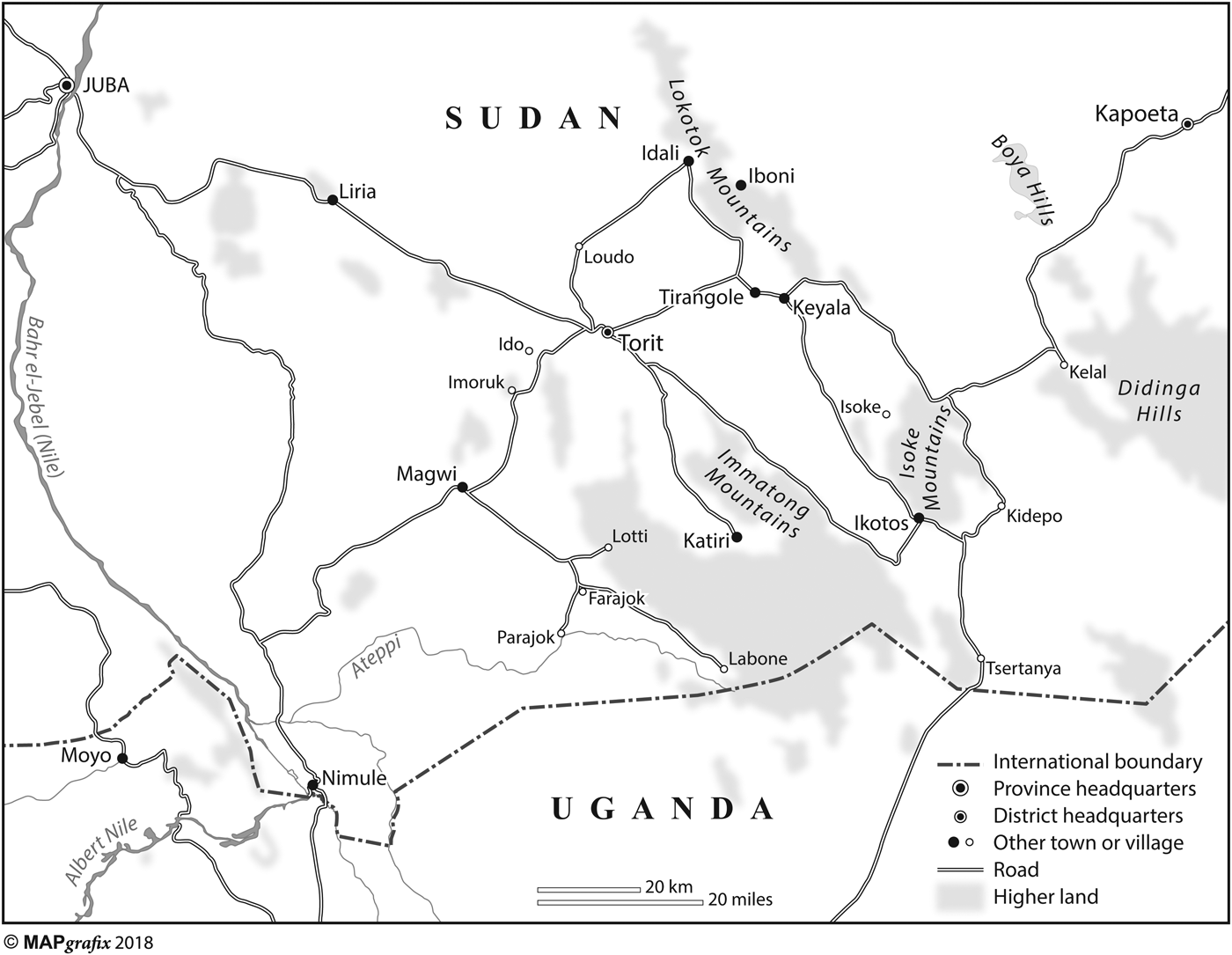
Map of the Torit region during the Anya-Nya conflict.
HUNTING OUTLAWS
The Torit mutiny on 18 August 1955, along with the ensuing ‘disturbances’ in other towns over the following few weeks, is often presented as the starting point for South Sudan's struggle for liberation and independence. However, although this was an explosion of violence with an unprecedented casualty rate, it soon ended. A state of tense normalcy — if not peace and tranquillity — was maintained up to the early 1960s. National elections in early 1958 were followed a few months later by a military coup. However, until 1962, the main source of local friction in the South was the continued hunt for ‘outlaws’ and ‘mutineers’ hiding in the ‘bush’ in Eastern Equatoria, chiefly in the mountains to the southeast between Torit and the town of Kapoeta.Footnote 19
Although the military government still sought to maintain an appearance of legality, repression and state violence escalated in the period up to 1963. Recent research demonstrates that one consequence of the 1955 disturbances was the establishment of a system of intelligence for the south modelled on similar efforts by the Anglo-Egyptian Condominium Government (1899–1956) to keep track of the population in northern Sudan prior to independence. Offers of payment for information and the secret recruitment of spies from among the local population were police state methods with parallels in other post-independent developing countries.Footnote 20 Documents in the SSNA reveal intensified surveillance and information gathering in Torit District. Government records detail trials of ‘outlaws’ and anti-government informants throughout 1960 and 1961: on 31 July 1960, for example, four people from the Ikotos area were sentenced to two years in prison for ‘disguising’ subversive activities.Footnote 21 On 16 August the same year, at Ikotos court, six more people were tried for the crime of harbouring outlaws. Another eight people were awaiting trial for the same crime, including two chiefs, Ortano and Rafael, who were accused of harbouring army defectors suspected of murdering another chief and headman on 31 July 1960.Footnote 22 By the same token, in December 1960, a Torit court sentenced seven people to five years’ imprisonment, and four others to two years, for harbouring outlaws on the Isoke and Karkuri mountains; other chiefs were also awaiting trial.Footnote 23
One way in which increased tension manifested itself was through Southerners defecting from state jobs and joining the rebellion: SSNA police files over 1963 report growing numbers of defections and disappearances of policemen and officers, often with their weapons.Footnote 24 Government reports also pinpoint the timing of Lazario Mutek's escape from prison on 1 July 1963; Mutek, who became a key Anya-Nya commander, had been in detention since 6 June 1960 for possessing weapons.Footnote 25 By early 1964, many of the remaining Southerners in civilian government positions had been transferred northwards, probably a measure against further defections.Footnote 26 Thus, evidence from SSNA can provide a more accurate and granular account of local developments in this period of increased tension and insecurity and expand our knowledge of the lives of chiefs and leaders, as well as of ordinary farmers, town-dwellers, and foot soldiers.
ESCALATION TO CIVIL WAR
Increasing insecurity and unrest in the southern provinces during 1960–3 was partly a result of the deliberate government policy of tightening control and subduing dissidents through direct targeting and collective punishment.Footnote 27 As an US diplomat commented in 1963:
The Sudan Government's action has initiated a vicious circle, where security measures have aroused increased fear and defection among the Southerners which in turn lead to more serious security measures.Footnote 28
Rudimentary social services collapsed, and many people fled, seeking safety and opportunities abroad. The gradual expulsion of foreign missionaries was interpreted as religious intolerance; the last of the missionaries were expelled in March 1964 after the outbreak of civil war. In 1962, soldiers and policemen convicted after the disturbances in 1955 had reached the end of their sentences or were, for reasons that remain obscure, pardoned. Many of these men were bitter and had few opportunities when they returned home. The nascent ideology of African liberation was absorbed by educated Southerners and articulated by politicians in exile. These politicians formed exile organisations, sought external patrons, and lobbied international forums purportedly on behalf of the people of the South. Then, in the summer of 1963, these Southern politicians, together with ex-mutineers and defected soldiers, decided to form the armed insurgency which they named the Anya-Nya.
The escalation of violence into civil war during late 1963 has only been documented by rebel statements and observations by foreigners, but can now be corroborated by files in the SSNA.Footnote 29 These confirm rebel accounts of co-ordinated attacks in September 1963: for example, on 19 September, Torit District files record a rebel attack on Parajok police station, with no reported government losses, although the attackers did capture an abu khamsa rifle.Footnote 30 A police observer — possibly a security service officer — conducted what the document refers to as ‘follow up’ with 12 police officers, taking a Bren gun to ambush the ‘rebel camp’ from which the attack originated (although it is possible that this camp was a local village). The resulting intelligence report noted no deaths on either side, but counted the rebel camp at sixty men, including five named rebels: Safio Alawan, Dortio Lado, Lubiyala Lukiya, Edward Lakamo, and Stolino Adwara.Footnote 31 The files then record a series of attacks by the Anya-Nya, including on a government convoy at the Katiri-Torit road bridge, twenty miles outside of Torit on 20 September 1963; at the same time, another rebel band attacked a car on a bridge near Kira, close to Parajok, and destroyed the bridge.Footnote 32 Retaliatory violence between rebels and government forces can plausibly be traced between the South Sudan government archives and rebel propaganda from the time: for instance, after government papers recorded that rebels killed a state collaborator in the Khor Dalib area on 6 October 1963, the Anya-Nya news sheet Voice of Southern Sudan reported that 12 men, 24 women, and 36 children were murdered and their village burnt by an army unit moving through the nearby areas of Palwa, Lokoya, and Lerwa on 11 October.Footnote 33
Government sources demonstrate escalating patterns of such retaliatory attacks between state forces and bands of what were increasingly called ‘rebels’ (mutamaridin), and they reveal the growing impact of the conflict on local people. The patterns of retaliation that developed over this period continued throughout the civil war; and while the SSNA government files are obviously selective, some of these quid pro quo incidents can again be cross-referenced between pro-Anya-Nya and government accounts. For example, on 23 December 1963, a group of rebels captured and beat the mokongo (headman) of Loudo and Rabtowa villages. A police and army patrol was then sent to the area in response, and arrested — according to the government report — 22 men and 2 women suspected of harbouring rebels. An Anya-Nya report archived by the Roman Catholic Comboni Mission says that Loudo village was looted entirely, with its population of 2,000 men and women fleeing under gunfire, and with many dead.Footnote 34 Such provocations were, according to a US Embassy internal report, an explicit tactic of the rebels: the Anya-Nya intended ‘to dramatize the Southern problem by inviting violent retaliation by the Government against dissident activity.’Footnote 35 It appears then that from the outset Anya-Nya groups were following the common guerrilla tactic of radicalising the population through the use of pinprick attacks to deliberately provoke government retaliation against civilians, what Che Guevara called focoismo.Footnote 36
VIOLENCE UNBRIDLED
The tenor of the war shifted from 1963 to 1965. The archival material on the Torit area from this two-year period describes an intensification of military operations and the growing strength of the Anya-Nya. This intensification was characterised by a struggle for control of the countryside. Over these two years, in addition to government attacks on rebel bases, the road network and police outposts in larger towns and villages were violently contested. Government files include numerous petitions to the regional and central government in Juba and Khartoum, respectively, for reinforcements for road patrols, weaponry, and transport supplies. The roadless remote countryside — ‘the bush’ — was the first piece of territory ceded to the rebels. Here the state did not have a permanent presence, and the areas were governed by chiefs and through occasional visits by other state officials. Torit's rural development projects, including the sawmill at Katiri and the Ido leprosy colony, were targeted in rebel attacks, although not always held for extended periods of time. By the end of 1964 British foreign intelligence recorded that ‘northern officials, whether military or civilian, no longer move outside the towns except under heavily armed escort.’Footnote 37 By early 1965, the officials themselves admitted that their control was limited to roads, major villages with police posts, and Torit town itself.
The escalation of fighting in the Torit area exposed weaknesses in the local government's intelligence systems; internal files are filled with pleas for information on rebel movements and locations. But these files still contain detailed notes from informants on individual rebels, including on Saturnino Lohure, a key player in the Uganda cross-border arms trade and rebel organisation in this period. One document traces Lohure to Luku and Nawadoj rebel camps in September 1963, then at Lokung mountain and in Otingnilik village opposite Teretenya, on the Ugandan border.Footnote 38 Intelligence systems using local informants were apparently developed further following attacks in late 1963, for instance when scouts sent to seek corroboration of rumours that the rebel leader Emilio Tafeng was setting up a new camp in Luliyanga village on 4 December 1963.Footnote 39 Claud Kerbetta, court clerk at Tirangore village, recorded that the local leader of Luliyanga, Rubong Lerwe, was arrested and beaten to death at this time for ‘harbouring “anti-government elements.”’Footnote 40
From the end of 1963 onwards, government papers continued to record arrests and interrogations of suspected rebels and collaborators, but there are no further reports of trials or legal proceedings against suspected collaborators in the records pertaining to the Torit area.Footnote 41 The legal cases brought by the local government against Torit town residents in this period mainly fell under code 179 (‘Harbouring Rebels’), often for not automatically informing on rebel movements: for instance, on 1 August 1966, Biranka Lai Muhammad Idris was arrested for allegedly seeing a group of armed rebels outside her door but not reporting it.Footnote 42 The affected legality of the government's prosecution of ‘outlaws’ thus appears to end, replaced — if the example of Lerwe above is typical — by more summary methods. Concurrently, sources associated with the rebels report several extra-judicial executions by the government army; for instance Luate Baraba, brother of the Anya-Nya ex-MP Elia Lupe, was arrested by the government army at Kaya and shot in front of his wife in February 1965.Footnote 43 Considering the increasingly ruthless counter-insurgency methods employed by government forces it is reasonable to assume that these stories were not altogether fabricated.
Escalation of army counter-insurgency operations around Torit is evident in a government bombing campaign on the Pochala area and Didinga Hills over February and March 1964.Footnote 44 This campaign involved eight infantry companies, supported by rocket-firing Provost airplanes, advancing on the Boya hills from the west in the wake of the airstrike; the infantry systematically burnt villages. After seeing forty villages burning and about 150 people killed in the course of one day, a British observer noted that ‘this appears to be a fair sample of Government military activity in the South.’Footnote 45 Another indication of the intensification of the war around Torit was a steep rise in the rate of defections of South Sudanese police officers, government officials and other state employees. Until 1964 such defections numbered only ten or so people a year, but they leapt to dozens over the first months of 1965. A northern civil servant requested ‘urgent reports on names of employees, workers and appointees who fled from their areas from [the] beginning of 1965 to present, date of their flight, area they belong to, their tribe, and any other details.’Footnote 46
After the installation of the civilian government of Prime Minister Mohammed Ahmed Mahgoub in June 1965 came a series of massacres in Juba, Wau, and Malakal in July. Other massacres were reported, with scarce details, in Bor, Akobo, and elsewhere.Footnote 47 South Sudanese scholars and politicians present these killings as a deliberate government policy of eliminating the southern intelligentsia, including the students, teachers, chiefs, and educated workers of the region.Footnote 48 The massacres increased the stream of Southerners fleeing to Uganda, Khartoum, and the refugee camps of the Central African Republic. Meanwhile, the military capacity of the Anya-Nya groups had been considerably strengthened by arms and ammunition acquired in the aftermath of the collapse of Simba rebellion in eastern Congo.Footnote 49
The archival resources from Torit covering 1965 both echo and ground a national picture of a sudden shift in a war now targeting the South Sudanese population of larger towns. Over the same week of the Juba and Wau massacres — in Juba, over 8–10 July, and in Wau on 10 July — Torit town reportedly ignited. During the night of 9 July, according to a local government report, the rebels attacked an army patrol on the edge of the town in Hilla Kuku and Hilla Latoka (the neighbourhoods of Kuku and Latoka), houses were set alight, South Sudanese police officers fled, and civilians ran to the church.Footnote 50 The Anya-Nya reported that the clash was started by the Sudanese army, which
gave orders for operations on Kuku village just [half a] mile behind Torit police barracks. This village was said to harbour the Anya-Nya. Anyway the village was burnt to ashes with over 40 dead.Footnote 51
This incident is widely remembered in Torit residents’ own accounts of the first civil war. A war veteran, Severino Okilongi, recalled that the government shelled Hilla Kuku, near the St. Peter and Paul mission, next to Torit town, killing many residents, destroying the neighbourhood, and causing many to flee into Uganda to the Agago and Nakapiripirit refugee camps.Footnote 52 A fellow fighter, Gaitano Irudeno, remembered friends who were forced to help dig mass graves in the church site; he explained that Martin Lopita, who was then the priest of St. Peter and Paul, collected bodies and buried them within the churchyard.Footnote 53
Government accounts of this incident are notably sparse and euphemistic. Other than the report noted above, this massacre in Torit town — which local government officials would refer to as the ‘Malakiya incident’ or the ‘war incident’ — is a hole in the record. This might be symptomatic of a larger purge of information as there is no trace of massacres in Juba and Malakal in the currently available intelligence files from 1965. Furthermore, several of the SSNA's Torit District intelligence files for the period before the incident are marked as ‘closed’ and archived by their administrators at dates just before ‘the war incident’; the next file in the series was opened the next month. This may indicate a desire on the part of the government to omit these events, and possibly other instances of government repression, but it is also possible that the relevant files have been lost or destroyed for other reasons.
By the end of 1965, Torit's remaining population was embattled. According to the first report in the civil authority's new intelligence file post-July 1965,
the majority of the residents who used to live in the [Malakiya] and in the area [Hila] of the Latoka have fled outside of the city after the war incident… They have not joined the rebels as one would expect, but they have moved to the fringes of the city. The residents fear [remaining in the city] [but also] fear joining the rebels, because they are considered by them [the rebels] as loyal to the government.… The rest of the residents present, who have private interests tying them to the city, the [state] employees and others, all spend their nights inside army or police residences. Even [state] employees are afraid to spend the night in the kingdom or the area of the Latoka where their houses are located.Footnote 54
Police reports note that rebel encampments moved closer to Torit, surrounding the town; ‘this has resulted in an evacuation of the people for all the neighbourhoods’, including to the Imatong mountains and into Uganda.Footnote 55
After the Hilla Kuku violence in July 1965, reports of attacks on the suburban edges of Torit town continue for the rest of the war, including an armed attack on a police patrol in Hilla Latoka on 21 November 1965.Footnote 56 Comparisons of Anya-Nya letters in the Comboni Mission archives and SSNA government documents demonstrate the escalation of the Sudan government's use of collective violence against villages around Torit as the dry season began in December; government reports of ‘investigations’ into Anya-Nya camps are matched by Comboni records of village-burning patrols by the Sudan Armed Forces (SAF) and police.Footnote 57 Some of these documents imply a central loss of control over army brutalities. For instance, the Anya-Nya fighter Archangelo Loku ambushed a SAF patrol at the Opari water point on the Torit road, and the SAF reportedly lost 15 men. Pro-Anya-Nya sources narrate that in retaliation the surviving military force killed the local sub-chief Rafaele Abuni, his wife, two children, and six of his guards.Footnote 58 The 1963–5 Torit archival material offers evidence of the rapid escalation of these brutalities and local tragedies as the use of deadly force against civilians became part of wartime practice.
REBEL CONTROL: MIRRORING THE ENEMY
During the second half of the 1960s, Torit's war was entrenched and chaotic.Footnote 59 Archival documents demonstrate the visible impact of Anya-Nya weaponry brought from the Congo and Uganda over the previous years, including increasingly organised bridge ambushes and mining of roads. On 12 February 1966, a government patrol on the Magwi-Torit road was attacked seven times at consecutive ‘traps’ set by men with automatic weapons, the last occurring only a few miles from Torit.Footnote 60 There were also other indications of improved organisation: an attack on Torit on 5 November 1968 — corroborated between government and rebel related documents — involved an Anya-Nya ambush on the military barracks area, then on a convoy of military cars outside the town.Footnote 61 However, despite improved access to weapons, most engagements between parties were chaotic. Even an Anya-Nya report on its own attack on Magwi post on 30 March 1966 details how the fighters were delayed and then discovered by women at the police post who raised the alarm; their key armament, a grenade, was not used in the ensuing battle.Footnote 62
An important reason for the lack of combat effectiveness was fragmentation among the Anya-Nya forces in the Torit area, which created roving factions that blurred distinctions between rebel fighters and bandits.Footnote 63 Mutek's C Company controlled the area on the Torit road to Kapoeta, Tafeng's B Company forces were based at Imoruk, and Onyiro's at Idali and Obiyala in Iboni.Footnote 64 Rivalry is documented in both government files and in various sources originating from the rebels. An internal C Company document from October 1965 describes how a fighter from another Anya-Nya group stole an automatic weapon. This delayed one of the company's patrols, leaving half of the party to arrive at Tirangore during (rather than before) a Sudanese army attack on the village, where many rebels died in an exchange of fire. The thief reportedly ‘stated that it was Tafeng who instigated him with the others to take guns from [Marko] Lohuyoro's camp’; Lohuyoro killed him in retribution.Footnote 65
Meanwhile, in February 1966, Joseph Oduho, Emilio Tafeng, and Lazaro Mutek ‘turned against’ Lohuyoro after a meeting at Dito camp, initiating a feud among the rebels around Torit. In April, soldiers of Lohuyoro were turned away from Isoke camp by Mutek, and Lohuyoro's fighters were arrested and some beaten to death by members of Tafeng's company.Footnote 66 In May, Lohuyoro was arrested and tried by the Anya-Nya C Company under Mutek ‘for having failed to rule the Company and mistreated the officers, soldiers and villages as well and causing hatred between classes of the Anya-Nya in the Eastern Part of Equatoria.’Footnote 67 While Lohuyoro was under arrest, his troops continued to raid villages in the area over 1966, killing dozens of local residents.Footnote 68 At the same time, various Anya-Nya units imprisoned their own soldiers and local chiefs for embezzlement and looting.Footnote 69 Various factors explain the fragmented state of the local Anya-Nya groups, but most important among them is the paucity of the means to wage war; weapons, ammunition, equipment, provisions, rear bases, transportation, and means of communication were lacking. The groups had to live off the land within a largely subsistence economy, and their limited capacity to control, coordinate, and command Anya-Nya groups offered local rebel leaders few incentives to cede authority to their rivals.
Archival documents demonstrate how local popular priorities and livelihoods also structured the pattern of the war. Residents from Toposa communities around Kapoeta, for instance, shifted their support between local government and rebel groups depending on who was most able to protect them from predatory cattle raiding, as a 1966 government report notes:
[The Toposa] firmly stood by the government, except in the period between 64/65, when the government appeared weak and unable to protect them. But most of them returned their loyalty to the government when it became stronger… [and] they announced a fierce war on the rebels.Footnote 70
The war also facilitated inter-community retaliations, raiding, interpersonal abuses, and settlement of personal grievances. For instance during 1966 and 1967, famine in areas around Torit fuelled raids between communities and between rebel factions.Footnote 71 Moreover, in a drunken incident on 6 September 1966 the rebel Edwardo Betro, son of a chief of Torit, shot a rebel called Firsiano and injured another at the Ido leprosy camp; and on 9 November 1968, a suspected rebel entered Kiyala village and stabbed a girl, who died instantly.Footnote 72 In retaliation, national guard members and town residents tracked the man to Alio.Footnote 73 There a fight between the people from Kiyala and the people guarding the pro-government chiefs and people of Alio led to the deaths of 11 Alio residents and to a government investigation. Such civil war violence is also evident in other contemporary conflicts.Footnote 74
Violence between and within rebel- and government-allied fighting forces over 1965–70 also demonstrated the robustness of colonial ‘tribal boundaries’ and local ethno-territorial understandings of governance. At the end of 1965, a rebel fighter wrote that ‘Tafeng sent all the Latuka men [and] women back to their homes together with C [Company] fighters, [stating that the] Horiko and Latuka [ethnic groups] must fight separately.’Footnote 75 Both the Sudan government at Torit and the Anya-Nya rebel administrations approached the general population on the same collective ethnic lines. A threatening letter from Mutek's headquarters at Dito stated that the Didinga had been deceived by the Arabs, by ‘cheap food and cattle’, and that they would suffer a ‘violent death’ unless they stopped capturing and fighting members of the Anya-Nya who were ‘individuals of the Boya tribe.’Footnote 76 Local efforts towards wartime governance continued to rely on the heavy-handed but convenient logic of ethnic territories as a method of control, population management, and recruitment, but such strategies also encouraged ethno-centric rebel factions and inter-community conflicts within the war.Footnote 77
CONTROLLING CIVILIANS: A WAR OVER POPULATION
From 1965, the war entered a protracted mode in which the civilian population and their settlements became the primary targets of the warring parties. Government files from 1966 onwards report rebel camps and movements within one mile of Torit. Most government-run services outside of Torit collapsed, and the Anya-Nya took over school buildings and churches as bases and lookouts. This included the Ido leprosy colony. Those who remained in Torit experienced ‘a kind of besieging’ of the town.Footnote 78 Rivalries and disputes over arms among Anya-Nya leaders also undermined attempts to build local civil administration in rebel territories. For instance, on 16 October 1966, Joseph Oduho convened a meeting between local Anya-Nya companies and elders from neighbouring Toposa and Didinga communities ‘to deepen the idea of Anya-Nya governance.’ It was proposed that the Anya-Nya send out administrators to propagandise and organise in the Buniyo and the Didinga areas.Footnote 79 But these efforts were disrupted on 19 November when a rivalry between the rebel leaders Saturnino Lohure and Emilio Tafeng resulted in a bloody clash, with deaths reported on both sides.Footnote 80 Thus, rebel governance continued to be of an archipelagic nature until 1969 when Joseph Lagu — with the assistance of Israel — brought the various Anya-Nya outfits around Torit under his authority.Footnote 81
The Torit town violence of 1965 precipitated a crucial change in how Anya-Nya rebels and government forces approached the local population. Prior to 1965 ordinary people suffered war-related violence primarily through collective punishment or when they became collateral damage in rebel and state attempts to control the territory around Torit. One exception was men and women holding government posts — including teachers, sawmill workers, chiefs, and chiefs’ police — who were already under suspicion from both the Anya-Nya and government as possible rogue agents.Footnote 82 But, after July 1965, control of individuals and their loyalties and movements turned increasingly into a zero-sum game for the whole population within the Torit area and in the borderlands with Uganda. Impartiality was not an option. Both armed parties demanded collaboration as proof of loyalty. ‘Loyalty’ identification cards were introduced by the Torit local government in November 1965, issued to male applicants as a guarantee that ‘the record of the individual was of one truly loyal to the government,’ ‘helping them and introducing them if the police doubt any of them.’Footnote 83 By 16 December, 1,823 men had registered. Chiefs and local administrators controlled pass permits to villages, and they identified and questioned those ‘new to town’.Footnote 84
The government and the rebels both used brutal counter-intelligence methods. Anya-Nya records refer to anyone living around a police post as ‘CID’, a reference to the colonial-era plain-clothes Criminal Investigation Department and its networks of clandestine informers.Footnote 85 Rebel leaflets brought to the Torit intelligence bureau by chiefs’ police in 1965 warn ten named individuals in Ikotos not to help the police and threaten to kill ‘any CID’.Footnote 86 A letter from the rebel Lohuyoro's C Company to Saturnino Lohure on 27 January 1966 reported that the ‘entire Hiyala people [are] CIDs employed by the Arabs.’ They were allegedly informing the government of Anya-Nya movements and leading government forces to Mura Iloli and Loming to kill headmen and their families and burn the villages.Footnote 87 A government report on this incident explains that the Sudanese army attacked ‘a rebel camp’ in Iloli and killed 37 people.Footnote 88 Abductions, disappearances, and murders of teachers, chiefs, chiefs’ police, and farm workers were commonplace. Many of the victims were noted as suspected informants for one of the two sides.Footnote 89 On 23 June 1968, in one instance, three men who had gone to gather wood outside of Torit were captured by rebels who cut their ears off and released them, probably to send a message of what would happen to those who ‘listened’ for the government.Footnote 90 A government intelligence note dated 1 December 1965 mentions that people who had fled from the city following the ‘Malakiya incident’ received a poor reception from the Anya-Nya leader Emilio Tafeng, who drove them away from the rebel camps. Many of these displaced people then returned back to Torit demanding registration as ‘loyal to the government.’Footnote 91 Subject to this regime of declared loyalty, nobody was a civilian in the Torit area.
This logic underpinned the mobilisation of residents as war agents on both sides. Residents of Torit and of the villages surrounding police posts, such as Katiri and Ikotos, were organised into government ‘popular patrols’ against rebel fortifications often within a few kilometres of Torit. The national guard — aras watan — is first mentioned in the Torit government documents in November 1966. Guardsmen acted as informers, scouts, and by the late 1960s as a form of government militia around many towns in South Sudan.Footnote 92 People living within Torit and other police-post villages were driven through fear or financial reward into the aras watan. However, Anya-Nya groups also drew up systems of home guards and scouts that included pupils on holiday from refugee schools in northern Uganda and female farm workers.Footnote 93
Torit town records contain many examples of women breaking curfew, being arrested for taking food outside the town towards the forest and stealing medicine from the hospital in Torit. On 24 August 1966, Policeman John Ali saw Regina Musa, unmarried and from the Latoka area of Torit, carrying food into the forest; he found her to be carrying two rolls of tobacco, one bag of salt, and men's underwear. On the same day, the town intelligence service recorded that Orsilio Luka, also from the Latoka area of Torit, was supplying rebels with food and clothing; her husband Angelo was also considered a rebel. She was arrested on the way to the forest carrying two pairs of men's trousers and other clothing.Footnote 94 Less explicitly recorded, but a constant throughout local government records for the mid to late 1960s, is the kidnapping of women by Anya-Nya groups and sexual violence committed by both government and rebel fighters.Footnote 95
This mass mobilisation of local populations legitimated a further wartime strategy of coercive population control through destruction of infrastructure and crops as well as hindering the freedom of movement. Government forces, already engaged in village-burning patrols, began to systematically eradicate settlements along the roads outside of Torit, forcing the mass displacement of people to towns.Footnote 96 Government ground forces, assisted by air strikes, destroyed prewar buildings and churches: the residents who were unable to escape to the Torit peace village, to be discussed below, were killed.Footnote 97 Outbreaks of famine and cholera also helped government efforts: in mid-1966, the local government reported that the Eastern Equatoria security situation improved ‘markedly’. This was a result of famine causing mass displacement to Kapoeta town, compounded by government burning of maize in suspected rebel territories.Footnote 98 Despite many deaths from starvation, the government saw the situation as ‘highly acceptable’.Footnote 99 The rebels also deliberately created famine situations and forced populations to move, partly by eliminating state services and hindering access to Torit.Footnote 100 In December 1968, following rumours that the government was intending to open more police stations and primary schools, rebels demolished closed school buildings.Footnote 101
Both government and rebel forces thus attempted to create captive populations. By July 1969, people in Torit town were cut off from rural relatives by both government and rebel controls on movement.Footnote 102 The Anya-Nya camp at Dola, six miles south of Torit in the Ifoto area, was established in July specifically to guard the road to Torit. The rebel guards only allowed women to go to Torit after having registered their names and their ability to bring food supplies.Footnote 103 A further rebel force monitored another exit road from Torit towards Juba.Footnote 104 Gaitano Irudeno, a rebel fighter in Imoruk in this period, called this ‘a war of no return.’Footnote 105
In and around government-held towns and police posts, violent population control was pursued through the ‘peace village’ project. The cancellation of the ID card system in Torit in 1966 coincided with the beginning of the planning of ‘peace villages’ by Torit's local government. Scopas Poggo describes this as a ‘policy of “collectivization”’: ‘the security forces were ordered to go into villages and arrest the civilians, who were to be resettled along the roads or in the main administrative towns.’Footnote 106 The idea of forced villagisation under armed government control is familiar.Footnote 107 In Sudan it set a precedent for the later government establishment of ‘peace villages’ (dar es salaams) in Khartoum and across Kordofan in the 1990s and 2000s.Footnote 108 Around Torit, these camps were built on the sites of former villages. By November 1966, Poggo reports that 4,450 people were forcibly resettled in Torit District,Footnote 109 and he records a wartime total of 33 peace villages across Equatoria Province, although population figures for dozens more are recorded in Provincial government files from the late 1960s and early 1970s.Footnote 110 In the context of zero-sum loyalties, the peace villages became targets for Anya-Nya attacks: on 28 January 1968, a rebel group attacked residents at the peace village outside of the Kiyala police and army post; further attacks took place on 16 March the same year and on Shala village, three miles from Kiyala, on 4 June 1968.Footnote 111
By the late 1960s, the conflict was embedded in local logics and livelihoods: traceable across the archives in this period are rebels who were regularly attending school in Uganda and returning to fight in the dry seasons. In 1969, the national-level dynamics of the conflict changed. A new government under Gafaar Nimeri wanted a negotiated peace, and, as mentioned above, Israeli military support helped Joseph Lagu to unify most of the Anya-Nya groups under his leadership. These developments paved the road for peace negotiations which resulted in the 1972 Addis Ababa Agreement.Footnote 112 But despite the Anya-Nya's increased military strength, the weight of archival evidence demonstrates that the general pattern of the war around Torit did not change significantly after 1969; the inflow of weapons resulted in more deadly attacks, but the rebels did not capture any of the main urban centres in eastern Equatoria.Footnote 113
CONCLUSION
During the 1960s Torit and its surroundings became a battleground in a protracted struggle to control local populations. Providing evidence for this development, our study demonstrates the importance of examining the evolution and local reworking of perceptions and methods of war, as well as changing wartime moralities and societal practices. For the wider study of African history, this article suggests that decades of colonial intrusion — including forced recruitment, collective punishment and massacres, rape, mass displacement and corralling of civilians — have been expanded and cemented into contemporary logics of militarised governance and statecraft. Our analysis of these processes also adds to the growing literature concerning the shaping of current day South Sudan and of its people's understandings of state and society, civilian and military, and home and refuge.Footnote 114
The wealth of recently available historical evidence presents an opportunity to establish empirically-rooted chronologies and histories that reflect the diversity of experience across South Sudan, from the massacres of 1965 or the creation of ‘peace camps’ to local events that likely had an impact on decisions and reactions more widely; some examples have been illustrated here. Nevertheless, there are significant lacunae in the material left behind by both the government officials and rebels. This is due not only to failures of their intelligence and interrogation systems, but also to decisions made about what was considered unworthy of recording. Many of the experiences and much of the organisation and wartime lives of the men and women struggling to survive these long conflicts remain to be documented and accounted for.
This local history-writing is not parochial but essential; it demonstrates how the people of South Sudan have been forced to take sides against each other. It is a counter-balance to a glorified national narrative in which all of the South Sudanese people fought against the northerners. There is a need to settle much more complex and painful histories of mutual injury which can be (and are now being) used to mobilise grandchildren to revenge old injustice. The preservation, collection, and writing of histories reflective of South Sudanese people's experiences of the postcolonial wars can thus be a peace-building endeavour. At a time of community fragmentation, the collection of personal and local histories contributes to giving voice to those who feel vilified or ignored in regional or national narratives; the process of establishing chronologies brings to light the many versions and understandings of past events and violations on which possible paths to reconciliation and restitution might be built.


