

1. Introduction
The topics of mechanisms and natural selection have been the subject of much recent discussion in the philosophy of science. Relatively little has been written, however, about the intersection of these two topics—whether natural selection can be characterized as a mechanism that explains the phenomenon of adaptation. An important exception is Skipper and Millstein (Reference Skipper and Millstein2005), which argued that existing conceptions of mechanisms fail to “get at natural selection” (Reference Skipper and Millstein2005, 341), while leaving open the possibility that a refined conception of mechanisms could resolve the problems that they identified.
This article responds to Skipper and Millstein, acknowledging the merit of some of their points but arguing against their central conclusion that natural selection cannot be characterized as a mechanism. Skipper and Millstein's most important objection centered on the issue of regularity. Natural selection is understood to operate probabilistically, but the leading accounts of mechanisms, proposed respectively by Glennan (Reference Glennan1996, Reference Glennan2002) and Machamer, Darden, and Craver (Reference Machamer, Darden and Craver2000; hereafter MDC), appear to be concerned with deterministic mechanisms, that is, those that will always produce a certain outcome if the mechanism is working properly and all necessary conditions are satisfied. Section 2 examines these accounts of mechanisms, paying particular attention to the role that regularity plays in each.
In their concluding remarks on directions for further work, Skipper and Millstein suggest that this objection might be answered through the concept of stochastic mechanisms that had been suggested in Glennan's earlier (Reference Glennan1992) work. Sections 3 and 4 respond to this suggestion. Section 3 discusses the issue of regularity in mechanisms, focusing on the issue of stochastic mechanisms, that is, those that operate probabilistically. Section 3 proposes dividing mechanistic explanation into three categories having different thresholds of regularity: ex post mechanistic explanations; stochastic mechanisms; and deterministic mechanisms.
Section 4 builds on this discussion of regularity and describes natural selection as a two-level, multistage stochastic mechanism, using Seeley's (Reference Seeley1986) example of morphological change in snail shell structure caused by crab predation as an example. Section 4 also touches on a related point about the operation of the mechanism of natural selection, suggesting that describing natural selection as a mechanism helps highlight the error in claims that natural selection is circular by emphasizing the role of so-called engineering fitness in creating the selective bias in favor of the beneficial trait.
Section 5 responds to other objections raised by Skipper and Millstein concerning the potential components of the mechanism of natural selection. Section 6 concludes that Skipper and Millstein's objections can be overcome and that natural selection can be characterized as a mechanism that explains the phenomenon of adaptation. Indeed, explaining the phenomenon of adaptation through the mechanism of natural selection illustrates the power and flexibility of using mechanistic models to explain natural phenomena.
2. Models of Mechanisms and Mechanistic Explanation
The mechanistic approach is a strategy for explaining natural phenomena. It is an alternative to deductive nomological (D-N) explanation. D-N explains an observation or statement by deriving it from laws and initial conditions. Mechanistic explanation, in contrast, explains a puzzling phenomenon by describing or simulating the mechanism that produces it (Bechtel and Abrahamsen Reference Bechtel and Abrahamsen2005).
Two influential accounts of mechanisms have been developed respectively by Glennan (Reference Glennan1996, Reference Glennan2002) and MDC (Reference Machamer, Darden and Craver2000). Glennan's account characterizes mechanisms as follows:
A mechanism for a behavior is a complex system that produces that behavior by the interaction of a number of parts, where the interactions among the parts can be characterized by direct, invariant, change relating generalizations. (Reference Glennan2002, S344)
As this definition suggests, according to Glennan the operation of a mechanism is characterized by the interaction of its parts. Glennan's conception is reductionist, focusing on the decomposition of a complex system into its component parts (Reference Glennan1996, Reference Glennan2002). Glennan's account in his 2002 paper focused on the explanation of “general regularities,” and as the emphasis on “direct, invariant” interactions suggests, applied to mechanisms that operated in a deterministic manner (Reference Glennan2002, S346). In earlier work, however, Glennan had suggested that some mechanisms might operate consistent with a statistical account of regularity, and labeled these mechanisms “stochastic” (Reference Glennan1992). Section 3, below, expands on this concept of stochastic mechanisms.
MDC, in contrast, define mechanisms as follows:
Mechanisms are entities and activities organized such that they are productive of regular changes from start or set-up to finish or termination conditions. (Reference Machamer, Darden and Craver2000, 3)
For MDC, activities are the ‘producers of change’. Entities, in turn, are the things that ‘engage in activities’. Entities are described with nouns; activities are described with verbs or verb forms. MDC's formulation of the role of regularity—mechanisms are “productive of regular changes”—may be more flexible than Glennan's Reference Glennan2002 formulation. MDC assert that “mechanisms are regular in that they work always or for the most part in the same way under the same conditions” (Reference Machamer, Darden and Craver2000, 3). Although MDC seem to have in mind mechanisms that are deterministic in their outcomes, this formulation is broad enough to encompass at least stochastic mechanisms that operate with a high degree of regularity. MDC also depart from Glennan in providing an explicitly nonreductionist account of mechanisms, recognizing the “multilevel character” of the biological sciences, and noting the need to understand both higher-level and lower-level entities to explain a phenomenon (Reference Machamer, Darden and Craver2000, 23).
The difference between MDC and Glennan is more than labeling preferences—activities, for example, do more work in MDC's account than interactions do in Glennan's. I predominantly use MDC's account in the analysis of natural selection as a mechanism that follows, but by doing so I do not intend to take sides in the larger debate about the relative merits of the Glennan and MDC accounts of mechanisms. Indeed, it may be possible to characterize natural selection as a mechanism using aspects of Glennan's account. The analysis of natural selection as a mechanism, however, requires a more explicitly broad conception of regularity than those included in Glennan's and MDC's accounts of mechanisms.
3. Mechanisms and Regularity
Mechanistic models and explanations should be evaluated based on whether they provide scientifically useful and satisfactory explanations of phenomena, not whether they comport with intuitive or preconceived notions of mechanism. One common preconceived notion, based on experience with human-created artifacts, is the idea that properly functioning mechanisms act deterministically. A functioning clock, for example, will deterministically tell the time. Even with human artifacts, however, such intuitive notions can be misleading. A fair coin-flipping machine, when functioning properly, will act deterministically in tossing the coin, but the outcome of any given flip (i.e., heads or tails) is probabilistic, not deterministic.
The degree of regularity needed to make a satisfactory scientific explanation depends in part on whether the explanation is being made ex post or ex ante. Ex post explanations seek only to explain a phenomenon after it has occurred, and make no attempt to predict whether, or how, the phenomenon will occur again in the future. In ex post explanations, the causal verb is past tense: the mechanism caused/produced/resulted in the phenomenon. Ex ante explanations, in contrast, are more ambitious. They seek to explain both how a phenomenon has occurred in the past and to predict how it will occur in the future. In ex ante explanations, the causal verb is often present tense, with future tense implications: the mechanism causes/produces/results in the phenomenon. Ex ante explanations do not have to be deterministic, but still require a degree of regularity—a prediction of the outcome of an ex ante explanation may be made in terms like ‘might’ or ‘likely to’.
Using the dichotomy between ex post and ex ante explanation leads to three categories of mechanistic explanation: ex post mechanistic explanations, stochastic mechanisms, and deterministic mechanisms. I discuss each in turn.
An ex post mechanistic explanation explains how a phenomenon happened after the fact. As an example, consider the frequency of a trait in a population that is the result of genetic drift. Drift is the tendency of allele frequency to vary randomly over time based solely on sampling error in the passage from one generation to the next. By definition, differences in a trait's frequency within a population that result from drift are not the result of differences in reproductive success caused by that trait. As a result, in the case of drift it is impossible to say beforehand that a particular trait is likely to, or is certain to, increase in frequency in the population (Griffiths et al. Reference Griffiths2004).
It is possible, however, to provide a mechanistic explanation of trait frequency that is the result of drift after the fact. Consider, for example, a trait that is predominant in a population as the result of the founder effect, a particular type of drift. In a founder effect scenario, a small subset of a population becomes isolated and forms a new population. If a trait predominates within this small subset (the ‘founders’ of the new population), that trait will predominate within the new population even if the trait was rare within the original, larger population (Griffiths et al. Reference Griffiths2004). As I will discuss further below in the context of natural selection, populations can be seen as abstract entities that describe a set of individuals. (Each individual, of course, also can be seen as an entity.) Using this concept of populations as entities, the founder effect can be explained mechanistically as the larger population (an entity) subdividing (an activity) into two new populations (both entities)—the new isolated subset in which a trait that is unusual in the larger population predominates, and the remnants of the original population.
Although this explanation works after the fact, before the subdivision took place it would have been impossible to know the identity or traits of the individuals who would become isolated. It might be possible to predict with confidence that some sort of drift is likely to occur over time, especially in small populations. Because of the random nature of drift, though, it is impossible to look forward from the starting point and say that a particular trait will increase or decrease in its prevalence over time.
Bogen (Reference Bogen2005) has suggested that mechanistic explanations do not require regularity, and the foregoing discussion of ex post mechanistic explanation supports Bogen's position. Although clearly not as useful as an explanation that has future predictive value, an ex post mechanistic explanation has independent scientific utility, and captures (I think) how scientists go about explaining some past phenomena. As Bogen observed, “the goodness of the explanation of one or more instances does not depend on whether the generalizations are true (even approximately) of further instances” (Reference Bogen2005, 401).
While Bogen's observation about the explanation of a single instance is correct, science would not achieve much if it was limited to one-shot explanations. Some degree of regularity is necessary to make predictive explanations. Accurate and useful predictions can be made, however, for levels of regularity that fall short of determinism. Using the example of the fair coin-flipping machine, a prediction can be made in advance that the probability of the outcome being heads is 50%. The coin-flipping machine is a stochastic mechanism. Glennan defined stochastic mechanisms as those that can be characterized by some degree of randomness or probability that falls short of determinism (1992).Footnote 1 Glennan's inclusion of randomness is consistent with dictionary definitions of ‘stochastic’. ‘Random’ however, can have several different meanings, capturing both outcomes that can be described probabilistically and those that cannot. As used here, stochastic includes the former, but not the later. Stochastic mechanisms therefore are those whose outcome can be predicted in advance in terms that are probabilistic.
Glennan notes that mechanisms can be stochastic both in their internal operation and in the outcome that they produce (Reference Glennan1992, 131).Footnote 2 Although the internal operation of mechanisms could in many circumstances be of great interest, it is the outcome of the mechanism that impacts its predictive value. I therefore focus here on outcome. By definition, it is not possible to predict with certainty the outcome of a particular operation of a stochastic mechanism. The type of prediction that can be made about the outcome of an operation of a stochastic mechanism turns on whether the likelihood of the outcome is greater than 50%. For stochastic mechanisms characterized by probabilities of 50% or less, the best prediction of the outcome of any particular operation will be made in terms like ‘might’. For those characterized by probabilities of greater than 50%, predictions can be made in terms of ‘likely to’ or ‘probably will’.
This difference in predictability suggests that stochastic mechanisms should be divided into two categories. First, unbiased stochastic mechanisms are those that operate with outcome probabilities of 50% or less. The fair-coin flipping mechanism is an example. Another example is the mechanism that releases neurotransmitters and initiates electrical activity in postsynaptic neurons described by Bogen (Reference Bogen2005). Looking forward at any particular operation of a neurotransmitter mechanism, it is at best possible to say that the probability of the initiation of electrical activity is a percentage less than 50%. (This way of looking at the neurotransmitter mechanisms, of course, presumes that we are interested in predicting successful operation; if we are interested in predicting failure, then we can make a stronger prediction.) If the mechanism is going to operate more than one time, or if there is more than one mechanism operating, it is possible to make stronger predictions. The neurotransmitter mechanisms are sufficiently numerous that even though each operation fails more often than it succeeds, they succeed often enough to allow the nervous system to function (Bogen Reference Bogen2005, 400). Similarly, if the coin-flipping machine is run several times, it is possible to predict that it is likely that one of the outcomes will be heads. It remains impossible, however, to predict which of the neurotransmitter mechanisms will successfully operate, or which of several coin flips will come up heads.
Second, biased stochastic mechanisms are those that operate with probabilities of greater than 50% and whose operations can be characterized by terms like ‘are likely to’ or ‘probably will’. Natural selection, discussed further below, is an example of a biased stochastic mechanism. Natural selection occurs when a particular trait gives an individual organism a selective advantage over other individuals who do not possess the trait. In marked contrast to the example of drift, it is possible to look forward from the starting conditions and predict that it is likely that the trait's prevalence in the population will increase because of the selective bias in favor of the trait. By its terms, the prediction is probabilistic, and therefore less than certain. This is especially true before the beneficial trait has become widely established in a population when the individuals that have the trait could fail to survive and reproduce for reasons that have no connection with the beneficial trait.
Deterministic mechanisms explain phenomena where ex ante predictions can be made with certainty. Examples of deterministic mechanisms are the mechanism of the heart's pumping and the protein synthesis mechanism described by MDC.Footnote 3 So long as the mechanism is working properly, its outcome can be predicted deterministically. A working heart will pump blood. A working protein synthesis mechanism will synthesize a protein.
Even deterministic mechanisms, of course, sometimes fail. Predictions about the future operation of deterministic mechanisms therefore need to include the caveat that the mechanism be working properly and that appropriate conditions obtain. The specter of failure, however, does not undercut the deterministic nature of the mechanism. A useful comparison can be made here with stochastic mechanisms. In a deterministic mechanism, the outcome is certain so long as the mechanism does not fail. In a stochastic mechanism, the outcome is uncertain even if the mechanism is working properly.
Deterministic mechanisms may be the gold standard in terms of scientific usefulness. In both Glennan's or MDC's accounts the specific examples of mechanisms used as illustrations are deterministic. Both accounts capture the idea of deterministic mechanisms well. Descriptions of deterministic mechanisms, however, do not allow explanation of some natural phenomena, and limiting mechanistic explanation to deterministic mechanisms greatly circumscribes its potential. There is ample room for the usefulness of stochastic mechanisms and ex post mechanistic explanations, as the following example of natural selection demonstrates.Footnote 4
4. Natural Selection as a Mechanism
Organisms tend to possess traits that are well-suited to their natural environments. This phenomenon is called adaptation. Natural selection can be characterized as a mechanism that explains adaptation. As the mechanism of natural selection operates, hereditable traits that increase the likelihood of survival and reproduction propagate throughout a population. An individual possessing this type of trait is more likely to survive and reproduce than an individual lacking the trait. As a result, the beneficial trait is likely to increase its prevalence in the population in subsequent generations because individuals with the trait have an increased likelihood of passing their hereditable characteristics to the next generation.
Seeley's (Reference Seeley1986) study of rapid change in the shell structure of the intertidal snail Littorina obtusata provides a good illustration of the operation of the mechanism of natural selection. Between 1871 and 1984, the shell structure in some L. obtusata populations in waters off Northern New England changed dramatically. In 1871, high-spired shells predominated. By 1984, low-spired shells predominated.
Seeley placed her study in the context of a larger debate about the explanation of the phenomenon of punctuated morphological change (i.e., long periods of equilibrium followed by rapid change) that is widespread in the fossil record. Seeley noted that “there is strong disagreement among evolutionary biologists over the mechanisms producing this pattern” (Reference Seeley1986). Some evolutionary biologists argue that rapid morphological change can be explained through the mechanism of natural selection; others propose that another mechanism, such as speciation, explains the phenomenon. Recent theoretical models have supported the view that natural selection can explain the phenomenon of rapid morphological change, and Seeley used the example of the change in L. obtusata shell structure to support that position (1986, 6897).
Seeley described the phenomenon to be explained as follows:
Snail shells collected prior to 1900 in northern New England are high-spired with thin walls, but shells from L. obtusata populations in most areas of northern New England today are low-spired with thick walls. (Reference Seeley1986, 6897)
The change in shell structure coincided with the expansion of the range of Carcinus maenas, a crab that preys on L. obtusata. Prior to 1900, C. maenas was not found in waters north of Cape Cod. It is now found in most, but not all, of the waters where L. obtusata is found.
Although the low-spired shell predominates in most of L. obtusata's range, individuals with high-spired shells can still be found in waters where C. maenas is rare. Genetic tests showed that living high- and low-spired snails are very similar in allele frequencies (Nei's
 $D=0.003$
), indicating that they were of the same species. The availability of both low-spired and high-spired individuals allowed Seeley to engage in a series of laboratory and field studies that showed that high-spired L. obtusata shells are more vulnerable to C. maenas predation than low-spired shells. In the field tests, pairs of high- and low-spired snails were tethered to algae. In areas where C. maenas was common, the survival rate for low-spired snails was 57%, compared to only 14% for high-spired snails. In areas where C. maenas was rare, the survival rate for both types of snails was 100%. In laboratory tests, crabs were offered a high- or low-spired snail; “only 12% of the low-spired snails but 100% of the high-spired snails were successfully attacked by Carcinus” (Reference Seeley1986, 6899).
C. maenas attack L. obtusata by using their claws to crush the snail's shell. The difference in the snail's success in resisting crab predation is explained by the structure of the shell:
Low-spired shells are better defended against crab attack because of increased whorl overlap in these shells. … Because shell thickness increases with each successive whorl, increased overlap causes the thin shell whorls of the juvenile snail to be enclosed in the thicker whorls of the adult. In high-spired shells, these thin (and thus more vulnerable) whorls are exposed to crushing predators. (Reference Seeley1986, 6899)
Using the data from Seeley's study, I first discuss C. maenas predation on L. obtusata as a mechanism. I then increase the degree of abstraction, and discuss natural selection as a population-level mechanism.
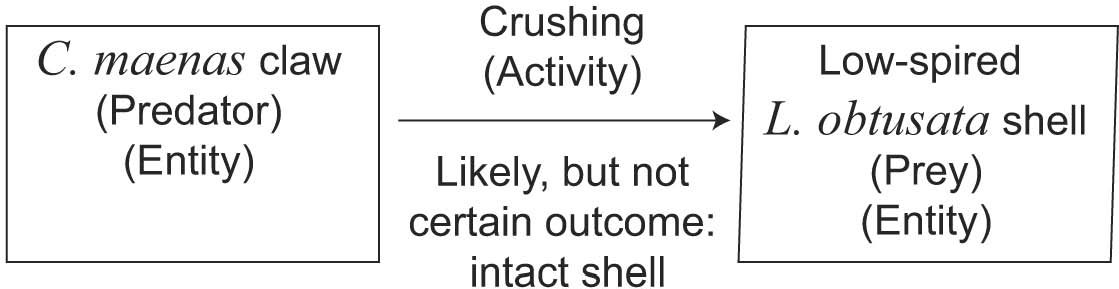
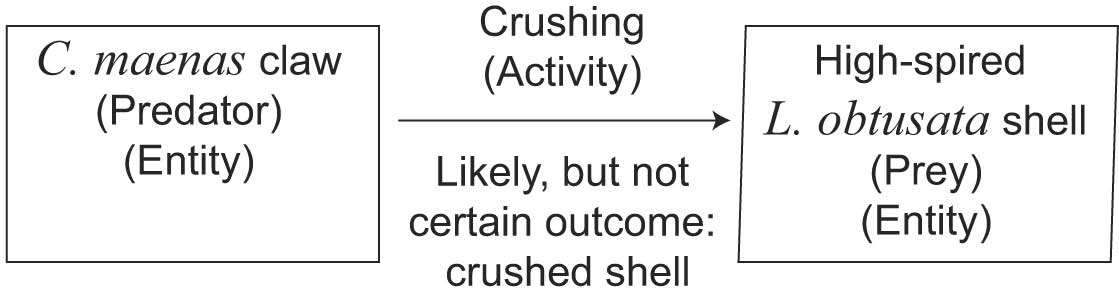
Figures 1 and 2 illustrate C. maenas predation on L. obtusata as a mechanism using MDC's entities and activities language. Figure 1 illustrates a C. maenas attack on a low-spired L. obtusata shell. Figure 2 illustrates a C. maenas attack on a high-spired L. obtusata shell.
Figure 1.

Figure 2.

This characterization of crab predation as a mechanism is consistent with the MDC account of mechanisms. The entities (the crab's claw and the snails shell) and activities (crushing) are organized in a way that they may be productive of a change (a crushed shell) from the start of the attack to the end of the attack. The element of regularity in both scenarios falls short of determinism. In Figure 1, the outcome of an operation of the mechanism of crab predation on a low-spired snail is likely to be unsuccessful predation; in other words, the mechanism is unlikely to be successful for any given operation. In Figure 2, the outcome of an operation of the mechanism on a high-spired snail shell is likely to be successful predation; in other words, the mechanism is likely, but not certain, to succeed for any given operation. As a result, this example of crab predation can be characterized as an unbiased stochastic mechanism when the snail being attacked has a low-spired shell (i.e., it may successfully operate some of the time) and as a biased stochastic mechanism when the snail being attacked has a high-spired shell, that is, it will successfully operate more often than not.
The mechanism of crab predation shows that there is no circularity in the selectivity story about the change in prevalence in shell structures in the L. obtusata population over time. Individuals with low-spired shells predominate not simply because low-spired individuals happened to survive predation more often; they survived predation because the low-spired shells were stronger and therefore more resistant to crushing by a crab's claw. The difference in physical shell structure is a good example of what is variously referred to as ‘engineering fitness’, ‘ecological fitness’, ‘design fitness’, or a ‘solution to a design problem’. All of these terms are intended to capture the idea that a beneficial trait (here, low-spired shells) conveys an advantage over another trait (here, high-spired shells) because the beneficial trait gives the organism an advantage in meeting a selective challenge.
It is easy to see that a low-spired snail is more likely to survive than a high-spired snail in an environment where C. maenas is present, and that a snail with the trait of a low-spired shell would have a selective advantage over one with the trait of a high-spired shell. To see the long-term impact of this disparity, and to fully explain the phenomenon of the change in predominance of shell-structure traits over time requires moving from the individual level up to the population level.
Natural selection operates when a critical environmental factor causes one trait to be selectively favored over another trait (Darden and Cain Reference Darden and Cain1989). The resulting bias makes it more likely that the favored trait will increase in prevalence in the population over time. A “population” is “a group of conspecific organisms that occupy a more or less well-defined geographic region and exhibit reproductive continuity from generation to generation” (Millstein Reference Millstein2006, 639). A population can be seen as an abstract entity that describes a group of individual organisms. I refer to a population as an ‘abstract’ entity because the population does not exist in the world independently of its individual members. In other words, the population is simply a description of a group of individual organisms. The characteristics of the population at any given time are simply the sum of the characteristics of the individuals.
This said, changes in the prevalence of traits can only be appreciated at the population level over time. Figure 3 uses the L. obtusata example to illustrate how natural selection can be seen as a mechanism with the snail and crab populations as entities.
Figure 3.

Figure 3 highlights the role of time in natural selection. The starting and ending conditions are described at the start time and the end time. The intervening time is described as the study time. Figure 3 is an ex post mechanistic explanation—it explains mechanistically the phenomenon of the change in shell-structure predominance in the L. obtusata population over time. In other words, it explains the increase in prevalence of the low-spired trait in the L. obtusata population. The introduction of predation by C. maenas was a critical environmental factor that favored the trait of low-spired shells over the trait of high-spired shells. Individuals with the trait of low-spired shells therefore had a selective advantage that made it more likely that they would survive and reproduce than individuals with the high-spired trait. Over the course of many generations, this selective advantage resulted in the predominance of the low-spired trait. Natural selection thus is a multistage mechanism that tends to increase the prevalence of a beneficial trait within a population over time. Because of natural selection's probabilistic nature, in any one generation the prevalence of the beneficial trait might go down. So long as the selective bias remains in favor of the beneficial trait, and so long as the beneficial trait is well-established in the population, the operation of probability over time is likely to result in the beneficial trait becoming predominant within the population.
The change in L. obtusata shell structure is a relatively simple example of natural selection. The introduction of C. maenas predation appears to have overwhelmed other environmental factors affecting shell structure. The source of the critical environmental factor in natural selection, however, need not be only one entity. It could be the sum of the activities of many entities imposing various types of selective pressure. As I use the term here, selective pressure is an abstract activity that refers to the impact that the critical environmental factor has on the population being studied. The entities imposing the selective pressure need not be—indeed often are not—predators. The selective pressure, for example, could be imposed by the amount of rainfall or the air temperature in the population's environment. Indeed, the environment in a particular location can be seen as an abstract entity that is the sum of all of the other entities in that location. Figure 4 illustrates natural selection as a mechanism more abstractly.
Figure 4.

In Figure 4, all of the sources of selective pressure together favor trait A over trait B. To be clear, some of the entities may impose selective pressure that favors trait B. The aggregate selective pressure, however, favors trait A. The result is that over time, it is likely, but not certain, that trait A will increase in prevalence in the population. As described in Figure 4, natural selection is a biased stochastic mechanism. It is possible to predict at the start time that the likely outcome of the operation of the mechanism would be that trait A will increase in prevalence and trait B will decrease its prevalence. Returning to the L. obtusata example above, if it had been possible at the starting time to establish that low-spired shells provided a selective advantage in an environment where C. maenas was present, it would have been possible looking forward at the start time to predict that it was likely (but not certain) that as C. maenas predation was introduced, the prevalence of low-spired shells would increase in the L. obtusata population.
Natural selection therefore is a two-level, multistage stochastic mechanism that explains the phenomenon of adaptation. It is two-level because the phenomenon of adaptation cannot be fully explained using either individual or population level mechanisms alone. The individual-level mechanism illustrated in Figures 1 and 2 explains why one trait was favored over another, but does not fully explain the change in prevalence the traits over time. The population-level ex post mechanistic explanation illustrated in Figure 3, and the population-level mechanism illustrated in Figure 4, alone do not fully explain why one trait was favored over another.Footnote 5 It is a multistage mechanism because it operates over time, with the prevalence of the favored trait likely to increase with each passing generation. It is stochastic because it operates probabilistically, not deterministically. With each passing generation, selectively favored traits are likely to increase in prevalence within a population. The result is that organisms are likely to possess traits that are well-suited to their natural environments.
5. Responding to Skipper and Millstein
As suggested in the introduction of this essay, Skipper and Millstein argued that the Glennan and MDC accounts of mechanism fail to “get at natural selection” (Reference Skipper and Millstein2005, 341) but left open the possibility that a refined account of mechanisms could address some of their criticisms. The foregoing discussion responds to a number of Skipper and Millstein's objections, and is an effort to provide an expanded account of mechanisms that ‘gets at’ natural selection. The Glennan and MDC accounts of mechanisms reflected the examples that were the focus of their proponents—human artifacts like toilets in the case of Glennan and molecular biology and neurobiology in the case of MDC. I agree with Skipper and Millstein that Glennan's and MDC's accounts do not easily explicate the sense in which natural selection is a mechanism.
I also agree with Skipper and Millstein that addressing the issue of regularity is a critical step in characterizing natural selection as a mechanism, and Sections 3 and 4 are an attempt to resolve this issue. Skipper and Millstein raised two other questions about applying accounts of mechanisms to natural selection that need to be addressed. First, they asked what the entities and activities would be in the mechanism of natural selection. Most of Skipper and Millstein's discussion of this issue focused on the behavior of individual organisms, rather than populations. As the foregoing discussion suggests, I agree that natural selection cannot be well-characterized as a mechanism at the individual level alone. This issue, however, can be resolved by treating populations as entities.
Skipper and Millstein briefly discussed the possibility that populations could be seen as entities, and reject this possibility almost out-of-hand. They correctly noted that seeing populations as entities is inconsistent with some of the specifics of Glennan's account of mechanisms. Beyond this point, they briefly offered one additional argument against seeing a population as an entity: “citing the same entity (albeit a changed entity) serving as a part of a mechanism and as its outcome conflates the explanans and the explanandum” (Reference Skipper and Millstein2005, 337). Skipper and Millstein did not provide any elaboration on this point, and it is far from clear why as a general matter it is problematic for an entity to be part of a mechanism that causes a change in that entity. Many mechanisms operate to change entities. Furthermore, the objection seems to be undercut by the abstract nature of populations. As illustrated with the L. obtusata example discussed in Section 4, the individuals who make up the population at the start time are different from the individuals who make up the population at the end time. Although it is accurate to say that the population is the same abstract entity at both the start and end points, the underlying individuals are not the same.
Second, Skipper and Millstein observed that the entity responsible for the critical factor in natural selection is often passive, using Darwin's finches as an example. The finches vary in the heritable traits of beak length and shape. Due to the characteristics of their beaks, some finches are able to eat seeds that other finches cannot. The seeds are the critical factor in this example—if finch A cannot consume a seed because of the shape of its beak, but finch B can consume the seed, then the critical factor favors the shape of B's beak over A's beak. The seeds, however, are passive. Selective pressure is imposed on finch A because of A's inability to consume the seed.Footnote 6
This passivity raised difficulty for Skipper and Millstein in seeing the seed as being engaged in an activity. It is difficult to square passivity with the robust notion of activities that is the centerpiece of MDC's account of mechanisms, and I therefore agree with Skipper and Millstein that this issue raises an important objection to the use of MDC's account to characterize natural selection. This objection cannot be met simply by changing the focus to the finch's attempt to eat the seed, which could easily be characterized as an activity, because it is the seed, not the finch, that is the source of the critical environmental factor favoring one beak shape over another.
This specific objection, though important, undercuts only the use of MDC's full notion of activities in this context, not the ability to characterize natural selection as a mechanism more generally. The objection could be met by, for example, substituting Glennan's term ‘interaction’, or Tabery's (Reference Tabery2004) term ‘interactivity’, for ‘activity’. Alternatively, the objection could be met with a more general account of activities. Though there is some understandable intuitive resistance to seeing something that is passive as being engaged in an activity, the seed certainly can be seen as a ‘producer of change’, to use MDC's formulation. A finch that has died from starvation because its beak cannot reach seeds that other finches can reach is just as dead as a snail that has had its shell crushed by a crab. Increasing a level of abstraction, I have no difficulty in conceiving of seeds imposing selective pressure (which I defined above as an abstract activity that refers to the impact that the critical environmental factor has on the population being studied) on a population of finches.
6. Conclusion
Skipper and Millstein's asserted that existing accounts of mechanisms failed to “get at natural selection.” While many of their objections were well-taken, and raised important questions about the use of mechanistic explanation in this context, these objections can be overcome. Natural selection can be characterized as a two-level, multistage stochastic mechanism that explains the phenomenon of adaptation. This example highlights the flexibility of mechanistic explanation, which has an advantage over reductionist approaches in that it easily allows movement between lower and higher levels of explanation. A full explanation of the phenomenon of the change in L. obtusata shell structure requires understanding of the impact of C. maenas predation on both the individual and population level. At the individual level, low-spired shells are more resistant to crushing, giving snails with low-spired shells a selective advantage. At the population level, the impact of this selective advantage is reflected in the change in prevalence in high- and low-spired shells over time.