1. Were the Grampian and Scandian separate short-lived metamorphic/orogenic events?
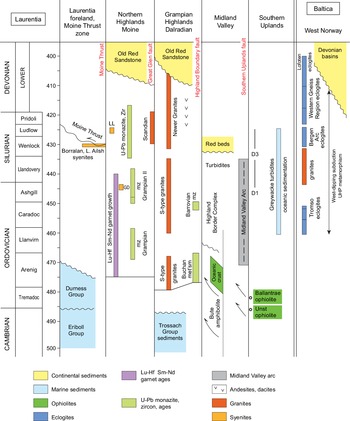
Dewey and Ryan follow their earlier papers by arguing that the Grampian (475–465 Ma) and Scandian (437–415 Ma) were two separate short-lived orogenies in Northern Scotland. This was in part based on the bimodal distribution of metamorphic ages, but recent Lu–Hf and Sm–Nd garnet ages and U–Pb monazite and zircon ages now suggest that crustal thickening and high-grade regional metamorphism in the Moine rocks of the Northern Highlands terrane lasted semi-continuously from 475 to 418 Ma (Fig. 1; Baxter et al. Reference Baxter, Ague and DePaolo2002; Cutts et al. Reference Cutts, Kinney, Strachan, Hand, Kelsey, Emery, Friend and Leslie2010; Bird et al. Reference Bird, Thirlwall, Strachan and Manning2013; Mako et al. Reference Mako, Law, Caddick, Thigpen, Ashley, Cottle and Kylander-Clark2019). The ‘gap’ between Grampian and Scandian metamorphism that underpinned previous models (Dewey, Reference Dewey2005; Dewey et al. Reference Dewey, Dalziel, Reavy and Strachan2015) has now been largely ‘filled in’ by 450–439 Ma garnet and monazite ages, the so-called ‘Grampian II event’ (Bird et al. Reference Bird, Thirlwall, Strachan and Manning2013; Mako et al. Reference Mako, Law, Caddick, Thigpen, Ashley, Cottle and Kylander-Clark2019). The gap between the Grampian II event and Scandian metamorphic ages is now only 4 m.y. (439–435 Ma), hardly sufficient time to initiate a separate, major regional metamorphic event, or orogeny.
Updated time–space chart for the Lower Palaeozoic Scottish Caledonides and Western Norway, showing age ranges of marine sediments (pale blue), continental sediments (yellow), ophiolites (dark green) and eclogites (dark blue). Ranges of peak metamorphism dated by U–Pb monazite (mauve), Sm–Nd and Lu–Hf garnet (light green). Ranges of intrusive igneous rocks (dated by U–Pb zircon, allanite) include alkaline syenites (orange), granites (red) and the Midland Valley arc (grey). Andesites and dacites associated with the Late Silurian – early Devonian Newer granites (Glencoe, Etive, Lorn lavas) are shown with ‘v’ symbols. See Searle (Reference Searle2021) for localities and sources of data. Ages are based on the International Chronostratigraphic Chart 2016/04.

Although there are, as yet, no Silurian (Scandian) metamorphic ages in the Dalradian rocks of the Grampian Highlands, the ages of decompression-related S-type granites (457–449 Ma; Oliver et al. Reference Oliver, Wilde and Wan2008) and the ‘Newer granites’ (430–410 Ma; Oliver et al. Reference Oliver, Wilde and Wan2008; Neilson et al. Reference Neilson, Kokelaar and Crowley2009; Strachan et al. Reference Strachan, Alsop, Ramezani, Frazer, Burns and Holdsworth2020) require temperatures in the lower crust to be high enough for crustal melting during that time. These granites were formed from melting of dominantly Metasedimentary protoliths during widespread regional sillimanite – K-feldspar grade melting, and migmatization. All the geological and geochronological evidence from the Moine and Dalradian rocks points to a single, long-lived, Ordovician–Silurian crustal thickening and regional metamorphic event (Fig. 1; Searle, 2021), rather than two, or three (Grampian I, Grampian II, Scandian) separate short-lived events (Dewey, Reference Dewey2005; Viete & Lister, Reference Viete and Lister2016). In contrast to the claim by Dewey and Ryan that there is no westward younging of metamorphism, there is increasing evidence from high-temperature geochronology that the oldest ‘peak’ metamorphic ages occur in the SE in the Buchan zone (478–468 Ma; Fig. 1), and the youngest U–Pb monazite ages occur in the Northern Highlands above the Moine Thrust (430–415 Ma; Mako et al. Reference Mako, Law, Caddick, Thigpen, Ashley, Cottle and Kylander-Clark2019). Metamorphic isograds have also been structurally inverted across the Northern Highlands by post-metamorphic west-vergent ductile shearing (Ashley et al. Reference Ashley, Thigpen and Law2015; Mako et al. Reference Mako, Law, Caddick, Thigpen, Ashley, Cottle and Kylander-Clark2019; Searle et al. Reference Searle, Cornish, Heard, Charles and Branch2019).
2. What were the offsets along the Great Glen fault?
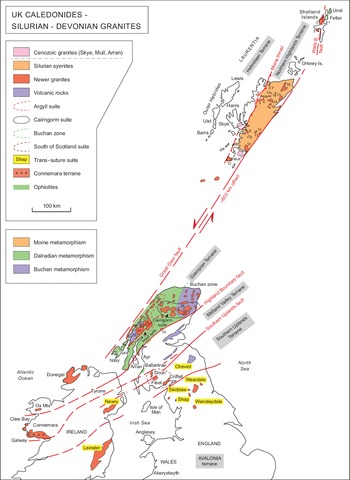
Estimates of sinistral offsets along the Great Glen fault remain difficult to assess, because of a shortage of precise pinning points. Suggestions of 700–1200 km offset (Dewey & Strachan, Reference Dewey and Strachan2003; Dewey et al. Reference Dewey, Dalziel, Reavy and Strachan2015), or 400 km minimum (Dewey & Ryan, 2022), suggest that if the Northern Highlands terrane was this far removed from the rest of Scotland (Fig. 2) it must either have been a completely separate ‘terrane’ with similar metamorphic rocks to those of the Grampian terrane along the boundary, or have had continental crustal rocks linking to the SW. If the Dewey et al. model is correct and it was purely a continental strike-slip fault, it is not clear what has happened to the 700–1200 km of continental crust that should be SW of the restored Northern Highland terrane.
Reconstruction of Northern Scotland assuming c. 600 km of sinistral slip along the Great Glen fault, according to the model of Dewey (Reference Dewey2005) and Dewey et al. (Reference Dewey, Dalziel, Reavy and Strachan2015). This is the lower end of their proposed 1200–700 km geological offset. Note the complete separation of Moine and Dalradian metamorphic rocks. In this model the Northern Highlands terrane would have been a completely separate plate, or terrane, prior to slip along the fault. It is unclear what lay between the Northern Highlands and the Grampian terranes in this model. Numbers/names and ages of granite intrusions are the same as Searle (Reference Searle2021, fig. 8).

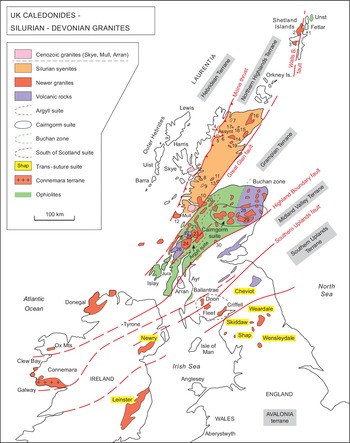
The original suggestion of Kennedy (Reference Kennedy1946) that the Strontian granite intruding the Moine rocks NW of the Great Glen fault, and the Foyers granite intruding the northern Dalradian rocks, SE of the Great Glen fault, were originally one and the same pluton, offset sinistrally by 105 km, remains a distinct possibility, and if correct is the only known offset geological marker along the Great Glen fault. Both granites show a tonalite–granodiorite–adamellite composition, both have similar Nd–Sr isotopic compositions, both are associated with hornblende-bearing appinites (Marston, Reference Marston1971; Archibald et al. Reference Archibald, Murphy, Fowler, Strachan and Hildebrand2022) and both have indistinguishable U–Pb zircon ages (425 ± 3 Ma for Strontian; 424 ± 4 Ma for Foyers granite; Rogers & Dunning, Reference Rogers and Dunning1991; Oliver et al. Reference Oliver, Wilde and Wan2008). Figure 3 shows a reconstruction of Northern Scotland assuming a c. 100 km sinistral offset along the Great Glen fault. This links the Strontian and Foyers granites as being originally one pluton cut by the fault. Intrusive magmatic fabrics in both granites are overprinted and become realigned with fabrics caused by post-intrusion sinistral shearing along the Great Glen fault (Searle, 2021). The higher exposure levels of the Foyers granite, which has a thermal aureole superimposed on earlier regional metamorphic rocks, compared to the deeper erosional level of the Strontian granite suggest that there has also been some dip-slip, down-to-SE motion along the Great Glen fault (Marston, Reference Marston1967).
Reconstruction of northern Scotland assuming c. 100 km of sinistral offset along the Great Glen fault, according to the model of Kennedy (Reference Kennedy1946). Offset markers are the Strontian granite (10) and the Foyers granite (20). In this reconstruction the Dalradian and Moine metamorphic rocks were all part of the same Laurentian plate and the metamorphic terranes were continuous. See Searle (Reference Searle2021) for locations, names and ages of granites.

The scattered distribution of the Late Silurian – early Devonian granites across the Dalradian and Moine terranes, and the fact that strike-slip fabrics were superimposed onto earlier magmatic fabrics, shows that the granites were not intruded along the strike-slip faults as claimed by Hutton and Reavy (Reference Hutton and Reavy1992). From mapping of metamorphic zones across the Great Glen (Fettes, Reference Fettes, Harris, Holland and Leake1979), Winchester (Reference Winchester1974) concluded that there was a post-metamorphic sinistral offset of 160 km across the fault. More recent maps of metamorphic isograds across the Northern Highlands Moine (Thigpen et al. Reference Thigpen, Law, Loehn, Strachan, Tracy, Lloyd, Roth and Brown2013; Ashley et al. Reference Ashley, Thigpen and Law2015; Mako et al. Reference Mako, Law, Caddick, Thigpen, Ashley, Cottle and Kylander-Clark2019) and Grampian Highlands Dalradian rocks (Pattison & Goldsmith, Reference Pattison and Goldsmith2022) show that the metamorphic sequences and isograds are similar across the fault, with no intervening exotic or suture zone rocks. A palaeomagnetic study of the Foyers sandstones adjacent to the Great Glen fault found closely similar inclinations of magnetization across the fault, suggesting that mid- to late Palaeozoic relative latitudinal displacement could not have been more than a few degrees (Storetvedt et al. Reference Storetvedt, Tveit, Deutsch and Murthy1990).
It has been suggested that the width of ductile deformation fabrics as across the Great Glen fault (100 m) relate to a ‘very large displacement’ (Dewey & Ryan, 2022). However, there is no correlation between the width of ductile fabrics across a shear zone and the amount of displacement (Hanmer et al. Reference Hanmer, Williams and Kopf1995). One of the largest and most prominent strike-slip faults in western Tibet, the Karakoram fault, has a ∼3–4 km wide zone of ductile dextral shearing fabrics, yet the total dextral displacement is ∼120–150 km (Phillips et al. Reference Phillips, Parrish and Searle2004; Searle & Phillips, Reference Searle and Phillips2004; Phillips & Searle, Reference Phillips and Searle2007). Similar wide shear zones and limited displacements occur across the Xianshui-he fault in eastern Tibet (Searle et al. Reference Searle, Roberts, Chung, Lee, Cook, Weller, St-Onge, Xu, Tan and Li2016) and the Red River fault in Yunnan and Vietnam (Searle et al. Reference Searle, Yeh, Lin and Chung2010 a).
3. How does the geology of the Southern Uplands fit the model?
Dewey and Ryan propose that a thick crustal ‘ram’ or backstop, such as Tibet, is required to drive orogenic wedges like the Himalaya. Several orogenic belts do not have thick crust ‘rams’ or backstops in the hinterland. The Alps, for example, has the Italian Po plain as the hinterland, an area that has not experienced crustal thickening and that remained close to sea-level throughout the Alpine orogeny (Schmid et al. Reference Schmid, Pfiffner, Froitzheim, Schönborn and Kissling1997). The Oman Mountains show elevations up to 3 km and a crustal root, and show hundreds of km of crustal shortening with lower-crust granulite facies metamorphism, yet the hinterland was, and still is, oceanic crust in the Gulf of Oman (Searle, Reference Searle2007; Ali et al. Reference Ali, Watts, Searle, Keats, Pilia and Ambrose2020). My model for the evolution of the Scottish Caledonides (Searle, 2021) involves the Midland Valley arc-microcontinent collision with Laurentia at c. 480 Ma (Tremadoc, Lower Ordovician), after ophiolite obduction (Chew et al. Reference Chew, Daly, Magna, Page, Kirkland, Whitehouse and Lam2010) and before the start of Buchan and Barrovian metamorphism (Pattison & Goldsmith, Reference Pattison and Goldsmith2022, and references therein; Fig. 1). The observation that the Midland Valley terrane shows marine sedimentation up to Early Silurian time does not negate the fact that collision, crustal thickening and metamorphism occurred along the Dalradian and Moine starting much earlier, at ∼476 Ma (Fig. 1). The fact that oceanic sedimentation existed up to mid-Silurian times along the Southern Uplands (McKerrow et al. Reference McKerrow, Leggett and Eales1977; Leggett et al. Reference Leggett, McKerrow and Eales1979; Dewey, Reference Dewey2005; Dewey et al. Reference Dewey, Dalziel, Reavy and Strachan2015), 100 km SE of the Highland Border complex suture zone, is not relevant. The question whether the Southern Uplands was really a ‘clear and perfect’ example of an accretionary prism is now open to debate, since the original comparison to the Indo-Burma ranges (Mitchell & McKerrow, Reference Mitchell and McKerrow1975) has proved to be incorrect (Morley et al. Reference Morley, Naing, Searle and Robinson2020). The age distribution of detrital zircons in the Southern Uplands has been used to suggest provenance from the north (Grampian terrane) supporting the accretionary wedge model (Waldron et al. Reference Waldron, Floyd, Simonetti and Hearman2008). Other authors suggest a sedimentary provenance was from south Avalonia, not Laurentia (Cawood et al. Reference Cawood, Nemchin, Smith and Loewy2003; Phillips et al. Reference Phillips, Evans, Stone, Horstwood, Floyd, Smith, Akhurst and Barron2003). Detrital zircons only provide evidence of age, not necessarily provenance. Neoproterozoic-age rocks almost certainly occur at structurally lower levels in the Avalonia plate, as well as in the Grampian terrane, so in my view the provenance of these sediments in the Southern Uplands remains unresolved.
4. Was there a post-Grampian subduction direction flip?
Dewey and Ryan, following from their earlier papers (Dewey & Shackleton, Reference Dewey and Shackleton1984; Dewey, Reference Dewey2005; Dewey et al. Reference Dewey, Dalziel, Reavy and Strachan2015), proposed that the site of subduction polarity reversal was along the Southern Uplands fault at 467 Ma. This timing follows the Buchan low-pressure high-temperature metamorphism and transition to the higher-pressure Barrovian metamorphism in the Grampian Highlands. Polymetamorphic Dalradian metamorphism shows a progressive shift from andalusite- and cordierite-bearing gneisses in the Buchan zone in the east, to kyanite- and sillimanite gneisses in the Barrovian zone to the west (Pattison & Goldsmith, Reference Pattison and Goldsmith2022). Buchan metamorphism is spatially and temporally related to Early Ordovician gabbro intrusions, and the low-pressure, high-temperature Buchan zone rocks were progressively overprinted to the west by higher-pressure Barrovian kyanite metamorphism. The boundary is a ductile shear zone, the Portsoy Lineament, that strikes north–south, at right angles to the proposed subduction zone. There is no evidence from the metamorphic record or deformation history of the Dalradian rocks of a major tectonic shift, that would be expected from a subduction polarity flip at 467 Ma.
Flipping a subduction zone is no easy matter, one that would have to involve the sudden reversal of the entire mantle convection cell. Although subduction zones can and do steepen with time, and even overturn, as in some western Pacific arc systems, a total reversal of dip direction along the same subduction zone is rarely, if ever, recorded. Western Pacific subduction has been consistently west-dipping for at least the last 160 m.y. Neo-Tethyan subduction from the Alps to the Himalaya–Tibet has consistently been northward-dipping since the Triassic, and subduction along the Andes has consistently been east-dipping since the Triassic. In Scotland, there is no evidence for a ‘flip’ in subduction direction from SE-dipping during the Ordovician Grampian orogeny to a NW-dipping subduction zone during the Silurian orogeny (Dewey, Reference Dewey2005; Dewey et al. Reference Dewey, Dalziel, Reavy and Strachan2015). The apparent evidence for the NW dip during the Silurian is the northward dip of the Southern Uplands accretionary prism (McKerrow et al. Reference McKerrow, Leggett and Eales1977; Leggett et al. Reference Leggett, McKerrow and Eales1979; Dewey et al. Reference Dewey, Dalziel, Reavy and Strachan2015), an area that lies 100 km SE of the Highland Boundary ‘suture zone’ between Laurentia and the Midland Valley arc-microcontinent, and is therefore not directly relevant. The second line of evidence frequently quoted is the presence of the Late Caledonian ‘Newer granites’ which have been interpreted as high-K calc-alkaline magmas forming above a subduction zone (Atherton & Ghani, Reference Atherton and Ghani2002; Dewey, Reference Dewey2005). However, in the Andes >160 m.y. of continuous magmatism formed hundreds of plutons, some more than 50 km in diameter, along a 2000 km long margin-parallel Andean arc (Pitcher, Reference Pitcher1978, Reference Pitcher1987)According to your response to our query for AQ15, we have cited both references (Pitcher, 1978, 1987) at the end of section 4. Please check and let us know if this is fine.. In Scotland, the 430–410 Ma ‘Newer granites’ are smaller, far more compositionally diverse, generally more alkaline in composition, and crop out across all terranes from the Northern Highlands south as far as the Lake District, northern England (Fowler et al. Reference Fowler, Kocks, Darbyshire and Greenwood2008; Neilson et al. Reference Neilson, Kokelaar and Crowley2009; Miles et al. Reference Miles, Woodcock and Hawkesworth2016). They are not aligned along a single plate margin as in the Andes.
5. How do the Silurian–Devonian ‘Newer granites’ fit the model?
Silurian to Early Devonian calc-alkaline granites (430–410 Ma) are widespread across the Grampian and Northern Highlands zones, and have been used to argue for NW-dipping subduction zone magmatism, despite their ages being 37 m.y. later than the proposed timing of subduction polarity flip (467 Ma; Dewey, Reference Dewey2005; Dewey et al. Reference Dewey, Dalziel, Reavy and Strachan2015). The ‘Newer granites’ have compositions ranging from ultramafic and mafic to granites and syenites, and vary from the highly alkaline syenites of the Moine thrust zone (Borralan, Loch Ailsh; Fox & Searle, Reference Fox and Searle2021), to high-Ba, high-Sr plutons of the Northern Highlands (Fowler et al. Reference Fowler, Kocks, Darbyshire and Greenwood2008), to the high-K, calc-alkaline Cairngorm and Argyll suites of the Grampian Highlands (Halliday & Stephens, Reference Halliday and Stephens1984; Neilson et al. Reference Neilson, Kokelaar and Crowley2009). Similar-age granites also occur in the Southern Uplands and Avalonia terranes, so they intruded across all terranes and are not orogen-parallel as would be expected in an Andean comparison. Miles et al. (Reference Miles, Woodcock and Hawkesworth2016) emphasized that there is no strong difference in age or major element geochemistry across all terranes, and also noted the absence of ages at the time suggested for northward-dipping subduction.
Some of the Northern Highlands granites are more similar to alkaline complexes with associated appinites, and mantle-derived lamprophyres, than to subduction-related magmas (Fowler et al. Reference Fowler, Kocks, Darbyshire and Greenwood2008; Neilson et al. Reference Neilson, Kokelaar and Crowley2009; Goodenough et al. Reference Goodenough, Millar, Strachan, Krabbendam and Evans2011; Miles et al. Reference Miles, Woodcock and Hawkesworth2016; Archibald et al. Reference Archibald, Murphy, Fowler, Strachan and Hildebrand2022). The highly undersaturated alkaline source for the syenites (e.g. Borralan and Loch Ailsh syenites in Assynt) and lamprophyres suggest a deep, hot, sub-continental lithospheric mantle source (Rock, Reference Rock1984; Rock & Hunter, Reference Rock and Hunter1987; Searle et al. Reference Searle, Law, Dewey, Streule and Law2010 b; Fox & Searle, Reference Fox and Searle2021). In the Grampian terrane, relatively large volumes of high-Ba, high-Sr andesites and dacites (Etive, Glencoe and Lorn lavas) form the volcanic edifice of the Newer granites (Neilson et al. Reference Neilson, Kokelaar and Crowley2009). Collectively, these Late Silurian – early Devonian Newer granites are not typical Andean I-type granites, and their north–south distribution across all terranes suggests that they cannot simply be related to any subducting slab break-off process (Atherton & Ghani, Reference Atherton and Ghani2002). They are also scattered across the entire Grampian and Northern Highland terranes and unrelated to strike-slip faults, either in space or time. Granites that are adjacent to strike-slip faults (Strontian, Ratagain, Foyers granites) clearly show a transition from earlier magmatic intrusive fabrics to strike-slip shearing fabrics towards the fault, that were superimposed after initial intrusion and crystallization. Their origin remains debated, but it seems that they are more like late orogenic alkaline A-type syenites and granites, derived by partial melting of enriched sub-continental mantle providing heat and magma (lamprophyres) to melt the lower crust, rocks that do not require a north-dipping subduction zone.
6. Was the Scandian orogeny caused by Laurentia–Baltica collision?
In my model (Searle, Reference Searle2021), the Silurian component of the Caledonian orogeny (Scandian) was a continuation, in space and time, of the Ordovician (Grampian) orogenic processes of crustal thickening and regional Barrovian metamorphism following Laurentia – Midland Valley arc/microplate collision, and was not caused by the collision of Laurentia with Baltica. Western Norway shows >60 m.y. of semi-continuous ultrahigh-pressure metamorphism (from ∼460 to 400 Ma) along a west-dipping subduction zone (Fig. 1). Eclogites from the Tromsø nappe (462–452 Ma; Corfu et al. Reference Corfu, Ravna and Kullerud2003; Brueckner & van Roemund, Reference Brueckner and van Roemund2004), Bergen arcs (430–424 Ma; Glodny et al. Reference Glodny, Kuhn and Austrheim2008) and the Western Gneiss region (424–405 Ma; Kylander-Clark et al. Reference Kylander-Clark, Hacker, Johnson, Beard, Mahlen and Lapen2007; Gordon et al. Reference Gordon, Whitney, Teyssier, Fossen and Kylander-Clark2016) do not accord with any Andean-type collision margin (see review of ages and structures in Labrousse et al. Reference Labrousse, Hétenyi, Raimbourg, Jolivet and Andersen2010). The youngest kyanite-bearing eclogites from the Lofoten islands have a Lu–Hf isochron age of 399 ± 10 Ma (Froitzhelm et al. Reference Froitzhelm, Miladinova, Janák, Kullerud, Ravna, Majka, Foncesca, Münker and Nagel2016) extending the timing of west-dipping subduction and UHP metamorphism to 60 m.y. from Middle Ordovician to Lower Devonian. None of the major structures in Northern Scotland can be satisfactorily linked to major events in western Norway, and the timing of collision and metamorphism in Scotland does not correlate with any continental collision in western Norway. Many Caledonian structures can be traced northwards, along-strike into Greenland (summarized in Leslie et al. Reference Leslie, Smith and Soper2008), so the suture between Laurentia (Greenland and Scotland) and Baltica (Norway, Sweden, etc.) presumably lies along the Norweigan Sea between Norway and Greenland, and the Tornquist suture in the North Sea.
7. Conclusions
Whichever model for the Caledonian orogeny in Scotland is preferred, it must align with the observations and data as outlined above. I suggest that the geological and geochronological data support my model that the Scottish Caledonides represent an eroded Himalayan-type orogenic belt with a NW-tapering orogenic wedge from the Highland Boundary suture zone in the SE to the Moine Thrust and Laurentian foreland in the NW. Following NW-directed ophiolite obduction and SW-dipping subduction along the Highland Border sequence in the Late Cambrian (Tanner, Reference Tanner2007, Reference Tanner2008; Chew et al. Reference Chew, Daly, Magna, Page, Kirkland, Whitehouse and Lam2010; Dewey et al. Reference Dewey, Dalziel, Reavy and Strachan2015), crustal thickening as a result of the Laurentia – Midland Valley arc-microcontinent collision resulted in crustal thickening and a single metamorphic event lasting from c. 478 to 420 Ma. Late Caledonian sinistral offset along the Great Glen fault was likely only 100–150 km, not 700–1200 km as previously thought (Dewey Reference Dewey2005; Dewey et al. Reference Dewey, Dalziel, Reavy and Strachan2015). A series of granite intrusions along the Great Glen and associated fault zones, including the Strontian, Foyers, Ratagain and Clunes tonalite-granites, clearly show that NE–SW-aligned strike-slip shear fabrics were superimposed onto earlier circular magmatic and emplacement fabrics, so their U–Pb zircon ages of 428–424 Ma give a maximum possible age of initiation of strike-slip shearing along the Great Glen fault. Major slip along the Great Glen fault also occurred after deposition of the Devonian Old Red Sandstone which unconformably overlies all Caledonian metamorphic and magmatic rocks.
Late Silurian granites (‘Newer granites’) are not compositionally, structurally or isotopically like Andean granites, and do not provide evidence for the flip in subduction direction from SW-dipping during the Ordovician to NW-dipping during the Silurian. U–Pb zircon ages (430–408 Ma) are 30 m.y. younger than the proposed timing of subduction ‘flip’, and initiation of NW-directed subduction according to the model of Dewey (Reference Dewey2005) and Dewey et al. (Reference Dewey, Dalziel, Reavy and Strachan2015). The Newer granites are also unlikely to represent products of slab-break-off (Atherton & Ghani, Reference Atherton and Ghani2002), or of a discrete Andean-type plate margin, because they intruded across all terranes from the Northern Highlands south to the Southern Uplands and northern England, not along a plate boundary as would be expected in an Andean subduction zone setting. The 430–408 Ma high-Ba, high-Sr ‘granites’ have compositions ranging from ultramafic and mafic to granites and syenites, and are more similar to A-type alkaline complexes with associated appinites, and mantle-derived lamprophyres (Fowler et al. Reference Fowler, Kocks, Darbyshire and Greenwood2008; Neilson et al. Reference Neilson, Kokelaar and Crowley2009; Miles et al. Reference Miles, Woodcock and Hawkesworth2016; Archibald et al. Reference Archibald, Murphy, Fowler, Strachan and Hildebrand2022).
For Scotland, my model (Searle, Reference Searle2021) simplifies the tectonic evolution into a single Laurentia – Midland Valley arc-microplate collision along a continuously SW-dipping subduction zone, progressing with time from Late Cambrian ophiolite obduction, to Ordovician–Silurian collision-related crustal thickening and regional metamorphism, along a NW-tapering orogenic wedge. Only the southern Dalradian and Highland Border complex form a steep SW-vergent backthrust zone, of proportions similar to those along the northern Himalaya backthrust zone (∼20 km width; Corfield & Searle, Reference Corfield, Searle, Khan, Treloar, Searle and Jan2000) and the southern part of the Alps backthrust zone (∼25–30 km width; Schmid et al. Reference Schmid, Pfiffner, Froitzheim, Schönborn and Kissling1997).
Acknowledgements
I am very grateful to Rob Strachan, John Dewey, Chris Hawkesworth, Andrew Miles and Ed Stephens for ongoing discussion about Scottish tectonics.