Significant outcomes
Glucagon-like peptide-1 (GLP-1) agonists are neutral in tests of anxiety and depression after acute administration.
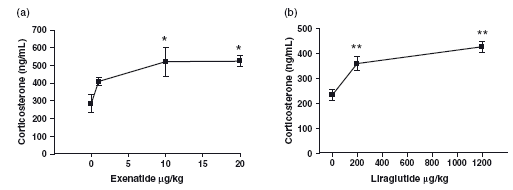
Both exenatide and liraglutide stimulate corticosterone release after acute administration.
Limitations
In clinical context, the chronic effects of GLP-1 agonists are more important and should be addressed in future studies.
Introduction
Glucagon-like peptide-1 (GLP-1) belongs to the class of incretin hormones. Incretins are a group of gut hormones which are involved in the regulation of glucaemia via glucose-dependent enhancement of insulin secretion and suppression of glucagon secretion (Reference Drucker1). GLP-1 is produced in the intestinal L cells in response to incoming nutrients and it is believed to act both directly on the pancreatic cells as well as on the receptors located at vagal nerve terminals (for review see Williams (Reference Williams2)). Moreover, GLP-1 is used in the brain as a neurotransmitter, and besides affecting insulin secretion, GLP-1 is implicated in the regulation of multiple other processes including food intake, memory formation, etc. (Reference Tang-Christensen, Larsen and Goke3,Reference During, Cao and Zuzga4). Likewise, GLP-1 receptors in the brain have been suggested to be involved in the regulation of anxiety. Thus, central administration of GLP-1 into cerebral ventricles or directly into certain brain areas induces an anxiogenic-like effect in various anxiety models in rat (Reference Kinzig, D'Alessio and Herman5–Reference Gulec, Isbil-Buyukcoskun and Kahveci7). Moreover, a GLP-1 receptor antagonist induced an anxiolytic-like effect in the rat elevated plus-maze test of anxiety (Reference Kinzig, D'Alessio and Herman5). In parallel with the effect on anxiety level, GLP-1 has been suggested to play a role in the stress response. Thus, GLP-1 receptor knockout mice have impaired neurohormonal and behavioural response to stress (Reference MacLusky, Cook and Scrocchi8). This connection is supported by the notion that various GLP-1 receptor agonists increase the secretion of corticosterone in mice, rats and humans (Reference Gil-Lozano, Perez-Tilve and Varez-Crespo9). Currently, there are two GLP-1 agonists approved for the treatment of type 2 diabetes. Exenatide (Byetta) is a peptide structurally similar to human GLP-1 and liraglutide (Victoza) is an exact copy of human GLP-1 which is made more resistant to degrading enzyme dipeptidyl peptidase-4. Taking into account that exenatide has been shown to cross the blood–brain barrier (Reference Kastin and Akerstrom10), it is reasonable to expect that some of the multiple effects of GLP-1 agonists are mediated via central mechanisms. In fact, it has recently been shown that even the anorexigenic effect of peripherally administered liraglutide and exenatide is partly mediated by direct activation of GLP-1 receptor in the central nervous system (Reference Kanoski, Fortin, Arnold, Grill and Hayes11).
As liraglutide is a relatively new molecule, there are less data about its effects in animal models. Thus, few studies have compared the two GLP-1 agonists under the same experimental conditions in animal models.
The aim of this study was to compare the behavioural and hormonal effects of systemic (subcutaneous) treatment with exenatide and liraglutide in the glucaemically equipotent doses.
Materials and methods
Animals
Male C57Bl/6J mice (Harlan, Venray, The Netherlands) weighing 25–30 g were used. Mice were kept 10 per cage in an animal house at 20 °C in a 12-h light/dark cycle (light on at 07:00 h.). Tap water and food pellets were available ad libitum. The animals were kept for at least 2 weeks in the animal colony before entering experiments. All animal procedures were accepted by the National Committee for Ethics in Animal Experimentation and complied with ‘Principles of laboratory animal care' (NIH publication 25–28, 1996).
Mouse light–dark compartment test
The exploratory model first described by Crawley and Goodwin was used (Reference Crawley and Goodwin12). The apparatus consisted of two compartments (20 × 20 × 20 cm) connected by a 7.5 × 7.5 cm opening in the wall. One compartment was painted black and covered with a roof. The other compartment had no roof and was brightly illuminated by a 60-W bulb located 25 cm above the box. An animal was placed into the centre of the dark compartment and latency of the first transition, number of transitions and time spent in the light compartment was recorded during 5 min.
Forced swimming test
The forced swimming test was performed as described by Porsolt et al. (Reference Porsolt, Bertin and Jalfre13). Briefly, a glass cylinder 12 cm in diameter was filled with 8 cm water at 25 °C. The animal was gently put into the water, and all of its behaviour was videotaped during 6 min. Subsequently, the immobility time was counted by an observer blind to the treatment protocol during the last 4 min of the 6-min test.
Motor activity
Motor activity was measured using an automated system with six chambers (45 × 45 × 45 cm) made from transparent acrylic (MOTI, Technical & Scientific Equipment GMBH, Bad Homburg, Germany). The apparatus-nave mice were put into the chamber and vertical and horizontal activity was counted during a 10-min test period.
Experimental design
The light–dark compartment test, the measurement of motor activity and the forced swimming test were carried out consecutively 60, 70 and 80 min after the treatment with GLP-1 receptor agonist, respectively (Reference Volke, Wegener, Bourin and Vasar14). Each group comprised 10 animals.
Exenatide (Byetta) and liraglutide (Victoza) were diluted with saline and injected subcutaneously in a volume of 0.1 ml per 10 g body weight of mice.
Measurement of glucose
Blood was obtained by the tail bleed after completion of the forced swimming test (90 min after injection). Glucose level was measured by a glucometer (Optium Xceed, Abbott, Witney, Oxon, UK).
Corticosterone levels
Truncal blood was obtained after decapitation of animals after the completion of the forced swimming test. Blood was collected into the ethylenediaminetetraacetic acid (1.8 mg/ml blood) vials and plasma was separated immediately by centrifuging (2700 rpm, 7 min). Corticosterone was analysed by EIA kit (Immunodiagnostic Systems Ltd, Boldon, Tyne & Wear, UK) according to the manufacturer's instructions.
Statistics
Data were statistically examined using one-way analysis of variance. Post hoc comparisons between individual groups were performed by Newman–Keuls test. Data are expressed as the mean values ±SEM. Differences were considered to be statistically significant when p was less than 0.05.
Results
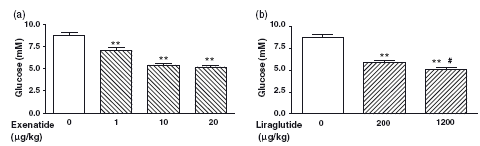
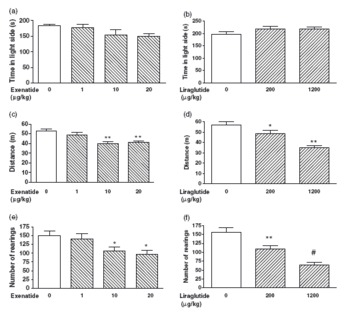
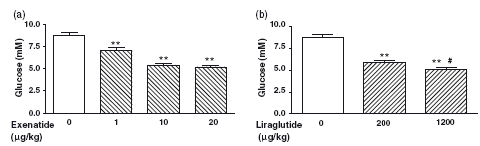
Administration of exenatide or liraglutide to the mice resulted in a dose-dependent decrease of plasma glucose values by up to 30% from basal values (exenatide F 3.36 = 38; p < 0.0001; liraglutide F 2.27 = 49; p < 0.0001; Fig. 1). The doses of exenatide of 10 and 20 µg/kg and liraglutide 200 and 1200 µg/kg were largely equipotent in terms of glucose lowering. The treatment with GLP-1 receptor agonists had no effect on anxiety levels of mice in the light–dark compartment test (Fig. 2). Exenatide tended to decrease the time spent in the light side of the apparatus, but this effect did not reach any statistical significance. Liraglutide did not have any effect on the time spent in the light side. Both drugs decreased motor activity after acute administration (Fig. 2). Exenatide lowered both the distance travelled (F 3.36 = 7.3; p < 0.01) and the number of rearing (F 3.36 = 4.2; p = 0.012) in the doses of 10 and 20 µg/kg, the effect reached its maximum already with the dose of 10 µg/kg. Similarly, liraglutide decreased the distance travelled and the number of rearing but the higher dose (1200 µg/kg) was clearly more effective than the lower one.
Effect of exenatide (a) and liraglutide (b) on plasma glucose. GLP-1 receptor agonist was administered subcutaneously 90 min before measurement. Results are expressed as mean ± SEM. n = 10 in all groups. **p < 0.001 versus saline; #p < 0.05 versus 200 µg/kg dose (Newman–Keuls test).
Effects of exenatide and liraglutide in light–dark compartment test (a, b) and on motor activity (c–f). Results are expressed as mean ± SEM. n = 10 in all groups. *p < 0.05; **p < 0.01; #p < 0.001 versus saline (Newman–Keuls test).

GLP-1 receptor agonists did not influence the immobility time in the forced swimming test. The immobility times in the experiment with exenatide were as follows: 215 ± 13 s (saline), 192 ± 24 s (1 µg/kg), 208 ± 8 s (10 µg/kg) and 193 ± 22 s (20 µg/kg). The immobility times in the experiment with liraglutide were as follows: 208 ± 14 s (saline), 230 ± 6 s (200 µg/kg), 207 ± 10 s (1200 µg/kg) and 106 ± 23 s (imipramine 15 mg/kg, p < 0.001 vs. saline).
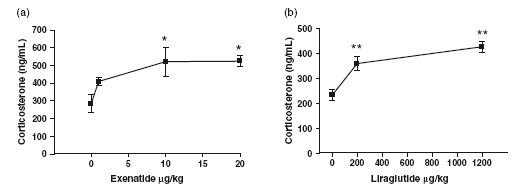
GLP-1 receptor agonists augmented dose dependently the corticosterone secretion. The effect of exenatide (F 3.36 = 4.9; p < 0.01) reached the maximum at the dose of 10 µg/kg (Fig. 3). In the case of liraglutide (F 2.27 = 18; p < 0.001) the dose of 200 µg/kg increased the concentration of corticosterone (p < 0.001 vs. saline) and the dose of 1200 µg/kg tended to be even more effective (p = 0.054 vs. lower dose).
Effect of exenatide (a) and liraglutide (b) on plasma corticosterone. GLP-1 receptor agonist was administered subcutaneously 90 min before measurement. Results are expressed as mean ± SEM. n = 9–10. *p < 0.05; **p < 0.001 versus saline (Newman–Keuls test).
Discussion
Our aim was to compare the behavioural and hormonal effects of two clinically available GLP-1 receptor agonists. To assure that the doses of exenatide and liraglutide used are in a clinically meaningful range and equipotent, we first showed that the effect of the drugs is very comparable in decreasing the glucose values. As shown in Fig. 1, exenatide in the doses of 10 and 20 µg/kg and liraglutide in the doses of 200 and 1200 µg/kg induced a very similar reduction of blood glucose values. It is important to stress that neither drug caused hypoglycaemia, a finding that is expected due to the glucose-dependent mechanism of action of these drugs. Preclinical studies have shown that the central (intracerebroventricular) administration of GLP-1 agonists induces anxiogenic-like action in rats (Reference Kinzig, D'Alessio and Herman5–Reference Gulec, Isbil-Buyukcoskun and Kahveci7). Reassuringly, we did not see any signal of changed anxiety level in our study. Thus, it can be assumed that at least in clinically meaningful doses, neither exenatide nor liraglutide would induce anxiety. This does not mean that GLP-1 and GLP-1 receptors are not involved in the regulation of anxiety in the central nervous system. Our results enable to assume that the brain concentrations of GLP-1 agonists after subcutaneous administration may not be sufficient to affect GLP-1ergic mechanisms. Likewise, the clinical study where GLP-1 was administered intravenously to patients suffering from panic disorder, found no effect on anxiety (Reference Strawn, D'Alessio, Keck and Seeley15). As far as we are aware, there are no published studies showing the anxiogenic-like effect of GLP-1 agonist after systemic administration. Both drugs significantly decreased the motor activity of mice in the activity cages. The effect of a higher dose of liraglutide (1200 µg/kg) seemed to be more pronounced than a higher dose of exenatide. The motor suppressant effect of higher doses of exenatide has been described previously (Reference Talsania, Anini, Siu, Drucker and Brubaker16). It is reasonable to believe that this effect may represent the malaise induced by stimulation of GLP-1 receptors. It is well known that after acute administration to patients high proportion of subjects will suffer from nausea or even vomiting and for that reason treatment is initiated with subeffective doses of GLP-1 agonists. The proportion of patients feeling nausea decreases with continuation of treatment. Similarly, hypolocomotion disappears after repeated dosing of liraglutide in animals (Reference Porter, Kerr, Flatt, Holscher and Gault17). The exact mechanisms involved in the hypolocomotory effect of GLP-1 receptor stimulation and whether this effect is related to general malaise deserves further studies. Finally, we measured the effect of GLP-1 mimetics on corticosterone levels (Fig. 3). Distinct GLP-1 agonists have been shown to increase the secretion of corticosterone in many mammals under non-stressful conditions (Reference Gil-Lozano, Perez-Tilve and Varez-Crespo9). However, the effects of liraglutide and exenatide on corticosterone levels have not been described within the same study. Our study shows that this effect is also present under stressful conditions (the forced swimming test). Again, the effects of liraglutide and exenatide on corticosterone levels were with similar magnitude. However, it is not known whether tolerance develops to the corticosterone-stimulating effect of GLP-1 mimetics. Thus, if the stimulation of glucocorticoid axis is continuous during chronic treatment it may induce some adverse psychiatric effects.
Acknowledgements
This study was supported by Estonian Science Foundation (grant 8324) and Estonian Ministry of Education and Research (SF 0180148s08).
V. V. is member of the Editorial Board of Acta Neuropsychiatrica, but was not involved during the review and decision of this paper.