




No CrossRef data available.
Assessing representations of South African Indian English in writing: An application of variation theory
Published online by Cambridge University Press: 16 September 2005
Abstract
This article examines three representations of South African Indian English in print: The Adventures of Applesammy and Naidoo (1946) by Ray Rich; The Lahnee's Pleasure (c. 1972) by Ronnie Govender; and The Wedding (2001) by Imraan Coovadia. The use of dialect is a defining feature of all three texts. I show that the tools provided by variation theory are particularly useful in the analysis of literature that uses direct speech to portray characters and types. In particular, the principles of variation theory can be used to: (a) reveal the nature of stereotyping in the first text (a parody), which relies on the suppression of variation, and the generalization of linguistic and social characteristics; (b) evaluate the fidelity of a “realist” dialect representation of the community in the second text (a play); and (c) help characterize the nonrealist, nonstereotyping, imaginative use of language in the third text (a post-modern novel).An early version of the research for this article was presented at the IAWE (International Association of World Englishes) Conference, Potchefstroom University, 2001; at seminars at the University of Cape Town and University of Pennsylvania in 2002; and at NWAVE (New Ways of Analysing Variation in English and Other Languages), Stanford University, 2002. A revised and expanded version was presented at ASNEL (Association for the Study of New English Literatures), Magdeburg, 2003. I thank participants at these conferences and three anonymous LVC referees for feedback and comments, Malcah Yaeger-Dror for discussions of her related research, and Sarah and Clare Johnson for the graphics. I am especially grateful to the University of Cape Town's Research Committee for a grant that supported this research.
Information
- Type
- Research Article
- Information
- Copyright
- © 2005 Cambridge University Press
The comparison of literary representations of dialects with actual speech samples of the communities depicted is a growing application of variationist sociolinguistics. Yaeger-Dror, Hall-Lew, and Deckert (2002) examined the contraction of not (e.g., she isn't) versus the contraction of the auxiliary in negation (e.g., she's not) in a number of varieties of English, using large-scale corpora of various types. From the unscripted spoken corpora, notably the 1980's Switchboard (SWB) corpus of telephone conversations gathered by Texas Instruments from all areas of the United States, Yaeger-Dror and Deckert (2000) found patterns of regional variation in the territory. Speakers from distinct regions show different tendencies in using one type of contraction over the other, with southern U.S. speakers using auxiliary contraction statistically more consistently than northern U.S. speakers. This pattern is confirmed by a parallel analysis of presidential speeches for the last 50 years. The southern presidents use aux-contraction, whereas northern presidents favor not-contraction. Findings such as these can be used to evaluate the fidelity of literary representations of dialect. Although Harriet Beecher Stow, for example, “may have thought she was writing southern dialogue, the data [concerning negation] indicate that her ear was from Massachusetts” (Yaeger-Dror et al. 2002:104). This is not necessarily typical. In fact, the authors show that when people write about the dialects they do know, they are capable of making subtle characteristics, like not-contraction, reflect actual regional and ethnic differences. Other studies comparing dialect usage with literary representations include work by Jeff Kallen (2002) on, among other things, the humorous use of Irish English by Irish American comedians, and Fonollosa (1995) who showed that the Canadian playwright, Michel Tremblay's use of specific syntactic locutions by his Joual characters is entirely consistent with actual working-class speech, as found in the Montreal corpus. See also, Marriott (1997) in connection with the representations of class accents in a British war film.
The present article aims to add to this body of work by uncovering the relation between a gross stereotype or parody of an emerging second language (L2) and actual interlanguage use. I focus on a single grammatical feature of South African Indian English dialect (henceforth SAIE), the use of the verb suffix -ing in contexts wider than those permitted in formal standard English. The initial analysis from which the framework arises, draws largely from an earlier paper (Mesthrie, 2002) on a satirical radio series, Applesammy and Naidoo (1945) in South Africa. I argue that the arch satirical text systematically flouts the sociolinguistic principles governing speech as described in variation theory (Labov, 1972 and subsequently). Thereafter, I test this framework by subjecting a realist portrayal of the same dialect by an “insider” to a similar analysis. The work I examine is the play, The Lahnee's Pleasure, by Ronnie Govender (c. 1972). Finally, I examine the way a comic, post-modernist novel, The Wedding, by Imraan Coovadia (2001) employs the same suffix in a creative way, without flouting the rules of variation theory. In all three texts studied, dialect is not just a matter of “local color,” it is a defining feature.
A brief history of the speech community represented in these texts is necessary. For most of the 20th century, the largest group of Indians outside of South Asia were those of South Africa. The growth of this community stems from a decision by the British government to ship large numbers of Indians to their colonies as cheap labor in the era immediately following the abolition of slavery in the early 19th century. Over 150,000 laborers from different parts of India were shipped to the colony of Natal in the period 1860–1911.1
Natal had not been a slave-holding colony, having been established in the 1840s. Historians attribute the need for an outside labor force to the initial reluctance of the indigenous Zulu people to commit to regular wage labor.
There are also latter day youngsters who attend private schools, in which the norms of white South African sociolinguistic networks are operative.
This article examines the ways in which SAIE has been represented in three very different kinds of texts, with a main focus on the use of the verb ending -ing. As a baseline, it is first necessary to chart the myriad functions of this suffix in the basilect. First, the standard function of marking present progressive aspect (with be + -ing) is to be found as in (1):
(1) I'm looking for the matches.
This function competes with several others—the four main ones being: historic present of narration (sentence 2); habitual (3); perfective (4); past habitual (5); and simple past/preterite (6).
(2) I'm suffering here now and the pain is getting worse. (‘I was suffering (from chest pains) and the pain was getting worse’—in a narrative set in the past).
(3) He's travelling to town every day. (‘He travels to town daily’).
(4) I'm staying this house seven years. (‘I've been staying in this house for seven years’).
(5) We was talking English at home (‘We used to speak English at home’).
(6) Hawa, she's telling she cooks an' all. (‘Don't you remember, she said she (still) cooks and so forth’).
From these examples we see that SAIE is unusual in using be + -ing as the historic present of narration, unlike the simple present of most other dialects (Wolfson, 1979). It is also unusual in allowing be + -ing in past habitual and preterite contexts, although the latter may sometimes overlap with the historic present of narration. Like many second-language varieties of English (“New Englishes”) SAIE is tolerant of -ing in stative and habitual contexts (see Platt, Weber, & Ho, 1984:72–73, for other varieties). Although some L1 varieties in the U.K. and U.S. also allow be + -ing with statives in sentences like (3) and (4), it is doubtful that they do so to the same extent as the New Englishes. By contrast, in “cultivated” SAE, which counts as the local prestige variety, be + -ing is generally disallowed with stative verbs.3
“Cultivated SAE,” also referred to as “Conservative SAE” (Lanham & Macdonald, 1979), is (or used to be) the preferred variety for serious broadcasting and speech making. In lower sociolects of SAE, however, the perfective meaning expressed in (4) is acceptable.
A further consideration is that basilectal and pre-bas SAIE speakers may use -ing to varying extents without the preceding auxiliary verb be:
(7) Just like that carrying on, you know. (‘We carry on / are carrying on just like that …’).
As (7) shows, absence of be may also occur with pro-drop, but this is not a necessary condition. At the outset, it is important to distinguish between the primary function of be + -ing as a marker of progressive aspect in varieties of English and the use of -ing as an overgeneralization of the “bare –ing” form (of gerunds, participles etc.). These are distinguished functionally, though not always formally, because standard be + -ing progressives may show the absence of be in some SAIE lects. Both progressives and bare -ing verb forms are of interest in this study for the way they have been used (and sometimes conflated) in written representations of SAIE. Statistics for the functions of be + -ing among a representative sample of SAIE speakers are given in Mesthrie (1992b:51–52; 68–70). These and other related statistics will be provided when analyzing the use of (be) + -ing in the three literary texts in the following sections.
STEREOTYPES IN APPLESAMMY AND NAIDOO
The text of a popular radio comedy series aimed at listeners in Natal in the 1940s, involving two Indian characters, is of potential importance in adding SAIE data for a period in which information about colloquial speech norms is rare. Evolving from earlier sketches on radio involving Indian characters in the early 1940s, it stabilized as Applesammy and Naidoo (henceforth A&N). The leading roles were played by the scriptwriters, Ray Rich and Dusty Cracknell. About their performances, the creator of the sketches, P. B. Durnford (1946:3–4) wrote:
The popularity of their performances is something no one will be brave enough to dispute, and I think it worth mentioning that some of their most ardent fans are the Natal Indian listeners who relish the odd wisecracks in their own language that “Dusty” Cracknell frequently interposes. It ought to be more widely known that Mr. Cracknell is in fact an accomplished linguist and speaks Tamil, Telugu and Hindustani.
The text of the programs was reproduced in a booklet The Adventures of Applesammy and Naidoo, carrying the subtitle A book for young people, based on the stories behind the popular broadcasts of “Applesammy and Naidoo.” The booklet comprises 25 short chapters or episodes detailing the misadventures of its two heroes. Much of the presentation is dramatic, with their direct speech making up approximately 564 sentences (5681 words).4
The number of sentences is given as approximate, as I did not count one-word interjections as single sentences, but incorporated them into sentences that they precede and with which they form a single discourse unit.
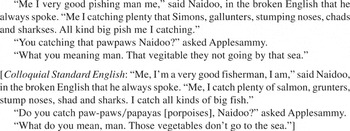
It is apparent from excerpts like these that the comedy is based on (and/or builds up) a stereotype of Indians, more specifically of descendants of Indian indentured workers drawn into an urban environment. Typical misadventures involving fishing, bee-catching, buying cars, horse-racing, selling flowers, encounters with the bureaucracy, and so forth produce stock comedy with great opportunities for stereotyping. The comedy is not subtle; it demeans the character's actions, attributes lowly motives to their actions and—more insidiously—draws a firm line between the ignorant and less than law-abiding Indian characters and their rather better-informed white characters and young readers. For example, the very first chapter ends with a disastrous fishing outing for the characters, “they had lost their rods and their tackle, and were wet and miserable” (p. 8). The concluding paragraph speaks to the young reader:
But it really served them right, didn't it? They shouldn't have broken the law as they did. Anyway that taught them a lesson, and they never tried fishing in the black-out again.
The text certainly deserves the attention of the historical sociologist. Despite itself, it can be seen as serving a serious function—perhaps a reassurance to the dominant classes of the time of their own superiority in the face of the growing urbanization of (and therefore possibilities of greater competition from) people originally destined for the plantations. An essential part of this reassurance is in the very choice of medium. The two characters (and a nephew Chinsammy, who makes a brief appearance in chapter 22) speak in English jargon or “broken language”; the authorial voice is always in standard English, as is that of all the white characters. By this means a dichotomy is set up between “authentic” voice and that of the “other.”
In Mesthrie (2002) I argued that A&N is a caricature, rather than a representation that linguists might draw on for data on SAIE, from a period for which little other linguistic data exists. This caricature is one that was doing the rounds in the British Asian Empire since the 19th century. It is also parallel to the caricatures of African Americans in the U.S., in the radio series Amos and Andy (Anthony Kroch, personal communication, 2002). Linguistically, some of the features have their roots in Butler English, a variety spoken by house-servants in British India—the butler being a rather less dignified figure than that of upper-class Victorian England. Butler English was documented by Schuchardt (1891), who claimed that English employers also used the jargon in conversing with their employees. Hosali (2000) showed that this pidgin-like variety survives to the present day in parts of south India. In Mesthrie (1990) I showed that pre-basilectal SAIE shows many similarities with Butler English, but that it probably arose independently in Natal, where it is not a coherently defined entity in the way that the basilect is. However, because the existence of a similar variety to Butler English has been reported in at least one other territory (Burma) where British settlers employed immigrant Indians, it could well have been transported as a kind of foreigner talk by British settlers in Natal with prior experience of India. An illustration of such foreigner talk occurs in George Orwell's Burmese Days (1934):
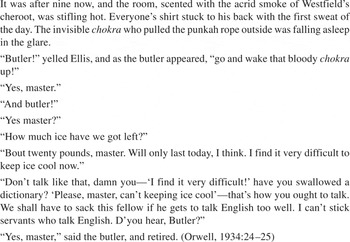
I have quoted this passage at length because the employer uses one of the constructions studied in this article, as a kind of foreigner talk (“can't keeping ice cool” for “I can't keep the ice cool”). This example of foreigner talk involves pro-drop and the “bare -ing” form. That is, -ing is preceded by a modal, rather than by be; and the Verb + -ing is really a nonfinite form.
It is in the nature of stereotypes that they are based in a small measure on reality. Apte (1994:4349) cited Brown (1965) who spoke of a “kernel of truth” hypothesis in the literature on stereotypes. Some of the linguistic features of the characters in the text do cluster in Indian English dialect, and survive in the speech of older, rural, and less-educated people in the early 21st century. On the other hand, Apte (1994:4348) affirmed that “a stereotype is now considered to be an overgeneralization and an uninformed one.” These remarks apply rather well to the portrayal of SAIE by the A&N satirists.
The baseline that I will use to illustrate the stereotyping effects in A&N is the English of the least competent speakers in my database of the 1980s. Such pre-basilectal speakers are difficult to follow, even for SAIE speakers who are thoroughly familiar with the rest of the dialect as a whole. Next I give an excerpt from a male pre-bas speaker:
I work in the—little bit time—in the Renishaw Mill; not working in the mill—field, working in the field. I working with the hoe, too. After this white faller saying “No, no, no, you go there, by the line, you know ‘line’?” Same place I got the hurt, here, toe. This time I went there hospital, Khan's Hospital.
The comparison between characters depicted in the 1940s and pre-bas speakers of the 1980s is not asynchronous, given that all six pre-bas speakers of my original database were elderly and loners (and therefore not likely to have undergone many changes in speech norms in their lifetime). They would have been around the age of 15 to 25 at the time of the A&N series—a perfect match with the characters satirized there. Linguistically, this group seems most appropriate for comparing SAIE usage with the language of the A&N scripts. Socially, however, there is a mismatch because the kind of adventurous persons who had regular (if unequal) contacts with whites would not have been pre-basilectal. Had Applesammy and Naidoo really been young, adventurous men living in the 1940s, they would probably be speakers of the basilect or lower mesolect and shift styles “upwards” in out-group communication with whites. In other words, the comparison I am making between pre-bas and A&N (rather than basilect or lower mesolect and A&N) is more than generous to the scriptwriter.5
This comparison also irons out any possible effect of the SAIE dialect having developed over time. That is to say, the comparison covers the (dubious) possible objection that the equivalent of today's basilectal speakers might have been pre-basilectal in the 1940s.
In A&N, the two main characters have speaking parts in which -ing is applied as an ending to almost all verbs, irrespective of tense, mood, and aspect, as (8) shows.6
There are only a few exceptions in A&N: (a) verbs that take an -it ending (i.e., verb + cliticized object it). The most common verb here is got, which occurs invariantly as the fused form gottit. There is one additional example of catchit, as in “But did you catchit any fish master?” (b) the imperative prepositional verb look at, which occurs five times compared to the imperative form looking at, which occurs once; and the imperative verbs mind and come on; and (c) three tokens that I suspect show a scriptwriter or editor's lapse rather than a genuine effort at showing variability: “You broked up; I wanting to catch that fish; When you feeling him pull this hand…”
(8) But how me I can knowing when that bite he caming? (‘How could I have known when I got a bite’)
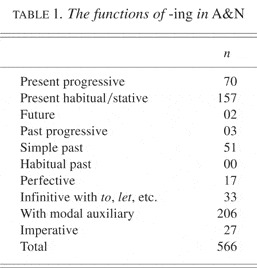
The range of functions of -ing in A&N is shown in Table 1.
The functions of -ing in A&N

All attestations of -ing in A&N are nonstandard. This includes the present progressives, which are standard in semantics, but nonstandard in form, because they lack a preceding be. Examples of each of these categories follow.
Present progressive:
(9) That policingman's boat he caming this side Applesammy. (‘The policeman's boat is coming this side, Applesammy.’)
Present stative:
(10) What you meaning man? (‘What do you mean man?’)
Present habitual:
(11) And he solling plenty honey and he making lots, lots money. (‘He sells lots of honey and makes lots of money.’)
Future:
(12) They making us cooking7
This gerundive form is not counted in this study, because it serves an adjectival, not a verbal function.
Past progressive:
(13) Hello Naidoo—ha, ha, you silly pool—you looking at that chocree8
Bhojpuri-Hindi chokrı “girl.”
Simple past:
(14) But last week you saying that you don't liking to killing that pigs Applesammy. (‘But last week you said that you don't like to kill pigs, Applesammy.’)
Past habitual: (none)9
The reasons for the absence of past habituals is interesting. This is the tense used for reminiscences and building histories (“We used to …”). The one-dimensional stereotypes in A&N do not allow for such building of a narrative.
Perfective:
(15) Long time me I not yeating that Curry Pish man Naidoo. (‘It's been a long time since I've eaten curried fish, man, Naidoo.’)
Infinitive with to, let, etc.
(16) Come on let's us going watching this race man. (‘Come on, let's go and watch the race, man.’)
With modal auxiliary:
(17) Me I can pixing that my rod pirst time Applesammy, then me I can pixing that your rod, eh? (‘Let me fix my rod first, then I can fix yours, hey.’)
Imperative:
(18) Please master gaving that nurrer one chance please master. (‘Please give me another chance, master.’)
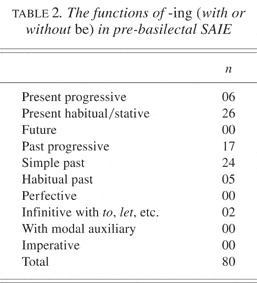
A&N thus gives the impression that its characters don't have a concept of tense, mood, and aspect. They use -ing simply as a marker of a verb, irrespective of whether it is progressive in semantics or not, and a fused object marker -it with got. Only three verbs are exceptions (see note 6 for these three and the fused form gottit). Table 2 (based on Mesthrie, 1992b) gives the use of -ing forms (with or without be) for the same functions among five pre-bas speakers by way of comparison.
The functions of -ing (with or without be) in pre-basilectal SAIE

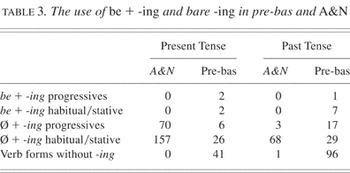
Because -ing differs in its semantic function of progressive marker (with or without be) from its function as a bare suffix, it is necessary to separate these functions and examine them more closely. Table 3 details the use of (be) + -ing in these two functions in pre-bas and A&N.
The use of be + -ing and bare -ing in pre-bas and A&N

From Table 3 it is evident that A&N eschews regular forms for all categories of verb: almost all verbs have a Ø + -ing ending.10
With the single exception of broked as described in note 6.

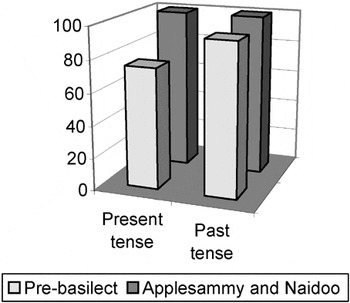
Percentage of Ø + ing verb forms in relation to progressives in pre-basilect and Applesammy and Naidoo.

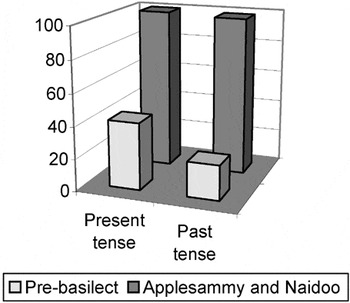
Percentage of Ø + ing verb forms in relation to nonprogressives in pre-basilect and Applesammy and Naidoo.
Figure 1A shows that the two databases do have something in common (the “kernel of truth” hypothesis): pre-bas does make high use of Ø + -ing forms in progressive contexts. At the same time, Figure 1A shows quantitative overgeneralization as the relatively high occurrences of Ø + -ing for progressives in pre-bas are made even higher in A&N. Figure 1B shows that pre-bas makes considerably less use of Ø + -ing in nonprogressive contexts. However, this is ignored in the A&N stereotype, which treats Ø + -ing in nonprogressive contexts the same as in progressive contexts.
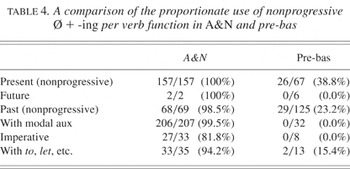
Whereas Tables 1 and 2 give the raw figures for each environment (or function) for -ing, Table 4 gives the proportionate use of -ing to the verbs without -ing in each environment. Because we are in effect measuring the overgeneralization of -ing, this time it is necessary to factor out ordinary progressives requiring be + -ing in standard English.11
Table 4 is therefore a revised, more constrained version of Table 3 in Mesthrie (2002:106), which gives the proportions for all occurrences of be + -ing.
A comparison of the proportionate use of nonprogressive Ø + -ing per verb function in A&N and pre-bas


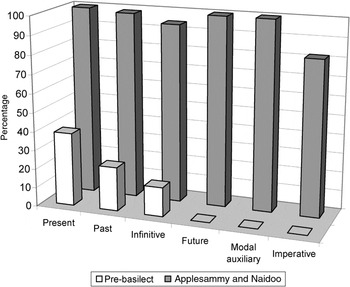
Percentage of forms with nonprogressive -ing per tense category in Applesammy and Naidoo and the pre-basilect.
The overall difference between the two sets of bar graphs in Figure 2 is dramatic, revealing the exaggerative effect of the stereotype more fully than do Figures 1a and 1b:
(a) There is no use of imperatives with -ing in pre-bas; in A&N they are virtually mandatory.
(b) As infinitive with to, let's etc. the form -ing is rare in pre-bas; but virtually mandatory in A&N.
(c) There is no record of -ing being used with a modal auxiliary like can and must in pre-bas; in A&N it is mandatory.
(d) There is no use of future -ing in pre-bas, unlike A&N.
Constructs from variation theory are useful in characterizing the nature of the stereotyping evident in A&N. It is clear from Tables 3 and 4 and Figures 1 and 2 that:
(a) The basis for the stereotype is the use of -ing by pre-basilectal (and even basilectal) speakers who use -ing forms fairly often without the verb be in the present progressive, and who extend it to occasional use in other contexts like the habitual present or the simple past.
(b) The stereotype presents a variable rule for -ing as if it is invariant in each of the contexts concerned.
(c) The stereotype overgeneralizes the rule grammatically to “neighboring” contexts in which pre-bas -ing does not occur (imperative, future, modal auxiliary).
Furthermore the text as a whole promotes other effects, which are not presented in Figure 2:
(d) The stereotype overgeneralizes the variable rule socially insofar as almost all Indian speakers are made to speak like this.12
There are two exceptions: two figures of authority or of expertise (a police corporal and a horse-racing expert) are given brief speaking parts in two chapters in rather stilted, colonial standard English.
(e) The stereotype overgeneralizes the rule stylistically insofar as the speakers speak in this way in all styles. (See particularly the authorial comment cited earlier: “said, Naidoo, in the broken English he always spoke.”)
The gross stereotyping text is thus an antithesis of natural language usage described in sociolinguistics (e.g., Bell, 1984; Chambers, 2003; Labov, 1972) in which variation is shown to be a normal form of linguistic behavior. My database shows that even pre-bas speakers of an L2 show variation in their grammar. Although they do not, by any means, have advanced abilities in the TL, the forms that do exist in their interlanguage are seldom invariant. Like the character, Ellis in Orwell's Burmese Days (1934) the authors of A&N attempt to suppress this variation and impose a unidimensional “otherness” to the speech of colonial subjects. It is interesting that the same grammatical form, -ing without be, should have been targeted. Orwell's character insists, “‘Please, master, can't keeping ice cool’—that's how you ought to talk.” Yet not a single occurrence of -ing in this context (after modals) occurs in my pre-bas data, despite 32 opportunities for such use.
Yaeger-Dror (1992) characterizes any instance of an individual using a linguistic variant more than those he/she is emulating, as a form of hypercorrection. Since “correction” towards a prestige norm is not always evident in studies of traditional (quantitative) hypercorrection of the sort described by Labov (1966), Yaeger-Dror proposed the more general term hyperaccommodation, based on the account of code convergence and divergence between interlocutors put forth by Giles, Bourhis, and Taylor (1977). Following from this account, Janda and Auger (1992) described various types of hypercorrection/hyperaccommodation, including humorous hypercorrection, which is of relevance here. They characterize it as a striking kind of downward hypercorrection, occurring when speakers in the emulating group have higher social status than members of the emulated group. Janda and Auger (1992:209) characterize this “mocking process” following from qualitative hypercorrection in the following way:
(a) Members of some social group attempt to imitate the speech of another group, for humorous reasons.
(b) They therefore replace one or more native elements from their own speech with one or more nonnative elements that they believe to be used by speakers in the group targeted for imitation.
(c) They end up overgeneralizing such a nonnative element to one or more new environments—a form of qualitative hypercorrection.
(d) In these environments, members of the target group actually have either the same form used by the speakers attempting them or yet a third form.
For examples from African American Vernacular English (AAVE), see Janda and Auger (1992:209). Baugh (1992) used the term hypocorrection in the case of adjustments “downwards” toward a less prestigious dialect variant by speakers of a more prestigious variety. The type of hypocorrection he described is not done for humorous reasons. His example is of African Americans brought up on standard American English attempting to deploy AAVE as a second dialect in certain contexts.
Although Janda and Auger's four-step account of humorous hypercorrection does apply broadly to the A&N text, the phenomenon underlying the parody involves so deliberate and invariant a process that neither the term hypercorrection nor hyperaccommodation convey the right nuance. The most appropriate term for the gross stereotyping in A&N seems to be “mock language”—that is, the use of a lower status language or dialect in an exaggerated or distorted way by speakers of a dominant variety, with the intention of stereotyping and parodying speakers of the dominated variety. Jane Hill (1993) used the term “mock Spanish” for the appropriation of presumed linguistic features of Spanish by English speakers in the southwestern United States in casual speech. Hill provided the example of Hasta la vista, baby, which parodies and devalues the formal Spanish phrase hasta la vista (literally, “until—the—seeing”), which signals a sincere hope for the pleasure of a future meeting. The juxtaposition with the slang term baby renders the original phrase colloquial and vulgar, as does the exaggerated intonation in which the phrase would be rendered. Similarly, Ronkin and Karn (1999) used the term “mock Ebonics” to describe the vast number of materials on the Internet that parody Ebonics or African American Vernacular English.
There is a further violation of “naturalness” in A&N. In Mesthrie (2002) I show that A&N is an odd mixture of certain early-interlanguage features used frequently in the interests of stereotyping (e.g., -ing and the fixed, fused verb-form gottit, see note 6) with more advanced features (e.g., a range of prepositions and plural nouns) dictated by the need to be intelligible to its listeners. One should beware of circularity here, if early interlanguage features simply means “nonstandard forms more characteristic of A&N than pre-bas,” and advanced feature means “standard forms more characteristic of A&N than pre-bas.” There has to be an independent metric to decide which forms occur in early acquisition and which occur later. Such independent evidence can be found in studies of L1 and L2 acquisition. Ellis's summaries (1994:78–100) make it clear that (1) -ing is a form that occurs first (i.e., before other verb inflections) in child language and in L2 acquisition; (2) that among prepositions, in and on are acquired first; (3) that uncontracted copulas occur before contracted copulas (e.g., are before 're; is before 's); and (4) that can't occurs prior to, and is more frequent than, can. In all these respects, A&N is a poor reflection of a specific interlanguage level of its characters. There is a reason for this lack of naturalness, which I term “the interests of the text.” If A&N were really to reproduce the norms of pre-bas (or even the basilect), it would be unintelligible to a majority of its listeners or readers. As I indicated in Mesthrie (1992b:65), the pre-bas is difficult to follow, even for people familiar with SAIE as a whole. It is little surprise then that there are some features in which A&N performs in a more TL way than pre-bas. I illustrated this in relation to prepositions and noun plurals in Mesthrie (2002).
DIALECT REALISM IN THE LAHNEE'S PLEASURE
I now turn to The Lahnee's Pleasure (henceforth LP), a play written by Ronnie Govender, a member of the SAIE community. The play aims to faithfully represent the L2 working-class dialect of the mid-20th century. The broader question is whether a native speaker-writer, knowledgeable about the speech norms of a community, might nevertheless still be susceptible to the process of linguistic overgeneralization. In other words, is a degree of stereotyping inevitable as creative writers seek to impose some order on the multifarious utterances that speakers are capable of in everyday speech? The play LP is set on a sugar estate of the Natal North Coast in what appears to be the late 1960s.13
The province itself is now known as KwaZulu-Natal.
MOTHIE: Arreh, our time, man, our time. Girls can't come out of the house—so strict they was. Arreh, six o'clock all the doors will be closed. Can't see one girl with one eyes. That time boys must dance girls part. Saturday night! Saturday night! Fire all burning one side. All the pots will be cooking one side. Thabla, saranji, all getting hot by the fire. Everbody will ask, Mothie came way? Me! Kisten came way? Your father! Everybody looking for us to start the wedding joll.
You know these big, big shots from Durban, Sunnyia—arreh, all will come and sit in one place. Drinking whisky, brandy, everything man.
Colloquial Standard English:
Hey, our times [were quite something]. The parents were so strict that girls weren't allowed out of the home. Y'know, people would shut their doors at 6 o'clock. You couldn't see a girl at all. At that time boys had to dance the part of girls [in shows]. Saturday nights [were something else]. On one side a fire would be burning; and pots of food would be cooking. The thabla and sarangi [musical instruments] would be kept warm by the fire. Everybody would ask “Has Mothie arrived?” That's me … “Has Kisten come?” That's your father… Everybody would be looking out for us to start the merry-making.
Y' know, Sunny, even the big shots from Durban would come to sit and watch. They would be drinking whisky, brandy and such.
This excerpt draws largely on basilectal speech, emphasizing the norms of working-class people who evolved a variety of English radically different in many respects from the more standard varieties of colonial English spoken by the ruling classes and promulgated in classrooms. It is of some interest to ascertain exactly how authentic the representation of language in the play is. I will first comment on this issue broadly, before providing statistical comparisons with the categories analyzed in the A&N text. The playwright is sensitive to language variation of several sorts. Although the main character, Mothie, speaks mainly basilectal SAIE, his speech shows occasional style shifting, as one would expect. Thus, he switches to an acrolectal form (more or less standard) on p. 8:
(19) (Proceeds to table and says loudly) If I want to drink wine, it's my business.
This is an act of code divergence, in defiance of the newcomer in the bar, obviously an outsider (of Indian origin) looking “with kindly amusement” at Mothie's antics. Later (p. 11) Mothie repeats the same sentence aggressively to the barman:
(20) If I want to drink—my business.
The deletion of the dummy subject it and of the copula verb is in (20) is more in keeping with basilectal norms, showing a convergence back to the norms of the bar room. Another piece of variation involves Mothie's encouraging words to his young son, who is offered a soft drink by the barman:
(21) Go, uncle giving cold drink, go. (‘Go and receive the cold drink that the barman is offering you.’)
With the absence of the object pronoun you and the article a after the main verb giving, this counts as a piece of downshifting typical of adults speaking to children, signifying a kindly cajolement. In Mesthrie (2003) I showed how the basilect and pre-basilect is understood by working-class parents to be an appropriate variety for addressing children.
Another sociolinguistic point of relevance is that Mothie's language is basilectal, but does not include much slang.14
Many people wrongly equate nonstandard dialect grammar and lexis with slang. It is therefore necessary to point out that the basilect has a grammatical coherence of its own; into which some speakers (typically young males) may insert slang words.
When the boss himself makes an appearance, his language involves a kind of talking down, in the direction of the mock language associated with the A&N stereotypes:
(22) Now you going to have one big, big wedding. Don't forget to bring me some curry and rice…. Hey Mothie have one nother one wine …. and give those chaps a drink too … (p. 41).
However, neither his language nor his attitude shows undiluted mockery. There is a gesture of goodwill in the offer of drink and the request for food from the wedding. Likewise, two of his utterances here are standard (Don't forget to bring me some curry and rice and give those chaps a drink too), rather than mock language. His attempt at joviality here is tinged with slight condescension, conveyed by a version of SAIE that unwittingly contains several mistakes. First, in the phrase big, big wedding, reduplication of the adjective big is used inappropriately with a singular noun. Compare this with Mothie's earlier utterance (p. 7):
(23) What big, big prayers we'll have.
Mothie's utterance in (23) shows the appropriate context for the reduplication, before plural nouns.15
This rule may appear to be violated in two of Mothie's basilectal sentences: Wedding! Big, big wedding we'll have (p. 7) and Little, little thing we worry about … (p. 12). It is clear from the context, that although the nouns appear as singular, they are semantic plurals: “We used to have (very) big weddings”; “We worry about (such) small things.”
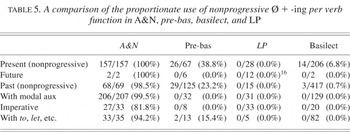
I now examine the use made by the playwright of the be + ing construction in the utterances of Mothie. The broader questions, as already mentioned, are whether a degree of sociolinguistic veracity can be found in Mothie's use of a specific grammatical construction or whether even well-intentioned authors fall prey to stereotyping in this respect. Table 5 compares the statistics for A&N and pre-bas in Table 4 with those of LP and the basilect.
A comparison of the proportionate use of nonprogressive Ø + -ing per verb function in A&N, pre-bas, basilect, and LPIn this count I excluded present progressives with future meaning, as in I'm coming just now, which I place under present; futures with modal + be + V + -ing (I'll be standing next to you, man) are excluded.

For three categories (future, modal aux, and imperative) LP shows zero use of -ing, in keeping with the pre-bas and basilect, and unlike LP. In a fourth category (infinitives), LP reflects the zero usage of the basilect, rather than the sporadic use of pre-bas. The use of Ø + -ing in LP forms thus closely matches that of my basilectal sample, with one exception: The playwright eschews Ø + -ing for the simple present and past. The reason for this is that these are residual forms of the basilect (more characteristic of the pre-bas, which has overtones of being “broken”). The proportions for the basilect, as given in Table 5, are in fact 14/206 (6.8%) and 3/417 (0.7%). LP ignored this residue. Instead, the LP text favored a more sophisticated use of Ø + -ing for past habitual irrealis progressives (cf., everybody looking for us for “everybody would be looking for us” in the LP passage cited earlier).
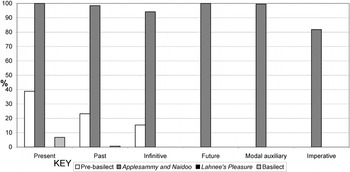
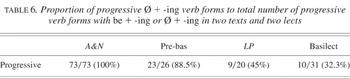
Figure 3 presents the information given in Table 5 graphically. Figure 3 confirms that LP and A&N are mirror opposites for the nonprogressive Ø + -ing forms. A&N blows up the small number of such forms from pre-bas and basilect into a categorical presence. LP, on the other hand, ignores this small number of forms in favor of categorical absence. Hence, LP does not show up in the graph for Figure 3 at all. However, LP does not ignore dialect use of be + -ing. This is reflected in Table 6, which shows the proportion of progressive -ing forms without be to the number of -ing forms with be.

Percentage of forms with nonprogressive -ing per tense category in Applesammy and Naidoo, The Lahnee's Pleasure, the basilect, and pre-basilect.
Proportion of progressive Ø + -ing verb forms to total number of progressive verb forms with be + -ing or Ø + -ing in two texts and two lects

Table 6 shows how close Mothie's norms are to the basilect for progressives, rather than to pre-bas and A&N. This is a socially authentic portrayal of someone with minimal education, with community-based social networks, and little or no social contact with L1 English speakers. Tables 5 and 6 thus show that a native-speaker playwright with “realist” intentions can replicate a community's nonstandard norms with a high degree of accuracy. This includes representing the community's variable rules (in this case, for the use of the two types of -ing), as well as showing the effects of “audience design” (Bell, 1984), as Mothie style-shifts in accommodation to different speakers. The “interests of the text” are less evident in Mothie's speech, apart from his use of occasional past habitual used to rather than should. Here, it is possible that the playwright was constrained by the difficulties that should might pose to a wider audience. SAIE is the only dialect of English world-wide to use should (variably, but quite commonly) for the past habitual “used to.” There is another sense in which the interests of the text are invoked, that is, in the play as a whole. There is a necessary contrast between the standard speech of the Indian stranger returning from England, and the basilectal norms of the main character. The standard speech acts as something of a counterpoint to Mothie's language. Some standard speech is necessary to keep a sense of balance in order to make this a creative work with a reasonably broad appeal, and not simply a dialect tract. The standard speech also reminds the audience that not all Indians are basilectal. That is, LP avoids the social overgeneralization evident in A&N.
TRANSCENDING DIALECT REALISM—THE WEDDING
I now turn briefly to the final text, The Wedding (henceforth TW), a novel by Imraan Coovadia, also a member of the SAIE speech community. The novel's plot is simple: It deals with the chance meeting of a city man and a village woman in India, their hurried wedding (against the woman's wishes) and their eventual journey to a new life in South Africa. More anti-romance than romance, this tale is told in an effusive style, described on the front cover blurb by 2003 Nobel laureate, J. M. Coetzee as “prose of dazzling comic wizardry.” Much of the novel is in the form of dialogue and the free indirect style of the characters. An authorial voice using standard English is rather less evident. There is one way that this text differs from A&N and LP: The English is not meant to represent English as such (though the author is silent about this). Rather, it is intended as a representation of the L1 of the characters (either Marathi, Gujarati, or the Meman dialect of Sindhi). The following excerpt deals with the attempts by a poor and miserly father-in-law to get his new son-in-law to accept two train tickets to Hyderabad as a wedding gift. This show of generosity is mitigated by the fact that he did not have to pay for the tickets, and that Hyderabad—an unlikely honeymoon spot—is in the wrong direction from the newlyweds destination, Bombay. In the following extract, Yusuf is the father-in-law and Ismet is the son-in-law besotted with his new village-girl wife, Khateja, who does not reciprocate such feelings in the slightest.
“Hyderabad! But that is located in the opposite direction!” “Oh,” Yusuf said smoothly, “but that is precisely the point. Leisure time. When you get to Hyderabad all you must do is buy a ticket and lo! You will arrive in Bombay quick-snaps. You will say, ‘My good father Yusuf, he was absolutely correct. In fact, my holiday was too-too short. A fleeting thing. Pity we didn't get a chance to see more of Hyderabad, it is one of our oldest and most interesting Indian cities.’ I give you my personal guarantee.”
Then he quieted his voice and said confidentially, “Besides, it is Khateja who is wanting this thing, you see. Always wanted to see Hyderabad even as a small kitten. “Daddy take me to Hyderabad, Daddy take me to Hyderabad. Daddy can we pay a visit to this Hyderabad for a few days tourism? Don't know why exactly, just always had a thing about it.”
“Hyderabad?”
Ismet grimaced. He thought of it as a grimy, enfeebled, hillset city, sun-cudgeled, raisin-peopled, camel-walked, rain-drained.
“Oh, oh, wonderful city, wonderful city. Never been there myself but heard only the best about it. Best reports. Brother Yacoob, your uncle Yacoob, saw it on one occasion many years back. Never got over it. Never got over it, it is the most amazing thing. Still to this day he is always talking about it, always has a good word for it, Hyderabad has this, Hyderabad has that, in Hyderabad they know what is two and two, and so on. He'll be too happy when he hears you've gone. Always been crazy about Hyderabad. Where Khateja got the idea, I suppose.”
Dialect uses of -ing in TW are woven into a wider fabric of poetic language. The effect of such transformation of dialect into “poetic diction” is not to stereotype (as in A&N) or to be a faithful representation of a particular dialect (as in LP), but to transcend the particular. In this regard, the most noteworthy feature is the absence of bare -ing forms. Whenever -ing occurs in TW, it is accompanied by some form of be. Examples of -ing in the TW text are therefore entirely of an aspectual nature, capturing the well-known Indian English predilection for extension of progressive -ing to habitual and stative contexts (Trudgill & Hannah, 1985:110). Some examples of be + -ing in stative contexts are given next (all citations are taken from TW, chapt. 3):
(24) And he is still wishing to marry me.
(25) We are wanting you to look your best.
(26) You are looking so handsome.
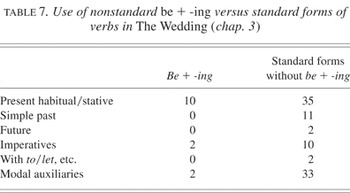
It is also noticeable that Coovadia exploited the ambiguity in some be + -ing forms, where the construction can be taken as nonstandard or just about acceptable as colloquial standard. However, because from the viewpoint of formal standard English these do not take be + -ing in the sense intended, they are counted as habituals (27–28) or stative (29), rather than as progressives in Table 7.
(27) She is always talking about it.
(28) That's what they are saying.
(29) I'm looking forward to meeting it.
As Table 7 shows, the use of be + -ing is outnumbered by the use of simple past and present forms. TW has no instances of be + -ing for future, simple past, perfective, or habitual past. It does, however, occasionally use be + -ing after imperatives (30–31) and modals (32), with special effect:
(30) Better be kissing that chicken goodbye.
(31) Do not be forgetting us, eh.
(32) Can't be squandering the minutes…
The effect of sentences (24) to (32) is to stylize the Indianness of the thought processes, going back to the Marathi/Gujarati/Sindhi of the speakers, rather than to stigmatize incompetent English via bare -ing forms. This effect is strengthened by having the vast majority of these forms used variably with the standard form predominating, as shown in Table 7.
Use of nonstandard be + -ing versus standard forms of verbs in The Wedding (chap. 3)

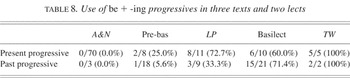
Standard present progressives (n = 5) and past progressives (n = 2) with be + -ing in TW are excluded from Table 7, but are included in Table 8, which gives a comparison of the proportion of be + -ing progressives to all progressives in the varieties studied in this article.
Use of be + -ing progressives in three texts and two lects

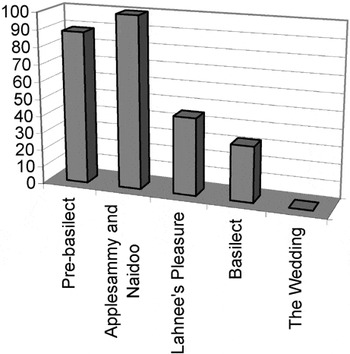
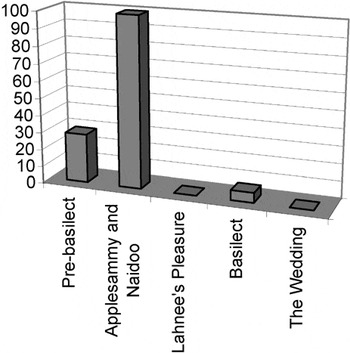
Table 8 shows a continuum in the use of be + -ing in all five varieties studied. A&N, which draws on and exaggerates pre-bas norms, steadfastly refuses to bestow any tokens of the standard variant on the speech of its main characters. At the other end, TW joyously acknowledges the use of be + -ing with all progressives (Table 8) and with some habituals/statives, as well (Table 7), in keeping with the norms of Indian English and SAIE. Intermediate figures occur in pre-bas, basilect, and LP, reflecting an interplay between bare -ing forms and be +-ing forms for the progressive. This situation is reflected in Figures 4A and 4B, which draw on Tables 5 and 6. These figures summarize the use of Ø + -ing in progressive use and nonprogressive use, respectively, in all the varieties studied in this article.

Percentage of past and present progressive Ø + ing verb forms to total number of progressives in three texts and two lects.

Percentage of past and present nonprogressive Ø + ing verb forms to total number of verb forms in three texts and two lects.
CONCLUSION
By using actual speech data conducted under sociolinguistic conditions associated with the “Labovian interview” as a baseline, it is possible to assess the kinds of choices made by authors with different aims. In this article, I demonstrate the gross stereotyping effects of mock language or parody, showing how principles of variation are systematically violated in A&N. The six principles that emerge are the following:
(a) A few variables are used to create a gross stereotype.
(b) Each such variable is presented as if it is linguistically invariant in the dialect being stereotyped, as a nonstandard form (quantitative overgeneralization).
(c) The variable is overgeneralized to neighboring (phonetic or grammatical) contexts in which it does not occur in the dialect being stereotyped (qualitative overgeneralization).
(d) The variable is overgeneralized to cover the entire speech community (with a few possible exceptions) being stereotyped (social overgeneralization).
(e) The variable is overgeneralized to cover all contexts of use, and thus to undo the effects of “audience design” (stylistic overgeneralization).
(f) The variable(s) may be embedded among other standard grammatical features (in contrast to the community's actual norms) in the interests of intelligibility to the intended audience.
I also confirm that a text written by a writer with “insider” status may (unconsciously) replicate the principles of variation rather well, in the interests of realism (see also Yaeger-Dror et al. 2002; Fonollosa, 1995). Finally, for contrastive purposes, I focussed on a post-modern, comic presentation that draws on dialect features and shows awareness of the variability of dialect grammar. At the same time, it transforms that grammar greatly, ending up with poetic language that transcends the nonstandard–standard divide. It also eschews the monostylism promulgated by the stereotyping text.
References
REFERENCES
Apte, Mahadev.
(1994).
Stereotype and social attitudes. In
R. Asher (ed.),
The encyclopedia of language and linguistics
(Vol. 8).
Oxford:
Pergamon.
4348–4350.
Baugh, John.
(1992).
Hypocorrection: Mistakes in production of vernacular African
American English as a second dialect.
Language and Communication
12(3/4):317–326.Google Scholar
Bell, Alan.
(1984).
Language style as audience design.
Language in Society
13(2):145–204.Google Scholar
Brown, R.W.
(1965).
Social psychology.
New York:
Free Press.
Chambers, Jack.
(2003).
Sociolinguistic theory (
2nd ed.).
Oxford:
Blackwell.
Coovadia, Imraan.
(2001).
The wedding.
New York:
Picador.
Durnford, Philip B.
(1946).
Foreword. In
R. Ray,
The Adventures of Applesammy and Naidoo.
2nd ed.
Pitermaritzburg:
Shuter and Shooter.
3–4.
Ellis, Rod.
(1994).
The study of second language acquisition.
Oxford:
Oxford University Press.
Fonollosa, Marie-Odile.
(1995).
Le théâtre, reflet de la langue parlée?
(representation de la langue parlée dans le théâtre de
Michel Tremblay dans les années 1970 et 1980).
Master's thesis.
Université de Montréal.
Giles, Howard,
Bourhis, Richard, &
Taylor, Donald.
(1977).
Toward a theory of language in ethnic group relations. In
H. Giles (ed.),
Language, ethnicity and intergroup relations.
London:
Academic.
307–348.
Govender, Ronnie.
(n.d.)
(c. 1972).
The lahnee's pleasure.
Johannesburg:
Ravan.
Hill, Jane.
(1993).
Hasta la vista baby—Anglo Spanish in the American
Southwest.
Critique of Anthropology
13:145–176.Google Scholar
Hosali, Priya.
(2000).
Butler English: Form and function.
Delhi:
B. R. Publishing.
Janda, Richard D., &
Auger, Julie.
(1992).
Quantitative evidence, qualitative hypercorrection, sociolinguistic
variables—and French speakers 'eadaches with English
h/Ø.
Language and Communication
12(3/4):195–236.Google Scholar
Kallen, Jeffrey.
(2002).
Irish in America: Mr. Dooley and Hiberno-American dialect
writing. Paper presented at the American Dialect
Society/LSA Conference, January 3, 2002.
Labov, William.
(1966).
The social stratification of English in New York City.
Washington, DC:
Center for Applied Linguistics.
Labov, William.
(1972).
Sociolinguistic patterns.
Philadelphia:
University of Pennsylvania Press.
Lanham, Leonard W., &
Macdonald, Carol.
(1979).
The standard in South African English and its social history.
Heidelberg:
Julius Groos Verlag.CrossRef
Le Page, Robert, &
Tabouret-Keller, Andreé.
(1985).
Acts of identity—Creole-based approaches to language and
ethnicity.
Cambridge:
Cambridge University Press.
Marriott, S.
(1997).
Dialect and dialectic in a British war film.
Journal of Sociolinguistics
1(2):173–194.Google Scholar
Mesthrie, Rajend.
(1990).
Did the Butler do it?: On an analogue of Butler English in Natal,
South Africa.
World Englishes
9(3):282–288.Google Scholar
Mesthrie, Rajend.
(1992a).
Language in indenture: A sociolinguistic history of Bhojpuri-Hindi
in South Africa.
London:
Routledge.
Mesthrie, Rajend.
(1992b).
English in language shift—The history, structure and
sociolinguistics of South African Indian English.
Cambridge:
Cambridge University Press.
Mesthrie, Rajend.
(2002).
Mock languages and symbolic power: The South African radio series
Applesammy and Naidoo.
World Englishes
21(1):
99–112.Google Scholar
Mesthrie, Rajend.
(2003).
Children in language shift: The syntax of fifth generation Indian
South African English speakers.
South African Journal of Linguistics and Applied Language
Studies
21(3):119–126.Google Scholar
Orwell, George.
(1934).
Burmese days.
New York:
Harper.
Platt, John,
Weber, Heidi, &
Ho, Mian L.
(1984).
The New Englishes.
London:
Routledge.
Rich, Ray.
(1946).
The adventures of Applesammy and Naidoo.
(3rd ed.).
Pietermaritzburg:
Shuter and Shooter.
(1st ed.: 1945)
Ronkin, Maggie, &
Karn, Helen.
(1999).
Mock Ebonics: Linguistic racism in parodies of Ebonics on the
Internet.
Journal of Sociolinguistics
3:360–380.Google Scholar
Schuchardt, Hugo.
(1891).
Beitrage zur Kenntnis des englischen Kreolisch III, Das
Indo-Englische'.
Englische Studien
15: 286–305.
Translated and edited by G. G. Gilbert (1980) in Pidgin and creole
languages. Cambridge: Cambridge University Press. 38–64.Google Scholar
Trudgill, Peter, &
Hannah, Jean.
(1985).
International English: A guide to varieties of standard
English (
2nd ed.).
London:
Edward Arnold.
Wolfson, Nessa.
(1979).
The conversational historical present alternation.
Language
55:168–182.Google Scholar
Yaeger-Dror, Malcah.
(1992).
Introduction to Communicative accommodation: A new perspective on
‘hypercorrect’ speech.
Language and Communication
12(3/4):181–192.Google Scholar
Yaeger-Dror, Malcah, &
Deckert, Sharon.
(2000).
Disagreement, contraction and dialect: evidence from a large corpus
of American English.
CLIC
2.
49–59.Google Scholar
Yaeger-Dror, Malcah,
Hall-Lew, Lauren, &
Deckert, Sharon.
(2002).
It's not or isn't it? Using large
corpora to determine the influences on contraction strategies.
Language Variation and Change
14:79–118.Google Scholar
The functions of -ing in A&N
The functions of -ing (with or without be) in pre-basilectal SAIE
The use of be + -ing and bare -ing in pre-bas and A&N
Percentage of Ø + ing verb forms in relation to progressives in pre-basilect and Applesammy and Naidoo.
Percentage of Ø + ing verb forms in relation to nonprogressives in pre-basilect and Applesammy and Naidoo.
A comparison of the proportionate use of nonprogressive Ø + -ing per verb function in A&N and pre-bas
Percentage of forms with nonprogressive -ing per tense category in Applesammy and Naidoo and the pre-basilect.
A comparison of the proportionate use of nonprogressive Ø + -ing per verb function in A&N, pre-bas, basilect, and LPIn this count I excluded present progressives with future meaning, as in I'm coming just now, which I place under present; futures with modal + be + V + -ing (I'll be standing next to you, man) are excluded.
Percentage of forms with nonprogressive -ing per tense category in Applesammy and Naidoo, The Lahnee's Pleasure, the basilect, and pre-basilect.
Proportion of progressive Ø + -ing verb forms to total number of progressive verb forms with be + -ing or Ø + -ing in two texts and two lects
Use of nonstandard be + -ing versus standard forms of verbs in The Wedding (chap. 3)
Use of be + -ing progressives in three texts and two lects
Percentage of past and present progressive Ø + ing verb forms to total number of progressives in three texts and two lects.
Percentage of past and present nonprogressive Ø + ing verb forms to total number of verb forms in three texts and two lects.
 You have
Access
- 10
- Cited by