Introduction
Oxygenation and ventilation are crucial in the resuscitation of the critically ill pediatric patient. While basic airway management, including bag mask ventilation, are the default methods, tracheal intubation (TI) remains the gold standard for achieving a secure airway. Reference Monsieurs, Nolan and Bossaert1–Reference Winchell and Hoyt3
The pediatric airway anatomy and respiratory physiology differ from the adult, often making airway management challenging. The anatomical differences are age dependent and include a proportionally large head, a relatively large tongue, and a larynx that appears more anterior, all of which may restrict access to the trachea. Reference Santillanes and Gausche-Hill4,Reference Schmidt, Weiss and Engelhardt5 Furthermore, the pediatric patient is more susceptible to hypoxemia due to a higher rate of oxygen consumption, respiratory muscles that are predisposed to fatigue, and a reduced functional vital capacity compared to the adult. Reference Santillanes and Gausche-Hill4 The pediatric airway is also more vulnerable to trauma and prone to swelling during attempts of TI. Reference Schmidt, Weiss and Engelhardt5
Importantly, pediatric prehospital TI is a rare event, further adding to the challenges. Children constitute roughly only five percent of the caseload of Emergency Medical Services (EMS), with an incidence of prehospital TI of 0.1% to 5.0% in those pediatric patients. Reference Garner, Bennett, Weatherall and Lee6 Unsurprisingly, studies confirm increased rates of TI failure and complications in pediatric patients. Reference Garner, Bennett, Weatherall and Lee6,Reference Rodríguez, Higuita-Gutiérrez, Carrillo Garcia, Castaño Betancur, Luna Londoño and Restrepo Vargas7 Authors conclude that specialist competence in pediatric advanced airway management is crucial. Reference Monsieurs, Nolan and Bossaert1,Reference Anders, Brown, Simpson and Gausche-Hill2,Reference Rodríguez, Higuita-Gutiérrez, Carrillo Garcia, Castaño Betancur, Luna Londoño and Restrepo Vargas7–Reference Crewdson, Lockey, Røislien, Lossius and Rehn9 Research into pediatric prehospital airway management is considered a prioritized research area. Reference Seidel, Henderson and Tittle10–Reference Browne, Shah and Studnek12
The aim of the present study is to describe the characteristics and outcomes of pediatric patients undergoing prehospital TI. Furthermore, to compare these pediatric airway data with outcomes from an adult population obtained using the same database. Reference Gellerfors, Fevang and Bäckman13
Methods
Study Design
This is a pre-specified sub-group analysis of prehospital pediatric TI, using data from a prospective multi-center study of prehospital TIs. Reference Gellerfors, Fevang and Bäckman13 Out of 2,028 patients in the original study, Reference Gellerfors, Fevang and Bäckman13 222 patients were excluded due to missing data regarding age, one patient was excluded due to duplicate registration, leaving 1,731 adult patients and 74 pediatric patients (<16 years of age). The population in this study includes all pediatric patients (<16 years of age) requiring prehospital TI on primary missions from May 2015 through November 2016. Records were collected by six helicopter Emergency Medical Services (HEMS) and six Rapid Response Cars (RRCs) operating in four Nordic countries. Patients on secondary missions (ie, inter-hospital transports) were excluded.
Setting
The data for the original study Reference Gellerfors, Fevang and Bäckman13 were collected in Sweden, Norway, Finland, and Denmark in a combination of urban and rural settings covering 147,000 km2. The area is populated by approximately 7.1 million inhabitants. The six HEMS were based in Helsinki in Finland, Trondheim and Stavanger in Norway, as well as Stockholm, Östersund, and Gothenburg in Sweden. The six RRCs were based in Aarhus and Odense in Denmark and Stockholm and Gothenburg in Sweden.
Eight of the twelve participating units were staffed by physician anesthetists. Two HEMS (Stockholm and Östersund), as well as two RRCs in Stockholm, were staffed with nurse anesthetists. Physicians and nurse anesthetists in the HEMS and RRCs in the Nordic countries commonly have several years of experience in a hospital setting before working in a prehospital unit. Nordic physician anesthetists are certified in both critical care and perioperative medicine.
All participating units were capable of performing rapid sequence induction (RSI) using anesthetic agents, neuromuscular blocking agents, sedatives, and opioids. All units were equipped with video laryngoscopes, with the exception of the HEMS in Trondheim and Stavanger.
Data Collection and Definitions
The data were originally prospectively collected for the study by Gellerfors, et al Reference Gellerfors, Fevang and Bäckman13 using the Utstein-based template by Sollid, et al. Reference Sollid, Lockey and Lossius14 The data were registered on a paper case report form after mission completion and later transferred to a digital dataset. The data collected for each patient included demographic data, indication for prehospital intervention, Glasgow Coma Scale score, time on scene, prehospital survival rate, TI indication, number of laryngoscopy attempts, and TI success rates. The TI complications used in this study were previously defined by Sollid, et al. Reference Sollid, Lockey and Lossius14 They include hypoxemia (SpO2 <90%), bronchial or esophageal intubation, hypotension (<90mmHg), aspiration of blood or gastric contents, bradycardia (≤60 beats per minute), vomiting, or dental trauma. A TI attempt was defined as laryngoscopy with the purpose of tracheal intubation; RSI was defined as TI assisted by drugs including neuromuscular blocking agents; TI time was defined as the time from when the laryngoscope first passed the front teeth until correct tube positioning was verified with capnography or lung auscultation; and time on scene was defined as the time from arrival of the HEMS or RRC to the patient until leaving the scene carrying the patient.
Study Size
No power calculation was made due to the descriptive nature of this study.
Ethics
Ethical approval was acquired for the original study Reference Gellerfors, Fevang and Bäckman13 and included sub-group analysis of the collected data. Ethical review board approvals are Sweden (2015/411-31, 2015/1519-32), Denmark (Danish Data Protection Agency no. 20087-58-0035, 15/16531 and the Danish Health and Medicine Authority no. 3-3013-941/ 1/), and Norway (2015/545/REK vest). In Finland, the study did not deviate from normal practice or documentation and did not require Ethical Review Board approval.
Statistical Analysis
Data are presented as numbers and percentages for categorical variables or medians with interquartile ranges for continuous variables. Comparisons between groups were made with Fischer’s exact test for categorical variables and Wilcoxon rank-sum test for continuous variables. Statistical significance was set as P <.05. There were missing data in the dataset. The frequency of missing data among the pediatric patients were: total number of intubations 1.4%, time on scene 12.0%, sex 5.4%, TI time 4.1%, and number of TI attempts 1.4%. Missing data among the patients ≥16 years of age were: time on scene 7.8%, TI time 3.3%, alive at emergency department (ED) 1.2%, on-going cardiopulmonary resuscitation (CPR) at ED arrival 1.2%, and prehospital death 1.2%. Data analysis was performed using the statistical software Stata version 15 (Stata Corp.; College Station, Texas USA).
Results
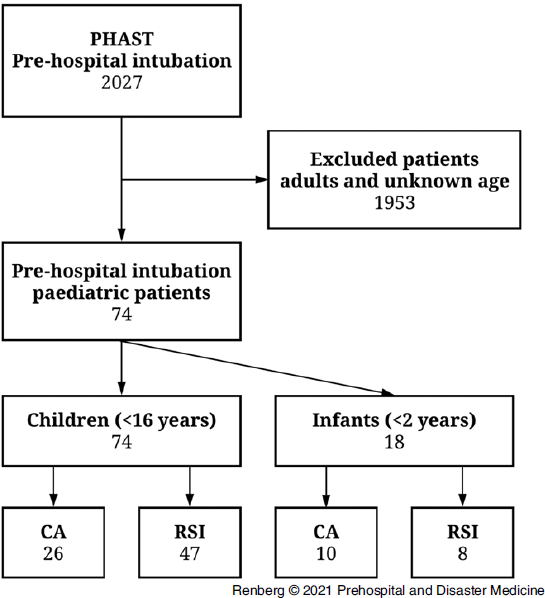
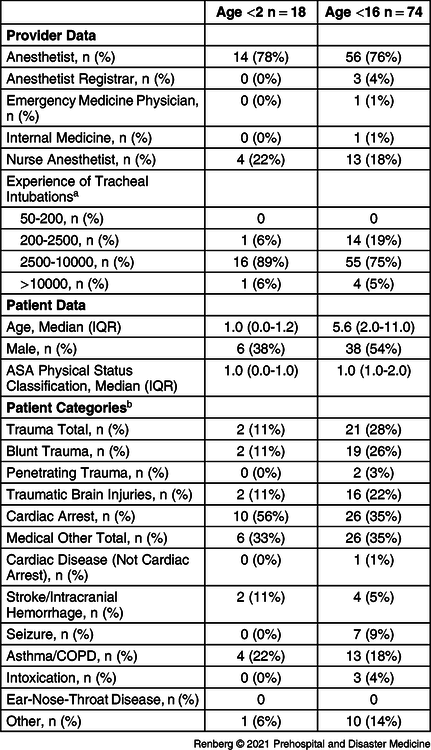
During the study period, clinicians attended 74 children requiring TI (Figure 1). Of these, 18 were younger than two years (termed <2y). In all children, cardiac arrest and other medical conditions were the dominant medical categories (Table 1) in 26 (35%) children, followed by trauma in 21 (28%) children. Obstructive airway disease was the most common pathology in the category Other medical conditions in 13 (18%) children. Physician anesthesiologists intubated 56 (76%) of the children. The majority (59; 80%) were intubated by providers with at least 2,500 previous intubations.
Flowchart of Pediatric Intubated Patients.
Abbreviations: PHAST, prehospital airway original study by Gellerfors, et al; CA, cardiac arrest; RSI, rapid sequence induction.

Demographic Information

Abbreviations: ASA, American Society of Anesthesiologists; COPD, chronic obstructive pulmonary disease; IQR, interquartile range.
a Missing data, therefore percentages do not add up to 100%.
b Multiple response set, therefore percentages do not add up to 100%.
TI Success Rates and Complications
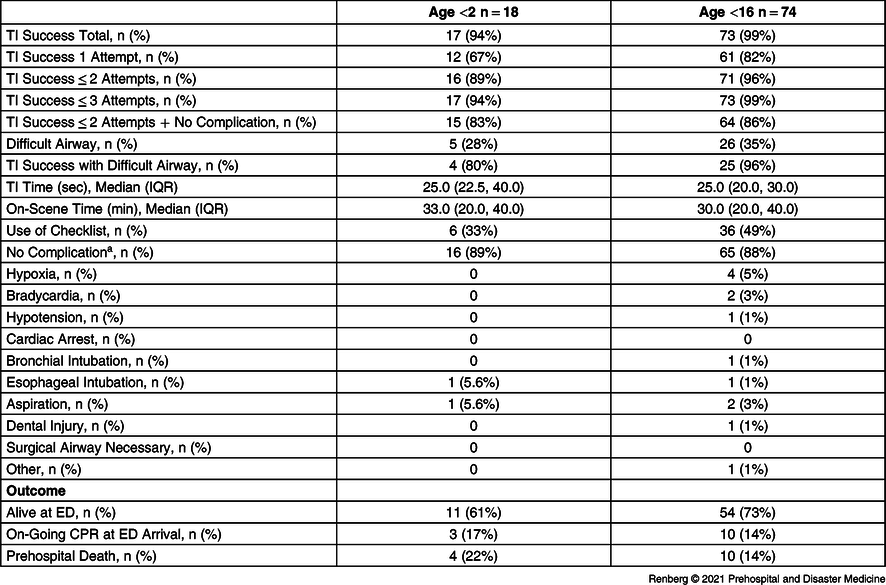
The overall TI success rate was 98.6% and 94.0% for children <2y (Table 2). In all children, 61 (82%) were intubated using one laryngoscopy attempt, 71 (96%) within two attempts, and 73 (99%) after three attempts. For children <2y, success rates per attempt were lower at 67%, 89%, and 94%. The median TI time was 25 seconds for both groups. The median on-scene time was 30 minutes. On-scene time was somewhat longer in the <2y group at 33 minutes. Complications occurred in nine (12 %) children. Fifty-four (73%) children were alive at arrival at the ED (11 [61%] in <2y). Cardiopulmonary resuscitation was on-going at ED arrival in 10 (14%; 3 [17%] in <2y). Ten (14%) children (4 [22%] in <2y) were declared deceased before ED arrival.
Prehospital Intubation Success and Complications in Children <16 Years of Age and Infants <2 Years of Age

Abbreviations: CPR, cardiopulmonary resuscitation; ED, emergency department; IQR, interquartile range; TI, tracheal intubation.
a Multiple response set, therefore percentages do not add up to 100%.
RSI and Cardiac Arrest Sub-Groups
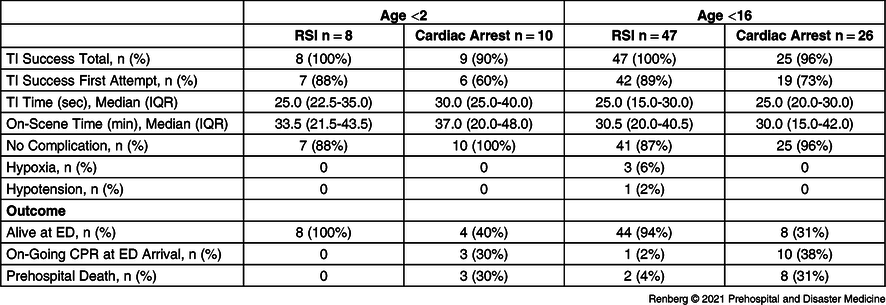
Airway data for each age category (<16 and <2y) in the sub-groups cardiac arrest and RSI are presented in Table 3. Among all children (<16) with cardiac arrest, TI was successful in 25 (96%). The TI first pass success rate in cardiac arrest was 73% among all children and children <2y was 60%. All children requiring RSI were successfully intubated with complications occurring in six (13%).
Prehospital Intubation Success and Complications in Children and Infants According to RSI and Cardiac Arrest

Abbreviations: CPR, cardiopulmonary resuscitation; ED, emergency department; IQR, interquartile range; RSI, rapid sequence induction; TI, tracheal intubation.
Comparisons with Adult Patients
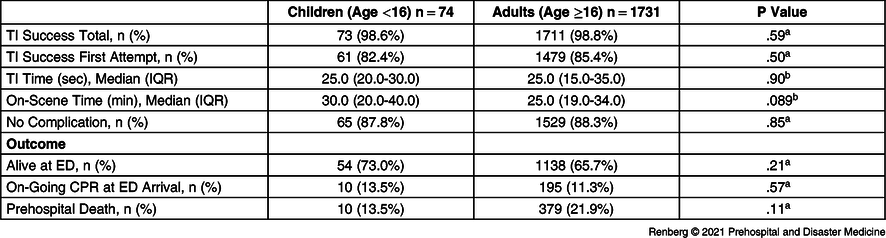
Table 4 compares the children observed in this study with the adult population in the original study. Reference Gellerfors, Fevang and Bäckman13 The overall TI success rate was 98.6% in children and 98.8% in adults (P = .59). The success rate for the first TI attempt was 82.4% for all children and 85.4% for adults (P = .50). The median on-scene time was 30 minutes in children compared to 25 minutes in adults (P = .089). Fifty-four (73%) children and 1,138 (66%) of adults were alive at arrival to the ED (P = .21); 10 (13.5%) children and 195 (11.3%) adults had on-going CPR at ED arrival (P = .57).
Prehospital Intubation Success and Complications in Children Compared to Adults

Abbreviations: CPR, cardiopulmonary resuscitation; ED, emergency department; IQR, interquartile range; RSI, rapid sequence induction; TI, tracheal intubation.
a Fisher’s exact test.
b Wilcoxon rank-sum test.
Discussion
This study on pediatric prehospital TI performed by experienced airway providers documented a high overall TI success, few associated complications, and short scene times.
The high overall TI success rate of 98.6% in this study compares favorably to all but one of 19 included studies in a meta-study by Rodriguez, et al Reference Rodríguez, Higuita-Gutiérrez, Carrillo Garcia, Castaño Betancur, Luna Londoño and Restrepo Vargas7 and is in line with the study by Eich, et al Reference Eich, Roessler, Nemeth, Russo, Heuer and Timmermann15 who documented a 98.3% overall success rate. The TI success rate was lower than reported by Nevin, et al (99.6%) in pediatric trauma patients. Reference Nevin, Green, Weaver and Lockey16 Despite the underlying challenges of the pediatric airway and physiology, the high overall TI success rate in this study is nearly identical to that of the adult population reported in the original study Reference Gellerfors, Fevang and Bäckman13 (98.6% compared to 98.8%). This result may be attributed to the experience of the participating teams, where 80% of providers had performed at least 2,500 intubations.
Trauma constitutes a significant portion of the pediatric prehospital caseload. Reference Eich, Roessler, Nemeth, Russo, Heuer and Timmermann15 In the management of trauma patients, it is important to mitigate complications associated with TI to avoid a secondary insult. Reference Chi, Knudson and Vassar17 Prehospital hypoxia in patients with traumatic brain injury leads to increased disability and mortality. Reference Chi, Knudson and Vassar17 First pass success rate is a relevant metric as each TI attempt is associated with additional risk of complications. Reference Mort18 This study observed a first pass success rate of 82% of all children, and 67% in the <2y group, comparable to the first pass success rate in adult patients (85.4%) in the original study. Reference Gellerfors, Fevang and Bäckman13 The first pass success rate is lower than observed by Schmidt, et al Reference Schmidt, Ulrich, Seifert, Albrecht, Spahn and Stein19 (95.3%) but higher than reported by Tarpgaard, et al Reference Tarpgaard, Hansen and Rognås20 who observed a first pass success rate of 75% for all children <16 years and 54% for children <2y.
The incidence of complications observed in this study was consistent with previous studies at 12% for all children and 11% for the <2y group. Reference Garner, Bennett, Weatherall and Lee6,Reference Eich, Roessler, Nemeth, Russo, Heuer and Timmermann15,Reference Burns, Watterson, Ware, Regan and Reid21 The complication rate was comparable to the adult patients in the original study Reference Gellerfors, Fevang and Bäckman13 (12%) and with a study by Sunde, et al Reference Sunde, Heltne and Lockey22 (13%) with both adult and pediatric patients. It was, however, considerably lower than reported by Tarpgaard, et al who documented complication rates of 20% all children and 38% for children <2y. Reference Tarpgaard, Hansen and Rognås20 A meta-study and systematic review by Garner, et al Reference Garner, Bennett, Weatherall and Lee6 observed a pooled incidence of complications in 10% of pediatric prehospital TI that was performed by physicians, and a significantly higher complication rate when performed by non-physician (30%-39%). The most prevalent complication in Targaard, et al Reference Tarpgaard, Hansen and Rognås20 (8%), Sunde, et al Reference Sunde, Heltne and Lockey22 (25%), and the meta-study by Rodriguez, et al Reference Rodríguez, Higuita-Gutiérrez, Carrillo Garcia, Castaño Betancur, Luna Londoño and Restrepo Vargas7 (7%) was esophageal intubation. In this study, the most prevalent complication in all children was hypoxia (5%) and in the <2y group esophageal intubation (5.6%; n = 1) and aspiration (5.6%; n = 1).
In the original study, Reference Gellerfors, Fevang and Bäckman13 HEMS and RRCs attended 32,007 patients, out of which 2,027 required TI. The 74 pediatric patients in this study therefore only comprised 3.7% of all TI, and the incidence of a pediatric TI in all patients attended by the RRCs and HEMS were only 0.2%. The observed incidence of prehospital pediatric TI in this study are in line with Garner, et al Reference Garner, Bennett, Weatherall and Lee6 who report an incidence of pediatric patients in approximately five percent of all patients tended to by EMS and TI in 0.1% to approximately 5.0% of those patients. Pediatric prehospital TI is extremely rare and this reinforces the need of maintaining adequate competence outside of strict prehospital exposure.
The effect of time on scene on mortality in trauma patients is heterogeneous and studies have failed to demonstrate a survival benefit of shorter scene times. Reference Harmsen, Giannakopoulos, Moerbeek, Jansma, Bonjer and Bloemers23 However, short response time and transport time may be associated with increased survival, indicative of prehospital time being of importance. Reference Harmsen, Giannakopoulos, Moerbeek, Jansma, Bonjer and Bloemers23 Tjissen, et al Reference Tijssen, Prince and Morrison24 observed that overly short (<10 minutes) as well as long (>30 minutes) times on scene in non-traumatic cardiac arrest in children may be associated with decreased survival. Time on scene might be the only time variable under the influence of EMS providers, which might suggest that the right type and amount of intervention be administered in the shortest time possible. Reference Harmsen, Giannakopoulos, Moerbeek, Jansma, Bonjer and Bloemers23
This study observed a median time on scene of 30 minutes for all children and slightly longer, 33 minutes, for the children <2y. This was a longer on-scene time than in the adult patients, with a median time of 25 minutes (P = .089). A longer time on scene might, at least in part, be attributed to the underlying airway and respiratory differences in the pediatric patient as well as an increased likelihood of challenging scenes associated with a critically injured child. Nevin, et al Reference Nevin, Green, Weaver and Lockey16 observed a median time on scene of 20 minutes in undifferenced trauma patients, with an increase to a median of 41 minutes when RSI was administered. This study found a longer median time on scene (30 minutes) among all children, but it was not significantly influenced by the administration of RSI (30.5 minutes). However, the observed median time on scene compared favorably to Burns, et al Reference Burns, Watterson, Ware, Regan and Reid21 who observed a median on-scene time of 50 minutes.
Seventy-three percent of the children were alive at arrival at the ED compared to 65.7% of the adult patients in the original study, Reference Gellerfors, Fevang and Bäckman13 and 13.5% of the children were declared deceased prehospital compared to 21.9% of the adult patients. A result that, at least in part, may reflect a reluctance to terminate resuscitation attempts in children in the prehospital setting.
Generalizability
These data were collected in four rather homogenous Nordic countries with similar demographics and EMS; extrapolation to other settings should be done with caution. The results could be useful to similar EMS and demographics.
Limitations
This was a sub-group analysis with a relatively low number of children from a descriptive study and the results should therefore be viewed with caution. In addition, these data consist of self-reported data, which may under-report adverse events as reported by Kerrey, et al. Reference Kerrey, Rinderknecht, Geis, Nigrovic and Mittiga25 In order to mitigate the effect of recall and registration bias of self-reported data, the airway provider registered the data directly after mission completion on an anonymous data registration form. No data on in-hospital or long-term mortality and complications were collected in the original study, Reference Gellerfors, Fevang and Bäckman13 which may under-estimate complications related to prehospital TI.
Conclusion
This descriptive study observed pediatric prehospital TI with relatively few complications, short on-scene time, and a high overall prehospital TI success rate in children <16 years of age. The observed TI success rate was nearly identical compared with the adult patients in the same setting, as described in the original study, Reference Gellerfors, Fevang and Bäckman13 despite the underlying challenges of the pediatric airway and respiratory physiology, as well as the rare occurrence of the prehospital pediatric TI. This favorable result might, at least in part, be attributed to the experience of the participating HEMS and RRCs and underlines the importance of competence in TI.
Conflicts of interest/funding
This study was not funded. No conflicts of interest to declare.