Implications
An overall assessment system to assess animal welfare must take several considerations into account. Increasing the number of measures results in more information, but it also increases either the time or the number of observers required. This work studied the observation of different measures of animal welfare upon pigs’ arrival at the slaughterhouse, with particular focus on where and how the observations are made in function of the validity of the results obtained. Testing theoretical aspects of assessment of animal welfare in commercial conditions contributes to the development of animal welfare schemes for the industry.
Introduction
Animal welfare concerns have given rise to several monitoring systems in Europe (Bartussek, Reference Bartussek1999; Von Borrell et al., Reference Von Borrell, Bockisch, Büscher, Hoy, Krieter and Müller2001; Bracke et al., Reference Bracke, Spruijt, Metz and Schouten2002). Most of these systems are largely based on observations of the animal’s environment and management as these are presumed to affect animal welfare, whereas only few observations are done on the animal itself. The EU project Welfare Quality® proposed an overall assessment system for animal welfare based on observations of the animal (Blokhuis et al., Reference Blokhuis, Jones, Geers, Miele and Veissier2003). Based on a multidimensional approach, welfare was defined by four principles: feeding, housing, health and optimal emotional states (Botreau et al., Reference Botreau, Veissier, Buttherworth, Bracke and Keeling2007). That means, for instance, welfare of pigs at the slaughterhouse comprises good health, comfort, expression of appropriate behaviours, and so on. However, an overall assessment system is only as valid as the measures used to develop it. Parameters included in a valid overall assessment system should be feasible and repeatable. Repeatability is defined as the similarity of repeated measurements on one object or subject. Inter-observer repeatability (IOR) concerns the degree to which two or more observers assessing the same animals at the same time report similar scores. The decision whether to select relevant parameters for an overall assessment system is based on validity, feasibility and repeatability as described above.
An overall assessment system for pig welfare at the slaughterhouse must take into account that different welfare measures may be best scored in different areas of the plant. For example, stocking density is relevant in the lairage zone (lairage), vocalisations in the stunning area and motion-sick animals in the unloading bay. Transportation is considered to be a major stressor for farm animals, especially for pigs. It might have detrimental effects on health, well being, performance and meat quality (Stephens and Perry, Reference Stephens and Perry1990). The unloading area is thus one of the most important places to include when assessing welfare at the slaughterhouse. The unloading area is also the place where animals are exposed to a novel environment and handling that may cause fear or difficulties in moving. Therefore, observations made in the unloading area, such as lameness, fear and animals slipping and falling can be useful measures for an overall assessment system for animal welfare at the slaughterhouse.
Lameness is very relevant for pig welfare because it indicates pain and a reduced ability to cope with the environment. According to Grandin (Reference Grandin2000), poor condition of animals arriving at the plant, such as animals with a compromised gait, is one of the five basic causes of animal welfare problems in slaughter plants.
Several indicators have been used to assess fear, such as approach/avoidance behaviour, freezing or reduced exploratory behaviour, amount of defecation, failure to feed in a strange environment or vocalisations. During unloading, avoidance behaviour could be measured by the number of pigs that show turning back, reluctance to move, retreat attempts or vocalisations. Some of these fear parameters were validated in a previous study of the Welfare Quality® project (Dalmau et al., Reference Dalmau, Fabrega and Velarde2009). Further, animal welfare and calm handling at the slaughterhouse is impaired if animals slip or fall on the floor (Grandin, Reference Grandin2003). Grandin (Reference Grandin2000) also cites that the percentage of pigs that slip or fall during handling is one of the five major criteria for monitoring welfare at slaughter plants.
The objective of this study was to test IOR when scoring lameness, fear and slipping and falling as parameters for monitoring welfare of killing pigs arriving at the slaughterhouse, and to test IOR between locations when scoring lameness, slipping and falling.
Material and methods
Assessments were carried out in killing pigs (100 to 130 kg BW) at two Belgian and two Spanish slaughterhouses. The following measures were scored: slipping and falling (173 groups with a mean of 10 pigs/group), lameness (173 groups with a mean of 10 pigs/group) and fear (100 groups with a mean of 26 pigs/group; Table 1). Slipping and falling, and lameness were assessed twice: during unloading (over the whole length of the unloading ramp; three to four observers), and in the passageway to lairage (from the point where pigs left the ramp, for a length of 5 to 7 m; three observers). Fear was assessed in the unloading area by six to seven observers. The observers, all of them were staff at the research institutes who participated in the study, were all experienced in the fields of pig production or pig behaviour. They were trained to observe all the different parameters by means of video recordings and other training material. For training the staff in lameness detection, a video was used that showed seven animals without lameness and 22 animals with different degrees of lameness. This trained the observers to distinguish the different types of possible lameness. In the case of slipping and falling, a PowerPoint presentation and some videos were shown to illustrate the difference between slipping and falling. Finally, in the case of fear assessment, observers were shown a video illustrating different examples of fear in 20 groups of animals.
Number of groups and animals considered for the analyses in relation to the slaughterhouses

The type of unloading ramp of each slaughterhouse is also provided.
The unloading area in the slaughterhouse consisted of the lorry ramp and unloading bay. If the slaughterhouse did not have an adjustable ramp, as in the case of slaughterhouse 3 (Table 1), the unloading area was considered to stretch from the beginning of the lorry ramp to the end of the floor slope. If the lorry had a tailgate lift, the assessment began when the lift was on the floor with the doors open.
The number of animals with lameness was scored by visually observing the gait according to a two-point scale: (0) normal gait or (1) abnormal gait as described by difficulties walking but still using all legs, minimum weight bearing on affected limb and animals unable to move by themselves. The measures of fear were defined according to Dalmau et al. (Reference Dalmau, Fabrega and Velarde2009): (1) animals showing reluctance to move, defined as a pig stopped, not moving the head or body and not exploring for at least 2 s; (2) retreat attempts, defined as a pig backing away; (3) turning back, defined as a pig that facing the unloading area, turned its body and faced the lorry area; and (4) vocalisations, defined as pig squealing or with vocalisations different than grunting. In slaughterhouse 2, vocalisations were not considered. Finally, slipping was defined as a loss of balance without the body touching the floor, while falling consisted of a loss of balance in which a part of the body other than the legs touched the floor. Fear was scored separately from the other parameters.
In the case of lameness and slipping and falling measures, the experimental unit (group under observation), was determined arbitrarily before unloading by a handler standing in the lorry that marked each group with a different colour code. By default, the group size was 10; if group size was smaller (because they were the last animals on a tier), this was recorded by the handler. The experimental unit during unloading was similar to that used during movement to lairage. During the fear assessment, the experimental unit was determined according to the groups that the stock personnel of the plant used to drive the animals to lairage; the intention here was to not interfere with the behaviour of the animals. In this study, the mean group size was 26, although it ranged from 4 to 73. Observers were positioned either in front of the ramp or the lift of the lorry, in order to see the whole ramp or lift without disturbing the unloading process.
Statistical analyses
For each group (representing the experimental unit), the numbers of pigs showing lameness, reluctance to move, retreat attempts, turning back, vocalisations or slipping and falling, were expressed as fractions of the total number pigs within the group. As these data were not normally distributed, Spearman’s rank correlations were used to calculate the association between the number of pigs showing lameness, reluctance to move, retreat attempts, turning back, vocalisations and slipping and falling, per subgroup within observer pairs. All statistical analyses were performed with the Statistical Analysis System (SAS; software SAS Institute Inc., Cary, NC, USA; 1999 to 2001).
Results
Lameness
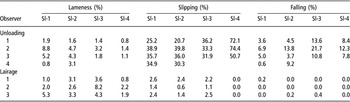
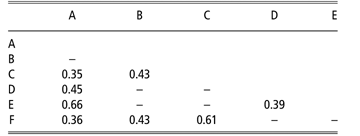
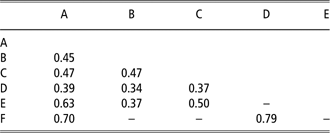
According to the observers, the mean prevalence incidence of lameness in the unloading area was 4.2%, 3.4%, 2.1% and 3.3% in slaughterhouses 1, 2, 3 and 4, respectively, and 2.8%, 3.0%, 5.4% and 1.6% in the area from the unloading bay to lairage (Table 2). The mean value of the Spearman’s rank correlations between paired observers in relation to the 173 groups studied was of r = 0.25 (ranging from 0.48 to 0.01) in the unloading area and of r = 0.46 (ranging from 0.66 to 0.35) in the unloading to lairage (Table 3).
Percentage of animals showing lameness, slipping and falling according to the different observers/Sl in the unloading area (unloading) or from the unloading bay to the lairage zone (lairage)

Sl = slaughterhouse.
Spearman’s rank correlation among observers for the fraction of lame pigs/group scored in the zone from the unloading bay to lairage
In all cases, P < 0.05.
Fear
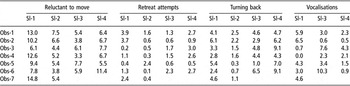
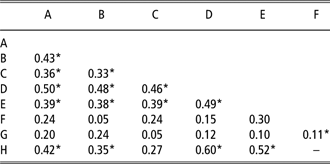
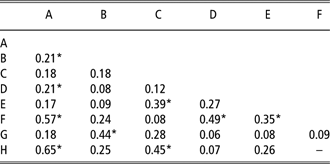
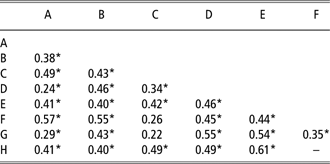
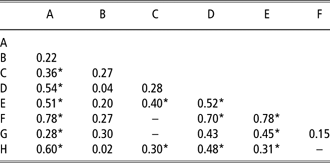
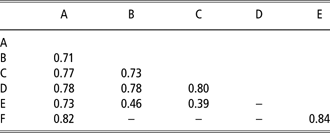
According to the observers, the mean incidence of reluctance to move was 10.6%, 5.5%, 5.4% and 7.4% for slaughterhouses 1, 2, 3 and 4, respectively (Table 4) and the mean incidence of retreat attempts was 1.9%, 0.8%, 1.3% and 2.1%. The average percentage of turning back was 4.1%, 1.4%, 4.0% and 6.7% for slaughterhouses 1, 2, 3 and 4, respectively. The mean incidence of vocalisations was 3.6%, 4.5% and 1.9% for slaughterhouses 1, 3 and 4, respectively. The Spearman’s rank correlations between paired observers in relation to the 100 groups were of r = 0.31 (ranging from 0.60 to 0.05) for reluctance to move (Table 5), r = 0.25 (ranging from 0.65 to 0.06) for retreat attempts (Table 6), r = 0.43 (ranging from 0.61 to 0.22) for turning back (Table 7) and r = 0.39 (ranging from 0.78 to 0.02) for vocalisations (Table 8).
Percentage of animals showing reluctance to move, retreat attempts, turning back and vocalisations according to the different Obs/Sl

Sl = slaughterhouse; Obs = observers.
Spearman’s rank correlation among observers for the fraction of animals showing reluctance to move in the unloading area
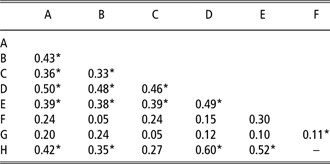
*Significance at P < 0.05.
Spearman’s rank correlation among observers for the fraction of animals showing retreat attempts in the unloading area
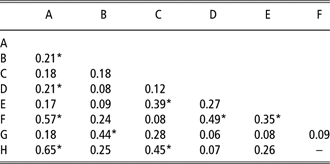
*Significance at P < 0.05.
Spearman’s rank correlation among observers for the fraction of animals showing turning back in the unloading area
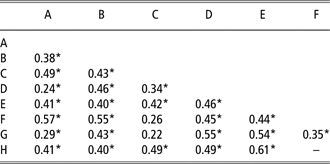
*Significance at P < 0.05.
Spearman’s rank correlation among observers for the fraction of animals showing vocalisations in the unloading area
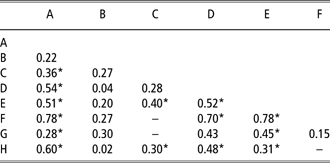
*Significance at P < 0.05.
Slipping and falling
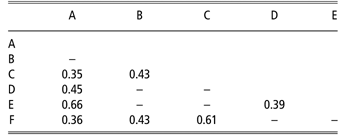
According to the observers, the mean incidence of animals slipping in the unloading area was 33.7%, 31.7%, 33.8% and 65.7% in slaughterhouses 1, 2, 3 and 4, respectively, and 2.1%, 4.4%, 1.9% and 0.0% in the area from the unloading bay to lairage (Table 2). The mean incidence of animals falling in the unloading area was 4.1%, 7.8%, 15.4% and 9.5% in slaughterhouses 1, 2, 3 and 4, respectively, and 0.1%, 0.1%, 0.1% and 0.0% in the area from the unloading bay to lairage. The Spearman’s rank correlations between paired observers in relation to the 173 groups studied were of r = 0.71 (ranging from 0.84 to 0.39) for slipping in the unloading area (Table 9), and r = 0.50 (ranging from 0.79 to 0.34) for falling in the unloading area (Table 10). In the unloading to lairage, the mean value was r = 0.13 (ranging from 0.00 to 0.48) for slipping. Due to the low incidence of animals falling in lairage, no correlations were obtained for this parameter.
Spearman’s rank correlation among observers for the fraction of animals slipping in the unloading area
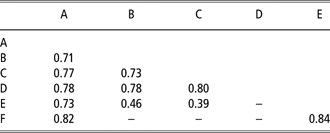
In all cases, P < 0.05.
Spearman’s rank correlation among observers for the fraction of animals falling in the unloading area
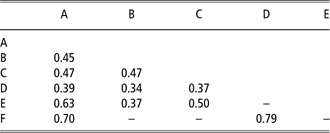
In all cases, P < 0.05.
Discussion
Lameness
In general, it was difficult to score lameness at unloading, especially when the slope increased (when animals were unloaded from the second or third tier of the lorry). In the unloading bay to lairage, in contrast, as pigs moved slower and slid less than at unloading, it was easier to score lameness, which resulted in a higher IOR. However, in this location, a clear and unobstructed view of every moving animal is often not possible when pigs are moved group wise. This explains the moderate Spearman’s correlations (Martin and Bateson, Reference Martin and Bateson1993) obtained and the inter-observer variability on the scorings per slaughterhouse. In addition, when discussing the results with the observers, it was concluded that the IOR could be improved if lameness was assessed in the corridor to lairage without scoring slipping and falling at the same time.
Fear
IOR of fear parameters were moderate or low. Two problems were detected when recording fear in the slaughterhouse. First, the vantage point of the observers’ mainly influenced their ability to assess. In this case, as six to seven observers were observing the same animals at the same time, not all of them had a good view of the unloading area. This created some blind zones, which may have affected the final correlations. In fact, when fear was assessed based on video recordings (where all observers had the same vantage point), IOR was improved to r = 0.54 for reluctance to move (data not presented). Second, the observers all agreed that assessing four behavioural parameters of fear made it difficult to adequately assess all parameters simultaneously. It was consequently decided to reduce the four parameters to two. Turning back was one of the chosen parameters, as it had the highest IOR. The other choice was either vocalisations or reluctance to move. According to the observers, assessing vocalisations interfered more with the observation of the other parameters, as the animals must be followed more intensively and it became difficult to observe other parameters. In contrast, reluctance to move could be combined well with turning back, and during the video recording analysis, where all the observers had the same point of view, this parameter had the highest mean IOR. After reducing the assessment of fear to turning back and reluctance to move, a training session with five observers was carried out. The training had two parts: first, watching video recordings (45 groups of 6 to 36 animals from the first, second and third tier of the lorry, for a total of 40 min of video material) and second, observing animals in a commercial abattoir (unloading two lorries, for a total of 370 animals observed during 1 h). During the training, agreement between scores increased to r = 0.67 for reluctance to move and r = 0.74 for turning back. According to the assessments of the observers, the slaughterhouse could be scored into a range from 5.5% to 8.0% of animals showing reluctance to move and from 1.3% to 2.1% showing turning back depending of the observer (data not presented).
Slipping and falling
The IOR of slipping and falling in the area between the loading bay and lairage was low. This was due to the difficulty of observing all the animals when they were moving as a group. In addition, the presence of animals slipping and falling in this area of the slaughterhouse was low. In contrast, the same observations in the unloading area yielded moderate-to-high IOR. In this case, most of the animals could be observed at the same time, and according to the results, the prevalence of animals slipping and falling is also higher in the unloading area in comparison with lairage. A discussion of the results with the observers also revealed that it would be useful to investigate whether IOR could be increased by assessing slipping, and especially falling, separately, and not in combination with other parameters such as lameness.
The results obtained from the observations carried out during the assessment of lameness, fear behaviour and slipping and falling by different observers in the four pig slaughterhouses suggested the following. If these parameters were to be combined in a protocol of overall assessment of animal welfare, they should be assessed in a way that does not overtax the observers and it should be done in different locations. Lameness might be assessed from the unloading bay to lairage, whereas the other parameters are best observed in the unloading area of the slaughterhouse.
Conclusions
Based on these results and on our recent experiences with pig welfare monitoring at the slaughterhouse, we advise the following. Assess lameness from the unloading bay to lairage, assess no more than two indicators of fear at the same time (reluctance to move and turning back), and assess slipping and falling in the unloading area of the slaughterhouse. The three indicators of animal welfare (lameness, fear and slipping and falling) must be measured in a way that does not overtax the observers.
Animal welfare implications
An overall assessment system to assess animal welfare must take several considerations into account. Increasing the number of measures results in more information, but it also increases either the time or the number of observers required. The IOR decreases when the same observer is assessing lameness and slipping and falling in the unloading area, so different groups of animals must be assessed for both parameters. Furthermore, the simultaneous assessment of more than two fear behaviours also decreases the reliability, and it does not seem possible to combine the observation of vocalisations with another measure. The area where animals are assessed also affected the validity of the observations.
Acknowledgements
This study was financed by the Welfare Quality® project. This project is a European research project on the integration of animal welfare in the food quality chain, from public concern to improved welfare and transparent quality. Welfare Quality is co-financed by the European Commission, within the 6th Framework Programme, contract No. FOOD-CT-2004-506508. This article represents the authors’ views and does not necessarily represent a position of the European Commission, who will not be liable for the use made of such information. The authors thank to all of the slaughterhouse personnel and management for their collaboration, and to Miriam Levensen for language revision.