Vidalia® sweet onion is a dry-bulb onion grown in Georgia as a cool-season crop established in the autumn and harvested the following spring. Georgia onion plantings in 2014 were 4,540 ha, with a statewide crop value estimated at $108 million (USDA 2015). There have been efforts in recent years to expand the markets of Vidalia® sweet onion. One area of interest is certified organic onion production.
Crop production budgets for organic onion production indicate that the two most costly inputs are the cost of transplants ($4,450 ha−1) and weed control using hand weeding ($3,710 ha−1) (RL Torrance, personal communication). In addition to being costly, relying solely on hand weeding is often not feasible due to difficulties in legally hiring and managing labor to hand weed. Any cost-effective weed control system that reduces or eliminates the need for hand weeding will provide a significant cost savings to organic onion growers.
The high cost of weed control using hand weeding is common to many organic crop production systems, including organic onion production (Melander and Rasmussen Reference Melander and Rasmussen2001; Melander et al. Reference Melander, Rasmussen and Barberi2005). Compared with direct seeding, transplanting onion is a cultural practice that improves weed management in organic onion production (Ascard and Fogelberg Reference Ascard and Fogelberg2008; Bond et al. Reference Bond, Burston, Bevan and Lennartsson1998). The most effective integrated system of weed control in transplanted onion production reduced hand weeding by 70%, which resulted in a 96% yield increase compared with the same systems used in direct-seeded onion production. A transplanted onion production system gives the crop an advantage over weeds by providing a time buffer between transplanting the crop and weed emergence, allowing for earlier cultivation in transplanted onion due to larger crop size compared with direct-seeded onion. Additionally, onion transplanted in late autumn is a shorter-season crop compared with direct-seeded onion, which is planted in late summer.
Mechanical weed control is among the most reliable methods of weed management in organic crops, including onion (Ascard and Fogelberg Reference Ascard and Fogelberg2008; Johnson et al. Reference Johnson, Langston, MacLean, Sanders, Torrance and Davis2012). The preferred cultivation implement is the tine weeder (Johnson et al. Reference Johnson, Langston, MacLean, Sanders, Torrance and Davis2012), which uses multiple rows of closely spaced tines. The tine weeder uses vibratory action to displace weed seedlings (Ascard and Fogelberg Reference Ascard and Fogelberg2008; Melander et al. Reference Melander, Rasmussen and Barberi2005). In laboratory studies, a single cultivation using an implement conceptually similar to a tine weeder uprooted 51% of the emerged weed seedlings in a coarse-textured soil (Kurstjens et al. Reference Kurstjens, Perdok and Goense2000). It is plausible that repeated cultivations using a tine weeder to displace seedling weeds would increase overall control. In transplanted onion, research has shown that up to four cultivations with a tine weeder were needed for adequate season-long weed control (Johnson et al. Reference Johnson, Langston, MacLean, Sanders, Torrance and Davis2012). Those studies also indicated that diseases of stored onion were not increased by intensive cultivation with a tine weeder.
While the benefits of cultivation with a tine weeder were clearly evident (Johnson et al. Reference Johnson, Langston, MacLean, Sanders, Torrance and Davis2012; Melander and Rasmussen Reference Melander and Rasmussen2001; Melander et al. Reference Melander, Rasmussen and Barberi2005), weeds often escaped control and the survivors were very large at the time of harvest. Johnson et al. (Reference Johnson, Langston, MacLean, Sanders, Torrance and Davis2012) observed that surviving weeds hindered the first-stage of harvest—the lifting process. Onion lifting uses a horizontally mounted sharpened steel blade that undercuts onion plants. Large weeds, particularly those with well-developed tap roots, impeded the blade from cleanly undercutting the crop, and some onion bulbs were damaged. Damaged onion bulbs can correlate to increased incidence of botrytis neck rot (caused by Botrytis allii Munn) in stored onion (Boyhan and Torrance Reference Boyhan and Torrance2002). Natural extracts from giant knotweed have fungicidal and bactericidal properties (Su et al. Reference Su, Blair, Johnson and Marrone2012). The resulting pesticide is permitted in certified organic crop production, and when used as a biofungicide, can be used to manage diseases caused by Botrytis species (Anonymous 2017), mainly by altering host-plant response to infection (Su et al. Reference Su, Blair, Johnson and Marrone2012). Since botrytis neck rot is a serious disease of stored Vidalia® sweet onion, the biofungicide may provide protection for certified organic onion growers.
Field trials were initiated in 2012 to further address the interactive effects of intensive cultivation with a tine weeder, weed removal, and a biobased fungicide on onion yield and diseases of stored onion. Additionally, these experiments were designed to measure the effects of natural weed infestations on yield, bulb size, and diseases of stored onion.
Materials and Methods
Irrigated field trials were conducted for three growing seasons from 2012 through 2014 at the Vidalia Onion and Vegetable Research Center near Lyons, GA (32.018801°N, 82.220101°W). This site is located in the designated region where Vidalia® sweet onion is commercially produced (Boyhan and Torrance Reference Boyhan and Torrance2002) The soil was a Tifton loamy sand (fine-loamy, kaolinitic, thermic Plinthic Kandiudults), composed of 88% sand, 6% silt, and 6% clay, with 0.5% organic matter.
The experimental design was a randomized complete block with four replications. Treatments were a factorial arrangement of three levels of cultivation with a tine weeder, two levels of weed removal with hand weeding, and two levels of disease management with a biofungicide for a total of 12 treatment combinations. Cultivation regimes were cultivation twice (2X) at 2-wk intervals for a total of two cultivations per season, cultivation four times (4X) at 2-wk intervals for a total of four cultivations per season, and a noncultivated control. The initial cultivation was 3 wk after transplanting onion. The cultivation implement was a tine weeder (Aerostar Tined Weeder, Einböck GmbH & CoKG, 4751 Dorf an der Pram, Austria), which features multiple rows and gangs of flexible steel-rod tines with tine engagement adjusted to crop row spacing by using mechanical lifters. Weed removal treatments were season-long hand weeding at weekly intervals and a weedy control (no hand weeding). Fungicide treatments were a biofungicide derived from giant knotweed (Regalia®, Marrone Bio Innovations, Davis, CA) and a nontreated control. The biofungicide is suitable for use on certified organic crops and labeled to control fungal diseases caused by Botrytis spp. (Anonymous 2017; Su et al. Reference Su, Blair, Johnson and Marrone2012). The biofungicide was applied four times at biweekly intervals beginning in early February at 9.3 L ha−1 with a CO2-pressurized tractor-mounted plot sprayer calibrated to apply 468 L ha−1 at 414 kPa using high-volume spray tips (Turbo TeeJet® 11006 tips, Spraying Systems, Wheaton, IL).
Onion (‘Savannah Sweet,’ an approved cultivar for Vidalia® sweet onion production) was grown according to National Organic Standards, although the experimental site was not certified organic due to proximity to conventionally grown crops. Organically grown onion transplants were produced in seedbeds that were direct seeded in September each year. Two weeks before trial initiation, field sites were fertilized with 13,400 kg ha−1 of composted poultry litter (average analysis of 3% N, 2% P, 3% K) in November of each year and soil incorporated 8-cm deep with a power tiller. This rate of composted poultry litter was based on previous studies that determined the recommended rates for organic onion grown in Georgia (Boyhan et al. Reference Boyhan, Hicks, Torrance, Riner and Hill2010). In late November, seedbeds were again freshly tilled with a power tiller that also simultaneously marked transplant holes. Immediately after the final seedbed preparation, onion was transplanted by hand. Plots were 1.8-m wide by 6.1-m long, with four rows centered on the seedbed and each row 30-cm apart. At the time of transplanting, stem diameter of bare-root onion seedlings was approximately 10 mm with 50% of the tops removed, which was determined to be optimum for onion production in the region (Boyhan et al. Reference Boyhan, Torrance, Cook, Riner and Hill2009). Within each row, onion transplants were spaced 10-cm apart to achieve the optimum combination of yield and desirable bulb size (grade) (Boyhan and Kelley Reference Boyhan and Kelley2008; Boyhan et al. Reference Boyhan, Torrance, Cook, Riner and Hill2009).
Weed densities were measured mid-March of each year. Weeds were counted in two 0.5-m2 quadrats (0.5 by 1.0 m) in each plot, centered over a pair of onion rows. Yields were measured by mechanically undercutting and lifting onion at physiological maturity in early May each year. After field curing for 1 wk, roots and tops were clipped by hand and onion bulbs graded by size according to established standards (USDA 1995). Diseased, misshapen, and small onion bulbs were discarded during the grading process. Onion yields were recorded by grade and total yield. A subsample of 20 randomly selected medium-sized onion bulbs were collected from each plot and stored for 120 d at 1 C in controlled-atmosphere cold-storage conditions (3% O2, 5% CO2, 70% relative humidity [RH]). At the conclusion of the storage period, bulbs were removed and placed under ambient conditions (approximately 21 C, 65% RH) for 14 d of a simulated shelf-life period, at which time individual bulbs were sectioned and examined for symptoms of fungal and bacterial diseases common to stored onion.
Data were analyzed using a mixed-model analysis. Degrees of freedom were partitioned to test singularly and in combination the effects of cultivation, weed removal, and biofungicide treatment on weed control, onion yield parameters, and incidence of diseases of stored onion. Means were separated using Fisher’s protected least significant difference test at P≤0.05.
Results and Discussion
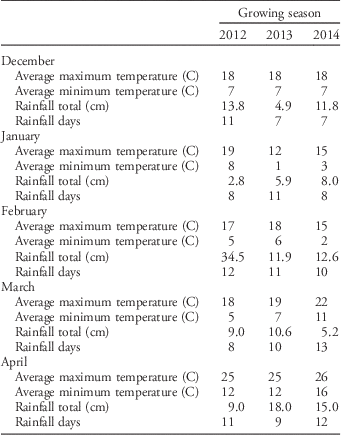
There were large differences in growing conditions among years, particularly in rainfall during periods when cultivation was scheduled (Table 1). For example, during the 2012 season, there was more total rainfall in February compared with the same month during other years, which affected the timing and performance of cultivation. Additionally, baseline weed densities varied among years, with weeds more numerous in the 2014 growing season compared with previous years (Table 2). Therefore, all data are presented by year. Analysis of variance indicated no significant interactions among cultivation, weed removal, and the biofungicide. Therefore, data for all parameters are presented by main effect.
Monthly daily temperature and rainfall summaries.Footnote a

a Data were recorded on Stanley Farms (known as “Vidalia” station) of the Georgia Automated Weather Network, approximately 32 km from the location of these experiments.
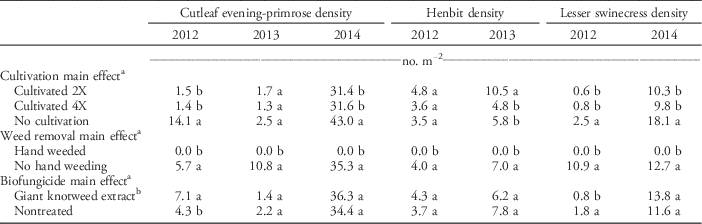
Main effects of cultivation, weed presence, and biofungicide on weed densities recorded in mid-March of each year in organic onion, Lyons, GA, 2012 to 2014.

a Within each main effect, means in a column followed by the same letter are not different according to Fisher’s protected least significant difference test at P≤0.05.
b The biofungicide is derived from giant knotweed. Four applications were made midseason at biweekly intervals at 9.3 L ha−1.
Weed Density
Cutleaf evening-primrose was present each year of the study, with the greatest density in 2014 (31.3 to 43.0 plants m−2) (Table 2), which proved challenging for all field operations that season. Cultivation reduced cutleaf evening-primrose density in 2012 and 2014. Cultivation 2X was equally effective as cultivation 4X in reducing cutleaf evening-primrose density compared with the noncultivated control. In 2013, cultivation had no effect on cutleaf evening-primrose density, but baseline densities were low that year, ranging from 1.3 to 2.5 plants m−2.
Onion treated with the biofungicide had more cutleaf evening-primrose than the nontreated control in 2012, but not in 2013 or 2014 (Table 2). Because there are no reports of the extract of giant knotweed stimulating emergence of weeds, this isolated effect in 2012 appears to be a circumstantial event.
Henbit was present in 2012 and 2013. In 2012, cultivation had no effect on henbit density (Table 2). In 2013, cultivation 4X reduced henbit densities compared with cultivation 2X, although densities did not significantly differ from the noncultivated control. The biofungicide did not affect henbit density in 2012 and 2013.
Lesser swinecress was present in 2012 and 2014 (Table 2). Cultivations 2X and 4X were equally effective in reducing lesser swinecress densities compared with the noncultivated control both years. In 2012, lesser swinecress densities were lower when onion was treated with the biofungicide compared with the nontreated control. In contrast, lesser swinecress densities in 2014 did not differ between treatment with a biofungicide and the nontreated control. There are no reports of extract of giant knotweed extract having herbicidal properties. Additionally, there was no phytotoxicity from the biofungicide, eliminating the possibility that the treatment stunted onion and facilitated weed infestations in the treated crop. As was the case with cutleaf evening-primrose, lesser swinecress response to the biofungicide appears to be an unexplained event.
Onion Yields
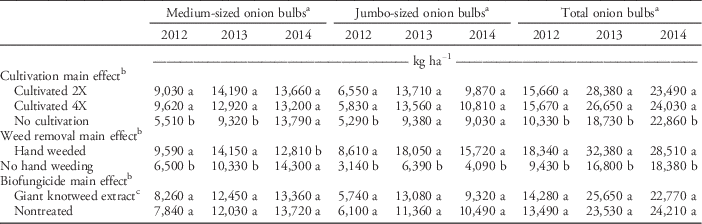
Medium-sized onion yield was greater when cultivated with the tine weeder compared with the noncultivated control in 2012 and 2013, with no yield difference between cultivations 2X and 4X (Table 3). There was no difference in medium-sized onion yield among any of the cultivation regimes in 2014. Cutleaf evening-primrose density in the 2014 cultivation main effect plots (ranging from 31 to 43 plants m−2) was much greater than in previous years, and the lack of medium-sized onion yield response to cultivation is an indication of the limitation of cultivation with a tine weeder for controlling dense weed populations. In 2012, cultivations 2X and 4X increased jumbo-sized onion yield over the noncultivated control, with no yield difference between cultivations 2X and 4X. Jumbo-sized onion yields were not affected by cultivation in 2013 and 2014. When onion yields are totaled, cultivations 2X and 4X increased onion yield over the noncultivated control each year of the study, with no difference between the two cultivation levels.
Main effects of cultivation, weed presence, and biofungicide on yield of organic onion, Lyons, GA, 2012 to 2014.

a Medium = 5.1 to 7.6 cm in diameter; jumbo >7.6 to 9.5 cm in diameter. Onion bulbs<5.1 cm in diameter were discarded. Colossal-sized bulbs (>9.5 cm diameter) are not reported due to few being produced in these trials but are included in the total yield.
b Within each main effect, means in a column followed by the same letter are not different according to Fisher’s protected least significant difference test at P≤0.05.
c The biofungicide is derived from giant knotweed. Four applications were made midseason at biweekly intervals at 9.3 L ha−1.
The main effect of weed removal using hand weeding increased medium-sized onion yields in 2012 and 2013 (Table 3). Jumbo-sized onion yields and total onion yields were increased by weed removal over the weedy plots each year of the study. The only inconsistency in yield response was for medium-sized onion yields in 2014, which had weedy onion yielding more than those hand weeded to remove all weeds. This can be attributed to an altered bulb-size distribution due to weed pressure; extreme weed infestations in the 2014 weedy plots caused the majority of the onion bulbs to be smaller (medium-sized), while hand-weeded plots in 2014 had proportionally more larger-sized bulbs (jumbo-sized).
The biofungicide did not affect any onion yield parameter across all years of the study (Table 3). Despite four applications of the biofungicide, the material had no effect on onion yield.
Diseases of Stored Onion
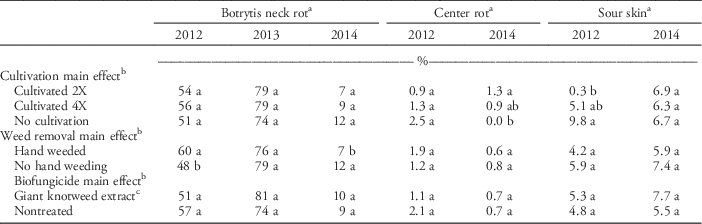
Botrytis neck rot was present in stored onion samples each year of the study. Cultivation had no effect on incidence of botrytis neck rot each year (Table 4). Weed removal had inconsistent effects on incidence of botrytis neck rot. In 2012, onion maintained weed-free with hand weeding had greater incidence of botrytis neck rot (60%) than plots that were weedy (48%). In 2013, weed removal had no effect on botrytis neck rot. However, in 2014, incidence of botrytis neck rot was greater when plots were weedy (12%) compared with hand-weeded plots (7%). Reasons for the variable response of botrytis neck rot incidence in stored onion due to hand weeding are unknown. The use of a biofungicide had no effect on incidence of botrytis neck rot in stored onion.
Main effects of cultivation, weeds, and a biofungicide on disease incidence in stored organic onion; Lyons, GA 2012-2014.

a Botrytis neck rot caused by the fungus Botrytis allii; center rot caused by the bacterium Pantoea ananatis; sour skin caused by the bacterium Pseudomonas cepacia. Disease incidence based on a sample of 20 medium-sized onion bulbs stored for 120 d.
b Within each main effect, means in a column followed by the same letter are not different according to Fisher’s protected least significant difference test at P ≤0.05.
c The biofungicide is derived from giant knotweed. Four applications were made midseason at biweekly intervals at 9.3 L ha−1.
Center rot, caused by the bacterium Pantoea ananatis (Serrano) Mergaret, was present in 2012 and 2014. Incidence of center rot was low both years, with cultivation having no effect on center rot incidence in 2012. In 2014, center rot incidence was increased by cultivation 2X (1.3%) over the nontreated control (0%) (Table 4), although conclusions cannot be made with such low levels of disease incidence.
Sour skin, caused by the bacterium Pseudomonas cepacia (Burkholder) Palleroni & Holmes, was present in 2012 and 2014. In 2012, onion cultivated 2X had lower incidence of sour skin compared with the noncultivated control, with no difference in incidence when onion cultivated 2X or 4X was compared (Table 4). Weed removal with hand weeding had no effect on incidence of sour skin. Similarly, four applications of the biofungicide had no effect on incidence of sour skin.
The lack of interaction among any of the main effects clarifies the role of cultivation with a tine weeder to control weeds in organic Vidalia® sweet onion. Overall, cultivations 2X and 4X were equally effective in reducing weed densities in transplanted organic onion. However, some weeds escaped control, and those weeds were large at harvest. This has been a consistent observation in previous studies that included cultivation as a main effect in the treatment structure (Johnson and Davis Reference Johnson and Davis2014a, Reference Johnson and Davis2014b; Johnson et al. Reference Johnson, Langston, MacLean, Sanders, Torrance and Davis2012). Obviously, greater baseline weed density results in more weeds surviving cultivation. The main effect of weed removal by hand weeding on onion yield was independent of the cultivation main effect for all parameters. This means that hand weeding to remove weeds escaping control from cultivation is not necessary to protect onion yields. While cost of weed control, including hand weeding, was not measured in these studies, season-long hand weeding will certainly be more costly than cultivating 4X with a tine weeder, which was estimated to cost $26.00 ha−1 for a single cultivation in 2008 (D Kaiser and N Smith, personal communication). Cultivation with a tine weeder remains a viable option for weed control in organic Vidalia® sweet onion.
There was no consistent effect of cultivation on diseases of stored onion, with incidence of the common fungal disease botrytis neck rot not affected by cultivation in all 3 yr of the study. This validates earlier research that did not show cultivation with a tine weeder increasing incidence of storage diseases of onion (Johnson et al. Reference Johnson, Langston, MacLean, Sanders, Torrance and Davis2012). Weed removal with hand weeding had unpredictable effects on incidence of botrytis neck rot in stored onion. The premise that the presence of weeds, particularly large weeds at harvest, would cause increases in botrytis neck rot cannot be proven or disproven by our results. While disease incidence was low, weed removal using hand weeding did not affect bacterial diseases of stored onion, which is contrary to conventional thought. Earlier observations during the lifting of onion at harvest in weedy plots led to speculation that weeds were interfering with the undercutting implement, resulting in damaged bulbs that would possibly increase disease incidence in storage. The lifting phase of onion harvest in the weedy plots was tedious and strained harvesting equipment. Despite these difficulties, our data indicate that the presence of weeds, including cutleaf evening-primrose densities as great as 35 plants m−2, does not necessarily affect diseases in stored onion.
The biofungicide evaluated in these trials provided no benefit to organic Vidalia® sweet onion production. Onion yields did not respond to the biofungicide, and incidence of diseases of stored onion were not affected by treatment. Based on these results, there is no advantage to use the biofungicide derived from giant knotweed in organic onion production.
It is worth noting that there were two years (2012 and 2013) in these experiments when the trials were located in fields with much lower baseline weed densities compared with 2014 (Table 2). Overall, cultivation performed better in 2012 and 2013 compared with 2014, with onion yields reflecting better weed control using the tine weeder. While this demonstrates the limitations of sole reliance on cultivation for cool-season weed control in organic Vidalia® sweet onion, it also illustrates the need in organic production systems for baseline weed densities to be maintained at a low level. Given the limitations of weed management in certified organic crop production, reduced baseline weed densities will facilitate overall weed management and reduce losses due to weeds.
Acknowledgments
We acknowledge the technical contributions of Daniel R. Evarts, whose skills made these studies possible. Appreciation is expressed to C. Randy Hill and Denny R. Thigpen at the Vidalia Onion and Vegetable Research Center for their support of this research study. We appreciate the managerial support and assistance rendered by Stephen Powell, Corrections Officer-II, Rogers State Prison, Reidsville, GA.