By and large, general emergency shelters established in community disasters have been designed for healthy, ambulatory persons traditionally referred to as the general population. 1 , 2 The composition of the general population presenting at a general emergency shelter has shifted over time, however, requiring adaptation of the emergency response system.Reference Sherry and Harkins 3 When combined with the potential unavailability of acute or chronic care facilities and mandates requiring equal access under the Americans with Disabilities Act (ADA), 4 general shelters must accommodate those who may have previously been transferred. 2 , 5 – 10
This study focused on function rather than disability or medical strata and defined functional needs clients as those who require assistance with activities of daily living (ADLs) and maintaining independence. Functional needs range from broad categories like food and shelter to specific categories such as medical devices and medication. 2 , 4 , Reference DeMarsh 7 , Reference Mont 11 , 12
ADA and federal assistance guidelines mandate that persons who require assistance or accommodation for functional needs in daily life, but who do not require acute medical care for stabilization, be admitted and served in general populations shelters. These shelters are required to provide equal access to services that preserve dignity in a manner similar to healthy, ambulatory populations. 2 , 4 , Reference DeMarsh 7 , 10 There has been a debate of whether functional needs support services can be successfully provided while meeting ADA requirements 2 to not segregate persons on the basis of disability. 1 Resolving this concern requires a significant shift in the practices and training of emergency response and shelter personnel. 1 , 2 , Reference Saez 13 – Reference Fannin 16
The US National Response Framework defines the Emergency Support Function #6 (ESF 6) of mass care as the provision of emergency sheltering, emergency feeding operations, emergency first aid, bulk distribution of emergency items, and collecting and providing information on victims to family members. The American Red Cross is partnered with the Federal Emergency Management Agency (FEMA)/Homeland Security for national response implementation of ESF 6, with the majority of functions provided at the local level, supported by state and federal actors. 5
An understanding of disaster respondersReference Bisin and Verdier 14 , Reference Fannin 16 and chronic care triage methodology prior to sheltering can assist in successful implementation of ADA requirements 4 to integrate functional needs into shelter operations 1 and to incorporate population-based chronic care triage into community mass care. Routing disaster evacuees to the various components of community mass care can be improved by comparing chronic care triage modalities for those with functional needs. Potential implications are increased shelter operation effectiveness and improved health outcomes of sheltered disaster survivors.
General shelter arrivals will have varying levels of chronic care needs requiring the availability of functional needs support services. 1 This research evaluated the ability of Medical Reserve Corps (MRC) volunteers and public health workers (PHWs) to conduct chronic care triage of disaster survivors before community mass care sheltering. The objective was to assess the ability of the flow processes to assist shelter providers to connect functional needs clients with effective, efficient, humane, and ADA-compliant 4 services in general emergency shelters.
Methods
Design and Setting
Each participant, either MRC volunteer or PHW, rated 20 survivors arriving at a chronic care triage station at a public health community reception center during a simulated disaster scenario. The client mix of survivors was set to approximate expected proportions of those with chronic care needs but expanded to 90% of presenting survivors. For each scenario, each participant was asked to use the algorithm provided to triage survivors to the appropriate chronic care service delivery point. This evaluation assumed that situation-appropriate transport services were available.
Clients
The simulated survivors included a target population of functional needs clients in a general shelter. Because a disaster would be required to obtain a living sample, clients were simulated, based on literature, from expected distributions in the national population, ages 18 to 90 years, of disability, mobility, sensory-visual, cognition, medical devices, ADLs, age, weight, and gender.
Interventions
Participants (the raters) were randomly assigned to use 1 of 4 conditions (two algorithms, one rubric, and one control group) to assist in decision-making regarding client status and service outcome. One algorithm was modified from current literature.Reference Nelson and Baptiste 17 A second algorithm was created on the basis of identified gaps in the literature. The rubric contained a modified scale based on a post-disaster experiential rubric used during the Hurricane Ike disaster.Reference Hirschfeld and Moore 18 The fourth condition was a control arm with no tool to assist in decision-making.
Main Outcome Measures
Because some tools afforded the user to have partially correct answers, the scores were weighted by relation to effectiveness, efficiency, and human dignity/ADA 4 compliance. Scores were standardized from zero for an incorrect answer up to one for a correct answer. Mean scores per group (the 3 tools and control) equivalent to the percentage correct were assessed by using one-way analysis of variance.
Definitions
Except for “disability,” which was used as defined by the ADA, 4 the following working definitions were used in the design phase of the study and were not mutually exclusive: 1 , Reference Fannin 16
-
∙ Vulnerable: has additional needs or influences outside of conventional expectations that impact the ability to protect or serve the self and often experiences disparity;
-
∙ Special needs: has needs derived from social influences or factors (examples include limited language proficiency, breastfeeding, pet-owners, elderly, children, families, religion, race/ethnicity, cultural, and geographic influence);
-
∙ Functional needs: has unfulfilled survival needs or requires assistance related to ADLs, communication, and mobility, especially to maintain degrees of independence (examples include toileting, transferring, hygiene, food preparation and consumption, temperature maintenance, and obtaining safe shelter); 2 , Reference Mont 11 , 12
-
∙ Medical needs: requires skilled nursing or medical care to maintain physical or mental health and stability as compromised by medical conditions (may be chronic, acute, or exacerbated by the disaster).
Data Source
We created a survey regarding functional needs gaps in general shelters during emergencies. The survey compared 3 tools and a set of control instructions regarding ability to effectively triage functional needs clients to shelters in an emergency situation. Respondents were assured anonymity; the data collection program evaluation was designed accordingly. The 12-day data collection period began June 8th, 2012, with one reminder sent via e-mail.
The data collection took place under the local public health agency’s authority to conduct program and practice evaluation in order to ensure protection of the public’s health. The study evaluation was submitted to the Wright State University’s Institutional Review Board and received exemption from review. The procedures followed were in accordance with the ethical standards of the responsible committee on human experimentation (institutional and national) and with the Helsinki Declaration, as revised in 2004.
Raters
This research examined the tools and the public benefit of the effectiveness of the training program for those most likely to use the tools: MRC volunteers and PHWs. The entire countywide cohort of PHWs and MRC volunteers not involved in the design of the tools were offered the evaluation via a survey link sent through established e-mail lists. MRC volunteers (n=204) and PHWs (n=66) were randomly assigned into 4 groups; of these, 45 chose to participate (response rate=16.5%). Out of these 45 participants, 30 fully completed the survey. The raters triaged 659 simulated disaster survivors prior to community mass care sheltering. Open-ended sampling of both subgroups was used with the upper limit bounded by total cohort size; all potential participants were notified that participation was voluntary. No one who responded to the survey link was excluded. Participants were able to share the link so that those with shared computers could complete the survey without difficulty.
The survey instrument consisted of 34 questions, which took approximately 40 minutes to complete. All raters began the survey with 7 questions about training, experience, and feedback on functional needs emergency shelter services and then were asked to use one of the supplied tools to triage 20 functional needs client vignettes. The vignettes presented survivors evacuating from an affected area with an estimated proportion of persons with functional needs requiring service. Appropriate service distributions were established a priori: 10% of the cases were distributed to a “no assistance needed” category, realizing that this number under-represents this category; 20% needed transfer to another facility to meet their needs; 20% arrived with personal care assistance; and 50% of the vignettes required some functional needs support services.
The raters triaged survivors in sequence by using either (1) no tool, (2) the Modified Lateral Transfer Flowchart, (3) the Chronic Care Triage Scale, or (4) the Athena Functional Needs Flowchart to connect each survivor to the appropriate service delivery endpoint. The service delivery endpoints were (1) transfer to another facility, (2) shelter assistance on standby if needed, (3) bring the functional needs service to client, or (4) assist client to service (with or without a friction-reducing device using 1 or 3 caregivers). The last 7 questions focused on experience, the professional profile of the volunteer, and repeated solicitation of feedback on functional needs emergency shelter services. The first 7 and last 7 questions were of a qualitative nature and were analyzed and reported separately for completion of a master’s degree.Reference Fannin 16
Data Analysis
Statistical analysis was conducted by using the IBM Statistical Package for Social Sciences (SPSS) for Windows, version 20. 19 Statistical analysis consisted of reliability testing and analysis of variance. The raters’ results were grouped by the randomly assigned tool used (Control, Lateral, Chronic, and Athena). Whereas the single intraclass correlation performed as if just one rater was used to triage all the survivors, with the single rater scoring lower than the average of many raters, the groups’ intraclass correlations provide a true measure of reliability of the raters.Reference Stemler and Tsai 20
Development of Experimental Algorithms
The 4 arms of the study consisted of the 3 different tools (1 scale and 2 flowcharts) and a control arm with no tool. Each tool was modified from either existing mechanisms or from identified gaps in care. The general format was based on a red, yellow, green triage structure owing to its familiarity to the MRC members, emergency responders, and PHWs. Each algorithm was adjusted to incorporate acute medical triage and transport to an acute care facility. To reduce cognitive load on survey responders, this portion was not included in the survey nor evaluated. Instead, survey responders were instructed that all presenting clients had passed appropriate acute medical triage. Service selection pathways and delivery endpoints were standardized as closely as possible without negating the integrity of the underlying process (Table 1). The two flowcharts primarily differed in the consideration of a personal care assistant and service methodology. Use of either tool was not considered to be a static one-time event; rather, sheltered survivors would be reassessed by using triage principles. The rationale for development accompanies the description of each tool.
Service Delivery Endpoint by Clinical Vignette’s Functional Category

Tool 1: Chronic Care Triage Scale
The US Public Health Service supported shelter operations during and after Hurricane Ike. As persons arrived at the shelter, those with functional needs were placed in cohorts to provide more efficient service (Table 2). Lessons learned from this method of chronic care triage were shared widely and may be used by responders in the future.Reference Hirschfeld and Moore 18 From this understanding, we adapted a rubric that could be used by shelter volunteers to connect clients to service delivery. For survey purposes, the adapted rubric was called the Chronic Care Triage Scale. The Chronic Care Triage Scale categorizes incoming clients to medical station services, a medical shelter, functional needs support services in a general shelter, or the greater general shelter without functional needs support services (Figure 1). Although it is understood that many needs imminent during triage are transitory or overlap with other presenting issues, 1 , Reference Fannin 16 this shelter operations construct focuses on client routing through general, functional, and medical needs groupings. Furthermore, the use of the construct assumes that community resources are organized such that separate systems are planned, exist, and would operate as medical stations, medical shelters, and general shelters with segregated functional needs support service capability. These concepts were preserved for evaluation during scale development.
Chronic Care Triage Scale. Adapted from Hirschfeld and Moore.Reference Hirschfeld and Moore 18

Chronic Care TriageFootnote a

a Adapted from Hirschfeld and Moore.Reference Hirschfeld and Moore 18
Tool 2: Modified Lateral Transfer Flowchart
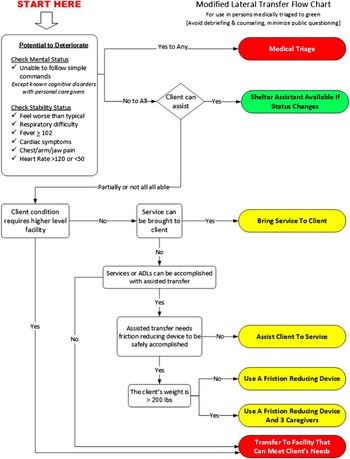
Algorithms exist in the literature to deliver functional needs support services in nonemergent situations. These tools are used in a number of settings and focus on specific patient care details such as lateral transfers and the number of required attendants.Reference Nelson and Baptiste 17 Lateral transfer was defined in this study as transferring a partial or non-weight-bearing survivor between 2 horizontal surfaces but could also include some limited lifting between beds and other surfaces. Given the nature of disasters, existing tools may be adapted to meet the influx of patients with functional needs in general emergency shelters. To evaluate the effect of adapting existing tools developed for nonemergency shelter scenarios and to have a modality for lateral transfers, we developed the Modified Lateral Transfer Flowchart (Figure 2).
Modified Lateral Transfer Flowchart.

Tool 3: Athena Functional Needs Flowchart
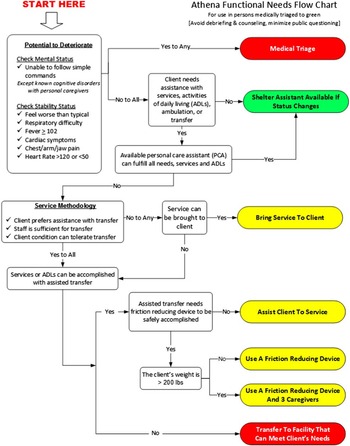
Segregating by functional needs, as practiced in the aftermath of Hurricane Ike, and lateral transfer algorithms, as used in hospitals and chronic care facilities, do not fully address functional needs service requirements or the presence of a personal care assistant in either a personal or professional relationship. The modified lateral transfer flowchart failed to assess client capacity, personal assistance via family or aides, client’s preferences, condition of the client, personal autonomy, and ADA requirements 4 (Figure 2). The capacity of the shelter, even in the context of pre-planning requirements, is minimally addressed.Reference Nelson and Baptiste 17 We developed the Athena Functional Needs Flowchart to allow for decision nodes of service methodology and the presence of a personal care assistant to be contrasted against the lateral transfer method and the segregated delivery of services by functional need (Figure 3).
Athena Flowchart: Considers Personal Care Assistant and Service Methodology During Chronic Care Triage.

Group 4: Control Instructions
The fourth group was designed as a control to differentiate whether tools assist in appropriately triaging functional needs clients to service delivery endpoints. The control instructions directed responders to triage clients on the basis of their current knowledge, skills, abilities, and best judgment.
Clients
A disaster would be required to obtain a living sample; thus, disaster survivors aged 18 to 90 years were simulated to approximate the expected disability distributions of mobility, sensory-visual, cognition, medical devices, ADLs, and weight in noninstitutional populations. Simulated clients with various functional needs were developed over 4 phases by identifying the distributions of (1) disability types expected to present, (2) gender and ages, (3) service types and number of clients requiring those services, and (4) intermediate pathways to enhance service selection.
Distribution of Types of Disabilities
Information from the literature was used to establish 5 categories of disability distribution: mobility, sensory, cognitive/behavioral, medical device, and no functional needs. Little information was available on exact distributions of functional needs clients with medical devices presenting to emergency shelters. Many population distributions were extrapolations of census counts; others were from post-disaster hospital presentation or mortality records; approximately half were from nonemergency situations. Population distributions were averaged to establish weighted means for each category and then normalized to apply the percentages to a set of 10 client vignettes representing simulated disaster survivors. The normalized distributions were as follows: mobility: 3, cognitive: 2, sensory: 2, medical device: 2, and no assistance needed: 1. Mobility was oversampled to account for bariatric patients not counted in census statistics.
The following demographics were used to create scenario population distributions: gender, age, and body weight. Of simulated clients, 50% were assigned to each gender.Reference Mills, Edmondson and Park 21 – Reference Greenough, Lappi and Hsu 23 Only adults were considered. Age distributions were selected on the basis of a documented skew of increasing disability or functional needs requiring assistance along population aging. The following number per age and body weight were simulated in each set of 10 disaster survivors: age 18 to 39 years: 2; 40 to 59 years: 3 and 4, respectively; 60 to 69 years: 3; and 70 to 90 years: 2 and 1, respectively; weight <200 pounds (lbs): 5; 200-299 lbs: 4; 300-499 lbs: 1.
Service types were endpoints to which responders could triage the variety of clients to internal and external services. These service types were placed into each of the 3 tools tested. The initial service types were created by analyzing decision points on an existing functional needs flowchart used in nonemergency facilities.Reference Nelson and Baptiste 17 This chart had 3 categories: (1) no assistance needed, (2) transfer using friction-reducing device, and (3) transfer using friction-reducing device plus 3 caregivers. We placed these as a foundational structure in the 2 flowcharts for the following reasons: the latter two endpoints fit ADLs and the mobility category, and the former endpoint served shelter seekers with variable disability and functional needs assistance from shelter personnel. 1 , Reference Fannin 16
Categorization of need by ADLs was alone insufficient to address the breadth of service assignments in a shelter. To determine appropriate service endpoints, ADLs were divided into assistance types: sheltering baseline, functional needs, and medical needs. Clients receiving minimal shelter support required no assistance with ADLs, medical device/medication, or mobility. Functional needs clients required assistance with one or more ADLs. Medical clients required acute or highly skilled nursing care. We created the following functional needs categories: ADL-based mobility, ADL-based sensory, ADL-based cognitive, medical device requiring assistance, and no assistance needed.
Main Outcome Measure
Federal response plans covering shelter operations recognize flexibility and the use of shelter sites designated by local government. Those plans, however, stress whenever possible that sites should be selected to maximize the accessibility for individuals with disabilities. 1 , 5 , 6
Like many units across the country, the Greene County Medical Reserve Corps unit has had a succession of trainings related to sheltering since its inception in 2005.Reference Brannen, Barcus and McDonnell 24 The unit has also responded to Hurricane Rita/Katrina, provided shelter support of functional needs during the aftermath of Hurricane Ike, assisted with the 2009–2010 H1N1 pandemic vaccination campaign, and provided support to a functional needs shelter after a large apartment building fire.
This depth of experience led to several considerations during the design phase. What process will improve routing of medically cleared disaster victims to services? What form should the process take? Segregating those with functional needs to more efficiently deliver needed services does not meet the legal requirements of delivering services without regard to disability. 1 , Reference Sherry and Harkins 3 , 4 , 6 , 25 If there is a dilemma in how services are delivered, what is the best way to meet legal standards? Can respect for human dignity be maintained in disaster situations? Where is the tipping point between maintaining human dignity versus preserving effectiveness and efficiency of delivering disaster support services? Should the historical emergency response culture or diverse context and severity of disasters be considered in designing and updating shelter operations?
These questions led our research team to assert that, in scoring the routing of disaster survivors, weighting rater responses on a scale, rather than dichotomous assignment of 0 and 1 for incorrect and correct answers, would more accurately represent disaster responder experience and perception. Endpoints were weighted by relation to (1) effectiveness, (2) efficiency, and (3) human dignity/ADA compliance, 4 with a standardized score of 0 for an incorrect answer, between 0 and 1 for partially correct answers, and 1 for a correct answer. Answers were considered correct if they met all 3 criteria and incorrect if they met only 1 or none of the criteria. Mean scores per group (the 3 algorithms and control; Figures 1 to 3), equivalent to the percentage correct, were assessed.
Participants
Forty-five of 267 MRC volunteers and PHWs contacted chose to participate (MRC volunteers: 57.8%, PHWs: 53.3%), completing routing of 659 survivors. Each participant was presented with 20 disaster survivors’ client vignettes.
Results
The lower bound of true reliability of the tools used by random raters triaging randomly ordered survivors as measured by Cronbach’s alpha was 0.881. Scores of 0.7 or higher are usually considered acceptable.Reference Tavakol and Dennick 26 Mathematically, reliability is defined as the proportion of the variability in the responses to the survey that is the result of differences between the respondents.Reference Barrett 27 The computation of Cronbach’s alpha was based on the number of survivors (k) and the ratio of the average covariance to the client vignette variance.Reference Bland and Altman 28 In our study, the disaster survivors by design had a large proportion of functional needs. Reliability across raters of the disaster survivors was the measure of reliability.
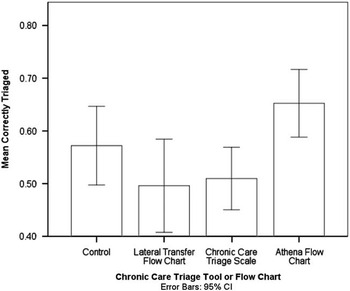
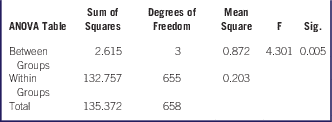
One-way analysis of variance found a significant difference between groups for mean percentage correctly triaged (Table 3). Post hoc pairwise comparisons showed an increase for the Athena flowchart across all the tools in the number of survivors with functional needs correctly triaged (Figure 4). There was a correlation coefficient of 0.897 among the ordered algorithms based on their ranked concentration to chronic care concerns.
Mean Pairwise Comparisons of Percentage Correctly Triaged. When raters used the Athena Flowchart (n=189) versus the Lateral Transfer Flowchart (n=100, p=0.005); Athena Flowchart versus Chronic Care Triage Scale (n=227, p=0.001); and Athena Flowchart versus control (n=143, p=0.108).

Analysis of Variance of Total Correctly Triaged Between Chronic Care Triage Tools

Discussion
To serve vulnerable populations, specifically clients with functional needs, general shelters need to consider policies, in-shelter assistance, or shelter design beyond the basic provision of shelter, food, water, and sanitation. 2 These considerations are often in the areas of mobility, technology, and ADLs and may include communication, psychological assistance, and medication.Reference Mont 11 , 12
The results can extend to both the inclusion of a personal care assistant and service methodology. The three-pronged service methodology addressed personal self-determination (dignity), the instructive realities of shelter administration, and the restrictions of client condition. These two nodes (personal care assistant and shelter methodology) are likely important and synergistic. Additional research may assess the weight of importance of these nodes. Starting with the basic functional need of shelter, the Athena chart addresses all shelter attendees rather than segregating persons with disabilities from those without. In doing so, shelter clients are prioritized until all occupants have returned home or are matched with long-term solutions.
Adopting a nonemergency tool, such as the Modified Lateral Transfer Flowchart, during a disaster scenario, or a field-developed/field-expedient tool, such as the Chronic Care Triage Scale, was less effective in correctly triaging survivors to needed services. In essence, given the current evidence, our best estimate is that such tools, when not vetted or adapted through testing and evidence-based analysis, could do more harm than not using any triage tool.
Allowing for the differences in the Lateral and the Athena flowcharts, the consideration of service methodology and the availability of personal care assistance requires an investment in time. However, the potential gain in service efficiency is up to 25% from the widest span in confidence intervals from no rubric to the use of the Athena chart. Service methodology considers the client preference, staffing, and client tolerance. Matching client preference with capabilities is an ethical mandate. 1 , 6 The use of an initial screening that considers personal care assistance and service methodology is consistent with recommendations for a “public health” rather than a “medical” paradigm. Having chronic care triage capability as part of community response will enhance community mass care operations. Indeed, the entire field is progressing on this issue, with the Rhode Island MRC having an assessment and identification of medical and functional needs that uses Kansas City MRC’s videos on shelter interventions. 29
As part of the process of receiving clients into general shelters, sorting surviving clients into basic categories will increase those correctly identified with additional assistance needs while complying with ADA requirements 2 of not segregating persons with functional needs or disability. This is consistent with a larger concept of continuing chronic care triage and services in a 2-phase screening process, with the second phase being a cot-to-cot review.Reference Springer 30 Nurse staffing at a 1:50 ratio with 1 additional health provider available has been proposed for general shelters.Reference Springer 30
The significant trend of the correlation coefficient of 0.897 provides further evidence of the need to incorporate chronic care triage as part of community mass care management. The high reliability of the raters (0.881) indicates that the findings should be reliable and generalizable to other PHWs and MRC volunteers who are providing population-level chronic care triage prior to community mass care sheltering. For medically cleared disaster survivors, the Athena Functional Needs Flowchart provides a higher level of access to functional needs services than does the practical and field-expedient chronic care triage scale. Chronic care triage that considers personal care assistance availability and service methodology should be considered in community mass care plans.
Conclusion
Triage process flow that considers service methodology and the personal care assistance of medically cleared disasters survivors before community mass care translates into proportional efficiency gains up to 8% in meeting chronic care health service needs in an effective, efficient, humane, and ADA-compliant service in general emergency shelters. Chronic care triage that considers personal care assistance availability and service methodology should be considered in community mass care plans.
Acknowledgments
The authors express deep gratitude to Dr Sharon Stanley, Dr Nikki Rogers, Dr Naila Khalil, and Sylvia Ellison for their efforts related to this work.