Implications
Results suggest a transfer of the phytoestrogen genistein from the sow to her offspring through placenta and/or colostrum. Even though providing genistein in late pregnancy increased IGF1 concentrations in gilts, it did not affect fetal growth. Yet, carcass fat content of neonatal piglets was increased and this coincided with a lower incidence in piglet mortality. The only effect of treatment on skeletal muscles of newborn piglets was an indication of a shift towards more glycolytic (instead of oxidative) metabolism. Overall, results do not support the use of such a treatment in commercial swine units to improve sow and piglet performances.
Introduction
Phytoestrogens are naturally occurring plant compounds that are structurally and/or functionally related to estrogens. They can have estrogenic or anti-estrogenic activities, depending on the concentration of endogenous estrogens present (Sun Hwang et al., Reference Sun Hwang, Seok Kwak, Jae Lim, Hee Lee, Soon Kang, Boo Choe, Gil Hur and Ok Han2006). Isoflavones (which include genistein and daidzein) are the best known class of phytoestrogens and were shown to be potentially beneficial in gestating swine. Dietary daidzein supplementation of late-pregnant sows increased the percentage of carcass fat in newborn piglets (Rehfeldt et al., Reference Rehfeldt, Adamovic and Kuhn2007), and improved prenatal growth of piglets via an up-regulation of the muscle IGF1 receptor gene transcription at birth (Ren et al., Reference Ren, Kuhn, Wegner, Nürnberg, Chen and Ender2001). When given to late-pregnant and early lactating sows, daidzein increased litter weights at birth and on day 20 of lactation (Liu et al., Reference Liu, Zheng, Chen, Chen and Han1999). However, these last two studies were done on a very limited number of sows. In vitro studies with porcine muscle cell cultures showed that genistein and daidzein affect the expression of genes of the IGF system (Kalbe et al., Reference Kalbe, Mau and Rehfeldt2008), and may reduce muscular protein degradation (Rehfeldt et al., Reference Rehfeldt, Kalbe, Nurnberg and Mau2009).
Genistein also has stimulating effects on mammary tissue in swine. Injections of genistein to post-pubertal gilts enhanced mammary gland development in a dose-dependent manner (Ford et al., Reference Ford, Clark, Walters, Wheeler and Hurley2006), and an increase in mammary parenchymal DNA was observed when gilts were fed 2.3 g/day of genistein from 90 to 183 days of age (Farmer et al., Reference Farmer, Palin, Gilani, Weiler, Vignola, Choudhary and Capuco2010). The present study was therefore undertaken to determine the impact of exogenous genistein during the specific period of rapid mammary and fetal development taking place in late pregnancy on body and organ weights, skeletal muscle properties and carcass composition of neonatal piglets, and growth of suckling piglets.
Material and methods
Animals and treatments
In total, 56 cross-bred gilts (Yorkshire×Landrace) were bred with semen from Yorkshire boars and were equally divided into the following two groups on day 90 of gestation: (1) controls (CTL), receiving two daily injections of vehicle (2 ml of corn oil); and (2) two daily i.m. injections (at 0800 and 1800 h) of 220 mg of genistein diluted in 2 ml of corn oil. Treatments were administered from day 90 of gestation until the onset of farrowing. The genistein (LC Laboratories, Woburn, MA, USA) was put in corn oil for 30 min at room temperature and mixed by simple rotation a few times during that period, it was then sonicated in an iced water bath for 2 min and vortexed for 20 s. Syringes were prepared twice a week and were kept covered with aluminum foil at 4°C. They were delicately mixed by hand before injecting. Throughout gestation, gilts were housed in individual stalls (0.6×2.1 m) and were fed 2.5 kg/day of a commercial gestation diet (13.6% CP, 13.5 MJ/kg digestible energy (DE), 0.6% lysine, 4.6% crude fiber) at 0755 h from mating to day 25 of gestation and from days 70 to 89 of gestation. This diet was fed at a rate of 2.6, 2.4 or 2.1 kg/day from days 25 to 69 of gestation for gilts with backfat thicknesses of <16, 17 to 21 and >21 mm, respectively. From days 90 until 109 of gestation, this same diet was fed at 3.2 kg/day. The diet contained 398.7 kg of corn, 150 kg of wheat, 108 kg of canola meal, 106 kg of barley, 90 kg of wheat shorts, 75 kg of gluten feed (21% CP), 20 kg of soya hulls, 10 kg of corn distillers dried grains with solubles, 42 kg of vitamin–mineral premix and 0.3 kg of lysine per 1000 kg of diet. On day 110 of gestation, gilts were moved to farrowing crates and were fed 3.2 kg/day of a commercial lactation diet (18.9% CP, 14.7 MJ/kg DE, 1.1% lysine, 2.9% crude fiber) until farrowing. On the day of farrowing they received 0.8 kg in the morning and 0.8 kg in the afternoon of the diet and as of the next day they were fed ad libitum with refusals being weighed daily. The lactation diet contained 554.3 kg of corn, 227 kg of soybean meal, 60 kg of canola meal, 100 kg of wheat shorts, 16 kg of feed fat, 42 kg of vitamin–mineral premix and 0.7 kg of lysine per 1000 kg of diet. Gilts were weighed and their backfat thickness was measured ultrasonically at the last rib (Scanmatic SM-1; Medimatic, Hellerup, Denmark) on days 89 and 110 of gestation, following an overnight fast, and on days 2 (BW only) and 22 of lactation, without overnight fasting. Isoflavones were measured in the commercial diets used. The gestation diet provided 13.9, 10.1 and 2.6 mg/kg diet of genistein, daidzein and glycitein, respectively. The lactation diet provided 244.2, 202.0 and 38.3 mg/kg diet of genistein, daidzein and glycitein, respectively. No isoflavones were detected in the corn oil used as vehicle for the injections.
Piglets were weighed within 12 h of birth and litters were standardized to 10±1 pigs at 48 h postpartum. Piglets were weighed again on days 2, 7, 14, 21, 28 and 56 postpartum. No creep feed was distributed to piglets until weaning (day 22±1), and they were then fed standard commercial diets ad libitum until day 56. One male of average litter BW from 16 CTL and 15 GEN sows was slaughtered at 24±1 h postpartum by a blow to the head followed by exsanguination. A jugular blood sample was obtained from that piglet before slaughter (for IGF1 and isoflavones analyses), and weights of the liver, heart and visceral organs (i.e. stomach after emptying, small and large intestines, spleen, pancreas) were obtained. Within 5 min of slaughter, the right semitendinosus (ST) muscle was dissected and weighed, and a 400 mg sample was obtained from a transversal cut of the mid-section. It was cut into small pieces, frozen in liquid nitrogen and stored at −80°C until analyzed. The reminder of the carcass was frozen at −20°C after removal of the head, hooves and tail, and was kept for compositional analyses (dry matter, fat, protein). All animals were cared for according to a recommended code of practice (Agriculture and Agri-Food Canada, 1993).
Blood and milk sampling
Jugular blood samples were obtained from 16 CTL and 16 GEN gilts at 0730 h on days 89 (before onset of treatment) and 110 of gestation, and at 1000 h on days 3 and 21 of lactation. Concentrations of prolactin and IGF1 were measured on all samples, concentrations of estradiol and progesterone were measured in gestation only and isoflavones (genistein, daidzein, glycitein and equol) were measured on the sample at 110 days of gestation.
Blood samples for prolactin assays were obtained in tubes without anticoagulant. They were left at room temperature for 4 h, stored overnight at 4°C, centrifuged the following day at 4°C for 12 min at 1800×g and serum was harvested. All other blood samples (including those from piglets) were collected in EDTA tubes (Becton Dickinson and Company, Rutherford, NJ, USA), were put on ice and centrifuged within 20 min at 4°C for 12 min at 1800×g, and plasma was immediately recovered. Serum and plasma samples were frozen at −20°C until they were assayed.
Gilts which were used for blood sampling were also used for milk collection on day 3 of lactation. Representative milk samples were obtained by hand milking. They were collected from three functional glands (anterior, middle and posterior) after an i.v. injection of 1.0 ml of oxytocin (20 IU/ml; P.V.U., Victoriaville, QC, Canada). Pigs were separated from their dam for 45 min before oxytocin was injected. Milk was then stored at −20°C and used for standard compositional analyses (dry matter, fat, protein, lactose).
Assays
The quantitative analysis of isoflavones in plasma samples was completed with a method using liquid chromatography/MS combined with photodiode array detection, as developed in Dr. Gilani’s laboratory (Sepehr et al., Reference Sepehr, Robertson, Gilani, Cooke and BP-Y2006). It comprised enzymatic digestion of isoflavone conjugates to obtain total isoflavone concentrations. The limit of detection values for genistein, daidzein, glycitein and equol were 0.0005, 0.0003, 0.0002 and 0.02 µM, respectively. Average mass recovery was 94.9%, 90.6% 102.5% and 94.1% for genistein, daidzein, glycitein and equol, respectively. Concentrations of IGF1 were measured with a commercial kit for humans (Alpco 26-G; Alpco, Salem, NH, USA) with small modifications as detailed previously (Plante et al., Reference Plante, Laforest and Farmer2011). Validation for a plasma pool from lactating sows was demonstrated. Parallelism was 101.2% and average mass recovery was 101.3%. Sensitivity of the assay was 0.10 ng/ml. The intra- and interassay CV were 6.11% and 1.46%, respectively. Concentrations of prolactin were determined according to a previously described radioimmunoassay (RIA) (Robert et al., Reference Robert, de Passillé, St-Pierre, Dubreuil, Pelletier, Petitclerc and Brazeau1989). The radioinert prolactin and the first antibody to prolactin were purchased (A. F. Parlow; US National Hormone and Pituitary Program, National Institute of Diabetes and Digestive and Kidney Diseases, Torrence, CA, USA). Validation for a plasma pool from lactating sows was conducted. Parallelism was 98.3% and average mass recovery was 98.4%. Sensitivity of the prolactin assay was 1.5 ng/ml. The intra- and interassay CV were 4.16% and 1.05%, respectively. Progesterone was measured with commercial kits (Progesterone CT; ICN Pharmaceuticals Inc., Costa Mesa, CA, USA). Intra- and interassay CV were 5.16% and 1.71%, respectively. Estradiol (MP Biomedicals, Orangeburg, NY, USA) was quantified using a commercial RIA kit. The intra- and interassay CV were 6.77% and 2.28%, respectively.
Chemical analyses
Piglet carcasses were ground three times in a meat grinder through a plate with 5-mm-diameter holes. They were put in a blender (15 amps) until homogenous in texture and were stored at −20°C. Dry matter content was determined according to an established forced air oven drying procedure (Association of Official Analytical Chemists (AOAC), 2005). Representative carcass samples were freeze-dried and later pulverized in a centrifugal grinding mill (Brinkmann ZM-1; Brinkmann Instruments, Rexdale, Canada). Fat was extracted twice with dichloromethane using the Soxtex System (Tecator 1043 Extraction Unit; Tecator, Herudan, VA, USA). Crude fat was determined by weighing the extracted residue. Protein content was determined in duplicates with the micro-Kjeldahl method (Kjeltec Auto System; Tecator AB, Hoganas, Sweden).
Whole milk was analyzed for dry matter, fat, protein and lactose contents. Dry matter was measured according to a validated method using forced air oven drying (AOAC, 2005). Protein content was determined in duplicates with the micro-Kjeldahl method and fat was extracted using an established ether extraction method (AOAC, 2005). Lactose was measured by a colorimetric method using a commercial kit (Megazyme International Ireland Ltd, Bray Business Park, Bray, Co. Wicklow, Ireland). Intra- and interassay CV were 1.14% and 2.62%, respectively.
Biochemical analyses
A sample of 100 mg of muscle tissue was homogenized on ice in 2 ml of potassium phosphate buffer (pH=6.9) using a Potter-Elvehjem Tissue Grinder (Wheaton, Milleville, NJ, USA). It was then analyzed for DNA, RNA and protein concentrations and the activities of creatine kinase (CK), lactate dehydrogenase (LDH) and isocitrate dehydrogenase (ICDH) were determined as described by Lösel et al. (Reference Lösel, Franke and Kalbe2013). Briefly, DNA was measured fluorometrically after using Hoechst 33258 (Sigma-Aldrich Chemie, Taufkirchen, Germany) according to Rehfeldt and Walther (Reference Rehfeldt and Walther1997). RNA was quantified fluorometrically with SYBR®Green II (Life Technologies, Darmstadt, Germany) according to Oksbjerg et al. (Reference Oksbjerg, Petersen, Sorensen, Henckel, Vestergaard, Ertbjerg, Moller, Bejerholm and Stoier2000). Protein concentrations were determined according to Peterson (Reference Peterson1977) and CK activity was measured using a commercial kit (Biomed, Oberschleissheim, Germany). The activities of LDH and ICDH were measured using modified assay protocols according to SIGMA (http://www.sigmaaldrich.com/life-science/metabolomics/enzyme-explorer/learning-center/assay-library.html).
Messenger RNA expression
Total RNA was isolated from ST muscle tissue with the RNeasy fibrous Mini Kit (Qiagen, Hilden, Germany), as recommended by the supplier. This procedure includes the removal of genomic DNA with RNase-free DNase. Extracted RNA was quantified using a NanoDrop instrument (Peqlab, Erlangen, Germany). Quality of all RNA samples was assessed by the A260/A280 ratio and by denaturing agarose (1%) gel electrophoresis. Reverse transcription was carried out as previously reported (Kalbe et al., Reference Kalbe, Bérard, Porm, Rehfeldt and Bee2013) using a mixture (2 : 1) of random primer p(dN)6 and anchored-oligo (dT)18 primer (Roche, Mannheim, Germany).
Transcript expression of IGF1 and the corresponding receptor (IGF1R), estrogen receptors α and β (ERα and ERβ), as well as of hypoxanthine phosphoribosyltransferase 1 (HPRT1) and TATA box binding protein (TBP) reference genes was measured. For qualitative PCR, 1.25 µl of purified complementary DNA from each sample was amplified in duplicate with the LightCycler-FastStart DNA MasterPLUS SYBR Green I kit (Roche) in 10 µl total reaction volume. Primer information was previously described for IGF1 and IGF1R (Kalbe et al., Reference Kalbe, Mau and Rehfeldt2008), TBP and HPRT1 (Erkens et al., Reference Erkens, van Poucke, Vandesompele, Goossens, van Zeveren and Peelman2006), ERα (Pfaffl et al., Reference Pfaffl, Lange, Daxenberger and Meyer2001) and ERβ (Kowalski et al., Reference Kowalski, Graddy, Vale-Cruz, Choi, Katzenellenbogen, Simmen and Simmen2002). All primers were purchased from Sigma-Genosys (Steinheim, Germany) and, when possible, were derived from different exons to avoid amplification of residual genomic DNA. Amplification and quantification of generated products were performed in a LightCycler instrument 2.0 (Roche) under the following cycling conditions: pre-incubation at 95°C for 10 min, followed by 40 cycles at 95°C for 15 s, annealing for 10 s at 57°C (IGF2), 58°C (ERβ), 59°C (TBP, HPRT1), 60°C (IGF1, IGF1R) or 64°C (ERα), extension at 72°C for 10 s and single-point fluorescence acquisition for 6 s in order to avoid quantification of primer artifacts. The melting peaks of all samples were routinely determined by melting curve analysis in order to ascertain that only the expected products were generated. In addition, molecular sizes of PCR products were monitored by agarose gel electrophoresis analysis (not shown). To normalize the variations between individual LightCycler runs, an arbitrarily selected sample was co-amplified as calibrator.
Relative quantification was performed with the LightCycler software version 4.5 using the quantification module Relative Quantification-Monocolor. The relative expression ratio of the target gene was calculated based on the PCR efficiencies and the crossing point deviation of an unknown sample v. the calibrator, and was expressed in comparison to an endogenous reference gene (HPRT1), as described by Pfaffl et al. (Reference Pfaffl, Lange, Daxenberger and Meyer2001). The HPRT1 expression was not affected by treatment (P=0.26). To calculate the PCR efficiency, routine dilutions of the gene-specific external standard (cloned PCR products) of known concentrations covering five orders of magnitude (5×10⁻¹⁶ to 5×10⁻¹² g DNA) were co-amplified during each run (Paredes et al., Reference Paredes, Kalbe, Jansman, Verstegen, van Hees, Lösel, Gerrits and Rehfeldt2013). Sequencing was performed with the automated sequencing system ABI PRISM 310 genetic analyzer using the ABI PRISMBig Dye kit (both from PE Applied Biosystems, Weiterstadt, Germany).
Statistical analyses
The MIXED procedure of SAS (SAS, 1998) was used for statistical analyses. A one-way factorial design was used for carcass composition, organ weights, endocrine and muscle variables of neonatal piglets as well as milk composition, and it included the effect of treatment with the residual error being the error term used to test main effects of treatment. Repeated-measures ANOVA with the factors treatment (the error term being sow within treatment) and day (the residual error being the error term) as well as the treatment×day interaction were carried out on sow BW, backfat thickness, feed intake, hormonal data and piglet weights. Separate ANOVA for each day were also carried out on these variables. Isoflavones data in sows and piglets did not meet the criteria for homogeneity of variances and numerous values were in fact nil. Analyses were therefore carried out on the median using the non-parametric Wilcoxon’s test. Data on percentage mortality of piglets could not be analyzed directly due to the very high occurrence of 0 values and due to heterogeneous variances. A logistic analysis was therefore performed on the occurrences of mortalities in a litter. Results are compared using odds ratios. Data in tables are presented as least squares means±SEM except when stipulated otherwise.
Results
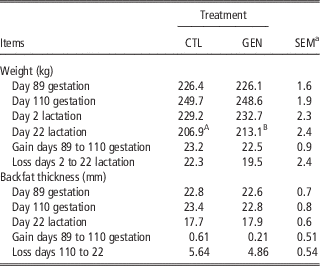
Weights and backfat thicknesses of gilts are shown in Table 1 and did not differ between treatments (P>0.1), except for a tendency for GEN sows to be heavier than CTL sows on day 22 of lactation (P<0.1). Average daily sow feed intakes were also similar across treatments (P>0.1) and were 3.04±0.14, 4.73±0.13 and 6.05±0.11 kg for weeks 1, 2 and 3 of lactation, respectively. There was an effect of week of lactation (P<0.001) on sow feed intake but no treatment×week interaction (P>0.1).
BWs and backfat thicknesses in gilts that were controls (CTL) or that were injected with 220 mg of genistein twice daily from day 90 of gestation until farrowing (GEN)

A,BTreatments tend to differ (P<0.10).
a Maximum value of the standard error of the mean.
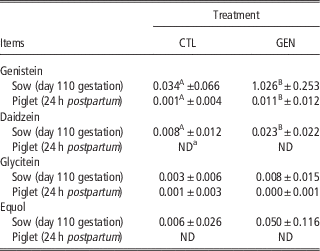
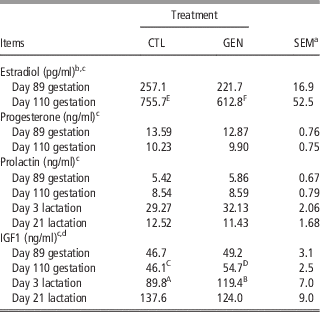
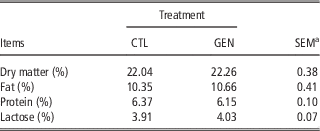
Concentrations of the various isoflavones in plasma from gilts on day 110 of gestation and from piglets at 24 h postpartum are shown in Table 2. Treatment significantly increased concentrations of genistein in both sows (P<0.05) and piglets (P<0.05) and also increased daidzein concentrations in sows (P<0.05). Daidzein and equol were not detectable in plasma from piglets. Circulating concentrations of hormones in sows are shown in Table 3. There was no effect of treatment on progesterone or prolactin concentrations in sows (P>0.10), but there was a treatment effect (P<0.05) on estradiol concentrations, with values being lower in GEN than CTL sows (P<0.05). The repeated-in-time analysis showed a tendency for estradiol concentrations to be lower in GEN than CTL gilts on day 110 of gestation (P<0.10). There was a treatment×day interaction on IGF1 concentrations (P<0.01), with values being greater in GEN than CTL sows on day 110 of gestation (P<0.05) and day 3 of lactation (P<0.01). There was an effect of day on all hormones measured (P<0.001). Milk composition on day 3 of lactation is shown in Table 4 and none of the measured variables (dry matter, fat, protein, lactose) was affected by genistein (P>0.1).
Arithmetic means (±SD) for circulating concentrations of isoflavones (µmol/l) on day 110 of gestation in gilts that were controls (CTL) or that were injected with 220 mg of genistein twice daily from day 90 of gestation until farrowing (GEN), and concentrations of isoflavones in their neonatal piglets

A,BTreatments differ (P<0.05).
a Not detectable (<0.000).
Circulating hormonal concentrations on days 89 and 110 of gestation and days 3 and 21 of lactation, in gilts that were controls (CTL) or that were injected with 220 mg of genistein twice daily from day 90 of gestation until farrowing (GEN)

A,BTreatments differ (P<0.01).
C,DTreatments differ (P<0.05).
E,FTreatments tend to differ (P<0.10).
a Maximum value of the standard error of the mean.
b Significant treatment effect (P<0.05).
c Significant day effect (P<0.001).
d Significant treatment×day interaction (P<0.01).
Milk composition on day 3 of lactation in gilts that were controls (CTL) or that were injected with 220 mg of genistein twice daily from day 90 of gestation until farrowing (GEN)

a Maximum value of the standard error of the mean.
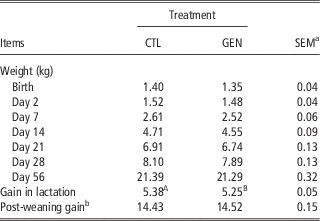
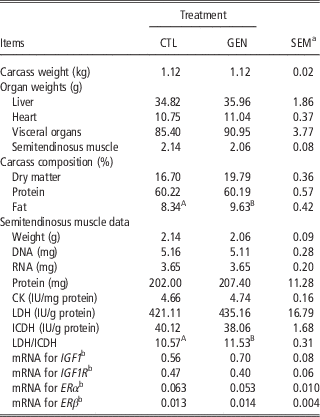
Weights of piglets are shown in Table 5, and were similar for piglets across treatments (P>0.1) at birth and on days 2, 7, 14, 21, 28 and 56. There was, however, a tendency for piglets from GEN sows to gain less weight during lactation than piglets from CTL sows (P<0.1), whereas post-weaning weight gain was not affected by treatment (P>0.1). The pre-weaning mortality rate was very low, averaging 6.9% (SD=8.1) and 5.3% (SD=7.7) for CTL and GEN sows, respectively. The odds ratio comparing CTL to GEN sows was not significant (P>0.10) but the value of 1.78 indicated almost twice as many chances of pre-weaning deaths occurring in litters from CTL than in litters from GEN sows. Data on carcasses of piglets at 24 h postpartum are shown in Table 6. Weights of the carcasses were similar for both treatment groups, as well as weights of the liver, heart, visceral organs and ST muscle (P>0.1). Percentage of dry matter and protein in the carcasses were similar across treatments (P>0.1), but carcasses from GEN litters contained more fat than those from CTL litters (P<0.05). None of the biochemical properties of the ST muscle differed between groups (P>0.1), namely, concentrations (data not shown) or total amounts of DNA, RNA and protein, and specific activities of the enzymes CK, LDH and ICDH (Table 6). The only ST muscle variable affected was the ratio LDH/ICDH, which was lesser in piglets from CTL than in piglets from GEN sows (P<0.05). The relative messenger RNA (mRNA) abundance for the genes IGF1, IGF1R, ERα and ERβ in the ST muscle was not affected by treatment (Table 6, P>0.1).
BWs of male piglets from gilts that were controls (CTL) or that were injected with 220 mg of genistein twice daily from day 90 of gestation until farrowing (GEN)

A,BTreatments tend to differ (P<0.10).
a Maximum value of the standard error of the mean.
b Weaning on day 22.
Organ weights, carcass composition, biochemistry and relative messenger RNA (mRNA) abundance of selected genes in skeletal muscle, and circulating IGF1 concentrations at 24 h postpartum in male piglets from gilts that were controls (CTL) or that were injected with 220 mg of genistein twice daily from day 90 of gestation until farrowing (GEN)

CK=creatine kinase; LDH=lactate dehydrogenase; ICDH=isocitrate dehydrogenase.
A,BTreatments differ (P<0.05).
a Maximum value of the standard error of the mean.
b Values correspond to the relative abundance of studied genes mRNA: IGF1R, IGF1 receptor; ERα and ERβ, receptors for estradiol α and β. Hypoxanthine phosphoribosyltransferase 1 (HPRT1) was used as endogenous reference gene.
Discussion
Current findings suggest that there is passage of the phytoestrogen genistein from the sow to her offspring through placental and/or colostral transfer. To the best of our knowledge, this is a first indication of such transfer in swine. When the potential transfer of genistein in gestation was studied in rats, it was demonstrated that genistein can cross the placental barrier (Doerge et al., Reference Doerge, Churchwell, Chang, Newbold and Delclos2001). Another study looking at the lactational transfer of genistein in 10-day-old rat pups showed only limited transfer through milk (Doerge et al., Reference Doerge, Twaddle, Newbold and Delclos2006). Lewis et al. (Reference Lewis, Brooks, Milburn, Soames, Stone, Hall and Ashby2003) also observed that secretion of genistein into milk of rats is low, being ~0.04% of the 50 mg/kg treatment dose imposed once in lactation. On the other hand, when lactating rats received a single oral dose of 50 mg/kg of genistein 4 days postpartum, there were indications that it could exert short-term estrogenic actions on tissues of the breast-fed neonates (Montani et al., Reference Montani, Penza, Jeremic, Biasiotto, La Sala, De Felici, Ciana, Maggi and Di Lorenzo2008).
Even though genistein appeared to be transferred from the sows to the fetuses in the present study, concentrations were very low and there were only minimal effects in terms of fetal development, as indicated by the unaltered birth weights and organ weights of neonatal pigs. This absence of effect on fetal growth may be linked to the lower concentrations of isoflavones present in sow plasma compared with a previous report (Farmer et al., Reference Farmer, Robertson and Gilani2013), and the difference in concentrations could be due to the lower isoflavone content of the gestation feed in the present experiment (13.9 mg/kg of genistein in the present study v. 97 mg/kg in Farmer et al., Reference Farmer, Robertson and Gilani2013). Interestingly, Necaise et al. (Reference Necaise, Moulton, Christiansen, Walters, Crenshaw, Scanes and Ryan2008) saw no effect on growth rate when feeding 3 or 9 mg/kg BW daily to neonatal pigs. Such was also the case when looking at growth rate of rats up to 6 weeks of age following neonatal treatment with s.c. injections of 0.5, 5 or 50 mg/kg per day of genistein for 5 days (Padilla-Banks et al., Reference Padilla-Banks, Jefferson and Newbold2006) or growth rate of rats up to 8 weeks following s.c. injections of 4 or 40 mg/kg per day of genistein for 21 days after birth (Lewis et al., Reference Lewis, Brooks, Milburn, Soames, Stone, Hall and Ashby2003).
In dairy cows, isoflavones were shown to be transferred from the lactation feed into the milk, with genistein being the predominant one (Flachowsky et al., Reference Flachowsky, Hünerberg, Meyer, Kammerer, Carle, Goerke and Eklund2011). Yet, standard composition of milk (dry matter, fat, protein, lactose) was not assessed. Current results indicate that providing two daily injections of 220 mg of genistein to late-pregnant gilts does not affect standard milk composition in early lactation. This is in accordance with the similar growth rate of suckling piglets from litters of both treatments. It is important to mention that even though concentrations of genistein in the current lactation diet may appear high, similar concentrations were previously reported in typical corn–soybean diets (Farmer et al., Reference Farmer, Palin, Gilani, Weiler, Vignola, Choudhary and Capuco2010). That earlier study compared the effects of supplying genistein in gilts fed a soya-free diet or a diet containing soya and it was shown that mammary development was not stimulated solely by ingesting a standard diet containing soya. Nevertheless, that does not preclude the fact that the soya content of the lactation diet in the present study may have masked some of the potentially beneficial effects of genistein.
Li et al. (Reference Li, Li, Yang, Yuan, Zhang, Geng, Xiao and Yin2011) reported increased circulating concentrations of IGF1 as well as IGF1 expression levels in the longissimus dorsi muscle of pigs that were fed soy isoflavones for 2 months, concomitantly with an increase in carcass fat. Rehfeldt et al. (Reference Rehfeldt, Adamovic and Kuhn2007) also observed increased fat content in neonatal piglets born from sows that were fed 1 mg/kg BW per day of daidzein from day 85 of gestation until farrowing. The greater IGF1 concentrations of GEN gilts compared with CTL gilts after 3 weeks of treatment in the current trial corroborate findings from Li et al. (Reference Li, Li, Yang, Yuan, Zhang, Geng, Xiao and Yin2011) and further indicate that the effect on circulating IGF1 was no longer apparent 3 weeks after cessation of treatment. The greater fat percentage in carcasses of neonatal piglets from GEN v. CTL sows in the present study also corroborates findings of Li et al. (Reference Li, Li, Yang, Yuan, Zhang, Geng, Xiao and Yin2011) and Rehfeldt et al. (Reference Rehfeldt, Adamovic and Kuhn2007) and it could be postulated that this increased carcass fat is related to the lower incidence of mortality observed in litters from GEN compared with CTL sows. However, the increased IGF1 concentrations in GEN sows did not translate into an altered expression level of IGF1 or IGF1R in the ST muscle of their newborn piglets. This was unexpected as Ren et al. (Reference Ren, Kuhn, Wegner, Nürnberg, Chen and Ender2001) reported an up-regulation of IGF1R gene transcription in skeletal muscles of newborn piglets from sows that were fed 8 mg/kg of feed of daidzein from day 85 of gestation until parturition.
The amount of genistein used may be a reason for this discrepancy. Indeed, results from an in vitro study showed a dose-dependent effect of daidzen and genistein on IGF1 mRNA levels in porcine skeletal muscle cells (Kalbe et al., Reference Kalbe, Mau and Rehfeldt2008). Similar findings were reported in vivo, whereby Kuhn et al. (Reference Kuhn, Hennig, Kalbe, Rehfeldt, Ren, Moors and Degen2004) saw no effect of feeding either soybean meal (782 mg/kg of isoflavones) or soy protein concentrate (125 µg/g of isoflavones) from weaning through the growing–finishing period on IGF1R mRNA expression in the longissimus dorsi of pigs. In that experiment, even though total circulating concentrations of isoflavones were ~10-fold greater with the soybean meal diet, no significant differences in growth performances were noted. The absence of effect was thought to be due to poor bioavailability of soy isoflavones. Physiological state of the animal may also be important as a study with pregnant rats (Nogowski et al., Reference Nogowski, Szkudelska, Szkudelski and Pruszynska-Oszmalek2006) led authors to suggest that genistein cannot manifest its action during pregnancy because of high concentrations of endogenous estrogens.
Even though non-significant, specific activities of LDH, a marker for anaerobic glycolytic energy production, were numerically greater and those of ICDH, a marker for oxidative energy generation via the citric acid cycle, lesser in the ST muscle of piglets from GEN v. CTL sows in the present study, leading to a greater LDH/ICDH ratio. This is indicative of a shift towards more glycolytic (instead of oxidative) metabolism in skeletal muscles of piglets from sows fed genistein.
The first demonstration that ERα and ERβ are expressed in porcine skeletal muscle was in 2007 (Kalbe et al., Reference Kalbe, Mau, Wollenhaupt and Rehfeldt2007), and it suggested that skeletal muscles are a target tissue for estrogens or estrogen-like compounds. Values for the mRNA expression of ERβ in the present study were very low and likely close to the detection limit of the assay, thereby rendering their quantification quite difficult and somewhat compromising their reliability. Yet, it is evident that the transcription level for ERβ is quite low in skeletal muscles of newborn piglets.
Conclusions
Providing two daily i.m. injections of 220 mg of genistein to gilts in late pregnancy had a positive impact on IGF1 concentrations in gilts but did not affect fetal growth and had minimal effects on fetal development. The fat content of carcasses from 24-h-old piglets was greater in litters from GEN sows compared with CTL sows and this coincided with a lower incidence in piglet mortality. The only effect of treatment on the ST muscle of newborn piglets was an indication of a shift towards more glycolytic (instead of oxidative) metabolism. Milk composition of sows in early lactation was also not affected by genistein. Results from the present study do not support the use of such a treatment in commercial swine units to improve sow and piglet performances but further research is needed to substantiate the potentially positive impact on piglet mortality.
Acknowledgments
The authors thank A. Bernier, L. Thibault, A. Steinborn and A. Berndt for their invaluable technical assistance, the staff of the Swine Complex, especially J. Phaneuf and M. Côté, for care of the animals, S. Méthot for statistical analyses and Swine Innovation Pork for financial support.