

Introduction
This study evaluates the achievements of the employment-oriented welfare state by analysing whether active labour-market policies (ALMPs) contribute to improvements in the financial soundness of welfare states. In this article, we empirically examine the relationship between ALMPs and the fiscal soundness of welfare states, reflecting on two aspects that have not been adequately covered in previous studies. First, considering the sequence of policy performance, we explicitly investigate the effects of ALMPs on fiscal soundness, mediated by employment rate. ALMPs have boosting labour market participation as their primary objective, so the natural result of this is an indirect effect on fiscal soundness by increasing taxpayers. Thus, we examined whether the relationships among ALMPs, employment rate and the fiscal soundness of a welfare state are significant. Next, we reflected on the influence of each ALMPs, using analytical models to determine which programmes used the most powerful tools to address public-finance problems in welfare states.
Most developed welfare states use various ALMPs while reducing unemployment benefits to cope with the budgetary deficits and increases in debt that appeared in the 1980s and continued from that point. This phenomenon has been described as a shift of paradigm to a “employment-driven/employment-oriented welfare state” (Bonoli, Reference Bonoli, Clasen and Clegg2011; Häusermann & Palier, Reference Häusermann and Palier2008; Kenworthy, Reference Kenworthy, Castles, Leibfried, Lewis, Obinger and Pierson2010; Ko & Cho, Reference Ko and Cho2017; OECD, 1994) or a movement from a social welfare state to “social investment” state (Esping-Andersen et al., Reference Esping-Andersen, Gallie, Hemerijck and Myles2002; Sherraden, Reference Sherraden2003). Regardless of what we call this phenomenon, this transition is clearly expected by policymakers to change some of the unemployed from recipients of unemployment benefits into taxpayers. That is, the goal is to get more people involved in the labour market.
This change began with criticisms of passive labour-market policies (PLMPs), which are not valid for addressing high rates of unemployment (Mosher & Trubek, Reference Mosher and Trubek2003). Those who initiated and supported the paradigm change urged that the government should actively intervene in the labour market to expand employment, not merely to support the income of the unemployed. It was believed that government efforts to increase employment would contribute to resolving not only the severe unemployment rate, but also unsustainable problems in public finance (de Beer, Reference de Beer2007; Kenworthy, Reference Kenworthy, Castles, Leibfried, Lewis, Obinger and Pierson2010), as increases in the number of the employed would lead to reductions in welfare expenditures for them, coupled with greater tax revenues from them. The shift to an employment-oriented welfare state occurred in many developed countries. However, studies analysing the impacts of this change on public finance are rare, even though this is a central goal. In particular, how this should be characterized is unclear because few studies have explored whether labour-market policies (LMPs) did significantly influence improvements in the fiscal soundness of welfare states.
Furthermore, the mechanism through which ALMPs would affect public finance is not clear. Previous studies limited their studies of increasing ALMPs to their outcomes on employment. The expected employment and financial outcomes from a shift to the employment-oriented welfare state do not happen at the same time but rather sequentially. For the paradigm shift to be connected to improving financial performance, a certain period must pass after the level of employment increases (Ko & Cho, Reference Ko and Cho2017). Previous studies that have investigated how government interventions have influenced public finance (Jeong, Lim, & Yang, Reference Jeong, Lim and Yang2012; Ko, Reference Ko2014; Ko & Cho, Reference Ko and Cho2017) have missed the effects of labour policy. Moreover, evaluative studies have indicated that individual ALMPs have different goals and difference performance (Card, Kluve, & Weber, Reference Card, Kluve and Weber2010, Reference Card, Kluve and Weber2015; Kluve et al., Reference Kluve, Puerto, Robalino, Romero, Rother, Stöterau and Witte2016; Martin & Grubb, Reference Martin and Grubb2001;). However, previous work has not examined the differential impact among various ALMPs regarding fiscal soundness.
Therefore, we explored the results of the expansion of ALMPs as a proxy for a shift to the employment-oriented welfare state that would take into account these missing points. That is, we investigate which ALMPs have the ability to improve public finances and why. At the same time, we considered the mediating effects of the employment rate on the relationship between ALMPs and fiscal soundness.
ALMP outcomes
Impacts of ALMPs on employment rates
LMPs are divided into PLMPs and ALMPs. The purpose of unemployment benefits, a type of PLMP, is to support the income of the unemployed. PLMPs have been criticized for extending the duration of unemployment, which in turn increases the overall rate of unemployment (Atkinson & Micklewright, Reference Atkinson and Micklewright1991; Mosher & Trubek, Reference Mosher and Trubek2003; Tatsiramoss, Reference Tatsiramoss2006). This may, in turn, lead to a decrease in the motivation to work among the unemployed and increase the rate of employed. Additionally, employers may hesitate to hire due to the tax burdens imposed to support unemployment benefits.
ALMPs are regarded as an effective method of increasing labour-market participation. Most studies evaluated that ALMPs have demonstrated their positive impacts on the employment rate (Bradley & Stephens, Reference Bradley and Stephens2007; Estevão, Reference Estevão2007; Kang, Kim, & Kim, Reference Kang, Kim and Kim2001; OECD, 1993). However, some studies showed that the positive impacts of ALMPs are not statistically significant (Baker et al., Reference Baker, Andrew, Howell, Schmitt and Howell2005). Moreover, recent studies have found different effects for the various ALMPs on employment performance (Calmfors, Forslund, & Hemstrom, Reference Calmfors, Forslund and Hemstrom2002; Card, Kluve, & Weber, Reference Card, Kluve and Weber2010, Reference Card, Kluve and Weber2015; Kluve, Reference Kluve2006, Reference Kluve2010). In particular, the precise results vary according to the type of ALMP followed. In the OECD, ALMP programmes are classified into seven types: public employment services (PES) and administration, training, employment incentives (subsidies), sheltered and supported employment, direct job creation and direct incentives. In this study, we focus on three of these: PES, vocational training and employment incentives.Footnote 1 These three programmes occupy most of the active labour-market programmes in OECD countries, and they have different effects on the employment rate and how they invest in human capital.
Specifically, training is defined as programmes that improve the employability of the unemployed by teaching vocational skills, leading to significant positive effects on employment over the long term (Bonoli, Reference Bonoli2010; Card, Kluve, & Weber, Reference Card, Kluve and Weber2015; Bengtsson, de la Porte, & Jacobsson, Reference Bengtsson, de la Porte and Jacobsson2017). It can be useful for increasing labour-market participation as if the government provides the training opportunity to develop the skills required in a rapidly changing labour market. PES can improve employability by helping the unemployed surmount barriers to job seeking, by providing consultation and recruitment services for direct matching between employers and the unemployed, but this is not an improvement in direct vocational skills. Employment incentives are intended to create and maintain employment by providing subsidies to employers to support wages, especially during a recession.
The effects of PES and employment incentives on employment may be of shorter than those of training because a temporary subsidy often cannot support a stable job, and the beneficiaries may ultimately become unemployed again (Card, Kluve, & Weber, Reference Card, Kluve and Weber2015). Furthermore, the organizations that receive subsidies might opt to replace an existing employee with a subsidized one (Calmfors, Forslund, & Hemstrom, Reference Calmfors, Forslund and Hemstrom2002). Empirical studies that compare employment performance in different countries, however, have not shown consistent results for labour-market programmes (Kang, Kim, & Kim, Reference Kang, Kim and Kim2001; Estevão, Reference Estevão2007). Therefore, it is necessary for this study to recheck this.
Impact of ALMPs and employment rates on fiscal soundness in welfare states
Many researchers have argued that social expenditures are the leading cause of the deterioration of fiscal soundness. Chang et al. (Reference Chang, Lee, Feng and Ning2016) showed that higher social expenditures increased government debt in 13 OECD countries. Seater (Reference Seater, Parker and Whaples2013) also found that increases in social spending lead to increases in national debt over the short term. However, other studies have concluded that this negative relation is inconclusive because some of these relationships have been insignificant (Wilensky, Reference Wilensky2006; Lee, Reference Lee2018). For example, Lee (Reference Lee2018) examined whether higher social expenditures increase the national debt by using dynamic panel data from 34 countries over the period from 1980 to 2014. She concluded that social expenditures have no significant effects on public debt.
Furthermore, some studies have indicated that social expenditures contribute to the revival of financial soundness (Jeong, Lim, & Yang, Reference Jeong, Lim and Yang2012; Ko, Reference Ko2014; Ko & Cho, Reference Ko and Cho2017). Such studies have usually taken note of social policies that have positive effects on promoting employment. Ko (Reference Ko2014) found that some welfare states that give priority to social services, such as vocational training or childcare services, show more stability in their public finances because these measures contribute to economic growth. Jeong, Lim, and Yang (Reference Jeong, Lim and Yang2012) also showed that expenditures in social investment expenditures, such as in social services, ALMPs, and supporting working families, have a positive influence on fiscal soundness. They also explained that social policies that promote the employment rate and the productivity of human resources could result in a robust circular relationship with the economic situation, which would then contribute to financial soundness (Bernard & Boucher, Reference Bernard and Boucher2007). Besides, Ko and Cho (Reference Ko and Cho2017) investigated the effects of LMPs on financial performance, centring on the quality of employment and the type of employment created by government intervention. They found that the expansion of ALMPs contributed to strong financial performance through employment promotion. However, their study focussed on the type of employment and did not identify differences in performance in individual labour-market programmes.
To summarize, we expect that ALMP will increase the employment rate, and this will lead to an increase in the fiscal soundness of the country. As mentioned above, the impact of ALMP on the employment rate is expected to vary, depending on the level of human capital investment of the unemployed. However, as shown above, few studies have analysed financial performance in LMPs. Moreover, it remains unclear whether the ALMPs as a representative employment-oriented welfare state pursues can positively contribute to public-finance soundness. The impact of different types of ALMP on public finance and the employment rate differs. Thus, we here empirically examine the impact of different ALMPs public finances employing improvements in the employment rate.
Method and data
Variables
To investigate the effectiveness of the ALMPs of employment-oriented welfare states contribute to the financial soundness, we focussed on countries that have been both mature and in-crisis welfare states and restructured in the period from 1996 to 2015. Specifically, we considered the following 18 countries: Australia, Belgium, Canada, Denmark, Finland, France, Germany, Italy, Japan, Luxembourg, the Netherlands, New Zealand, Norway, Portugal, Spain, Sweden, Switzerland and the United States. Table 1 shows the descriptive statistics of the variables used in the analysis. Although the specific reforms in each country are different, they have in common that they emphasize labour-market participation in order to solve unemployment (OECD, 1993, 1994).
Descriptive statistics.

Abbreviations: ALMPs, active labour-market policies; PES, public employment services; PLMPs, passive labour-market policies.
Net lending/borrowing and gross debt were chosen as the dependent variables for this study to represent the fiscal soundness of the given state. These variables were used to indicate the fiscal crisis for each state in the 1980s. Specifically, in this study, net lending/borrowing, defined as the difference between total revenues and total expenditures, was developed using the concept of net operating balance, which determines the sustainability of government operations. The latter is the total balance of government fiscal liabilities, measured as the face value of the bonds, and it is the public debt used by the Fiscal Monitor of the (International Monetary Fund [IMF], 2018, p. 93).Footnote 2
The ALMPs that we focussed on in this study, measured as public expenditures for PES, vocational training and employment incentives. The positive relationship between ALMPs and economic power post the problem of endogeneity, which was reflected by correction by the gross domestic product (GDP). That is, the expenditure on each ALMP is operationalized as a percentage of GDP. We also analysed the employment rate as a mediating variable, focusing on the mechanism through which welfare expenditure increases the employment rate and ultimately affects fiscal soundness. The employment rate was defined relative to the economically most active part of the population (aged 15–64 years).
The effects of policies can differ depending on the context, and we considered two main aspects of context: economic situations and labour market institutions. Specifically, economic factors such as the economic growth rate, inflation rate and the old-age population ratio were controlled. The economic growth rate and inflation rate are indicators of the state of the economy and are closely related to the employment rate and fiscal soundness of the country. In addition, increases in the elderly population may increase the burden of care for the working population and the burden of welfare expenditures. We also controlled institutions related to labour markets, the degree of employment protection and union density. All of these are factors affect the level of labour market spending in each country and its effects.Footnote 3
Method
We used two methods of analysis: the panel Granger causality test and three-step mediation testing of, to analyse the leverage of each ALMP on employment rate and fiscal soundness of welfare states. First, the panel Granger causality test, suggested by Dumitrescu and Hurlin (Reference Dumitrescu and Hurlin2012), was used to judge the statistical significance of relationships among ALMPs, employment rate and fiscal performance are.Footnote 4 That is, if we can explain the current fiscal soundness of existing welfare states using previous values for each ALMP and the employment rate, then, we can conclude that past values for individual ALMPs determine fiscal soundness in welfare states. Also, we set the time lags among ALMPs and their expected results, using the Akaike information criterion (AIC) for the results of the Granger causality tests, instead of setting them arbitrarily.Footnote 5
And then, to investigate the employment rate as a mediator between the ALMPs and fiscal soundness, we used the three-step test of mediation developed by Baron and Kenny (Reference Baron and Kenny1986). The procedure was as follows: examine the effects of the individual ALMPs on the employment rate; identify the effects of the individual ALMPs on fiscal soundness and identify the simultaneous effects of the individual ALMPs and the employment rate on fiscal soundness. The coefficients of individual ALMPs at the third stage are smaller than those at the second stage. So long as those in the first and second stages are statistically significant, the mediation effects of the employment rate are statistically meaningful.
In the three-step testing of mediation, we adopted two analytical methods to ensure rigorous analysis. We used the feasible generalized least squares (FGLS) to correct heteroscedasticity, because it can produce more consistent and efficient estimates than those developed by panel-corrected standard error estimator (PCSE), especially when the time series is short (Chen, Lin, & Reed, Reference Chen, Lin and Reed2010). Furthermore, if a significant level of heteroscedasticity is identified,Footnote 6 estimations using FGLS that can correct it are to be preferred (Reed & Ye, Reference Reed and Ye2011). At this time, the dependent variables are autocorrelated, so we also reflected the lagged dependent variable of each step.Footnote 7 Furthermore, based on the result of the panel Granger causality test, we inputted the lagged independent variables followed appropriated time lags according to the AIC.
However, PCSE is free from any downward bias of standard error, issues in dealing with simultaneous correlation, or heteroscedasticity problem, as it models the error term itself. In particular, it is considered to be very accurate in combined time-series data of 15 years or more (Beck, Reference Beck2001, pp. 278–279; Beck & Katz, Reference Beck and Katz1995, pp. 639–641). For this reason, we used both PCSE and FGLS.
Furthermore, the empirical model reflects lagged dependent variables, because the employment rate and financial balance, which are dependent variables, are significantly auto-correlated as shown in Table 2. Beck and Katz (Reference Beck and Katz2011) suggested that including the lagged dependent variables for avoiding bias due to adopt both autocorrelation and fixed-effect model. Thus, we reflected the lagged dependent variables in the analysis. Also, to eliminate the unit root problem, each variable is analysed by reflecting the first-difference variables.
Autocorrelation and unit-root test.

The results using first-difference data means the validation of autocorrelation and unit root for first-difference values of each variable. Autocorrelation test is based on the first-order autocorrelation test. For validation of unit root, we used Im-Pesaran-Shin unit-root test.
Abbreviations: ALMPs, active labour-market policies; PES, public employment services; PLMPs, passive labour-market policies.
Empirical results
Are there strong links among ALMPs, employment rate and fiscal soundness?
Significant causal links were found among individual ALMPs, employment rate and fiscal soundness.
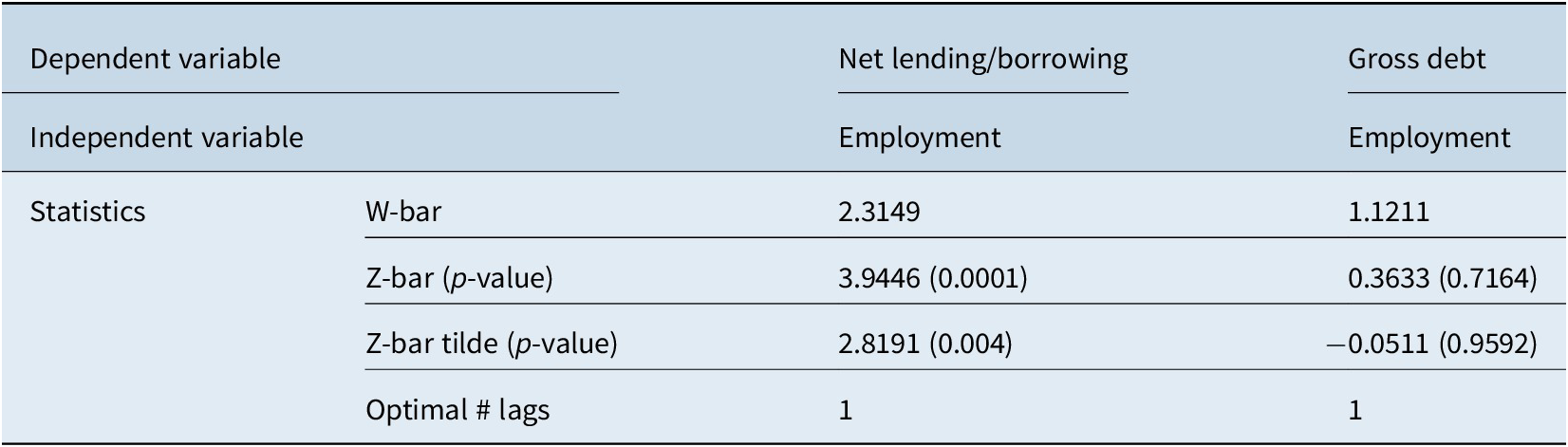
The results of the Granger test indicated that the employment rate has statistically significant effects on net lending/borrowing. However, it is difficult to tie the employment rate to gross debt causally. Likewise, total ALMPs and each ALMP area are considered to be causes of the employment rate at the level that conventionally is taken as showing significance. However, we found that most ALMPs have no direct impact on net lending or borrowing, as is shown in Table 3. That is, we should be careful to interpret our data to indicate that ALMPs have a significant causal impact on the fiscal condition of the welfare state, even if we do find a significant correlation between them in our regressions.
Granger causality of employment rate on public finance.

According to the Im-Pesaran-Shin unit-root test, the values of gross debt and employment rate have unit roots at conventional significance level. Thus we used those values after first differencing in the Granger Causality.
Granger causality of ALMPs on employment rate, and public finance.

According to the Im-Pesaran-Shin unit-root test, the values of gross debt and employment rate have unit roots at conventional significance level. Thus, we used those values after first differencing in the Granger causality.
Abbreviations: ALMPs, active labour-market policies; GDP, gross domestic product; PES, public employment services.
In the examination of the size of the budget involved in LMPs, the difference between actual enforcement and trends in the employment situation should be noted, but it is not easy to improve employment situation over the short term. There is also a time lag between increases in employment and changes in national finances because the expenditures of the follow the budget plan developed in the previous year. The change on employment rates occurs some time after the government intervention in the labor market through public spending. However, it is unclear that how many years apart the change in variables will appear, but here according to the AIC, the rate of employment changes before net lending or borrowing does, and ALMPs change before either the employment rate or net lending/borrowing does. ALMPs also appear 2 years ahead of net lending or borrowing, but only 1 year from the employment rate. These results lead us to infer the sequential causal relationship among the ALMPs, employment rate and net lending or borrowing, as we expected before.
Do the higher-level spending of ALMPs enhance fiscal soundness by improving the employment rate?
Here, we verified the mediating effects of the employment rate empirically. It is possible to affirm the effectiveness of the employment-oriented welfare state when the government’s efforts lead to higher employment rate, and the fiscal status of states then improves. If we find a mediation effect of employment in this relationship, it would be possible to infer the possibility of a virtuous circle among ALMPs, employment rate and fiscal soundness, which is the basic idea of the employment-oriented welfare state.
Most LMPs have statistically significant impacts lower the employment rate in the first stages, as shown in Table 5. PLMPs generally have a negative influence on the employment rate as well, and ALMPs have a largely non-significant influence on the employment rate, as shown in Table 5, regardless of controlling for PLMPs. High-level spending of ALMPs tend to increase employment, which forms a logical basis for the transition to an employment-oriented welfare state. Moreover, the level of ALMPs contributes to the expansion of the net lending of states, not only by increasing employment, but also by themselves, as is shown in the second and third stages of Table 6. Their impacts are limited, however, when we control the other factors, such as economic and institutional factors, we did not find positive impacts of ALMPs on deficits unlikely previous research, which did not control the lagged dependent variables. Of course, it might be a correlation relationship, not a causal one. Thus, we should be careful not to over-evaluate the impacts of ALMPs on public finance.
The impact of LMPs on net lending/borrowing.

The dependent variable of first stage estimation is employment rate and those in second and third stages are net lending. Each stage reflects the lagged dependent variables are reflected because of autocorrelation and the LMPs are the lagged variables based on the result of the panel Granger causality test (lag 1). The coefficients of lagged dependent variables are shown in “AR(1) coef.” rows of each stage. According to the Im-Pesaran-Shin unit-root test, the values of gross debt, employment rate and LMPs variables have unit roots at conventional significance level. Thus we used those values after first differencing. Standard errors in parentheses.
Abbreviations: FGLS, feasible generalized least squares; LMPs, labour-market policies; PCSE, panel-corrected standard error estimator.
* p < 0.05.
** p < 0.01.
*** p < 0.001.
The impact of ALMPs on net lending/borrowing.

The dependent variable of first stage estimation is employment rate and those in second and third stages are net lending. Each stage reflects the lagged dependent variables are reflected because of autocorrelation and the LMPs are the lagged variables based on the result of the panel Granger causality test (lag 1). The coefficients of lagged dependent variables are shown in “AR(1) coef.” rows of each stage. According to the Im-Pesaran-Shin unit-root test, the values of gross debt, employment rate and LMPs variables have unit roots at conventional significance level. Thus we used those values after first differencing. Standard errors in parentheses.
Abbreviations: ALMPs, active labour-market policies; FGLS, feasible generalized least squares; PCSE, panel-corrected standard error estimator; PES, public employment services.
* p < 0.05.
** p < 0.01.
*** p < 0.001.
The impact of each ALMP on net lending/borrowing.

The dependent variable of first stage estimation is employment rate and those in second and third stages are net lending. Each stage reflects the lagged dependent variables are reflected because of autocorrelation and the LMPs are the lagged variables based on the result of the panel Granger causality test (lag 1). The coefficients of lagged dependent variables are shown in “AR(1) coef.” rows of each stage. According to the Im-Pesaran-Shin unit-root test, the values of gross debt, employment rate and LMPs variables have unit roots at conventional significance level. Thus we used those values after first differencing. Standard errors in parentheses.
Abbreviations: ALMPs, active labour-market policies; FGLS, feasible generalized least squares; PCSE, panel-corrected standard error estimator; PES, public employment services.
* p < 0.05.
** p < 0.01.
*** p < 0.001.
Although it has been argued that PLMPs create unemployment traps and lead to the loss of the desire to work (Atkinson & Micklewright, Reference Atkinson and Micklewright1991; Mosher & Trubek, Reference Mosher and Trubek2003), ALMPs are considered to be practical strategies for promoting labour-market participation (Bradley & Stephens, Reference Bradley and Stephens2007; Estevão, Reference Estevão2007; OECD, 1993). As shown in Table 6, at least ALMPs have not been interrupted to enter the labour market, and it is the useful tool for encouraging the employment rate, which in turn leads to greater fiscal soundness. ALMPs have the power to solve problems related to the confluence of a welfare state, financial insecurity and a low employment rate. Increasing employment through public initiatives appears to be a valid strategy for resolving financial problems, assuming a shift to an employment-oriented welfare state (Kenworthy, Reference Kenworthy, Castles, Leibfried, Lewis, Obinger and Pierson2010; de Beer, Reference de Beer2007). However, as we stated above, the positive effects on employment rate and public finance of ALMPs are insignificant, so those effects cannot be overestimated.
Which ALMPs have enhanced fiscal soundness through the improvement of the employment rate?
Does each ALMP make a difference in employment or fiscal performance? Which ALMPs are effective for fiscal soundness? According to the results shown in Table 6, ALMPs can increase employment, but not all items of the ALMPs always demonstrate this ability. Of course, the strategy of expanding ALMPs has a positive effect on states’ fiscal soundness and employment rate, but this is not always true across ALMPs. Thus, it cannot be concluded that the more extensive ALMPs lead directly to increase employment, although such ALMPs, employment incentives, tend to increase employment.
The mediation effects of employment rate on the relationship of ALMP expenditures on public finance are unclear. For example, vocational training can improve public finances in welfare states, but it does not always increase the employment rate. Education and training are costly because they require a relatively long investment time, so in the short term, the employment effect of training participants may be harmful (Calmfors, Forslund, & Hemstrom, Reference Calmfors, Forslund and Hemstrom2002). In the long run, however, the accumulation of human capital can have a significant positive effect on employment, and in turn, it can lead to sounder public finance.
Meanwhile, employment incentives are the most reliable tool for leading higher employment, but its effect on sustaining healthy public finances by raising the employment rate may not be strong enough. Employment incentives grant employers subsidies for a limited period to hire new workers or maintain their employment. Therefore, the effects of employment incentives can be directly seen in the short term. However, it seems to have the least impact on improving fiscal soundness, since the results are not likely to be prolonged unless the workers demonstrate their productivity for the limited time (Kluve et al., Reference Kluve, Puerto, Robalino, Romero, Rother, Stöterau and Witte2016).
PES is the most reliable tool to lead high employment rate as pointed out previous studies (Brown & Koettl, Reference Brown and Koettl2012, Reference Brown and Koettl2015; Card, Kluve, & Weber, Reference Card, Kluve and Weber2010, Reference Card, Kluve and Weber2015; Kluve, Reference Kluve2010). In previous studies, counselling and monitoring through public employment services have been identified as cost-effective policies as well (Brown & Koettl, Reference Brown and Koettl2012, Reference Brown and Koettl2015). These positive results are short term (Brown & Koettl, Reference Brown and Koettl2012, Reference Brown and Koettl2015; Card, Kluve, & Weber, Reference Card, Kluve and Weber2010, Reference Card, Kluve and Weber2015; Kluve, Reference Kluve2010), and the long-term duration analysis may reduce the effect. PES seems to have a moderate impact on short-term employment performance through counselling, job matching, and so on (more effective than training but less than employment incentives). This may also help to improve fiscal soundness in the long run, but its effect is not statistically significant, unlike training.
Discussion
Beginning in the 1980s, many welfare states have implemented welfare reform to address fiscal insecurity and high unemployment. Despite concerns that financial burdens would increase, government intervention in private market through public expenditure, namely, increasing ALMPs, has kept continuing. Interestingly, as the results of this study demonstrate, the expansion of ALMPs has helped to shore up the fiscal soundness of the welfare state through improvements in employment. That is, governmental intervention to increase ALMPs has contributed both to the employment rate and to a virtuous cycle of securing fiscal soundness through job creation.
To be clear, our analysis does not say that increasing the ALMPs will guarantee sound public finance. We emphasize that the favourable result of ALMPs on employment rate and public finance pointed out that previous studies may not always be correct for all ALMPs, although we do confirm that at least certain high-level spending of ALMPs have shown good results for both in employment and public finance. Only vocational training shows the partial result that contributes to national finances by increasing the employment rate. However, we need further research to investigate the long-term impacts of this programme to conclude this. PES shows a reasonably good effect on the employment rate, but this does not lead to an improvement in fiscal soundness significantly. Employment subsidies may improve the overall employment rate at least in the short term, and they may also fail to improve the fiscal soundness of the welfare state. Why does each ALMP have differential impacts on fiscal soundness? We think this is the result of whether they enhance employability.
Upskilling through training requires a relatively long investment run-up, meaning that its effects on employment and public finance are only shown over the long term. Although training is more expensive than other ALMPs, it has the potential to produce high-quality employment and stable tax revenues due to the increase in overall employability (Calmfors, Forslund, & Hemstrom, Reference Calmfors, Forslund and Hemstrom2002; Card, Kluve, & Weber, Reference Card, Kluve and Weber2010, Reference Card, Kluve and Weber2015; Kluve, Reference Kluve2006, Reference Kluve2010; Brown & Koettl, Reference Brown and Koettl2015). According to our analysis, training has a partial power to improve public finance than PES does. Although PES does promote employment in the contemporary, rapidly changing and the flexible labour market by marketing and matching existing skills, job seekers are more likely to be connected to insecure jobs, if they do not have the proper investment of human capital. Ko and Cho (Reference Ko and Cho2017) argued that if most people were hired at low income or temporary jobs, this would worsen public finance, even though the rate of employment is sufficiently high. Despite these results, most developed countries placed a greater emphasis on PES than on vocational training after the mid-1990s, and this trend only strengthened after the Great Recession. That is, reforms supporting re-commodification rather than social investment have been preferred in recent years (Bonoli, Reference Bonoli2010; De la Porte & Jacobsson Reference De la Porte, Jacobsson, Morel, Palier and Palme2012; Bengtosson et al., 2017).
Subsidies can promote employment for vulnerable groups, such as the long-term unemployed, the elderly and immigrants, to allow them to quickly return to or enter the labour market (Brown, Merkl, & Snower, Reference Brown, Merkl and Snower2007, Reference Brown, Merkl and Snower2011). While such subsidies may be effective in a crisis, it may be challenging to rely on them to develop employment performance in the long run. Because the subsidies themselves do not increase any worker’s employability, so vulnerable workers must prove their value during the subsidies period to maintain employment. Further, subsidies, in particular, have a high risk of negative indirect effects. For example, a company that receives a subsidy could replace an existing full-time worker with an irregular employee for a subsidy, or subsidies may be provided to people who can work without them, resulting in wasted expenditures.
Although ALMPs do have some achievements, we must not overestimate their performance. High spending on ALMPs have been accompanied by improved employment and financial performance, but it is difficult to conclude what the precise cause is for the result. That is, we have to recognize that the impacts of ALMPs might overlap with PLMPs. This should also be noted in the evaluation of the performance of individual ALMPs. In many countries, it is not easy to distinguish between ALMPs and PLMPs because workers are obliged to participate in the ALMPs when PLMPs are provided. For example, the establishment and implementation of individual action plans are imposed as a condition of receiving unemployment benefits. Planning and implementation are usually done through a public employment service organization, and they are also smoothly linked to other ALMPs, such as training and subsidies in the implementation and employment process. Therefore, it must be understood that each LMP is organically linked and to find a combination of them that matches the given situation.
Disclosure statement.
No potential conflict of interest was reported by the author.
Hyejin Ko, Associate Research Fellow of Korea Institute for Health and Social in South Korea. Her research interests are exploring the ways to build a fiscally and politically sustainable welfare state by conducting comparative studies about the structure of welfare spending, taxation and the impact of welfare and labour market policies.
Eunchong Bae, Researcher of Institute of Social Welfare in Seoul National University and a PhD candidate in a Department of Social Welfare at SNU. Her research focuses on the social protection for the vulnerable groups in the labour market and comparative social policy.