Introduction
Colonial-period contact led to the introduction of exotic animal species into Indigenous hunter-gatherer societies worldwide. The appearance of these animals elicited a variety of responses. While some communities embraced the new creatures and the opportunities they represented, others resisted or carefully balanced their engagement (e.g. Barker Reference Barker2006; Colledge Reference Colledge2013; Cummings et al. Reference Cummings, Jordan and Zvelebil2013). Some communities took up the practice of animal domestication; others incorporated introduced fauna into existing hunting activities, allowing the animals to roam free. In many places, new animals became part of creative, artistic practices, encoded and revealed through rock art. Regardless of the diversity of these engagements and practices, they all demonstrate the complexity of human-animal relationships for Indigenous societies.
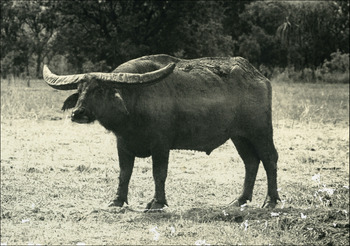
In this article we highlight one such case: the artistic practices associated with the ‘re-emergence’ of Timorese water buffalo (Bubalus bubalis) into western Arnhem Land, Australia (Figure 1). We use the word re-emergence because, following the local ontological perception, water buffalo were not a ‘new’ animal for Aboriginal people. Instead, these animals were simply revealing themselves anew. As with all other sentient beings, buffalo were an existing part of Djang (the Dreaming)—the foundation for all animated, living beings that had always been there and always will be. From an Indigenous perspective, this foundation was, and still is, able to integrate and explain any change or historical event (Morphy Reference Morphy, Hirsch and O'Hanlon1995, Reference Morphy1999). Myers (Reference Myers1991) touches upon this concept in his work in Central Australia. Explaining the capacity of Pintupi belief systems to incorporate change, Myers gives the example of extensions to a known Dreaming track revealing themselves:
Until 1975 I had been told that one of the main Pintupi Dreaming tracks ended at a place called Pinari near Lake Mackay. However, after Pintupi from my community visited their long-separated relatives at Balgo, they returned to tell me that ‘we thought that story ended, went into the ground, at Pinari. But we found that it goes underground all the way to Balgo’. Apparently, this revelation was discovered in a vision by a man from Balgo. The example shows that historical change can be integrated, but that it is assimilated to the pre-existing forms: the foundation had always been there, but people had not known it before. (Myers Reference Myers1991: 53)
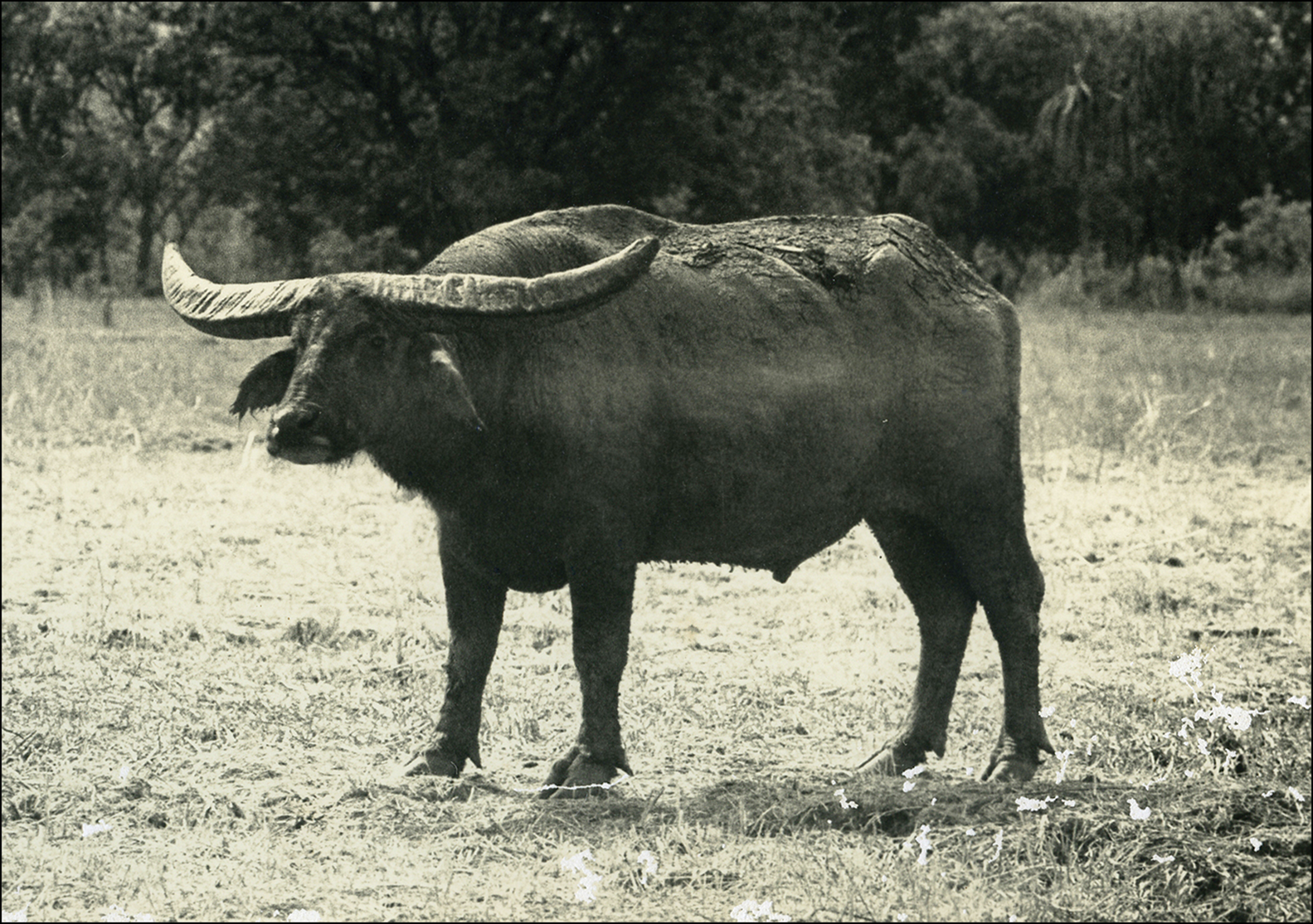
Timorese water buffalo (Bubalus bubalis), Nourlangie Safari Camp c. 1960 (photograph by J. Opitz).
Likewise, Trigger (Reference Trigger2008) and Fijn (Reference Fijn2017) use rock art to complement their broader discussions of newly introduced animals being ‘naturalised’ in cultural terms.
There has been increasing discussion of how rock art reflects Aboriginal artists’ encounters with, for example, South-east Asian (‘Macassan’) and European outsiders (e.g. Burningham Reference Burningham1994; Taçon & May Reference Taçon, May, Clark and May2013). Morphy (Reference Morphy1998: 63–64 & 213–18) has shown how ‘Macassans’, who visited annually, became an integrated part of the Yolngu belief system in north-eastern Arnhem Land, and how this is still expressed through Aboriginal artworks and ceremonial practices. In contrast, many rock art motifs depicting outsiders, their animals, ways of transport, and their paraphernalia, have been explained as the result of casual encounters or as ‘casual art’ (see Chaloupka Reference Chaloupka1993: 214–15). Few of these studies, however, have attempted to explore these histories from an emic perspective; that is, how an Aboriginal knowledge system responded to the introduction of new animals and the role that rock art may have played in this process, and how and why these processes were expressed in the art. In this article we draw upon evidence from previous research and new rock art recordings from Djarrng in western Arnhem Land to explore the relationship between local Indigenous cultural belief systems, newly introduced animal species and rock art.
Introduced animals in rock art
In North America it is well attested that horses were introduced and incorporated into the cultural lives of different Indigenous groups well before the arrival of Europeans (e.g. Keyser & Klassen Reference Keyser and Klassen2001; Keyser Reference Keyser2004; Sundstrom Reference Sundstrom2004). Yet it is in South Africa that we find some of the most important discussions of newly introduced animals and rock art. Here, domesticated animal species were introduced into, for example, San life-worlds and were incorporated into their visual culture before the arrival of European outsiders (e.g. Dowson Reference Dowson1998; Ouzman Reference Ouzman2003, Reference Ouzman2005). Vinnicombe (Reference Vinnicombe1976: 155), for instance, demonstrated that horses were the second most frequently depicted animal in her research area. Manhire et al. (Reference Manhire, Parkington, Mazel and Maggs1986) reviewed the distribution of cattle, sheep and horses in southern African rock art—specifically in the south-western Cape and the Natal Drakensberg areas. In line with the work of Lewis-Williams (Reference Lewis-Williams1981), among others, Manhire et al. (Reference Manhire, Parkington, Mazel and Maggs1986) argued that such paintings are shamanistic in conception and created in response to the stressful conditions brought about by competition with immigrant groups: “the paintings were an integral part of the social and cognitive system of the artists and relate specifically to situations in which hunter-gatherers interacted with herders, agropastoralists and, at a later stage, European settlers” (Manhire et al. Reference Manhire, Parkington, Mazel and Maggs1986: 22).
Recently, Challis (Reference Challis, David and McNiven2017) has highlighted how depictions of horses in rock art made by AmaTola ‘Bushmen’ were merged with depictions of baboons, and used to symbolise a group of raiders with a mixed cultural and ethnic background. Here, the introduction of a new species in the rock art repertoire (i.e. horse depictions) was used to express a new creolised cultural identity.
While not common, rock paintings of introduced animals have been noted in previous research from across western Arnhem Land (e.g. Lewis Reference Lewis1988: 411; Chaloupka Reference Chaloupka1993: 200; Flood Reference Flood1997: 316; May et al. Reference May, Taçon, Guse and Travers2010, Reference May, Taçon, Paterson and Travers2013, Reference May, Wright, Domingo, Goldhahn and Maralngurra2020a; Taçon et al. Reference Taçon, Paterson, Ross, May, McDonald and Veth2012; Cooke Reference Cooke2014; Fijn Reference Fijn2017; Gunn et al. Reference Gunn, David, Taçon, Delannoy and Geneste2017; see also Brandl Reference Brandl1973: 188, pl. xxi). Discussions of their significance from an Indigenous perspective, however, are rare. Cooke (Reference Cooke2014: 6) notes an innovative painting of a buffalo, located in the sandstone plateau area, with horns and ears depicted in aerial view, and bones, teeth and jaw depicted in side view. Likewise, Chaloupka (Reference Chaloupka1993: 198–99) presents a scene depicting two horses with riders, seemingly following a buffalo. The inclusion of ‘X-ray’ design elements suggest that the artist was both familiar with the anatomy of the animal and also embedded within the artistic traditions of the region—the latter linked to culture, clan and Aboriginal law (Taçon Reference Taçon1989; Taylor Reference Taylor1996; May et al. Reference May, Wright, Domingo, Goldhahn and Maralngurra2020a).
The introduction of buffalo
During the mid-1800s, a variety of animals—particularly goats, horses, pigs and water buffalo—were introduced into Arnhem Land via European settlements along the north coast and on nearby islands. The buffalo were released from three abandoned British settlements on the Cobourg Peninsula and Melville Island between 1824 and 1849 (e.g. Berndt & Berndt Reference Berndt and Berndt1970: 5; May et al. Reference May, Wright, Domingo, Goldhahn and Maralngurra2020a, Reference May, Rademaker, Nadjamerrek and Gumurdul2020b). For those released on the mainland, the local monsoonal conditions suited the buffalo perfectly, and they rapidly spread across Arnhem Land (Mulvaney Reference Mulvaney2004: 11). In 1845, the explorer Leichhardt interacted with an Aboriginal man by the name of Bilge somewhere in the East Alligator River area. Bilge showed great interest in their horses and bullock, with Leichhardt (Reference Leichhardt1847: 519) stating that “Bilge frequently mentioned ‘Devil devil’ in referring to the bullock, and I think he alluded to the wild buffalo, the tracks of which we soon afterwards saw”. A few days later, Leichhardt (Reference Leichhardt1847: 524–25) noted the name “Anaborro” (nganaparru) being used by local Aboriginal people to refer to buffalo.
In response to the increasing numbers of buffalo, shooting camps emerged along the river plains between the East Alligator River and present-day Darwin and on the Cobourg Peninsula (e.g. Levitus Reference Levitus1982: 13–21; Bowman & Robinson Reference Bowman and Robinson2010: 192; Feakins Reference Feakins2019). Aboriginal families participated in this industry by shooting and skinning large numbers of buffalo (Berndt & Berndt Reference Berndt and Berndt1970: 5; Robinson Reference Robinson2005: 893; Feakins Reference Feakins2019). These families were compensated with cloth, food, tobacco and, not least, access to meat from the 300–550kg animals that were killed.
Uncovering nganaparru at the Djarrng site
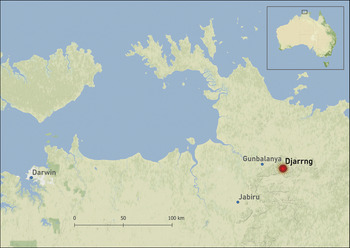
We draw upon one particular site known as Djarrng (Figure 2) due to its unique rock art relating to buffalo and its potential to inform our understanding of nineteenth-century Aboriginal responses to this imposing creature.
Map showing the general location of Djarrng; the exact location is withheld at the request of traditional owners (map produced by A. Jalandoni; base map by Stamen Design (OpenStreetMap)).

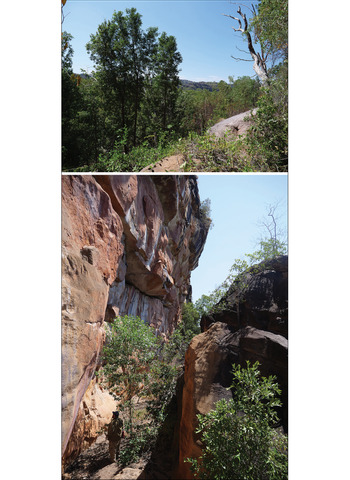
Djarrng is part of the northern portion of the Spencer Range and consists of an east-facing rock wall and shelter stretching over 100m along the base of the cliff (Figure 3). As Nelson et al. (Reference Nelson, Chippindale, Chaloupka, Taçon and Nelson2000: 75) note:
The cliff face extends ≈6m high, with a further cliff wall and a rock stack overhanging above, giving a total vertical height of ≈25m for the cliff at the south end of the site, and perhaps 30m at the north.
Top) view from the Djarrng site; bottom) view along one of the main rock art panels, in 2019 (photographs by S.K. May).

Previous research
Previous research at Djarrng is summarised elsewhere (Taçon et al. Reference Taçon, May, Wesley, Jalandoni, Tsang and Mangiru2021). The site was first noted as ‘Tyadang’ by archaeologists McCarthy (Reference McCarthy1965) and White (Reference White1967), who emphasised the importance of the site's rock art, especially the recent contact-period paintings. Notably, White (Reference White1967: 17) suggested that the rock art of Djarrng deserved further research “especially since local Aborigines claim to have painted some of the designs” (White Reference White1967: Appendix II-1: vi–vii).
In the 1970s, Edwards (Reference Edwards1979) visited and photographed the rock art at Djarrng. He noted that Djarrng was a major wet-season shelter site near the divide of the Cooper and Tin Camp Creeks. No strong taboos were associated with the shelter, meaning it could be visited by all ages and genders. Furthermore, Edwards noted that it has been a favourite campsite and was “visited by the mythological hero, Mankung, while he was looking for wild honey. He searched in vain so he went east and found some honey in an area called Makani” (Edwards Reference Edwards1979: 57–58). Noting key paintings at the site, Edwards states that
The gallery of art at this site is extensive, covering the base of the cliffs for several hundred metres. There are three life-size buffaloes with X-ray and other polychrome art styles superimposed over them. As buffalo probably reached this area in the 1840s, this dates the recent art to the last 130 years. (Edwards Reference Edwards1979: 57–58)
Contact-period rock art
Djarrng is home to over 200 rock art figures (Taçon et al. Reference Taçon, May, Wesley, Jalandoni, Tsang and Mangiru2021), with a multitude of contact-period subject matter, including horses (one with two riders), smoking-pipes, saddle packs, tin cans, humans in the classic ‘hands on hips’ pose (a characteristic way of depicting non-Aboriginal people), firearms and knives. More traditional motifs that seem to be contemporaneous are also present, such as ‘X-ray’ kangaroos, fish, turtles, birds and yams. All of these paintings add to the broader story of Djarrng and provide important context for our analysis of the buffalo paintings.
The Djarrng buffalo
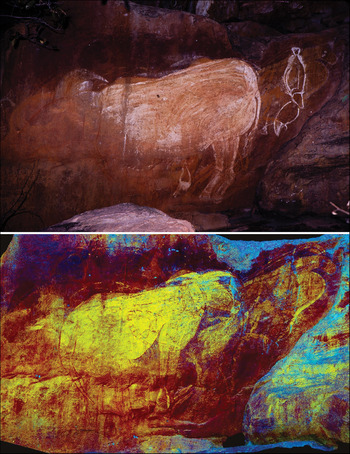
Our fieldwork documented six life-sized buffalo in the Djarrng rock art. Buffalo two, for example, measures approximately 2.76 × 1.52m, buffalo four measures ~2.01 × 1.31m and buffalo five measures ~2.28 × 1.56m. Buffalo one, three and six are too poorly preserved to be measured. Notably, it is only through the use of new technologies that these paintings have revealed themselves again. Today, all of the buffalo paintings have faded and are, in some cases, almost invisible to the human eye (Taçon et al. Reference Taçon, May, Wesley, Jalandoni, Tsang and Mangiru2021). Our research, therefore, has been assisted by the photographs of rock art researcher George Chaloupka, who visited and photographed the site in the 1970s and 1980s. Other paintings have been revealed in our current research through a combination of photogrammetry and image enhancement (dStretch) of both old and new photographs.
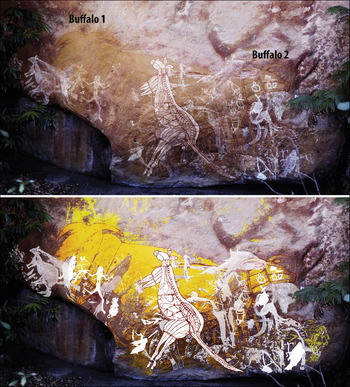
Buffalo one is solid yellow/orange with red lines (Figure 4). It has been extensively ‘over painted’ and superimposed, for instance, by buffalo two (Figure 4), a white horse and numerous other contact-period motifs. Buffalo two is also a solid yellow/orange figure with red lines, but is depicted with more elaborate decorative infill.
Top) Buffalo one and two, in 1979 (based on a photograph by G. Chaloupka, Museum and Art Gallery of the Northern Territory; DJA086); bottom) digital tracing of buffalo one and two (tracing by A.S. Sambo).

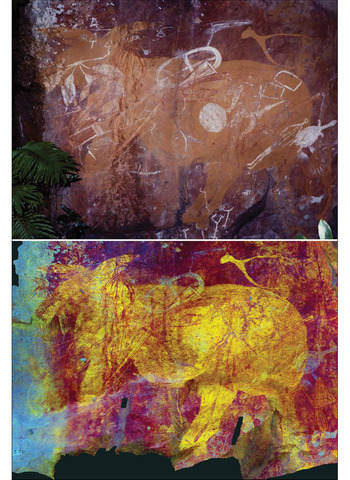
On a different panel is a solid white buffalo (buffalo three; Figure 5) painted over an earlier, solid yellow/orange buffalo (buffalo four) with a red outline (Figure 5). Notably, buffalo four shows clear ‘X-ray’ design elements.
Top) Buffalo three, in 1979 (photograph by G. Chaloupka, Museum and Art Gallery of the Northern Territory; DJA133); bottom) digital enhancement of buffalo four, based on 2019 photogrammetry (image by A. Jalandoni).

Near to the previous paintings is buffalo five, again painted in yellow/orange, but lacking the red outline and design elements (Figure 6); it is possible that the red colouring was part of the original design and has not survived. This buffalo has been superimposed by an assortment of recent imagery, including saddlebags, firearms and tin cans, and people with hands on hips and wearing European-style hats.
Top) Buffalo five, in 1979 (photograph by G. Chaloupka, Museum and Art Gallery of the Northern Territory; DJA053); bottom) digital enhancement of buffalo five (image by A. Jalandoni).

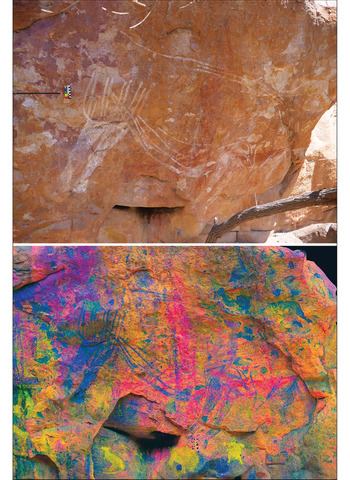
Located farther along the shelter is buffalo six—the last of the Djarrng buffalo (Figure 7). This white-outlined buffalo has a solid white colour for its legs, but the body is represented only in outline, with strategically placed lines along the back, belly and at the top of the legs. Notably, this buffalo was painted without a head.
Top) Buffalo six, in 2019 (photograph by S.K. May); bottom) digital enhancement of buffalo six (image by A. Jalandoni).

The significance of nganaparru in Arnhem Land cultural belief systems
Several key factors combine to suggest that the Djarrng buffalo represent more than simple representations of prey. Berndt and Berndt (Reference Berndt and Berndt1970: 53) note that buffalo were part of the complex system of social networks operating in western Arnhem Land, including those governing social units “in which persons are grouped or classified together” and those emphasising person-to-person relationships in the kinship system. Berndt and Berndt (Reference Berndt and Berndt1970: 65) state that “It is not only the human world that is divided up into these compartments. They apply to the natural world as well, or at least the great part of it”. Buffalo, horses and bullocks (male cattle) were each linked to specific moieties and sub-moieties in the intricate clan-system (for further discussion about social classification, see Taylor Reference Taylor1996). Buffalo were linked specifically to the ngaraidgu matrimoiety and the ‘jariburig’ (yariburig) semi-moiety whose symbol is gunag (fire) (Berndt & Berndt Reference Berndt and Berndt1970: 65–67).
Altman's (Reference Altman1982a: 283; Reference Altman1982b, Reference Altman1987, Reference Altman, Vincent and Neale2016) research has also highlighted and explored how nganaparru were integrated into particular patrimoieties (a social category related to descent through the father's-line) and subsections (kinship or ‘skin’ name groupings). Elders identified two types of nganaparru: one with short front legs (Yirritja patrimoiety, Nawamud/Kodjok subsection) and the other with thinner bodies and longer front legs (Dua patrimoiety, Nabulan/Gela subsection). Altman (Reference Altman1982b: 283) identified that buffalo were also associated with western Arnhem Land groupings: both types are Naraidgu matrimoiety; the former is Yariburig semi-matrimoiety, Nawamud/Kodjok subsection, and the latter are of Yariyaning semi-matrimoiety, Nabulan/Gela subsection.
Food-related taboos are common across western Arnhem Land, but Altman (Reference Altman1982b) established that some introduced bush foods exist outside of this taboo system, including nganaparru (water buffalo), buluki (feral cattle) and bigi bigi (feral pig). Altman argues that the unusual status of these animals was due to the fact that they had no ceremonial affiliation (Altman Reference Altman1982b: 317–18): “When questioned about this extraordinary status of buffalo, and why this was so, informants invariably declared ‘because there's no ‘business’ for nganaparru’ or ‘because nganaparru is too big’” (Altman Reference Altman1982a: 280).
While Altman (Reference Altman1982a: 282) argues that there are no totemic associations or production taboos associated with buffalo, he states that they were integrated into Kunwinjku mythology and art. He uses the example of a Rainbow Serpent (Ngalyod), called Inanga, which has the ears and horns of a buffalo, and whose father is said to be the nganaparru. This nganaparru Rainbow Serpent was illustrated in a bark painting by Jimmy Njiminjuma during the 1980s (Taylor Reference Taylor1996). Taylor discusses a similar relationship between Ngalyod and nganaparru: “Kurulk clan members say that Ngalyod in the form of a buffalo-headed figure was responsible for the creation of sites in their clan lands. Artists from this clan such as Mawurndjul and Njiminjuma frequently paint Ngalyod in this form” (Taylor Reference Taylor1996: 209–10).
Aboriginal artist Wurrubirlibirl told Taylor that the buffalo's horns and large body size were similar to that of Ngalyod, stating that “Kunwinjku artists have created images which integrate this species with the existing body of knowledge regarding Ngalyod” (Taylor Reference Taylor1996: 210).
Alongside this direct evidence, there is another clue concerning the cultural affiliations of the Djarrng buffalo: the artist's choice of colour. It is not by chance that four of the six Djarrng buffalo are painted as solid yellow/orange silhouettes. Buffalo three and six, which are painted in white, are a later addition, with one having been painted over the top of an earlier buffalo. There is ample evidence to suggest that the use of colour was not random, but part of a strict artistic system that continues today in Arnhem Land (e.g. Miller et al. Reference Miller, May, Goldhahn, Taçon and Cooper2021). As Taylor argues in relation to Kunwinjku bark paintings:
The background colour is a sign of the patrimoiety affiliations of the completed design: red, yamidj, for the Duwa moiety, and yellow, karlba, for the Yirridjdja patrimoiety. The paints are also considered to be transformed body substances of the Ancestral beings and are mined as ochres at djang sites. Red is associated with blood, and yellow with the fat of the Ancestral being. The incorporation of these transformed Ancestral substances, which connote images of health and fertility in the production of the design, add to the power of the completed design. (Taylor Reference Taylor1996: 120)
The yellow selected by the artists to create the silhouette of the buffalo may be associated with the Yirritja patrimoiety. The short front legs of the buffalo—as opposed to those with thinner bodies and longer front legs—may also link them to this patrimoiety (Nawamud/Kodjok subsection), as well as the Naraidgu matrimoiety, the Yariburig semi-matrimoiety and Nawamud/Kodjok subsection. The reliability of this ethnographic evidence is clear when considered in context: the Berndts, Altman and Taylor worked with artists who were either rock painters themselves or had been trained by rock painters. Furthermore, the artists belonged to neighbouring clans and often had strong cultural links to the broader Djarrng area. Indeed, in this case, ethnography is essential in the interpretation of the recent rock art imagery, as it provides important evidence for the complex ongoing relationship between humanity and the natural world (Franklin Reference Franklin2005: 78).
Significantly, Altman documented evidence for nganaparru re-emerging rather than simply appearing as ‘new’: “For while in the myth context, elders stress that nganaparru has always been here (i.e. it is indigenous), Europeans have told younger Aborigines that the buffalo is an introduced species” (Altman Reference Altman1982a: 284). Despite European attempts to discount Aboriginal perceptions on the origins of nganaparru, it is clear that they remain strongly placed within Aboriginal belief systems, with art being used as a tool to communicate their story and their place in the world.
Rock art as a tool for minimising disruption
The Aboriginal people of Arnhem Land are not resistant to material or technological change. They have adapted to hunting a large and dangerous mammal, the buffalo, but they are resistant to societal and structural change that threatens their way of life. (Fijn Reference Fijn2017: 20)
In exploring how contact-period rock art encapsulates and expresses the tension between tradition and innovation in western Arnhem Land, Frieman and May (Reference Frieman and May2019) argue that it could be used to minimise disruption to specific values conceptualised as ‘traditional’. In the case of the Djarrng buffalo, we find visual representations of a species that has re-emerged—a species that was always there, but is once again showing itself to Aboriginal people. Creating life-sized paintings of these emerging creatures was probably part of the mechanism by which these animals were reintroduced to the community. Rock art acted as an inter-generational educational media by which young people could learn the buffalo habits, learn how to exploit them as a resource, and learn how they fit within existing cultural systems (e.g. Goldhahn et al. Reference Goldhahn, May, Maralngurra and Lee2020). The Djarrng buffalo paintings are manifestations of the re-emergence of these animals, and a way through which community members, perhaps elders, could manage their re-emergence without challenging the fundamental ontology of a structured cultural system.
Conclusion
Myers (Reference Myers1991) argues that Aboriginal understandings of historical process are not static. Rather, the ‘Dreaming’ organises these experiences so that it appears to be continuous and permanent: “For the Pintupi, the dynamic, processual aspect of history seems to exist as one of discovering, uncovering, or even re-enacting elements of the Dreaming” (Myers Reference Myers1991: 53). We have argued that rock art played a similar role in the re-emergence of a new species of animal—the buffalo—into western Arnhem Land life, land and culture. Djarrng artists were demonstrating the cultural significance of nganaparru and their place within the existing cultural systems on a large scale. Whether for an audience watching them paint, or for others who would subsequently pass by this site, the viewer would see and likely understand this iconography. As an inter-generational tool to help minimise disruption to traditional belief systems, the Djarrng buffalo were, and still are, visual markers of this process and a remarkable testimony of Aboriginal history.
This research emphasises that contact-period rock art was neither the result of casual activity nor a corruption of traditional art. Rather, the painting of new subject matter, such as water buffalo, incorporated key design elements that allowed artists to control the re-emergence of buffalo into social and cultural life. It allowed them to communicate, educate, memorialise and come to terms with some of the profound changes that were occurring. Moreover, the described process of re-emergence is of relevance not only for Djarrng but also for contact-period rock art sites across Australia and elsewhere around the world. It forces us to reconsider our interpretation of rock art produced during much earlier periods of colonisation or invasion, such as the art made in relation to the so called ‘Neolithic revolution’. The Djarrng buffalo demonstrate the complex inter-generational cultural information embedded in rock art and reveal to us its potential to inform our broader understandings of cross-cultural encounters.
Acknowledgements
We thank the Northern Land Council for research permits and Injalak Arts for their support. Thanks to the Museum and Art Gallery of the Northern Territory for permission to use George Chaloupka's photographs as part of this research, Carmel Schrire for discussing the site and sharing her photographs with us, and Jon Altman for discussions relating to buffalo. We are grateful to Gabriel Maralngurra for his advice on the significance of buffalo in western Arnhem Land and his insights into the paintings. J.G. thanks Rock Art Australia for their support.
Funding statement
This research was funded by Australian Research Council grants FL160100123 (Taçon) and DE170101447 (Wesley).