INTRODUCTION
Trematodes of the family Renicolidae parasitize kidneys and ureters of birds feeding on bivalves and fishes. Numerous keys to this family were published previously (Dollfus, Reference Dollfus1946; Wright, Reference Wright1954, Reference Wright1956, Reference Wright1957; La Rue, Reference La Rue1957; Odening, Reference Odening1962; Riley and Owen, Reference Riley and Owen1972; Sudarikov and Stenko, Reference Sudarikov, Stenko and Sonin1984; Gibson, Reference Gibson, Gibson, Bray and Jones2008). However, the status and classification of many renicolid species is still considered uncertain and some of existing descriptions are considered incomplete because of the non-visibility of important identification features such as intestine, gonads, vitellarium and ventral sucker, and because nothing is known accurately about the degree of specificity of the morphologic identification features (Odening, Reference Odening1962). Anyways, as correctly pointed out by Gibson (Reference Gibson, Gibson, Bray and Jones2008), potential identification features of Renicolidae are usually obscured by the uterus.
Numerous attempts have been made to split the genus Renicola Cohn, 1904. But as very few autapomorphic features are available, the newly erected genera were frequently subject to reclassifications and merged back with the genus Renicola; for a review of the history of re-classifications, cf. Gibson (Reference Gibson, Gibson, Bray and Jones2008) or Kharoo (Reference Kharoo2013). Moreover, only negligible phylogenetic data are available. In their study of the suborder Plagiorchiata, Tkach et al. (Reference Tkach, Pawlowski, Mariaux, Swiderski, Littlewood and Bray2001) analysed the 28S rDNA of a renicolid specimen, concluding that renicolids are close to Eucotylidae, i.e. the family parasitizing bird kidneys similarly to Renicolidae. More recently, Olson et al. (Reference Olson, Cribb, Tkach, Bray and Littlewood2003) added the analysis of 18S rDNA, concluding that Renicolidae are placed within the Microphalloidea, again close to the Eucotylidae. Whereas the family level systematics appears to be solved, only negligible data are available relevant to the differentiation of closely related species. Besides numerous specimens not identified to the species level (Tkach et al. Reference Tkach, Pawlowski, Mariaux, Swiderski, Littlewood and Bray2001; Olson et al. Reference Olson, Cribb, Tkach, Bray and Littlewood2003; Leung et al. Reference Leung, Donald, Keeney, Koehler, Peoples and Poulin2009; Hechinger and Miura, Reference Hechinger and Miura2014; O'Dwyer et al. Reference O'Dwyer, Faltýnková, Georgieva and Kostadinova2015), the following taxa identified to the species level were analysed: Renicola buchanani and Renicola cerithidicola (CO1 is available for both; Hechinger and Miura, Reference Hechinger and Miura2014), Renicola roscovita (short stretch of 28S rDNA; Litvaitis and Rohde, Reference Litvaitis and Rohde1999), and Nephromonorcha varitestis (partial 28S rDNA; the 28S rDNA locus analysed in our paper did not overlap with this sequence; Patitucci et al. Reference Patitucci, Kudlai and Tkach2015). Cercaria doricha and Cercaria pythionike (ITS1, 5·8S rDNA, ITS2; Campbell et al. Reference Campbell, Cross, Chubb, Cunningham, Hatfield and MacKenzie2007) parasitizing the herring in the North and Baltic Seas were suggested to belong to Renicolidae too, but the NCBI Blast of these sequences does not support such classification of these specimens.
In Central Europe, six species of Renicolidae were reported. These include the type species of the genus Renicola, Renicola pinguis (Mehlis in Creplin, 1846) (Sitko and Heneberg, Reference Sitko and Heneberg2015), Renicola lari Timon-David, 1933 (Oßmann, Reference Oßmann2008), Renicola paraquinta Rajewsky, 1937 (Sitko, Reference Sitko1968; specimens of this species from Central European terns were re-classified here as Renicola sternae sp. n.), Renicola mediovitellata Bykhovskaya-Pavlovskaya, 1950 (Rząd et al. Reference Rząd, Sitko, Kavetska, Kalisińska and Panicz2013), Renicola bretensis Timon-David, 1953 and Renicola secunda Skrjabin, 1924 (both reported by Sitko et al. Reference Sitko, Faltýnková and Scholz2006). Importantly, the validity of the first three above-named species was questioned by Odening (Reference Odening1962), who suggested that all the three may be synonymized as R. pinguis.
In this study, we address the possible synonymization of species within the R. pinguis complex suggested by Odening (Reference Odening1962) by employment of combined molecular and comparative morphological analysis. We perform first conclusive phylogenetic analysis of the taxonomic position of central European Renicolidae based on four independent nuclear and mitochondrial DNA loci. We also describe a new species hosted by terns, which was previously repeatedly misidentified as R. paraquinta, provide comparative measurements of the examined central European Renicolidae and address their tissue specificity and host-specific prevalence based on the extensive cohort of birds examined in years 1962–2015.
MATERIAL AND METHODS
Sampling
For the purpose of prevalence assessment, we examined over 17 000 individuals of 240 bird species for the presence of helminths of the Renicolidae in years 1962–2015 (det. & coll. J. Sitko). All examined birds were collected in the Czech Republic (48°39′N–50°59′N, 12°19′E–18°29′E), primarily in the eastern parts of the country as specified in detail in Supplementary Table S1.
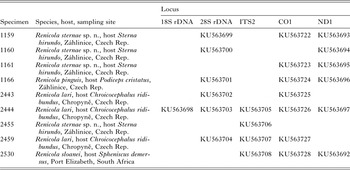
For the purpose of phylogenetic analyses, we examined representative specimens of the Renicolidae collected in the Czech Republic (Chropyně 49·35°N, 17·37°E, Strachotín 48·90°N, 16·67°E, Tovačov 49·42°N, 17·30°E and Záhlinice 49·17°N, 17·28°E) and also the specimen of Renicola sloanei Wright, Reference Wright1954 collected in South Africa (Port Elizabeth 33·94°S, 25·53°E) from Apr-1963 to May-2015. All helminths were obtained from birds that were submitted for deposition in the Comenius Museum in Přerov, Czech Republic (Czech specimens) or that died in the Penguins Eastern Cape Marine Rehabilitation Centre (South African specimen). All the birds were already dead from various causes when they were received by the institutions. The helminth specimens were fixed and stored in 96% ethanol. The list of individuals examined is provided in Table 1.
New sequences of the Renicolidae collected from the Czech Republic and South Africa, generated throughout the course of this study. NCBI GenBank accession numbers are indicated

For comparative morphological analysis, we stained representative specimens in Semichon's carmine, dehydrated by alcohol series and mounted in Canada balsam. For the analyses of egg length, we measured the longest egg present within each examined adult individual. Dimensions are shown in μm as range (mean ± s.d.). All other data are shown as mean ± s.d. unless stated otherwise.
DNA extraction, amplification and sequencing
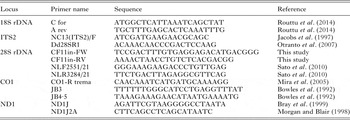
We extracted and amplified DNA as described (Heneberg et al. Reference Heneberg, Rojas, Bizos, Kocková, Malá and Rojas2014), using the primers targeting nuclear 18S rDNA, ITS2 and 28S rDNA loci, and mitochondrial CO1 and ND1 loci (Table 2). The new primers for the amplification of partial 28S rDNA (CF11in-FW and CF11in-RV for) were designed for Plagiorchiida using Primer3 (http://frodo.wi.mit.edu/primer3, accessed on 4-Jan-2016) based on 100% conserved parts of 28S rDNA sequences of Collyriclum faba and Maritrema spp. The DNA amplicons were purified using USB Exo-SAP-IT (Affymetrix, Santa Clara, CA) and were subjected to bidirectional Sanger sequencing at ABI 3130 DNA Analyzer (Applied Biosystems, Foster City, CA). The resulting consensus DNA sequences were submitted to GenBank database under accession numbers KU563692-KU563710 and KU563722-KU563728 (Table 1).
Primers used for the amplification and sequencing of mitochondrial and nuclear DNA loci in the Renicolidae

Alignments and phylogenetic analyses
Newly generated sequences, sequences obtained from NCBI GenBank as of 27-Dec-2015, and sequences of corresponding outgroups were aligned by ClustalW (gap opening penalty 7, gap extension penalty 2 for both pairwise and multiple alignments, DNA weight matrix IUB, transition weight 0·1). We manually corrected the alignments for any inconsistencies, trimmed the aligned sequences and removed short-length sequences from the alignments; only trimmed sequences were utilized for further analyses. The trimmed ITS2 locus (consisting of partial 5·8S rDNA, full-length ITS2 and partial 28S rDNA sequences) corresponded to nt. 1–582 (582 bp) of Prosthogonimus cuneatus KP192736 (Supplementary Table S2). The trimmed 28S rDNA locus (partial LSU rRNA coding sequence) corresponded to nt. 3192–3495 (304 bp) of Lepidophyllum steenstrupi AY157175 (Supplementary Table S3). The trimmed CO1 locus (partial CO1 coding sequence, short non-coding region and partial tRNA-Thr coding sequence) corresponded to nt. 119–683 (565 bp) of Renicola buchanani KF512572 (Supplementary Table S4). The trimmed ND1 locus (partial ND1 coding sequence) corresponded to nt. 1–182 (182 bp) of Schistogonimus rarus KP192760 (Supplementary Table S5).
Maximum likelihood fits of 24 nucleotide substitution models were performed as described (Řezáč et al. Reference Řezáč, Gasparo, Král and Heneberg2014), with all sites used for the analyses, including gaps. For each model, we calculated the Bayesian information criterion, corrected Akaike information criterion and maximum likelihood values. For the ITS2 locus, we analysed 6 sequences with a total of 643 positions in the final dataset (Supplementary Table S6). For the 28S rDNA locus, we analysed 7 sequences with a total of 304 positions in the final dataset (Supplementary Table S7). For the CO1 locus, we analysed 17 sequences with a total of 565 positions in the final dataset (Supplementary Table S8). For the ND1 locus, we analysed 7 sequences with a total of 182 positions in the final dataset (Supplementary Table S9). We used the best fit models for follow-up phylogenetic analyses. We employed the bootstrap procedure at 1000 replicates. For the tree inference, we used nearest-neighbour-interchange as the maximum likelihood heuristic method of choice, and the initial tree was formed by the neighbour joining algorithm.
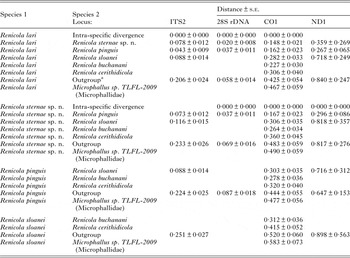
We used the maximum likelihood method to estimate inter- and intrasite evolutionary divergence in newly sequenced species of the Renicolidae. We calculated the number of base differences per site by averaging over all sequence pairs between groups (Distance) ± s.e., and employed bootstrap procedure at 1000 replicates. The models used to estimate inter- and intrasite evolutionary divergence based on the ITS2 and 28S rDNA loci were identical with those used to construct the respective trees. However, to analyse the CO1 and ND1 loci, we employed the Tamura-Nei model (Tamura and Nei, Reference Tamura and Nei1993) with the non-uniformity of evolutionary rates among sites modelled by using a discrete Gamma distribution (+G) with 5 rate categories, because the Hasegawa-Kishino-Yano model does not allow the calculation of inter- and intrasite evolutionary divergence by the program used (Tamura et al. Reference Tamura, Peterson, Peterson, Stecher, Nei and Kumar2011).
To corroborate the data obtained with maximum likelihood analysis, we employed Bayesian inference. To infer the tree topologies using a Bayesian approach, we converted the ClustalW alignments generated in MEGA5 to the Nexus format in Mesquite 3·04, manually adjusted the accessory information, and performed the Bayesian analysis in MrBayes 3·2·5, using the mixed model of nucleotide substitution. Bayesian analysis included four Monte Carlo Markov chains for 2 000 000 generations, and trees sampled every 1000th generation, with the average standard deviation of split frequencies not exceeding 0·01. We discarded the first 25% of samples as burn-in. After discarding the burn-in samples, we used the remaining data to generate a 50% majority-consensus tree with the posterior probabilities of branches indicated. We visualized the resulting trees in FigTree 1·4·2. We obtained the following summary statistics for the analyses performed: average standard deviation of split frequencies 0·0029–0·0046, maximum standard deviation of split frequencies 0·0075–0·0122, average potential scale reduction factor 1·000, and maximum potential scale reduction factor 1·000–1·007.
RESULTS
Central European Renicola spp.
During the extensive long-term examination of Czech birds, we confirmed the presence of six Renicola spp., namely R. bretensis, R. lari, R. mediovitellata, R. pinguis, R. secunda and R. sternae sp. n. (reported previously as R. paraquinta). In this study, we focused particularly on the species suggested to be synonymized by Odening (Reference Odening1962), i.e. R. lari, R. pinguis and R. sternae sp. n. (reported previously as R. paraquinta). The species used for phylogenetic analyses were identified based on the morphological examination in their core hosts, i.e. in Chroicocephalus ridibundus (R. lari), Podiceps cristatus (R. pinguis) and Sterna hirundo (R. sternae sp. n.).
Phylogenetic analyses of specimens isolated from birds
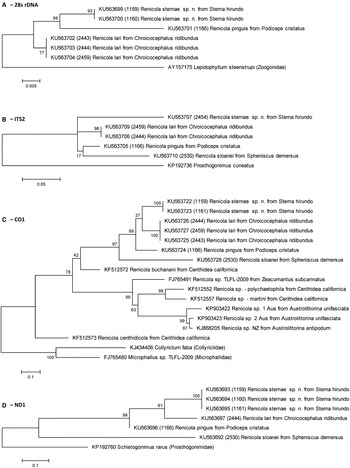
Maximum likelihood analysis of both nuclear (ITS2 and 28S rDNA) and mitochondrial (CO1 and ND1) DNA loci revealed that all the three species questioned by Odening (Reference Odening1962) represent distinct, well-defined species among the Renicola specimens isolated from various bird hosts (Fig. 1). All the four DNA loci tested (ITS2, 28S rDNA, CO1 and ND1) were species-specific, differentiating the specimens from gulls (R. lari), terns (R. sternae sp. n.) and grebes (R. pinguis). None of the four loci displayed intraspecific variability, but the number of individuals of each species tested was low (Table 3). Selection of outgroups was affected by limited availability of microphallid sequences of most of the loci tested. Phylogenetic classification of Renicolidae in a position close to Eucotylidae, which was suggested by Olson et al. (Reference Olson, Cribb, Tkach, Bray and Littlewood2003), was confirmed by an analysis of 18S rDNA. The analysis included 18S rDNA sequences of R. lari, which were generated in course of this study, other two previously sequenced Renicola specimens, two eucotylids (Paratanaisia bragai and Tanaisia fedtschenkoi) and Pachypsolus irroratus as an outgroup (data not shown). For other four DNA loci tested, only limited spectrum of previously sequenced Microphalloidea species was available. Only for the CO1 locus, there were available multiple sequences of Microphallidae and the relatively recently released sequence of Collyriclum faba (Collyriclidae). The estimation of inter-specific evolutionary divergence revealed that the microphallid sequence (Microphallus sp. TLFL-2009) with the highest similarity to the Renicola spp. examined in this study is more distant to any of the four Renicola spp. than the CO1 sequence of Collyriclum faba. However, the evolutionary divergence between Renicola spp. and the other Microphalloidea in the CO1 locus was too big to provide a good resolution (Fig. 1, Table 3).
Maximum likelihood analysis of sequences of nuclear (28S rDNA (A) and ITS2 (B)) and mitochondrial DNA loci (CO1 (C) and ND1 (D)) of Renicolidae.

Estimates of the intra- and inter-specific evolutionary divergence of the Renicolidae from the Czech Republic and South Africa examined in this study, and specimens with DNA sequences available in the NCBI GenBank database

The estimates are based on sequences of ITS2, 28S rDNA, CO1 and ND1 DNA loci. Distance: The number of base differences per site generated by averaging over all sequence pairs between groups.
a As the outgroups, we used the sequences of non-renicolid species with the highest similarity to the analysed specimens as revealed by NCBI Blast algorithm. Thus, sequences of different organisms were used for different DNA loci based on their public availability. The sequences of the following species were used: Prosthogonimus cuneatus (Prosthogonimidae, ITS2), Lepidophyllum steenstrupi (Zoogonidae, 28S rDNA), Collyriclum faba (Collyriclidae, CO1) and Schistogonimus rarus (Prosthogonimidae, ND1). In addition, to analyse CO1, we also used the sequence of nearest microphallid species, i.e. Microphallus sp. TLFL-2009 (Microphallidae).
The sequences of DNA from R. sloanei, were distant from the complex of R. lari/pinguis/sternae as revealed by the analyses of CO1 and ND1 loci (Fig. 1, Table 3). However, the analysis of the CO1 locus suggested that all the four above species cluster together when compared with other hitherto sequenced Renicola spp., including R. buchanani, R. cerithidicola and a complex of Renicola spp. isolated from intermediate snail hosts (Austrolittorina unifasciata, Austrolittorina antipodum, Cerithidea californica and Zeacumantus subcarinatus) and not identified to species. The genus Renicola appears to be paraphyletic, with R. lari, R. pinguis, R. sternae sp. n., R. sloanei and R. buchanani forming one clade, with Renicola specimens unidentified to species and isolated from marine snails of Californian, Australian and New Zealand origin forming another clade, and with R. cerithidicola being basal to both the above-proposed clades (Fig. 1C). Analysis of more DNA loci of these species is needed to provide any conclusive reclassification of Renicola spp.
Of note is that the 3′ tails of CO1 coding sequences of Renicola spp. displayed strong inter-specific variability in both the length and sequence, and were followed by a short non-coding spacer sequence prior the tRNA-Thr coding region. Note also that the respective regions were highly conserved within the species. Although we did not use the respective part of sequence in our phylogenetic analyses, we propose the use of this region as a candidate region for polymerase chain reaction-, restriction fragment length polymorphism (RLFP) or matrix-assisted laser desorption/ionization - time-of-flight mass spectrometer (MALDI-TOF)-based assays aiming to identify the particular Renicola spp. without the need to undertake DNA sequencing (Table 4).
Amino-acid sequence of 3′ tail of CO1 of the four Renicola spp. sequenced in this study. Each species expressed CO1 of slightly different length, which was highly conserved within the particular species

“*”, Termination codon; ”-”, Data absent.
We corroborated the data obtained with maximum likelihood analysis by inferring the tree topologies using a Bayesian approach. The Bayesian approach confirmed all the key conclusion of the maximum likelihood analyses (Supplementary Figs S1, S2, S3, S4).
Ecology of Renicolidae
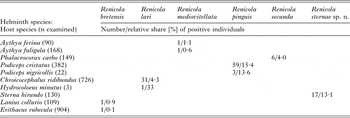
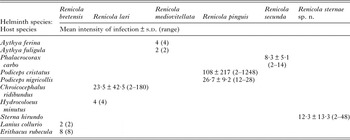
The host-specific prevalence (Table 5) and intensity of infection (Table 6) of Renicolidae were strongly species-specific. The differences in the prevalence suggest strict separation of ecological niches for the six species. All the bird species hosted only up to one Renicola species. The most abundant species, R. pinguis, was common in great crested grebes (Podiceps cristatus) and black-necked grebes (Podiceps nigricollis), but was absent in little grebes (Tachybaptus ruficollis) and other species. Also R. sternae sp. n. was found relatively frequently, but it was restricted to common terns (Sterna hirundo), which have a circumpolar distribution but are limited in abundance and considered endangered in the Czech Republic. The gull specialist, R. lari, was regularly found in black-headed gulls (Chroicocephalus ridibundus). It may infect also other Czech gulls, as suggested by its finding in a little gull (Hydrocoloeus minutus), but other gull species than C. ridibundus increased their abundance in the Czech Republic only recently, and we did not examine sufficient number of specimens to provide a definitive answer. However, in gulls, the Renicola prevalence is three- to four-times lower than that experienced in grebes and terns. Besides the R. lari/pinguis/sternae species complex, the Czech birds hosted also, R. mediovitellata, which was a rare parasite of Anatidae. We identified only a single infected individual of common pochard (Aythya ferina) and tufted duck (Aythya fuligula) each. We further identified R. bretensis, which was a rare parasite of red-backed shrikes (Lanius collurio) and European robins (Erithacus rubecula, new host record), and R. secunda, which was a kidney parasite of great cormorants (Phalacrocorax carbo) (Table 5, Table 6). As the Renicolidae species are brought in the Czech Republic from abroad (probably from brackish or salt waters) due to bird migration only, all the prevalences were calculated only from the number of adults examined, excluding the examined juvenile birds.
Host-specific prevalence of the Renicolidae in the Czech Republic in years 1962–2015. The Renicolidae occur only in adult birds in the Czech Republic, thus the relative share of positive host birds was calculated from the number of adults examined

Intensity of infection by the Renicolidae in the Czech Republic in years 1962–2015

We corroborated the above-suggested spectrum of core Renicola spp. Host–parasite interactions by DNA sequencing as described above.
Comparative morphology of the R. lari/pinguis/sternae complex
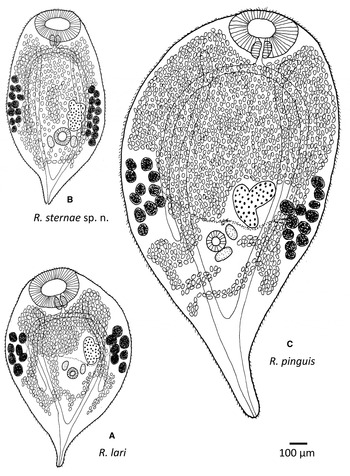
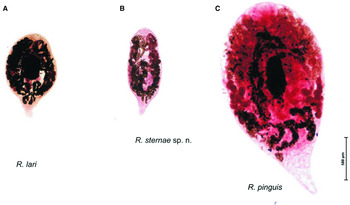
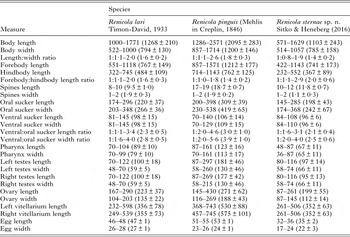
As species of the R. lari/pinguis/sternae complex discussed in this study were not subjected to DNA analyses previously, we complement here the DNA analyses with measurements of key morphologic features of the analysed species as identified by the combined morphologic and genetical approach (Table 7) and provide representative drawings (Fig. 2) and photographs (Fig. 3) of the species analysed. The body measures of these three Renicola spp. overlap with each other. Renicola pinguis is the largest one, with adults being usually longer and wider than adults of the other two species, with particularly remarkable hindbody length. Renicola lari and R. sternae sp. n. differ in a length of pharynx. However, all these measures overlap at least in a part of the adults, thus large series of worms are needed for a definitive diagnosis. Importantly, based on the specimens analysed, the two non-overlapping measures consist of spines length (9·5 ± 1·0, 18·7 ± 0·7 and 11·8 ± 0·7 in R. lari, R. pinguis and R. sternae sp. n., respectively) and egg length (47 ± 1, 53 ± 1 and 35 ± 2 in R. lari, R. pinguis and R. sternae sp. n., respectively) (Table 7).
Representative drawings of species of the Renicola pinguis complex analysed in this study: Renicola lari (A), R. sternae sp. n. (B) and R. pinguis (C).

Representative microphotographs of species of the Renicola pinguis complex analysed in this study: Renicola lari (A), R. sternae sp. n. (B) and R. pinguis (C) stained in Semichon's carmine. (A) Renicola lari, host Larus ridibundus, adult male, sampling site and date: Strachotín, Czech Republic, 5-Jun-1964. (B) Renicola sternae sp. n., type specimen, host Sterna hirundo, adult male, sampling site and date: Strachotín, Czech Republic, 19-Jun-1968. (C) Renicola pinguis, host Podiceps cristatus, adult female, sampling site and date: Záhlinice, 27-May-1995.

Measurements of the Renicolidae based on the adult individuals collected in the Czech Republic in years 1962–2015. Host species of the individuals described: Renicola lari – 30 specimens from Chroicocephalus ridibundus; R. sternae sp. n. – 30 specimens from Sterna hirundo; R. pinguis – 30 specimens from Podiceps cristatus. Data are shown as range (mean ± sd)

Description of R. sternae sp. n. Sitko and Heneberg
Type host: Sterna hirundo Linnaeus, 1758 (Aves: Laridae)
Other hosts: Probably other Palearctic Sterninae spp., including Chlidonias niger, Hydroprogne caspia, Sterna albifrons, Sterna hirundo and Thalasseus sandvicensis.
Misidentifications: Renicola lari Timon-David, Reference Timon-David1933; Bykhovskaya-Pavlovskaya (Reference Bykhovskaya-Pavlovskaya1962) in Sterna hirundo and Chlidonias niger; Sitko et al. (Reference Sitko, Faltýnková and Scholz2006) in Hydroprogne caspia and Sterna hirundo. Renicola paraquinta Rajewsky, 1937: Sitko (Reference Sitko1968) in Sterna hirundo; Sitko (Reference Sitko1993) in Sterna hirundo; Gibson et al. (Reference Gibson, Bray and Harris2005) in Chlidonias niger, Sterna albifrons, Sterna hirundo and Thalasseus sandvicensis; Sitko et al. (Reference Sitko, Faltýnková and Scholz2006) in Sterna hirundo.
Vector: Unknown
Site: Kidney, ureter
Type locality: Czech Republic, Záhlinice (49·29°N, 17·48°E, 6770)
Other localities: Czech Republic: Hustopeče nad Bečvou (49·57°N, 17·44°E, 6473), Lomnice nad Lužnicí (49·08°N, 14·71°E, 6957), Nová Ves (48·93°N, 16·52°E, 7165), Strachotín (48·90°N, 16·65°E, 7065) (Supplementary Table S1)
Prevalence: 17 of 130 examined Sterna hirundo were parasitized (13·1%) (Table 5); mean intensity of infection 12·3 ± 13·3 (range 2–48) (Table 6)
Molecular features: Unique 3′ CO1 tail: GSLILPLIHHLDYGSFSVCWKW* (Table 4). 28S rDNA (KU563699, KU563700), ITS2 (KU563706), CO1 (KU563722, KU563723) and ND1 (KU563693, KU563694, KU563695) sequences. Inter-specific evolutionary divergence in ITS2: 0·073 ± 0·012 base differences per site to R. pinguis, and 0·078 ± 0·012 to R. lari; in 28S rDNA 0·020 ± 0·008 to R. lari, and 0·037 ± 0·011 to R. pinguis; in CO1 0·148 ± 0·021 to R. lari, and 0·167 ± 0·023 to R. pinguis; and in ND1 0·359 ± 0·269 to R. lari and 0·296 ± 0·086 to R. pinguis (Table 3).
Material deposited: Adult specimens are deposited in the collection of Commenius Museum, Přerov, Czech Republic (marked as P-P-1871/3); DNA samples are deposited at the Charles University in Prague, Third Faculty of Medicine (marked as 1159, 1160, 1161, 2455).
Etymology: The specific epithet sternae is derived as a genitive of the host generic name Sterna.
Diagnosis: Renicola sternae sp. n. differs from other species in the Renicola pinguis complex in the length of eggs, and in the length of spines (Table 7). Other morphological characters overlap with those of closely related species. There are marked differences at the molecular level at all four DNA loci tested. Of note is a presence of species-specific 3′ tail of the amino-acid sequence of CO1.
Description: (Sterna hirundo −30 specimens) (Figs 2B and 3B; Table 7). Body ovoid, with maximum width near midbody, more pointed posteriorly, distended by gravid uterus. Cuticle thin, armed to posterior end with widely spaced rows of thinly placed, sharply pointed spines. Oral sucker subterminal, shallow. Oral cavity small, shallow depression in centre of sucker, leading directly into weakly muscular pharynx. Esophagus slender. Ceca enlarged, arcuate, lined by simple epithelium, extending into posterior third of body. Ventral sucker small, in posterior half of body. Testes smooth to slightly irregular in outline, lying dorsal and posterior to ventral sucker. Genital pore indistinct in fixed adult specimens, slightly to one side (usually left) of body midline, approximately length of testis in advance of testis. Ovary sinistral, near midline of body, larger than testis, lobed, lobed more strongly laterally, extending from about level of genital pore to midregion of testis to ventral sucker area. Ootype weakly developed, surrounded by lightly staining Mehlis’ gland. Uterus voluminous, ascending and descending at least four times (nine single passages) through body length, filled to capacity with eggs. Two ascending and descending passages of uterus containing youngest eggs on same side of body midline as ovary and with those passages of uterus having younger eggs being more median and of shorter extent than that of second, more lateral passages. In descending and ascending passages on opposite sides of body, uterus makes two more complete passages through body length with those passages containing most mature eggs located more median in position and of shorter extent. Vitellarium lateral to caeca in middle third of body, of variable extent, from anterior to ovary to just caudal to level of testis or less, follicles large, most often fusing together medially at or near origin of transverse yolk duct, consisting of 6 to 12 follicles on ovarian side of body and 9–13 follicles on opposite side. Transverse yolk ducts originating on each side as pair of smaller ducts but fusing into single duct before joining with each other to form yolk reservoir. Eggs operculated, uniformly sized in all levels of uterus. Excretory pore at posterior end of body. Body measurements are shown in Table 7.
Remarks: Parasite of terns, previously frequently misidentified as R. paraquinta or R. paraquintus.
DISCUSSION
The identification of species of the family Renicolidae is not trivial, particularly as adults of the R. lari/pinguis/sternae complex possess very limited autapomorphic identification indicators and were previously suggested to form a single species by Odening (Reference Odening1962). In addition, the status of the genus Renicola is questionable. The genus includes over 50 species, and there were numerous attempts to split it or at least to propose some subgroups (cf. Gibson, Reference Gibson, Gibson, Bray and Jones2008), and some erroneous reclassifications affecting among others R. lari analysed in this study (cf. Pojmańska and Niewiadomska, Reference Pojmańska and Niewiadomska2015). However, all the hitherto suggested classification systems were based on morphological characters, because molecular phylogenetic analysis of the genus was never conducted with the exception of positioning of Renicolidae within the higher taxonomical units.
Analysis of the newly obtained DNA sequences confirmed here the classification of R. lari, R. pinguis, R. sloanei and R. sternae sp. n. as valid species (Fig. 1). The analysis of DNA suggested the existence of at least two clades. However, the situation is complicated by the origin of examined materials. Whereas one clade was supported by the material analysed from definitive host (R. lari, R. pinguis, R. sloanei and R. sternae sp. n.) and in part from intermediate hosts (R. buchanani), the another clade consisted of multiple specimens unidentified to species and sequenced so far only from marine snails of Californian, Australian and New Zealand origin. In addition, the isolate of R. cerithidicola isolated from its intermediate host was basal to both the above clades.
Combined morphological and genetic approach revealed that the infections by the R. lari/pinguis/sternae complex are highly host species specific. Some previous reports on an overlap of the host spectrum can be rejected, such as the erroneous report of R. lari in Sterna hirundo by Sitko (Reference Sitko1993), cited also by Sitko et al. (Reference Sitko, Faltýnková and Scholz2006). Others require further verification; these include the report of R. lari in terns such as Hydroprogne caspia (Macko, Reference Macko1964) and Sterna albifrons (Kostadinova, Reference Kostadinova1993, Reference Kostadinova1997) and in the osprey Pandion haliaeetus (Kennedy and Frelier, Reference Kennedy and Frelier1984), which all were probably affected by the Odening's suggestion to treat the whole species complex as a single species. Very broad host species spectrum was reported also by Bykhovskaya-Pavlovskaya (Reference Bykhovskaya-Pavlovskaya1962), who reported R. lari in Sterna hirundo and Chlidonias niger, and conversely R. paraquinta in Larus canus, Larus fuscus and Larus ridibundus. The host spectrum of R. lari probably does not include terns, but includes multiple species of gulls and perhaps skuas. Among the gull species, the following ones were confirmed as definitive hosts: Larus argentatus, Larus audouinii, Larus canus, Larus crassirostris, Larus marinus, Ichthyaetus melanocephalus, Hydrocoloeus minutus and Chroicocephalus ridibundus (Bykhovskaya-Pavlovskaya, Reference Bykhovskaya-Pavlovskaya1962; Murai et al. Reference Murai, Sulgostowska, Matskási, Mészáros and Mahunka1986; Sulgostowska and Czaplinska, Reference Sulgostowska and Czaplinska1987; Kostadinova, Reference Kostadinova1993, Reference Kostadinova1997; Sitko, Reference Sitko1993, Reference Sitko1995; Lafuente et al. Reference Lafuente, Roca and Carbonell1998; Nekrasov et al. Reference Nekrasov, Pronin, Sanzheva and Timoshenko1999; Reimer, Reference Reimer2002; Skirnisson et al. Reference Skirnisson, Guðmundsdóttir, Andrésdóttir and Galaktionov2003; Gibson et al. Reference Gibson, Bray and Harris2005; this study). In addition, the skuas Stercorarius parasiticus and Stercorarius pomarinus were reported as R. lari hosts by Bykhovskaya-Pavlovskaya (Reference Bykhovskaya-Pavlovskaya1962); Sergeeva (Reference Sergeeva1971) and Gibson et al. (Reference Gibson, Bray and Harris2005). The host spectrum of R. sternae sp. n. probably does not include gulls, but includes multiple species of terns, in which it was previously misidentified as R. paraquinta. Among the tern species, the following ones were confirmed as definitive hosts: Chlidonias niger, Hydroprogne caspia, Sterna albifrons, Sterna hirundo and Thalasseus sandvicensis (Sitko, Reference Sitko1993; Gibson et al. Reference Gibson, Bray and Harris2005). The host spectrum of R. pinguis includes multiple species of grebes, and possibly also loons and rarely egrets. Among the grebe species, the following ones were confirmed as definitive hosts: Podiceps auritus, Podiceps cristatus, Podiceps grisegena and Podiceps nigricollis (Macko, Reference Macko1959, Reference Macko1961; Sulgostowska and Czaplinska, Reference Sulgostowska and Czaplinska1987; Kostadinova, Reference Kostadinova1993; Storer, Reference Storer2000; Sitko and Heneberg, Reference Sitko and Heneberg2015). In loons, R. pinguis was recorded only in Gavia stellata (Bykhovskaya-Pavlovskaya, Reference Bykhovskaya-Pavlovskaya1962; Storer, Reference Storer2002). Finally, there exists a record of R. pinguis from a single species of egret, Bubulcus ibis coromandus (Shyamasundari and Rao, Reference Shyamasundari and Rao1998). The R. pinguis records in egrets and loons require further verification by other independent researchers as the egrets, herons and loons are thought to host predominantly other Renicola spp.
The classification of species within the R. lari/paraquinta/pinguis/sternae complex is complicated by the fact that the specimens traditionally treated as R. paraquinta may actually have nothing in common with the type specimen of this species. The situation with R. lari is the simplest one. It was described by Timon-David (Reference Timon-David1933) in renal tubules of Larus argentatus from France, and additional drawings based on the material from Timon-David were published by Dollfus (Reference Dollfus1946). However, the tern species, termed by multiple authors as R. paraquinta, was described by Rayevsky in Larus ridibundus from Russian Vladivostok (Stunkard, Reference Stunkard1964). Most (if not all) of its records in terns were actually misidentifications with the here proposed species R. sternae sp. n., which differs particularly in the length of eggs (R. paraquinta has eggs 23–25 mm long, whereas R. sternae sp. n. has eggs 32–36 mm long, cf. Odening Reference Odening1962 and Table 7). Other species described from terns include Renicola tertia, described by Skrjabin (Reference Skrjabin1924) in Sterna fluviatilis from Turkestan, Renicola cruzi, described by Wright (Reference Wright1954) in Thallaseus maximus and Sterna hirundinacea from Brazil, and Renicola brevivitellus, described by Leonov and Belogurov (Reference Leonov and Belogurov1963) from Onychoprion aleuticus and Sterna hirundo from Aleutian Islands. Renicola brevivitellus is a species from East Asia, characterized by very short vitellarium, R. cruzi is a South-American species with oval body and small oral sucker, and R. tertia is a European species similar to R. paraquinta and R. sternae sp. n. but with larger body, less developed vitellarium, slightly lobated testes and large eggs (46–57 × 20–24 µm). In contrast, R. sternae sp. n. has well developed vitellarium, oval testes. The eggs of R. sternae sp. n. are smaller than those of R. tertia, R. pinguis or R. lari, measuring just 31–36 × 17–24 µm. Importantly, the species R. tertia and R. cruzi were considered distinct species belonging to different clades than R. pinguis complex by Odening (Reference Odening1962), so they probably can be treated separately from the R. pinguis complex. As written already by Wright (Reference Wright1956): ‘During the course of the present work it has been found that variation between individual specimens from any batch of worms is so great that it must be accepted either that multiple infections with more than one species are common or that most previous workers have not taken into account the degree of variation within species.’ Clearly, a thorough revision of the Renicola spp. infecting terns is needed. Based on this study, we recognize R. paraquinta as a Far-Eastern species isolated only from birds of the subfamily Larinae (and requiring confirmation by molecular phylogenetics), whereas R. sternae sp. n. is hosted by Palearctic terns (confirmed by molecular phylogenetics in this study).
In conclusion, the combined molecular and comparative morphological analysis of central European Renicolidae confirmed that the previously questioned R. pinguis complex consists of multiple species, the existence of which is supported by both morphological and genetic evidence, and which display strict niche separation in terms of host specificity and selectivity. The analysis of CO1 locus confirmed previous speculations on paraphyletic origin of Renicola, which thus requires thorough revision as soon as sequences of adult specimens from multiple clades predicted by morphological analyses are available.
SUPPLEMENTARY MATERIAL
The supplementary material for this article can be found at http://dx.doi.org/10.1017/S0031182016000895.
ACKNOWLEDGEMENTS
We thank Gerard Kanarek (Polish Academy of Sciences, Gdańsk) for securing the specimen of R. sloanei, and Milan Řezáč (Crop Research Institute, Prague) for instrumentation support.
FINANCIAL SUPPORT
The study was supported by the project PRVOUK P31/2012 from the Charles University in Prague.