Introduction
Around the world, the number of dementia cases is rising rapidly with population aging. However, some variability in the prevalence of dementia has been found across national, geographic, and cultural groups. The research of the 10/66 Group has found dementia prevalence rates vary from 4.8% (rural China) to 12.6% (Cuba), using a well-validated and consistent methodology across populations (Llibre Rodriguez et al., Reference Llibre Rodriguez2008). Dementia prevalence in the Indigenous Cree population in Canada was found to be 4.2%, with rates of Alzheimer's dementia particularly low (0.5%; Hendrie et al., Reference Hendrie1993). The nature and extent of dementia and other cognitive disorders are largely unknown in urban Australian Aboriginal communities, as are the experience and meaning of dementia for Aboriginal people, the risk factors for cognitive decline, and the need for and provision of appropriate dementia services (Arkles et al., Reference Arkles, Jackson Pulver, Robertson, Draper, Chalkley and Broe2010).
Aboriginal Australians have the poorest health and greatest disadvantage in mortality rates of all other Indigenous populations in comparable wealthy nations (Hill et al., Reference Hill, Barker and Vos2007). Yet, despite this, the number of older Aboriginal and Torres Strait Islander people is increasing rapidly; Aboriginal “survivors” do reach old age in both urban and remote communities; and at 75 years and over (when dementia risk is rising) Aboriginal and Torres Strait Islander people have a life expectancy close to that of non-Indigenous Australians (Australian Bureau of Statistics, 2010). Moreover, there is evidence to suggest that the pattern of excess morbidity and mortality in early–mid life is finally improving (Thomas et al., Reference Thomas2006; Australian Bureau of Statistics, 2010), which will result in a longer adult lifespan and population aging in coming decades. This is a health transition that took place in the non-Indigenous community some 50 years previously (Broe, Reference Broe and Sachdev2003). In the Aboriginal population there is a pressing need to: (i) determine dementia prevalence, (ii) improve dementia services, and (iii) work towards population-based objectives for dementia prevention and healthy aging, in the same way as current research addresses these issues in other populations.
In remote Aboriginal communities, two studies have shown high prevalence rates of dementia (Zann, Reference Zann1994; Smith et al., Reference Smith2008). One study in the remote Kimberley region of Western Australia (Smith et al., Reference Smith2008), used a validated instrument for remote Aboriginal communities – the Kimberley Indigenous Cognitive Assessment (KICA; LoGiudice et al., Reference LoGiudice2006). The KICA was specifically developed to work with Aboriginal people whose first language is not English, whose literacy rates are low, and whose lifestyles are not comparable to urbanized populations. This study found a dementia prevalence of 12.4% in the Aboriginal population aged 45 years and older (23.8% at 60 years and above; Smith et al., Reference Smith2008), five times higher than the comparable overall Australian dementia rate. Potential dementia risk factors (associations) identified in the Kimberley study included lack of formal education, head injury, stroke, epilepsy, and current smoking; dementia was also more common in men (Smith et al., Reference Smith2010). Another study, in far north Queensland, using a non-validated modified instrument, found a dementia prevalence rate of approximately 20% in Aboriginal and Torres Strait Islander peoples over the age of 65 years (Zann, Reference Zann1994).
The large majority of Aboriginal people, however, live in non-remote areas (i.e. major cities, regional cities/towns, and near rural locales, herein referred to as “urban”), and the largest proportion in New South Wales (NSW), where 43% reside in major cities, 52% in regional areas, and only 5% in remote settings (Australian Bureau of Statistics, 2010). This urban majority are primarily English speaking and literate, but have also been exposed to multiple social and biomedical risk factors across the life course (Arkles et al., Reference Arkles, Jackson Pulver, Robertson, Draper, Chalkley and Broe2010), many of which might contribute to early cognitive decline and dementia.
Both urban and remote Aboriginal populations have a disproportionate burden of mid-late life disease, notably diabetes and cardiovascular disease, compared to non-Indigenous Australians, attributable to higher rates of smoking, obesity, and physical inactivity (Vos et al., Reference Vos, Barker, Begg, Stanley and Lopez2009). This parallels with recent research highlighting that up to half the cases of Alzheimer's dementia worldwide could be attributed to modifiable factors (e.g. smoking, physical inactivity; Barnes and Yaffe, Reference Barnes and Yaffe2011) and may go part way to explaining the higher rates of dementia seen in remote Aboriginal Australians. However, it is increasingly acknowledged that childhood environmental factors are also associated with dementia onset (e.g. education, socioeconomic status, abuse, and other adverse experiences; Moceri et al., Reference Moceri2001; Anstey and Sargent-Cox, Reference Anstey and Sargent-Cox2009). Older urban Aboriginal populations may have experienced a greater standard of living in terms of housing and access to education and health services when compared to remote populations, though still well below that of mainstream Australia. This urban population has also commonly experienced discrimination (e.g. inequitable education and healthcare, segregation of public space) and dispossession of traditional culture (i.e. through forced settlement on reserves/missions, suppression of traditional language and cultural practices, removal of children from families, and other government assimilation policies), particularly in their early years (Arkles et al., Reference Arkles, Jackson Pulver, Robertson, Draper, Chalkley and Broe2010). While remote populations have been affected by these things too, the relative isolation from non-Indigenous communities and historically more recent exposure to white culture have contributed to greater endurance of ancient languages and cultural practices in remote communities. This connection to traditional ways of life has been shown to be beneficial to health (Burgess et al., Reference Burgess2009), and may also protect against dementia. Thus, urban Aboriginal populations will likely have similarly high rates of dementia as seen in remote populations, but the pattern of associated risk factors, including the relative contribution of early social and mid-late life biomedical factors, may differ. Moreover, given the hitherto limited awareness of dementia in these Aboriginal communities (Garvey et al., Reference Garvey2011), as well as in clinicians/service providers (Pollitt, Reference Pollitt1997), we predict that access to dementia care services and supports will be reduced, placing a greater strain on family caregivers.
The current study addresses the pressing need to investigate aging, cognition, and dementia in urban Australian Aboriginal communities. Here, we describe the study protocol, with relevant background information and an overview of the development of the methodology of the study.
Objectives
The Koori Growing Old Well Study (KGOWS) primarily aims to: (i) determine, in urban Aboriginal populations aged 60 years and over, the prevalence of dementia and cognitive impairment; (ii) assess the relative performance of a number of standard as well as adapted cognitive screening instruments for the assessment of dementia and cognitive impairment in this population; and (iii) examine associated factors for dementia and cognitive impairment in this population. In addition, this research will examine the use of formal dementia services and community services by Aboriginal people with dementia; describe the burden of dementia in their caregivers; and build capacity in dementia assessment and care, risk factor detection and prevention.
We will test the following hypotheses: (i) The overall prevalence of dementia in urban Aboriginal people aged 60 years and over is higher than that found in prevalence studies in non-Indigenous people in this age group and is similar to that found in studies in remote Aboriginal communities (Zann, Reference Zann1994; Smith et al., Reference Smith2008;). (ii) The common types of dementia in the urban Aboriginal population are those found in non-Indigenous populations; however, the proportion of dementia sub-types will differ in Aboriginal and Torres Strait Islander people, reflecting the younger age of onset of dementia and their additional risk factor exposures (i.e. less Alzheimer's dementia, a relative preponderance of vascular dementia, and more secondary dementias). (iii) The prevalence of cognitive impairment will be higher than in the general Australian population, in parallel to dementia prevalence. (iv) Cognitive screening for dementia in the urban Aboriginal population will be made by standard as well as culturally appropriate instruments. (v) Dementia diagnosis will be associated with early-life adverse events and established midlife dementia risk factors. (vi) We also predict that the use of formal dementia services and community services by Aboriginal people with dementia and their caregivers will be low, and the caregiver burden will be high.
A further objective is to establish partnerships with local Aboriginal Community Controlled Health Organizations (ACCHOs) and to recruit Aboriginal Research Assistants (ARAs) and other community members into the study team to raise awareness and build capacity in dementia assessment, risk factor prevention, and need for dementia services.
Methods
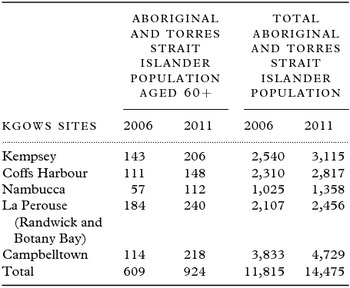
We partnered with five Aboriginal communities across NSW as collaborating study sites. Study sites were geographically defined by Local Government Areas (LGAs) in conjunction with self-defined local Aboriginal communities. The selected LGAs had significant numbers of urban Aboriginal people aged 60 years and over (Australian Bureau of Statistics (ABS) data; see Table 1). There were two sites in metropolitan Sydney (La Perouse [Randwick/Botany Bay LGAs], Campbelltown) and three in regional/rural coastal areas of NSW (Kempsey, Nambucca, Coffs Harbour). Each of these had an ACCHO and a mainstream Aboriginal Health Manager, as well as Elders groups, Aboriginal Land Council, and other community organizations with which our research team established a working relationship in health service delivery and/or research.
Aboriginal and Torres Strait Islander population by KGOWS site based on Australian Bureau of Statistics (ABS) census data of 2006 and 2011

Ethics
The study received ethical approval from the Aboriginal Health and Medical Research Council (AHMRC; 615/07), The University of New South Wales Human Research Ethics Committee (HREC 08003), and NSW Population & Health Services Research Ethics Committee (AU RED Ref: HREC/09/CIPHS/65; Cancer Institute NSW Ref: 2009/10/187).
Community engagement and study oversight
This study originated from our involvement with service delivery to the La Perouse Aboriginal community. Community consultations suggested a need for aged care and dementia services for a growing older population and a major need for child services and health promotion. Aboriginal researchers with backgrounds and experience in Aboriginal health, including the study leadership, associate investigators, and ARAs were involved from the outset. ARAs were local Aboriginal people employed to support census and recruitment activities, and as part of our aims to build capacity in research and dementia knowledge/services. ARAs were an invaluable asset to the study, and we had most success with recruiting ARAs who were same-age “peers” as the study participants. Community consultation, consent, and partnerships (with local ACCHOs) were established within each study site prior to the recruitment of participants to this study. A local community guidance group was also formed at each site, consisting of three to six local Elders. These local guidance groups supported and advised the study team on fieldwork matters such as approach to recruitment, nomination of ARA candidates, cultural appropriateness, and understanding local community networks. A designated leader of each local guidance group was also a member of the study's Aboriginal Reference Group (ARG). The ARG included community Elders and prominent Aboriginal people from medicine, academia, and public policy, who were otherwise independent of KGOWS. The ARG provided advice and guidance to the research team, supported and monitored its capacity building in dementia assessment and care for the Aboriginal workers and communities.
Census and recruitment
An important issue in this study was how to carry out scientifically acceptable research where standard recruitment methods (e.g. random digit dialing, census district door knock techniques, electoral rolls, etc.) were not appropriate. In NSW, Aboriginal and Torres Strait Islander people comprise 2.5% of the overall population, and this proportion is particularly low in major cities. The Aboriginal and Torres Strait Islander population is interspersed within the wider community and thus not as accessible as in remote regions, where the Aboriginal and Torres Strait Islander population is proportionally much higher (i.e. 30–90%; Australian Bureau of Statistics, 2010).
For each study site we generated a sampling frame based on three strategies. (i) Where available, currently existing lists identifying Aboriginal and Torres Strait Islander people aged 60 and over were sought in the development of the sampling frame; the most comprehensive of these was identified in collaboration with our ACCHO partners, ARG and local health service. (ii) The second strategy entailed augmenting any currently available lists by a snowball sampling technique to capture those individuals who were not represented on existing lists. This technique is appropriate in populations with incomplete and/or unavailable identification, and where people are likely to know each other (Kalton and Anderson, Reference Kalton and Anderson1986). Snowball sampling was conducted in parallel with study recruitment and with the assistance of local ARAs, community health workers, and other community members. (iii) Third, we compared these augmented data with known data from the ABS Census, 2006, for evidence of comprehensiveness. In keeping with national Australian ethical guidelines, the final study list belonged to the local Aboriginal community and was allowed to be used by us for the purposes of this study only.
The study census process was initiated at the first site in September 2008, progressively rolled-out across all sites, and continued alongside study recruitment. Formal study recruitment began in early 2010, following community engagement and pilot work throughout 2008–09 (outlined below).
Our approach to recruitment was gentle, culturally appropriate, and multifaceted. A direct approach from non-Aboriginal researchers was generally avoided. Our researchers invested considerable time in maintaining a “presence” in communities, participating in key community activities (as appropriate), and generally giving time to build trust and rapport, and allow for the many obstacles to participation that could arise even for those very willing to take part. We connected with community members through ARAs, local community guidance groups, local services, media outlets, and periodic mail-outs using our study census list. In some cases, the recruitment process, from time of first contact with the potential participant until they were interviewed, took two years. Some of the key issues that constrained or guided our recruitment activities included temporary/seasonal relocation and extended periods away with family in connected (but geographically distant) communities; difficulty contacting some potential participants via conventional means (e.g. phone connections unavailable); and inaccurate records of identification for Aboriginal and Torres Strait Islander individuals (e.g. Aboriginality not asked about or not documented correctly, as well as fears of being identified). Establishing and maintaining contact via community home visits by ARAs was important for participation in the study.
Sample and inclusion/exclusion criteria
We aimed to recruit a total of 366 Aboriginal and Torres Strait Islander people 60 years of age and older – that is, 60% of a target total population of 609 (ABS Census of 2006, see Table 1). Additionally, if the true dementia prevalence rate in the community were as high as rates found in remote communities in the same age range (i.e. ~24%; Smith et al., Reference Smith2008), this sample size would be adequate to ensure a 95% probability that a sample estimate between 19.6% and 28.4% would be obtained.
The study included all participants who were identified on the study lists, self-identified as Aboriginal and/or Torres Strait Islander (and were recognized by the community as such; as per accepted Australian definition), aged 60 years or older, dwelling in the urban environment for most of their lives (and at least six months in the relevant LGA at time of study enrolment), willing to participate, and capable of providing written informed consent. Verbal assent was obtained from participants assessed as unable to consent but capable of participating in the study; proxy consent was also obtained from their closest relative or friend (“person responsible” as defined by the 1987 Guardianship Act in NSW). Individuals were excluded from the study if they had a stroke in the past three months; they presently were incarcerated; their “person responsible” did not want them to participate (as applicable); or, in the case of those who agreed to participate but were unable to consent, if they had no “person responsible” to consent for them. All participants received a gift pack with health information, local service listings, grocery voucher, and bag (valued at AU$15).
For each participant who progressed to Study Phase 2 (see Procedure, below), we also recruited one designated family- or community-based “Contact Person” (CP), as nominated by the study participant. CPs could include family members, people residing with the participant, key members of the community, etc. CPs were people who had known our participants and their family-networks well and, as far as possible, known them over much of their lifespan. CPs did not need to be Aboriginal.
Measures
We used a combination of standard, as well as adapted, instruments to determine diagnosis of dementia, dementia types, and cognitive impairment. We made extensive use of the methodology of the Sydney Older Persons Study (SOPS; Waite et al., Reference Waite, Broe, Grayson and Creasey2001), the KICA study (Smith et al., Reference Smith2008), and the results of our pilot study. We used these previous protocols primarily to inform our study procedure and assessment of medical history, daily functioning, and decline, in terms of scope and culturally appropriate ways of posing these questions. We also drew on ABS surveys for demographic items (including socioeconomic status). In contrast to these previous studies, we included a more comprehensive early life history section and several standardized self-report scales. The pilot study involved 30 Aboriginal people (aged 41–79 years; 22 women and 8 men) from two of the current KGOWS sites (city and regional). Participants had ten years of formal education on average (range: 6–14 years) and all participants spoke English as their preferred language. We sought feedback from participants and fieldworkers as to the cultural appropriateness and feasibility of the proposed instruments. The main pilot feedback themes were that the initial survey was too long, sometimes not structured in an appropriate way (i.e. not user friendly or pursued too many personally irrelevant questions), and some of the standardized scales did not “speak to” or adequately capture participants’ experiences (e.g. originally selected racism and resilience scales). The pilot study outcomes were work-shopped with Aboriginal and non-Indigenous researchers, and instruments retained, modified or replaced, accordingly. The overall length of the survey was reduced by 30% (in line with the majority feedback), while current service use was assessed in greater detail. Participants were generally willing to provide information and respond to questions, including those of a sensitive nature (e.g. childhood abuse, separation from family, and discrimination).
cognitive function
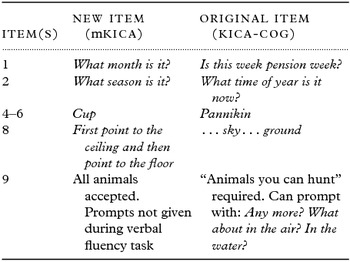
A key methodological challenge was how to effectively and appropriately assess cognitive impairment in this population (Pollitt, Reference Pollitt1997). We reviewed the literature on the design and modification of cognitive assessment tools for use with specific cultural and language populations, including those with reduced literacy and/or poor formal education; as well as standard instruments used in our own, and other, clinical and population studies, taking into account the high level of basic literacy in our urban Aboriginal population. We included two standard (RUDAS and MMSE) and one adapted (mKICA) cognitive screening tests to evaluate their relative performance to detect cognitive impairment against “gold standard” medical diagnosis. The Rowland Universal Dementia Assessment Scale (RUDAS) is a six-item cognitive screening tool developed in Australia to detect dementia in culturally diverse populations, which appears to be culturally fair and not influenced by language, education, or gender (Storey et al., Reference Storey, Rowland, Basic, Conforti and Dickson2004). The RUDAS is scored out of 30 points. The Mini-Mental State Examination (MMSE; Folstein et al., Reference Folstein, Folstein and McHugh1975), a 20-item screening tool that is also scored out of 30, was included for comparison as a common and effective cognitive screening tool used in clinical practice and dementia research across many cultures and language groups. The modified Kimberley Indigenous Cognitive Assessment (mKICA) was adapted from the original KICA cognitive section (LoGiudice et al., Reference LoGiudice2006; developed for remote non-literate Aboriginal people with English as a second language). Changes were made in consultation with the KICA developers, to improve face validity for non-remote populations. Modifications included adjustment to the wording and administration instructions for some items, but no substantive changes to task content (see Table 2). The mKICA has 16 items and is scored from a total of 39 points.
Summary of Kimberley Indigenous Cognitive Assessment (KICA) modifications

The cultural appropriateness and preliminary validity of these cognitive screening tools were investigated in our pilot study (Radford and Mack, Reference Radford and Mack2012). All tests were well tolerated and acceptable to participants, and discriminated between normal functioning and cognitive impairment (including dementia) at the group level. Significantly lower test scores were found for those classified as having cognitive impairment (n = 9; RUDAS: M = 24.9, SD = 4.8; MMSE: M = 24.5, SD = 7.0; mKICA: M = 34.8, SD = 4.9) compared to those without (n = 10; RUDAS: M = 28.2, SD = 1.4; MMSE: M = 28.4, SD = 1.5; mKICA: M = 38.2, SD = 1.0). Scores were not significantly correlated with education. The proposed study screening cut-offs (RUDAS ≤ 25, MMSE ≤ 26, and/or mKICA ≤ 35) selected 33% of participants. Overall, including 20% of those scoring above these cut-offs, we calculated an approximate 50% (n = 183) projected selection rate for Phase 2 of the main study (see Procedure, below). In the pilot sample, these screening criteria successfully detected all dementia cases and 2/4 MCI cases. The two MCI cases not detected had very high scores (e.g. 29 and 30 on MMSE), thus it would not have been feasible to raise the cut-offs to such a level given the resources available.
risk factors
To examine the role of early-life adverse events, education, and established midlife biomedical risk factors for cognitive impairment and dementia, we developed a comprehensive survey instrument based on those from SOPS and KICA, as well as the ABS. These were piloted and adapted accordingly. This survey covered socioeconomic risk factors including education, childhood social environment, and employment history; and medical risk factors including hearing loss, alcohol and drug use, head injury, vascular risk factors, and midlife chronic systemic diseases (e.g. cardiovascular disease, stroke, diabetes). Our survey instrument also included standardized measures to assess childhood trauma and abuse, racial discrimination, resilience and coping, mental health, and alcohol use. Further details on the scales used and their reliability and validity, particularly as this relates to Aboriginal Australians, are provided in Table S1, published as supplementary material online attached to the electronic version of this paper at http://journals.cambridge.org/ipg.
other measures
Functional status (activities of daily living) was assessed using the Kilsyth Disability Rating Scale (Akhtar et al., Reference Akhtar, Broe, Crombie, McLean, Andrews and Caird1973). A comprehensive survey of health and social service use was devised, examining a range of health, aged care, and dementia services, including mainstream and Aboriginal community controlled services; frequency of use, quality of service, and barriers to services were assessed. In addition, caregiver burden (in CPs) was measured using the modified Caregiver Strain Index (Thornton and Travis, Reference Thornton and Travis2003).
Procedure
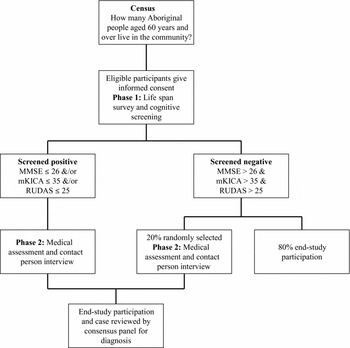
Following the sharing of key existing community lists by partner Aboriginal organizations under AHMRC guidelines, the generation of study census lists proceeded in parallel with study recruitment and data collection, until all available sources of information were exhausted. Data collection was conducted in two phases (see Figure 1).
Study flow diagram.

Phase 1
All consenting participants were interviewed by a trained researcher (accompanied by the local ARA, as appropriate) using our structured survey instrument. Participants were also screened using the three cognitive instruments (RUDAS, MMSE, and mKICA).
Phase 2
The second phase was limited to participants who scored below a predetermined cut-off score on any one of the three cognitive instruments and a 20% random sample of those who scored above these cut-offs. A positive screening result was RUDAS ≤ 25, MMSE ≤ 26, and/or mKICA ≤ 35. In Phase 2, a separate CP Interview was completed for each participant, to complement the information on potential risk factors across the lifespan collected during the initial (Phase 1) participant interview. A medical assessment by a geriatrician or physician experienced in aged care was also conducted, including social and medical history, neurological examination, brief cognitive assessment, and assessment of functional status. A CP was also consulted as part of the medical assessment. For further details of the medical assessment, see Table S2 published as supplementary material online attached to the electronic version of this paper at http://journals.cambridge.org/ipg.
Outcomes
Final dementia diagnosis was determined, based on results of Phase 2 medical assessment, by clinical consensus with a panel of three or more clinicians, including at least one geriatrician and one clinical neuropsychologist. Clinicians involved in Phase 2 medical assessments and consensus determinations were blind to all data collected in study Phase 1, including the outcome of cognitive screening. This was the “gold standard” for determining prevalence rates. Dementia was diagnosed using National Institute on Aging and Alzheimer's Association Workgroup “all-cause dementia” criteria (McKhann et al., Reference McKhann2011). Specific types of dementia were also diagnosed: Alzheimer's dementia (American Psychiatric Association, 2000; McKhann et al., Reference McKhann2011), vascular dementia (American Psychiatric Association, 2000), frontotemporal dementia (Neary et al., Reference Neary1998), dementia with Lewy bodies (McKeith et al., Reference McKeith2005), dementia due to other medical conditions (American Psychiatric Association, 2000), dementia due to the persisting effect of substance abuse (American Psychiatric Association, 2000), along with dementia not otherwise specified or “mixed dementia,” as applicable. Diagnosis of mild cognitive impairment (MCI; Winblad et al., Reference Winblad2004) was made for those with reported cognitive decline not meeting dementia criteria.
Statistical analysis
Using Phase 2 “gold standards,” the performance of the three cognitive screening tests will be evaluated using ROC-analyses, logistic regression, and/or discriminant analyses. By inverse-weighting diagnoses for the 20% who were randomly selected for Phase 2 (i.e. screened negative), such results can be generalized to the wider study sample to determine dementia prevalence rates. Age standardized prevalence rates will also be calculated. Analysis of associated factors will be carried out using logistic and linear regression methods.
Results
Participation rate and sample characteristics
The study census process yielded a list of 546 eligible participants, of which 336 (62%) participated in the study. Of the 210 people identified who did not participate, 123 refused, 31 could not be contacted, 11 moved away before they were interviewed, nine died before interviewed, and 36 could not be scheduled for other reasons prior to the end of data collection. There were no significant differences in age, sex, or urban/regional distribution between those who participated in the study and those who did not. The distribution of the study sample across urban Sydney (n = 140; 42%) and other regional/rural sites (n = 196; 58%) was also comparable to ABS Census figures shown in Table 1. The median age of participants was 66 years (range: 60–92 years) and 60% were female. All participants spoke English, which was reported to be their first language in 98% of cases. Only a small proportion (1%; n = 3) reported receiving no formal education; (39%; n = 131) reported at least ten years of education. Approximately half the participants screened “positive” (i.e. below study cut-off on at least one cognitive test; n = 171; 51%). Including the 20% random sample of those who screened negative, 204 (61%) were selected for Phase 2. Of these, 153 (75%) completed Phase 2 medical assessment. Reasons for not completing Phase 2 included: 39 refused, six died, two were lost to follow-up, and four were unable to be scheduled before the end of data collection. Compared to non-completers, those who completed a medical assessment were more likely to be from a regional/rural site (64% vs. 45%, χ 2 = 5.69, p = 0.017, φ = 0.17), but there were no significant differences in age, sex or MMSE scores between these groups. Further sample description and results pertaining to our specific hypotheses will be presented in subsequent reports.
Discussion
KGOWS is one of a number of studies occurring around the world that aim to establish the prevalence of and risk factors for dementia and cognitive impairment in Indigenous people in high-, middle-, and low-income countries. This study will provide the first available prevalence rates for dementia and cognitive impairment in a representative sample of older Aboriginal Australians residing in urban (non-remote) areas – specifically, across communities in metropolitan Sydney and regional NSW. KGOWS will also examine diagnostic instruments and criteria to make a culturally fair and validated dementia diagnosis in urban Aboriginal communities, taking into account factors such as education and socioeconomic disadvantage. The study will provide information on biomedical and socioeconomic factors associated with dementia; specifically it will provide objective data on the association between education and cognitive status in Aboriginal communities that will underpin the move towards early and continuing access to education for Aboriginal and Torres Strait Islander people to improve cognitive and health outcomes. It will also provide information on the healthcare needs of the participating communities, the use of formal dementia and community services by Aboriginal people with dementia and their caregivers, and on the burden of dementia on Aboriginal caregivers.
In addition, KGOWS will report results to our partner Aboriginal communities and ACCHOs; build their capacity in dementia assessment, risk factor detection, prevention, and dementia services; and extend this model to other urban Aboriginal communities through our networks, collaborators, and publications. As part of our study procedure, we provide results of study health checks for consenting participants to their nominated primary healthcare provider. It has emerged that one of the most direct and rewarding ways we were able to benefit individual study participants has involved our local research teams (ARA, Project Officer, non-Aboriginal interviewer, and medical personnel) assisting participants with high needs to access crucial health, home care, and other support services.
KGOWS has led to an affiliated research and capacity building program, including younger participant groups and additional Aboriginal communities, using postgraduate researchers and small grants. This program is currently exploring: the experience and meaning of dementia from Aboriginal perspectives; the influence of education and early learning experiences on cognition and dementia risk; and the relationship between early life stress, cognitive impairment, and brain aging. We are currently funded to develop strategies for dementia education and improved access to appropriate services for Aboriginal people with dementia and their caregivers, as part of our commitment to translate research into sustainable community benefits. We also plan to extend KGOWS as a longitudinal study on the role of documented early life social factors (such as adverse childhood events, parenting, and education) and midlife biomedical risk factors (such as smoking, hypertension, diabetes) in cognitive decline with advancing age. KGOWS and its associated research program will contribute to the assessment of dementia and cognitive impairment being undertaken in Indigenous communities around the world and improve the level of understanding of the social and biological determinants of successful aging.
Conflict of interest
This study is supported by a National Health and Medical Research Council Project Grant (510347). Initial piloting of instruments was funded by Dementia Collaborative Research Centres (DCRC) and Alzheimer's Australia Research. Dr Radford is funded by the RW & JG Post-doctoral Fellowship in Aboriginal Health and Ageing and the project received donations through the Ageing Research Centre at Prince of Wales Hospital, Sydney. The Koori Growing Old Well Study (KGOWS) is a collaboration between Neuroscience Research Australia (NeuRA), University of NSW, and Aboriginal and academic research partners. Our collaborators include: our Aboriginal partner communities, Aboriginal Health Managers in NSW Area Health Services (Gail Daylight, Vicki Wade, Tim Agius), Muru Marri Indigenous Health Unit UNSW, Dementia Collaborative Research Centres, Prince of Wales Hospital, KICA Research Group at University of Western Australia, ARC-NHMRC Ageing Well Network, and the National Aboriginal and Torres Strait Islander Dementia Advisory Group (NATSIDAG) at Alzheimer's Australia.
Description of authors’ roles
K. Radford participated in the study design and implementation, fieldwork, and consensus determinations and drafted the paper. H. Mack managed the research team and data collection, participated in the study design, ethics approvals, implementation and community engagement, and helped to draft the paper. H. Robertson participated in the funding application and ethics approvals and helped to draft the paper. B. Draper participated in the study design and implementation, and helped to draft the paper. S. Chalkley participated in the study design, fieldwork, and consensus determinations. G. Daylight was integral in initial community consultations and in guiding the cultural appropriateness of the study. R. Cumming participated in the study implementation and helped to draft the paper. H. Bennett participated in the study design and consensus determinations. L. Jackson Pulver participated in the design and implementation of the study. G.A. Broe conceived of and directed the study; he participated in its design, community engagement, fieldwork, and consensus determinations, and helped to draft the paper. All authors read and approved the final paper.
Acknowledgments
This work relied on the assistance and support of many individuals and organizations. We are particularly grateful to our participants, our local Elder guidance groups, KGOWS Aboriginal Reference Group, and our Aboriginal community partners who continue to offer their support for our research: Durri Aboriginal Corporation Medical Service in Kempsey, Darrimba Maarra Aboriginal Health Clinic in Nambucca, Galambila Aboriginal Health Service in Coffs Harbour, La Perouse Local Aboriginal Land Council, La Perouse Aboriginal Community Health Centre, and Tharawal Aboriginal Corporation in Campbelltown. We wish to recognize the hard work of our research team including Aboriginal research assistants, project officers and interviewers, and medical doctors. We thank Professor Leon Flicker, Associate Professor Dina Logiudice, and Dr Kate Smith for their expert advice on adapting the KICA cognitive screening tool, along with Dr Jeffrey Rowland for guidance on use of the RUDAS with urban/regional Aboriginal communities. We also thank Associate Professor Emeritus David Grayson for his substantial contribution to the design and implementation of the study, and ongoing support with data analyses.