


Introduction
The interpersonal context in which obsessive compulsive disorder (OCD) occurs is important to understanding the disorder (Abramowitz et al. Reference Abramowitz, Baucom, Wheaton, Boeding, Fabricant, Paprocki and Fischer2013). Research suggests that OCD patients can suffer from diverse interpersonal problems, as they are more likely to be divorced/separated or single and to have lower social functioning, less social support and lower sexual activity compared to the general population (Steketee & Pruyn, Reference Steketee, Pruyn, Swinson, Antony, Rachman and Richter1998; Koran, Reference Koran2000; Bobes et al. Reference Bobes, Gonzalez, Bascaran, Arango, Saiz and Bousono2001; Stengler-Wenzke et al. Reference Stengler-Wenzke, Kroll, Matschinger and Angermeyer2006; Abbey et al. Reference Abbey, Clopton and Humphreys2007). A greater understanding of interpersonal problems in OCD and how they might affect treatment outcomes is therefore needed. Research has suggested that personality issues (including interpersonal problems) and comorbid conditions (Meyer et al. Reference Meyer, Farrell, Kemp, Blakey and Deacon2014) are among the most common reasons for not providing clients with exposure therapy for OCD. Therefore, it is very important to address whether interpersonal problems reduce response to cognitive behavioural therapy (CBT) and whether CBT is associated with improvements in interpersonal domains, as well as in OCD symptoms. The goals of CBT for patients with OCD should not only include symptom improvement, but also functional improvement in a range of domains, including interpersonal.
According to interpersonal theory of personality, interpersonal behaviours can be causal and maintaining factors in emotional disorders (Pincus & Wiggins, Reference Pincus and Wiggins1990; Horowitz, Reference Horowitz2004). Interpersonal characteristics have also been associated with outcomes following psychotherapy (Blatt et al. Reference Blatt, Zuroff, Quinlan and Pilkonis1996). There seems to be some evidence that a friendly and submissive interpersonal style is related to a better therapeutic alliance and therapy outcome, while a dominant and hostile style is associated with the reverse (Muran et al. Reference Muran, Segal, Samstag and Crawford1994; Gurtman, Reference Gurtman1996; Borkovec et al. Reference Borkovec, Newman, Pincus and Lytle2002). Interpersonal styles can be constructed along two dimensions of affiliation (friendly to hostile) and agency (domineering to submissive), as operationally defined by the Inventory of Interpersonal Problems – Circumplex (IIP-C; Alden et al. Reference Alden, Wiggins and Pincus1990). The eight subscales of the IIP-C describe the following interpersonal styles: vindictive, overly accommodating, socially inhibited, intrusive, non-assertive, cold, domineering, and self-sacrificing. To our knowledge, this is the first study to examine these interpersonal dimensions and how they relate to outcomes in CBT for OCD. It is possible that interpersonal dimensions might influence treatment outcomes in OCD, as has been found with other disorders such as depression. In depression, it was found that elevated interpersonal distress was related to weaker therapeutic alliances and higher symptom levels following treatment (Renner et al. Reference Renner, Jarrett, Vittengl, Barrett, Clark and Thase2012). Interpersonal styles have not yet been investigated as factors that might impact treatment outcomes in OCD, although related research on interpersonal factors in OCD does exist.
Individuals with OCD often report experiencing lifelong interpersonal difficulties. Children and youth with OCD have reported difficulties with both making and maintaining friendships, and are also more likely to be victimized by their peers (Piacentini et al. Reference Piacentini, Bergman, Keller and McCracken2003; Storch et al. Reference Storch, Murphy, Geffken, Soto, Sajid, Allen, Roberti, Killiany and Goodman2004). OCD can have a substantial effect on peer relationships, especially among children, and has also been reported to have a negative impact on family functioning. Family accommodation refers to how significant others respond to the behaviour of those with OCD, and research has shown that a greater degree of family accommodation is associated with poorer treatment outcomes (Amir et al. Reference Amir, Freshman and Foa2000), while decreases in family accommodation can lead to better results (Merlo et al. Reference Merlo, Lehmkuhl, Geffken and Storch2009). Conversely, high levels of criticism, hostility and emotional involvement, often referred to as expressed emotion, have been found to be associated with treatment discontinuation and OCD symptom relapse (Chambless & Steketee, Reference Chambless and Steketee1999). Interpersonal rejection might also be a consequence of excessive reassurance-seeking (Parrish & Radomsky, Reference Parrish and Radomsky2010). Noting the impact of these interpersonal difficulties on treatment outcomes, it has been suggested that families that accommodate or that are high on expressed emotion might benefit from family-based interventions, and some couples-based approaches to enhancing exposure and response prevention (ERP) have also been suggested (Abramowitz et al. Reference Abramowitz, Baucom, Wheaton, Boeding, Fabricant, Paprocki and Fischer2013). However, these have yet to be tested empirically.
Research on problems in social relationships among adults with OCD has typically focused on comorbid personality disorders. To date, most studies on the role of personality and treatment of OCD have focused on the influence of categorical Axis II diagnoses, and the findings from these studies have been somewhat inconsistent (Fricke et al. Reference Fricke, Moritz, Andresen, Jacobsen, Kloss, Rufer and Hand2006; Keeley et al. Reference Keeley, Storch, Merlo and Geffken2008). The most consistent finding has been that schizotypal personality traits predict poorer treatment outcomes (Thiel et al. Reference Thiel, Hertenstein, Nissen, Herbst, Kulz and Voderholzer2013). A study published in 2011 used a dimensional approach to assess personality/schemas, and found that higher pre-treatment scores on the abandonment schema were related to poorer treatment outcomes (Håland et al. Reference Håland, Vogel, Launes, Haaland, Hansen, Solem and Himle2011). The abandonment schema is related to severe personality pathology, and this finding could be similar to that from a related study in which patients with high scores on most subscales of the Millon Clinical Multiaxial Inventory had worse treatment results (Fals-Stewart & Lucente, Reference Fals-Stewart and Lucente1993). Patients with no evident personality pathology and those with dependent qualities demonstrated the best overall treatment outcomes.
There is a need to know more about how patients with OCD differ from healthy controls and those with other psychological disorders with respect to interpersonal issues, as defined by interpersonal theory of personality and operationalized with the IIP-C. This is important because interpersonal theory and therapy have proved to be important in other disorders, such as depression (Cuijpers et al. Reference Cuijpers, Geraedts, van Oppen, Andersson, Markowitz and van Straten2011). In addition, CBT is a highly effective treatment for OCD with a recovery rate of 50–60% (Fisher & Wells, Reference Fisher and Wells2005), but some patients do not respond to treatment and whether this is related to interpersonal styles remains unknown. Greater attention could be paid to these factors during treatment, if they are found to be relevant in OCD.
As discussed above, patients with OCD can experience a range of different impairments, including interpersonal problems such as peer victimization and impaired family functioning, and possible comorbid personality disorders. Although these constructs represent interpersonal difficulties, they do not address individual interpersonal styles of the OCD patient (e.g. friendly, submissive, dominant, hostile) as explicitly as the IIP-C. Because of the lack of studies on interpersonal style based on this framework in OCD, there are few specific hypotheses to be made about which interpersonal issues are problematic in OCD and how these could affect treatment, which makes this study primarily exploratory in nature. Therefore, the aims of this study were to describe interpersonal problems, as defined by the IIP-C, in patients with OCD, and to investigate how they relate to and affect the treatment of OCD.
More specifically, the study aimed to:
-
(1) Compare the IIP-C scores of OCD patients (before and after treatment) with healthy controls and psychiatric outpatients.
-
(2) Investigate whether interpersonal problems, as measured by the IIP-C, affect treatment outcomes.
-
(3) Explore how interpersonal difficulties change following CBT for OCD.
-
(4) Explore whether interpersonal difficulties are associated with comorbidity in OCD.
Method
OCD sample
A total of 101 Norwegian outpatients with OCD took part in the study. Overall, 74% were women and the average age was 35.2 (s.d. = 11.9) years. OCD patients were included if they met DSM-IV criteria for OCD. Exclusion criteria were if another Axis I diagnosis was considered primary, suicidal behaviour, and psychosis. With regard to comorbidity, 38% had a comorbid depressive disorder (i.e. major depressive episode, dysthymia, recurrent depressive disorder) and 53% had a comorbid anxiety disorder. A total of 55 patients were recruited from a study of group CBT (Håland et al. Reference Håland, Vogel, Lie, Launes, Pripp and Himle2010) and the remaining 46 patients received individual CBT at an OCD clinic.
Two thirds (68.5%) of the participants were married or cohabiting. Overall, 39.6% were in full-time work, 11.3% were students, 47.2% were unemployed and 1.9% had part-time work. The mean age at the appearance of OCD was 19.1 (s.d. = 8.9) years, while the mean duration of OCD was 15.6 (s.d. = 12.1) years. Patients on a stable dose of selective serotonin reuptake inhibitors were allowed to enter the study. Approximately half (51.9%) of the population used these medications, and they were encouraged to remain on a stable dosage throughout the study.
All of the participants underwent CBT for approximately 12 weeks. A total of 138 patients were originally eligible for the study, but because of missing data the final sample consisted of 101 patients. There were no significant differences between the participants who provided post-treatment data and those who did not. This effect held for the Yale–Brown Obsessive Compulsive Scale (YBOCS; Goodman et al. Reference Goodman, Price, Ramussen, Mazure, Fleischmann, Hill, Heninger and Charney1989) (t 128 = –0.59, p = 0.55), Beck Depression Inventory (BDI; Beck et al. Reference Beck, Steer and Garbin1961) (t 129 = 0.02, p = 0.99) and IIP-C (t 127 = 1.34, p = 0.18) scores.
A total of 28 participants had missing data on IIP-C at post-treatment, but provided follow-up scores. For these cases, follow-up scores were used as the post-treatment scores. It should be noted that one person had missing data on comorbid diagnoses, one person had missing data on depressive symptoms pre- and post-treatment, and one person had missing data on depressive symptoms at post-treatment only.
Subsample comparisons
There were no significant differences between patients receiving group treatment and those receiving individual treatment with respect to scores on the YBOCS interview (t 98 = 0.55, p = 0.59) or the BDI (t 98 = 0.14, p = 0.89). However, patients receiving individual treatment had lower scores on OCD (t 99 = 2.14, p = 0.034) and depressive (t 97 = 3.15, p = 0.001) symptoms post-treatment. There were also no differences between the two groups with respect to interpersonal problems at pre- (t 99 = 1.18, p = 0.24) or post- (t 99 = 1.79, p = 0.077) treatment. Repeated-measures analysis of variance (ANOVA) found no significant time×treatment modality (group/individual) effect (F 1,99 = 1.17, p = 0.28). Age (t 99 = 0.06, p = 0.96) and the distribution of men and women (χ 2 = 0.01, p = 0.94) were also similar across the two groups.
Control groups
Healthy control sample
OCD patients were compared with two previously described Norwegian populations, with permission from the main author of that study (Bjerke et al. Reference Bjerke, Hansen, Solbakken and Monsen2011). The healthy control sample (undergraduate students and their acquaintances) consisted of 302 participants (60% women) with a mean age of 33 years. Approximately half of the participants were psychology students, while the other half consisted mainly of employees at larger companies.
Psychiatric outpatient sample
The general psychiatric outpatient sample included 988 participants (64% women) with a mean age of 35 (range 16–77) years, and consisted of consecutively admitted patients at a psychiatric outpatient clinic in Norway (Bjerke et al. Reference Bjerke, Hansen, Solbakken and Monsen2011). The inclusion criterion was being referred to the clinic for treatment, while exclusion criteria were emergency cases, not speaking Norwegian and a previous offer of treatment at the clinic. A description of the diagnostic characteristics of the psychiatric outpatient sample has not been published.
The three sample populations (patients with OCD, healthy controls, psychiatric outpatients) were very similar with respect to age, although the OCD group had a greater proportion of women compared to the control groups (74% vs. 60–64%).
Procedure
Patients with OCD in the current study were assessed by trained independent raters using the Structured Clinical Interview for DSM-IV-TR Axis I Disorders – Patient Edition (First et al. Reference First, Spitzer, Gibbon and Williams1995). In addition, a clinician administered the YBOCS to evaluate the severity of OCD before starting treatment. Patients with OCD completed the 64-item version of the IIP-C, along with measures of OCD symptoms and depressive symptoms, before treatment, immediately after treatment and at 12-month follow-up. Treatment consisted of exposure exercises with response prevention following an exposure hierarchy set early in the treatment. Cognitive techniques were also used in order to challenge obsessive beliefs. The individual treatments were based on Kozak & Foa (Reference Kozak and Foa1997), while the group treatment was adapted from a manual by Krone et al. (Reference Krone, Himle and Nesse1991). During individual treatment, one session was devoted to involving family members or partners, allowing for psychoeducation and addressing interpersonal issues resulting from the OCD. The group format involved 12 weekly meetings, with each session lasting 2.5 h. Patients who received individual treatment had an average of 24 h of therapy, divided into two sessions per week in the initial phase of treatment, followed by weekly sessions from mid-treatment to the end of treatment.
The main structure of the individual treatments was as follows. In the first session, a case-conceptualization was formulated and a habituation rationale was presented for the patient. Self-registration of rituals was given for homework. During the second session, an exposure hierarchy was created in collaboration with the patient and rules for ritual prevention were agreed upon. The following sessions were similar in structure, and consisted mainly of evaluating homework assignments (exposure exercises), in vivo and imaginary exposures (approximately 60 min), and preparation for homework assignments. Exposures were delivered in a sequence as specified by the hierarchy. One aim of the treatment was to reach the top of the hierarchy after six treatment sessions. Towards the end of the overall treatment period, the focus turned to relapse prevention. Therapists delivering treatment were mainly psychologists trained in CBT for OCD.
The main elements of the group treatment were psychoeducation and ERP. Groups were led by two therapists (a psychologist and a psychiatrist) trained in CBT for OCD, and six patients were included in each group. The first six group sessions involved presenting a topic relevant to the treatment of OCD (e.g. general information about OCD, treatment rationale, family life and lifestyle choices). Interventions included the use of a workbook, techniques aimed at externalizing OCD (e.g. ‘OCD is a bully, let's fight back’) and the use of coping statements (e.g. ‘it's not me, it's my OCD’). The structure in the group sessions was similar to that of individual therapy: checking homework assignments, in vivo exposure and designing new homework. A family meeting lasting 2.5 h was conducted after session 4, in which family members were given information and discussed how they could support the patient.
Measures
The IIP-C (Alden et al. Reference Alden, Wiggins and Pincus1990) consists of 39 items beginning with the phrase ‘It is hard for me to. . .’ (example item: ‘Really care about other people's problems’), while the remaining 25 items describe ‘Things that you do too much. . .’ (example item: ‘I try to change other people too much’). Each item is rated from 0 (not at all) to 4 (extremely). The scores are summarized into eight subscales corresponding to different forms of interpersonal problems and all of the item scores can also be summarized into a global score, indicating a general level of interpersonal distress. The eight subscales are labelled ‘vindictive’ (e.g. wanting revenge), ‘overly accommodating’ (e.g. having trouble saying no to others), ‘socially inhibited’ (e.g. having difficulty participating in groups), ‘intrusive’ (e.g. interfering too much with other people's issues), ‘non-assertive’ (e.g. having difficulty expressing one's own needs), ‘cold’ (e.g. problems with showing affection towards others), ‘domineering’ (e.g. being too aggressive towards others) and ‘self-sacrificing’ (e.g. being overly trusting of others). A system that divides the interpersonal behaviours into four categories formed by the intersection of affiliation and dominance has been suggested by Gurtman (Reference Gurtman1996). These have been labelled ‘friendly-dominant’, ‘hostile-dominant’, ‘hostile-submissive’ and ‘friendly-submissive’. For Norwegian samples, a cut-off (normal vs. clinical) value of 1.03 on the IIP-C total score and a reliable change index score of 0.38 have been suggested (Ryum et al. Reference Ryum, Stiles and Vogel2007). Several studies have supported validity of the IIP-C (Pincus & Wiggins, Reference Pincus and Wiggins1990; Gurtman, Reference Gurtman1996; Borkovec et al. Reference Borkovec, Newman, Pincus and Lytle2002). In the current study, Cronbach's alpha for the total scale was 0.96. Alpha values for the subscales ranged from 0.62 to 0.88 (vindictive = 0.78, overly accommodating = 0.84, socially inhibited = 0.86, intrusive = 0.62, non-assertive = 0.88, cold = 0.81, domineering = 0.76, self-sacrificing = 0.82).
The YBOCS was used as a measure of obsessive–compulsive symptoms and is commonly used as a treatment outcome measure in studies on OCD. Five obsession and five compulsion items are assessed on 0–4 point ratings. Total scores were used in this study. Cronbach's alpha was 0.67 at pre-treatment and 0.89 at post-treatment.
The BDI (Beck et al. Reference Beck, Ward, Mendelson, Mock and Erbaugh1961) is a 21-item, self-report inventory using 0–3 point ratings. It has been shown to be a reliable and valid measure of depression severity in both clinical and non-clinical populations (Beck et al. Reference Beck, Steer and Garbin1988). In the current study, Cronbach's alpha was 0.92.
Data analyses
IIP-C scores from OCD patients were compared with previous scores from healthy controls and psychiatric outpatients using independent t tests. Correlation analyses were used to investigate possible relationships between age and IIP-C, YBOCS and BDI scores. Treatment responders were also compared with non-responders using independent t tests with IIP-C scores as the dependent variable, in order to explore whether interpersonal problems were related to treatment outcomes. Correlations were used to analyse the relationship between interpersonal problems and symptoms of OCD and depression. To explore changes in IIP-C, YBOCS and BDI scores following treatment, we used paired samples t tests, supplemented with effect sizes using pooled standard deviations. Finally, independent t tests were used to compare interpersonal problems in patients with and without comorbidities.
Results
Sample comparisons
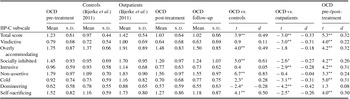
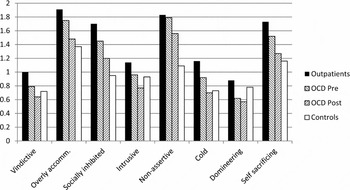
Compared to the healthy control sample, the OCD patients generally reported significantly more interpersonal problems. The OCD group had significantly higher scores than healthy controls on being overly accommodating, socially inhibited, non-assertive, cold, and self-sacrificing. Compared to the psychiatric outpatient sample, the OCD sample had lower interpersonal problem scores in general. Table 1 summarizes the IIP-C scores of the three populations.
Mean item scores on the IIP-C at pre-treatment, post-treatment and at 12-month follow-up for OCD patients and the healthy and psychiatric outpatient control groups

IIP-C, Inventory of Interpersonal Problems – Circumplex; OCD, obsessive compulsive disorder.
Effect sizes were calculated using pooled standard deviations.
The suggested cut-off (normal vs. clinical) for the IIP-C total score is 1.03.
*p<0.05, **p<0.01.
Interpersonal problems and treatment outcomes
A total of 44 patients met the criteria for a clinically significant change in OCD symptoms, as defined by a change in YBOCS score of ≥10 and a post-treatment score of ≤14 (Fisher & Wells, Reference Fisher and Wells2005). When comparing these responders with non-responders, there were no significant differences in interpersonal problems either at pre- (t 99 = 0.28, p = 0.78) or post- (t 99 = 0.62, p = 0.54) treatment for the IIP-C total score. Similarly, none of the IIP-C subscales differentiated OCD responders and non-responders.
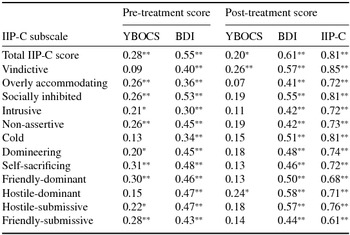
Interpersonal problems, as assessed before treatment, showed either a non-significant or mild relationship to symptoms of OCD after treatment (see Table 2). The IIP-C total score had a correlation of 0.20 with the post-treatment YBOCS score. Weak but significant correlations were found between the post-treatment YBOCS score and the pre-treatment category of hostile-dominant (r = 0.24) and the pre-treatment vindictive subscale (r = 0.26).
Correlations between pre-treatment IIP-C scores and pre- and post-treatment depressive symptoms and OCD symptoms.

BDI, Beck Depression Inventory; IIP-C, Inventory of Interpersonal Problems – Circumplex; OCD, obsessive compulsive disorder; YBOCS, Yale–Brown Obsessive Compulsive Scale.
*p<0.05, **p<0.01.
The correlations between interpersonal problems and depressive symptoms were stronger. We separated IIP-C scores into quartiles, and compared the top quartile (IIP-C score >1.70) with the bottom quartile (reporting the fewest interpersonal problems; IIP-C score <0.70), as well as the mid-group. Patients in the top quartile of IIP-C scores had significantly more depressive symptoms, both before and after treatment (pre-treatment: F = 21.8, p = 0.001; post-treatment: F = 30.0, p = 0.001) than the other groups. They also had higher pre-treatment YBOCS scores (F = 5.3, p = 0.007), although post-treatment YBOCS scores were unaffected (F = 2.0, p = 0.138).
Treatment effects
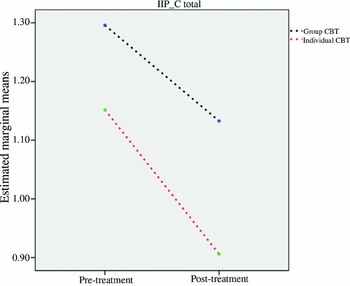
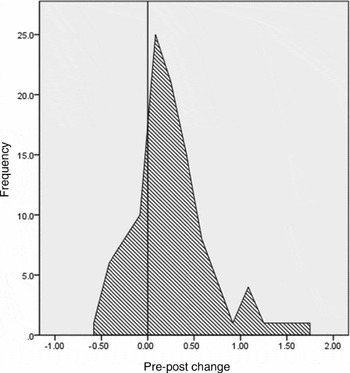
YBOCS scores were significantly reduced from a mean of 24.16 (s.d. = 3.91) pre-treatment to 13.52 (s.d. = 6.30) post-treatment (t 100 = 15.99, p<0.001). This was equal to an effect size of 2.03. Depressive symptoms were also significantly improved, as observed by changes in the BDI score from a mean of 16.62 (s.d. = 10.36) to 9.88 (s.d. = 9.34) (t 98 = 7.85, p<0.001), equal to an effect size of 0.68. A paired sample t test suggested significant changes from pre- to post-treatment for all IIP-C variables except the domineering subscale (t 100 = 1.32, p = 0.19) (Table 1). Vindictive problems changed significantly (t 100 = 4.01, p<0.001), as did scores on the overly accommodating (t 100 = 4.18, p<0.001), socially inhibited (t 100 = 4.21, p<0.001), intrusive (t 100 = 4.16, p<0.001), non-assertive (t 100 = 3.32, p<0.001), cold (t 100 = 4.98, p<0.001) and self-sacrificing (t 100 = 3.98, p<0.001) subscales. The effect sizes ranged from 0.08 (domineering subscale) to 0.32 (total score and overly accommodating subscale) and were stable, as observed at 12-month follow-up). The majority of patients showed little change in interpersonal difficulties, but 25% showed a substantial improvement (reliable change). Changes in the IIP-C total score are shown in Figures 1 and 2.
Changes in interpersonal problems for OCD patients treated with group or individual CBT. IIP-C, Inventory of Interpersonal Problems – Circumplex.

Distribution of change scores for the Inventory of Interpersonal Problems – Circumplex (IIP-C) total score from pre- to post-treatment. The reliable change index for IIP-C has been suggested to be 0.38.

Post-treatment sample comparisons
After treatment, OCD patients’ scores on the IIP-C were similar to those of the healthy control group. However, the OCD group still had more problems with non-assertiveness. In addition, and similar to pre-treatment results, OCD patients presented with lower scores on being domineering, intrusive and vindictive compared to healthy controls (Fig. 3). The OCD patients generally scored lower on interpersonal difficulties compared to the psychiatric outpatients.
Inventory of Interpersonal Problems – Circumplex (IIP-C) comparisons between the samples. Scores represent mean item scores (0–4).

Interpersonal problems, comorbidities and subtypes
Patients with depression as a comorbid diagnosis (N = 38) had higher scores on the IIP-C at pre-treatment (t 98 = 3.41, p = 0.001) and post-treatment (t 98 = 3.02, p = 0.003) compared to patients without comorbid depression. Patients with comorbid anxiety disorders (N = 53) also had higher IIP-C scores pre- (t 98 = 4.09, p = 0.000) and post- (t 98 = 2.89, p = 0.005) treatment compared to patients without comorbid anxiety.
One-way ANOVA found no significant differences between people with autogenous obsessions, reactive obsessions, or the combination of these two subtypes of OCD with regard to interpersonal problems (F 2,67 = 0.632, p = 0.54). Similarly, no significant differences were found between these groups on any individual IIP-C subscale. Likewise, no significant differences were found between people with aggressive obsessions, contamination obsessions, and mixed obsessions (F 2,66 = 0.18, p = 0.83). Again, none of the IIP-C subscale scores approached significance.
Discussion
The OCD group had more interpersonal problems than the healthy controls in general and scored especially high on non-assertiveness, social inhibition, self-sacrifice and being overly accommodating. There are various possible explanations for this finding; for example, it might not necessarily be linked to personality traits, but could primarily be a product of worry and rumination involving overestimations of threats and responsibilities. Patients with OCD had lower scores on all subscales of the IIP-C than the general psychiatric outpatient population, with the exception of non-assertiveness.
If interpersonal problems prove to be a predictor of treatment outcome, then it will be important to develop interventions targeting this factor. However, the current study found no differences between treatment responders and non-responders with respect to IIP-C scores pre- or post-treatment. This suggests that patients with OCD might respond well to OCD treatment, despite different levels of interpersonal problems. Interventions targeting interpersonal problems might be relevant for OCD patients who still experience depressive symptoms after ERP treatment for OCD. However, it is difficult to draw conclusions about cause and effect with respect to self-reported problems with depression and relationships.
In the current study, CBT for OCD was associated with small to moderate improvements in interpersonal problems. Although the majority of patients showed little change in interpersonal difficulties, 25% showed reliable improvement. These modest results could be due to floor effects, as the OCD patients’ scores were minimal at baseline. It is quite possible that these findings could be secondary to reduced OCD symptoms, as one might expect this to be associated with less pressure from patients on the people around them, less accommodation (Merlo et al. Reference Merlo, Lehmkuhl, Geffken and Storch2009) and reduced strain on relationships. CBT for OCD is a highly specialized treatment that focuses mainly on OCD symptoms and less on interpersonal functioning. However, inviting family members or important others to a session is common (and part of the treatment manual) and allows the therapist to address the interpersonal issues of the OCD patient. These sessions could possibly increase a significant other's understanding of the OCD sufferer and possibly lead to changes in their relationship. Another potential explanation for the observed changes is that they could be a consequence of general symptom improvement or demand characteristics, possibly affecting report style on self-report measures. Previous research has found that ERP treatment can lead to improvements in marital problems and that patients can become less demanding and dependent (Steketee & van Noppen, Reference Steketee and van Noppen2003). Our findings confirm related research suggesting that 25% of patients show reliable improvement in general interpersonal functioning following ERP treatment without a special emphasis on interpersonal functioning.
It is difficult to compare the change scores on the IIP-C with other studies since no other treatment study on OCD has reported these scores. In addition the pre-treatment scores were quite low, leaving little room for change, and the treatment duration was only 12 weeks. However, related studies on disorders such as depression and generalized anxiety (where the IIP-C constructs might be more relevant) have reported change in IIP-C scores, with moderate effect sizes ranging from 0.4 to 0.8 (Shapiro et al. Reference Shapiro, Barkham, Rees, Hardy, Reynolds and Startup1994; Liechsenring et al. Reference Liechsenring, Salzer, Jaeger, Kächelse, Kreische, Leweke, Rüger, Winkelbach and Leibing2009). The observed differences in effect sizes could possibly be due to regression towards mean effects, but it could also be an effect of different treatments targeting different types of interpersonal issues.
It is important to establish whether interpersonal problems in OCD are related to the disorder itself or to comorbid disorders, or are a separate problem of their own. Our findings suggest that interpersonal style is more related to comorbid conditions than to OCD itself. In general, comorbidities (depression and anxiety) were related to higher levels of interpersonal problems than OCD, which fits with previous research documenting interpersonal problems among patients with depression (Cuijpers et al. Reference Cuijpers, Geraedts, van Oppen, Andersson, Markowitz and van Straten2011) and generalized anxiety disorder (Borkovec et al. Reference Borkovec, Newman, Pincus and Lytle2002). While interpersonal therapy is efficient at treating depression, however, attempts at integrating interpersonal techniques into CBT treatment of generalized anxiety disorder have not yet proven helpful (Newman et al. Reference Newman, Castonguay, Borkovec, Fisher, Boswell, Szkodny and Nordberg2011). Interventions for comorbid disorders and associated interpersonal styles in OCD need to be addressed empirically.
Limitations
This study has some limitations. First, we assessed interpersonal problems using self-report, which could be problematic as studies have demonstrated the importance of multiple sources of information in assessing interpersonal problems (Clifton et al. Reference Clifton, Turkheimer and Oltmanns2005). Related research has shown a moderate degree of agreement on the IIP-C between romantic partners’ perceptions of self and partner (Foltz et al. Reference Foltz, Morse and Barber1999). Second, the study lacked a control group receiving no treatment or another treatment, making it difficult to determine whether the findings are limited to CBT for OCD. Third, a possible limitation concerns merging data from group and individual treatments into one dataset, as there were some differences with respect to treatment response among the two groups (i.e. fewer symptoms of OCD and depression at post-treatment for those who received individual treatment). However, the aim of this paper was not to investigate possible differences in interpersonal issues specific to different treatment formats, but for OCD treatment in general. It is also unknown if interpersonal problems are different among OCD subtypes.
It is important to underscore the fact that the present study does not address cause and effect relationships among the different variables. A final limitation concerns the lack of detailed demographic and diagnostic information from the psychiatric outpatient control group, as little is known about the prevalence of different disorders in that population.
Conclusion
This is the first study, to the best of our knowledge, that has examined interpersonal problems in OCD as defined by the IIP-C, although previous research has reported interesting results about peer victimization, family functioning, expressed emotions and personality pathology. The findings suggest that patients with OCD have interpersonal styles that might cause them problems, but that these problems are minimal at baseline and do not significantly affect obsessive compulsive symptoms post-treatment or follow-up. These interpersonal problems might be more strongly related to depressive symptoms than to OCD-specific symptoms. The interpersonal issues in general, and especially submissiveness problems, showed signs of slight improvement following CBT for OCD; however, some interpersonal difficulties, especially social inhibition and non-assertiveness, appeared to be associated with comorbid disorders that might need further treatment.
Summary of the main points of the study
-
• No previous study has investigated interpersonal problems in OCD, as measured with the IIP-C.
-
• Interpersonal problems have been proven to be important and to affect treatment outcomes in other psychological disorders.
-
• The current study found that patients with OCD had more interpersonal problems than healthy controls.
-
• The OCD population had slightly fewer interpersonal problems than a comparison group of psychiatric outpatients.
-
• Interpersonal style did not predict improvements in OCD symptoms.
-
• CBT for OCD was associated with small to moderate improvements in interpersonal problems.
-
• Interpersonal problems in OCD appeared to be more attributable to comorbid conditions than to OCD-specific symptoms.
Ethical standards
The authors assert that all procedures contributing to this work comply with the ethical standards of the relevant national and institutional committees on human experimentation and with the Helsinki Declaration of 1975, as revised in 2008.
Acknowledgements
This research received no specific grant from any funding agency, commercial or not-for-profit sectors.
Declaration of Interest
None.
-
(1) To identify interpersonal styles characteristic of OCD.
-
(2) To learn how interpersonal problems affect treatment outcomes for OCD.
-
(3) To learn how CBT for OCD is associated with interpersonal problems.
-
(4) To understand correlates of interpersonal problems in OCD.



Comments
No Comments have been published for this article.