Phonological awareness is an important predictor of reading abilities across languages (Caravolas, Lervåg, Defior, Malkóva, & Hulme, Reference Cardoso-Martins2013; Ziegler et al., Reference Ziegler, Bertrand, Tóth, Csépe, Reis, Faísca and Blomert2010). Rime awareness is one of the underlying components of phonological awareness (Anthony & Francis, Reference Anthony and Francis2005), and rime judgment tasks (e.g., flake–snake; “Are these words rhyming?”) are one way to assess rime awareness. Some studies of children’s rime judgment abilities have shown that preliterate children judge any type of phonological overlap as a rime (Cardoso-Martins, Reference Carroll and Myers1994). These biases to judge words as phonologically similar, even if they are not, are phonological similarity effects (i.e., Cardoso-Martins, Reference Carroll and Myers1994; Carroll & Snowling, Reference Castles and Coltheart2001). Phonological similarity effects were first understood as a sign for holistic phonological processing in preliterates. While some studies could show that this is true for global, phonetically based similarity biases, which strongly decrease across development (Carroll & Myers, Reference Carroll and Snowling2011), some recent studies report that phonological similarity effects can also be found in young readers and adults (Wagensveld, Segers, van Alphen, & Verhoeven, Reference Wagensveld, Segers, van Alphen and Verhoeven2013). It is, thus, unclear, whether these effects are caused by holistic phonological processing or not.
This article aims to study the underlying phonological processes in rime judgment to understand whether phonological similarity effects differ between preliterates and literates. To this end, a new rime judgment task with two distractor conditions was developed to study grain size effects during the phonological processing leading up to rime decisions. One distractor condition had the same size of phonological overlap as the rime (body) and one had a smaller size of overlap (nucleus). The task was administered to the same group of German-speaking children at four time points across the onset of reading instruction and, separately, to a group of adults.
Development of phonological representations and reading acquisition
The development of phonological representations is a development from bigger phonological units (e.g., syllable or rime) toward smaller phonological units (e.g., phoneme) and the ability to distinguish and manipulate different sizes of phonological units (Anthony & Lonigan, Reference Anthony and Lonigan2004; Lonigan et al., Reference Lonigan, Burgess, Anthony and Barker1998; Walley, Reference Walley1993).
In the psycholinguistic grain size theory (Ziegler & Goswami, Reference Ziegler and Goswami2005) it is argued that phoneme awareness is a necessary precondition for reading development, but the progression of phonological abilities and its relation to reading can differ between languages. In German, phoneme awareness develops only after children have acquired some orthographic knowledge, but children quickly adopt a phoneme-by-phoneme decoding process once reading acquisition commences (Goswami, Ziegler, Dalton, & Schneider, Reference Goswami, Ziegler, Dalton and Schneider2001; Goswami, Ziegler, & Richardson, Reference Goswami, Ziegler and Richardson2005).
In line with the assumption that phoneme awareness is important for reading development, phoneme awareness has been found to predict reading abilities in many languages (Caravolas et al., Reference Cardoso-Martins2013), while rime awareness has not always been identified as an early predictor of reading abilities (see Castles & Coltheart, Reference De Cara and Goswami2004, for a review). At a first glance, thus, it seems beneficial to confine the assessment of phonological abilities with regard to the prediction of later literacy abilities to phoneme awareness assessments. However, Castles and Coltheart (Reference De Cara and Goswami2004) point out the difficulty of assessment of phoneme awareness abilities in children that due to factors in their language or educational environment have not yet developed phoneme awareness adequately (Castles & Coltheart, Reference De Cara and Goswami2004; Metsala & Walley, Reference Moll and Landerl1998; Ziegler & Goswami, Reference Ziegler and Goswami2005). Thus, the language and educational environment (i.e., training of phoneme–grapheme conversion, orthographic knowledge, and language structure) should be considered with regard to the study of phonological development and its connection to literacy development.
Rime awareness and reading acquisition in German
In German, for which studies show that neither phoneme awareness nor letter knowledge is usually strongly developed before school entry (Goswami et al., Reference Goswami, Ziegler and Richardson2005; Mann & Wimmer, Reference Marian, Bartolotti, Chabal and Shook2002), the study of the development of rime awareness abilities and its connection to literacy development is an important step for the thorough understanding of the role of phonological awareness in literacy development. Further, in German, where children receive little literacy stimulation before school entry (Kuger, Rossbach, & Weinert, Reference Kuger, Rossbach, Weinert, Pfost, Artelt and Weinert2013), rime awareness has been identified as a kindergarten predictor of later reading abilities multiple times (Ennemoser, Marx, Weber, & Schneider, Reference Esser and Wyschkon2012; Näslund & Schneider, Reference Schmalz, Marinus, Coltheart and Castles1996; Wimmer, Landerl, & Schneider, Reference Wimmer, Landerl and Schneider1994), and similar effects have previously been reported for other languages as well (Goswami, Reference Goswami1999; Goswami & Bryant, Reference Goswami and Bryant1990). After all, children with no phoneme awareness but good rime awareness are likely to be the first to proceed to the next level of phoneme sensitivity. Thus, how rime awareness and its underlying phonological processes are connected to literacy development remains a relevant topic to discuss.
Phonological similarity effects in rime judgment
Rime awareness is assessed with rime oddity (e.g., Bradley & Bryant, Reference Caravolas, Lervåg, Defior, Málková and Hulme1978; De Cara & Goswami, Reference Ennemoser, Marx, Weber and Schneider2003) or rime judgment tasks (e.g., Cardoso-Martins, Reference Carroll and Myers1994; see Macmillan, Reference Mann and Wimmer2002, for a review). Cardoso-Martins (Reference Carroll and Myers1994) conducted a study in which preschoolers, kindergartners, and first graders had to decide, which of two words (i.e., bala or fogo) was rhyming with a target word (i.e., sala) and found that children had difficulties solving this task if distractors overlapped phonologically with the target (i.e., massa – laca vs. massa – passa). This bias to judge phonologically similar distractors as rhyming was specifically strong in preliterate children and decreased with increasing literacy skills. Results were replicated by Carroll and Snowling with 3- and 4-year-olds (Reference Castles and Coltheart2001) and by Wagensveld, van Alphen, Segers, and Verhoeven (Reference Wagensveld, van Alphen, Segers and Verhoeven2012) with Dutch-speaking 6-year-olds. In these studies, phonological similarity effects were viewed as evidence for preliterates’ holistic processing of phonological information (Cardoso-Martins, Reference Carroll and Myers1994; Carroll & Snowling, Reference Castles and Coltheart2001), while literate children had developed analytical phonological processing strategies (Cardoso-Martins, Reference Carroll and Myers1994).
To some extent, these assumptions correspond with the psycholinguistic grain size theory (Ziegler & Goswami, Reference Ziegler and Goswami2005). For example, both clusters of hypotheses postulate the progression from a broad perception to a fine perception of phonological units (holistic > analytical; coarse-grained > fine-grained), and both share the belief that reading acquisition determines or at least advances this progression. Thus, it would be expected that throughout literacy development, the underlying phonological processing abilities that lead to a decision about phonological overlap in rime judgment are affected by the progression from an awareness of large grain sizes to an awareness of small and large grain sizes. This, however, has not been studied so far.
In contrast to these results and theoretical assumptions, some recent studies found phonological similarity biases in preliterates, beginning literates, and adults (Wagensveld et al., Reference Wagensveld, van Alphen, Segers and Verhoeven2012, Reference Wagensveld, Segers, van Alphen and Verhoeven2013). The authors concluded that phonological similarity effects are not markers of coarse-grained phonological processing in emergent literacy but based on a more fundamental and innate phonological processing capacity, which makes individuals sensitive to phonological overlap. While this might be true and is an important finding on phonological sensitivity in similarity judgments, the conclusion that underlying phonological processing abilities do not evolve throughout literacy development seems to be rather strong. Given the universal involvement of phonological abilities in literacy development (McBride-Chang & Kail, Reference McBride-Chang and Suk-Han Ho2002; McBride-Chang & Suk-Ho, Reference Metsala, Walley, Metsala and Ehri2005; Ziegler et al., Reference Ziegler, Bertrand, Tóth, Csépe, Reis, Faísca and Blomert2010), it is rather unlikely that rime judgment is not affected by literacy development.
Limitations of previous studies
There are several methodological aspects of the previous studies that have to be discussed. First, while the effects reported by Carroll and Snowling (Reference Castles and Coltheart2001) were found in a longitudinal study, both Cardoso-Martins (Reference Carroll and Myers1994) and the studies of Wagensveld et al. (Reference Wagensveld, van Alphen, Segers and Verhoeven2012, Reference Wagensveld, Segers, van Alphen and Verhoeven2013) had a cross-sectional design. Changes of effects in rime judgment tasks might be easier to detect using designs that focus on changes that occur within individuals.
Second, previous studies did not control for phonological neighborhood density (e.g., Luce & Pisoni, Reference Macmillan1998; Marian, Bartolotti, Chabal, & Shook, Reference McBride-Chang and Kail2012). According to the lexical restructuring model (Metsala & Walley, Reference Moll and Landerl1998), which was partly adopted in the psycholinguistic grain size theory (Carroll & Myers, Reference Carroll and Snowling2011; Ziegler & Goswami, Reference Ziegler and Goswami2005), children are likely to develop fine-grained phonological representations earlier for words from dense phonological neighborhoods. Thus, in previous studies, stimuli material might have been confounded by phonological neighborhood density effects. Children might have been more sensitive to phoneme units in words that have many similar sounding neighbors in the vocabulary children are familiar with (i.e., high-frequency words), and less sensitive to phoneme units in words that have few similar sounding neighbors in the vocabulary children are familiar with. Effects that support the assumption about the connection between phonological neighborhood density and phonological development have been reported for rime oddity decisions (De Cara & Goswami, Reference Ennemoser, Marx, Weber and Schneider2003) and are, thus, likely to affect rime judgment decisions as well. Therefore, if words from sparse phonological neighborhoods are used, it is more likely to underestimate children’s phonological development and, thus, find evidence for coarse-grained phonological processing. Therefore, phonological neighborhood density should be controlled in studies on rime awareness.
Third, in previous studies (Cardoso-Martins, Reference Carroll and Myers1994; Carroll & Snowling, Reference Castles and Coltheart2001; Wagensveld et al., Reference Wagensveld, van Alphen, Segers and Verhoeven2012, Reference Wagensveld, Segers, van Alphen and Verhoeven2013) the rime judgment tasks only included one distractor condition. Thus, these studies were not able to investigate whether participants distinguished between different (grain) sizes of phonological overlap. Based on the psycholinguistic grain size theory (Ziegler & Goswami, Reference Ziegler and Goswami2005), it would be expected that preliterate children would be more sensitive to larger sizes of phonological overlap and less sensitive to smaller sizes of phonological overlap.
The current study
This study aimed to investigate whether the underlying phonological processing abilities of rime judgment decisions change as a function of literacy development. To this end, a new rime judgment task was developed that allowed us to study whether phonological similarity biases vary as a function of phonological overlap in different groups of participants. In a longitudinal study, the task was administered to a group of German-speaking children, two times before and two times after school entry, and a group of adults. Before school entry, children in Germany typically receive very little literacy stimulation (Kuger et al., Reference Kuger, Rossbach, Weinert, Pfost, Artelt and Weinert2013). In previous studies, no letter knowledge or reading abilities have been observed before school entry (Goswami et al., Reference Goswami, Ziegler and Richardson2005; Mann & Wimmer, Reference Marian, Bartolotti, Chabal and Shook2002).
The rime judgment task included a rime (i.e., /t∙aɪ̯∙l/ - /z∙aɪ̯∙l/) condition, a control condition (i.e., /t∙aɪ̯∙l/ - /b∙eː∙t/), and two distractor conditions that varied in the size of phonological overlap with the target. In the body condition (i.e., /t∙aɪ̯∙l/ - /t∙aɪ̯ ç/), the size of phonological overlap was the same as in the rime condition. In the nucleus condition (i.e., /t∙aɪ̯∙l/ - /r∙aɪ̯∙s/), the phonological overlap was limited to one phoneme. Stimuli were controlled for phonological neighborhood density. Both accuracy and latency were recorded.
In line with the findings of Wagensveld et al. (Reference Wagensveld, van Alphen, Segers and Verhoeven2012, Reference Wagensveld, Segers, van Alphen and Verhoeven2013), we expected that both children and adults would show phonological similarity effects. However, we also assumed that children before school entry primarily use larger units for phonological processing and, as a consequence, would show stronger similarity effects in the body than in the nucleus condition. After children had entered school and acquired first reading skills, they should also become sensitive to smaller grain sizes. We therefore expected to see no differences between the two conditions at later measurement points (and in adults).
Method
Participants
Data reported in this study are part of the longitudinal project PLAiT (Prerequisite Language Abilities in the Transitional phase).
Adults
The adult participants were 21 German-speaking students (10 male), recruited from three universities in Berlin. Their mean age was 24.85 (SD = 2.77) years and their reading abilities (as assessed with the Reading and Spelling Test; Moll & Landerl, Reference Näslund and Schneider2010) did not significantly differ from the population mean, M = 50.10, SD = 23.47, t (20, μ = 50) < 1.
Children
Initially, 104 children were recruited from seven cooperating Early Childhood Education and Care institutions in Berlin. The children were only able to participate with the consent of their parents. Results are presented from a task, which was administered 10 months (T1) and 4 months (T2) before school entry, and 2 months (T3) and 10 months (T4) after school entry.
From the initial sample, 65 children provided complete data for all assessments. Four children were excluded from analysis because their parents reported that German was not their native language. The remaining 61 children (34 boys) were from middle to high socioeconomic backgrounds (HISEI: M = 67.67; SD = 11.57; HISEI = highest value of the International Socio-Economic Index of Occupational Status; Ganzeboom, Reference Ganzeboom2010; Ganzeboom, De Graaf, & Treiman, Reference Ganzeboom, De Graaf and Treiman1992). Scores in standardized nonverbal intelligence (BUEVA-III; Esser & Wyschkon, Reference Faust, Balota, Spieler and Ferraro2016), vocabulary (Kauschke & Siegmüller, Reference Kauschke and Siegmüller2010), and phonological working memory (BUEVA; Esser & Wyschkon, Reference Esser and Wyschkon2002) assessments indicated that children’s general cognitive and language abilities were typically developed. The participating children were not able to read before school entry, which was indicated by the assessment of reading 2 months after school entry with a speeded, standardized word reading task (WLLP-R; Schneider, Blanke, Faust, & Küspert, Reference Schroeder, Würzner, Heister, Geyken and Kliegl2011). At this time, 34% of children were not able to identify a single word and variability in correct responses was large, M = 12.64, SD = 10.24. Ten months after school entry, the mean number of correctly identified words in 5 min had increased substantially, M = 37.03, SD = 17.64.
Children’s mean age was 5 years, 4 months (5;4; SD = 3.12 months) at T1, 5;10 (SD = 3.13 months) at T2, 6;4 (SD = 3.15 months) at T3, and 7;1 (SD = 3.13 months) at T4. Before school entry, children were tested in individual sessions in a quiet room at the Early Childhood Education and Care institutions the child attended. After school entry, children were tested in quiet rooms at our research institute (82%), at their school (13%), or at their home (5%). Children received a small toy for their participation.
Rime judgment task
The rime judgment task was a computerized task, presented using Inquisit (Version 3.1.0.6) with a DELL Latitude 520 laptop computer. Participants were instructed to listen to two words and decide whether the two words rimed. The words were presented with a pause of 500 ms between presentations. Participants could only answer after having heard both words completely. They indicated their answer by pressing a green key if the words rimed and a red key if the words did not rime. Four practice trials and 32 test trials were presented in randomized order. All participants were allowed to ask questions during the practice trials, and we verified that they had understood the task correctly before proceeding. Both response accuracy and latency were recorded.
Design
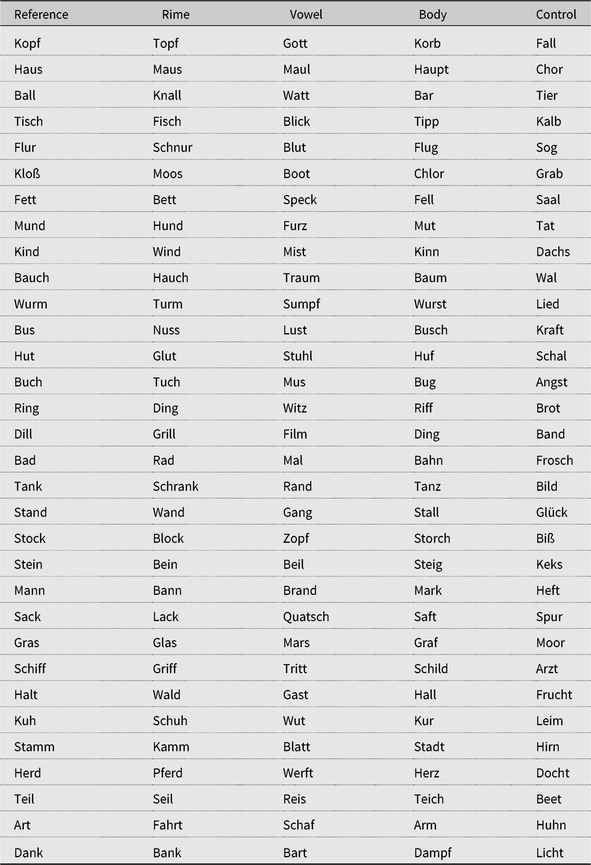
Children were asked to judge whether two monosyllabic nouns rimed or not. In each trial, children first heard a reference word (i.e., Teil, /t∙aɪ̯∙l/) followed by a second word that was varied based on the four different types of phonological overlap (Table 1). In the rime condition, the rime of both words overlapped (i.e., Seil, /z∙aɪ̯∙l/). In the body condition, the body of the words (i.e., onset and nucleus) overlapped (i.e., Teich, /t∙aɪ̯ ç/). In the nucleus condition, the vowel (nucleus) overlapped (i.e., Reis, /r∙aɪ̯∙s/), and in the control condition, there was no overlap between the two words (i.e., Beet, /b∙eː∙t).
Item characteristics of words used in the rime judgment task

Note: aNumber of exchanged phonemes in relation to the reference word. bLemma frequencies in childLex (normalized frequencies per million, log-transformed to the base of 10). cNumber of phonological Coltheart neighbors in childLex. dNumber of consonants. eVowel length represented by 1= short vowel and 2 = long vowel.
Materials
Overall, 160 words were selected from a database for child-directed literature (childLex; Schroeder, Würzner, Heister, & Kliegl, Reference Seymour, Aro and Erskine2015). In line with the previous literature (Cardoso-Martins, Reference Carroll and Myers1994; Carroll & Snowling, Reference Castles and Coltheart2001), we used real words not pseudowords in our analysis. Wagensveld et al. (Reference Wagensveld, Segers, van Alphen and Verhoeven2013) had used both words and pseudowords in their analysis, but no relevant differences were found between the two groups. Furthermore, we were concerned that the young children would not be familiar with pseudoword stimuli, and thus, we would tap into other cognitive processes.
All words used in the study were high-frequent words (lemma frequency) from dense phonological neighborhoods (Coltheart neighbors). To ensure children’s familiarity with the words, the familiarity was rated by 12 parents, who had children in a similar age as the participating children at T1 (M = 5;2; SD = 9.66 months), in a pilot study. Parents rated each word that was used in the rime judgment task on a scale from 0 to 2, with 0 representing no knowledge, 1 representing passive knowledge (“understands but doesn’t use the word”) and 2 representing regular production of the word (“understands and uses the word”). The average score of M = 1.77 (SD = 0.57) indicated that children of the youngest age group being looked at in the study were on average familiar with the selected words.
Differences between types of overlap were controlled based on the Levenshtein distance between the conditions. Rime and body conditions did not differ significantly in Levenshtein distance, t ≤ 1, p > .05, but both differed significantly from the control and nucleus condition, all ts > 2, ps < .001. Nucleus and control condition also differed significantly in Levenshtein Distance, t > 2, p < .001. Conditions were matched for word frequency, phonological neighborhood density, and number of phonemes, all Fs (3, 124) < 1, all ps > .05. Table 1 summarizes mean Levenshtein distance, frequency, phonological neighborhood density, and number of phonemes for each condition and the reference words. Phonological complexity was diverse with 46% of words having a consonant–vowel–vowel–consonant (CVVC) or CVC, 23% a CVCC, 20% a CCVC or CCVVC structure, and 11% having other structures (CCVCC, CCVVCC, CVCCC, CVV, VCC, VCCC, VVCC, or VVCCC). However, analysis of variance analyses for group differences showed that there were no differences in conditions with regard to onset, F (3, 124) = 0.32, p > .05, vowel, F (3, 124) = 1.12, p > .05, and offset complexity, Fs (3, 124) = 0.82, p > .05 (see Table 1). German has more phonologically complex monosyllabic words than English (Marian et al., Reference McBride-Chang and Kail2012), and complex words are, thus, representational for the words that German children grow up with and in which context phonological sensitivity develops (see also Wimmer et al., Reference Wimmer, Landerl and Schneider1994, for other examples of similar item restrictions).
Four lists were created in which the target word was paired with one of the experimental conditions using a Latin square design. The lists were matched for Levenshtein distance, frequency, phonological neighborhood density, and number of phonemes, all Fs (3, 124) < 1, all ps < .05. At each measurement point, children were assigned to a different list using a Latin square design.
The internal consistency of the task was measured for children and adults separately. For children, internal consistency was measured across all time points and was good with Cronbach’s α = 0.82. The same was true for adults with Cronbach’s α = 0.85.
Covariates
To control for effects of task complexity in children, phonological working memory was assessed 10 months before school entry using a standardized digit recall task (BUEVA; Esser & Wyschkon, Reference Esser and Wyschkon2002). The reliability of the task (Cronbach’s α) was good (α = 0.80) and children scored in a range that is typical for this age, M = 20.75, SD = 4.61.
Results
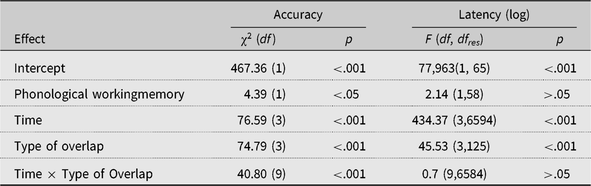
In order to include both participant and item effects (generalized) linear mixed-effects models (Baayen, Davidson, & Bates, Reference Baayen, Davidson and Bates2008) were used for analysis using the {lme4} package (Version 1.1-12) in R. A binomial model using a logit link was used for response accuracy, and a linear model was used for log-transformed response latencies. Only accurate responses were included in the response latency analysis. In addition, we excluded responses below 300 ms and responses longer than 10,000 ms (children) and 4,000 ms (adults). In addition, latencies that deviated more than 2.5 SD from the log-transformed participant or item mean were also discarded. Overall, 14.1% of children’s responses (T1–T4) and 2.4% of adult’s responses were excluded.
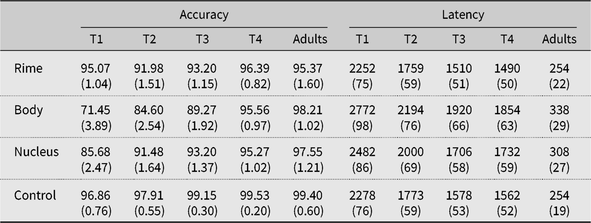
In all models, intercepts for participants and items were included as crossed random effects and type of overlap (4: rime, body, nucleus, or control) as a fixed effect. In the model for children, the factor time (4: T1, T2, T3, or T4) and its interaction with type of overlap was additionally included in the analysis. Furthermore, the continuous variable phonological working memory was included as a fixed effect in the analysis with children. Omnibus effects were calculated based on Type III model comparisons (using the Anova function in the R package {car}; Fox & Weisberg, Reference Fox and Weisberg2011). Post hoc analyses were carried out using single-degree-of-freedom contrasts based on the cell mean estimates in separate models with the same parameters. In order to avoid any misinterpretation due to a general affirmation bias (Heather-Fritzley & Lee, Reference Heather Fritzley and Lee2003), effects for affirmative responses (rime condition) and rejecting responses (control, body, and nucleus condition) were computed separately. In particular, the bias effects that are crucial for the present study (similarity and grain size) are defined as the difference between the control and the body or the nucleus condition and only involve rejecting responses. Descriptive results are provided in Table 2. The results of the mixed-effects model analysis for children are provided in Table 3 and reported within the text for adults.
Descriptive statistics for response accuracy (%) and latency (ms)

Note: Standard errors are provided in parentheses.
Omnibus effects in the analysis of the rime judgment task

Note: Chi-square (accuracy) and F values (latency) for effects using Type III sum of squares.
Children
Accuracy
At the first time point, children’s responses were above chance level in all conditions, all ts > 10, all ps < .001, indicating that the children understood the task. The main effect of time was significant and indicated that children’s performance increased significantly across measurement points: children improved significantly from T1, M = 87.27%, SE = 2.04, to T2, M = 91.49%, SE = 1.56, ∆ = 4.22%, t > 2, p < .01; from T2 to T3, M = 94.01%, SE = 1.19, ∆ = 2.52%, t > 3, p < .001; and from T3 to T4, M = 96.69%, SE = 0.75, ∆ = 2.68%, t > 3, p < .001.
The main effect of type of overlap was also significant: as expected, responses in the rime condition were very accurate (M > 90%). More important, children’s performance was lower in the body, M = 85.22%, SE = 2.33, and in the nucleus condition, M = 91.41%, SE = 1.62, than in the control condition, M = 98.36%, SE = 0.45, all ts > 6, all ps < .001, indicating that children showed a phonological similarity effect in both conditions. In addition, performance in the body condition was significantly lower than in the nucleus condition, t > 2, p < .05, indicating that the size of overlap affected the size of the similarity effect in children.
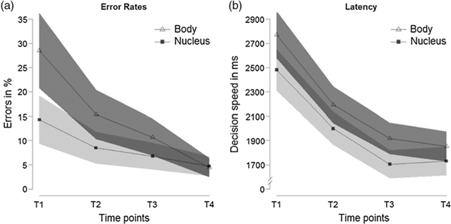
Furthermore, results showed a significant interaction of time and type of overlap (see Figure 1a). This interaction was driven by the fact that the effect of type of overlap differed between measurement points, χ2 (3) = 16.60, p > .01. More specifically, from T1 to T3, body and nucleus conditions differed significantly from each other, all ts > 1.7, all ps < .05, while this difference was not significant at T4, t < 0.3, p > .05. This effect, however, might be caused by ceiling effects in response accuracy and should therefore not be interpreted in isolation.
Trajectory of children’s rime decision in body and nucleus conditions: (a) error rates and (b) latency. Depicted are means surrounded by areas representing standard errors.

Response latency
The main effect of time was significant, indicating that children improved significantly across all measurement points: children’s responses became faster from T1, M = 2446 ms, SE = 84, to T2, M = 1932, SE = 66, ∆ = 514 ms, t > 17, p < .001, and from T2 to T3, M = 1679, SE = 57, ∆ = 253 ms, t > 8, p < .001. From T3 to T4, M = 1660, SE = 56; however, the effect was not significant, ∆ = 119 ms, t < 1.5, p > .05.
In addition, the main effect of type of overlap was also significant (see Figure 1b): children were faster in the control condition, M = 1798 ms, SE = 60, than in both body, M = 2185 ms, SE = 76, and in the nucleus, M = 1980, SE = 68, condition, both ts > 3.5, ps < .001, indicating that children showed phonological similarity biases in both conditions. However, children were also significantly slower in the body than the nucleus condition, ∆ = 205 ms: t > 4, p < .001, indicating that they were sensitive to the size of phonological overlap. Finally, children’s responses in the rime condition were similarly fast as in the control condition, t < 2, p > .05.
Adults
In accuracy responses, adult participants were at ceiling in all conditions and the effect of type of overlap was not significant, χ2 (3) = 0.19, p > .05. In latency responses, by contrast, the main effect of type of overlap was significant, F (3, 118) = 9.61, p < .001. Responses were faster in the control condition than in both body and nucleus conditions (see descriptive statistics in Table 2); both ts > 2, ps < .001. This indicated that adults showed phonological similarity biases in both conditions. In contrast to children, however, responses in the body and the nucleus conditions did not differ significantly from each other: t < 1.3, p > .05.
Joined analysis of adults and children
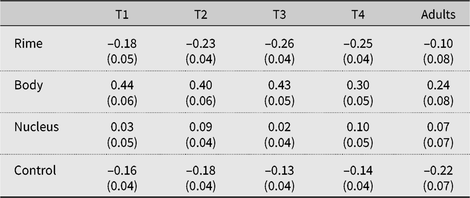
In order to compare children and adults directly with each other and test explicitly where and how effects change during reading development, we conducted a combined analysis using by participant z-transformed response latencies to control for over-additivity effects (Faust, Balota, Spieler, & Ferraro, Reference Faust, Balota, Spieler and Ferraro1999). Descriptive statistics of z-transformed response latencies are provided in Table 4.
Descriptive statistics for z-standardized response latencies

Note: Z standardization by participant.
In order to quantify the size of both phonological similarity effects (body and nucleus vs. control) as well as the effect of grain size use (body vs. nucleus) we set up customized, single degree of freedom contrasts. Results across both groups show a main effect for the phonological similarity effects, F (1, 135) = 15.31, p < .001, and for the effect of grain size use, F (1, 135) = 62.39, p < .001. Furthermore, both effects developed significantly over time, which was indicated by a Phonological Similarity × Time Interaction effect, F (5, 1,303) = 5.19, p < .001, and a Grain Size × Time interaction effect, F (5, 1,289) = 14.16, p < .001. In the following, results of post hoc analyses that were carried out using single degree of freedom contrasts based on the cell mean estimates are reported. Presented results include replications of the results above and additionally direct comparisons of the effects in children and adults.
Phonological similarity effects
Children showed a significant phonological similarity effects at T1, t = 6.7, p < .001, T2, t = 7.27, p < .001, T3, t = 6.46, p < .001, and T4, t = 6.46, p < .001, and adults showed a phonological similarity effect as well, t = 3.68, p < .001. However, effect sizes decreased across time, T1: β = 0.9, SE = 0.14; T2: β = 1.0, SE = 0.13; T3: β = 0.85, SE = 0.13; T4: β = 0.85, SE = 0.13; adults: β = 0.65, SE = 0.18. The interaction effect was explained by significant differences between effects at T1 and T2 (before school entry) compared with the phonological similarity effect in adults, t = 1.7, all p < .05, while the same effect at T3 and T4 (after school entry) did not differ significantly from the effect in adults, t < 1.2, p > .05.
Grain size effect
As reported above, there was a significant grain size effect in children at all time points, all ts > 2, all ps >.05, but no significant grain size effect in adults, t < 1.4, p > .05. However, effect sizes decreased strongly across development with the largest drop throughout the first school year, T1: β = 0.42, SE = 0.10; T2: β = 0.31, SE = 0.09; T3: β = 0.40, SE = 0.09; T4: β = 0.20, SE = 0.09; adults: β = 0.17, SE = 0.12. Thus, the interaction effect was due to a significant decrease in effects from T1/T2 to T3/T4, t = 2.26, p < .05. Furthermore, effects between children at the end of first grade and adults did not differ significantly from each other, t = 0.19, p > .05.
Discussion
In this longitudinal study, a rime judgment task was administered to a group of German-speaking children two times before and two times after school entry as well as to a group of adults. Participants were asked to judge whether a target word rimed with a reference word or not. The target words overlapped with the reference word in the rime (i.e., /t∙aɪ̯∙l/ - /z∙aɪ̯∙l/), the body (i.e., /t∙aɪ̯∙l/ - /t∙aɪ̯ ç/), the nucleus (i.e., /t∙aɪ̯∙l/ - /r∙aɪ̯∙s/), or not at all (control condition; i.e., /t∙ɪ∙ʃ/ - /b∙eː∙t/). The question in focus was whether participants showed phonological similarity effects, that is, are distracted by the phonological overlap in the distractor conditions relative to the control condition. In contrast to previous studies, we manipulated the size of the phonological overlap in the distractor conditions. In line with the assumptions of the psycholinguistic grain size theory about phonological development in German (Ziegler & Goswami, Reference Ziegler and Goswami2005), we expected that the size of the similarity effect will differ between distractor conditions before children start to learn to read, because they are more likely to use larger grain sizes for phonological processing. Children who have already acquired some reading skills (and adults), by contrast, should also be able to process words using smaller grain sizes and, as a consequence, show the same similarity effect in both distractor conditions.
Effects of phonological similarity across development
In line with our expectations, children and adults showed strong similarity effects; that is, both groups consistently misjudged nonrhyming word pairs significantly more often as rhyming, if they had some phonological overlap with the target word. Children showed this effect at all measurement points in both response accuracy and latency. In adults, this effect was only observed in response latency, because accuracy rates showed strong ceiling effects. This finding replicates the results of previous studies that found similarity biases in preliterate children (Cardoso-Martins, Reference Carroll and Myers1994; Carroll & Snowling, Reference Castles and Coltheart2001). In addition, and similar to Wagensveld et al. (Reference Wagensveld, van Alphen, Segers and Verhoeven2012, Reference Wagensveld, Segers, van Alphen and Verhoeven2013), we found that phonological similarity effects were also present in children after they had acquired first reading skills and in adults. The analysis of by-participant z-transformed response latencies, furthermore, showed that the size of this effect decreased significantly throughout development. On the one hand, this supports the assumption that phonological overlap affects responses on rime judgment tasks in general and that this bias is stable across reading development. On the other hand, this also indicates that phonological similarity effects decrease with the onset of reading acquisition.
Grain size effects in phonological processing during rime judgment
In addition, we found that the phonological similarity biases were affected by the size of overlap between the reference and the target word and that this effect evolved with reading development. Specifically, in accuracy responses, children showed a stronger similarity bias effect in the body condition than in the nucleus condition before and shortly after school entry but not at the end of first grade, when first fluent reading abilities had been acquired. However, this could also be explained by ceiling effects, and furthermore, results could not be compared to adults, who were at ceiling in accuracy responses. This is why we also analyzed the response latencies in both children and adults.
Response latency analysis showed that children were more sensitive and, as a consequence, slower in the body condition compared to the nucleus condition. The same effect was, however, not found in adults. A joined response latency analysis of children and adults with z-transformed data revealed a significant interaction of the grain size effect (body vs. nucleus) with time. This interaction was explained by a decreasing size of effect in children with effects being stronger before school entry and at the beginning of first grade (∼0.3–0.4) and decreasing throughout the first year of reading instruction (∼0.2). The rather small effect of differences in phonological processing with regard to grain size did not differ between children at the end of first grade and adults. Thus, children were more sensitive to larger than smaller grain sizes before they had learned to read and gradually developed an additional sensitivity for smaller grain sizes with literacy development.
Conclusions
Our findings suggest that phonological processing is affected by literacy development and develops from more coarse-grained (or holistic) to more fine-grained (or analytical) processing as a function of reading acquisition. This is in line with the psycholinguistic grain size theory (Ziegler & Goswami, Reference Ziegler and Goswami2005), which assumes that preliterate children are more sensitive to larger phonological grain sizes and are only able to process smaller grain sizes after having acquired some reading skills. However, the observation by Ziegler and Goswami (Reference Ziegler and Goswami2005) was mainly based on the results of phoneme awareness tasks (e.g., letter substitution). Our results demonstrate that this finding also generalizes to rime judgment and, presumably, other phonological tasks that involve similarity judgments. This is particularly important in educational environments, in which phoneme awareness is not explicitly taught before school entry, and thus, phoneme awareness is difficult to assess at early points in development (Castles & Coltheart, Reference De Cara and Goswami2004).
It is important to note that the present findings have been found in German-speaking children. German has a transparent orthography (Schmalz, Marinus, Coltheart, & Castles, Reference Schneider, Blanke, Faust and Küspert2015; Seymour, Aro, & Erskine, Reference Seymour, Aro and Erskine2003), and studies have shown that children in transparent orthographies adopt a phoneme-based decoding strategy earlier than children in opaque orthographies and achieve first automatized reading strategies within the first year of instruction (Goswami et al., Reference Goswami, Ziegler and Richardson2005). It can be expected that the developmental onset of this effect varies as a function of orthographic transparency and that children learning to read in an opaque orthography (e.g., English) would still show effects at the end of first grade that are more similar to the effects for preliterate children in the present study.
Limitations and directions for future studies
In this study we used a highly controlled item set that was also controlled for dense phonological neighborhood density. German is a language with few phonological neighbors, if compared, for example, to English or French (Marian et al., Reference McBride-Chang and Kail2012). Differences in phonological processing between words from sparse and dense phonological neighborhoods have already been found in rime awareness tasks in English (Hogan, Bowles, Catts, & Storkel, Reference Hogan, Bowles, Catts and Storkel2011) and, given the phonological language structure, are likely to be found in German as well. Thus, studies on the development of rime awareness with words from both sparse and dense phonological neighborhoods in German or languages with similar phonological structures would be helpful to increase the understanding of phonological development.
There are also some methodological problems that we were not able to address in the present study. For example, it would be interesting to also include other phonological overlap conditions that vary large phonological overlap by position or phonetic quality (i.e., /t∙aɪ̯∙l/ - /t∙a:∙l/; nucleus substitution). This is also important for theory, because one of the assumptions of the psycholinguistic grain size theory is that phonological sensitivity progresses from syllables to onset-rime awareness to phonemes, which makes this progression dependent on the position of phonemes in a word. This assumption is mainly based on findings from English (i.e., Kirtley, Bryant, MacLean, & Bradley, Reference Kirtley, Bryant, MacLean and Bradley1989). However, Geudens and Sandra (Reference Geudens and Sandra2003) were able to negate the assumption that young children are particularly sensitive to onset-rime structure for Dutch, which is not only phonologically but also in general language structure more closely related to German than English. However, there are very few direct neighbors in German (Marian et al., Reference McBride-Chang and Kail2012). Thus, we were not able to find enough words with other overlaps that would have met the criteria of this study and would have been familiar to young children. It would, however, be interesting to include conditions with varying overlap with regard to phoneme position and phonetic quality in future studies.
Finally, the same is true for the inclusion of more small overlap conditions to contrast effects of consonant overlap with vowel overlap (nucleus; i.e., /t∙aɪ̯∙l/ - /t∙e:∙r/). Again, we had difficulties finding suitable words for young children that would meet the rest of our criteria, and furthermore, we would have increased an already large item set for a group of young participants with, thus, a limited attention span. Therefore, we decided to use an additive pattern instead (vowel vs. vowel + consonant) to ensure that differences in the conditions cannot be explained solely by vowel saliency. However, as we had no condition that tested only consonant overlap, we cannot rule out confounds caused by differences in processing of vowels and consonants completely. Adding a condition with only consonant overlap should, therefore, be considered in future studies.
Summary
In sum, our results confirm that in German a phonological similarity bias is observed in preliterate and literate children as well as in adults. However, the strength of the effect is affected by the amount of overlap between reference and target word, and the size of this effect decreases in parallel to literacy development. Preliterate children are more sensitive to larger phonological processing units and, as a consequence, show stronger phonological similarity effects if the overlap between target and reference word is large. Literate children and adults, by contrasts, are also sensitive to small phonological processing units and their response behavior is, therefore, influenced less by the amount of phonological overlap. Thus, results support the claims of the psycholinguistic grain size theory (Ziegler & Goswami, Reference Ziegler and Goswami2005). Results also show that not only development in phoneme awareness but also development in rime awareness is linked to literacy development.
Author ORCIDs
Sascha Schroeder, 0000-0001-7001-4588
Acknowledgments
We thank Julia Mann, Felix Klapproth, and Elisabeth Klose for their support in data collection.
Appendix A
Stimuli of the rime judgment task