


Statement of Research Significance
Research Question(s) or Topic(s): Word finding therapies are some of the most widely used treatments for people with language difficulties (post-stroke aphasia). This review examines whether effects of naming treatment generalize to spoken discourse and functional communication. Main Findings: Therapies that target naming do not reliably improve discourse or functional communication. However, these can be improved by therapies that directly target them. Study Contributions: This study suggests that, if the goal is improving discourse and functional communication, then aphasia intervention research should focus on treating them.
Introduction
Anomia – difficulty with word finding – is a pervasive symptom in aphasia; indeed, it is often considered the defining feature of aphasia (e.g., Caplan Reference Caplan, Heilman and Valenstein2012). Many aphasia treatments consider words as the “building blocks” of verbal communication, and focus on improving word-finding as a foundation for improving spoken discourse.
(Spoken) discourse describes language production beyond the single clause (Dressler et al., Reference Dressler, Halliday and Hasan1978; Ulatowska & Olness, Reference Ulatowska and Olness2007), which is produced for a specific purpose or function (Dipper et al., Reference Dipper, Marshall, Boyle, Hersh, Botting and Cruice2021a; Halliday, Reference Halliday1978). It includes the lexical, phonological and syntactic aspects of single words and sentences (i.e., microstructure; Glosser & Deser, Reference Glosser and Deser1992) and the processes that maintain its conceptual/semantic coherence (i.e., macrostructure; van Dijk, Reference van Dijk1980). Discourse is often associated with conversation, such as taking a “turn” to recall an event when talking to someone. In aphasia intervention, discourse is frequently associated with monologue (c.f., Simmons-Mackie et al., Reference Simmons-Mackie, Raymer and Cherney2016 for a conversation-focused review), which is typically assessed through personal narratives or picture descriptions. A closely related concept is “functional communication”: the use of language to communicate effectively in the real world (Doedens & Meteyard, Reference Doedens and Meteyard2022). Functional communication assessments tend to rely on the social functions of communication, and the impact of aphasia on a person’s everyday activities (e.g., Holland, Reference Holland1998). Thus, discourse and functional communication are different approaches to capturing naturalistic, everyday communication (e.g., sharing information, establishing and maintaining relationships; Davidson et al., Reference Davidson, Worrall and Hickson2003).
A recent article by Cavanaugh et al. (Reference Cavanaugh, Dickey, Hula, Fromm, Golovin, Wambaugh, Fergadiotis and Evans2024) reported a relatively large-scale (n = 60) retrospective analysis of discourse production following high-intensity semantic feature analysis (SFA; Boyle & Coelho, Reference Boyle and Coelho1995; Massaro & Tompkins, Reference Massaro and Tompkins1994). SFA is a well-established treatment for anomia based on rebuilding semantic networks to facilitate retrieval of the correct word during object naming (a closely related treatment uses semantic networks around verbs: Edmonds et al., Reference Edmonds, Nadeau and Kiran2009). A recent meta-analysis showed that SFA is effective at improving naming of trained words and generalizes to untrained words (Quique et al., Reference Quique, Evans and Dickey2019).
Cavanaugh and colleagues found that, unfortunately, SFA did not result in improvements in discourse, such as informativeness or grammatical complexity. Even word-level aspects of discourse, such as lexical diversity (type-token ratio) and rate of semantic errors, did not improve. This lack of generalization is potentially a very serious problem: a recent review (Goodman et al., Reference Goodman, Kelly and Evans2026) found that people with aphasia overwhelmingly prioritize function-focused rehabilitation goals, but only a small minority of federally funded aphasia clinical trials measure functionally focused primary outcomes. The vast majority of trials use impairment-based measures; but if improvements in specific impairments (such as word finding) do not generalize to function-focused rehabilitation goals, then our research resources are not aligned with the goals of people with aphasia.
In the present study, we conducted a systematic review to determine whether the lack of generalization observed by Cavanaugh et al., is a general pattern. A preliminary literature search showed that much of the work on generalization used single case studies. Such studies are an important cornerstone of the aphasia treatment literature (Thompson, Reference Thompson2006) and can rigorously demonstrate within-subject effects. However, those effects are inherently limited to the particular single-cases, and do not license generalization to other individuals (Backman & Harris, Reference Backman and Harris1999; Shadish et al., Reference Shadish, Cook and Campbell2002). When considering generalization to a population, the size (and representativeness) of the sample is critical, so we decided to focus on the largest available studies. We set the threshold at N > 15 participants as a convenient definition of “largest studies.” We focused on interventions that targeted naming (primary outcome) and measured discourse or functional communication (secondary outcome). We hypothesized that improvements in naming would not systematically generalize to discourse or functional communication. We also used the same systematic review approach to assess whether discourse and functional communication are amenable to treatments that target them. Our hypothesis was that such treatments would improve discourse and functional communication. We also considered whether these treatment effects generalize to naming, but did not have an a priori hypothesis about whether such generalization should occur or not.
Methods
This review followed the Preferred Reporting Items for Systematic Reviews and Meta-Analyses guidelines (Page et al., Reference Page, McKenzie, Bossuyt, Boutron, Hoffmann, Mulrow, Shamseer, Tetzlaff, Akl, Brennan, Chou, Glanville, Grimshaw, Hróbjartsson, Lalu, Li, Loder, Mayo-Wilson, McDonald, McGuinness, Stewart, Thomas, Tricco, Welch, Whiting and Moher2020). Studies were included if they were: a monolingual intervention with 15 or more participants; written in English; conducted in the chronic phase (at least 4 months post stroke, Simmons-Mackie et al., Reference Simmons-Mackie, Raymer and Cherney2016); and measured both picture naming and either discourse or functional communication. Interventions directly targeting discourse or functional communication, without necessarily testing naming, were further included. Studies were excluded if participants had a co-morbid neurodegenerative condition; did not report new data (reviews or meta-analyses); were pharmacological therapies; or interventions that used a speech device or transcranial magnetic stimulation to enhance communicative recovery. Multimodal interventions, which allowed the use of multiple communicative modes (speech, gesture, images, etc.), were included. Multilevel interventions combining more than one linguistic level (e.g., words, micro and macrostructure, pragmatics) were excluded because our focus is on generalization from naming treatment to discourse or functional communication. Studies conducted in the acute or subacute stage were also excluded as there is substantial natural recovery in the days and weeks after stroke (Hope et al., Reference Hope, Leff, Prejawa, Bruce, Haigh, Lim, Ramsden, Oberhuber, Ludersdorfer, Crinion, Seghier and Price2017; Stefaniak et al., Reference Stefaniak, Halai and Lambon Ralph2020).
Online literature searches were conducted on 27 July 2025 using PsycINFO, PubMed and Scopus databases (CINAHL Plus was subsequently searched Footnote 1 for any additional articles meeting the search criteria). The following compound search term was used:
Stroke aphasia
AND
(Naming OR Word finding difficult* OR Anomia)
AND
(Connected speech OR Spoken discourse OR Functional communication)
AND
(Therap* OR Treat* OR Intervention*)
Search results were screened using Covidence systematic review software (www.covidence.org). We added 17 studies through citation searching. Duplicates were removed by the software.
The titles and abstracts were screened according to the inclusion/exclusion criteria. The first author conducted an initial full review of each article, then discussed their inclusion with the second author. The full text of the included articles was read fully to extract the relevant results. A flowchart of the process produced by Covidence is shown in Figure 1.
PRISMA flow diagram of search results.

Figure 1. Long description
The flowchart begins with the identification phase, where studies are sourced from databases like PsycINFO, Scopus, and PubMed, totaling 1013 studies, and references from other sources, totaling 17. 74 duplicates are removed. In the screening phase, 974 studies are screened, and 852 are excluded. 122 studies are sought for retrieval, and after assessing eligibility, 106 studies are excluded for reasons such as small cohort, functional communication not assessed, and multimodal therapy. Finally, 16 studies are included in the review.
Results
A total of 16 studies met our inclusion criteria: nine studies that reported successful naming therapies and tested generalization to discourse or functional communication, and seven studies that tested discourse or functional communication treatments.
Naming interventions
The nine naming treatment studies reported improved naming in a total of 344 participants. For discourse measures, three studies found no generalization from successful naming treatment (Cavanaugh et al., Reference Cavanaugh, Dickey, Hula, Fromm, Golovin, Wambaugh, Fergadiotis and Evans2024; Efstratiadou et al., Reference Efstratiadou, Papathanasiou, Holland, Varlokosta and Hilari2019; Woolf et al., Reference Woolf, Caute, Haigh, Galliers, Wilson, Kessie, Hirani, Hegarty and Marshall2016), one found mixed evidence (Silkes et al., Reference Silkes, Fergadiotis, Graue and Kendall2021, found improvement in discourse informativeness from PMT but not from SFA). Three studies found improvements in discourse (Conroy et al., Reference Conroy, Sotiropoulou Drosopoulou, Humphreys, Halai and Lambon Ralph2018; Silkes et al., Reference Silkes, Fergadiotis, Pompon, Torrence and Kendall2019; Upton et al., Reference Upton, Doogan, Fleming, Leyton, Barbera, Zeidman, Hope, Latham, Coley-Fisher, Price, Crinion and Leff2024), though two of these found improvements specifically for the trained items (Conroy et al., Reference Conroy, Sotiropoulou Drosopoulou, Humphreys, Halai and Lambon Ralph2018; Upton et al., Reference Upton, Doogan, Fleming, Leyton, Barbera, Zeidman, Hope, Latham, Coley-Fisher, Price, Crinion and Leff2024). For functional communication measures, one study found no generalization from successful naming treatment (Palmer et al., Reference Palmer, Dimairo, Cooper, Enderby, Brady, Bowen, Latimer, Julious, Cross, Alshreef, Harrison, Bradley, Witts and Chater2019), one found mixed evidence (Efstratiadou et al., Reference Efstratiadou, Papathanasiou, Holland, Varlokosta and Hilari2019, reported no change at immediate testing, but improvement in a different measure at follow up), and one study found improvements in functional communication (Masson-Trottier et al., Reference Masson-Trottier, Marcotte, Rochon, Leonard and Ansaldo2024). Thus, although each of these interventions improved naming (direct therapeutic target), only about half of them found that these benefits generalized to discourse or functional communication (often limited to improved production of trained words in a discourse context). See Table 1 for a summary of the results.
Interventions targeting naming (primary outcome) that also measured discourse

Table 1. Long description
The table presents data on nine studies targeting naming interventions and their effects on discourse and functional communication. It has six columns: Authors, Number of participants, Therapy, Outcomes on naming, Outcomes on discourse or functional communication. The table includes six rows of data. Row 1: Authors: Cavanaugh et al. (2024), Number of participants: 60, Therapy: Semantic feature analysis (SFA; Boyle & Coelho, 1995) delivered either individually (n = 30) or in a group (n = 30) for 45-50 min per week over a total of approximately 60 min over 12 weeks, Outcomes on naming: Improvement in word finding (treated and untreated items), Outcomes on discourse or functional communication: No improvement in discourse level measures, including: lexical-semantic processing, grammatical complexity, discourse informativeness. Row 2: Authors: Conroy et al. (2018), Number of participants: 20, Therapy: Standard treatment (sound-based naming) and Novel treatment (impaired, increasingly difficult, and accurately-focused treatment that encouraged participants to name treated items), Treatment intensity and length: 2 sessions per week between 30 and 50 minutes for 12 weeks, Outcomes on naming: Improvement in word finding (treated items), Outcomes on discourse or functional communication: Improvement in word finding, treated picture description, the effect was larger for the novel treatment, no improvement in discourse informativeness (but no improvement for either treatment), type-token ratio or average imageability of the nouns used, decrease in the average word frequency of the nouns used. Row 3: Authors: Efstratiadou et al. (2019), Number of participants: 38, Therapy: Labeling, SFA, SFA, Pantomiming, Outcomes on naming: Improvement in word finding (treated and untreated items), Outcomes on discourse or functional communication: No improvement in discourse effectiveness and measure of functional communication immediately post treatment, improvement in a different measure of functional communication follow up testing. Row 4: Authors: Masson-Trottier et al. (2024), Number of participants: 18, Therapy: Phonological component analysis (PCA; Leonard et al., 2000) in frequent- low-frequency sessions, with a frequency of three weekly sessions for 6 weeks, Treatment intensity and length: 20 words (there were an additional 40 words that were not treated), Outcomes on naming: Improvement in word finding (treated and untreated items), Outcomes on discourse or functional communication: Improvement in functional communication. Row 5: Authors: Palmer et al. (2019), Number of participants: 83, Therapy: Usual care & computerized speech-language therapy (SLT) word-finding intervention, Usual care & attention control (guided conversation), Control: Usual care (no/minimal therapy), Treatment intensity and length: 30-30 minutes of daily, at-home, practice over a 6-week period, with 10 visits to the clinic, Outcomes on naming: Improvement in word finding (treated items), Outcomes on discourse or functional communication: No improvement in functional communication. Row 6: Authors: Silkes et al. (2019), Number of participants: 26, Therapy: Phonological therapy (PMT) to strengthen a patient’s ability to produce phonemes in progressively longer words and nonwords, Treatment intensity and length: 30 min of therapy per day, five days per week for 16 weeks, Outcomes on naming: Improvement in word finding (reported in Silkes et al., 2019), Outcomes on discourse or functional communication: Improvement in discourse effectiveness at immediately and follow up testing post-therapy, improvement in discourse informativeness at follow-up only. Row 7: Authors: Silkes et al. (2021), Number of participants: 57, Therapy: SFA (n = 29), PMT (n = 28), Outcomes on naming: Improvement in word finding (reported in Silkes et al., 2019), Outcomes on discourse or functional communication: No improvement in discourse informativeness for the SFA participants, improvement in discourse informativeness for the PMT participants at follow up. Row 8: Authors: Upton et al. (2024), Number of participants: 27, Therapy: LabelFaster, a digital confrontation naming intervention incorporating phonological cues, Treatment intensity and length: six weeks of self-managed, app-based therapy (LabelFaster), with a target goal of 60 hours, Outcomes on naming: Improvement in word finding (treated items), Outcomes on discourse or functional communication: Improvement in word finding (trained items) during picture description. Row 9: Authors: Woolf et al. (2016), Number of participants: 15, Therapy: Word-finding therapy delivered by the University in S1 or at a clinical site (in S2), Treatment intensity and length: 1-hour session per week for 10 weeks, Outcomes on naming: Improvement in word finding (treated items), Outcomes on discourse or functional communication: No improvement in word finding during discourse (conversation, as assessed by mean number of content words per turn, mean number of content words per turn, mean number of nouns per turn.
* The participant cohorts were different.
† This finding was in line with the authors’ hypothesis based on their previous work (Silkes et al., Reference Silkes, Fergadiotis, Pompon, Torrence and Kendall2019).
Discourse and functional communication therapies
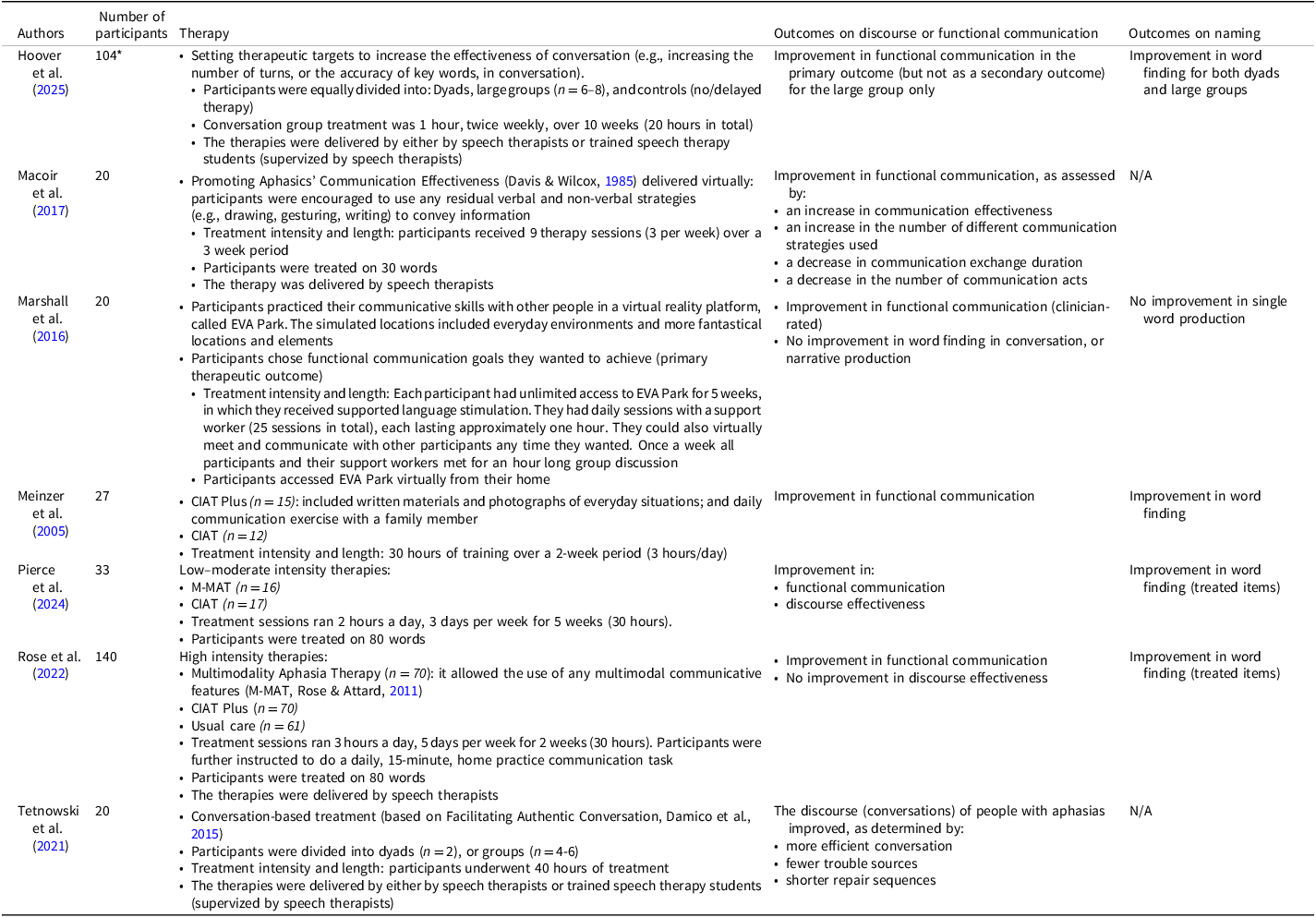
Our search yielded seven studies that targeted and improved discourse or functional communication in a total of 364 participants (Hoover et al., Reference Hoover, Szabo, Kohen, Vitale, McCloskey, Maas, Kulkarni and DeDe2025; Macoir et al., Reference Macoir, Sauvageau, Boissy, Tousignant and Tousignant2017; Marshall et al., Reference Marshall, Booth, Devane, Galliers, Greenwood, Hilari, Talbot, Wilson and Woolf2016; Meinzer et al., Reference Meinzer, Djundja, Barthel, Elbert and Rockstroh2005; Pierce et al., Reference Pierce, OHalloran, Togher, Nickels, Copland, Godecke, Meinzer, Rai, Cadilhac, Kim, Hurley, Foster, Carragher, Wilcox, Steel and Rose2024; Rose et al., Reference Rose, Nickels, Copland, Togher, Godecke, Meinzer, Rai, Cadilhac, Kim, Hurley, Foster, Carragher, Wilcox, Pierce and Steel2022; Tetnowski et al., Reference Tetnowski, Tetnowski and Damico2021). Four of these interventions also improved naming (Hoover et al., Reference Hoover, Szabo, Kohen, Vitale, McCloskey, Maas, Kulkarni and DeDe2025; Meinzer et al., Reference Meinzer, Djundja, Barthel, Elbert and Rockstroh2005; Pierce et al., Reference Pierce, OHalloran, Togher, Nickels, Copland, Godecke, Meinzer, Rai, Cadilhac, Kim, Hurley, Foster, Carragher, Wilcox, Steel and Rose2024; Rose et al., Reference Rose, Nickels, Copland, Togher, Godecke, Meinzer, Rai, Cadilhac, Kim, Hurley, Foster, Carragher, Wilcox, Pierce and Steel2022), one did not find improved naming, and two studies did not test naming. See Table 2 for more detailed descriptions of the interventions and their findings.
Interventions targeting discourse or functional communication

Table 2. Long description
The table has seven rows and five columns. The columns are labeled Authors, Number of participants, Therapy, Outcomes on discourse or functional communication, and Outcomes on naming. Each row corresponds to a different study. Row 1: Hoover et al. (2025), 104 participants, therapies include setting therapeutic targets and conversation group treatment, improvement in functional communication for large groups, improvement in word finding for both dyads and large groups. Row 2: Macoir et al. (2017), 20 participants, promoting aphasics’ communication effectiveness, improvement in functional communication, outcomes on naming not assessed. Row 3: Marshall et al. (2016), 20 participants, practicing communication skills in a virtual reality platform, improvement in functional communication, no improvement in single word or narrative production. Row 4: Meinzer et al. (2005), 27 participants, CIAT Plus and CIAT, improvement in functional communication, improvement in word finding. Row 5: Pierce et al. (2024), 33 participants, M-MAT and CIAT, improvement in functional communication and discourse effectiveness, improvement in word finding. Row 6: Rose et al. (2022), 140 participants, high intensity therapies including multimodality aphasia therapy and CIAT Plus, improvement in functional communication, improvement in word finding. Row 7: Tetnowski et al. (2021), 20 participants, conversation-based treatment, improvement in discourse, outcomes on naming not assessed.
* Preliminary analyses on a subset of these participants were reported in previous studies (e.g., DeDe et al., Reference DeDe, Hoover and Maas2019; Hoover et al., Reference Hoover, McFee and DeDe2020, Reference Hoover, DeDe and Maas2021).
Discussion
Our review reveals two major points: first, treatments that target naming can successfully improve naming, but only about half of these studies found that improvements generalized to discourse or functional communication, and much of that benefit was tied specifically to improved production of the treated words. Second, treatments that explicitly target discourse and functional communication can successfully improve them, and often improve naming also. That is, naming improvements are more common as a side effect of improving discourse or functional communication (found in 4 out of 5 studies), than as a “building block” or “active ingredient” in the success of aphasia treatment (found in only half of the studies).
Generalization from more complex treatment targets (discourse production) to simpler ones (single word production) appears to be more effective than generalization from simpler to more complex levels. A similar asymmetry has been labeled the Complexity Account of Treatment Efficacy (Thompson et al., Reference Thompson, Shapiro, Kiran and Sobecks2003, p.11): training the production and comprehension of syntactically complex structures induces improvements to less complex forms, but the opposite effect (i.e., simple syntactic structures generalizing to more complex ones) does not occur.
On generalization
The term “generalization” is used to refer to (at least) three different cases: (1) “within level” improvement at the same linguistic level as the focus of treatment (e.g., picture naming intervention generalizing to untreated words), (2) “across level” improvement at a different linguistic level (e.g., picture naming intervention generalizing to discourse) (Webster et al., Reference Webster, Whitworth and Morris2015, p. 1241), and (3) transfer of trained behavior(s) to a new context or environment (e.g., improved production of trained words in a discourse context).
The logic of single-word naming treatment research is that improved naming of treated words will generalize to other words (near transfer to untreated words), which will improve word production in discourse (far transfer to communication success). However, generalization is a difficult problem in cognitive training (e.g., Sala & Gobet, Reference Sala and Gobet2019), sometimes called the “curse of specificity” (Bavelier et al., Reference Bavelier, Green, Pouget and Schrater2012, p.392). Despite anomia being a pervasive symptom in aphasia, improved naming of isolated objects usually does not generalize to more naturalistic tasks, even closely related ones that should be based on the same cognitive mechanisms (Doedens & Meteyard, Reference Doedens and Meteyard2022; Herbert et al., Reference Herbert, Gregory and Best2014). Indeed, it may be wrong to assume that human communication is decomposable into building blocks like naming, which can be removed from the context of discourse production, listening, turn taking, and non-verbal features (Matusz et al., Reference Matusz, Dikker, Huth and Perrodin2019). Interventions targeting only naming are multiple therapeutic steps away from discourse, and should not be assumed to generalize to it.
Multilevel intervention studies have expressly argued that in order to improve discourse, it should be targeted directly. One such example is Language Underpins Narrative in Aphasia (Dipper et al., Reference Dipper, Devane, Barnard, Botting, Boyle, Cockayne, Hersh, Magdalani, Marshall, Swinburn and Cruice2024), a theory-based, codesigned, discourse intervention that integrates multiple standard treatments (e.g., SFA, mapping therapy, story grammar) to provide metalinguistic tools for improving discourse (personal narratives). Another example is Narrative and Discourse Intervention in Aphasia (Whitworth et al., Reference Whitworth, Leitão, Cartwright, Webster, Hankey, Zach, Howard and Wolz2015; Whitworth, Reference Whitworth2024), a structured therapy targeting discourse microstructure to build macrostructure for a range of monologues (e.g., telling stories, giving opinions, explaining procedures, recounting events). The success of such therapies suggests that word finding tasks can be useful as a “stepping stone” on the way to discourse treatment.
Considerations
The naming interventions that measured “discourse” as a secondary outcome had considerable variability in their choice of assessment. For example, some studies used Correct Information Units (e.g., Cavanaugh et al., Reference Cavanaugh, Dickey, Hula, Fromm, Golovin, Wambaugh, Fergadiotis and Evans2024; Efstratiadou et al., Reference Efstratiadou, Papathanasiou, Holland, Varlokosta and Hilari2019), which were unrelated to the treatments, and generally did not elicit the production of treated words (naming targets). Other studies tailored the discourse stimuli to the treatments, and found better generalization outcomes (e.g., Conroy et al., Reference Conroy, Sotiropoulou Drosopoulou, Humphreys, Halai and Lambon Ralph2018; Upton et al., Reference Upton, Doogan, Fleming, Leyton, Barbera, Zeidman, Hope, Latham, Coley-Fisher, Price, Crinion and Leff2024). This indicates that generalization of naming improvements may be limited to improved production of those specific words in a slightly different context rather than improved discourse or communication more broadly.
“Functional communication” is often assessed by person- or partner-rated measures, and could reflect personal biases in ways that more objective discourse measure do not. For example, the Communicative Effectiveness Index, (CETI; Lomas et al., Reference Lomas, Pickard, Bester, Elbard, Finlayson and Zoghaib1989) is a widely used, psychometrically validated, partner-reported measure of functional communication that was administered in several of the functional studies we reviewed (Meinzer et al., Reference Meinzer, Djundja, Barthel, Elbert and Rockstroh2005; Pierce et al., Reference Pierce, OHalloran, Togher, Nickels, Copland, Godecke, Meinzer, Rai, Cadilhac, Kim, Hurley, Foster, Carragher, Wilcox, Steel and Rose2024; Rose et al., Reference Rose, Nickels, Copland, Togher, Godecke, Meinzer, Rai, Cadilhac, Kim, Hurley, Foster, Carragher, Wilcox, Pierce and Steel2022). The naming interventions (Table 1) tended to use more objective discourse measures while the functional communication interventions (Table 2) tended to use more subjective measures, so it is not a direct comparison. Although discourse and functional communication are often correlated, we should not assume that functional communication improvements are equivalent to discourse improvements. In fact, the functional communication therapy described in Marshall et al. (Reference Marshall, Booth, Devane, Galliers, Greenwood, Hilari, Talbot, Wilson and Woolf2016), which addresses users’ functional goals (e.g., ordering food at a restaurant) did not improve discourse production, and only improved confrontational role play tasks (in the Communication Activities of Daily Living, CADL; Holland, Reference Holland1998) that were very similar to the therapy. Across all of the studies we reviewed, the most consistent pattern is that interventions (both naming and discourse/functional) tend to improve their primary outcome, with limited generalization to anything else.
The ease of measuring object naming probably contributes to its prominence in aphasia research. Discourse and functional communication are multi-dimensional and interactive in nature, making it more challenging to capture change (pre vs post therapy), and there are many – possibly non-equivalent – measures of discourse and functional communication (Bryant et al., Reference Bryant, Ferguson and Spencer2016). Recently, there has been an increased interest in formally standardizing discourse measures for aphasia (Cruice et al., Reference Cruice, Aujla, Bannister, Botting, Boyle, Charles, Dhaliwal, Grobler, Hersh, Marshall, Morris, Pritchard, Scarth, Talbot and Dipper2022; Dipper et al., Reference Dipper, Marshall, Boyle, Hersh, Botting and Cruice2021b; Dutta et al., Reference Dutta, Murray, Stark, Bryant and Kong2023). For instance, the FOQUSAphasia (FOstering the QUality of Spoken discourse in Aphasia) working group has begun to systematically collect and analyse the neuropsychological/psychometric properties, and normative data, for some of the most commonly used discourse measures (Stark et al., Reference Stark, Dutta, Murray, Bryant, Fromm, MacWhinney, Ramage, Roberts, den Ouden, Brock, McKinney-Bock, Paek, Harmon, Yoon, Themistocleous, Yoo, Aveni, Gutierrez and Sharma2021). Additionally, the functional assessments that have been developed often emphasize time-efficiency and ease of administration to facilitate adoption in research and clinical settings. For example, the CADL and CETI have been developed to be used by clinicians as well as non-clinicians/researchers, and they only take 30 minutes and 10–15 minutes to administer, respectively (Holland et al., Reference Holland, Fromm and Wozniak2018; Lomas et al., Reference Lomas, Pickard, Bester, Elbard, Finlayson and Zoghaib1989). Such measures should be included in tests of naming treatments whose overarching goal is to improve communication.
Concluding remarks
The “curse of specificity” is remarkably prevalent within speech–language therapy. Treatments targeting naming can improve naming, but only about half found improvements in discourse or functional communication. In contrast, treatments that target discourse and functional communication can improve them, and often improve naming performance as well. Future research should follow the lead of interventions that targeted discourse or functional communication, build on them, and uncover cognitive and neural basis of improving discourse and functional communication.
Supplementary material
The supplementary material for this article can be found at https://doi.org/10.1017/S1355617726102252.
Funding statement
Preparation of this article was supported by grants from the US National Institutes of Health (R01DC017137) and the John Templeton Foundation (63118).
Competing interests
None declared.




 Open access

