If artists were to be “the antennae of the race” (E. Pound, “Teacher's Mission” 630), Ezra Pound believed that they had to sign their work: “The man who dares not sign his opinions is beneath all legally expressible contempt” (“Ignorant Ignorami”). But as he discovered while broadcasting for Radio Roma during World War II, anonymity had its attractions. His anonymous scripts—of which there would be hundreds—were “in some ways better than the personal / When anonymous I can be omniscient / when I speak in my own voice I have to be modest and stick to what I have seen first hand” (qtd. in Redman 211). Omniscience was no reprieve from a treason indictment issued in 1943, but after arriving back in the United States to face trial, Pound was declared mentally incompetent and interned at Saint Elizabeths, a mental hospital in the nation's capital. Despite his signature lacking any legal standing, Pound's twelve years as patient no. 31113 coincided with his “greatest fame and influence” (Surette xiii): The Pisan Cantos was awarded the Bollingen Prize, the “Rock Drill” and “Thrones” cantos were written, and major translations from Confucius and Sophocles appeared. If during the war years Pound was told that “[y]r politics have cooked yr revered goose to a point you wd. not believe … its hard sledding to protect yr reputation” (Laughlin, Letter to Ezra Pound), in the postwar he was feted in literary reviews and became the subject of scholarly conferences and books. Shoring up Pound's reputation and literary bona fides, as Greg Barnhisel has shown, involved a deliberate strategy on the part of his elite supporters and publishers (James Laughlin at New Directions, T. S. Eliot at Faber and Faber) to split Pound in two. There was the technically refined poet and modernist mover and shaker whose literary and aesthetic work was published and promoted, and then there was a “bad” Pound whose writings on social credit or politics had to be suppressed, a division that struck a chord with the New Critics. Cantos, translations, reprints in prestigious literary reviews: these high-literary items make up the bulk of Pound's post-1945 output in the most comprehensive edition of his collected periodical contributions (Baechler et al.), creating the impression that late Pound was cloistered in lofty aesthetic domains.
Yet just as Pound broadcast much more for Italian radio than can be gathered by consulting the print volume of those broadcasts (Doob), his publishing activities from what he called the “bughouse” were more extensive than the print record indicates.Footnote 1 To continue to have a voice on contemporary politics and culture, Pound returned to the little review, the form that had catapulted his career decades earlier. Often issued by a group or cabal pushing a particular aesthetic or political line, little reviews tended to be “little” in size (a small physical format, few pages), were often irregular in their publication schedule, and had a small circulation. Cheap to put out and typically operating outside market pressures, little reviews were ideal venues for “aesthetic experimentation and political radicalism” (Churchill and McKible 6), places where such daring texts as Eliot's The Waste Land or extracts from James Joyce's Ulysses first appeared (in both cases, thanks to Pound's intercession). While Pound made his name through little reviews in the 1910s and 1920s, the changing political and literary context of postwar America and his own legal troubles now made it necessary to work in stealth, through “LITERARY camouflage” (E. Pound, Letter to Dallam Simpson [Early 1948]). While never contributing to The Elizabeth: A Paper by and for the Patients, Pound wrote scores of anonymous notes for a series of little reviews put out by disciples, among them Four Pages (Galveston and South Wales / London), NINE (London), The European (London), Voice (Belfast), Mood (St. Louis), Academia Bulletin (Washington, DC), Strike (Washington, DC), Edge (Melbourne), and The New Times (Melbourne). These ephemeral reviews, supplemented by single-issue publishing houses and dedicated distribution channels, constituted a distinct print-culture ecosystem for Poundian thought in the postwar period. As Dallam Simpson, editor of Four Pages and publisher of the Cleaners’ Press, told Peter Russell, editor of NINE and publisher of Pound Press, there needed to be “a systematic attempt to get, not only the part of EP's work that Eliot and Laughlin like, but the whole of it into print” (Letter to Peter Russell). The guiding motivations for these journals varied as much as Pound's work cut a wide cloth; some were mainly interested in social credit economics (Edge, New Times), others mainly marshalled his racial and political ideas (Academia Bulletin, Strike), and still others focused on his cultural views (Four Pages, NINE). These coterie venues also overlapped with “elite” Pound networks: Four Pages published original work by William Carlos Williams and Marianne Moore, and its books offshoot, the Cleaners’ Press (later acquired by the Square Dollar Series), put out Basil Bunting's Poems: 1950; Hugh Kenner, whose book The Poetry of Ezra Pound (1951) consolidated the poet's standing in the academy, was asked to serve on the board of the Square Dollar Series; Pound sent money pamphlets and far-right material to literary venues like Shenandoah and worked over the editors of The Hudson Review (Jarman).
Pound and little reviews has become one of literature's great stories, a modernist creation myth for the ages. His extensive involvement in Poetry, The Egoist, The Little Review, and BLAST, to name just the heavy hitters, made him a central figure in the form that vitalized modernist art and literature. The groundbreaking study that established the pivotal role of little reviews in modern literature and gave the form scholarly credibility, The Little Magazine: A History and a Bibliography (Hoffman et al.), which first appeared in 1946, at a time when the form was losing its cultural salience because of mass-market periodicals and cultural homogenization, called Pound “one of the most effective sponsors of experimental literature in our century” (21). Robert Scholes and Clifford Wulfman's Modernism in the Magazines (2010) casts Pound as the central “thread” in that history (viii). The “recurring presence” in Eric Bulson's account of how the form shaped literary modernism (“No little magazines, no modernism”) and adapted to different global contexts is, predictably, Pound (5, 1).Footnote 2
Although Pound is widely credited as the key figure in the history of little reviews, his full involvement has yet to be told. Scholes and Wulfman allow only “the Pound of the first three decades of the twentieth century” into their pages (viii). The little reviews from the postwar period have been dismissed wholesale: “little of the material appearing in special journals devoted to Poundian theories started by the young converts who surround ‘grampaw’ at St. Elizabeths is today worth the attention of the serious student of literature” (Corrigan 474). That fifty-year-old value judgment still prevails despite a flurry of recent works on postwar Pound (Coyle and Preda; Javadizadeh; Marsh; Moody; Swift). Four Pages, the first of the disciple reviews, is not mentioned by Alec Marsh or Daniel Swift; Barnhisel ignores it, too, in his account of postwar Pound print culture even though Laughlin received and read the review; Michael Coyle and Roxana Preda mention Four Pages in passing but seem to be unaware of the six British numbers of the review (205n8); and David Moody affords it a single paragraph (291–92), which can hardly unpack why Pound wrote over three hundred letters to its nominal first editor. The various accounts of Pound's fascism, from Tim Redman to Matthew Feldman (Ezra Pound's Fascist Propaganda), tend to wrap up the story in 1945.Footnote 3 It does not help that Four Pages, like the other postwar coterie Pound reviews, is undigitized, so in the “offline penumbra” (Leary 82) it remains unexplored, unread, unknown.
A monthly that ran irregularly from 1948 to 1951, Four Pages coincided with a pivotal period in Pound's life. In spring 1948 his wife, Dorothy, pulled the plug on any further legal appeals to free Pound from St. Elizabeths. A year later the Bollingen Prize award unleashed countless editorials and letters to the editor on the merits of Pound's poetry, his anti-Semitism and fascism, and modern literature in general (see Coyle and Preda 23–46; Dimock; Leick). In lieu of treason proceedings he was tried “in the newspapers and magazines and, still less officially, the classrooms and living rooms of the postwar United States” (Javadizadeh 116). These unofficial trials alternately vilified Pound for spearheading the “insanity” of modern poetry and turned him into “the nearly helpless witness to his own canonization” (Coyle and Preda 23). Examining Pound's involvement with postwar little reviews adds a necessary corrective to the image of the institutionalized poet and his postwar “remaking” by Laughlin and Co.; instead of being sidelined into a well-wrought urn, Pound raised his voice on contemporary events in obscure venues like Four Pages.
The full extent of Pound's involvement in Four Pages has never been fully revealed. To state that he was “eagerly involved” or engaged in some “backseat driving” (Coyle and Preda 184, 188) drastically understates the completeness of his control over the review. Even if his name did not feature on the masthead, by setting the production schedule, contributing anonymous notes, soliciting material, marking up proofs, signing off on final copies, and subsidizing its operating costs, Pound, to all intents and purposes, ran Four Pages. Understanding his involvement in the review provides a more complete picture of how postwar Pound marshalled little reviews and a global network of disciples to put across his political and economic beliefs at a time when he could not speak openly, in his own name. If little reviews had facilitated modernist “aesthetic indiscretions,” to adopt an idea from Michelle Taylor (52), postwar Pound used them for anonymous political ones.
[I]
Perhaps it was a New Year's resolution that led a young man stuck in a dead-end office job in Galveston, Texas, to post a letter to Dorothy Pound:
Since I have delayed writing so long I find myself making up excuses why I should'nt post it. There are many. I don't know you. You don't know me. Then the letter may come as an intrusion. This I sincerely hope not. It is not intended as such, beleive me. On the other hand there are reasons why I must. I have been very close to your husband for a number of years, not in a personal sense, I have never had the pleasure meeting him, I have never written, but I have studied his work intently. I have read, absorbed, and understood. Not all, but some, of the remarkable fruit of his pen. …
… Is there any thing I can do either for you or Mr. Pound. I owe him so much, so very much and I have thus far placed forth so little. Is there any aid I can render, irregardless of the nature. Is there any action to be taken that could possibly at all free him. (Simpson, Letter to Dorothy Pound [11 Jan. 1947])
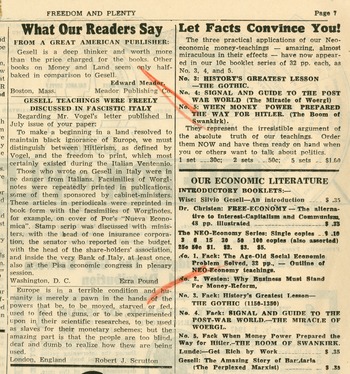
Only a few days earlier the young man had asked the superintendent of Saint Elizabeths about “Ezra Loomis Pounds” and, more specifically, “Mr. Pounds behaviorism in confinement and the nature of his insanity”—information needed for the “anthology of American Poetry” he was compiling, which would include the poet, though “I would hardly call Mr. Pounds an American” (Letter to Winfred Overholser). If in the intervening days the letter writer learned that his idol was “Pound,” not “Pounds,” the oddly formal yet grammatically confounded letter must have raised suspicion. In his next letter, “W. Dallam Simpson” clarified that his offer of help did not “imply violence.” He only wanted to disseminate ideas: “I had definitely sensed the absence of ELP's work from the current market and had, for some time, suspected it to be the work of groups of money lenders” (Letter to Dorothy Pound [26 Jan. 1947]).Footnote 4 The anti-Semitic overtones affiliated the stranger with radical Poundians like fellow Texan Hugo Fack, a social credit reformer and notorious Hitlerite who furnished Simpson with Dorothy's address and whose Freedom and Plenty defended Pound and even printed a signed letter from him in its November 1946 issue (fig. 1).Footnote 5
Ezra Pound, Letter to the editor, Freedom and Plenty, November 1946. Hamilton College Collection.

The young man from Galveston did not give away much about himself, to Pound's consternation (“age? past life??,” Pound wondered on the margins of a letter Simpson addressed to him on 12 September 1947). Simpson's story began David Copperfield style: “I was born, just where, I do not know, the illegitimate son of an English woman and an Irish artist.” Given up for adoption soon after his birth in England in 1926, Simpson was raised in Chicago and Texas. Fellow students at Texas State Teachers College, which he entered when only fourteen, considered him “an oddity and a near genius.” There he edited the student literary magazine and distributed one-page pamphlets on “just what a sham education was in USA” (until the printer began refusing the type). Now working as an office manager in a shipping firm, Simpson cast himself as an eager pupil:
I know I have much to learn. I TRY. Since being out of school, I have been defeated on every turn, due to my youth. People constantly cry “freak” because I have no group. Neither young, neither old. But I continue. I have been building from the time I was, say 12. What? My personal temple. The one that is equipped to shelter, even now, many, if they want it.
(Letter to Ezra Pound and Dorothy Pound [18 Sept. 1947])
The Dickensian life story of Simpson (1926–2002) was rounded off by a stint as a Marine, becoming ordained as a Baptist minister, working for the Dixiecrat Party, championing civil rights in East Texas (his integrated church was burnt down), restarting life as a newspaper deliveryman in Houston, and then founding a fine art and antiques auction house (the Simpson Galleries, today run by Simpson's son and grandson). A book collector who amassed a personal library of 100,000 volumes, Simpson also wrote about fifty books, most of them self-published, many of them for children (Abram).
Simpson's first idea submitted for “ponderance” was to publish selections from Pound's wartime broadcasts (Letter to Dorothy Pound [22 Apr. 1947]). He had earlier surveyed Pound's attorney about this, but Julien Cornell was against publishing broadcasts that he had characterized, in a bail application, no less, as full of “anti-Semitic and vulgar utterances.” Laughlin had also told Dorothy that “if those outbursts of intolerance are publicized I can see no way out of the mess” (Letter to Dorothy Pound). Even Pound, who stood by his broadcasts in private, discouraged their wider dissemination.Footnote 6
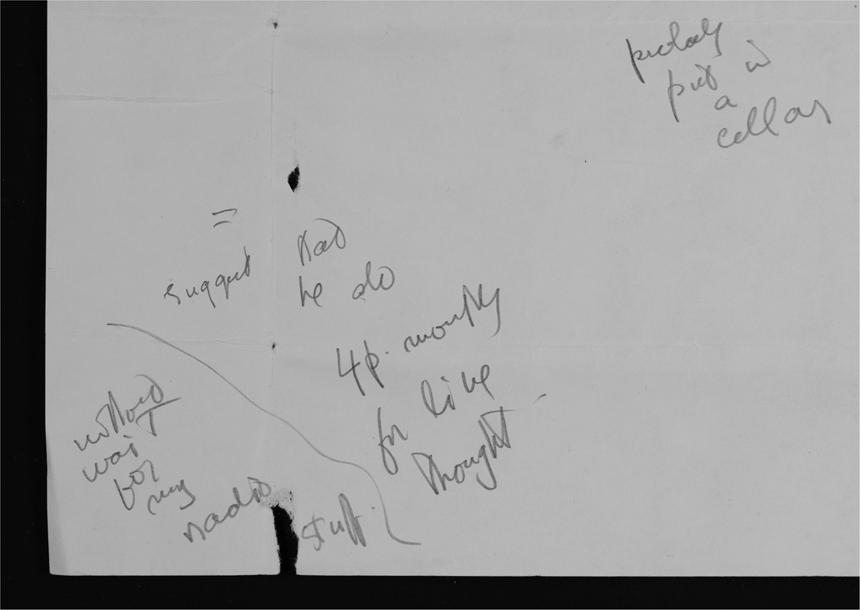
Rather than look back, Simpson should, as Pound scribbled on the margins of a letter, “do 4p. monthly for live thought” (fig. 2). This condensed format recalled the British-Italian Bulletin, a propaganda sheet financed by the Italian Embassy in London that Pound had dubbed “a vital necessity, even if there are only four pages of it” (“Readers”). Dorothy elaborated Ezra's current thinking: “EP is worried always that there is no absolutely no place where the ‘alives’ can get themselves printed—together + without years or years of delays” (Letter to Dallam Simpson [15 May 1947]). If Simpson dreamed of “Live Thought” becoming “like the old L'Esprit Nouveau, or Blast or Poetry when EP was with them” (Letter to Dorothy Pound [17 May 1947]), he did not cast himself as a pioneering modernist editor. He could “be of use,” he detailed, in “copy work—proof reading—correcting … compiling, arranging, editing, etc. Can furnish filing space … + keep basic records” (Letter to Ezra Pound and Dorothy Pound [16 Aug. 1947]).Footnote 7
Marginalia by Ezra Pound, in Letter from Dallam Simpson to Dorothy Pound, 22 April 1947. Lilly Library, Indiana University.

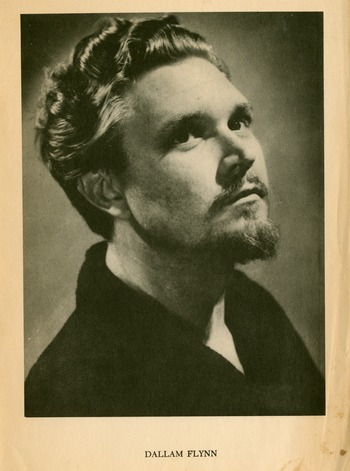
While busy soliciting cost estimates from printers and acquiring twenty-two reams of paper, Simpson had little idea what should go into the planned monthly. His own stuff hardly promised literary bounty: “Pieces et de morceaux” was an unpublished verse volume whose French title was grammatically wrong, misspelled, and a term of disparagement; “Phonetics” took on “the International Phonetic Society, or whatever they call themselves”; “Chi Chi” was a Greek alphabet-soup title for an “unprinted—overlooked—early volume”; and the 25,000-word “Institutional Economics” was, he conceded, “overly written” (Letter to Ezra Pound and Dorothy Pound [20 May 1947]). The chapbook Prooima (1951), later published pseudonymously under “Dallam Flynn,” contained six poems that imitate the subject matter, tone, and form of “il maestro E.P.” The full-page photographic portrait of the author was a spitting image of Pound (fig. 3).Footnote 8 Although lacking much in the way of originality, experience, and literary flair, Simpson had one trump card: “unlimited time” to further Pound's cause (Letter to Ezra Pound and Dorothy Pound [16 Aug. 1947]).
Dallam Flynn, Prooima, Cleaners’ Press, 1951. Hamilton College Collection.

[II]
When Dorothy finally sent Ezra's vision for the review to Simpson, she prefaced it with the following:
Please do not let anybody see this typescript.—as it has EP's handwriting on it—better not let anyone see his mind is working even to that extent. Would you be willing to act as Editor? And do you agree to the ideas + names - + have you any further to suggest?
And chiefly that EP's name (+ mine) is to be kept quite out of the whole affair. Believe me, this is wiser: I can't write all the explanations for this … I do hope his stock is going up a trifle—but very slowly, and we particularly don't want his name connected at present anywhere—with the Chandler, Best cases, etc. etc. (Letter to Dallam Simpson [22 Aug. 1947])
There were, as intimated by the mention of the recent trials of Douglas Chandler and Robert Best for radio treason, legal and political reasons to conceal Pound's participation. Openly taking credit for new writing would raise suspicions at the Department of Justice, risking a trial for treason.Footnote 9 The nascent conflict with the Soviet Union had resulted in widespread paranoia about spies and treason. Even if Pound was firmly on the political right—his propaganda had been anti-communist, and he admired McCarthy—he was symbolically associated with betrayal when loyalty oaths were the order of the day. In this political climate Pound believed that “the ONLY way to get calm perusal” was to write anonymously (Letter to Denis Goacher [19 Feb. 1953]). Of the possible motivations to write anonymously—“an aristocratic or a gendered reticence, religious self-effacement, anxiety over public exposure, fear of prosecution, hope of an unprejudiced reception, and the desire to deceive” (Griffin 7)—wartime and then postwar Pound checked multiple boxes.
With that caveat about anonymity in place, Dorothy transmitted Ezra's vision:
PRELIMINARY monthly statement.
Wd. S., be “editor[”] stating need of a 32 page 4 pages monthly.
on program. That Wyndham Lewis, Eliot, Cocteau, persons in charge of E.P.'s ms/ W.C. Williams, e. e. cummings shd/ have 2 pages a month each at their disposal (not to say thy wd/ always use it)
and to collaborate with SanFrancisco and N. York groups, possibly
composed of Berkeley group: Robt Duncan, Everson, Fredman, Neil, Fabelli, Obric Spicer
N.Y. Finlay, Moore, MacLow, OHair ////
4 pages strictly LITERARY, but aware that ideas exist, even if economic.
Private program, not necessarily DECLARED, but operant. (Letter to Dallam Simpson [22 Aug. 1947])
It is difficult to envision a coherent “program” arising out of church-and-crown conservatism (Eliot), reactionary anarchism (Wyndham Lewis), and democratic Americana (Williams). The harsh essay that Williams wrote on Eliot for the second issue of Four Pages (with its tongue-in-cheek opening line, “That Mr. T. S. Eliot is an idiot I see no reason to insist” [1]) debunked the notion that this group could settle on a coherent “private program.”
The open-ended quotation mark before “editor” made clear that this was a nominal role, which Simpson accepted: “I hope to receive a name for the pub. from you soon, with directions for recurring material” (Simpson, Letter to Ezra Pound and Dorothy Pound [2 Sept. 1947]). As Pound's literary front and receptacle, Simpson received instructions, addresses of people to contact, even drafts of letters to sign and post (Pound-drafted, Simpson-signed letters were sent to Eliot, E. E. Cummings, Marianne Moore, and even Olga Rudge). To avoid alerting the hospital, Dorothy asked that all incoming mail be forwarded to her. It would have been much easier for Simpson to move to DC so he could visit every afternoon from 1:00 to 4:00 p.m., as Pound had asked, but since he was unable to do that just yet, everything went through the post. Simpson was told to prepare the first three issues: “Numbers 1, 2, +3, must be right, + must indicate base of agreement between WDS + EP – not so coloured by EP as to be incredible. EP wants your view. his he has sent” (Dorothy Pound, Letter to Dallam Simpson [11 Sept. 1947]).Footnote 10 Having mainly busied himself with envelopes, paper, and printers, Simpson rushed to compose a “position”:
I am a very sincere person..I am sincere to my friends, to my enemies and to MYSELF. It escapes me how any save the sincere can hv thoughts worth printing, here then … I present a pre-requisite. … I am not concerned with editing a paper. I am deeply interested in editing some sheet, leaflet, etc. that contains the SINCERE works of the few who hv “some place to go and are headed in that direction … I demand only one thing. (sincere ideas from sincere people). I care not a damn what the ideas are about. Just so they are ideas. (Letter to Ezra Pound and Dorothy Pound [12 Sept. 1947])
Accomplishing little save for showing that sincerity could be a muddle, Dorothy responded, “EP wants to see the whole text of the first 3 issues. After that he wants only to control ½ of page 3 + leave the rest to you” (Letter to Dallam Simpson [20 Sept. 1947]). As her next letter clarified, “EP certainly means to give you plenty of liberty to express yourself, especially after the first three issues. Idea is that you should use his experience—He doesn't want to control you” (Letter to Dallam Simpson [25 Sept. 1947]).
Simpson, though, wanted just that: “I am young. I am ignorant. I am not proud of the BA I possess. … any directions, instructions, suggestions, any control, thought needed by you, is to forever, be welcome, and useful” (Letter to Ezra Pound and Dorothy Pound [27 Sept. 1947]). Pound obliged, Simpson thanked: “3 great letters from you today … Gracias. Much to go on … with your form and outline for 1.2.&3” (Simpson, Letter to Ezra Pound and Dorothy Pound [2–3 Oct. 1947]). Simpson later marveled, “I was looking thru file in some hopes of locating necessary article to complete issue 3, when I ran upon ‘general sketch’ of first FOUR issues, drawn up by you, at time of original proposal. What went into number one, what is going into 2, what is in 3 maquette … and Chilanti for 4, all exactly as you had planned it even then” (Letter to Ezra Pound [Dec. 1947]). Despite being under psychiatric lock and key 1,400 miles away, Pound was “the man in the saddle … what you say goes in FOUR PAGES” (Simpson, Letter to Ezra Pound [May 1948]). Simpson waited for Pound's corrections before publication and followed his production timetable: “EP spent nearly all this afternoon on No. 3. He says, No. 4 to press at once—to be out by 30th March—No. 5 to be out by say Ap. 25” (Dorothy Pound, Letter to Dallam Simpson [11 Mar. 1948]). The $25 printing cost for each number was paid by Pound, who now had access to his American bank holdings (until May 1947 the Treasury Department had frozen his accounts).Footnote 11
Although Simpson wanted nothing more than “to devote four pages per month to the exculpation of EP” (Simpson, Letter to Ezra Pound and Dorothy Pound [13 Sept. 1947]), Dorothy explained that “EP doesn't want anything by himself in the first 3. issues. About him, with discretion” (Letter to Dallam Simpson [20 Sept. 1947]). As Ezra Pound put it, “We need LITERARY camouflage to cover main aims” (Letter to Dallam Simpson [early 1948]). This camouflage had two aspects. Seemingly “literary” matter would function as “hooks or lubrications, aimed at getting TO more people” (Letter to Dallam Simpson [box 9, folder 3]) and smuggle in political and economic ideas. The second aspect was hiding the journal's main source and ulterior objectives. True to that aim, half of the items in the American numbers were anonymous, pseudonymous, or unsigned. To use a military term then in vogue, Four Pages was black propaganda.
[III]
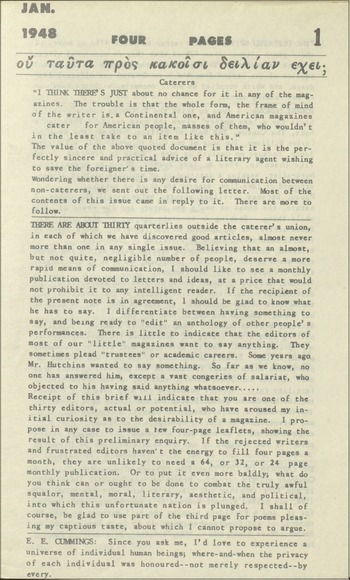
Launched in January 1948 (fig. 4), Four Pages ran for fifteen issues. The first nine issues, until publication was suspended in September, came out of Galveston, and then, from spring 1950 to January 1951, six British-based numbers were released. For the American series, one thousand copies of each issue were printed and sold at two cents per copy. Some contributors were paid, but the low sale price and zero advertising negated the review's financial viability.Footnote 12 Four Pages's contributors included Williams, Cummings, Robert Duncan (Berkeley poet), Ronald Duncan (librettist for Benjamin Britten's Rape of Lucretia), Rolf Fjelde (future Henrik Ibsen translator), Jackson Mac Low, W. S. Merwin, and D. S. Carne-Ross (future Greek scholar). It published poetry by J. P. Angold, Basil Bunting, Jean Cocteau, Marianne Moore, and Kitasono Katue, the Japanese poet who later illustrated the first four covers of Black Mountain Review. The Galveston-based numbers were strikingly international—“YES, GALVESTON IS A seaport town. Ships calls here. Men acquainted with several foreign tongues drift into this town and office,” a note in one issue reads (Note)—with poetry in Italian and French, notices in German, translations from Japanese and Chinese, and a translation, possibly by Pound (Stock 544), of an Italian short story. The geographic spread of letter writers ranged from California to Kansas to the Hudson Valley and took in Britain, Italy, Iran (an unattributed descriptive piece on Persepolis lifted from a letter Bunting wrote to the Pounds), and Norway.
Four Pages, no. 1, Jan. 1948, p. 1. Harry Ransom Center, University of Texas, Austin.

The review's epigram—οὐ ταῦτα πρὸς κακοῖσι δɛιλίαν ɛχɛι—was a wry comment on the times: “Need we add cowardice to all the rest of this filth?” is how Pound rendered it when translating Sophocles's Elektra a year later (Reid 20).Footnote 13 The choice of foregrounding Elektra, with its theme of postwar revenge, was not happenstance, and this particular line, which Pound thought the play's “key phrase” (Reid xiv), speaks to the necessity of action in the face of apathy and forgetfulness (Elektra asks this question of her sister Chrysothemis, who is tempted to forgive the death of their father). The epigram nonetheless contained an error (its last word should be ἔχɛι), hardly an auspicious start for a review lambasting the mindless ignorance of the present.
Four Pages announced itself as “a monthly publication devoted to letters and ideas, at a price that would not prohibit it to any intelligent reader” (Article [no. 1]). Its guiding principles were seemingly left up to contributors:
Receipt of this brief will indicate that you are one of the thirty editors, actual or potential, who have aroused my initial curiosity as to the desirability of a magazine. I propose in any case to issue a few four-page leaflets, showing the result of this preliminary enquiry. If the rejected writers and frustrated editors haven't the energy to fill four pages a month, they are unlikely to need a 64, or 32, or 24 page monthly publication.
The postmodern irony of founding a new review by surveying other editors (including “potential” ones!) on the desirability of doing so, and then printing their replies as the review proper, contrasted sharply with the pointed sense of American decadence that followed: “Or to put it even more baldly; what do you think can or ought to be done to combat the truly awful squalor, mental, moral, literary, aesthetic, and political, into which this unfortunate nation is plunged. I shall of course, be glad to use part of the third page for poems pleasing my captious taste, about which I cannot propose to argue.” The poem pleasing that “captious” taste was “Sheep,” signed L. C. Flynn, yet another pseudonym for Simpson:
A serious contender in a bad poetry contest, this doggerel revealed the ideological underpinning of Four Pages: “what is being thought, as distinct from what is being advertised” (“Directory”). If promising to “inspect and try to arouse interest in all books and periodicals sent to Four Pages, and found worth our notice,” the “periodical formations” (Chambers 2) of Four Pages—the other reviews it sought as allies or kindred spirits, its self-positioning within the literary-periodical field—proved to be muddled. The fellow review that featured most prominently in its American numbers was The Green Mountaineer, an anti–United Nations, anti-Semitic conspiracy-minded sheet put out by Frank A. Parker, self-described author of “over 2,000 pages of pamphlets non-profitly distributed for over 25 years of facts and figures.”Footnote 14 The other review touted as an ally was Retort, a leftist anarchist journal that published Poundians like Bunting, Marshall McLuhan, and Peter Russell and later issued a book of prison writing (with an introduction by Christopher Isherwood) on paper provided by New Directions.
While Four Pages proclaimed itself an exponent of Silvio Gesell's social credit economics and Confucius's teachings, its politics tended to the reactionary paranoid: “There are two systems of government: government by law and government by corruption” (Article [no. 3]). If that unattributed line was a subtle barb about Pound's legal troubles, the political targets within Four Pages were often obscure, like the 1948 Sugar Act, brought to the review's attention by Parker. The list of pressing social and political problems in the June 1948 issue (“Directory”) included “food-production” (referring to an earlier article about the Japanese “kadzu” [kudzu] seed), “mass-poisoning by chemicals” (a nod to Pound's obsession with fluoridated water), “the functioning of government machinery” (bureaucracy and its evils, that old canard), and “the infamies and perversions of international trade in guns and money” (or some classic anti-Semitic dog-whistling).
The most important contribution of Four Pages, and one singularly indebted to Pound, was a manifesto in its March 1948 issue:
CLEANERS
THE LAST EFFECTIVE POET'S manifesto was issued in 1912. We believe that it is now time for another one, impersonal, but suited to our generation. The first component is taken from John Rowan's letter (FOUR PAGES No. 1), the second has been revised after Frank Moore's objection to the vagueness of the terms in our letter of enquiry. The third point, if not Pound's, is certainly one, anybody might come to, after digesting Make It New, Guide to Kulchur, or his last work on Confucius.
Manifest
1. We must understand what is really happening.
2. If the verse-makers of our time, are to improve on their immediate precursors, we must be vitally aware of the duration of syllables, of melodic coherence, and of the tone leading of vowels.
3. The function of poetry is to debunk by lucidity.
We, the CLEANERS, D. Simpson
L. C. Flynn
Igon Tan
(Simpson et al.)
Pound had sent Simpson a draft of the manifesto under the title “Reading and Rioting” and asked his erstwhile literary front to drum up signatories. Simpson managed to sign up himself and two of his pseudonyms. If Pound thought that putting across the ideas in “third person instead of first” “gets round all question of attribution” (Letter to Dallam Simpson [late 1947]), the allusions to Imagism (1912, the three-point program) and the convoluted statement about the origins of the third point made all this a transparently Poundian undertaking.
The manifesto was a distillation of Pound's poetic practice; point 3, Pound noted, “has taken EP thirty or MORE years to find … by slow growth” (Letter to Dallam Simpson [late 1947]). If the original Imagist Manifesto tended to result in privileging “a radical splitting off of private sensibility from concerns for public welfare,” as Charles Altieri has noted (7), here the concerns with public engagement dominate, to the point that some individuals asked to sign it demurred because they read it as calling for “ding-an-sich propaganda” (Rainer, Letter to Ezra Pound). The call to “debunk by lucidity” failed to find its target—“NO echo was raised + the Manifesto passed into silence” (Ezra Pound, Letter to Noel Stock)—despite the fact that Pound had it reprinted in Strike and lobbied Shenandoah to republish it. The manifesto falls flat in many respects, doing little to rejuvenate or reinvent Imagist principles. Points 1 and 3 were gnostic in their combination of impenetrability and tautology, while the proliferation of commas in point 2 underscored how artificial rhythm, meter, and sound could become when exercised in such a fashion. Even Pound's most faithful followers dismissed the manifesto and Four Pages as an over-the-top imitation of the master—especially when they got letters from Simpson that seemed like straight parody (in fairness, they probably were written by Pound).
[IV]
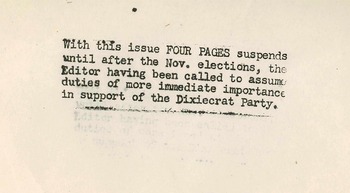
If the political discussion in Four Pages was confused, it was real-life politics that ended the Galveston numbers, as an insert in the September 1948 number announced (fig. 5): “With this issue FOUR PAGES suspends until after the Nov. elections, the Editor having been called to assume duties of more immediate importance in support of the Dixiecrat Party.” Having come to see “the past ten or so months as a wasted effort” (Simpson, Letter to Ezra Pound [1948]), Simpson looked forward to furthering Pound's cause by pushing social credit onto the Dixiecrat platform (that did not happen).
Insert, Four Pages, no. 9, Sept. 1948. Harry Ransom Center, University of Texas, Austin.

While losing the primary venue for his political and social ideas, Pound was spared the continual headaches of Simpson's bungling editorial work. Slow to assemble and correct proofs, Simpson had to be told multiple times what to do with a particular item. When an issue was finally printed, unposted copies would colonize the kitchen table. Worst of all, he was eager to reveal Pound's involvement. “He will be greatly surprised when he learns the facts re 4 PP,” Simpson said of Williams: “Do you think he shd be told NOW?” (Letter to Ezra Pound and Dorothy Pound [Jan. 1948]). After changing printers, Simpson wondered if the new one could be brought “into RANGE” (Simpson, Letter to Ezra Pound [10 Feb. 1948]). He even solicited a canto—“NOW I realise that I am somewhat OUT of position asking you for material to go into YOUR magazine” (Simpson, Letter to Ezra Pound [1948])—which hardly fit the bill of “literary camouflage.” At any moment Simpson could crack:
Today I was complimented (local) on an article (unsigned, ergo assumed to be written by me) that, of course, I did not write. I CANNOT allow this. What is to be done? … I cannot let people (anybody with eyes, and an even impaired sense of smell) think that I have written the things, that you turn out. They are from a LIVING BRAIN … mine is d e a d … GOT to start planning how we can tell ’em … . that you were the brain behind four pages … NOT simpson. He wouldn't have the sense to put together ½ a broadsheet … if he lived to be 1008. (Simpson, Letter to Ezra Pound and Dorothy Pound [1948])
These requests to include Pound more openly in Four Pages or expose him as its source risked undermining the review and, more worryingly, could reopen the psychiatric assessment and lead to a criminal trial for treason.
Having gotten Simpson to concentrate on Bunting's Poems: 1950 (which came out in a Cleaners’ Press edition riddled with errors since Bunting, in Iran, could not correct unsent proofs), Pound sounded out his British contacts about resuming Four Pages. The most promising target was Peter Russell, the editor of NINE who had once mentioned starting a British version for the benefit of the Ezra Pound Circle, a monthly reading group that met in a London pub (Russell, Letter to Ezra Pound). After Russell refused, Pound turned to his social credit circle and found a taker in Henry Swabey, an “obscure country vicar” (Swabey, Letter to Dorothy Pound) raising goats, chickens, pigs, and two small children on an Essex farm while writing “Usury and the Church of England,” parts of which came to be published through Pound's intercession in Edge. Most of the work, though, was done by Raymond Hughes, a budding playwright originally from Northern Ireland then living in South Wales. He had gumption, as his first letter to Pound revealed: “You don't know Hughes. This is Hughes. Hughes speaking” (Letter to Ezra Pound [10 Oct. 1949]). In a few months Hughes went from being an unknown to tasked with reviving Four Pages. Like Simpson before him, Hughes was happy to do Pound's bidding, wanting nothing more than to “serv[e] my apprenticeship well and faithfully” (Hughes, Letter to Ezra Pound [18 Nov. 1950]).
On top of a young “editor” passing on drafts, forwarding correspondence, and awaiting “sanction” before going to press (Hughes, Letter to Henry Swabey), Pound controlled the relaunched Four Pages through the purse. He subsidized the printing and postage costs (at a little over five pounds per issue) and even sent Hughes money to purchase a typewriter. By early January 1951, though, Hughes was irate that no funds had arrived for months: “I cannot carry on; I cannot even afford to distribute the current issue to anyone” (Letter to Ezra Pound [14 Jan. 1951]). All was forgotten when the Pounds stumped up, with Hughes pressing for the review to come out every two weeks.
Because Pound was fully fronting Four Pages, he was able to dictate a major change: the British numbers would be subscription-only, “a communication only to its paid subscribers … and to active correspondents” (Swabey, Article). Pound's decision to limit distribution to subscribers (see Swabey, Letter to Ezra Pound) was driven by his desire to tighten the communications circuit of a small group sympathetic to his political and economic ideas. A small “circle or group,” Pound later observed, “COULD, and in happier climate WOULD circumvolve the disparate elemuntz and get something DONE” (Letter to Ingrid Davies [15 Jan. 1955]).Footnote 15 For Four Pages, subscribers were encouraged to pass on the review to others, who in turn could be put on the circulation list if they sent in “real information” (Hughes, Letter to unidentified recipient). This made Four Pages even more a coterie journal, as Taylor defines the term, with its audience restricted and its legibility reduced (36). One clear impact of this change was that letters from its limited readership came to account for nearly thirty-five percent of the published items in the British numbers (compared to fifteen percent in the American series).
If anonymity remained a guiding principle—“4.P. will not appear tied to E.P.” (Hughes, Letter to Ezra Pound [4 Oct. 1950]), “EP stuff will now be cut to abs. minimum as ordered” (Hughes, Letter to Ezra Pound [18 Nov. 1950])—there were mishaps. The identity of “E” in the following line was hardly mysterious: “The problem is not Who wrote the ‘Protocols,’ but whether a given individual is for or against the policy advocated by them—E” (“Programme—Comments”). Anonymity was difficult, Hughes explained, when most subscribers “would not even bother reading my letters if it were not for the promise of occasional gossip from me re EP” (Hughes, Letter to Ezra Pound [18 Nov. 1950]). One faithful reader out of Oxford even suggested that the review change its name to “E. P. News Letter” (Gilling-Smith). That was exactly what Pound wanted to avoid, but the reality was that operating in a closed network diminished the need for anonymity. While about half the items in the American numbers were anonymous, pseudonymous, or unsigned, that figure went down to around one third for the British series.
Limiting itself to existing subscribers and expanding only through personal networks, the British numbers of Four Pages were even staler than the Galveston ones. Its six issues contained no poetry or prose fiction, which had filled about twenty-five percent of the total pages in the American series. Design-wise, the first relaunched number came out in oversized mimeographed sheets, leading Simpson to exclaim, “Great balls of fire!!!! … I have just seen the NEW 4pp. … 10 ft long and fully 6 wide. … My gawd you'll blow the roof orf that architectural atrocity, when you see it” (Letter to Ezra Pound and Dorothy Pound [1950]). The British numbers afterward copied the Galveston layout, the only small twist being the introduction of a system of numbering items “so that assents, negations and queries can readily be referred to their proper subjects” (Swabey, article). The readers in the closed network now had a self-referential catalog for their echo-chamber missives.
Hughes hoped that the review's arresting feature would be its incendiary content. Every item should “cause an outcry if read by those it exposes” (Hughes, Letter to Max Wykes-Joyce). “We are not afraid to print anything that might be too ‘hot’ on your side of the Atlantic,” Hughes boasted in a letter to Laughlin, who was asked to scout promising copy. But the political program of the relaunched Four Pages was hardly explosive: expanding food production by gifting every family five acres, imposing “a light monthly duty on all money in circulation,” and the idea, first floated by Pound in the late 1930s, that “Parliament should go on the air” (Hughes, “Programme”). The concerns in one typical issue (November 1950) included finding substitutes for soap, denying royal assent to poorly worded legislation, and creating an inland sea in the Congo basin so as to bring to Europe “the entire surplus of natural resources in the African continent” (Hesse 1). Most issues, Hughes admitted, were filled with “third-rate table-talk” (Letter to Max Wykes-Joyce) from Pound associates. Four Pages was “sinking,” one not entirely disinterested observer stated, whereas “under the Dallam's eye and the Maestro's guidance it was a serious sheet” (Simpson, Letter to Ezra Pound and Dorothy Pound [1951]).
With its subscriber-only distribution, irregular financial backing, and overreliance on an increasingly disillusioned Hughes, the British run of Four Pages was unsustainable. Disagreements over money but also larger policy (on two occasions Hughes insisted that propaganda had a very negative connotation in Britain) also contributed to the review's demise. While Pound kept asking for Four Pages to be restarted (see Hughes, Letter to Ezra Pound [18 Mar. 1952]), that only happened seven years later, although under a different name. This came about after a schoolboy sent Pound a copy of the literary magazine he edited. Unaware that the review only circulated in the halls of Westminster School, Pound enthused about its contents and pressed the young editor, William Cookson, to start up a little review that would take on board the principles of Four Pages.Footnote 16 The result was Agenda, a poetry magazine that soon grew too big for its four-page britches; it remains in print today.
[V]
In his 1930 essay “Small Magazines,” Pound noted that “a review is not a human being saving its soul, but a species of food to be eaten” (697). If Pound did not set up Four Pages to save his soul, he did hope it could save his skin: “The STRATEGIC aim,” as he later put it of his various postwar print efforts, “is the kind of publicity that will accelerate Ez’ liberation” (Letter to Denis Goacher [18 May 1954]). In its fifteen issues Four Pages covered a wide field of Poundian obsessions. While there was no shortage of “political radicalism” in its pages, it was radicalism tied to the scores of anti-Semitic, anti-internationalist, anti-communist, conspiracy-laden “news-sheets” and “fact-sheets” Pound received at St. Elizabeths (now filed at Hamilton College under the label “Extremist Press”). No review that published, as Four Pages did on multiple occasions, Henry Elmer Barnes (a Holocaust denier who coined the phrase “historical blackout”), Camilo Pellizzi (the president of the Istituto Nazionale di Cultura Fascista and a key figure in getting Pound on Radio Roma during the war), or the Duke of Bedford (a major benefactor of second-wave fascism in Great Britain), could be unaware of the political signaling involved. There was also a correspondence when it came to visual design. The bare type and lack of ornamentation in Four Pages and other radical right reviews, if driven by financial considerations, also came to signify their presentation of the “naked” truth that “decorative” mainstream outlets suppressed.
In terms of “literary camouflage,” Pound's name appeared several times in Four Pages, usually in reference to reading lists or educational programs. His legal case was never directly discussed, and the British numbers even elided the Bollingen controversy. If it is difficult to attribute to Pound all the numerous anonymous quotes within Four Pages, the review assembled, almost bric-a-brac, through the current reading recommended, the quotations chosen, the subjects covered, the contributors approached, Pound's fundamental ideas:
Pound's involvement was not suspected even by some who prided themselves on being intimately familiar with his thinking, yet the unsubtle parroting of Pound's ideas made Four Pages unreadable even for those who hung on his every word. Ronald Duncan, who founded Townsman in 1937 at Pound's prompting, complained—without any discernible self-reflection about how his own little review featured Pound in almost every single one of its first twenty issues (see R. Parker)—that “[i]t seems to me a pity that ‘Four Pages’ and several other quarterlies should guy your style and imitate to the point of ridicule” (Letter to Ezra Pound [24 June 1948]). Peter Russell also had misgivings about a review that was “a pale shadow of E.P.'s ideas” (Letter to John C. Rowan). A few years later Kenner was probably thinking of Four Pages when he told Pound that his coterie ventures were bound to fail:
No one wants ANOTHER “Little Mag” NOW, because there is no public, public as distinct from stray readers … And the thing is to build up a PUBLIC, which can't be done by “private jokes” … These things convey NOTHING to the uninstructed … Hell is paved with the gravestones of little mags which had no dynamic except proclaiming their own independence & isolation. (Letter to Ezra Pound [28 Nov. 1952])
For all its muted failure, the history of Four Pages shows how institutionalized Pound assembled a transatlantic print network to disseminate his ideas through a model of interventionist anonymous authorship. Although the two young men recruited as black-op amanuenses proved unreliable, Pound devoted significant energy, financial resources, and epistolary ink in getting Four Pages out. This can be explained by his absolute conviction that just as his wartime broadcasting was the act of a patriot, the postwar journals he anonymously spearheaded, starting with Four Pages, fulfilled a civic duty when “[m]y contemporaries in licherchoor” were “sheer sapheads with NO civic sense, iggurunt as ham” (Ezra Pound, Letter to Ingrid Davies [30 July 1955]). The tragedy of the situation was that Pound's contact with the outside world was mediated through a motley band of lost souls and vituperative racists. As Denis Goacher bemoaned, “it was a pity to have to waste time saving E.P. from his more hysterical disciples.” But with his signature lacking any legal standing and fearful that open declarations of his political beliefs would lead to the resuscitation of the treason charge, Pound had little choice but to work through disciples and use anonymity as a cover. The “world form” (Bulson) that had launched his career, the little review, was the most suitable conveyor of those beliefs. In Pound's thinking, civilization could only be saved if a small group of right-thinking people came together to combat the “skunks” who controlled the mainstream press (a skunk being, as he prejudicially defined it, “one who falsifies history, one who falsifies news, one who instead of examining what a man says, rushes out to stir hysteria and howls for a crucifixion” [Letter to Max Wykes-Joyce (22 Apr. 1952)]). The experience of Four Pages was only the start, since Pound guided a number of other disciple little reviews. Each new effort announced itself as a new awakening, a genuine revolution in thought, only to end in disappointment. But it was not for lack of trying on Pound's part.