1. Irish
Modern Irish (henceforth just ‘Irish’) is a Celtic language spoken on a daily basis by as many as 70,000 people in the Republic of Ireland (Walsh Reference Walsh2010). In this article I argue that, despite recent criticisms of optimization-based models of morpho-phonology, a subset of Irish plural allomorphy is best understood as an instance of output-optimizing affix selection. Section 2 outlines the Irish plural system and the proposed analysis. In Section 3 I argue that non-optimizing models of Irish plural allomorphy miss important synchronic and diachronic generalizations about the Irish plural system, and Section 4 concludes.
2. Irish plurals
In Irish, plural nouns are formed with a wide array of suffixal morphology. As a brief illustration, plurality can be expressed by final consonant palatalization (1a), by suffixation of [ə] (1b), and by the simultaneous occurrence of both processes (1c).Footnote [2] Pluralization may also be accompanied by changes in stem vowels, such as syncope (1b, c) (see Hickey Reference Hickey1985a, Reference Hickeyb).

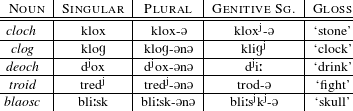
These examples of plural formation constitute only a small subset of the patterns found in Irish. With respect to plural inflection, Ó Siadhail (Reference Ó Siadhail1995) divides Irish nouns into six different major classes, with 26 smaller subclasses. Unfortunately, as noted in Ó Siadhail (Reference Ó Siadhail1991: 159), it is ‘very difficult to predict how the plural of any given noun is formed’ (see also Stenson Reference Stenson1978: 519).Footnote [3] In general, nouns that follow a particular pattern of plural formation cannot be grouped together on the basis of semantic, phonological, or other morphological similarity. To illustrate, consider the nouns given in Table 1.
Some Irish nominal paradigms (Ó Siadhail Reference Ó Siadhail1991, Reference Ó Siadhail1995; Carnie Reference Carnie2008).

As Table 1 suggests, the choice of plural allomorph cannot be predicted from the segmental content of the noun (see also Lazar-Meyn Reference Lazar-Meyn and Ahlqvist1982; Hickey Reference Hickey1985b: 155–159). Although both deoch and cloch end in [ox], the two nouns take different plural suffixes, deoch pluralizing with [-ənə] and cloch with [-ə]. A similar contrast is provided by cloch and clog, which pluralize differently despite being almost segmentally identical.
The morphological incoherence of these plural classes is evident when we consider the system of genitive inflection. Clog, deoch, troid, and blaosc all take the plural suffix [-ənə], but have distinct patterns of inflection in the genitive singular (most nouns lack a distinct genitive plural form). Nor can the plural be predicted from the genitive: the genitive forms of blaosc and cloch are derived in the same way (final palatalization with [-ə] suffixation), but the two nouns take different plural suffixes. Since no semantic properties characterize the class of nouns that pluralize with [-ənə] in Table 1, its membership is apparently an arbitrary fact about the lexicon. Exactly analogous arguments can be produced for other plural formatives in the language. (See Wigger Reference Wigger1973, Stenson Reference Stenson1978, Carnie Reference Carnie2008 for more on the arbitrariness of nominal paradigms in Irish.)
2.1 A subregularity: -(e)anna and -(e)acha
At first glance Irish plural morphology appears to be quite erratic. There are nonetheless certain subregularities in the system. In particular, two plural markers, -(e)anna and -(e)acha, have partially predictable distributions. The plural suffix -(e)anna typically attaches to monosyllabic nouns (2). Transcriptions and generalizations are representative of Achill Irish, a Western (Connacht) dialect of Mayo.Footnote [4] In this dialect the suffix in question is usually realized as -(e)annaí [-ənɪ ]/[-əni ].

Importantly, the distribution of -(e)annaí is not limited to monosyllabic nouns: it also attaches to polysyllabic nouns with final stress (3) (though such forms are not numerous; Section 2.3).Footnote [5]

In contrast, the plural suffix -(e)acha [-axə] normally occurs with polysyllabic nouns ending in an unstressed syllable:Footnote [6]

These two suffixes are therefore in complementary distribution: -(e)annaí [-ənɪ] attaches to nouns bearing final stress, while -(e)acha [-axə] attaches elsewhere.
There are some exceptions to this basic distribution of -(e)annaí and -(e)acha. Specifically, certain monosyllabic nouns take the suffix [-axə], rather than [-ənɪ] (see Hickey Reference Hickey1985b: 158; Ó Siadhail Reference Ó Siadhail1991: 160 for more discussion):

Perhaps unsurprisingly, exceptional forms like (5) are subject to regional variation, and many dialects use regular plural forms like áiteanna(í) instead of irregular forms like áiteacha (Mac An Bhaird Reference Mac An Bhaird1974; Stenson Reference Stenson1978; Ó Siadhail Reference Ó Siadhail1991: 160; Ó Sé Reference Ó Sé2000: 26, etc.).
There is an important asymmetry in these exceptions: examples of irregular suffixation of [-axə] to monosyllables (5) are reasonably common, but forms in which [-ənɪ] exceptionally attaches to polysyllables with non-final stress are essentially non-existent.Footnote [7] Therefore, for both regular and exceptional plural forms, [-ənɪ] has a more narrowly circumscribed distribution than [-axə].
We can thus restate the basic descriptive generalization: barring a set of dialectally unstable lexical exceptions, -(e)annaí [-ənɪ] appears adjacent to stressed syllables, and -(e)acha [-axə] appears elsewhere (Table 2).
Distributions of -(e)annaí [-əni] and -(e)acha [-axə].

Lastly, though not all loanwords display this pattern of plural marking, some recent and semi-recent borrowings demonstrate that these suffixes are still quite productive (Ó Siadhail Reference Ó Siadhail1991: 160):Footnote [8]

The highly productive character of -(e)anna(í) and -(e)acha is also emphasized by Wigger (Reference Wigger1973: 66–67), Mac An Bhaird (Reference Mac An Bhaird1974: 215), Stenson (Reference Stenson1978: 479), Lucas (Reference Lucas1979: 50), Hickey (Reference Hickey1985b), Ó Buachalla (Reference Ó Buachalla1988: 44, 52), and Ó Curnáin (Reference Ó Curnáin2007: 671, 2023).
2.2 -(e)anna and -(e)acha as contextual allomorphs
There are reasons to believe that [-ənə] and [-axə] are in fact allomorphs of a single underlying plural morpheme. For one, -(e)anna and -(e)acha are formally similar, being the only productive [-VCV] plural markers in the language.Footnote
[9]
They are also the only plural suffixes with distributions that are clearly conditioned by stress or syllable count. Most importantly, these two suffixes are in (near-)complementary distribution. This distributional pattern makes sense under the assumption that [-ənə] and [-axə] are simply contextually restricted surface forms of a single underlying plural suffix. For convenience, I will refer to this abstract morpheme as  .Footnote
[10]
Despite the partial resemblance between [-ənə] and [-axə], the contextual allomorphy described here is clearly a case of suppletion. No phonological process exists in Modern Irish that would convert [x] to [n] or vice versa, so alternations between [-ənə] and [-axə] must be treated as suppletive (see also Section 3.2). Since the distribution of these two suffixes is determined by noun stem stress, this subcase of plural marking instantiates prosodically conditioned suppletive allomorphy, or pcsa (Carstairs Reference Carstairs1988, Reference Carstairs, Dressler, Luschützky, Pfeifferand and Rennison1990; Mester Reference Mester1994; Paster Reference Paster2006).
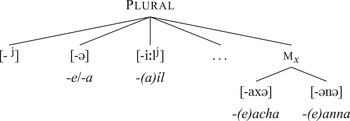
I am thus proposing Figure 1 as the basic structure of plural allomorphy in Irish. A given noun may idiosyncratically appear with a particular suffix, as determined by some selectional relation between the two morphemes. When the suffix in question is  , its actual phonological form is conditioned by phonological properties of the noun it attaches to. While this is a fairly rich morphological structure, the distributional facts support an analysis of plural allomorphy in which -(e)anna and -(e)acha are recognized as a distinguished pair of affixes, set apart from the other plural morphemes in the system (compare with similar ideas in Bonet, Lloret & Mascaró Reference Bonet, Lloret and Mascaró2007, Bonet & Harbour Reference Bonet and Harbour2012).
Partial selectional structure of Irish plural morphology.

Finally, of the two allomorphs [-axə] can be considered the ‘elsewhere’ or ‘default’ variant. As discussed in Section 2.1, the distribution of [-ənə] is sharply restricted: it only attaches to stressed syllables, and there are no lexical exceptions in which [-ənə] attaches to an unstressed syllable. In contrast, [-axə] attaches to unstressed syllables, but also exceptionally attaches to a number of stressed monosyllabic nouns. As [-ənə] has more stringent conditions on its distribution than [-axə] does, I assume that its appearance is triggered by a specific environment, namely post-tonic position.
In the discussion that follows I argue that this instance of Irish plural allomorphy is best analyzed as a case of output optimization (Mester Reference Mester1994; Tranel Reference Tranel1996; Kager Reference Kager and Kleinhenz1996; Mascaró Reference Mascaró, Durand and Laks1996, Reference Mascaró2007, and many others). In particular, I propose that the choice of plural suffix is sensitive to metrical structure: allomorphy avoids marked (
 $\acute{{\it\sigma}}$
H) feet.
2.3 The Irish stress system
Since the distribution of [-ənə] and [-axə] is conditioned by noun stem stress, a brief discussion of the stress system of Irish is in order. An OT formalization is given in Section 2.3.2.
2.3.1 Stress placement and non-iterativity
For most dialects of Modern Irish (those in the Northern and Western groups), stress placement is straightforward: excluding a few lexical exceptions, stress falls on the first syllable of the word (Ó Sé Reference Ó Sé2008 among many others). In these dialects, stress is not conditioned by syllable weight:

Following Doherty (Reference Doherty, Mester and Robbins1991) and Green (Reference Green1997) I take the rigidly initial stress system of Western and Northern dialects to reflect quantity-insensitive trochaic footing at the left edge of the word (e.g. [(ˈkrɑ.ɡər)lɑːn ]).
There is no evidence of secondary stress in most varieties of Irish. One exception is Munster Irish, a full analysis of which lies outside the scope of this paper (but see Sections 2.4.2 and 2.7). The lack of secondary stress suggests that footing is non-iterative in most dialects of Irish – content words contain only a single foot. Since I know of no positive evidence for iterative foot structure in the language (apart from secondary stress in Munster Irish), I will assume non-exhaustive footing without further comment (see Ní Chiosáin Reference Ní Chiosáin, van der Hulst and Ritter1999, Bennett Reference Bennett2012 for evidence supporting this view).
2.3.2 Modeling Irish stress: OT analysis
The initial stress system of Northern and Western Irish can be modeled with four constraints: AllFeetLeft (afl), Trochee, Weight-to-stress (wsp), and Parse(
 ${\it\sigma}$
) (Green Reference Green, Dobrin, Singer and McNair1996, Reference Green1997; see Prince & Smolensky Reference Prince and Smolensky1993/2004; McCarthy & Prince Reference McCarthy and Prince1993; McCarthy Reference McCarthy2003, Reference McCarthy2008a for standard constraint definitions). I assume that headedness(
 ${\it\omega}$
), the constraint requiring every prosodic word
 ${\it\omega}$
to contain at least one foot (its head), is inviolable (i.e. it is part of Gen; Itô & Mester Reference Itô, Mester, Honma, Okazaki, Tabata and Tanaka1992/2003; Selkirk Reference Selkirk, Beckman, Walsh Dickey and Urbanczyk1995, etc.).
To capture the leftward orientation of stress, I take afl to be undominated. The ranking {afl, Trochee}
 $\gg$
wsp (8b, c) ensures that stress placement will be quantity-insensitive, and afl
 $\gg$
Parse(
 ${\it\sigma}$
) (8d) derives non-iterative footing. Although low-ranked, Parse(
 ${\it\sigma}$
) still eliminates candidates with monosyllabic feet (8e).

It should be noted that the winning candidate in (8), [(ˈkɨ.njiː)njiː ], contains an uneven (ˈLH) trochee with a heavy syllable in the weak position of the foot. In many quantity-sensitive languages, feet of this shape are actively avoided (Hammond Reference Hammond1986, Hayes Reference Hayes1995, etc.). In Section 2.5 I will argue that (ˈ
 ${\it\sigma}$
H) feet are indeed avoided in Irish plural allomorphy, despite the general acceptability of (ˈ
 ${\it\sigma}$
H) feet in the language.
While it seems uncontroversial that long vowels and diphthongs should count as heavy (i.e. bimoraic) in Irish, the question of coda weight is more fraught. Word minimality restrictions cannot be used as a diagnostic for coda weight because Irish freely allows monomoraic content words like rath [ˈrɑ ] ‘luck’ and te [ˈtje ] ‘hot’ (Stockman Reference Stockman1974: 38, 65; Green Reference Green1997: 64; Ní Chiosáin Reference Ní Chiosáin, van der Hulst and Ritter1999: 572). In dialects with strict initial stress (7), stress placement simply provides no evidence as to the weight of coda consonants. However, in the quantity-sensitive stress system of Munster Irish (Section 2.4.2), codas are inert for stress assignment (‘only those syllables containing a long vowel or diphthong count as heavy’, Doherty Reference Doherty, Mester and Robbins1991: 19; also Ó Sé Reference Ó Sé1989, Reference Ó Sé2008). This suggests that codas are weightless in Munster Irish; I assume that the same is true for all dialects of the language, given the absence of evidence to the contrary. Nevertheless, in Sections 2.4 and 2.5 I argue that consonants can be moraic in Irish under very specific circumstances, and that consonant weight influences plural allomorph selection.Footnote [11]
2.4 The exceptional status of /ax/
The sequence /ax/, found in the plural suffix -(e)acha /-axə/, behaves as prosodically prominent in both quantity-insensitive and quantity-sensitive dialects of Irish. In Ulster and Achill Irish, unstressed [a] resists vowel reduction when preceding [x] (Section 2.4.1); in Munster Irish, [ax] sequences attract stress (Section 2.4.2). In the following sections, I account for this behavior by arguing that [x] is in fact moraic when occurring in an [ax] string. The prosodic prominence of [ax] sequences becomes important in Section 2.5, where it is proposed that the moraic status of [x] in the plural suffix [-axə] partially conditions Irish plural allomorphy.
2.4.1 Vowel reduction in Ulster and Achill Irish
Unstressed short vowels typically reduce to [ə] in Irish (or to [ɨ]/[ɪ] between palatalized consonants). Short vowel reduction is a fairly old feature of the language, and occurs in all dialects (Thurneysen Reference Thurneysen1946: 29; O’Rahilly Reference O’Rahilly1932: 110; Ó Sé Reference Ó Sé1989, and many others). However, in many Ulster (Northern) dialects of Irish, unstressed [ax] sequences do not undergo reduction to [əx] (Quiggin Reference Quiggin1906: 9; O’Rahilly Reference O’Rahilly1932: Chapter XIV; Ó Sé Reference Ó Sé1989: 167; Ó Dochartaigh Reference Ó Dochartaigh1987: Chapter 4; Ó Siadhail Reference Ó Siadhail1991: 33, etc.). The same pattern of (non-)reduction occurs in Achill Irish (9).

Strings of the form /ax/ thus pattern with long vowels in resisting vowel centralization in unstressed positions. The implication is that /ax/ sequences are more phonologically prominent than other /aC/ or /Vx/ strings.
This interpretation of (9) is challenged by apparent instances of unstressed [a] in other phonetic contexts. It has been claimed that the long vowels  are realized as short [a] when unstressed in Ulster Irish, e.g luchóg [ˈlu.haɡ ] ‘mouse’ (Ó Siadhail Reference Ó Siadhail1991: 80) and amhráin [ˈo.ɾan ] ‘song’ (Ní Chasaide Reference Ní Chasaide1995). Such examples might suggest that unstressed short [a] is actually permitted in these dialects. If so, these derived instances of unstressed [a] would undermine the claim that words like (9a–e) lack reduction because of the inherent prominence of [ax] strings.
While the Ulster 
 $\rightarrow$
[a] merger is often portrayed as a categorical neutralization (e.g. Quiggin Reference Quiggin1906: 5–17), there is in fact phonetic evidence for a surface distinction between
 . Descriptive sources for West Ulster Irish often transcribe unstressed
 as long
 or half-long [a˙] (Wagner Reference Wagner1959: 88–91; Sommerfelt Reference Sommerfelt1922: 122–123; Wagner Reference Wagner1969; Ó Dochartaigh Reference Ó Dochartaigh1987: Chs. 2, 4).Footnote
[12]
For Achill Irish (9) the shortening of unstressed
 actually depends on phrasal position, giving rise to overt alternations like coileán

 ${\sim}$
[ˈkɨ.ljɑn ] ‘pup’ (Stockman Reference Stockman1974: 310). The sequence [ax], in contrast, is consistently transcribed with a short [a] (Stockman Reference Stockman1974: 307–308; Ó Dochartaigh Reference Ó Dochartaigh1987: Chapter 4).
The punchline is that the merger of unstressed  and /a/ may be only partial, such that the underlying vowels are still distinguishable on the surface despite some degree of overlap in their phonetic realizations. This is especially true for unstressed
 , which encompasses not just [a(ː)] but also mid-back realizations like [o ɔ]. Assuming that these phonetic differences are indicative of a surface phonological distinction between the vowels in question (e.g. Benus & Gafos Reference Benus and Gafos2007), these findings are consistent with the view that West Ulster and Achill Irish have a phonological prohibition against unstressed short [a] except in the context of a following [x].
To summarize, in West Ulster and Achill Irish [ax] strings are exempt from an otherwise general process of short vowel reduction in unstressed syllables. This resistance to reduction suggests that [ax] sequences are prosodically more prominent than other [aC] or [Vx] sequences in these dialects (e.g. Green Reference Green, Dobrin, Singer and McNair1996, Reference Green1997). The facts are different in East Ulster Irish: here, long  seem to fully reduce to short [a] when unstressed, and unstressed /ax/ further reduces to [əx] (Ó Dochartaigh Reference Ó Dochartaigh1987).Footnote
[13]
I postpone further discussion of East Ulster varieties until Section 2.7.1.
2.4.2 Munster Irish stress
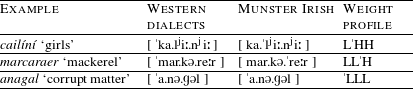
Further evidence for the prosodic prominence of [ax] strings can be gleaned by examining the stress patterns of Munster Irish, a dialect group located in southern Ireland. Like Irish more generally, Munster Irish has default word-initial primary stress. However, Munster Irish differs from most dialects in that the stress system is quantity-sensitive (Table 3). The basic descriptive generalization is that primary stress falls on the leftmost syllable containing a long vowel or diphthong within an initial three-syllable window, otherwise on the first syllable.Footnote [14]
As mentioned in Section 2.3.2, coda consonants do not generally contribute to syllable weight in Munster Irish. There is, however, one exception: in the absence of long vowels, primary stress will fall on a  syllable in second position.
Quantity sensitivity in Munster Irish (Ó Siadhail Reference Ó Siadhail1991: 129–130; Doherty Reference Doherty, Mester and Robbins1991: 20–21).


The stress-attracting character of [ax] is supported by synchronic alternations like nead [ˈnjad ]
 ${\sim}$
neadacha [njɪˈdaxə ] ‘nest(s)’ and cheannaigh [ˈxjaniɡj ] ‘(s)he bought’
 ${\sim}$
ceannach [kjəˈnax ] ‘buying’ (Ó Cuív Reference Ó Cuív1944: 77, 105; Ó Sé Reference Ó Sé2000: 89, 104).Footnote
[15]
The Munster Irish stress system thus relies on the ternary weight distinction {  (Doherty Reference Doherty, Mester and Robbins1991, Green Reference Green, Dobrin, Singer and McNair1996, and references there). Only the combination of [a] and [x] draws stress rightward; other [aC] and [Vx] strings do not attract stress. The special prominence of [ax] sequences must therefore be due to the joint influence of [a] and [x] in contact.Footnote
[16]
There is thus convergent evidence that [ax] strings are more phonologically prominent than corresponding [aC] or [Vx] strings in Irish. What remains to be explained is why [ax] shows this unusual constellation of properties. In the next section, I argue that the sequence [ax] is phonologically prominent in Irish because [x] bears an independent mora when following [a].
2.4.3 Syllabification
Besides the stress-attracting properties of [ax] in Munster Irish, and its resistance to reduction in West Ulster and Achill Irish, Doherty (Reference Doherty, Mester and Robbins1991) claims that [ax] also behaves exceptionally with regard to syllabification: in a surface [axV] string, intervocalic [x] is parsed into the same syllable as the preceding [a].Footnote [17]

Strong evidence for backwards syllabification of [x] with [a] comes from the observation that [ax] sequences attract stress in Munster Irish even when followed by a vowel, as in oideachas [ə.ˈdjax.əs ] ‘education’ (Hickey Reference Hickey2011: 312). Under the generally accepted view that stress is a property of syllables (Liberman & Prince Reference Liberman and Prince1977, Hayes Reference Hayes1995, etc.), it would be deeply surprising to find that hypothetical onset [x] in an [a.xV] string was responsible for attracting stress to a preceding heterosyllabic [a]. Given that onset consonants do not usually contribute to syllable weight – much less to the weight of the preceding syllable – such a pattern would be all the more striking. As hypothesized in Doherty (Reference Doherty, Mester and Robbins1991: 28n), these observations imply that [x], under some narrowly circumscribed conditions, counts as a moraic coda consonant in Irish (see also Noyer Reference Noyer1990). (I will return to the question of why [x] bears a mora specifically when preceded by [a].)
The additional fact that unstressed [ax] resists centralization in Ulster Irish (9) can be captured under the assumption that vowel reduction only targets monomoraic syllables in these dialects. If [ax] strings always form a bimoraic rhyme  , it then correctly follows that they should be exempt from reduction, just like long vowels. This is so even when the [x] is intervocalic


I conclude that there is credible evidence that intervocalic [x] in an [axV] string is moraic and tautosyllabic with the preceding [a]. All subsequent transcriptions will reflect this syllabification.
Doherty’s (Reference Doherty, Mester and Robbins1991) claim is not as radical as it perhaps seems: there is good empirical evidence for backward syllabification both in Irish and in other languages. Impressionistic and experimental studies of Irish are in rough agreement that intervocalic consonants are parsed as codas when following a stressed short vowel, [ˈCVC.V ] (see Green Reference Green1997; Dalton & Ní Chasaide Reference Dalton and Ní Chasaide2005, Reference Dalton, Ní Chasaide, Gussenhoven and Riad2007; Ní Chiosáin, Welby & Espesser Reference Ní Chiosáin, Welby and Espesser2012 on Irish; Clements Reference Clements, Bogers, van der Hulst and Mous1986; Ladefoged, Ladefoged, Turk, Hind & Skilton Reference Ladefoged, Ladefoged, Turk, Hind and Skilton1998 on Scottish Gaelic and Cohn & McCarthy Reference Cohn and McCarthy1998: Section 3; Bennett Reference Bennett2012: 221–222 for cases outside Celtic). I conclude that backwards syllabification, though typologically rare, is nonetheless attested and therefore plausible in the case of [ax.V] strings (especially when stressed [ˈax.V]). Bennett (Reference Bennett2012: 216–222) provides some additional arguments that backward syllabification might be especially favored for intervocalic [x] in Irish; those arguments are omitted here for reasons of space.
Still unexplained is why [a], but no other vowel, behaves as prosodically prominent when preceding [x]. There is good reason to believe that this is a non-accidental fact. In particular, I would suggest that Irish [x] is phonologically a glide-like counterpart of [a]. If this is correct, then [ax] sequences are quasi-diphthongal – a structural analysis that explains why [ax] strings pattern with true diphthongs for stress attraction in Munster Irish and vowel reduction in Ulster Irish.
I have in mind here a parallel between the behavior of [ax] rhymes and the distribution of post-vocalic [ɹ] in various varieties of English. In dialects of English with ‘intrusive r’, the approximant [ɹ] is inserted in hiatus environments whenever the first vowel is one of [a ɔ ə] (e.g. McCarthy Reference McCarthy1993 and references therein).

Several authors have pointed out that intrusive [ɹ] is the glide counterpart of the non-high back vowels [a ɔ ə] – precisely those vowels that license its appearance (Kahn Reference Kahn1976, Gick Reference Gick1999, Baković Reference Baković1999, Itô & Mester Reference Itô, Mester, Grijzenhout and Kabak2009). This observation has led many of those same authors to propose that intrusive [ɹ] is not epenthetic in a strict sense, but rather represents the breaking of a vowel in hiatus into a vowel–glide–vowel sequence. The choice of [ɹ] as the intrusive segment then follows from the fact that [ɹ] is roughly homorganic with [a ɔ ə], the vowels that provide its source.
The proposed analogy is this: the glide counterpart of [a] is [ɹ] in English, but [x] in Irish.Footnote [18] Evidence for this view comes from the featural composition of [a] and [x]. Under standard feature theories these two segments share at least some place features, most notably [dorsal] and [+back] (e.g. Sagey Reference Sagey1986). Furthermore, some dialects of Irish realize velarized /x/ as the uvular fricative [χ] (e.g. Sommerfelt Reference Sommerfelt1922: 72; Breatnach Reference Breatnach1947: 40–41; Ó Curnáin Reference Ó Curnáin2007: 171, 408–414; Bennett, McGuire, Ní Chiosáin & Padgett Reference Bennett, McGuire, Ní Chiosáin and Padgett2012, and fn. 6). It is therefore plausible that Irish /x/ shares the feature [-high] with /a/ as well. There is a real sense, then, in which [x] and [a] are phonologically homorganic.
For concreteness, I offer the following proposal. I assume that there is a weak bias against onset [x] in Irish, as suggested by the fact that word-initial [x] is always morphologically derived, never underlying (Ní Chiosáin Reference Ní Chiosáin, van der Hulst and Ritter1999; see Bennett Reference Bennett2012: 216–222 for details). This bias can be encoded as a violable markedness constraint, *Onset/[x] (Smith Reference Smith, Edwards, Midtlyng, Sprague and Stensrud2008, Flack Reference Flack2009). Second, I assume that *Diphthong penalizes any complex nucleus  in which V and
 ${\it\beta}$
have differing dorsal specifications (Casali Reference Casali1996, Rosenthall Reference Rosenthall1997). Importantly,
 nuclei do not violate this constraint: [a] and [x] are phonologically homorganic, sharing at least the features [dorsal,+back]. (As [high] and [low] are not contrastive for dorsal consonants in Irish, I remain agnostic regarding the specification of these features on [x]; see McCarthy Reference McCarthy and Keating1994; Dresher Reference Dresher2009; Backley Reference Backley2011: Section 3.6.)
In general, the markedness of onset [x] is not sufficient to trigger backward syllabification of intervocalic [x]: the drive to avoid codas and derived diphthongs outweighs the bias against onset [x] (14a). However, following [a], backward syllabification of [x] is permitted because [a] and [x] are homorganic: [x] is parsed as an offglide to [a],  (14b). Like all complex nuclei in Irish,
 then counts as bimoraic. As *Onset/[x] is inactive for consonants other than [x], the default pattern of intervocalic syllabification will still be [V.CV] (14c).

Finally, to prevent other dorsal consonants from syllabifying with [a] (e.g.  I assume first that obstruents are prohibited from syllable nuclei in Irish (*[-son]/Nuc is undominated; Prince & Smolensky Reference Prince and Smolensky1993/2004; Zec Reference Zec1994), and second that [x] is phonologically an approximant and thus exempt from this restriction (see Ó Dochartaigh Reference Ó Dochartaigh1987: Chapter 6 and appendices for possible supporting evidence within Irish, and Martínez-Celdrán & Regueira Reference Martínez-Celdrán and Regueira2008 on Western Romance).
One last word is in order regarding the exceptional prominence of [ax] rhymes. I have argued that the phonological prominence of /ax/ sequences can be attributed to the fact that such strings are quasi-diphthongal. This might lead us to expect that other homorganic [VC] sequences, such as [uv] and [ij], should behave similarly with respect to stress assignment, vowel reduction, etc. They do not. This contrast in prominence may be due to the relatively high sonority of low /a/. In phonetic terms, the low vowel /a/ has higher intrinsic duration and overall intensity than non-low vowels (e.g. House Reference House1961, Lehiste Reference Lehiste1970, Gordon Reference Gordon2006, Parker Reference Parker2002). In some languages (e.g. Gujarati) the high sonority of /a/ manifests itself phonologically through the preferential stressing of syllables that contain /a/ (Kenstowicz Reference Kenstowicz1997, de Lacy Reference de Lacy2002b, etc.). I suspect that something similar is occurring with /ax/ sequences in Irish. The phonetic salience of [a], along with the additional duration contributed by homorganic [x], might encourage speakers to treat [ax] strings as phonologically heavy (though not as heavy as long vowels and diphthongs; see Blankenhorn Reference Blankenhorn1981: 236–239; Ó Sé Reference Ó Sé2008: 87–88, and fn. 20).Footnote [19] Whether the special contribution of [a] is best captured by reference to moras, sonority, or phonetic duration is a debate that would take the present discussion too far afield; see Blevins (Reference Blevins2006), Gordon (Reference Gordon2006), de Lacy (Reference de Lacy and de Lacy2007a), Ryan (Reference Ryan2011, Reference Ryan2014), and work cited therein for details.
In this section I have argued that there are robust empirical grounds for assuming backwards syllabification of [x] in an [ax] string, such that [ax] is parsed as a bimoraic rhyme  . The importance of this conclusion lies in the fact that the plural suffix /-axə/ contains an underlying, potentially bimoraic /ax/ sequence, as shown in the next section. This observation provides the key to understanding the pattern of Irish plural allomorphy described in Section 2.1.
2.4.4 -(e)acha is underlyingly /-axə/
The two phonological hallmarks of underlying /ax/ are (i) resistance to unstressed vowel reduction in West Ulster and Achill Irish and (ii) stress attraction in Munster Irish. Beginning with West Ulster and Achill Irish, we find that the plural suffix -(e)acha is indeed realized as unreduced [-axə]:

Similarly, the first vowel of -(e)acha attracts stress in Munster Irish (16); when stressed, this vowel retains its underlying /a/ quality.

I conclude that /-axə/ is the underlying form of the plural marker -(e)acha. This suffix therefore has the potential to surface as  , with a heavy–light weight profile. This distinguishes -(e)acha /-axə/ from the allomorphically related suffix -(e)anna /-ənə/, which contains only reduced, monomoraic underlying vowels. In the following section I argue that the stress-sensitive distribution of -(e)acha and -(e)anna follows from the fact that -(e)acha contains a phonologically prominent /ax/ string. In Section 2.7.1 I return to some problems posed by the reduction of unstressed /-axə/ to [-əxə] in Munster, Connacht, and East Ulster.
2.5 An OT analysis of Irish plural allomorphy
In this section I analyze the distribution of -(e)acha and -(e)anna in terms of output optimization: -(e)anna appears when the selection of -(e)acha would lead to ill-formed metrical structure. I focus first on West Ulster Irish, Achill Irish, and Munster Irish, as these are the three dialect clusters in which the distribution of -(e)acha and -(e)anna is most transparently output optimizing. The metrical system of Munster (Southern) Irish is more complex than the initial-stress systems of West Ulster and Achill Irish, and so I tackle Munster Irish in a separate section (Section 2.7). Other dialects of Irish (Conamara Irish and East Ulster Irish) are dealt with in Section 2.7.1.
2.6 West Ulster and Achill Irish
The guiding intuition of this analysis is that -(e)acha, which contains the prosodically prominent sequence /ax/, cannot attach to a stressed syllable in West Ulster and Achill Irish. The reason is simple: suffixation of /-axə/ to a stressed syllable would create an ill-formed  trochee,
 .Footnote
[20]
The suffix /-ənə/, found adjacent to stressed syllables, appears only when needed to avoid such ill-formed feet. This instance of Irish plural allomorphy is thus output optimizing: the suffix /-ənə/ is chosen exactly when it helps to maximize the metrical well-formedness of the resulting word.
Hence, the central premise of the analysis is that this subpattern of Irish plural allomorphy is non-arbitrary. Nevertheless, certain stipulations about the lexicon are still necessary. I follow Mascaró (Reference Mascaró, Durand and Laks1996, Reference Mascaró2007) in assuming that related allomorphs form a partially ordered set in the lexicon, with forms at the top of the scale serving as the preferred realizations of the morpheme in question. In OT, these preference relations can be enforced by the constraint priority, which assigns violations to output forms in which a morpheme is realized as one of its dispreferred allomorphs.

For the case at hand we can take /-axə/ to be the preferred allomorph, positing the lexical ordering { }. Effectively, this ordering encodes the observation that /-axə/ serves as the default ‘elsewhere’ variant in this pattern of contextual allomorphy (Section 2.2).Footnote
[21]
The transcriptions in this section are representative of Achill Irish, which does not reduce unstressed [ax] to [əx] and which realizes -(e)anna as -(e)annaí [-ənɪ]. I return to the question of vowel reduction in Section 2.7.1.

A decisive ranking for this analysis concerns priority and wsp. Looking at polysyllabic stems, we can demonstrate that priority must dominate wsp:

The plural suffix /-axə/ surfaces with a moraic [x
 $_{{\it\mu}}$
], thereby creating a non-initial heavy syllable and giving rise to a wsp violation. This wsp violation could be avoided by selecting the allomorph /-ənə/, [n] being non-moraic. Since the optimal form appears with the allomorph /-axə/, we can conclude that wsp violations are tolerated in order to avoid the dispreferred allomorph /-ənə/. In other words, priority outranks wsp.
2.6.1 Monosyllabic nouns and wspFt
As long as priority is undominated, nothing compels the appearance of the dispreferred allomorph /-ənə/ with monosyllabic noun stems: -(e)acha will wrongly be preferred across the board.

This dilemma can be resolved by positing a variant of wsp relativized to foot-internal positions. Any constraint that evaluates foot-internal unstressed heavy syllables as being more ill-formed than unfooted heavy syllables will prefer a candidate like [(ˈklo.ɡə)nə ] (with the non-default allomorph -(e)anna) over a default form like  . I call this constraint wspFt
:

The intuition behind wspFt
is that (ˈ
 ${\it\sigma}$
H) trochees are more ill-formed than (ˈ
 ${\it\sigma}$
L) trochees because (ˈ
 ${\it\sigma}$
H) trochees contain a prominent, heavy syllable in the weak branch of a foot – an extremely non-prominent position (e.g. Prince Reference Prince, Deaton, Noske and Ziolkowski1991; Hayes Reference Hayes1995; Dresher & van der Hulst Reference Dresher and van der Hulst1998; Kager Reference Kager1999: 151; Gouskova Reference Gouskova2003; de Lacy Reference de Lacy2004, Reference de Lacy and de Lacy2007a; McCarthy Reference McCarthy2008b, and citations therein). Bennett (Reference Bennett2012) argues that wspFt
is independently active in the phonology of Conamara Irish, though that dialect group is largely outside the focus of this paper (Section 2.7.1).
High-ranked wspFt
correctly favors -(e)anna over -(e)acha in post-tonic position. We now understand the prosodic motivations for -(e)anna
 ${\sim}$
-(e)acha allomorphy: allomorph selection avoids ill-formed metrical feet.Footnote
[22]

The special prominence of [ax] strings therefore interacts with reasonable constraints on prosodic structure to determine the distribution of plural allomorphs in West Ulster and Achill Irish.
Since wspFt is freely violated in monomorphemic words of Irish, it must be the case that wspFt is dominated by the same metrical markedness constraints that dominate wsp (I assume throughout that high-ranked FtBin rules out candidates containing degenerate feet, e.g. *[(ˈɡɤ)bɑːʃ.tjə ]).

Although wspFt is too low-ranked to condition surface stress placement, the effects of wspFt are nonetheless manifest in plural allomorph selection. As with other cases of optimizing pcsa, the selection of -(e)anna with monosyllabic stems thus amounts to the emergence of the unmarked (McCarthy & Prince Reference McCarthy, Prince and Gonzàlez1994; Mascaró Reference Mascaró, Durand and Laks1996, Reference Mascaró2007).
2.6.2
Parse(
 ${\it\sigma}$
) and syllabic binarity

The ranking wspFt
 $\gg$
priority
 $\gg$
wsp accounts for most of the facts. However, one piece of data remains intransigent under this ranking: noun stems consisting of a heavy monosyllable are incorrectly predicted to surface with
/-axə/:

Candidate (24b)  is correctly eliminated by wspFt
. However, candidate (24c) sidesteps this violation of wspFt
by leaving the offending
 unfooted,
 This candidate then wrongly emerges as the optimal output form, as Priority favors the /-axə/ allomorph.
The task, then, is to find a constraint that eliminates  for containing a monosyllabic foot. A clear contender is Parse(
 ${\it\sigma}$
), which will favor disyllabic footing under all circumstances (FtBin is another option, but under most formulations it does not distinguish [(H)H] feet from [(HH)] feet). Parse(
 ${\it\sigma}$
) is relatively low-ranked in Northern and Western Irish: words contain just one left-aligned foot, and so many syllables are left unparsed. However, low-ranked Parse(
 ${\it\sigma}$
) can still exert pressure to make that single foot disyllabic (Section 2.3.2). To eliminate candidates that avoid wspFt
violations by leaving
 unfooted, Parse(
 ${\it\sigma}$
) must outrank priority:

The formerly problematic (25c) is eliminated by Parse(
 ${\it\sigma}$
), as it fails to foot the post-tonic syllable. The crucial observation is that losing candidates either violate wspFt
, or violate Parse(
 ${\it\sigma}$
) to a greater extent than the winner. Effectively, this prevents /-axə/ from attaching to monosyllabic stems:
 plurals will always be ill-formed with respect to some aspect of foot parsing.
2.6.3 Noun stems with exceptional stress
Recall from Section 2.1 that -(e)anna(í) also attaches to polysyllabic nouns with exceptional final stress, such as [də.ˈɡjrjiː- ənə] ‘degree(s)’ (Hickey Reference Hickey1985b; the example is from a Western dialect). I assume that final stress in most varieties of Irish corresponds to a prespecified, but non-initial trochee (but see Section 2.7 on Munster Irish).Footnote [23]

The fact that such nouns pluralize with /-ənə/ rather than /-axə/ follows directly: since post-tonic syllables are parsed as the weak member of a trochee whenever possible, /-axə/ will be dispreferred in post-tonic position whether or not the stressed syllable is word-initial.

2.6.4 Accounting for lexical exceptions
Some monosyllabic nouns exceptionally pluralize with /-axə/, despite ending in a stressed syllable.

I assume that different noun stems in Irish may be associated with different cophonologies, expressed as lexically specific rankings of priority and wspFt (e.g. Anttila Reference Anttila2002, Inkelas & Zoll Reference Inkelas and Zoll2007; see Bonet et al. Reference Bonet, Lloret and Mascaró2007, Pater Reference Pater and Parker2010 for alternative approaches). Exceptional monosyllabic nouns belong to a cophonology in which priority dominates wspFt .

priority being undominated, this ranking will always select the default allomorph /-axə/ for these noun stems, even at the cost of violating wsp and wspFt (29a).Footnote [24]
One more lexical generalization needs to be captured. Nouns taking /-ənɪ/ always end in a stressed syllable, without exception (Section 2.1). This asymmetry falls out immediately from the ordering of allomorphs enforced by priority:

As long as priority consistently dominates wsp, no ranking of these constraints will force /-ənɪ/ to attach to an unstressed syllable. The general point is that an account of plural allomorphy in terms of priority can derive all and only the attested lexical exceptions to the basic distributions of -(e)anna and -(e)acha.
A reviewer worries that -(e)acha occurs with too many monosyllabic stems in Irish for such forms to be considered ‘exceptional’. Four points are worth emphasizing here. First, all detailed treatments of the Irish plural system agree that monosyllabic nouns taking -(e)acha belong to a minority pattern, and an unstable one at that (Section 2). Second, there is good evidence that morpho-phonological regularities (such as the avoidance of -(e)acha with monosyllabic stems) may be learned as productive, grammatically controlled patterns even in the face of numerous exceptions (e.g. Zuraw Reference Zuraw2010, Gouskova & Becker Reference Gouskova and Becker2013). Third, speakers appear to learn restrictions on inflectional allomorphy which are not straightforwardly predictable from lexical frequencies, but which may nonetheless reflect phonological well-formedness conditions (e.g. Becker, Nevins & Levine Reference Becker, Nevins and Levine2012; see also Marcus, Brinkmann, Clahsen, Wiese & Pinker Reference Marcus, Brinkmann, Clahsen, Wiese and Pinker1995, Pinker & Ullman Reference Pinker and Ullman2002). Finally, all analyses of these data must account for the fact that -(e)acha freely occurs with polysyllabic stems, and -(e)anna does not. This observation holds regardless of how often -(e)acha might also occur with monosyllabic stems. I conclude that even if exceptional monosyllabic forms with -(e)acha were especially frequent, that itself would not be a counter-argument against the OT analysis developed here.
2.7 Munster Irish
The central hypothesis of Section 2.5 is that -(e)anna /-ənə/ appears after stressed syllables in order to prevent the formation of [ˈ
 ${\it\sigma}$
H] sequences. Recall from Section 2.4.2 that Munster Irish differs from most other dialects in having a robust system of weight-conditioned non-initial stress. If the analysis of plural allomorphy given above for West Ulster and Achill Irish were extended directly to Munster varieties, we should expect a large number of polysyllabic nouns with final stress, e.g. bradán
 ‘salmon’ (Holmer Reference Holmer1962: 31), to pluralize with -(e)anna rather than -(e)acha.
There is widespread regional variation in the formation of plurals – recall, for example, that the noun áit ‘place’ may be realized as either áiteacha  or áiteanna
 depending on the dialect. It nevertheless appears that the distribution of -(e)anna is the same in Munster as it is elsewhere: only monosyllabic nouns may pluralize with this suffix (Mac An Bhaird Reference Mac An Bhaird1974; Ó Sé Reference Ó Sé2000: Chapter 6; Ó Buachalla Reference Ó Buachalla2003: Chapter 3; McCarthy Reference McCarthy2013).Footnote
[25]
As expected, -(e)acha typically affixes to polysyllabic nouns in these varieties, though it may attach to monosyllabic nouns as well. With polysyllabic nouns (31c, d, e) or monosyllabic nouns containing a long vowel (31f, g), the underlying /ax/ of -(e)acha remains unstressed and undergoes reduction to [əx]. Stress shift occurs when -(e)acha attaches to a monosyllabic noun containing a short vowel (31h,i), given that [ax] is in the second syllable of the word (Section 2.4.2).

It should be noted that polysyllables bearing final stress (31e) do not pluralize with -(e)anna, but with -(e)acha.
The distribution of -(e)anna and -(e)acha in Munster Irish can also be modeled as output optimizing with respect to metrical structure. For West Ulster and Achill Irish, contextual allomorphy largely emerges from the ranking
wspFt
 $\gg$
Priority: better to choose a non-default allomorph than to derive a heavy syllable in the weak branch of a foot,
 . Given the richer word-level prosody of Munster Irish, plural allomorph selection turns out to be optimizing with respect to a wider array of metrical well-formedness constraints. In this dialect group, -(e)anna appears whenever affixation of -(e)acha would force the construction of an iambic foot (32b), a non-initial foot (32c), or an ill-formed
 foot (32d).Footnote
[26]

This result holds for all monosyllabic stems, including those that contain a long vowel (33). High-ranked Parse(
 ${\it\sigma}$
) again guarantees that selecting -(e)anna will be preferable to leaving -(e)acha unfooted in an attempt to dodge violations of wspFt
(33b, c) (Section 2.6.2).

As in Section 2.6, monosyllabic noun stems that exceptionally pluralize with -(e)acha (31f–i) can be accounted for by assigning them to a cophonology in which Priority is undominated (29).
The remaining task is to show that polysyllabic noun stems will uniformly surface with -(e)acha as the plural allomorph. For stems consisting of only light syllables, this is trivial. Nouns that begin with an [LL] string follow the unmarked pattern of initial trochaic footing, [(ˈLL)…]. Since Priority will demand the appearance of -(e)acha whenever metrical markedness is not at stake, -(e)acha correctly surfaces as the plural allomorph in these forms.

The picture is more complex for noun stems bearing non-initial stress: why do finally stressed polysyllables like cathaoireacha  ‘chairs’ take a different plural allomorph than finally stressed monosyllables like básanna
 ‘deaths’? The answer is that final stress in these forms actually involves two different metrical parses. If Trochee is ranked below AllFtL, non-initial stress will typically involve iambic rather than trochaic footing (35). Under iambic footing post-tonic [ax.ə] will actually be unfooted, and so wspFt
will be fully satisfied (35a). All else being equal, Priority again enforces the selection of -(e)acha as the surface plural allomorph.

There is some corroborating evidence that non-initial stress in Munster Irish involves iambic footing. In [LˈH] words the initial unstressed short vowel retains its underlying quality whenever the stressed second syllable contains a long high vowel  (O’Rahilly Reference O’Rahilly1932: 86; Ó Cuív Reference Ó Cuív1944: 104–105; Breatnach Reference Breatnach1947: 124; Ó Sé Reference Ó Sé1989: 159; Green Reference Green1997: 43; Ó Sé Reference Ó Sé2000: 38–39; Iosad Reference Iosad2013, among others).

I take this co-variation to be an indication that Munster Irish places conditions on the relative sonority of vowels within the same foot, e.g. cocaí  , beagán
 , etc. (see Bennett Reference Bennett2012, Reference Bennett2013; Bennett & Henderson Reference Bennett and Henderson2013 for more discussion and for similar patterns in other languages). Pretonic vowel reduction thus supplies some further evidence for an iambic parse in Munster Irish words bearing second-syllable stress.Footnote
[27]
The preceding analysis is incomplete in several respects. First, the proposed constraint ranking fails to generate third-syllable stress on long vowels, as in pusachán  ‘pouter’ (Ó Sé Reference Ó Sé2000: 46–47). This failure is due to the dominance of AllFeetLeft, in particular over wsp. Under this ranking, it is better to leave a heavy syllable unstressed than to construct a non-initial foot, e.g.
 . This ranking arises because wsp must be low-ranked to permit the selection of [-axə] with polysyllabic nouns, and to correctly prevent third-syllable stress on [ax] (34).
One way to rectify this issue would be to redefine wsp such that it does not apply to [ax] sequences (something like this is needed in any case, given that third-syllable long vowels attract stress while third-syllable [ax] does not, (34); see also footnote 20). This redefinition of wsp would allow for the promotion of wsp above afl, providing a resolution to the apparent ranking paradox. (This can be confirmed by inspecting the supplementary OTSoft files associated with this article.)
Second, this analysis fails to generate second-syllable stress in forms that begin with an [HH] sequence, e.g. díomhaoin  ‘idle’ (Ó Sé Reference Ó Sé2000: 16). If left-aligned trochaic footing is prefered by default, then initial stress [(ˈH)H]/[(ˈHH)] should always trump non-initial [H(ˈH)]/[(HˈH)] stress in these forms. This is a notorious problem in the literature on Munster Irish stress. Various solutions have been proposed, typically involving richer representational assumptions (Green Reference Green, Dobrin, Singer and McNair1996, Reference Green1997; Iosad Reference Iosad2013, and references therein) or appeal to the fact that Munster Irish words regularly begin with an LH pitch melody, which might favor second-syllable stress (Blankenhorn Reference Blankenhorn1981; see also Ó Sé Reference Ó Sé1989, de Lacy Reference de Lacy2002a, Bennett & Henderson Reference Bennett and Henderson2013). I have little to add to this debate, but the issue is largely orthogonal to the present discussion.
Third, this analysis fails to produce the secondary stresses that have been reported for Munster Irish. For example, Ó Sé (Reference Ó Sé2000: 49) claims that [ˈHLH] words sometimes have a final secondary stress, e.g. údarás 
 ${\sim}$
[ˈuː.də.rɑːs ] ‘authority’. However, as noted above, the ranking afl
 $\gg$
wsp prevents weight-driven stress from falling outside of an initial two syllable window (34).Footnote
[28]
The failure to generate such stresses may in fact be a virtue of the present analysis, as the evidence for secondary stress in Munster Irish is not strong. Many putative secondary stresses are described as variable or optional (Holmer Reference Holmer1962, Ó Sé Reference Ó Sé2000, Reference Ó Sé2008, Iosad Reference Iosad2013). As far as I am aware there are no acoustic studies of stress in Irish, and thus no instrumental phonetic data confirming the existence of non-primary stresses. Secondary stress never conditions phonotactics or allophonics, so the only empirical evidence for such stresses comes from impressionistic fieldworker descriptions (with the exception of [LLH] forms, discussed below). It should be noted further that non-initial secondary stress is limited to heavy syllables. Taken together, these observations suggest that the secondary stresses reported for Munster Irish may be auditorily real but grammatically inert, corresponding to the inherent perceptual prominence of heavy syllables rather than a true phonological stress peak (Gordon Reference Gordon2006; for closely related discussion see de Lacy Reference de Lacy2007b, Reference de Lacy2014; Blaho & Szeredi Reference Blaho, Szeredi, Washburn, McKinney-Bock, Varis, Sawyer and Tomaszewicz2011; Newlin-Łukowicz Reference Newlin-Łukowicz2012; Bennett Reference Bennett2013; Gordon Reference Gordon2014; Tabain, Fletcher & Butcher Reference Tabain, Fletcher and Butcher2014).
The clearest cases of secondary stress involve [ˌLLˈH] forms like achainí  ‘request’ (Ó Sé Reference Ó Sé2000: 49). These are the only forms in which secondary stress precedes the main stress, and the only forms in which secondary stress falls on a light syllable. The secondary stress in [ˌLLˈH] forms is further manifested by a resistance to vowel centralization in the initial syllable. However, as Iosad (Reference Iosad2013) notes, these facts are also compatible with the view that initial secondary stresses correspond not to metrical accent, but to post-lexical initial prominence effects involving word-initial lengthening and/or a word-initial boundary tone (e.g. Klatt Reference Klatt1976, Gordon Reference Gordon2014; see Section 2.7.1 for arguments that vowel reduction is post-lexical in Munster Irish). I conclude that the evidence for phonological secondary stress in Munster Irish is at best mixed, and given our current state of understanding should probably not be used as a basis for theory comparison.
Finally, the proposed analysis of plural allomorphy in Munster Irish is committed to the view that stem-final stress on polysyllables always involves iambic footing. Monosyllabic nouns uniformly take -(e)anna (32)/(33), but polysyllabic nouns bearing final stress take -(e)acha (35). This difference was analyzed above as a difference in footing: monosyllabic noun stems show trochaic footing [(ˈ
 ${\it\sigma}$
-ə)nə]
 ${\sim}$
 , while polysyllabic nouns with final stress show iambic footing
 . Were footing to be trochaic in these forms, we would wrongly predict the selection of -(e)anna as a response to violations of wspFt
,
 .
In general, the ranking afl
 $\gg$
Trochee will favor iambic footing
 over a more poorly aligned trochee
 (35e). The question is whether this generalization about foot parsing holds for all forms bearing final stress. Ó Sé (Reference Ó Sé1989, Reference Ó Sé2000, Reference Ó Sé2008) notes that regular final stress occurs in the following cases (examples from Ó Sé Reference Ó Sé2000: 10, 49, 112):

For reasons enumerated above we should be skeptical about the final secondary stresses reported for [ˈHLˌH] and [ˈLLLˌH] forms; in any case these examples are easily accommodated with iambic footing, [(ˈH)(LˌH)] and [(ˈLL)(LˌH)]. In (35) it was shown that [LH] forms are straightforwardly compatible with iambic [(LˈH)] footing as well. More problematic are [LLH] and [HH] forms. Iambic footing for [LLˈH] predicts an [L(LˈH)] parse, while the secondary stress reported for the initial syllable would seem to be more compatible with a purely trochaic parse [(ˌLL)(ˈH)]. Recall, however, that these initial secondary stresses are not obviously metrical in nature, and may be closer to the post-lexical edge accents reported for languages like Korean and French (see Jun Reference Jun and Jun2005 for an overview). While footing for [HˈH] forms is something of an enigma, the available evidence is at least compatible with iambic footing [(HˈH)], though the system developed here will not produce second-syllable stress in these forms without further amendment (see above).
Much more needs to be said about the role of prosodic structure in the determination of stress in Munster Irish. My only intent in this section is to sketch some plausible ways of thinking about the interaction of stress shift, footing, and plural allomorph selection in those dialects.
2.7.1 Opacity and dialect variation
In Section 2.4 I argued that post-vocalic [x] counts as moraic just in case the preceding vowel is [a]. This claim was leveraged to account for stress-sensitive allomorphic variation between the plural suffixes /-ənə/ and /-axə/. In West Ulster and Achill Irish, where unstressed /ax/ is realized as surface [ax], the prosodic motivations driving allomorph selection are perfectly transparent. However, other varieties of Irish introduce a complicating factor. In most dialects spoken in Connacht (the West) and Munster (the South), underlying /ax/ surfaces as reduced [əx] rather than [ax] when unstressed (O’Rahilly Reference O’Rahilly1932: 109–110 among many others). This reflects a more general process, found in all dialects, which reduces unstressed short vowels to [ə] (or to [ɪ]/[ɨ], depending on consonantal context). In some surface forms containing -(e)acha, then, there is no [ax] sequence, and thus no motivation for assigning a mora to the intervocalic [x] in [-əxə].
This pattern of vowel reduction is problematic for the analysis of plural allomorphy proposed here. If reduced [-ə.xə] is preferable to its unreduced counterpart  on general phonological grounds, nothing prevents [-ə.xə] – with a non-moraic [x] – from occurring with monosyllabic nouns (38). (For convenience I assume that the constraint driving the reduction of unstressed short vowels is McCarthy’s Reference McCarthy2008b
 , though nothing depends on this.)

In this way, the simultaneity of vowel reduction and affix selection incorrectly circumvents the use of the non-default allomorph /-ənə/. This is a clear case of morpho-phonological opacity: vowel reduction conceals the underlying quality distinctions that condition plural allomorphy. It follows that plural allomorphy in Munster Irish cannot be ‘output optimizing’ in the strictest sense, since the prosodic motivations behind allomorph selection are masked by the application of an independent process of reduction. This observation is consistent with the finding of Paster (Reference Paster2006: 143) that, cross-linguistically, prosodically conditioned suppletive allomorphy is ‘sensitive to input elements, not surface elements’ (see also Wolf Reference Wolf2008, Anderson Reference Anderson, Maiden, Goldbach, Smith and Hinzelin2011, Bonet & Harbour Reference Bonet and Harbour2012).
There are a number of ways to address this opacity problem. One solution is to locate vowel reduction in the post-lexical component of Irish phonology. On this view vowel reduction is intrinsically ordered after allomorph selection, given that word formation necessarily occurs in the earlier lexical component of the grammar. These assumptions lead to serial derivations like (39), in which post-lexical vowel reduction obscures the conditions governing plural allomorph selection in the lexical stratum.

There is some supporting evidence for a post-lexical treatment of vowel reduction in Irish. In Munster Irish, nouns like cipín  ‘stick’, which have an [LH] weight profile, normally bear stress on the second syllable. In sentential contexts, however, stress may retract to the initial syllable of the word. The conditions governing phrasal stress retraction are complex and not fully understood; what matters here is that when words with an [LˈH] profile are followed by a word bearing initial stress, stress typically retracts on the first word, e.g. cipín dearg
 ‘small red stick’ (Ó Siadhail Reference Ó Siadhail1991: 31–32; see also Ó Cuív Reference Ó Cuív1944: 67; Ó Sé Reference Ó Sé1989, Reference Ó Sé2000: 52–54; Ó Buachalla Reference Ó Buachalla2003: 2).

The crucial observation about this pattern of stress shift concerns the quality of the newly stressed vowel. Vowel reduction eliminates all underlying place features from unstressed short vowels; as such, it destroys the otherwise unpredictable information about contrastive vowel quality that is stored in underlying representations like corcán  . (While the backness of short vowels is predictable from the following consonant in Irish, height is not; Ó Siadhail Reference Ó Siadhail1991: 36–37, Ní Chiosáin Reference Ní Chiosáin1991: 140, etc.) Post-lexical stress shift, on the other hand, allows the underlying quality of such short vowels to surface unchanged, e.g. corcán mór

 $\rightarrow$

Further support for this analysis of the vowel alternations in (42) comes from the observation that certain words resist post-lexical stress shift, e.g. bothán tuí  ‘hayshed’. Ó Sé (Reference Ó Sé2000: 53) accounts for this contrast by assuming an underlying /ə/ in the initial syllable of words resisting stress shift; since schwa is not generally stressable in Munster Irish, the underlying /ə/ blocks phrasal stress retraction (see also Green Reference Green, Dobrin, Singer and McNair1996). The distinction between words like bothán (which block stress shift) and words like corcán (which do not) provides strong evidence that phrasal stress retraction recovers the underlying quality of the initial vowel, rather than simply raising or fronting/backing [ə] under phrasal stress.
Now, if vowel reduction were a lexical process, it would have to precede phrase-level stress shift, which is clearly post-lexical. However, this cannot be correct: lexical vowel reduction would neutralize underlying short vowels to [ə]/[ɪ], making it impossible to recover the different vowel qualities seen under post-lexical stress shift (43). Vowel reduction must therefore follow phrase-level stress assignment.

If vowel reduction follows post-lexical stress shift, then reduction must be post-lexical too. On this view of things, plural allomorph selection is both phonologically transparent and output optimizing at the lexical level, even if post-lexical vowel reduction leads to surface opacity down the road. See Kim (Reference Kim2010), Anderson (Reference Anderson, Maiden, Goldbach, Smith and Hinzelin2011) for similar issues in Huave and Surmiran, and Paster (Reference Paster2006), Wolf (Reference Wolf2008) for general discussion. (See Wolf Reference Wolf2008, Reference Wolfto appear for a non-stratal model of opaquely conditioned allomorph selection couched in a different variant of derivational OT.)
We can now return to some issues raised above regarding dialect variation in the surface form of the plural suffix -(e)acha. This suffix is regularly realized as unreduced [-axə] in West Ulster and Achill Irish (Section 2.4.1). For these dialects, there is no opacity problem: the selection of -(e)anna with monosyllabic noun stems is always transparently output optimizing (Section 2.6). In Munster Irish, the interaction between plural allomorphy and vowel reduction is indeed opaque, but arguably transparent and output optimizing at the lexical level.
Things are not so clear-cut for Connacht Irish, the third of the major dialect groups. To the best of my knowledge, the plural suffix -(e)acha always surfaces as reduced [-əxə] in these varieties (or as -(e)achaí  ; see footnote 10 for references). Consequently, in Connacht Irish there is little empirical evidence that the plural suffix -(e)acha is underlyingly /-axə/ rather than /-əxə/. Similar issues arise for East Ulster Irish: here, -(e)acha is typically realized as [-əxə] or [-əhə] (Section 2.4.1 and footnote 31). For these dialects too the underlying form of -(e)acha must begin with /ə/, not /a/.
It should be clear that the preceding facts rule out the possibility that allomorphic alternations between -(e)acha and -(e)anna are also optimizing in Connacht and East Ulster Irish. If -(e)acha is underlyingly /-əxə/ (with a non-moraic [x]), then the stress-conditioned distribution of -(e)acha and -(e)anna must be phonologically arbitrary. I am perfectly willing to accept this conclusion (see also Section 3 below). Many regularities in Irish plural affixation are phonologically and morphologically arbitrary (Section 2). Furthermore, it does not follow that alternations between /-axə/ and /-ənə/ are phonologically arbitrary in all dialects. Indeed, all of the complicating factors at play here – the reduction of unstressed /ax/ to [əx] in Connacht and East Ulster; unstressed vowel shortening in Ulster; non-initial stress in Munster; and the [x]
 ${>}$
[h] change in East Ulster – are innovative features of the dialects in question (O’Rahilly Reference O’Rahilly1932; Ó Dochartaigh Reference Ó Dochartaigh1987; Ó Sé Reference Ó Sé1989, Reference Ó Sé2008, and many others). On the other hand, the distribution of -(e)anna and -(e)acha must be a relatively old feature of the language, as it cuts cleanly across all major dialect groups. In the Western and East Ulster dialect groups, where all trace of underlying /ax/ has disappeared from the plural suffix -(e)acha, the non-optimizing character of this case of plural allomorphy is simply an innovative change.Footnote
[30]
To summarize:

2.7.2 Consequences
In the preceding sections, I have argued that a subpattern of Irish plural allomorphy involving the suffixes -(e)anna and -(e)acha can be analyzed as emerging from the interaction of fairly uncontroversial constraints on metrical structure. Taken together, the constraints wspFt
and Parse(
 ${\it\sigma}$
) heavily penalize [ˈ
 ${\it\sigma}$
H] sequences. Irish plural allomorphy avoids such ill-formed structures by creating [ˈ
 ${\it\sigma}$
L] sequences whenever possible. However, Irish does generally tolerate [ˈLH] and [ˈHH] sequences, as in (45).

Parse(
 ${\it\sigma}$
) and wspFt
are mostly dormant in the language at large: the pressures that they exert are generally too weak to materially affect prosodic structure. Irish plural allomorphy thus constitutes an interesting case of the emergence of the unmarked in the metrical domain (Kager Reference Kager, Buszard-Welcher, Lee and Weigel1992, Reference Kager and Mead1993; Mascaró Reference Mascaró, Durand and Laks1996, Reference Mascaró2007).
A crucial piece of this analysis is the assumption that -(e)anna and -(e)acha are allomorphs of a single underlying morpheme: when the phonology of Irish has a choice between two allomorphs, it selects the allomorph that leads to an optimal prosodic structure (at the lexical level). In contrast, other plural suffixes, which have only a single surface form, often give rise to ill-formed [ˈ
 ${\it\sigma}$
H] sequences, e.g. the [ˈHH] profile of brógaí
 ‘shoes’ (Stockman Reference Stockman1974: 317).
The analysis developed here thus successfully integrates a corner of Irish plural morphology into the broader morpho-phonology of the language. In the following sections I argue that an explicit connection between plural allomorphy and metrical well-formedness must be part of any explanatory account of the prosodically conditioned distribution of -(e)anna and -(e)acha.
3. Affix selection as output optimization
Recent years have seen a profusion of research on prosodically conditioned suppletive allomorphy, or pcsa. Two typological generalizations have been cemented in this period. First, some patterns of suppletive allomorphy do seem to be output optimizing, in that the surface distribution of allomorphs is plausibly determined by general conditions on phonological well-formedness. Clitic allomorphy in Moroccan Arabic (46) provides a classic example of this type: variation in the form of the third-person singular masculine clitic [=h]
 ${\sim}$
[=u] is apparently determined by considerations of syllable markedness.

However, not all patterns of pcsa yield to an analysis in terms of surface optimization. Some irremediably non-optimizing cases of pcsa are also firmly attested. Perfective allomorphy in Tseltal (47) belongs to this class: no credible markedness constraint explains why the perfect is marked with [-oh] after monosyllabic stems, and with [-ɛh] elsewhere (though cf. Bennett Reference Bennettto appear: Section 5.2 for some complications).

See Paster (Reference Paster, Alderete, Han and Kochetov2005, Reference Paster2006, Reference Paster2009) for more discussion of non-optimizing pcsa.
Given the existence of both optimizing and non-optimizing allomorphy, contemporary work on pcsa falls into two camps (see also Bonet & Harbour Reference Bonet and Harbour2012). Many authors maintain that some patterns of allomorphy are formally optimizing in character: the distribution of allomorphs emerges from grammatical mechanisms that actively aim to reduce the markedness of output forms. The present article clearly takes this stance, given the contention that plural suffix allomorphy in Irish is conditioned by constraints on surface prosodic structure. A partial list of recent work adopting this view includes González (Reference González, Heinz, Martin and Pertsova2005), Elías-Ulloa (Reference Elías-Ulloa2006), Mascaró (Reference Mascaró2007), Bonet et al. (Reference Bonet, Lloret and Mascaró2007), Wolf (Reference Wolf2008, Reference Wolfto appear), Kim (Reference Kim2010), Anderson (Reference Anderson, Maiden, Goldbach, Smith and Hinzelin2011), and Bermúdez-Otero (Reference Bermúdez-Otero2012); other relevant references are cited in those works and in Section 2.2. Since non-optimizing pcsa is indisputably attested, work in this vein often adopts a hybrid model of allomorph selection making use of both optimization pressures (i.e. surface well-formedness constraints) and some mechanism(s) for encoding phonologically arbitrary distributional requirements (e.g. Bonet et al. Reference Bonet, Lloret and Mascaró2007, Wolf Reference Wolf2008, Aronoff & Xu Reference Aronoff and Xu2010, Wolf Reference Wolfto appear, Nevins Reference Nevins, van Oostendorp, Ewen, Hume and Rice2011, Bermúdez-Otero Reference Bermúdez-Otero2012, Bonet & Harbour Reference Bonet and Harbour2012, Kurisu Reference Kurisu2012).
On the other hand, it has been argued that the very existence of non-optimizing pcsa constitutes an argument against treating any patterns of allomorphy as optimizing in character. Prominent advocates of this view include Paster (Reference Paster, Alderete, Han and Kochetov2005, Reference Paster2006, Reference Paster2009), Bye (Reference Bye, Blaho, Bye and Krämer2007), and Embick (Reference Embick2010). These researchers offer accounts of allomorphy that rely on a single mechanism for the analysis of pcsa, such as lexical subcategorization. Support for this view comes from theoretical parsimony: better to model all instances of pcsa using a single tool (or set of tools, as in Embick Reference Embick2010) than to segregate optimizing and non-optimizing pcsa into distinct empirical domains, each being analyzed with different grammatical devices.
It has proven difficult to find empirical evidence that would conclusively settle this debate (though Paster Reference Paster, Alderete, Han and Kochetov2005, Reference Paster2006, Reference Paster2009; Kim Reference Kim2010; and Deal & Wolf Reference Deal and Wolfto appear make important strides in this direction). One response to this dilemma has been to put more emphasis on conceptual elegance as the basis for theory comparison. As just noted, considerations of theoretical simplicity seem to favor frameworks that unify all patterns of pcsa under a single mechanism (such as lexical subcategorization) over hybrid models that exploit both arbitrary preference and some optimization procedure to model the same patterns of pcsa.
Parsimony arguments derive their force from Ockham’s razor: all else being equal, we should favor simpler scientific models of any given body of data. Such arguments presuppose that the theories under comparison are equivalent in their descriptive and explanatory coverage. However, this is very rarely the case in practice: more typically, we evaluate theories that account for overlapping but non-identical subsets of the observed data. In such cases, the criteria of formal simplicity, empirical coverage, and explanatory force need to be carefully weighed against each other (see Gauch Reference Gauch2003: Chapter 8, as well as Anderson Reference Anderson1974: 293; Halle Reference Halle and Brogyanyi1979: 331; McCarthy Reference McCarthy2002: 239–240; Bonet et al. Reference Bonet, Lloret and Mascaró2007; Bye Reference Bye, Blaho, Bye and Krämer2007; Wilson Reference Wilson2006; Moreton Reference Moreton2008; Anderson Reference Anderson, Maiden, Goldbach, Smith and Hinzelin2011; Bermúdez-Otero Reference Bermúdez-Oteroto appear).
In this spirit, I will argue that non-optimizing analyses of allomorphy fail to provide an explanatory account of the synchronic distribution of the -(e)anna and -(e)acha suffixes in Irish. In Section 3.2 I show that the diachronic development of the Irish plural system also implicates the workings of a synchronic optimization mechanism. The upshot is that optimization-based models can account for a diachronic pattern that remains unexplained (and unpredicted) by subcategorization-based models of pcsa. This finding undermines any simple parsimony argument for subcategorization over output optimization, since the two theories do not account for the same linguistic facts. I focus on subcategorization-based approaches in the spirit of Paster (Reference Paster, Alderete, Han and Kochetov2005, Reference Paster2006, Reference Paster2009) and Bye (Reference Bye, Blaho, Bye and Krämer2007), but the same objections apply to any theory that denies a role for output-optimization mechanisms in pcsa (e.g. Embick Reference Embick2010).
3.1 Subcategorization misses synchronic phonological generalizations
As the first step in a subcategorization-based analysis of Irish plural allomorphy, we can offer the following subcategorization frames for -(e)anna and -(e)acha:

The subcategorization frame for /-ənə/ specifies an inviolable prosodic condition on its host stem (final stress), while the empty subcategorization frame for /-axə/ designates it as the less-restricted, default (or ‘elsewhere’) allomorph.
Subcategorization frames (hence SubCat frames) are inherently non-explanatory. As bare statements of the combinatoric restrictions on individual allomorphs, they offer no insight into why a given case of pcsa might show a particular pattern of contextual variation rather than one of the logically possible alternatives. For proponents of SubCat-based approaches, this is a strength of the theory: the expressive power of SubCat frames allows them to model even the most arbitrary instances of phonologically conditioned suppletion.
For critics of the SubCat approach to pcsa, this expressive power is instead a theoretical weakness. At least some patterns of pcsa are conditioned by phonotactic principles that are observably active in the synchronic phonology of the language in question, such as the avoidance of complex syllable margins (46) (González Reference González, Heinz, Martin and Pertsova2005, Wolf Reference Wolf2008). Theories that depend on SubCat frames are thus forced to restate quite general phonotactic principles in the lexicon, as allomorph-specific combinatoric restrictions. In doing so, they introduce a duplication problem: the theory must recapitulate the same phonological generalization(s) in distinct components of the grammar, thereby muddying the argument from theoretical economy in favor of the SubCat approach to pcsa (Kisseberth Reference Kisseberth1970; Prince & Smolensky Reference Prince and Smolensky1993/2004; though see Anderson Reference Anderson1974: 293; Hale & Reiss Reference Hale and Reiss2008: 14; Paster Reference Paster2013; Bermúdez-Otero Reference Bermúdez-Oteroto appear for counter-arguments to this objection).
Returning to the Irish case at hand, SubCat frames fail to explain (i) why the suffix alternation /-axə/
 ${\sim}$
/-ənə/ is conditioned by stress, rather than some other factor, and (ii) why this contextual variation involves exceptionally prominent
 rather than some other arbitrary allomorph, e.g. hypothetical [-ofə]. These are empirical issues, not merely questions of theoretical elegance. In the optimization-based theory defended here, both of these observations can be reduced to general properties of the phonology of Irish, thereby giving the analysis some explanatory bite. The challenge for SubCat-based theories of pcsa, then, is to provide an equally suitable account of these facts in non-optimizing terms.
3.2 Diachronic explanation: the loss of generalization is more than putative
As just emphasized, it is incumbent on SubCat-based theories to account for the fact that some patterns of allomorphy do appear to be optimizing in nature. This task has often been approached by attributing the appearance of synchronic optimization to properties of historical change. Paster (Reference Paster2006: 175) stakes out a strong version of this view, claiming that
‘the lack of explanatory power is not problematic for subcategorization if there is an external explanation for the apparent optimization…if we can explain a case of apparent optimizing PCSA diachronically, then there is no need to incorporate this into the synchronic model of PCSA at the expense of a unitary account of the phenomenon.’
A similar position is taken by Embick (Reference Embick2010: Chapters 1.5, 4.3, 7.2).
Paster goes on to suggest that apparently optimizing patterns of pcsa may arise from the morphologization of one or more phonological processes that were active in earlier forms of the language (on which, see Anderson Reference Anderson and Newmeyer1988 and others). Her reasoning is as follows: synchronic phonological processes are often output optimizing, in the descriptive sense that phonotactic restrictions tend to ban functionally difficult and/or typologically rare structures (Hayes Reference Hayes, Darnell, Moravscik, Noonan, Newmeyer and Wheatly1999, Steriade Reference Steriade, Johnson and Hume2001). Over time, speakers may reanalyze such optimizing phonological alternations as being morphological in character. In this way, an optimizing phonological process can become fossilized in the morphology, giving rise to spuriously optimizing patterns of allomorphy.
Whatever its general merits may be, this kind of diachronic explanation is not available for the pattern of plural allomorphy discussed here. The suffixes /-axə/ and /-ənə/ were never related by phonological rule. Indeed, Modern Irish /-axə/ and /-ənə/ have a clear morphological source in the nominal system of Old Irish (here I follow Ó Buachalla Reference Ó Buachalla1988; see also Lazar-Meyn Reference Lazar-Meyn and Ahlqvist1982, Hickey Reference Hickey1985b, Stüber Reference Stüber1997 and work cited therein). Plural /-ənə/ derives from a more marginal plural marker -(e)ann, which occurred in some of the ‘n-stem’ paradigms of Old Irish (e.g. anm-ann ‘name (nom.pl/acc.pl)’). The ending -a was originally a distinct accusative plural suffix (e.g. con-a ‘hound (acc.pl)’), but later fused with -(e)ann to give the plural marker -(e)anna. This new suffix was extremely productive, and by Middle Irish had spread well beyond the original n-stem nouns.
The historical development of /-axə/ followed a similar path (Strachan Reference Strachan1905a, Reference Strachanb; Hickey Reference Hickey1985b). A subset of the Old Irish ‘r-stem’ and ‘guttural’ nouns appeared with an -ach extension in some inflected forms. Accusative plurals in this class also took the suffix -a, mentioned above.

As with the emergence of -(e)anna, fusion of the accusative plural suffix -a with the guttural extension -(e)ach gave rise to a new plural marker -(e)acha, which was then generalized to nominative plurals and to other noun stems.
The most pressing question here is how Modern Irish -(e)anna came to have a restricted distribution (I will return to -(e)acha shortly). What diachronic mechanisms might be responsible for the fact that modern -(e)anna only co-occurs with monosyllabic stems?Footnote [31] One could imagine an explanation based on analogy: if the n-stem nouns that originally took an -(e)ann extension were predominantly monosyllabic, we might expect the use of -(e)ann (later -(e)anna) to spread first and most robustly to novel stems that were monosyllabic as well. Contingencies of linguistic history would then account for the distribution of Modern Irish -(e)anna without the need to invoke any synchronic optimization mechanism.
It is difficult to know what the exact statistical distribution of stem shapes was in Old Irish. However, to the best of my knowledge there is no reason to believe that monosyllables were especially common in the n-stem noun class, or among the nouns that -(e)ann first spread to. Examples (50) and (51) show that both -(e)ann(a) and -(e)ach(a) were attested in Old Irish with monosyllabic bases.Footnote [32]

The crucial forms, of course, are those in which -(e)ann attached to a polysyllabic stem. Such examples are not particularly difficult to find, as (52) attests.Footnote [33]

There appears to be no correlation between stem size and the distribution of -(e)ann in Old and Middle Irish (nor has anyone suggested one, as far as I am aware). This is to be contrasted with the modern language, in which -(e)anna is categorically unattested with polysyllabic stems. The same point can be made for -(e)acha: the distribution of historical -(e)ach may have been conditioned by the segmental content of stems, but not by their size (see Lazar-Meyn Reference Lazar-Meyn and Ahlqvist1982, Hickey Reference Hickey1985b). The prosodically determined, complementary patterning of -(e)acha and -(e)anna is thus an innovation.
But where did this innovation come from? As just argued, no prosodic criterion allows us to distinguish noun stems that took -(e)ann in Old or Middle Irish from those that took -(e)ach instead. Outside the nominal domain the closest analogical model for -(e)anna is the verbal agreement suffix -(e)ann (Ó Buachalla Reference Ó Buachalla1988), but this suffix showed no prosodic conditioning at all. These facts cast doubt on the notion that the modern distributions of -(e)anna and -(e)acha arose through a process of analogy.
A misperception-based account, of the sort championed by John Ohala and Juliette Blevins in their accounts of Neogrammarian sound change, also seems implausible here (e.g. Ohala Reference Ohala and Jones1993, Ohala & Busà Reference Ohala and Busà1995, Blevins Reference Blevins2006). To explain the restricted distribution of -(e)anna, it would have to be true that -(e)anna is (or was) accurately perceived with monosyllabic stems, but not polysyllabic ones. Such suggestions strain credulity.
We are then left with the possibility that these two suffixes drifted toward a surface-optimizing distribution without any external conditioning by phonetics or proportional analogy. That is, learners of Irish were apparently biased toward positing -(e)anna plurals for monosyllabic stems, and -(e)acha plurals for polysyllabic ones. If this view is correct, then the historical development of -(e)anna and -(e)acha
is itself an instance of output optimization (see also Paster Reference Paster2006: 175, 204). In the course of acquisition, learners favored phonologically well-formed [
 $\acute{{\it\sigma}}$
-eanna] plurals over less optimal [
 $\acute{{\it\sigma}}$
-eacha] plurals. This bias, when iterated over centuries of acquisition and morphological change, then led toward the sharp distributional skew found for these two suffixes in the modern language (see Martin Reference Martin2007 for similar ideas). However, this is tantamount to admitting that output optimization plays a role in morphological systems: where would such a learning bias come from, if not from the grammar itself?Footnote
[34]
The historical trajectory of the Irish plural system thus supports a role for optimization mechanisms in allomorph selection. Subcategorization-based frameworks fail to account for either the synchrony or the diachrony of -(e)anna
 ${\sim}$
-(e)acha allomorphy, precisely because prosodic well-formedness conditions have no place in such theories. This shortcoming is shared by all theories of pcsa that implement a strict separation between allomorph selection and the phonology proper. Alternative grammar-external explanations for the development of -(e)anna
 ${\sim}$
-(e)acha allomorphy may of course be forthcoming. However, in the absence of a concrete proposal along those lines – one that meets the challenges sketched above – we must conclude that the diachrony of Irish plural allomorphy implicates synchronic optimization pressures in allomorph selection.
To be clear, I am not suggesting that all cases of pcsa should be modeled as synchronically optimizing. Nor am I claiming that the existence of synchronically optimizing pcsa falsifies subcategorization-based approaches to suppletive allomorphy (it does not). Rather, I am claiming that grammatical theories of pcsa must incorporate the notion of synchronic optimization to account for the pathway of morphological change observed in the diachrony of the Irish plural system. Taken together, the typological and diachronic evidence would seem to support a hybrid model of pcsa in which allomorph selection is conditioned both by phonological markedness and by arbitrary preference (Section 3).
It should also be emphasized that hybrid models make no predictions about the relative frequency of optimizing versus non-optimizing allomorphy (the same is true of subcategorization-based models). Paster’s (Reference Paster2006) survey finds that both optimizing pcsa and non-optimizing pcsa are typologically well-attested. If it were to turn out that non-optimizing pcsa is substantially more common than the optimizing sort, that would certainly be a fact in need of explanation. However, it is far from clear that the explanation should be sought in formal properties of the grammar: as with many statistical tendencies in phonological typology, the existence of such a skew would almost certainly be due to grammar-external factors (e.g. de Lacy & Kingston Reference de Lacy and Kingston2013).
4. Conclusion
In this paper I argued that a subset of Irish plural formation, involving alternations between the suffixes -(e)anna and -(e)acha, should be analyzed as output optimizing allomorph selection. Crucial to this analysis was the assumption that surface [ax] strings contain a moraic  . The exceptionally moraic status of
 allows the suffix -(e)acha to be targeted by metrical markedness constraints like wspFt
, which then drive the stress-sensitive distribution of plural allomorphs.
This pattern of plural allomorphy also presents a challenge for non-optimizing models of allomorph selection. The diachronic development of -(e)acha and -(e)anna implicates output-optimization mechanisms, as does the current synchronic state of the plural system. Theories that refuse to countenance a role for surface optimization in allomorph selection therefore fall short on explanatory grounds.


 seabhac
 and so on (Ó Sé
 ‘reaper’, feirmeóir
 ‘farmer’ (Breatnach