Introduction
In animal disease control, where culling is adopted as a measure, compensation has a key role to play. By providing a monetary indemnification or compensation in kind, private citizens receive reimbursement for the losses incurred as a result of a public action taken (World Bank, Reference WORLD BANK2006). This provision is seen as an essential component of controlling animal diseases, with historic documentation running back to 1866. Compensation should be an integral tool in any stamping-out strategy in emergency animal disease situations. It has two clear objectives: to promote effective disease control by encouraging reporting of suspected cases and to reimburse losses of complying farmers or animal owners in the general public.
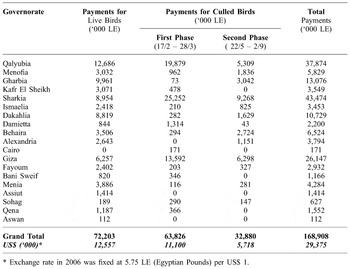
In the early stages of the Highly Pathogenic Avian Influenza (HPAI) H5N1 outbreak in 2006, the Government of Egypt (GoE) decided to provide compensation in relation to the culling of poultry. Initially the policy stated that everybody will be compensated for their loss according to the value set (LE 5 per bird, approximately equivalent to US$ 0.90). The initial compensation strategy also included a payment of LE 3 per live bird paid to registered poultry farmers in order to help them during a period of market collapse. However, as the outbreak evolved the policy changed to compensation only for licensed farms until the compensation payments were ceased in September 2006. The initial and fierce stamping-out strategy resulted in an estimated 30 million birds being culled, of which about 20 million received compensation (Table 1).
Since the initial outbreaks in February 2006, Egypt continues to struggle with the control of HPAI. The disease is currently endemic and the control methods put in place need to be reassessed. The GoE has been working continuously towards strengthening its response and has recently entered into a dialogue with the Food and Agriculture Organization (FAO) seeking technical assistance and advice on the reestablishment of a compensation strategy and policy.
Compensation payments for culling poultry in 2006 by the Egyptian Government.

* Exchange rate in 2006 was fixed at 5.75 LE (Egyptian Pounds) per US$ 1.
Compensation in Egypt
This paper builds on activities undertaken by FAO in Egypt since the first HPAI outbreak. In late 2006, FAO commissioned two studies related to compensation in Egypt, one focusing on the commercial producers (Shalaby, Reference SHALABY2006) and the other on the small-scale, backyard or rooftop production of poultry (Ghoneim, Reference GHONEIM2006). Both studies collected primary and secondary data relating to the compensation policies and decisions made during the initial phases of the outbreak. These studies were followed up by a larger livelihoods assessment of the socioeconomic impact of HPAI or its control affecting vulnerable households in Middle Egypt (Geerlings, Reference GEERLINGS2007). The assessment used primary data collection methods, such as female focus group meetings and household interviews, to gather information. Since spring 2007, FAO has actively provided technical support and assistance to the GoE on the development of a compensation policy and strategy (FAO, Reference FAO2008).
In close consultation with the Ministry of Agriculture and Land Reclamation (MALR) a strategy paper on compensation has been developed for Egypt. The core elements of this paper relates to the alternative funding mechanisms of a compensation trust fund, valuation of birds for compensation, as well as the operational elements of implementing such a plan.
Ensuring financial sustainability of a compensation fund is a necessary component of a successful policy. In order to create a robust fund, funding mechanisms need to be established that are in line with the regulatory and legal environment of the country. Whilst contributions to such a fund may be made by international donors, it is recommended that the main contributions come from the State and the producers. This recognizes that international donors might only be interested to contribute funds for activities that generate international public good, such as the control of diseases. The main objectives of the funding strategy developed were to ensure sufficient funds are available at all times to cover payments for all eligible beneficiaries; to have a funding-replenishment mechanism in place; to ensure the financial sustainability of the compensation fund (including identification of sources) over the expected duration of the HPAI disease control and eradication period; and to ensure that the funding mechanism is in line with national laws and with bilateral and multilateral agreements (such as the WTO).
Another critical element of a successful compensation policy is the development of methods to calculate the value to be paid per bird culled and the rate of compensation. The methods need to take into account the total value of the bird and the percentage of the value to be compensated. In the compensation policy developed, it is proposed that commercial producers would receive 75% of the baseline value whereas traditional poultry production would be compensated with 90% of this value. For broilers, the baseline price was calculated based on market prices. It is suggested that a three week moving average of the market price be used. The same calculation applied for the traditional production of local chicken breeds. However, as these products are on average 27% more expensive in the market, the baseline price is marked-up accordingly. Hence, the calculation is based on the moving average price per kilogram (farmgate), the weight of the bird (calculated from age), and the percent of compensation allocated (depending on type of producer).
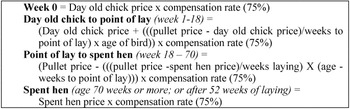
For layers, parent and grandparent breeders, it was proposed that the calculations would be based on the estimated future income to be derived from these birds (Figure 1). However for this compensation calculation to be operational, daily or weekly market prices of the day old chicks; pullets at point of lay; and spent hen need to be regularly available.
Formula to calculate compensation for layers/breeding stock by age group.

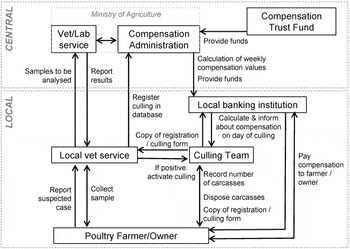
Once the funding and bird-valuation components are agreed upon, it is equally important that the implementation of the compensation policy adheres to operational procedures that are consistently applied in the field. Detailed planning is needed to ensure transparency and accountability of the compensation activities, and it is particularly critical as compensation payments follows the culling of poultry which may be emotional and traumatic for the owner of the birds. A tight operational plan facilitates assurance that all actors involved in compensation-related activities (from culling to payment and follow-up veterinary input) are informed about their roles and responsibilities. Figure 2 provides a schematic example of the elements that should be considered in an operational plan. For each component, a detailed description of activities is required and all components need to be linked together.
Proposed mechanism to manage and implement a culling and compensation policy.

Conclusions
If a country adopts culling as a measure to control HPAI, it should also develop a compensation policy. Compensation helps to ensure that disease-reporting continues and producers are not alienated by control measures that might appear draconian at the farm-level. Although compensation is critical, it is not the only aspect of good HPAI control.
A critical aspect of the success in culling, as a control measure, is ensuring that the physical activity of culling and disposing of birds is well resourced and managed. This process is followed by careful attention to disinfection, which needs to be allowed for in the budget. Finally, the owners of the birds need to be informed regarding what will take place with their flock and when they should expect to receive payment for the birds slaughtered. Where countries have difficulty in implementing such measures in a consistent manner, there needs to be an assessment of how much culling can be realistically achieved. In this, culling of affected flocks and those flocks considered to be dangerous, contacts should be a priority. Any flocks outside such categories should only be considered if financial and logistical resources can be found to carry out all culling and compensation measures well.
Rehabilitation of poultry production units can occur without established compensation payments. Pre-start up activities for small producers and strong veterinary engagement need to be established in order to improve biosecurity and create trust. The FAO has supported the GoE in developing a compensation policy to support culling as a control measure for HPAI. It recognises that compensation is a necessary aspect of successful disease control using culling and that this process needs to be supported by well managed disposal and disinfection procedures.