


A good deal more than the English Channel separates the coordinated market economies of continental Europe from their liberal cousins to the west; yet, scholars remain puzzled about the origins of these divergent economic models. How, for example, do the “virtuous circles” of coordination manage to take hold in many European nation states, whereas the Tocquevillian patterns of cooperation fail to thrive beyond American communities? At the dawn of the 20th century, employers and their government supporters across the Western world sought to develop peak business associations to nurture developmental capitalism; yet, these experiments in nonmarket coordination ultimately resulted in quite different organizational forms. Some countries produced fragmented or “pluralist” associations, whereas others developed highly organized, centralized, and hierarchical “social corporatist” groups. With the great political transformation in the 19th century—when capitalist development and the globalization of trade created pressures for the nationalization of industrial public policies—how did these national patterns of either cooperation or free market liberalism become institutionalized?
We seek to discover the determinants of corporatist and pluralist associations; in particular, we reflect on the political factors—the structures of party representation and the state—that shape the formation and subsequent trajectories of employers' peak organizations. If employers require an executive manager to help them organize their interests and shape their collective political identities, then the terms of political engagement—set by party systems and electoral rules—should influence the evolution of their organizational capacities. We hypothesize that proportional, multiparty systems are more likely to foster the development of corporatist associations, whereas non-proportional, two-party systems are conducive to the formation of pluralist associations. Countries with multiparty systems have dedicated business parties with political incentives to cooperate with other parties and social actors to form governing coalitions; consequently, these parties help to develop the collective voice of business. In addition, employers in multiparty coalitions might surmise that they have a smaller chance of capturing a party likely to win an electoral majority than their counterparts in two-party systems; therefore, they may be more interested in the creation of non-state policymaking channels that delegate considerable power to social actors. In contrast, the large umbrella parties found in two-party systems cut across class lines: employers are dispersed across parties, have difficulty finding common ground, have fewer political reasons to negotiate with labor, and, thus, form fragmented “pluralist” groups. When these employers do capture one party, they have no political reason to compromise with the other party to achieve an electoral majority and have fewer motivations to push the development of nonpolitical channels. Moreover, we suggest that federal systems engender pluralist associations, because decentralized political authority makes for greater levels of regional diversity in policy decisions and outcomes. Employers' organization will tend to be likewise fragmented in federal systems.
Our insights into the origins of organized employers are important for several reasons. Initially, our research has bearing on the genesis of managed capitalism versus liberal market capitalism. Although others have fruitfully investigated the impact of preindustrial traditions of cooperation and skills development on the emergence of industrial coordinated economies, the influence of electoral and party systems on coordination has been largely neglected (Thelen Reference Thelen2004; Hall and Soskice Reference Hall and Soskice2001; but see Cusack, Iversen, and Soskice Reference Cusack, Iversen and Soskice2007). Additionally, only limited empirical research has been done on the specific origins and early development of employers' associations (but see Crouch Reference Crouch1993). We agree that industrial relation traditions are important legacies for employer organization, but would direct scholarly attention to the political structures that are also salient in determining early patterns of coordination. In short, the relationship between electoral and industrial relation systems is dynamic and we stress the co-evolution of political representation and economic organization. An encompassing business organization (and coordinated capitalism) have difficulty surviving without a consensual PR party system; thus, business representation varies systematically with the party system.
Moreover, our paper contributes theoretically to the scarce literature on the links between party systems and interest organization (but see Cusack, Iversen, and Soskice Reference Cusack, Iversen and Soskice2007). Students of comparative politics generally root political party development in the structure of societal cleavages (Lipset and Rokkan Reference Lipset and Rokkan1967; Bartolini Reference Bartolini2000), yet we highlight the reciprocal influence of parties and electoral systems on the historical evolution of business organization and social class. Scholars of contemporary parties recognize the overlapping functions and interconnections between interest organizations and political parties: alternative forms of interest intermediation may develop in response to representational gaps in party politics (e.g., Lawson and Merkl Reference Lawson and Merkl1988). It arguably follows that the initial development of employers' associations was also molded by party competition.
Finally, our analysis has important implications for understanding the sources of social solidarity and equality. We have shown elsewhere that corporatist forms of employer organization have a significant impact on social protection programs (Martin and Swank Reference Martin and Swank2004). Thus, from the perspective of welfare state theory, it is vital to understand the initial development and evolution of these organizational forms.
THEORIES OF BUSINESS ORGANIZATION
National umbrella business associations developed across the Western world in the latter part of the 19th century in response to the growing consensus that industrialization required national rather than regional policy solutions (e.g., see Bensel, Reference Bensel2000). Regionally dominated and diverse economies were consolidating into national economies, markets were increasingly global, and remarkable technological advances were demanding more evolved workforce skills. Consequently, national business groups developed to promote industrial interests in policy debates and to help companies work collectively on tasks that could not be done individually. Yet these early experiments in national business organization rather rapidly produced quite different types of peak associations. Although some advanced industrialized nations ultimately saw the emergence of a single peak employers' association to represent collective business interests, other countries witnessed multiple umbrella groups and a system of representation marked by fragmentation and redundancy. Table 1 offers systematic evidence on the degree of employers' organization from the beginning of the 20th century to the 1930s. Our core measure of organization indexes, on a 3-to-9 scale, the scope, centralization, and policymaking integration of peak associations in 4 decades (see table notes and the discussion of measurement of employer organization below). By the 1910s, nations had begun to bifurcate between those that had more social corporatist associations and those that were clearly more pluralist. Thus, employers in the Nordic and Germanic nations had, by the onset of World War I, begun to establish relatively broadly organized and centralized associations. Employers associations in the Anglo nations, most notably, remained more fragmented and decentralized. These patterns of differentiation accelerated in the 1920s and 1930s.
Patterns of Employers' Organization in Developing and Democratizing Nations, 1900–1938

Note: The table displays our additive index of (1) scope of employers organization (i.e., the share of employers organized in peak national associations); (2) the centralization of power (e.g., control over strike/lockout funds, bargaining strategies) in peak national associations; and (3) integration of national peak associations into national policymaking forums. (See text in measurement section for more detail.
a Employers organization measured circa 1921–22.
How do we account for the degree to which national business communities developed highly organized and centralized collective associations? We suggest three broad causes of employers' organization. First, differences in the stage and type of capitalist development might differentially affect employers' needs for collective organization and action. The development of a national peak employers' association may be influenced by the level of industrialization, as indexed by per-capita income or wealth generated by economic production and the manufacturing share of total economic output. Historical analysis suggests that sector trade associations, and subsequently, multisector umbrella organizations developed to manage competition associated with unregulated capitalism (by controlling prices, output, and the entry of new firms) and to assist in rapid industrial growth (by facilitating standardization, innovation, research and development, insurance benefits, and consensual labor relations; Tedlow Reference Tedlow, Yamazuki and Miyamoto1988; Lynn and McKeown Reference Lynn and McKeown1988, 2–3). (We delineate hypotheses in Table 2. See hypotheses 1 and 2.)
Hypotheses on the Origins and Development of Employers' Organization

In addition, industrial sectors producing for export markets may be more likely to form trade associations than those producing for domestic consumption, and national economies with a larger share of exports may be more likely to develop highly centralized business groups. Business associations provide firms with a forum to unify against the common enemy of foreign firms, by nurturing collective action (Katzenstein Reference Katzenstein1985; Gourevitch Reference Gourevitch1986; Davenport-Hines Reference Davenport-Hines, Yamazuki and Miyamoto1988). Alternatively, employers in countries with few exports might experience less pressure to organize for these purposes or to constrain wages; in the absence of international openness, they might be more willing to satisfy labor demands for higher wages in order to secure labor peace (Galenson Reference Galenson1952; see Table 2, hypothesis 3).
The degree of regional diversity in national economies might also influence how employers organize their peak associations. High levels of economic regional diversity should complicate organization, because pronounced regional diversity makes it more difficult for employers to identify common ground; therefore countries with more diverse, regionally specific economies might be expected to develop less-centralized employers' associations (Tolliday and Zeitlin Reference Tolliday and Zeitlin1991; see Table 2, hypothesis 4).
A second broad set of explanations posits employer organization as a reaction to labor activism or to other features of the labor and industrial relations system. One argument is simply that business organizes to fight unions; consequently, employers should produce higher levels of cooperation and organization when faced with threats from more highly organized labor movements (e.g., Stephens Reference Stephens1979; Crouch Reference Crouch1993; see Table 2, hypothesis 5). Ethnic and religious divisions in the broader society hinder labor's ability to organize and, relatedly, business organization as well (Stephens Reference Stephens1979; King, Reference King2005; Manow and Van Kersbergen 2007). American “exceptionalism” has been linked to the immigrant communities that dominated 19th-century America, making ethnicity trump class (Hartz Reference Hartz1955). In Europe, religious or ethnolinguistic cleavages created a pillorization of society; for instance, in the Netherlands, Protestant and Catholic employers' associations were integrated with Protestant and Catholic unions and other civic associations in religiously distinct networks. Thus, we assess the hypothesis that the degree of religious and ethnolinguistic cleavages tends to depress employers' organization (see Table 2, hypothesis 6).
Worker skills and other features of industrial relations also matter; thus, coordination among employers is heavily influenced by 19th-century traditions of economic cooperation and coordination (Thelen Reference Thelen2004; and Swenson, Reference Swenson2002; Cusack, Iversen, and Soskice Reference Cusack, Iversen and Soskice2007). Four dimensions are important. First, strong preindustrial guilds result in better organized industrial employers' organizations, because guilds facilitated vocational training systems that allowed firms to develop specific assets and that, in turn, created an ongoing need for high levels of skills and industrial coordination. Second, employer organization may be influenced by the presence of rural cooperatives that foster the integration of agricultural, industry and financial interests. Third, employer organization may be facilitated by the predominance of industrial versus craft unions; industrial unions create the capacity and interests in unions to engage in cooperation with employers over training and wages. Fourth, employer organization may be linked directly to the degree to which the economy is dominated by a skills-based export sector; these firms use highly skilled labor and have a greater need for collective training and bargaining arrangements to secure workforce stability and wage concessions. Thus, we would hypothesize that these 19th-century “traditions of coordination” should be associated with employers' organization in the early decades of the 20th century (Table 2, hypothesis 7).
Overall, these legacies of cooperation are important for our argument. This is so not only because these factors in all likelihood play an important role in fostering employers' organization, but because they are also related to the emergence of proportional, multiparty systems. That is, recent work by Cusack, Iversen, and Soskice (Reference Cusack, Iversen and Soskice2007) has linked these traditions of coordination, or the co-specific assets of labor and business that develop under these forms of coordination, to the choice of proportional representation by business. Thus, the absence of a general theoretical accounting of these forces as well as a statistical control for coordination may well lead us to accept a spurious relationship between proportionality/multipartism and employers' organization. At the same time, although legacies of coordination are important, we would stress that cross-national varieties of capitalism may have been less starkly different in the 19th than in the 20th century. Coordinated market economies could be found at the regional level throughout Europe and North America before the first “industrial divide”; however, only some countries adopted coordinated national production regimes. For instance, American manufacturing processes in many sectors resembled those in continental Europe and a diversity of models or economic dualism may best characterize American manufacturing during this period (Piore and Sabel Reference Piore and Sabel1984; Berk Reference Berk1994). Many American communities also had extensive apprenticeship and training systems during the 19th century (Piore and Sabel; Hansen Reference Hansen1997; Martin Reference Martin2006). Moreover, we believe that politics, to which we now turn, also shape the emergence and maturation of organized employers in the early decades of the 20th Century.
A third set of explanations explores the direct influence of electoral and party systems and state structures on variation in national patterns of business association. Although scholars have explored the impact of aspects of state agency and structure on employer organization (Garon Reference Garon1987; Martin Reference Martin1991, Reference Martin1994; Schneider Reference Schneider2004) and on public policy making more generally (Huber, Ragin, and Stephens Reference Huber, Ragin and Stephens1993; Steinmo Reference Steinmo1993), the structure of electoral-party systems is a relatively neglected influence in the study of business organization. Yet because parties and interest organizations are both institutions for intermediating societal interests, we might reasonably expect dynamics in one sphere to affect dynamics in the other. Past analytic work on linkages between societal organizations and party systems has assumed a causal chain from groups to parties: parties emerge from societal cleavages and organizations (Daadler Reference Daadler, LaPalombara and Weiner1966; Lipset and Rokkan Reference Lipset and Rokkan1967). But party systems might also shape the development of societal cleavages, inspiring the development of employers' association from the top down or from the bottom up. When existing parties inadequately represent a societal group's interests, a dedicated interest organization might form from the bottom up in order to address this gap in representation (Torcal and Mainwaring Reference Torcal and Mainwaring2003). Alternatively, party strategists might create a business group from the top down to serve their political needs of rallying societal support for the party's agenda or to develop corporate capacity to implement the policies of the business party (Martin Reference Martin1991, Reference Martin1994).
Several features of party systems and state structures may shape the attributes of business associations. First, our core hypothesis is that features of business organization are deeply influenced by the degree of proportionality and multiparty representation: these electoral arrangements influence the incentives of both employers and party activists in the organization of business coordination. Specifically, we postulate that proportional, multiparty systems are more likely to guide employers' associations into social corporatist forms, whereas nonproportional two-party systems are more likely to give rise to pluralist associations.
Actors in nonproportional, two-party and proportional, multiparty systems face different strategic games, because nonproportional, two-party systems offer a more incomplete electoral coverage of social groups than do proportional, multiparty systems. Multiparty systems often include dedicated business parties; in the context of proportional electoral rules, these partisan organizations can make credible commitments to their members on future benefits and coverage of interests is fairly high (Iversen Reference Iversen2005; Cusack, Iversen, and Soskice Reference Cusack, Iversen and Soskice2007). These dedicated business parties help to aggregate and to unify broad corporate interests; therefore, they may assist in developing the collective voice of business. Dedicated business parties have incentives to form alliances with parties representing workers, farmers, and other interests in order to join ruling coalitions, and one might expect these parties to transfer this spirit of cooperation to employers' associations. In countries with multiple parties, managers calculate that their chances of capturing a party likely to win an electoral majority are minimal; therefore, they have an interest in the creation of policymaking channels that work outside of government by delegating considerable power to social actors. Highly organized employers associations may emerge to coordinate labor and industrial relations systems and to help with state development strategies; yet, these groups should be less involved in electoral politics (the party's prerogative).
In two-party systems, the large umbrella parties tend to cut across class lines and employers (and other groups) are often dispersed across parties. Systems of two-party competition generally create a “representation gap” in electoral politics, because parties compete for and formulate positions to appeal to the median voter and, therefore, cannot make credible commitments to specific social groups (Downs Reference Downs1957). Interest groups such as business associations may develop to fill voids created by representation gaps, but this path to interest group development may produce more fragmented, less unified, less cooperative and more politicized groups. When employers are dispersed across parties, a common corporate voice may be more difficult to establish. No business party exists to urge the associations to develop accommodating positions with labor. When employers in two-party systems do capture one of the parties (as was the case of the US Republican party in 1896), they still have no reasons to compromise with the other party. They may seek to attract workers to their constituency base, but they have no political reason to encourage the development of an organized working class. When business organizations develop to substitute for real business parties, employers' associations should be expected to play a bigger role in electoral politics. The excessively politicized nature of business organizations in two-party systems might give rise to greater questions about the employers' associations legitimacy and, in turn, undermine employers' roles in labor and industrial relations and economic development.
These fundamental differences in the consequences of electoral systems for employers mean that associations often have quite different functions in the two types of party systems. Because the coverage of employers' interests is likely to be more complete in proportional systems, the associations are less likely to be electoral in function; and because the business party needs to cooperate with labor, the associations are likely to be encouraged by the party to develop processes of negotiation that minimize class conflict. Thus, we expect proportional multiparty systems to be associated with social corporatist business organization (Table 2, hypothesis 8).
Second, the structure of the state, especially the degree of federalism, should matter.Footnote 1 Generally, the dominant view in democratic theory has been that organization articulation of interests follows constitutional structure (e.g., Coleman Reference Colman, Bakvis and Chandler1987). In our view, the degree of power sharing between levels of government matters in that it shapes the goals of both bureaucrats and interest groups; thus, political authority dispersed to the local level makes it less likely that national employers' organizations will achieve high levels of centralization and coordination. The degree of governmental centralization matters in that national-level bureaucrats in federal systems of shared power have more modest goals than their counterparts in centralized systems with concentrated power. Thus, although in some countries the formation of national-level business associations might coincide with the development of national regulations (and employer associations might provide input into the design of these regulations), the limited national goals of federal countries might delimit the goals of the newly emerging business associations (Hawley Reference Hawley1966). Federal systems have greater levels of regional diversity in policy outcomes and employers' associations will have similarly diverse concerns across these regions. Thus, when power is dispersed to the regional levels, business associations are more likely to develop at the regional levels. Admittedly, coordinated capitalism has developed in federal systems. This is especially the case in sector coordinated systems such as Germany. Yet, Denmark and other more centralized Scandinavian polities have developed stronger macro-corporatist institutions at the national level.
In addition, federal systems also have less centralized political parties, and parties dominated by local elites have less need for centralized business organizations than parties with strong, national leadership. A party dominated by local organizations will be ill-equipped to address national issues; a national party should have a greater need for centralized business support for its political agenda. The goals of government, of course, influence the level at which parties organize (Amorin and Cox Reference Amorin and Coz1997). Yet once created, the level of party institutionalization (national versus local) should have independent effects on social structures (Chhibber and Kollman Reference Chhibber and Kollman2004). The problem of incomplete coverage is also exacerbated when two-party systems also have high levels of geographical diversity: when sectional or regional diversity constitutes the primary cleavage dividing the electorate into two parties, class determinants of party identification lose salience. Industrialists are likely to be underrepresented in the national political arena and this complicates the political expression of the collective interests of employers. In sum, we hypothesize that the degree of federalism should be negatively associated with employers' organization (Table 2, hypothesis 9).
METHODOLOGY
We assess our hypotheses on the origins of employers' organization and, more broadly, organized capitalism through both the quantitative analysis of historical data and the comparative case studies. In the sections that follow, we outline the measurement and estimation procedures for the quantitative historical analysis. We then report our findings from analysis of 1900's to 1930's data from 16 nations on hypothesized causes of highly organized employers and broader systems of national economic cooperation. We then offer extensive historical analysis of two paradigmatic cases for employers and market organization, namely, Denmark and the United States. We seek to obtain a broad assessment of our theoretical arguments through analysis of quantitative historical data; we seek to deepen our understanding of the mechanisms linking late 19th and early 20th centuries political institutions and dynamics, industrial relations, and economic structures on the one hand, and employers' organizations and the origins of varieties of capitalism on the other, through the process tracing of our comparative historical case studies.
Measurement for Historical Quantitative Analysis
As outlined earlier, our central goal is to explain why employers in some nations had organized encompassing and centralized interest associations by the years immediately proceeding World War II (while employers' organizations in other nations remained pluralist). We also wish to address in a preliminary manner the related question of why some nations had established the institutions for national economic coordination before World War II (WWII). To these ends, we construct an index of employers' organization for each decade from the 1900s through the 1930s as the central dependent variable. We also construct measures by decade of pre-WW II national coordination (corporatism).
With respect to employers' organization, we collect data for circa 1900, 1914, 1925, and 1938 for 16 nations on the following dimensions: (1) scope of employers' organization (i.e., the share of employers organized in one or coordinated multiple peak national associations); (2) the centralization of power (e.g., control over strike/lockout funds, bargaining strategies) in one or coordinated multiple national associations; and (3) integration of national peak associations into national policymaking forums (e.g., representation on national commissions, policy-making boards). We score each decade in our 16 countries on a scale of 1.0 and 3.0 for each dimension (using increments of .5), where 1.0 represents low/minimal and 3.0 represents high/strong organizational articulation. We then sum these scores to form a (3.0-to-9.0) measure of employer organization. To form our measure of national coordination, we add the standardized score of the employer organization index to standard scores for centralization of wage bargaining and union power (an index of union density and peak union association powers). Table 1 displays the cross-national and temporal variation in 1900–1930's employer organization in 16 nations. (Data sources for all variables are in the Appendix.)
For general economic determinants of employer organization, we follow standard practice and measure the general level of industrialization as (log) per-capita Gross Domestic Product (hereafter GDP). To further explore features of economic development, we construct measures of the concentration of economic activity in manufacturing (percentage of GDP from manufacturing).Footnote 2 In addition, we construct a measure of trade openness of the economy by computing exports as a percentage of GDP (both expressed in 1990 U.S. dollars). Finally, we proxy regional dispersion of economic activity by taking the log of area (expressed in square miles).
Features of the labor and industrial relations system were measured as followed. We measure labor mobilization as union density, or union membership as a percentage of the work force. To proxy traditions of coordination, we sum dichotomous measures of the presence (1.0) or absence (0.0) of guilds, rural cooperatives, industrial (vs. craft) unions, and a large skills-based export sector developed by Cusack, Iversen, and Soskice (Reference Cusack, Iversen and Soskice2007). To measure nonclass cleavages, we utilize the mean of standard Taylor–Hudson indices of religious and ethnolinguistic fragmentation; this measure varies from 0.0 to 1.0.
With respect to our core political hypotheses, we measure proportionality/multipartism in the electoral system in three ways. First, we utilize an ordinal measure of proportionality of electoral rules where 0.0 designates low proportionality (e.g., the United States), 1.0 signifies semiproportionality (e.g., France 1919, 1924) and 2.0 designates high proportionality (e.g., Denmark after 1915) in electoral outcomes. Second, we also use a common measure of the (log of) disproportionality of electoral outcomes. Specifically, we follow Gallager (Reference Gallagher1991) and measure disproportionality as: the square root of 1/2∑(v i − s i)2, where v i is the vote share of the i-th party and s i is the seat share of i-th party. We also use a measure of multipartism where election periods with fewer than three parties are coded 0.0 and election periods with three or more parties are coded 1.0. Empirically we emphasize the proportionality of the electoral system and not the number of (total or nonsocialist) effective parties. As is commonly understood, highly proportional systems are inevitably multiparty systems; measures of effective number of parties inherently tap features of the cleavage structure of society (see Chapters 5 and 8 of Lijphart Reference Lijphart1999). Thus, as an empirical matter, proportionality incorporates our theoretical logic on real or potential representational gaps and multiparty system dynamics but avoids problems associated with measurement of additional features of cleavage structures. Finally, we measure state (de)centralization by a federalism-unitary ordinal variable (where 0.0 designates a unitary polity, 1.0 signifies a federalist system, and .5 represents an intermediate or quasi-federal institutional structure).Footnote 3
All of the above measures are computed as lagged levels of designated factors where the lag is typically the annual mean for 5 years before the point of measurement of employer organization. Thus, for example, for any country in 1910s decade (where employer organization is measured circa 1914), union mobilization is mean union density at two or more time points between 1908 and 1913 (where the number of time points is a function of data availability or historical considerations).
Estimation
Following our theoretical arguments, we specify a basic empirical model of the degree of employer organization. Tests of some alternative dimensions of a factor, or some factors within a set of hypothesized causes of employers organization—for instance, alternative features of economic development—are made by adding some variables to the basic model in sequential individual tests. We do this on the basis of the theoretical priority accorded a factor and because multicollinearity and the limited number of degrees of freedom militate against estimating models with large numbers of exogenous variables. (Descriptive statistics and correlations for our core variables are in the Appendix.) Our basic model is:

where i designates nation; t designates decade, 1900s, 1910s, 1920s and 1930s as discussed earlier; and εi,t is the error term. With regard to the “it,” we delete country decades from analysis where fascist regimes are in power (i.e., Austria, Germany, and Italy in the 1930s) and where basic democratic institutions are not yet in place (e.g., the majority of our nations for 1900). We are left with 36 country decades in which at least basic democratic institutions are established at the time of measurement of employer organization and in the preceding 5 years where causal factors are measured. Thus, we have 36 cases in which the interplay of political economic forces we highlight in our theory should be clearly operative.Footnote 4 We are especially attentive to problems such as heteroskedasticty, autocorrelation, and distortions due to outliers, difficulties that may be intensified in small samples.
We estimate our panel models with ordinary least squares (OLS) with panel-corrected standard errors computed for unbalanced panels. (Alternative estimators such as OLS and Huber-White robust standard errors for clustered data return estimates of highly similar substantive magnitudes and significance levels.) We also assess residuals for the presence of serial correlation. Tests for autocorrelation produced universally null results. For instance, assuming a common first-order process, rho ranges from roughly −.13 to .12 in reported models, and is completely insignificant. To evaluate the sensitivity of our results to alternative specifications, and to further account for the sources of possible spuriousness (see the discussion to follow), we estimate our final model with a lagged dependent variable. In addition, we assess the robustness of our results to exclusions of nations and of decades. To do so, we compute “jackknifed” estimates in which we delete one nation or decade at a time. For the nation-based tests, for instance, we estimate 16 fifteen-country equations. The mean of these 16 new coefficients becomes the jackknifed coefficient for the variable and the standard deviation of these 16 fifteen-country estimates becomes the standard error. Comparable jackknifed estimates are computed to evaluate the effect of particular decades. Finally, to account for period effects (e.g., “shocks” associated with war or depression), we include decade dummies for 1900, 1910, and 1920 in models of pre-WW II employers' organization and social corporatism.
FINDINGS FROM THE HISTORICAL QUANTITATIVE ANALYSES
We report the findings from estimation of our basic model of employers' organization and from additional models that test supplementary political institutional, economic needs/structures, and labor and industrial relations systems hypotheses in Table 3. The results displayed under column I do indeed suggest that several focal factors are statistically associated with the degree of organizational articulation of employers in the 1900 to 1930's period. The proportionality of the electoral system (ordinal measure) is significantly related (p < .01) to the degree of employer organization. The substantive magnitude of this effect (β = 1.9) is also large: an increase from minimal to moderate, or moderate to high proportionality is associated with an increase of roughly 2.0 on our scale of employer organization (recall the range of this variable is 3.0 to 9.0). Shifting to column II, one can also see that our column I finding on the large role of proportionality is bolstered by the comparably large and significant effect of the index of disproportionality. In the third column equation, we use our simple measure of multipartism. Although this factor is influenced by the complexity of cleavage structures, we do find, as in the case of the previous two indicators of the nature electoral-party systems, that simple multipartism is positively associated with the degree of employer organization. Ultimately, we select the ordinal measure of proportionality as our preferred specification for the electoral-party system factor: the overall fit of the model with this specification is much better; the simpler scale is more readily interpreted, and the measure is more robust to additional controls and estimators. (Also see the measurement section on choice of this variable.)
The Underpinnings of Employers' Organization, 1900s–1930s in 16 Nations

Note: All models are estimated with OLS with panel correct standard errors. Cases are 36 country decades for the 16 nations defined in the text. Each model includes time period dummies for 1900s, 1910s, and the 1920s.
*p < .10.
**p < .05.
***p < .01.
With respect to the other core factors, federalism is negatively associated with employers' organization. Although the substantive magnitude of this effect is nontrivial—the difference in employer organization between federal and unitary polities is close to 1.0 (β = .76), and although it is highly significant in some estimations and robust in the jackknife results (see below), federalism is statistically significant at only the .10 level (or falls just short of significance) in column I and in some additional variations of the model. Interestingly, in models where federalism is not significant, alternative measures of fragmentation and diversity such as (log) area, are significant. In addition, the relationship between employer organization and our central measure of past union mobilization is highly significant in column I and in virtually all specifications of our models. In terms of substantive magnitude, a past increase in unionization rates of 10% of the work force would, all else being equal, result in a .5 increase on our (3-to-9) scale of employer organization. Finally, column I results for our economic forces are generally not strongly supportive of hypotheses that stress economic structural conditions, needs, and related dynamics in shaping the development of employers' associations. Geographic size and international (trade) openness are not significantly related to employer organization in most models; (log) per capita GDP is, however, modestly associated with the employers measure in column I and in the majority of other model specifications.
We display the tests for the hypothesized effects of an additional measure of economic structure, namely, economic concentration in industry (manufacturing share of GDP) in the fourth column of Table 3. Economic concentration in manufacturing; although correctly signed, is only marginally significant. In additional specifications of the model, manufacturing concentration as well as the set of complementary measures of the dispersion of economic activity proved to be generally insignificant, trivial in the magnitude, or incorrectly signed with regard to impacts on employer organization.
We display tests for additional hypotheses on the impacts of labor and industrial relations factors in the fifth and sixth columns of Table 3. We might first note that union mobilization retains its substantively strong and statistically clear association with employer organization in these models. We also test for the effects of potentially fragmenting nonclass cleavages as well as the potentially positive impacts of traditions of coordination. As the column results indicate, we find no support for the argument that net of other forces, religious and ethnolinguistic fragmentation has significant independent impacts on the organization of employers. On the other hand, the coordination variable is correctly signed and highly significant. This finding adds support to the argument developed by Cusack, Iversen, and Soskice (Reference Cusack, Iversen and Soskice2007) and Iversen and Soskice (no date) that guild traditions, cooperative legacies, industrial unions, and a large skills-based export sector are associated with employers' organization and promote the further development of coordination. It is also important to note that in the presence of this control, our central measure of proportionality remains significant. As discussed earlier, the presence of this variable, itself an important correlate of corporatist organization of employers, should minimize concerns that the significant relationship between proportionality and employer's organization is spurious.
We now move to the last stage of our quantitative analysis. This consists of a test of our arguments as explanations of pre-World War II national economic coordination as well as a set of tests of the robustness of our final model; that model is displayed in column I of Table 4. (Also note that the final model and disaggregated models of sets of factors along with a variety of model statistics are reported in the Appendix.) Column II of Table 4 displays the results of our estimation of the basic model for pre-World War II social corporatism. As the table indicates, the overall model explains 1900–1930's variations in the degree of development of social corporatism fairly well (R2 = .71). Moreover, political forces—electoral proportionality and federalism—exert substantial and significant influence on the development of social corporatism. So too does the strength of traditions of coordination and the level of economic development. Geographic size and economic openness, however, are not significantly related to national coordination in the pre-World War II era. Overall, political economies with relatively high levels of industrialization, strong legacies of coordination, centralized state structures, and proportional electoral systems were much more likely to develop corporatism in the 1900–1930's period than other systems.
Final Models of Pre-WW II Employers Organization and Social Corporatism

Note: Models of columns I to III are estimated with OLS with panel correct standard errors. Cases are country decades as defined in the text. The model includes time period dummies for 1900s, 1910s, and the 1920s. The models of columns IV and V report jackknifed coefficients as defined in the text.
*p < .10.
**p < .05.
***p < .01.
Finally, Table 4 reports the results of our estimation of a lagged endogenous variable model and of jackknife tests of robustness of our basic model of 1900–1930's employers organization to exclusions of individual countries and decades from the analysis. These tests indicate that the core factors for which we have received consistent support—proportionality of the electoral system, federalism, union mobilization, traditions of coordination, and the level of development—proved generally robust to these alternative specifications and tests. For the dynamic specification entailed by the lagged endogenous variable model, greater proportionality, unionization, and traditions of coordination are associated with higher employers' organization. As noted earlier, the control for past levels of employer association also assuages fears about a spurious correlation between proportionality and current employers' organization. Finally, all these consistently important factors—proportionality, federalism, unionization, traditions of coordination, and economic development—are highly robust to deletions of nations and decades.Footnote 5
In sum, historical quantitative data analysis of pre-World War II variations in employer associations suggests that electoral and party systems, federalism, features of labor and industrial relations systems, most notably, unionization and traditions of coordination, and economic development largely explain why some nations experienced corporatist organization of employers. We now turn to our historical analysis of the paradigmatic cases of Denmark and the United States to further assess and articulate these arguments and findings.
FINDINGS FROM THE COMPARATIVE CASE ANALYSES
The following section on the origins and evolution of peak employers' associations in Denmark and the United States offer case study findings about our three broad hypotheses that augment the results of our historical quantitative analysis. This case selection is appropriate because both countries developed associations in the mid 1890s and each represents a quintessential example of a model country: the Danish employers' association was the frontrunner among European organizations in attaining high levels of corporatist coordination, and the United States is often evoked as an exemplar of the liberal-market economy with pluralist labor and business organizations.
First, as is detailed later, the case studies support our core hypothesis that the structure of party competition was important to the development and subsequent trajectories of employers' associations in Denmark and the United States. In both, business organization was partially a top-down process, in that party leaders encouraged employers to form associations; in addition, the dynamics of multiparty competition (later associated with proportional representation) reinforced employer coordination in Denmark, whereas two-party competition hindered business cooperation in the United States. Thus associations in both countries were, in part, initiated by political leaders to aid party ambitions such as expanding constituent bases and supporting policy agendas, yet major differences in partisan competition sent the Danish Employers' Federation and the National Association of Manufacturers down radically divergent tracks.
Second, the legacies of 19th-century traditions for economic cooperation and coordination (or the lack thereof) also played a role in the evolution of employers' associations in the two countries. Party politics in Denmark supplemented the legacies of the guild tradition and high-skills production in steering Danish employers toward a cooperative stance with a more highly organized workforce. In contrast, although many American employers sought to develop institutions to foster skills development and cooperation with labor, others (especially in the south) pursued a low-wage strategy. These sectional differences in the diverse parts of the American economy were augmented by the dynamics of the two-party system in hindering the emergence of a corporatist employers' association.
Third, although employer organization in both countries was clearly motivated by the emergence of industrial capitalism, the cases give less support to cross-national differences in levels of industrial development. In both countries, employers organized, in part, to seek public policies favorable to manufacturing, to nurture industrial capitalism and to transfer regulatory privilege from agriculture to manufacturing (NAM, Edgerton 1926). For example, NAM formulated goals to build infrastructure for manufacturing and foreign trade: its Committee on Resolutions proposed as a basis for organization the ambition that, “our home market should be retained and supplied by our own producers and our foreign trade relations should be extended in every direction” (“Delegates Got Down to Business” 1895, 8). Yet this hypothesis might lead us to expect a greater level of organization in the United States than in Denmark, as the latter remained more solidly dominated by agricultural interests and manufacturers (as opposed to farmers) produced little for foreign markets. Yet, according to Galenson (Reference Galenson1952, 71–72; Hyldtoft Reference Hyldtoft1999), Denmark's domestic focus made employers more—rather than less—motivated to join associations.
The Formation of the Confederation of Danish Employers
The creation of the Danish Employers' Confederation of 1896, later to become the Dansk Arbejdsgiverforening (DA), was motivated by partisan struggle for control, and this pattern of party competition served to reinforce collectivist tendencies within the Danish political economy.Footnote 6 Danish employers' embrace of cooperation was congruent with the collectivist, preindustrial guild system and with employers' interests in sustaining a high-skilled workforce. The guild tradition was, perhaps, most important in its impact on skills, as a large share of Danish workers were skilled craftsmen (Galenson Reference Galenson1952, 195; Iversen). In addition, Danish collectivism had deep roots in the ideological/spiritual writings of N. F. S. Grundtvig (Knudsen Reference Knudsen and Knudsen1991; Østergård Reference Østergård1992) and in Germanic ideas about workplace stability (Levine Reference Levine1978). Finally, the collectivist impulse among Danish employers was reinforced by a debilitating fight with labor in the metal trades in 1885, in which employers first resisted and then caved to labor demands (Due et al., Reference Due, Madsen, Jensen and Petersen1994, 73). In part, this early episode in industrial conflict demonstrated the considerable power of Danish labor, yet employers—somewhat surprisingly—quickly surged ahead of workers in seeking institutions for centralized wage-bargaining, motivated by a rational calculation of their own self interests (Agerholm and Vigen Reference Agerholm and Vigen1921). Thus Danish employers sought a more centralized labor federation, in part, because they wanted unions to refuse to work for free-riding firms who stayed out of the business association (Galenson Reference Galenson1952). By 1900, the structure of trade union organization had been set by the high levels of centralization among employers: as early as 1898 during a large lockout by the metal industry, DA sought to contain the conflict at a national, multi-industrial level and lobbied for the formation of a joint committee to oversee collective agreements (Due et al. Reference Due, Madsen, Jensen and Petersen1994).
In addition to these legacies of coordination, we argue that the structure of partisan competition strengthened Danish employers' strategic calculations of their collectivist interests in coordination, and was decisive to the evolution of the centralized and highly coordinated peak organization. In brief, a faction of the Danish Right Party (Højre) desired a politics of coordination—in which a cooperative employers' association was key—as a means of furthering the interests of the moderate voice within the party and of enhancing Højre's negotiating position with other political actors. The need to form coalitions with other parties in this multiparty system fostered cooperative strategies within both the political and labor–management arenas. Thus the conservative party in this multiparty system had a strategic reason for pushing a path of labor–management coordination among its business constituents.
In the 1890s, Højre's right to rule the government without a plurality in the Danish Parliament was being threatened by the move toward parliamentary reform (finally occurring in 1901) and by the growing power of the social democrats, the farmers' Liberal party (Venstre), and an emerging splinter group of Venstre (Bindslev Reference Bindslev1937–38). Højre was split into two factions with diverse views about reviving the party's flagging fortunes: the parliamentary wing, led by Lars Dinesen, wanted to cooperate with other parties (especially with the splinter group), to centralize the party, to reduce the power of the local committees, and to foster cooperative strategies with labor in order to strengthen Højre's negotiating position and to broaden its cross-class appeal. The other wing, based in the local committees or conservative clubs, resisted these middle-way strategies and wanted a strong national defense and an independent, powerful right (Bindslev Reference Bindslev1937–38; Dybdahl Reference Dybdahl1969, 14–15).
According to its official history, Højre's involvement in the creation of the Employers' Federation must be viewed against this backdrop of the party's fight for rule against the Liberal and nascent Social Democratic parties (Arbejdsgiver Foreningen I Danmark Gennum 50 Aar.). The precipitation for the organizational development was a building trades strike. In response, Vilhelm Køhler (brick factory director and head of the bricklayer guild) and Niels Andersen (a Højre member of parliament and employer in the construction industry) proposed the development of an employers' association committed to restraining industrial conflict, at a meeting on March 6, 1986, in Copenhagen, attended by representatives for most of the sectoral associations in building, metal working and other trades. Andersen's incentives for organizing business clearly reflected his political interests in cooperation within both the party and industry. He believed that strengthened cooperative capacities in labor–management relations could offer evidence that Højre could produce a middle-way politics between the older conservative legacy and the new social democratic challenge, and could lead the country to technological industrial development and labor peace between employers and workers (Agerholm and Vigen Reference Agerholm and Vigen1921Arbejdsgiver Foreningen Gennem 50 Aar 1946;). One wonders if Andersen also viewed the employers' organization as giving the party leaders leverage against the local party committees. These political motivations for the formation of the employers' federation may partially account for the Social Democrat's deep-seated animosity toward the idea. Thus the paper, Social Demokraten, wrote on May 20, 1896:
Let the workers have their own associations in peace, when through these groups they can request improvements in worker representation and take matters up with a loyal negotiator. Leave on the shelf the arrogant tone of those who want the opposite for workers so that there will be “peace and stability” [quotations in the original] in the workplace. To workers we say, “Keep a watchful eye on the increasing combination of the purchasers of labor power and close ranks.” (Agerholm and Vigen Reference Agerholm and Vigen1921, translation by CJ Martin)
The creation of DA did not end labor/management strife once and for all, as a huge, 3-month, labor market battle arose in 1899, but this “Great Lockout” finally induced employers and workers to engage in their first “hovedaftalet” or general negotiation between DA and LO. In fact, there is some evidence that employers drove the lockout in order to push toward a national system of collective bargaining (so that employers could restrain their workers' wages) and to guarantee managerial control over the organization of work. Ultimately Højre's States Minister Hørring in an informal meeting with Niels Andersen threatened to intervene if the two sides were unable to find a solution. But before this was necessary, the employers and labor associations ended the standoff with the famous (in Denmark) September Compromise (September Forlig) and the Danish system of collective bargaining was institutionalized (Due et al. Reference Due, Madsen, Jensen and Petersen1994, 80–81; Madsen).
The reorganization of Højre into the Conservative Folk Party in 1915 and adoption of PR throughout the country in 1920 increased the employers' share of the right party's membership and strengthened the identity of Danish manufacturers as a national business community. Although Højre had been something of a cross-class party (Dybdahl); the Conservatives claimed that they would more exclusively represent employers, focus more strongly on the economic interests of its industrial constituency, move away from 19th-century laissez-faire liberalism, and exert every effort to keep workers from becoming proletarianized. They viewed cooperation with Venstre in the new PR setting as their best hope of reconstructing the “old moderate coalition” and stopping social democratic radicalism; thus Bindslev (Reference Bindslev1937–38, 264–71) claims that the choices were “more driven by tactical considerations than by ideas.
The creation of proportional representation and emergence of a dedicated business party also had an impact on the inner workings of the employers' organization: the political consolidation of the nations' employers with proportional representation permitted the gradual reduction of regional differences among industrialists; this, in turn, enabled the functional reorganization and centralization of authority within DA. The September Compromise had established employers' control over the organization of work and structured industrial conflict along decentralized trade lines, yet participation remained voluntary. True centralization came with the functional reorganization of DA in the 1920s and the move to make a uniform bargaining policy that was mandatory for affiliates in 1931 (Beretningen om Dansk Arbejdsgiversforenings Virksomhed 1927–1928; Galenson Reference Galenson1952, 79–82; Due et al. Reference Due, Madsen, Jensen and Petersen1994, 89–95). Galenson (Reference Galenson1952, 79) argues that this functional reorganization of DA was made possible by the receding distrust separating Copenhagen manufacturers from their regional counterparts—a shift made possible by the deepening political identity of employers. The greater consolidation of employers had policy consequences as well; for example, when major social reforms were undertaken in the 1930s, the Conservatives were furious when they were shut out of the coalition supporting these reforms by a secretive agreement between Venstre and the Social Democrats (Møller 1994, 111–60).
The Formation of the National Association of Manufacturers
The National Association of Manufacturers was created in 1895 and, as with the DA, was motivated by partisan struggle for control; in addition, NAM's trajectory can be linked to noncollectivist tendencies within the American political economy. Yet, an interesting aspect of the NAM story is that it was initially motivated by a desire to develop national organization capacities for coordination, and hoped “to consolidate into one great powerful representative body the total force and influence of American industry, so that when any question of any large national industry shall present itself, American manufacturers will speak and act with a positive assumption that they will be heard and heeded” (“The National Association of Manufacturers and other Organizations” 7/1/1899). NAM's President Search promoted negotiation rather than antagonism with organized labor and suggested that “profit can be derived in many ways . . . in those modern establishments where progressive ideas have been applied in full force” (Search, Reference Search1901). NAM's constituency base was drawn from those sectors in pre-Fordist 19th-century America that were quite coordinated and relied on highly skilled workers (Berk Reference Berk1994; Hansen Reference Hansen1997). These employers wanted higher levels of cooperation among agents in business, labor and the state to foster economic development (Werking Reference Werking1977, 21, 22). Regionally, some states and communities had extensive vocational training programs, and employers elsewhere entered into private collective arrangements to meet their skills needs (Bureau of Labor, 1911).
NAM's inability to realize these ambitions for coordination can partly be attributed to labor market characteristics. Although employers in some regions used high-skilled workers, others (especially in the South) were already seeking to compete on the basis of low costs. Collective arrangements at the regional level declined when national policies became necessary to serve the needs of a more integrated national economy, because employers' lacked organizational capacities to secure national policies. For example, despite the earlier commitment to vocational training by many employers, by the 1920s U.S. vocational training was located in school-based programs lacking occupational definitions and skills benchmarks, in part because American employers (unlike Germans) lacked the capacities to secure national training programs (Hansen Reference Hansen1997).
We argue that these noncollectivist forces within the American system of industrial relations and NAM's movement away from its original collectivist vision were reinforced by the dynamics of two-party competition. Indeed, the limits of the two-party system explain both the development of NAM as a tool for coordinating business, labor, and the state and its ultimate rejection of this cooperative vision.
William McKinley and Marcus Hanna sought to develop NAM to aid the McKinley presidential campaign, to further their nationalist economic ambitions, and to overcome the constraints of the U.S. party system: they wanted a national business constituency that would transcend party sectionalism and control by local party bosses (Olcott Reference Olcott1916, 298). The Republican party was thwarted in promoting industrial policies by its failure to reach employers in the south and west, who voted Democratic. Thus, the need for a national business organization supporting policies for industrial development was especially great in the southern one-party states, where Democratic party's dominance made another form of organization necessary to affirm a commonality of interests among employers, to link southern business managers to their compatriots in other sections of the country and to connect these employers to McKinley's campaign for political economic change (National Association of Manufacturers, “Advice from the South,” 1895, 154). NAM expected to be rewarded for this contribution and the National Industrial Review (a quasi-official publication of NAM) forecast that the organization “will be in future a great factor in our National elections” (The National Industrial Review 1895; Steigerwalt Reference Steigerwalt1964, 33).
The origins of NAM reveal McKinley's political involvement and interests. Although the official story was that employers in Cincinnati and Atlanta spontaneously developed the association, NAM later admitted that McKinley had a major role in the effort (NAM 1926, 61). Key personnel were important to both the McKinley campaign and the NAM organization. Thomas McDougall, a NAM leader in Ohio, had helped to organize an effort to save McKinley from financial scandal a few years before (Olcott Reference Olcott1916, 290). NAM's first president, Thomas Dolan of Pennsylvania, was curiously elected to office at the organizing convention without even being present; but was so close to McKinley that he became a trustee for the McKinley monument after the president's death (“It's President Dolan,” 1895, 1; “For the McKinley Monument,” 1901, 3). Thomas Martin served as a member of the organization's constitution and bylaws committees, and was the president of the Atlanta McKinley Club. Colonel JF Hanson was both the NAM vice-president from Georgia and the major speaker at the meeting of the Southern Republican party convention in advance of the 1896 convention (“Manufacturers in Convention,” 1895, 2; Bacote Reference Bacote1959, 218). Colonel AF Buck both recommended to McKinley Republican delegates for the St. Louis Republican National Convention and served as a liaison to African-American Republican leaders in the state (McKinley letter to RE Wright 1896; Buck letter to McKinley Reference Buck1896).
McKinley gave the keynote address at the NAM organizing convention, which drew a standing ovation from the crowd (Gable 1959, 536). NAM's second annual meeting in January 1896 was originally scheduled for the fall of 1895 but was rescheduled for “just about the time when the campaign for the Republican nomination for the Presidency will open” and state conventions began meeting to select the nominee (“A High-Tariff Republican President” 1895, 1). NAM leaders instructed their members that “a greater significance attaches to the outcome of this convention and its ultimate results, than to that of any other . . . that has ever been held on this hemisphere” (The National Industrial Review July 1895, 148). According to The New York Times, the most significant event at the convention was “the applause which greeted a mention of the name of Major McKinley. This applause told as plainly as could a preamble and resolution the real purpose of the delegates” (“Manufacturers Cheer for McKinley” 1896, 1). McDougall's (Reference McDougall1896, 3–8) rousing speech made the campaign connection even more explicit, when he blamed “business paralysis to-day” on a lack of statesmanship.
Yet NAM's cooperative ambitions were not realized because its legislative requests fell victim to the interplay of Democrats in Congress who consistently voted against NAM's legislative agenda for economic development, because they viewed NAM as too closely aligned with the Republican party. NAM eagerly sought the creation of a new Cabinet-level Department of Commerce (finally established in 1903), to coordinate industrial development policy (The National Industrial Review May 1895). After the election of 1896 the organization was so certain that the commerce department's creation was imminent, that NAM's Resolutions Committee member, George Johnson, told the New York Times that President-elect McKinley had already chosen a secretary with NAM's unconditional endorsement (“A Ninth Cabinet Member: A Contingent Offer Made”1897, 1). Yet bills to create the Department of Commerce and Industry repeatedly encountered resistance from legislators reluctant to grant favor to industrial interests. By the 1898 NAM annual convention President Theodore Search was to comment wearily, “There is scarcely another government in the civilized world that does not possess a governmental department whose duty it is to exert a special care and to observe a solicitude in behalf of trade and industry” (Search Reference Search1898, 3–32, 13–14). NAM's efforts to obtain a national charter were likewise defeated by Congressional Democrats (Search, “President's Report” Proceedings 1900, 12–13). NAM's reputation as a partisan political agent of the Republican party seeking to establish a base in Democratic states played a big role in the decline of the organization's fortunes. Thus, NAM's second president, Theodore Search, acknowledged, “Suspicions of political purposes have done great injury to the Association and have naturally retarded its progress” (Steigerwalt Reference Steigerwalt1964, 39). NAM's legislative failures contributed to the association's profound about-face in 1903, when it determined that it could not attain its cooperative goals and finally converted to an antilabor platform in 1903.
After the NAM experience, political leaders periodically tried to foster greater levels of coordination (as with the creation of the Chamber of Commerce), but an absence of incentives for cooperation between the two parties worked against this goal (Martin Reference Martin2006). In addition, as new “peak” employers' associations were created to achieve coordination, the business voice in American became further fragmented politically. In response to the Great Depression, for example, FDR sought to coordinate employers from the top-down with the development of the National Industrial Recovery Act: many large employers supported the effort and had Roosevelt succeeded, the United States would have achieved much higher levels of labor market coordination. Yet the now-extant pattern of pluralist business organization and competition between the broadly supportive Chamber of Commerce and the opposing National Association of Manufacturers enabled employers to take disparate positions on the act (Hawley Reference Hawley1966; see also Swenson Reference Swenson2002). The act also became an object of intense partisan competition and was subsequently declared unconstitutional by the Republican-dominated U.S. Supreme Court.
It is beyond the scope of this article to go into other cases, but the representation of British employers echos some aspects of the American experience. Here industrialists had no unitary partisan home and were even less-represented than in the United States, where the Republican Party could purport to speak for a large percentage of employers. Some British manufacturers belonged to the Conservative Party (in which they had to compete with the landed gentry), some belonged to the Liberal Unionist splinter group, and some were members of the Liberal Party, which was ideologically opposed to the trade protections increasingly sought by industrialists after the McKinley tariffs of 1890 (Garst Reference Garst1999). Therefore, neither party was motivated to aggregate business at a national level to cultivate political constituencies at the end of the Nineteenth Century, and the distribution of employers across parties reinforced industrial divisions, such as that between finance and manufacturing. The first truly national employers' association, the Federation of British Industries, was formed only when World War I created emergent needs for cooperation and when the British Foreign Office sought assistance by industrialists for its economic and political ambitions (Blank Reference Blank1973, 14). The FBI sought a high level of economic coordination (Labor Research Department 1923); but close ties to the Conservative Party entangled it in the cross-current of party competition. In addition, the parties jealously guarded their control over policy making and refused to delegate power to the social partners (Lowe Reference Lowe1978). Yet business frustration with the inadequacies of the party system continued and, after the first world war, those interested in preserving industrial coordination considered the formation of a new Centre party, largely drawn from the pool of Lloyd George Liberals and Conservative “coalitionalists,” who were overrepresented by industrialists (Close Reference Close1973).
CONCLUSION
The end of the 19th-century was a watershed moment in the evolution of modern political economies. National business communities together with their political leaders sought to develop the cooperative capacities of business in order to nurture industrial capitalism, even in countries such as the United States that would later become bastions of neoliberal thought. Yet in their search for order, some countries constructed nonmarket institutions for managing the chaos associated with advanced industrial capitalism, whereas in other countries, early experiments with coordination evolved into less structured, more pluralist forms of employer association. We have stopped to wonder why nations moved down these divergent paths: why social corporatist forms of business organization flourished in some countries, but did not take hold in others and ultimately gave way to the hegemonic triumph of market liberalism.
Our investigation has revealed a dynamic and mutually reinforcing relationship between the spheres of industrial relations and political party competition: in brief, social corporatist business representation requires a multiparty, proportional representation system. Both our quantitative and case study analyses find that the logic of party competition, legacies of coordination, and levels of federalism all had a bearing on the development of managed capitalism. In our comparative analysis of historical quantitative data, the absence of proportionality and attendant two-party system is systematically associated with low levels of employers' organization and low levels of social corporatism in the early decades of the twentieth century. There is also evidence (though less strong) that federalism and associated fragmentation depressed employer organization and national coordination. Levels of union mobilization, 19th-century traditions of coordination, and economic development each foster encompassing and centralized employer associations. Yet, the strategic context of employers' choices of collective organization and action fundamentally differed across political systems; indeed, core features of emergent democratic politics and state structures directly determined the character of employers' collective actions and the development of varieties of capitalism as the 20th century progressed.
Our historical investigation of two paradigmatic cases, Denmark and the United States, reinforces our confidence in the robustness of these patterns of statistical association and provides substantial insights into the mechanisms that link political competition to forms of employer organization. In both Denmark and the United States, employers organized to support public policies designed to nurture industrialization and to shift public policies to positions more favorable to industrial development. Yet substantial differences in electoral and party systems, as well as preindustrial legacies of skills development and cooperation, sent the Danish Employers' Federation and the National Association of Manufacturers down diverse tracks. In both countries, party strategists on the right sought the organization of employers in order to expand their constituent bases and to aid in policy struggles; indeed, the associations were created at the behest of the parties. Yet, the Danish Right Party's political interests in forming alliances with other parties to join ruling coalitions could best be served with a coordinated, highly organized business community. In contrast, Republicans and their business allies were ultimately unable to form a corporatist-style association, because party competition worked against this aspiration. NAM was created, in part, to overcome the limitations of sectionally and locally dominated two-party competition: McKinley hoped to reach electorally employers in the South and West who voted Democratic, and to muster legislative support among these employers for nationalist economic development policies. Yet, two-party competition ultimately thwarted the legislation of NAM's initial national policy goals and the organization failed to secure enactment of its agenda.
Why should we care about these struggles and structures of the past? First, our findings suggest that party politics has a substantial impact on the construction of business as a social class; thus, we view interests, to some measure, as socially constructed and receptive to political influences (see also Katzenstein Reference Katzenstein1985; Gourevitch Reference Gourevitch1986; and Thelen Reference Thelen2004). Corporatist mechanisms of coordination allowed 20th-century employers to develop a distinctive set of competitive strategies and to work toward national economic goals (Hall and Soskice Reference Hall and Soskice2001); thus, the possibilities for representing the economic development goals of employers varied across non-proportional, two-party and proportional multiparty systems (Cusack, Iversen, and Soskice Reference Cusack, Iversen and Soskice2007). Because these capacities had an important impact on both economic development and subsequent class formation, understanding the origins of the institutions for coordination is essential to grasping the evolution of class relations.
Second, the story of the origins of business organization is important for welfare state theory. Business organization is an important determinant of levels of social protection across advanced industrial societies: employers who belong to encompassing, centralized business associations organization are significantly more likely to support social protection and cooperatively assist in effective implementation than those in fragmented groups (Martin and Swank Reference Martin and Swank2004). If organization translates into greater support for social amelioration and an equitable society, it is fundamentally important for scholars of social policy to understand the initial emergence and development of this institutional capacity.
Finally, another watershed moment is upon us. An essential concern is whether the institutions for coordination developed during the golden age of manufacturing can survive in the postindustrial age (Swank 2002). Yet although the corporatist associations may (or may not) be losing their capacity for organizing industrial relations in the postindustrial economy, the role of the state and partisan competition in shaping this struggle for order remains salient. The degree to which the institutions of coordination are sustained may depend on the ability of the state to renegotiate social pacts, to build new coalitions of broad majorities, and to push the development of new institutional forms. The structure of partisan competition may remain important to these processes of renegotiation.
APPENDIX
Data Sources and Supplemental Descriptions of Variables
Sources that are otherwise used in the text and, in turn, are in the References, are cited by author–date method below.
POLITICS
Electoral-Party System and State Structure Variables
Unless otherwise noted, data on elections, votes and seats, parties, suffrage and state structures are from Thomas Mackie and Richard Rose (1974), The International Almanac of Electoral History. New York: The Free Press.
Disproportionality of the Electoral System
As noted in text, we use the formula in Gallagher Reference Gallagher1991.
Multipartism
Dichotomous variable where 1.0 indicates multiparty election period (three or more effective parties); otherwise 0.0. Number of parties computed using the formula developed by Markku Laakso and Rein Taagepera in ‘Effective Number of Parties: A Measure with Application to Western Europe”. Comparative Political Studies 12 (1): 3–27. Formula:  , where p is the proportion of seats for the i-th party.
Proportionality of Electoral System
Data developed from the narrative on the development of party systems in each country in Mackie and Rose: ‘0’ = SMDP; ‘2’ = PR; ‘1’ = semiproportional
Bicameral/Unicameral
0' = bicameral legislature; ‘1’ = unicameral legislature.
Presidential/Parliamentary
‘0’ = presidential; ‘1’ = semi-presidential; ‘2’ = parliamentary system.
Time since Suffrage
Date for the country year minus date of effective universal male suffrage.
“Degree of Federalism”
‘0’ = federal system; ‘1’ = unitary system; ‘.5’ = semi-federal. Source: recoded from Jaggers, Keith, and Ted Robert Gurr. 1996. POLITY III: Regime Change and Political Authority, 1800–1994. 2nd ICPSR version (Study #6695).
Public Sector Size (spending and revenues)
Sources: for the European countries: Flora, Peter et al. (1983). State, Economy, and Society in Western Europe 1815-1975, Vol I: “The Growth of Mass Democracies and Welfare States.” Chicago: St. James Press. Country specific sources for all other countries (available on request).
LABOR AND INDUSTRIAL RELATIONS SYSTEM:
Nonclass Cleavages
We follow Carles Boix (1999), “Setting the Rules of the Game: the Choice of Electoral Systems in Advanced Democracies,” American Political Science Review 93 (3): 609–24, and use a composite index of Taylor-Hudson religious and ethnolinguistic fragmentation.
Traditions of Coordination
Index of sum of dichotomous variables for the presence or absence of guilds, rural cooperatives, industrial versus craft unions, and a skills-based export sector. Source: Cusack, Iversen, and Soskice Reference Cusack, Iversen and Soskice2007.
Union Density
Union members as a percentage of the labor force. Source: John Stephens, Reference Stephens1979.
Additional Model and Variable Information

Note: Models are estimated with OLS with panel correct standard errors.
*p < .10.
**p < .05.
***p < .01.

ECONOMIC NEEDS/STRUCTURE
Population
The population of each country expressed in thousands of inhabitants. Source: Maddison, Angus (1992). Monitoring the World Economy 1820–1992. Paris: OECD.
Area
The area surface in thousands of square miles. Sources: 1903–1923: World Almanac and Encyclopedia. New York: Newspaper Enterprise Association, 1924–1950. The World Almanac and Book of Facts. New York: Newspaper Enterprise Association.
Economic Sector Diversity
See note 2 on Index construction. Sources: for European cases: Flora et al. (1983), Vol II, The Growth of Industrial Societies and Capitalist Economies; for Australia and New Zealand: Mitchell, B. R. (1998a). International Historical Statistics: Africa, Asia & Oceania 1750–1993. New York: Stockton Press; for Canada and the United States: Mitchell, B. R. (1998b). International Historical Statistics: The Americas 1750–1993. New York: Stockton Press.
Exports
The level of merchandise exports expressed in 1990 Geary Khamis Dollars (thousands) Sources: Maddison, Angus (1991). Dynamic Forces in Capitalist Development: A Long-Run Comparative View. New York: Oxford University Press. Maddison (1992). Country-specific sources.
Gross Domestic Product
GDP in thousands 1990 Geary Khamis Dollars. Source: Maddison (1992)
Economic Concentration
Percentage of GDP coming from manufacturing. Sources: for Australia and New Zealand: Mitchell (1998a). For Canada and the United States: Mitchell (1998b). For the European countries: Mitchel, B.R. (1998c). International Historical Statistics: Europe 1750–1993. New York: Stockton Press.
EMPLOYERS ORGANIZATION (and Measures of National and Sector Coordination)
Employers Organization
Additive index of the following three dimensions of employers organization.
Employers' Scope, Centralization of Power, and Integration into State Policy Making
See text on construction of individual measures and composite index. Source: for European nations, we rely heavily on Crouch (Reference Crouch1993) and many of the historical sources cited therein. For Australia, Canada, and the United States, we rely on chapter surveys in Windmuller and Gladstone (Reference Windmuller and Gladstone1984) of the history of employers' associations in those nations. For Canada, we also rely on William Coleman (1986), “Canadian Business and the State.” ed. Keith Banting, The State and Economic Interests (University of Toronto Press); for Australia and New Zealand, we also rely on David H. Plowman (1989), Holding the Line: Compulsory Arbitration and National Employer Coordination in Australia (New York: Cambridge University Press); and Deborah Mabbett (1995), Trade, Employment, and Welfare: A Comparative Study of Trade and Labor Market Policies in Sweden and New Zealand, 1880-1980 (New York: Oxford University Press), and the historical materials cited therein.
Collective Bargaining
Centralization of collective bargaining between unions and employers circa 1900, 1914, 1925, 1938, and 1955. Coding scale: 1.00 = none or minimum, 2.00 = moderate, 3.00 = high (where coding is done in .5 increments). Source: same as for employers organization.
Union Centralization
Powers (e.g., strike funds, appointment of officials in constituent unions, strategy) of national peak association of labor for circa 1900, 1914, 1925, 1938, and 1955. Coding scale: 1.0 = none or minimum, 2.0 = moderate, 3.0 = high (coding is done in .5 increments). Source: same as employer organ.
 , where p is the proportion of employment in each i sector: agriculture, mining, manufacturing, construction, communications, transportation and services. Firm size may also reflect the level of industrialization; however, comparable data on firm size do not exit for our sample.
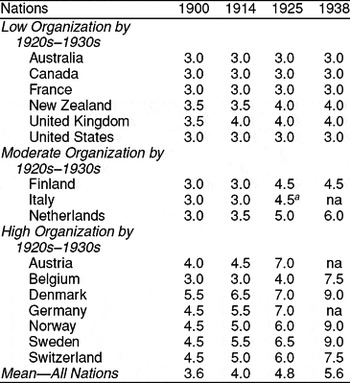
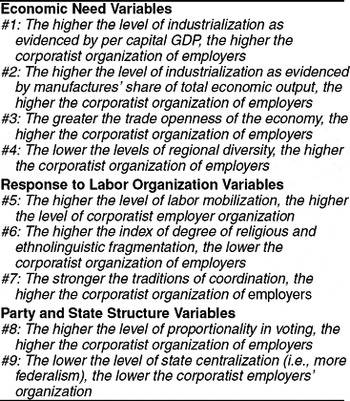
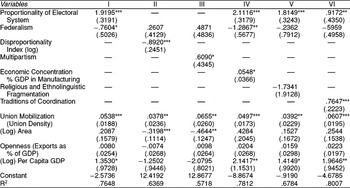
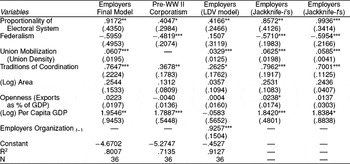
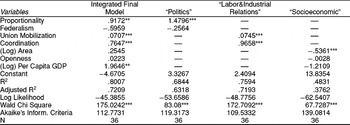



Comments
No Comments have been published for this article.