Introduction
Eating disorders (EDs), that is anorexia nervosa (AN), bulimia nervosa (BN) and binge eating disorder (BED), are common mental disorders with heightened morbidity and all-cause mortality (Treasure et al. Reference Treasure, Claudino and Zucker2010). Whereas AN patients of the restricting type (ANR) merely show severe food restriction, those of the binge/purge type (AN/BP) also show binge eating episodes and purging behaviours (e.g. self-induced vomiting or laxative misuse). Similarly, both BN and BED are characterized by recurrent episodes of binge eating with (BN) and without (BED) compensatory purging behaviours (APA, 2013).
Obesity is defined as having a body mass index (BMI) ⩾30 kg/m2; overweight refers to a BMI between 25 and 30 kg/m2. Both conditions are multifactorial and mostly chronic and play important roles in the development of several somatic diseases such as diabetes, hypertension, cardiovascular disease and different types of cancer (Baumgartner et al. Reference Baumgartner, Heymsfield and Roche1995; Pi-Sunyer, Reference Pi-Sunyer2002). The prevalence of obesity has risen dramatically over the past 20 years and is considered as one of the most urgent public health concerns (WHO, 2000).
Individuals with a bulimic-type ED (especially BN and BED) and those suffering from overweight or obesity share common behavioural patterns of compulsive overeating (Hill, Reference Hill2007; Goldschmidt et al. Reference Goldschmidt, Aspen, Sinton, Tanofsky-Kraff and Wilfley2008), neurobiological features of dysfunctional cognitive control and food addiction (Van den Eynde & Treasure, Reference Van den Eynde and Treasure2009; Volkow et al. Reference Volkow, Wang, Fowler, Tomasi and Baler2012), in addition to biological and environmental risk factors (Bulik et al. Reference Bulik, Sullivan and Kendler2003; Haines et al. Reference Haines, Kleinman, Rifas-Shiman, Field and Austin2010). Furthermore, co-morbidity rates are high between EDs and obesity (Villarejo et al. Reference Villarejo, Fernandez-Aranda, Jimenez-Murcia, Penas-Lledo, Granero, Penelo, Tinahones, Sancho, Vilarrasa, Montserrat-Gil de Bernabe, Casanueva, Fernandez-Real, Fruhbeck, De la Torre, Treasure, Botella and Menchon2012). Importantly, there is growing evidence for a link between obesity and inefficient cognitive control (Fitzpatrick et al. Reference Fitzpatrick, Gilbert and Serpell2013). Given these similarities, bulimic-type EDs and obesity have been considered to lie on the same continuum (Williamson et al. Reference Williamson, Womble, Smeets, Netemeyer, Thaw, Kutlesic and Gleaves2002).
Correspondingly, dimensional concepts and transdiagnostic theories on common mechanisms underlying the whole spectrum of EDs, including obesity, have gained increasing interest in recent years (Fairburn et al. Reference Fairburn, Cooper and Shafran2003). Indeed, ED patients regularly show a diagnostic cross-over between ED categories and there is considerable co-morbidity between EDs and obesity, which supports a diagnostic approach based on dimensions of observable behaviour and neuropsychological measures (Eddy et al. Reference Eddy, Dorer, Franko, Tahilani, Thompson-Brenner and Herzog2008; Castellini et al. Reference Castellini, Lo Sauro, Mannucci, Ravaldi, Rotella, Faravelli and Ricca2011; Monteleone et al. Reference Galderisi, Bucci, Mucci, Bellodi, Cassano, Santonastaso, Erzegovesi, Favaro, Mauri, Monteleone and Maj2011). Obsessive–compulsive personality traits are considered as one of these central mechanisms and transdiagnostic dimensions of ED psychopathology ranging from AN to BN to BED (Fairburn et al. Reference Fairburn, Cooper and Shafran2003; Cassin & von Ranson, Reference Cassin and von Ranson2005; Meade et al. Reference Meade, Nam, Beckerman and Hatchwell2010). Obsessive–compulsive traits have also been linked to obesity (Mount et al. Reference Mount, Neziroglu and Taylor1990; Petry et al. Reference Petry, Barry, Pietrzak and Wagner2008; Pavan et al. Reference Pavan, Azzi, Lancerotto, Marini, Busetto, Bassetto and Vindigni2013).
Obsessionality and compulsivity have been defined as traits associated with altered neurotransmission in frontostriatal systems (Zastrow et al. Reference Zastrow, Kaiser, Stippich, Walther, Herzog, Tchanturia, Belger, Weisbrod, Treasure and Friederich2009), leading to persisting inappropriate actions (Dalley et al. Reference Dalley, Everitt and Robbins2011). There is increasing evidence that obsessive–compulsive personality traits play an important role in the development and maintenance of EDs and obesity. For example, compulsive personality traits are considered to represent a heritable factor contributing to ED vulnerability (Lilenfeld et al. Reference Lilenfeld, Kaye, Greeno, Merikangas, Plotnicov, Pollice, Rao, Strober, Bulik and Nagy1998, Reference Lilenfeld, Stein, Bulik, Strober, Plotnicov, Pollice, Rao, Merikangas, Nagy and Kaye2000; Anderluh et al. Reference Anderluh, Tchanturia, Rabe-Hesketh and Treasure2003). ED patients are characterized by perfectionism, behavioural rigidity and ritualized behaviours concerning eating, weight and shape (Cassin & von Ranson, Reference Cassin and von Ranson2005; Schmidt & Treasure, Reference Schmidt and Treasure2006; Bardone-Cone et al. Reference Bardone-Cone, Wonderlich, Frost, Bulik, Mitchell, Uppala and Simonich2007). Compulsive behaviour seems to be deeply rooted in the neurobiology of EDs as it is associated with decreased activations in the left and right thalamus, ventral striatum, anterior cingulate cortex and sensorimotor brain regions in women with acute AN, for instance (Zastrow et al. Reference Zastrow, Kaiser, Stippich, Walther, Herzog, Tchanturia, Belger, Weisbrod, Treasure and Friederich2009). Correspondingly, it has been suggested that certain cortico-striato-thalamic loops are associated with compulsivity (Robbins et al. Reference Robbins, Gillan, Smith, de Wit and Ersche2012).
At a neuropsychological level, obsessive–compulsive traits may show up as inefficient set-shifting, which is characterized by concrete and rigid approaches to changing rules and stereotypic or perseverative thinking and behaviour (Friederich & Herzog, Reference Friederich and Herzog2011). By contrast, high levels of set-shifting reflect the ability to easily move back and forth between multiple tasks, operations or mental sets in response to changing goals or environmental experiences (Miyake et al. Reference Miyake, Friedman, Emerson, Witzki, Howerter and Wager2000). Thus, set-shifting may represent a basic executive function that contributes to rigid mental acts and behaviours that are central to the phenomenology of several mental disorders, particularly obsessive–compulsive disorder (OCD) and EDs but also attention deficit hyperactivity disorder (ADHD) and substance dependence (Robbins et al. Reference Robbins, Gillan, Smith, de Wit and Ersche2012). Accordingly, poor set-shifting was found in individuals with OCD and those with an ED (Chamberlain et al. Reference Chamberlain, Fineberg, Blackwell, Robbins and Sahakian2006; Tchanturia et al. Reference Tchanturia, Davies, Roberts, Harrison, Nakazato, Schmidt, Treasure and Morris2012), and also in their unaffected first-degree relatives (Holliday et al. Reference Holliday, Tchanturia, Landau, Collier and Treasure2005; Chamberlain et al. Reference Chamberlain, Fineberg, Menzies, Blackwell, Bullmore, Robbins and Sahakian2007). The latter finding suggests poor set-shifting to be a stable trait marker that is also seen in the absence of clinically significant symptoms and that may play a central role in the development of EDs and OCD.
The most common measures of set-shifting in ED research are the Wisconsin Card Sorting Test (WCST; Heaton et al. Reference Heaton, Chelune, Talley, Kay and Curtiss1993) and the Trail Making Task (TMT; Halstead, Reference Halstead1947; Reitan & Wolfson, Reference Reitan and Wolfson1985). Less commonly used measures of set-shifting ability in EDs are the Verbal Fluency Test (VFT; Delis et al. Reference Delis, Kaplan and Kramer2001), the Intra-Dimensional/Extra-Dimensional (ID/ED) set-shifting task (Robbins et al. Reference Robbins, James, Owen, Sahakian, Lawrence, McInnes and Rabbitt1998), the Brixton spatial anticipation test (Burgess & Shallice, Reference Burgess and Shallice1997), the Object Alternation Test (OAT; Freedman, Reference Freedman1990) and Weigl's Sorting Test (WST; Weigl, Reference Weigl1941). In addition, the Uznadze haptic illusion task (Uznadze, Reference Uznadze1966) has been used in a few studies to assess cognitive flexibility in EDs (Tchanturia et al. Reference Tchanturia, Harrison, Davies, Roberts, Oldershaw, Nakazato, Stahl, Morris, Schmidt and Treasure2011, Reference Tchanturia, Davies, Roberts, Harrison, Nakazato, Schmidt, Treasure and Morris2012). However, this task also assesses, to a greater extent, abilities of perceptual discrimination (Uznadze, Reference Uznadze1966; Tchanturia et al. Reference Tchanturia, Morris, Anderluh, Collier, Nikolaou and Treasure2004b ).
Numerous studies with primarily small sample sizes have used these tests to investigate set-shifting in ED patients but have yielded fairly inconsistent results. Some studies found evidence for inefficient set-shifting in AN (Fagundo et al. Reference Fagundo, de la Torre, Jimenez-Murcia, Aguera, Granero, Tarrega, Botella, Banos, Fernandez-Real, Rodriguez, Forcano, Fruhbeck, Gomez-Ambrosi, Tinahones, Fernandez-Garcia, Casanueva and Fernandez-Aranda2012), BN (Roberts et al. Reference Roberts, Tchanturia and Treasure2010) and BED (Svaldi et al. Reference Svaldi, Brand and Tuschen-Caffier2010) whereas others failed to do so (Abbate-Daga et al. Reference Abbate-Daga, Buzzichelli, Amianto, Rocca, Marzola, McClintock and Fassino2011; Galderisi et al. Reference Galderisi, Bucci, Mucci, Bellodi, Cassano, Santonastaso, Erzegovesi, Favaro, Mauri, Monteleone and Maj2011). There is similar heterogeneity regarding the findings of altered set-shifting in overweight and obesity, with some studies showing reduced set-shifting abilities in affected individuals (Verdejo-Garcia et al. Reference Verdejo-Garcia, Perez-Exposito, Schmidt-Rio-Valle, Fernandez-Serrano, Cruz, Perez-Garcia, Lopez-Belmonte, Martin-Matillas, Martin-Lagos, Marcos and Campoy2010) and some showing no difference between overweight/obese (OW/OB) individuals and normal-weight (NW) controls (Ariza et al. Reference Ariza, Garolera, Jurado, Garcia-Garcia, Hernan, Sánchez-Garre, Vernet-Vernet, Sender-Palacios, Marques-Iturria, Pueyo, Segura and Narberhaus2012).
Several authors have previously summarized empirical findings on cognitive functions (including set-shifting) in EDs and overweight/obesity. However, these reviews either (a) did not use a meta-analytic approach (Van den Eynde et al. Reference Van den Eynde, Guillaume, Broadbent, Stahl, Campbell, Schmidt and Tchanturia2011; Fitzpatrick et al. Reference Fitzpatrick, Gilbert and Serpell2013) or (b) did not cover the complete spectrum of EDs (AN: Stedal et al. Reference Stedal, Frampton, Landro and Lask2012; AN and BN: Roberts et al. Reference Roberts, Tchanturia, Stahl, Southgate and Treasure2007; Zakzanis et al. Reference Zakzanis, Campbell and Polsinelli2010; overweight/obesity: Fitzpatrick et al. Reference Fitzpatrick, Gilbert and Serpell2013) and did not distinguish between AN subtypes (Roberts et al. Reference Roberts, Tchanturia, Stahl, Southgate and Treasure2007; Zakzanis et al. Reference Zakzanis, Campbell and Polsinelli2010; Stedal et al. Reference Stedal, Frampton, Landro and Lask2012); and/or (c) did only focus on one single measure of set-shifting (Stedal et al. Reference Stedal, Frampton, Landro and Lask2012); and/or (d) have not pooled an overall ES, incorporating studies using different measures of set-shifting (Roberts et al. Reference Roberts, Tchanturia, Stahl, Southgate and Treasure2007; Van den Eynde et al. Reference Van den Eynde, Guillaume, Broadbent, Stahl, Campbell, Schmidt and Tchanturia2011). Furthermore, as the number of set-shifting studies in EDs is increasing rapidly, previous reviews on this topic need to be updated.
The aim of the present review was to synthesize the available literature on set-shifting across all three ED subtypes and overweight/obesity by means of meta-analysis. More specifically, the following questions are addressed by this review: (a) Are ED subtypes and overweight/obesity associated with poor set-shifting as measured by neuropsychological tests when compared to normal controls? (b) Do ED subtypes differ regarding set-shifting ability? (c) Do overweight and obese people differ in terms of set-shifting ability? (d) Is there a difference between adult and adolescent individuals with EDs or overweight/obesity regarding set-shifting ability? (e) To what degree are the findings moderated by the specific set-shifting tasks?
Method
Search strategy and study selection
Original articles were searched using four electronic databases: PubMed, PsycINFO, PSYNDEX and Web of Science. Additional searches through reference lists and contacts with expert research groups in this area were conducted. The search strategy focused on cognitive domains related to set-shifting. The following search terms were used: compulsive, compulsivity, mental flexibility, cognitive flexibility, set-shifting, executive function, cognitive control, neurocognitive, neurocognition, neuropsychology, eating disorder, bulimia nervosa, binge eating disorder, anorexia nervosa, binge/purge, binge eating, purging disorder, overweight, obese, and obesity. Literature was searched up until November 2013.
The retrieved titles and abstracts generated from the literature search were screened independently by two of the authors (M.W. and H.-C.F.). For every abstract that was identified as potentially relevant by at least one of these two authors, the full-text article was retrieved for evaluation, which was completed independently by M.W. and H.-C.F. Discrepancies were resolved by discussion.
The classification of tasks as set-shifting measures was based on the information provided in the publications and discussions among all authors. As mentioned in the Introduction, the two most commonly used tests were the WCST and the TMT. In the WCST, participants are required to match stimulus cards with one of four category cards. The sorting rule can be according to colour, shape or number of the displayed symbols. The rules switch unpredictably during task administration and have to be inferred repeatedly by the participant. Perseveration errors seem to be the most widely used and most sensitive performance index of the WCST. This index is obtained by counting the number of times a participant sorts the cards according to a previously correct but currently false principle, despite negative feedback from the test (Pennington & Ozonoff, Reference Pennington and Ozonoff1996). In the TMT, the participants are first asked to numerically connect numbered circles (i.e. 1–2–3; trail A) and then to alternatively link numbers and letters (i.e. 1–A–2–B–3–C; trail B). Set-shifting performance is indexed by the time taken to complete trail B correctly or by the difference between the time taken for trail A and trail B (Crowe, Reference Crowe1998).
A priori criteria for the inclusion of original studies into the present meta-analysis were that they (a) were peer-reviewed original research articles; (b) compared at least one clinical group of ED patients (minimum age 10 years) with a healthy control group or compared at least one group of OW/OB individuals (minimum age 10 years) with a NW control group; (c) differentiated clearly between ED subtypes (participants had to meet either DSM-III, DSM-IV or ICD-10 criteria for current AN, BN or BED; for ED studies only); (d) provided detailed descriptions of sociodemographic variables; (e) used at least one neuropsychological task that assessed set-shifting; and (f) provided sufficient statistical information to allow the calculation of effect sizes (ESs).
Data extraction and quality assessment
For data extraction (study characteristics, study results and quality assessment), we used a standardized form developed prior to the literature search. All discrepancies were rechecked and disagreements were resolved by discussion with all authors. Descriptive statistics (means, standard deviations and sample sizes) for the main outcome measures of relevant tasks in ED patients and healthy controls and also in OW/OB individuals and NW participants were extracted for the calculation of ESs. For articles that did not report means and/or standard deviations, p values and sample sizes were used. Additionally, the following information was extracted from each study to aid the quality description and assessment of the study: diagnostic criteria, inclusion criteria, exclusion criteria, source of sample, sample size, sample demographics (age, gender, BMI, educational level), co-morbid diagnoses, current treatment (including psycho-active medication), neuropsychological test, outcomes, and main findings. Missing data were requested from the authors of the original articles whenever possible.
The methodological quality of included studies was assessed with a validity score based on the study's design, measures and analyses (e.g. data analysis, sample size, co-morbid diagnoses, current treatment, psychotropic medication, and differences between ED patients or OW/OB individuals and controls concerning age, educational level and relevant information about the tests used). The maximum quality score was 10. Quality levels of evidence for each study were defined as either high (⩾8), medium (6–8) or low (⩽5). Any discrepancies in quality assessment between two of the authors (M.W. and H.-C.F.) were resolved by a third author (M.H.).
Quantitative data synthesis
For publications that included more than one patient group (e.g. AN and BN), ESs were calculated separately for each patient group and treated as separate studies [shown as (1), (2), etc.]. A separate ES was calculated for the main outcome of every relevant task in all studies. For studies using more than one neuropsychological measure of set-shifting, a mean ES by averaging ESs across all measures within one study was computed and included in the calculation of the overall ES.
The ES was calculated as Hedges’ g (a variation of Cohen's d that corrects for biases due to small sample sizes) and reported with its 95% confidence interval (CI). The magnitude of Hedges’ g was interpreted using Cohen's recommendations with small (⩾ 0.2), medium (⩾ 0.5) and large (⩾ 0.8) effects. A negative ES indicates worse set-shifting in ED patients or OW/OB individuals compared to controls. Given the variety of neuropsychological measures and outcomes, we used the more conservative random-effects model rather than a fixed-effect model to estimate a pooled ES. Heterogeneity among the studies was assessed using the Q test. Additionally, the I 2 statistic values are reported [I 2 = (Q – df)/Q]. As a sample size-independent measure of the inconsistency of ESs across studies, I 2 is more powerful, with small sample sizes, compared to Cochran's Q test. An I 2 value above 50% indicates medium heterogeneity, and an I 2 value above 75% indicates large heterogeneity (Higgins et al. Reference Higgins, Thompson, Deeks and Altman2003).
Moderator and sensitivity analysis
Subgroup analyses were conducted for ED and overweight/obesity subtypes and measures of set-shifting to identify potential moderators that might explain sources of heterogeneity between studies. Furthermore, subgroup analyses were conducted within each ED subtype and in overweight and obese samples (whenever possible) to explore the differences of set-shifting ability between adult and adolescent individuals. Sensitivity analyses were conducted to explore the influence of study quality on the pooled ES.
Small study effects
Small study effects as an indicator for publication bias were assessed informally by visual inspection of the funnel plot and by conducting Egger's test (Sterne et al. Reference Sterne, Sutton, Ioannidis, Terrin, Jones, Lau, Carpenter, Rucker, Harbord, Schmid, Tetzlaff, Deeks, Peters, Macaskill, Schwarzer, Duval, Altman, Moher and Higgins2011).
Results
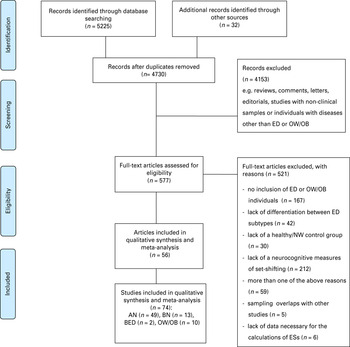
The PRISMA statement for reporting systematic reviews and meta-analyses was followed (Moher et al. Reference Moher, Liberati, Tetzlaff and Altman2009). Figure 1 is a flow chart showing the number of articles found at each stage of the literature search and the final number of studies included in the analysis.
Preferred Reporting Items for Systematic Reviews and Meta-Analyses (PRISMA) flow diagram. ED, eating disorder; AN, anorexia nervosa; BN, bulimia nervosa; BED, binge eating disorder; OW, overweight; OB, obese; NW, normal weight; ES, effect size.

Our literature search yielded 4730 potentially eligible articles after exclusion of duplicates. A total of 577 articles were found to be potentially relevant and were retrieved as full text. Of these, 521 articles were excluded because they did not meet the inclusion criteria: no inclusion of ED or OW/OB individuals (n = 167), lack of differentiation between ED subtypes (n = 42), absence of a healthy control group for ED studies or a NW control group for overweight/obesity studies (n = 30), lack of a neuropsychological test of set-shifting (n = 212), or a combination of these reasons (n = 59). In addition, five studies (Tchanturia et al. Reference Tchanturia, Morris, Anderluh, Collier, Nikolaou and Treasure2004b , Reference Tchanturia, Harrison, Davies, Roberts, Oldershaw, Nakazato, Stahl, Morris, Schmidt and Treasure2011; Nakazato et al. Reference Nakazato, Tchanturia, Schmidt, Campbell, Treasure, Collier, Hashimoto and Iyo2009; Zastrow et al. Reference Zastrow, Kaiser, Stippich, Walther, Herzog, Tchanturia, Belger, Weisbrod, Treasure and Friederich2009; Giel et al. Reference Giel, Wittorf, Wolkenstein, Klingberg, Drimmer, Schonenberg, Rapp, Fallgatter, Hautzinger and Zipfel2012) were excluded from the meta-analysis because of sampling overlaps with other reports by these authors (Tchanturia et al. Reference Tchanturia, Serpell, Troop and Treasure2001, Reference Tchanturia, Anderluh, Morris, Rabe-Hesketh, Collier, Sanchez and Treasure2004a , Reference Tchanturia, Davies, Roberts, Harrison, Nakazato, Schmidt, Treasure and Morris2012; Nakazato et al. Reference Nakazato, Hashimoto, Schmidt, Tchanturia, Campbell, Collier, Iyo and Treasure2010; Giel et al. Reference Giel, Friederich, Teufel, Hautzinger, Enck and Zipfel2011; Friederich et al. Reference Friederich, Walther, Bendszus, Biller, Thomann, Zeigermann, Katus, Brunner, Zastrow and Herzog2012). Another six studies were not included because no data were available for the calculation of an ES (Touyz et al. Reference Touyz, Beumont and Johnstone1986; Ohrmann et al. Reference Ohrmann, Kersting, Suslow, Lalee-Mentzel, Donges, Fiebich, Arolt, Heindel and Pfleiderer2004; Castro-Fornieles et al. Reference Castro-Fornieles, Bargallo, Lazaro, Andres, Falcon, Plana and Junque2007; Cserjési et al. Reference Cserjési, Luminet, Poncelet and Lenard2009; Fergenbaum et al. Reference Fergenbaum, Bruce, Lou, Hanley, Greenwood and Young2009; Garcia-Garcia et al. Reference Garcia-Garcia, Jurado, Garolera, Segura, Sala-Llonch, Marques-Iturria, Pueyo, Sender-Palacios, Vernet-Vernet, Narberhaus, Ariza and Junque2013). Finally, 48 articles including 64 studies with a total of 1825 ED patients (comprising 1394 AN, 376 BN and 55 BED patients with sample sizes ranging from six to 171 for each ED subgroup) and eight articles including 10 studies with a total of 449 OW/OB participants with sample sizes ranging from 11 to 140 in each subgroup were included in the meta-analyses. The results are separated into two categories: ED and overweight/obesity.
Set-shifting in EDs
Study characteristics
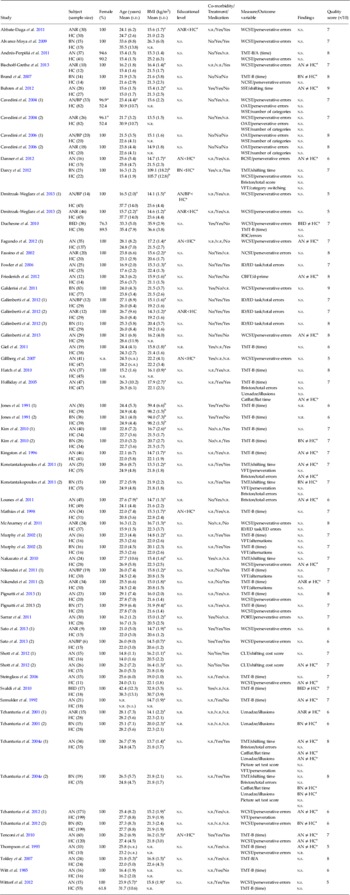
The mean quality score of all included ED studies was 7.5. As shown in Table 1, most of the studies investigated set-shifting exclusively in female samples, with only four articles also including a minority of male participants (Cavedini et al. Reference Cavedini, Bassi, Ubbiali, Casolari, Giordani, Zorzi and Bellodi2004; Duchesne et al. Reference Duchesne, Mattos, Appolinario, de Freitas, Coutinho, Santos and Coutinho2010; Andrés-Perpiña et al. Reference Andrés-Perpiña, Lozano-Serra, Puig, Lera-Miguel, Lázaro and Castro-Fornieles2011; Wittorf et al. Reference Wittorf, Giel, Hautzinger, Rapp, Schonenberg, Wolkenstein, Zipfel, Mehl, Fallgatter and Klingberg2012). Most of the studies were conducted in adult samples; the exceptions were 10 AN studies (Witt et al. Reference Witt, Ryan and Hsu1985; Fowler et al. Reference Fowler, Blackwell, Jaffa, Palmer, Robbins, Sahakian and Dowson2006; Hatch et al. Reference Hatch, Madden, Kohn, Clarke, Touyz, Gordon and Williams2010; Andrés-Perpiña et al. Reference Andrés-Perpiña, Lozano-Serra, Puig, Lera-Miguel, Lázaro and Castro-Fornieles2011; McAnarney et al. Reference McAnarney, Zarcone, Singh, Michels, Welsh, Litteer, Wang and Klein2011; Sarrar et al. Reference Sarrar, Ehrlich, Merle, Pfeiffer, Lehmkuhl and Schneider2011; Buhren et al. Reference Buhren, Mainz, Herpertz-Dahlmann, Schafer, Kahraman-Lanzerath, Lente and Konrad2012; Shott et al. Reference Shott, Filoteo, Bhatnagar, Peak, Hagman, Rockwell, Kaye and Frank2012; Bischoff-Grethe et al. Reference Bischoff-Grethe, McCurdy, Grenesko-Stevens, Irvine, Wagner, Yau, Fennema-Notestine, Wierenga, Fudge, Delgado and Kaye2013; Dmitrzak-Weglarz et al. Reference Dmitrzak-Weglarz, Skibinska, Slopien, Tyszkiewicz, Pawlak, Maciukiewicz, Zaremba, Rajewski and Hauser2013) and one BN study (Darcy et al. Reference Darcy, Fitzpatrick, Colborn, Manasse, Datta, Aspen, Shields, Le Grange and Lock2012). The mean age of the entire sample was 23.9 years (range 14.8–42.4 years). The mean age of AN, BN and BED participants was 23.2, 25.0 and 36.1 years, respectively. The mean BMI in the entire sample was 17.5 kg/m2 (range 13.3–35.9 kg/m2). The mean BMI of AN, BN and BED participants was 15.7, 22.0 and 34.9 kg/m2 respectively. Thirteen articles reported no co-morbid Axis I diagnosis in their patient groups (Fassino et al. Reference Fassino, Piero, Daga, Leombruni, Mortara and Rovera2002; Cavedini et al. Reference Cavedini, Bassi, Ubbiali, Casolari, Giordani, Zorzi and Bellodi2004, Reference Cavedini, Zorzi, Bassi, Gorini, Baraldi, Ubbiali and Bellodi2006; Fowler et al. Reference Fowler, Blackwell, Jaffa, Palmer, Robbins, Sahakian and Dowson2006; Brand et al. Reference Brand, Franke-Sievert, Jacoby, Markowitsch and Tuschen-Caffier2007; Alvarez-Moya et al. Reference Alvarez-Moya, Jimenez-Murcia, Moragas, Gomez-Pena, Aymami, Ochoa, Sanchez-Diaz, Menchon and Fernandez-Aranda2009; Kim et al. Reference Kim, Kim and Kim2010; Andrés-Perpiña et al. Reference Andrés-Perpiña, Lozano-Serra, Puig, Lera-Miguel, Lázaro and Castro-Fornieles2011; Lounes et al. Reference Lounes, Khan and Tchanturia2011; McAnarney et al. Reference McAnarney, Zarcone, Singh, Michels, Welsh, Litteer, Wang and Klein2011; Galimberti et al. Reference Galimberti, Martoni, Cavallini, Erzegovesi and Bellodi2012, Reference Galimberti, Fadda, Cavallini, Martoni, Erzegovesi and Bellodi2013; Shott et al. Reference Shott, Filoteo, Bhatnagar, Peak, Hagman, Rockwell, Kaye and Frank2012).
Summary of studies on set-shifting in patients with eating disorders (EDs)

AN, Anorexia nervosa; ANR, AN restricting type; AN/BP, AN binge/purge type; BN, bulimia nervosa; BED, binge eating disorder; PORT, Probabilistic Object Reversal Task; RSC, Rule Shift Cards Test; HC, healthy controls; BMI, body mass index; n.s., no significant difference between patients and controls; n.r., not reported; BCST, Berg's Card Sorting Test; Brixton, Brixton spatial anticipation test; CBFT, Cognitive-behavioural flexibility task; CLT, Category Learning Test; Uznadze, Uznadze haptic illusion test; ID/ED, Intra-Dimensional/Extra-Dimensional; NCST, Nelson's Card Sorting Test; PST, Picture Set Test; s.d., standard deviation; SST, Set-Shifting Test; TMT, Trail Making Task (Parts A and B); VFT, Verbal Fluency Test; WCST, Wisconsin Card Sorting Test; WST, Weigl's Sorting Test.
a Significant group difference.
b Percentage of ideal body weight.
In seven studies set-shifting was assessed before treatment (Tchanturia et al. Reference Tchanturia, Serpell, Troop and Treasure2001; Cavedini et al. Reference Cavedini, Zorzi, Bassi, Gorini, Baraldi, Ubbiali and Bellodi2006; Sarrar et al. Reference Sarrar, Ehrlich, Merle, Pfeiffer, Lehmkuhl and Schneider2011) or during the first 1 or 2 weeks of treatment (Murphy et al. Reference Murphy, Nutzinger, Paul and Leplow2002; Brand et al. Reference Brand, Franke-Sievert, Jacoby, Markowitsch and Tuschen-Caffier2007; Nikendei et al. Reference Nikendei, Funiok, Pfuller, Zastrow, Aschenbrenner, Weisbrod, Herzog and Friederich2011; Galimberti et al. Reference Galimberti, Martoni, Cavallini, Erzegovesi and Bellodi2012). The other studies did not include any kind of treatment. Eleven articles reported that their patient groups were free of any psychotropic medication (Witt et al. Reference Witt, Ryan and Hsu1985; Jones et al. Reference Jones, Duncan, Brouwers and Mirsky1991; Szmukler et al. Reference Szmukler, Andrewes, Kingston, Chen, Stargatt and Stanley1992; Cavedini et al. Reference Cavedini, Zorzi, Bassi, Gorini, Baraldi, Ubbiali and Bellodi2006; Brand et al. Reference Brand, Franke-Sievert, Jacoby, Markowitsch and Tuschen-Caffier2007; Duchesne et al. Reference Duchesne, Mattos, Appolinario, de Freitas, Coutinho, Santos and Coutinho2010; McAnarney et al. Reference McAnarney, Zarcone, Singh, Michels, Welsh, Litteer, Wang and Klein2011; Buhren et al. Reference Buhren, Mainz, Herpertz-Dahlmann, Schafer, Kahraman-Lanzerath, Lente and Konrad2012; Fagundo et al. Reference Fagundo, de la Torre, Jimenez-Murcia, Aguera, Granero, Tarrega, Botella, Banos, Fernandez-Real, Rodriguez, Forcano, Fruhbeck, Gomez-Ambrosi, Tinahones, Fernandez-Garcia, Casanueva and Fernandez-Aranda2012; Friederich et al. Reference Friederich, Walther, Bendszus, Biller, Thomann, Zeigermann, Katus, Brunner, Zastrow and Herzog2012; Galimberti et al. Reference Galimberti, Fadda, Cavallini, Martoni, Erzegovesi and Bellodi2013). By contrast, 17 articles included patients currently under selective serotonin reuptake inhibitor (SSRI) medication (Murphy et al. Reference Murphy, Nutzinger, Paul and Leplow2002; Tchanturia et al. Reference Tchanturia, Anderluh, Morris, Rabe-Hesketh, Collier, Sanchez and Treasure2004a ; Holliday et al. 2005; Fowler et al. Reference Fowler, Blackwell, Jaffa, Palmer, Robbins, Sahakian and Dowson2006; Alvarez-Moya et al. Reference Alvarez-Moya, Jimenez-Murcia, Moragas, Gomez-Pena, Aymami, Ochoa, Sanchez-Diaz, Menchon and Fernandez-Aranda2009; Kim et al. Reference Kim, Kim and Kim2010; Tenconi et al. Reference Tenconi, Santonastaso, Degortes, Bosello, Titton, Mapelli and Favaro2010; Abbate-Daga et al. Reference Abbate-Daga, Buzzichelli, Amianto, Rocca, Marzola, McClintock and Fassino2011; Giel et al. Reference Giel, Friederich, Teufel, Hautzinger, Enck and Zipfel2011; Konstantakopoulos et al. Reference Konstantakopoulos, Tchanturia, Surguladze and David2011; Nikendei et al. Reference Nikendei, Funiok, Pfuller, Zastrow, Aschenbrenner, Weisbrod, Herzog and Friederich2011; Darcy et al. Reference Darcy, Fitzpatrick, Colborn, Manasse, Datta, Aspen, Shields, Le Grange and Lock2012; Galimberti et al. Reference Galimberti, Martoni, Cavallini, Erzegovesi and Bellodi2012; Shott et al. Reference Shott, Filoteo, Bhatnagar, Peak, Hagman, Rockwell, Kaye and Frank2012; Wittorf et al. Reference Wittorf, Giel, Hautzinger, Rapp, Schonenberg, Wolkenstein, Zipfel, Mehl, Fallgatter and Klingberg2012; Bischoff-Grethe et al. Reference Bischoff-Grethe, McCurdy, Grenesko-Stevens, Irvine, Wagner, Yau, Fennema-Notestine, Wierenga, Fudge, Delgado and Kaye2013; Sato et al. Reference Sato, Saito, Utsumi, Aizawa, Shoji, Izumiyama, Mushiake, Hongo and Fukudo2013), other antidepressant medication (Murphy et al. Reference Murphy, Nutzinger, Paul and Leplow2002), low-dose antipsychotic medication (Bischoff-Grethe et al. Reference Bischoff-Grethe, McCurdy, Grenesko-Stevens, Irvine, Wagner, Yau, Fennema-Notestine, Wierenga, Fudge, Delgado and Kaye2013) or benzodiazepine treatment (Alvarez-Moya et al. Reference Alvarez-Moya, Jimenez-Murcia, Moragas, Gomez-Pena, Aymami, Ochoa, Sanchez-Diaz, Menchon and Fernandez-Aranda2009). Of note, only 28 out of 64 original ED studies reported significant differences between ED patients and healthy controls regarding set-shifting abilities (see Table 1).
Overall ES and publication bias
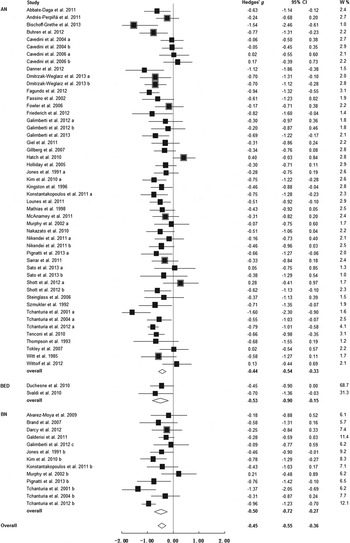
The pooled overall ES for the 64 studies on set-shifting in ED patients (Hedges’ g = –0.45, s.e. = 0.05, 95% CI –0.55 to –0.36, p < 0.001) represented a small to medium ES for inefficient set-shifting in ED patients (see Fig. 2). There was significant evidence of heterogeneity between studies [Q (63) = 126.0, p < 0.001]. The ESs across studies showed medium inconsistency (I 2 = 50.0%). However, visual inspection of the funnel plot (see Supplementary Material E) and the results of Egger's test (p = 0.118) did not indicate small study effects (which would be indicative of a publication bias) regarding the pooled overall ES.
Forest plot for studies on set-shifting in patients with eating disorders (EDs): ■ studies with adult samples;  studies with adolescent samples. AN, Anorexia nervosa; BN, bulimia nervosa; BED, binge eating disorder; Hedges’ g, estimation of effect size (a negative effect size indicates poorer set-shifting in patients than in controls); CI, confidence interval; W%, relative weight (percentage).

Moderator analysis
As shown in Supplementary Material A, subgroup analyses for ED subtypes yielded significant small to medium ESs for AN (Hedges’ g = –0.44, 95% CI –0.54 to –0.33, p < 0.001), BN (Hedges’ g = –0.50, 95% CI –0.72 to –0.27, p < 0.001) and BED (Hedges’ g = –0.53, 95% CI –0.90 to –0.15, p = 0.006). The ESs across ED subtypes did not differ significantly (p = 0.824; see Fig. 2). Compared to the ESs across the two studies with BED patients (I 2 = 0), the ESs across the 49 studies with AN patients and the ESs across the 13 studies with BN patients showed higher inconsistency (I 2 = 49.9% and 57.8% respectively).
Approximately two-thirds of studies (32 of 49) did not differentiate between ANR and AN/BP. However, we found a medium pooled ES across the 11 studies with ANR patients (Hedges' g = –0.51, 95% CI –0.78 to –0.23, p < 0.001) whereas the pooled ES across the six studies with AN/BP patients was not significant (Hedges’ g = –0.18, 95% CI –0.41 to 0.05, p = 0.131; see also Supplementary Material A). Visual inspection of the funnel plots (Supplementary Material E) and the results of Egger's tests did not indicate small study effects regarding the pooled ESs for ED subtypes (all p values > 0.26; see Table 1).
Subgroup analyses for studies in adult and adolescent ED patients did not reveal significant differences in ESs, neither between adult and adolescent AN patients (p = 0.627) nor between adult and adolescent BN patients (p = 0.412; for details see Supplementary Material B). However, it should be noted that there was only one BN study examining an adolescent sample and, contrary to the studies with adult BN samples, this study revealed no significant ES for the difference between BN participants and controls. There was no study with adolescent BED patients.
As shown in Supplementary Material C, several measures of set-shifting were used in the original studies. Across the studies, ESs for these different measures differed significantly from each other (p < 0.001). The most frequently used measures of set-shifting in studies with ED patients were the TMT, used in 32 studies (Hedges’ g = –0.41, 95% CI –0.54 to –0.28, p < 0.001), and the WCST, used in 25 studies (Hedges’ g = –0.53, 95% CI –0.67 to –0.40, p < 0.001). The pooled ESs across the less frequently used measures of set-shifting (i.e. the Brixton test, Uznadze haptic illusion task, ID/ED task and VFT) differed considerably, ranging from a large (Uznadze: Hedges’ g = –1.02, 95% CI –1.31 to –0.73, p < 0.001) to a small (Brixton: Hedges’ g = –0.43, 95% CI –0.79 to –0.08, p = 0.016; VFT: Hedges’ g = –0.25, 95% CI –0.44 to –0.07, p = 0.008) to a non-significant ES (ID/ED: Hedges’ g = –0.17, 95% CI –0.44 to +0.10, p = 0.219; for details, see also Supplementary Material C). Visual inspection of funnel plots and the results of Egger's tests did not indicate small study effects (all p values > 0.08; see also Fig. 2).
Sensitivity analysis
The sensitivity analysis including only studies of medium to high quality (59 out of 64) yielded a comparable overall ES (Hedges’ g = –0.45, 95% CI –0.55 to –0.36), indicating that study quality did not influence the pooled ES.
Set-shifting in overweight and obesity
Study characteristics
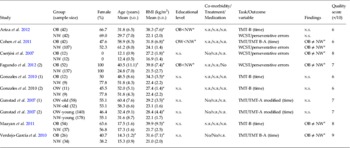
The mean quality score for all included overweight/obesity studies was 7.0. As shown in Table 2, most of the studies investigated set-shifting in samples of both genders (Fagundo et al. Reference Fagundo, de la Torre, Jimenez-Murcia, Aguera, Granero, Tarrega, Botella, Banos, Fernandez-Real, Rodriguez, Forcano, Fruhbeck, Gomez-Ambrosi, Tinahones, Fernandez-Garcia, Casanueva and Fernandez-Aranda2012) and another study with only men (Cserjési et al. Reference Cserjési, Molnar, Luminet and Lenard2007). Most of the studies were conducted in adult samples; only three studies were conducted with adolescent samples (Cserjési et al. Reference Cserjési, Molnar, Luminet and Lenard2007; Verdejo-Garcia et al. Reference Verdejo-Garcia, Perez-Exposito, Schmidt-Rio-Valle, Fernandez-Serrano, Cruz, Perez-Garcia, Lopez-Belmonte, Martin-Matillas, Martin-Lagos, Marcos and Campoy2010; Maayan et al. Reference Maayan, Hoogendoorn, Sweat and Convit2011). The mean age across studies was 36.9 years (range 12.1–60.4 years). The mean BMI across studies was 32.7 kg/m2 (range 27.2–39.9 kg/m2). Three articles reported no co-morbid Axis I diagnosis in their participant groups (Cserjési et al. Reference Cserjési, Molnar, Luminet and Lenard2007; Gunstad et al. Reference Gunstad, Paul, Cohen, Tate, Spitznagel and Gordon2007; Verdejo-Garcia et al. Reference Verdejo-Garcia, Perez-Exposito, Schmidt-Rio-Valle, Fernandez-Serrano, Cruz, Perez-Garcia, Lopez-Belmonte, Martin-Matillas, Martin-Lagos, Marcos and Campoy2010). Most of the studies did not provide information regarding current treatment and use of psychotropic medication (for details, see Table 2). Of note, only half of the original studies reported significant differences between OW/OB participants and NW controls regarding set-shifting (see Table 2).
Summary of studies on set-shifting in overweight (OW) and obese (OB) individuals

BMI, Body mass index; NW, normal weight; n.s., no significant difference between patients and controls; n.r., not reported; s.d., standard deviation; TMT, Trail Making Task (Parts A and B); WCST, Wisconsin Card Sorting Test.
a Significant group difference.
Overall ES and publication bias
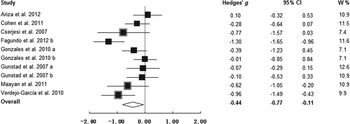
The pooled overall ES for the 10 studies on set-shifting in OW/OB samples (Hedges’ g = –0.44, s.e. = 0.17, 95% CI –0.77 to –0.11, p = 0.008) represented a small to medium ES of reduced set-shifting in OW/OB participants (see also Fig. 3). We found significant evidence for heterogeneity between studies [Q (9) = 49.6, p < 0.001]. The ESs across the studies showed high inconsistency (I 2 = 81.8%). However, visual inspection of the funnel plot (see Supplementary Material E) and the result of Egger's test (p = 0.557) did not indicate any small study effects regarding the pooled overall ES.
Forest plot for studies on set-shifting in overweight (OW) and obese (OB) participants: ■ studies with adult samples; studies with adolescent samples. Hedges’ g, estimation of effect size (ES; a negative ES indicates poorer set-shifting in patients than in controls); CI, confidence interval; W%, relative weight (percentage).

Moderator analysis
As the ESs across overweight/obesity studies were highly inconsistent, subgroup analyses (overweight versus obese; adult versus adolescent) were conducted. The first subgroup analysis did not yield a significant ES for overweight individuals (Hedges’ g = –0.07, 95% CI –0.26 to +0.12, p = 0.453) but did indicate a medium ES for obese individuals (Hedges’ g = –0.61, 95% CI –1.02 to –0.19, p = 0.004). The ESs between these two groups differed significantly (p = 0.022; see also Supplementary Material D). However, compared to the ESs across the three studies in overweight samples (I 2 = 0), the ESs across the seven obesity studies showed higher inconsistency (I 2 = 81.0%). Subgroup analyses for studies in adult and adolescent overweight and obese samples did not reveal significant differences in ESs (p = 0.084; for details see Supplementary Material D). In the overweight and obesity studies, the TMT and/or the WCST were used for assessing set-shifting. Across the studies, the ESs for these two different measures were not significantly different (p = 0.507; for details see Supplementary Material D).
Sensitivity analysis
No sensitivity analysis was conducted because all included overweight and obesity studies were of medium to high quality (quality score ⩾6).
Discussion
This systematic review and meta-analysis is the first to quantitatively synthesize neuropsychological data for set-shifting (a) across the whole spectrum of EDs and overweight/obesity and (b) separately for each ED subtype and (c) overweight and obesity, (d) for adult and adolescent samples, and (e) for each set-shifting measure. Nearly half of the original studies on set-shifting in EDs and OW/OB individuals failed to identify significant differences between ED or OW/OB individuals and controls. By contrast, the current meta-analysis revealed significant effects for poor set-shifting across the whole spectrum of EDs and obesity with small to medium ESs, except for AN/BP and overweight individuals.
A major finding of this meta-analysis is that all three ED subtypes and obesity were associated with diminished set-shifting abilities and that the magnitude of inefficiency was similar in AN, BN, BED and obesity. However, dismantling potential differences between AN subtypes, we found evidence for inefficient set-shifting in ANR but not in AN/BP. Similarly, we found significant effects for obese but not for overweight individuals. It should be noted, however, that there was great inconsistency regarding the ESs in obesity studies. ESs were comparable in adult and adolescent AN, BN and OW/OB samples in the studies that met the inclusion criteria for the meta-analysis. However, there was only one study examining set-shifting in adolescent BN patients, and no study with adolescent BED patients.
With respect to the different measures of set-shifting used in the original studies, our meta-analysis revealed a large ES for the Uznadze haptic illusion task, small to medium ESs for the TMT, WCST, Brixton and VFT, and a non-significant ES for the ID/ED task. This finding may indicate that ED patients and OW/OB individuals feature greater inefficiencies in some specific subcomponents of set-shifting than in others. For instance, the psychomotor/haptic subcomponent as assessed by the Uznadze task may be more seriously impoverished than other domains. However, the diverging results across the different measures of set-shifting may, at least in part, also result from methodological issues. Some tasks, such as the WCST, are complex and require many different cognitive operations. Besides the target component of set-shifting (Miyake et al. Reference Miyake, Friedman, Emerson, Witzki, Howerter and Wager2000), these tasks also involve other distinct classes of cognitive control abilities to enable the behavioural modifications in response to a sudden and unannounced change in task demands (Ridderinkhof et al. Reference Ridderinkhof, Span and van der Molen2002). These include, for example, performance monitoring (i.e. monitoring and interpreting task-relevant cues and feedback signals appropriately to guide adaptive behaviour) and rule induction and consolidation (considering and evaluating potential implicit rules and selecting one of them to adapt future responses) (Ridderinkhof et al. Reference Ridderinkhof, Span and van der Molen2002). These different facets involved in the same task may contribute, to some degree, to the variance in ESs found across different set-shifting measures.
The ES of the difference between AN patients and healthy controls resembles those found in previous reviews that were based on smaller sample sizes (Roberts et al. Reference Roberts, Tchanturia, Stahl, Southgate and Treasure2007; Zakzanis et al. Reference Zakzanis, Campbell and Polsinelli2010; Stedal et al. Reference Stedal, Frampton, Landro and Lask2012). However, Zakzanis et al. (Reference Zakzanis, Campbell and Polsinelli2010) reported a non-significant ES for BN. By contrast, the current meta-analysis, including a larger total sample of BN, revealed a significant medium ES. Our meta-analysis further extends the findings from previous reviews in several ways. First, we included a larger total sample of ED patients covering the full spectrum of EDs (i.e. AN, BN and BED) and also overweight and obese individuals. The evidence for inefficient set-shifting as a transdiagnostic feature from ED subtypes to obesity points to a common underlying factor.
Second, the present study systematically assessed the methodological quality of original studies. Sensitivity analyses that were based on these scores indicated that the methodological quality of studies is unlikely to confound the overall results.
Third, in extension to previous meta-analyses that focused on one specific set-shifting measure (Stedal et al. Reference Stedal, Frampton, Landro and Lask2012) or more than one selected set-shifting measures (Roberts et al. Reference Roberts, Tchanturia, Stahl, Southgate and Treasure2007; Zakzanis et al. Reference Zakzanis, Campbell and Polsinelli2010), the present meta-analysis took a wider range of set-shifting measures into account to calculate a more comprehensive ES of inefficient set-shifting in ED. This methodological approach was justified as the level of heterogeneity (I 2 value) was found to be acceptable.
Fourth, the current review on set-shifting is the first to differentiate between AN subtypes. Of note, we found evidence for inefficient set-shifting in ANR but not in AN/BP. This finding is in contrast to the diagnostic cross-over perspective (Eddy et al. Reference Eddy, Dorer, Franko, Tahilani, Thompson-Brenner and Herzog2008; Castellini et al. Reference Castellini, Lo Sauro, Mannucci, Ravaldi, Rotella, Faravelli and Ricca2011; Monteleone et al. Reference Galderisi, Bucci, Mucci, Bellodi, Cassano, Santonastaso, Erzegovesi, Favaro, Mauri, Monteleone and Maj2011) and instead supports behavioural phenotype distinctions between ANR and AN/BP.
Fifth, the current meta-analysis is the first to compare the findings for adult versus adolescent samples in set-shifting studies. Importantly, we found no differences between adult and adolescent samples in AN, BN and OW/OB samples (although there was only one study with adolescent BN patients). This finding supports the view of EDs, including obesity, as neurodevelopmental disorders of striatocortical systems and suggests that cognitive control inefficiencies are involved in their onset and maintenance (Friederich & Herzog, Reference Friederich and Herzog2011).
Sixth, our meta-analysis is the first to systematically summarize findings of altered set-shifting in overweight and obesity by means of meta-analysis. Fitzpatrick et al. (Reference Fitzpatrick, Gilbert and Serpell2013) have addressed this issue in a recent systematic review on executive functioning in overweight and obesity, but they did not perform a meta-analysis. The authors came to the conclusion that only a few studies used the WCST and that these have revealed significant differences between obese individuals and controls, and that findings from studies using other measures are mixed. Extending this systematic review, the current meta-analysis has revealed significantly reduced set-shifting in obese individuals across the WCST and the TMT but no inefficiencies in overweight samples.
Taken together, the findings of the present meta-analysis corroborate the notion that inefficient set-shifting is a salient neuropsychological phenomenon in all three ED subtypes and in obesity. According to clinical impressions, obsessive–compulsive temperament traits seem most prominent in AN. However, the present meta-analysis has revealed comparable levels of inefficient set-shifting in AN, BN and BED, and also in obesity. Thus, inefficient set-shifting seems also to be of relevance for understanding the somewhat differing psychopathology of BN, BED and obesity. Overall, greater compulsivity, as indicated by set-shifting inefficiency, may play a similarly important role in the maintenance of EDs and obesity as is postulated in addictive disorders (Volkow et al. Reference Volkow, Wang, Fowler, Tomasi and Telang2011).
The findings of the present meta-analysis also add to the discussion of whether EDs and obesity should be integrated into the obsessive–compulsive spectrum (Bienvenu et al. Reference Bienvenu, Samuels, Riddle, Hoehn-Saric, Liang, Cullen, Grados and Nestadt2000; Phillips et al. Reference Phillips, Stein, Rauch, Hollander, Fallon, Barsky, Fineberg, Mataix-Cols, Ferrao, Saxena, Wilhelm, Kelly, Clark, Pinto, Bienvenu, Farrow and Leckman2010). Disorders of the obsessive–compulsive spectrum are assumed to be distinct from, but related to, OCD in sharing the central phenomena of repetitive thoughts and behaviours. There is an ongoing debate about whether such disorders should be grouped together in one supra-ordinate category in the DSM. Grouping disorders into one chapter has the potential to usefully guide clinical assessment and selection of treatment approaches. The shared pathophysiology of EDs and OCD is indicated by the presence of overly strong obsessions and compulsions that, in the context of EDs, appear as obsessive preoccupations with food, body shape and weight, and highly ritualized behaviours such as counting calories, frequent weighing and excessive exercising. Furthermore, nearly half of all ED patients suffer from a co-morbid OCD (Kaye et al. Reference Kaye, Bulik, Thornton, Barbarich and Masters2004). There is also some evidence that suggests common neurobiological abnormalities in EDs and OCD (Murphy et al. Reference Murphy, Nutzinger, Paul and Leplow2004). However, only a minority of OCD experts agree with including EDs in the obsessive–compulsive spectrum so far (Mataix-Cols et al. Reference Mataix-Cols, Pertusa and Leckman2007). Thus, further research is needed into how EDs are related to OCD and the role of obsessive–compulsive personality traits and underlying neurocognitive functions in the aetiology of EDs.
The present meta-analysis has revealed poor set-shifting not only in EDs but also in obesity. This finding supports the idea that EDs and obesity lie on a continuum and share several neurobiological and neurocognitive features (Van den Eynde & Treasure, Reference Van den Eynde and Treasure2009; Volkow et al. Reference Volkow, Wang, Fowler, Tomasi and Baler2012). However, less severe increases in body weight, as evident in overweight individuals, do not seem to be associated with inefficient set-shifting. Further research is necessary to extend this preliminary evidence.
To follow the promising avenue of research on set-shifting as a factor contributing to the development and maintenance of EDs and obesity, prospective longitudinal studies are needed that examine the temporal associations between altered set-shifting and the course of the respective disease, including the migration between ED subtypes and obesity. There is already some evidence for poor set-shifting in women recovered from AN (Roberts et al. Reference Roberts, Tchanturia, Stahl, Southgate and Treasure2007). However, further research with recovered samples is necessary to elucidate whether inefficient set-shifting is a trait factor (independent of the disease stage) not only in AN but also in BN, BED and obesity.
Limitations
First, as with all meta-analyses, our findings are influenced by the characteristics of the primary studies to some degree. However, the sensitivity analysis indicates that study quality did not influence the pooled overall ES significantly.
Second, again as with all meta-analyses, we cannot entirely exclude the possibility that the results of the present meta-analysis are confounded by publication biases. However, we made some effort to minimize potential biases by additional searches for studies through contact with relevant research groups and exclusion of studies with patient samples overlapping with other reports. Furthermore, the funnel plots and the results of Egger's tests did not suggest a publication bias.
Third, although the tasks included in this review are considered as typical measures of set-shifting, our analyses revealed remarkably different ESs across these measures. The problems concerning the measurement of set-shifting have been discussed earlier.
Fourth, our findings are only valid for ED patients and OW/OB individuals in the acute phase of the respective disorder or disease. We did not include patients recovered from an ED or overweight/obesity and did not consider changes in cognitive control functions across illness phases, or the influence of treatments. It was also not possible to carry out reliable separate calculations for BED patients because of the small number of available studies in this ED subtype.
Conclusions
In sum, the findings of the present review and meta-analysis demonstrate relevant set-shifting inefficiency in ED patients and obese individuals that may not only contribute to maladaptive eating behaviour but also prevent more flexible behavioural responses to environmental changes in general. Thus, psychological treatments for EDs and obesity should not solely focus on disease-related issues (i.e. eating, weight and shape) but could also target more basic cognitive control functions such as an inefficient set-shifting to remediate these specific inefficiencies in ED patients (Tchanturia et al. Reference Tchanturia, Davies, Lopez, Schmidt, Treasure and Wykes2008; Lock et al. Reference Lock, Agras, Fitzpatrick, Bryson, Jo and Tchanturia2013; Brockmeyer et al. Reference Brockmeyer, Ingenerf, Walther, Wild, Hartmann, Herzog, Bents and Friederich2014).
Whereas other approaches to classifying EDs, such as the impulsivity or dietary negative-affect model, focus almost exclusively on bulimic-type EDs, the obsessive–compulsive model and related neuropsychological measures also incorporate ANR. Thus, this approach has validity for the full spectrum of EDs, including those individuals who migrate from one to another ED diagnostic category, and also for obesity. However, longitudinal studies are necessary to investigate the temporal stability and predictive validity of this neuropsychological dimension for the classification of EDs and obesity and for deriving differentiated treatment implications.
Supplementary material
For supplementary material accompanying this paper visit http://dx.doi.org/10.1017/S0033291714000294.
Acknowledgements
M.W. was supported by a travelling fellowship from the China Scholarship Council affiliated with the Ministry of Education, P.R. China. We thank all authors of the included original studies, particularly those who sent us necessary data for our review and meta-analysis. We also thank Professor C. Li for his suggestions regarding data interpretation.
Declaration of Interest
None.