Introduction
This paper investigates the views that the main providing group of the German welfare state, the working generation, holds with regard to the main consuming group, the older generation. Generally, two explanations of an individual's attitudes towards other generations in the context of state-managed transfers exist in the literature (e.g. Goerres and Tepe Reference Goerres and Tepe2010; Kohli Reference Kohli1987; Svallfors Reference Svallfors2008; Ullrich Reference Ullrich2008: chap. 6.3). First, norms that individuals internalise during socialisation can make individuals support public intergenerational transfers. Here, norms denoting the support of other welfare generations can be differentiated from norms that denote the support of family members. Whereas the former refer to anonymous individuals, the latter refer to people one knows personally. Second, age-based self-interest in the context of scarce welfare state resources and an ageing society can elicit conflictive attitudes towards other generations. Whereas norms imply that the working generation has a positive attitude towards the elder generation, self-interest implies a negative one. Thus positive and negative attitudes that are simultaneously held towards something are by definition contradictory and therefore ambivalent.
The paper theoretically and empirically integrates the concepts of norms and self-interest in the context of intergenerational relationships in the welfare state into the framework of ambivalence. Furthermore, it applies and links the concepts of psychological and sociological ambivalence. The former concept relates to the inner state of individual experience, such as feeling torn between two incompatible evaluations of the same object. The latter concept denotes the contradicting societal structures an individual faces and that can evoke psychological ambivalence, such as incongruent expectations deriving from a position in a social structure.
The research topic is relevant for three reasons. First, previous research on intergenerational relationships within the context of welfare states has focused mainly on either norms or self-interest. This paper adds a new perspective of intergenerational ambivalence. Developing a more detailed understanding of the working population's attitudes gives a more complete picture of social reality which researchers in other thematic fields have already acknowledged, such as studies on intergenerational relationships in the family (e.g. Bengtson et al. Reference Bengtson, Giarrusso, Mabry and Silverstein2002; Ferring et al. Reference Ferring, Michels, Boll and Filipp2009; van Gaalen and Dykstra Reference van Gaalen and Dykstra2006; van Gaalen, Dykstra and Komter Reference van Gaalen, Dykstra and Komter2010), social networks (e.g. Mutz Reference Mutz2002), welfare state attitudes (e.g. Feldman and Zaller Reference Feldman and Zaller1992; Gainous Reference Gainous2008a) or political attitudes (e.g. Lavine Reference Lavine2001). Also, ambivalence is an old theme in sociological theory (Merton and Barber Reference Merton, Barber and Tiryakian1963) and the classics of voting studies (Campbell et al. Reference Campbell, Converse, Miller and Strokes1976 [1960]; Lazarsfeld, Berelson and Gaudet Reference Lazarsfeld, Berelson and Gaudet1968 [1944]) that suggests transferring this concept to other spheres of social reality.
Second, most public social insurance schemes in Germany are based on the pay-as-you-go principle (Bäcker et al. Reference Bäcker, Naegele, Bispinck, Hofemann and Neubauer2008: 117) which means that the contributions are directly used to cover social security provision, such as health care or pensions. The working generation is the main providing group of the welfare state as it contributes the highest amount of income taxes and social insurance fees. This principle derives from the notion of the socially constructed life cycle (Kohli Reference Kohli, Binstock and George2006; Mayer and Schoepflin Reference Mayer and Schoepflin1989) in which individuals either participate in gainful employment and contribute to the welfare state or draw on benefits from the social security system as either young people in education or pensioners (see also Attias-Donfut and Arber Reference Attias-Donfut, Arber, Arber and Attias-Donfut2000; Komp, Van Tilburg and Van Groenou Reference Komp, Van Tilburg and Van Groenou2009). Thus, investigating the working generation's attitudes is of political as well as of normative relevance.
Third, current workers experience the same historical and political welfare state and societal situation. More concretely, the current cohort of workers faces an ageing society with scarce welfare state resources, indicating that their situation in old age will probably be worse than that of today's pensioners with regard to public pensions and health care. The focus on Germany is interesting as its old age dependency ratio, a measure that can be interpreted as provision towards the elder generation by the working population, is one of the highest in the world and the relative size of the elder generation will increase further (United Nations 2010).
The outline of the paper is as follows: the subsequent section reviews the relevant literature and develops a theoretical framework for the empirical analysis. The next section describes the data, method and variables. The section on empirical findings explores the ambivalence variable, delivers descriptive findings of ambivalence and tests propositions using a multivariate approach. The last section summarises and concludes the paper.
Literature review and theoretical framework
The welfare state constitutes a society in which the State reallocates life chances between its citizens. In order to promote wellbeing, the welfare state is active in areas such as health, education, housing and income maintenance either by providing services or income transfers (Pierson Reference Pierson2006: 10). The state redistributes resources between social classes, such as rich and poor, and between generations, such as the working generation and the elder generation. With the accelerating pace of demographic ageing, the latter transfer increases in importance (Goerres and Vanhuysse Reference Goerres, Vanhuysse, Vanhuysse and Goerres2012).
Intergenerational relationships in the welfare state are anonymous and depend on formal characteristics such as time of birth and employment. Exchange is based on mandatory rules and managed by the State (Liebig and Scheller Reference Liebig and Scheller2007). This exchange system is also known as the generational contract. In most contexts, it denotes that the working generation contributes the most to social services in comparison to other parts of the population as it finances the largest part of the welfare state via income taxes and social insurance fees (Bäcker et al. Reference Bäcker, Naegele, Bispinck, Hofemann and Neubauer2008). In a narrower sense, the generational contract characterises the public pay-as-you-go pension system, in which the working generation finances the pensions of the elder generation, and this entitles those individuals to receive pensions once they are retired (e.g. Liebig and Scheller Reference Liebig and Scheller2007).
Intergenerational relationships and the perspective of self-interest
One approach to conceptualising intergenerational relationships emphasises self-interest and is mostly formulated against the background of the demographic change and scarce welfare state resources. Due to a decreasing fertility rate, a shrinking size of the contributors – the working generation – has to finance welfare state services that are demanded by a simultaneously growing group of beneficiaries – the pensioners (Harbers Reference Harbers2008). Rising life expectancy causes longer periods of pension payments and thus additionally aggravates the working population's burden. Consequently, young cohorts in an ageing society are disadvantaged relatively to older ones as they are confronted with higher contributions but lower benefits as future beneficiaries in the welfare state (Auerbach, Kotlikoff and Leibfritz Reference Auerbach, Kotlikoff and Leibfritz1999). Furthermore, high public debt exacerbates the financing of the welfare state. If young cohorts could depend on old age support from the state, there should be lower levels of age-based self-interest. But in the context of demographic change and high public debt, subsequent cohorts will be burdened more than older cohorts. Supporting this view, a study revealed that most individuals are pessimistic about the consequences of population ageing (Velladics, Henkens and Van Dalen Reference Velladics, Henkens and Van Dalen2006).
Against this background, an intergenerational conflict over scarce welfare services is expected. Self-interest is said to trigger tension between welfare generations as individuals aim at maximising their advantage and minimising their disadvantage. More concretely, this kind of motivation can best be understood in terms of age-based self-interest (see Goerres and Tepe Reference Goerres and Tepe2010). In public opinion research, investigations focus on the question of whether individuals are more in favour of governmental spending for policies they profit from (e.g. Blome, Keck and Alber Reference Blome, Keck and Alber2008: chap. 9; Busemeyer, Goerres and Weschle Reference Busemeyer, Goerres and Weschle2009; Keck and Blome Reference Keck, Blome, Alber, Fahey and Saraceno2008; Svallfors Reference Svallfors2008). Other research has examined voting behaviour in the context of age-relevant redistributive social policy issues (Bonoli and Haeusermann Reference Bonoli and Haeusermann2009; Goerres Reference Goerres2008). All in all, these studies do not deliver consistent findings on the existence of an intergenerational conflict.
This empirically inconclusive picture of an intergenerational conflict might be due to a one-sided explanatory framework. In the discussion of their results, some authors admit that there might be other factors besides self-interest, such as perceptions about justice or other normative beliefs (Busemeyer, Goerres and Weschle Reference Busemeyer, Goerres and Weschle2009). Also, the elder generation is assumed as being perceived as deserving (Svallfors Reference Svallfors2008). Thus, it seems that conflict might only be one side of intergenerational relationships and that norms and values are also relevant.
Intergenerational relationships and the perspective of norms and values
Another view on intergenerational relationships emphasises norms and values. Norms are regarded as the moral foundation of intergenerational exchange in the welfare state. The literature suggests that individuals internalise norms relating to society and to the family.
The first way of acquiring norms is in the socialisation process within a given society or ‘welfare state regime’. Growing up in a certain welfare state socialises individuals to expect certain welfare state services (e.g. Andreß and Heien Reference Andreß and Heien2001; Svallfors Reference Svallfors1997). Beliefs about justice (see Deutsch Reference Deutsch1975) or reciprocity (see Bowles and Gintis Reference Bowles and Gintis2000) are considered to be associated with the solidarity of generations in the welfare state.
Empirical findings show that people use different criteria for different social groups when evaluating just welfare state treatment. Among several social groups, the elder generation is viewed as the most deserving in many European countries (van Oorschot Reference van Oorschot2000). This finding can be explained within the context of norms of justice, or more precisely the need principle: the elder generation has no control over their age and thus over their need for special welfare state services (such as pensions or health care). Also, the norm of reciprocity could apply (see van Oorschot Reference van Oorschot2000), the elder generation having contributed to the welfare state when they were members of the working generation. According to the generational contract and the embedded norm of reciprocity, this entitles the elder generation to receive pensions.
A further origin of intergenerational cohesion in the welfare state is the family (see e.g. Daatland and Herlofson Reference Daatland and Herlofson2003). Based on findings from family sociology that has investigated solidarity between family generations (e.g. Deindl and Brandt Reference Deindl and Brandt2011; Glaser and Grundy Reference Glaser and Grundy2002; Grundy and Henretta Reference Grundy and Henretta2006; Haberkern and Szydlik Reference Haberkern and Szydlik2010; Hank Reference Hank2007; Hoff Reference Hoff2007; Lowenstein and Daatland Reference Lowenstein and Daatland2006; Motel-Klingebiel, Tesch-Roemer and Von Kondratowitz Reference Motel-Klingebiel, Tesch-Roemer and Von Kondratowitz2005; Ogg and Renaut Reference Ogg and Renaut2006; Schenk, Dykstra and Maas Reference Schenk, Dykstra and Maas2010), some scholars emphasise the importance of intergenerational relationships in the family for those in the welfare state (Goerres and Tepe Reference Goerres and Tepe2010; Künemund and Rein Reference Künemund and Rein1999; Sundstrom, Malmberg and Johansson Reference Sundstrom, Malmberg and Johansson2006; Wilkoszewski Reference Wilkoszewski2009).
Goerres and Tepe (Reference Goerres and Tepe2010) describe two possible mechanisms of motivations of familial exchange that become manifest in intergenerational solidarity between welfare generations. Familial exchange of help, time and money can be facilitated by intensifying welfare state services. Individuals supporting programmes that other welfare generations benefit from believe that they will receive more support or help from them. Also, intergenerational familial contact can affect the ability to understand the needs of older and younger groups and the motivation to support them. In this case, individuals support welfare state programmes for welfare generations different from their own because they care about the wellbeing of their family members without expecting a benefit for themselves.
Intergenerational relationships and the perspective of ambivalence
The proposition put forward in this paper is that the existence of self-interest and norms in intergenerational relationships is not an ‘either–or’ question – as presented in most studies (for an exception, see e.g. Mehlkop and Neumann Reference Mehlkop and Neumann2012 or Wilkoszewski Reference Wilkoszewski2009). Individuals in today's society are subjected to several contexts that can be distinguished analytically: (a) an ageing society with scarce welfare state resources in which age-based self-interest is a relevant motive in intergenerational relationships, (b) a welfare state and a society whose members have special norms and values regarding the generational contract, as well as (c) a family characterised by intergenerational solidarity that impacts intergenerational solidarity between welfare generations. Importantly – and here the beginning of a new theoretical framework is developed – individuals’ motives on the psychological level (norms and self-interest), if strong, are contradictory. These opposing motives are known as ambivalence.
Ambivalence on the psychological level denotes opposing and concurrently existing contrasts of feeling, acting, thinking or wanting that are interpreted as irresolvable. An individual holding an ambivalent attitude has both a positive and negative stance towards an object, implying neither a positive nor a negative overall evaluation (Eagly and Chaiken Reference Eagly and Chaiken1993: 93; Luescher et al. Reference Luescher, Liegle, Lange, Hoff, Stoffel, Viry and Widmer2010; Merton and Barber Reference Merton, Barber and Tiryakian1963). Ambivalence at the level of family generations has often been researched (e.g. Ferring et al. Reference Ferring, Michels, Boll and Filipp2009; van Gaalen, Dykstra and Komter Reference van Gaalen, Dykstra and Komter2010). With respect to our thematic framework of welfare generations, an individual from the working generation has an ambivalent attitude if he or she is torn between a positive (resulting from norms) and a negative attitude (resulting from age-based self-interest) towards the elder generation in society.
In contrast to psychological ambivalence, sociological ambivalence refers to contradicting societal conditions that individuals experience when being exposed to opposing normative tendencies, rules or expectations that derive from their position in society and that call for contradictory attitudes and behaviours (Merton and Barber 1963). In the following, the term ‘structural contradictions’ is used for this phenomenon. Applied to our thematic framework, structural contradictions are conditions that members of the working generation face and that call for age-based self-interest as well as for normative evaluations towards the elder generation.
It seems that there is a direct connection between structural contradictions and psychological ambivalence in the way that the former causes the latter. According to Merton and Barber (Reference Merton, Barber and Tiryakian1963: 95), structural contradictions are a major origin of psychological ambivalence. Individuals with incompatible social positions will tend to develop conflicting attitudes, feelings or behaviour. Weigert (Reference Weigert1991: 44) notes: ‘As we explore sociological sources, we will invariably imply … psychological states of individuals and the experiential consequences of sociological ambivalence. Discussion of contradictions in values, norms, or identities must touch on individual experience as well’ (see also Campbell et al. Reference Campbell, Converse, Miller and Strokes1976 [1960]: 87; Lazarsfeld, Berelson and Gaudet Reference Lazarsfeld, Berelson and Gaudet1968 [1944]; Lewis Reference Lewis2008; Mutz Reference Mutz2002).
There are two types of structural contradictions that members of the working generation face and in this paper propositions concerning their effect on psychological ambivalence towards the elder generation are formulated. The first type of structural contradiction is grounded in social expectations regarding a single social status (Merton and Barber Reference Merton, Barber and Tiryakian1963: 96) which is today's contributing part of the generational contract. This status involves the role of the main welfare state service provider via income tax and social insurance contributions. As argued above, the generational contract denotes that the working generation supports the younger and older generations, and in exchange can expect support once they are pensioners. However, due to demographic change, members of the working generation may evaluate their ‘life record’ of contributions and entitlements to and from the welfare state as worse than that of today's pensioners. They probably cannot expect the same welfare state service such as public pensions but have to provide for it as a member of the working generation. Thus, a negative attitude towards the elder generation, such as feelings of being burdened by this group, can result from age-based self-interest.
At the same time, societal norms may be strong and lead to a positive evaluation of the elder generation. The individual could perceive this group as deserving or could acknowledge their contribution to the generational contract during the working life, which can be explained in terms of the deservingness principles of need and reciprocity. Taken together, the resulting motivations from these structural contradictions are age-based self-interest, implying a negative attitude towards the elder generation and societal norms, implying a positive attitude towards the elder generation. If both attitudes are strong, psychological ambivalence results from structural contradictions: individuals of the working generation may feel torn between a good and a bad evaluation of the elder generation in society.
The second type of structural contradiction the working generation faces is triggered by social expectations incorporated in different social statuses (Merton and Barber Reference Merton, Barber and Tiryakian1963: 96). These are, on the one hand, the contributing part of the generational contract and, on the other hand, the status of a family member. The former – as described above – might result in age-based self-interest. In this case, the individual should evaluate the elder generation negatively and perceive this group as a burden. The key associated role in question to the latter status is the adult child. This family member holds a supportive attitude towards the parental generation and wants his or her retired parent's wellbeing provided for by public welfare, implying a positive attitude towards the elder generation in society. Similar to the first type of sociological ambivalence, these opposing structural circumstances may cause psychological ambivalence towards the elder generation: these individuals may feel torn between a good and a bad evaluation of the elder generation in society.
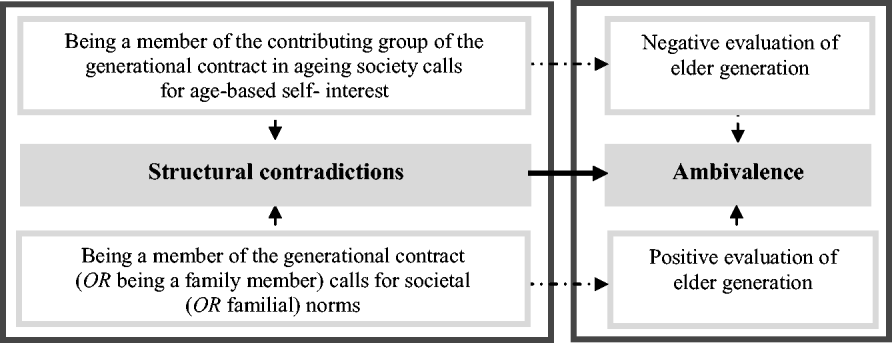
These two types of ambivalence will be summarised in propositions for the empirical analysis. Both propositions formulate that the more societal structures are opposed, the higher is the psychological ambivalence. Nevertheless, as both contain age-based self-interest, they differ with respect to one aspect of structural conditions: the first one refers to societal norms and the second one to familial norms (see also Figure 1).
Visualisation of propositions. Note: The four white boxes with grey borders represent the preconditions for structural contradictions and for ambivalence, respectively. The shaded boxes represent the concepts analysed in the study.

Societal norms and self-interest proposition
Structural contradictions of being young and holding strong societal norms towards the elder generation in society are positively associated with ambivalence towards the elder generation. In other words, young individuals are disadvantaged in state-managed intergenerational transfers and thus have strong age-based self-interest. At the same time, individuals internalise societal norms that denote a supportive attitude towards the elder generation. Whereas the former norm implies a negative attitude towards the elder generation, the latter one implies a positive attitude towards the elder generation. Individuals facing these conflicting structural contradictions are torn between a positive and negative evaluation of the elder generation – they have an ambivalent attitude.
Familial norms and self-interest proposition
The more structural conditions of being young and holding familial norms contradict each other, the more ambivalence towards the elder generation increases. Put in other words: as in the first proposition, young individuals are disadvantaged in state-managed intergenerational transfers and thus might feel burdened by the elder generation. Thus, the strong age-based self-interest that results implies a negative evaluation of the elder generation. Moreover, as family members, individuals have relationships with older generations, such as their parents, and thus have a supportive attitude towards the elder generation. Individuals facing these co-existing structural contradictions are ambivalent: they evaluate the elder generation positively and negatively simultaneously.
Data and methods
The data source is the representative International Population Policy Acceptance Study (IPPAS) (Avramov and Cliquet Reference Avramov, Cliquet, Höhn, Avramov and Kotowska2007b) funded by the European Commission.Footnote 1 From 2000 to 2003, this survey measured the values and attitudes regarding demographic trends in 14 Eastern and Western European countries (Avramov and Cliquet 2008). The analysisFootnote 2 mainly draws on data from the ‘Ageing’ module, which captures positive and negative evaluations of the elder generation separately, a precondition for the analysis of ambivalence as argued below. The analysis is restricted to Germany, which was surveyed in 2003. The sample is disproportional for the two parts of Germany, meaning that East and West Germany can be analysed separately and both parts of the country can be compared.
As this paper investigates the working generation's attitudes, the empirical analysis focuses on those individuals who indicated income from work as their main source of household income and who consequently are the main contributors to the welfare state. In doing so, we exclude all individuals that mainly profit from the welfare state, such as people in education or receiving unemployment benefits. Analyses for West and East Germany are undertaken separately, as differences are expected due to the socialisation process of different welfare regimes. For ease of interpretation, higher scores of all continuous variables indicate a stronger or more positive respondents’ attitude or evaluation. Continuous independent variables are z-transformed in order to allow for comparability of coefficients. These variables have a mean of 0 and a standard deviation of 1. An ordinary least squares regression is applied to analyse the effects of the independent variables on the dependent variable. The coefficients represent the estimated magnitude of the relationship formulated in our propositions and the effects of the control variables.
Construction of the dependent variable
A new variable is constructed that measures psychological ambivalence towards the elder generation in society. This variable is presented in the descriptive part and used in the multivariate analysis as the dependent variable.
The following items measure the positive evaluations of the elder generation: ‘Society should take into consideration the rights of the elderly’ and ‘Society should take into consideration the problems of the elderly’. The negative evaluation of the elder generation is measured with the following items: ‘The elderly are a burden for society’ and ‘The elderly are no longer productive and take away economic resources from society’.Footnote 3 The scale for all variables is as follows: 1 = strongly agree, 2 = agree, 3 = neither agree nor disagree, 4 = disagree, 5 = strongly disagree.
The items measuring positive and negative attitudes are contradictory and refer to the same attitude object, namely the elder generation in society (see also Gainous Reference Gainous2008a; Kaplan Reference Kaplan1972; Suitor, Gilligan and Pillemer Reference Suitor, Gilligan and Pillemer2011). Thus, the conditions for ambivalence are theoretically given. Using a formula, both measures are combined in one variable.
For creating the variable, first, the two items measuring positive (negative) evaluations towards the elder generation were added respectively. Then, the new variable was created, using a formula by Thompson, Zanna and Griffin (Reference Thompson, Zanna, Griffin, Petty and Krosnick1995). Ambivalence researchers often employ this formula (e.g. Craig, Kane and Martinez Reference Craig, Kane and Martinez2002; Gainous, Martinez and Craig Reference Gainous, Martinez and Craig2010; Huckfeldt, Mendez and Osborn Reference Huckfeldt, Mendez and Osborn2004; Sparks, Harris and Lockwood Reference Sparks, Harris and Lockwood2004) which has been called a ‘standard procedure’ (Basinger and Lavine Reference Basinger and Lavine2005: 172):
 $${\rm Ambivalence} = \left[ {\displaystyle{{(P + N)} \over 2}} \right] - |P - N|$$
where P = score on item measuring positive evaluation of the elder generation; N = score on item measuring negative evaluation of the elder generation.
To integrate the positive and negative evaluations into a numerical representation of ambivalence, a theoretical argument for ambivalence conditions is needed (Thompson, Zanna and Griffin Reference Thompson, Zanna, Griffin, Petty and Krosnick1995). One condition is intensity. High positive and negative evaluations signify ambivalence. This condition is represented by the first part of the formula that computes the average: (P+N)/2. The more this score increases, the more ambivalence increases. The other condition is similarity. Positive and negative evaluations should be similar in magnitude. If one component has a high score and the other a low, the attitude polarises towards the positive or negative and thus ambivalence becomes weaker. This condition is represented by the second part of the formula that calculates the absolute difference: |P−N|. The higher the similarity, the smaller the amount subtracted from the first part of the equation (Lavine Reference Lavine2001; Thompson, Zanna and Griffin Reference Thompson, Zanna, Griffin, Petty and Krosnick1995). Hence, ambivalence is greatest when positive and negative evaluation have high scores, that is, when intensity is high and similarity is low. Ambivalence is smallest – or non-existent – when the positive component is largest and the negative component is smallest or vice versa.
Construction of independent explanatory variables
The two hypotheses relating to ambivalent attitudes towards the elder generation are based on the assumption of opposing views resulting from structural contradictions. These are: age-based self-interest versus societal norms and age-based self-interest versus familial norms.
Age serves as a proxy for age-based self-interest. The younger an individual is, the longer she or he has to contribute income taxes and social insurance fees as an employee to the welfare state system and the lower pensions she or he can expect. In our sample, age ranges from 20 to 65 years. In order to make higher values representing more age-based self-interest, the distance from pension age was calculated by subtracting each individual's age from 65 and thereby reversing the order of the ages.
In this paper's theoretical context, societal norms denote the perceived deservingness of the elder generation and the approval of this group's support in the welfare state (e.g. pension entitlement). The government has the greatest responsibility with regard to redistribution in order to achieve socio-economic equality. Supporting this operationalisation, a recent study in Germany shows that individuals hold the government most responsible for social security among several institutions (government, employers, private households and other institutions) (Nüchter et al. 2009). Thus, if the elder generation is perceived as being deserving, respondents should indicate this when being asked for their opinion on the government's responsibility for the elder generation. So, societal norms were measured with the following item: ‘Changes in society are everyone's concern. The government could play an important or a minor role in this. Please indicate what you think about the government's responsibility regarding the following …: “Looking after the elderly”’ (where 1 = not responsible and 4 = completely responsible). Higher values thus mean a stronger approval.
Family norms denote the supportive attitude towards the parental family generation. This phenomenon is measured with the items: ‘It could happen that an elderly person continuously needs a little help in daily living. Do you think these items are best entrusted to children’ (where 1 = strongly disagree and 5 = strongly agree).
To calculate a measure for conflicting societal conditions (age-based self-interest versus societal norms, age-based self-interest versus familial norms), the same formula which computed ambivalence was employed after having standardised the variables due to their different scales. The formula calculates a measure that captures the difference between value scores (e.g. as applied by Gainous Reference Gainous2008b for a similar research purpose). The new measures have higher values for greater structural contradictions. For example, a very young respondent who holds strong norms towards the elder generation receives a high score, indicating highest structural contradictions.
Control variables
Most of the control variables (except religiousness and socialisation in the former German Democratic Republic (GDR)) are commonly used in welfare state attitude research (for a review, see e.g. Ullrich Reference Ullrich2008). The first control variable is gender. Women, especially in West Germany, traditionally care for the family, which could result in a pro-elder attitude. Also, this group has a lower labour market involvement (due to child rearing) and thus a higher probability of being in need of social services. This could either result in higher self-interest, as the elder generation is perceived as a competitor for resources, or in solidarity with the elder generation as another consuming group of welfare state services. A high level of education is usually seen as an indicator for values such as tolerance and social responsibility and in our context captures a positive attitude towards the elder generation.
Income is an indicator for an individual's position in society and resulting self-interest: the higher the status, the lower the probability of relying on welfare state support and the lower the self-interest. Alternatively, individuals with high income usually have to pay more taxes (in absolute terms) and could thus have a high self-interest. Religiousness taps attitudes that value the elder generation as a deserving group such as charity and altruism (item: ‘What role does religion play in your life?’ where 1 = no role at all and 4 = very important). We also control for socialisation in the former German Democratic Republic and thus in the socialistic welfare regime. A dummy variable captures those who were 15 years or older in East Germany when Germany reunified in 1990.
Empirical results
Descriptive results
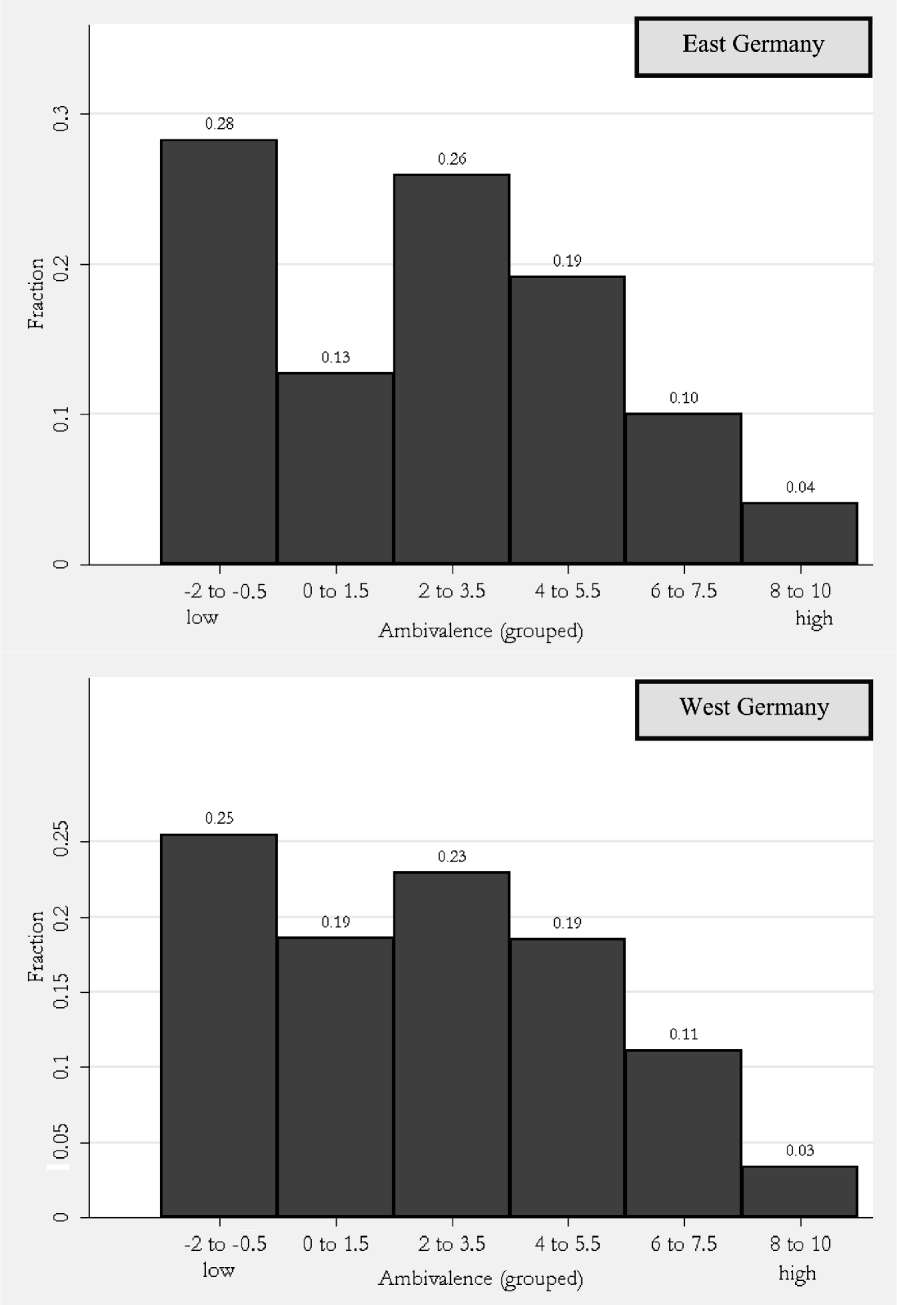
We grouped the ambivalence variable, meaning that we subsumed four scores of the original scale respectively in order to ease this variable's frequency visualisation. The distribution of the ambivalence variable is similar in East and West Germany. The majority in both parts of the country has a rather non-ambivalent to moderate ambivalent attitude towards the elder generation. Nevertheless, 14 per cent is extremely ambivalent or very ambivalent (see Figure 2, two bars on the right-hand side of the distribution). This finding is important given that the majority of studies do not pay attention to ambivalence in intergenerational relationships in the welfare state.
Distribution of ambivalence (grouped). Note: Ambivalence grouped (four scores to one category), own calculation.
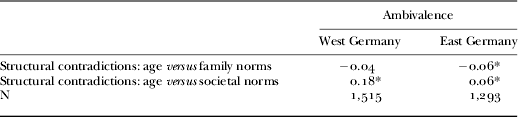
Table 1 shows the correlations of the dependent variable (ambivalence) and the main explanatory variables representing structural contradictions. One structural contradiction has a significant positive association with ambivalence: younger individuals with strong societal norms are more ambivalent towards the elder generation. Nevertheless, this bivariate association is rather weak (approximately 0.18 in West Germany and 0.06 in East Germany). The bivariate correlation of the structural contradiction of being young and holding strong familial norms and psychological ambivalence is statistically significant for the subsample of East Germany. However, the association is unexpectedly negative.
Correlation of ambivalence and main explanatory variables
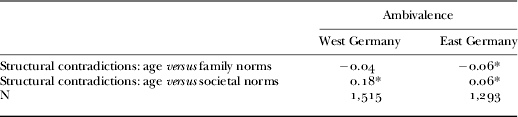
Note: Data are Pearson product-moment correlation coefficients.
Data source: International Population Policy Acceptance Study respondents that indicated income from work as their main household income (working generation), Germany, 2003.
Significance level: * p < 0.05.
Multivariate results
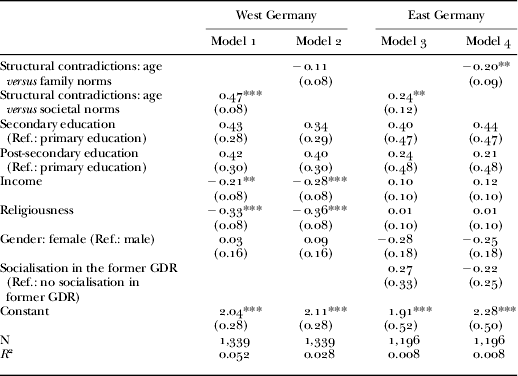
The two regions of Germany were analysed separately to examine possible differences due to dissimilar welfare regime socialisation. In contrast to former socialist East Germany, the Western part has a long tradition of the pay-as-you-go principle that mainly depends upon the working generation. The empirical multivariate findingsFootnote 4 reveal support for one hypothesised association between structural contradictions and psychological ambivalence in the working generation´s attitude towards the elder generation. In West and East Germany (see Table 2, models 1 and 3), the data yield: the younger and the stronger the internalised norms the more ambivalent the attitudes towards the elder generation. In other words: the younger an individual, the longer he or she has to contribute to the public social security system, triggering high self-interest in the context of intergenerational relationships in the welfare state. The individual holds a strong normative attitude towards the elder generation simultaneously, which – theoretically – results from the acknowledgement of the elder generation's needs and deservingness, or from norms of reciprocity that denote that the elder generation had been paying into the public social security system when they were members of the working generation and have thus gained the right of entitlement. These experienced structural contradictions cause psychological contradictions. In this case, individuals hold opposing attitudes towards the elder generation simultaneously.
Prediction of ambivalent attitudes towards the elder generation in society
Note: Own calculations. Standard errors are in parentheses below coefficients, continuous explanatory variables are standardised. Ref.: reference category. GDR: German Democratic Republic.
Data source: International Population Policy Acceptance Study respondents that indicated income from work as their main household income (working generation), Germany, 2003.
Significance levels: * p < 0.10, ** p < 0.05, *** p < 0.01.
As the variables are z-standardised, their magnitude can be compared. Interestingly, these coefficients of structural contradictions have the largest (significant) effect in our models, i.e. they have the strongest impact on the dependent variable in comparison to the other covariates. Thus, these structural contradictions are the most important determinant of ambivalence. The effect is stronger in West Germany than in East Germany.Footnote 5 This could mirror experience with a longer tradition of intergenerational exchange in the welfare state that results in a stronger relationship of structural contradictions and ambivalence in the Western part of the country. It implies that the socialisation differences between East and West Germans are still existent after 13 years of reunification when the survey was conducted.
The other theoretical assumption regarding structural contradictions relating to age and familial norms does not yield significant coefficients for West Germany. For East Germany, there is a significant coefficient, which is negative (see Table 2, model 4). The younger (the higher the age-based self-interest) and the stronger the familial norms are simultaneously, the less an individual is ambivalent towards the elder generation. This finding is contrary to our theoretical assumption.
Additional interesting findings from our regression analysis are the significant coefficients of the control variables. The higher the income and the more religious an individual is respectively, the lower ambivalence in West Germany (Table 2, models 1 and 2). Low ambivalence means that the attitudes are consistent, being both strongly positive and low negative or vice versa. In the context of our theoretical assumptions that religiousness taps pro-elder attitudes (see section on control variables), religious individuals are more likely to have strong positive (and thus low negative) evaluations of the elder generation, evidenced as low levels of ambivalence. Supporting this, religiousness has a negative significant correlation with negative attitudes and a significant positive with positive attitudes towards the elder generation (not displayed).
Similarly, individuals with high income in West Germany have a low self-interest, as they have a low probability of relying on welfare state services. Consequently, they have a low negative evaluation of the elder generation and simultaneously a high positive one, which results in low ambivalence towards the elder generation in society. Supporting this, income has a significant negative correlation with negative attitudes towards the elder generation (not displayed).
Conclusion
This paper has examined a neglected aspect of intergenerational relationships in the welfare state: combining motives of self-interest (in an ageing society with scarce welfare state resources) and either societal or familial norms, the concept of ambivalence of the working generation towards the elder generation in the welfare state has been developed. The assumption has been that individuals of the working generation perceive the elder generation as a burden in the welfare state whilst simultaneously holding strong norms that result in a positive attitude towards the elder generation.
The analysis contributes towards the existing literature in three ways. First, a holistic explanatory framework has been employed: not solidarity or conflict but solidarity and conflict, since both are relevant dimensions of intergenerational relationships in the welfare state. Second, both dimensions of intergenerational relationships have been applied to the wider theoretical framework of ambivalence. Third, the concepts of psychological ambivalence and structural contradictions have been examined in the context of intergenerational relationships in the welfare state and an empirical investigation of their relationship has been undertaken.
The analysis yields that although the majority has (rather) consistent attitudes, 14 per cent has an extremely or very ambivalent attitude towards the elder generation. This result is important as ambivalence in intergenerationel relationships in the welfare state is very rarely examined. A further important result is that younger individuals with simultaneously strong internalised societal norms regarding the elder generation are associated with ambivalence. Also, the socialisation context seems to be of importance: the relationship between the simultaneous existence of high age-based self-interest and societal norms with ambivalence is stronger in West Germany that has a longer tradition of the ‘generational contract’.
Surprisingly, structural contradictions of being young and holding strong familial norms are significantly and – contrary to the theoretical expectation – negatively associated with ambivalence towards the elder generation in East Germany. It could be that an empirical investigation of several dimensions of familial solidarity (which could not be undertaken due to data restriction) would have supported our assumption (see Bengtson and Roberts Reference Bengtson and Roberts1991 or Szydlik Reference Szydlik2000 on family solidarity dimensions).
What consequences do ambivalent attitudes have for intergenerational exchanges in the welfare state? Many institutions build on individuals’ support. Intergenerational exchange, such as the intergenerational contract embedded in the German pension system, is dependent on the legitimacy of the population. Individuals torn between a positive and negative consideration might neither support nor oppose such a system. Instead, they could become indifferent towards this institution and declining support of such a system might result. Supporting this assumption, a study showed that individuals experiencing structural contradictions are subsequently more likely to develop ambivalent attitudes which in turn discourage political participation (Mutz Reference Mutz2002).
Further studies could focus on the future development of ambivalent attitudes towards the elder generation. The amount of the German public pension benefits, which are based on the pay-as-you-go system, will decline and be subsidised by private pensions (see Börsch-Supan, Reil-Held and Schunk 2008). Thus, attitudes towards the elder generation could change as well because pensions increasingly might be perceived as a private affair. Perhaps, the elder generation could no longer be perceived as a burden and the ambivalent attitude towards older people might polarise towards a positive evaluation. Alternatively, if the current demographic transformations proceeds and the proportion of the older population continues to grow, it could result in the elder generation being perceived as a burden because this group increasingly will draw on health-care services and as the working generation still has to contribute to the pay-as-you-go pension system. In this scenario, ambivalent attitudes towards the elder generation might still be existent or might even increase.
Finally, it should be acknowledged that the study has some limitations as the items used for the ambivalence measure were not originally designed for surveying this phenomenon. One constraint is social desirability, which denotes that respondents tend to give answers that are viewed favourably by others and do not reflects their true attitudes (O'Neill Reference O'Neill1967). Our measure of ambivalence could result in data representing a weaker picture of ambivalence as respondents under-report negative and over-report positive evaluations of the elder generation.
Additionally, respondents tend to give consistent answers (Green and Citrin 1994). A respondent that indicates a strong positive evaluation of the elder generation tends to give a consecutive weak negative evaluation (although she or he might have a strong negative image of the elder generation) in order to give the impression of a consistent attitude to the interviewer. The question ordering of the items suggests that this phenomenon could apply to our data as the initial item reflects a very positive statement on the elder generation. This positive item might serve as an anchor for the following items and make the respondents deny a negative evaluation. Despite these possible drawbacks, the study has demonstrated that there are working generation members holding an ambivalent attitude toward the elder generation.
Acknowledgements
For helpful comments on earlier versions of this article, I would like to thank the anonymous reviewers and the editor, Hans-Jürgen Andreß, Andrea Britze, Romana Careja, Achim Goerres and Karsten Hank. Also, I would like to thank Andreas Weiland as he was of great help in preparing this article. Former versions were distributed at the XVII ISA World Congress in Gothenburg, Sweden, July 2010 and presented at the ECPR Graduate Conference, Dublin, Ireland, August/September 2010.