




As public spaces, museums navigate complex social, political, and economic dynamics. Various stakeholders question what museums do, for whom, and to what ends. In the previous century, functioning primarily as a collecting institution may have sufficed; today, expectations of museums are broader, ranging from civic and ethical to educational and health-oriented concerns.Footnote 1 Many of these questions point directly to the social functions of museums. To deepen relevance and ensure long-term sustainability, museums must affirmatively engage such questions, articulate their value propositions, and exemplify those values. For institutions interested in developing their social capacities, this article—rooted in extensive data collection and analysis—offers a ground-up theory for how museums can leverage existing resources to increase social impact.
1. Soft community
Soft community offers a new theoretical framework for the social value of museum experiences. Soft community is an interpersonal dynamic that occurs when shared experiences allow individuals to feel belonging across lines of difference—affinity, belief, experience, identity—and build social trust. In contrast with harder edge communities (in which relational boundaries around identities or social values are prioritized), soft community is grounded in individual belonging and enjoyment with different people in a communal experience. Soft community promotes curiosity, enjoyment, individual agency, and collective engagement. When diverse individuals participate in a common experience—mediated or self-directed—experience-based social connections form. These connections can uplift shared values that harder-edge communities might overlook, encouraging deeper individual participation and collective enjoyment.
Museums can leverage their existing resources to cultivate soft community. From non-partisan political functions (e.g., serving as a polling place) to broader social functions (encountering collections and ideas that may affirm, contest, or otherwise engage one’s affinities, identities, experiences, and beliefs), museums can build social trust.Footnote 2 Across exhibitions and programs, museums can encourage higher-quality understandings through inquiry and invite connections that encourage curiosity.Footnote 3 When soft community is present in museums, visitors feel a sense of belonging; ownership (of their own participation and of the quality of the shared experience); and connection between themselves, the museum, and other visitors.
While soft community will not immediately solve the complex social, political, and economic dynamics communities face, it does provide a set of practical actions to help museums model—as public spaces—how to sustain connection and curiosity across difference, which points toward broader civic values. When museums share their collections and programs using the soft community framework, they offer visitors the opportunity to grow through curiosity, ask questions, and interact in ways that help them connect with themselves, one another, and the wider world.
2. Situating soft community
Building on museologist John Falk’s psychographic and visitor-centered approach, museum-based research and evaluation have expanded over the past two decades, improving our understanding of museum experiences and the impact of arts engagement.Footnote 4 As part of the museum sector’s efforts to consider civic and social capacities, more visitor-centered scholarship has focused on the personal impact of the arts and museums on individual growth and well-being.Footnote 5 Well-being has been defined as a dynamic process that gives people a sense of how their lives are going, which can be improved through five everyday actions: be active, connect, keep learning, give, and take notice.Footnote 6 Arts interventions in healthcare settings have been shown to improve aspects of patient well-being and happiness.Footnote 7 Drawing from public health and brain research, arts and health researcher Susan Magsamen and designer Ivy Ross emphasize well-being through the individual physical and mental benefits of engaging with art.Footnote 8
Connection’s importance to individual well-being and its influence on social development has driven researchers to investigate belonging in the museum context. Historically, many museums emphasized perspectives existing visitors held to incorporate belonging, but recent research defines belonging more broadly.Footnote 9 Building on multidisciplinary scholarship, museologists Price and Applebaum focus on belonging in museum settings, using measurement tools that emphasize how individuals self-report their sense of belonging, including contextual factors such as place belonging and people–environment fit.Footnote 10 A large follow-up study found that welcome is necessary but insufficient to the definition of belonging and that a visitor’s personal definition of their community impacts their sense of belonging.Footnote 11 Research focused on infrequent art museum visitors identified the importance of individuals feeling connected to the art (based on interests and identities) and positive interactions with staff and other visitors for belonging.Footnote 12
Soft community extends this work as it includes both individual and communal experience. It aligns with existing research on belonging, social connection, and inclusion, but it emphasizes the impact for the collective group of visitors (and thus of the museum’s broader social value) rather than individual outcomes. It considers how these experiences orient toward social impact, inclusive of both bonding and bridging across experiences, identities, affinities, and beliefs. Soft community identifies criteria for and qualities of a shared sense of belonging occurring among visitors participating in museum programs. It offers a path to operationalize concepts of belonging into an active and reinforcing dynamic, creating a sense of community affinity within the museum itself. This growing affinity improves individual perceptions of connection and inclusion, helping visitors recognize points of connection with one another and de-emphasize points of difference. Soft community allows museums to become public spaces of collective connection, positioning them as trusted places for belonging amid diversity.
When we began this research, our focus was on visitor experience around connection (to themselves and others); we did not intend to create a new theory of museum social impact. However, our observation and analysis included a broad set of quantitative survey data as well as qualitative interview responses, which afforded insights beyond those included in the studies described above. The outcomes and analysis of our unique data set aligned with and generatively extended many key findings in the literature, which led us to theorize upwards.
3. Case study: High Museum of Art, Atlanta
At the High Museum of Art in Atlanta, Georgia, we have spent over a decade reorienting our institution to reflect, engage, and serve our local community.Footnote 13 The High is the largest visual art museum in the southeastern United States and welcomes over 350,000 visitors annually. The museum’s permanent collection features over 20,000 works of art spanning seven curatorial departments, presented alongside 12–15 special exhibitions and hundreds of public programs each year. We have intentionally adjusted our approach to acquisitions and exhibitions, visitor outreach, and programming so our collection, membership, and visitor demographics more accurately reflect our city, which is tracked every year in our Art and Inclusion report.Footnote 14 In fiscal year 2024–2025, the High attracted more than 50 percent Black, Indigenous, and People of Color participation; younger-than-average audiences (76% under age 55); broad socioeconomic engagement (40% come from households making under $70,000/year); and steadily growing membership retention (60% across a sector-leading 46,000 member households).
4. Visitor experience research
Over the past three years, the High’s Learning and Civic Engagement (LCE) department has conducted multiple audience research projects to improve our understanding of visitor experience and program outcomes. Primary LCE team goals are linking people and art to encourage connection (to self, community, and the wider world) and growth through inquiry. As part of this work, we kicked off an in-depth evaluation study in Spring 2025 to understand how effectively our portfolio of programs was delivering on these two goals and to obtain direct visitor feedback on factors that impact their experience.
Working with museologist Ellie King, we adapted the Museum Exhibition User Experience (MEUX) model to extend from exhibitions to programs, allowing us to evaluate the museum’s program goals vis-à-vis the visitor experience.Footnote 15 The MEUX model also allowed us to account for the differences between programs while still evaluating for shared intentions using both quantitative and qualitative methods. For this research, we used a short-form paper-based survey and informal interview protocol. The survey collected data on demographics (race, age, gender, visit group) and visit motivations. Focusing on visitor experience, the survey had three sections: an emotions list (a set of emotion words adapted from the Geneva Emotional Wheel), 17 word-pair descriptors (7-pt scale between two opposing adjectives), and 10 outcome statements (5-pt Likert scale from Strongly Disagree to Strongly Agree).Footnote 16 Follow-up interviews asked visitors to discuss what stood out to them about their experience, what program elements made an impact, how they felt about their experience, and details on outlier answers from the survey.
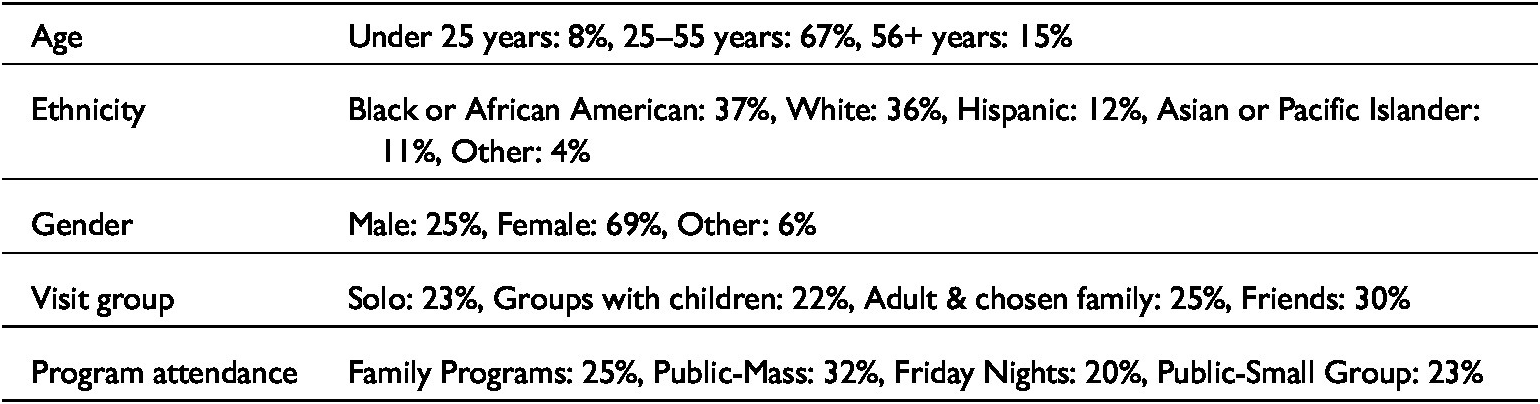
Between March and May 2025, we collected 404 surveys and conducted 104 interviews across 13 programs, which we evaluated in 4 program groups for comparative analysis.Footnote 17 The evaluated programs included large public events that coincided with general admission as well as programs with targeted audiences and limited attendance. The resulting data offered a comprehensive view of visitor perspectives about program activities, experiences, and outcomes, which we then analyzed and evaluated against visitor demographics (see Table 1).
Demographics of survey respondents collected by authors between March and May of 2025.

Table 1 Long description
The table consists of five rows detailing survey demographics.
* Age: Under 25 years at 8 percent, 25 to 55 years at 67 percent, and 56 plus years at 15 percent.
* Ethnicity: Black or African American at 37 percent, White at 36 percent, Hispanic at 12 percent, Asian or Pacific Islander at 11 percent, and Other at 4 percent.
* Gender: Male at 25 percent, Female at 69 percent, and Other at 6 percent.
* Visit group: Solo at 23 percent, Groups with children at 22 percent, Adult and chosen family at 25 percent, and Friends at 30 percent.
* Program attendance: Family Programs at 25 percent, Public-Mass at 32 percent, Friday Nights at 20 percent, and Public-Small Group at 23 percent.
Through quantitative methods (e.g., means, cross-tabulation, correlation, analysis of variance) and qualitative analysis (e.g., themes, word frequencies), the data highlighted qualities of the social environment as the most common drivers of visitor experience (as opposed to specific program content or activities). As we considered the outputs, the data also surfaced themes that pointed toward a specific type of social connection occurring at the museum’s programs, one rooted in common motivations and shared experience of the museum space and program activities. Specifically, the following emic themes laid the foundation for identifying and articulating our concept of soft community:
-
• A sense of welcome and inclusion is a defining experience of visiting the High, and these qualities emerge from visitors themselves in tandem with the museum’s efforts.
-
• Visitors demonstrate shared values about what kind of experience they want to have, and surfacing shared values impacts the quality of a visitor’s experience.
-
• A handful of qualities of our collection and programs have an outsized impact on visitor engagement and outcomes, regardless of visitor demographics.
Observing Visitor Values: Welcome, Inclusion, Fun, and Choice
When we looked holistically at the data, an important trend became clear: regardless of demographics or program attendance, visitors want to have fun (however they define that for themselves). To meet this desire, the museum’s ability to provide an environment that is welcoming (approachable and not intimidating), inclusive (accessible to and reflective of a variety of needs and preferences), and flexible (maximizing choice and adaptability for visitors) is fundamental to a positive museum experience.
This trend emerged across the data. Visitors selected “to be entertained” (48%), “to do something new/different” (38%), and “interested in the topic/activities” (37%) as top motivations for their museum visit. Curiosity (62%), Excitement (48%), and Joy (41%) were the top emotions selected to describe the visit experience. Welcoming and Inclusive rose to the top as the strongest-rated descriptors of visitor experience, with Enriching, Empowering, Memorable, Sociable, and Fun rounding out the top half of the ratings. “I enjoyed myself” and “I feel the museum is for me and my family” also stand out as two of the strongest averages in the outcome statements (4.75 and 4.53, respectively). Across responses, when visitors experienced “joy,” “excitement,” and/or “curiosity,” these directly correlated with a visitor’s perceptions of a more engaging, enriching, and memorable experience.Footnote 18 In the interview data, the four of the most common themes related to social connection/community (mentioned in 70 interviews), variety/flexibility (53 mentions), welcoming/inclusive (50 mentions), and fun/joy (45 mentions).
Details raised in the interviews offered insight into how visitors conceptualized these trends for themselves. A sense of fun often connected back to feeling comfortable and encouraged, doing something new, experiencing something unexpected or surprising, and feeling a collective sense of excitement and participation. In tandem, the ways visitors experienced agency and flexibility underpinned experiential qualities of welcome and fun. Visitors highlighted the importance of making choices, following their own interests, and moving easily between activities. Across our observations, when visitors felt encouraged to pursue their own interests without feeling pressured, a shared value of curiosity thrived.
Visitors attributed their perceptions of welcome and inclusion to staff friendliness, a sense of energy and liveliness, docent and facilitator encouragement, access to accommodations, and visibility of both art and other visitors that reflected their diverse identities, abilities, and interests. These aspects also helped to combat the perception that museums are formal places that privilege those with knowledge and expertise and will fault inexperienced visitors for doing something wrong—a concept museologist Elaine Heumann Gurian termed “threshold fear.”Footnote 19 Overall, strong consensus emerged that visitors felt a sense of belonging at the museum for themselves and their families. In their own words:
-
• “This event was empowering, because I felt like I didn’t have to be perfect to come and participate.”
-
• “This was really fun, and this has been the most welcoming art museum that I have been to. Some museums can feel formal and hard to approach.”
-
• “The atmosphere seems very special and not boring or intimidating… I’ve never been to an art museum, and I expected it to be stuffy and quiet. But it’s lively and welcoming! It feels like it’s inviting people in.”
A dynamic we did not expect, however, is that welcome and inclusion were multidirectional, transmitted from institution to visitor and between visitors themselves. Many participants flagged the friendliness, approachability, and energy of other visitors as impacting their sense of welcome, even when they did not explicitly interact with other patrons. Two interview excerpts exemplify this: “The atmosphere feels familial even though I came solo. I love seeing people enjoying themselves in the museum and having fun.” And: “It’s empowering. Everyone here has the same mindset and seems happy and approachable. I feel like I can make connections.” Each capacity appeared to support the other: the museum’s emphasis on welcome and inclusion paralleled and encouraged this attribute in visitors, who then served as ambassadors for these values to each other.
5. Impact of museum and program context
Alongside these felt experiences, visitors across demographics flagged three museum and program features as particularly impactful: diversity of the collection and exhibitions (spanning time, geography, artistic media), the offer of multi-sensory and immersive experiences, and the inclusion of unexpected activities for a visual arts museum (e.g., yoga, DJ performances).Footnote 20 These features helped visitors feel more present during their visit and reinforced the perception that the museum values multiple perspectives and engagement modes. Further, these elements refocused visitor attention, helping them disconnect from the outside world and feel more connected to museum visit’s communal experience. As two visitors stated: “Everyone talks about the divisiveness in the world, but when you come to the High and see everyone interacting, it seems like fake news. Everyone really can get along and come together.” And: “The state of the world is a lot right now, and this made me feel less anxious. I was actually able to step outside of everything going on in the world.”
The High’s interactive activities, broad welcome, and encouragement of joy and fun have nurtured a physical space where visitors become valued participants in a larger collective. The story of their visit has become one in which the museum cares as much about people and connection as it does art and education. Together, the museum and its visitors have built social trust, creating a space where people actively and passively connect with themselves and each other. In their own words:
-
• “I love the High’s space and staff, and the thoughtfulness about how to make kids connect to art and to each other.”
-
• “I appreciated the [staff teaching] artist leading the workshop. He was encouraging and inspiring to the whole class… This is a great community building program!”
-
• “Everyone is so kind. The [community partner’s] ballet performance showed community happening. Even security helps the museum feel engaging and that they’re there to help.”
6. Soft community: A framework for social connection
Reflecting on our findings, we identified a communal dynamic occurring, beyond the consistently positive individual visitor experience. Returning to the interview data, multiple references to “being alone together” helped us identify this theme. As one visitor said: “I like that I can have solitude in a social and community setting… I usually come alone, but people will also approach and invite me into connecting with them in a way that doesn’t feel pushy.” We named this specific phenomenon—the sense of a shared purpose, values, and experience regardless of whether direct social interaction was occurring—soft community, which became the foundation for articulating the social experience we observed and its meaningful potential for museums.
To define and articulate the framework, we identified eight characteristics that most influence the emergence and sustainment of soft community:
Contextual/Experiential Qualities (Pre-Program):
-
• Physical Proximity: The museum offers a physical space for individuals to gather for a shared purpose.
-
• Multi-Dimensional Content: The museum curates objects, information, and activities that engage multiple senses and diverse elements of human experience.
Intentional Social Values (During Program):
-
• Welcome: The museum creates a comfortable physical and social environment that is approachable for, inclusive of, and accessible to a wide array of affinities, identities, experiences, and beliefs.
-
• Fun: The museum embraces joy, entertainment, and excitement as tools for encouraging curiosity and reducing barriers to engagement and social connection.
-
• Curiosity: The museum offers a space where curiosity serves as an entry point to engagement/participation and actively encourages curiosity to be sparked, pursued, and shared.
-
• Agency: The museum offers autonomy and empowers visitors to make individual choices about duration, to pursue one’s interests in content and/or activities, and to engage or connect at one’s level of comfort or preference.
Communal Social Qualities (Post-Program):
-
• Informal Interpersonal Connection: The museum encourages a sense of connection and interaction through shared attitudes (e.g., enjoyment, flexibility) and experiences, even when doing solo activities.
-
• Social Trust: The museum offers a defined place (through policies and practices) that promotes a perception of agreement around a set of social values (e.g., belonging, autonomy).
While each of the pre- and during-program characteristics contributes to individual as well as collective experiences, pursuing the combination of these qualities is critical to the beneficial cycle of soft community. Although these characteristics initially emerged directly from our research, many extend individual-level characteristics other scholars have noted toward a shared, communal exchange, connecting previous investigations of belonging, social connection, and inclusion across contexts. Working together, a sense of “museum community” develops, in which visitors are members making choices as well as operating with a shared sense of responsibility for encouraging mutual social values, reinforcing a sense of social trust between visitors and with the museum. While soft community is still primarily centered on the immediate visitor experience (rather than longitudinal impacts), the collective dynamic may have broader potential value to both visitors and the museum. For museums, creating a public space that demonstrates communal belonging amid diversity can expand visitorship and help position museums to more effectively create public dialogue about identity, belonging, and community in a way that emphasizes shared values and respects difference.
7. Cultivating soft community
Soft community prioritizes points of relation rather than points of difference. In soft community, qualities of welcome, fun, curiosity, and agency help the museum engage all visitors and cultivate social trust. These qualities help break down social barriers, bring shared values to the fore (versus boundary-enforcing norms), and elevate common experience as a spark for connection. Embracing joy and curiosity helps museums avoid didactic self-seriousness, which can discourage visitors from connecting with collections, programs, and one another. Ultimately, these qualities facilitate the museum’s social capacities: welcome leads to belonging and safety; fun leads to connection and a felt sense of collective experience; curiosity leads to active engagement and participation in shared purpose; and agency maintains boundaries that keep individuals and groups from feeling fully subsumed in the collective. Repeatedly, across our interviews, these characteristics emerged from individuals as justification for affinity for the museum and one another, attracting visitors and members, volunteers and staff, community leaders and funders who operate with these values and offer them to others in the museum.
What does this look like in practice? Imagine a local family—two adults and two children under 13—visiting the museum for the first time during a Family Program. The large glass windows of the museum atrium allow sight of dozens of other groups with children, some in strollers, some toddling, some exuberantly waving at siblings. Through the windows, the new visitors see a designated area featuring rows of tables with an artmaking activity, where both adults and kids smile and participate. When the family enters the museum, they immediately hear adults chatting in conversational tones and children laughing. The admissions representative is friendly, explains the rules for the galleries (e.g., backpacks worn in front of the body), offers guidance, and points out volunteers, all in matching t-shirts and easy to identify. Before this family has even seen a work of art or participated in an activity, several things have become apparent:
-
1) Other people like them (families with children) feel comfortable and safe in the space. This orients them toward a common identity and context between themselves and other visitors.
-
2) Kids behaving as kids—including noise and high energy—are not unwelcome or out of place.
-
3) They have the information they need to avoid “getting in trouble” in a new and unfamiliar space, and they know who to ask for help and how to find them, if needed.
-
4) They see and/or hear multiple activities happening, and other families freely moving between those activities.
-
5) The museum is a place where people seem to be having fun and making memories with their families, which is what motivated them to visit the museum.
This is soft community’s start: different individuals gathered in a physical space for a collective purpose (in this case: to engage in a fun, interesting, and safe experience with visual art), creating a temporary relationship built around mutual belonging, autonomy, pursuing curiosity, and enjoyment. But soft community extends beyond the individual experience that most concepts of social connection, belonging, and well-being center; it incorporates what comes next. The sense of camaraderie and “we’re here for the same thing” becomes a dynamic between the visitors themselves, creating an in-situ social affinity based on participating in and enjoying the museum experience. This affinity connects them with the other visitors as contributors to the shared experience (whether they directly interact or not) while still holding place for their personal identities and interests.
8. Soft community’s value to social and community connection
Soft community offers a practical model that can improve the social impact of museums. Articulating and describing its characteristics provides a road map for institutions to become spaces where curiosity and connection can thrive. Museums have potential to become more trusted conveners and public storytellers, microcosms of the potential that pluralism, civic cooperation, and expanded definitions of belonging can offer. Our research data offers a nuanced perspective regarding how soft community creates social trust and collective belonging that promotes shared values and connection:
-
• When a museum creates a space in which people feel safe (through welcome, inclusion, accessibility), participants can embrace connections with themselves and others rather than prioritize self-protection.
-
• When a museum demonstrates care and respect for making the individual’s experience within its space positive (through fun, agency, curiosity), participants feel valued and empowered to engage as unique human beings and to respect the unique perspectives of other participants. Because the individual’s needs and preferences are not dismissed or subsumed, barriers to connection can come down.
-
• When a museum engages diverse aspects of the human experience (through multi-dimensional content and informal interpersonal interaction), participation becomes more immersive and rooted in what is common to each participant (engagement, safety, and enjoyment in the experience itself) rather than what might separate participants. Multi-faceted experiences increase modes of connection and shift focus from the individual’s relationship to the content and point it toward the shared experience, diminishing the potential for tension and separation.
When people feel safe, when their personal needs and preferences matter, and when interaction is oriented around an expansive definition of individual experience, we can create community built around and protective of connection rather than focused on identities or right beliefs.
9. Soft community’s limits
Visual art museums are a fertile environment for soft community. Complex visual culture—art created across time, geography, identity, and belief—offers opportunities for broad inquiry and curiosity rather than narrow reiterations of a specific dogma or viewpoint. Soft community does not require or argue for right belief (“one should believe”). Instead, it promotes a shared sense of true belief (“we all have our own beliefs, and they interact in a variety of ways”). For this reason, soft community is not a functional model of community engagement for all museums. While soft community lends itself well to institutions that present a wide variety of ideas and perspectives, some institutions focus on more discrete narratives. The Legacy Museum in Montgomery, Alabama, for example, is committed to presenting “a comprehensive history of the destructive violence that shaped our nation, from the slave trade, to the era of Jim Crow and racial terror lynchings, to our current mass incarceration crisis.”Footnote 21 For this institution, one of its central goals is to convey the value of a specific perspective, which encourages a more focused community through a particularly shared narrative.
10. Considerations for engaging soft community
At the High, visitor feedback indicates that a diverse swath of Atlanta feels welcome, which improves our ability to challenge divisive public narratives that place artificial limits on connections between individuals. Our survey included representatives across multiple spectrums, and no single demographic indicator—including age, race, gender, or socio-economic status—was an outlier in reported experience of the qualities that undergird soft community.
For museums interested in engaging soft community, we recommend:
-
• Define your visitor community: is it a geographic region, town, or city? Does it include people with different affinities, identities, experiences, and beliefs?
-
• Use observational tools: develop a survey and interview protocol that affords statistically significant results.
-
• Evaluate key capacities: to what degree do your museum’s content (collections, exhibitions) and programs (activities, activations) include welcome, inclusion, fun, and choice?
-
• Investigate narrative frameworks: to what degree do your museum’s content and programs model generous inquiry and encourage connection between self, others, and the wider world?
Soft community is not static; it requires ongoing maintenance and care. Museums are well suited for this work, as they can employ physical proximity, informal interpersonal connection, multi-dimensional content, social trust, welcome, fun, curiosity, and agency, monitoring and adjusting as needed. Extending maintenance and care across collections and communities allows museums to be catalysts for social connection, developing critically important social trust through soft community.
Supplementary material
The supplementary material for this article can be found at http://doi.org/10.1017/pub.2026.10271.
Author contributions
Conceptualization: J.E., A.W.; Data curation: J.E., A.W.; Formal analysis: J.E., A.W.; Funding acquisition: J.E., A.W.; Methodology: J.E., A.W.; Project administration: J.E., A.W.; Resources: J.E., A.W.; Software: J.E., A.W.; Supervision: J.E., A.W.; Validation: J.E., A.W.; Writing - original draft: J.E., A.W.; Writing - review & editing: J.E., A.W.
Funding statement
Thanks to the Goizueta Foundation for providing funding for Jenna Edwards’ position as Fellow, Research and Evaluation at the High Museum of Art. This article is an outgrowth of research undertaken during her fellowship year.
Conflicts of interest
The authors declare no competing interests.


 Open access

