Rm. 714: Introduction
This article centers on the analysis of a single tablet, Rm. 714, and the fine carving of a pig found on its obverse. Mesopotamian tablets could serve as the medium for more than cuneiform, and drawings are found on tablets as early as the third millennium b.c.e. Many of these early tablets are otherwise uninscribed, but later examples feature both drawing and cuneiform writing on a single tablet.Footnote 2 Rm. 714, dated to the first millennium b.c.e., also pairs writing and carving, with a single line of cuneiform on the opposite side to its impressive relief. Although the inscription provides us with some information, Rm. 714 must be analyzed primarily through a consideration of its relief and by comparing the tablet to other carved or sculpted objects. The wide range of textual and artistic references to pigs provides critical context for how the animal was both used and depicted in Mesopotamia. When this is considered alongside the additional context provided by comparisons to similar carved objects, several possible functions for Rm. 714, as well as additional significance for the pig in its relief, may be proposed.
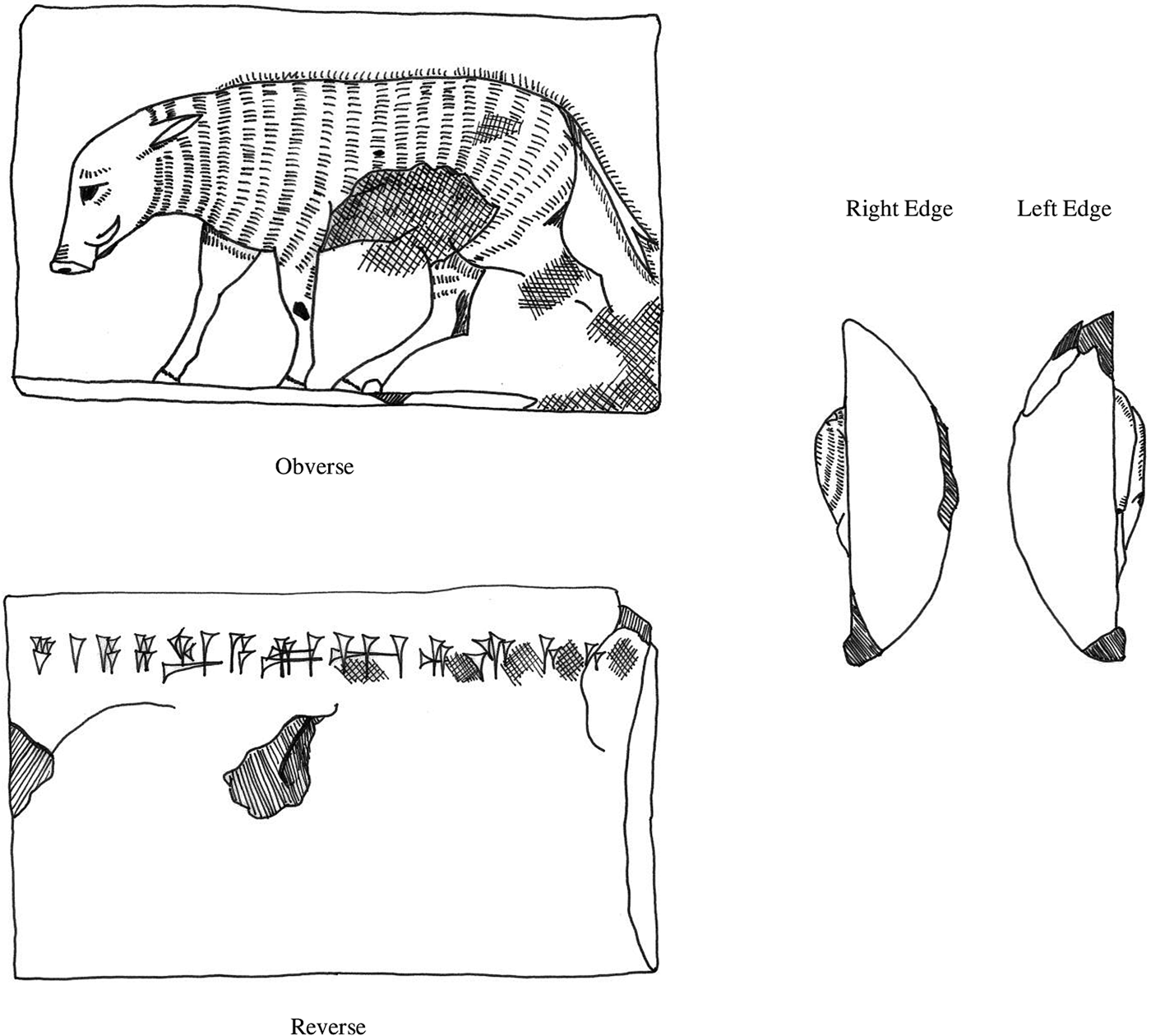
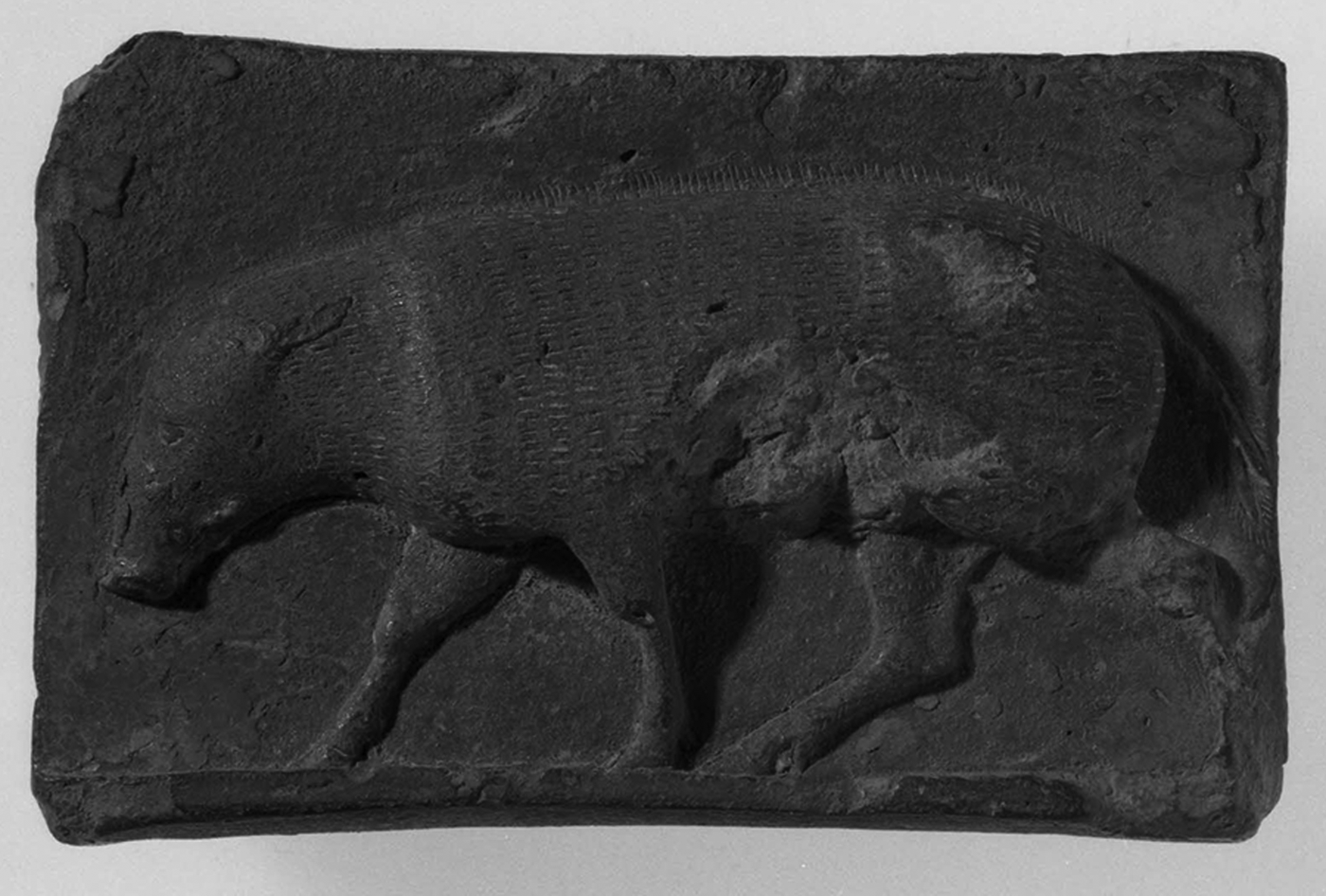
The relief is the most notable aspect of Rm. 714. The tablet is small and rectangular, with dimensions of 6.8 centimetres by 4.3 centimetres, and made of dark-colored, fine clay; it is notably plano-convex in cross-section and uninscribed save for one line of cuneiform script along the upper edge of the tablet's reverse.Footnote 3 Its obverse displays its very fine, high relief carving of a striding pig (Fig. 1). Although there is some damage to the tablet's lower right edge, with the left hind leg of the pig broken away, the tablet is otherwise completely preserved. The relief of the pig in particular is in good condition, showing clearly the fine detail and artistic skill of its carving (Fig. 2). The pig is carved directly onto the tablet, its outline emphasized by a line of vertical hatching running along and above the line of its back and curving around the outline of its tail.
Tablet with Relief of Striding Pig, Rm. 714, 6.8 × 4.3 cm. Handcopy by author

Tablet with Relief of Striding Pig, Rm. 714, obverse. © The Trustees of the British Museum

Previous analysis of Rm. 714, notably by Reade (Reference Reade2001/2002: 154–56), has considered it in the context of other sculpted objects held in the collections of the British Museum. Many of these objects had been previously explored as potential sculptor's models, with other common proposals for function being apotropaic or personal dedicatory objects.Footnote 4 This article aims to evaluate the possible functions of Rm. 714 in light of both similar objects as well as the wider range of artistic representations and textual references to pigs in the Neo-Assyrian and earlier periods. Although Rm. 714's convex reverse is at odds with the flat backs of other sculptors models or apotropaic plaques, the relief itself still falls within a larger context of porcine representations in Mesopotamia.
The information provided by comparative artistic and textual sources is critical, as the tablet lacks archaeological context. Although it is recorded in Carl Bezold's catalogue of objects in the British Museum from Kouyunjik (the main mound at Nineveh), it appears in a final listing of many different large categories of tablet groups, included under the sub-heading of “inscribed fragments and tablets which were not found at Kouyunjik” (Bezold Reference Bezold1896). The Rassam collections (listed as RRm. within the catalogue) include allotments of many tablets grouped together as follows: 622–40, 642–853, and 856–901, to be followed by individually numbered tablets.Footnote 5 Rm. 714 falls within the largest of these three tablet groupings, purchased by Hormuzd Rassam in Baghdad in 1877. At this time, as Reade (Reference Reade2001/2002: 154) notes, the only southern sites that were potential sources for purchased tablets were Babylon and Borsippa, which is all that may be said about the original location of Rm. 714.
The options for contextual analysis exhausted, we are left with the object itself. Although the relief is indisputably its most prominent feature, its inscription also merits consideration. The single line of cuneiform found on the reverse is worn at points in its latter half but still clearly identifies the tablet's owner: “šá diša-za-ru apil(a) é-sag-⌜íl a⌝-[a],” which may be translated, with some caveats, as “Belonging to Azaru, son of Esagil(a).”Footnote 6 The inscription marks the tablet's owner, and the object, in turn, was personally connected to Azaru.Footnote 7 Its potential function in this regard is more obscure, as the most notable element of the tablet remains the detailed carving on the obverse. This relief, and the pig it depicts, also provide the most viable route for dating the tablet. Although neighbouring tablets in its grouping of Rm. 642–853 are overwhelmingly from the first millennium b.c.e., they do not otherwise help establish a more specific or concrete date. Over a quarter of the tablets with accession numbers within the Rm. 700 range are late Babylonian or Hellenistic astronomical texts and are thus distinct in both genre and time from Rm. 714.Footnote 8 The tablet's relief does closely match other artistic depictions of pigs from the Neo-Assyrian period, making this the object's most likely original date. Overall, the depiction of the pig of Rm. 714, from its artistic style to the posture of the animal itself, provides the single most important source of evidence for further conclusions about the tablet and its potential functions.
Pigs in Mesopotamia
As our focus is thus squarely on how the pig on Rm. 714 is depicted, it is necessary to first survey the broader context of textual and artistic representations of pigs within Mesopotamia. Within textual sources in particular, the pig (Sus scrofa) fulfills a variety of roles.Footnote 9 There are two words for pigs in Akkadian; the far more commonly used term, šaḫû, derives from the Sumerian word for the animal (šah2).Footnote 10 A rarer Akkadian word, ḫuzīru, also appears. The majority of references to the animals appear in the context of their use as livestock, where they occupy the curious position of being primarily, if not exclusively, valuable for their meat.Footnote 11 Although other livestock animals, such as cows, sheep, goats, and various fowl, are also slaughtered for meat, they all produce both edible (milk and eggs) and useful (hair, wool, or feathers) secondary products without harm to the animal's own life. For a pig to be useful, on the other hand, it must be slaughtered.Footnote 12
Analysis of animal remains in Mesopotamia corroborates the widespread presence of the pig as a livestock animal, though textual references to the practice of pig farming are less common.Footnote 13 The lack of secondary products thus did little to harm the overall popularity and usefulness of the animal. Pigs appear to occupy a slightly different position in comparison to other livestock, a situation compounded by the dual existence in the region of both domesticated and wild pigs, the latter hunted for their meat.Footnote 14 With pig domestication in the Near East dating to the Pottery Neolithic, there was more than sufficient time for the development and subsequent presence of the distinct physical traits of domestic versus feral pigs that can be observed in artistic representations of the animals.Footnote 15 Wild pigs remained larger than their domestic counterparts, with a size and strength that made hunting them a hazardous, if not potentially fatal, endeavor. Despite the danger, such practices were widespread, with depictions of hunting pigs found across the ancient world.Footnote 16
The pig had connotations and uses beyond its role as either quarry or livestock. In Anatolia and the Levant, it was at times regarded as an unclean animal, with taboos associated with its presence. Within the Mesopotamian ritual sphere, pigs as well as piglets (or models of either) were employed as scapegoats, the targets for redirected impurity.Footnote 17 One ritual text to counter disease, for example, contains instructions for first embodying the disease in a clay figurine, to then marry it off to a piglet “as a wife” (kīma aššati).Footnote 18 Through these actions, the disease would be forced to leave the patient and was bound instead through symbolic marriage to the scapegoat animal. This notion of impurity or, at the least, a connection to demonic antagonists, repeats with the demoness Lamaštu, who is often depicted as suckling a piglet and dog at her breast, in lieu of human infants. The pairing of pig and dog is repeated in another text, a ritual incantation intended to counter witchcraft. This incantation reverses the scapegoat dynamic by detailing how the witch has created a figurine of the afflicted individual, and fed it to a variety of animals, including a dog, pig, “bird of the sky,” and “fish of the underground water,” as well as inflicting a wide range of other evils upon the figurine of the afflicted patient.Footnote 19 Thus, while the pig may be invoked as a scapegoat or even potentially a protection against evil, it can also serve as a vector by which witchcraft or other malevolent acts can be worked against an individual.
Artistic Representations
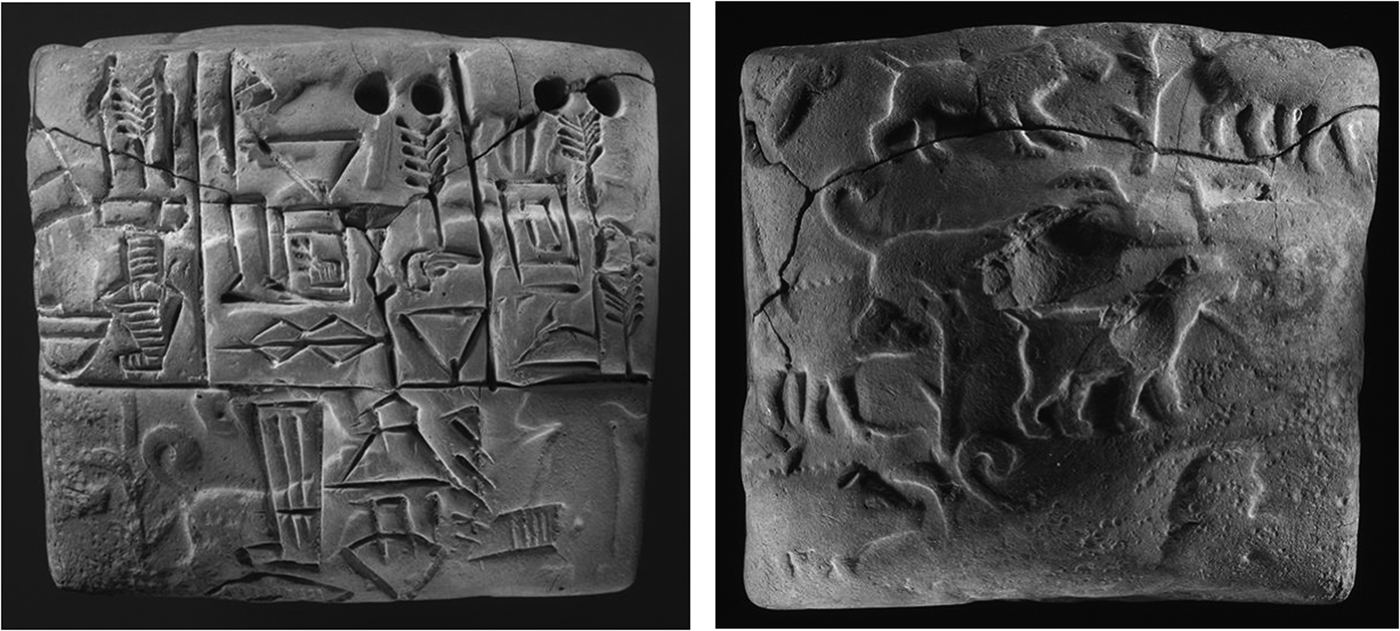
Artistic representations of the pig are as chronologically widespread as their textual counterparts. Though the pig is most often seen in the first millennium b.c.e. in Mesopotamian art, representations from earlier periods are also found. One of the earliest artistic representations is from an administrative tablet from the Jemdet Nasr period (c. 3000 b.c.e.), which documents grain distribution for a large temple and is impressed repeatedly with a cylinder seal depicting a pig alongside several other animals (MMA 1988.433.1, Fig. 3). When reconstructed in full, the sealing presents a hunting scene: a figure holds the leashes of two dogs and approaches a marshy landscape comprised of two registers of pigs and lions hiding in canebrake.Footnote 20 Unlike much later depictions of hunting scenes, which depict the high drama of a hunt in action, here the hunt in question has yet to begin.
Jemdet Nasr Tablet, MMA 1988.433.1, 5.5 × 6 cm, © The Metropolitan Museum of Art. Purchase, Raymond and Beverly Sackler Gift, 1988. www.metmuseum.org

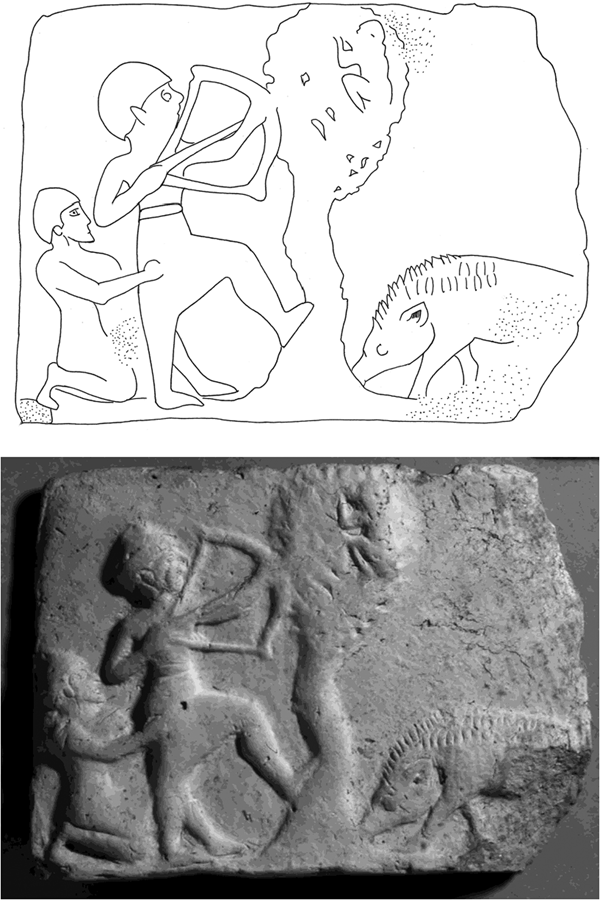
Hunting scenes form a common backdrop for artistic representations of pigs. Another such scene can be found on a plaque (BM 128891), which can be dated to roughly 1900 b.c.e. and was found during excavations at the site of Ishchali in the Diyala region (Fig. 4).Footnote 21 The plaque, which has a flat reverse well suited for mounted display, depicts an archer aiming at a monkey that hangs from the branch of a tree, with a servant crouched at his side. A pig sniffs about at the roots of the other side of the tree, possibly foraging. Although the pig seen on the sealing in MMA 1988.433.1 holds its head higher than this animal, both share a spiky-bristled back common to male pigs (boars) in particular. Otherwise, the position of the pig on this plaque is very similar to that of the animal as seen on the obverse of Rm. 714.Footnote 22 Thanks to the presence of a duplicate plaque, more poorly preserved than this example but still identical, it is clear that this plaque was produced in a mould. The second copy, however, was sold at the auction of a private collection in 2003 and unfortunately lacks any archaeological context.Footnote 23 Even if these are the only two examples currently known, the presence of multiple copies indicates a larger scale of both production and potential distribution, as well as the popularity of the composition and its subject.
Plaque of Archer, BM 128891, 12.1 × 9 cm. Drawing and photograph by author

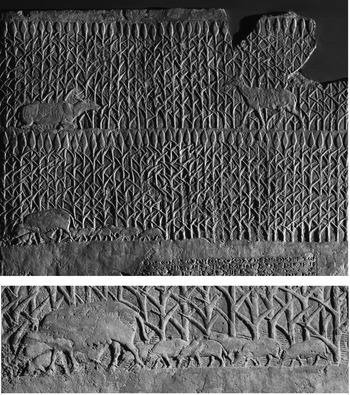
The most famous artistic representation of a pig is found on the Neo-Assyrian palace reliefs; it is also the closest match to Rm. 714's pig. This pig, seen among the reliefs on the north and east walls of Court VI of Sennacherib's palace at Nineveh, is the only complete appearance of the animal within the Neo-Assyrian palace reliefs (Fig. 5).Footnote 24 While most of the room is devoted to scenes depicting the quarrying of the stone and transport of the half-carved colossal lamassu statue intended for the palace, another section of the relief is concerned with irrigation and related works.Footnote 25 This relief section depicts a canal and the swamp it runs into, a marshland richly thicketed with reeds that contains several animals, including a sow with her seven piglets around her. The close similarity between the two images is curious given their different geographic origins: Rm. 714 is most probably from a site in northern Babylonia, as discussed, and thus far to the south of the Assyrian palace relief.
Top: BM 124824, full panel 203.2 × 199.39 cm, South-West Palace of Sennacherib at Nineveh, Court VI; bottom: Panel detail of marsh; detail of sow and piglets, © Trustees of the British Museum

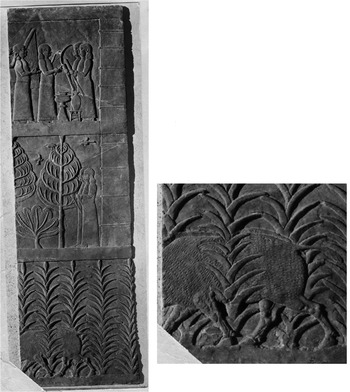
When these images are considered alongside each other, the pigs seen in the earliest two examples (BM 128891 and MMA 1988.433.1) appear in contrast to the later, first millennium b.c.e. representations seen in Rm. 714 and the Nineveh relief. The pigs in both earlier examples, particularly on the plaque (BM 128891), display a bristly mane running along the back, a trait seen most prominently in males due to the clear patterns of sexual dimorphism demonstrated across various pig subspecies.Footnote 26 This bristly mane is also seen in a partially preserved pig on a relief from the North Palace of Ashurbanipal at Nineveh (Fig. 6), which appears to be the only other pig found within the Assyrian palace reliefs. Although the pig's head is not preserved, depriving us of the chance to examine the tusks, the bristly mane running along its back is clearly depicted. The pigs of Rm. 714 and the relief in Sennacherib's palace, in contrast, lack this bristly mane; incised hatchmarks mark the tablet above the pig's back and around its tail, but these markings emphasize the outline of the pig, and are not a part of its figure. The lines are too short and fine, and continue past the point where the bristles of a mane would end. Overall, Rm. 714's pig presents a less aggressive image than the similarly bristly-maned figures seen in later seals, where the pig charges forward, head and tusks raised, against the hunter. Though the pig in Rm. 714 has no accompanying piglets, the similarity between it and the sow on Sennacherib's palace relief, coupled with the disconnect between it and the depictions of other, clearly male, pigs, helps to identify it as a sow rather than a boar. The two are not exact copies of each other: the sow in the Assyrian palace relief has visibly pronounced udders, to match her accompanying young, and while her tusks are also visible, they are not as prominent as those seen in Rm. 714.Footnote 27 The similarities between the two, however, far outweigh these differences, and the presence of a distinctive bristly mane on the pig in Ashurbanipal's palace makes it clear that these hallmarks of sexual dimorphism were important in all depictions of the animal.
Left: BM 124922, full panel 170.18 × 53.34 cm, North Palace at Nineveh, Room S; right: detail of boar in marsh; © Trustees of the British Museum

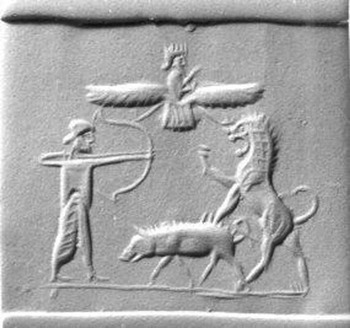
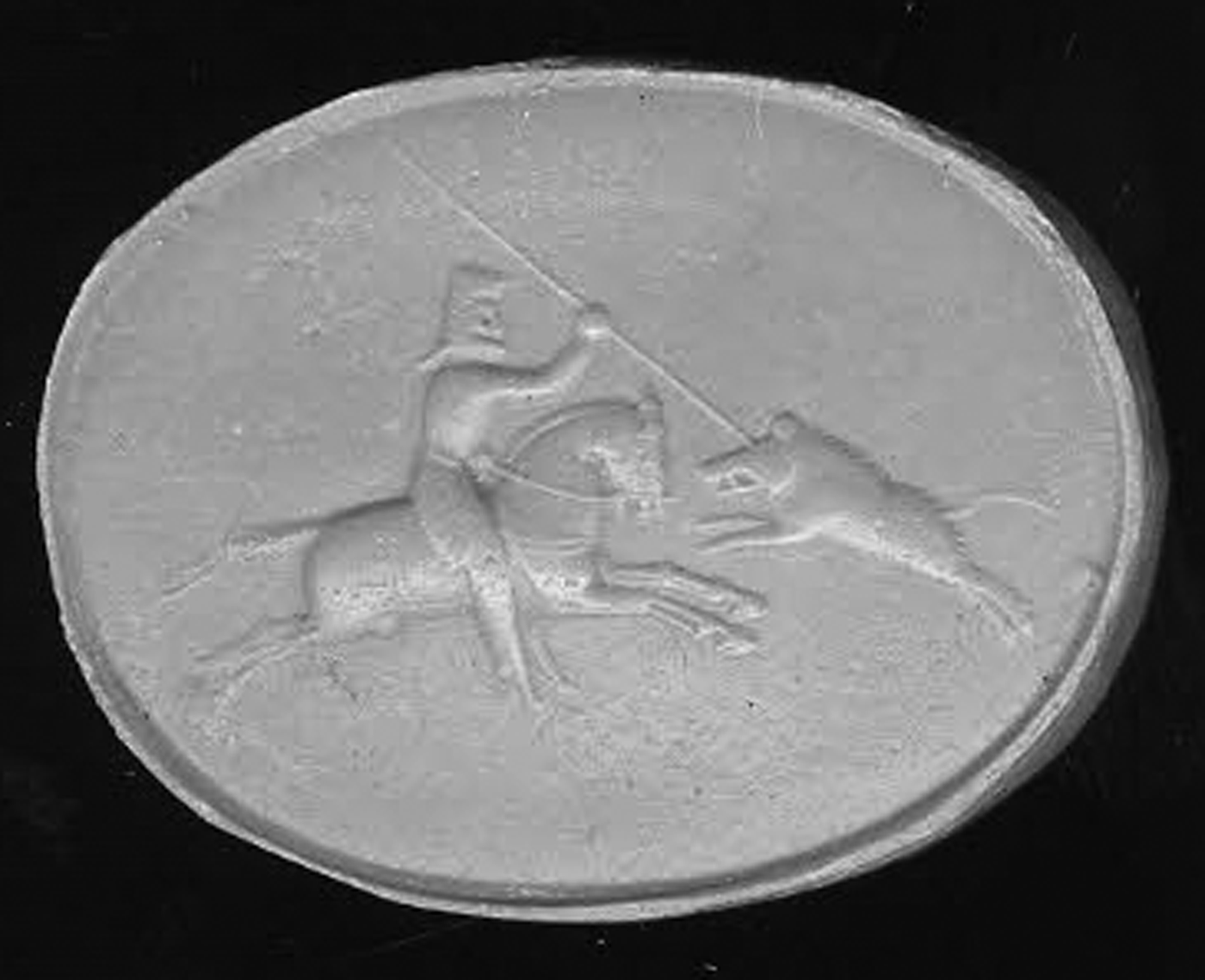
We see other, even later, pigs within the artistic record, representations that revisit the more aggressive posture seen in wild boars. The motif of a boar hunt is increasingly represented in cylinder seals from the fifth century b.c.e. onwards. In these seals, the hunt is the central and predominant motif, with the boar serving as a dangerous quarry. The staging – as can be seen in a characteristic seal (MMA 1984.383.25; Fig. 7) – most often features a single hunter set against a charging boar. In this particular seal, the archer faces both charging boar and lion, but the boar may also appear as the sole quarry. The use of the bow in this example is seen in other seals of this type, though other weapons are also used. In another seal (BM 120325; Fig. 8), the hunter is on horseback and attacks the charging boar with a spear.Footnote 28 In this example, as with the much earlier British Museum plaque (BM 128891), the bristly-maned back of the boar is clearly depicted.Footnote 29 Each of these representations is marked by the dangerous and aggressive posture of the animal, with most mid-charge, attacking the hunter. These stances are at odds with the non-aggressive stance seen on Rm. 714's pig.
Boar Hunt seal, MMA 1984.383.25, 3.2 cm. © Metropolitan Museum of Art. Gift of Sarah and Martin Cherkasky, 1984. www.metmuseum.org

Boar Hunt seal, BM 120325, 2.7 × 2.1 cm. © Trustees of the British Museum

Comparative Plaques and the Role of Pigs
Even considered in isolation, artistic parallels between the Assyrian relief and Rm. 714 are clear; however, the relief is only one feature of the tablet. The most anomalous aspect of Rm. 714 remains its highly curved reverse, which prohibits it from fulfilling the same wall-mounted functions as other plaques, which would otherwise be the closest comparisons to Rm. 714. The unexpected disjunction allows us to treat Rm. 714 as a distinct object, albeit one with stylistic parallels to other plaques. The flat back of other plaques facilitates their wall-mounted display, a trait that is also seen in sculptors models. In contrast to the rough edges of mould-produced plaques, however, the reliefs carved on sculptor's models were more finely detailed.Footnote 30 Of course, moulds produced plaques in numbers that could excuse their roughness and lack of finer details. The moulds for these objects survive far less frequently than the copies produced, thanks to the disparity in the numbers and circulation, although they are occasionally preserved (Spycket Reference Spycket1992).
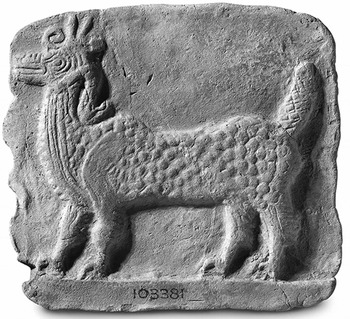
The functions of these two types of object are fundamentally distinct. Moulds produced objects en masse that were used by private households, often functioning apotropaically, as in the case of a first millennium b.c.e. mould-produced mušhuššu from Babylon (BM 103381; Fig. 9).Footnote 31 At 9.2 centimetres by 10.2 centimetres, this plaque was too large to have been kept easily on one's person and was instead designed for household protection and was possibly displayed. Not all plaques were necessarily protective. One mould-produced plaque, from Neo-Babylonian period Nippur, features a lion striding to the left, with a single line of cuneiform identifying it as the property of Iddina-ahu, the son of Ninurta-balat-X.Footnote 32 Although Rm. 714 is not mould-produced, the two objects otherwise much resemble each other, and may have performed similar functions. Differing somewhat in content, there are also a number of mass-produced plaques from the Old Babylonian period that feature scenes of sexual intercourse. These terracotta plaques generally depict a man and woman in the midst of intercourse, though single nude female figures, often portrayed as straddling or squatting over an erect phallus, also appear. While these objects could potentially appeal to the goddess Inana, they presumably had a less directly apotropaic function (Bahrani Reference Bahrani2011: 51; Spycket Reference Spycket1992).Footnote 33
mušhuššu plaque, BM 103381, 9.2 × 10.2 cm. © Trustees of the British Museum

The finely-crafted details seen in Rm. 714 and objects like it stand in contrast to the rough-edged mould-produced plaques. These so-called “sculptors models” may not have even served that purpose; some were clearly displayed publicly. A model of the king killing a lion, though in a style very similar to the Neo-Assyrian royal reliefs, has several key differences. The relief in the model is much higher than that of the wall reliefs, and although the object is broken the face of the king seems to have suffered targeted and deliberate damage more characteristic of purposeful defacement (Reade Reference Reade2001/2002: 152). Such defacement suggests the object was on public display, as a focal point for worship and reverence of the king; when such reverence failed, the object was targeted and defaced. Public display would have been at odds with the functions required of a sculptor's model.
The closest match to Rm. 714 may be found in a group of plaques excavated at Babylon. These objects, all broken, were described as plano-convex, with a similarly curved reverse to cuneiform tablets.Footnote 34 All finely carved in low relief, the group includes depictions such as a striding lion, with only the hindquarters preserved, and the upper half of a bearded male figure holding a flask. Koldewey (Reference Koldewey1901) presented their potential function as either that of sculptors models or objects of personal religious dedication, in light of their location near the temple of Ninurta, although he noted neither explanation could entirely and conclusively be supported.
We can consider the merits of either of these functions as applied to Rm. 714. If it were a personal object of religious or ritual significance, Rm. 714 would then be grouped alongside other figurines and plaques that fulfilled apotropaic roles, designed to protect a private dwelling. Here, the convex nature of Rm. 714's reverse is less problematic: though the previously discussed mušhuššu-plaque may have been easily displayed, such objects, particularly figurines, did not need to be actively visible in order to offer protection. An apotropaic function is not often a role assigned to pigs, however. While monstrous figurines could be buried at critical points in private dwellings to create a protected space, they were individual demonic or mischwesen figures, and certainly not pigs, though dog figurines could fulfill this role.Footnote 35 If we consider Rm. 714 as a possible sculptor's model, we may simply posit that it belonged to an individual, one Azaru, son of Esagil, according to the inscription on the reverse. From the fine quality of the relief, its creator (who may or may not have been the same person) had a high degree of technical and artistic skill, and the relief itself finds stylistic echoes in the depiction of a pig in Sennacherib's palace at Nineveh, with further echoes seen in the clearly male pig found in Ashurbanipal's Nineveh palace. Despite Rm. 714's southern origin, there is no discernable stylistic difference between these two roughly contemporary examples, and we do not see an overall division of Assyrian and Babylonian styles in regards to these depictions. As Reade points out, however, there is little reason to connect Rm. 714, which existed outside of the court sphere, with the depictions seen on Assyrian palace reliefs (Reference Reade2001/2002: 154–55). In the end, this leaves us in a similar position to Koldewey: either explanation is possible, but neither can be conclusively (or exclusively) supported with the available evidence.
The connection between Rm. 714's pig and the mother sow found on the Assyrian reliefs, however, provides another possible contextual grounding for this plaque. The marshy scene of the reliefs in Court VI, with its lush vegetation and abundant game animals, is further detailed in an inscription at the entrance to the room, which describes Sennacherib's actions to create the marsh depicted on the reliefs:Footnote 36
To calm the rush of the waters for the orchards, I (Sennacherib) created a swamp and planted a canebrake therein. Herons, wild pigs, and deer I turned those…the canebrakes flourished well, the high-flying heron built his nest, and the wild pigs and deer multiplied abundantly (Russell Reference Russell1991: 259).
Sennacherib here recounts his own engineering feat of building the Kisiri canal, in order to provide consistent irrigation for the orchards (Russell Reference Russell1987: 536). These are standard actions for a ruler, as the ability to provide a consistent water source and to maintain the complicated system of canals was a hallmark of kingship.Footnote 37
Beyond the associations with kingship, the marshy scene of Court VI ties into a larger context involving displays of abundance. Repetition – of animals, of vegetation – was a visual marker of both abundance and fertility, arguably one seen as early as the mid-third millennium b.c.e.Footnote 38 Pigs fit this trope well. When compared to the other animals, domestic or wild, in Mesopotamia, which at most and only rarely would bear two offspring at once, the potential half-dozen or more piglets that could be born in a single litter was a clear and direct sign of fertility and abundance. The created marshland of this relief is a lush hunting ground, and the sow appears as one of the game animals to populate it. The other animals, three deer, are placed singly and are fully mature. They represent animals that may be hunted as they are, while the sow and her piglets are a promise of greater future abundance and prosperity. The inscription may claim that both wild pigs and deer “multiplied abundantly,” but the relief itself focuses on the former of the two animals. Sennacherib has restored the marshland to fullness, if not created it entirely anew, and in doing so has also created a landscape that displays the abundance that would be emblematic of this rule overall. The pig functions within this narrative and, as a consequence, reinforces its positive qualities.
Not all qualities from the Assyrian relief may be grafted onto the pig in Rm. 714, however. Indeed, though the pig in Rm. 714 appears in a similar posture and attitude to the mother sow, it lacks the more explicitly stated context of abundance provided by the larger setting and landscape of the relief. Despite this, we may still say with some certainty that Rm. 714's pig appears to be a sow and not a boar, and that her overall posture, similar to the sow of the Sennacherib relief, is a non-threatening one, particularly when compared to the visibly bristly-maned depictions or more notably aggressive posture of pigs seen on the cylinder seals previously discussed. It is less clear what the role of such a non-aggressive posture would be, as Rm. 714's pig lacks the entourage of piglets that would more easily position her as a marker of abundance and fertility. While this does not discount such connections, it does require we consider them as one more alternative and potentially possible function, or even aspect, of the tablet and its relief. Aside from the information gleaned directly from Rm. 714's relief and its inscription, all other conclusions must be drawn through comparative context, and considered with those caveats.
So far, this article has focused more upon the questions posed by Rm. 714 than any possible answers. As we have seen, definitive conclusions about Rm. 714 are, in large part, difficult to reach. From its inscription, we may say with some certainty that Rm. 714 was a personal object that either belonged to or was made by one Azaru, son of Esagil. Its creator was certainly skilled, as is evident in the high quality of the relief's carving, and similar sculpted or carved objects have been analyzed as either sculptors' models or apotropaic objects. Though Rm. 714 finds close stylistic connections to two pigs seen in Assyrian palace reliefs, there is little reason to connect a privately owned object from Babylonia to art produced within the elite, court sphere of Assyria. This does not decide the case in favor of its apotropaic use; however, as Rm. 714's highly curved back restricted its ability to be hung or mounted directly on a wall, which may have limited its more visible use and display. Given these caveats, it may be best to understand Rm. 714 first and foremost as a personal object, potentially one with dedicatory significance, though other possible uses are not beyond the realm of speculation.Footnote 39 Small in size and thus highly portable, Rm. 714 would easily have traveled with its owner as part of his personal belongings, with the high quality and fine detail of the relief helping it merit its place as a valued and treasured personal object.